The Alpha and the irrational
Posted: May 11, 2024 Filed under: Art & Healing, Farming off the Farm, What is an Art Farm | Tags: consciousness, rational mind, spirituality 1 CommentIf one subscribes to the Great Man Theory, then history is defined by the deeds of great men; highly unique individuals whose attributes – intellect, courage, leadership or divine inspiration – have a decisive historical effect. Thomas Carlyle developed the theory, and wrote:
“Universal History, the history of what man has accomplished in this world, is at bottom the History of the Great Men who have worked here. They were the leaders of men, these great ones; the modelers, patterns, and in a wide sense creators, of whatsoever the general mass of men contrived to do or to attain; all things that we see standing accomplished in the world are properly the outer material result, the practical realization and embodiment, of Thoughts that dwelt in the Great Men sent into the world: the soul of the whole world’s history, it may justly be considered, were the history of these.”
Pythagorus of Samos, the ancient Ionian Greek philosopher and polymath, certainly ranks among these alpha males. He has been credited with mathematical and scientific discoveries, including the Pythagorean theorem, Pythagorean tuning, the five regular solids, the Theory of Proportions, the sphericity of the Earth and the identity of the morning and evening stars as the planet Venus. His ideas are ubiquitous: Plato’s dialogues exhibit his teachings, every high school student memorizes his theorem, and every carpenter or engineer uses the 3-4-5 triangle to square a room.

He saw beyond the material realm, and further developed ideas of mysticism. His “metempsychosis” – which means the “transmigration of souls” – holds that every soul is immortal and, upon death, enters a new body. He also devised the doctrine of musica universalis– literally universal music, also called music of the spheres or harmony of the spheres – which holds that the planets move according to mathematical equations and thus resonate to produce an inaudible symphony of music. The 16th century astronomer Johannes Kepler further developed this idea, although he felt the music was not audible but could be heard by the soul.
Aristotle characterized the musica universalis as follows:
“…since on our earth the motion of bodies far inferior in size and in speed of movement [produce a noise]. Also, when the sun and the moon, they say, and all the stars, so great in number and in size, are moving with so rapid a motion, how should they not produce a sound immensely great? Starting from this argument and from the observation that their speeds, as measured by their distances, are in the same ratios as musical concordances, they assert that the sound given forth by the circular movement of the stars is a harmony.”
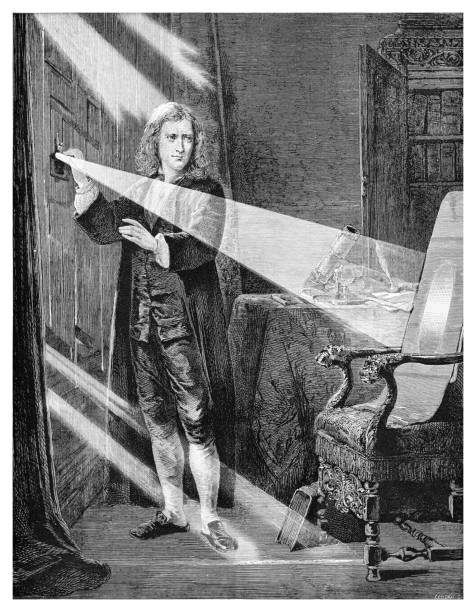
Clearly, Pythagorus was a big thinker, and his ideas influenced Isaac Newton, another of the alpha males. Newton – who established classical mechanics, invented calculus, formulated the laws of motion and universal gravitation – was a paragon of the rational scientific mind. Newton was a Great Man, by definition. He also was a leading alchemist.
In its purest form, alchemy is concerned not with turning base metals into gold, but as a symbolic language guiding the transmutation of the physical self into the ascendent consciousness of the anointed. Of an estimated ten million words of writing in Newton’s papers, approximately one million – 10% – deal with alchemy. This was more than a passing interest.
John Maynard Keynes, the Cambridge economist who restructured the post-WW2 global financial system – easily ranking him among the Great Men – had this to say about Newton:
“Newton was not the first of the age of reason. He was the last of the magicians, the last of the Babylonians and Sumerians, the last great mind which looked out on the visible and intellectual world with the same eyes as those who began to build our intellectual inheritance rather less than 10,000 years ago. Isaac Newton, a posthumous child born with no father on Christmas Day, 1642, was the last wonderchild to whom the Magi could do sincere and appropriate homage.”
Let us pause and consider: just as Pythagorus explained the physical realm he also saw celestial harmony beyond the physical; Newton mastered not only scientific thought but was a leading alchemist of his day. Two of the paragons of the rational alpha mind had secret lives as mystics.
The Western intellectual tradition is based entirely on the rational, and anything beyond the rational is defined by the negative form – “irrational” – which is decidedly pejorative. As wrote Carl Jung, ““Everything that the modern mind cannot define it regards as insane.” Pythagorus was denigrated as a cult leader. During Newton’s life, the English Crown considered alchemy to be a heresy, punishable by death. The burning of his alchemical writings perhaps was not an accident.
What if we expand our concepts and consider connections not defined by measurable facts? What if we begin to use the term “supra-rational”? No less than Albert Einstein – the modern paragon of rational thought – was compelled in this regard. In 1930 he published an essay “Religion and Science” which described the sense of awe and mystery which he termed a “cosmic religion” of “superpersonal content.” Einstein counseled to move beyond the anthropomorphic concept of god to “the sublimity and marvelous order which reveal themselves in nature … to experience the universe as a single significant whole.”

For Einstein, “science without religion is lame, religion without science is blind.” He said “God is a mystery. But a comprehensible mystery. I have nothing but awe when I observe the laws of nature. There are not laws without a lawgiver, but how does this lawgiver look? Certainly not like a man magnified. …some centuries ago I would have been burned or hanged. Nonetheless, I would have been in good company.”
The “Great Man Theory” was advanced in the 19th century Victorian era. In the 21st century we need to move forward, and expand the scope, even beyond gender, to all life, beyond the “either/or” and toward the “both/and” mindset.
I should like to propose that the “Great Man” be replaced by the “Great Soul,” and that we look beyond the rational, the material, the physical, and embrace the whole cloth, the harmony and music of “our higher angels,” the music of the spheres, “to experience the universe as a single significant whole.”
In fact, this “Great Soul” is in use; in the Hindu language, “Mahatma” from the Sanskrit word “mahātman,” literally means “great-souled.” Mahatma Ghandi is but one exemplar of this path.
The seeds of a new future surround us. We can be hopeful.
 an Art Farm
i especially love where this led, and along the getting there, i have always loved those quotes of einstein, which i’ve found to not be among the first level remembered. Mahatma, indeed.