Monad and a Margin of Safety
Posted: October 16, 2026 Filed under: Child Centered Activities, consciousness 1 Comment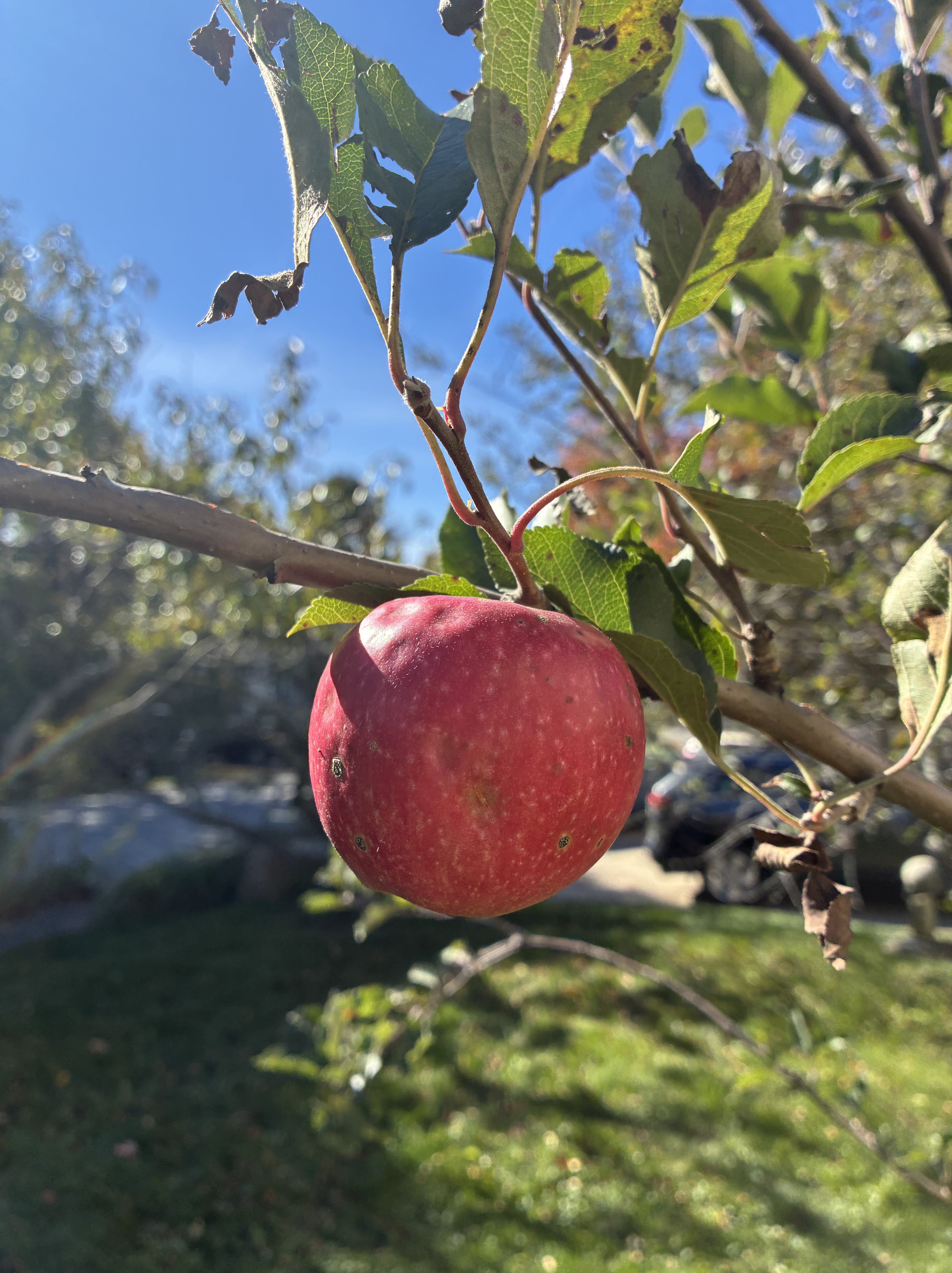
Sacred Geometry notwithstanding, my son wants to learn to invest money. Our applied learning approach can accommodate both Sacred Numbers and investing; financial literacy is important while the Platonic solids are essential.
“Scoop,” my son’s Uncle, is a market maven in disguise. Licensed as a Certified Financial Advisor, he may or may not have clients but does manage money. In the finest fiduciary tradition, he says nothing about his work. His discretion is absolute. He could be managing tens of millions of United States Dollars, but you would never know. More than likely he is just the guy ahead of you at the butcher’s, buying bacon or bratwurst, or in a bookstore, browsing quietly.
He has never set foot on Wall Street, but has logged hundreds of miles hiking in the wilderness. A long term value investor, his preferred risk management is the wild place where predators roam. Doug Peacock, the Vietnam Green Beret medic turned wildlife activist is one of his heroes, best captured in this quote, “It ain’t wilderness unless there’s a critter out there that can kill you and eat you.” Scoop, more than likely is outside, beside some alpine stream, listening to bird song, breathing in the pure air. He is remarkably gentle, thoughtful, considerate.
I called Scoop, and with alacrity he made handouts on investing terms and principles. He mailed a copy of “How a Second Grader Beats Wall Street” by the financial planner Allan S. Roth. That simplicity wins is the book’s premise. Adults get lost in the hype of hope and fear, while the child ignores the noise. Behold then that ancient wisdom of practical virtue: “Verily I say unto you, Except you change and become like little children, you will never enter the kingdom…”
Into the kingdom of investing our journey began, armed with our textbook, our tutor, probability and statistics, we learned vocabulary. “Book value” is the net worth of a company, its assets minus liabilities. “Market value” is the total capitalization, the stock price multiplied by the total shares owned. The difference between the Book and Market value can be significant.
In practical terms, I told my son, “Think of my tool bag with saws, chisels, clamps, and wrenches. Add up their cost and that is the book value of my tool bag.” My son opines, “We really should buy a cordless Sawz-all, a battery circular saw, and a torque wrench but ya, I get your point.” I continue, “Say I go to a client. They think I am really skilled, and agree to pay a premium rate. Or they think I am a moron and won’t pay much. That is market value.” He catches on, “So they want to pay more because they like it. Or pay less because they don’t like it. What happens when a business goes bankrupt? What happens to the stock price then?” My son was absorbed in our lesson.
Having already talked about Phi, the Golden Ratio, I continue, “The ratio of book value to market value tells you if a stock is overpriced. You need to understand the business. What do they do? Do they make money? Do profits increase? What is their debt? Does the business have a famous brand, unmatched technology, loyal customers? All of this factors into the price : value ratio. If the value is more than the price, then it is worth buying. If the business fails, you will only get book value, or less.”
We talk about stock picking, market timing, and asset allocation. Stock picking needs luck and skill, it rarely works. Market timing is even harder, trying to buy and sell at the perfect time, when missing the 10 best days can cut your returns nearly in half.
Asset allocation is Scoop’s approach. He diversifies risk, capturing long term growth using risk management. By analogy, Doug Peacock’s “critter out there that can kill you” is an absolute risk, a permanent loss “of capital.” The 2nd Grader approach is low-risk, broad market asset allocation. The 2nd Grader, in fact, outperformed both “call of the wild” day trading and the S&P 500 by 4% annually.
My 8th grade son has something to learn from the 2nd grader. My task is to show how investing relates to Sacred Numbers.
Sacred Numbers – the Quadrivium – are about observing natural cycles, patterns, ratios, and cosmic order. Pythagoras reportedly said, “Number rules the universe.” Euclid mentioned the Golden Ratio in his Elements, written around 300 BCE. Ἀγεωμέτρητος μηδεὶς εἰσίτω – “Let no one untrained in geometry enter” – was written over the door to Plato’s Academy. The Golden Ratio (Φ≈1.618) and the Fibonacci Sequence (discovered centuries later) are models of those patterns.
In the investment world, analysts use the Fibonacci numbers (23.6%, 38.2%, 50%, 61.8%, 78.6%) to trace market highs and lows to gauge support and resistance. The number 3, which represents balance, completeness, and structure – the past, present and future; birth, life, and death – is used to mark “triple tops and bottoms,” a theory known as the Elliott Wave Principle that divines mathematical patterns underlying market psychology. The concept has both critics and believers.
The 2nd Grader’s portfolio was based upon allocation in thirds: US stocks for domestic growth, international stocks for global diversification, the Bond market for low-risk yields. W.D. Gann developed an entire trading system based upon the relationship between price, time and pattern. His system is based upon recurring cyclical and geometric patterns, that when aligned with time cycles can demonstrate strength or weakness. His ideas are controversial, with critics arguing that followers highlight the rare successful calls while ignoring failed predictions. The glassy eyed banker almost certainly rejects sacred notions, but metaphysics does seem to influence the world, if not the market.
Scoop advocates a buy and hold strategy focused on index funds, also known as ETFs (Exchange Traded Funds). In sacred terms the ETF is the Monad, the one; a fund that owns the market as an ecosystem, rather than individual trees. My son responds, “So buying individual stocks is more like gambling, it’s all or none, but the index fund is safer, buying shares in the entire market.”
The Dyad, which is 2, is duality which in the market is gain or loss, hope or fear, market value or book value. Managing that relationship is the key, which means ratios – such as Phi – come into play. Benjamin Graham and Warren Buffett are legendary masters of value investing. Scoop explains their concept of the “Margin of Safety,” which is the ratio between intrinsic value and market price. When the price is less than the value, you are buying at a discount, which gives protection when the market is volatile. Phi does not directly pertain to the Margin of Safety, but both describe a relationship between two quantities, a recurring pattern in nature, which is a way to manage risk.
The quadrivium includes astronomy, which is based upon the regularity of orbits, seasons, and rhythms. Winter always follows the harvest. In finance, this is the “Reversion to the Mean.” Market expansion (a bull market) is followed by contraction (bear markets). Historical averages bear out, so there is wisdom building a portfolio designed to endure all four seasons.
My son’s interest in financial literacy opens a wide array of topics. Algebra, probability, and statistics readily pertain, so too risk management and the cost of money. Our homeschooling has a practical application.
Our approach to life is “both/and,” our objective in teaching is not only applied; money is not the measure of the man and financial literacy is necessary but not sufficient. Sacred numbers afford a chance to connect a life skill to fundamental laws of harmony, truths of the very long term.
Mysticism runs counter to the modern world’s embrace of empirical science. But 483 years since Copernicus launched the scientific revolution is a mere fraction to the 2412 years since Plato launched his Academy. We navigate that 1:5 ratio at our homeschool.
A 2nd grader can teach an 8th grader long term investing, while this Boomer does teach a Zoomer about the long term tradition.
We are well beyond any standardized test.
______________________________
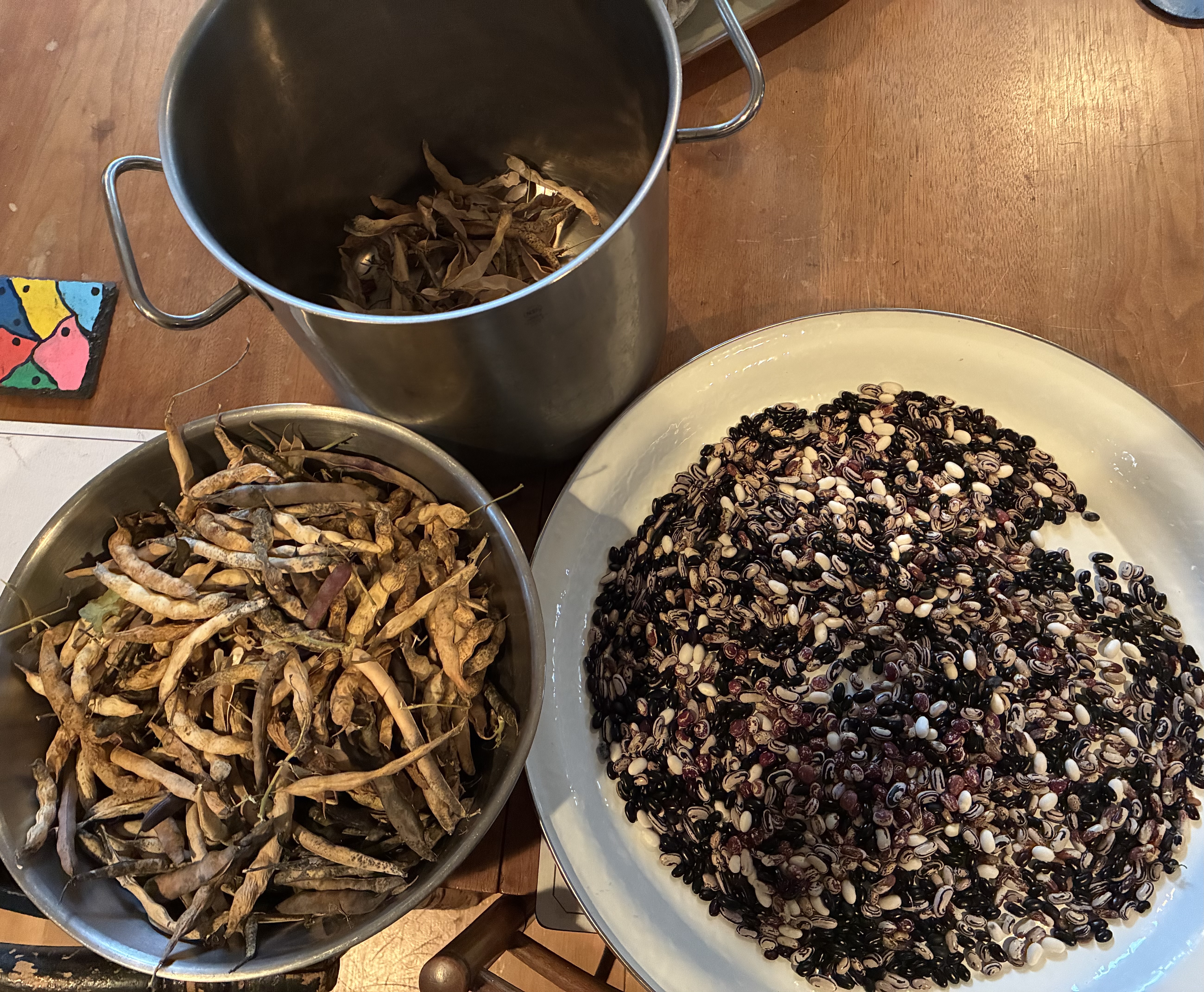
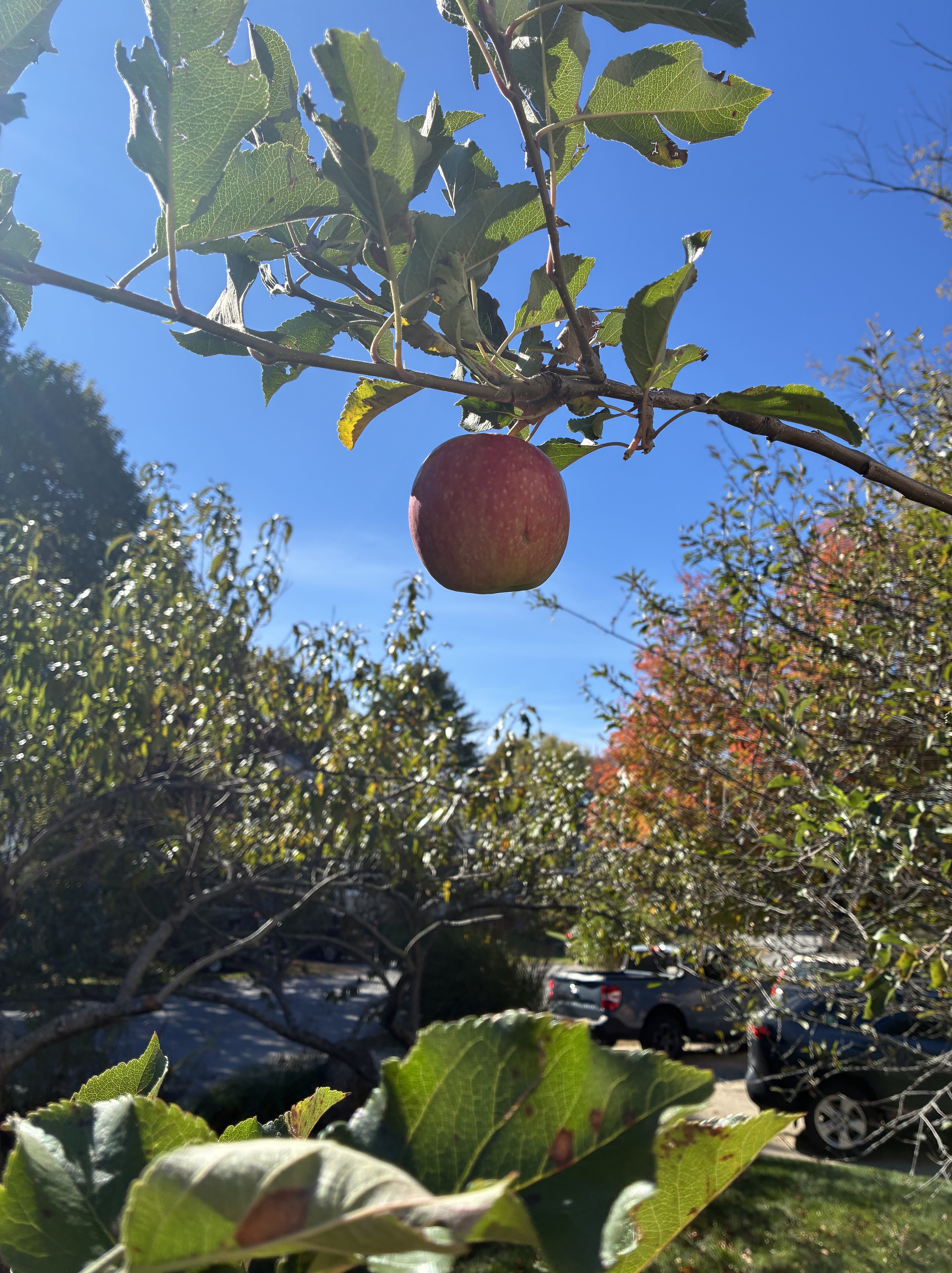
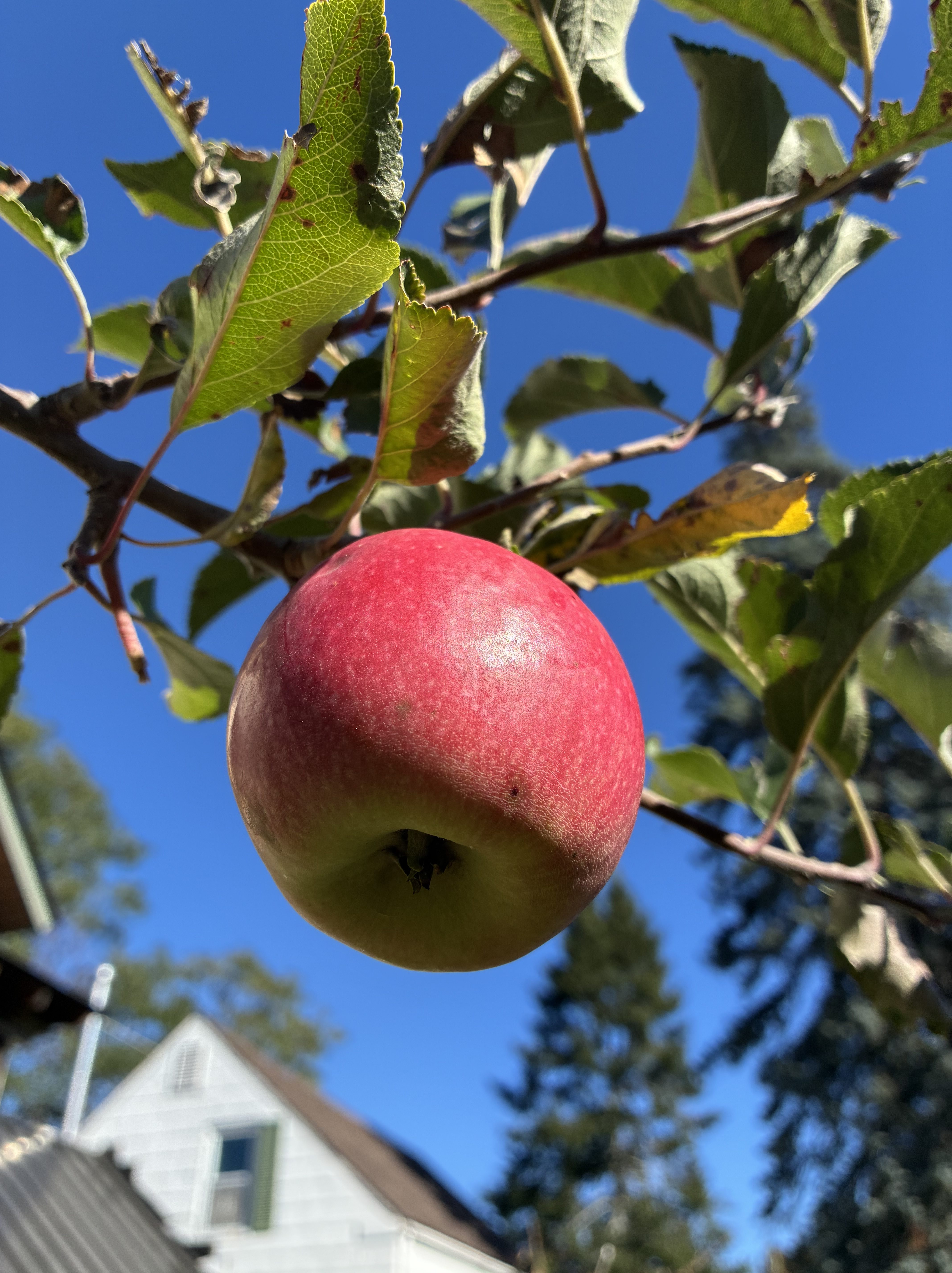
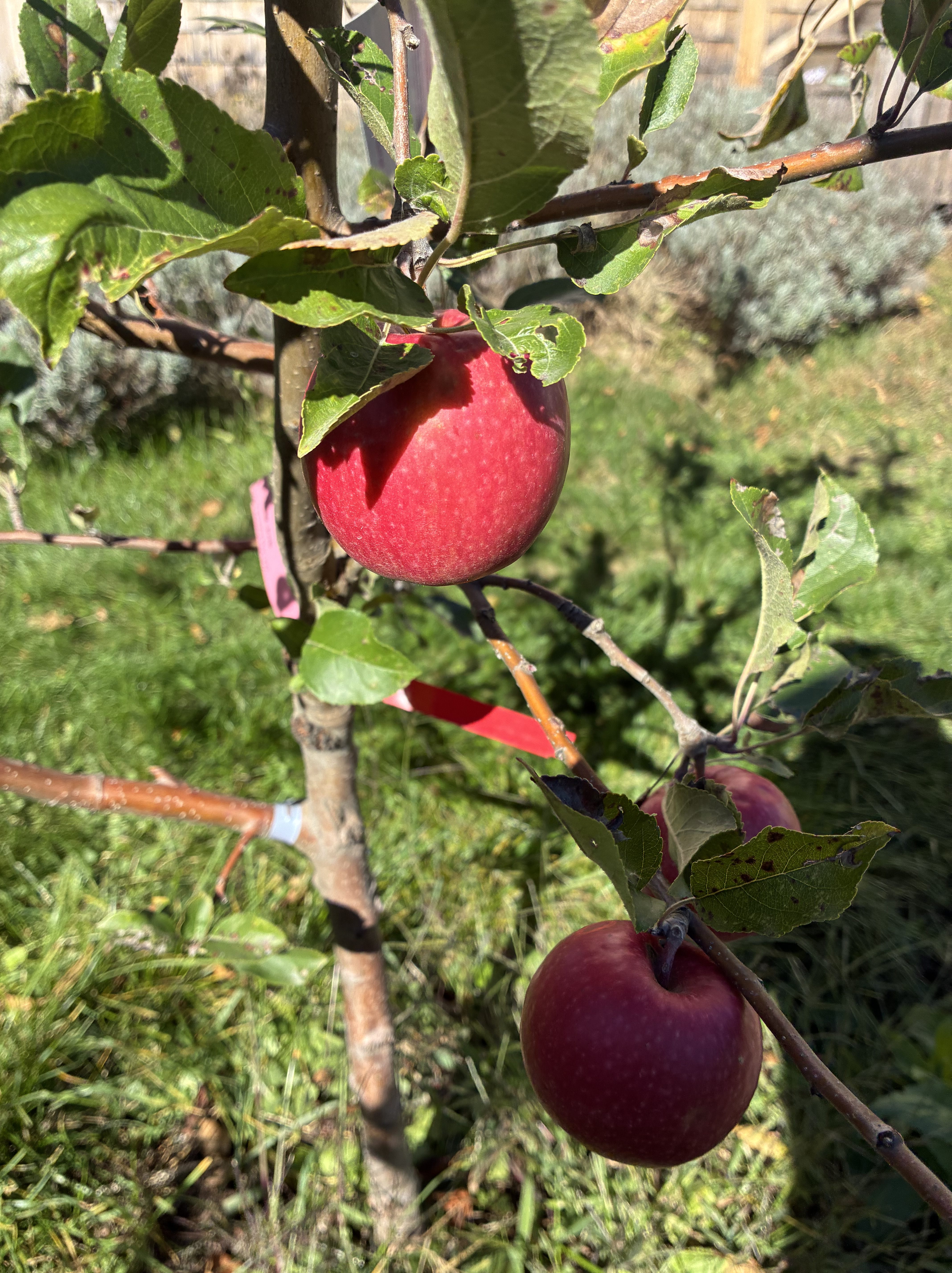
Our heirloom pole bean harvest continues. The Pink Lady apples ripen on our tree.
Place
Posted: September 4, 2026 Filed under: Child Centered Activities, consciousness, Permaculture & Home Renovation 1 Comment
“Place is the first of all beings, since everything that exists is in a place and cannot exist without a place,” Archytas observed, a Pythagorean mathematician, as recorded by Simplicius, the Neoplatonist. As a Pythagorean, he saw the kinship of all beings, a fundamental spiritual connection shared by humans and animals.
Niels Bohr, the pioneering Danish physicist who made foundational contributions to understanding atomic structure and quantum theory, then won the Nobel Prize in Physics in 1922, stood at Kronberg Castle in Denmark, in 1924 and, with a colleague, mused on place:
Isn’t it strange how this castle changes as soon as one imagines that Hamlet lived here? As scientists we believe that a castle consists only of stones, and admire the way the architect put them together. The stone, the green roof with its patina, the wood carvings in the church, constitute the whole castle. None of this should be changed by the fact that Hamlet lived here, and yet it is changed completely. Suddenly the walls and ramparts speak a different language. The courtyard becomes an entire world, a dark corner reminds us of the darkness of the human soul, we hear Hamlet’s “To be or not to be.” Yet, all we really know is that his name appears in a 13th century chronicle. No one can prove he really lived here. But everyone knows the question Shakespeare had him ask, the human depth he was made to reveal, and so he too had to be found in a place on earth, here in the Kronberg. And once we know that, Kronberg becomes quite a different castle for us.
To an American, this is a striking insight. To the Western Apache, it goes without saying.
Keith Basso was a cultural and linguistic anthropologist whose career was spent with the Western Apache, specifically the community of Cibecue, Arizona learning their reverence for place. He explains, that to the Apaches of Cibecue, “the past is a well-worn ‘path’ or ‘trail’ which was traveled first by the people’s founding ancestors and which subsequent generations of Apaches have traveled ever since.” Over time this path is no longer visible. The past has disappeared, and so it must be reconstructed through place-names, stories, and songs.
The place names, markers of culture, use specific identifiers to preserve not only the words of the ancestors, but graphic impressions: “Two Old Women Are Buried” (a hill); “Lizards Dart Away In Front (the eastern face of a mountain); “She Became Old Sitting” (a cornfield); “She Carries Her Brother On Her Back” (a steep slope).
The names offer evidence of change over time, shifts in climatic patterns, even change in the face of a geologic constant – all finding expression in the Apache place-world. Their names carry resonant cultural meaning. Life has meaning because it is rooted in place.
American exceptionalism knows nothing of such grounded sense of place.
The “Big Apple” is named not because of an old orchard but the big prize money at race tracks in and around the former Dutch colony. Thoroughbreds bridled and broken to race for the prize, to earn riches for the owners. “West,” a town in Texas, is in the north/central region of that state, named for its original Postmaster. “Poland” was a favorite song of the first settler of that town in central Maine, while “Rocky Mountain” North Carolina lies 1,800 miles east of the Rocky Mountains, 400 miles east of the Smoky Mountains, on the fall line between the foot hills of the Piedmont and the low flat coastal plain.
Our culture lives upon, but not with, the land.
Land is our commodity, a contract to be bought, sold and fought over; divided for its spoils, left then on its own. Manifest Destiny was our clarion call, ordained by God, of which the self-certain settlers reassured themselves as they staked their claims.
The Atlantic coast became crowded, gold discovered in Georgia, so five highly civilized cultures were forced to walk west, under US Military escort, on the Trail of Tears. The vast lands beyond the Appalachians beckoned Anglo immigrants, who flooded west to stake their claims.
Wagon trails became paved highways, and the great American road trip was born, the right of everyman to go-go-go on a quest for spiritual freedom, rejection of post-war conformity. “There was nowhere to go but everywhere, so just keep on rolling under the stars,” wrote Kerouac, but racing at 70 miles per hour in search of everywhere is to know nothing of anywhere: no place, and no poetry.
Eventually that immense physical space became filled. Within our lifetime another frontier emerged – the internet – and now data centers consume place and power to drive AI’s limitless consumption of energy. Soon some will begin to colonize Mars, our insatiable need to dominate and take, onward, to “go where no man has gone before.”
The Wendat (Huron) or Iroquoian word Ontarí’io or oniatarí:io, which translates to “great lake”, “beautiful lake”, or “lake of shining waters” has been arbitrarily renamed in honor of an explorer and navigator from Florence, Italy.
A capricious act, how unserious we are.
And this was done not by the will of we the people, but unilaterally by one man’s ipse dixit command.
An uproar ensues. Maps will be changed, at considerable cost, while others promise to defy the name change. But a political fight seems impotent, just two sides of the same coin: place as object.
To our ongoing detriment we ignore our own relationship, and our ancestors’ relationship, to the earth that nurtures and supports us. How little we know, and how much less we understand, about place: the kinship of all beings, a fundamental spiritual connection shared by humans and animals. “Place is the first of all beings….”
Such has been the daily news, as eighth grade resumes and my son and I prepare to dig in the dirt.
The applied soil science class shall resume as a meditation upon place, the biology, chemistry and geology that under pins “the darkness of the human soul” which can open, through understanding, to the light. For history, we can study Manifest Destiny as collective myth, the guiding story of American civilization.
We will approach place with a renewed vigor, as a counter balance to the mindless news of the day, the aggressive taking, names that mean nothing but ego.
We will dig in the dirt.
And perhaps, in doing so, learn again where we are.
Strike from the Void
Posted: August 28, 2026 Filed under: Chronicles of a First Time Parent, consciousness 1 Comment
One peaceful Sunday morning on the island of Oahu, American sailors gathered for breakfast and went about their routine, enjoying the pacific calm before church service. Incoming B-17 bombers were scheduled so planes in the distance went unnoticed.
Heavy clouds hung low as the first wave of planes approached from the north/northwest, descending low, opening fire. Two waves of aircraft – torpedo bombers, dive bombers, horizontal bombers and Mitsubishi A6M2 Zeros – 353 aircraft in total unleashed a fusillade of fire in a stunning display of strategy.
300 years earlier Miyamoto Musashi’s “The Book of Five Rings,” a classic guide to samurai strategy and the way of the warrior, taught one must “strike from the void.” Pearl Harbor was its own strike from the void: unexpected, devastating, and brilliantly executed. 19 American naval ships, including 8 battleships, were destroyed or damaged, 188 aircraft lost or severally damaged, 2,403 American sailors and soldiers killed.
The next day, December 8, 1941 the United States declared war against Japan. On December 11, 1941 Germany and Italy declared war on the United States, prompting the U.S. to enter the European conflict. The world was at war.
War is good for business and the military-industrial complex kicked into high gear. Henry Ford, at his River Rouge Complex, halted all civilian automobile production. The plant’s employment surged to roughly 120,000 workers converting raw materials into tanks, engines and military vehicles. The total American industrial output built 297,000 aircraft, 86,000 tanks, 124,000 ships, 2.4 million military trucks and 2.6 million machine guns.
The Axis powers were overwhelmed, fascism was defeated. The “Greatest Generation” rallied to the cause, put everything aside, took seriously its task. My father’s three older brothers all volunteered for the Army Air Corps, but the oldest, Danny, was assigned to Iwo Jima where he was killed, stabbed in his heart by Japanese swordsmen while sleeping at night. Many paid the ultimate price. The fortunate, however, lived to see the end and then return home.
William Levitt was a Lieutenant in the Pacific Theatre who served in the U.S. Navy Seabees’ “Naval Construction Force” with motto “Construimus, Batuimus” (“We Build, We Fight.”). Levitt managed a construction unit in Hawaii, as well as in Norfolk, Virginia, where he mastered military logistics and rapid-building techniques. As war is good for business, the war was transformative for the Levitt family business.
Approximately 15.6 million service members survived and returned home alive from World War 2. Housing demand skyrocketed to millions of homes needed. William Levitt had met his market. As Henry Ford had mastered assembly line automation at the Rouge River Complex, so Levitt mastered assembly line housing with Levittown, first on Long Island and next in Bucks County, PA. Levitt could build an entire house in less than six weeks, sold for as low as $100 down payment.
The cover story on Time magazine for July 3, 1950 pictured Levitt with the tag line “For Sale: a new way of life.” The commodification of housing, the American Dream on steroids, everyman could have his suburban castle with white picket fence.
As the crow flies, New Hope, PA is 23 miles from Levittown, but as a philosophy of building it is worlds away. George Nakashima was a Japanese-American woodworker and architect who launched his studio and workshop there. Before the war he studied at MIT then, in 1931, went abroad using a round-the-world tramp steamship ticket.
In Paris, France he was introduced to Le Corbusier, one of the titans of modern architecture. They shared thoughts on architecture as a spiritual activity, with a moral obligation to society. In Japan, he worked on the Imperial Hotel and took time to study Japanese architecture. In Puducherry, India he was a construction consultant for an ashram dormitory. He made furniture for the first time.
He returned to the United States just before WW2. Because he was Japanese American, he and his family were arrested and incarcerated at the Minidoka War Relocation Camp in Idaho.
In life, it seems, the good you seek is seeking you. While locked up at Minidoka, Nakashima was tutored by a man trained in traditional Japanese carpentry. He mastered hand tools and joinery, gained the discipline slowly to focus on perfection every step of the way. Where Le Corbusier spoke of building “as a spiritual activity, with a moral obligation,” at Minidoka Nakashima grounded those ideals into practice.
William Levitt and George Nakashima, both builders of the Greatest Generation, left starkly different legacies. Levitt shaped the physical landscape of millions of lives, casting the blueprint for assembly-line post-war American suburbia. Homeownership was made possible for millions of families, but at a dependence on the automobile. The thought of purchasing one of his homes for $1 down is a relic of the distant past.
In the pantheon of American craftsmen, George Nakashima is a towering figure, who ranks among the founding generation of “Studio Furniture” makers. His influence is profoundly broad. His work honors the “soul of the tree” – making as a spiritual practice.
Levitt addressed, and solved for his time, the need for affordable housing. Nakashima brought to the market objects of exquisite natural beauty, heirlooms worthy of generations. Now is my time to work through these questions.
I am a carpenter. I work with my hands. I make things for my bread labor. I have built handcrafted furniture for Thos Moser and cabinets for private commissions. At times I have been on crew building custom castles by the sea, other times renovating a working man’s home. I have fabricated and installed multiple Public Art projects.
A teacher of mine once wisely said, “You need to go out and break your heart, and then you will come back to what you love.” As a young man I worked in the Chicago commodity markets – the old “open outcry pits” – then spent a decade on a vision quest pursuing humanitarian finance, an oxymoron, my version of “a spiritual activity, with a moral obligation.” Like Icarus I flew too close to the sun, crashed and burned.
Learning to walk again, I met a German woodworker of the Studio Furniture tradition. I managed his Apprentice program and taught woodworking to adults. I came to building late, after failure, but this work has grounded me.
Building is my bread labor, but my full time job is homeschooling my son. I am a Boomer homeschooling a Zoomer, at the dawn of the post literate age.
COVID haunted my son’s 1st grade year, and I homeschooled during the shutdown through 2nd grade. Nationwide, the return to public schools brought a surge of disruptive behavior, absenteeism, and mental health challenges. Locally, an epidemic of teen suicide raged through our town.
Middle school was a huge adjustment – his 5th grade moved to the same building as 8th graders – and although his experience started off well enough, intense bullying could not be controlled. Finally, he made the call and our DIY experiment began.
The picture-postcard paradise of Levittown’s affordable American Dream shaped the world that my generation, the Boomers, inherited. For my son and his Zoomers, however, that seems outdated, unachievable, a dystopian mirage of mass marketing.
Homeschool is not for the faint of heart. But nor is felling a tree, to mill and dry its wood, to handcraft a family heirloom, passed down through the generations.
As with a chisel, I shape wood into a chair, so with words, numbers, ideas, and patience, I shape my son’s mind. Together we learn. He teaches me about his world of AI and online gaming, which makes me reflect upon the starkly different forces that shaped my generation.
From where did we come? To where do we go?
Father and son.
The summer ends. Greek, Latin and English languages are on deck. Our 8th grade is set to begin.
____________________________________
Lead photo by Milo
The Harvest: Potatoes & Words
Posted: August 14, 2026 Filed under: Art & Healing, consciousness 1 Comment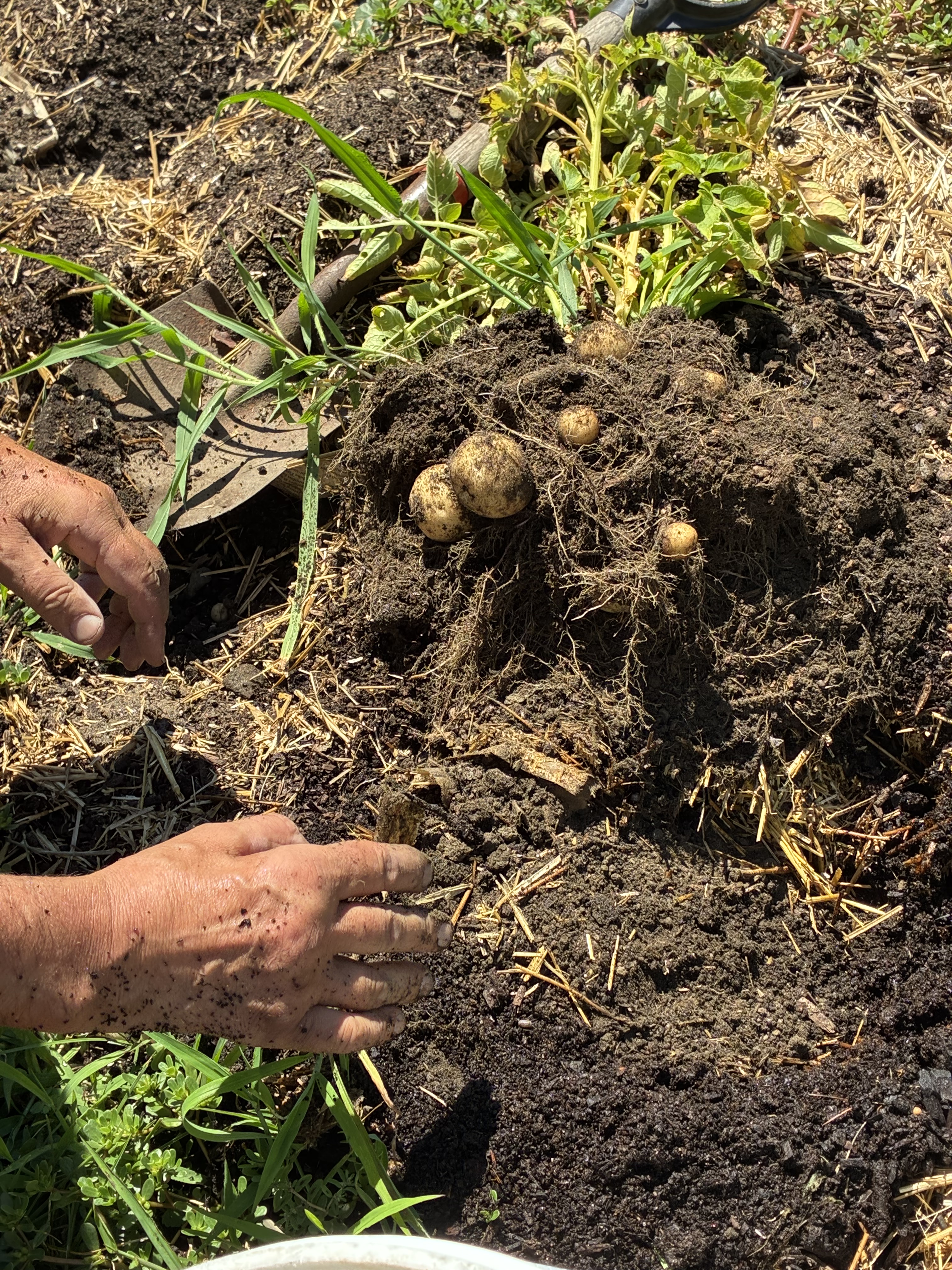
In August, the summer vacation season peaks. Somewhere around 20.5 million people stop work in France, 18 million in Italy, approximately 3 million come to Maine, to vacation at the peak of summer. This has been a scorching hot summer both in Europe and across the United States. What better moment than this to pause and relax at the ocean?
Almost no one goes to the operating room, but I, thinking differently, seized the moment.
My summer plans most certainly did not include surgery, but one day in May the pain in my left hip was too much and so I called the orthopedic surgeon. Like a nuclear reaction, a chain of events was set in motion.
This was my second total hip replacement. The first was done during COVID, and that surgeon has since retired. I needed to choose someone new. That is one strange a la carte menu.
A friend mentioned that he had been diagnosed and cured – twice – of heavy metal poisoning, metallosis is the official term, resulting from metal-on-metal, an old school hip replacement. I confirmed that my first replacement involved a ceramic cup with titanium shaft, so there was no possible metal-on-metal in my body. The surgeon who helped my friend was, ultimately, a fine choice for me as well.
I had a meet and greet with that Doctor, and so, based upon five minutes’ conversation, made my choice.
I was given a date in mid-September, which seemed odd because I had been certain I would have the surgery in August. But then, the next day there was a cancellation, and I was offered the very much earlier date of 10 August.
At first I panicked, that felt far too soon, but within a few hours everything settled out, and it became clear that it was better to move full speed ahead, than to wait, endlessly until early autumn.
Like cogs in the modern medical machine, the surgeon’s team leaped into motion. I met with nurses, had bloodwork done, cancelled dental work and requested clearance from other doctors, began daily exercises, and signed, with Notary and Witness, my Last Will & Testament and Advanced Healthcare Directive. I rallied the home team – my children – to finish chores around the house and yard.
We harvested all of the potatoes.
There is no way I will be on hands and knees in late August and September, and so we pulled them all now: Reba, buff skin with white flesh; Red Norland, the classic “new potato;” and Russian Banana Fingerlings, that heirloom, crescent-shaped tuber we grow every year.
“All hands on deck!” I ordered, as my manicured-nail daughter grabbed the potato hoe and shovel and hopped to it.
The sun blazed hot and I reminded her, “This is your Irish heritage.”
I skipped the lecture on autochthony, from the Ancient Greek word αὐτός (autos) “self”, and χθών (chthōn) “soil.” Locavore chefs speak of terroir as the specific taste resulting from soil, climate and geography but they only get it half right. Given the human animal’s nature, the Greeks went further, asserting that the self is of that soil; place as the essence of identity.
The Irish lineage seemed concrete enough for my daughter to get the point. Perhaps I will chat about that while we grill and then eat those luscious tubers.
In the mornings we toiled in the garden, but in the afternoon I scoured the public library to assemble a reading list for the next six weeks of recovery. Of no surprise, the list is rather broad, encompassing philosophy, Indigenous authors, magical realism, and the seething anger of a deep ecologist, who was influenced by Jacob Needleman.
Letters to a Spiritual Seeker, Henry David Thoreau
Money and the Meaning of Life, Jacob Needleman
A Sense of the Cosmos, Jacob Needleman
To Hell with Culture, Herbert Read
The Way to Rainy Mountain, M. Scott Momaday
Wisdom Sits in Places, Keith H. Basso
Building: A Carpenter’s Notes on Life & the Art of Good Work, Marc Ellison
Rust Belt Boy, Paul Hertneky
Blood Orchid: an unnatural history of America, Charles Bowden
Love in the Time of Cholera, Gabriel Garcia Marquez
Common Sense for the Healing Arts: Essays by Robert M. Duggan
The harvest gathered – potatoes and words – I began to enter the silence.
A friend, an elder, sent me this advice, which I found deeply centering:
Give your body a heads up that it is happening. Do some visualization to it and travel around the inner scape with your love and gratitude. Thank the left hip for its years of service and amazing performance. Have a conversation between the left and right hip. Travel through the body with color and joy and appreciation. If there’s a way to take an hour to tune in uninterrupted, take it. Let the anatomy be informed. Cast a love circle around the medical team. Enter the theatre with awe, wonder, curiosity, grace and welcome. Love to you is coming from many. Ride the ride, brother. …
As I learned from my Mother, “We are not human beings having a spiritual experience. We are spiritual beings having a human experience.”
This week’s events brought that concept into a simple clarity. It allowed me to prepare both to go under the knife, and to return through the light. On the other side of surgery, now I surrender to this healing, which is a gift.
________________________________

The Knife and the Light
Posted: August 7, 2026 Filed under: consciousness, Portfolio - Elena's work 1 Comment
When I was a child we would eat fish on Fridays, scrambled eggs and bacon at Sunday brunch, charcoal-grilled eight-and-a-half-minute hamburgers on weekends, and in the scrum that was an Irish Catholic family dinner, cross talk by everyone at once, the push-pull of ideas, food passed with the caveat “Don’t spill the milk!” From her end of the table my mother would speak up, raising the mystery of duality in humans, “we are souls in animal bodies.”
In her college days, my mother had read Teilhard de Chardin; he was the pioneering but controversial French Jesuit scientist and priest, while she, wearing a beret and smoking cigarettes in the greenhouse, had been a young radical artist. By the time I entered the story, she was married with children but still encouraged us to ponder the great mystery. The dinner conversation would rapid fire move on – my extrovert father quick with puns and one liners – while my mother was quieter, introspective.
We are endowed with spirit within a mortal physical body. A very long time ago Aristotle explored the material world in his Physics before turning to first principles in his Metaphysics. The task of reconciling the two still is left to us.
We live at the crossroads of duality: mind and body, male and female, good and evil, past and future, animal and divine. The divine cannot be superior nor the animal lesser. Wholeness depends upon their balance, the fuel required to build consciousness. That is a most challenging place to be, in a culture obsessed with the rational, material and physical – the quantitative – much less so with awe, stillness, and the intuitive mythopoetic – the qualitative.
We have perfected the machinery of output, efficiency, optimization, and hyper-rational self-interest. Jacob Needleman, the philosopher and religious scholar, observed, “we have come to know the price of everything, and the value of nothing.” We increasingly live in a culture of Mammon. We deify money. Human life is cheap.
How do we find our way out of this rabbit hole? The challenge is to remember, always, that we live in the present through consciousness, which is experiential awareness. The rational cognitive mind excels at analysis, but on its own, it tends to zero-sum binaries: us versus them, profit versus loss, winner versus loser. This is the outward focus. But consciousness is personal and internal, functioning in the present moment, receiving meaning and feeling. Consciousness is a light; the rational mind is a knife. We need the knife but cannot live by cutting alone. Consciousness, like a fulcrum, can balance the duality, and feeling is key.
In Money and the Meaning of Life, Needleman wrote: “It is far better to understand a central truth with the whole of oneself than it is to know many things only with the mind. When one knows only with the mind and the feelings are not integrated into the knowing, then the knowledge one has becomes harmful. Technology without ethics is the result of having knowledge without developing the instrument of ethical perception, the feelings. As it was said long ago, ‘The mind is for seeing what is true; the feelings are for understanding what is good.’ ”
What is needed is to restore the qualitative. When we say the purpose of life is healing, this is the qualitative path. When we value the relational over the transactional, this is the qualitative path. When we resist the dopamine of doomscrolled outrage, and replace it with a silent presence to the friction between our animal selves and our spiritual longing, this is the path to a simple, grounded sanity.
If the quantitative goal is accumulation, the qualitative goal is wholeness. Healing is not about erasing our animal limits or eliminating the tension between sacred and profane; it is about bringing them into harmony, a peaceful coexistence. It is learning to stand at the fulcrum without demanding that one side destroy the other.
Facts easily divide people, while cultural stories can unite. When we rely only on the rational knife, myth becomes its necessary counterpoint. I was fortunate, at college, to study Classical Languages, reading the Iliad and the Odyssey, but also, to meet and hear Joseph Campbell speak. His work on comparative mythology showed that cultures across time share common narrative forms of consciousness – the hero’s journey to transformation and truth.
From Gilgamesh to Odysseus, from Arjuna to King Arthur: stories of departure, initiation, and return bearing newfound wisdom. The renewed fascination with The Odyssey seems culturally telling. As dissent and argument build to a crescendo, I can’t help but wonder if we the people are simply yearning for any path forward.
“We are not human beings having a spiritual experience. We are spiritual beings having a human experience.” This saying attributed to Teilhard de Chardin captures the supreme adventure of creation. I was awakened to this mystery at my childhood dinner table, and it challenges my mind still. Now raising my own children, we begin the story by breaking bread together.
___________________________________
Lead photo by Elena
Yellow Sky
Posted: July 24, 2026 Filed under: consciousness 1 Comment
Yellow skies press down from the Great Lakes to the Northeast. From Minnesota to Massachusetts air quality issues abound. “Code Red” and “Code Purple” alerts sound in the Mid-Atlantic, Detroit’s Air Quality Index (AQI) hits 724, while Duluth, MN skyrockets to 924, an environmental emergency far exceeding the threshold for “Hazardous” air. The concentration of fine particulate matter is so dense that it poses immediate, severe health threats to every person, regardless of their health status. But real men do not wear N95 masks.
More than 1,000 Canadian forest fires are the cause of recent events. Science shows industrial activity and fossil fuels contribute to this weather, but politicians express outrage at forest management practices. A warming climate is just another Chinese hoax, or, to use the popular cliche, “it is what it is.” Or, is it symbolic?
This week our July Book Club read “The Bride Comes to Yellow Sky,” a short story by Stephen Crane, one of the most innovative authors of his generation. In 1895 he published “The Red Badge of Courage” to critical acclaim, what H.G. Wells called an “orgy of praise.” Crane’s storytelling prowess was so fine that he crafted “The Red Badge” entirely in his imagination, since he had no experience on the battlefield. The use of color and chiaroscuro are vitally present in his writing, and scholars compare his writing not only to Impressionist painting, but suggest that he influenced the painters. Vivid, that is.
Yellow Sky is the name of a fictional town in western Texas at the end of the wild western frontier. In “The Bride Comes to Yellow Sky”, the town marshal, Jack Potter, has gone east to find a bride, to embrace domestic life. As the story opens the bride and groom ride west in a train, from San Antonio. The plush car is no stagecoach. They dine in the parlor car – cost is no concern – where the Negro Porters wait upon them. “They were evidently very happy.” Potter was “…a man known, liked, and feared in his corner, a prominent person….” who trades his twin revolvers for a suit and silver pocket watch. He went East to court a woman, no longer to fight with men.
During his absence, several men drink in the town bar, when a drunken man named Scratchy Wilson appears to terrorize the town. The barkeep explains, “You see, this here Scratchy Wilson is a wonder with a gun—a perfect wonder; and when he goes on the war trail, we hunt our holes—naturally. He’s about the last one of the old gang that used to hang out along the river here. He’s a terror when he’s drunk.”
Behold the classic myth of the American west manosphere: the man in the white hat fights the thug dressed in black, rugged independence everywhere abounds in a frontier wild, open, and free. Western movies, foundational to American culture, commanded almost 30% of all Hollywood films in the post-WWII era. With 50 Westerns debuting annually and saturating television with serialized shows, the genre established a new cultural temple of patriotism and masculinity just as we Boomers were born.
“The Bride Comes to Yellow Sky” speaks of the end of an era, of change. Railroads, the “Iron Horse,” thundered West bringing consumer goods, fashion and ideas from the East. The wild west changed when self-reliance was replaced by shared modern culture. Jack Potter’s bride from the east represents feminine grace, his rough edges smoothed; no guns brought to court her. Their homecoming represents family, home and permanence, the antithesis of a home on the range. The “yellow sky” represents sunset, which is an ending, lights off, curtain down.
This week’s short story bears striking relevance to the world in which my son, and his peers, come of age. Our society seems to teeter on the edge, both sides of the political aisle locked in an endless struggle of “us versus them,” divisiveness all the rage, tempers hot, like the climate, only get hotter. Masculine aggression is on steroids, like cage fighters dueling on the front lawn, modern heroes of our wild west.
Scratchy Wilson enters “into the middle of the main street of Yellow Sky…in either hand the man held a long, heavy, blue-black revolver.” He is dressed “in a maroon-colored flannel shirt, which had been purchased for purposes of decoration and made, principally, by some Jewish women on the east side of New York.” The last of a dying breed, even he wears the clothes from an Eastern city.
Looking for a fight, he begins shooting at a dog. “At sight of the man, the dog sprang up and walked diagonally away, with a sullen head, and growling. The man yelled, and the dog broke into a gallop. As it was about to enter an alley, there was a loud noise, a whistling, and something spat the ground directly before it. The dog screamed, and, wheeling in terror, galloped headlong in a new direction. Again there was a noise, a whistling, and sand was kicked viciously before it. Fear-stricken, the dog turned and flurried like an animal in a pen. The man stood laughing, his weapons at his hips.”
Scratchy Wilson wants more violence, and so he sets off looking for the town marshal, Jack Potter. The myth of the isolated individual is built upon the illusion of separation, of “divide and conquer.” This is the dying breed, to my son’s generation, when science increasingly shows that a forest is not separate solitary trees but an integrated ecosystem, while studies of humpback whales suggest they adopt complex songs from neighboring groups; an animal form of cultural transmission. Research continues, showing interconnectedness is a growing theme.
For millennia, many societies have celebrated an ego-centered dominance, a focus upon conquest, violence and material quantity, rather than healing and an internal quality. There is reason to wonder if the excessive preening among authoritarian-minded males today is not their yellow sky moment, their plaintive war cry of a dying breed, the end of an era that has lasted too long. My son reads “The Bride Comes to Yellow Sky” in this context.
On the topic of myths from the manosphere, consider this combat search-and-rescue prayer recently recited at the Department of War:
“The path of the downed aviator is beset on all sides by the iniquities of the selfish and the tyranny of evil men. Blessed is he who, in the name of camaraderie and duty, shepherd the lost through the valley of darkness, for he is truly his brother’s keeper and the finder of lost children. And I will strike down upon thee with great vengeance and furious anger those who attempt to capture and destroy my brother. And you will know my call sign is Sandy 1 when I lay my vengeance upon thee, and amen.”
Contrast that to the words of the Aramaic-speaking radical, from 2000 years ago, of deeds such as walking on water, raising the dead, multiplying loaves and fishes, “These and greater things ye shall do.” This teaching speaks of elevating reality toward a unified healing life, not an aggressive combative individual struggle.
Amidst signs of social decay, the New York Times bestseller “A World Appears, a Journey into Consciousness” writes of a Copernican Moment of awakening. There is good reason to pause and consider what might be possible, where we collectively are now, how we choose to go forward in an awakening consciousness.
If life imitates art, then the outcome would be already known. In “The Bride Comes to Yellow Sky” the climax occurs when bad man Wilson intercepts the marshal Potter and his bride. But the shoot out does not happen. Potter, already married and unarmed, has moved forward leaving Wilson to wallow in his lost past. The old code of the Wild West was never to fight a married man, so Wilson, dressed in boots with “red tops with gilded ornaments, such as are used by little boys” is adrift. The bad man always was just a buffoon.
But our moment now is not the climax, our outcome is not yet known, because symbolically, we are earlier in the story, when the bad man Scratchy Wilson is terrorizing the town, shooting at dogs. This is the lesson for my son to learn as yellow skies hover low as he reads the short story.
My generation, we Boomers, have been trained, generation after generation, to obsess over the climax of conflict, high drama of a courtroom, the cavalry charging in a Saturday matinee, the pistol drawn at High Noon, killings in the streets, the hyper-masculine male at the podium, finger raised, barking at the moon: the court jester of Camelot whose time has passed. The Zoomers and generations to follow will live entirely with an awareness of – and can choose to build community through – ecosystems that are interconnected and interdependent.
My son and his peers must learn to distinguish noise from message, must look past the clown parade of politicians’ false promises, must find within themselves a deeper feeling of purpose simply in being kind and thoughtful; the long journey of healing and restoration. My role, and the purpose of our July Book Club, is to give him a vocabulary to help him on that path.
About those July yellow hazy skies, we can only hope that all people on Gaia wake up to their new reality.
_______________________________
The lead photo was taken in July 2026 by a community member (such as Chance Paavola or Wayne Wastaken) fleeing the Namaygoosisagagun First Nation (Collins First Nation) in northern Ontario, Canada, as a massive wildfire overran the area. The image was used on Bill McKibbens’ Substack “The Crucial Years.”
Failure
Posted: July 17, 2026 Filed under: Child Centered Activities, Chronicles of a First Time Parent, consciousness 1 Comment
Here at the Art Farm Homeschool, summertime living is easy, but not idle. We have created a July Book Club, in which the Magister zooms in, via telecomm, to discuss with my son a short story masterpiece. My son’s recalcitrance to join any club with peers, his aversion to leaving the house, his preoccupation with online gaming left us no choice. The book club is only 4 weeks, while summer break is 12, so the balance of time is definitely skewed to his leisure, but this month, like a fulcrum, he will engage in reading and thoughtful discussion.
This week’s short story is “The Egg,” by Sherwood Anderson. The story is set in the first decade of the 1900s in the fictional town of Bidwell, Ohio. The story’s narrator is a young child, and its protagonist, “the Father,” was “a cheerful and kindly man” whose work was idyllic as a farm hand on a pre-industrial farm. Once married, he “became ambitious. The American passion for getting up in the world took possession.…”
Their path to success was to raise chickens, but the venture fails badly. Having lost that farm, they move into town to start over. They borrow a horse and wagon, load their “cheap chairs” and a crate of live chickens, on top of which, like a crown jewel, the narrator’s baby carriage. “Why we stuck to the baby carriage I don’t know. It was unlikely other children would be born and the wheels were broken. People who have few possessions cling tightly to those they have. That is one of the facts that make life so discouraging.”
The father rode on the wagon, while the Mother and son walked the long eight miles into town, “…a tiny caravan of hope looking for a new place from which to start on our upward journey through life.” The scene eerily foreshadows Steinbeck’s “Grapes of Wrath,” when the migrants flee the Dust Belt, traveling Route 66 to the promised land of California. Long is the dark shadow of the American Dream.
Sherwood Anderson revolutionized 20th-century fiction with a probing and unsparing prose. His stories are set during the Second Industrial Revolution, the transition from steam to electricity, from iron to steel, assembly line production, urbanization, corporate consolidation. His core theme was the lonely, isolated individual, whose youthful truth had grown hardened, an unfulfilled longing, struggling for connection.
During the First Industrial Revolution, seventy years before Anderson, Henry David Thoreau railed at the “Iron Horse” of the Fitchburg Railroad, the tracks laid one-third of a mile from his beloved Walden Pond. The deafening roar of industry intruding on his idyll, he wrote, ”We do not ride on the railroad; it rides upon us.” He warned the machines were becoming our masters, rendering people into an impotent servitude, “The mass of men lead quiet lives of desperation.”
From Thoreau to Anderson the Industrial Revolutions had completely altered the American landscape. And yet the American Dream held firm, the myth of upward mobility, that each generation would succeed its parents; the tireless labor of one’s youth to acquire wealth, spent in later years to regain health. “Most of the luxuries, and many of the so-called comforts of life, are not only not indispensable, but positive hindrances to the elevation of mankind.”
As a child, I remember family discussions, at the Kitchen table, about the American Dream. For my generation the realization has been remarkable. Nearly 90% of Americans born in the 1940s and 50s earned more than their parents. Because of compounding asset growth in real estate and an essentially bull market since the 1980s, the Baby Boomers hold over $85 trillion in household assets.
The Third Industrial Revolution, the advent of semiconductors and the internet, unfolded during the careers of we Boomers. Since 1993, when the browser Mosaic was launched, catalyzing widespread access to the world-wide-web, the stock market has surged 3,100% further widening the gap between the have and have nots.
Now the world of algorithms and artificial intelligence represent the Fourth Industrial Revolution, during which my son’s generation, the Zoomers, come of age. It goes almost without question that the American Dream fades, the thought of upward mobility increasingly out of reach, while the mental health epidemic spikes.
A recent study published by the Dove Medical Press, an open access peer-reviewed journal, found that “17.14-24.19% of adolescents developed AI dependencies over time, while studies consistently show that mental health problems predict subsequent AI dependence, with social anxiety, loneliness, and depression serving as primary risk factors.” The isolation that Sherwood Anderson wrote about, and the desolation of which Thoreau warned, have only increased. Jacob Needleman, the high school teacher my son learned about in May, cautioned, “When thought races ahead of Being, a civilization is racing towards destruction.”
My son will not read juvenile fiction this summer. The short stories that the Magister has chosen are considered masterpieces, and their hard edge is appropriate for a young man coming of age. Among his age peers, suicide rates have increased 62% since 2007, with boys having significantly higher rates, while Black youths ages 10 to 17 have increased 144% over the same period.
My son comes of age in a conflicted time, an age of skepticism. Sitting on the front porch, we discussed the American Dream, to which he replied, “That may be what it was supposed to be, but that is not how it is.” He is already aware that the American Dream was, at best, a cultural myth, or at least an historical aberration.
It is a sad irony that bankruptcy is used with increasing frequency by older individuals. According to the Consumer Bankruptcy Project, in the last 20 years, the number of people 65 and older filing for bankruptcy has increased to become its fastest-growing demographic group. We Boomers have enjoyed an economic abundance of historic proportions, but now aging, increasing numbers are falling behind.
At the age of 44 I declared a Chapter 7 bankruptcy. Mine was the good fortune to fail while young, to still have time to start over. I learned that forgiveness lies at the core of civil jurisprudence, and failure can bring a “fresh start.”
The legal doctrine known as the “Fresh Start” came from the 1934 landmark Supreme Court ruling in Local Loan Co v Hunt, 292 U.S. 234, in which the unanimous opinion, written by Justice George Sutherland, reads,
“One of the primary purposes of the Bankruptcy Act is to ‘relieve the honest debtor from the weight of oppressive indebtedness, and permit him to start afresh free from the obligations and responsibilities consequent upon business misfortunes.’ … [It] gives to the honest but unfortunate debtor… a new opportunity in life and a clear field for future effort, unhampered by the pressure and discouragement of pre-existing debt.”
A financial reset is a civil right, but an interior reset is a human necessity. The depth of my experience redirected my life and taught me that the purpose of life is healing, forgiveness a means to that end, which stands in stark contrast to American culture. Jacob Needleman commented, “The root of materialism is a poverty of ideas about the inner and outer world. Less and less does our contemporary culture have, or even seek, commerce with great ideas, and it is that lack that is weakening the human spirit. This is the essence of materialism. Materialism is a disease of the mind starved for ideas.” Our antidote to the isolation that AI and gaming breed is for my son and the Magister to read short stories during July and exchange ideas.
“The Egg” is told from the perspective of the son, as a grown man, remembering his Father’s failures. My son, a keen observer, forms his own thoughts now, which will include his reflections on my failures. His inheritance from me will be moral more than material. My task is to teach him skill with his tools, depth of character, and an informed view on the isolation plaguing his generation. What he chooses to do with that will become his healing story.
My career advice, should he ever ask, shall come from Thomas Carlyle, who influenced Thoreau and the Transcendentalists, “Make yourself an honest man, and then you may be sure that there is one less scoundrel in the world.”
Babel in Ur
Posted: May 29, 2026 Filed under: Child Centered Activities, consciousness, Money & Banking 1 Comment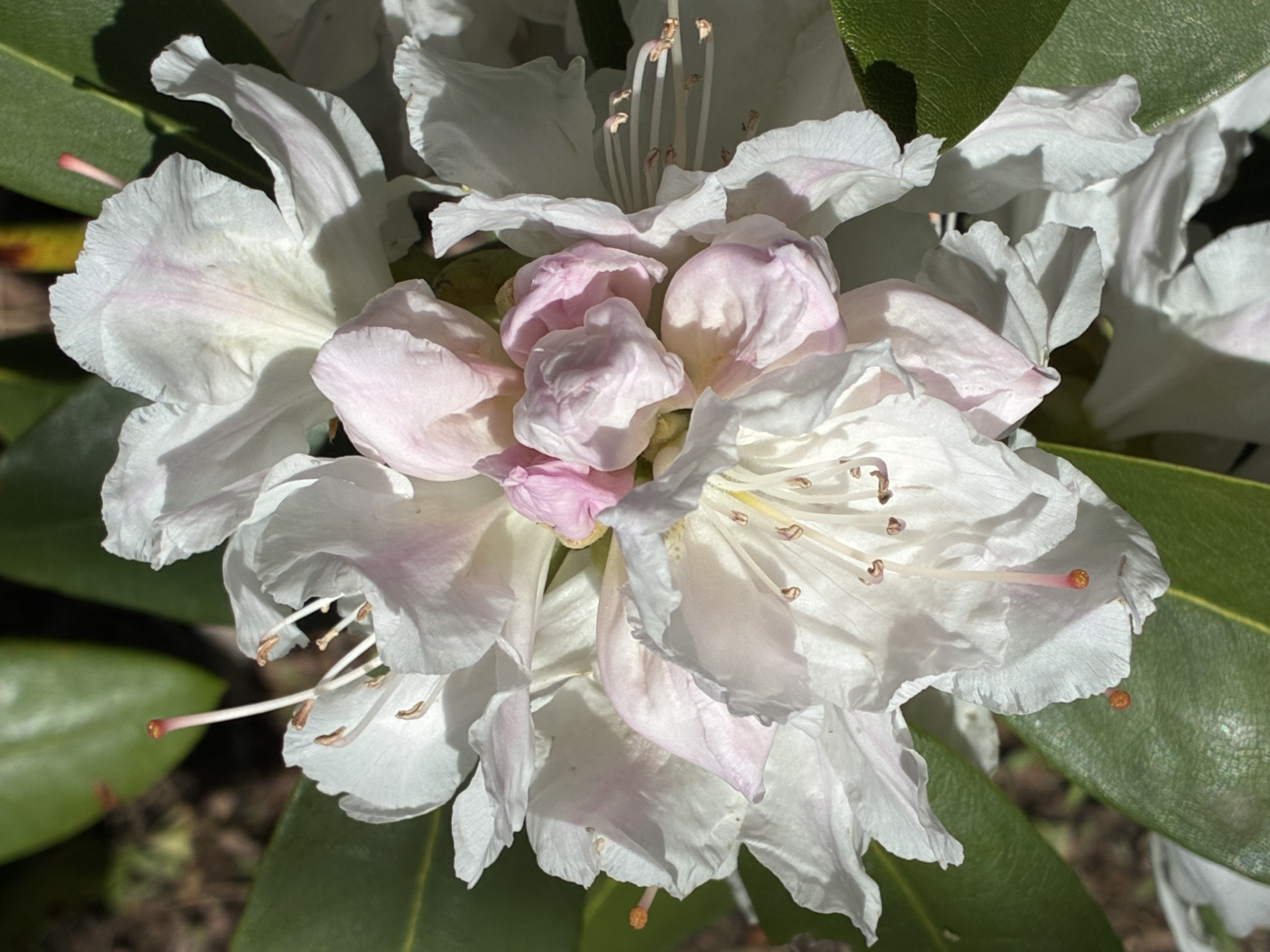
My son comes of age at the dawn of the post literate age, when seven fictive persons with valuation exceeding $23 Trillion USD own artificial intelligence and employ robots at scale, developing plans to colonize Mars while enjoying unrestricted freedom of speech. These fictive persons’ capitalization exceeds the EU’s entire economic output, is roughly 123% of China’s nominal GDP and is greater than the market valuation of every other nation on planet earth, except for the United States.
To put into perspective this 21st century tech vanguard, my son and I looked back to the 27th century BCE. The Epic of Gilgamesh, carved in stone during the third dynasty of Ur, is one of the earliest stories in literature, the first epic poem. The story is cautionary; technology, literacy and centralization tend to consolidate power and over millennia, the more things change, they may, in fact, stay the same.
I will proclaim to the world the deeds of Gilgamesh. This was the man to whom all things were known; this was the king who knew the countries of the world. He was wise, he saw mysteries and knew secret things, he brought us a tale of the days before the flood. He went on a long journey, as weary, worn-out with labor, returning he rested, he engraved on a stone the whole story.
In Uruk he built walls, a great rampart, and the temple of blessed Eanna for the god of the firmament Anu, and for Ishtar the goddess of love. Look at it still today: the outer wall where the cornice runs, it shines with the brilliance of copper; and the inner wall, it has no equal. Touch the threshold, it is ancient. …Climb up the wall of Uruk; walk along it, I say; regard the foundation terrace and examine the masonry: is it not burnt brick and good? The seven sages laid the foundations.
Uruk was a city in Mesopotamia, the “cradle of civilization” between the Tigris and Euphrates rivers. Agriculture and irrigation were introduced there, around 5000 BCE. The world’s first writing system – cuneiform – emerged by 3200 BCE and was used to record the Epic of Gilgamesh. The Sumerian Kingdom developed the state-of-the-art technology for “burnt brick” as building material.
Southern Mesopotamia (present day Iraq) lacked stone quarries or forests, but mud and clay were abundant, and when they learned to control high-temperature kiln firing, they created durable, water-resistant “burnt brick.” Secured with bitumen “tar” mortar, the bricks became waterproof allowing larger, taller, more complex structures to be built.
By 2100 BCE, in the neighboring city Ur, the oldest existing legal code, the Code of Ur-Nammu was developed, and the King began massive building campaigns. The stepped temple towers he built, known as Ziggurats, became monuments to his centralized power; “built by Ur-Nammu” stamped on every brick.
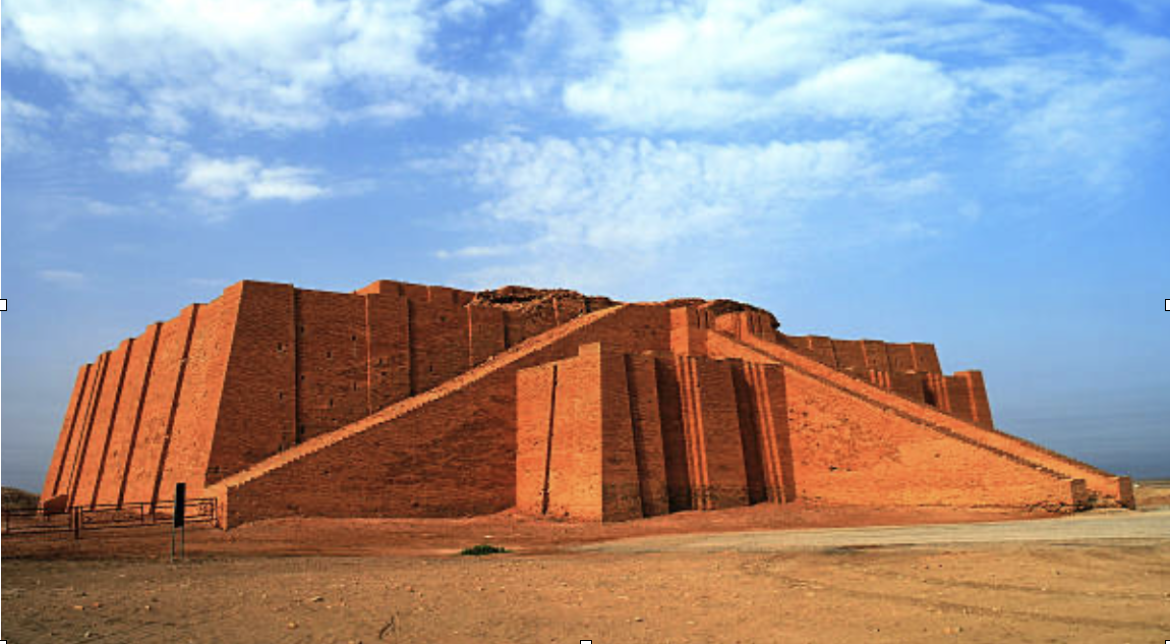
The temple and palace as centralized control, using one language – cuneiform, an intelligence not available to the common person – to manage ever expanding economic power, by means of an algorithmic governance with slave labor, bears relevance to the dilemma of my son’s generation: the Magnificent Seven fictive persons own and control AI using chips made of sand and silicon by robots at scale, their massive data centers our modern day Ziggurat.
The First Patriarch of the Hebrew people, Abraham, was born in Ur, and would have grown up in the shadow of the Great Ziggurat, pondering the King’s divine right and his shrine to the moon god Nanna: collective monumental religion. Called to a different path, Abraham wandered in the desert, seeking the divine in a covenant of personal conscience and individual responsibility: monotheism.
Centuries later, when Abraham’s story was written down, very likely during the Jewish exile in Babylon, the Hebrew scribes wrote the story like this:
1 And the whole earth was of one language, and of one speech…. 3 And they said one to another, Go to, let us make brick, and burn them thoroughly. And they had brick for stone, and slime had they for morter. 4 And they said, Go to, let us build us a city and a tower, whose top may reach unto heaven; and let us make us a name, lest we be scattered abroad upon the face of the whole earth.
The story of the Tower of Babel was certainly inspired by the Ziggurats of the Sumerian Kings whose temples were a highly organized center of commerce and religion, a holy staircase built to invite the gods down, an act of supplication, as though upon “bended knee”. The Jewish scribes, however, saw it as an act of arrogant pride – hubris – humans empowered to climb up, as well as the dangers of empire and lock-step uniformity; “confounding their language” forced diversity.
5 And the Lord came down to see the city and the tower, which the children of men builded. 6 And the Lord said, Behold, the people is one, and they have all one language; and this they begin to do: and now nothing will be restrained from them, which they have imagined to do. 7 Go to, let us go down, and there confound their language, that they may not understand one another’s speech. 8 So the Lord scattered them abroad from thence upon the face of all the earth: and they left off to build the city.
The power of empire or the sin of hubris? A God of judgement and wrath or one who gently “confounded their language”? Our homeschool assiduously avoids the either/or as we seek the both/and multi-dimensional reality. We reached out to our Soul Brother to inquire of the Buddhist perspective. His reply: Dogen Zenji’s Genjō-kōan.
Dogen Zenji was a Zen monk, poet, philosopher who introduced the practice of zazen – seated meditation – to Japan. As a young monk, he travelled to China to study Chan Buddhism, the paradox-heavy, oxymoronic strain that challenges the rational mind. “What is the sound of one hand clapping,” Chan’s classic aphorism, applies surprisingly well to our AI era.
Chan Buddhism teaches that reality is nothing more than direct physical experience, not a conceptual framework defined by words, letters, or logic; information is not realization. Information is a tool – like the hammer and nail in my carpenter’s tool belt – and the real person must command their tools. AI unchecked can become a barrier stopping us from experiencing the physical world. My son should learn to use AI, but more importantly, to see the limits both of AI and of words. “A finger pointing at the moon is not the moon itself,” says the koan, so my son will soon confront the paradox; I have no answers, only questions, which he must resolve from his own direct experience.
In the Tower of Babel story, the perfection and harmony of one language was a conceptual trap, an imperial uniformity; reality is neither single nor rigid as the autocrat desires but is the diverse, varied “ten thousand things.” Written as a story of divine punishment, people “scattered…upon the face of all the earth,” Chan sees the Tower of Babel’s fall as liberation from delusion, a return to the earth where life unfolds with the friction of physical experience. Shame has no place in reality.
The act of building a tower to reach heaven is the delusion of separation, heaven as a destination attained via material accumulation. About reality Dogen Zenji wrote: “When ancestors gave expression to it, they did not search for it as something outside.” The ego may be chagrined, but clay and slime, the material used to make the bricks, is reality itself and the path to realization is to be wholly present in this current moment. There is wisdom in quiet receptivity, allowing reality to meet you as it is, on its terms.
Emperors, tyrants and the wealthy build monuments to themselves – “built by Ur-Nammu” stamped on every brick – such is their delusion, but so too deluded are the people who aggrandize and support same. The ego desires a permanent unchanging self, separate from others, but Dogen taught the self is fundamentally empty and interconnected with everything else: “To study the Buddha Way is to study the self. To study the self is to forget the self.”
In the end, after the people had been scattered, the decaying monument of mud and slime would have fulfilled its unintended symbolism, showing the impermanence of human constructs. For Dogen Zenji, reality is never something finished but rather a continuous dynamic process, the entropy of physics, real persons becoming, not being, which is the magnificence of humanity, even in its varied confused uncertainty.
“Firewood becomes ash, and it does not become firewood again… life is a period of itself, and death is a period of itself,” the Dogen wrote. My son is the firewood, now. My role to fuel his fire, to kindle his flame, to teach him to go, forward bearing his light.
To Have and to Hold
Posted: May 15, 2026 Filed under: Child Centered Activities, consciousness, Money & Banking | Tags: abraham-lincoln 2 Comments
Our pursuit of personhood continues. Plato’s plucked chicken and Aristotle’s “thought bearing animal” both centered on materiality, to which Aristotle added the rational mind. There should be no surprise with that, given materiality and the rational mind were absolutely central to Classical Greek civilization. The birthplace of philosophy and science, the “life of reason” was considered their highest calling. Their art and architecture, such as the Parthenon, the perfect embodiment of geometric harmony expressed in material form.
Our homeschool emphasizes not the mono-rational mind but instead the multi-dimensional self; a person is more than a mind in locomotion. The Greek definitions, foundational to western Civilization, seemed too narrow and so my son and I travelled to the other side of the globe, to Asia, to see what thoughts would emerge.
Pudgala is a Sanskrit term (पुद्गल) that can mean “physical matter” or “person.” At its root, pud means “combine” and gala means to “separate,” so the core understanding is that change is the constant, clusters of indivisible atoms forming and breaking apart, all of which create matter, the building block of life. The term originated in Sanskrit around the 5th century BCE.
In Greece at that time, Heraclitus, the pre-Socratic philosopher, understood the universe as the “unity of opposites” constantly in flux, always becoming, never being. His writings remain only in fragments, sayings like “everything flows” and “no man ever steps in the same river twice.”
Known as the “weeping philosopher,” Heraclitus was followed in the 4th century BCE by Democritus, known as the “Laughing Scholar.” He reasoned the universe was composed of atoms (indivisible units) and the void (empty space); atoms, the building blocks of matter, never break or perish, but combine and separate to form clusters, differing forms of matter, by moving through the void. The co-founder of Atomic Theory, Democritus described the essence of fusion and fission, which is the foundation of modern atomic physics.
So whether from the Greek or Sanskrit, physical matter is clearly one trait of a person. Aristotle added in “reason” while Asian philosophers went further. To the Jain Dharma path pudgala was the non-living physical matter that makes up our bodies, breath and the physical brain, ever changing, both supporting and restraining consciousness and the soul. Within Buddhism pudgala usually refers to a mere person as the suffering self – the burden bearer – experiencing birth, death and rebirth. The Shaiva tradition of Hinduism went further, with pudgala as the person, bound in material form, whose path was to overcome physical impurities in their return to universal consciousness, the “man seeking to know divinity [śivatva].”
Such was the “Great Conversation” between these schools of thought, with multiple varying meanings hotly debated, but which seems remarkably similar to the “body-mind-spirit” concept of holism, popular today. Our pursuit here is to define a person including the dynamic of constant change. Maslov’s hierarchy of needs comes to mind; physiological, safety, love and belongingness, esteem, and self-actualization are all parts of a whole person.
After much discussion, we settled on our definition of a person as “a thought bearing biped mammal with consciousness of purpose, meaning, intuition and connection.” We are, after all, in pursuit of the multi-dimensional self, and how that compares and contrasts with the “fictional person.”
At the most basic level, consider the body. Corpus verum (real body) struggles with mortality, while the corpus fictum can exist in perpetuity. Kongo Gumi, a Japanese construction company building Buddhist temples, was founded in 578 and is the world’s oldest continuously operating company. The Hudson’s Bay Company, founded in 1670, was the oldest surviving joint-stock company until it was forced into liquidation last year. The fictional person is a superb entity to amass power and wealth over the very long haul.
Civil society is necessary for the fictional person to function, which requires real persons for that task. Real persons can be remarkably clever, to a fault. Consider that artificial intelligence is owned by the fictional persons, who have a combined market capitalization surpassing $30 trillion United States Dollars. As fictional persons employ robots at scale, will freedom of speech and personhood be extended further? Mind-boggling how creative we the real people can be, for better or worse. Caveat emptor.
But about that physical body, the corpus verum, a noteworthy thing happened long ago in England. Charles II, the King, convinced of his Divine Right, was unaccountable to Parliament. He raised taxes arbitrarily by decree and desired to send prisoners to remote overseas jails, beyond legal recourse. He was a rake and libertine, and the reaction was swift and complete. The Habeas Corpus Act 1679 was approved by the Parliament of England, taking power away from the King replacing it with a legal process preventing unlawful, arbitrary imprisonment. Habeas in Latin means “you have” and when the King would hold any body in prison, that body, the person, was assured their day in court. This became a cornerstone of democratic rule of law.
Our homeschool operates on the “friends and family” plan, and so for socialization I recruit help from Uncles, Cousins, and friends. My son’s Cousin happens to be an expert in Habeas Corpus, having clerked on the 2nd and 9th United States Circuit Court of Appeals and published, in the Stanford Law Review, the following:
“American habeas corpus, long conventionally known as the Great Writ of Liberty, is more properly understood as the Great Writ of Popular Sovereignty—a tool for We the People to insist that when our agents in government exercise our delegated penal powers, they remain faithful to our sovereign will. Once we grasp this conceptual shift, the implications for the law of habeas are profound.”
A noble argument, and yet in the history of the United States, American Presidents have suspended that Writ four times – most notably the “Great Emancipator” during the Civil War – plus one attempt concerning detainees at Guantanamo Bay, and the current occupant desiring to do so to immigrants. Last year the Cousin joined us by teleconference to chat about the Great Writ and why the corpus fictum (the government) would suspend the rights of a corpus verum (the person). A transcript follows here (edited for clarity and brevity).
Cousin: The basic theory of US government is: “we the people are in charge.” Habeas is a way to enforce the principle of law. If an Executive (President, Governor, etc) locks someone up, then that person is entitled to go to court. But in war, you can’t follow an ordinary process. [Discussion of Abraham Lincoln suspending the Writ during the Civil War, holding 12,000 civilians without due process.]
My son: It seems good and bad. I can understand Abe’s thought process but you should have a fair trial.
Cousin: [a discussion of prerogative writs, court orders restraining government officials from exceeding their authority] …In summary, these are regulating the question of who has power. “Prerogative writs” concern the royal prerogative, the privilege or powers specific to the King. In the USA this is the sovereign people, as exercised by the agents of the people.
[There followed a long discussion of “writ” and its derivation. I used example of “to write” which my son understood. The question arose of the phrase “the great writ of popular sovereignty” concerning whether, per use of the definite article, habeas is the one or are there others?]
The Great Writ of Liberty is the traditional name. Habeas was a mechanism through which all other liberties could be protected. Habeas was the vehicle for asserting other rights we have. The jailer must be held to account. [Discussion turned to Stephen Miller’s proposal to suspend habeas corpus.]
My son: Because (1) he likes DJT he would say this, and (2) he wants it to be really simple, any immigrant gets picked up, and gets locked up.
Cousin: A logistical simplicity. Yes. But why would many people think this is a good idea?
My son: Probably just a similar thought, just get rid of them.
Cousin: There are 11 to 22 Million people here illegally. There is a political will to change that. But what is the argument on the other side?
My son: There are many immigrants, and some are illegal, but this is not like Abe Lincoln at the Civil War. Now it is not really necessary. Everyone should have a trial. If Stephen Miller was being deported he would want a trial. If Donald Trump was being deported he would want a trial.
Cousin: At a basic intuitive level, it feels the crisis facing our nation is not as critical as Civil War. Was Lincoln’s suspending good or bad? If suspended, it is really important to guard our liberties, but all lofty ideals matter nothing if the country ceases to exist. How do you weight that?
Milo: Suspending habeas corpus should be a last resort. I don’t know what problems – people’s free will – but on a large level, it would fill up the jails.
In closing, the Cousin brought up Aristotle’s concept of the good as it relates to government; the state exists not only for economic survival, but to cultivate virtue, promote justice and to provide a forum for citizens to engage in rational, virtuous political activity; the “thought bearing political animal” oriented to the virtuous, not only the capitalist, life.
In Jay, a Person
Posted: May 8, 2026 Filed under: Child Centered Activities, consciousness 1 Comment
Chapter 1 verse 1 of the Gospel of John states, “In the beginning was the word.”
1 U.S. Code § 1 begins “Words denoting number, gender, and so forth…”
Words, at the core of our homeschool curriculum, define the sacred and profane. As my son learns the sacred Ἐν ἀρχῇ ἦν ὁ λόγος, καὶ ὁ λόγος ἦν πρὸς τὸν θεόν, καὶ θεὸς ἦν ὁ λόγος so I study the profane.
1 U.S. Code § 1 continues “…the words “person” and “whoever” include corporations, companies, associations, firms, partnerships, societies, and joint stock companies, as well as individuals”. Corporate personhood is a fictional person, “corpus fictum” is the Latin term, and so, this being May, it becomes clear our year end project shall ask: ”What is a person?” and, “what are the rights and responsibilities, thereof ?”
We begin with a chicken plucked of all its feathers. In his dialogue “The Statesman,” Plato defined human beings – persons – as “featherless bipeds.” A clever definition, in response to which Diogenes the Cynic threw over the walls of Plato’s Academy a plucked chicken to emphasize the difference between abstract theory and practical reality. Duly noted, our homeschool needs to be practical.
Aristotle, more pragmatically, defined humans both as a “political animal” (ζῶον πολιτικόν) inclined to form societies and as the “thought bearer animal” (ζῶον λόγον ἔχον). Of note, the word λόγον is the same as John’s λόγος, a word fundamental and rich with multiple meanings. “Word” is the common definition, but also “reason,” “logic” or “principle;” λόγος represents a divine ordering intelligence, a structural coherence. The German philosopher Heidegger would later argue “rational” is far too narrow as the defining human trait; “having” speech, discourse, and the capacity to articulate the meaning of our world is our defining trait. In the beginning, indeed, is the word.
All of this talk about persons and words brought to mind the landmark case Citizens United v. Federal Election Commission (2010) in which the Supreme Court granted to the fictional person unlimited freedom of speech. For better or worse unrestricted corporate spending is free speech, supporting or opposing political candidates; persons real and fictive do articulate the meaning of our world.
All of this was becoming too abstract, so I hopped into my truck and drove north to Jay, Maine to see first hand what happens when the fictional person and the political animal come into conflict. We all know the rights, but what are the responsibilities?
Jay is a town of 4,620 people nestled in the foothills of Western Maine, on the banks of the mighty Androscoggin River. 178 miles long, the river flows from Errol, New Hampshire down across western Maine to Merrymeeting Bay before it empties into the Gulf of Maine. The river drains 3,530 square miles as it drops an average eight feet per mile, making it a prime location for hydro-powered mills and factories. The history of the fictional person making paper by the toil of many “thought bearer animals” largely began in Jay, on that river.
Hugh Chisholm, a baron industrialist of Portland, Maine, made his first fortune selling picture postcards. A shrewd capitalist, he decided to vertically integrate and control pulp and paper making. He opened the Otis Falls Pulp Company in Jay in 1888. It was among the most modern facilities of its time and, by 1898, Chisholm had merged 20 paper and pulp mills to create the International Paper Company, controlling over 60% of the newsprint industry.
History is rich with irony, bitterly so for Jay. Chisholm formed his paper trust, just before the “Rough Rider” President began busting the trusts. International Paper survived, thrived, and expanded but when the B-movie actor, who had served eight terms as President of the Screen Actors Guild, a 45,000 member Union, became the union-busting USA President, then International Paper Company turned its sights on Jay and decided to bust Local 14.
In 1987 International Paper Company was thriving. For more than twenty years it had been a component of the Dow Jones Industrial Index, and its profits that year increased 33% while net sales rose 42% to $7.8 Billion. Despite near-record profitability, the company demanded concessions in the form of wage cuts and givebacks (increases previously won), high monthly payments for health insurance, an end to double-time pay on Sundays, and the elimination of all holidays (including Christmas). Jay Local 14 went on strike.
The fictional person locked out the living breathing persons. The fictional person is responsible legally to its shareholders while the living breathing persons who toil in the mill are but a fungible means to that end. For the living breathing person responsible to family, friends and community the day is long, those are ties that bind, many of those families having lived in Western Maine for generations. The people of Jay stood tall. Those “political animals” inclined to form societies became a beacon to the world.
Solidarity is a noun, meaning “unity that produces or is based on community of interests, objectives, and standards.” Since 1915, the word has been the anthem and rallying cry amongst union workers. August 1980, workers at the Lenin Shipyard in Gdansk, Poland used that noun in naming their Independent Self-Governing Trade Union “Solidarity.” That union’s membership peaked at 10 million and played a central role in the end of communist rule in Poland. 1987, in Jay, Maine, solidarity was key as the strikers, community and people from away all came together in support of real persons fighting the fictional person.
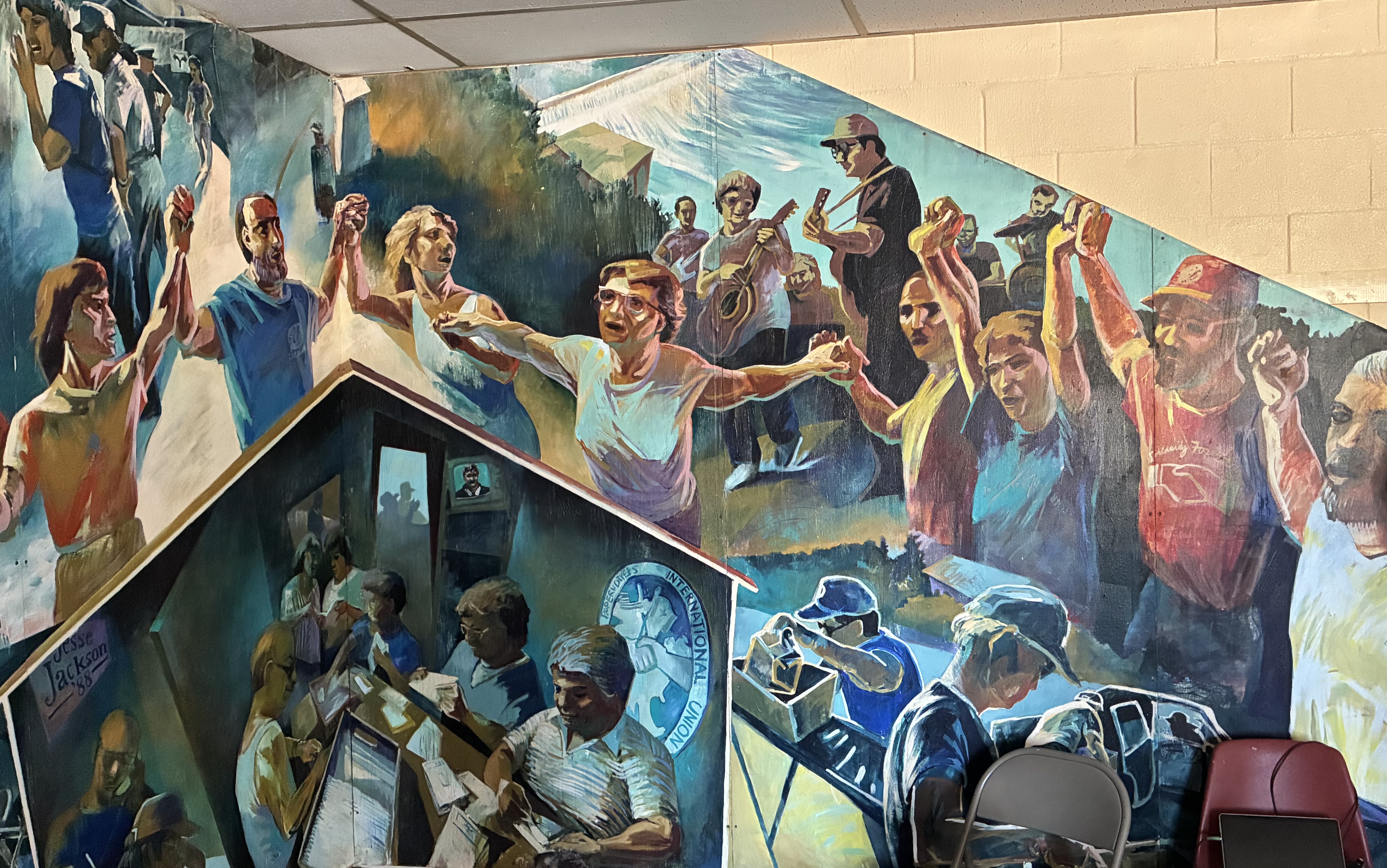
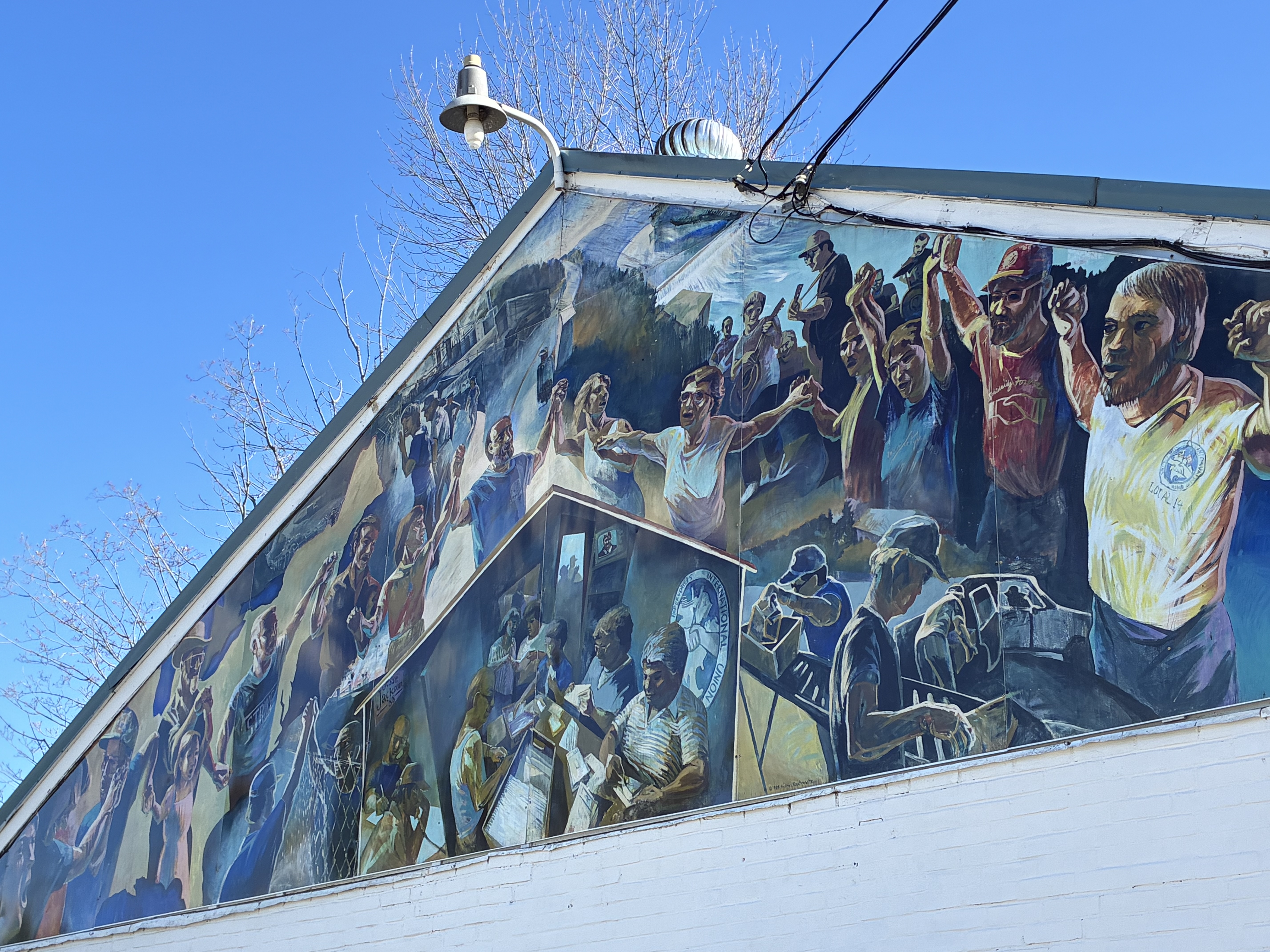
The United Paperworkers International Union local 14 organized a focused community-based pro-Labor campaign: 24/7 picketing plus food and clothing banks, letter writing and a media campaign to broadcast the news. Massive rallies were held, including a 10,000 person march, and caravans sent across New England – one demonstration at the Bank of Boston – and even to Alabama to build support. Presidential candidate Jesse Jackson, in October 1987, visited Jay and spoke to 3,500 people. Support was widespread. The Chinese Progressive Association Workers’ Center in Boston mailed checks weekly to Local 14 to stay the course. A young woman, age 28 who happened to be studying art in Maine, created a mural showing the solidarity.
In the end, International Paper broke Local 14. The strikers were permanently replaced. In 2006 the mill was sold. Like a bad neighbor, the fictional person moved on. Its waste remains.
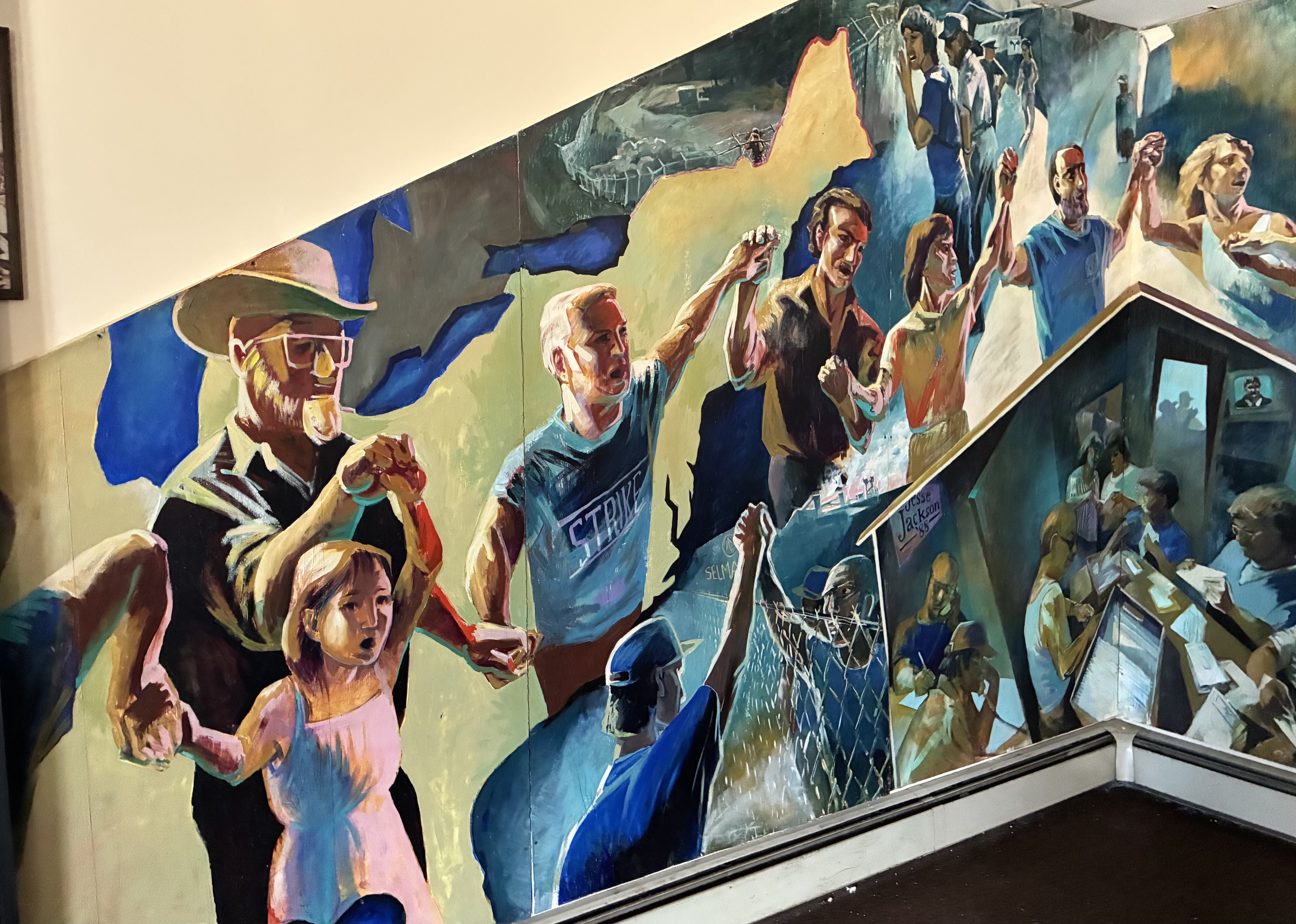
The Androscoggin River is known as “Cancer Valley.” From Rumford downstream incidences of cancer and illness are high, well above average, both from the chemicals discharged into the river and the mountains trapping pollutants in the air. The Androscoggin was named in the 1970s as one of the most polluted rivers in America, so polluted that it would lose all of the oxygen in its waters. Edmund Muskie, who authored the Clean Water Act, grew up on the Androscoggin River, and that legislation made a difference. The river has significantly recovered, but toxic chemicals remain in the fish while untreated sewage overflows during heavy rains. The river is still the most polluted in Maine. No one drinks its water. Except for animals.
The fictional person has the right to move off shore to find cheaper labor, while living-breathing persons, with homes and families, remain settled in the river valley. We the people – or, our elected representatives – have granted to the fictional persons extensive rights, with minimal responsibilities, it would seem.
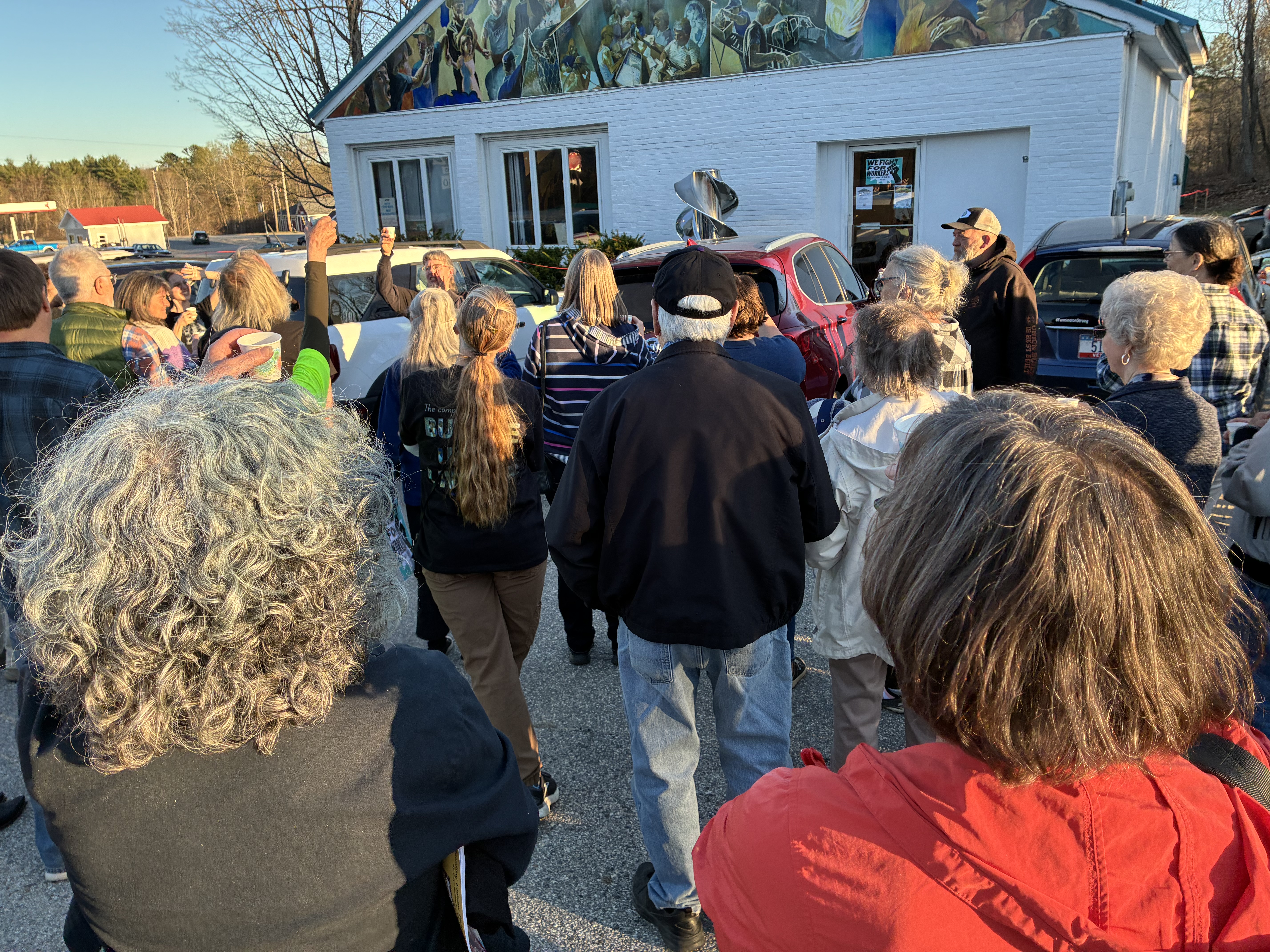
“The company has gone, but the union lives on” is the motto of Local 14. On International Workers Day, I drove north to attend a rededication ceremony for the Local 14 Strike Mural in Jay. Standing room only, the event was robust with speakers and memories, including the artist who painted the mural, 40-years ago. The Local 14 chorus sang and we all joined in. A toast of sparkling cider was made, a meal was served. Solidarity and civility were shared in Jay, on 1 May.
Words and relationships are central to our homeschool. “Person” and “solidarity” are words to be discussed, with the crux of the matter: ”What is a person?” and “What are the rights and responsibilities, thereof?” And so begins our end of year summative, which will include an art-making mural project. Mark-making is meaning making, and the difference between fictive and real is an essential truth.