In Jay, a Person
Posted: May 8, 2026 Filed under: Child Centered Activities, consciousness 1 Comment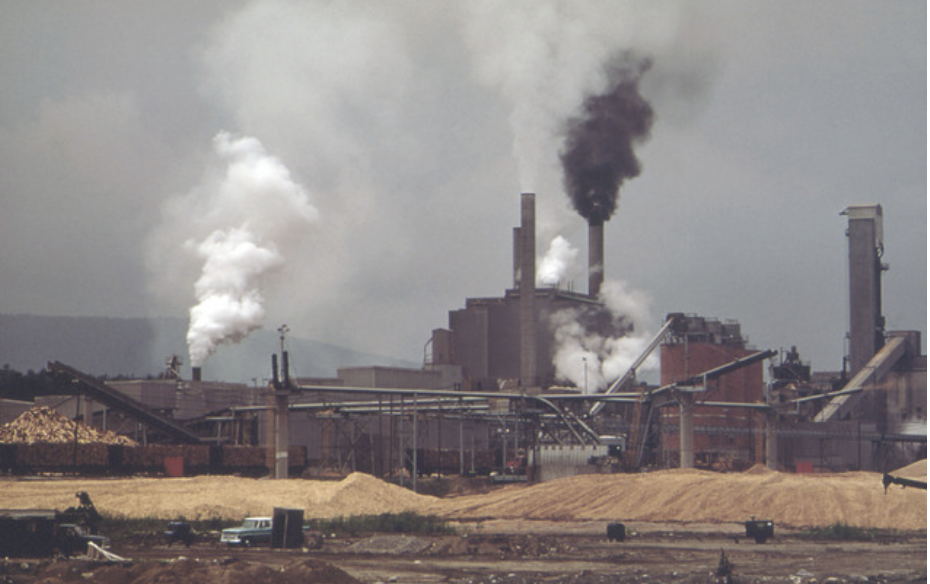
Chapter 1 verse 1 of the Gospel of John states, “In the beginning was the word.”
1 U.S. Code § 1 begins “Words denoting number, gender, and so forth…”
Words, at the core of our homeschool curriculum, define the sacred and profane. As my son learns the sacred Ἐν ἀρχῇ ἦν ὁ λόγος, καὶ ὁ λόγος ἦν πρὸς τὸν θεόν, καὶ θεὸς ἦν ὁ λόγος so I study the profane.
1 U.S. Code § 1 continues “…the words “person” and “whoever” include corporations, companies, associations, firms, partnerships, societies, and joint stock companies, as well as individuals”. Corporate personhood is a fictional person, “corpus fictum” is the Latin term, and so, this being May, it becomes clear our year end project shall ask: ”What is a person?” and, “what are the rights and responsibilities, thereof ?”
We begin with a chicken plucked of all its feathers. In his dialogue “The Statesman,” Plato defined human beings – persons – as “featherless bipeds.” A clever definition, in response to which Diogenes the Cynic threw over the walls of Plato’s Academy a plucked chicken to emphasize the difference between abstract theory and practical reality. Duly noted, our homeschool needs to be practical.
Aristotle, more pragmatically, defined humans both as a “political animal” (ζῶον πολιτικόν) inclined to form societies and as the “thought bearer animal” (ζῶον λόγον ἔχον). Of note, the word λόγον is the same as John’s λόγος, a word fundamental and rich with multiple meanings. “Word” is the common definition, but also “reason,” “logic” or “principle;” λόγος represents a divine ordering intelligence, a structural coherence. The German philosopher Heidegger would later argue “rational” is far too narrow as the defining human trait; “having” speech, discourse, and the capacity to articulate the meaning of our world is our defining trait. In the beginning, indeed, is the word.
All of this talk about persons and words brought to mind the landmark case Citizens United v. Federal Election Commission (2010) in which the Supreme Court granted to the fictional person unlimited freedom of speech. For better or worse unrestricted corporate spending is free speech, supporting or opposing political candidates; persons real and fictive do articulate the meaning of our world.
All of this was becoming too abstract, so I hopped into my truck and drove north to Jay, Maine to see first hand what happens when the fictional person and the political animal come into conflict. We all know the rights, but what are the responsibilities?
Jay is a town of 4,620 people nestled in the foothills of Western Maine, on the banks of the mighty Androscoggin River. 178 miles long, the river flows from Errol, New Hampshire down across western Maine to Merrymeeting Bay before it empties into the Gulf of Maine. The river drains 3,530 square miles as it drops an average eight feet per mile, making it a prime location for hydro-powered mills and factories. The history of the fictional person making paper by the toil of many “thought bearer animals” largely began in Jay, on that river.
Hugh Chisholm, a baron industrialist of Portland, Maine, made his first fortune selling picture postcards. A shrewd capitalist, he decided to vertically integrate and control pulp and paper making. He opened the Otis Falls Pulp Company in Jay in 1888. It was among the most modern facilities of its time and, by 1898, Chisholm had merged 20 paper and pulp mills to create the International Paper Company, controlling over 60% of the newsprint industry.
History is rich with irony, bitterly so for Jay. Chisholm formed his paper trust, just before the “Rough Rider” President began busting the trusts. International Paper survived, thrived, and expanded but when the B-movie actor, who had served eight terms as President of the Screen Actors Guild, a 45,000 member Union, became the union-busting USA President, then International Paper Company turned its sights on Jay and decided to bust Local 14.
In 1987 International Paper Company was thriving. For more than twenty years it had been a component of the Dow Jones Industrial Index, and its profits that year increased 33% while net sales rose 42% to $7.8 Billion. Despite near-record profitability, the company demanded concessions in the form of wage cuts and givebacks (increases previously won), high monthly payments for health insurance, an end to double-time pay on Sundays, and the elimination of all holidays (including Christmas). Jay Local 14 went on strike.
The fictional person locked out the living breathing persons. The fictional person is responsible legally to its shareholders while the living breathing persons who toil in the mill are but a fungible means to that end. For the living breathing person responsible to family, friends and community the day is long, those are ties that bind, many of those families having lived in Western Maine for generations. The people of Jay stood tall. Those “political animals” inclined to form societies became a beacon to the world.
Solidarity is a noun, meaning “unity that produces or is based on community of interests, objectives, and standards.” Since 1915, the word has been the anthem and rallying cry amongst union workers. August 1980, workers at the Lenin Shipyard in Gdansk, Poland used that noun in naming their Independent Self-Governing Trade Union “Solidarity.” That union’s membership peaked at 10 million and played a central role in the end of communist rule in Poland. 1987, in Jay, Maine, solidarity was key as the strikers, community and people from away all came together in support of real persons fighting the fictional person.
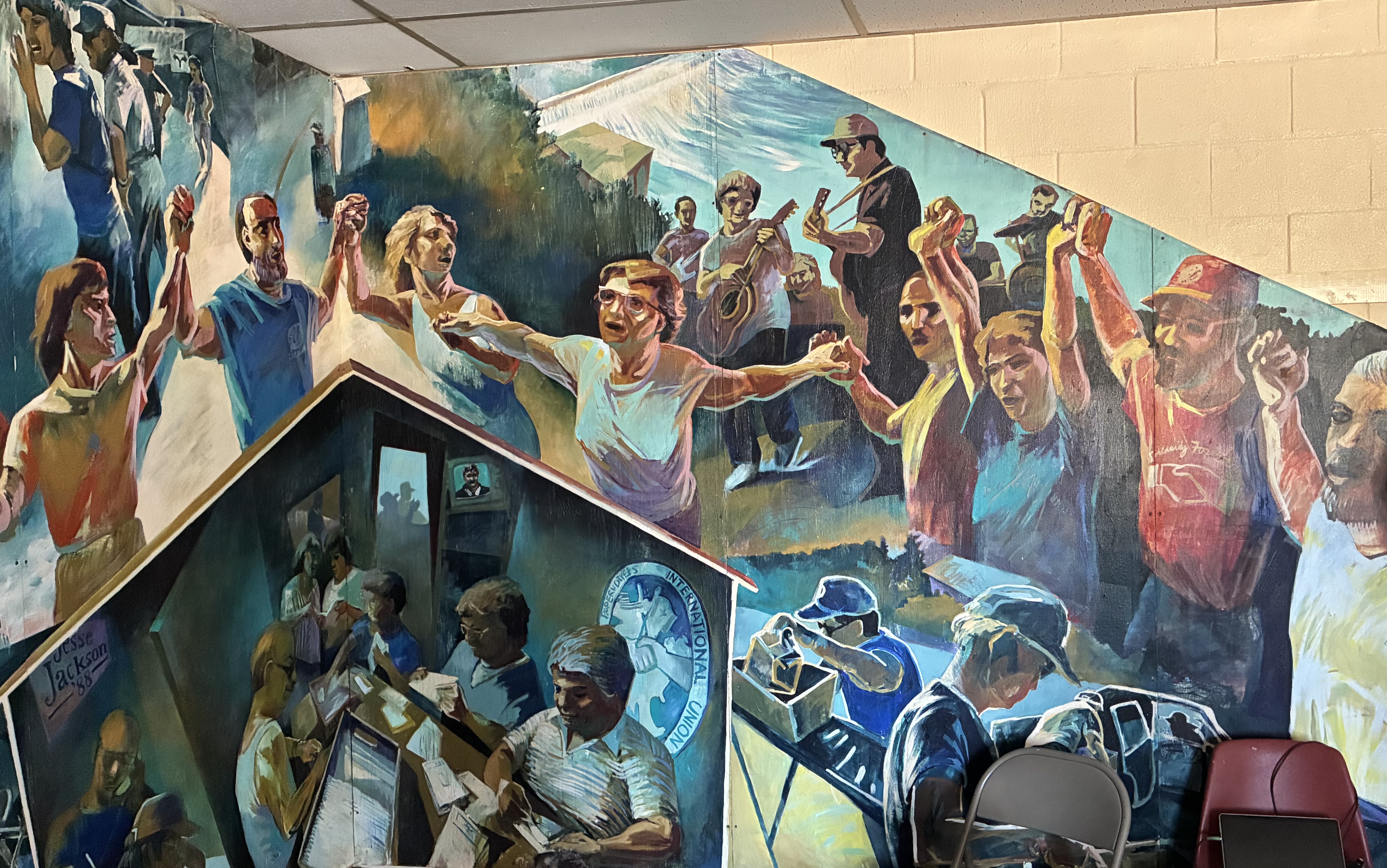
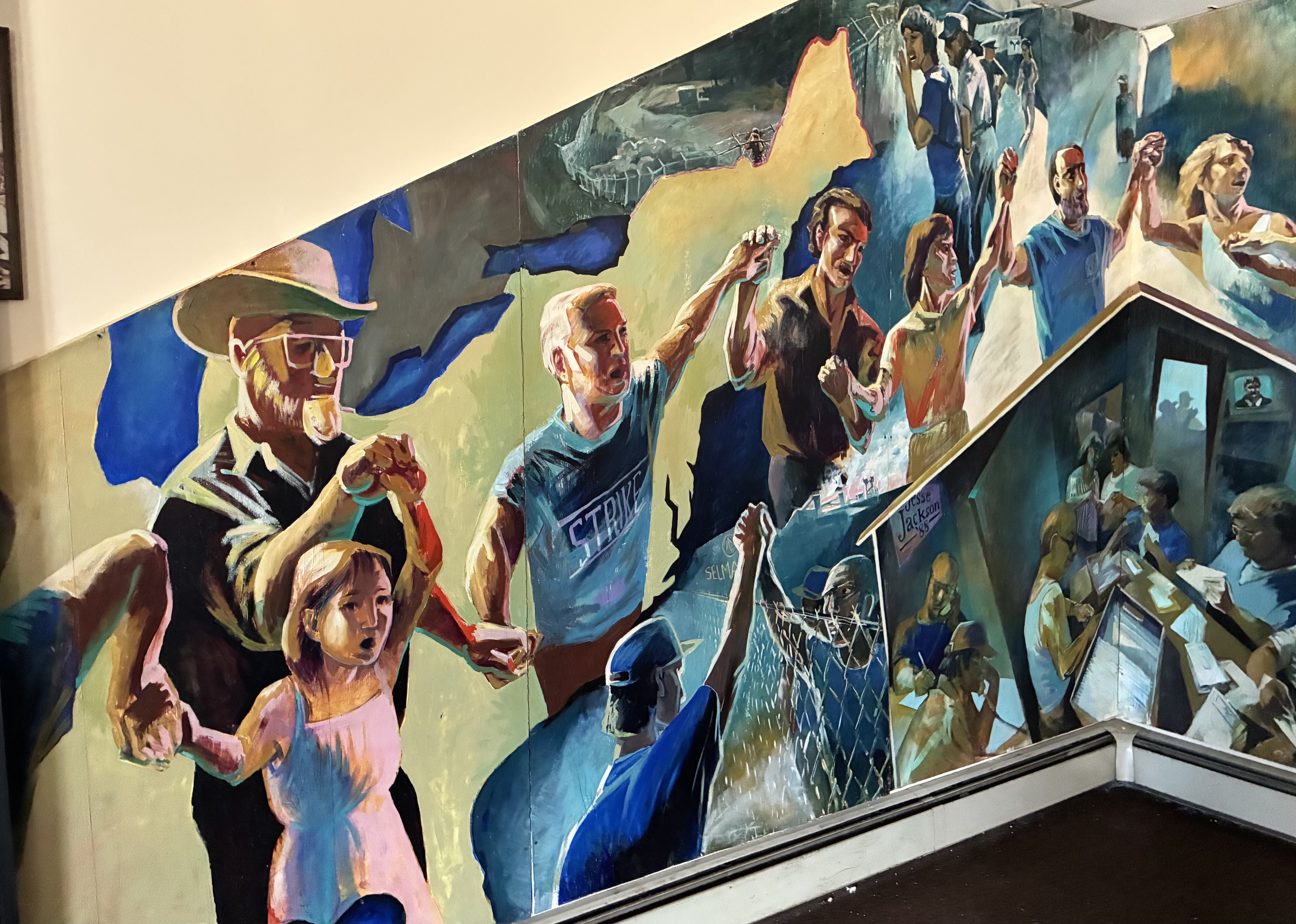
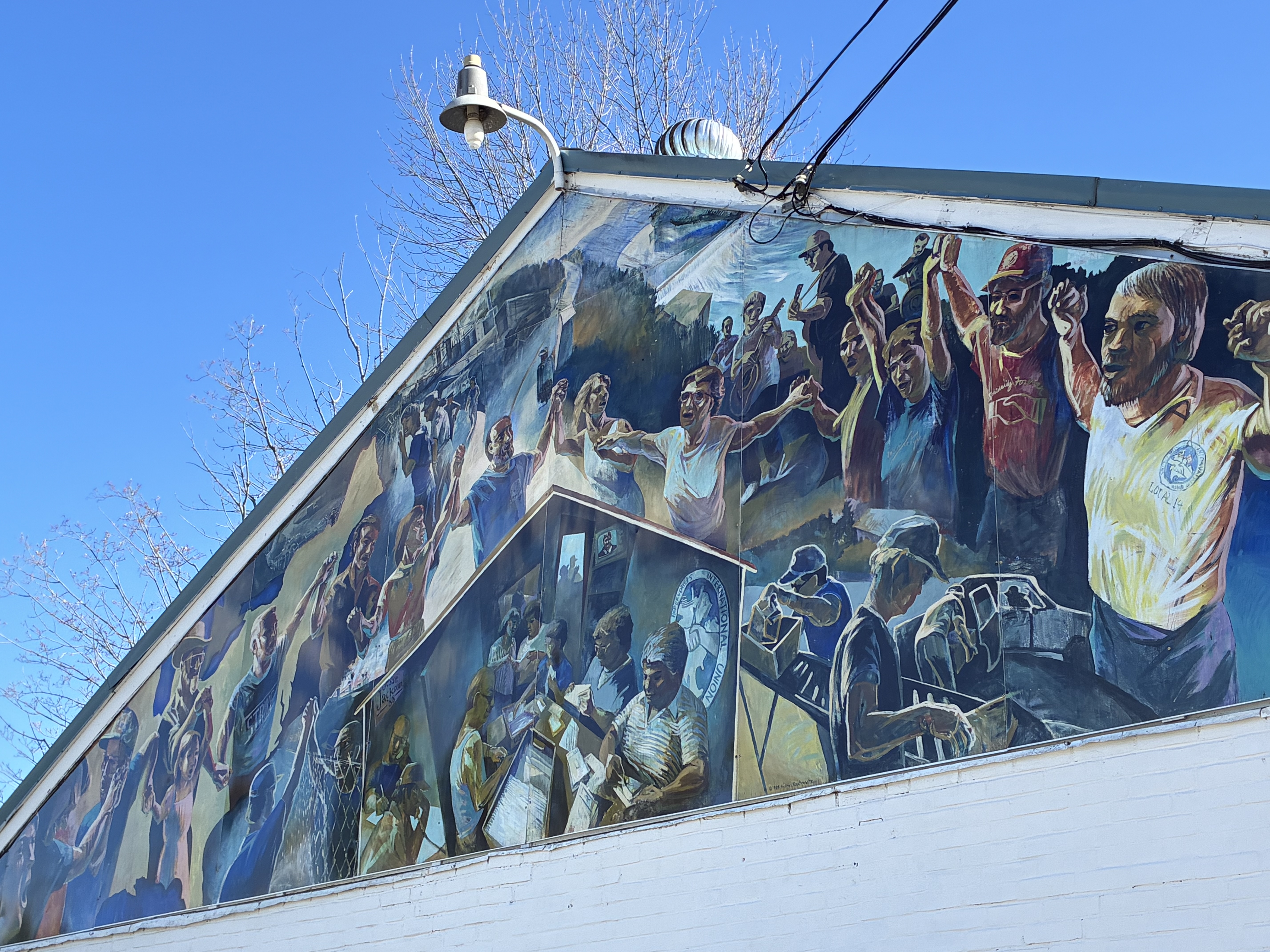
The United Paperworkers International Union local 14 organized a focused community-based pro-Labor campaign: 24/7 picketing plus food and clothing banks, letter writing and a media campaign to broadcast the news. Massive rallies were held, including a 10,000 person march, and caravans sent across New England – one demonstration at the Bank of Boston – and even to Alabama to build support. Presidential candidate Jesse Jackson, in October 1987, visited Jay and spoke to 3,500 people. Support was widespread. The Chinese Progressive Association Workers’ Center in Boston mailed checks weekly to Local 14 to stay the course. A young woman, age 28 who happened to be studying art in Maine, created a mural showing the solidarity.
In the end, International Paper broke Local 14. The strikers were permanently replaced. In 2006 the mill was sold. Like a bad neighbor, the fictional person moved on. Its waste remains.
The Androscoggin River is known as “Cancer Valley.” From Rumford downstream incidences of cancer and illness are high, well above average, both from the chemicals discharged into the river and the mountains trapping pollutants in the air. The Androscoggin was named in the 1970s as one of the most polluted rivers in America, so polluted that it would lose all of the oxygen in its waters. Edmund Muskie, who authored the Clean Water Act, grew up on the Androscoggin River, and that legislation made a difference. The river has significantly recovered, but toxic chemicals remain in the fish while untreated sewage overflows during heavy rains. The river is still the most polluted in Maine. No one drinks its water. Except for animals.
The fictional person has the right to move off shore to find cheaper labor, while living-breathing persons, with homes and families, remain settled in the river valley. We the people – or, our elected representatives – have granted to the fictional persons extensive rights, with minimal responsibilities, it would seem.
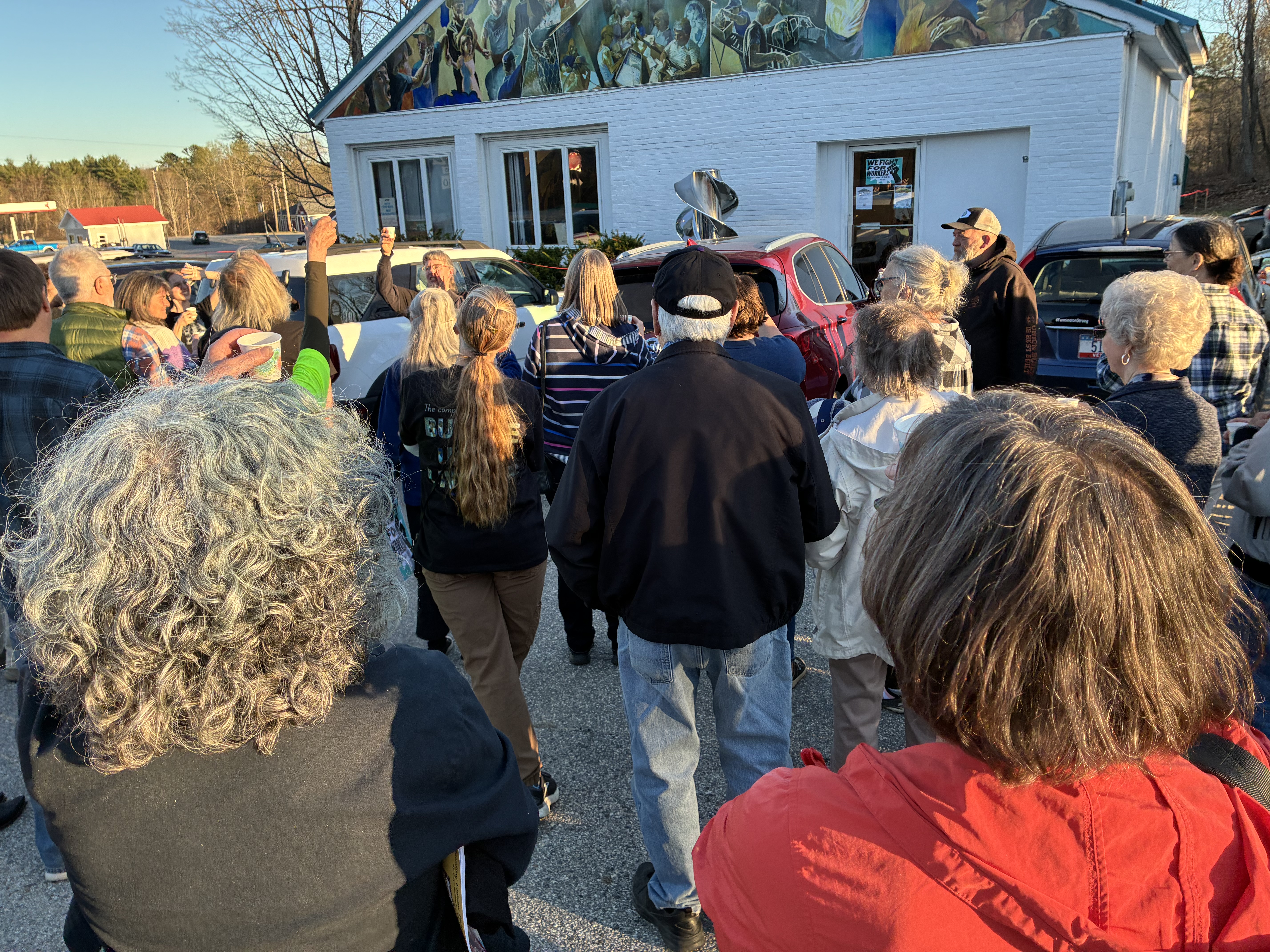
“The company has gone, but the union lives on” is the motto of Local 14. On International Workers Day, I drove north to attend a rededication ceremony for the Local 14 Strike Mural in Jay. Standing room only, the event was robust with speakers and memories, including the artist who painted the mural, 40-years ago. The Local 14 chorus sang and we all joined in. A toast of sparkling cider was made, a meal was served. Solidarity and civility were shared in Jay, on 1 May.
Words and relationships are central to our homeschool. “Person” and “solidarity” are words to be discussed, with the crux of the matter: ”What is a person?” and “What are the rights and responsibilities, thereof?” And so begins our end of year summative, which will include an art-making mural project. Mark-making is meaning making, and the difference between fictive and real is an essential truth.


wow.
>