Monad and a Margin of Safety
Posted: October 16, 2026 Filed under: Child Centered Activities, consciousness 1 Comment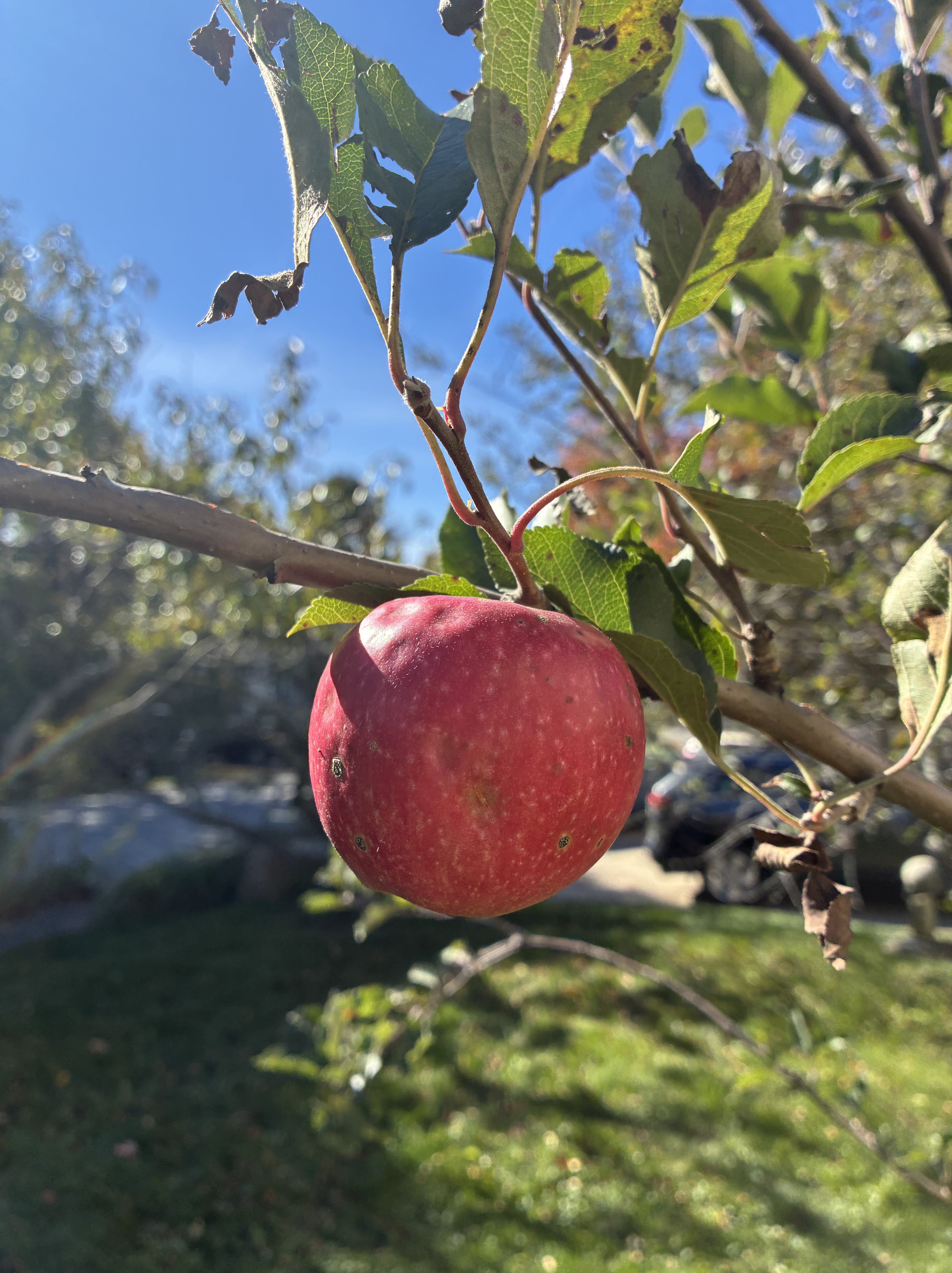
Sacred Geometry notwithstanding, my son wants to learn to invest money. Our applied learning approach can accommodate both Sacred Numbers and investing; financial literacy is important while the Platonic solids are essential.
“Scoop,” my son’s Uncle, is a market maven in disguise. Licensed as a Certified Financial Advisor, he may or may not have clients but does manage money. In the finest fiduciary tradition, he says nothing about his work. His discretion is absolute. He could be managing tens of millions of United States Dollars, but you would never know. More than likely he is just the guy ahead of you at the butcher’s, buying bacon or bratwurst, or in a bookstore, browsing quietly.
He has never set foot on Wall Street, but has logged hundreds of miles hiking in the wilderness. A long term value investor, his preferred risk management is the wild place where predators roam. Doug Peacock, the Vietnam Green Beret medic turned wildlife activist is one of his heroes, best captured in this quote, “It ain’t wilderness unless there’s a critter out there that can kill you and eat you.” Scoop, more than likely is outside, beside some alpine stream, listening to bird song, breathing in the pure air. He is remarkably gentle, thoughtful, considerate.
I called Scoop, and with alacrity he made handouts on investing terms and principles. He mailed a copy of “How a Second Grader Beats Wall Street” by the financial planner Allan S. Roth. That simplicity wins is the book’s premise. Adults get lost in the hype of hope and fear, while the child ignores the noise. Behold then that ancient wisdom of practical virtue: “Verily I say unto you, Except you change and become like little children, you will never enter the kingdom…”
Into the kingdom of investing our journey began, armed with our textbook, our tutor, probability and statistics, we learned vocabulary. “Book value” is the net worth of a company, its assets minus liabilities. “Market value” is the total capitalization, the stock price multiplied by the total shares owned. The difference between the Book and Market value can be significant.
In practical terms, I told my son, “Think of my tool bag with saws, chisels, clamps, and wrenches. Add up their cost and that is the book value of my tool bag.” My son opines, “We really should buy a cordless Sawz-all, a battery circular saw, and a torque wrench but ya, I get your point.” I continue, “Say I go to a client. They think I am really skilled, and agree to pay a premium rate. Or they think I am a moron and won’t pay much. That is market value.” He catches on, “So they want to pay more because they like it. Or pay less because they don’t like it. What happens when a business goes bankrupt? What happens to the stock price then?” My son was absorbed in our lesson.
Having already talked about Phi, the Golden Ratio, I continue, “The ratio of book value to market value tells you if a stock is overpriced. You need to understand the business. What do they do? Do they make money? Do profits increase? What is their debt? Does the business have a famous brand, unmatched technology, loyal customers? All of this factors into the price : value ratio. If the value is more than the price, then it is worth buying. If the business fails, you will only get book value, or less.”
We talk about stock picking, market timing, and asset allocation. Stock picking needs luck and skill, it rarely works. Market timing is even harder, trying to buy and sell at the perfect time, when missing the 10 best days can cut your returns nearly in half.
Asset allocation is Scoop’s approach. He diversifies risk, capturing long term growth using risk management. By analogy, Doug Peacock’s “critter out there that can kill you” is an absolute risk, a permanent loss “of capital.” The 2nd Grader approach is low-risk, broad market asset allocation. The 2nd Grader, in fact, outperformed both “call of the wild” day trading and the S&P 500 by 4% annually.
My 8th grade son has something to learn from the 2nd grader. My task is to show how investing relates to Sacred Numbers.
Sacred Numbers – the Quadrivium – are about observing natural cycles, patterns, ratios, and cosmic order. Pythagoras reportedly said, “Number rules the universe.” Euclid mentioned the Golden Ratio in his Elements, written around 300 BCE. Ἀγεωμέτρητος μηδεὶς εἰσίτω – “Let no one untrained in geometry enter” – was written over the door to Plato’s Academy. The Golden Ratio (Φ≈1.618) and the Fibonacci Sequence (discovered centuries later) are models of those patterns.
In the investment world, analysts use the Fibonacci numbers (23.6%, 38.2%, 50%, 61.8%, 78.6%) to trace market highs and lows to gauge support and resistance. The number 3, which represents balance, completeness, and structure – the past, present and future; birth, life, and death – is used to mark “triple tops and bottoms,” a theory known as the Elliott Wave Principle that divines mathematical patterns underlying market psychology. The concept has both critics and believers.
The 2nd Grader’s portfolio was based upon allocation in thirds: US stocks for domestic growth, international stocks for global diversification, the Bond market for low-risk yields. W.D. Gann developed an entire trading system based upon the relationship between price, time and pattern. His system is based upon recurring cyclical and geometric patterns, that when aligned with time cycles can demonstrate strength or weakness. His ideas are controversial, with critics arguing that followers highlight the rare successful calls while ignoring failed predictions. The glassy eyed banker almost certainly rejects sacred notions, but metaphysics does seem to influence the world, if not the market.
Scoop advocates a buy and hold strategy focused on index funds, also known as ETFs (Exchange Traded Funds). In sacred terms the ETF is the Monad, the one; a fund that owns the market as an ecosystem, rather than individual trees. My son responds, “So buying individual stocks is more like gambling, it’s all or none, but the index fund is safer, buying shares in the entire market.”
The Dyad, which is 2, is duality which in the market is gain or loss, hope or fear, market value or book value. Managing that relationship is the key, which means ratios – such as Phi – come into play. Benjamin Graham and Warren Buffett are legendary masters of value investing. Scoop explains their concept of the “Margin of Safety,” which is the ratio between intrinsic value and market price. When the price is less than the value, you are buying at a discount, which gives protection when the market is volatile. Phi does not directly pertain to the Margin of Safety, but both describe a relationship between two quantities, a recurring pattern in nature, which is a way to manage risk.
The quadrivium includes astronomy, which is based upon the regularity of orbits, seasons, and rhythms. Winter always follows the harvest. In finance, this is the “Reversion to the Mean.” Market expansion (a bull market) is followed by contraction (bear markets). Historical averages bear out, so there is wisdom building a portfolio designed to endure all four seasons.
My son’s interest in financial literacy opens a wide array of topics. Algebra, probability, and statistics readily pertain, so too risk management and the cost of money. Our homeschooling has a practical application.
Our approach to life is “both/and,” our objective in teaching is not only applied; money is not the measure of the man and financial literacy is necessary but not sufficient. Sacred numbers afford a chance to connect a life skill to fundamental laws of harmony, truths of the very long term.
Mysticism runs counter to the modern world’s embrace of empirical science. But 483 years since Copernicus launched the scientific revolution is a mere fraction to the 2412 years since Plato launched his Academy. We navigate that 1:5 ratio at our homeschool.
A 2nd grader can teach an 8th grader long term investing, while this Boomer does teach a Zoomer about the long term tradition.
We are well beyond any standardized test.
______________________________
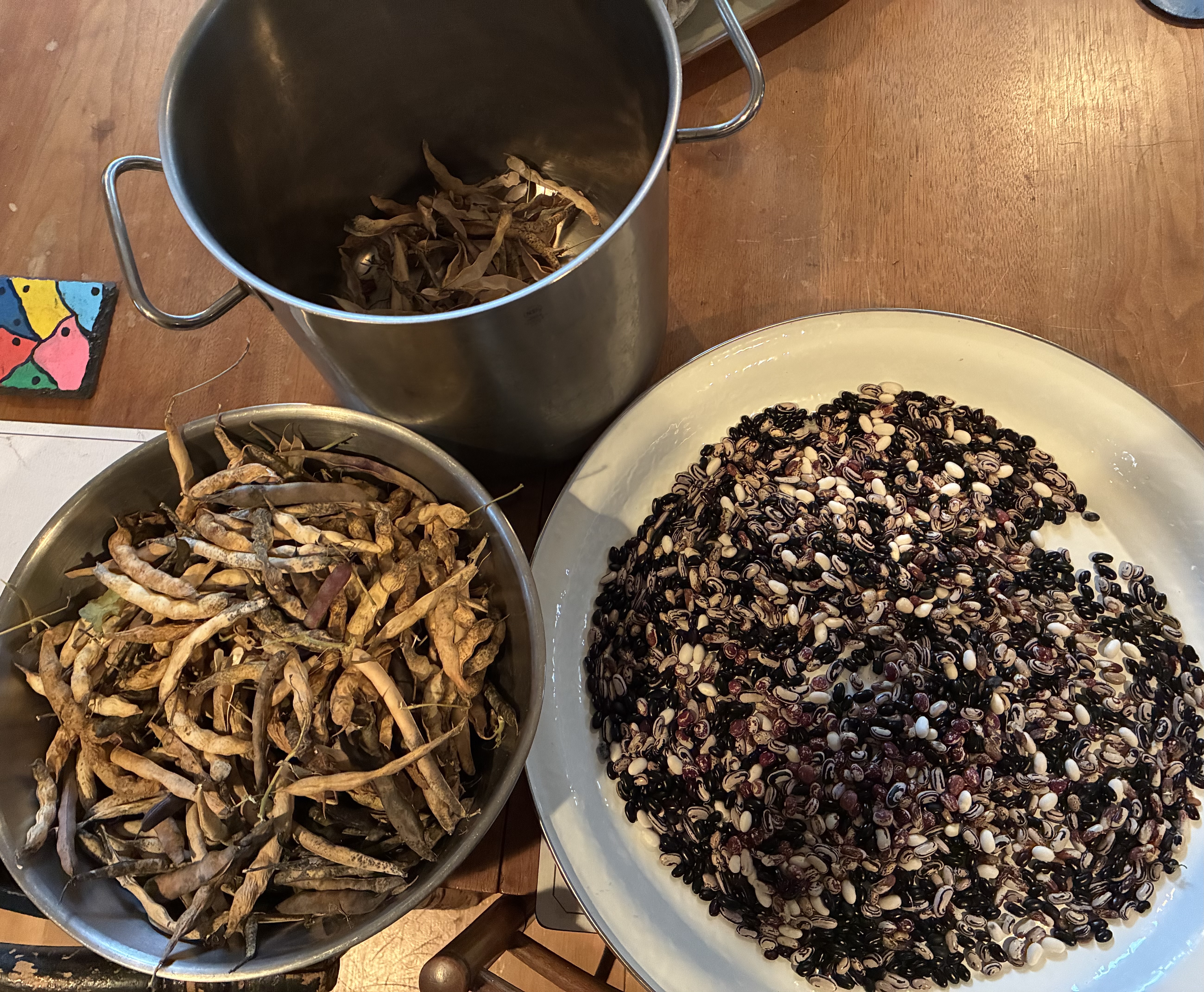
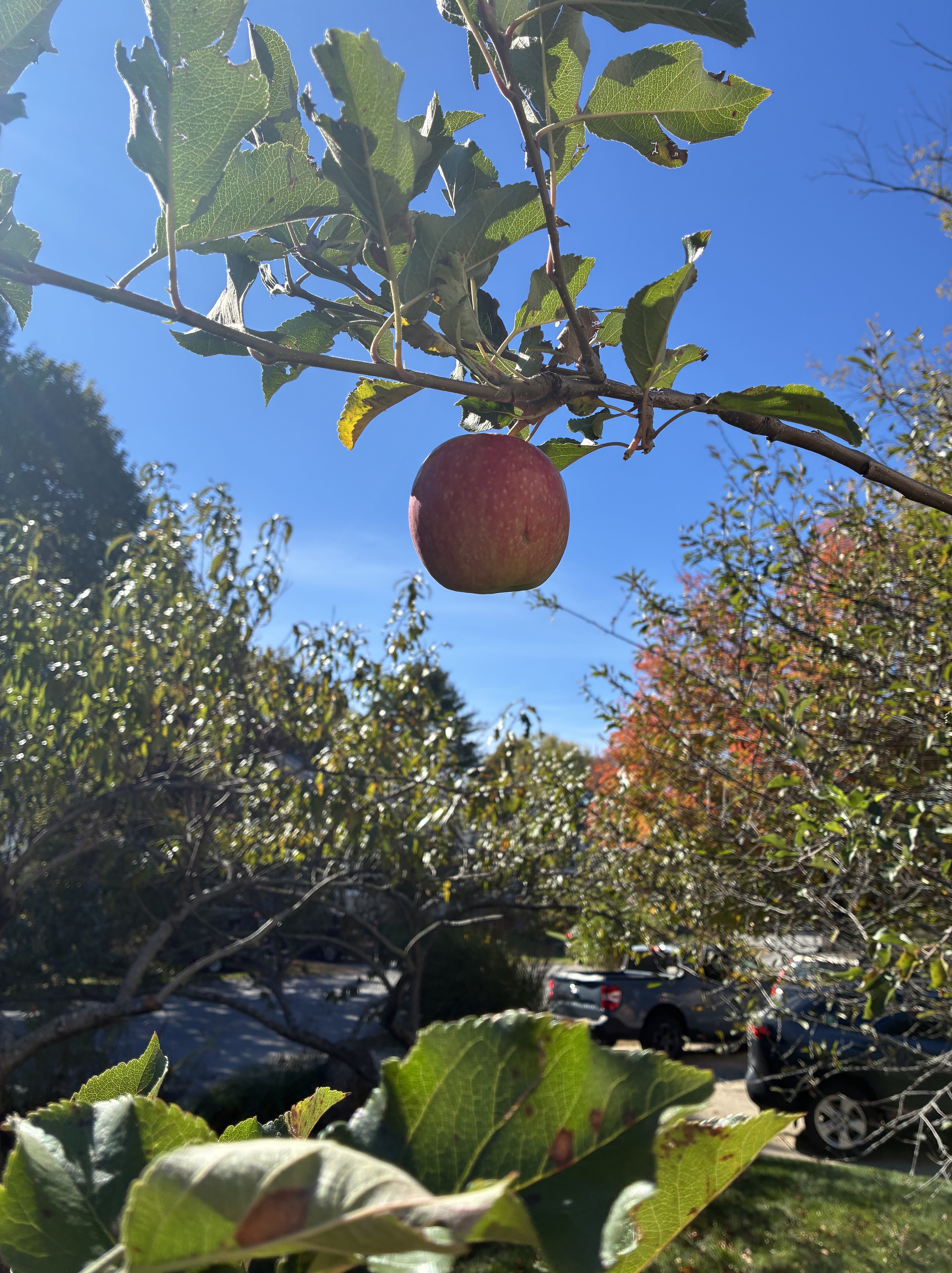
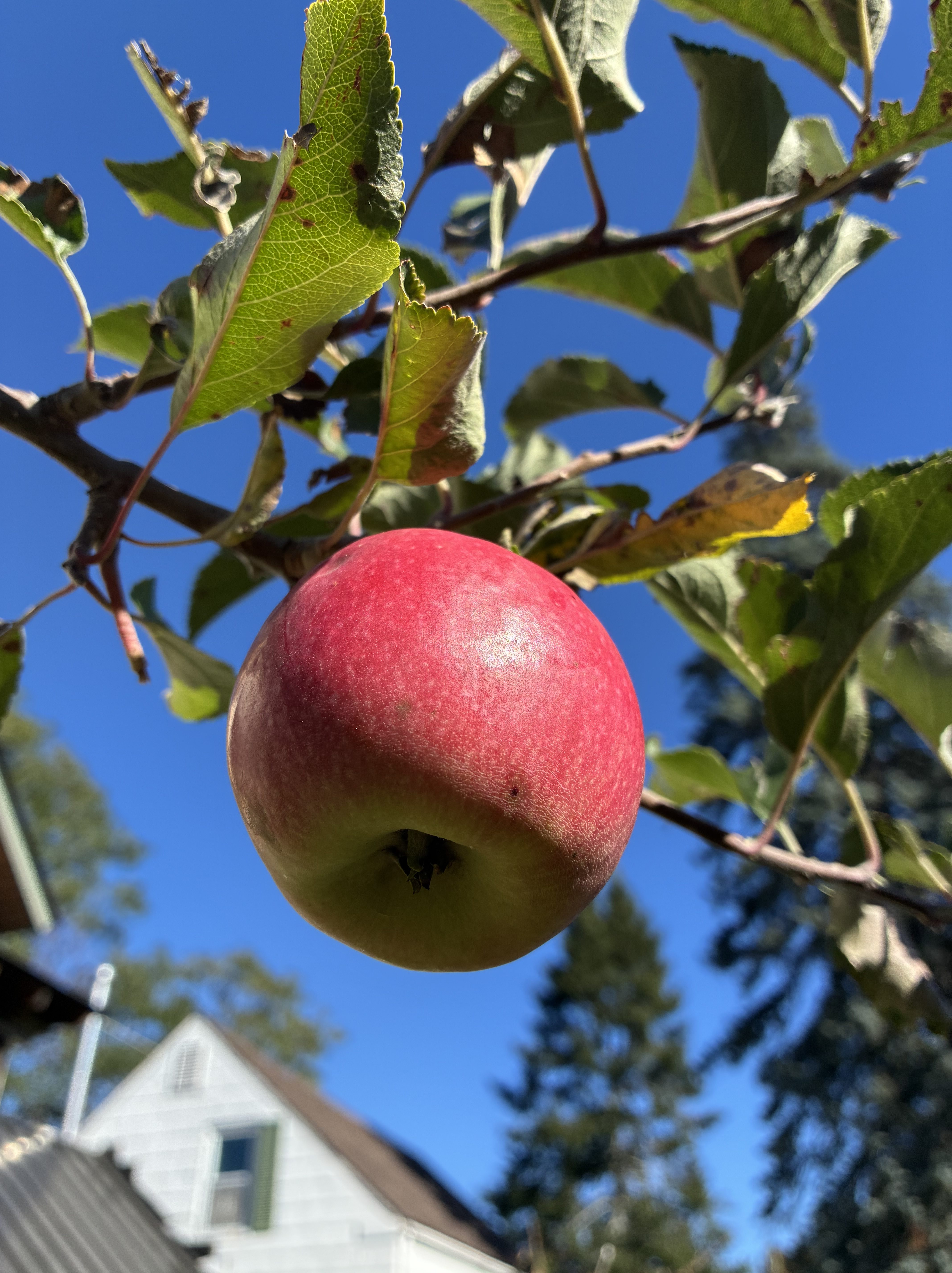
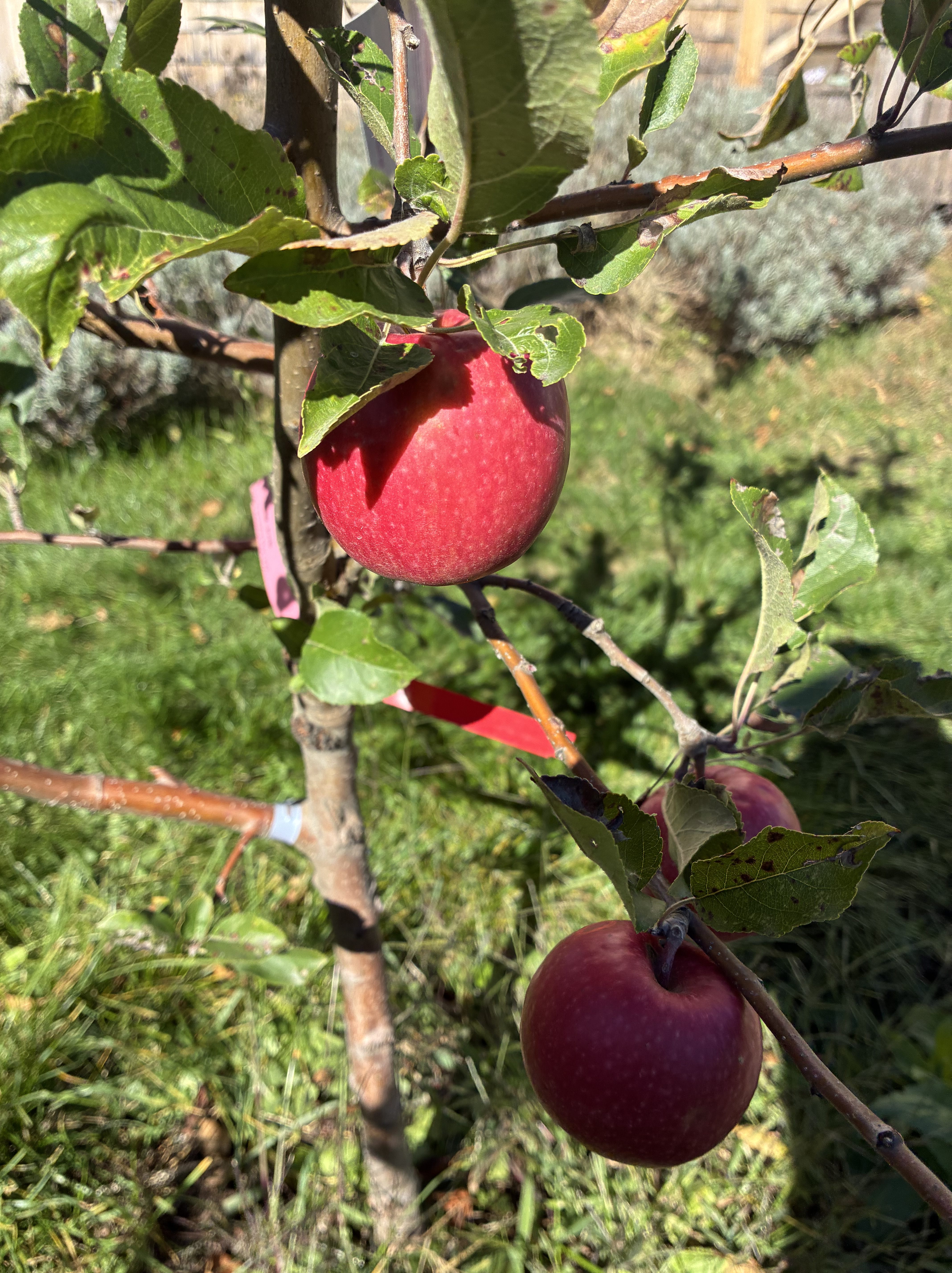
Our heirloom pole bean harvest continues. The Pink Lady apples ripen on our tree.
Not to the Test
Posted: October 9, 2026 Filed under: Child Centered Activities 1 Comment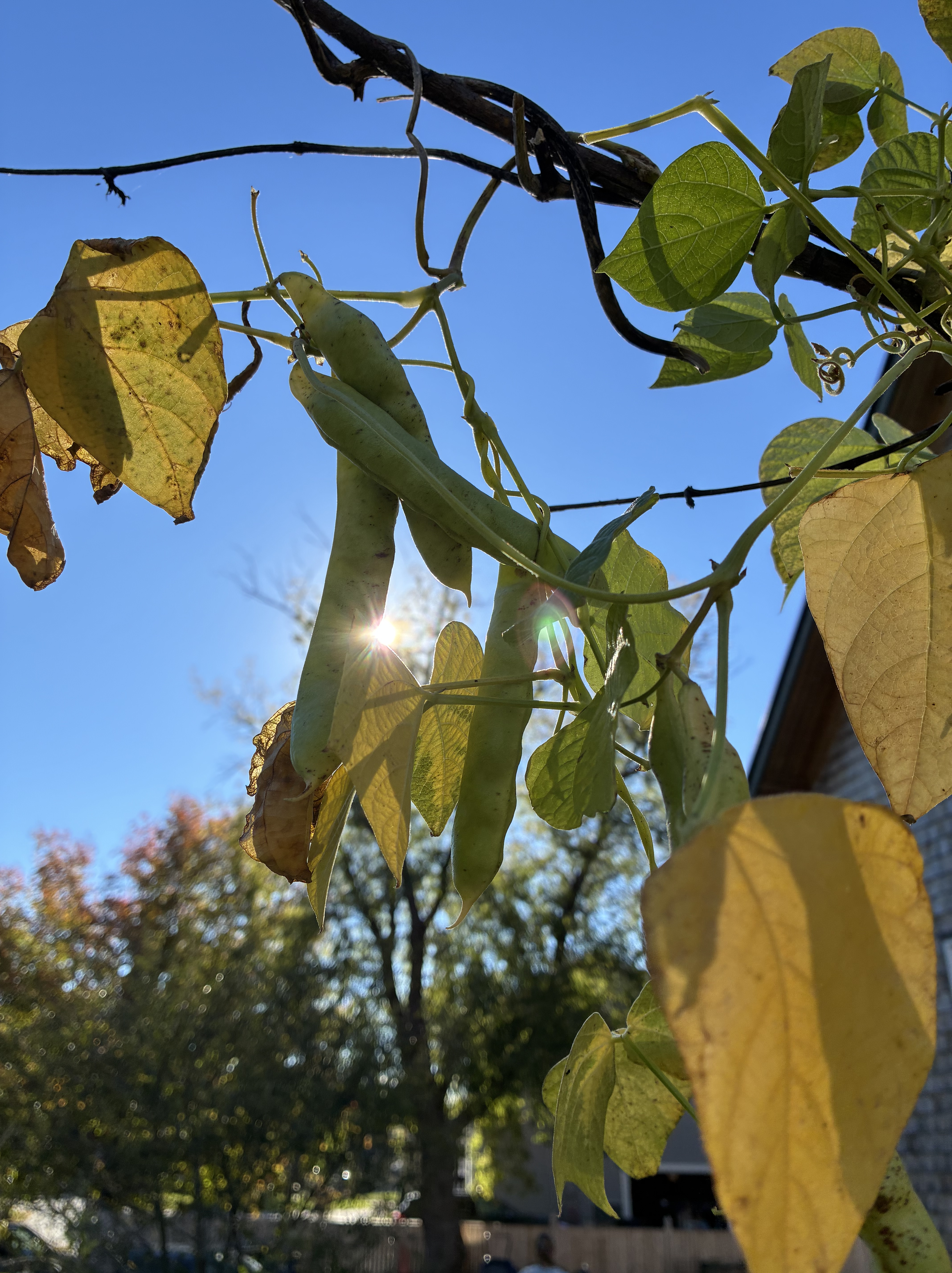
8th grade standardized tests contain questions like these:
A triangle has three angles in the following degrees: 70°, 30°, and x. What is the measure of angle x in the triangle?
A. 30°
B. 60°
C. 80°
D. 150°
My son knows all triangles have 180° so x can only be 80° when the other angles are 70° and 30°. “That wasn’t hard,” he says.
Marty has $80 to spend at a sporting goods store. He will spend $56 on a shirt, and then buy some darts. Each box of darts costs $6. He wants to buy as many boxes as possible. Which equation shows the number of boxes of darts, x, he can buy?
A. 80 = 56 + 6x
B. 80 = 56 * 6x
C. 80 = (56)(6x)
D. 80 = 56/6x
He knows that x can only be 4 if 56 + 6x = 80 but he deadpans, “I made an educated guess.”
Our homeschool ignores standardized tests. There is value in knowing social conventions, a functional literacy. He needs to know how to read a graph, how to reconcile a checkbook, calculate a discount, read fractions on a tape measure, recognize and solve an equation. Like “blocking and tackling” those skills are important, but to learn about number, we take a different path.
We follow the Quadrivium: the mathematical architecture of the Real.
Plato, in Book VII of the Republic, outlined the path away from ignorance up toward the light of eternal truth and the Good. Mathematical knowledge is like a ladder, allowing the student to ascend higher, “it leads the best part of the soul up to the view of the best among the things that are…”
In the Quadrivium, Arithmetic is “pure reason,” the art of number; Geometry is the “Form of the Good,” number in space; Harmonics/Music is “Beauty and Order” which is number in proportion and time; Astronomy is a “Diagram of the Pure” ordered motion in space.
Quadrivium means “a crossing of four roads,” a name used by Boethius, the Roman philosopher, around 500 AD for the four mathematical sciences. Combined with the three language arts – grammar, logic, and rhetoric, referred to as the Trivium – these became the Seven Liberal Arts. The origin was at Plato’s Academy, a private school founded around 387 BCE whose tradition of the mathematical sciences plus logic endured and influenced Christian, Islamic and medieval European scholars. In 529 AD, Emperor Justinian passed laws banning non-orthodox teaching, which effectively disbanded the Neoplatonic Academy.
Consider a 900 year tradition, and some of its students, these just a few among many who studied or were influenced by the Quadrivium: Plato, Aristotle, Euclid, Cicero; Plotinus, Boethius, Dionysius the Areopagite, Bede; St. Augustine, Bernard of Clairvaux, Hildegard of Bingen; Roger Bacon, Saint Thomas Aquinas, Dante, Copernicus, and Johannes Kepler.
My son asks, “Why are so many places named after Greeks and Romans? St. Augustine, Florida. Euclid, Ohio… it’s by Cleveland.” We stop the math lesson and talk about St. Augustine, and Euclid.
The Magister teaches the Trivium, and so we pursue the Quadrivium. But what happened? Why did the Trivium and Quadrivium become obsolete?
The Dark Ages ended. Monasticism ran its course, universities were formed. The Renaissance Humanists arose, then the Scientific Revolution changed the focus from metaphysical truth to observation, experiment, the quantitative. The Enlightenment further emphasized reason, criticism, empirical knowledge: “I think, therefore I am.”
Then the Industrial Revolution brought standardized education; the school bell like the factory whistle training cogs in the machine. The seven liberal arts were neither technical, nor vocational, not the STEM path to employment. The modern world is about measurable and quantifiable output. Quantity, not metaphysical quality.
Our Art Farm Homeschool Academy is focused less on the measurable, more on perception, a quality of discernment, on understanding.
Sacred Number is mystic arithmetic, shared widely among religions, paths to wisdom, among all peoples, across all time. The fascinating question is why this is pervasive.
One is unity. The monad. The origin and point with no dimension. The Great Spirit. God. Permanence. The one name of all names. The shoreless ocean of Unity, it is circle, center, the purest tone, the indivisible All. The unmanifested Divine, the I am that I am.
Two is duality, polarization. Either/or, yin and yang, the two sides of every coin, left and right; shadow, opposite, and object.
Three, the first odd number, makes a triangle which is the first shape to hold space; a three legged stool can stand anywhere, a braid is complete by the third strand, life unfolds across the past, present and future; birth, life, and death. In music the perfect fifth vibrates at a 3:2 ratio, which resolves conflict; singing bowls tuned to 3:2 calm the nervous system. The circle of fifths is considered the cosmic spiral of becoming.
Four is manifestation. The cardinal directions and the elements of Fire, Air, Earth, and Water; in modern physics the building blocks are protons, neutrons, electrons, and neutrinos; the year is divided in four, as animals walk on legs of four.
And so it goes for all the natural numbers. Seven are the days of creation, the chakras, the classical planets, while 12 is the months of the year, signs of the zodiac, tribes of Israel, the disciples; the number of cosmic order, completion and time.
“These are not proofs of a cosmic numerology, but a pattern, a language humans have used to interpret order.” With a surprising confidence, my son says, “That is not too far out. It makes sense and I understand it. I have heard about that. I think I have heard you talk about that.” Somewhat taken aback, I reply, “Then let’s talk about zero.”
The Babylonians, around 300 BCE, and Mayans, around 30 BCE, used a placeholder to show an empty space; 501 is different from 51 because there is no value in the “tens” space. But the placeholder was not a number. It predates zero.
The Dark Ages in Europe were an enlightened time in India. A brilliant mathematician named Aryabhata developed the concept of zero and used it in calculations. In the 7th century the mathematician Brahmagupta defined the rules for zero: 0 – 0 = 0 but any number + 0 remains unchanged and yet 0 multiplied by any number = 0.
The concept traveled along the Silk Road and was embraced by Islamic merchants and mathematicians. An Italian, known as Fibonacci, brought the concept to Europe and popularized the Hindu-Arabic numerals. The merchant guilds favored Roman numerals, while the Catholic Church regarded “nothingness” as demonic and dangerous. Zero was a long process of adoption, resistance, and refinement.
But zero simplified bookkeeping, which merchant bankers embraced. Gutenberg’s printing press made clear that Arabic numerals were more legible than Roman numerals. Linear perspective was discovered, its vanishing point a single point of nothingness, visually equal to the void. Renaissance humanism loosened the Catholic Church’s grip, while Cartesian coordinates helped lay the foundation of calculus.
Zero changed the world.
“But what made them choose that symbol? What is so important about zero?” Flummoxed, I say, “Well, there is no accounting without zero. What is $100?” He counters, “Ten thousand pennies.” “No,” I say, “What is the number?” Dryly he replies, “Oh, a 1 with two zeros.” “Precisely,” I respond, “but it’s more.”
Zero is absence, the whole number of the empty set, what early Indian treatises called “Sunya,” meaning “void,” the abyss, the unknowable, not “nothingness” but the cosmic womb, that from which all other numbers and creation emerge. Zero makes the void calculable.
Pushing further, we discuss Phi, which represents the Golden Ratio, an irrational number equal to approximately 1.6180339887. Any line divided into two, (roughly 5/8 and 3/8) such that the ratio of the entire line to the longer line equals the ratio of the longer line to the shorter line yields Phi. Euclid wrote about this in the Elements.
“Fibonacci,” I explain, “that Italian mathematician, who grew up in North Africa, learned about the pattern where two numbers added together equal the next number in sequence (1, 1, 2, 3, 5, 8, 13, 21, 34…) and when dividing any number by the one before it, the further you go, the closer you get to 1.618. 5/3 =1.667, 13/8 =1.625, 34/21 =1.619. The Fibonacci sequence relates to Phi.”
This ratio seems to show up everywhere: in the proportions of the Parthenon in Greece, Egyptian pyramids, Leonardo da Vinci’s Mona Lisa; the spiral of sunflower seeds, the shape of pinecones, hurricane clouds and the shells of nautiluses appear based on Phi. The seeds and pinecones are undisputed, the art and architecture are disputed, the nautilus and hurricanes follow different ratios, but appear similar.
Everyday items, like credit cards and laptop screens are shaped closely like “Golden Rectangles.” To be precise, I get out the ruler and measure my credit card, which measures 1.586, not quite 1.618 but he sees the basic point. That Phi is a real, recurring ratio is beyond dispute, reason enough for our lesson.
My son and I go into the garden to look at the coneflowers. I show him images of the Parthenon, the Mona Lisa, The Great Wave by Hokusai, other paintings by Rembrandt, Raphael, Dali and Mondrian. He asks, “So this is not philosophical, but mathematical?” I reply, “It is a ratio, found throughout nature, art, architecture, in all cultures.” “I think I get this,” he quietly says.
We go to the piano and I play a perfect fifth, which is the ratio 3/2. 3 and 2 are Fibonacci numbers, but the ratio 3/2 equals only 1.5, too early in the sequence to equal 1.618. Phi is an irrational dynamic, spatial geometry, while the perfect fifth is harmonic symmetry, a clean pure resonance, number in time. I play the Prelude of Also sprach Zarathustra by Richard Strauss, whose fanfare to the sunrise opens with a rising perfect fifth. He hears the sound, I show him the math.
The symbols in Phi ( Φ or φ ) look like a 1 passing through 0, curiously, but that may be a coincidence. We began by talking about natural numbers and zero, which lead us to void and unity, which lead to ratios and patterns, which are geometry, music, and planetary motion. The Quadrivium. The path we follow teaching number in the 8th grade.
But what practical application could this have? Here are sample Quadrivium test questions:
In classical arithmetic, two distinct positive integers a and b are called ‘amicable numbers’ if the sum of the proper divisors of a equals b, and the sum of the proper divisors of b equals a. Which of the following pairs satisfies this condition?
- 220 and 284
- 496 and 8128
- 118 and 182
- 140 and 200
In Pythagorean musical tuning, intervals are constructed using ratios of fundamental frequencies based on pure harmonics. If a reference pitch has frequency f, what is the frequency of the note that is an octave and a perfect fifth higher?
- 4 f
- 5/2 f
- 3 f
- 7/2 f
“Whoa! Dad, are you serious? This is hard!”
To go forward to his future, we go back 2,000 years.
___________________________
(NB: Quadrivium answers are below).
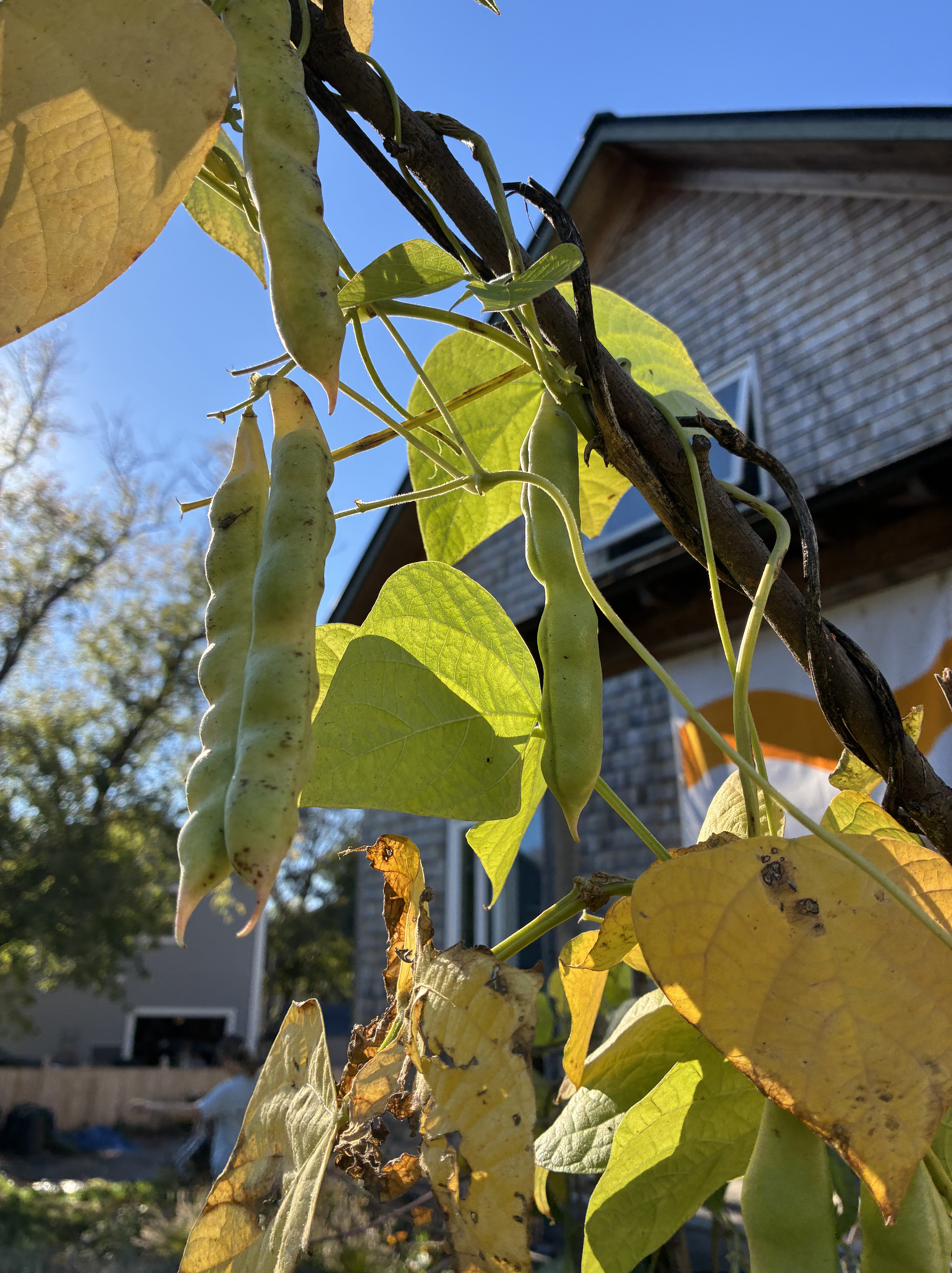
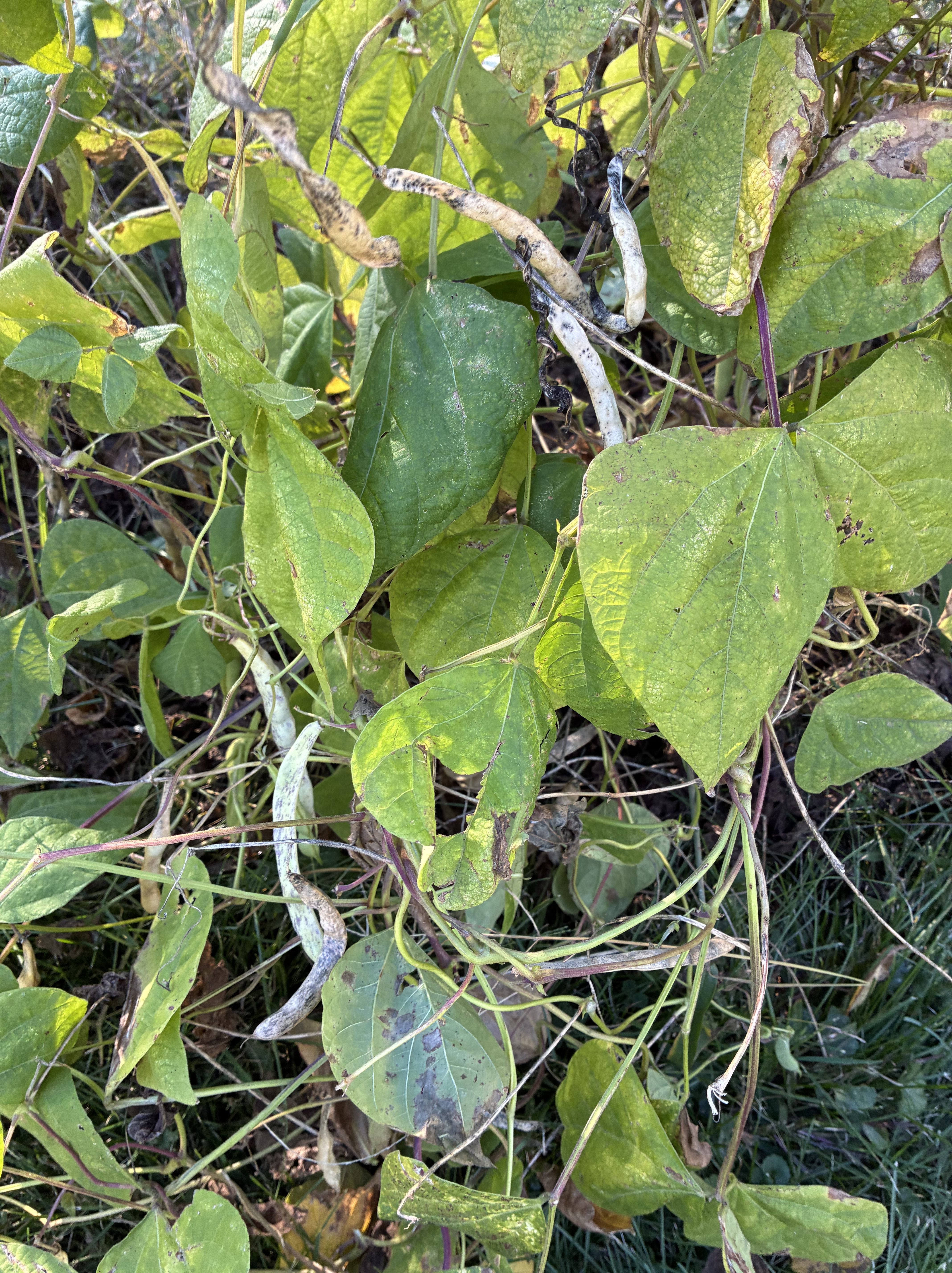
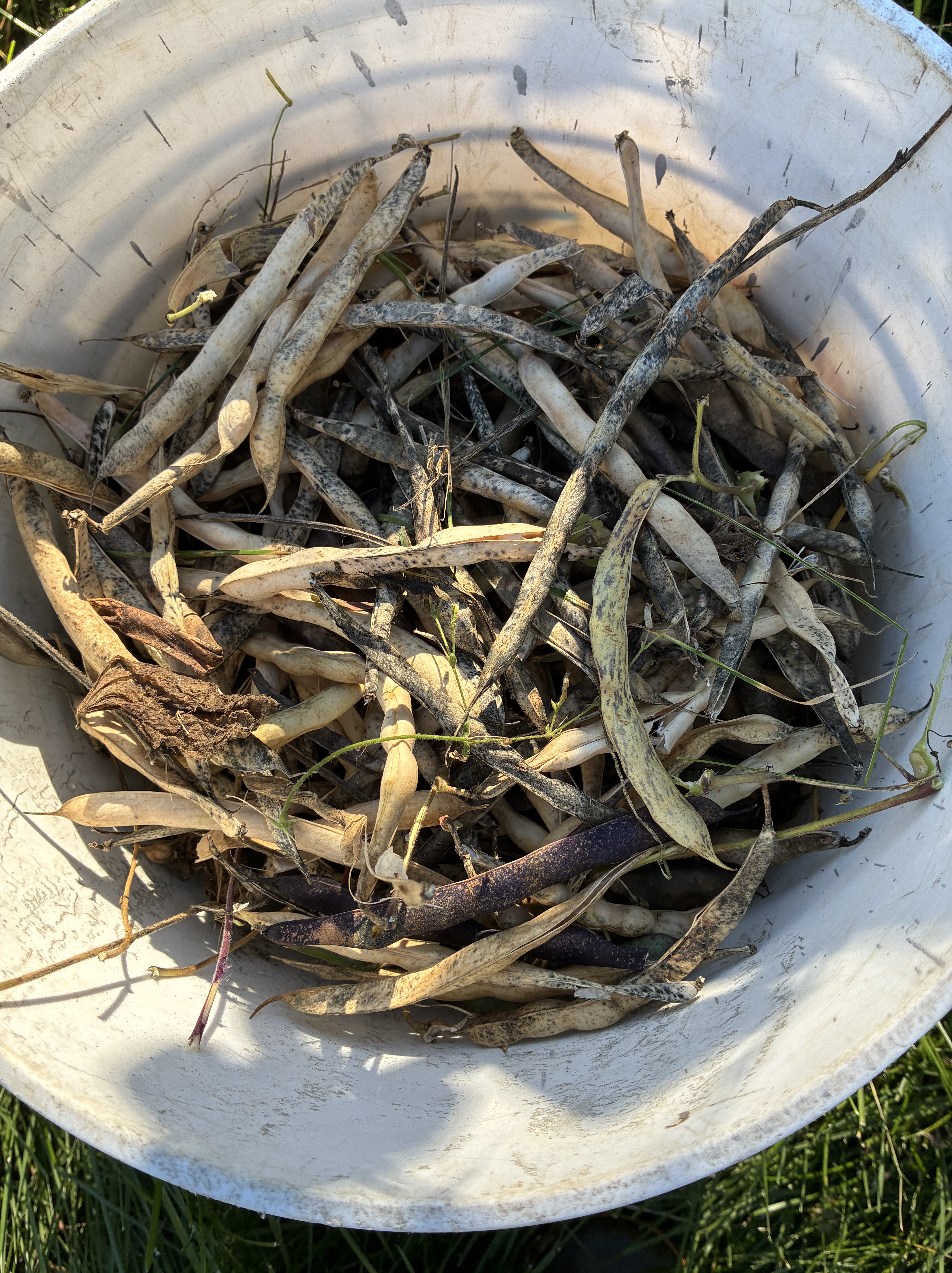
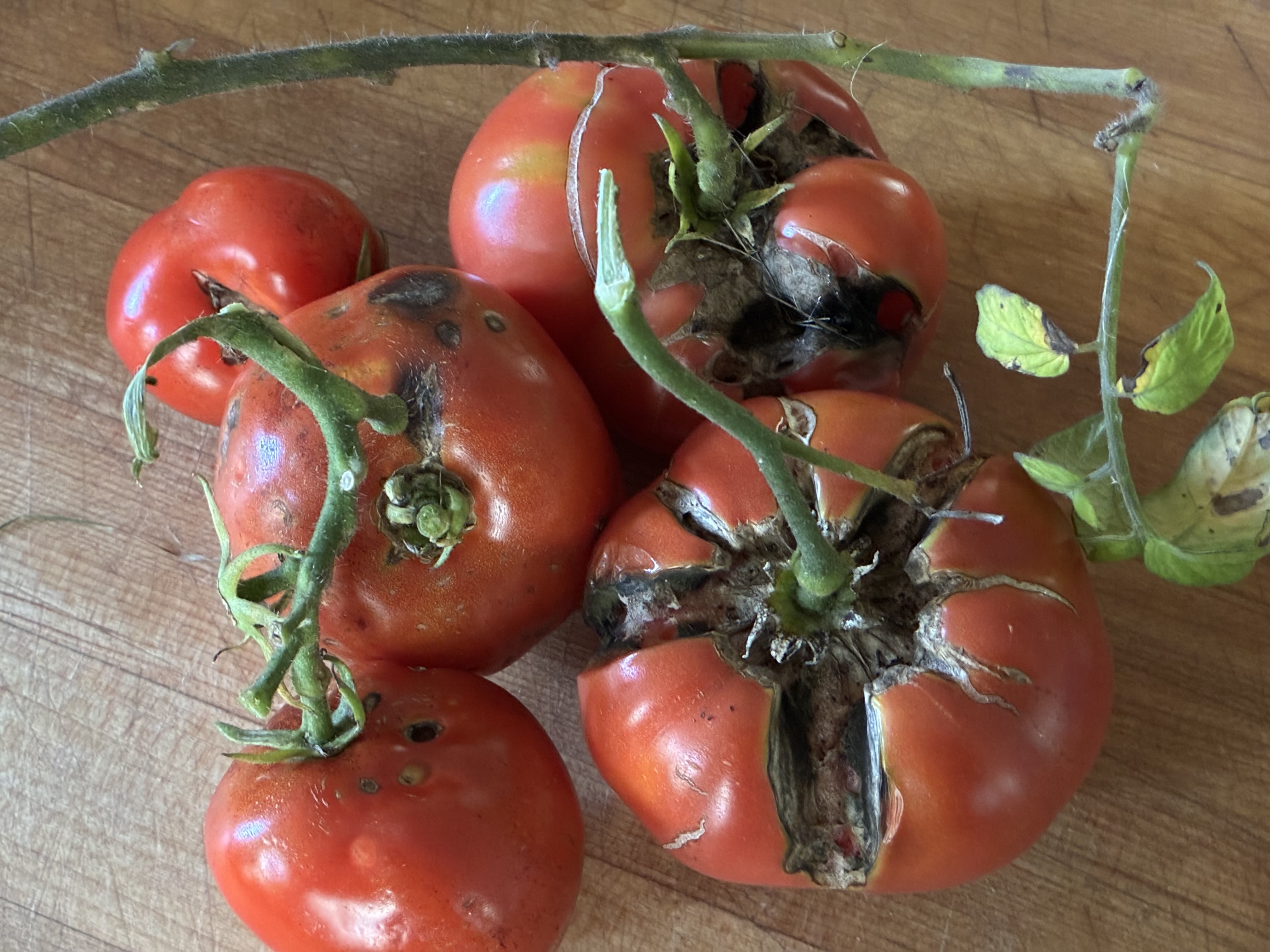
The gardens still produce, though late season. The tomatoes’ last harvest, while an abundance of pole beans hang still on the vine. Garlic shall be planted later this month, after the first frost.


A “proper divisor” of a number is any positive factor excluding the number itself.
Proper divisors of 220: 1, 2, 4, 5, 10, 11, 20, 22, 44, 55, and 110. Sum=1+2+4+5+10+11+20+22+44+55+110=284.
Proper divisors of 284: 1, 2, 4, 71, and 142. Sum=1+2+4+71+142=220.
Because the sum of 220’s divisors equals 284, and the sum of 284’s divisors equals 220, they “love” one another in the Pythagorean tradition. Of note, 220 and 284 was the very first pair of amicable numbers discovered by the Pythagoreans, who viewed them as a symbol of friendship.
An Octave corresponds to a ratio of 2:1. Raising a frequency f by an octave doubles it: Octave=2×f=2f.
A Perfect Fifth corresponds to a ratio of 3:2. Raising a pitch by a perfect fifth multiplies its frequency by 3/2 =1.5f.
Combining them: To go up an octave and then a perfect fifth higher, multiply the frequencies sequentially: Frequency=f×2×3/2 =3f.
The interval of an octave plus a fifth (a twelfth) vibrates at exactly triple the frequency (3f) of the fundamental tone. This embodies the Monad (1) expanding through the Trinity (3).
The Edge of the Map
Posted: October 2, 2026 Filed under: Child Centered Activities, What is an Art Farm 1 Comment
Our 8th grade year begins well, with confidence. In late August, before we began, I mentioned to my son that the Latin language will be included, to which he concurred. I told him there will be four days of Language Arts classes to which he replied, “I’m good with that!” I let him know we would focus on the language to get started, then add in science and math. He seemed quite good, even upbeat.
The Magister had felt that Latin would appeal to my son’s orderly mind, while deepening grammatical understanding. The Magister wasted no time in getting started, and time management has been a focus; our goal is not only to learn, but to use time well and productively.
Early on, my son arrived 2 minutes late for class. The Magister pressed him, emphasized he should arrive 2 minutes before class. Pausing for emphasis, he explained, “Our culture is all about distractions. We are fighting that tide. I want you to know when you see me becoming a bear it is for the reason to help you master your use of time. When we get to the end next spring, and you have finished the Latin book, you will say ‘I am somebody that I wasn’t last fall. I can do things I could not do then.’ That is why I am a bear on punctuality. You will be far ahead of everyone else.”
And so my son learns Latin, which communicates meaning through word endings, rich in grammatical meaning using case, number, gender, tense and person. English follows a strict subject-verb-object order, using prepositions and auxiliary verbs to clarify relationships. Latin has five cases (Nominative, Genitive, Accusative, Dative, Ablative) while English has three (Nominative, Accusative, Possessive). The difference is significant, and reveals how different cultures organize reality.
The Magister is firm, fair and demanding. My son is required to conjugate verbs, inflect nouns, determine phrases adjectival, adverbial or prepositional; learn the English derivatives for Latin words, use Roman numerals to cite historic dates such as when did the Roman Monarchy begin, or in what year and century did the Roman Republic end?
Pronunciation is practiced, with syllabification and correct accent on the antepenult, penult, or ultima syllables. The “r” sound is a trilled alveolar, somewhat like a snarling dog, what ancient grammarians referred to as “the dog letter.” Cursive handwriting is taught, both in English and Greek. The learning is multi-sensory: sight, sound, speech, and muscle memory. Rigorous it is – I am challenged to assist – but all proceeds well.
My son’s translations are charmingly literal. “Mars Rheam Silviam amat” is translated “Mars, the god of war, Rhea Silvia loves.” “Amulius Rheam Silviam vinculis claudit” becomes “Amulius Rhea Silvia with chains locks up.” He is literally capturing the Latin word order, rather than converting it into the subject-verb-object of English. Those differences open worlds of perception; every culture’s understanding of the world is different, and none are superior. In a world increasingly argumentative and combative, humility is a significant lesson.
Chinese does not have future tense verbs, but uses helping words to establish “time when.” In Urdu/Hindi, KAL (short a) means both yesterday and tomorrow, PARSON means both day before yesterday and day after tomorrow, TARSON is three days out while NARSON is four days away. The past and future are simply a direction from “now.” English forces us to say which direction (yesterday versus tomorrow) but Urdu/Hindi express that using context and verb tense.
Some languages conceptualize time as a flow moving toward you, others that you move through time, but for Urdu/Hindi proximity to “now” matters more than which side of “now” you’re on.
Albert Einstein once commented, “People like us, who believe in physics, know that the distinction between past, present and future is only a stubbornly persistent illusion.” Grammatically speaking, his was a profound truth.
While learning his Latin, my son also works through the classical grammar of English; toggling back and forth stretches and strengthens a limber and keen mind. Our homeschool’s approach is “both/and”, which underscores that “reality” is not fixed but fluid, not absolute but perceptual. Intellectual humility is a trait of the wise.
English allows a vague, unclear relationship to knowledge, while many Amazonian languages require the speaker to state precisely how something is known: did you see it, hear about it secondhand, infer it, or dream it? One must specify “it rained (I saw it)” or “it rained (I’m told)” or “it rained (I woke up and the ground was wet, so I infer).”
If time is an illusion, then space has myriad understandings. Australian Aboriginal and some Balinese and Mayan languages have no words for “left” and “right” relative to the body; cardinal directions are used for everything (“move your cup a little to the north-east,” “there’s an ant on your south leg”).
Word order in English is essential to meaning (“the dog bit the man” vs. “the man bit the dog”) but Latin opens vast and varied opportunities for emphasis, rhythm, and rhetorical impact. The titans among Latin authors – Ovid, Horace, Virgil for poetry and Cicero and Tacitus for prose – wrote literature that influenced European authors for millennia.
I mention none of this to my son.
I leave him to his studies, trusting the grammar itself will open worlds. It seems to be working. Recently while doing his school work, his voice cried out, “I really like having the Magister as a teacher. I really like learning what many adults do not know. I like knowing something my classmates do not study.”
It is a paradox, but to learn a language deeply is to see the edge where the verbal “map of understanding” is one-off from life, itself, where that plays out. Essentially, my son gains insight to the limits of language.
Dorothy Sayers, a paragon of modern classical education and homeschooling, wrote in 1948, “…the incessant battery of words, words, words. [Students] do not know what the words mean; they do not know how to ward them off or blunt their edge or fling them back; they are a prey to words in their emotions instead of being the masters of them in their intellects.”
Aldous Huxley, a towering man of letters, author of Brave New World, described the student of languages, “He will be wiser but less cocksure, happier but less self-satisfied, humbler in acknowledging his ignorance yet better equipped to understand the relationship of words to things, of systematic reasoning to the unfathomable Mystery which it tries, forever vainly, to comprehend.”
We pursue the mystery. Grammar is our means to that end.
What Huxley described as, “…to cut holes in the fence of verbalized symbols that hems him in” the Magister has compared to “dwelling closer to that border and hem of all languages, beyond which lies…but a purposeful illusion.”
In an essay titled, “Learning Another Language” the Magister wrote:
The language we each are raised up with is truly our world, but if we take the trouble to learn a different language, we travel to another place, remaining ourselves in our central awareness of being, but dispossessing ourselves of all the peculiar ways of seeing the world which our first language determines and restricts. For when we name some object or event in our world (and what is language if not a collection of names), we make something what it is by saying in effect what it’s not. That’s a coffee cup next to me there, so don’t think its anything else. I’ve rationed it off, sectionalized it from the rest of experience by virtue of that word cup—and that is what we mean by a rational world: clear-cut and defined, permanent and explainable, reliable and real.
All that definition and permanency could very well be an illusion—not a delusion, but an illusion, a playing at (the original meaning of the word).
But that is what language does and must do: set the world up as a stage, believable for a time, but thankfully not believable always. And if we can command, to some working degree at least, another language, modern or ancient, we get a ticket to go to another play and see how those actors, those nouns and verbs and all they do together, make appear real what surely—just look around—will not last. All the world’s a stage, said, of course, Shakespeare, and all the men and women merely players. There is no performance without language, and every language will perform the world differently. So another language is another conceptual costume whose colors and folds and decorative buttons give us another character to watch—or even to play ourselves—while we look day by day for the really real.
My son does his work in the computer nook that he built. He made the measured drawings, we cut the wood, he sanded and varnished it, drilled the wire management holes, installed the brackets. He does his studies there, quiet some time, humming and chirping loudly at others.
I call out, “Hey, how is it going?” He calls back, “Going well. I have one more assignment.” He studies his declensions, learns his vocabulary, builds his sentences, dials in for his classes on his own. The focus on time management is paying off, his study paying dividends, his pride in “learning what many adults do not know.”
A grammar of being.
Our 8th grade is learning the Mystery.
And the Magister keeps it grounded, “See you at 9:58:00 ET Thursday. (0 seconds). Remember that the morning before class is only for review, not study.”
Gus
Posted: September 25, 2026 Filed under: Child Centered Activities, Portfolio - David's work, What is an Art Farm 2 Comments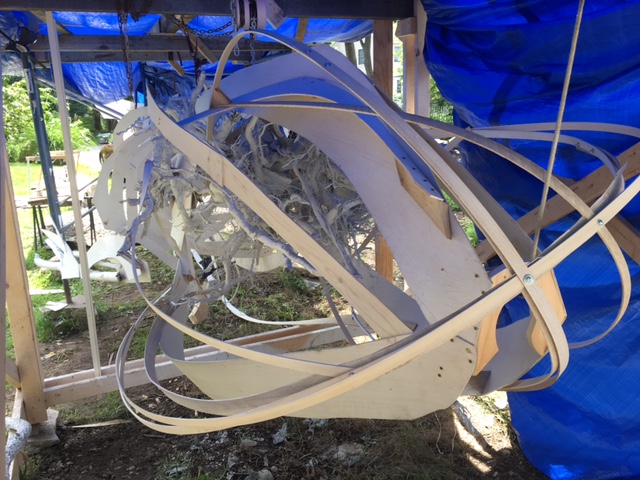
Framing a house rests upon its foundation. Building a whale does not. The whale will be too large to work in my workshop so I need to work outside. I need a series of crates from which to hang the whale, with enough room to work, all of which will be put upon wheels but narrow enough fit through exhibition doorways.
Industrial pipe staging seems an ideal solution but will not allow enough space for the head. Using dimensional lumber – 2x6s for the base, 2x4s for posts – I build a custom crate and double reinforce everything for stability. Weight is less my concern than stability during transit. A pair of 10 foot 2x4s goes on each side, diagonals crisscrossing to prevent the crate from racking.
Plates are installed in each corner where heavy duty casters will be attached when it comes time to move and install the piece. My crate’s dimensions are governed by the entrance doorway of the Bigelow Laboratory of Ocean Sciences. There is no margin of error.
On top of the structure I set an old barn beam – rugged, stout, strong – from which the entire head will hang during construction and every road trip. What I don’t know is that between all the installations, including time in storage, the crate will be in use for more than five years. What I do know is that it needs to be rugged.
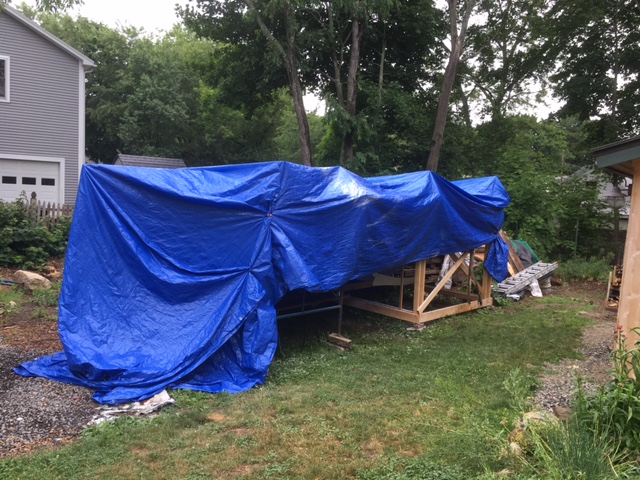
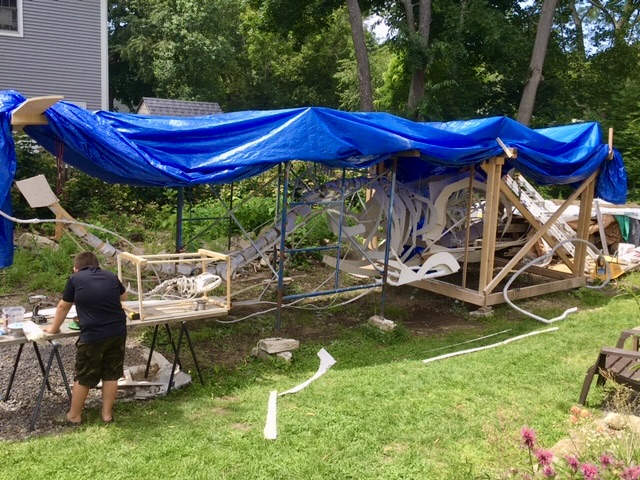
As the sculpture grows, I will assemble a section of pipe staging, 5’ wide by 6’ tall by 7’ long, and spacing the staging a few feet behind the crate, will have a rectangle, about 20 feet in length, inside of which I will work. Planks and boarding – a very simple roof – go on top, upon which I lay a blue tarp, 20 feet by 40 feet, to cover the entire workspace. The studio is basic, watertight, and sufficient. We begin.
The Maven spray painted the root ball and trunk white. It is a surprising choice that moves the materials away from tree closer to his “right frame of mind.” The next task is finding the tipping point, from which the rootball/mind will hang. Engineers use a complex calculus of mass, torque and equilibrium to find the center of gravity. The Maven centers himself, goes quiet, then grabs my drill and a 1/2” boring bit and pulls the trigger. Once the hole is bored, we attach an 11” eye bolt with lock washer to the rootball/mind. Together we hoist it up and hang it from the scaffolding.
Next we begin making the skull. As a whale is not a house, so its skull is not like other mammals. Its skull is something majestic. A whale lives in water so gravity affects its skeleton differently than land-based mammals; buoyancy lifts the whale while gravity pulls down upon land animals. The whale’s face and forehead bones telescope as they move backward and overlap. The upper jaw bones taper forward into the snout. The nasal openings move to the top, not the front, forming the blowhole. The ear bones are detached, acoustically isolated. That complexity belongs to the Maven.
He grabs two sheets of 1/4 inch plywood, painted white, and draws a series of non-Euclidean shapes. I take my jigsaw and cut them out. Using the scraps, he draws several more shapes which I cut out. In short order we have our bones, more or less: mandible, maxilla, premaxilla, supra occipital, exooccipital, basioccipital, frontal, squamosal, nasal and tympanic bulla.
The whale root ball/mind hangs at a comfortable working height. During COVID people are encouraged to keep a 6 foot distance, but building inside my crate we enjoy no such luxury. We are outside, on a perfect early July day, and have work to do.
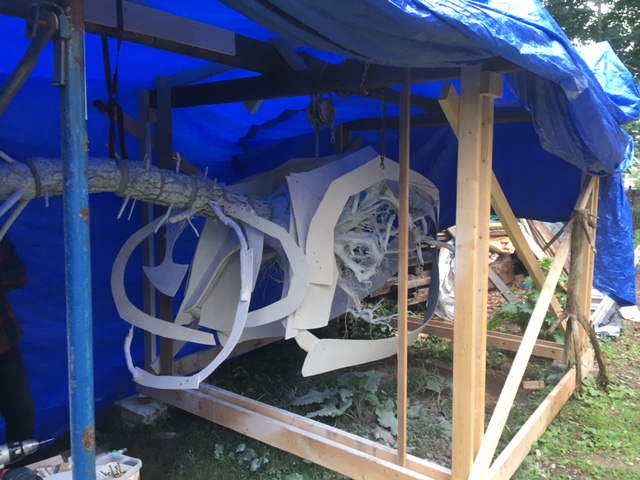
The bones by any name I need to assemble, creating volume in space around, but not touching, the root mind. This is an immense puzzle. When I was a child, a classmate in the 4th grade told me that his father was building a house from the top down. How wild, I thought! It always puzzled me why I remembered that but clearly, it was a premonition of this project: I am building the whale skull from the top down. I have no foundation upon which to frame and the root balls tangle of roots allows no purchase upon which to build.
It is July, peak of the summer, and sour cherries come ripe in our orchard. The Maven wanders off to sit under the Montmorency pie cherry tree. He plucks cherries and gazes off into the distance. Inside my cube of space I am alone, on my own.
Chuang Tzu comes to mind. In his famous story, Cook Ding carves an ox for Lord Wenhui by following the Dao, moving through the empty spaces between the joints, “as though he were performing the Dance of the Mulberry Grove or keeping time to the Jingshou Music.” As a young chef, Ding saw only the mass of a whole animal. After three years of practice, he saw it as parts, not mass. Now, his inner spirit guides rather than physical eyes.
In a moment the solution arises: gussets. A gusset is simply an extra piece of material, added to give more space and strength. They are found in clothing, bags, envelopes and construction. For the skull the gusset solves the question of rigid form. To each of the Maven’s various shapes I attach cleats, using 3/4” stock and wood screws. The cleats can be sculptural in shape. What matters is they are a bracket, mass, attached to the left and right hemispheres, to which I can attach the gusset, “the extra piece of material.” I don’t need specific dimensions. The maven can hold the skull bones, then I can mark the gusset length, cut and sand it, then screw it into place.
During the afternoon I busily build cleat blocks which I attach, then secure using the gussets. The skull is a triangle, narrow above the rootball/mind but wide below. The rear is broad, the front narrow. The maven wants curving shapes for the jowl, which is easy given the flexibility of 1/4″ plywood. I simply cut those pieces longer, then bow them back into place. I have given structure to form.
It works remarkably well. So well I name the whale “Gus.”
Once the skull is assembled, the Maven returns and explains he wants bands surrounding the assembly in space, “like gyroscopic things.” We are using foraged materials and he has some boards, so I rip long thin pieces, 8 feet long by 1 inch wide by 1/16 inch thick. I can bend these easily, and gluing two layers together adds considerable strength. Nothing is structural here, and I can pin them discretely to the mandible using 1 inch #8 panhead machine screws, with washer, lock washer and acorn nut; the assembly arcs up, out, and around, creating complexity and mystery.
The Maven explains, “I want abstract decisions, not the idea why, organic decisions by geometric solutions. The “gyroscopic things” …what are they? Without those Gus loses complexity, and that complexity relates to what a whale is, to what a tree is, what anything is. I want a level of complexity that then feels alive.”
All I know is that we are on a roll.
Red Grooms is an American multimedia artist known for colorful kinetic constructions, using sculpture and painting, to depict hyper-detailed scenes of urban life. The Manhattan art critic G.R. Swenson described him as one of a generation of artists who, “took the world too seriously not to be amused by it.” An absurdist impetuous energy, rich with Marx Brothers’ puns, inform his constructions, which can fill up an entire Manhattan loft or office lobby. His work is legendary. He has been referred to as “a movement of one man that is open to everybody.”
In September 2017 Portland’s Artists’ Rapid Response Team staged a “Codfish Funeral” procession down Congress Street, through the Arts District during one of the First Friday Art Walks. Combining moving projections of water and codfish with live music and dancing it was an artistic response to the dwindling populations of the Atlantic Cod.
Among the artists was one woman, a force of nature, whose name is Anna. She was already familiar with Red Grooms work, and saw the opportunity to combine multimedia with science to raise awareness to the warming temperatures in the Gulf of Maine. She framed the problem in terms of an ecosystem rather than economics.
She worked with science teachers to reach more than 200 students at 16 schools, elementary through college level, in Southern and Mid-Coast Maine. Her idea was simple, which she leveraged through scale and reach.
In 2020, just as the COVID shutdown began, the Bigelow Laboratory for Ocean Sciences asked her to host an exhibit. Nick Record, a senior research scientist at Bigelow became a key ally, “I think both scientists and artists are trying to look at the world through new lenses and show the world in ways people haven’t seen it before. Curiosity and discovery, trial and error, and creativity are essential, whether you’re a scientist, an artist, or somewhere in between.”
The Force of Nature contacted the Maven and proposed the “Majestic Fragility” idea and asked him to build a whale’s head. The Maven did not like her idea, and countered with something else, larger, a complete whale. She agreed. He made a model. She raised the funding. That is where I stepped in.
Because this is COVID, all of the artists work in isolation. Each artist has some component of the ecosystem, but no one will meet, until everyone gathers to install everything at the Bigelow Laboratory. Each artist has one specific component and the ethos is to use foraged or recycled materials. In the Red Grooms spirit, the energy of many colorful parts allows each artist latitude so that the whole will read as one, the individual parts subsumed into the collective.
The idea of foraged and recycled materials relate back to the ideas of Wendell Berry, the American novelist, poet, cultural critic and farmer. “There are no sacred and unsacred places; there are only sacred places and desecrated places. My belief is that our life and the world in it are conditional gifts,” he wrote. Life and existence as gifts, freely given not earned, and we do not “own” the earth but are mere temporary inhabitants. From this view the fisheries are not merely an economic input but part of an integrated ecosystem, entrusted to us on the condition of responsible stewardship. Fighting words to some, but common sense to many; the Force of Nature and her collective are using art to encourage dialogue.
Work on the whale skull proceeds well and we prepare to build the spine. We cut the white painted tree trunk into sections 8 inches long. I bore through each, a not easy task, to allow a 1/2 inch threaded rod, 5 feet long, to pass through. Between each section a smaller disc, cut from a narrower trunk, will be placed, like cartilage. The threaded rods are bendable, the trunk vertebrae strung like garlands on a bough.
The maven’s model rests on a table next to my cube of space workshop. The model gives us reference, but the whale as built becomes its own sculpture. Each vertebrae has small paddle-like pieces attached; odd shaped 1/4” plywood with a dowel attached to pin them into place. The thoracic vertebrae near the skull need ribs forming a cage to protect the heart and lungs. An assembly of curving 1/4” plywood pieces frame the rib cage nicely.
The assembly gets less complex, more narrow as it tapers further down the spine. Each five foot section has a coupling nut with an eyebolt attached at its end. We connect each 5 foot section by a lag bolt with hex nut. Common hardware store items source our materials. We can easily detach each 5 foot section when we move the entire whale.
Overnight rains come. As I lay in my bed I can hear the raindrops on the tarp, and repeatedly at 2am go outside to push the tarps up, to remove pooling water. Gus cannot get wet. It becomes a nightly ritual, which almost seems like a benediction; rains fall gently as Gus readies to move on.
The tail assembly is an exceedingly complex challenge. A whale’s head and its tail are dominant features, so the tail, which technically is a fluke, needs visually to balance out the head. I will secure the fluke to logs on the threaded rod so I first need to figure out how to stabilize it, so it does not rotate. To the maven, I leave the question of width that scales with the head.
Cleats screwed to multiple vertebrae, along the curving spine, will lock the fluke in place. The maven, of course, sees the fluke not as one mass, but as three separate pieces, each at different angles and shapes. Gussets again allow me to create volume in space. The assembly is both not a whale fluke and a whale fluke.
The remaining tasks proceed easily. Using birch logs and random shaped plywood we build two pectoral flippers, the short, broad paddle shaped fins on the side. We attach them to the skull assembly and hang it in space using 1/8” aircraft cable and ferrules.
The final step is more of the “gyroscopic things” for another dash of complexity along the spine. Bittersweet is an aggressive, woody invasive vine in Maine that is a bane to gardeners, but a boon to the Maven. He has foraged long lengths of it, which we attach like garland adorning the spine. Two pieces of bowed 1/4” plywood 4’ wide are attached from the tail to the sternum, adding more volume to the sculpture.
By late August we are wrapping up Gus, four months of work from the aggregate yard to completion. My commission is to build “head scratching wonder and irrational decisions.” By unanimous consent, in collaboration we have achieved that.
We are ready to rent a 25-foot box truck and take the show on the road.
__________________________________
Editor’s Note: Although this story is told using present tense verbs, the whale was actually built in the summer of 2021. The “Majestic Fragility” exhibit was on display at the Bigelow Laboratory of Oceanic Sciences through summer of 2022, then was moved to the Maine Maritime Museum for the “Sea Change” exhibit from February 2023 through 2024. It was moved to Bangor, where the exhibit is expected to become a permanent installation at the Wabanaki Public Health & Wellness center.
Place
Posted: September 4, 2026 Filed under: Child Centered Activities, consciousness, Permaculture & Home Renovation 1 Comment
“Place is the first of all beings, since everything that exists is in a place and cannot exist without a place,” Archytas observed, a Pythagorean mathematician, as recorded by Simplicius, the Neoplatonist. As a Pythagorean, he saw the kinship of all beings, a fundamental spiritual connection shared by humans and animals.
Niels Bohr, the pioneering Danish physicist who made foundational contributions to understanding atomic structure and quantum theory, then won the Nobel Prize in Physics in 1922, stood at Kronberg Castle in Denmark, in 1924 and, with a colleague, mused on place:
Isn’t it strange how this castle changes as soon as one imagines that Hamlet lived here? As scientists we believe that a castle consists only of stones, and admire the way the architect put them together. The stone, the green roof with its patina, the wood carvings in the church, constitute the whole castle. None of this should be changed by the fact that Hamlet lived here, and yet it is changed completely. Suddenly the walls and ramparts speak a different language. The courtyard becomes an entire world, a dark corner reminds us of the darkness of the human soul, we hear Hamlet’s “To be or not to be.” Yet, all we really know is that his name appears in a 13th century chronicle. No one can prove he really lived here. But everyone knows the question Shakespeare had him ask, the human depth he was made to reveal, and so he too had to be found in a place on earth, here in the Kronberg. And once we know that, Kronberg becomes quite a different castle for us.
To an American, this is a striking insight. To the Western Apache, it goes without saying.
Keith Basso was a cultural and linguistic anthropologist whose career was spent with the Western Apache, specifically the community of Cibecue, Arizona learning their reverence for place. He explains, that to the Apaches of Cibecue, “the past is a well-worn ‘path’ or ‘trail’ which was traveled first by the people’s founding ancestors and which subsequent generations of Apaches have traveled ever since.” Over time this path is no longer visible. The past has disappeared, and so it must be reconstructed through place-names, stories, and songs.
The place names, markers of culture, use specific identifiers to preserve not only the words of the ancestors, but graphic impressions: “Two Old Women Are Buried” (a hill); “Lizards Dart Away In Front (the eastern face of a mountain); “She Became Old Sitting” (a cornfield); “She Carries Her Brother On Her Back” (a steep slope).
The names offer evidence of change over time, shifts in climatic patterns, even change in the face of a geologic constant – all finding expression in the Apache place-world. Their names carry resonant cultural meaning. Life has meaning because it is rooted in place.
American exceptionalism knows nothing of such grounded sense of place.
The “Big Apple” is named not because of an old orchard but the big prize money at race tracks in and around the former Dutch colony. Thoroughbreds bridled and broken to race for the prize, to earn riches for the owners. “West,” a town in Texas, is in the north/central region of that state, named for its original Postmaster. “Poland” was a favorite song of the first settler of that town in central Maine, while “Rocky Mountain” North Carolina lies 1,800 miles east of the Rocky Mountains, 400 miles east of the Smoky Mountains, on the fall line between the foot hills of the Piedmont and the low flat coastal plain.
Our culture lives upon, but not with, the land.
Land is our commodity, a contract to be bought, sold and fought over; divided for its spoils, left then on its own. Manifest Destiny was our clarion call, ordained by God, of which the self-certain settlers reassured themselves as they staked their claims.
The Atlantic coast became crowded, gold discovered in Georgia, so five highly civilized cultures were forced to walk west, under US Military escort, on the Trail of Tears. The vast lands beyond the Appalachians beckoned Anglo immigrants, who flooded west to stake their claims.
Wagon trails became paved highways, and the great American road trip was born, the right of everyman to go-go-go on a quest for spiritual freedom, rejection of post-war conformity. “There was nowhere to go but everywhere, so just keep on rolling under the stars,” wrote Kerouac, but racing at 70 miles per hour in search of everywhere is to know nothing of anywhere: no place, and no poetry.
Eventually that immense physical space became filled. Within our lifetime another frontier emerged – the internet – and now data centers consume place and power to drive AI’s limitless consumption of energy. Soon some will begin to colonize Mars, our insatiable need to dominate and take, onward, to “go where no man has gone before.”
The Wendat (Huron) or Iroquoian word Ontarí’io or oniatarí:io, which translates to “great lake”, “beautiful lake”, or “lake of shining waters” has been arbitrarily renamed in honor of an explorer and navigator from Florence, Italy.
A capricious act, how unserious we are.
And this was done not by the will of we the people, but unilaterally by one man’s ipse dixit command.
An uproar ensues. Maps will be changed, at considerable cost, while others promise to defy the name change. But a political fight seems impotent, just two sides of the same coin: place as object.
To our ongoing detriment we ignore our own relationship, and our ancestors’ relationship, to the earth that nurtures and supports us. How little we know, and how much less we understand, about place: the kinship of all beings, a fundamental spiritual connection shared by humans and animals. “Place is the first of all beings….”
Such has been the daily news, as eighth grade resumes and my son and I prepare to dig in the dirt.
The applied soil science class shall resume as a meditation upon place, the biology, chemistry and geology that under pins “the darkness of the human soul” which can open, through understanding, to the light. For history, we can study Manifest Destiny as collective myth, the guiding story of American civilization.
We will approach place with a renewed vigor, as a counter balance to the mindless news of the day, the aggressive taking, names that mean nothing but ego.
We will dig in the dirt.
And perhaps, in doing so, learn again where we are.
Ignorance or Arrogance
Posted: July 31, 2026 Filed under: Child Centered Activities, Chronicles of a First Time Parent 2 Comments
When I was a boy, a common saying was “A man’s word is his bond.” I haven’t heard that spoken in decades. Today we speak of fake news, deep fake AIs, identity theft, accusations of fraud, corruption and cover ups. We liberally condemn each other with name calling like a grade school playground, but to speak of integrity seems increasingly uncommon. Our culture, it seems, wants to fight to the bottom.
Talk is cheap but we are accountable. Actions have consequences. This week’s homeschool lesson was a moral equivalent of Newton’s Third Law of Motion: every action has an equal and opposite reaction. Rather than give my son a lecture, I bought him a chain saw. My goal was to teach personal responsibility not as an abstraction but as a tactile physical experience.
I was not qualified to teach this class. My father was a wordsmith, who didn’t know a hammer from a nail; his tool was a typewriter and thesaurus, with which he was exceptionally skilled. He and I never bonded over power tools. I learned use of a chain saw through on-the-job-training: “this is the brake, here is the trigger, hold it like this. Go.” With a chain saw I am competent, but most certainly I have no command. I would have been pushing my limit to teach this course.
Often a boy learns best from an unrelated teacher, so I hired a journeyman; a 240 pound, 6 foot 3 inch tall, tattooed, muscular, shaved head white male who grew up on a homestead in the woods of New Hampshire. He has been using a chain saw since he was ten. A carpenter by trade, his skills are many, including plumbing and electric, a licensed firearms instructor, with training as a field medic. A published author, he is “The Everything Man.”

He required my son to buy and wear personal protective equipment: a helmet with face screen and ear protection plus chaps to protect his legs, steel toed boots and gloves. The class began at the back of his pick-up truck where an array of tools were laid out: a camp axe and a felling axe, his handmade bow saw, a machette and two gas powered chain saws. My son has an electric 16” chain saw and a pole saw.
A chain saw spins between 12,000 and 14,500 RPMs at full throttle, which is more than 6 times the RPM of an airplane propeller. You must respect that the blade will cut you down in an instant. During a brief opening lecture the Man explained that mistakes are caused “by ignorance or arrogance.” On the one hand is the lack of information, knowledge or training, while on the other is an excess of pride, a lack of respect for the tool. The class was designed to avoid the first problem, while the teacher’s humble honesty addressed the second.
Dressed in his protective gear, my son and the Man walked to the backyard to cut down a rotting maple tree. It is located outside our fence line, beside the sidewalk along a busy road. I had asked the town to take it down, but the arborist replied that it was our responsibility, and, once brought to his attention, it was on his list of trees to watch.
The trunk is thoroughly rotted. One large section fell years ago – before we owned this house – while the remaining branches reach over the fence, stretching almost thirty feet into our back yard. One large limb, about 14” diameter, grows straight up and becomes enmeshed in branches of other trees. This tree was a challenge, a lesson in strategy and gravity.
My son could use the pole saw to reach the lower limbs, but he needed to be mindful of where the limb would fall and then stand behind that. By cutting from above, the branch would fall down and his saw would not get pinched. A saw can get pinched, though, and that can become a serious issue. I was once cutting down an invasive maple, 8” diameter and 40 feet tall. A friend was holding a rope to pull the tree, but the rope was not firm enough and as I cut deeply, the tree swayed back pinching the saw. The saw could not cut, nor could I remove it; a frighteningly serious problem. I knew you cannot leave a tree halfway cut through the trunk. But I had no axe. I had ignorance. But thankfully, I had a neighbor who knew what to do, had a tree rope and chain saw, and saved the day. The Everything Man ensured my son learned from my mistake.

Once the limbs were on the ground, my son was handed a razor sharp machette and taught how to swing that blade, to slash cut away the smaller limbs, removing the clutter before using the chain saw. There is a logical process, moving from the smaller branches to the larger end, when cutting for firewood. The 16” blade equals the length of logs usable in our wood stove, and my son was shown how to use the blade as his measuring stick, for cutting to length. This work went quickly, but the tree was so rotted, we gained little useable firewood.
An electric chain saw is surprisingly quiet, while gas powered saws are ferociously loud and aggressive, commanding immediate respect. Its raw power leaves no room for carelessness.
The final exam came when The Everything Man got out his gas powered Stihl chain saw. He reviewed all the features, then handed it to my son. In learning how to handle such a powerful tool, my son grew in confidence. He experienced what it meant to command his tool, making each cut under his control. This lesson of accountability was a direct physical experience, not theory, not logic, not gaming online.
That one limb, 14” diameter, growing straight up into the canopy above, we left in place. That requires an arborist who can climb the tree, using tools beyond what we had. It would have been ignorance or arrogance, or both, to attempt to fell that, so our prudence was its own lesson of setting boundaries.
When the cutting was done, the class returned to the pickup truck, for a discussion about cleaning and maintenance. The Everything Man showed both how to dismantle the saw to clean wood chips from the inner parts, and how to sharpen the blade. It is a slow methodical process, three passes at 30 degrees, essential to maintaining the blade’s sharp edge, which is another form of integrity, of accountability. The teacher gave examples of one chain lasting a lifetime, or needing to buy new chains frequently; the only difference is care.
“Chop wood, carry water” is a maxim of Chan Buddhism, that teaches life is lived through ordinary work, not abstractions. Much about life is repetitive, dull, and unremarkable. Integrity is forged in the care of our tools, the honoring of our words, and the acceptance of responsibility. The chain saw was the lesson this week. I said very little. He repeatedly said “thank you.”


Failure
Posted: July 17, 2026 Filed under: Child Centered Activities, Chronicles of a First Time Parent, consciousness 1 Comment
Here at the Art Farm Homeschool, summertime living is easy, but not idle. We have created a July Book Club, in which the Magister zooms in, via telecomm, to discuss with my son a short story masterpiece. My son’s recalcitrance to join any club with peers, his aversion to leaving the house, his preoccupation with online gaming left us no choice. The book club is only 4 weeks, while summer break is 12, so the balance of time is definitely skewed to his leisure, but this month, like a fulcrum, he will engage in reading and thoughtful discussion.
This week’s short story is “The Egg,” by Sherwood Anderson. The story is set in the first decade of the 1900s in the fictional town of Bidwell, Ohio. The story’s narrator is a young child, and its protagonist, “the Father,” was “a cheerful and kindly man” whose work was idyllic as a farm hand on a pre-industrial farm. Once married, he “became ambitious. The American passion for getting up in the world took possession.…”
Their path to success was to raise chickens, but the venture fails badly. Having lost that farm, they move into town to start over. They borrow a horse and wagon, load their “cheap chairs” and a crate of live chickens, on top of which, like a crown jewel, the narrator’s baby carriage. “Why we stuck to the baby carriage I don’t know. It was unlikely other children would be born and the wheels were broken. People who have few possessions cling tightly to those they have. That is one of the facts that make life so discouraging.”
The father rode on the wagon, while the Mother and son walked the long eight miles into town, “…a tiny caravan of hope looking for a new place from which to start on our upward journey through life.” The scene eerily foreshadows Steinbeck’s “Grapes of Wrath,” when the migrants flee the Dust Belt, traveling Route 66 to the promised land of California. Long is the dark shadow of the American Dream.
Sherwood Anderson revolutionized 20th-century fiction with a probing and unsparing prose. His stories are set during the Second Industrial Revolution, the transition from steam to electricity, from iron to steel, assembly line production, urbanization, corporate consolidation. His core theme was the lonely, isolated individual, whose youthful truth had grown hardened, an unfulfilled longing, struggling for connection.
During the First Industrial Revolution, seventy years before Anderson, Henry David Thoreau railed at the “Iron Horse” of the Fitchburg Railroad, the tracks laid one-third of a mile from his beloved Walden Pond. The deafening roar of industry intruding on his idyll, he wrote, ”We do not ride on the railroad; it rides upon us.” He warned the machines were becoming our masters, rendering people into an impotent servitude, “The mass of men lead quiet lives of desperation.”
From Thoreau to Anderson the Industrial Revolutions had completely altered the American landscape. And yet the American Dream held firm, the myth of upward mobility, that each generation would succeed its parents; the tireless labor of one’s youth to acquire wealth, spent in later years to regain health. “Most of the luxuries, and many of the so-called comforts of life, are not only not indispensable, but positive hindrances to the elevation of mankind.”
As a child, I remember family discussions, at the Kitchen table, about the American Dream. For my generation the realization has been remarkable. Nearly 90% of Americans born in the 1940s and 50s earned more than their parents. Because of compounding asset growth in real estate and an essentially bull market since the 1980s, the Baby Boomers hold over $85 trillion in household assets.
The Third Industrial Revolution, the advent of semiconductors and the internet, unfolded during the careers of we Boomers. Since 1993, when the browser Mosaic was launched, catalyzing widespread access to the world-wide-web, the stock market has surged 3,100% further widening the gap between the have and have nots.
Now the world of algorithms and artificial intelligence represent the Fourth Industrial Revolution, during which my son’s generation, the Zoomers, come of age. It goes almost without question that the American Dream fades, the thought of upward mobility increasingly out of reach, while the mental health epidemic spikes.
A recent study published by the Dove Medical Press, an open access peer-reviewed journal, found that “17.14-24.19% of adolescents developed AI dependencies over time, while studies consistently show that mental health problems predict subsequent AI dependence, with social anxiety, loneliness, and depression serving as primary risk factors.” The isolation that Sherwood Anderson wrote about, and the desolation of which Thoreau warned, have only increased. Jacob Needleman, the high school teacher my son learned about in May, cautioned, “When thought races ahead of Being, a civilization is racing towards destruction.”
My son will not read juvenile fiction this summer. The short stories that the Magister has chosen are considered masterpieces, and their hard edge is appropriate for a young man coming of age. Among his age peers, suicide rates have increased 62% since 2007, with boys having significantly higher rates, while Black youths ages 10 to 17 have increased 144% over the same period.
My son comes of age in a conflicted time, an age of skepticism. Sitting on the front porch, we discussed the American Dream, to which he replied, “That may be what it was supposed to be, but that is not how it is.” He is already aware that the American Dream was, at best, a cultural myth, or at least an historical aberration.
It is a sad irony that bankruptcy is used with increasing frequency by older individuals. According to the Consumer Bankruptcy Project, in the last 20 years, the number of people 65 and older filing for bankruptcy has increased to become its fastest-growing demographic group. We Boomers have enjoyed an economic abundance of historic proportions, but now aging, increasing numbers are falling behind.
At the age of 44 I declared a Chapter 7 bankruptcy. Mine was the good fortune to fail while young, to still have time to start over. I learned that forgiveness lies at the core of civil jurisprudence, and failure can bring a “fresh start.”
The legal doctrine known as the “Fresh Start” came from the 1934 landmark Supreme Court ruling in Local Loan Co v Hunt, 292 U.S. 234, in which the unanimous opinion, written by Justice George Sutherland, reads,
“One of the primary purposes of the Bankruptcy Act is to ‘relieve the honest debtor from the weight of oppressive indebtedness, and permit him to start afresh free from the obligations and responsibilities consequent upon business misfortunes.’ … [It] gives to the honest but unfortunate debtor… a new opportunity in life and a clear field for future effort, unhampered by the pressure and discouragement of pre-existing debt.”
A financial reset is a civil right, but an interior reset is a human necessity. The depth of my experience redirected my life and taught me that the purpose of life is healing, forgiveness a means to that end, which stands in stark contrast to American culture. Jacob Needleman commented, “The root of materialism is a poverty of ideas about the inner and outer world. Less and less does our contemporary culture have, or even seek, commerce with great ideas, and it is that lack that is weakening the human spirit. This is the essence of materialism. Materialism is a disease of the mind starved for ideas.” Our antidote to the isolation that AI and gaming breed is for my son and the Magister to read short stories during July and exchange ideas.
“The Egg” is told from the perspective of the son, as a grown man, remembering his Father’s failures. My son, a keen observer, forms his own thoughts now, which will include his reflections on my failures. His inheritance from me will be moral more than material. My task is to teach him skill with his tools, depth of character, and an informed view on the isolation plaguing his generation. What he chooses to do with that will become his healing story.
My career advice, should he ever ask, shall come from Thomas Carlyle, who influenced Thoreau and the Transcendentalists, “Make yourself an honest man, and then you may be sure that there is one less scoundrel in the world.”
Probably
Posted: June 11, 2026 Filed under: Child Centered Activities, Chronicles of a First Time Parent 3 Comments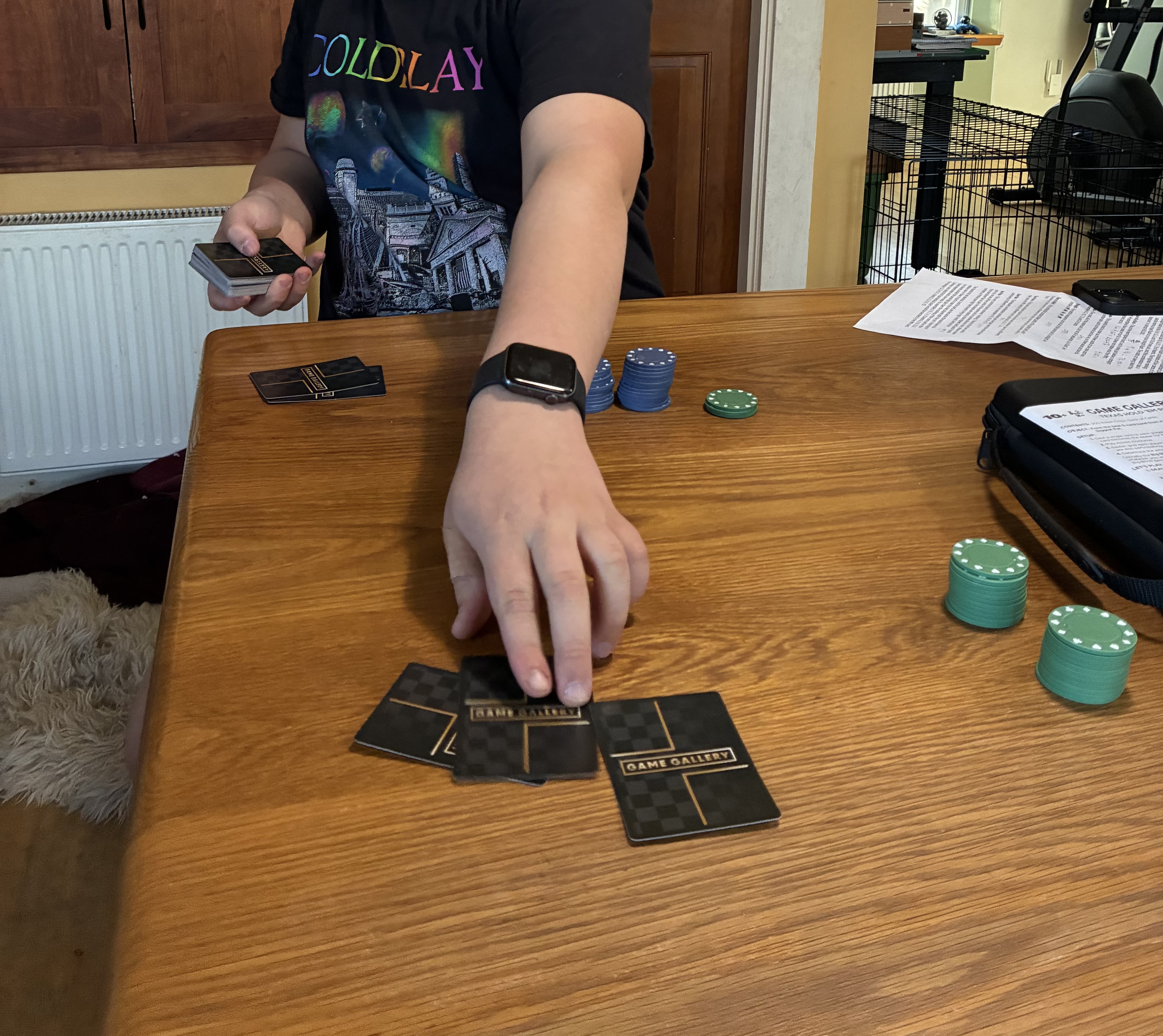
It is probable that teaching my son probability by playing Poker is considered morally degenerate, to some.
But then again, consider the society in which he comes of age: total lottery sales exceed $110 Billion per year, sports betting exceeds $166 Billion, while $391 Billion per year in total is spent on games of chance, a roll of the dice. How then to explain that his great grandfather, in 1918, was unable to borrow money to buy a car because auto loans were considered immoral, debt was viewed as a character flaw, cars were for pleasure not a necessity? Probability is a lesson in history and math.
The word “probability” comes from the Latin root probare which means “to test or prove,” while the word itself is derived from the adjective probabilis meaning “plausible, provable, that may be assumed to be believed.” The Roman orator Cicero built an argument upon that word, rejecting the idea that humans could attain absolute, perfect knowledge, he argued that probabilities were far more practical, politically feasible, a means to move the crowd in your favor. In 15th century Middle English the word was linked to legal credibility until it became a mathematical term around 1718.
I teach the mathematical application here at our homeschool. I am of an age that math properly should be taught using a sharpened pencil on lined paper, not online interactive like a game. I purchased a textbook from a local store. It has served us well, except, more than a few times the solutions were wrong. But even that is a teaching moment. “To test, to prove” teaches my son to question actively, not receive passively, the answers of authority. Textbooks, algorithms, and AI are not settled truth. My son needs to learn to roll up his sleeves, match and raise, have skin in the game.
My son did well on the probability chapter, but the textbook referenced playing cards several times; a noteworthy assumption. My son was unable to answer because he had never played cards. He did not know what was being asked. I was dumbstruck! I ran back to that bookstore to buy poker chips and playing cards.
I easily use equations in my carpentry, but teaching the volume or surface area of a dodecahedron, or a quadratic equation challenged me to relearn long-forgotten theorems. Ours is not the blind leading the blind, but more like the French proverb, “”Au royaume des aveugles, les borgnes sont rois” (“In the kingdom of the blind, the one-eyed men are kings.”)
“Papa,” my son’s Grandfather, on the other hand, is the rare bird who flies high in the world of pure mathematical truth. A PhD in Physical Chemistry/Theoretical Physics, in his first published paper, in 1977, he announced “a very fundamental conceptual error present in the traditional formulation of the entropic force between the ends of a single Gaussian macromolecule.” In other words, the classical theory of the academy was wrong.
His pioneering “Entropic approach to Brownian movement” was published in 1980 in the American Journal of Physics, and is considered the grandfather of modern Brownian entropic force modeling. In Brownian motion a particle’s movement is entirely random, but, connecting pure geometry and probability to thermodynamics, he showed that by measuring the probability distribution of a particle’s movement, there is a measurable intrinsic entropic force.
In his 2001 paper “Entropic Elasticity of Weakly Perturbed Polymers” Papa reasoned:
The probability of occurrence of an end-to-end separation r (r =|r|) for such a chain is described by r2P(r), where P(r) is the normalized field-free end-to-end distribution function, b3π−3/2exp(-b2r2) for r << Na.
From r2P(r) one may determine the standard deviation or dispersion (σ o) in r and compare it with the average value of r for a freely orienting chain not subject to an external force. σ ο 2 = <r2>o – (<r>o)2 = .23/b2. The absence of an external force is denoted by the subscript o. The result is:
σ o/<r>o = .42
Hard pressed to grasp that, my probability teaching centers on the mathematical truth:
________n!________
C ( n, k ) = k! ( n – k )!
Where n = 52 cards in the deck, k = the number of cards in the hand, and ! = the factorial function, which for 5 card stud is (5x4x3x2x1). My son’s probability of drawing any one specific hand is 1 out of 2,598,960. Steep odds, and so we began. I taught him to shuffle, to deal the cards, and the value of chips. “Applied theory” is my approach both to life as to probability; math lives at the intersection of intuition and calculation.
In poker, as in life, the odds of getting nothing are high, almost 50-50, but more precisely 0.9953015 : 1. One pair is an everyday occurrence, 1.36477 : 1, while a flush – the basic kind, neither a straight nor a royal – comes in at 507.8019 : 1, until at the apex, the summa elite, the royal flush has steep odds against, at 649,739 : 1. The unspoken lesson is that rare events can happen, so you should hold out hope.
Our poker playing plan was devilishly clever. My son is of the “anxious generation” also known as “the loneliest generation.” According to the National Social Anxiety Center, 60% of his peers report significant mental health challenges, including social anxiety, which can be paralyzing. Factors driving this spike include pandemic disruptions, consuming social media use, and diminished face-to-face interactions. Our homeschooling did not arise in a vacuum.
My son would prefer not to leave his gaming corner, let alone to leave the house, and so what better pedagogical tool than playing a game where bluffing is strategic, a “poker” face reveals nothing, while watching for “tells” is key. We play the game face-to-face, cards held high like a Maginot wall, each of us huddled behind our defense. In this bounded rule-governed space, interactions are intentional. If anxiety feels inevitable, probability suggests “we can think about this, we can figure the odds, you must play the hand you are dealt.”
We have alternated between the math text book and our game of chance. He does well with the pencil and paper – often doing the calculations in his head – but he beats me at betting more often than not. Poker between two players is less fun than with more, and he yearned to widen the circle.
That is a math lesson all its own. The odds of any one specific hand remain 1 out of 2,598,960 no matter the number of players, but the relative value of a premium hand increases. In our heads-up matches, one pair often wins. But with more players, a single pair will rarely win the pot. That means, mathematically, in a larger group you should bet more aggressively with a strong hand. Bluffing, on the other hand, is less effective with a larger group. With more people playing, the probability is high that someone else holds the premium hand, and anyone player can call your bluff, which means the odds of everyone else folding is highly improbable.
My son asked his sister and his Mother, the Goddess, repeatedly to join us, but somehow that never worked out; between work and school they are quite busy. So we invited my son’s former classmate, a close friend from before the pandemic, to come over to our house. He agreed. My son was ready with his chips and cards.
His classmate, of keen eagle eye and sharp mind, taught us to play black jack. Black jack, the most widely played casino banking game in the world, is significantly less social than 5-card stud. Blackjack unfolds between one player and the dealer, its focus only the math to reach 21. Quiet pervades, conversation is limited.
My goal inviting the “eagle eye” to our house was not math but socialization. My agenda not so hidden, nor did I intend it to be, I wanted my son to engage in play. What unfolded was exquisite and rare, more precisely a probability of 1 in 229,000 (.00044%), or maybe it was 1 in 401,138, or then again 1 in 1,153,500. My son and I are still calculating the odds.
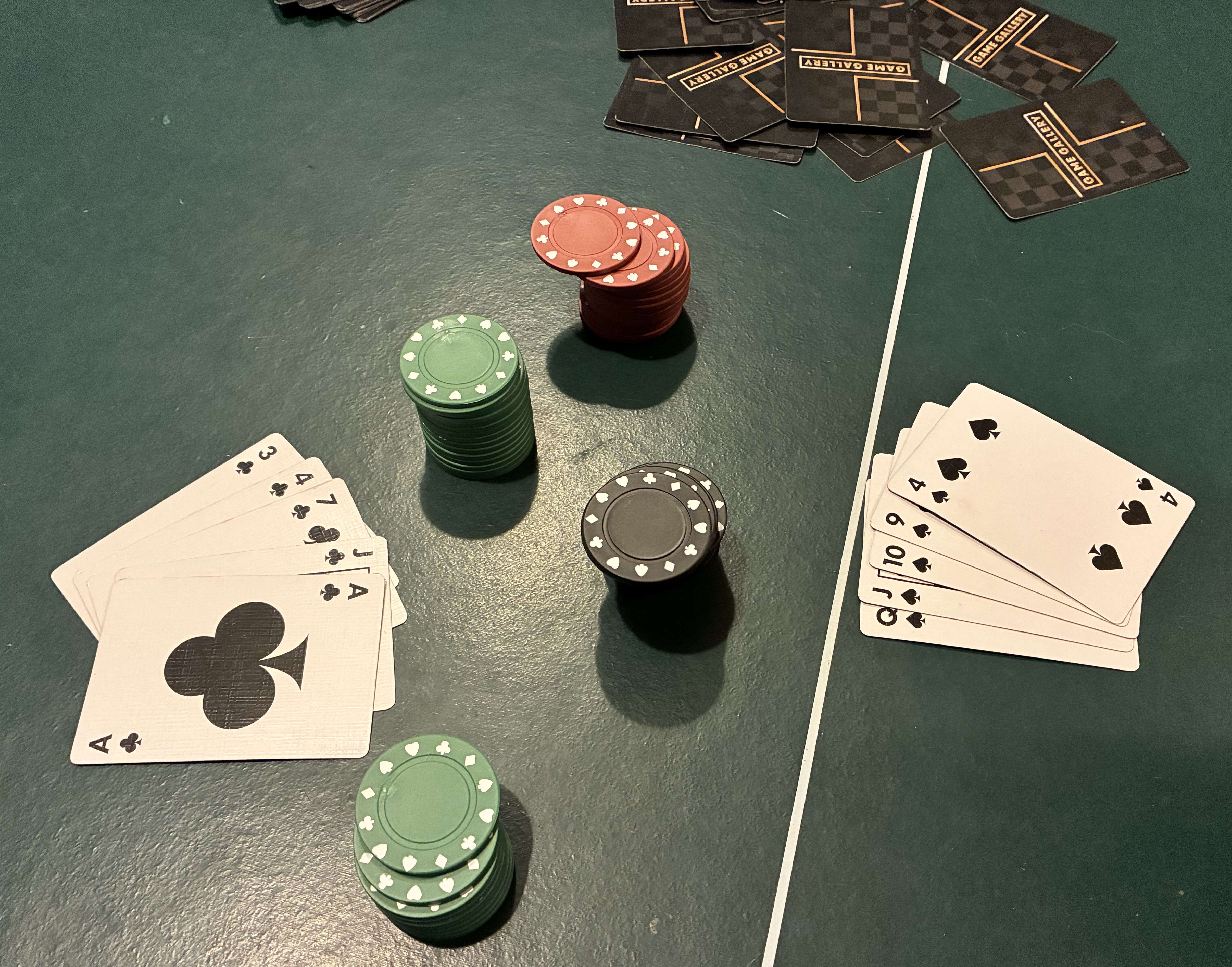
My son dealt the cards, and we played several rounds, chatting away amicably. The pots increased in size, the chips moved back and forth. We played 5-card stud with three draws and betting rounds per hand. On the last hand, the Eagle Eye began to bet aggressively. I matched and raised. My son held back. Laying down his cards, all black, all spades, Queen, Jack, 10, 9 and a 4, the Eagle Eye smiled and quietly, confidently said, “Flush.” He was one card away from the Royal Flush.
I had an Ace up my sleeve: all black, all clubs, Ace, Jack, 7, 4, 3. Not royal, rather commoner, but Ace high beats Queen. Incredulously we gazed at the cards.
Quietly my son is coming to realize that anxiety is not an absolute, but probably, with love, devotion and surrender, he can find his way out of the gauntlet of his generation.
_____________________________________
Babel in Ur
Posted: May 29, 2026 Filed under: Child Centered Activities, consciousness, Money & Banking 1 Comment
My son comes of age at the dawn of the post literate age, when seven fictive persons with valuation exceeding $23 Trillion USD own artificial intelligence and employ robots at scale, developing plans to colonize Mars while enjoying unrestricted freedom of speech. These fictive persons’ capitalization exceeds the EU’s entire economic output, is roughly 123% of China’s nominal GDP and is greater than the market valuation of every other nation on planet earth, except for the United States.
To put into perspective this 21st century tech vanguard, my son and I looked back to the 27th century BCE. The Epic of Gilgamesh, carved in stone during the third dynasty of Ur, is one of the earliest stories in literature, the first epic poem. The story is cautionary; technology, literacy and centralization tend to consolidate power and over millennia, the more things change, they may, in fact, stay the same.
I will proclaim to the world the deeds of Gilgamesh. This was the man to whom all things were known; this was the king who knew the countries of the world. He was wise, he saw mysteries and knew secret things, he brought us a tale of the days before the flood. He went on a long journey, as weary, worn-out with labor, returning he rested, he engraved on a stone the whole story.
In Uruk he built walls, a great rampart, and the temple of blessed Eanna for the god of the firmament Anu, and for Ishtar the goddess of love. Look at it still today: the outer wall where the cornice runs, it shines with the brilliance of copper; and the inner wall, it has no equal. Touch the threshold, it is ancient. …Climb up the wall of Uruk; walk along it, I say; regard the foundation terrace and examine the masonry: is it not burnt brick and good? The seven sages laid the foundations.
Uruk was a city in Mesopotamia, the “cradle of civilization” between the Tigris and Euphrates rivers. Agriculture and irrigation were introduced there, around 5000 BCE. The world’s first writing system – cuneiform – emerged by 3200 BCE and was used to record the Epic of Gilgamesh. The Sumerian Kingdom developed the state-of-the-art technology for “burnt brick” as building material.
Southern Mesopotamia (present day Iraq) lacked stone quarries or forests, but mud and clay were abundant, and when they learned to control high-temperature kiln firing, they created durable, water-resistant “burnt brick.” Secured with bitumen “tar” mortar, the bricks became waterproof allowing larger, taller, more complex structures to be built.
By 2100 BCE, in the neighboring city Ur, the oldest existing legal code, the Code of Ur-Nammu was developed, and the King began massive building campaigns. The stepped temple towers he built, known as Ziggurats, became monuments to his centralized power; “built by Ur-Nammu” stamped on every brick.
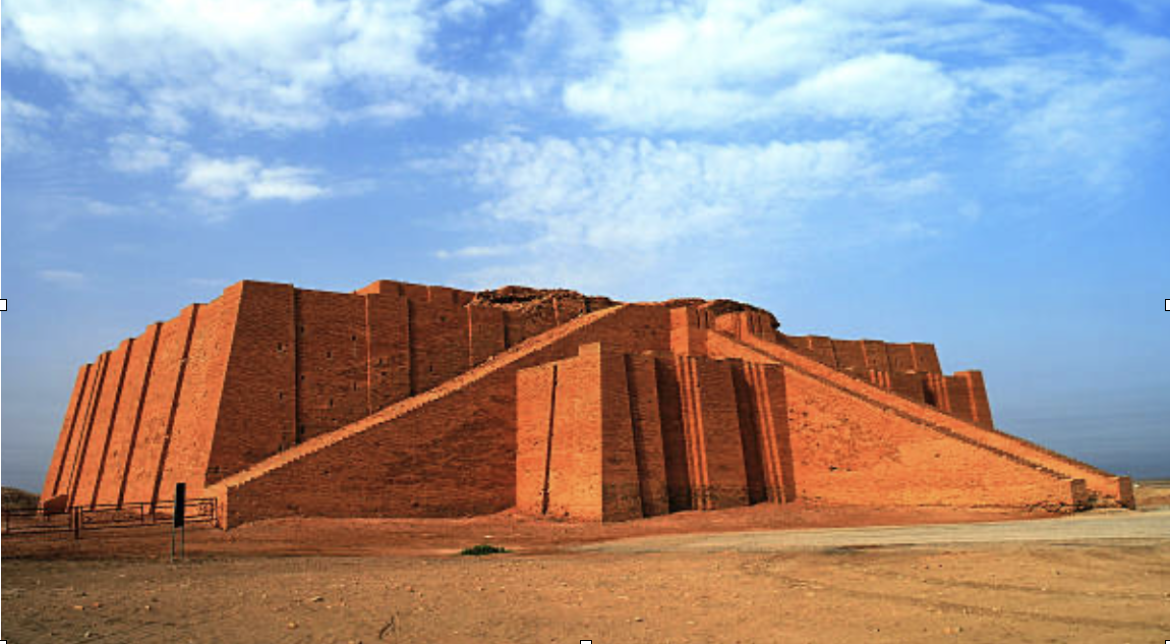
The temple and palace as centralized control, using one language – cuneiform, an intelligence not available to the common person – to manage ever expanding economic power, by means of an algorithmic governance with slave labor, bears relevance to the dilemma of my son’s generation: the Magnificent Seven fictive persons own and control AI using chips made of sand and silicon by robots at scale, their massive data centers our modern day Ziggurat.
The First Patriarch of the Hebrew people, Abraham, was born in Ur, and would have grown up in the shadow of the Great Ziggurat, pondering the King’s divine right and his shrine to the moon god Nanna: collective monumental religion. Called to a different path, Abraham wandered in the desert, seeking the divine in a covenant of personal conscience and individual responsibility: monotheism.
Centuries later, when Abraham’s story was written down, very likely during the Jewish exile in Babylon, the Hebrew scribes wrote the story like this:
1 And the whole earth was of one language, and of one speech…. 3 And they said one to another, Go to, let us make brick, and burn them thoroughly. And they had brick for stone, and slime had they for morter. 4 And they said, Go to, let us build us a city and a tower, whose top may reach unto heaven; and let us make us a name, lest we be scattered abroad upon the face of the whole earth.
The story of the Tower of Babel was certainly inspired by the Ziggurats of the Sumerian Kings whose temples were a highly organized center of commerce and religion, a holy staircase built to invite the gods down, an act of supplication, as though upon “bended knee”. The Jewish scribes, however, saw it as an act of arrogant pride – hubris – humans empowered to climb up, as well as the dangers of empire and lock-step uniformity; “confounding their language” forced diversity.
5 And the Lord came down to see the city and the tower, which the children of men builded. 6 And the Lord said, Behold, the people is one, and they have all one language; and this they begin to do: and now nothing will be restrained from them, which they have imagined to do. 7 Go to, let us go down, and there confound their language, that they may not understand one another’s speech. 8 So the Lord scattered them abroad from thence upon the face of all the earth: and they left off to build the city.
The power of empire or the sin of hubris? A God of judgement and wrath or one who gently “confounded their language”? Our homeschool assiduously avoids the either/or as we seek the both/and multi-dimensional reality. We reached out to our Soul Brother to inquire of the Buddhist perspective. His reply: Dogen Zenji’s Genjō-kōan.
Dogen Zenji was a Zen monk, poet, philosopher who introduced the practice of zazen – seated meditation – to Japan. As a young monk, he travelled to China to study Chan Buddhism, the paradox-heavy, oxymoronic strain that challenges the rational mind. “What is the sound of one hand clapping,” Chan’s classic aphorism, applies surprisingly well to our AI era.
Chan Buddhism teaches that reality is nothing more than direct physical experience, not a conceptual framework defined by words, letters, or logic; information is not realization. Information is a tool – like the hammer and nail in my carpenter’s tool belt – and the real person must command their tools. AI unchecked can become a barrier stopping us from experiencing the physical world. My son should learn to use AI, but more importantly, to see the limits both of AI and of words. “A finger pointing at the moon is not the moon itself,” says the koan, so my son will soon confront the paradox; I have no answers, only questions, which he must resolve from his own direct experience.
In the Tower of Babel story, the perfection and harmony of one language was a conceptual trap, an imperial uniformity; reality is neither single nor rigid as the autocrat desires but is the diverse, varied “ten thousand things.” Written as a story of divine punishment, people “scattered…upon the face of all the earth,” Chan sees the Tower of Babel’s fall as liberation from delusion, a return to the earth where life unfolds with the friction of physical experience. Shame has no place in reality.
The act of building a tower to reach heaven is the delusion of separation, heaven as a destination attained via material accumulation. About reality Dogen Zenji wrote: “When ancestors gave expression to it, they did not search for it as something outside.” The ego may be chagrined, but clay and slime, the material used to make the bricks, is reality itself and the path to realization is to be wholly present in this current moment. There is wisdom in quiet receptivity, allowing reality to meet you as it is, on its terms.
Emperors, tyrants and the wealthy build monuments to themselves – “built by Ur-Nammu” stamped on every brick – such is their delusion, but so too deluded are the people who aggrandize and support same. The ego desires a permanent unchanging self, separate from others, but Dogen taught the self is fundamentally empty and interconnected with everything else: “To study the Buddha Way is to study the self. To study the self is to forget the self.”
In the end, after the people had been scattered, the decaying monument of mud and slime would have fulfilled its unintended symbolism, showing the impermanence of human constructs. For Dogen Zenji, reality is never something finished but rather a continuous dynamic process, the entropy of physics, real persons becoming, not being, which is the magnificence of humanity, even in its varied confused uncertainty.
“Firewood becomes ash, and it does not become firewood again… life is a period of itself, and death is a period of itself,” the Dogen wrote. My son is the firewood, now. My role to fuel his fire, to kindle his flame, to teach him to go, forward bearing his light.
Wolf of Wall Street
Posted: May 22, 2026 Filed under: Child Centered Activities 1 Comment
In 1891, with his Mother’s blessings, a 14-year old boy ran away from home in Acton, Massachusetts. Needing help on the family farm, his father had withdrawn him from school, but the strong-headed boy refused and so, with $5 from his Mother, off to Boston he went to seek his future. He found work as a “board boy” posting stock quotes at a Paine Webber brokerage. Working six days per week, five trading hours per weekday and two hours on Saturday, he was paid $5 per week.
96 miles north, but a lifetime away, the workers in Maine’s paper and pulp mills toiled 10 to 12 hours per day, 6 days per week, amidst deafening noise, excessive heat with high-pressure steam, and exposure to toxic chemicals like chlorine and sulfur dioxide. The “machine men” were paid $18 per week, while the “rag women” earned between $4.80 to $6 per week.
In 1890, only 45% of American workers earned an income above poverty level. Children, as young as 4 or 5 years old, but often by age 7 worked eight to twelve hours per day, six days per week, to earn $1. The Maine Memory Network reports, “Two million school-age children each worked fifty to seventy hours a week. Some of the children’s parents could not take care of them, so they were put in a place where they were forced to work while being contained by barbed wires.” In 1900 1 out of every 5 children was employed, but to the Puritan mill and factory owners this was a social good, even a favor, providing gainful employment.
Down in Boston, our “board boy” – quick with numbers and exceedingly clever – began frequenting the “bucket shops,” businesses that allowed bets on the rise and fall of stocks or commodities without actually purchasing the underlying contract; modern day prediction markets – Polymarket, Kalshi or Predictit – are high tech bucket shops.
In 1892 he made his first bet on five shares of the Chicago, Burlington and Quincy Railroad, returning a profit of $3.12, for a 62% return. By the age of 16 he quit his job and began trading full time, earning about $200 per week (the equivalent of $7,800 today). To repay his Mother’s gift that helped him run away, he returned home with $1,000; she disapproved of his gambling, to which he explained that he was, in fact, “speculating.” With his rare gift, he pioneered day trading.
By the age of 20 he had achieved a 1,000% return from his trading, and was banned from Boston. He moved to New York City, where he turned $10,000 into $50,000 in five days, and then, in 1901 at the age of 24, he went long the Northern Pacific Railway turning $10,000 into $500,000 (equivalent to $19.5 Million today). Such is the extraordinary power of trading the stock of fictive persons.
Back north in Maine, 1901, Hugh Chisholm’s International Paper Company controlled 60% of the American newsprint market, but espying an opportunity in the high-quality book and specialty papers, he established the Oxford Paper Company, its Rumford Mill producing both pulp and paper, about 44 tons of paper per day. Through International Paper, Chisholm controlled the paper trust, while through Oxford Paper he had the monopoly on producing all postal cards for the United States Post Office.
This is a story of “thought bearing animals,” real persons, using fictive persons – joint stock companies – to achieve dominance and power over their peers, the persons – men, women and children – who make things.
With each passing year, our “board boy” grew stronger, until he became known as the “Wolf of Wall Street.” 1906, still in his 20s, he went short the Union Pacific Railroad before the San Francisco earthquake; anticipating a decline, he sold the shares and when their value went down he made a quick $250,000 profit. During the Panic of 1907 he was short the entire market, making $1 Million in a single day.
The panic of 1907 caused a severe nationwide recession, surpassed only by the Great Depression. Bank runs caused widespread failures, jobs were cut and as credit dried up, industrial output dropped by 30%. J.P. Morgan personally stepped in to bail out the entire New York Stock Exchange and to persuade the “Wolf” to stop selling. The Wolf did, but then went long, buying back shares to earn $3 Million, on the rebound.
To the clever and cunning, the fictive person can be beneficent. Back north, in the river valleys of Maine, for real persons hardship only worsened. On Wall Street, the Wolf could earn $1 Million in a day, while in Maine’s paper mills, unskilled laborers earned $1.50, machine tenders $2.50 to $2.75, while Foremen earned up to $3.50 per day. With the market for paper weak, the warehouses full, International Paper Company and the Oxford Paper Company served notice that wages would be cut by 7.75%. But the cost of living had increased 11% in two years, and so the Paper Makers Union respectfully declined the Company’s offer. On 2 August 1908 the workers in Jay, Rumford, Livermore Falls and Orono went on strike.
The Union made two serious errors in judgment. The high inventory meant the corporations held the position of strength, so they shut down the mills entirely, laying off all the workers, including the Pulp & Sulphite Union members. The Paper Makers Union had acted alone, not including the Pulp & Sulphite Union in their decision. The corporate fictive person, using the strategy “divide and conquer,” easily argued they wanted to keep people working but had been forced to shut down. Things only got worse. International Paper rejected the Paper Makers Union demands and reopened the mills, the Pulp & Sulphite Union gladly returning to work, at a 5% wage reduction. International Paper advertised for strike breakers, who took those Union jobs. Capitalism does not work by majority rule, the real persons toiling in the paper mills lacked power; they were forced into a one-sided employment contract.
This discussion about fictive persons versus real persons rests upon a legal cornerstone laid down almost 90 years earlier, neither in Maine nor Massachusetts, but in neighboring New Hampshire. Trustees of Dartmouth College v Woodward is the landmark United States Supreme Court decision, in 1819, that established corporate charters are contracts inviolate and sacrosanct, protected by the Contracts Clause, Article I, Section 10 of the United States’ Constitution.
The argument was over education, and the irony is that education emphatically is and has been of local control, per Amendment 10 of the Constitution. The state wanted to make the private college public, to benefit all of its citizens. The State Supreme Court agreed, ruling in favor of the public good. But on appeal, at the Federal level, private contracts trumped public education when the United States Supreme Court ruled 5-1 that the contract is unassailable, regardless of the public will. The Dartmouth ruling became the bedrock of American free enterprise, protecting and empowering the growth of private corporations.
The fault line in that bedrock, however, is the myth that real persons are entirely rational actors. That fault line emerged in 1776, not in the “City of Brotherly Love,” but in London, England where Adam Smith published The Wealth of Nations, the foundational text of classical economics. Smith argued that “natural liberty” (free enterprise) was more effective and efficient than heavily regulated trade. His famous quote is, “”It is not from the benevolence of the butcher, the brewer, or the baker that we expect our dinner, but from their regard to their own interest.”
That idea eventually grew to embrace Homo Economicus (Economic Man) which defined real persons as perfectly rational, narrowly selfish agents driven entirely to maximize utility and personal gain; markets are efficient because they are wholly rational. To his credit, Adam Smith cautioned that free enterprise, if unchecked, would lead to collusion and monopolies, “a conspiracy against the public, or in some contrivance to raise prices.” In the river valleys of Maine, the fictive person Homo Economicus arguably did conspire against the better interests of the public, being the real persons.
The Wolf of Wall Street was wise to that myth. Extraordinary Popular Delusions and the Madness of Crowds is a history of financial mania and non-rational herd behavior, a seminal book published in 1841 that directly contradicts the cherished myth of Homo Economicus. The Wolf studied that book closely, feverishly, which in part is why he went short the market – making fortunes – both in 1907 and at the Great Crash of 1929.
Here at our homeschool academy, the working definition puts a premium on the multidimensional, rather than the mono-rational, person. We embrace emotional intelligence more than narrow productive output.
My son is the same age as was the Wolf when he ran away from his childhood home in Acton, Massachusetts. My son can tour the river valleys of western Maine and see first hand the cause and effect of inviolate contracts and rational self interest of fictive persons. My task is to broaden his understanding, to deepen his empathy, to prepare him for a world that seems increasingly out of balance, as if real persons matter only as mere workers to feed the industrial machine.
_________________________________
Red Bud covered with blossoms, Gaia shouts, “summer is near!”