Babel in Ur
Posted: May 29, 2026 Filed under: Child Centered Activities, consciousness, Money & Banking 1 Comment
My son comes of age at the dawn of the post literate age, when seven fictive persons with valuation exceeding $23 Trillion USD own artificial intelligence and employ robots at scale, developing plans to colonize Mars while enjoying unrestricted freedom of speech. These fictive persons’ capitalization exceeds the EU’s entire economic output, is roughly 123% of China’s nominal GDP and is greater than the market valuation of every other nation on planet earth, except for the United States.
To put into perspective this 21st century tech vanguard, my son and I looked back to the 27th century BCE. The Epic of Gilgamesh, carved in stone during the third dynasty of Ur, is one of the earliest stories in literature, the first epic poem. The story is cautionary; technology, literacy and centralization tend to consolidate power and over millennia, the more things change, they may, in fact, stay the same.
I will proclaim to the world the deeds of Gilgamesh. This was the man to whom all things were known; this was the king who knew the countries of the world. He was wise, he saw mysteries and knew secret things, he brought us a tale of the days before the flood. He went on a long journey, as weary, worn-out with labor, returning he rested, he engraved on a stone the whole story.
In Uruk he built walls, a great rampart, and the temple of blessed Eanna for the god of the firmament Anu, and for Ishtar the goddess of love. Look at it still today: the outer wall where the cornice runs, it shines with the brilliance of copper; and the inner wall, it has no equal. Touch the threshold, it is ancient. …Climb up the wall of Uruk; walk along it, I say; regard the foundation terrace and examine the masonry: is it not burnt brick and good? The seven sages laid the foundations.
Uruk was a city in Mesopotamia, the “cradle of civilization” between the Tigris and Euphrates rivers. Agriculture and irrigation were introduced there, around 5000 BCE. The world’s first writing system – cuneiform – emerged by 3200 BCE and was used to record the Epic of Gilgamesh. The Sumerian Kingdom developed the state-of-the-art technology for “burnt brick” as building material.
Southern Mesopotamia (present day Iraq) lacked stone quarries or forests, but mud and clay were abundant, and when they learned to control high-temperature kiln firing, they created durable, water-resistant “burnt brick.” Secured with bitumen “tar” mortar, the bricks became waterproof allowing larger, taller, more complex structures to be built.
By 2100 BCE, in the neighboring city Ur, the oldest existing legal code, the Code of Ur-Nammu was developed, and the King began massive building campaigns. The stepped temple towers he built, known as Ziggurats, became monuments to his centralized power; “built by Ur-Nammu” stamped on every brick.
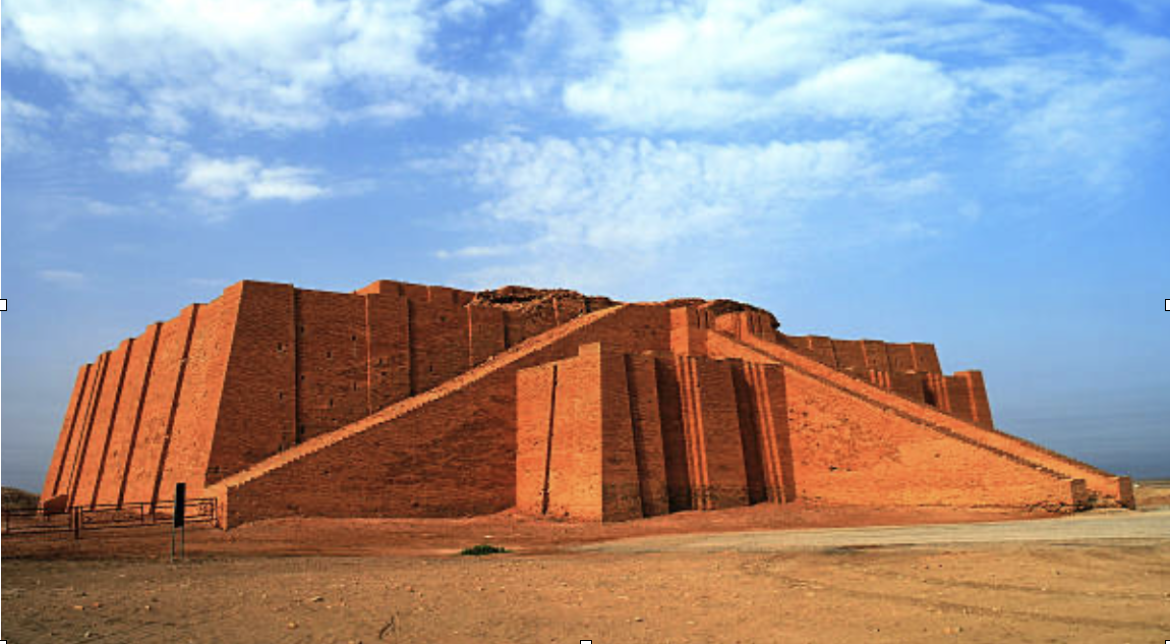
The temple and palace as centralized control, using one language – cuneiform, an intelligence not available to the common person – to manage ever expanding economic power, by means of an algorithmic governance with slave labor, bears relevance to the dilemma of my son’s generation: the Magnificent Seven fictive persons own and control AI using chips made of sand and silicon by robots at scale, their massive data centers our modern day Ziggurat.
The First Patriarch of the Hebrew people, Abraham, was born in Ur, and would have grown up in the shadow of the Great Ziggurat, pondering the King’s divine right and his shrine to the moon god Nanna: collective monumental religion. Called to a different path, Abraham wandered in the desert, seeking the divine in a covenant of personal conscience and individual responsibility: monotheism.
Centuries later, when Abraham’s story was written down, very likely during the Jewish exile in Babylon, the Hebrew scribes wrote the story like this:
1 And the whole earth was of one language, and of one speech…. 3 And they said one to another, Go to, let us make brick, and burn them thoroughly. And they had brick for stone, and slime had they for morter. 4 And they said, Go to, let us build us a city and a tower, whose top may reach unto heaven; and let us make us a name, lest we be scattered abroad upon the face of the whole earth.
The story of the Tower of Babel was certainly inspired by the Ziggurats of the Sumerian Kings whose temples were a highly organized center of commerce and religion, a holy staircase built to invite the gods down, an act of supplication, as though upon “bended knee”. The Jewish scribes, however, saw it as an act of arrogant pride – hubris – humans empowered to climb up, as well as the dangers of empire and lock-step uniformity; “confounding their language” forced diversity.
5 And the Lord came down to see the city and the tower, which the children of men builded. 6 And the Lord said, Behold, the people is one, and they have all one language; and this they begin to do: and now nothing will be restrained from them, which they have imagined to do. 7 Go to, let us go down, and there confound their language, that they may not understand one another’s speech. 8 So the Lord scattered them abroad from thence upon the face of all the earth: and they left off to build the city.
The power of empire or the sin of hubris? A God of judgement and wrath or one who gently “confounded their language”? Our homeschool assiduously avoids the either/or as we seek the both/and multi-dimensional reality. We reached out to our Soul Brother to inquire of the Buddhist perspective. His reply: Dogen Zenji’s Genjō-kōan.
Dogen Zenji was a Zen monk, poet, philosopher who introduced the practice of zazen – seated meditation – to Japan. As a young monk, he travelled to China to study Chan Buddhism, the paradox-heavy, oxymoronic strain that challenges the rational mind. “What is the sound of one hand clapping,” Chan’s classic aphorism, applies surprisingly well to our AI era.
Chan Buddhism teaches that reality is nothing more than direct physical experience, not a conceptual framework defined by words, letters, or logic; information is not realization. Information is a tool – like the hammer and nail in my carpenter’s tool belt – and the real person must command their tools. AI unchecked can become a barrier stopping us from experiencing the physical world. My son should learn to use AI, but more importantly, to see the limits both of AI and of words. “A finger pointing at the moon is not the moon itself,” says the koan, so my son will soon confront the paradox; I have no answers, only questions, which he must resolve from his own direct experience.
In the Tower of Babel story, the perfection and harmony of one language was a conceptual trap, an imperial uniformity; reality is neither single nor rigid as the autocrat desires but is the diverse, varied “ten thousand things.” Written as a story of divine punishment, people “scattered…upon the face of all the earth,” Chan sees the Tower of Babel’s fall as liberation from delusion, a return to the earth where life unfolds with the friction of physical experience. Shame has no place in reality.
The act of building a tower to reach heaven is the delusion of separation, heaven as a destination attained via material accumulation. About reality Dogen Zenji wrote: “When ancestors gave expression to it, they did not search for it as something outside.” The ego may be chagrined, but clay and slime, the material used to make the bricks, is reality itself and the path to realization is to be wholly present in this current moment. There is wisdom in quiet receptivity, allowing reality to meet you as it is, on its terms.
Emperors, tyrants and the wealthy build monuments to themselves – “built by Ur-Nammu” stamped on every brick – such is their delusion, but so too deluded are the people who aggrandize and support same. The ego desires a permanent unchanging self, separate from others, but Dogen taught the self is fundamentally empty and interconnected with everything else: “To study the Buddha Way is to study the self. To study the self is to forget the self.”
In the end, after the people had been scattered, the decaying monument of mud and slime would have fulfilled its unintended symbolism, showing the impermanence of human constructs. For Dogen Zenji, reality is never something finished but rather a continuous dynamic process, the entropy of physics, real persons becoming, not being, which is the magnificence of humanity, even in its varied confused uncertainty.
“Firewood becomes ash, and it does not become firewood again… life is a period of itself, and death is a period of itself,” the Dogen wrote. My son is the firewood, now. My role to fuel his fire, to kindle his flame, to teach him to go, forward bearing his light.


you and Pope Leo train your attention the very same Babel this week. Pondering….would be interested to hear M’s take on at least part of the encyclical probing the magnificent human.