Human, Flourishing
Posted: June 5, 2026 Filed under: Chronicles of a First Time Parent, What is an Art Farm 1 Comment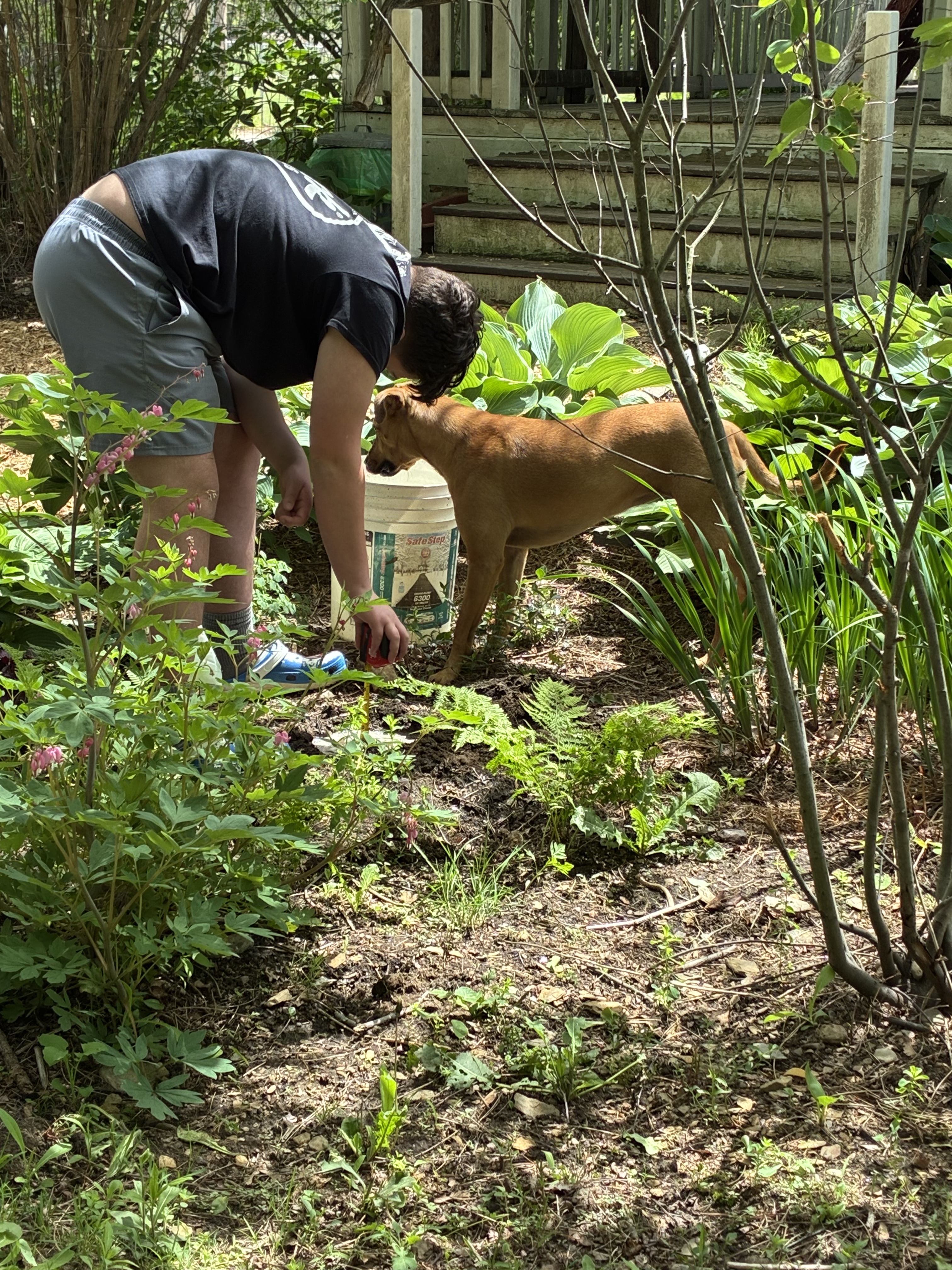
What to the Romans was named Terra, to the Greeks Gaia, astronomically is classified as Sol III – the third planet from the Sun being an ocean world that harbors life with liquid surface water. Given a mass of (5.97217±0.00028)×1024 kg rotating at a breakneck speed of 1,037 miles per hour at its equator, here at 43° 38′ 29″ N / 70° 14′ 27″ W a real person coming of age learns about the materiality of life.
With the Mother Tree, he studies soil, more precisely “applied biogeochemistry,” starting with applied chemistry through field work and kitchen-based experiments. For the past eleven weeks he has examined soil, taken samples from multiple sites. He is learning that specificity is an essential attribute of knowledge.
Our backyard, for example, for centuries was the dumping ground for the real persons who have lived in this “Big House-Little House-Back House-Barn,” the classic New England farmhouse from the 1800s. Long before municipal waste collection, the people would toss their detritus “out back.” Their attention was focused on their vegetable fields growing in front of the house, so the back yard was left untended, a waste heap. We endlessly dig up broken glass, as well as a perfectly intact coffee mug, empty bottles of elixir, and other assorted sundry items.
My son has been digging holes out back, to study the soil, which is not “dirt” but something wonderfully complex, biotically rich, far more specific and particular. Of the Hollis Fine Sandy Loam variety, the soil here is classified by the Natural Resources Conservation Service as prime farmland. This 200-year old farmhouse was not built with heavy equipment pushing fill, and then landscaped with commercial sod grown on some industrial farm a few states away; original to this site, our soil is a biological archive of hundreds or thousands of years.
As guided by the Mother Tree, my son has used transects to mark a section of the back yard and drawn a map. He dug holes 6” deep and, having taken soil samples from five sites, studied their percolation rates, to understand compaction and composition. This hole is not like that hole; this hole percolates 1” per 3 minutes while that hole percolates 1/16” per 3 minutes. “Why is that?” we asked.
He made a quadrat – a standardized sampling frame, a window into place – then threw it randomly within the marked off section, to isolate specific areas, to systematically count, identify and measure the abundance, or lack, of plants and bio-mass. “What is that?” we asked.
On the space-time continuum, my son, a real person, during this academic year has been constructing a mental framework – structure and method, applied – to learn about place, one specific place, this yard, where he is becoming an adult real person. The Mother Tree has helped him to “think well,” not by locked logic but creatively.
Cynefin is a word among the Welsh people, with no direct translation into English. Literally it can mean “habitat” or “familiar place” but at a deeper level it describes an integral sense of belonging, the deeply intertwined factors of being, heritage, stories and traditions shared within family and community. In my teaching, emotional connection lies at the core of cynefin. This treasure trove among real persons, AI’s Ziggurat of the cloud lacks, entirely. The young real person growing here, on the Hollis Fine Sandy Loam of this art farm, accrues daily, slowly, a specific knowledge, grounded in emotional intelligence, that will become his identity.
Our quest to define “what is a person?” expanded this week to include “what is place?” which lead us to have a chat with his Cousin, the Professor of Law. I had expected to discuss the legal fiction of corpus fictum but the Cousin took the conversation in an entirely different, magnificent, direction.
Me: So, let’s begin with the definitions of a person: do you remember Plato’s?
My son: Uhhh…the chicken…with no feathers?
Me: correct. And Aristotle…?
My son: (silence)
Me: The animal…the political animal?
My son: Right.
Me: We also had the Sanskrit and the buddhist…with materiality shared among all of the definitions. Materiality seems basic to personhood. Our bodies.
Cousin: But is that a distinction of kind or form? I have a colleague here who studies bio-ethics, which is ethics at the edge of humanity. For example, genetically engineered monkeys replacing their genes with human genes to give birth to humans. Or pigs used to grow human organs.
My son: What do they feed it?
Cousin: Great question. Would a monkey with human ovaries and a womb need human food? To define humans as material is not precise. A person with a mechanical heart – a pacemaker – is still a person. This is a logical puzzle. A pig with a human organ is not human, but a human with a mechanical heart is still a human. So the distinction is not only material but form defines a human. Form = ends. Do you know the Greek word telos? It means what is something pointed towards? What is its ultimate aim? So, what is the end purpose in Aristotle’s definition?
My son: (pause, leans back in his chair) As simple as politics?
Cousin: Politics, yes, but what does he mean? (Pause) A “polity” = a political society.
Me: I should say, the words are derived from the Greek “polis” which means “city.” Metropolis is a city area. Metropolitan Transit is the bus line serving the city. The political animals live in cities, some organization, which is political.
Cousin: Aristotle’s definition of a political society is “a free people coming together to debate how ought we to order our lives together?” So what makes us distinctively human? What is the key word there?
My son: “Free” ?
Cousin: What about “free” makes us different from other animals?
My son: Well…humans are more developed, we have more opportunities.
Cousin: Is there a difference between human and animal? Is the difference of degree or kind? A categorical difference? Think back to “free”. Is there a kind of opportunity that we have that is different from animals?
My son: Humans have…I think about this some times, “why are humans the most developed? Why don’t guinea pigs drive cars?” We have more opportunities because we are more developed. We have choices.
Cousin: “Choosing”…that is huge.
My son: (leans back in his chair) Our dog has choices in…maybe this is too broad…she can decide to eat or not, she can go in the yard BUT we can choose other foods but she cannot. Maisie gets only one kind of food. She cannot communicate – she can bark but not talk. So it is harder for her to communicate. We make decisions for her. An animal in the wild has more choices. Domesticated animals…we make more choices for them. We make the major decisions.
Cousin: So you tie freedom with communication. Aristotle used the word “debate” in his definition. Let’s push further. What is the one word that we confront here, that is the key in his definition: “a free people coming together to debate how ought we to order our lives together?”
My son: (pause)
Me: We know we are talking about people… we have discussed “free” the adjective. And “debate” the verb. The key term is not going to be the pronouns “we” or “our” so…
My son: It is not going to be “together” because animals live in a pack. (Pause). “Ought?”
Cousin: What do we mean by “ought?”
My son: You “should”
Cousin: What kind of judgment is that? If I say “you ought to give a dollar” or “you ought not hit someone” ?
My son: You are proposing an idea?
Cousin: The “ought” has a meaning that begins with the letter M…
My son: Is “ought”…(pause)…a “mandate”?
Cousin: A dog could have a mandate. It needs to eat. What kind of a judgment…what is the basis for saying that?
My son: (pause)
Cousin: The word is “moral”
My son: Ohhhh!!!
Cousin: It is distinct to humans about morality. A dog might make a mess but that is not immoral. Humans as moral is the through line. Morality gives weight to the decisions that we make. It is ordering our lives together – so do packs of animals but the human form of animal is different due to the moral element. We are not only biological but a human flourishing. We are moral agents. How does that sound to you?
My son: (pause) I think I understand the topic better.
Cousin: Do animals have morality?
My son: I think animals – well, I don’t know how they process thoughts – but in the wild animals do not think of a moral question. They need to survive. I have heard that dog squeaky toys = the sound of an animal suffering. Dogs like that sound. But humans…do all humans have a moral capacity? Yes, but some are more aware than others. Not all vegans but many see that as a moral issue. Some vegans eat that way for health, but some as morally wrong. Others have no concern. All humans have some amount of morality, but it is stronger for some people.
Me: Do you remember last year we discussed Plato and the virtues: the good, the true and the beautiful; the ultimate divine reality. We are touching on that here. I have been thinking about compassion and here we talk about morality. How are those different? Morality can imply a guilt and remorse.
Cousin: Once we have the idea of morality as a defining characteristic then “what do we mean by morality?” There are three basic types:
- Utilitarianism: our goal is to maximize pleasure for the greatest number of persons
- Ontological reality: we live by a set of rules (as an architecture of the mind, we perceive the unknowable by imposing innate rules and categories)
- Virtue ethics: our purpose is to cultivate virtues (not by rules or consequences but by character, itself). Compassion is a virtue.
Me: So utilitarianism would be “homo economicus” – real persons as narrowly selfish agents driven entirely to maximize utility and personal gain.
Cousin: Correct. Ontological would be Immanuel Kant. He established rules for how we think. For the “Virtue Ethics” Aquinas said there are 7 cardinal virtues.
Me: “Cardinal” here means “primary”
My son: Like the cardinal directions…
Me: …north, east, south and west. Correct.
Cousin: Aquinas said there are three theological virtues: faith, hope and charity plus Aristotle’s four virtues: fortitude, temperance, prudence, justice. Justice means that everyone should get their due. Fortitude means courage. Temperance means self-restraint. What is compassion? A blend of charity and justice. Compassion is a virtue ethic, a morally flourishing person cultivating virtues. Any virtue like compassion is a secondary…the cardinal virtues are like the palette used to blend the other virtues.
* * * *
As our year draws to a close, we plan a summative project that will include art-making; the “cardinal virtues like the palette” is perfect. The act of making is particular, manifest and specific; the artist must choose, which mirrors precisely the action of moral agency.
Our definition of a person expands to become “a thought bearing biped mammal, not only biological but a human flourishing as moral agent, with consciousness of purpose, meaning, intuition and connection.” We go deeper into our understanding of persons and place, the specificity of being, further from the delusion of Ziggurats in the AI cloud.
 an Art Farm
as always, a keeper. particularly so.