Yellow Sky
Posted: July 24, 2026 Filed under: consciousness 1 Comment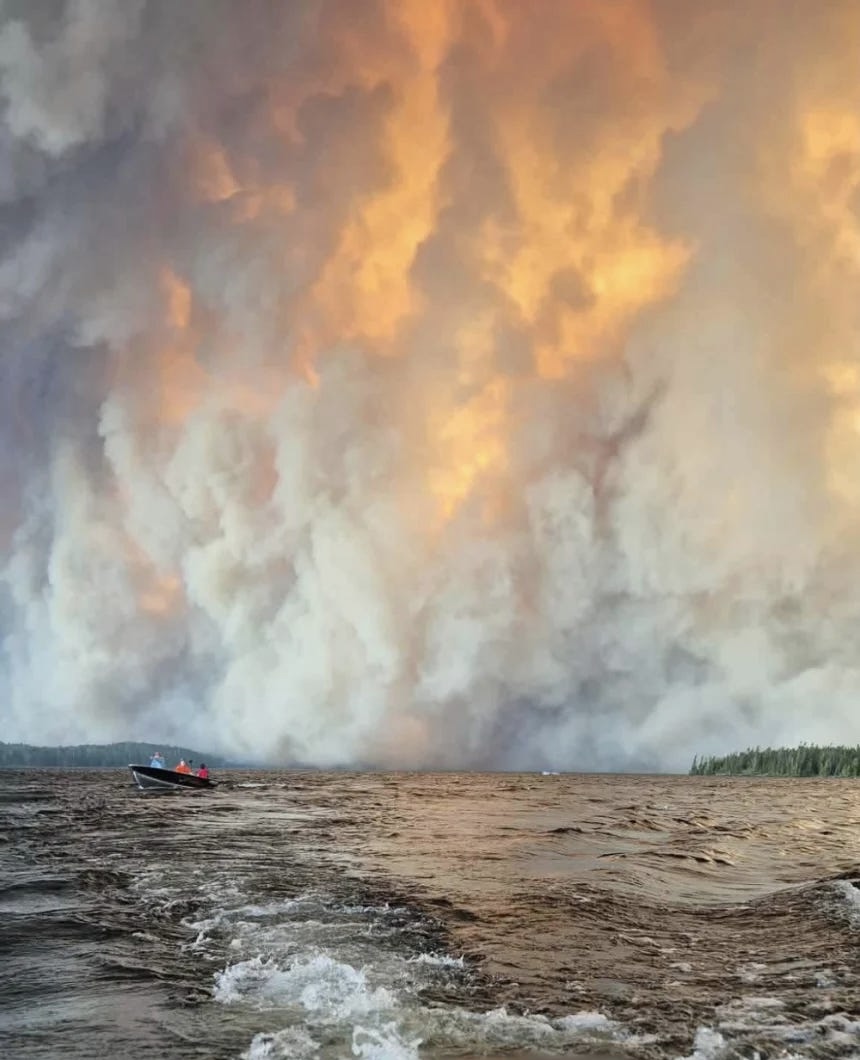
Yellow skies press down from the Great Lakes to the Northeast. From Minnesota to Massachusetts air quality issues abound. “Code Red” and “Code Purple” alerts sound in the Mid-Atlantic, Detroit’s Air Quality Index (AQI) hits 724, while Duluth, MN skyrockets to 924, an environmental emergency far exceeding the threshold for “Hazardous” air. The concentration of fine particulate matter is so dense that it poses immediate, severe health threats to every person, regardless of their health status. But real men do not wear N95 masks.
More than 1,000 Canadian forest fires are the cause of recent events. Science shows industrial activity and fossil fuels contribute to this weather, but politicians express outrage at forest management practices. A warming climate is just another Chinese hoax, or, to use the popular cliche, “it is what it is.” Or, is it symbolic?
This week our July Book Club read “The Bride Comes to Yellow Sky,” a short story by Stephen Crane, one of the most innovative authors of his generation. In 1895 he published “The Red Badge of Courage” to critical acclaim, what H.G. Wells called an “orgy of praise.” Crane’s storytelling prowess was so fine that he crafted “The Red Badge” entirely in his imagination, since he had no experience on the battlefield. The use of color and chiaroscuro are vitally present in his writing, and scholars compare his writing not only to Impressionist painting, but suggest that he influenced the painters. Vivid, that is.
Yellow Sky is the name of a fictional town in western Texas at the end of the wild western frontier. In “The Bride Comes to Yellow Sky”, the town marshal, Jack Potter, has gone east to find a bride, to embrace domestic life. As the story opens the bride and groom ride west in a train, from San Antonio. The plush car is no stagecoach. They dine in the parlor car – cost is no concern – where the Negro Porters wait upon them. “They were evidently very happy.” Potter was “…a man known, liked, and feared in his corner, a prominent person….” who trades his twin revolvers for a suit and silver pocket watch. He went East to court a woman, no longer to fight with men.
During his absence, several men drink in the town bar, when a drunken man named Scratchy Wilson appears to terrorize the town. The barkeep explains, “You see, this here Scratchy Wilson is a wonder with a gun—a perfect wonder; and when he goes on the war trail, we hunt our holes—naturally. He’s about the last one of the old gang that used to hang out along the river here. He’s a terror when he’s drunk.”
Behold the classic myth of the American west manosphere: the man in the white hat fights the thug dressed in black, rugged independence everywhere abounds in a frontier wild, open, and free. Western movies, foundational to American culture, commanded almost 30% of all Hollywood films in the post-WWII era. With 50 Westerns debuting annually and saturating television with serialized shows, the genre established a new cultural temple of patriotism and masculinity just as we Boomers were born.
“The Bride Comes to Yellow Sky” speaks of the end of an era, of change. Railroads, the “Iron Horse,” thundered West bringing consumer goods, fashion and ideas from the East. The wild west changed when self-reliance was replaced by shared modern culture. Jack Potter’s bride from the east represents feminine grace, his rough edges smoothed; no guns brought to court her. Their homecoming represents family, home and permanence, the antithesis of a home on the range. The “yellow sky” represents sunset, which is an ending, lights off, curtain down.
This week’s short story bears striking relevance to the world in which my son, and his peers, come of age. Our society seems to teeter on the edge, both sides of the political aisle locked in an endless struggle of “us versus them,” divisiveness all the rage, tempers hot, like the climate, only get hotter. Masculine aggression is on steroids, like cage fighters dueling on the front lawn, modern heroes of our wild west.
Scratchy Wilson enters “into the middle of the main street of Yellow Sky…in either hand the man held a long, heavy, blue-black revolver.” He is dressed “in a maroon-colored flannel shirt, which had been purchased for purposes of decoration and made, principally, by some Jewish women on the east side of New York.” The last of a dying breed, even he wears the clothes from an Eastern city.
Looking for a fight, he begins shooting at a dog. “At sight of the man, the dog sprang up and walked diagonally away, with a sullen head, and growling. The man yelled, and the dog broke into a gallop. As it was about to enter an alley, there was a loud noise, a whistling, and something spat the ground directly before it. The dog screamed, and, wheeling in terror, galloped headlong in a new direction. Again there was a noise, a whistling, and sand was kicked viciously before it. Fear-stricken, the dog turned and flurried like an animal in a pen. The man stood laughing, his weapons at his hips.”
Scratchy Wilson wants more violence, and so he sets off looking for the town marshal, Jack Potter. The myth of the isolated individual is built upon the illusion of separation, of “divide and conquer.” This is the dying breed, to my son’s generation, when science increasingly shows that a forest is not separate solitary trees but an integrated ecosystem, while studies of humpback whales suggest they adopt complex songs from neighboring groups; an animal form of cultural transmission. Research continues, showing interconnectedness is a growing theme.
For millennia, many societies have celebrated an ego-centered dominance, a focus upon conquest, violence and material quantity, rather than healing and an internal quality. There is reason to wonder if the excessive preening among authoritarian-minded males today is not their yellow sky moment, their plaintive war cry of a dying breed, the end of an era that has lasted too long. My son reads “The Bride Comes to Yellow Sky” in this context.
On the topic of myths from the manosphere, consider this combat search-and-rescue prayer recently recited at the Department of War:
“The path of the downed aviator is beset on all sides by the iniquities of the selfish and the tyranny of evil men. Blessed is he who, in the name of camaraderie and duty, shepherd the lost through the valley of darkness, for he is truly his brother’s keeper and the finder of lost children. And I will strike down upon thee with great vengeance and furious anger those who attempt to capture and destroy my brother. And you will know my call sign is Sandy 1 when I lay my vengeance upon thee, and amen.”
Contrast that to the words of the Aramaic-speaking radical, from 2000 years ago, of deeds such as walking on water, raising the dead, multiplying loaves and fishes, “These and greater things ye shall do.” This teaching speaks of elevating reality toward a unified healing life, not an aggressive combative individual struggle.
Amidst signs of social decay, the New York Times bestseller “A World Appears, a Journey into Consciousness” writes of a Copernican Moment of awakening. There is good reason to pause and consider what might be possible, where we collectively are now, how we choose to go forward in an awakening consciousness.
If life imitates art, then the outcome would be already known. In “The Bride Comes to Yellow Sky” the climax occurs when bad man Wilson intercepts the marshal Potter and his bride. But the shoot out does not happen. Potter, already married and unarmed, has moved forward leaving Wilson to wallow in his lost past. The old code of the Wild West was never to fight a married man, so Wilson, dressed in boots with “red tops with gilded ornaments, such as are used by little boys” is adrift. The bad man always was just a buffoon.
But our moment now is not the climax, our outcome is not yet known, because symbolically, we are earlier in the story, when the bad man Scratchy Wilson is terrorizing the town, shooting at dogs. This is the lesson for my son to learn as yellow skies hover low as he reads the short story.
My generation, we Boomers, have been trained, generation after generation, to obsess over the climax of conflict, high drama of a courtroom, the cavalry charging in a Saturday matinee, the pistol drawn at High Noon, killings in the streets, the hyper-masculine male at the podium, finger raised, barking at the moon: the court jester of Camelot whose time has passed. The Zoomers and generations to follow will live entirely with an awareness of – and can choose to build community through – ecosystems that are interconnected and interdependent.
My son and his peers must learn to distinguish noise from message, must look past the clown parade of politicians’ false promises, must find within themselves a deeper feeling of purpose simply in being kind and thoughtful; the long journey of healing and restoration. My role, and the purpose of our July Book Club, is to give him a vocabulary to help him on that path.
About those July yellow hazy skies, we can only hope that all people on Gaia wake up to their new reality.
_______________________________
The lead photo was taken in July 2026 by a community member (such as Chance Paavola or Wayne Wastaken) fleeing the Namaygoosisagagun First Nation (Collins First Nation) in northern Ontario, Canada, as a massive wildfire overran the area. The image was used on Bill McKibbens’ Substack “The Crucial Years.”


wow! mighty powerful. words and image, both.
>