Probably
Posted: June 11, 2026 Filed under: Child Centered Activities, Chronicles of a First Time Parent 3 Comments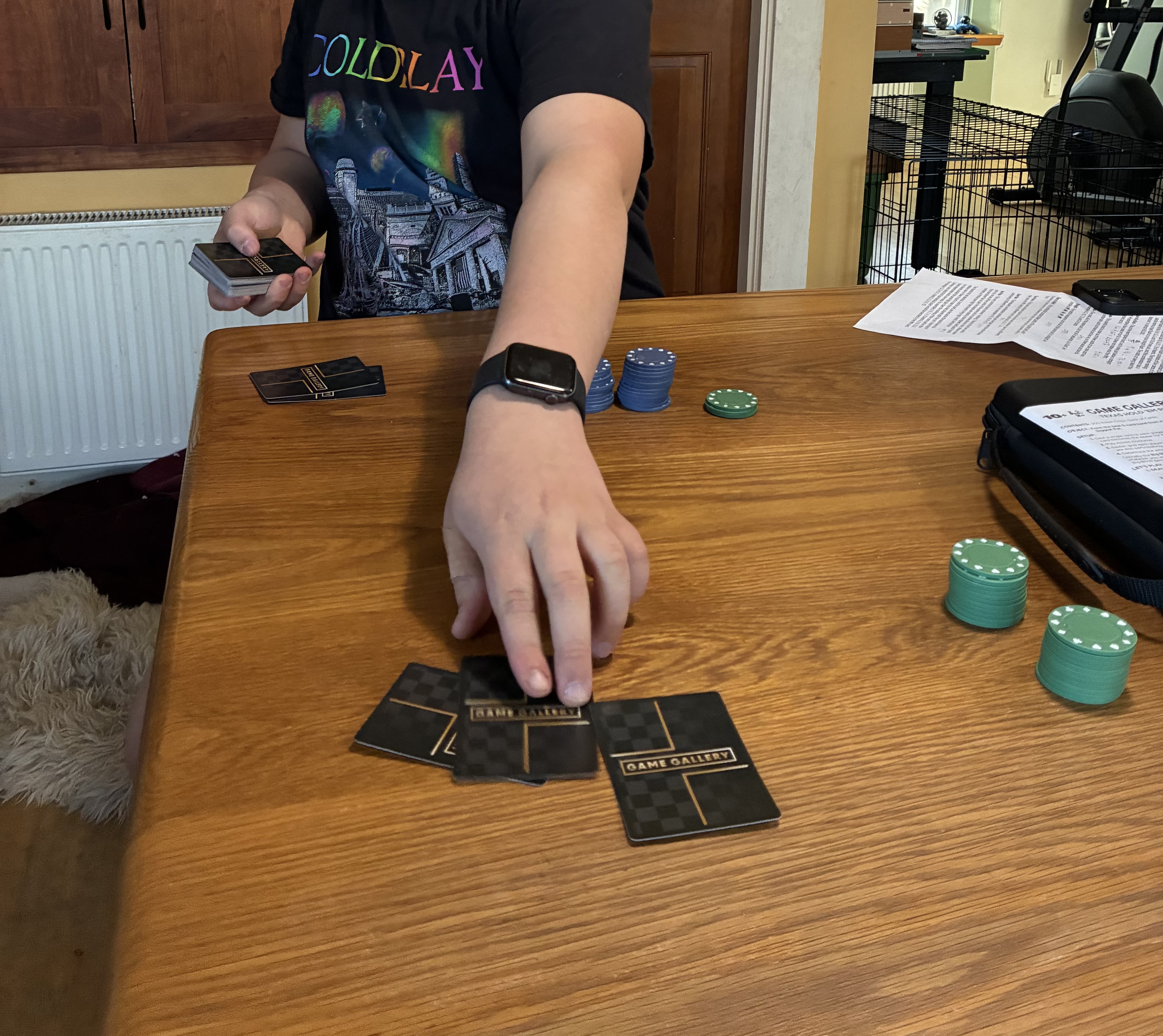
It is probable that teaching my son probability by playing Poker is considered morally degenerate, to some.
But then again, consider the society in which he comes of age: total lottery sales exceed $110 Billion per year, sports betting exceeds $166 Billion, while $391 Billion per year in total is spent on games of chance, a roll of the dice. How then to explain that his great grandfather, in 1918, was unable to borrow money to buy a car because auto loans were considered immoral, debt was viewed as a character flaw, cars were for pleasure not a necessity? Probability is a lesson in history and math.
The word “probability” comes from the Latin root probare which means “to test or prove,” while the word itself is derived from the adjective probabilis meaning “plausible, provable, that may be assumed to be believed.” The Roman orator Cicero built an argument upon that word, rejecting the idea that humans could attain absolute, perfect knowledge, he argued that probabilities were far more practical, politically feasible, a means to move the crowd in your favor. In 15th century Middle English the word was linked to legal credibility until it became a mathematical term around 1718.
I teach the mathematical application here at our homeschool. I am of an age that math properly should be taught using a sharpened pencil on lined paper, not online interactive like a game. I purchased a textbook from a local store. It has served us well, except, more than a few times the solutions were wrong. But even that is a teaching moment. “To test, to prove” teaches my son to question actively, not receive passively, the answers of authority. Textbooks, algorithms, and AI are not settled truth. My son needs to learn to roll up his sleeves, match and raise, have skin in the game.
My son did well on the probability chapter, but the textbook referenced playing cards several times; a noteworthy assumption. My son was unable to answer because he had never played cards. He did not know what was being asked. I was dumbstruck! I ran back to that bookstore to buy poker chips and playing cards.
I easily use equations in my carpentry, but teaching the volume or surface area of a dodecahedron, or a quadratic equation challenged me to relearn long-forgotten theorems. Ours is not the blind leading the blind, but more like the French proverb, “”Au royaume des aveugles, les borgnes sont rois” (“In the kingdom of the blind, the one-eyed men are kings.”)
“Papa,” my son’s Grandfather, on the other hand, is the rare bird who flies high in the world of pure mathematical truth. A PhD in Physical Chemistry/Theoretical Physics, in his first published paper, in 1977, he announced “a very fundamental conceptual error present in the traditional formulation of the entropic force between the ends of a single Gaussian macromolecule.” In other words, the classical theory of the academy was wrong.
His pioneering “Entropic approach to Brownian movement” was published in 1980 in the American Journal of Physics, and is considered the grandfather of modern Brownian entropic force modeling. In Brownian motion a particle’s movement is entirely random, but, connecting pure geometry and probability to thermodynamics, he showed that by measuring the probability distribution of a particle’s movement, there is a measurable intrinsic entropic force.
In his 2001 paper “Entropic Elasticity of Weakly Perturbed Polymers” Papa reasoned:
The probability of occurrence of an end-to-end separation r (r =|r|) for such a chain is described by r2P(r), where P(r) is the normalized field-free end-to-end distribution function, b3π−3/2exp(-b2r2) for r << Na.
From r2P(r) one may determine the standard deviation or dispersion (σ o) in r and compare it with the average value of r for a freely orienting chain not subject to an external force. σ ο 2 = <r2>o – (<r>o)2 = .23/b2. The absence of an external force is denoted by the subscript o. The result is:
σ o/<r>o = .42
Hard pressed to grasp that, my probability teaching centers on the mathematical truth:
________n!________
C ( n, k ) = k! ( n – k )!
Where n = 52 cards in the deck, k = the number of cards in the hand, and ! = the factorial function, which for 5 card stud is (5x4x3x2x1). My son’s probability of drawing any one specific hand is 1 out of 2,598,960. Steep odds, and so we began. I taught him to shuffle, to deal the cards, and the value of chips. “Applied theory” is my approach both to life as to probability; math lives at the intersection of intuition and calculation.
In poker, as in life, the odds of getting nothing are high, almost 50-50, but more precisely 0.9953015 : 1. One pair is an everyday occurrence, 1.36477 : 1, while a flush – the basic kind, neither a straight nor a royal – comes in at 507.8019 : 1, until at the apex, the summa elite, the royal flush has steep odds against, at 649,739 : 1. The unspoken lesson is that rare events can happen, so you should hold out hope.
Our poker playing plan was devilishly clever. My son is of the “anxious generation” also known as “the loneliest generation.” According to the National Social Anxiety Center, 60% of his peers report significant mental health challenges, including social anxiety, which can be paralyzing. Factors driving this spike include pandemic disruptions, consuming social media use, and diminished face-to-face interactions. Our homeschooling did not arise in a vacuum.
My son would prefer not to leave his gaming corner, let alone to leave the house, and so what better pedagogical tool than playing a game where bluffing is strategic, a “poker” face reveals nothing, while watching for “tells” is key. We play the game face-to-face, cards held high like a Maginot wall, each of us huddled behind our defense. In this bounded rule-governed space, interactions are intentional. If anxiety feels inevitable, probability suggests “we can think about this, we can figure the odds, you must play the hand you are dealt.”
We have alternated between the math text book and our game of chance. He does well with the pencil and paper – often doing the calculations in his head – but he beats me at betting more often than not. Poker between two players is less fun than with more, and he yearned to widen the circle.
That is a math lesson all its own. The odds of any one specific hand remain 1 out of 2,598,960 no matter the number of players, but the relative value of a premium hand increases. In our heads-up matches, one pair often wins. But with more players, a single pair will rarely win the pot. That means, mathematically, in a larger group you should bet more aggressively with a strong hand. Bluffing, on the other hand, is less effective with a larger group. With more people playing, the probability is high that someone else holds the premium hand, and anyone player can call your bluff, which means the odds of everyone else folding is highly improbable.
My son asked his sister and his Mother, the Goddess, repeatedly to join us, but somehow that never worked out; between work and school they are quite busy. So we invited my son’s former classmate, a close friend from before the pandemic, to come over to our house. He agreed. My son was ready with his chips and cards.
His classmate, of keen eagle eye and sharp mind, taught us to play black jack. Black jack, the most widely played casino banking game in the world, is significantly less social than 5-card stud. Blackjack unfolds between one player and the dealer, its focus only the math to reach 21. Quiet pervades, conversation is limited.
My goal inviting the “eagle eye” to our house was not math but socialization. My agenda not so hidden, nor did I intend it to be, I wanted my son to engage in play. What unfolded was exquisite and rare, more precisely a probability of 1 in 229,000 (.00044%), or maybe it was 1 in 401,138, or then again 1 in 1,153,500. My son and I are still calculating the odds.
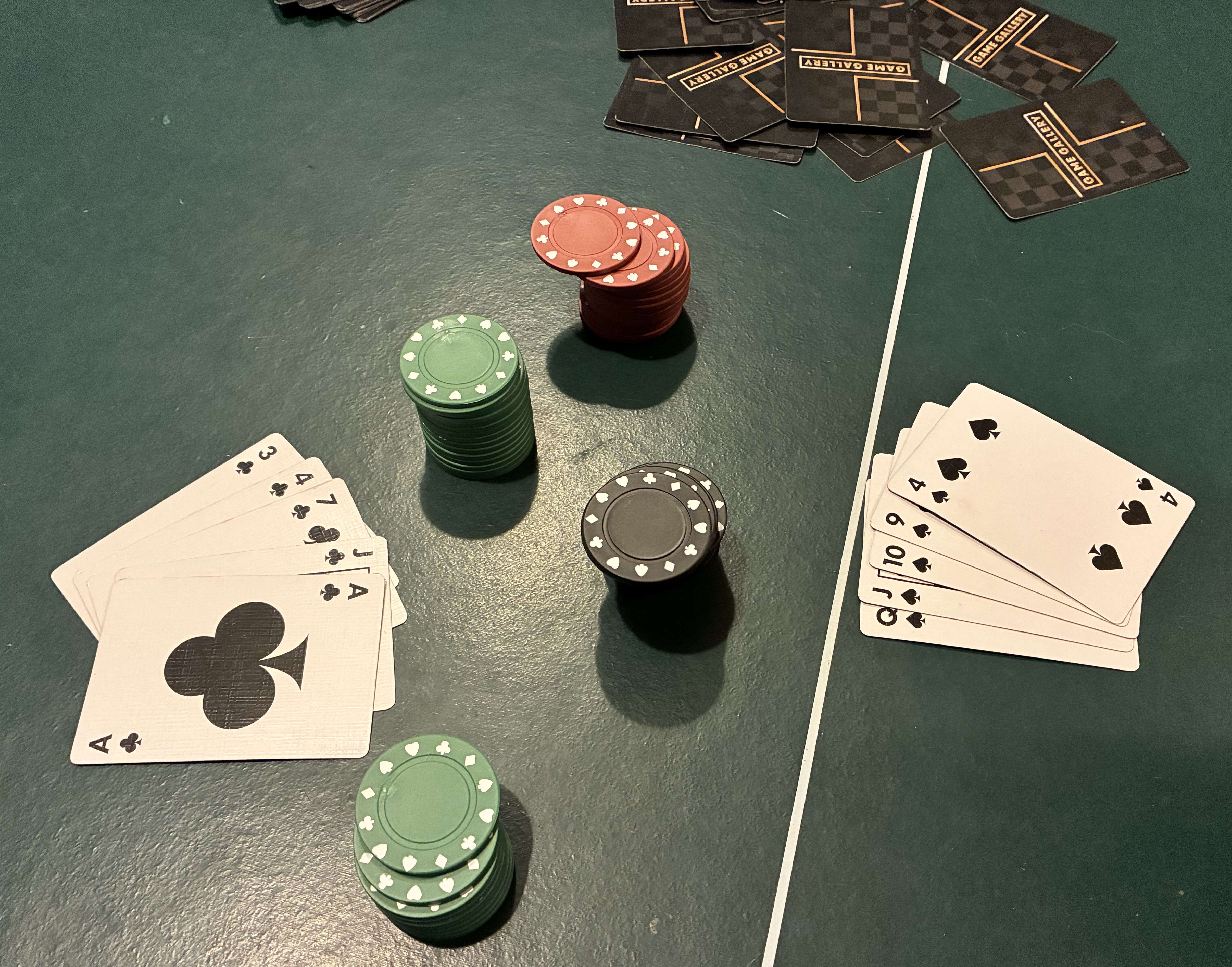
My son dealt the cards, and we played several rounds, chatting away amicably. The pots increased in size, the chips moved back and forth. We played 5-card stud with three draws and betting rounds per hand. On the last hand, the Eagle Eye began to bet aggressively. I matched and raised. My son held back. Laying down his cards, all black, all spades, Queen, Jack, 10, 9 and a 4, the Eagle Eye smiled and quietly, confidently said, “Flush.” He was one card away from the Royal Flush.
I had an Ace up my sleeve: all black, all clubs, Ace, Jack, 7, 4, 3. Not royal, rather commoner, but Ace high beats Queen. Incredulously we gazed at the cards.
Quietly my son is coming to realize that anxiety is not an absolute, but probably, with love, devotion and surrender, he can find his way out of the gauntlet of his generation.
_____________________________________


❤️❤️❤️❤️❤️
WOW. brilliant.
wow. BRILLIANT.