Unabridged
Posted: October 4, 2024 Filed under: Chronicles of a First Time Parent, Farming off the Farm, What is an Art Farm | Tags: books, dictionary, language, unabridged dictionary, words, writing 2 Comments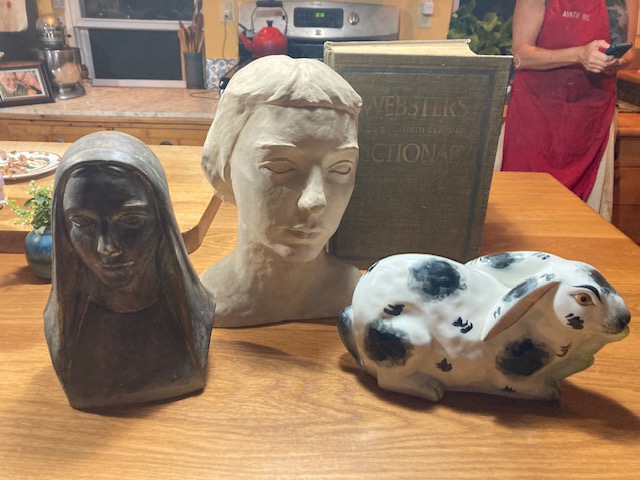
In my childhood, pride of place was given to a Webster’s New Twentieth Century Dictionary of the English Language, Unabridged, second edition (c) 1966. The massive book laid open, upon a bookstand that my Mother built, in the family room always beside the dinner table. Quick and easy reference was close at hand.
At 2,129 pages, plus addenda, the Webster’s weighs in at approximately 13 pounds, begins with “a” (first letter of the Roman and English alphabet: from the Greek alpha, a borrowing from the Phoenician) and ends with “zythum” (a malt beverage brewed by ancient Egyptians). The masterpiece is “based upon the broad foundations laid down by Noah Webster.” Such informed my childhood.
My frugal Mother, born in the Depression, bought groceries strictly on a budget, and received S&H Green Stamps for every purchase. We saved those stamps, compiled them into books, then drove to Glenview, Illinois to redeem same. The dictionary was purchased with Green Stamps, a day of victory, that I recall vividly, still.
Of the Silent Generation, she and millions of her peers diligently saved the Green Stamps. The Sperry & Hutchinson Company was founded in 1896 and operated until the 1980s, when consumerism became the vogue and frugality faded. But over 90 years the Beinecke family made a fortune, and funded the Beinecke Rare Book & Manuscript Library at Yale. In Greenwich, Connecticut, their 66-acre estate is now for sale for the first time, at an asking price of $35 Million, after more than four generations in the family. https://www.nytimes.com/2024/09/16/realestate/beinecke-estate-greenwich.html?smid=nytcore-ios-share&referringSource=articleShare
In my childhood home, words reigned supreme. My Father was a wordsmith, an Irish extrovert, who knew not the difference between a hammer or a screwdriver, but most certainly knew his nouns and verbs; subjects and objects; gerundives, gerunds, and participles; how to compose a sentence, how to frame his thoughts. When advertising came of age he worked as a Mad Man; known as the “Grocery Guru” his specialty was food merchandising. His gift of words allowed him to travel the world, holding meetings in Munich, giving speeches in Sydney; he commuted to his Manhattan office for lunch then flew home for dinner. He was published in multiple periodicals, and monthly in “Advertising Age,” then an upstart, which has become the standard bearer of the trade. After his death, my Mother continued the column for two years, writing “Consumer’s Viewpoint” telling the “Big Boys and Fat Cats” what she thought of their products.
And always, in our home, the Webster’s stood as stanchion, a ready reference, near at hand.
Last year my Mother sold the family home, and we emptied its rooms. Saving the dictionary was high on my list. I stored it at my sister’s, and then in August hauled it back home to Maine, along with sculptures my Mother had made. It was something of a cruel and unusual ask to have my children carry the tome through TSA at O’Hare Airport, but that I did. To my mind that task sealed their fate to the written word. Such is their origin story.
Growing up in the digital age of Google, my children may disregard the heavy analog hard copy book, a dull relic from the distant past. But long may it last on their bookshelves, and my hope is that it will endure as a reminder of their lineage. Languages change over time, such is their nature, but the story of the English language, derived from the German and Latin, and our ability to use words to frame our thoughts is an enduring aspect of our mind’s capacity to understand. I remain steadfast that there is a mysterious link between grammar and the mind.
A hard copy dictionary, then, is a bastion of that tradition. And for my children to understand same, is to know of their past. And so this Unabridged Dictionary is an heirloom of the highest regard here in our home. Purchased through frugality, cherished over many years.
______________________________________
Note: Kudos and thanks to Babs, of whom I say the apple fell not far from the tree. By kind permission of, I borrowed her phrase “…meetings in Munich, speeches in Sydney…”. And she provided the family room photo with dictionary and stand ever the sentry, the rear guard. Many thanks! 🥰
 an Art Farm
I think I’ve left comments a few times here this morning but they won’t show up.
will try this again!
i love love love love love this one. the writing is sprightly and seamless, the story of which you tell told through the refined gifts of the tradition. this is one i want to clip out and paste to a page, being of the old-school myself.
i didn’t realize the beineckes were behind the Ss and Hs! i love that old library, the rare book collection where my firstborn has dug deeply through its archives. who knew?!?!
love you dearly, david. it is such joy to tell our stories in some degree of tandem. our stories are never exactly the same, and therein is the wonder. but seeing through your lens only makes my own all the clearer. forever indebted. xox
Your beloved family member was a valued colleague over the 30 or so years of my textbook editing career. For me, though, it was the online edition, as it was so easy to see while editing onscreen. I consulted it constantly, which may be surprising, as one might expect an editor to know all the words already, but I soon learned that nobody does. I would leave the scientific terminology to the scientist authors, as long as it was consistent, but if the use of a common word seemed odd, I’d go to Webster’s, keeping in mind Mark Twain’s advice: “Use the right word, not its second cousin.” Sometimes I made a change, but at other times I learned a new meaning for a word, or a subtle difference between two words that I hadn’t been aware of. I hope the result was greater clarity and easier reading for students, who have enough of a challenge understanding the technical material in their textbooks.
I learned a bit about the creative process behind Webster’s at UMass in the late 1970s, in a lexicography class taught by the excellent Miss Audrey Duckert, who explained that there are two types of dictionaries, prescriptive (which tell you what the rules are) and descriptive (which reflect the reality of our changing language). Webster’s, as you say, is descriptive. Its staff have the enviable job of reading newspapers and magazines all day, finding and recording examples of word uses in the real world and using them to add words or update definitions. Thus the language, and its history, are preserved.
I enjoyed hearing about the history of the Mahanys as wordsmiths, and having a peek at what’s behind the writing abilities of those of today’s generations. Long may the dictionary adorn your shelves.