Beginnings
Posted: January 31, 2025 Filed under: Chronicles of a First Time Parent, What is an Art Farm | Tags: books, free public library, libraries, library, news, reading, RMG Consultants 1 CommentDouglas Lee Woodhouse has died.
This is our story.
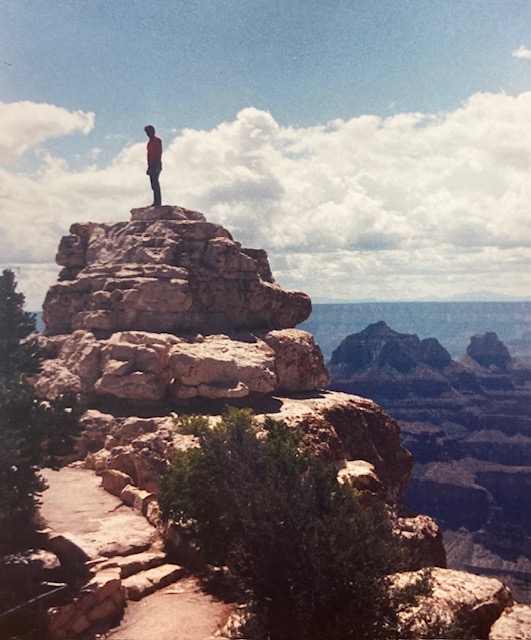
He wanted to drive to the desert, eat grapefruits while sitting cross legged playing his guitar. He went west, our young man, but made it not to the 100th meridian but to 87.629 degrees, which is Chicago, the City of Broad Shoulders, where he was welcomed with open arms.
Jack Kerouac’s “On The Road” was his sacred text, his mantra: “There was nowhere to go but everywhere, so just keep on rolling under the stars.” Destination unknown, Douglas Lee Woodhouse set out from his family home on Hollywood Avenue in Cincinnati. Nancy, his Mother, years later told me the punch line: “When he got into his Volkswagen, there was no gas! I had to drive him to the gas station to get enough gas to drive his car to the station to fill up!!”
North by northwest, Douglas arrived in Deerfield, Illinois where he “broke and entered,” which is to say he rummaged around the garage to find the “hidden” key, then let himself into his Aunt Barbara’s – my Mother’s – house whereupon he sat cross legged on the living room rug, played his guitar and sang. No desert, no grapefruits, but still silence until Aunt Barbara arrived home, most surprised, and called me promptly, “Douglas is sitting on my living room floor playing his guitar…and singing…I don’t know what to do! Can you help? Can he come to you? Now?!” “Certainly,” I said and a new life began.
Our roots were decades in the making. I was born 1961, and he arrived in 1964. We were cousins and crossed paths on family trips to Cincinnati, our Mothers’ childhood home, the brick house on North Cliff Lane built at the height of the depression among the Castles of Clifton. John F. Glaser, known as the “King of Coal” was a salesman active in the coal and home heating industry of the Ohio River Valley, while Lucille was sentry at the stove, a bountiful feast for anyone, for everyone who came to visit. It was a grand place to be young.
When Douglas arrived, I lived in the barrio, Noble at Erie, on Chicago’s Near-West side, in a very drafty large third floor walk-up. There was plenty of room for him to set up camp. The neighborhood was edgy and unpolished, working-class families and artists with a gang selling drugs from the corner one block away. We were a long way from the Castles of Clifton.
I worked at RMG Consultants, Inc., a library automation consulting firm, and my career began comically in the winter of 1985. A Senior at Northwestern University, I was hired to do word processing but was soon fired. While being fired I recommended my younger brother Brian, age 17, a junior in high school, whom they hired part time. They offered me a job painting the office, which, being unemployed, I accepted. While I painted, a deadline emergency arose, and so I closed the paint can and sat down with great focus to finish all the documents. Impressed, the Business Manager thereupon offered me her full-time position, as she was planning to leave the company. A stunning turn around.
RMG was at the vanguard when the library card catalog was becoming a relic, IT automation ascendant on the horizon. No less than the New Yorker wrote an expose about the change, card catalogs replaced with computers, the physical cabinet and notated 3×5 cards discarded from our collective past. To put 1985 in perspective, Steve Jobs had not yet been fired from Apple, Elon Musk was a freshman in high school in apartheid South Africa, Larry Page and Sergey Brin middle school students, Mark Zuckerberg in diapers. The future stretched out broadly, while the origin of library automation began the year Douglas was born.
In 1964, Howard Dillon, a new, young librarian at the Ohio State University Libraries was given the assignment to look into the library automation business and report to the library director and his cabinet. Howard began identifying and exchanging correspondence with persons in other libraries who were engaged in interesting experiments and projects. In October of that year, in Philadelphia, at the 27th annual meeting of the American Documentation Institute he rented a hotel meeting room for two days and gathered 21 of his correspondents for their first face-to-face discussions. There was great enthusiasm for this idea, and the librarians began a correspondence detailing projects, experiments or ambitions. The correspondence became formal, published as the “Newsletter on Library Automation.” Issue #1 was December 10, 1964.
Having no name, the group was referred to as the “Dillon Committee,” which name was used until the autumn of 1965 when the group organized themselves as the Committee On Library Automation (COLA) and elected leadership. COLA described itself as, “…an informal group of librarians formed to provide a means of exchanging information or research and development of automated systems applicable to libraries.”
Charles Payne – another key figure in our story – was elected Vice Chairman and Chairman Elect, while Howard Dillon served as the Editor. COLA pursued affiliation with an existing professional organization and in 1966 were formally recognized, when the council of the American Library Association (ALA) voted to create the Information Science and Automation Division (ISAD). The final COLA Newsletter, #44, was issued September 1969 when a new world was entered.
Rob McGee – founder of RMG Consultants – began as a Doctoral student at the University of Chicago’s Graduate Library School in 1965, already holding a Masters in Library Science from the University of North Carolina, and soon to study in Scotland, where he would receive a Diploma in Computing Science from the University of Glasgow. In the autumn of 1967 he returned to Hyde Park, and began at the University of Chicago Library Systems Development Office. In many ways this was a second career, he had been shelving books since he was 9-years old, at the Community College library in Wilmington, North Carolina. He also worked in the local paper mill and, in Washington State, 100-hour work weeks picking peas for the Green Giant Cannery. He grew up well versed in sheer physical labor, under the heat of the summer sun.
Born in Washington, DC, Rob grew up in Four Oaks, and then Wilmington, North Carolina during the Jim Crow era. His library experience began young, riding his bike to pick up 78 RPM “talking books” for his Grandmother and, for himself, grabbing as many books as would fit in his bike basket. In an era before television, the library loomed large, his Aunt Mil a role model and legendary teacher, reading historical fiction to students, stoking their interest to learn from books available at the local library.
Coming of age among World War II vets, learning on the GI Bill, those were different times in the Deep South. Rob saw the Free Public Library as a bedrock civic institution and once William Madison Randall joined the family Rob’s perspective became global. Library automation began in 1964, but as it pertains to the life of Douglas Lee Woodhouse foundationally it goes much further back.
To be continued…
…next week…the Vatican Library, an intelligence agent to President Franklin D Roosevelt, “that skinny kid with a funny name,” Thos Moser furniture in New Orleans….
 an Art Farm
it’s an amazing story, and the nooks and crannies you’ve explored here, make it something of a wide-eyed wonder! to be continued…..