1/2 = whole
Posted: July 4, 2025 Filed under: Chronicles of a First Time Parent, What is an Art Farm | Tags: law of attraction, portland cement, rumi, Zeno of Elea 1 Comment
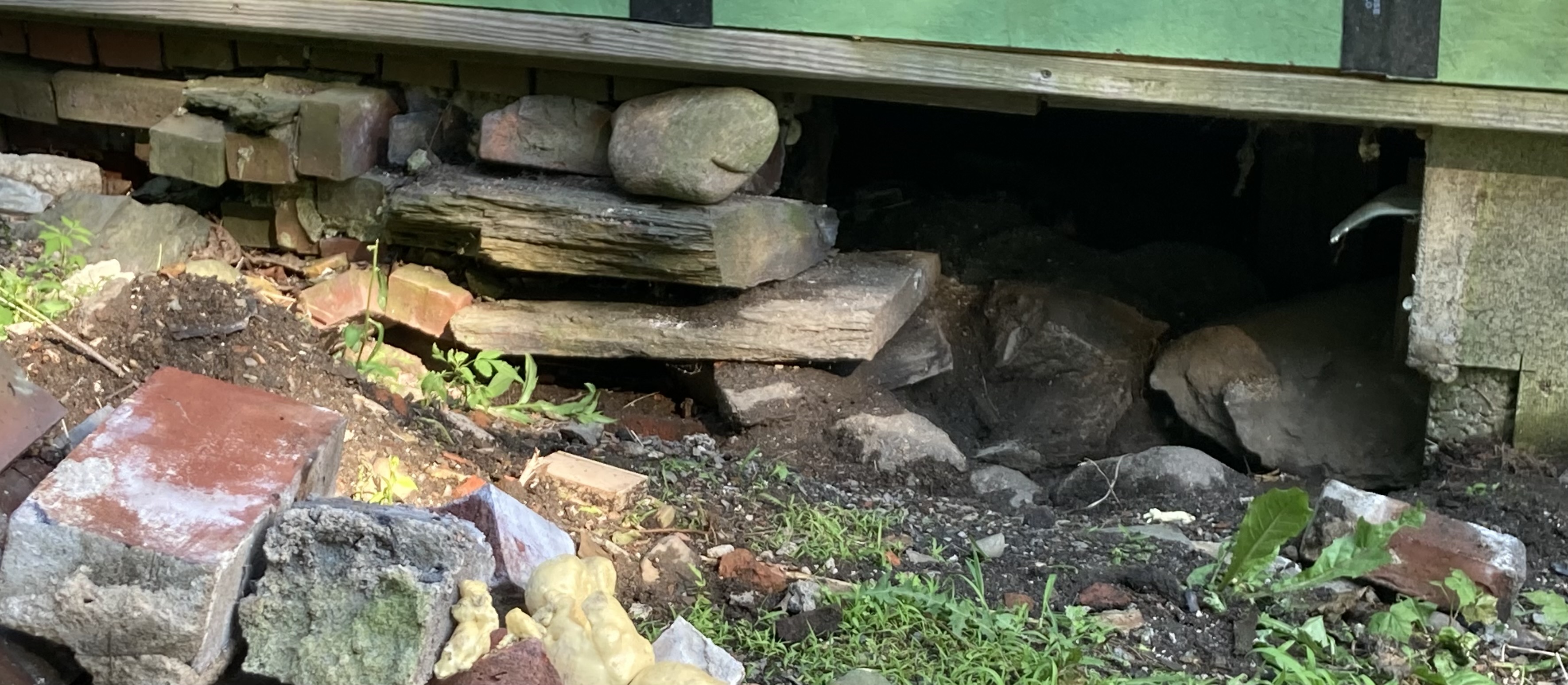
Last October I was in Solitary Confinement, working in our Farmhouse crawlspace to stabilize the floor system of the Ell; a grueling but necessary task. This week I encountered Zeno’s Paradox as I began work on the foundation wall. The floor having been stabilized, I will now remove the entire perimeter wall and then rebuild from the ground up, while working below the house. “Pick your poison” as the saying goes.
Zeno of Elea was a Greek philosopher and mathematician. He was a student of Parmenides who taught monism – essentially, that all life is one – and as such duality and plurality are illusions of the senses. Zeno, a thinker of profound proportion, created logical paradoxes to demonstrate the absurd consequences of common assumptions about motion, change and plurality. The paradoxes of motion, considered his strongest and most famous, were summarized by Aristotle as follows, “That which is in locomotion must arrive at the half-way stage before it arrives at the goal.”
Suppose a Greek peripatetic Philosopher wished to walk to the end of a path. Before he can get there, he must get halfway there. Before arriving halfway, he must get a quarter of the way. Before traveling a quarter, one-eighth; before one-eighth, one-sixteenth; and so on. Thus one must complete an infinite number of tasks, which Zeno maintains is an impossibility given that time is finite. I trust the reader will understand why beginning an Ell foundation rebuild seems like an infinite task.
In 1830 when our farmhouse was built, the carpenter/farmers foraged for materials. Using horse or oxen they would have gone out into the fields to pull boulders back to the job site. Heavy lifting, then a hole was dug (by hand) into which the rocks and boulders were stacked one on top of the other. Mortar and concrete were not used on the foundation, just “dry stack” of large stones in a hole. This is referred to as a “rubble foundation,” which Frank Lloyd Wright used extensively throughout his career.
On top of the rubble a course of bricks were laid, upon which the post and beam structure was built. Mortar in the 1830s was different from concrete today. In 1824 Joseph Aspdin, a British bricklayer, invented Portland Cement by heating clay and limestone at high temperatures to form a strong hydraulic cement. He named his discovery in honor of the stones of the Isle of Portland, in the English Channel, just off the County of Dorset. But South Portland, Maine was a long way from the Isle of Portland, and the makers of this home did not use Portland Cement on their bricks; the mortar they used has disintegrated over these 200 years. And so my challenge of tasks seems to expand, endlessly.
Two and a half millennia after Zeno of Elea posed his paradoxes, their essential truth still challenges the rational mind. It is noteworthy that they were resolved – dare I say – by Jalal al-Din Muhammad Rumi, the 13th century Persian poet and Sufi mystic, more commonly known as Rumi. Essentially he was a monist, seeing the interconnectedness of all beings and the unity of existence. He embraced humanity – all humanity – and believed empathy can foster harmony and inclusion.
He currently ranks among the highest selling poets in the USA, and is revered around the globe; in a time so divisive, this is noteworthy. Consider this poem:
When I run after what I think I want, my days are a furnace of distress and anxiety;
If I sit in my own place of patience, what I need flows to me, and without any pain.
From this I understand that what I want also wants me, is looking for me and attracting me.
There is a great secret in this for anyone who can grasp it.
More commonly this is described as “The Law of Attraction,” which states “the good you seek is seeking you; you only need go halfway.”
And so we can resolve Zeno’s paradox through the mystical insight of the poet, and my foundational task becomes easier. I have hired a journeyman philosopher/carpenter far wiser than I, and hope to hire a crew of workers far stronger than I, so that as a team we shall overcome.



 an Art Farm
I LOVE THIS
>