The Sybil
Posted: July 25, 2025 Filed under: consciousness, What is an Art Farm | Tags: Cumaean Sibyl, Delphi, Heraclitus, Lucius Tarquinius, Shakespeare 1 Comment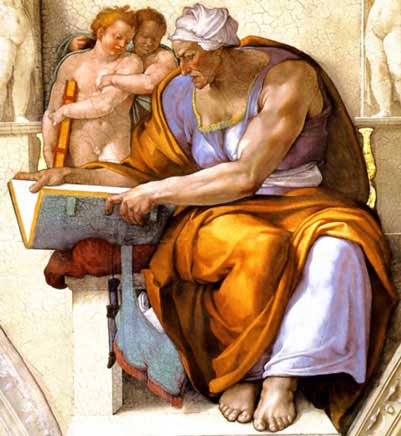
In the pantheon of wise women, the Sibyl – mysterious messenger of truth – ranks high, towering overhead on the ceiling of the Sistine Chapel. Who was she?
In the beginning, at Delphi, in the 11th Century BCE, there was but one, the Delphic Oracle herself. Heraclitus, the pre-Socratic philosopher, is the first known writer to comment, “The Sibyl, with frenzied mouth uttering things not to be laughed at, unadorned and unperformed, yet reaches to a thousand years with her voice bye aid of the god.” The Greeks eventually came to count ten women truth tellers located in Greece, Italy, the Levant and Asia Minor; they were known not by their name, but by the location of the shrine where they spoke.
Meanwhile, across the Adriatic Sea, Lucius Tarquinius Superbus reigned as the seventh and last King of Rome, 534 to 509 BCE. A man so corrupt and vile, he gained the throne through multiple murders of family, and his tyranny came to justify the abolition of the monarchy. Following his death the Republic arose and thereafter the Empire, which are the stuff of legend. The one enduring virtue of Tarquinius was his foresight to purchase the Sibylline Books. Even there, he almost failed.

The apocryphal story is told of an old woman, possibly a Cumaean Sybil, who offered nine books of prophecies to Tarquinius at an exorbitant price; he declined to purchase and so she burned three then offered the remaining six at the original price. Again he refused and so she burned three more then asked the original price for the remaining three. Tarquinius consulted the Augurs, who deplored the loss of the six and urged purchase of the remaining three even at the full original price. Tarquinius had them preserved in a sacred vault beneath the Capitoline temple of Jupiter.
After the fall of the Kings, the Roman Senate kept tight control over the Sibylline Books. The men who governed held the women’s prophecies under lock and key. They entrusted care to two patricians, until in 367 BC, when the custodians were increased to five patricians and five plebeians. These ten, as directed by the Senate, consulted the Sibylline Books not for predictions of definite future events but the religious observances necessary to avert extraordinary calamities and to expiate ominous prodigies (comets and earthquakes, showers of stones, plague, and the like). The rites of expiation were communicated to the public, and not the oracles themselves. In the 4th century CE, The Sibylline Books were burned by order of the Roman General Flavius Stilicho.
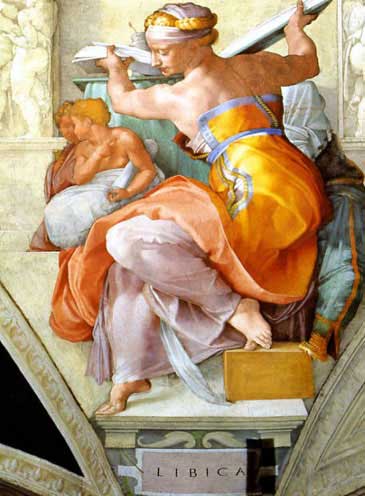
About that time the Roman Empire came to its end, replaced by the Judeo-Christian world. The Sibylline Books were replaced by the Sibylline Oracles, a blending of classical mythology, early Gnostic, Hellenistic Jewish and Christian beliefs. The prophecies became increasingly apocalyptic, with even the Book of Revelations foreshadowed. There is something for everyone, it seems, in the Sibylline Oracles, and they came to reach ever wider circles. Over several millennia they have become more, not less, studied.
Michelangelo painted five sibyls on the ceiling of the Sistine Chapel: the Delphic, Libyan, Persian, Cumaean and Erythraean, while Shakespeare mentions them in Othello, Titus Andronicus, The Merchant of Venice, and Troilus and Cressida. In contemporary culture, Sibyl was a 1976 film starring Sally Field and Joanne Woodward about a musician diagnosed with multiple personality disorder. What was prophecy to the ancients is a crisis today.
But why are women the Sybils? Science tells us that the corpus callosum – the connective white matter that connects our left and right brain hemispheres – is more robust in women. A woman’s brain seems hard-wired to more rapidly access each hemisphere, integrating emotions and feelings with the logical functions of the left hemisphere.
Culturally women are encouraged to be receptive to inner thoughts and feelings, while men have been raised to focus on the external physical and rational worlds. Be that as it may, throughout the ages it is women who have been the Sibyls, towering figures of art, literature and history – mysterious messengers of truth – who stand tall within the pantheon of sage women.
________________________________
Credit where credit is due: David Purpur brought to my attention The Sibylline Oracles, J. L. Lightfoot, Oxford University Press (c) 2007.
 an Art Farm
wow! i love love learning things, especially when they so crystal-clearly unfurled….thank you. and i thought sybil was only a terrorizing hollywood flick!
>