Commanding Intellect
Posted: August 15, 2025 Filed under: consciousness | Tags: John Masefield, Queen Lili’uokalani, Smith College, Zitkala-Ša 2 Comments
Throughout history, women have exercised a commanding intellect in positions of leadership, two examples of whom would be Queen Elizabeth I and Catherine II of Russia. Both defined their political eras, and exercised power to a remarkable degree. Whether each embodied wisdom, though, seems dependent as much upon one’s political views as upon any objective facts.
Elizabeth had an unusually broad education with a linquistic prowess to communicate with foreign ambassadors in their languages. Her Religious Settlement unified both the Church and State of England, laying the foundation for centuries of British rule, while her defeat of the Spanish Armada became a symbol of British dominance on all of the oceans. Arts and culture flourished during the Elizabethan Age. She is generally regarded as wise.
Catherine the Great significantly expanded Russian territory, introduced reforms in education, law and administration, and embraced the Enlightenment thinkers. But also, she was a ruthless autocrat who maintained serfdom, the system of forced labor that kept much of the population in poverty.
Commanding intellect relates to sheer mental horse-power, problem-solving savvy, and the efficient processing of information, but wisdom relates to intelligence applied in a meaningful and beneficial way; the use of good judgement as it impacts others.
Zitkala-Ša, an indigenous woman, was a writer, editor, translator, musician, educator and political activist. She was the co-founder, in 1926, of the National Council of American Indians which lobbied for United States citizenship and civil rights. She wrote the libretto and songs for the first American Indian opera. She wrote several works about cultural identity, the struggle between the majority Anglo culture in which she was educated and the Dakota culture into which she had been born. Her later writings told the stories of her Native American tradition to the English-speaking readership.
Queen Lili’uokalani was the last sovereign monarch of the Hawaiian Kingdom, assuming the throne in 1891. In 1887, while still a Princess, she represented her Royal Family at the Golden Jubilee of Queen Victoria at Westminster Abbey in London. She composed many songs, including the iconic “Aloha ‘Oe,” which remains a cultural symbol for Hawaii. During her reign as Queen, she worked on a new constitution to restore the power of the monarchy while granting voting rights to the economically disenfranchised. Her goal threatened the oligarchy, and on January 17, 1893 the United States Marines landed on the island. The American backed coup d’état ultimately placed Queen Lili’uokalani under house arrest and the United States annexed Hawaii in 1898.
In my personal experience, Helen Benham is the exemplar of the twin virtues of the commanding intellect with wisdom. Born in 1911, she was unusually well educated for a woman of her times. At the age of 22 she was graduated Phi Beta Kappa with honors from Goucher College. She became Assistant to the Dean at Swarthmore College and then for twenty-four years worked at Smith College, as Assistant to the Academic Dean until named the Registrar in 1960, a position she held until she retired in 1976. During her tenure at Smith, her keen intelligence and problem-solving abilities helped more than 15,000 young women prepare for careers, at a time when social norms resisted women in positions of power.
Her summa cum laude commanding intellect is best captured in the tale of a breakfast at McDonald’s with her Son-In-Law (my Father-In-Law), a Harvard PhD in Physical Chemistry. He explained an unsolved paradox of a colleague’s PhD dissertation, concerning the probability of a coin toss landing on its edge. The experiments produced results that defied the odds, which the colleague could not resolve. In the course of one cup of coffee Helen deduced – correctly – that air resistance was the mitigating factor, causing the aluminum coin to land more often on its edge than normally expected. Realizing that she was correct, the Son-In-Law prudently chose not to share Helen’s insight with his colleague, for fear that the elegant simplicity would be crushing to the young scholar.
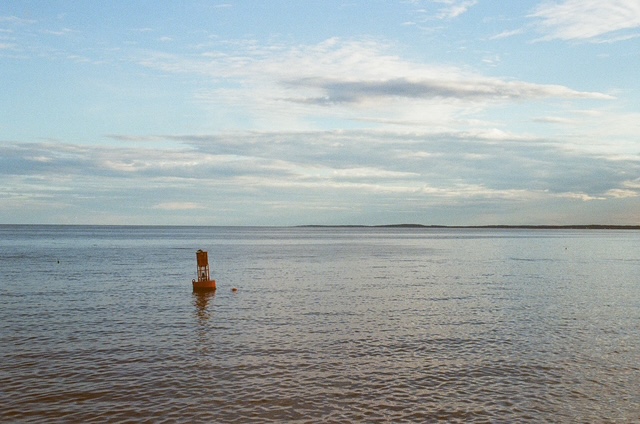
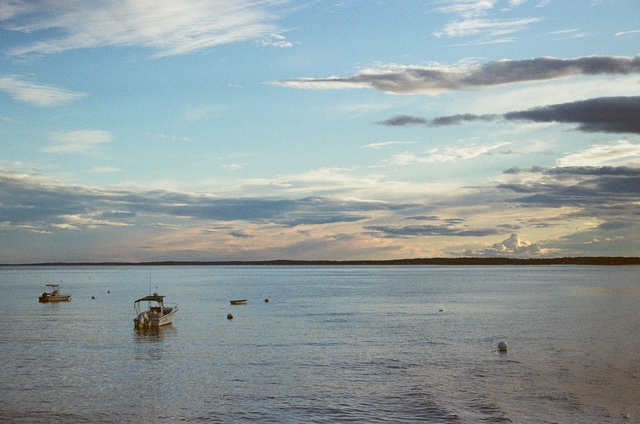
Helen Benham loved the ocean’s broad vista, and spent summers on the Hawk’s Nest Beach at Old Lyme, Connecticut and later in Damariscotta, Maine. John Masefield’s poem ‘Sea Fever,’ captures her essence:
‘I must go down to the seas again, to the vagrant gypsy life,
To the gull’s way and the whale’s way where the wind’s like a whetted knife;
And all I ask is a merry yarn from a laughing sea rover,
And quiet sleep and a sweet dream when the long trick’s over.’
______________________________
Credit where credit is due: Photos by Elena Benham. Professor Kristy Giles provided invaluable insights, as did Richard Morgan Neumann.
 an Art Farm
i love this series……
DAvid, wonderful! I loved reading about Helen. She was so very kind to me, always. Laurie Wessman LeBreton 2650 N. Lakeview, #310 Chicago, IL 60614 312/338-1309
http://laurielebreton.net/