Eugenius
Posted: March 27, 2026 Filed under: Art & Healing, Child Centered Activities Leave a comment
The sine qua non of my childhood, Eugenius and I grew up together in the era when Steve McQueen was a motorcycle riding bad-boy grey-sweatshirt-wearing prisoner-of-war locked in the “Cooler” of a Nazi POW camp. The sweatshirt was plain grey, no logo; the 1960s an era long before branding became “merch.”
Waking at dawn, Eugenius and I would eat non-sugared cold cereal in 2% white milk, lace up our black Stride Rite sneakers, pull grey sweatshirts over our head, then dash off, running until well past dark, endlessly in the woods and along the creek of our childhood home. Our mates were the Aiston brothers – Chris and Kevin – who went barefoot, even in winter. The youngest of 10 children, plus more than 20 cats, Rudy the Rooster and his flock of hens, and a Great Dane named Mukhuba, a name of African origin which means “strength or resilience;” life at the Aistons was at the vanguard of the counter culture. Our home was centrist-conservative, but we were allowed to run free, so long as we were home for dinner, hands scrubbed and seated at the table at 6pm, sharp.
We were joined at the hip. Touched by the muse, he learned the piano, so I taught myself the drums. Eventually I went to Art School and drummed with a Ghanian Tribesman Master Drummer, then dropped out, so when our Father, two months later, dropped dead suddenly, at age 52, I moved north to Milwaukee to run with Eugenius again.
He was in college. Following the centrist-conservative path, he studied Business Administration – Marketing at Marquette University. Following his heart, he rode the bus across town to study jazz theory at the Milwaukee Conservatory of Music.
At Marquette, I audited a Philosophy of Aesthetics class, read James Joyce’s “Ulysses” with a Knight of Malta (from West Allis, WI), discussed theology with a radical Benedictine monk, who taught freedom, simplicity and the enjoyment of sensory creation, “Desire is not sin. Desire is love waiting to happen.”
Eugenius’ jazz teacher was a man named King, a pianist-educator-mentor regaled as “avuncular and oracular.” King, who co-founded the degree-granting jazz studies program at the Conservatory, was widely known as a child-prodigy who became a harmonic genius. He grew up in Southern Illinois, received a Masters in Music in Nashville, Tennessee, then, during Jim Crow, emerged from the tradition of Earl “Father” Hines, bridging early jazz with bebop. A traveling jazzman, by night the King would get the white WASPs dancing, then slept in his car; no room at the Inn, the era of “separate but equal.” As if.
Seated beside the 5 packs-per-day chain-smoking King, Eugenius drank of the mysteries of harmonic theory, how to build chords, the conceptualization of “common tones,” the Circle of Fifths: the inner workings of the Muse and her music. Mante Ellis, a jazz guitarist and cofounder of that jazz program, remembers the King this way:
[He] would teach you all about everything, why it works like that. He was a monster wasn’t he?… he’d pick like F# lydian or something and make a kid go, ok, “F#”, you know, and he’d go through it and when you’d stumble he’d laugh. And he’d go up to you, because he wanted everyone to know everything. But the line he kept coming back to was, “The human mind tolerates what gives it pleasure, and what gives it pleasure is what it can do without thinking.”
And when he taught, he taught thorough. It wasn’t just a scale, he taught you why the scale, and why each note in that scale became a part of a family and the whole world was harmonious. Each tone in every scale is harmonious with itself. That’s why, you know… I thought about that. You go back and little simple shit that he taught, if you know that, man, it’s easier at the top.
What is sound? Well, sounds are vibrations that are controlled. If he asked anything about it, he’d ask what does 440 mean? 440 vibrations per second. Anything that vibrates is going to produce that sound. And what he meant by harmonious, you got even numbers and uneven numbers of vibrations. The even numbers won’t conflict. Uneven numbers and even numbers (hits fists together). Common sense. So, you studied with him, man you learned everything. The overtone series and all of that shit. Aw, man, he taught me all of that shit.
Eugenius as pupil, the King’s parting advice was, “You need to go break your heart. Then you will return to what you love.” In Milwaukee, we were kids “chasing the voodoo down” but as life moves on, so did we.
After Milwaukee, I studied Classical Literatures and Languages, while Eugenius moved to Kansas, a traveling salesmen hawking medical supplies. He was accepted into the Kellogg School of Business, Northwestern University’s world-ranking MBA program, but on the seventh day, walked into the legendary Dean Donald P. Jacobs’ office and announced, “I am going to drop out.” “To do what?” “To study classical piano,” Eugenius replied. Caught off guard, the imperious Dean Jacobs said, “No one has ever told me that. I wish you well.”
Having dropped out, west went the young Eugenius, and I rode along, his small Honda pulling a U-Haul trailer. We crossed the Rocky Mountains, the New Mexico desert by night, our destination the mile-high desert plains of Prescott Valley, Arizona. He found a studio apartment, bought a Steinway B, then slept under it because there was no room for a bed. He followed his heart.
Eventually I too moved west, lived with him again but then moved to Hootenanny Holler, Arizona, on my vision quest to create a currency based upon people’s ability to communicate. That was 1993, when the internet was young, a wild future was nascent. Data fuels the internet, and peoples’ communicating drives the data. What I saw was upwards of $300 Billion per year in profits, which if owned by the community, rather than capitalists, could become a vital force for the common good. I flew too close to the sun, crashed and burned. As the King had said, “You need to go break your heart. Then you will return to what you love.”
Decades have passed. I picked myself up, moved to Maine, worked as a carpenter and public art fabricator, but now homeschool my son at the “dawn of the post literate age.” I am increasingly convinced that rational self interest is self-limiting; that world culture is reaching a Copernican moment, when the mere rational needs to expand and embrace the intuitive, the heart, and its underlying motivations rather than the mind and its ego. So who better to call than Eugenius, to co-create a class “Math as Music: the Liminal Edge of the Rational and Intuitive.”
In the first class, Eugenius introduced the mechanics of the piano: 88 keys at 200 pounds of pressure per string, so >220 strings = 18 tons of stress, approximately 163.64 pounds of pressure per string. The lowest note, A0, needs a string 6’8” while the highest note, C8, is 1”; the physics of sound – discovered by Pythagorus, the Greek philosopher – states pitch is inversely proportional to a string’s length.
My son knows that when a vehicle passes, it emits a sound; not the engine noise, but the “whooshing” sound of displacement, an object moving through space. Pythagorus also knew that. So when Eugenius taught about harmonic overtones, the infinite sequence of harmonic pitches whose frequency is an integer multiple of any fundamental, originating tone, it was no stretch to talk about the “Music of the Spheres.”
Pythagorus intuited that the “whooshing” sound of celestial bodies – the sun, moon, and planets – produce a sound proportional to their motion, speed and size; Pythagorus saw perfect mathematical ratios creating a cosmic celestial harmony bathing the universe. Human life on Planet Earth seems chaotic, but the Music of the Spheres posits the cosmos is divinely ordered and harmonic.
It is only a hop, skip and jump from Pythagorus to Johannes Kepler’s Third Law of Planetary Motion, known as the “law of harmonies:” the square of a planet’s orbital period is directly proportional to the cube of the average distance from the Sun. Simply put, planets further from the sun take longer to orbit the sun. Kepler, strongly influenced by Pythagorus, was both a mathematician and a musical theorist, and his master work is known as Harmonice Mundi (The Harmony of the World).
So it this math or is it music? Is it jazz, or classical? Is life both-and rather than either-or? To an engineer coincidence is not correlation, but to a jazz musician coincidence can be inspiration. We are chasing that voodoo down. “Math as Music” is a playful exploration of pattern recognition, which is fundamental to intelligence.
Eugenius put it this way, “Curiosity plus repetition creates discovery and awareness. And the LOVE of LIFE instills a wonder and awe to understand the whole jiggling universe of which we are a quantum particle.”
__________________________
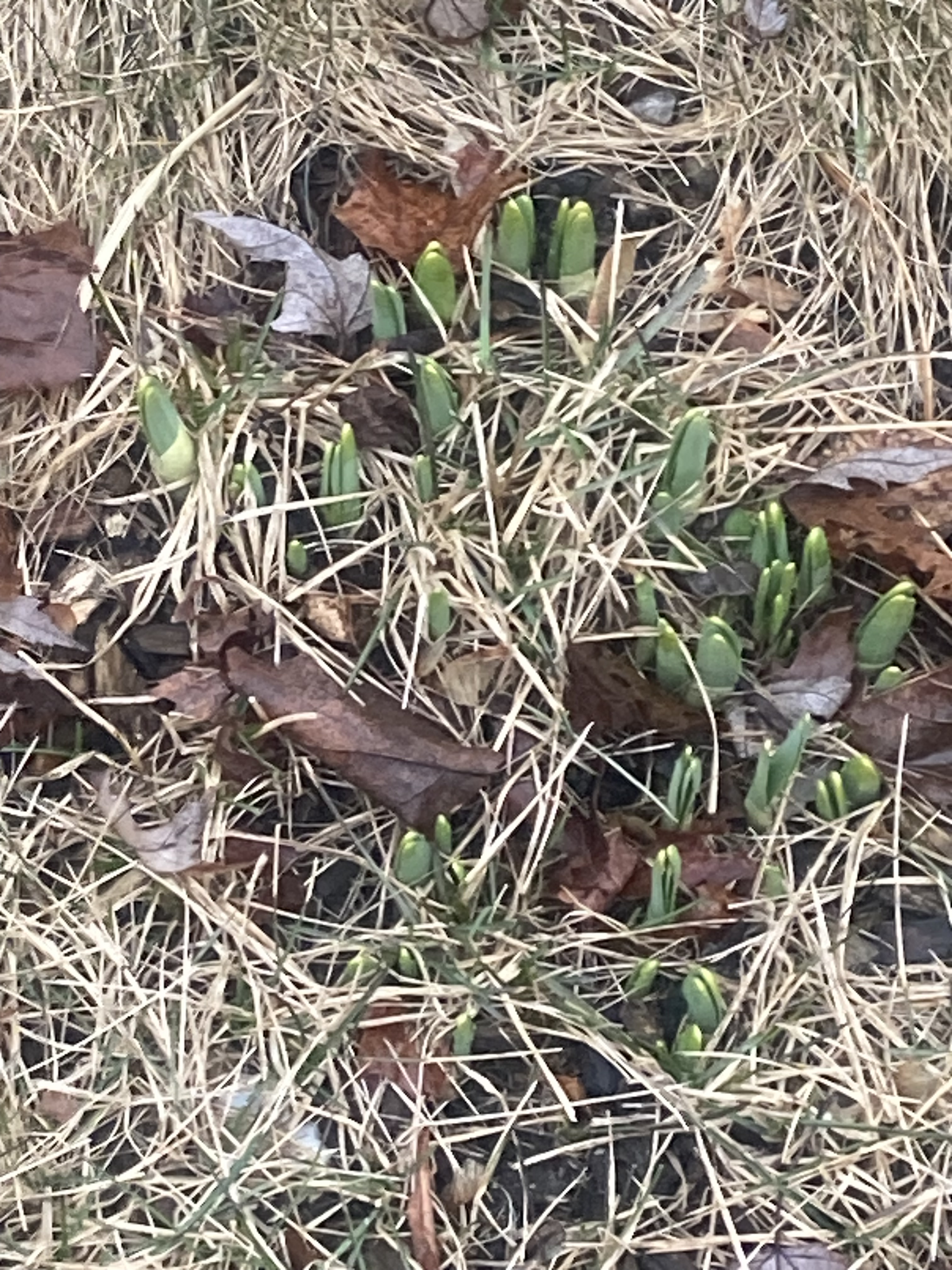
late spring, buds begin to push up…













 an Art Farm