Mr. Sneed and His Eggs
Posted: November 21, 2025 Filed under: Chronicles of a First Time Parent, Money & Banking, Portfolio - Elena's work, What is an Art Farm 2 Comments
The soundtrack of my childhood is best captured in the screech of sneakers on a parquet floor, the sharp, clear trill of a referee’s whistle, its echo down an empty gymnasium. On saturday mornings my father would drive my older brother and me to the Walden School for intramural basketball games. My brother is a gifted natural athlete who thrived there, while I found the game incredibly dull, the challenge of throwing a ball through a hoop entirely lost on me.
From my parent’s perspective it was a brilliant set-up; the house emptied for an entire morning, my Mother had quiet, my Father had no distractions and we returned home exhausted, which ensured a peaceful afternoon. My enduring intramural memory is that Mr. Sneed, who ran the program and was its referee, made his living trading eggs on the floor of the former Chicago Butter & Egg Board.
Eggs, to Mr. Sneed, were a fungible commodity, bought and sold in bulk. Eggs, in our house, were a thing scrambled, served with bacon, raspberry jam and English Muffins, for Sunday Brunch in our Dining Room after the 10:30am guitar mass at Holy Cross Church.
My Father’s day job was food merchandising. Known as the “Grocery Guru,” he wrote and lectured on three continents on how to market food at the retail grocery level. He was a stock and bond man so Mr. Sneed’s world of commodity futures contracts seemed an abstraction; foreign, opaque and mysterious. But there must have been some spark. I followed that path.
During college, I met people who worked in the markets and I visited the floor, experiencing the open outcry pits in action. Sheer bedlam, it was capitalism at its most raw and rapacious: I win, you lose, a buyer for every seller. Eventually I got a job at the Chicago Board of Trade’s Financial Futures floor, where more than $350 Billion in US Treasury bond future contracts change hands daily. It was the pits, an awful place to work, but fascinating all the same.
Eventually I became the “squawker,” reporting the 30-year Treasury bond pit action to a trading desk in Lower Manhattan, giving them an edge on market timing. The Broker for whom I worked had a superstition and would allow me to use black ink only, never red ink, which marks a loss in accounting, which he could not allow under his stead.
Following the pits I ended up managing the food service in a residence for women artists. From my office desk I traded stock options on the S&P 500. While working at a wholesale flower market I traded corn futures. Eventually I ended up trading the 30-year Treasury bond futures not on the floor but from an office. I never did well enough to quit the day job, but I never washed up, either. It was an odd fascination.
And so I came to meet the Wizard, a CPA active in off shore banking who was born in the 1920s in Nemaha County, Kansas. He had been named in honor of the traveling banker who visited the town, “an old Kansas man, born and bred in the heart of the Western Wilderness.” Close to the 100th meridian, it is hard to fathom how remote Nemaha County would have been in that age before electricity, running water and phones. It was Dorothy’s Kansas.

By conventional terms he was the Father of a college classmate, but in truth he was the Wizard of Oz trading the futures markets. He was curious about my experience and we began talking. Eventually he told me about the sanctus sanctorum, the Golden Fleece, the goose that lays the golden egg, which was the “cash forward discounting of 108% bank debentures.” And so into the land of smoke and mirrors I went.
He introduced me to a financier who had helped launch McDonalds and whose Uncle had financed the Hollywood mavens: Marcus Lowe, Samuel Goldwyn and Cecil B. DeMille. I found myself managing discussions with Sheik Mohammed Had, an Emissary and Confidante to the Royal House of Saud. I flew to Manila to meet with a mild-mannered man named Jun, possessor of 100 Metric Tons of Gold Bullion stored in the underground vaults at Kloten, Switzerland. Whether or not he was the illegitimate son of Ferdinand Marcos, the Dictator of the Philippines, was an open question, which is about the way things go in the land of smoke and mirrors. I worked with Abraham, a Christian from the South of India, who possessed a 1 kilogram rough cut emerald, the largest in the world. He was trying to leverage the asset to fund development programs for his community but when the planes struck the Twin Towers, it became all but impossible to work with rare and unusual assets.
I spent hours reading at Northwestern University’s Law Library and stumbled upon Public Law 104-62. Known as the Philanthropy Protection Act of 1995, this exempts certain charitable organizations from federal securities laws. Signed into law by the 2nd Patrician of Kennebunkport, 104-62 is a loophole large enough to drive a Brink’s truck through. I contacted McDermott Will and Emery, the world’s largest tax law firm, but was declined as a client because, “Having checked our entire roster of Associates, no one has ever heard of this law and we feel it would be unethical to learn on your dime.” Although arcane, humanitarian finance is an official law. In the land of smoke and mirrors I found the path less travelled, which proved to be almost impossibly difficult to follow.
While in London, I worked with a CPA from Toronto who had helped Kuwait finance reconstruction after the 1st Patrician’s Iraq-Kuwait War. Following the liberation, the Central Bank of Kuwait revived the Dinar at an exchange rate of USD 3.47 to 1 new Kuwaiti Dinar, making it the strongest currency in the world. That the power to organize, finance and fund can change an entire country has always struck me as fascinating.
At this season of life, these experiences are long in my past. On a recent trip back to Chicago, I took my children to the Board of Trade, but the open outcry markets are gone, replaced by electronic trading. Since 9-11 the Board allows no visitors into the Exchange. This chapter has entirely vanished.
The eggs I buy to feed my family now come unwashed at room temperature, from a local school teacher. Buying as close to the source is as far as imaginable from the fungible commodities of the Chicago markets.
That the power of capitalism can be used at scale to fund the common good remains a compelling idea, which runs counter to rational self-interest. And so I keep one line in the water still, just waiting for when the Great White Whale swims into the Casco Bay.
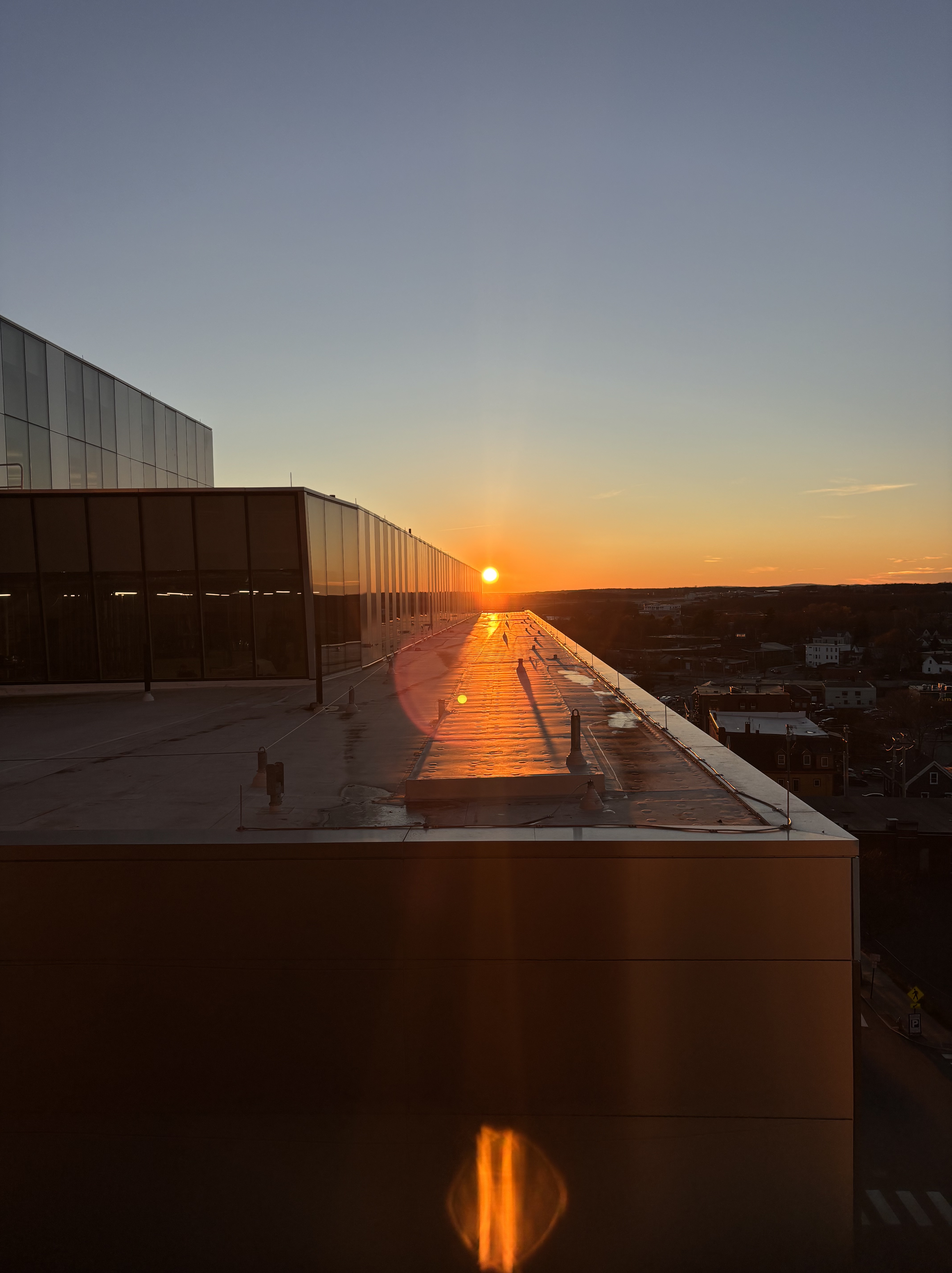
credit where credit is due: photos by Elena
Monetizing Light
Posted: November 14, 2025 Filed under: Money & Banking, What is an Art Farm 3 Comments
Every milli-second of every day for the past 4.6 Billion years, at the center of our solar system nuclear fusion repeatedly has occurred, and will occur; two hydrogen nuclei collide and merge to form a single helium nucleus, thereby releasing energy which powers the sun, which creates light.
As a form of electro-magnetic radiation, the nature of light is to emanate outward from its source, in the form of tiny discrete packets of energy called “quanta” or “photons,” and travel 93 Million miles in 8 minutes and 20 seconds whereupon they warm up a solar array on the roof of the School where I work.
Since 2015 sunlight has been harvested upon that roof, with 430 panels, covering 8,000 square feet, generating approximately 135,000 kWh of electricity per year. When sunlight bathes the solar array, electrons become energized and flow between cell layers, creating an electrical current. The flow of electrons is captured by metal plates and wires; thus, electricity is generated.
Solar power generation was discovered in 1839, and the basic design of a solar collector has endured since the 1970s. It is worth noting, however, that for the past 1.3 Billion years, fungi, and for the past 700 Million years, plants, have been eating light, thereby producing oxygen while decreasing carbon dioxide. Solar power is a stellar advancement, but cumbersome in comparison to the elegant simplicity of the plant kingdom. Still though, let’s sound three cheers for human progress and our role in it!!!
The embodied energy of the solar array (energy consumed to manufacture, ship and install the panels) is approx 260,050 kWh. That amount was offset in 1.9 years and since then the roof’s array has been net positive. Over the past ten years, the school has generated 780,010 kWh which means 842,641 pounds of carbon emissions were not produced, roughly equivalent to 424,754 pounds of coal, 5 tanker trucks of gasoline or 1.1 railcar of coal. The school’s footprint is small, its impact enduring.
By a financial sleight-of-hand the school is able to make money by converting light into power. This is done by selling “Renewable Energy Credits” (REC) to the secondary market where large utilities or carbon-producing industries purchase them to meet state-mandated climate standards. If this seems abstract, then you read well; the REC is a legally defined commodity separate and distinct from the physical electricity itself.
You can spend a dollar only once, and so too, the consumption of energy. What we monetize, then, is not the energy created and consumed but the carbon offset; we monetize not what was done, but what was not done. A subtle distinction, and except for the law of the land, otherwise not possible.
RECs have value not by fact, but by fiat; they have no monetary value except to high-carbon producing utilities and only by decree. In the year 2025, in these United States of America, the shared responsibility of clean air is legislated as a State’s right. 11 states have no REC program; the carbon “red” states are politically raging red (Deep South plus Nebraska, Wyoming and Idaho) while 11 states had programs that are now expired or repealed. All of New England participates, while Maine ranks among the more stringent standards, with 2019 legislation passed to increase Maine’s portion of electricity supplied by renewable energy resources to 80 percent by 2030 and a goal of 100 percent by 2050.
Whether the REC market will continue is an open question, hotly debated as the climate continues to heat up. While America looks back to its carbon rich past, China forges ahead with renewable energy. The Economist reports: “The scale of the renewables revolution in China is almost too vast for the human mind to grasp. China generated 1,826 terawatt-hours of wind and solar electricity in 2024, five times more than the energy contained in all 600 of its nuclear weapons. In the context of the cold war, the distinctive measure of a ‘superpower’ was the combination of a continental span and a world-threatening nuclear arsenal. The coming-together of China’s enormous manufacturing capacity and its ravenous appetite for copious, cheap, domestically produced electricity deserves to be seen in a similar world-changing light. They have made China a new type of superpower: one which deploys clean electricity on a planetary scale.” And very likely the AI race will be won by cheap electricity rather than chips.
All of which brings to mind Martin Luther King’s statement: “it may be true that morality cannot be legislated, but behavior can be regulated.” The RECs provide a vehicle toward a lower carbon future, and the school participates, every minute the sun is shining.
Forex Foray
Posted: May 9, 2025 Filed under: Chronicles of a First Time Parent, Money & Banking | Tags: economy, finance, history, money, politics Leave a comment
For your next dinner party, an interesting parlor game is to ask the question, “What is the strongest currency in the world?” The answer will stump many, and most likely, will surprise all.
My son and I talked about this recently. We were at our Credit Union and he asked about gold in their vaults – they have none – which lead to gold backing the United States Dollar (USD) – there is none.
I quoted the old joke, “There is not enough gold in Fort Knox…” and explained the Nixon Shock, when on the hot summer night of 15 August 1971, Richard Nixon – by Executive Order – suspended the convertibility of US dollars into gold. With a stroke of his pen, Nixon unilaterally ended the post World War II Bretton Woods monetary system.
In Latin “fiat” means “let it be done,” an authoritative decree and in monetary terms the USD is a “fiat” currency; there is no underlying asset base because it is secured only by “the promise to pay.” In an era of rising national debt and hyper-partisan politics, that promise to pay can seem frightfully uncertain.
“Isn’t the USD the strongest currency” my son sagely asked? I explained that the USD is the world’s reserve currency, and so the strength of all currencies is in comparison to it. Some currencies are weaker (less value) while others are stronger.
As most people would, my son reasoned the strongest currency must be either in Europe or Asia, “Asia produces so much.” Economic output logically focuses on the “Group of 7” leading industrialized nations: Canada, France, Germany, Italy, Japan, the United Kingdom and the USA. Our bias inherently is G7-centric.
We continued to talk, and he said, “No, it must be in the Middle East! They have so much oil.” He was onto something, and I told him, in fact, the Kuwaiti Dinar is the strongest currency in the world. The next three strongest currencies are also from the Middle East: Bahraini dinar, Omani rial and the Jordanian dinar. All are net exporters of oil, with a strong inflow of foreign currencies and stable governments.
A few years ago we drove north to Montreal, Canada. Before the trip my son and I went to a currency exchange to buy Canadian Dollars. He paid $1.00 USD to purchase about $1.25 Canadian Dollars. In other words, when he bought a Lego set in Canada it cost less than it would back at home; his money went further. A valuable lesson, and we had many fine meals on the cheap.
The lesson here is that the value of money is relative, not fixed. Long ago money was backed by gold, now it is fiat, while oil is becoming a dominant base of value. All oil sales are settled in United States Dollars – known as “petrodollars” – but China and Saudi Arabia have begun to settle in Chinese Yuan. The USD now is declining. The global movement seems away from fiat to asset-backed currencies. The omnipotence of oil backed currency would seem to make the transition to clean energy more difficult by an order of magnitude.
In the age when gold was the standard, there were arguments for both Gold and Silver to serve as the underlying basis. William Jennings Bryan’s historic speech advocating bimetallism, delivered in 1896 in Chicago, ranks among the finest examples of oratory in world history.
The gold proponents were the monied class on the East Coast. The silver constituency were the workers, the masses, the common man. Bryan reasoned:
“The man who is employed for wages is as much a business man as his employer; the attorney in a country town…the merchant at the cross-roads store…the farmer who goes forth in the morning and toils all day,.. the miners who go down a thousand feet into the earth…are as much business men as the few financial magnates who, in a back room, corner the money of the world. We come to speak of this broader class of business men.”
He then addressed the gold proponents, and argued against supply-side economics:
“There are two ideas of government. There are those who believe that, if you will only legislate to make the well-to-do prosperous, their prosperity will leak through on those below. The Democratic idea, however, has been that if you legislate to make the masses prosperous, their prosperity will find its way up through every class which rests upon them.”
He rhetorically cut down the gold position, advocating the bimetal monetary basis to support the common man, and then in crescendo, rose to his time-honored conclusion:
“Having behind us the producing masses of this nation and the world, supported by the commercial interests, the laboring interests, and the toilers everywhere, we will answer their demand for a gold standard by saying to them: “You shall not press down upon the brow of labor this crown of thorns; you shall not crucify mankind upon a cross of gold.”
Dead silence filled the Chicago Coliseum. Bryan feared he had missed his mark, until pandemonium broke out and he was raised onto the shoulders of delegates. “Bedlam broke loose, delirium reigned supreme” the Washington Post reported.
Gold, silver, fiat, or oil…in a world of constant change, the lesson for my son is that integrity need be his bank account, his word his bond, character alone counts. By that true standard he will do well regardless of the rising or falling tides of money and banking.
__________________________
In our home school chemistry class, solid progress had been made, my son has made his mark.



Red V8; the Donner Pass to Cascadia Planet
Posted: February 28, 2025 Filed under: Chronicles of a First Time Parent, Money & Banking, What is an Art Farm | Tags: bioregionalism, digital-marketing, internet-marketing, marketing 2 Comments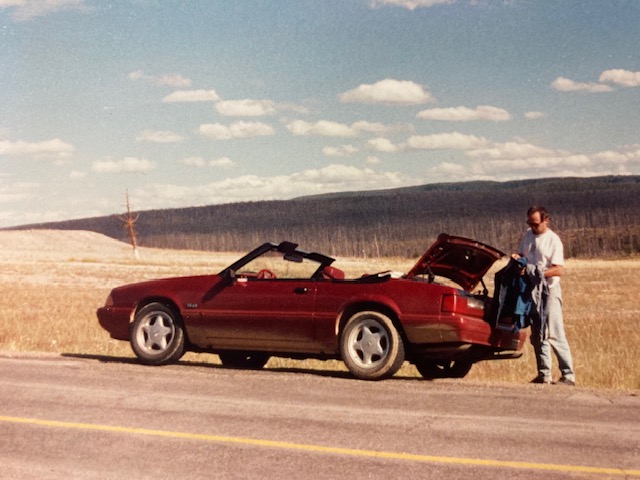
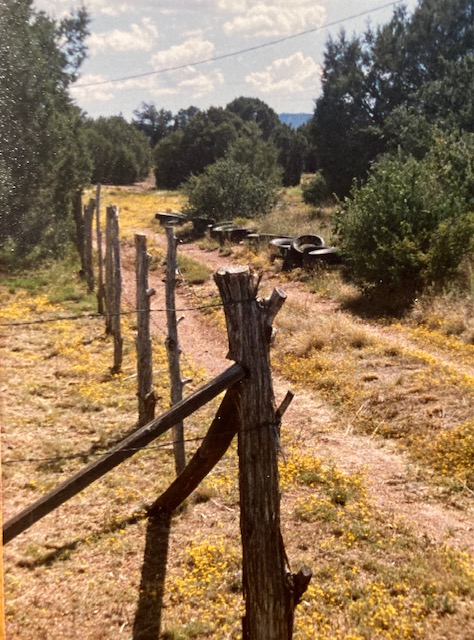
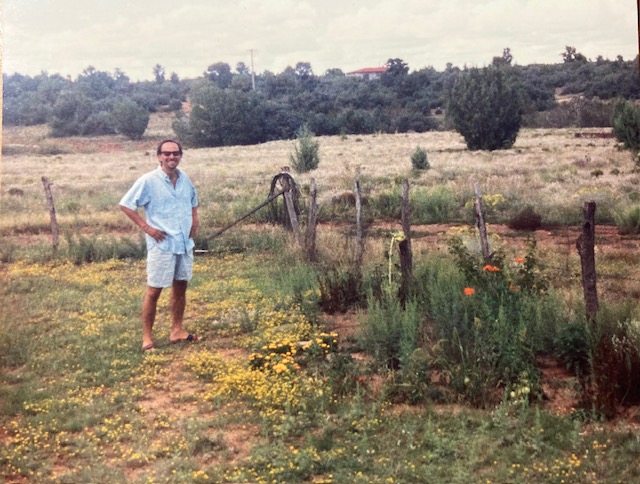
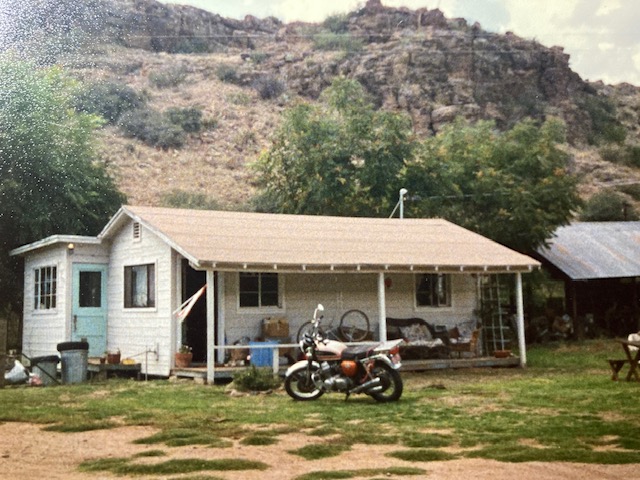
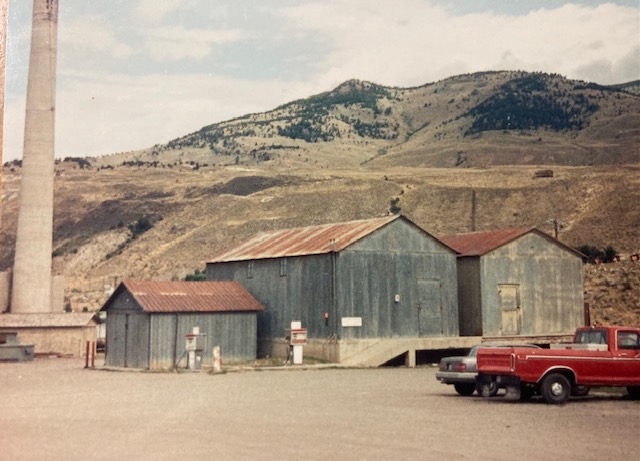
June, 1993 Douglas and Laurie moved from Hyde Park (South Greenwood Avenue) to Rogers Park (1336 Chase Street). In August Douglas came west to visit me, and on the spur of the moment, we drove his rented Red V8 Mustang convertible 932 miles north to Montana, where Brian was working in a laundromat at Yellowstone Park. We spent one day there, then drove back to Arizona: 1,800 miles in 72 hours. The long stretch of Utah and Wyoming desert was extraordinarily dull but we were young, full of moxie, Douglas had the corporate Amex, there was no turning back.
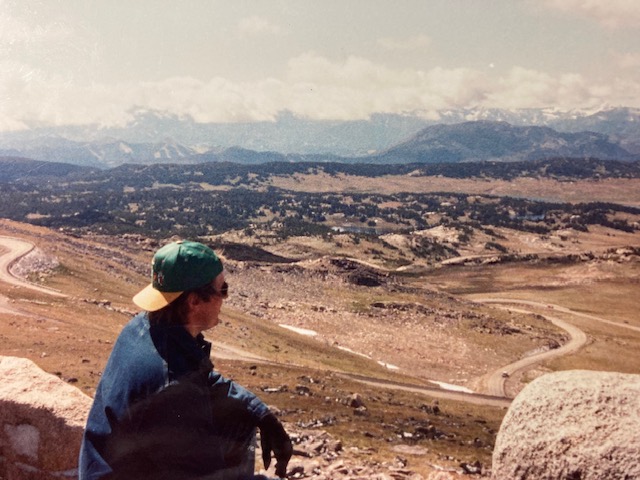
In September I was kicked out of the trailer (a consequence of his visit) and moved into a home further west in Hootenanny Holler. The house had a telephone. Douglas and I began talking about the concept of a Digital Library.
In addition to planning the world’s digital library, I organized a bio-regional news service and drew blue prints for community-based retail outlets. To my mind, the information future could not only be virtual, but need be tethered to life on the planet. I adapted Aristotle’s definition of man as a “political animal” using the tag line “Regardless of the internet’s reach, we will always communicate face-to-face with our neighbors.” I travelled to Vienna, Austria to attend an eco-cities conference, on how to rebuild our human habitat in balance with living systems.
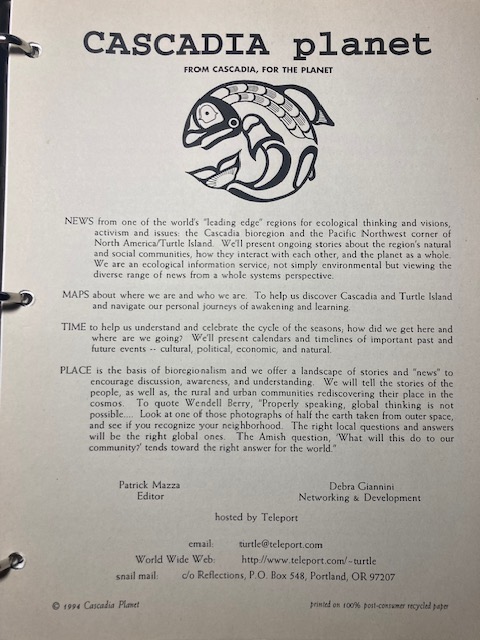
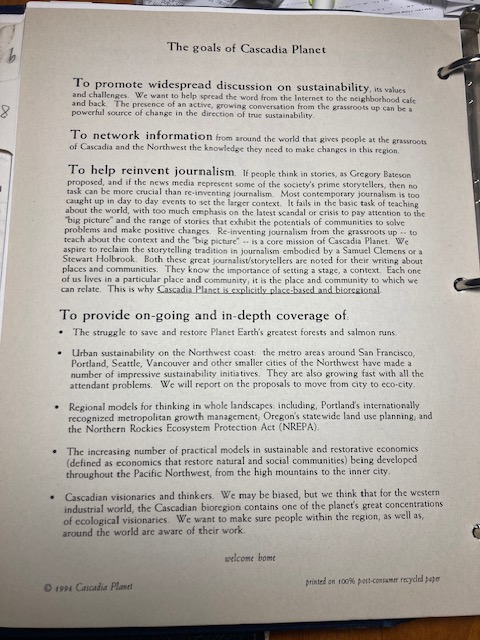
Twice a friend and I drove to Portland, Oregon – crossing the Donner Pass in the Sierra Nevadas in a blizzard – to lay the groundwork for the “Turtle News Network.” “Cascadia Planet” would be the flagship; Cascadia the bioregional name of the Pacific Northwest, as defined through the watersheds of the Columbia, Fraser and Snake Rivers, and the geology of the region. Bioregionalism recognizes not arbitrary political boundaries but the organic flow of water and rock.
There were stories to tell. I raised funds for a video documentary series, in newsmagazine format, profiling the bioregional movement. I met with Patrick Mazza, a journalist, and we developed plans for “Cascadia Planet” a website to include “text, multimedia sound, images, graphs, lists and a web-structure for related Internet searches.” Bear in mind, 1993 was an internet before video, before streaming, fewer than 600 web sites in total, before iPhones or social media apps; Mosaic had just been released and was the first browser to show both texts and images on the same page, a key factor in early acceptance of the World Wide Web. The air was electric with possibility.
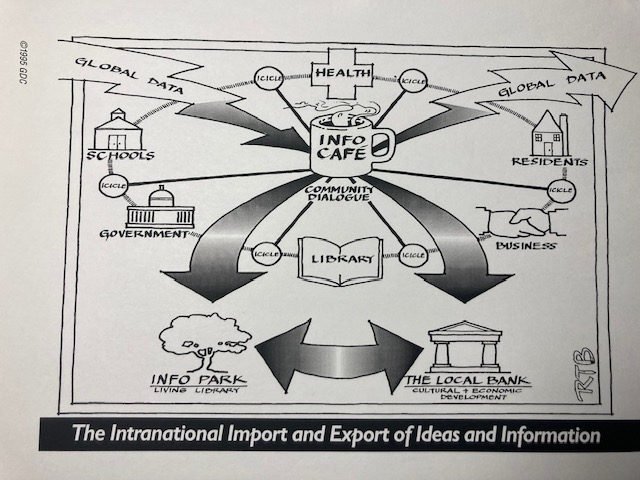
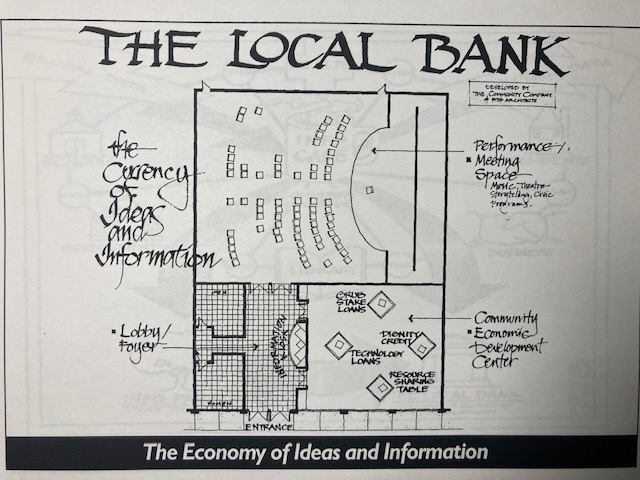
I envisioned three types of retail outlets:
- The Info Cafe: the world of information and the information of your world
- The Info Park: the living library of the information economy
- The Local Bank: the economy of ideas and information
Taken collectively, this was called “Global Data” – the world’s digital library plus a bioregional news network plus local grass-roots community dialogue: “The Intranational Import and Export of Ideas and Information.” Global access to information grounded face-to-face, person-to-person in dialogue with your neighbor, to solve problems, to build a sustainable future. Locavore, indeed.
In October Brian returned to Chicago, moved into the Chase Street house for a few weeks before leasing an apartment in Bucktown. In December I returned to Chicago. Rob gave me a desk space at the old office. We rolled up our sleeves and got to work writing the business plans for this venture.
Powell’s Books Chicago is an independent used bookstore, launched in 1970 to serve the intellectual and general interest community in the Hyde Park neighborhood. Michael Powell, the owner’s father, became intrigued with the store and launched, in 1971, his own used bookstore, “Powell’s City of Books” in Portland, Oregon. At 68,000 square feet – about 1.6 acres – of retail space the flagship store is the largest used bookstore in the world, with reading rooms where people are encouraged to sit and linger. It seemed a model for my Info Cafe.
While I was in Cascadia launching the Turtle News Network, Michael Powell was establishing an internet presence, using email and “file transfer protocol” (FTP) one of the earliest forms of computer interfacing. Powell’s website went live in 1994. “Cascadia Planet” went live in 1994. Further north in Cascadia, there were rumors of a young man named Bezos, who had quit a Wall Street job and was crossing the country, his wife driving, while he wrote a business plan to sell books on the internet. Our goal was access to information, his goal was selling books, all signs pointed to a robust future online.
In February 1994 I formed Global Dakota Corporation (GDC) and Digital Library Corporation (DLC) as State of Illinois C-Corporation holding companies. I sold Non-Voting Preferred shares in GDC to raise about $150,000. The name Global Dakota was chosen to reflect a global alliance of people. “Dakota” comes from the Native American Sioux nation and is a gender-neutral name that means “friend” or “ally.” Global spoke to ubiquity of the world wide web.
Rob and Douglas formed the Information Alliance and February through May wrote both “The Digital Library Corporation Concept and Vision” and the “Business Plan for the Digital Library Corporation.” The strategy of the DLC was cooperation, rather than competition:
“If the Digital Library Corporation is successful in communicating its vision – to improve the use of information resources through cooperative associations among libraries, publishers, and database providers — then the concern about “competition” and its negative elements will be ameliorated. The creation of a Digital Library World is a huge undertaking with plenty of room for a large number of disparate players. Rather than determining that it must be”control” everything pertaining to digital libraries, the DLC must seek to play a key role in shaping and aligning the movement toward digital libraries in a socially responsible manner.”
Brian had a college friend, an engineer with an interest in computers, who went on to become the webmaster at Ameritech, the telecomm giant. Douglas, Brian and I would spend evenings gathered at his house, in a smoke filled room, the Simpsons on the television, while we watched the earliest stages of the internet on the computer and talked about the future. It sounds hopelessly naive, but in those days many people felt the internet could be a positive force for democracy.




New Orleans, The Library of Congress, the pits
Posted: February 14, 2025 Filed under: Chronicles of a First Time Parent, Money & Banking, Portfolio - David's work, What is an Art Farm | Tags: australia, history, libraries, library automation, news, RMG Consultants, technology 1 Comment
In the summer of 1988 we traveled to New Orleans, another food-rich destination, for the ALA Annual Conference. What I experienced changed the direction of my life: Thos Moser Cabinetmakers, from Auburn, Maine, had a vast display of its solid Cherry tables and study carrels, Ash-spindled chairs and rockers. I stopped in my tracks, in awe that people built this…by hand! Douglas thrived in the virtual world of IT but I was drawn to the tactile, the tangible, the act of making.
RMG continued to grow, more people hired to word process the documents until we outgrew our office in a two-bedroom condominium in a residential high-rise. The condo-building did not allow an office but we were on a mission so we expanded into the condominium next door. Pat McClintock, a librarian from Kentucky joined the team. RMG already had an office on the East Coast – inside the DC Beltway – and would soon add one in Southern California.
RMG Consultants ran the table during that era, its client list grew to more than 1,000 libraries internationally:
- The Library of Congress & national libraries of Australia, New Zealand, South Africa.
- Academic and research libraries throughout the U.S., Australia, New Zealand and South Africa, and in Abu Dhabi, Canada, Egypt, Kuwait
- State library agencies and public libraries throughout the U.S. – small, medium, large, very large
- Urban public libraries, including, e.g.: NYPL, Brooklyn, Queens, Miami-Dade, Cincinnati, Cleveland, Cuyahoga County, Dallas, Dayton, DC Public, Fort Worth, LA County, Hong Kong Public Libraries, Shanghai Library
- Many library automation consortia, of all types and sizes – including the largest public, academic, and multi-type ones — in the U.S., Australia, South Africa
- Public sector library jurisdictions: e.g., city, county, province, school, state, regional libraries.
Our work days began slowly, then built to a crescendo when deadlines loomed. The Consultants pushed deadlines to the last, which meant we lived or died by overnight delivery. FedEx is commonplace today, but in the 1980s it was revolutionary. FedEx began as a college term paper idea in 1965 – when Douglas was 1 – but officially took flight in April 1973 when 14 aircraft delivered 186 packages to 26 US cities. The “Overnight Letter” was not offered until 1981 which is just about when Rob launched RMG Consultants. RMG relied on the “Overnight Letter;” it allowed extra time, which ensured deadlines were pressed harder, later. We would work until the very last minute, then I would run to my car, beeline to the near west side, to make the 9pm deadline. I knew the FedEx staff on a first name basis.
Where I am a dreamer, Douglas was street smart and resourceful. More than once, after meeting the deadline we would let loose and head deeper into the barrio, to Humboldt Park. A neighborhood not for an Anglo after dark, Douglas knew just where to go, what to say, how to buy on the street. It is all legal now, so we were just ahead of our time, but it was edgy, the very sharp edge of danger which Douglas knew how to navigate.
In the summer of 1989, Rob was offered a corporate consultancy with Sears Roebuck & Company the consumer goods behemoth. It was not a typical RMG assignment but the job paid well and growth requires cash flow. Rob reached out to Howard Dillon for help, an action that would forever change Douglas’ life and generations going forward.
Howard knew of a young librarian, a single mother, in the Business Library at the University of Chicago. Interested in new opportunities, she agreed to take on the job. Her first day on site went well. Erik Lekberg, a part-timer on our team, went along as her assistant. Afterwards he spoke admiringly of her acumen, praised her humor, “She was a lot of fun to work with!”
And so Laurie Nelson met Douglas. They worked well together. Laurie felt that spark and Douglas fanned that flame. Laurie, and her daughter Emily, became a part of our pod; Laurie and I were in our thirties, Douglas and Brian in their twenties, Emily not even ten, we had great fun together, endlessly.
RMG moved that year into a new office – a legitimate office space – with a conference room, word processing area, private office for Pat and room for Rob anywhere. We added more staff. We continued to grow. Erik Lekberg’s brother Tal was a skilled carpenter who helped me finish the space and then I painted the walls. We moved in and RMG moved forward. Then I was offered a job at the Chicago Board of Trade on the financial futures floor. As I told Rob and Pat that I was leaving, I felt I was breaking a bond but they were gracious and understood.
My Father and Grandfather were stock and bond men, but I was drawn – for an unknown reason – to financial futures and options and so I worked on the floor of the Chicago Board of Trade’s 30-Year U.S. Treasury Bond futures. The “open outcry” auction is long gone, but in those days brokers and traders stood jammed into “pits” where they would scream at each other, waving their arms in bright colored jackets, buying or selling more than $645 billion dollars worth – per day – of US Treasury bond futures. Capitalism in its most raw pure form. I began as a lowly runner then was promoted to “squawker” providing the “play-by-play” commentary via the telephone to the Prudential Bache trading desk in lower Manhattan. It was a macabre and unappealing place to work, but the experience would prove providential.
Enterprising computer scientists could make a fortune through library automation and as the new decade dawned the marketplace began to mature. Mergers and acquisitions began and Data Research Associates, one of the legacy automation firms, went public with an IPO in 1992.
Data Research Associates was the brainchild of Mike Mellinger, a larger-than-life software engineer, who studied Applied Math & Computer Science at Washington University, class of 1971, then wrote the ATLAS software for the St Louis Public Library and Cleveland Public Library. In the tradition of the authoritarian tech entrepreneur, Mellinger created the product and remained the most technically astute person in the company. Rob describes him as among the two most brilliant software engineers in the industry; Vinod Chachra, the other member of that pantheon enters our story three years later, in 1995.
When Mellinger took DRA public, the installed user base had grown to 1,584 libraries, and its revenues were the 4th largest in the industry. Rob McGee’s influence was through contract negotiations, on behalf of libraries that purchased the ATLAS system. Rob’s breadth of knowledge and ruthless objectivity were brought fully to bear at the negotiating table. Mellinger and McGee would tenaciously have at it, the vendor driven by the profit motive, while the consultant served as advocate to the library. Rob’s strategic advantage was that he knew how Mike was thinking, and thus – like a chess match – anticipated his moves. Rob was able to win, which drove performance standards higher, ensuring greater access to information for the library end-user. Rob’s approach was win-win: DRA gained the windfall of a signed contract, while the library enjoyed heightened user service. Having been present at the creation, Rob matured his leadership through contract negotiations.
Like battlefield attorneys who litigate by day, then share a cocktail after hours, nothing was ad hominem. McGee and Mellinger shared the highest respect for each other. DRA used the IPO proceeds to acquire two other vendors, increasing their annual revenues to $38.6 Million. Many vendors, though, chose to remain private, pocketing the robust cash flows from subscription revenues.

4 August 1991
Failure and Forgiveness
Posted: November 15, 2024 Filed under: Art & Healing, Chronicles of a First Time Parent, consciousness, Money & Banking, What is an Art Farm | Tags: authoritarian, bankruptcy, contemplation, failure, faith, forgiveness, jurisprudence, naivete, redemption, sufi 2 Comments
In my life the most meaningful lessons were learned from my failures more than any success. Would that it were different, but such, in my experience, has been the lesson learned. I suspect I am not alone here.
The consumer marketing machine, it seems, plays on everyone’s hopes for the good life: the getaway cruise, the flashy new car, the land of milk and honey, lifestyles of the rich and famous. To my mind these are diversions, distractions, from the hard work of honest integrity.
Among my failures was being held in contempt of court, United States Federal Court, Northern District of Illinois. It dragged on for months, and one day into the courtroom United States Marshalls entered, guns holstered, locked and loaded. My counsel nervously waited to petition on my behalf, but surprisingly, they had come not for me. I did not go to jail.

A banker from Lichtenstein did go to prison to serve a three-year term. I was a co-defendant in a lawsuit concerning off-shore Trust Asset Management, guilty not of fraud but of naïveté. The case eventually was settled. The experience gave me reason deeply to reconsider.
Following that settlement I filed a Chapter 7 bankruptcy, which taught me the remarkable experience of forgiveness. It is extraordinary to learn – in the first person – that forgiveness lies at the core of American civil jurisprudence.
Our system of justice is fundamentally about redemption and resolution. In practice often such may seem not the case – for profit prisons, for example – but forgiveness, in fact, does seem to lie at the core. Is not the hope for a better future the American dream? Such, at least, has been my personal experience.
In beginning that new chapter I further learned to let integrity be my bank account. Our culture deifies money. We are drunk in the belief that wealth must equal intelligence and character. We could be no further from the truth.
When I was a boy the popular phrase was “A man’s word is his bond.” Long out of date that is now. Our delusions are different from the truth, which remains that our character is key, that integrity is – in the end – all that matters.
I am not alone in feeling a seismic shift unfolding. This week I received a missive from a Franciscan monk, the founder of the Center for Action and Contemplation, who wrote:
“I have been increasingly convinced that we need a worldwide paradigm shift…(which) becomes necessary when the previous paradigm becomes so full of holes and patchwork “fixes” that a complete overhaul – which once looked utterly threatening – now appears as a lifeline. [We must] move beyond the reward/punishment paradigm.”

He told the Sufi-inspired story “The Angel with the Torch and the Pail”
“An angel was walking down the streets of the world carrying a torch in one hand and a pail of water in the other. A person asked the angel, “What are you doing with that torch and pail? The angel said, “With the torch I am burning down the mansions of heaven, and with the pail I am putting out the fires of hell. Then, and only then, will we see who truly loves God.”
The monk concluded by saying, “The most loving people I have met across the world in my lifetime of teaching and traveling all seemed to know that if love is the goal, it must be love for everybody.”
The bromance playing out on social media and in the halls of government is not about love for everybody. The situation in America is child’s play to the global trend toward authoritarian strongmen. To my mind most certainly this will result in a humanitarian failure, which would force we the people, on this small planet, deep into reevaluation.
We must own our failures before we can be reborn. Once we do that, what if redemption and love become the result of these uncertain times?

15 driving debt
Posted: April 20, 2024 Filed under: Child Centered Activities, Money & Banking 2 Comments
My daughter turned 15 last Sunday. On Tuesday she began Drivers Ed. On Wednesday we opened a checking account for her. She has asked about buying a car.
A few years ago, she and her friends bestowed upon me the title, “Funky Youth Pastor” which she assured me was a high honor. Given that, I hereinbelow give my sermon about turning 15, driving, and debt.
The word “mortgage” is derived from the Old French word “morgage”, which directly translates to “dead pledge”. This is not entirely morbid. In the early 1600s Sir Edward Coke, a barrister in England explained, “And it seemeth, that the cause why it is called mortgage is, for that it is doubtful whether the feoffor will pay at the day limited such sum or not: and if he doth not pay, then the land which is put in pledge upon condition for the payment of the money, is taken from him for ever, and so dead to him upon condition. And if he doth pay the money, then the pledge is dead as to the tenant.” In other words, a mortgage is “dead” when either the debt is paid or the payment fails.
Debt is not a death sentence but it carries a high cost. In fact, each of the monotheistic religions – Judaism, Christianity, and Muslim – have scripture which forbade interest.
The Quran, verse 275, says that interest – the payment upon debt – is forbidden:
“Those who consume interest cannot stand [on the Day of Resurrection] except as one stands who is being beaten by Satan into insanity. That is because they say, “Trade is [just] like interest.” But Allāh has permitted trade and has forbidden interest. So whoever has received an admonition from his Lord and desists may have what is past, and his affair rests with Allāh. But whoever returns [to dealing in interest or usury] – those are the companions of the Fire; they will abide eternally therein.”
In the Hebraic tradition, Deuteronomy 23:19-20, says that interest is not forbidden but it is restricted:
“Do not charge a fellow Israelite interest, whether on money or food or anything else that may earn interest. You may charge a foreigner interest, but not a fellow Israelite, so that the Lord your God may bless you in everything you put your hand to in the land you are entering to possess.”
Within the Christian tradition, in the early Middle Ages, it seems this scripture was taken to mean that Christians could not handle money but those of the Jewish faith could. And given that the Jewish people could neither own land, nor join a Guild to learn a trade, they became facile at handling money. But money was of Caesar’s realm, not God’s, and a schism was laid, then codified into law in 1745 when Pope Benedict issued his Vix Pervenit that condemned the practice of charging interest on loans as usury.
The words of the prophets have fallen on deaf ears. In January 2024 U.S. consumer debt – credit cards, students loans, auto loans, mortgages and payday loans – totaled $17.37 trillion dollars, and the median credit card interest rate is currently 24.37%. The gross federal debt of the United States has surpassed $34 trillion dollars. We are intoxicated with credit.
It was not always this way. In July of 1979 USA President Jimmy Carter gave his “Malaise” speech, speaking to the nation “…about a fundamental threat to American democracy…to worship self-indulgence and consumption.”
“It is a crisis that strikes at the very heart and soul and spirit of our national will. We can see this crisis in the growing doubt about the meaning of our own lives and in the loss of a unity of purpose for our nation. In a nation that was proud of hard work, strong families, close-knit communities, and our faith in God, too many of us now tend to worship self-indulgence and consumption. Human identity is no longer defined by what one does, but by what one owns. But we’ve discovered that owning things and consuming things does not satisfy our longing for meaning. We’ve learned that piling up material goods cannot fill the emptiness of lives which have no confidence or purpose.”
He had the decency to admit, “This is not a message of happiness or reassurance, but it is the truth and it is a warning.” No one wanted to hear that message. Jimmy Carter consistently ranks among the least respected of US Presidents and he lost in a landslide in the 1980 election.
Carter’s prophecy went ignored and twenty-one years later, the man from Kennebunkport, President George W. Bush would address the nation in September 2001 and encourage continued consumption.
Following the devastation of 9-11 he said, “And one of the great goals of this nation’s war is…to tell the traveling public: Get on board. Do your business around the country. Fly and enjoy America’s great destination spots. Get down to Disney World in Florida. Take your families and enjoy life, the way we want it to be enjoyed.”
My child, at the age of 18 you will be legally able to enter a contract and borrow money. We will then advise but no longer control your decisions. Certainly there is a car in your future and my goal now is to give you clarity to guide your decisions.
The auto website Edmunds reported in October 2023 that the average new car payment had reached an all-time high of $736 per month. The average cost of used cars was $29,328. As options and panache increase so too does the cost; always consider whether your purchase and obligations are sustainable. There is a wisdom in frugal simplicity.
And keep in mind what Ghandi said, “Live simply so that others may simply live.” This quote is available on a bumper sticker. Maybe put that on your first car?

 an Art Farm