Red V8; the Donner Pass to Cascadia Planet
Posted: February 28, 2025 Filed under: Chronicles of a First Time Parent, Money & Banking, What is an Art Farm | Tags: bioregionalism, digital-marketing, internet-marketing, marketing 2 Comments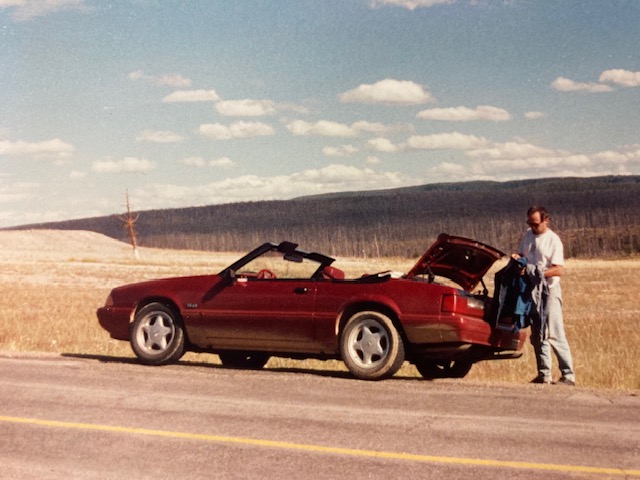
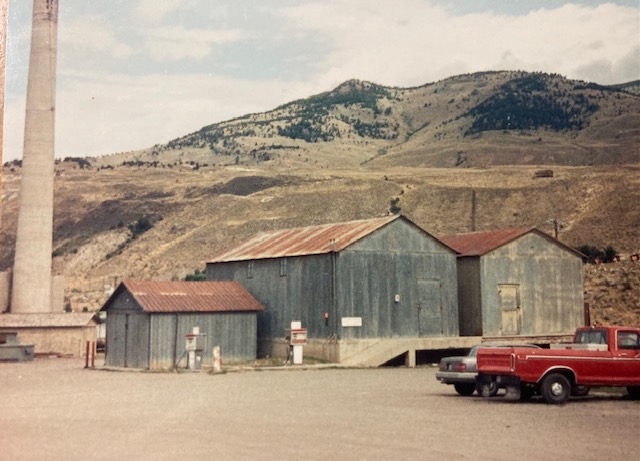
June, 1993 Douglas and Laurie moved from Hyde Park (South Greenwood Avenue) to Rogers Park (1336 Chase Street). In August Douglas came west to visit me, and on the spur of the moment, we drove his rented Red V8 Mustang convertible 932 miles north to Montana, where Brian was working in a laundromat at Yellowstone Park. We spent one day there, then drove back to Arizona: 1,800 miles in 72 hours. The long stretch of Utah and Wyoming desert was extraordinarily dull but we were young, full of moxie, Douglas had the corporate Amex, there was no turning back.
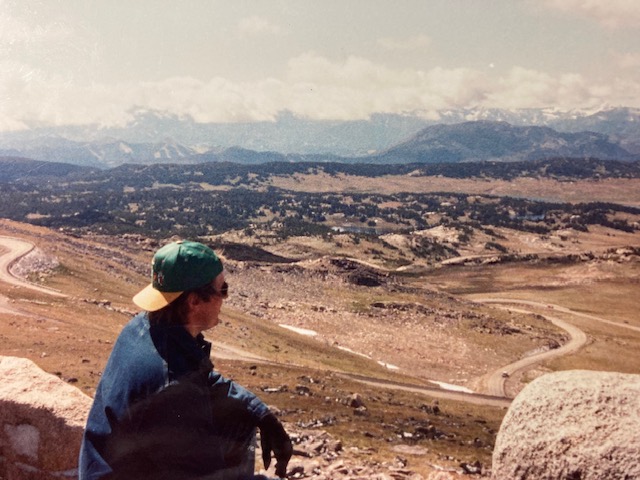
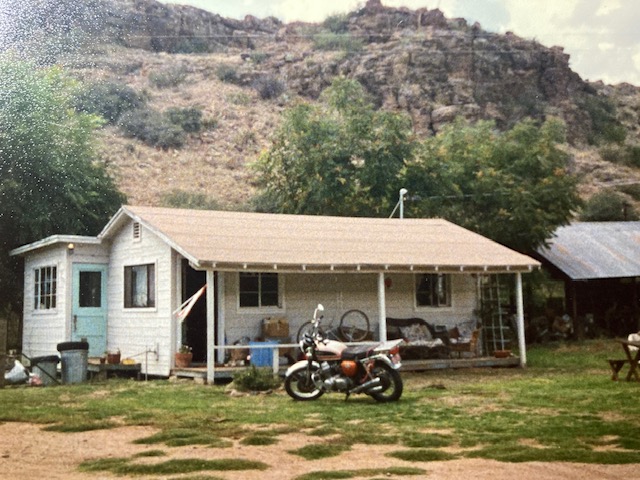
In September I was kicked out of the trailer (a consequence of his visit) and moved into a home further west in Hootenanny Holler. The house had a telephone. Douglas and I began talking about the concept of a Digital Library.
In addition to planning the world’s digital library, I organized a bio-regional news service and drew blue prints for community-based retail outlets. To my mind, the information future could not only be virtual, but need be tethered to life on the planet. I adapted Aristotle’s definition of man as a “political animal” using the tag line “Regardless of the internet’s reach, we will always communicate face-to-face with our neighbors.” I travelled to Vienna, Austria to attend an eco-cities conference, on how to rebuild our human habitat in balance with living systems.
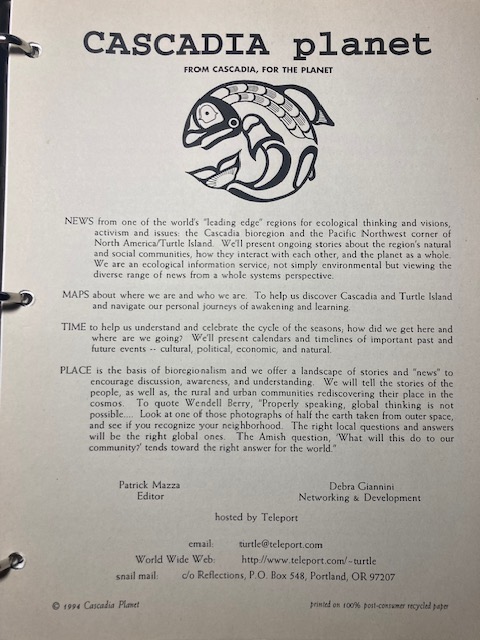
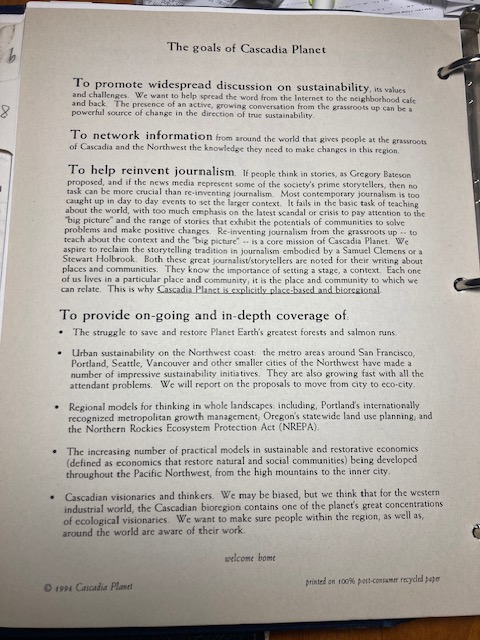
Twice a friend and I drove to Portland, Oregon – crossing the Donner Pass in the Sierra Nevadas in a blizzard – to lay the groundwork for the “Turtle News Network.” “Cascadia Planet” would be the flagship; Cascadia the bioregional name of the Pacific Northwest, as defined through the watersheds of the Columbia, Fraser and Snake Rivers, and the geology of the region. Bioregionalism recognizes not arbitrary political boundaries but the organic flow of water and rock.
There were stories to tell. I raised funds for a video documentary series, in newsmagazine format, profiling the bioregional movement. I met with Patrick Mazza, a journalist, and we developed plans for “Cascadia Planet” a website to include “text, multimedia sound, images, graphs, lists and a web-structure for related Internet searches.” Bear in mind, 1993 was an internet before video, before streaming, fewer than 600 web sites in total, before iPhones or social media apps; Mosaic had just been released and was the first browser to show both texts and images on the same page, a key factor in early acceptance of the World Wide Web. The air was electric with possibility.
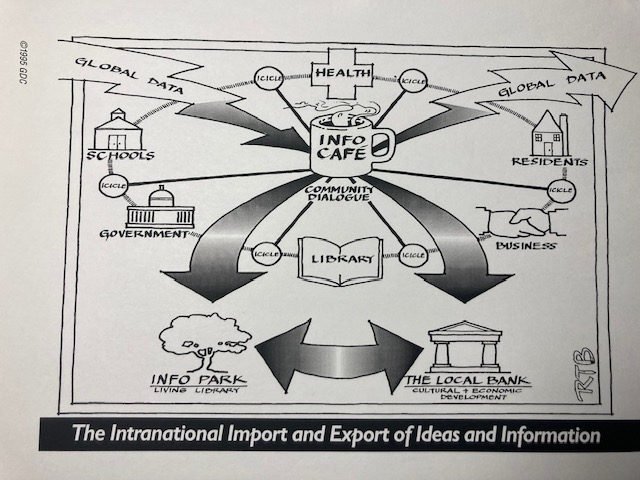
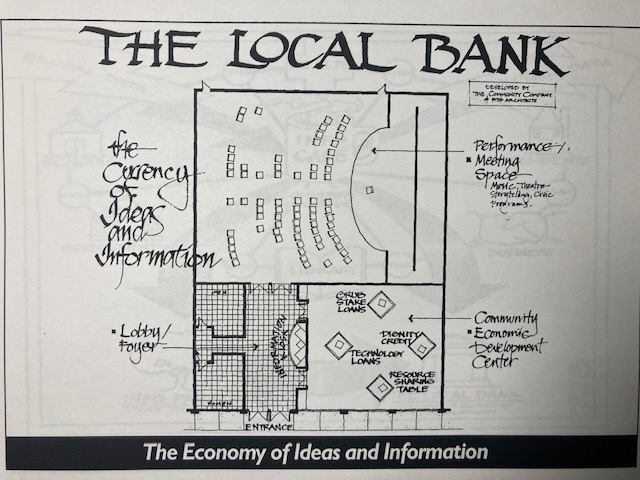
I envisioned three types of retail outlets:
- The Info Cafe: the world of information and the information of your world
- The Info Park: the living library of the information economy
- The Local Bank: the economy of ideas and information
Taken collectively, this was called “Global Data” – the world’s digital library plus a bioregional news network plus local grass-roots community dialogue: “The Intranational Import and Export of Ideas and Information.” Global access to information grounded face-to-face, person-to-person in dialogue with your neighbor, to solve problems, to build a sustainable future. Locavore, indeed.
In October Brian returned to Chicago, moved into the Chase Street house for a few weeks before leasing an apartment in Bucktown. In December I returned to Chicago. Rob gave me a desk space at the old office. We rolled up our sleeves and got to work writing the business plans for this venture.
Powell’s Books Chicago is an independent used bookstore, launched in 1970 to serve the intellectual and general interest community in the Hyde Park neighborhood. Michael Powell, the owner’s father, became intrigued with the store and launched, in 1971, his own used bookstore, “Powell’s City of Books” in Portland, Oregon. At 68,000 square feet – about 1.6 acres – of retail space the flagship store is the largest used bookstore in the world, with reading rooms where people are encouraged to sit and linger. It seemed a model for my Info Cafe.
While I was in Cascadia launching the Turtle News Network, Michael Powell was establishing an internet presence, using email and “file transfer protocol” (FTP) one of the earliest forms of computer interfacing. Powell’s website went live in 1994. “Cascadia Planet” went live in 1994. Further north in Cascadia, there were rumors of a young man named Bezos, who had quit a Wall Street job and was crossing the country, his wife driving, while he wrote a business plan to sell books on the internet. Our goal was access to information, his goal was selling books, all signs pointed to a robust future online.
In February 1994 I formed Global Dakota Corporation (GDC) and Digital Library Corporation (DLC) as State of Illinois C-Corporation holding companies. I sold Non-Voting Preferred shares in GDC to raise about $150,000. The name Global Dakota was chosen to reflect a global alliance of people. “Dakota” comes from the Native American Sioux nation and is a gender-neutral name that means “friend” or “ally.” Global spoke to ubiquity of the world wide web.
Rob and Douglas formed the Information Alliance and February through May wrote both “The Digital Library Corporation Concept and Vision” and the “Business Plan for the Digital Library Corporation.” The strategy of the DLC was cooperation, rather than competition:
“If the Digital Library Corporation is successful in communicating its vision – to improve the use of information resources through cooperative associations among libraries, publishers, and database providers — then the concern about “competition” and its negative elements will be ameliorated. The creation of a Digital Library World is a huge undertaking with plenty of room for a large number of disparate players. Rather than determining that it must be”control” everything pertaining to digital libraries, the DLC must seek to play a key role in shaping and aligning the movement toward digital libraries in a socially responsible manner.”
Brian had a college friend, an engineer with an interest in computers, who went on to become the webmaster at Ameritech, the telecomm giant. Douglas, Brian and I would spend evenings gathered at his house, in a smoke filled room, the Simpsons on the television, while we watched the earliest stages of the internet on the computer and talked about the future. It sounds hopelessly naive, but in those days many people felt the internet could be a positive force for democracy.




 an Art Farm