Isaac in Isolation
Posted: April 18, 2025 Filed under: Child Centered Activities | Tags: alchemy, books, consciousness, history, Isaac Newton, philosophy, rational mind, science 1 Comment
In 1665 the plague descended upon London, forcing all the residents to go into isolation. The COVID-19 of its day, in an age before plumbing or electricity, before iPhones and apps, the isolation was complete to a degree that we can barely fathom today.
A 22-year old named Isaac used his solitude well, conceiving the laws of infinitesimal calculus. Leibniz is credited with developing Calculus but young Isaac was 8 years ahead of him. Einstein has hailed the insights as “perhaps the greatest advance in thought.”
At the age of 44 Isaac walked in the gardens of Cambridge University and observed an apple falling straight down to the earth. So he surmised and proceeded to publish, in 1687, Principia which established the foundation for classical mechanics. A manuscript from the Royal Society retells this conversation of 15 April 1726, when Isaac told a colleague how the idea came to him:
“we went into the garden, & drank thea under the shade of some appletrees, only he, & myself. amidst other discourse, he told me, he was just in the same situation, as when formerly, the notion of gravitation came into his mind. “why should that apple always descend perpendicularly to the ground,” thought he to him self: occasion’d by the fall of an apple, as he sat in a comtemplative mood: “why should it not go sideways, or upwards? but constantly to the earths centre? assuredly, the reason is, that the earth draws it. there must be a drawing power in matter. & the sum of the drawing power in the matter of the earth must be in the earths center, not in any side of the earth. therefore dos this apple fall perpendicularly, or toward the center. if matter thus draws matter; it must be in proportion of its quantity. therefore the apple draws the earth, as well as the earth draws the apple.”
By the age of 55 Isaac had been named, by the British Crown, the Warden of the Mint, and then served as the Master of the Mint for 30-years. In contemporary terms, the Master was essentially the Chairman of the Federal Reserve, responsible to ensure the value and to assay the gold content of the King’s coins.
At the age of 62 the King bestowed upon him Knighthood, which is why we universally refer to him as Sir Isaac Newton, one of the towering figures in history, a paragon of rational thought.
What is less well known of Sir Isaac is that he was a leading alchemist of his day. The irony is almost mind-boggling: when alchemy was a crime punishable by death by public hanging the Master of the Mint was busy trying to turn base metals into gold. It is said of more than 10 million words of notes taken by Newton, 1 million at least pertained to alchemy. His interest was more than just a passing curiosity. By any conventional thought, that is an idea laughably hard to grasp.
What if alchemy is not about base metals turned into gold, but rather a symbolic language for the pursuit of higher consciousness? In the three-dimensional realm of conventional thought, where the laws of physics and Darwinian materialism reign supreme, what better symbolism could there be than “base metals” and “gold” referring to the path to wisdom of a greater whole.
Carl Jung in his Alchemy and Psychology and Fabricius in Alchemy: The Medieval Alchemists and Their Royal Art suggest that this is, in fact, the more accurate understanding. In The Foundations of Newton’s Alchemy, B.J.T. Dobbs argues that “Newton’s primary goal was not the study of nature for its own sake but rather an attempt to establish a unified system that would have included both natural and divine principles.” Newton was a critical link between the Renaissance Hermeticism and the rational chemistry and mechanics of the scientific revolution; in moving the scientific world forward, he looked back upon Neoplatonism, which in turn drew upon the writings of Hermes Trismegistus, the towering Hellenistic sage.
History teaches that higher consciousness threatens conventional thought. In 33 AD the self-righteous Pharisees had the radical street preacher put to death by public hanging. Martin Luther King had an FBI file and was assassinated for arguing that “all people are created equal.” In the year 2025, the pious among us ban books from libraries that challenge their narrow minded sense of self. The orthodox, it seems, are not expansive but restrictive and limiting.
Newton was wise never to publish his alchemical writings. In fact, many of them were burned by a fire; the story told that a dog knocked over a candle in his study, but one wonders what was the risk to his reputation for that intellectual pursuit. He remained, in a sense, in isolation throughout his life for his pursuit of alchemy.
The record shows that when Newton stepped down from the 2nd Lucasian Professorship of Mathematics – considered the single most prestigious professorship in the world – his replacement, William Whiston excoriated Newton publicly for his highly unorthodox views. No doubt Professor Whiston was smug in his self righteous words and considered the case closed. But in fact, it may be that he had simply locked himself, and his peers, inside the box of self limiting, rational thought.
The world is more vast than we tend to conceive. It would seem the challenge of our times now is to expand our collective higher consciousness, to awaken and more fully hear and embrace those “mystic chords…of our better angels.”
________________________________





Rogue Hollywood; from the Library of Alexandria to Carnegie Libraries
Posted: March 7, 2025 Filed under: Chronicles of a First Time Parent, consciousness, Portfolio - David's work, What is an Art Farm | Tags: books, carnegie libraries, cosimo de'medici, Dreamworks SKG, education, history, library of alexandria, technology, travel 1 Comment
Douglas was attending classes in History and Theology at Loyola University but his most serious work was done at the RMG office. He and I were joined at the hip, constant conversation, swapping ideas at a fever pitch.
RMG formed the Information Alliance among leaders in library automation:
- Robert F. Asleson, Esq, had decades of experience as President of five library and information industry companies: University Microfilms International, R.R. Bowker, Information Handling Services, International Thomson Information, Inc., and The Library Corporation. He was thoroughly versed in all issues of copyright clearance.
- Brower Murphy, a self-described “information egalitarian” had pioneered the use of CD-ROM technology for data storage. He then developed NlightN®, a hypermedia universal network allowing a single search across the entire world of published electronic information. This was google before Google, except, created in 1991, it was not designed for the internet.
- Vinod Chachra, President and sole owner of VTLS, Inc. oversaw a staff of 70 with customers in 18 countries, requiring 16 difference languages and multiple character sets and scripts. His software provided a turn-key solution to all library functions.
- Rob McGee and Howard Harris, another RMG Consultant, formed the alliance and Rob acted as editor of the “Concept & Vision” and the business plan.
Our approach to the Worlds Digital Library was direct: “Empowering the individual by access through libraries to the world’s information, ‘anyplace, anytime.’” The philosophy was broad and inclusive, the battle plan was specific and precise. A holding company, the DLC would operate through subsidiaries, each business creating a component of the whole. The first subsidiary was The Index Company, which would:
- digitize book images from collections of widely-used library materials
- compile collections of machine-readable tables-of-contents and back-of-the-book-indexes for subject oriented sets and collections of books
- create and distribute merged collections of the indexed records to provide access to Digital Libraries.
The DLC was the economic engine driving GDC. On paper, the DLC projected a Year 1 loss of ($4.08 M) but turned positive in Year 3 and by Year 5 was in the black at a profit of $6.3 Million USD. At the end of the 20th century, “hockey stick” projections were not uncommon, but questioned by conservative bankers.
On 7 May 1994 the “Concept & Vision” paper was finished, and letters of support were received from:
- Chair of the Virginia State Library Board
- Librarian of Harvard College
- Executive Director of CAVAL (Co-operative Action by Victorian Academic Libraries [Australia])
- President Council on Library Resources
- Deputy Director General, National Library of Australia
- President of the Council of the European Information Industry Association
- Executive Director off the United States National Commission on Libraries and Information Science
It is worth noting some of their comments:
- The Librarian of Harvard College wrote, “There are going to be a number of modest efforts to build the digital library. Yours could be the one most likely to succeed on a large scale.”
- Deputy Director-General of the National Library of Australia wrote, “The approach envisaged in this paper is sensible and shows the appropriate understanding of the current state of the industry which is needed for success to be likely.”
- The President of the Council, European Information Industry Association, “…we shall have no hesitation in bringing this proposal to the attention of our members and examining ways in which we can lay a supportive role in Europe.”
While writing the “Global Data” plan, the landscape in Hollywood was changing. Steven Spielberg, Jeffrey Katzenberg, and David Geffen announced they were going rogue, to create their own live-action and animation film studio. This meant Hollywood’s studio model was being revolutionized, and the financier with whom I was hoping to meet had deep roots – I was told – in that old model. If the paradigm was changing, then I needed to write my own version.
One spring evening at the Chase Street house, Douglas and I sat down at the kitchen table to write “Top-Down meets Bottom-Up” which compared Paramount Communications and Global Dakota Corporation, a $10 Billion colossus versus our $38 Million start up. I was David out to slay Goliath. Working deep into the night, we laid out the categories and filled in the blanks, referencing medieval history through the Internet. Laurie, who is quite savvy in the C-suite, told us it was sheer hubris.
Libraries have been central to all civilizations, throughout recorded time, our collective repository of knowledge, a storehouse of the written word – cuneiform or bound – a place where scholars gather to share knowledge, to push the vanguard. The earliest libraries have been discovered in present-day Syria, and in temple rooms in Sumer (present day Iraq), each in the Cradle of Civilization. The Library of Alexandria, in Cleopatra’s Ptolemaic Egypt reigned among the most significant libraries of the Ancient World, the corpus of Greece and Egypt in one repository, until Julius Caesar’s boys came to town, on military conquest, they burned the library. Dust to dust, ashes to ashes.
30,000 clay tablets from the Library of Ashurbanipal have been discovered at Nineveh – the recorded wealth of Mesopotamia – while the University of Chicago holds baked clay tablets, the administrative backbone of the vast territory of Persia, written in Old Persian, Elamite, and Babylonian languages. The Imperial Library of Constantinople is worthy of mention, authors such as Plato, Aristotle, Demosthenes, Socrates, Thucydides, Homer and Zeno stored and sought. Themeistius, a pagan philosopher and teacher, hired calligraphers and craftsman to produce the actual codices then created a university-like school centered around the library. Lao Tzu, author of the Tao Te Ching, was the keeper of books in the earliest library in China. Into this majestic idea Rob McGee stepped as a young boy, his bike’s basket filled, riding home to 1505 Grace Street with “talking books” for his Grandmother, an armful for himself.
The Free Public Library is not free financially – it is paid for by taxes – so what is free is the access to information. Traditionally libraries had been the private domain of Princes and Kings, Bankers or Clergy. The Renaissance brought an awakening when, in 1444, Cosimo de’Medici created the San Marcos Library, one of the earliest public libraries. Cosimo combined his own extensive collection with the 800 manuscripts of Niccolo de Niccoli, a humanist who worked as a copyist and collator of ancient manuscripts, and was the creator of cursive script, known today as “italics.” Niccolo’s humanist vision was inclusive: “…to the common good, to the public service, to a place open to all, so that all eager for education might be able to harvest from it as from a fertile field the rich fruit of learning.”
Pierpont Morgan’s Library, in the grand style of the Italian Renaissance, was opened to scholars and the public in 1924, the gift of J.P. Morgan, the banker of legend, who indirectly was behind the greatest public library building program in history. In 1901, J.P. Morgan bought the Carnegie Steel Company for $18 Billion (in 2025 dollars), which allowed Andrew Carnegie to vastly expand his brick and mortar ambitions. Between 1883 and 1929 2,509 Carnegie Libraries were built around the world, free to the public. By 1929 almost half of the public libraries in the United States were Carnegie Libraries.
At the end of the 20th Century, many saw change on the horizon, bricks and mortar becoming digital, access universal, which seemed like Archimedes’ fulcrum, upon which we could move the world. Rational self-interest held no motivation for me; e-commerce and social media pale in comparison to the humanist tradition. Douglas, though, had that capitalist urge, and his enthusiasm was grounding for me. He and Rob delivered the Information Alliance which undoubtedly could make the products to drive revenues. The Digital Library Corporation was the core asset, while the Turtle News Network and the community retail outlets expanded our reach.
I played the hand I was dealt. “Top Down Meets Bottom Up” became page 41 of the Global Dakota Business Plan. On 1 July 1994 the Business Plan, with consolidating Pro-Forma Financial Statements, was complete, weighing in at 12 pounds, almost 1,000 pages printed on 100% post consumer recycled paper. Having finished the first task, I tackled the second challenge: a meeting with the Senior Chairman of the Board of McDonald’s Corporation.

Beginnings
Posted: January 31, 2025 Filed under: Chronicles of a First Time Parent, What is an Art Farm | Tags: books, free public library, libraries, library, news, reading, RMG Consultants 1 CommentDouglas Lee Woodhouse has died.
This is our story.
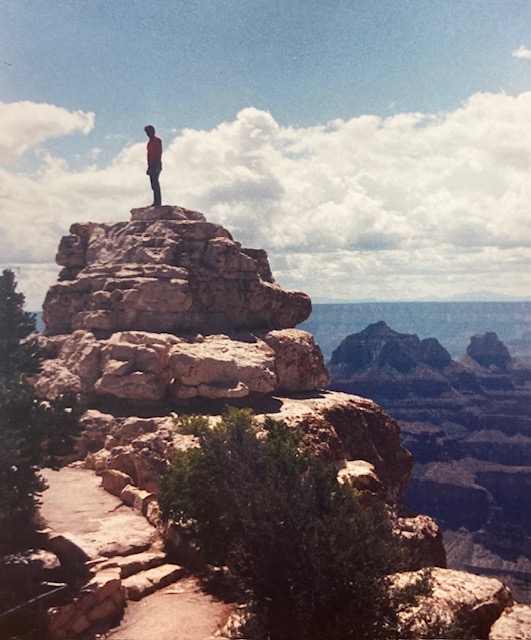
He wanted to drive to the desert, eat grapefruits while sitting cross legged playing his guitar. He went west, our young man, but made it not to the 100th meridian but to 87.629 degrees, which is Chicago, the City of Broad Shoulders, where he was welcomed with open arms.
Jack Kerouac’s “On The Road” was his sacred text, his mantra: “There was nowhere to go but everywhere, so just keep on rolling under the stars.” Destination unknown, Douglas Lee Woodhouse set out from his family home on Hollywood Avenue in Cincinnati. Nancy, his Mother, years later told me the punch line: “When he got into his Volkswagen, there was no gas! I had to drive him to the gas station to get enough gas to drive his car to the station to fill up!!”
North by northwest, Douglas arrived in Deerfield, Illinois where he “broke and entered,” which is to say he rummaged around the garage to find the “hidden” key, then let himself into his Aunt Barbara’s – my Mother’s – house whereupon he sat cross legged on the living room rug, played his guitar and sang. No desert, no grapefruits, but still silence until Aunt Barbara arrived home, most surprised, and called me promptly, “Douglas is sitting on my living room floor playing his guitar…and singing…I don’t know what to do! Can you help? Can he come to you? Now?!” “Certainly,” I said and a new life began.
Our roots were decades in the making. I was born 1961, and he arrived in 1964. We were cousins and crossed paths on family trips to Cincinnati, our Mothers’ childhood home, the brick house on North Cliff Lane built at the height of the depression among the Castles of Clifton. John F. Glaser, known as the “King of Coal” was a salesman active in the coal and home heating industry of the Ohio River Valley, while Lucille was sentry at the stove, a bountiful feast for anyone, for everyone who came to visit. It was a grand place to be young.
When Douglas arrived, I lived in the barrio, Noble at Erie, on Chicago’s Near-West side, in a very drafty large third floor walk-up. There was plenty of room for him to set up camp. The neighborhood was edgy and unpolished, working-class families and artists with a gang selling drugs from the corner one block away. We were a long way from the Castles of Clifton.
I worked at RMG Consultants, Inc., a library automation consulting firm, and my career began comically in the winter of 1985. A Senior at Northwestern University, I was hired to do word processing but was soon fired. While being fired I recommended my younger brother Brian, age 17, a junior in high school, whom they hired part time. They offered me a job painting the office, which, being unemployed, I accepted. While I painted, a deadline emergency arose, and so I closed the paint can and sat down with great focus to finish all the documents. Impressed, the Business Manager thereupon offered me her full-time position, as she was planning to leave the company. A stunning turn around.
RMG was at the vanguard when the library card catalog was becoming a relic, IT automation ascendant on the horizon. No less than the New Yorker wrote an expose about the change, card catalogs replaced with computers, the physical cabinet and notated 3×5 cards discarded from our collective past. To put 1985 in perspective, Steve Jobs had not yet been fired from Apple, Elon Musk was a freshman in high school in apartheid South Africa, Larry Page and Sergey Brin middle school students, Mark Zuckerberg in diapers. The future stretched out broadly, while the origin of library automation began the year Douglas was born.
In 1964, Howard Dillon, a new, young librarian at the Ohio State University Libraries was given the assignment to look into the library automation business and report to the library director and his cabinet. Howard began identifying and exchanging correspondence with persons in other libraries who were engaged in interesting experiments and projects. In October of that year, in Philadelphia, at the 27th annual meeting of the American Documentation Institute he rented a hotel meeting room for two days and gathered 21 of his correspondents for their first face-to-face discussions. There was great enthusiasm for this idea, and the librarians began a correspondence detailing projects, experiments or ambitions. The correspondence became formal, published as the “Newsletter on Library Automation.” Issue #1 was December 10, 1964.
Having no name, the group was referred to as the “Dillon Committee,” which name was used until the autumn of 1965 when the group organized themselves as the Committee On Library Automation (COLA) and elected leadership. COLA described itself as, “…an informal group of librarians formed to provide a means of exchanging information or research and development of automated systems applicable to libraries.”
Charles Payne – another key figure in our story – was elected Vice Chairman and Chairman Elect, while Howard Dillon served as the Editor. COLA pursued affiliation with an existing professional organization and in 1966 were formally recognized, when the council of the American Library Association (ALA) voted to create the Information Science and Automation Division (ISAD). The final COLA Newsletter, #44, was issued September 1969 when a new world was entered.
Rob McGee – founder of RMG Consultants – began as a Doctoral student at the University of Chicago’s Graduate Library School in 1965, already holding a Masters in Library Science from the University of North Carolina, and soon to study in Scotland, where he would receive a Diploma in Computing Science from the University of Glasgow. In the autumn of 1967 he returned to Hyde Park, and began at the University of Chicago Library Systems Development Office. In many ways this was a second career, he had been shelving books since he was 9-years old, at the Community College library in Wilmington, North Carolina. He also worked in the local paper mill and, in Washington State, 100-hour work weeks picking peas for the Green Giant Cannery. He grew up well versed in sheer physical labor, under the heat of the summer sun.
Born in Washington, DC, Rob grew up in Four Oaks, and then Wilmington, North Carolina during the Jim Crow era. His library experience began young, riding his bike to pick up 78 RPM “talking books” for his Grandmother and, for himself, grabbing as many books as would fit in his bike basket. In an era before television, the library loomed large, his Aunt Mil a role model and legendary teacher, reading historical fiction to students, stoking their interest to learn from books available at the local library.
Coming of age among World War II vets, learning on the GI Bill, those were different times in the Deep South. Rob saw the Free Public Library as a bedrock civic institution and once William Madison Randall joined the family Rob’s perspective became global. Library automation began in 1964, but as it pertains to the life of Douglas Lee Woodhouse foundationally it goes much further back.
To be continued…
…next week…the Vatican Library, an intelligence agent to President Franklin D Roosevelt, “that skinny kid with a funny name,” Thos Moser furniture in New Orleans….
Big Ideas in Miniature
Posted: January 17, 2025 Filed under: Child Centered Activities, Chronicles of a First Time Parent, Portfolio - David's work, What is an Art Farm | Tags: art, books, making, photography, woodturning 2 Comments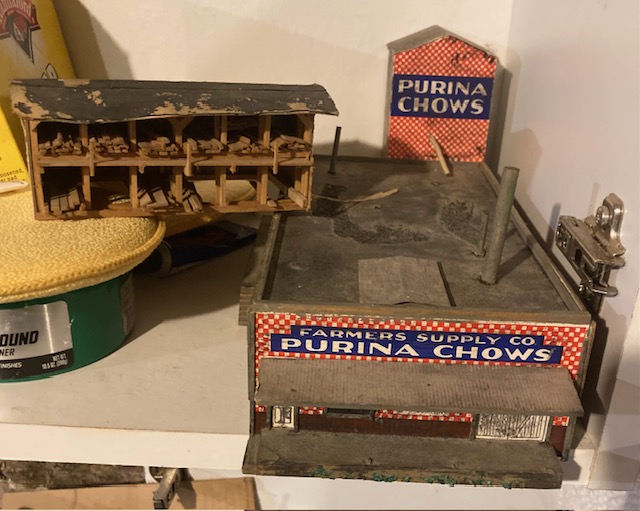
During my junior high school years – grades 6 thru 8 – I became enchanted by model trains and built an HO-scale train table in the basement. There was a mountain and tunnel; a small town with roads; a rail siding with buildings and sheds.
As my skills grew, so too the complexity of the layout. Tools were foreign to my father so I did it all on my own. Frustrated at times for no input I learned to be resourceful. Long before google and you tube, I subscribed to “Model Railroading” magazine to see what other people were doing.
There are no photos of the layout, nor do I remember any ever taken. I was in my own world, away in the basement, which brought great contentment. A few of the buildings remain, now stored in a box in our basement.
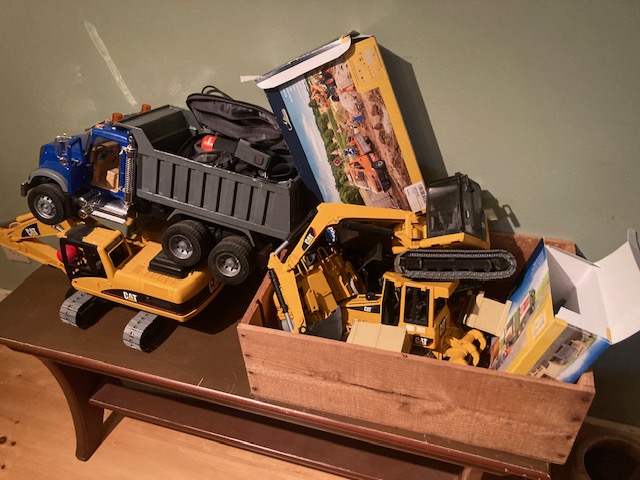
My son, of his own urging, has taken up a similar hobby, although his interest is heavy equipment and road construction. He began at age 8 – in the 2nd grade – so I handled the carpentry, but at his design. The first table was a 4×8 plywood sheet, cut to have to drop wings, which he painted. The table was placed just off our kitchen, a remarkably central location.
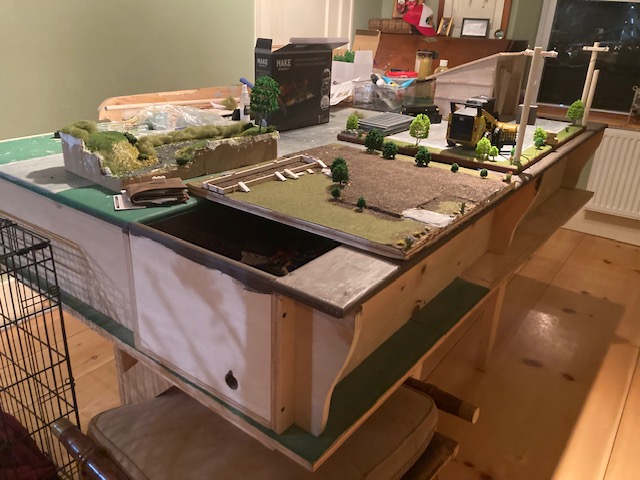
During COVID to break the monotony he and I would drive around town looking for road construction. Delays were desired. By chance there was a major project at that time, replacing sewers along the main artery.
Thus, a major renovation occurred on his table, the wings made permanently upright, a trench “cut” along the length, with the table raised 10” to create a space where he could lay down pipe in his imaginary world.
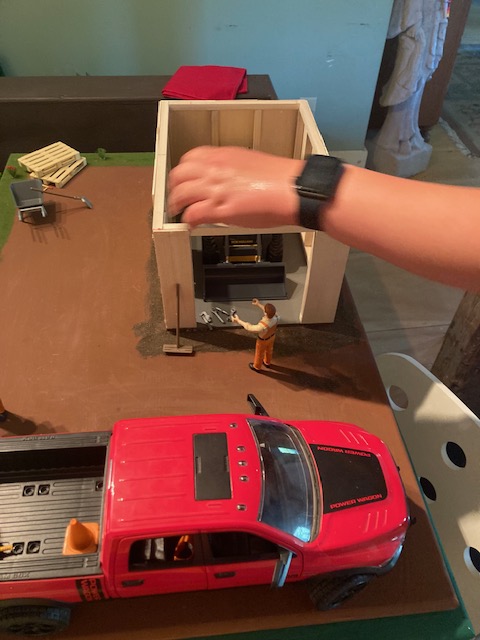
The table has gone through many iterations and now he builds dioramas, small stages displaying workers building roads or the yard where tools and equipment are stored.
The evolution of the table has been fascinating to watch, as he remains fully engaged building his dreams at his table in the hearth of our home.



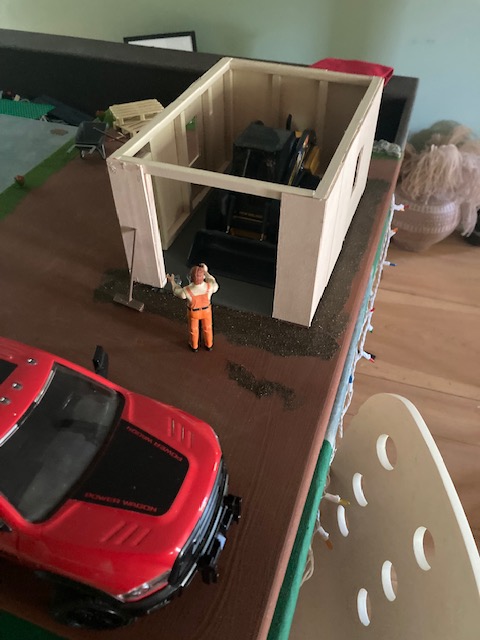

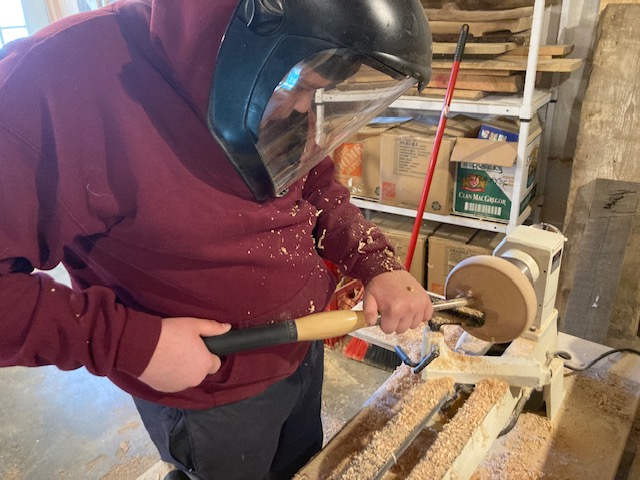
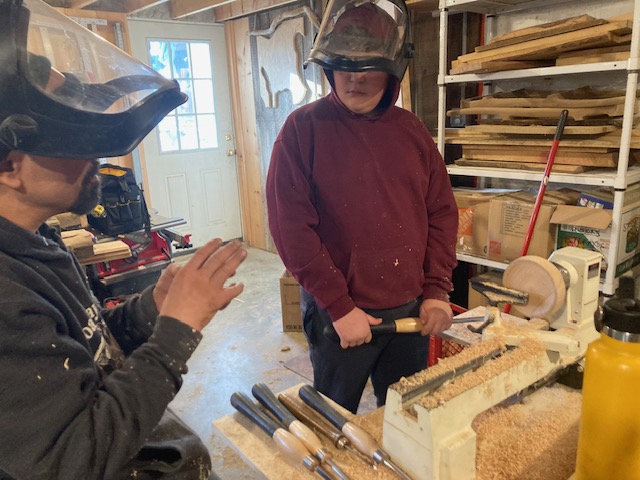
In other news, this week we had our first lesson in woodturning. Jose, a local woodworker, came to our workshop. A friend has loaned us a small lathe on which we turned a bowl made out of quilted maple, which I oiled and he presented to Mama. In two hours, he experienced the mystery of making, the satisfaction of completion and the joy of gifting an object hand made.
Dreams made manifest is an empowering experience.





Redemption and Return
Posted: November 8, 2024 Filed under: Art & Healing, consciousness, What is an Art Farm | Tags: alpha males, books, divine feminine, greek-mythology, Homer, hypermasculinity, Iliad, mythology, Plato, the Republic, thucydides, trojan-war 1 Comment
Recently, at the Friends School of Portland, I watched a performance of the Iliad that was remarkable; horrid and harrowing, vast and engaging, a testimony to the power of theatre.
The Fig Tree Committee, a group of Quakers from Portland, Oregon presents “An Iliad” to correctional facilities and the communities that surround them. Over 3,500 people, most of whom were incarcerated, have seen the production. In the Quaker vernacular, their work is a “leading” as it “…knits together audiences on both sides of the prison walls by using one of the world’s oldest stories to examine the cycles of violence, trauma, displacement, and hope for healing that unite us all.” https://www.figtreecommittee.org/
The Iliad, central to Classical literature, stands at the apex of Epic Poetry. Homer, the bard, is said to have written the poem circa 800 BC, retelling stories from the late Bronze Age circa 1,000 BC. The story revolves around Paris, a Trojan Prince, who abducted Helen, the wife of Meneleus, the Greek King. Extraordinary was Helen’s beauty, her’s “the face that launched 1,000 ships.” The poet sagely never describes her face, leaving that to the reader’s imagination.
For 10 long years the Greeks battled the Trojans, always to a standstill, which test of endurance is indeed the stuff of legend. The story – hypermasculinity and the alpha males’ dominance – is remarkably relevant to the world today. The Access Hollywood tapes seem but a modern day retelling of Paris abducting Helen.
The Fig Tree’s production used metadrama to connect the classic to the contemporary through the epic catalog of the 1,000 ships. The bard made plain such breadth by listing the many young men killed, but from American, rather than Greek towns, including Evanston, Illinois where long ago I read the Iliad in the Greek. That catalog foreshadowed what was to come, and what is playing out in America today.
Building to the play’s climax, the bard recited a brutally long catalog of wars – Ancient Greece through Europe to modern day Middle East and Gaza – 3,000 years summarized that took us ever deeper into the maze, to face the Minotaur; not half man half beast, but rather the vain beastial side of Aristotle’s “political animal.”
The Peloponnesian War – Sparta versus Athens, 431-404 BC – centered on the issue that “might makes right.” Thucydides, the Greek Historian, in 410BC wrote, “… right, as the world goes, is only in question between equals in power, while the strong do what they can and the weak suffer what they must.” “Might makes right” is the moral antithesis of the path to compassion.
Plato, the Athenian philosopher, wrote the Republic, 375 BC, arguing that democracy was unworkable, “Until philosophers are kings, or the kings and princes of this world have the spirit and power of philosophy … cities will never have rest from their evils,—no, nor the human race, as I believe,—and then only will this our State have a possibility of life and behold the light of day.”
The polite phrase is “Philosopher King” but the literal translation is “Benevolent Dictator.” The authoritarian strongman does seem ascendant now. Many say Victor Orbán is a modern day exemplar of the Philosopher King but his is an illiberal democracy, rule by the minority not “we the people.” Might makes right remains the macho battle cry and let’s be honest: hypermasculine alpha males have run the table for more than 3,000 years.
To my mind, the deeper long-term trend is that the Divine Feminine is ascendant, while the alphas, like dinosaurs, will fight to the bottom to preserve their long enjoyed patriarchy. I speak of masculine traits, not gender, and write this not to condemn but with compassion to decry so many generations of boys raised to be men who fight more than forgive, for whom “making a killing in the market” is a red badge of courage. Radical, indeed, was the street preacher, 2000 years ago, who dared say, “the meek shall inherit the earth.”
At the end of the March from Selma, Martin Luther King stood on the steps of the Alabama State Capital, and said, “The arc of the moral universe is long, but it tends toward justice.” The Iliad tells the same story. This masterpiece of literature is ultimately a story of redemption, the release of anger and hubristic pride.
At the Iliad’s end, Achilles speaks to Priam, the last King of the Trojans, and releases to him the body of Hektor, his son, whom Achilles had slain in battle. Each having lost everything, Achilles – the greatest among the Greek heroes, which is to say the paragon of the alpha male – found within himself redemption and gave back to Priam the body of his son, to be buried, returned to his native soil.
If the greatest of Greek heroes could find forgiveness and compassion, then certainly, so too, can we the people.
Work is to be done.
Let us be about it.
Now.
_______________________________________________________
I quote here from the Richmond Lattimore translation, Prius supplicating Achilles, the response of Achilles, the anointing of Hektor’s body, and the slaying of the “gleaming sheep” for a shared meal of Thanksgiving:
“Achilleus like the gods, remember your father, one who
is of years like mine, and on the door-sill of sorrowful old age.
And they who dwell nearby encompass him and afflict him,
nor is there any to defend him against the wrath, the destruction.
Yet surely he, when he hears of you and that you are still living,
is gladdened within his heart and all his days he is hopeful
that he will see his beloved son come home from the Troad.
But for me, my destiny was evil. I have had the noblest
of sons in Troy, but I say not one of them is left to me. (24.486-94)
“So he spoke, and stirred in the other a passion of grieving
for his own father. He took the old man’s hand and pushed him
gently away, and the two remembered, as Priam sat huddled
at the feet of Achilleus and wept close for manslaughtering Hektor
and Achilleus wept now for his own father, now again
for Patroklos. The sound of their mourning moved in the house. Then
when great Achilleus had taken full satisfaction in sorrow
and the passion for it had gone from his mind and body, thereafter
he rose from his chair, and took the old man by the hand, and set him
on his feet again, in pity for the grey head and the grey beard,
and spoke to him and addressed him in winged words: ‘Ah, unlucky,
surely you have had much evil to endure in your spirit.
How could you dare to come alone to the ships of the Achaians
and before my eyes when I am one who have killed in such numbers
such brave sons of yours? The heart in you is iron. Come, then,
and sit down upon this chair, and you and I will even let
our sorrows lie still in the heart for all our grieving. There is not
any advantage to be won from grim lamentation. (24.507-24)
“Then when the serving-maids had washed the corpse and anointed it
with olive oil, they threw a fair great cloak and a tunic
about him, and Achilleus himself lifted him and laid him
on a litter, and his friends helped him lift it to the smooth-polished
mule wagon. He groaned then, and called by name on his beloved
companion: ‘Be not angry with me, Patroklos, if you discover,
though you be in the house of Hades, that I gave back great Hektor
to his loved father, for the ransom he gave me was not unworthy.
I will give you yourshare of the spoils, as much as is fitting.’
“So spoke great Achilleus and went back into the shelter
and sat down on the elaborate couch from which he had risen,
against the inward wall, and now spoke his word to Priam:
‘Your son is given back to you, aged sir, as you asked it.
He lies on a bier. When dawn shows you yourself shall see him
as you take him away. Now you and I must remember our supper. (24.587-602)
“So spoke fleet Achilleus and sprang to his feet and slaughtered
a gleaming sheep, and his friends skinned it and butchered it fairly,
and cut up the meat expertly into small pieces, and spitted them,
and roasted all carefully and took off the pieces.
Automedon took the bread and set it out on the table
in fair baskets, while Achilleus served the meats. And thereon
they put their hands to the good things that lay ready before them.
But when they had put aside their desire for eating and drinking,
Priam, son of Dardanos, gazed upon Achilleus, wondering
at his size and beauty, for he seemed like an outright vision
of gods. Achilleus in turn gazed on Dardanian Priam
and wondered, as he saw his brave looks and listened to him talking.
But when they had taken their fill of gazing one on the other,
first of the two to speak was the aged man, Priam the godlike:
‘Give me, beloved of Zeus, a place to sleep presently, so that
we may even go to bed and take the pleasure of sweet sleep.
For my eyes have not closed underneath my lids since that time
when my son lost his life beneath your hands, but always
I have been grieving and brooding over my numberless sorrows
and wallowed in the muck about my courtyard’s enclosure.
Now I have tasted food again and have let the gleaming
wine go down my throat. Before, I had tasted nothing.’
He spoke, and Achilleus ordered his serving-maids and companions
to make a bed in the porch’s shelter and to lay upon it
fine underbedding of purple, and spread blankets above it
and fleecy robes to be an over-all covering.” (24.620-646)
Unabridged
Posted: October 4, 2024 Filed under: Chronicles of a First Time Parent, Farming off the Farm, What is an Art Farm | Tags: books, dictionary, language, unabridged dictionary, words, writing 2 Comments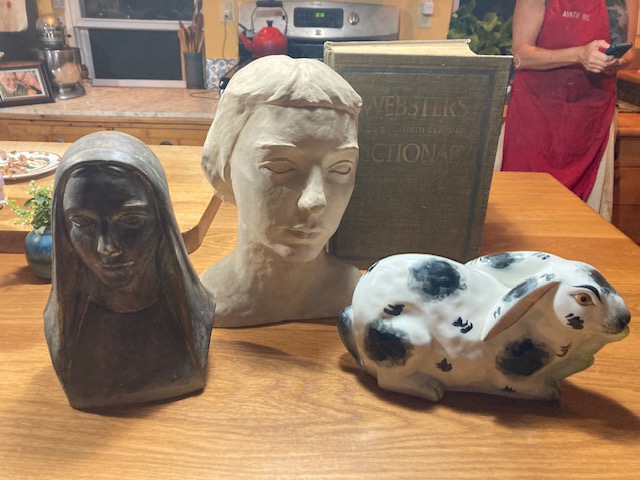
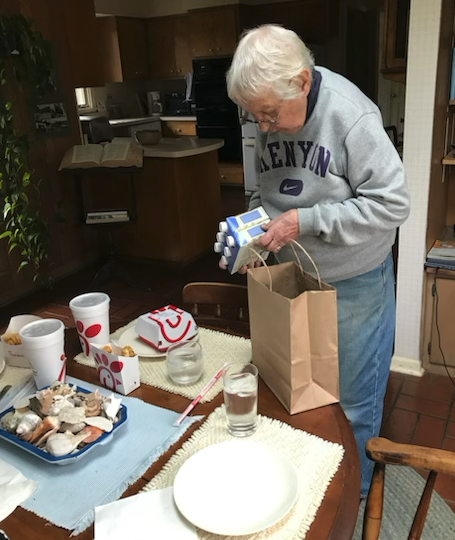
In my childhood, pride of place was given to a Webster’s New Twentieth Century Dictionary of the English Language, Unabridged, second edition (c) 1966. The massive book laid open, upon a bookstand that my Mother built, in the family room always beside the dinner table. Quick and easy reference was close at hand.
At 2,129 pages, plus addenda, the Webster’s weighs in at approximately 13 pounds, begins with “a” (first letter of the Roman and English alphabet: from the Greek alpha, a borrowing from the Phoenician) and ends with “zythum” (a malt beverage brewed by ancient Egyptians). The masterpiece is “based upon the broad foundations laid down by Noah Webster.” Such informed my childhood.
My frugal Mother, born in the Depression, bought groceries strictly on a budget, and received S&H Green Stamps for every purchase. We saved those stamps, compiled them into books, then drove to Glenview, Illinois to redeem same. The dictionary was purchased with Green Stamps, a day of victory, that I recall vividly, still.
Of the Silent Generation, she and millions of her peers diligently saved the Green Stamps. The Sperry & Hutchinson Company was founded in 1896 and operated until the 1980s, when consumerism became the vogue and frugality faded. But over 90 years the Beinecke family made a fortune, and funded the Beinecke Rare Book & Manuscript Library at Yale. In Greenwich, Connecticut, their 66-acre estate is now for sale for the first time, at an asking price of $35 Million, after more than four generations in the family. https://www.nytimes.com/2024/09/16/realestate/beinecke-estate-greenwich.html?smid=nytcore-ios-share&referringSource=articleShare
In my childhood home, words reigned supreme. My Father was a wordsmith, an Irish extrovert, who knew not the difference between a hammer or a screwdriver, but most certainly knew his nouns and verbs; subjects and objects; gerundives, gerunds, and participles; how to compose a sentence, how to frame his thoughts. When advertising came of age he worked as a Mad Man; known as the “Grocery Guru” his specialty was food merchandising. His gift of words allowed him to travel the world, holding meetings in Munich, giving speeches in Sydney; he commuted to his Manhattan office for lunch then flew home for dinner. He was published in multiple periodicals, and monthly in “Advertising Age,” then an upstart, which has become the standard bearer of the trade. After his death, my Mother continued the column for two years, writing “Consumer’s Viewpoint” telling the “Big Boys and Fat Cats” what she thought of their products.
And always, in our home, the Webster’s stood as stanchion, a ready reference, near at hand.
Last year my Mother sold the family home, and we emptied its rooms. Saving the dictionary was high on my list. I stored it at my sister’s, and then in August hauled it back home to Maine, along with sculptures my Mother had made. It was something of a cruel and unusual ask to have my children carry the tome through TSA at O’Hare Airport, but that I did. To my mind that task sealed their fate to the written word. Such is their origin story.
Growing up in the digital age of Google, my children may disregard the heavy analog hard copy book, a dull relic from the distant past. But long may it last on their bookshelves, and my hope is that it will endure as a reminder of their lineage. Languages change over time, such is their nature, but the story of the English language, derived from the German and Latin, and our ability to use words to frame our thoughts is an enduring aspect of our mind’s capacity to understand. I remain steadfast that there is a mysterious link between grammar and the mind.
A hard copy dictionary, then, is a bastion of that tradition. And for my children to understand same, is to know of their past. And so this Unabridged Dictionary is an heirloom of the highest regard here in our home. Purchased through frugality, cherished over many years.
______________________________________
Note: Kudos and thanks to Babs, of whom I say the apple fell not far from the tree. By kind permission of, I borrowed her phrase “…meetings in Munich, speeches in Sydney…”. And she provided the family room photo with dictionary and stand ever the sentry, the rear guard. Many thanks! 🥰
 an Art Farm