The Patriarch
Posted: June 1, 2024 Filed under: consciousness, What is an Art Farm | Tags: consciousness, spirituality 1 Comment
It is generally considered there were six cradles of civilization on Planet Earth: Mesopotamia; ancient Egypt, India and China; the Caral-Supe of coastal Peru, and the Olmec of Mexico.
Mesopotamia, known as the Fertile Crescent, is significant as the location of the Neolithic Revolution circa 10,000 BCE, from which arose the invention of the wheel, the planting of cereal crops, the development of cursive script, mathematics, astronomy and agriculture.
The Kingdom of Sumer, situated between the Tigris and Euphrates rivers, is known for its innovations in language, governance, and architecture; the Sumerians are considered the creators of civilization as modern humans understand it.
The Akkadian Empire followed, reaching its political peak between the 24th and 22nd centuries BCE and generally regarded as the first empire in history.
The Babylonian empire arose circa 1894 BCE and became the dominant power under Hammurabi, an extraordinary leader who gave himself the title “King of Babylon, Sumer and Akkad and of the four quarters of the world.” Most well known for his detailed legal code, part of which remains on display in the Louvre, Hammurabai ranks highly among the great lawgivers of history. But he is not among the Patriarchs.
In southern Mesopotamia, maybe in the city of Camarina, or likely in the city of Ur, although most commonly believed to have been Ur of the Chaldeans was born, circa 1951 BCE, a male named Abraham, who once grown, heard the divine voice command, “And I will make of thee a great nation, and I will bless thee and make thy name great and thou shall be a blessing.” In an empire of polytheism, Abraham followed a singular voice and became the Patriarch of monotheism.
Abba Solomon Eban, the author of “My People: The Story of the Jews” tells the story of the Jewish odyssey as “…not a chronicle of remote, superhuman warriors. It does not resemble the vision a resplendent heroic world such as the Greeks and other ancient peoples saw as their original state. …In subsequent literature and memory the Hebrew nation looked back to its first ancestor as the prototype of two virtues: goodness and warmth in human relations and utter resignation, beyond mere humility, to the divine will. Both Christian and Muslim traditions accept the historic authenticity of Abraham and admit him as their spiritual ancestor. But to the Jews he is the first and unique Patriarch, the model of Hebrew excellence. Inspired by his covenant and welded together by the memories of three generations descended from his loins, the Children of Israel, precariously settled in Egypt, cross the frontier into established history in the middle of the second millennium B.C.E.”
Ancestry is important, and the loins of Abraham are central both to Judaism and to the Christian faith. Biblical tradition holds that the Twelve Tribes of Israel are the descendants of Jacob, descended from Abraham. Chartres Cathedral, considered the high point of French Gothic art, has stained glass windows on the west wall showing the genealogy of the Royal House of David, in the form of a tree which springs from the loins of Jesse – he, a descendant of Jacob, and thus of Abraham – to reach its flowering in the carpenter’s son from Nazareth.
There is neither historical nor archeological evidence of Abraham. More than one-hundred years of searching in the desert have produced no evidence of this man considered the founding father of the relationship between the Jews and God, the spiritual progenitor of all Christians and Eastern Orthodox, and in Islam, a link in the chain of prophets beginning with Adam and culminating in Muhammad.
With more than 2.6 billion Christians and Eastern Orthodox plus 1.9 billion Muslims plus approximately 15.2 million Jews, more than half of the world’s population regard Abraham as a central pillar of their faith. And Abraham’s heirs – whether biological or spiritual – have often been at war, among themselves.
War is of this world, not of the divine. Constantine, of In Hoc Signo Vinces fame, converted to Christianity, while commanding the largest Roman army. He hired as tutor to his son a philosopher named Lucius Caecilius Lactantius, who taught that the goals of any political power were always, “to extend the boundaries which are violently taken from others, to increase the power of the state, to improve the revenues,” by latrocinium, which in Latin means “violence and robbery.”
The Nazarene, avatar of consciousness, Abraham’s grandson – the 54th as counted by Luke or the 43rd as per Matthew – Jesus taught, “Render unto Caesar the things that are Caesar’s, and unto God the things that are God’s.” The Holy Roman Emperor was a Caesar, and the teachings of latrocinium were passed down. The Empire would rule for more than 1,000 years, until the 1800s.
Pope Urban called for the First Crusade, in 1096, to slay the infidels in the Holy Land. With alacrity his orders were carried out, thirty thousand people killed in three days. Raymond of Aguilers described it, “Piles of heads, hands and feet were to be seen. Men rode in blood up to their knees and bridle reins. Indeed it was a just and splendid judgment of God that this place should be filled with the blood of unbelievers.”
Robert the Monk, an abbot in France, argued the Muslims were a “vile and abominable race,” “despicable, degenerate and enslaved by demons,” “absolutely alien to God,” and “fit only for extermination.”
Many of the Knights stayed closer to home, in Europe, as Abba Eban writes, “ ‘Kill a Jew and save your soul’ became the shortcut taken by many a zealous Crusader. A small number of Jews accepted baptism to remain alive; the majority refused, and died.”
To the slaying, the Muslims responded in kind, an eye-for-an-eye, and Holy Jihad began. Between 1096 and 1272 there were a total of nine Crusades, until 1291 when the Egyptian Mamelukes drove the Crusaders out of the Holy City.
The story of Abraham has played out over more than 120 generations, and one is tempted to wonder for how many more generations will the Righteous continue their brutally horrid and inhumane fight? We would do well to contemplate Abraham’s cardinal virtues: “goodness and warmth in human relations and utter resignation, beyond mere humility, to the divine will.”
Be like a cat
Posted: May 25, 2024 Filed under: Chronicles of a First Time Parent, consciousness, What is an Art Farm | Tags: consciousness, rational mind, spirituality Leave a comment
Back in the aughts, when I lived in Chicago, I studied Qigong with Dr. Paul Hannah. In Chinese, Qi means “air” or “breath” but in a metaphysical sense it is “vital energy.” Gong means cultivation. Qigong is the cultivation of that vital energy, as a non-martial art.
Dr. Hannah had grown up in the inner city projects in Chicago, and learned Tai Chi – the Chinese martial art – in order to defend himself, and thus avoid joining a gang; his ability to defeat the gang members in combat was his protection and way out of the projects. He became a board-certified psychiatrist, as well as a Tai Chi Master, with additional studies in acupuncture, Qigong and energy healing. https://www.hannahsholistichealing.com/
During my sessions he would have me stand in a half-crouched position, arms outstretched at shoulder-height in a circle, my finger tips almost touching, for an unbearably long time. He would leave the room, and later return with hot herbal tea. I believe he was training me to empty my mind and become aware of something else.
On the wall of the studio was a poster of a black panther, gazing forward, directly into the camera. He explained the concept of observing without becoming engaged, of being present with neither future nor past, neither time nor space. Dr. Hannah told me that poster had gotten him through college.
I did not then know the idea of mindfulness, but would now understand his instructions as my introduction. Thich Nhat Hanh has written, “When I eat an orange, I can eat the orange as an act of meditation. Holding the orange in the palm of my hand, I look at it mindfully. I take a long time to look at the orange with mindfulness. Breathing in, there is an orange in my hand. Breathing out, I smile at the orange.”
During that same period, I practiced Qigong with a practitioner of Chinese medicine, including acupuncture. During one session at his office, he introduced me to a colleague from China, who was considered a Master of Qigong. I was told this man had not eaten solid food for many years; he drank liquids, but metastasized the inner chi for his sustenance. Such a concept is beyond both my comprehension and experience, however, I was and remain willing to suspend disbelief. Perhaps such is possible, and I should not cut myself off from such a possibility. We have entered the realm of the suprarational.
Here in South Portland, Ryan Nitz is an acupuncturist with a community clinic. He treats many patients onsite at his clinic and, quite interestingly, has begun treating patients via remote. I do not mean by a tele-health zoom session, but rather, from his office in South Portland, Maine he treats patients in, say, Kansas or California. He does not use needles, but instead the “subtle energies” to manifest healing in the patient. https://www.mainecenterforacupuncture.com/
Essentially this is a form of Reiki, the Japanese form of energy healing; “rei” means universal and “ki” means life energy. Clearly now, we are beyond the bounds of western allopathic medicine. As Dr. Paul Hannah taught me, “be like a cat,” suspend disbelief and calm the mind while focusing on the energy present.
At the vanguard of energy, one meets some mighty cool cats!

The Alpha and the irrational
Posted: May 11, 2024 Filed under: Art & Healing, Farming off the Farm, What is an Art Farm | Tags: consciousness, rational mind, spirituality 1 CommentIf one subscribes to the Great Man Theory, then history is defined by the deeds of great men; highly unique individuals whose attributes – intellect, courage, leadership or divine inspiration – have a decisive historical effect. Thomas Carlyle developed the theory, and wrote:
“Universal History, the history of what man has accomplished in this world, is at bottom the History of the Great Men who have worked here. They were the leaders of men, these great ones; the modelers, patterns, and in a wide sense creators, of whatsoever the general mass of men contrived to do or to attain; all things that we see standing accomplished in the world are properly the outer material result, the practical realization and embodiment, of Thoughts that dwelt in the Great Men sent into the world: the soul of the whole world’s history, it may justly be considered, were the history of these.”
Pythagorus of Samos, the ancient Ionian Greek philosopher and polymath, certainly ranks among these alpha males. He has been credited with mathematical and scientific discoveries, including the Pythagorean theorem, Pythagorean tuning, the five regular solids, the Theory of Proportions, the sphericity of the Earth and the identity of the morning and evening stars as the planet Venus. His ideas are ubiquitous: Plato’s dialogues exhibit his teachings, every high school student memorizes his theorem, and every carpenter or engineer uses the 3-4-5 triangle to square a room.

He saw beyond the material realm, and further developed ideas of mysticism. His “metempsychosis” – which means the “transmigration of souls” – holds that every soul is immortal and, upon death, enters a new body. He also devised the doctrine of musica universalis– literally universal music, also called music of the spheres or harmony of the spheres – which holds that the planets move according to mathematical equations and thus resonate to produce an inaudible symphony of music. The 16th century astronomer Johannes Kepler further developed this idea, although he felt the music was not audible but could be heard by the soul.
Aristotle characterized the musica universalis as follows:
“…since on our earth the motion of bodies far inferior in size and in speed of movement [produce a noise]. Also, when the sun and the moon, they say, and all the stars, so great in number and in size, are moving with so rapid a motion, how should they not produce a sound immensely great? Starting from this argument and from the observation that their speeds, as measured by their distances, are in the same ratios as musical concordances, they assert that the sound given forth by the circular movement of the stars is a harmony.”
Clearly, Pythagorus was a big thinker, and his ideas influenced Isaac Newton, another of the alpha males. Newton – who established classical mechanics, invented calculus, formulated the laws of motion and universal gravitation – was a paragon of the rational scientific mind. Newton was a Great Man, by definition. He also was a leading alchemist.
In its purest form, alchemy is concerned not with turning base metals into gold, but as a symbolic language guiding the transmutation of the physical self into the ascendent consciousness of the anointed. Of an estimated ten million words of writing in Newton’s papers, approximately one million – 10% – deal with alchemy. This was more than a passing interest.
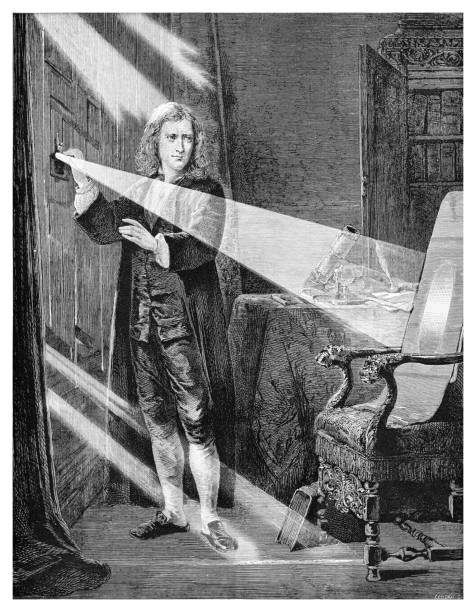
John Maynard Keynes, the Cambridge economist who restructured the post-WW2 global financial system – easily ranking him among the Great Men – had this to say about Newton:
“Newton was not the first of the age of reason. He was the last of the magicians, the last of the Babylonians and Sumerians, the last great mind which looked out on the visible and intellectual world with the same eyes as those who began to build our intellectual inheritance rather less than 10,000 years ago. Isaac Newton, a posthumous child born with no father on Christmas Day, 1642, was the last wonderchild to whom the Magi could do sincere and appropriate homage.”
Let us pause and consider: just as Pythagorus explained the physical realm he also saw celestial harmony beyond the physical; Newton mastered not only scientific thought but was a leading alchemist of his day. Two of the paragons of the rational alpha mind had secret lives as mystics.
The Western intellectual tradition is based entirely on the rational, and anything beyond the rational is defined by the negative form – “irrational” – which is decidedly pejorative. As wrote Carl Jung, ““Everything that the modern mind cannot define it regards as insane.” Pythagorus was denigrated as a cult leader. During Newton’s life, the English Crown considered alchemy to be a heresy, punishable by death. The burning of his alchemical writings perhaps was not an accident.
What if we expand our concepts and consider connections not defined by measurable facts? What if we begin to use the term “supra-rational”? No less than Albert Einstein – the modern paragon of rational thought – was compelled in this regard. In 1930 he published an essay “Religion and Science” which described the sense of awe and mystery which he termed a “cosmic religion” of “superpersonal content.” Einstein counseled to move beyond the anthropomorphic concept of god to “the sublimity and marvelous order which reveal themselves in nature … to experience the universe as a single significant whole.”

For Einstein, “science without religion is lame, religion without science is blind.” He said “God is a mystery. But a comprehensible mystery. I have nothing but awe when I observe the laws of nature. There are not laws without a lawgiver, but how does this lawgiver look? Certainly not like a man magnified. …some centuries ago I would have been burned or hanged. Nonetheless, I would have been in good company.”
The “Great Man Theory” was advanced in the 19th century Victorian era. In the 21st century we need to move forward, and expand the scope, even beyond gender, to all life, beyond the “either/or” and toward the “both/and” mindset.
I should like to propose that the “Great Man” be replaced by the “Great Soul,” and that we look beyond the rational, the material, the physical, and embrace the whole cloth, the harmony and music of “our higher angels,” the music of the spheres, “to experience the universe as a single significant whole.”
In fact, this “Great Soul” is in use; in the Hindu language, “Mahatma” from the Sanskrit word “mahātman,” literally means “great-souled.” Mahatma Ghandi is but one exemplar of this path.
The seeds of a new future surround us. We can be hopeful.
 an Art Farm