Closest to the Sun
Posted: December 12, 2025 Filed under: consciousness, Permaculture & Home Renovation, Portfolio - David's work | Tags: ecuador 1 Comment
Chimborazo is a snow covered inactive volcano, the highest mountain in Ecuador and the 39th highest peak in the Andes mountains. Located at the equator, its summit is the farthest point on Earth’s surface from the Earth’s center. To the locals it is “the closest volcano to the sun.”
Ecuador’s biodiversity is nearly unparalleled with diverse habitats and a high concentration of species. The Galapagos Islands, a province of Ecuador, inspired Charles Darwin’s theory of evolution. The Republic of Ecuador’s vast richness was acknowledged in 2008 when the country rewrote its constitution granting citizenship rights to natural habitats, embracing ecological balance, recognizing ecosystems as living entities and allowing citizens to sue on their behalf.
The Constitution’s Preamble states: “We women and men, the sovereign people of Ecuador; RECOGNIZING our age-old roots, wrought by women and men from various peoples, CELEBRATING nature, the Pacha Mama (Mother Earth), of which we are a part and which is vital to our existence, INVOKING the name of God and recognizing our diverse forms of religion and spirituality, CALLING UPON the wisdom of all the cultures that enrich us as a society, AS HEIRS to social liberation struggles against all forms of domination and colonialism AND with a profound commitment to the present and to the future, Hereby decide to build: A new form of public coexistence, in diversity and in harmony with nature, to achieve the good way of living, the sumak kawsay; A society that respects, in all its dimensions, the dignity of individuals and community groups, A democratic country, committed to Latin American integration—the dream of Simón Bolívar and Eloy Alfaro—, peace and solidarity with all peoples of the Earth….”
The basic principles include:
- Sovereignty lies with the people…with national unity in diversity
- Ecuador is a territory of peace
- The human right to water is essential and cannot be waived
- The Ecuadorian State shall promote food sovereignty
- The right…to live in a healthy and ecologically balanced environment that guarantees sustainability and the good way of living (sumac Kawsay), is recognized.
- The right to aesthetic freedom; the right to learn about the historical past of their cultures and to gain access to diverse cultural expressions.
- Education…shall guarantee holistic human development, in the framework of respect for human rights, a sustainable environment, and democracy.
- The State shall guarantee elderly persons…Specialized health care free of charge, as well as free access to medicines
- The State shall guarantee the rights of pregnant and breast-feeding women with free maternal healthcare services
- The right to migrate of persons is recognized. No human being shall be identified or considered as illegal because of his/her migratory status.
There is trouble in paradise, though, as corruption is endemic. Ecuador ranked 121st among 180 countries on the 2024 Corruption Perceptions Index. That put it among the most corrupt public sectors, and below average among countries of the Americas. By comparison, the USA was tied at 28th out of 180 countries, its lowest score since 2012, and its trend has been negative since 2015.
Ecuador is a hub for smuggling drugs produced in neighboring Columbia and Peru. The police, judiciary and executive branches are linked to crime, drug-trafficking and extortion. The World Justice Project’s 2022 report “The Rule of Law in Ecuador” found that “Ecuador saw the largest increases in the percentage of respondents who believe that some or all of the actors across [law enforcement, the executive branch, and the judiciary] are involved in corrupt practices. Among respondents in the Andean region, on average, Ecuadorians most often [three-quarters of all respondents] felt that top government officials engage in authoritarian behavior.…” The constitution speaks of noble ideals while the government is rife with graft.
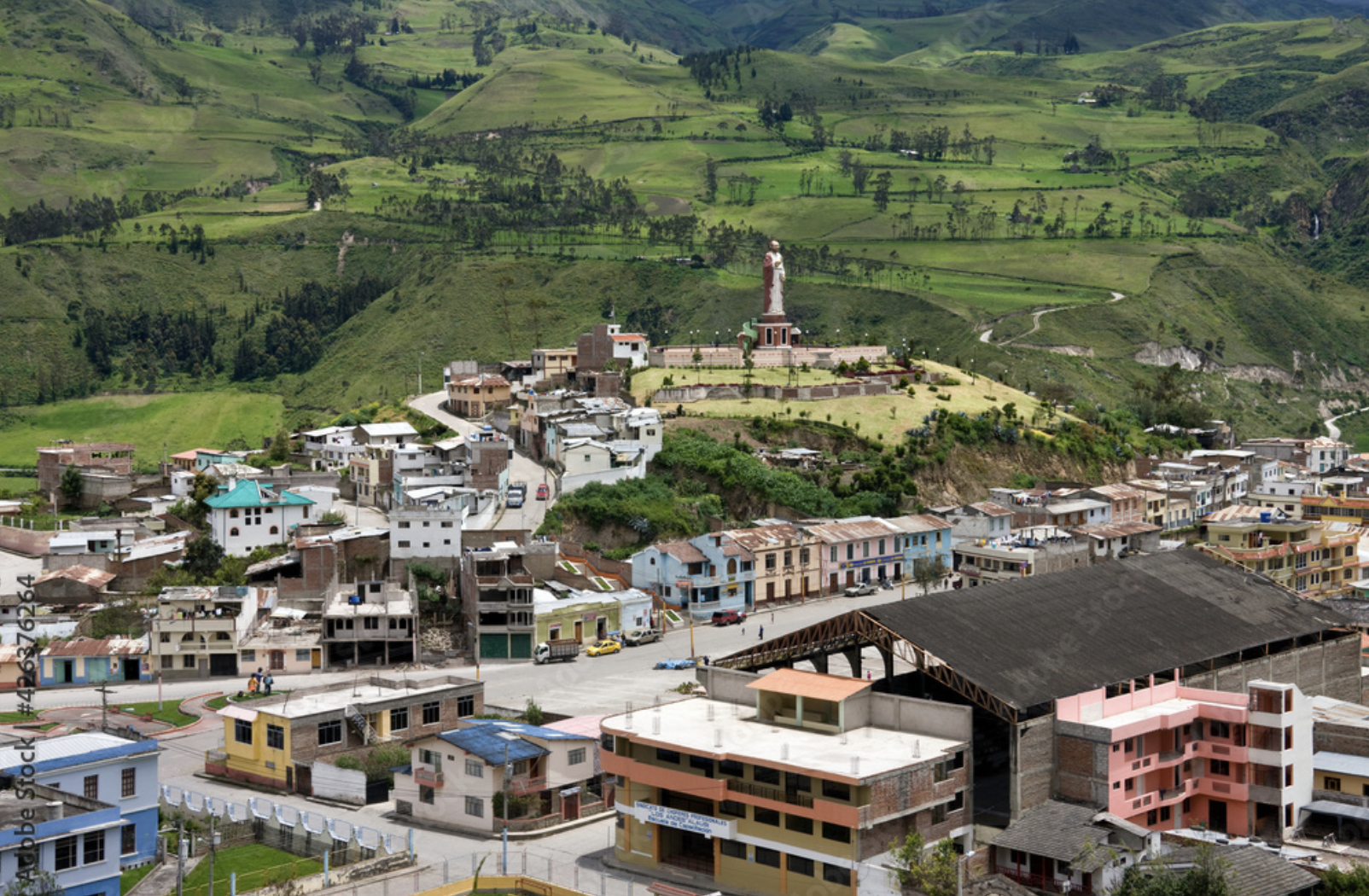
Anthony is a young man who grew up on Chimborazo. He is a father of children growing up in the Andes mountains, but because of the gangs and corruption he lives now in Massachusetts. A roofer, he works all around New England, traveling south to Rhode Island or Connecticut or as far north into Maine and Vermont.
Most all of the roofing crews in Southern Maine now are Hispanic. I see them driving their vans, loaded high with ladders and wheel barrows, doing all of the roofing jobs. For one job on the coast, I needed to remove a chimney on a very steep pitch. I asked the home owner to hire that out, and a Spanish speaking crew arrived. They had no safety equipment but climbed up without hesitation. Growing up in the Andes gives them a natural ease on heights.
The crew did not have the correct equipment and so I called the roofing contractor. Not surprisingly he showed up in his big truck, emblazoned with decals advertising his business. Dressed in sandals and shorts, it seemed we had interrupted him from working on his boat. He stood on the ground, looked up, doing nothing. The crew worked quickly and finished in about 3 hours. Most certainly the $1,500 paid to the boss did not include profit sharing. Every carpenter I know has similar stories to share.
We hired Anthony for the Tiny Cathedral, and by-passed the big-truck contractor. He and his cousin arrived, having driven two and a half hours north from Massachusetts. They did the job quickly and well and were paid cash for a full days wage, travel time included. The home owner still came out ahead, we avoided back-breaking labor, Anthony got a good break.
We shared pizza and beer over lunch. Between his broken English, and my pidgin Spanish, Anthony spoke about his roots, growing up in a small town closest to the sun. He described the exquisite beauty and how the ecotourism industry offers only a sanitized view while avoiding the gang and crime-ridden areas. Opportunity drew him north and he had not seen his son for seven years, nor did he expect to return home for another four years. He misses his son’s childhood but sends home money monthly.
That lunch was more than a year ago, and the self-righteous today likely would regard our act of civility as aiding and abetting. Ours is a transactional age where might makes right, where greed governs the strongmen, where earth is rare only in its industrial and financial value, but history is littered with the names of fallen despots, empires that came to pass. King Xerxes held such commanding power that after a storm destroyed his pontoon bridge, he had the sea whipped 300 times with chains, the engineers beheaded, to punish the sea for its disobedience preventing his Persian Army from conquering Greece. Long forgotten he is while daily still the tides rise and fall.
Wisdom endures on the side of “our age-old roots…the Pacha Mama of which we are a part and which is vital to our existence… diverse forms of religion and spirituality, …of all the cultures that enrich us [in] struggles against all forms of domination and colonialism.”
Closest to the Sun is closest to the light of truth.
 an Art Farm