Beyond the Rubicon
Posted: April 4, 2025 Filed under: Child Centered Activities, Chronicles of a First Time Parent | Tags: education, family, homeschool, homeschooling, Khan Academy, parenting, the trades 2 Comments
And so it came to pass, on the 10th day of March I delivered to the Superintendent my Notice of Intent to Home School. Life’s newest adventure began with a flurry of last-minute decision making.
On that same day the local School Department announced a $5 Million budget shortfall, and the Department of Education began to be decimated. Change abounds; our timing providential.
There is no turning back.
A world of materials is available online. Khan Academy is one not-for-profit free site with a goal “to create online tools that help educate students.” The site has 168.7 registered users, 58.7 Billion total learning minutes, and annual revenues of $107.3 Million. My son had used the platform at school, so we adapt that to our needs.
With DOGE-like efficiency, we pare the day down to its most basic form. The result is productive. The conventional middle school day lasts 6.25 hours, of which half is spent in homeroom, lunch, recess, “Jobs For Maine Graduates,” plus walking the halls between classes; thus about 3 hours for straight line study of Math, Science, and Humanities but a portion of classroom time is lost in the quotidian, explanations and questions, the general bustle. The essential learning reduces further toward 1.5 hours. At home we easily do that much, then add in outings, exercise, and hands-on experience. Bottom line: my son is engaged.
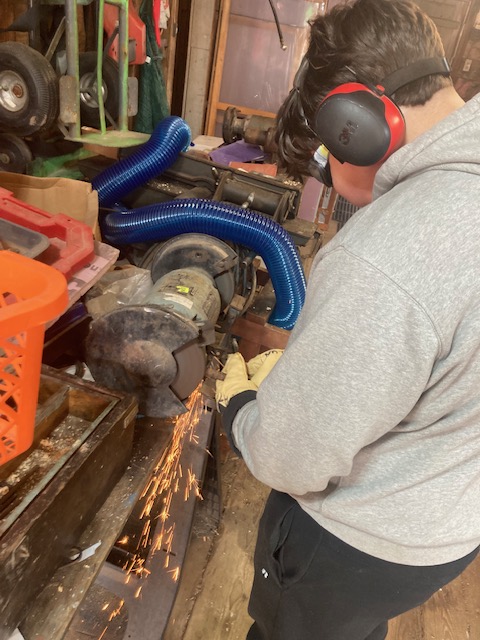
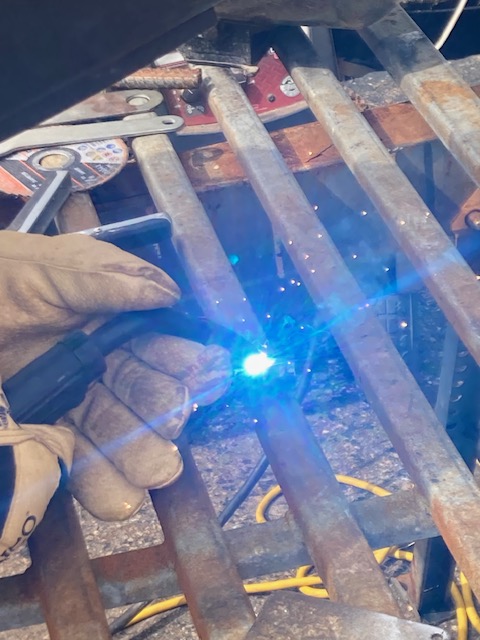
For Science, we have been using the Periodic Table of Elements to learn welding. I hired a friend, the “Pema Professor,” a journeyman philosopher/carpenter to teach this course. We drive to his home in Lyman, Maine. The first week’s homework was to circle the elements Hydrogen, Helium, Argon, Iron and Carbon. We also discussed the Noble Gases and Noble Metals. The practicum was MIG welding, an electric arc between a continuously fed wire electrode and the metal, melting both to create the weld – a pool of molten metal – protected by a shielding gas. Argon prevents water from entering the weld, which would lead to rust, to failure.

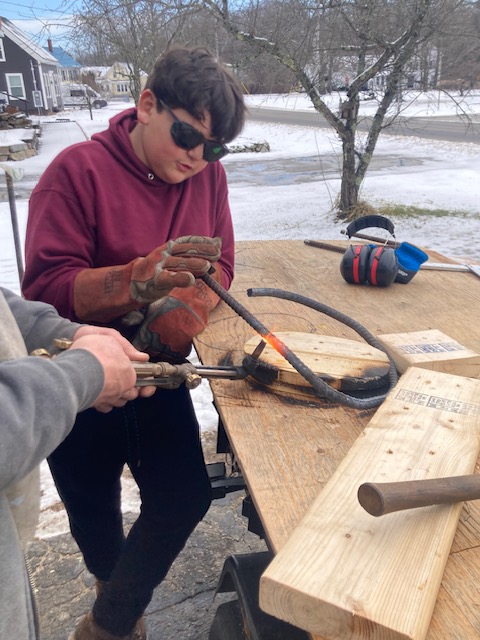
The second week focused on the difference between an element and a molecule. My son used an acetylene torch to bend metal. Acetylene gas is mixed with oxygen to create a high-temperature flame, reaching well over 1,000 degrees. The metal turned cherry red then bent as the heat increased the energy, electrons moving freely, expanding, creating a pliable rather than rigid structure. My son held the torch, set hot metal into a wooden jig, his weight laid against the rod, it bent. He is forming the letters of his name. Making his mark.
For math we are doing online exercises and learning the Pythagorean Theorem. Hidden in plain sight, Pythagorus resides in every corner of every room. As we design and build a trapezoidal bookcase, he can measure and calculate the legs and hypotenuse, help prepare the measured drawing and then build. Stay tuned on that one!
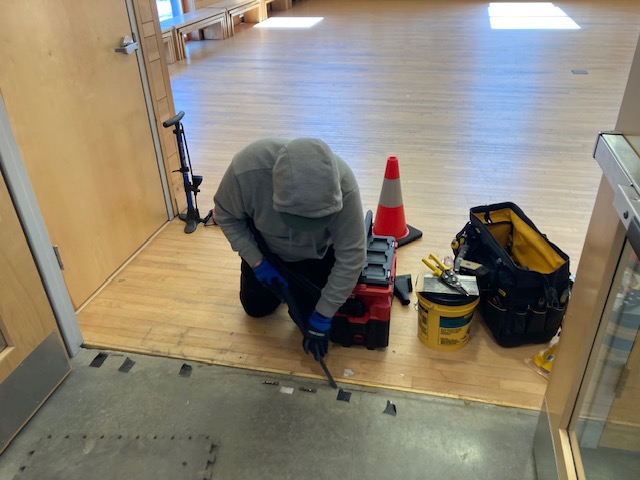
He has asked to be more challenged, and so I expand our repertoire; more math handouts and more reading materials to come. He is cooking meals, which brings a chance to study weights and measures, even converting metric to standard. As the growing season erupts we will dig into the earth at friends’ farms. My son helps with repairs at the Friends School of Portland; as a private religious school OSHA and Child Labor Laws do not pertain.
To assist in our holy experiment and to handle the annual assessment I have hired a State of Maine Certified Teacher. Alexander the Great, at the age of 13, was tutored by Aristotle; I shall refer then to this teacher as “Our Aristotle.” A young man, he was my son’s student teacher last year in the 5th grade; a keen and passionate observer, dedicated to his students’ needs. He was fired when the Assistant Principal told him – at the last hour of the last day – to change classrooms. “Our Aristotle” declined, reasoning that his students would benefit from closure, while an abrupt change would abrogate their experience while giving worthless time to engage new students. The Assistant Principal issued an ultimatum but “Our Aristotle” called the bluff; escorted out of the building, his dignity was in tact. The Administrator lost on all counts and all the students were left wanting.
My son, born of the “Anxious Generation,” comes of age during an epidemic of mental illness and teen suicide. Social media is a black hole, its focus upon other, not self. Grounding must come from within. Such is the tradition of New England: Henry David Thoreau, “Go confidently in the direction of your dreams! Live the life you’ve imagined,” or the Bard of Concord, “Trust thyself: every heart vibrates to that iron string.” Our Aristotle exemplified same in his refusal to acquiesce. He spoke truth to power.
Such then is the temperament we want to shape our son’s bearing and so our team grows. Life has no dress rehearsal. My son comes of age now, I am charged with his education. Schooled to the standards of the state, he will be educated to all of life.
In March we crossed the Rubicon. Now we go forward daily. We shall see where all this leads.









Rogue Hollywood; from the Library of Alexandria to Carnegie Libraries
Posted: March 7, 2025 Filed under: Chronicles of a First Time Parent, consciousness, Portfolio - David's work, What is an Art Farm | Tags: books, carnegie libraries, cosimo de'medici, Dreamworks SKG, education, history, library of alexandria, technology, travel 1 Comment
Douglas was attending classes in History and Theology at Loyola University but his most serious work was done at the RMG office. He and I were joined at the hip, constant conversation, swapping ideas at a fever pitch.
RMG formed the Information Alliance among leaders in library automation:
- Robert F. Asleson, Esq, had decades of experience as President of five library and information industry companies: University Microfilms International, R.R. Bowker, Information Handling Services, International Thomson Information, Inc., and The Library Corporation. He was thoroughly versed in all issues of copyright clearance.
- Brower Murphy, a self-described “information egalitarian” had pioneered the use of CD-ROM technology for data storage. He then developed NlightN®, a hypermedia universal network allowing a single search across the entire world of published electronic information. This was google before Google, except, created in 1991, it was not designed for the internet.
- Vinod Chachra, President and sole owner of VTLS, Inc. oversaw a staff of 70 with customers in 18 countries, requiring 16 difference languages and multiple character sets and scripts. His software provided a turn-key solution to all library functions.
- Rob McGee and Howard Harris, another RMG Consultant, formed the alliance and Rob acted as editor of the “Concept & Vision” and the business plan.
Our approach to the Worlds Digital Library was direct: “Empowering the individual by access through libraries to the world’s information, ‘anyplace, anytime.’” The philosophy was broad and inclusive, the battle plan was specific and precise. A holding company, the DLC would operate through subsidiaries, each business creating a component of the whole. The first subsidiary was The Index Company, which would:
- digitize book images from collections of widely-used library materials
- compile collections of machine-readable tables-of-contents and back-of-the-book-indexes for subject oriented sets and collections of books
- create and distribute merged collections of the indexed records to provide access to Digital Libraries.
The DLC was the economic engine driving GDC. On paper, the DLC projected a Year 1 loss of ($4.08 M) but turned positive in Year 3 and by Year 5 was in the black at a profit of $6.3 Million USD. At the end of the 20th century, “hockey stick” projections were not uncommon, but questioned by conservative bankers.
On 7 May 1994 the “Concept & Vision” paper was finished, and letters of support were received from:
- Chair of the Virginia State Library Board
- Librarian of Harvard College
- Executive Director of CAVAL (Co-operative Action by Victorian Academic Libraries [Australia])
- President Council on Library Resources
- Deputy Director General, National Library of Australia
- President of the Council of the European Information Industry Association
- Executive Director off the United States National Commission on Libraries and Information Science
It is worth noting some of their comments:
- The Librarian of Harvard College wrote, “There are going to be a number of modest efforts to build the digital library. Yours could be the one most likely to succeed on a large scale.”
- Deputy Director-General of the National Library of Australia wrote, “The approach envisaged in this paper is sensible and shows the appropriate understanding of the current state of the industry which is needed for success to be likely.”
- The President of the Council, European Information Industry Association, “…we shall have no hesitation in bringing this proposal to the attention of our members and examining ways in which we can lay a supportive role in Europe.”
While writing the “Global Data” plan, the landscape in Hollywood was changing. Steven Spielberg, Jeffrey Katzenberg, and David Geffen announced they were going rogue, to create their own live-action and animation film studio. This meant Hollywood’s studio model was being revolutionized, and the financier with whom I was hoping to meet had deep roots – I was told – in that old model. If the paradigm was changing, then I needed to write my own version.
One spring evening at the Chase Street house, Douglas and I sat down at the kitchen table to write “Top-Down meets Bottom-Up” which compared Paramount Communications and Global Dakota Corporation, a $10 Billion colossus versus our $38 Million start up. I was David out to slay Goliath. Working deep into the night, we laid out the categories and filled in the blanks, referencing medieval history through the Internet. Laurie, who is quite savvy in the C-suite, told us it was sheer hubris.
Libraries have been central to all civilizations, throughout recorded time, our collective repository of knowledge, a storehouse of the written word – cuneiform or bound – a place where scholars gather to share knowledge, to push the vanguard. The earliest libraries have been discovered in present-day Syria, and in temple rooms in Sumer (present day Iraq), each in the Cradle of Civilization. The Library of Alexandria, in Cleopatra’s Ptolemaic Egypt reigned among the most significant libraries of the Ancient World, the corpus of Greece and Egypt in one repository, until Julius Caesar’s boys came to town, on military conquest, they burned the library. Dust to dust, ashes to ashes.
30,000 clay tablets from the Library of Ashurbanipal have been discovered at Nineveh – the recorded wealth of Mesopotamia – while the University of Chicago holds baked clay tablets, the administrative backbone of the vast territory of Persia, written in Old Persian, Elamite, and Babylonian languages. The Imperial Library of Constantinople is worthy of mention, authors such as Plato, Aristotle, Demosthenes, Socrates, Thucydides, Homer and Zeno stored and sought. Themeistius, a pagan philosopher and teacher, hired calligraphers and craftsman to produce the actual codices then created a university-like school centered around the library. Lao Tzu, author of the Tao Te Ching, was the keeper of books in the earliest library in China. Into this majestic idea Rob McGee stepped as a young boy, his bike’s basket filled, riding home to 1505 Grace Street with “talking books” for his Grandmother, an armful for himself.
The Free Public Library is not free financially – it is paid for by taxes – so what is free is the access to information. Traditionally libraries had been the private domain of Princes and Kings, Bankers or Clergy. The Renaissance brought an awakening when, in 1444, Cosimo de’Medici created the San Marcos Library, one of the earliest public libraries. Cosimo combined his own extensive collection with the 800 manuscripts of Niccolo de Niccoli, a humanist who worked as a copyist and collator of ancient manuscripts, and was the creator of cursive script, known today as “italics.” Niccolo’s humanist vision was inclusive: “…to the common good, to the public service, to a place open to all, so that all eager for education might be able to harvest from it as from a fertile field the rich fruit of learning.”
Pierpont Morgan’s Library, in the grand style of the Italian Renaissance, was opened to scholars and the public in 1924, the gift of J.P. Morgan, the banker of legend, who indirectly was behind the greatest public library building program in history. In 1901, J.P. Morgan bought the Carnegie Steel Company for $18 Billion (in 2025 dollars), which allowed Andrew Carnegie to vastly expand his brick and mortar ambitions. Between 1883 and 1929 2,509 Carnegie Libraries were built around the world, free to the public. By 1929 almost half of the public libraries in the United States were Carnegie Libraries.
At the end of the 20th Century, many saw change on the horizon, bricks and mortar becoming digital, access universal, which seemed like Archimedes’ fulcrum, upon which we could move the world. Rational self-interest held no motivation for me; e-commerce and social media pale in comparison to the humanist tradition. Douglas, though, had that capitalist urge, and his enthusiasm was grounding for me. He and Rob delivered the Information Alliance which undoubtedly could make the products to drive revenues. The Digital Library Corporation was the core asset, while the Turtle News Network and the community retail outlets expanded our reach.
I played the hand I was dealt. “Top Down Meets Bottom Up” became page 41 of the Global Dakota Business Plan. On 1 July 1994 the Business Plan, with consolidating Pro-Forma Financial Statements, was complete, weighing in at 12 pounds, almost 1,000 pages printed on 100% post consumer recycled paper. Having finished the first task, I tackled the second challenge: a meeting with the Senior Chairman of the Board of McDonald’s Corporation.

God and Caesar at Middle School
Posted: January 10, 2025 Filed under: Child Centered Activities, Chronicles of a First Time Parent | Tags: education, homeschool, homeschooling, mental health, mythology, parenting, rational mind 1 Comment
John Stuart Mill has been much on my mind, of late. This 19th century English philosopher – called the most influential thinker in the history of liberalism – advocated proportional representation, the emancipation of women, and the development of labor organizations and farm cooperatives. More importantly, he was home schooled by his Father.
During the midwinter holidays, I pondered home schooling my son. We talked, I read the Maine statute on home schooling and wrote a “Letter of Intent to Home School” for submission to the local Superintendent. In the end, we deferred to our Son, who decided NOT to homeschool now, but to remain in the Middle School. I stood down but my thoughts once written stand as a manifesto of my son’s education, at his time coming of age.
William F. Buckley then came to mind. The Yale educated public intellectual, considered the founder of the modern conservative movement, he – of my Father’s generation – criticized Yale for “forcing collectivist, Keynesian, and secularist ideology on students…denying any sense of individualism by teaching them to embrace the ideas of liberalism.” Buckley’s “God and Man at Yale: The Superstitions of ‘Academic Freedom’” has endured and became a central pillar of the American conservative movement.
I am no Yale man. At Northwestern, I read the Classics and advocate not individualism but that all life is one; neither Caesar nor religious dogma are my Master; consciousness in the whole of the divine feminine grounded in the compassionate masculine, be that my polestar.
Here then is my manifesto on the education of the young man who must need find his own path, while following my footsteps. Lacking any formal title, I call this “God and Caesar at Middle School.”
Dear Sir,
Respectfully, I write to inform you that [my son], age 12, shall be withdrawn from SoPo Middle School effective 4 January 2025. Pursuant to M.R.S. 20-A §5001-A(3)(A)(4) this is my written notice of intent to provide home instruction.
My approach to pedagogy combines the intellectual rigor of John Stuart Mill’s education grounded in the emotional intelligence of a 21st century global citizen. The classical tradition shall be paramount as we look to the future.
Geometry and physics shall be taught in the applied sense. Our Greek Revival Farmhouse requires extensive renovations, and working with me, [he] shall learn both the practical skills of building and the mathematical truth that Pythagorus resides in every corner. “Measure twice, cut once” goes the maxim; the 3-4-5 triangle every carpenter’s adage. Thus he will learn.
There is a tradition of a carpenter’s son becoming a leader. As I teach the practical, so too the mystical; Pythagorus also taught of celestial harmony – the Music of the Spheres – and so [he] shall learn the broad plain of Athenian philosophy.
We shall ponder both God and Caesar, the twin domains of the Western Intellectual tradition. “Ad Maiorem Dei Gloriam” may be our motto, and we would begin with John “Ἐν ἀρχῇ ἦν ὁ Λόγος” but translate “Λόγος” in all languages, all cultures: Allah, YHWH, Elohim, Bhagavan, Iraivan, Gitche Manitou, Xu, Unkulunkulu, to name but a few. There is no monopoly on the truth and in the comparison he shall learn critical thinking, and respect for other points of view.
If we read “Percy Jackson” then also Ovid’s “Metamorphosis.” To my mind mythology is not mere childish fiction but the symbolic language of archetypal truth. Carl Jung, a man of science who studied the mind – the “logos” of the psyche – wrote that religions perfectly coopted the archetypes onto their narrative. “Percy Jackson” may be an engaging fiction but also something deeper. So shall I teach literature.
When Persephone returns, come spring, [he] shall labor in the gardens of our Art Farm in Sopo, and at Frinklepod Farm in Arundel, and also the Cold Brook Farm in Sherman, Maine. [He] shall drive and maintain heavy equipment and work with his hands, in the dirt. I shall teach connections, that all life is one.
We have taken classes in welding, and shall now learn wood turning, and [he] will learn the practical art – literally “art” in Latin means “skill” – both of Hephaestus, of Prometheus and of Daedalus. Art making predates agriculture, which is to say it predates civilization. It is a priori. It is hard-wired in our DNA. So then shall we build skills, both practical and conceptual.
Life itself will be [his] classroom. He will both be schooled at least 175 days per annum but educated full time; I vouchsafe that your metrics will be met, which I shall report annually, in arrears on 1 September, in writing as required by law.
My full time job is parenting and my bread labor is maintaining – part time – the physical plant and property of the Friends School of Portland. Through that school I intend to hire a certified State of Maine teacher to oversee my pedagogy.
Finally, for his socialization I expect [he] will continue to participate in extracurricular activities at the Sopo schools. I understand this is permitted under Title 20-A, Section 5021.
We have crossed the Rubicon. Let the new year begin!
Please confirm acceptance of this missive. I shall be happy to discuss this at your convenience, but our decision has been made.
A copy of this written notice has been hand delivered to the Middle School Principal.
Best regards,
David
 an Art Farm