Concrete π
Posted: June 6, 2025 Filed under: Child Centered Activities, Chronicles of a First Time Parent, What is an Art Farm | Tags: archimedes, concrete, habeas corpus, pi 2 Comments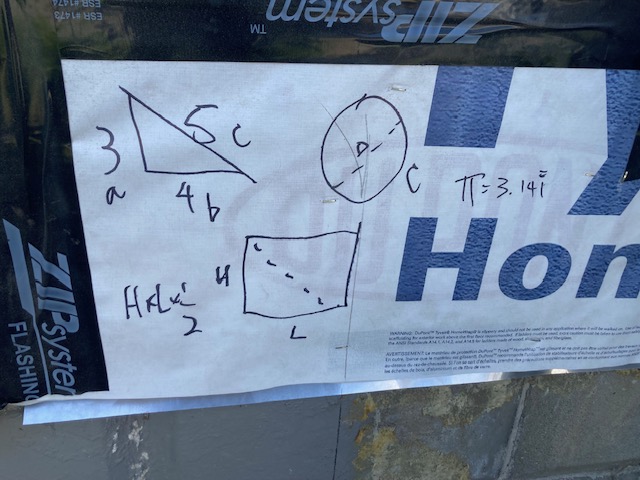
This week’s homeschool question was “How many US Presidents have suspended Habeas Corpus?” The answer, of course, is 7:
- Andrew Jackson at the Battle of New Orleans, by his sole order declared martial law (he was the commanding General, not yet the 7th USA President)
- Abraham Lincoln, by Executive Order, to rein in the “Cooperheads” a/k/a the Peace Democrats
- Ulysses S Grant, by Congressional act, suspended in nine counties in South Carolina
- Theodore Roosevelt, 1902, by Congressional Act, suppressed civil unrest in the Philippines
- Franklin Delano Roosevelt, 1941, by means of the Hawaiian Organic Act authorized suspension of habeas following the attack on Pearl Harbor, but in 1942, by Executive Order allowed a military tribunal to try and convict eight German saboteurs
- Bill Clinton, following the Oklahoma City bombing, signed the Antiterrorism and Effective Death Penalty Act of 1996
- George W. Bush, in 2001, by the Presidential Military Order authorized enemy combatants to be held indefinitely at Guantanamo Bay. But in Hamdi v. Rumsfeld (2004) the U.S. Supreme Court re-confirmed the right of every American citizen to access habeas corpus even when declared to be an enemy combatant.
All of these were in times of a crisis, and several of them included martial law. Given the dense history, my son’s Cousin, the Professor, zoomed in for a chat. The Professor has been published in the Stanford Law Review, where he argued that habeas is “a tool for We the People to insist that when our agents in government exercise our delegated penal powers, they remain faithful to our sovereign will.”
He went on to explain, “Given widespread consensus that English history should and does drive American habeas jurisprudence, and that the sovereigntist account of that history should now be treated as authoritative, it is puzzling that American courts and scholars have continued to cling to libertarian frameworks. Meanwhile, American habeas law is in crisis, with an ideologically cross-cutting array of scholars and jurists criticizing it as intellectually incoherent, practically ineffectual, and extravagantly wasteful. Over the Supreme Court’s past three Terms, Justice Neil Gorsuch has led a charge to hollow out federal postconviction habeas almost entirely, arguing that habeas courts should ask only whether the sentencing court was one of general criminal jurisdiction—and not whether it violated federal constitutional law en route to entering the petitioner’s judgment of conviction.”
My son and the Professor discussed all of this, at length. They compared the crisis of the Civil War to the current immigration brouhaha. My son reasoned that Mr. S Miller, “wants it to be really simple, immigrants get picked up, and locked up.” The Professor concurred, describing a “logistical simplicity.” My son continued, “There are many immigrants, some are illegal, but it is not like Abe Lincoln at the Civil War, now [suspension of habeas] is not really necessary. Suspending habeas should be a last resort. I don’t know what problems – it is about people’s free will – but on a large level it would fill up the jails.” The Professor concluded by speaking of Aristotle’s concept of the good.
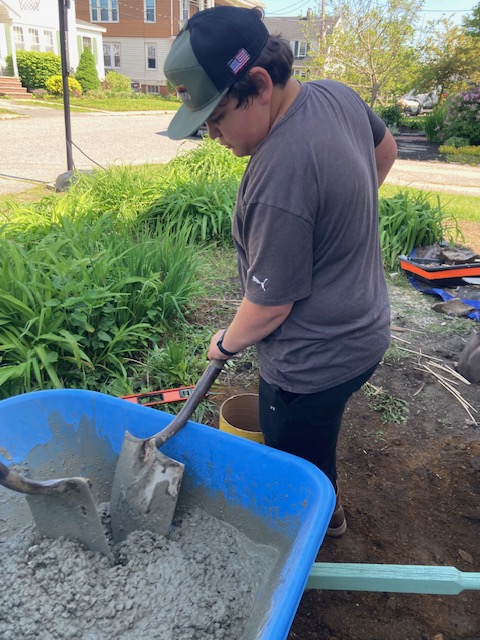
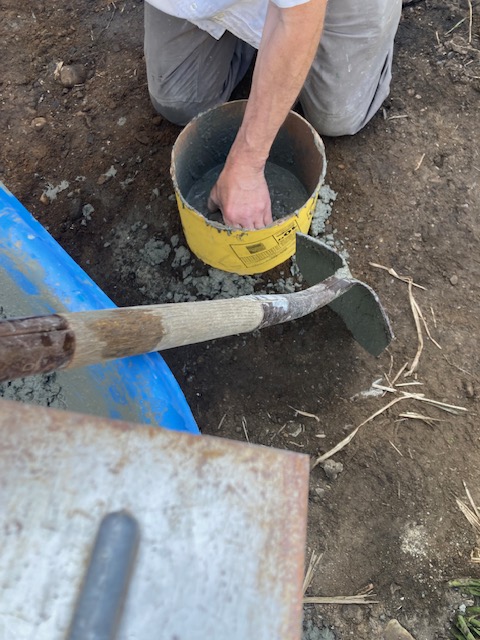
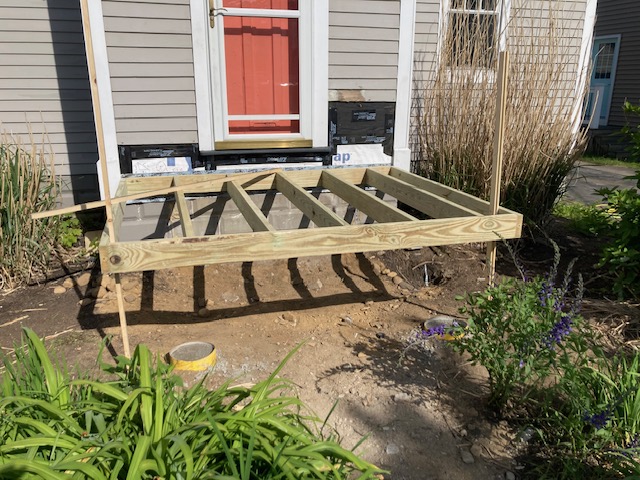
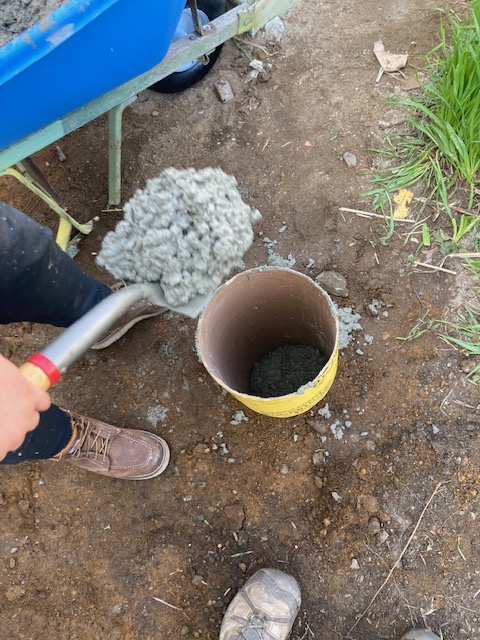
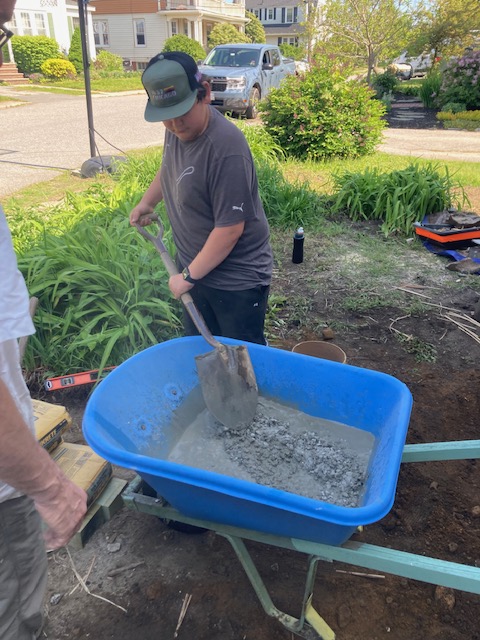
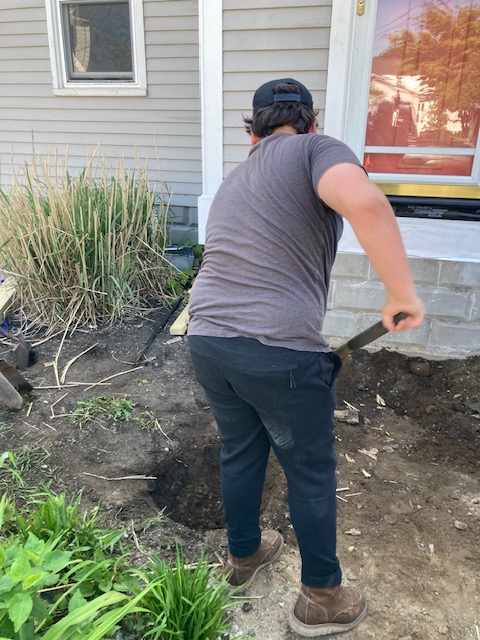
As a counterbalance to these abstractions, we poured concrete. The front entry of a friend’s home was demolished when his neighbor drove her car backwards, at a very high speed, into the front of his home. Remarkably, the driver avoided the house but smashed the stairs. Insurance paid little – no surprise there – so our marching orders are to be frugal. We are making it work, and my son is part of the crew. Child labor laws do not pertain in our homeschooling.
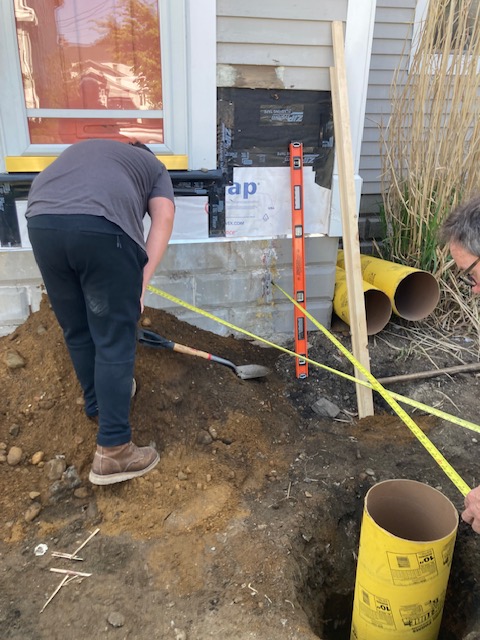
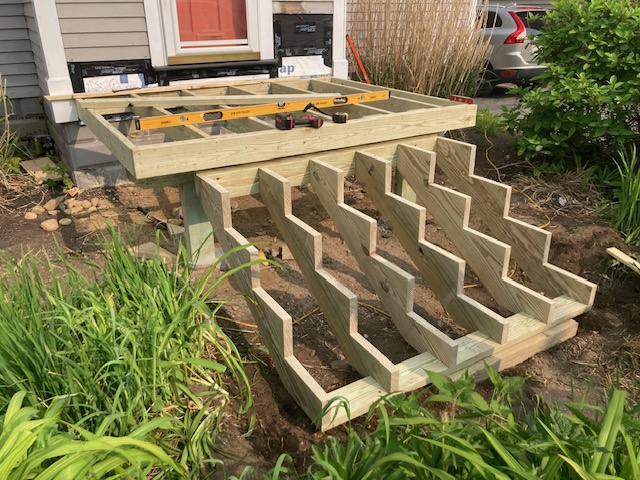
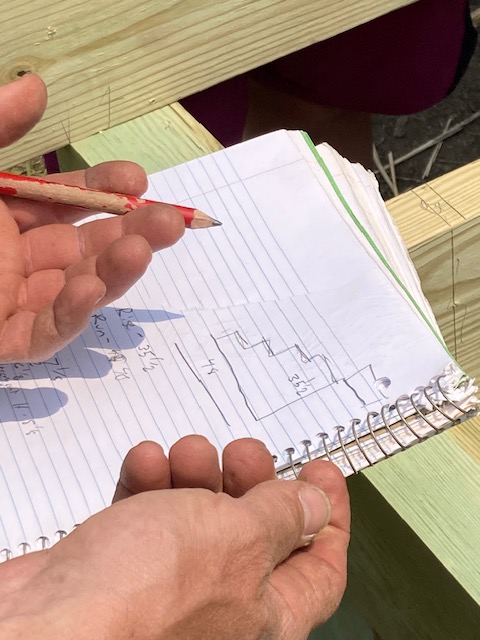
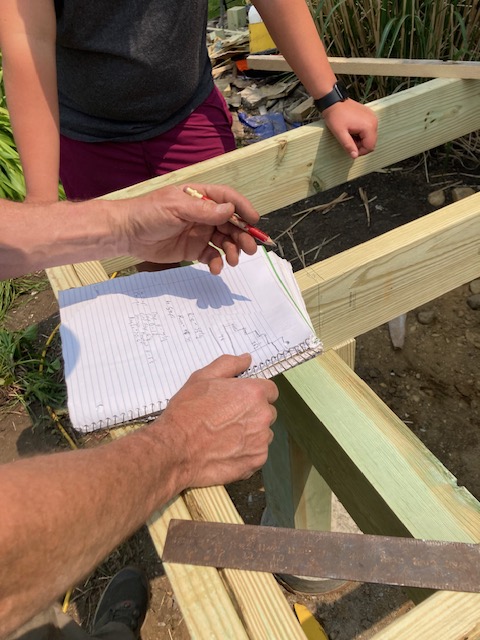
The new entry will have a platform about 4’ high, with four steps to it. This is applied geometry and we discussed the area of a rectangle [width x length], the area of a triangle [1/2(width x length)] and the volume of a column [V=π r2 * h]. We needed to calculate the volume to know how much concrete to buy. To place the footings, we located two points at right angles and parallel to the house. Pythagorus solved that question. We used the 3,4,5 triangle; given a2 + b2 = c2 then 9 + 16 = 25 marked the exact locations where we would dig.
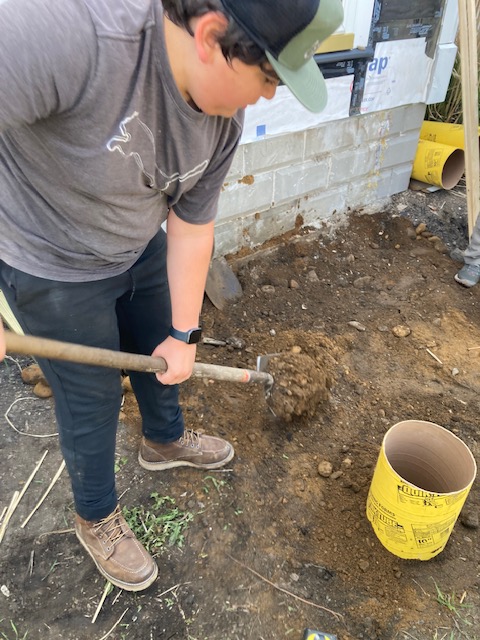
Like construction, learning requires a solid foundation. We began at the bottom and dug holes. We discussed the history of “Pi”, and its application to our task. “Pi” is the ratio of a circle’s circumference to its diameter. The Babylonians approximated Pi at 3. The Egyptians refined it to 3.1605, and then Archimedes of Syracuse hit the mark by using the Pythagorean Theorem. He drew a circle and two boxes; one box fit inside the circle and one circumscribed the exterior. He reasoned the area of the circle was between the area of the polygons and thus Pi would be between 3.1408 and 3.14285. The Chinese mathematician Zu Chongzhi took a different route, performing lengthy calculations with hundreds of square roots to calculate the ratio at 355/113, which is 3.14159292035. Centuries later, in 1706, the Englishman William Jones decided to name the ratio “π” which is the first letter of the Greek word “perimetros”, which means “circumference”.
Our project’s head carpenter is a journeyman Master Carpenter, who has built homes on the islands of Maine for decades. Building on an island requires the ultimate resourcefulness; everything used is carried by boat to the job site and so waste is minimal. A calm and wise teacher, he explained use of a sight level, how to square the platform, how to measure and cut stair risers. The platform he built is remarkably strong and the client is pleased. My son hopes to handle the landscaping that follows.
Driving to and from the job site, my son spoke of the satisfaction of helping people using practical problem solving. My son also commented that jobs based upon information pay higher than jobs in physical labor. I will not sugar coat that truth: the annual salary of an average Professor of Law is $173,000 while the most skilled carpenter earns around $80,000 per year. Such are the values of this society (although AI looms large). My son’s path is unknown and we expose him to the yin and the yang, the full range of ideas and labor, as he comes of age.
About that volume, my son correctly calculated that each column was 2.8 cubic feet, which required 480 pounds of concrete. A heavy load, I was thankful for a young assistant.





 an Art Farm