Henry Ford’s broad vision for business success included that his vendors and subcontractors should make a reasonable profit from doing business with the Ford Motor Company. Wholistic, he understood that everyone in the supply chain should be treated fairly for the system to thrive. He famously said, “A business absolutely devoted to service will have only one worry about profits. They will be embarrassingly large.”
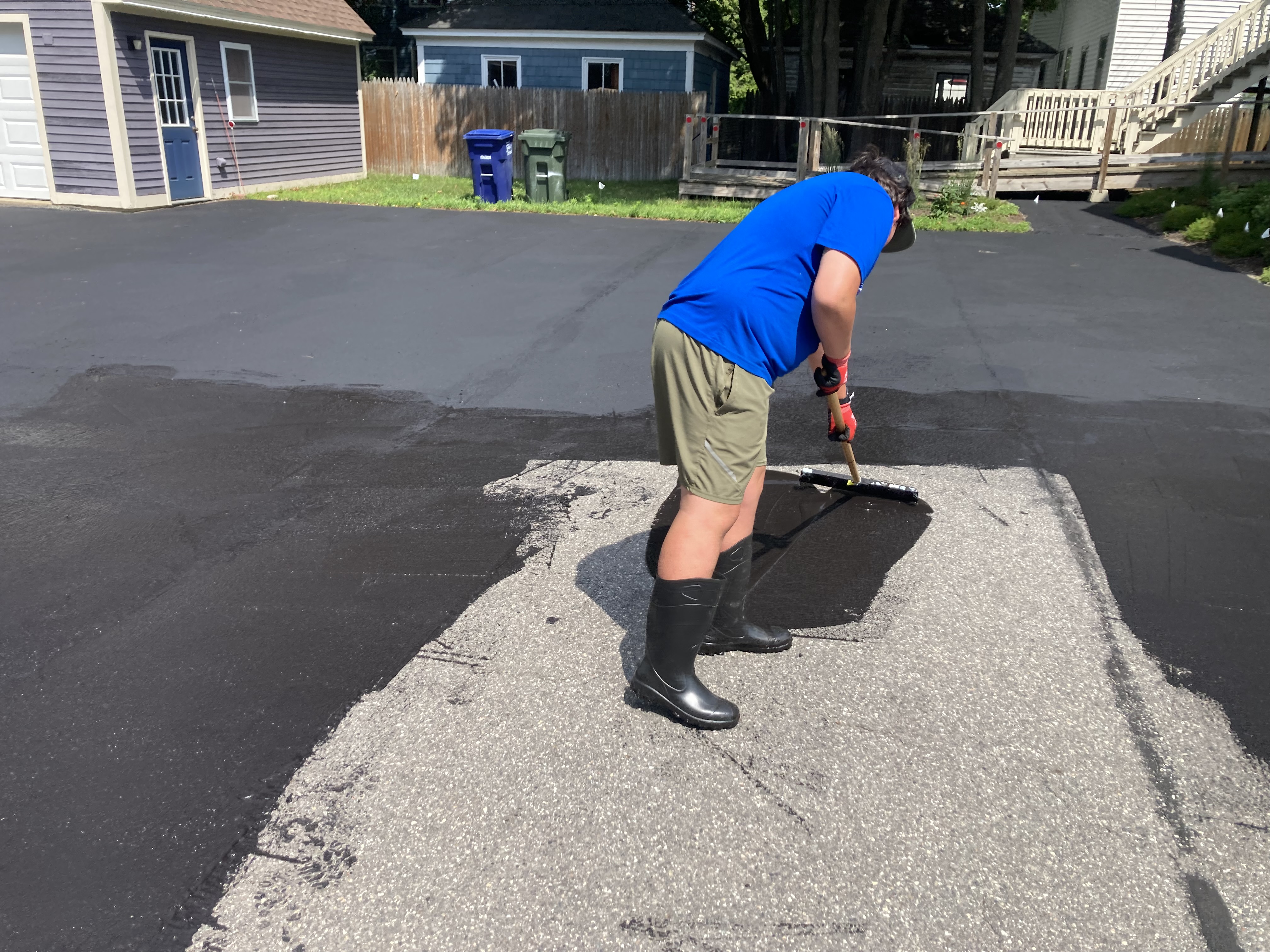
My son and I talked about this during the summer, when he took a job seal-coating a 5,004 square foot parking lot. It was his job – I, his crew and driver – but I advised that he should issue a quote in advance, so the client knew what to expect. With great confidence he named his price including a modest profit. The client understood the final invoice would be on a time and materials basis.
The job went well, but in fact was more demanding that expected. The crew pulled it through, but when it came time to submit the final bill my son realized that what had seemed – in advance – like a windfall, felt too small after the fact. He learned what hard labor meant and wanted to charge more. And so we talked about Henry Ford and what a “reasonable profit” meant. In the end, he settled on a 20% profit which equalled $52.50. The client was pleased and paid the bill gladly.
About Henry Ford we have kept talking, and our history curriculum is built around the farm boy from Dearborn who quit school with a 6th grade education. Encouraged by Thomas Edison, in 1903 he founded the Ford Motor Company. Models N, T and A followed and his River Rouge Complex would become the world’s largest, iconic and most efficient integrated factory. Detroit has a rich history, and Mo-Town adds a phenomenal soundtrack.
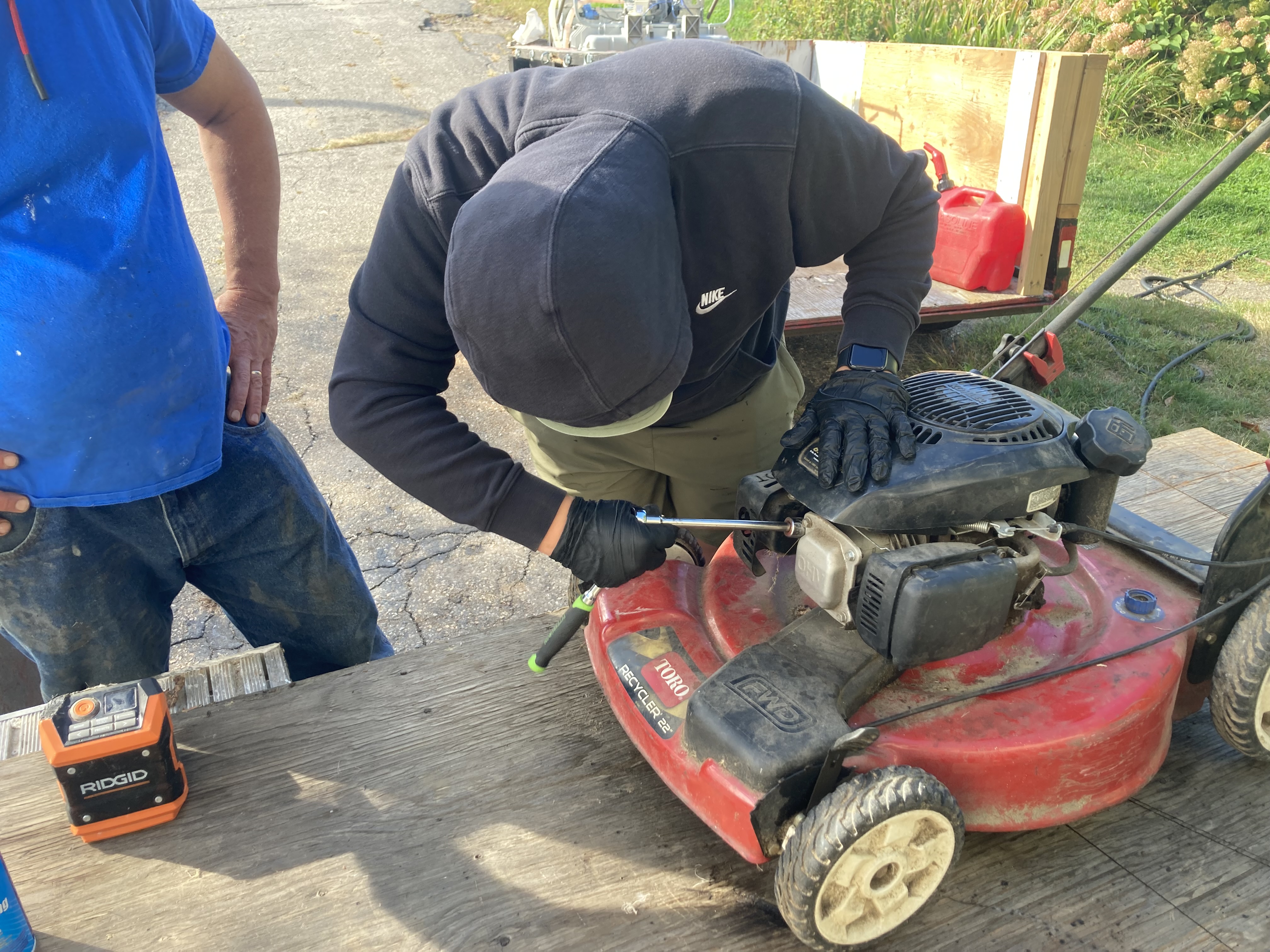
To make history tangible, we drove to the Professor’s house in Lyman, Maine to work on a small internal combustion engine. The Professor is a journeyman carpenter/philosopher, who not only has every tool known to mankind, but knows how to use them all! Pedagogy unfolded under a shade tree at the Lyman town center.
The Professor sagely required my son to write a summary of the experience. Given the complexity, my son dictated while I was his scribe, and we then parsed the grammar – nouns, common or proper and concrete or abstract; verbs and adverbs; prepositional phrases and their objects; subordinate clauses – and ended up with his summation:
“With Professor Nate, I worked on a Toro Recycler lawn mower with a 22” deck. The first thing we did was try to start it. It would not start. We realized that it did not have an air filter.
“We put it up on a table and looked at the spark plug. The spark plug had a lot of carbon, so we tested the plug to see if it had a spark. It did, but it was orange. The color of the spark can determine how much voltage is being generated from the engine. Red is poor, orange means power but weak, a blue spark is a strong: voltage follows the rainbow spectrum. Our plug had an orange spark. Nate had a new plug that we tested, but it had no spark at all.
“So then we tried using some 1,000 grit sand paper to sand off some of the carbon from the tip. After trying that we tested the original plug again and it had improved. We put it back into the motor, tightened it first by hand and then used a torque wrench, with approximately 30 foot-pounds of torque.
“We checked the oil and gas. We drained the gas bowl, which is under the engine on the left, to see if there was dirt in the fuel. There were specks of dirt and rust, and the fuel was green from the stabilizer. After we drained it, the fuel looked good.
“The Toro Recycler is supposed to have front wheel drive but it wasn’t working. We took the cover off and one of the belts was completely snapped. There was a stick lodged in the belt and a lot of grass had built up inside the housing of the belt. We put the belt cover back on. That should be the problem for the drive.
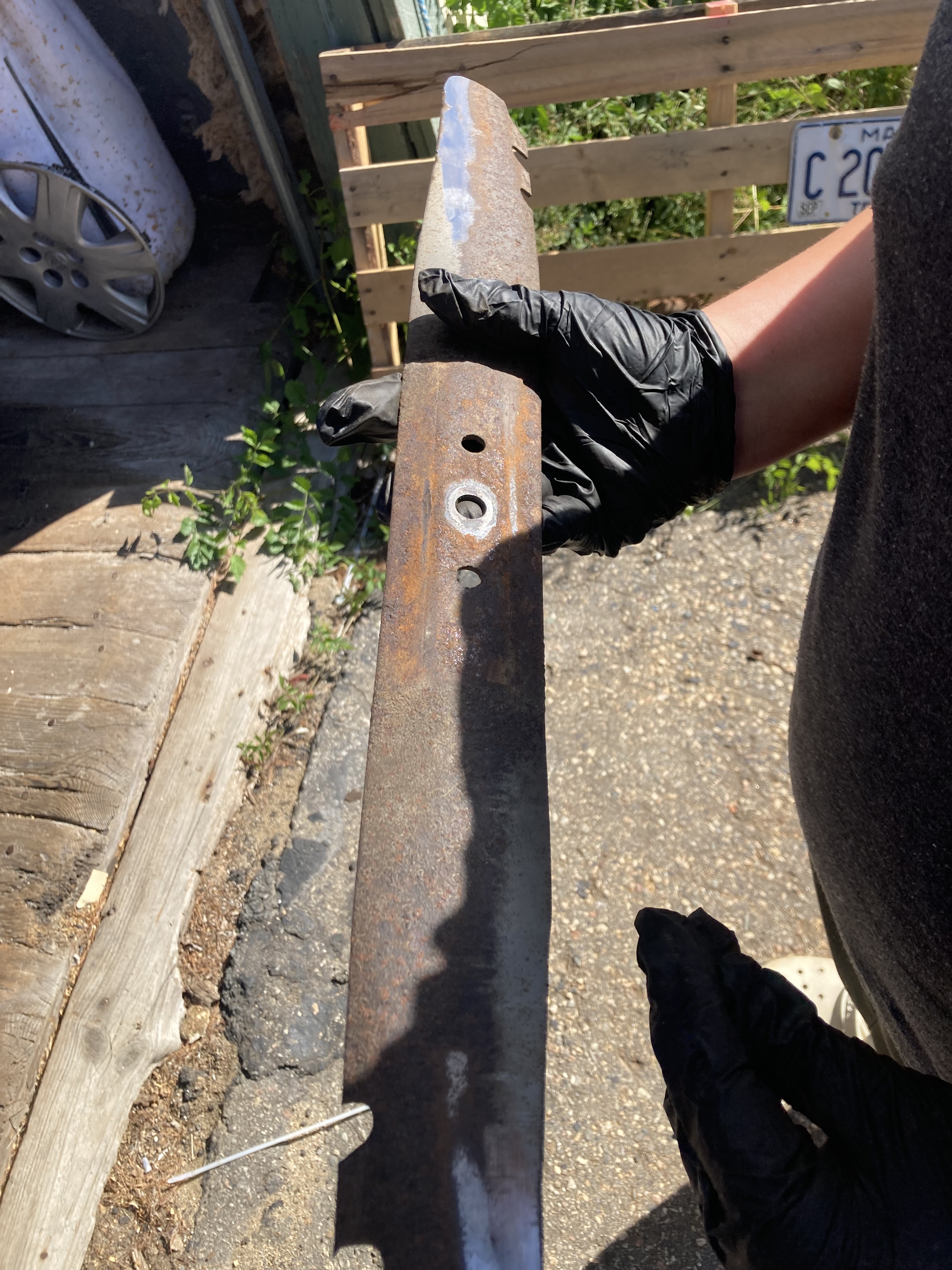
“We took the blade off using a pneumatic impact driver. We sharpened the blade, simply grinding the edge down. We put the blade back on using the torque wrench.
“We put the mower back on the ground and it started. It did not sound great at first, but slowly the sound improved as the motor circulated the new gas through the engine. It mowed well.
“Next we will get a new air filter, new drive belts and a blade. We need to clean the mower. We are also studying Volts, Amps, Ohms and Watts as part of our science class.”
While the Professor teaches the “how-to,” my son’s cousin, the Lizard-whisperer, is teaching him the pure science of electricity and magnetism; voltage and current; protons, neutrons and electrostatic fields. From all angles we are unpacking the mystery and majesty of an internal combustion engine.
The lead photo above is my son’s Great Grandfather John, standing proudly beside his Ford Model A touring car, circa 1928. John was a coal salesman in the Ohio River Valley, who made frequent trips throughout the coal rich hills of Appalachia. His car was for work more than pleasure.
John’s customers included Detroit Edison; he would purchase the entire output of mines in Eastern Kentucky and Ohio and then ship the coal north by the train load. But John’s coal did not fire Henry’s furnaces.
Henry’s revolutionary self-sufficiency controlled costs by owning the entire production process: 16 coal mines powering the electric plants that generated the voltage to run the steel mills producing the parts for the cars ever rolling down that assembly line at the Ford Motor Company’s River Rouge Complex.
A 6th grade drop out has much to teach our 7th grade home schooler.





 an Art Farm