Truths Held Self Evident
Posted: January 3, 2025 Filed under: Child Centered Activities, Chronicles of a First Time Parent, consciousness, What is an Art Farm | Tags: consciousness, Great potato famine, healing, hypermasculinity, intergenerational trauma, mental health, trauma 1 Comment
Among truths held self evident, that healing is the purpose of life must be central. But this view challenges the conventional A-list: asset acquisition, accomplishment, accumulation of wealth, accolade, acclaim, awards, advancement…to name but a few.
“He who dies with the most toys wins” is the popular path, but life’s hard labors will come to our doorstep, at which time the question is whether we step up or cower. Our future hangs upon the response.
Easier it is to kick the can down the road. John Maynard Keynes, the economist of destiny, who structured the post-WW2 financial reconstruction, famously said, “In the long run, we are all dead.” But life’s grim reaper is one keen accountant, and even if we choose to ignore, intergenerational trauma will settle all accounts going forward.
“Intergenerational trauma” was a new concept to me until a few years ago when my wife, a Licensed Clinical Professional Counselor spoke of it. Since then the term keeps popping up and it seems to define something of our zeitgeist. Some among us may claim this is just “a hoax from China” but scientific fact argues against brazen disregard.
Epigenetics is the science of how environmental and behavioral factors alter gene activity without changing the DNA sequence. The term “epigenetics” comes from the Greek word epi- which means “on or above.” Originally introduced in 1942, the field has grown rapidly since 2004, when the genome was fully sequenced.
Among its findings are that environmental factors can influence the health and traits over three generations through epigenetic change passed down via sperm and egg cells; the “transgenerational” effect impacts grandchildren even though they were not directly exposed to the original environmental factor. In other words, even the untold family stories shape who we are, and become.
“Beneath every railroad tie there lies a dead Irishman” is an adage describing the struggles of the Irish emigres. My father’s ancestors immigrated to the United States circa 1850. We do not have records, but believe the Mahany clan were from the city of Cork, in the County of Munster where the Great Potato Famine raged. Between 1845 and 1855 more than 1.5 million adults and children – all enduring trauma – left Ireland seeking refuge in America.
The railroads were major employers of the Irish, and the Mahany family followed that path. Daniel M Mahany/Mahoney, my great-grandfather, was born in Kentucky in 1860, the era of the Civil War, the Confederate South; intense tension among the Catholics, immigrants and the Protestant natives; machine politics and its rogues’ gallery of gang violence. As a laborer on the L&N Railroad his work must have been extremely difficult, and how he dealt with those tensions, or even traumas, once home is left unspoken.
My Father said little, next to nothing, about his family of origin and I can only wonder what traumas lie buried, untold stories of a painful past, but which still shape our gene pool. I am the third generation of Daniel Mahany’s child D.J. Mahany
One of five siblings, I process this neither in a vacuum nor by committee. The path of healing is deeply personal, each of us bringing to bear the untold complexities of our own lived lives. But plain is the historical record, factual is the science, and now is my moment.
I wonder if the turbulence of our times is not, to some degree, a long overdue reckoning of intergenerational trauma. There seems a purging of the collective id; the hypermasculine posturing, saber rattling of geo-political Oligarchs, the comic pretensions of World Wrestling Entertainment, all of which seem a masking of unhealed traumas endured and too long accrued. Mass violence marked the 20th century – the “century of genocide” – and I wonder if now comes the time when accounts need be settled.
My children are the fourth generation. My parenting choices have the potential to be liberating. Nothing can be more important to me now, at this stage of my life, than healing as the only thing that matters, that the future may be made more clear, centered in the light.
Turning 12
Posted: December 6, 2024 Filed under: Chronicles of a First Time Parent, consciousness, What is an Art Farm | Tags: coming of age rituals, consciousness, hypermasculinity, mental health, mindfulness, religion, spirituality 5 Comments
Our son turns 12 next week and I am mulling over rituals to mark this right of passage as our cherub becomes a young man.
I was raised in the Roman Catholic Church and its ritual would have been Confirmation. I have little memory of that, but it appears five hours of community service were required. I do remember wearing white, walking down the aisle and choosing Mark as my name. I chose that name to honor my best friend, who had just suffered a terrible accident in which both his arms were amputated. My choice was one of solidarity.

The Catholic tradition seems neither my nor my son’s path; I find Christian dogma limiting although Christ consciousness tremendously expansive. My faith is a work-in-progress while I am seeking alternatives for raising my son.
In the Amazon, the Satere-Mawe tribe have young men wear a glove filled with bullet ants for 10 minutes. Pushing the threshold of pain is not quite the path I seek. In Ethiopia boys jump over a cow, and in Vanuatu they jump from tall towers with vines tied to their ankles, but manliness, to my mind, is more than a measure of strength and courage.

In the Hebrew tradition the bar mitzvah marks a boy’s coming of age whereupon he begins to assume responsibility for his actions. Responsibility tied to manhood appeals to me. 13 is the age of Bar Mitzvah but to my mind, manhood is not just the number of years spent on the planet. It must be earned through understanding. This ritual, then, is about values and lessons learned.
During the summer my son and I volunteered frequently at the South Portland Food Cupboard. It was an enriching experience, and community service seems relevant in his coming of age. Construction work such as Habitat for Humanity comes to mind. I have heard of Church Youth Groups who undertake community service projects. I am looking for local possibilities.
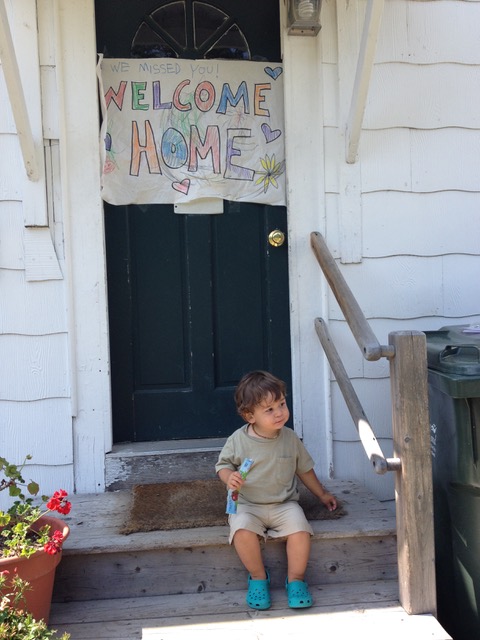
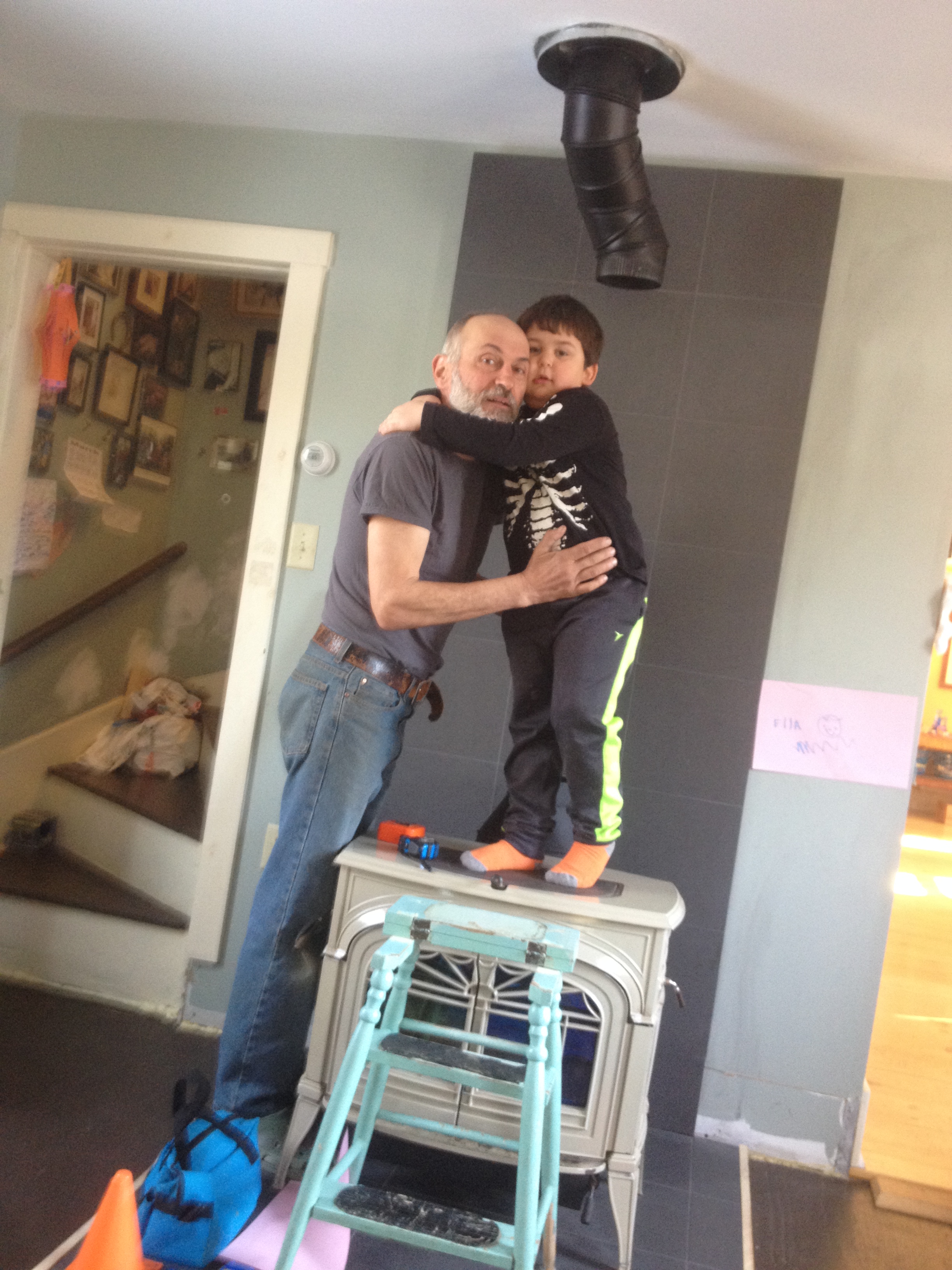
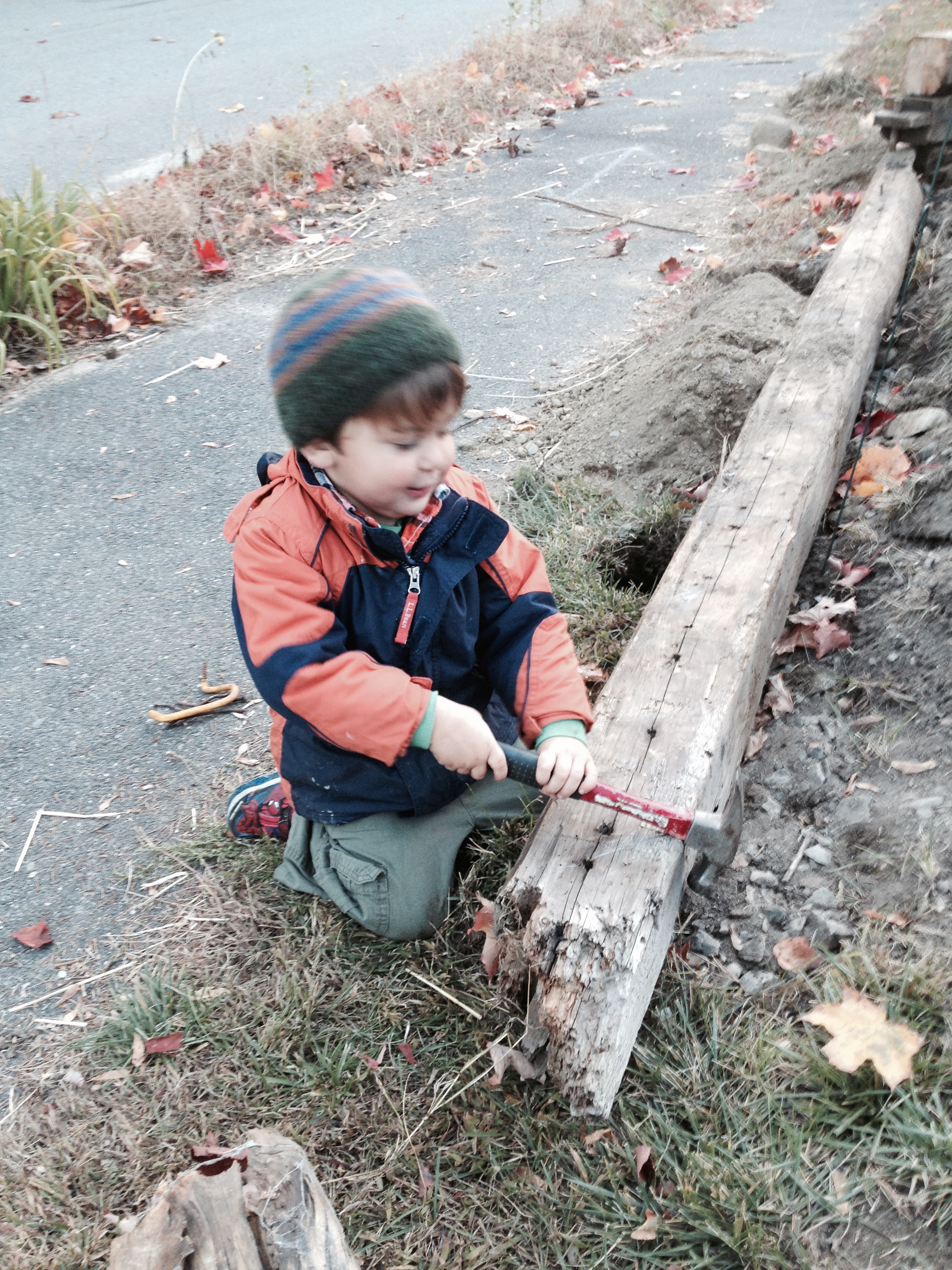
The insights of other men should be another aspect of this plan. My nephew, my son’s cousin, did have a Bar Mitzvah and has agreed to talk with him about the experience, and his own coming of age. A philosopher/carpenter friend has offered to teach more welding, and we may join with a classmate of my son and his father, for a shared experience; working with tools in the act of making. Another friend, whose son also is the same age, is loaning us a lathe for turning wood, and that may be another opportunity for input from other men in the community. My son will benefit from hearing more than my views.
And then there is the topic of sexuality. My Father’s coming-of-age speech to me was as comic as it was lacking. It was haltingly brief, when he simply asked, “Do you have any questions?” Feeling the tension, of course I replied, “No,” whereupon he handed me a paperback book on Catholic morals. I recall the author was aghast at a recent 6th grade school field trip, where the girls wore red lipstick and hosiery. Just blame it on the girls remains the dogmatic view. What I learned of sexuality came from my older Brother and the locker room, but my son deserves better than that.

The pious among us claim that traditional morality teaches the male as the leader, with male-female relationships the only acceptable norm. I regret to inform them that history teaches otherwise. The Christian era has been relatively brief, while Ancient Greece, Rome and China openly practiced homosexuality and pederasty. LGBTQ may arguably be the historical norm and reversion to the mean would seem natural. My son will benefit from thinking not in centuries but in millenia.
The process of writing this has become the means to outline a plan. Among the core values this DIY ritual should include are:
- compassion and cooperation are keys to a healthy masculinity
- no means no, and might does not make right.
- emotional intelligence has greater value than sheer intellectual horsepower
- listen to your heart, not just your head; be curious, ask questions, follow your passion
- practical problem-solving skills provide a grounded self-confidence
- making is hard-wired in our DNA; art predates agriculture, and therefore civilization itself
- Integrity presumes courage; let your word be your bond
- energy follows thought; actions have consequences


Redemption and Return
Posted: November 8, 2024 Filed under: Art & Healing, consciousness, What is an Art Farm | Tags: alpha males, books, divine feminine, greek-mythology, Homer, hypermasculinity, Iliad, mythology, Plato, the Republic, thucydides, trojan-war 1 Comment
Recently, at the Friends School of Portland, I watched a performance of the Iliad that was remarkable; horrid and harrowing, vast and engaging, a testimony to the power of theatre.
The Fig Tree Committee, a group of Quakers from Portland, Oregon presents “An Iliad” to correctional facilities and the communities that surround them. Over 3,500 people, most of whom were incarcerated, have seen the production. In the Quaker vernacular, their work is a “leading” as it “…knits together audiences on both sides of the prison walls by using one of the world’s oldest stories to examine the cycles of violence, trauma, displacement, and hope for healing that unite us all.” https://www.figtreecommittee.org/
The Iliad, central to Classical literature, stands at the apex of Epic Poetry. Homer, the bard, is said to have written the poem circa 800 BC, retelling stories from the late Bronze Age circa 1,000 BC. The story revolves around Paris, a Trojan Prince, who abducted Helen, the wife of Meneleus, the Greek King. Extraordinary was Helen’s beauty, her’s “the face that launched 1,000 ships.” The poet sagely never describes her face, leaving that to the reader’s imagination.
For 10 long years the Greeks battled the Trojans, always to a standstill, which test of endurance is indeed the stuff of legend. The story – hypermasculinity and the alpha males’ dominance – is remarkably relevant to the world today. The Access Hollywood tapes seem but a modern day retelling of Paris abducting Helen.
The Fig Tree’s production used metadrama to connect the classic to the contemporary through the epic catalog of the 1,000 ships. The bard made plain such breadth by listing the many young men killed, but from American, rather than Greek towns, including Evanston, Illinois where long ago I read the Iliad in the Greek. That catalog foreshadowed what was to come, and what is playing out in America today.
Building to the play’s climax, the bard recited a brutally long catalog of wars – Ancient Greece through Europe to modern day Middle East and Gaza – 3,000 years summarized that took us ever deeper into the maze, to face the Minotaur; not half man half beast, but rather the vain beastial side of Aristotle’s “political animal.”
The Peloponnesian War – Sparta versus Athens, 431-404 BC – centered on the issue that “might makes right.” Thucydides, the Greek Historian, in 410BC wrote, “… right, as the world goes, is only in question between equals in power, while the strong do what they can and the weak suffer what they must.” “Might makes right” is the moral antithesis of the path to compassion.
Plato, the Athenian philosopher, wrote the Republic, 375 BC, arguing that democracy was unworkable, “Until philosophers are kings, or the kings and princes of this world have the spirit and power of philosophy … cities will never have rest from their evils,—no, nor the human race, as I believe,—and then only will this our State have a possibility of life and behold the light of day.”
The polite phrase is “Philosopher King” but the literal translation is “Benevolent Dictator.” The authoritarian strongman does seem ascendant now. Many say Victor Orbán is a modern day exemplar of the Philosopher King but his is an illiberal democracy, rule by the minority not “we the people.” Might makes right remains the macho battle cry and let’s be honest: hypermasculine alpha males have run the table for more than 3,000 years.
To my mind, the deeper long-term trend is that the Divine Feminine is ascendant, while the alphas, like dinosaurs, will fight to the bottom to preserve their long enjoyed patriarchy. I speak of masculine traits, not gender, and write this not to condemn but with compassion to decry so many generations of boys raised to be men who fight more than forgive, for whom “making a killing in the market” is a red badge of courage. Radical, indeed, was the street preacher, 2000 years ago, who dared say, “the meek shall inherit the earth.”
At the end of the March from Selma, Martin Luther King stood on the steps of the Alabama State Capital, and said, “The arc of the moral universe is long, but it tends toward justice.” The Iliad tells the same story. This masterpiece of literature is ultimately a story of redemption, the release of anger and hubristic pride.
At the Iliad’s end, Achilles speaks to Priam, the last King of the Trojans, and releases to him the body of Hektor, his son, whom Achilles had slain in battle. Each having lost everything, Achilles – the greatest among the Greek heroes, which is to say the paragon of the alpha male – found within himself redemption and gave back to Priam the body of his son, to be buried, returned to his native soil.
If the greatest of Greek heroes could find forgiveness and compassion, then certainly, so too, can we the people.
Work is to be done.
Let us be about it.
Now.
_______________________________________________________
I quote here from the Richmond Lattimore translation, Prius supplicating Achilles, the response of Achilles, the anointing of Hektor’s body, and the slaying of the “gleaming sheep” for a shared meal of Thanksgiving:
“Achilleus like the gods, remember your father, one who
is of years like mine, and on the door-sill of sorrowful old age.
And they who dwell nearby encompass him and afflict him,
nor is there any to defend him against the wrath, the destruction.
Yet surely he, when he hears of you and that you are still living,
is gladdened within his heart and all his days he is hopeful
that he will see his beloved son come home from the Troad.
But for me, my destiny was evil. I have had the noblest
of sons in Troy, but I say not one of them is left to me. (24.486-94)
“So he spoke, and stirred in the other a passion of grieving
for his own father. He took the old man’s hand and pushed him
gently away, and the two remembered, as Priam sat huddled
at the feet of Achilleus and wept close for manslaughtering Hektor
and Achilleus wept now for his own father, now again
for Patroklos. The sound of their mourning moved in the house. Then
when great Achilleus had taken full satisfaction in sorrow
and the passion for it had gone from his mind and body, thereafter
he rose from his chair, and took the old man by the hand, and set him
on his feet again, in pity for the grey head and the grey beard,
and spoke to him and addressed him in winged words: ‘Ah, unlucky,
surely you have had much evil to endure in your spirit.
How could you dare to come alone to the ships of the Achaians
and before my eyes when I am one who have killed in such numbers
such brave sons of yours? The heart in you is iron. Come, then,
and sit down upon this chair, and you and I will even let
our sorrows lie still in the heart for all our grieving. There is not
any advantage to be won from grim lamentation. (24.507-24)
“Then when the serving-maids had washed the corpse and anointed it
with olive oil, they threw a fair great cloak and a tunic
about him, and Achilleus himself lifted him and laid him
on a litter, and his friends helped him lift it to the smooth-polished
mule wagon. He groaned then, and called by name on his beloved
companion: ‘Be not angry with me, Patroklos, if you discover,
though you be in the house of Hades, that I gave back great Hektor
to his loved father, for the ransom he gave me was not unworthy.
I will give you yourshare of the spoils, as much as is fitting.’
“So spoke great Achilleus and went back into the shelter
and sat down on the elaborate couch from which he had risen,
against the inward wall, and now spoke his word to Priam:
‘Your son is given back to you, aged sir, as you asked it.
He lies on a bier. When dawn shows you yourself shall see him
as you take him away. Now you and I must remember our supper. (24.587-602)
“So spoke fleet Achilleus and sprang to his feet and slaughtered
a gleaming sheep, and his friends skinned it and butchered it fairly,
and cut up the meat expertly into small pieces, and spitted them,
and roasted all carefully and took off the pieces.
Automedon took the bread and set it out on the table
in fair baskets, while Achilleus served the meats. And thereon
they put their hands to the good things that lay ready before them.
But when they had put aside their desire for eating and drinking,
Priam, son of Dardanos, gazed upon Achilleus, wondering
at his size and beauty, for he seemed like an outright vision
of gods. Achilleus in turn gazed on Dardanian Priam
and wondered, as he saw his brave looks and listened to him talking.
But when they had taken their fill of gazing one on the other,
first of the two to speak was the aged man, Priam the godlike:
‘Give me, beloved of Zeus, a place to sleep presently, so that
we may even go to bed and take the pleasure of sweet sleep.
For my eyes have not closed underneath my lids since that time
when my son lost his life beneath your hands, but always
I have been grieving and brooding over my numberless sorrows
and wallowed in the muck about my courtyard’s enclosure.
Now I have tasted food again and have let the gleaming
wine go down my throat. Before, I had tasted nothing.’
He spoke, and Achilleus ordered his serving-maids and companions
to make a bed in the porch’s shelter and to lay upon it
fine underbedding of purple, and spread blankets above it
and fleecy robes to be an over-all covering.” (24.620-646)
When Tears Become Bullets
Posted: August 22, 2024 Filed under: Chronicles of a First Time Parent, consciousness, Permaculture & Home Renovation, What is an Art Farm | Tags: hypermasculinity, jackson katz, the boy code, william pollock 2 Comments
In 2001, I met and soon moved in with a remarkable young woman, an art therapist, who had worked with young children at Byrd Elementary School at Chicago’s Cabrini Green housing project, as well as in the Robert Taylor Homes and Cook County Hospital. Working with inner-city boys, she was driven to thread the emotional needle, to help them move forward.
In that studio apartment, on her bookshelf, was ”Real Boys” written by William Pollock, PhD about “the myths of boyhood,” how our society shapes boys to become men. I tried repeatedly to crack that cover but could not. It cut too close to my core.
I quote now the four core tenets of what Pollock called “the Boy Code”:
“The sturdy oak: Men should be stoic, stable, and independent. A man never never shows weakness…boys are not to share pain or grieve openly.
Give ‘em hell: This is the stance of some of our sports coaches, of roles played by John Wayne, Clint Eastwood, and Bruce Lee, a stance based on a false self, of extreme daring, bravado, and attraction to violence.
The “big wheel”: This is the imperative men and boys feel to achieve status, dominance, and power. Or, understood another way, the “big wheel refers to the way in which boys and men are taught to avoid shame at all costs, to wear the mask of coolness, to act as though everything is under control….
“No sissy stuff:” Perhaps the most traumatizing and dangerous injunction thrust on boys and men is the literal gender straight jacket that prohibits boys from expressing feelings or urges seen as “feminine” – dependence, warmth, empathy.”
In short, big boys don’t cry. When I was young, my father – who lived to seize the brass ring, to slay the dragon, to climb the mountain, then died young – he repeatedly told me, “David, you can get used to hanging if you have to.” My football coaches always rhymed “no pain, no gain!” I fault neither my Father nor the coaches, as they only passed on what they had been taught. About all this, Pollock cautioned, “when boys cannot cry, their tears become bullets.”
Bullets, of course, can be metaphorical, and but one example would be the Wall Street “Masters of the Universe” among whom “might is right” with finance a zero sum game of domination, power and control. Consider hedge funds buying up the foreclosed housing stock and then raising rents, in the midst of a housing shortage. Or private equity buying medical practices, to maximize profits at the expense of patient care.
The first rule of the Boy Code is that we don’t talk about the Boy Code. I violate masculinity in writing this meditation upon raising a daughter and son in a culture where hypermasculinity is the norm. I speak here not of the male gender but the masculine traits, as taught.
Jackson Katz, a male pioneer in women’s studies, has written a book titled “Man Enough?” about the “Politics of Presidential Masculinity.” Presidential campaigns are described “…as the center stage of an ongoing national debate about manhood, a kind of quadrennial referendum on what type of man—or one day, woman—embodies not only our ideological beliefs, but our very identity as a nation….how fears of appearing weak and vulnerable end up shaping candidates’ actual policy positions…”
I write here neither to praise nor denigrate any candidate. My concern is our culture of dominance. In this time of hypermasculinity, where we demonize “other,” be they immigrants, the extreme right, the “marxist” left, Neo-nazis, ad infinitum, I am compelled to ask what if the problem is not “them” but us? It is so easy to point and blame “them” but infinitely more challenging to say it is our system of beliefs, self-reinforcing, which perpetuate cycles of violence, a culture of dominance rather than compassion.
Jackson Katz gave a TED Talk titled “Violence against women – it’s a men’s issue.” He makes the subtly persuasive point that rational self interest in a patriarchal society becomes a self-reinforcing system of belief; there is no conspiracy but a self interest in maintaining the status quo rather than embracing change. By analogy, Newton’s First Law of Motion here pertains, that a system of domination will persist until it is acted upon by an external force strong enough to bring change. https://www.ted.com/talks/jackson_katz_violence_against_women_it_s_a_men_s_issue?subtitle=en
“It takes a village” becomes my curse. In our home we raise children to value empathy, compassion and emotional intelligence, but the world into which they go – are schooled, coached and policed – there predominates the hypermasculine. How do we raise our children to be compassionate when their peers practice dominance? “Gentle as a dove, wise as a serpent,” comes to mind.
As a child, I would read the Sunday comics seated below my Father, while he devoured the business news. Pogo, the political satire, ran in those comics, with its theme “We have met the enemy, and He is us.” More than fifty years have passed and some demonize the “Deep State” or “them” but I ask, what if Pogo really was right? What then, if we ourselves are the problem?
An honest awareness seems a necessary starting point in a new dialogue.
* * * * * * * * *
Here at an art farm Bacchus has arrived bearing wild seedless Champagne grapes. Jimmy Nardello Italian Frying Peppers are abundant. Tomatoes exceed our capacity to use. Pole beans flower, to attract hummingbirds. Butternut squash grow on the vine. Peaches are ripe for the picking. We bring bushels of produce to the Food Cupboard.










 an Art Farm