Planting Potatoes
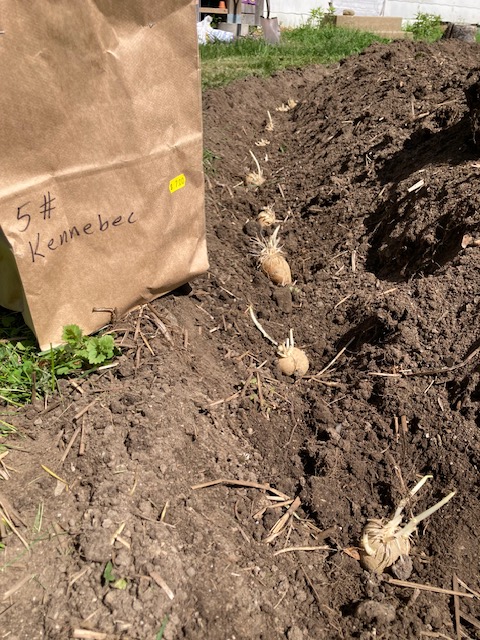
Posted: June 8, 2024 Filed under: Farming off the Farm, What is an Art Farm | Tags: irish american 2 CommentsHere at our Art Farm, we have been planting potatoes, three varieties this year: Dark Red Norland, Kennebec White, and Russian Banana Fingerlings. We have some “volunteers” returning from last year, never harvested. The bounty continues. Norland are early to mature, Kennebec are mid-season, Russian Banana are late to produce, which means potatoes all summer long.
Although of Irish heritage, I plant potatoes because, like a foraging groundhog, it is simply divine to rummage through the dirt and pull up a bouquet of spuds, hanging upon the vine. Gaia’s abundance is never closer at hand.

My long-deceased father rarely or never spoke about his origins, and through ancestry.com we have learned the barest of an outline. Phillip Mahaney immigrated, we believe, from the city of Cork, in the County of Munster, Ireland to the United States in 1850. The Great Potato Famine impacted that region, and between 1845 and 1855 more than 1.5 million adults and children left Ireland seeking refuge in America.
Thaddeus Shannon was born in Kildimo South, Miltown Malbay, County Clare, Ireland at the ancestral home named “Annagh Bridge House.” Thaddeus was not the eldest and therefore would not inherit the family farm, so he immigrated to the United States in 1884. Both Phillip and Thaddeus entered America on the Eastern seaboard, but traveled west to Bourbon County, in the bluegrass region of Kentucky. Their descendants – my grandparents – were married in June of 1924 in Paris, Kentucky.
The railroads were major employers of the Irish, and for the Mahany and Shannon families that is certainly the case. The Louisville & Nashville Railroad – “The Old Reliable” – was a major carrier serving fourteen states throughout the southern USA, and between 1880 and 1950 no less than 21 members of our extended family worked on those lines. The list of positions includes: Laborer, Shop Laborer or Section Laborer; Yard Master, Track Supervisor or Section Foreman (Boss); Machinist, Clerk or Messenger; Car Inspector, Brakeman, Conductor, Engineer or Head Engineer. My father’s first job, in 1944 at age 16, was Messenger at the Paris, Kentucky depot.

The sheer physical labor of the rail crews must have been daunting and the saying “Beneath every railroad tie there lies a dead Irishman” describes the struggles of the emigres. Although we know virtually nothing of our ancestors’ experience, something that happened but 10 miles from our farm tells a bone chilling story.
In the winter of 1864 the Royal Mail Ship “Bohemian” sailed from Liverpool, England to Quebec, Canada via Portland, Maine. A 295-foot, three-masted, bark-rigged ship, the Bohemian was also equipped with a 500-horsepower, double-cylinder steam engine, a screw propeller and six watertight bulkheads; the vessel’s design was considered very safe. On that final voyage there were 219 passengers with 99 crew members on board. 19 of the passengers were in cabins, while the remaining 200 were Irish immigrants in steerage.
“Steerage” class, effectively third or fourth class accommodations, was named because these passengers slept in the mechanical rooms of the ships, rather than cabins or public spaces. The passengers in steerage were literally looked down upon by the upper class passengers traveling on the decks above. The following description, from 1906, describes the conditions:
“[They] are positively packed like cattle, making a walk on deck when the weather is good, absolutely impossible, while to breathe clean air below in rough weather, when the hatches are down is an equal impossibility. The stenches become unbearable… [and the] division between the sexes is not carefully looked after, and the young women who are quartered among the married passengers have neither the privacy to which they are entitled nor are they much more protected than if they were living promiscuously. The food, which is miserable, is dealt out of huge kettles into the dinner pails provided by the steamship company.”
At 8pm on 22 February, amidst heavy fog, the ship struck Alden’s Rock, just off of Cape Elizabeth, Maine. The hull plates were ripped open and fire broke out. The Captain tried to run the ship to shore, but ran aground on Broad Cove Rock. Panic ensued. The first lifeboat safely transported 80 passengers to land. The Captain’s command was not “Women and children first” but the crew and upper class English went first. The Irish immigrants went last, and many – including women and children – jumped for life over board. More than 40 passengers and two crew members died at sea. Twelve of the bodies, thought to be Irish steerage passengers, were buried in a mass grave in Calvary Cemetery, Portland, Maine. During the exodus from the Great Potato Famine, an estimated 17,000 Irish immigrants were lost at sea attempting to migrate.
The topic of potatoes can stir an Irishman to great passion. An Irishman from Kentucky, whose ancestors lived in Henry County, not far from our Bourbon County, Wendell Berry wrote an essay, published in the Whole Earth Catalog in 1969, about the Civil Rights, Anti-War and environmental movements:
“The mentality that exploits and destroys the natural environment is the same that abuses racial and economic minorities, that imposes on young men the tyranny of the military draft, that makes war against peasants and women and children with the indifference of technology.
“The Confucian Great Digest says that the “chief way for the production of wealth” (and he is talking about real goods, not money) is “that the producers be many and that the mere consumers be few….” But even in the much-publicized rebellion of the young against the materialism of the affluent society, the consumer mentality is too often still intact: …In this state of total consumerism – which is to say a state of helpless dependence on things and services and ideas and motives that we have forgotten how to provide ourselves – all meaningful contact between ourselves and the earth is broken. We do not understand the earth in terms either of what it offers us or of what it requires of us, and I think it is the rule that people inevitably destroy what they do not understand.
Most of us, for example, not only do not know how to produce the best food in the best way – we don’t know how to produce any kind in any way. Our model citizen is a sophisticate who before puberty understands how to produce a baby, but who at the age of thirty will not know how to produce a potato. And for this condition we have elaborate rationalizations, instructing us that dependence for everything on somebody else is efficient and economical and a scientific miracle. I say, instead, that it is madness, mass produced.”
Some among us may not agree with his sentiments, but certainly we all can agree that upon the topic of potatoes an Irishman will have much to say.
 an Art Farm