It Came to Pass
Posted: June 20, 2025 Filed under: Art & Healing, Chronicles of a First Time Parent, consciousness | Tags: CG Jung, hanged man, Isaac Newton, Ryder-Waite, saint paul of the cross, tarot 1 Comment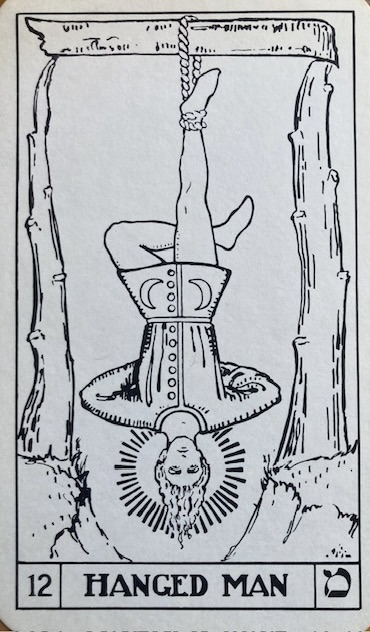
We ended our homeschool science class with the study of tarot. Some may say this is heresy, that tarot is not science, but I defy that line of reasoning. Consider these facts:
- The word “science” is derived from the Latin word “scio” which means “to know” or “to understand.” My son shall be raised to have broad, not narrow, understanding.
- Sir Isaac Newton, the paragon of the rational scientific method, was a lifelong alchemist. The Renaissance alchemists pursued rigorous empirical observation and experimentation; the notion of “active principles” that repel and attract arguably contributed to the theory of universal gravitation.
- Carl Jung, founder of “analytical psychology,” developed the concept of the collective unconscious, which resonates clearly with the tarot’s imagery. At the C.G. Jung Institute, he supervised research on the importance of tarot.
Such then, when I asked my son to pull one card from the Ryder-Waite deck, the “Hanged Man” emerged. At the age of 12, my son pulled card 12 from the deck. Jung referred to this as a synchronicity; events that coincide in time and appear meaningfully related, yet lack a discoverable causal connection. “Causal” speaks to the rational mind, but we were plumbing the subconscious.
At the age of 12 my son comes of age, which is a physical bodily experience as well as a deeply emotional and psychological transformation. Card #12 deals with beliefs that are stored in the subconscious mind, what is handed down. The Hanged Man represents a breaking away from that tradition. As my son comes of age, he becomes his own man.
Carl Jung believed that the archetypes are deeply embedded in the human psyche, and have emerged in the form of religious narratives. Saint Peter, the “Rock” upon which the Catholic church has been built, reportedly was hung upside down, by the Roman Emperor Nero. The hanging took place near the “Circus of Nero” close to the present day Saint Peter’s Basilica. The Cross of Saint Peter, an inverted cross, remains a central image in the arms of the Holy See and the Vatican City.
Let us consider this symbol more deeply. In “Tarot” Paul Foster Case writes, reversal in Hanged Man is “a reversal of thought, a point-of-view which is just the opposite to the accepted by most persons. In this scientific age we know that everything is an expression of the working of the law of cause and effect. …Practical psychology shows the potency of ideas. It demonstrates conclusively the truth that thoughts are the seeds of speech and action, that interpretations are the patterns for experience, that what happens to us is what we have selected, whether the selection be conscious and intentional, or unconscious and unpremeditated.
“The central theme of the hanged man…is that every human personality is completely dependent upon the All, here symbolized by the tree. As soon as this truth is realized, the only logical and sensible course of conduct is a complete surrender. This surrender begins in the mind. It is the submission of the personal consciousness to the direction of the Universal Mind. That submission is foreshadowed even in the picture of the Magician, who derives all his power from above. Until we know that of ourselves we can do nothing, we shall never attain the adeptship. The greater the adept, the more complete his personal self-surrender.”
Saint Peter of the Cross, in founding the Church during the Roman Empire, most definitely followed “a reversal of thought, a point-of-view which is just the opposite to the accepted by most persons.” To pursue this further we drove to Western Maine, to sit with a Reiki Energy Master, a White Witch, and talk about the tarot. This Master, as a child, lived in Morocco, Athens and Cairo; living now in the Lakes Region she is not provincial but broad in her understanding.
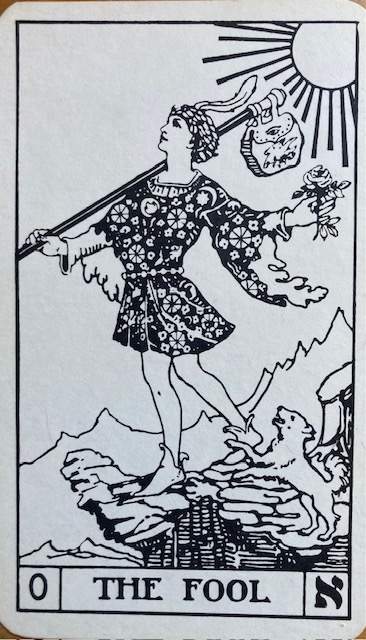
She explained that tarot is the journey to wisdom. The journey begins at 0, when you know nothing, and then you go through life. The Fool is ready to jump off the cliff. #1 the Magician has tools to become grounded, spiritual. #2 the High Priestess has intuition. #12 the Hanged Man is saying “take your time, there is no rush.”
She spoke of card #13 Death. She asked my son what he thought of death and he paused, then replied, “I think death is not good, it is bad.” She explained that death can be seen as a change, that all things must pass and transform. In that sense death is not bad, it is just change; it can be hard, very hard, but it is part of life. “The old self of the Hanged Man is changing. This is the death of the old way. Your Dad’s belief system will die off and you will choose your own.” She spoke about spirituality. My son explained that he had no religious practice. She encouraged a nature based approach. As my son comes of age, he will make many choices, his own.
Many cards had been lain on the table. As we cleaned up, the last card picked up was #13 Death. Again, synchronous, the Master commented, “You are all going through a transition.”
And so our season of homeschooling has ended.

Isaac in Isolation
Posted: April 18, 2025 Filed under: Child Centered Activities | Tags: alchemy, books, consciousness, history, Isaac Newton, philosophy, rational mind, science 1 Comment
In 1665 the plague descended upon London, forcing all the residents to go into isolation. The COVID-19 of its day, in an age before plumbing or electricity, before iPhones and apps, the isolation was complete to a degree that we can barely fathom today.
A 22-year old named Isaac used his solitude well, conceiving the laws of infinitesimal calculus. Leibniz is credited with developing Calculus but young Isaac was 8 years ahead of him. Einstein has hailed the insights as “perhaps the greatest advance in thought.”
At the age of 44 Isaac walked in the gardens of Cambridge University and observed an apple falling straight down to the earth. So he surmised and proceeded to publish, in 1687, Principia which established the foundation for classical mechanics. A manuscript from the Royal Society retells this conversation of 15 April 1726, when Isaac told a colleague how the idea came to him:
“we went into the garden, & drank thea under the shade of some appletrees, only he, & myself. amidst other discourse, he told me, he was just in the same situation, as when formerly, the notion of gravitation came into his mind. “why should that apple always descend perpendicularly to the ground,” thought he to him self: occasion’d by the fall of an apple, as he sat in a comtemplative mood: “why should it not go sideways, or upwards? but constantly to the earths centre? assuredly, the reason is, that the earth draws it. there must be a drawing power in matter. & the sum of the drawing power in the matter of the earth must be in the earths center, not in any side of the earth. therefore dos this apple fall perpendicularly, or toward the center. if matter thus draws matter; it must be in proportion of its quantity. therefore the apple draws the earth, as well as the earth draws the apple.”
By the age of 55 Isaac had been named, by the British Crown, the Warden of the Mint, and then served as the Master of the Mint for 30-years. In contemporary terms, the Master was essentially the Chairman of the Federal Reserve, responsible to ensure the value and to assay the gold content of the King’s coins.
At the age of 62 the King bestowed upon him Knighthood, which is why we universally refer to him as Sir Isaac Newton, one of the towering figures in history, a paragon of rational thought.
What is less well known of Sir Isaac is that he was a leading alchemist of his day. The irony is almost mind-boggling: when alchemy was a crime punishable by death by public hanging the Master of the Mint was busy trying to turn base metals into gold. It is said of more than 10 million words of notes taken by Newton, 1 million at least pertained to alchemy. His interest was more than just a passing curiosity. By any conventional thought, that is an idea laughably hard to grasp.
What if alchemy is not about base metals turned into gold, but rather a symbolic language for the pursuit of higher consciousness? In the three-dimensional realm of conventional thought, where the laws of physics and Darwinian materialism reign supreme, what better symbolism could there be than “base metals” and “gold” referring to the path to wisdom of a greater whole.
Carl Jung in his Alchemy and Psychology and Fabricius in Alchemy: The Medieval Alchemists and Their Royal Art suggest that this is, in fact, the more accurate understanding. In The Foundations of Newton’s Alchemy, B.J.T. Dobbs argues that “Newton’s primary goal was not the study of nature for its own sake but rather an attempt to establish a unified system that would have included both natural and divine principles.” Newton was a critical link between the Renaissance Hermeticism and the rational chemistry and mechanics of the scientific revolution; in moving the scientific world forward, he looked back upon Neoplatonism, which in turn drew upon the writings of Hermes Trismegistus, the towering Hellenistic sage.
History teaches that higher consciousness threatens conventional thought. In 33 AD the self-righteous Pharisees had the radical street preacher put to death by public hanging. Martin Luther King had an FBI file and was assassinated for arguing that “all people are created equal.” In the year 2025, the pious among us ban books from libraries that challenge their narrow minded sense of self. The orthodox, it seems, are not expansive but restrictive and limiting.
Newton was wise never to publish his alchemical writings. In fact, many of them were burned by a fire; the story told that a dog knocked over a candle in his study, but one wonders what was the risk to his reputation for that intellectual pursuit. He remained, in a sense, in isolation throughout his life for his pursuit of alchemy.
The record shows that when Newton stepped down from the 2nd Lucasian Professorship of Mathematics – considered the single most prestigious professorship in the world – his replacement, William Whiston excoriated Newton publicly for his highly unorthodox views. No doubt Professor Whiston was smug in his self righteous words and considered the case closed. But in fact, it may be that he had simply locked himself, and his peers, inside the box of self limiting, rational thought.
The world is more vast than we tend to conceive. It would seem the challenge of our times now is to expand our collective higher consciousness, to awaken and more fully hear and embrace those “mystic chords…of our better angels.”
________________________________



 an Art Farm