Solitary Confinement
Posted: October 25, 2024 Filed under: Chronicles of a First Time Parent, Permaculture & Home Renovation, Portfolio - David's work, What is an Art Farm | Tags: american-history, Andrew Jackson, medicated worm syrup, presidents, Trail of Tears 1 Comment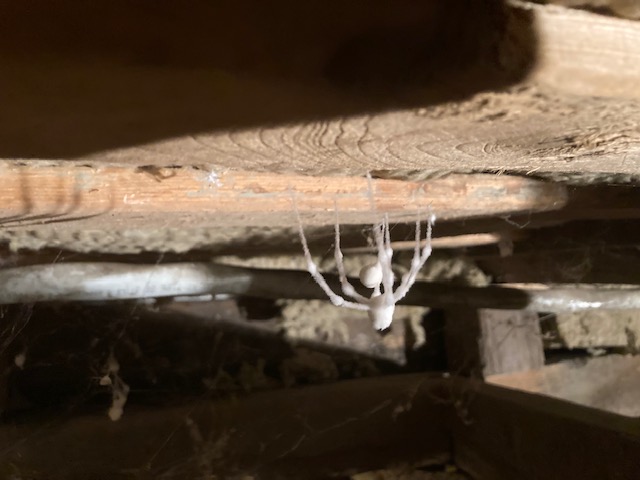
The 7th and 11th Presidents of the United States were titans from Tennessee, Andrew Jackson and James Polk. Polk was a disciple of Jackson, and both fought bitterly against the Second Bank of the United States arguing that it was a capitalist monopoly favoring the Eastern states. Jackson paid off the national debt, but also instigated the “Trail of Tears” ethnic cleansing, the relocation of tens of thousands of Native Americans, forced to walk from their ancestral homelands to lands “west of the river Mississippi.” A polarizing figure, Jackson advocated for ordinary Americans and preserved the union of states, but was denigrated for his racial policies.

1830 through 1848, in South Portland, Maine, C.D.W., a carpenter, built a farmhouse with a crew of thirteen. By day, they labored cutting trees and hauling rocks, to lay the rubble foundation and hew the timbers for the post and beam home. At day’s end, they had no hot showers (indoor plumbing began in Boston 1829, only for the rich) and their food was harvested or hunted from their gardens or woods (green grocers did not become common until circa 1916). Hard were the conditions under which those workers labored.
On Labor Day 2012, we bought the house and barn that C.D.W. built, then began an energy efficient upgrade. My wife was in her third trimester, so time was of the essence. Money was tight. A permacultural builder and crew helped gut and super insulate the main house, converting from kerosene to natural gas. Short on funds, we had to tear down the barn. On Thanksgiving day we moved in, when two weeks later our son arrived into our Greek Revival New England Farmhouse. In 2017 we were fortunate to rebuild the barn, adding a second bathroom, a loft and workshop. Which left the Ell as the last remaining unfinished section.
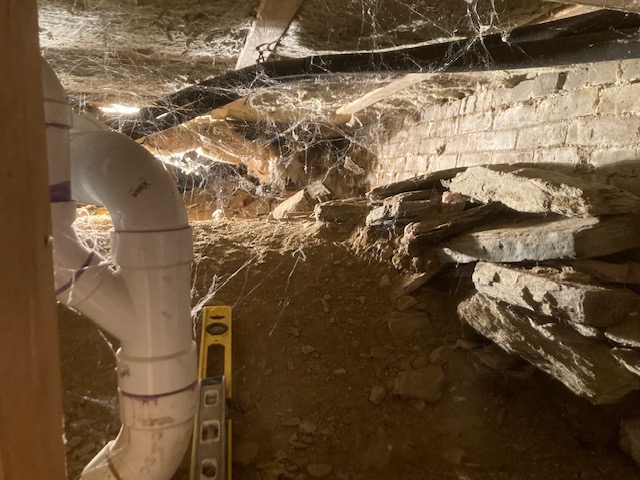
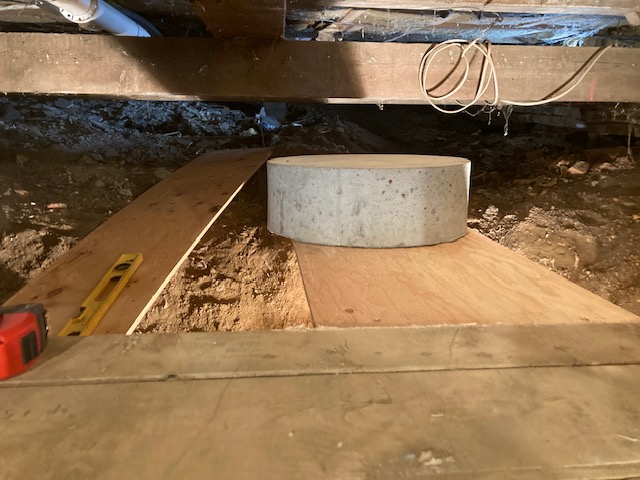
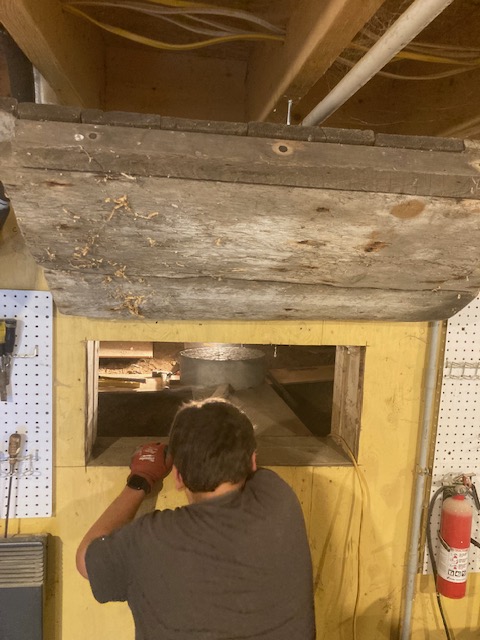
A prudent man would have passed on the home. A rich man would have torn down the Ell. But I was short on cash and long on hope, so I bought the farm in “as-is” condition, at a foreclosure price plus 20-years’ hard labor. I have begun now, finally, restoring the Ell. Before I can do the finish work, I need to rebuild the foundation, and before that, to stabilize the floor system. This work is done in the crawlspace, which means my hard labor now is essentially solitary confinement.

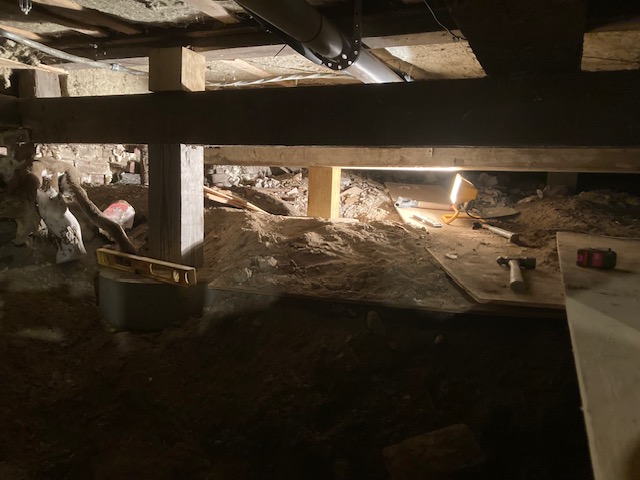
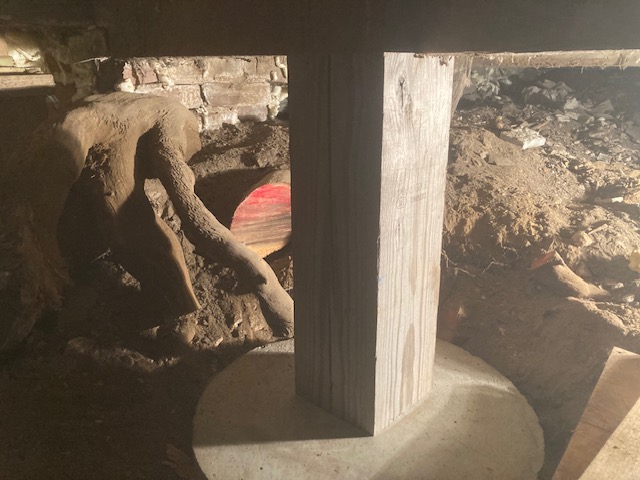
To secure the floor system I need to set ten concrete pads, upon each of which a post is hammered into place to stabilize the existing 1830 floor joists, with a gusset to lock the posts and prevent movement. Building standards were vastly different then, so I have to bring all of this up to code, with 36” to 16” of working space. Each concrete pad is difficult, while several are incredibly challenging. I had two choices: either mix concrete in the crawlspace and then bucket it into location OR pull a pre-cast block, weighing 130 pounds, into a pre-dug hole. Given “pick your poison,” I chose the latter, the pre-cast.
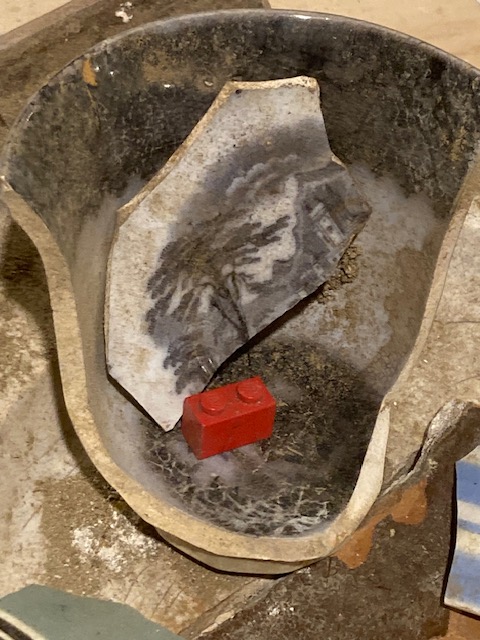
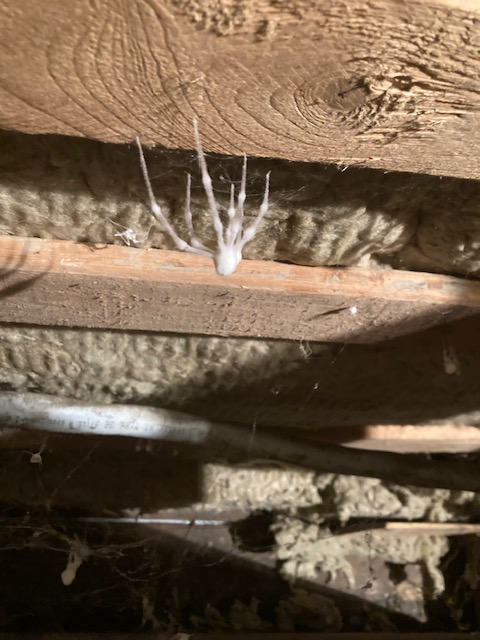
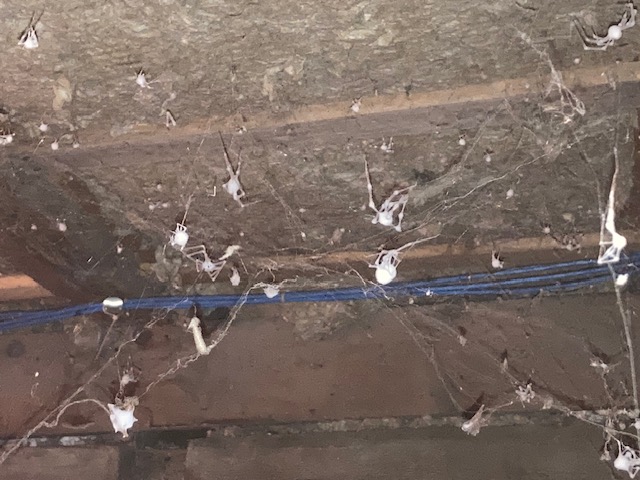
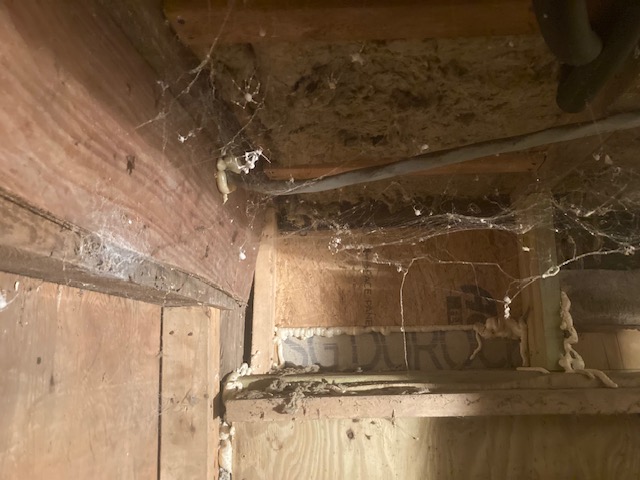
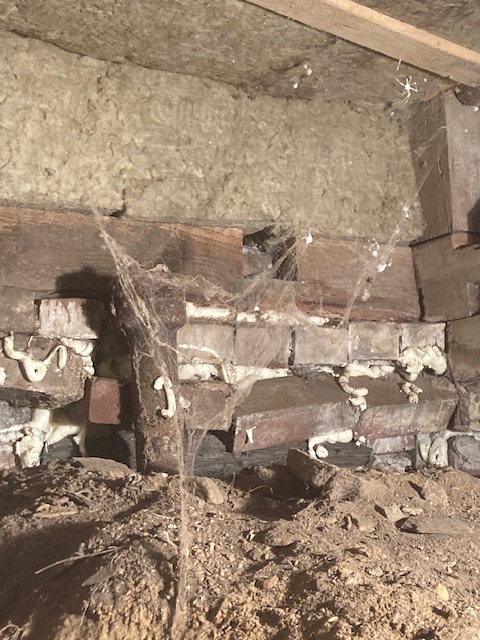
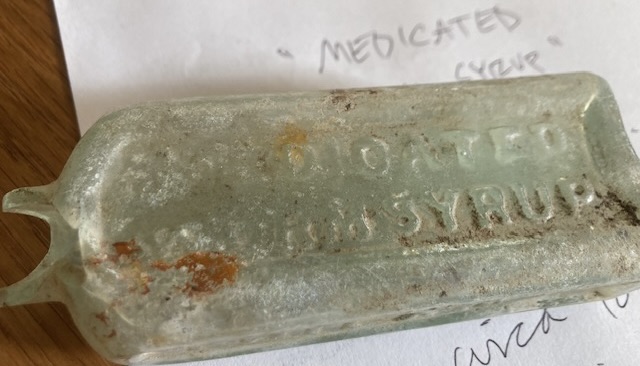
The crawlspace is macabre and surreal. Everywhere overhead abound spider webs and carcasses, covered in a white mold/fungus on the exoskeleton. Rats have lived in that crawlspace and in the dirt lay remnants of former lives in this house: chards of broken china with pastoral scenes, an oyster shell, shoe leather, a glass bottle of “Medicated Worm Syrup” made by Hobensack’s in Philadelphia circa 1845, and two lego pieces. In 1850 the Dyer family purchased this home, where their son John was born in one of the bedrooms. If someone was born here, how many have died here, over the past 200 years?
As a boy, I watched “The Great Escape,” Steve McQueen’s 1963 action film telling the story of World War II prisoners of war, digging a tunnel to escape from Stalag Luft III, a Nazi concentration camp. In one scene, the tunnel collapses, burying the character played by Charles Bronson. Many times I have thought on that during my crawling.
Let me be clear: never would I do this as paid work-for-hire. But for my wife and children I will and I have crawled on my back and my belly, with minimal leverage, to move concrete pads into place, hammering posts, affixing gussets to make stable the floor system.
My Father, dead now 43 years, has the last laugh. So many times he said to me, “David, you can get used to hanging if you have to.” I heard that, then, as a boy, in terms of my own life. But now, as a Father, I understand that for your children you go out of your way even when that means laboring in a crawlspace among desiccated spiders, remnants of rats.
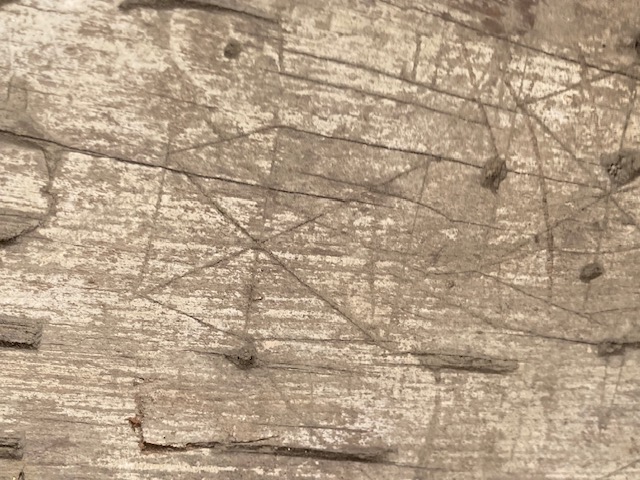
In the end, the work has been done, and I left my mark, on a beam – as did C.D.W. and crew – showing for the record that, Autumn 2024, DPM labored here, to make stable the world in which his children grow, and from which they will go forward, into the world.





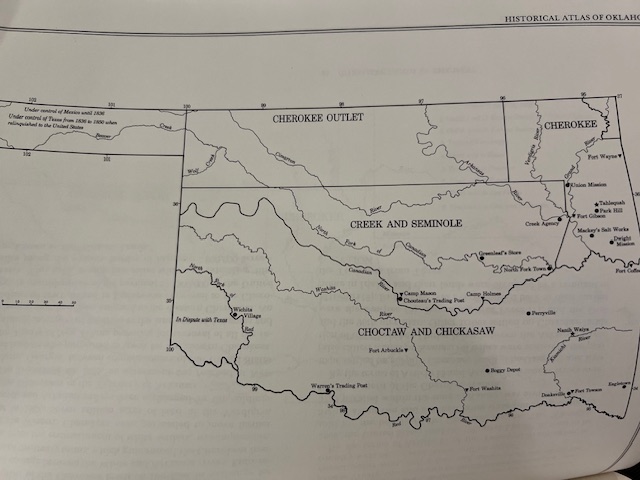
Professor Kristy Feldhousen-Giles has been most helpful with insights into the Indian Removal Act of 1830. The Nations were relocated “west of the river Mississippi” but no tribes were relocated west of the 100th meridian as that was under control of Mexico in 1830, and later under the Republic of Texas. The Battle of the Alamo was fought February through March 1836. The nationalist faction of Texans sought the expulsion of the Native Americans and the expansion of Texas to the Pacific Ocean.
Here is a map of the Indian resettlement 1830-1855 from the Historical Atlas of Oklahoma.
Here is the text of the Indian Removal Act, as authorized by the United States Congress, May 28, 1830.
 an Art Farm