Internal Alchemy
Posted: December 19, 2025 Filed under: consciousness | Tags: consciousness, meditation, mindfulness 1 Comment
Article 36 of the Ecuadorian Constitution states, “Those persons who have reached sixty-five years of age shall be considered to be elderly.” And the elderly shall receive free health care, paid work, universal retirement, tax exemptions and access to housing that ensures a decent life.
The United States has no such declaration. The Centers for Disease Control defines an “older adult” as 60 years of age, but age 65 marks eligibility for Medicare. The Age Discrimination in Employment Act of 1978 ended mandatory retirement and currently it is illegal to force anyone to retire.
In Europe, the average retirement age is 65 to 67, although the Nordic countries tend upwards to age 70. It seems entirely possible that Western civilization has radically understated human potential.
Ching-Yuen was a Chinese herbalist, born maybe circa 1677, who died in 1933. He retired from his military career at age 78, and received from the imperial government birthday cards on his 100th, 150th and 200th birthdays. Time Magazine reported on this in May 2012. Ching-Yuen’s advice on longevity was simply: “Keep a quiet heart, sit like a tortoise, walk sprightly like a pigeon and sleep like a dog.”
Baird T. Spaulding’s “Life and Teaching of the Masters of the Far East” tells of his trek to Persia and the Orient in 1894 where he made contact with “the Great Masters of the Himalayas,” people living 600 or more years. Spaulding explains the central teaching as, “The Masters accept that Buddha represents the Way to Enlightenment, but they clearly set forth that the Christ Consciousness is Enlightenment, or a state of consciousness for which we are all seeking – the Christ light of every individual; therefore, the light of every child born into the world.” He describes acts of higher consciousness, such as walking on water or manifesting food to feed the masses.
Cuie Wenze is a legendary Chinese physician from the Qin Dynasty who reportedly lived to be 300 years old through holistic life nourishment, balancing the physical, mental and spiritual. Gee Yule, another Taoist alchemist, lived a reported 280 years by cultivating the Three Treasures: Jing (essence) Qi (vital energy) and Shen (spirit) through practices like meditation, breathing and alchemy. There are many records of such lives, if one seeks out these stories.
Years ago, while I was learning Qi Gong I was introduced to a practitioner of Chinese medicine whom, I was told, had not eaten food in years, instead existing on the inner Qi he had cultivated. Whether fact or fiction, it was hubris of me to make any rational decision about this. Wisdom, it seemed, was in suspending disbelief and simply observing this man.
From Epicurus through the enlightenment up to our present day, Western rationalism has been materialist. “Food, clothing and shelter” define the basic needs, and given an “us versus them” mindset in competition for limited resources, is it any surprise the 20th century was history’s bloodiest with massive atrocities of human-caused slaughter. Rational self interest is, ultimately, self limiting.
“An eye for an eye only ends up making the whole world blind,” Gandhi said. “The unmentionable odor of death” the poet Auden wrote, on the night when World War II broke out. And now, late in 2025 authoritarian strongmen become dominant, consciousness seems curated by algorithms and increasingly by artificial intelligence. This is our choice, not a fait accompli, and so could “beauty and truth” be added to humans’ basic needs? Can we expand our sense of self?
To the materialist rational mind this seems wildly unrealistic, while to the Taoist this is internal alchemy. Sir Isaac Newton, paragon of the rational scientific mind, was also – coincidentally – a leading alchemist of his day. The laws of physics do pertain, while the metaphysics of consciousness – much like quantum mechanics – can broaden our scope, open our minds to new possibilities, an awareness of the subtle energies.
The average U.S. life expectancy has increased to 78.4 years. The trend is positive and allows much room for an expansion of consciousness. What if 65 were viewed not as aged, but as an opening, an opportunity to move inward away from the external pressures of daily life? 10,000 Boomers per day are now turning 65, with nearly 1 billion people over 65 world wide by 2030, and more than 1.5 billion by 2050. An unparalleled force for good could be unleashed if we transform consciousness.
The solstice brings a return of light. May this year’s return be both literal and figurative.
Turning 12
Posted: December 6, 2024 Filed under: Chronicles of a First Time Parent, consciousness, What is an Art Farm | Tags: coming of age rituals, consciousness, hypermasculinity, mental health, mindfulness, religion, spirituality 5 Comments
Our son turns 12 next week and I am mulling over rituals to mark this right of passage as our cherub becomes a young man.
I was raised in the Roman Catholic Church and its ritual would have been Confirmation. I have little memory of that, but it appears five hours of community service were required. I do remember wearing white, walking down the aisle and choosing Mark as my name. I chose that name to honor my best friend, who had just suffered a terrible accident in which both his arms were amputated. My choice was one of solidarity.

The Catholic tradition seems neither my nor my son’s path; I find Christian dogma limiting although Christ consciousness tremendously expansive. My faith is a work-in-progress while I am seeking alternatives for raising my son.
In the Amazon, the Satere-Mawe tribe have young men wear a glove filled with bullet ants for 10 minutes. Pushing the threshold of pain is not quite the path I seek. In Ethiopia boys jump over a cow, and in Vanuatu they jump from tall towers with vines tied to their ankles, but manliness, to my mind, is more than a measure of strength and courage.

In the Hebrew tradition the bar mitzvah marks a boy’s coming of age whereupon he begins to assume responsibility for his actions. Responsibility tied to manhood appeals to me. 13 is the age of Bar Mitzvah but to my mind, manhood is not just the number of years spent on the planet. It must be earned through understanding. This ritual, then, is about values and lessons learned.
During the summer my son and I volunteered frequently at the South Portland Food Cupboard. It was an enriching experience, and community service seems relevant in his coming of age. Construction work such as Habitat for Humanity comes to mind. I have heard of Church Youth Groups who undertake community service projects. I am looking for local possibilities.
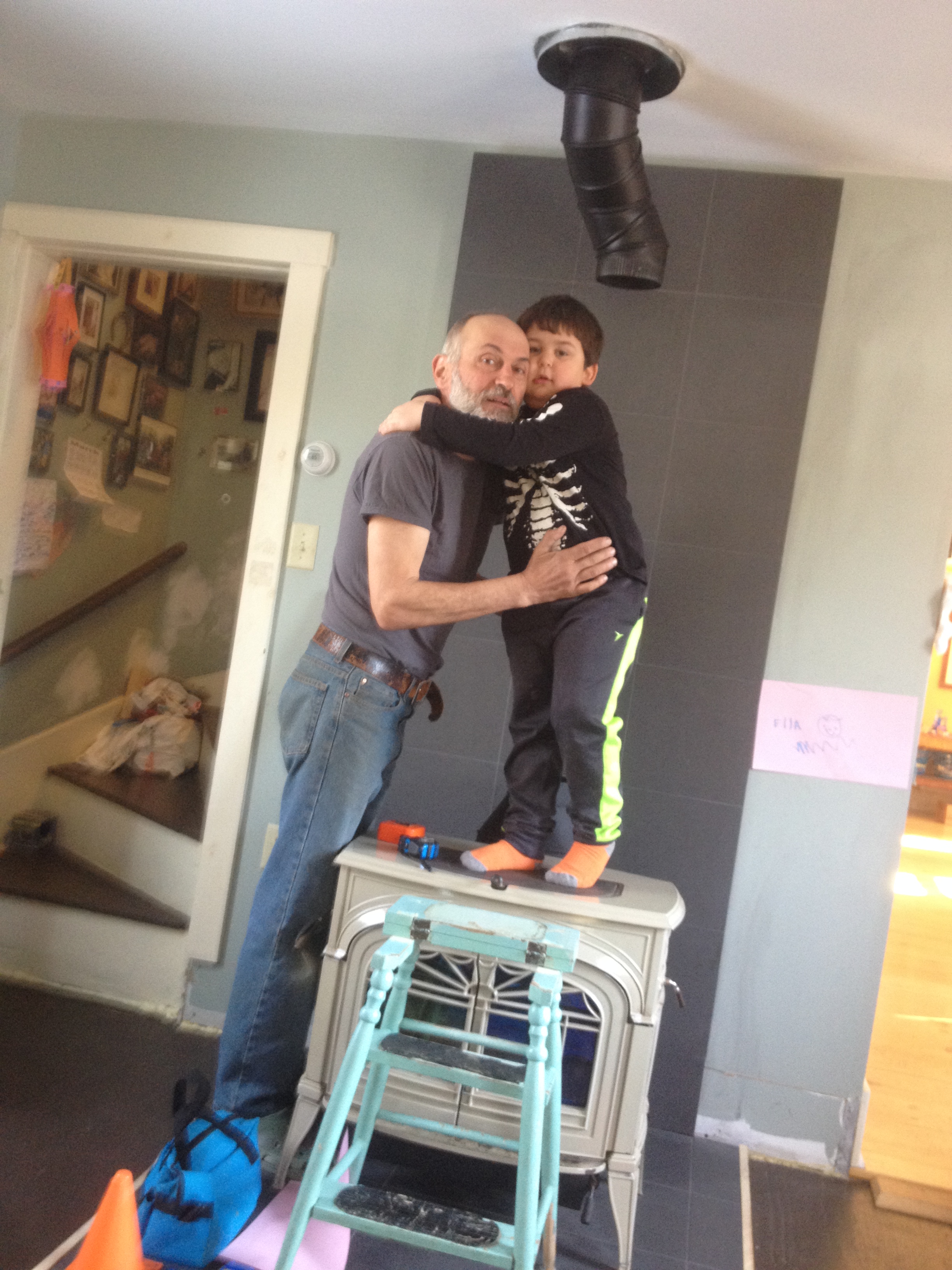
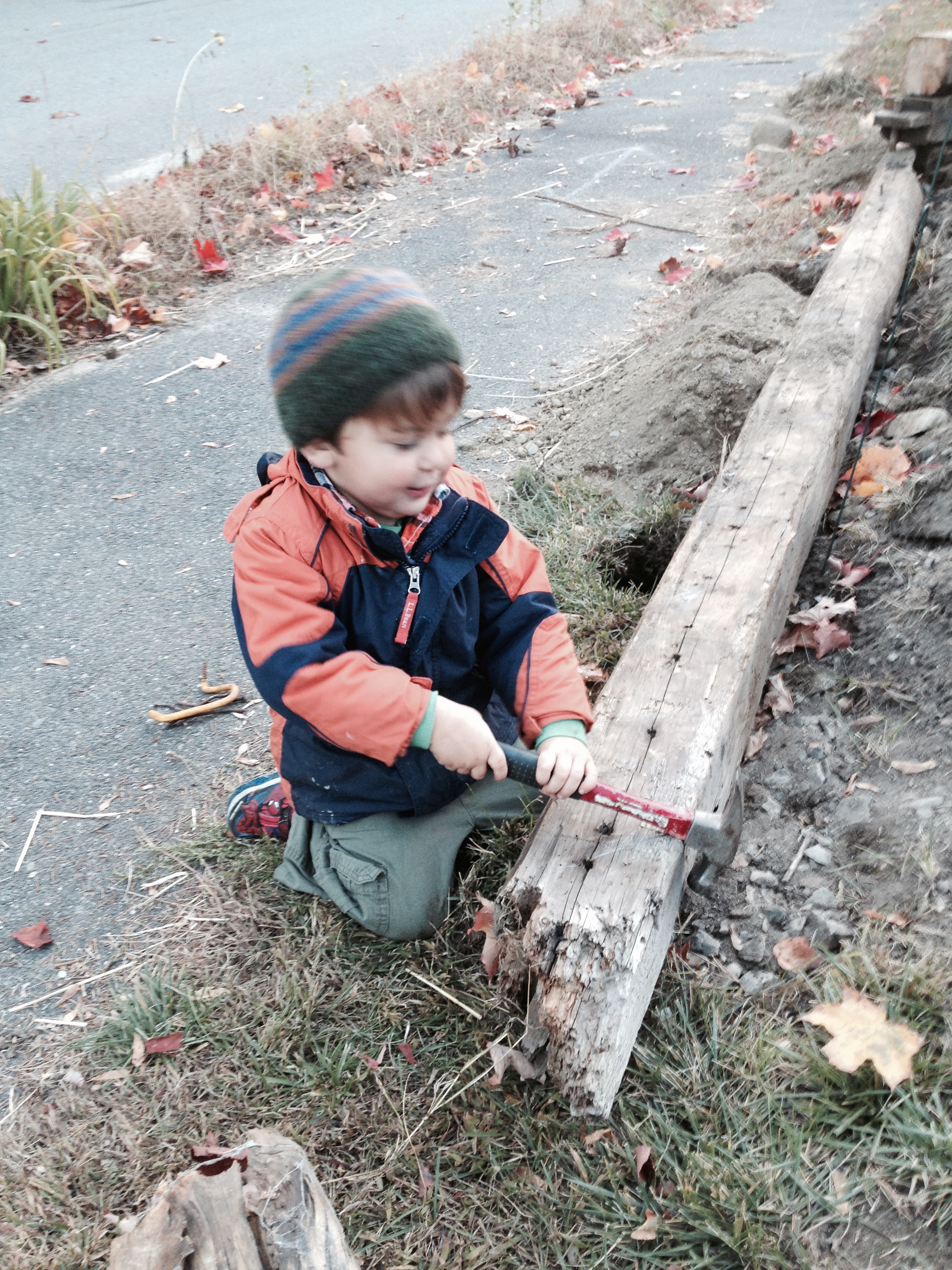
The insights of other men should be another aspect of this plan. My nephew, my son’s cousin, did have a Bar Mitzvah and has agreed to talk with him about the experience, and his own coming of age. A philosopher/carpenter friend has offered to teach more welding, and we may join with a classmate of my son and his father, for a shared experience; working with tools in the act of making. Another friend, whose son also is the same age, is loaning us a lathe for turning wood, and that may be another opportunity for input from other men in the community. My son will benefit from hearing more than my views.
And then there is the topic of sexuality. My Father’s coming-of-age speech to me was as comic as it was lacking. It was haltingly brief, when he simply asked, “Do you have any questions?” Feeling the tension, of course I replied, “No,” whereupon he handed me a paperback book on Catholic morals. I recall the author was aghast at a recent 6th grade school field trip, where the girls wore red lipstick and hosiery. Just blame it on the girls remains the dogmatic view. What I learned of sexuality came from my older Brother and the locker room, but my son deserves better than that.

The pious among us claim that traditional morality teaches the male as the leader, with male-female relationships the only acceptable norm. I regret to inform them that history teaches otherwise. The Christian era has been relatively brief, while Ancient Greece, Rome and China openly practiced homosexuality and pederasty. LGBTQ may arguably be the historical norm and reversion to the mean would seem natural. My son will benefit from thinking not in centuries but in millenia.
The process of writing this has become the means to outline a plan. Among the core values this DIY ritual should include are:
- compassion and cooperation are keys to a healthy masculinity
- no means no, and might does not make right.
- emotional intelligence has greater value than sheer intellectual horsepower
- listen to your heart, not just your head; be curious, ask questions, follow your passion
- practical problem-solving skills provide a grounded self-confidence
- making is hard-wired in our DNA; art predates agriculture, and therefore civilization itself
- Integrity presumes courage; let your word be your bond
- energy follows thought; actions have consequences


 an Art Farm