Oneness
Posted: January 1, 2026 Filed under: Art & Healing, Chronicles of a First Time Parent, consciousness, What is an Art Farm | Tags: anagarika govinda, consciousness, philosophy, science, spirituality, Thomas berry 2 Comments
Having built a whale, we decided to make a movie on the topic “all life is one.”
Having finished the short film, I sought funds from the Maine Arts Commission.
Having to substantiate my body of work as an artist, I referenced “An Art Farm.”
Whereupon, I realized our art farm had been mostly inactive since 2015 and so on 31 March 2024 I wrote “Crossing the Rubicon” about delivering the Whale north to the Wabanaki nation. I did not win the grant, but I did continue to write, and for 94 continuous weeks now I have posted short essays.
In a sense these are weekly postcards to my Mother, a chance to share thoughts that otherwise would not come up in our occasional phone conversations. More importantly, they allow me to mine thoughts that arise at 2am, to chase down loose threads and weave them, as if into tapestries, at best like those of the Renaissance rich in detail and color, telling stories of this strange and troubling moment in time.
An overarching theme seems to be Spiritual Ecology, a field of inquiry of which I only recently became aware. Rudolf Steiner is considered a visionary, having described a “co-evolution of spirituality and nature.” I learned of Steiner back in my Chicago days from a Gaia-centric friend at the vanguard. Pierre Teilhard de Chardin, also considered a founder, almost one century ago, wrote of a ”consciousness of the divinity within every particle of life, even the most dense material.” In “The Phenomenon of Man” he foresaw that “Science, philosophy and religion are bound to converge as they draw nearer to the whole.”
My Mother actively discussed de Chardin in her college days, and within the social circle of her childhood in Clifton of the Queen City, Cincinnati, Ohio, as well as at our dinner table. Father Sullivan, elder of Holy Cross Parish, once described my Mother as a “pantheist;” I suspect he meant that as a criticism but which she rightly took as a compliment! Perhaps, what the Father actually meant was panentheist (God in all things) not pantheist (God is all things), but regardless, since my childhood the tenets of Spiritual Ecology have been laid down as plain common sense.
On a family road trip west to the Grand Tetons, my Mother handed me a copy of John Muir’s biography. I was enthralled, in the backseat, while crossing the endless great plains. Decades ago I read Thomas Berry, also considered at the vanguard, who emphasized “returning to a sense of wonder and reverence for the natural world.” More than my share of Thoreau and Wendell Berry have I read, as well as David Abrams’ “The Spell of the Sensuous.” Joanna Macy has been celebrated among the Wise Women here at the art farm, while Emergence magazine is on my subscription list, the product of Emmanuel Vaughan-Lee, a Sufi trained multi-media maven on topics of a collective evolutionary expansion toward oneness.
But what would be this consciousness of oneness? The Renaissance is an historic example of a shift in consciousness, the “awakening” or “rebirth” of Europe, away from the Church-dominated Medieval era to embrace humanism, scientific inquiry, individualism, a flourishing of arts and culture. Rene Descartes, living at the end of the Renaissance, is considered foundational to modernity, his “cogito, ergo sum” defining the thinking rational self. But “cogito” is only one part of the whole self, and it can easily fall into the binary, mono-dimensional thinking of either-or, rather than both-and.
Newton’s Laws of Physics state an object is either at rest or in motion, but quantum mechanics allows an object to inhabit two states at once. Our logic has lead to AI which is a massive accomplishment, but it might either destroy us or bring far-reaching benefits. The “us versus them” is endlessly argued by politicians, the strongman’s lever using fear to divide and conquer. A spiritual ecology pursued only through the rational seems destined to failure. An expansive and inclusive approach is needed to embrace the breadth, depth and interconnectedness of both the natural world and ourselves.
“Creative Meditation and Multi-Dimensional Consciousness,” by Lama Anagarika Govinda, is insightful toward this life-affirming goal. He describes the “one-dimensional logic which…cuts the world apart with the knife of its ‘Either-Or,’” and then introduces “…a new way of thinking, an extended multi-dimensional logic which is as different from the classical Aristotelian logic as Euclidian geometry is from Einstein’s theory of relativity.” He presents this using the coordinates of an x-y axis. “If we regard the horizontal as the direction of our time-space development (unfolding), then the vertical is the direction of our going within, toward the universal center of our being and thus the realization of the timeless presence of all potentialities of existence in the organic structure of the whole of the living universe. This is what the poets call the ‘eternity of the moment’ which can be experienced in the state of complete inwardness…such as happens during meditation and creative inspiration.”
It is no small undertaking, a 21st century renaissance awakening to multi-dimensional consciousness not among the few, but ultimately we, the people, of the planet. Small-minded politicians and capitalists will pursue their goals of domination, and so this seems a necessary path out of the madness, deeper within. It is beyond the scope of one short essay to speak to such fullness, but this seems a direction for our art farm to pursue in the new year.
…and here is a link to the short film on the topic that we are part of the ecosystem, that all life is one, which set this ship – which is an art farm – to sail on this oceanic odyssey:
https://www.picdrop.com/claytonsimoncic/C39UK57ncx
The short film was produced with Anna Dibble. Clayton Simoncic was the photographer and editor.
_________________________________
Since it is written “the last shall be first,” I shall end this post and honor the Benham Family tradition, that good things come to those who begin a new month, on the first day with the first words: “Rabbit, Rabbit.”
May good things come to all people in the new year.
Maria the Jewess
Posted: August 22, 2025 Filed under: Art & Healing, consciousness, What is an Art Farm | Tags: alchemy, art, philosophy 1 Comment
In the 1st century CE, when Roman polytheism reigned supreme, the Jews were persecuted for their monotheism. In that age of male heroes, women were relegated to a second class. An alchemist would have been further still from conventional thought, but it was a trailblazing Jewish woman alchemist who began the intellectual tradition that Sir Isaac Newton would follow 15 centuries later.
Sir Isaac Newton, the paragon of the rational scientific male, in his day was a leading alchemist, when same was considered heresy, punishable by death by public hanging. Compelling then was this Jewish woman’s tradition. Newton transcribed more than 10 million words of notes, consisting of 16 folios, on the subjects of alchemy, religious and historical studies. And they were burned. So who was Mary the Jewess, also known as Maria Prophetissima and Maria the Copt and what did she know?
The Jewish Women’s Archive explains Maria “…was the first non-mythical Jewish woman to write and publish works under her own name. Maria is generally regarded as the first actual alchemist who is not a mythical figure. According to Zosimos of Panoplis, she started an alchemical academy in Alexandria, Egypt, and reportedly excelled at the process of transmutation of base metals into gold. Zosimos wrote a brief account of Maria’s philosophy, called The Four Bodies Are the Aliment of the Tinctures. Maria the Jewess invented several important pieces of chemical apparatus and was also known for a variety of mystical and alchemical sayings.”
Highly inventive, she used ovens made of clay, metal and glass, and formed gaskets using wax, fat, paste made of starch, and clay mixed with fat to seal the joints. Glass allowed the viewer to see the reactions, and allowed work to be done with mercury and sulfurous compounds. She may have been the first person to mention hydrochloric acid, and invented the double-boiler, known even today as the Bain-Marie, as well as the tribikos, a distillation still with three spouts, and the kerotakis, an extractor with a metallic palette inside a vacuum container holding vapors. According to Zosimos, she ground cinnabar [mercury (II) oxide] with mortars and pestles or lead and tin. Her fame endured in both Arab and European alchemy. The Kitāb al-Fihrist (Book Catalogue), by Ibn Al-Nadim in the late 10th century listed her among the 52 most important alchemists.
Her inventive spirit was surpassed by her writings. The “Axiom of Maria” states, “One becomes two, two becomes three, and out of the third comes the one as the fourth.” Carl Jung used this as a metaphor for the principium individuationis, the means by which one thing becomes distinct from other things. From Aristotle through Schopenhauer to Nietzsche this has been a fundamental concept in philosophy.
Concerning the union of opposites, Maria wrote: “Join the male and the female, and you will find what is sought.” As yin and yang define the whole, Maria was ahead of her time. Zosimos of Panopolis, the alchemist and Gnostic mystic, claims that Maria was a peer of Hermes Trismegistus who famously wrote, “As above, so below.” It is said that Maria taught Democritus, the Pre-Socratic philosopher, renowned for formulating an atomic theory of the universe. Reportedly they met in Memphis, Egypt, during the time of Pericles.
For the Greek alchemists ὕδωρ θεῖον, was both divine water and sulphurous water with the alchemical vessel imagined as a baptismal font, and the tincturing vapours of mercury and sulphur likened to the purifying waters of baptism, which perfected and redeemed the initiate. It would seem that the Christian rite of baptism bears alchemical roots.
All rivers lead to the sea, so too the River Jordan, where a woman Jewess holds a baptismal place at the delta basin, whereto wisdom flows down like the rain: as above, so below, indeed. Peace to all.
___________________________________
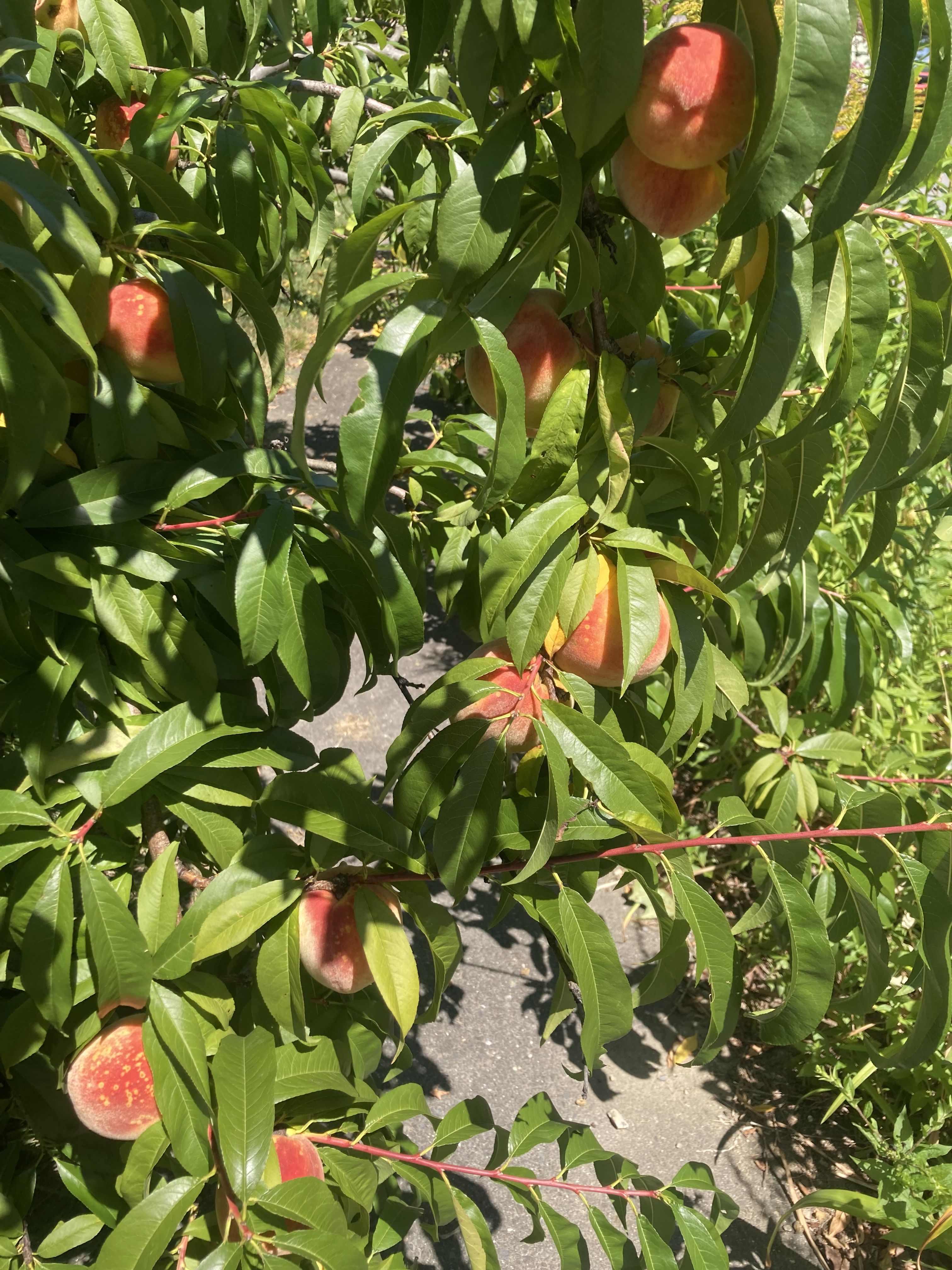
Credit where credit is due: David Purpur, again. Elena Benham, again. While Gaia gifts us, abundantly…


True or False ?
Posted: May 23, 2025 Filed under: Child Centered Activities, Chronicles of a First Time Parent, What is an Art Farm | Tags: history, Magna Carta, philosophy, Plato, Socrates 1 Comment
This week in homeschooling, a true/false question arose: Is habeas corpus “…a constitutional right that the president has to be able to remove people from this country”? We have, by coincidence, been studying habeas corpus for the past seven weeks so this question did not come out of the blue. What has been wildly surprising is to see the topic so hotly discussed in the news.
Our humanities seminar has been titled “Habeas Corpus, Habeas Vox,” which I described in my blog dated 11 April. We began by considering those words. My son knows that a hearse carries a dead body, which is a “corpse,” so the Latin word corpus was readily understood. Habeas corpus, he knows, has something to do with a body, rather than a Presidential right.
But what to make of that Latin verb habeas? We approached that by studying the Ancient Greeks. The Spartans governed by a combination of diarchy (two kings ruled), oligarchy with limited democracy. The Athenians, however, invented direct democracy, not representative democracy like our modern form. From Athens we jumped to Medieval England to read about the Magna Carta. In his “end-of-week” essay on 2 May my son wrote:
This week in Humanities we studied the legacy of Greece. Greece is located on the Mediterranean Sea. In Classical Greece, Athens was a city state that created democracy, but only the men citizens could vote; slaves and women could not vote.
The Greeks were known for the arts, architecture and philosophy. In Athens there was a teacher named Socrates, known for teaching by the “Socratic Method” which was asking questions to engage his students. Socrates was put to death by the courts because they thought he was corrupting his students. One of his students was Plato, who wrote the Republic, which is his views of democracy.
Something else we studied was English history. I read about the Magna Carta, a document that gives liberties granted to the English people. The English Barons and Nobles argued and threatened a Civil War unless King John granted those rights. King John was very greedy and selfish. The Magna Carta was settled on June 15, 1215 when King John affixed his seal.
The Magna Carta gives guarantees for the people as a whole. The people could not be convicted of their crimes unless they were lawfully convicted. The Barons (Nobles) had the right to declare war upon the King. The Magna Carta is considered one of the basic documents of British law.
Next week we will do studying more on English history!
We next proceeded to study the English Bill of Rights, and then the USA Constitution. Last week, my son wrote:
This week, Harvard University discovered they had an original copy of the Magna Carta. There are seven original copies, and Harvard just happened to have one. In 2007 an original copy of the Magna Carta sold for $21.3 Million Dollars. This could not have come at a better time!
The Magna Carta was written in cursive script on a sheepskin parchment 810 years ago. It is a legal document that gave power from the King to a small group of Men. What the Magna Carta did was similar to the Greek direct democracy, by including people in political discussion, instead of the King alone.
The British Bill of Rights, signed in 1689, which is 336 years ago, was a sort of New Age version of the Magna Carta. For nowadays, the new age of the Magna Carta would be the Declaration of Independence. The British Bill of Rights basically gave everyone a fair trial and banned cruel and unnecessary punishment.
All of these political texts – the Magna Carta, the British Bill of Rights, the American Declaration of Independence, and all other that I have not mentioned – have slowly but surely lead up to what we have today; having “freedom,” a fair trial, and due process. Whether you like the current President of the United States or not, he continues to challenge these monumental, historic and foundational concepts.
Next week we will study the 1st Amendment and Abraham Lincoln’s Habeas Corpus Suspension Act. Harvard University’s discovery of an original copy of the Magna Carta is a wild coincidence as we are studying all this!!
I should mention that the essays are entirely my son’s concepts and phrasing, but together we edit them. As his scribe, I raise questions of grammar, word choice and structure; using the Socratic method, I challenge him but he decides as he dictates. We use library books as primary sources to frame the concepts, which he rephrases into his own words. If he does not know the word “plagiarism” he most certainly knows to avoid the practice.
As the school year draws to its close, we are preparing for a debate – 6th grade version – on the essential nature of government. Plato, the Athenian philosopher, argued that democracy is not viable, and the ideal form of government is a “benevolent dictator” more politely referred to as the Philosopher King. This is an argument for absolute strength in the Executive branch. In the current American moment, the occupant of that office is reviled by some as a dictator, and praised by no one as benevolent. My son shall argue in the affirmative that the strong leader must not only be unchecked and absolute in his control, but guided by good will, even compassion.
My son’s cousin, a Professor of Law, shall present the challenging argument, that “We the people” is a most radical proposition, but ultimately, an essential truth. We shall leave to him to define precisely how the many can actively support the one well being of the state. He shall argue that habeas corpus, which is due process, which is the rule of law, is the key to that functioning: the “Great Writ of Popular Sovereignty.”
My son clearly knew the answer to the true/false question, and summed the matter up well, saying, “Do you know how embarrassing it is when a 12-year old knows habeas corpus better than an adult?!! That is really embarrassing! It just makes Americans look really dumb!” He shall be fully prepared to debate what is good, what is benevolent, what is effective leadership for the state.
______________________________
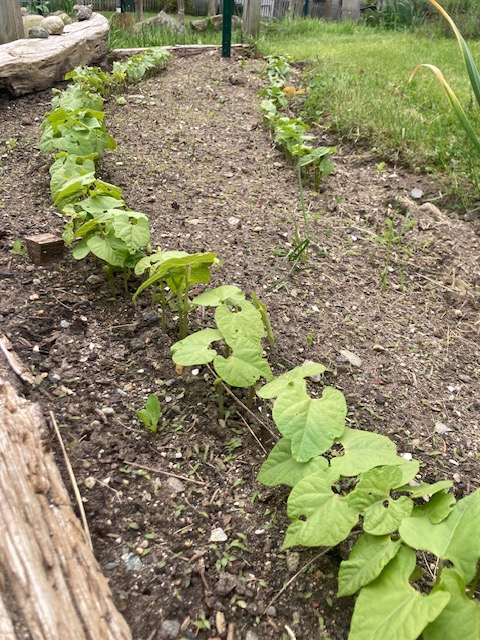
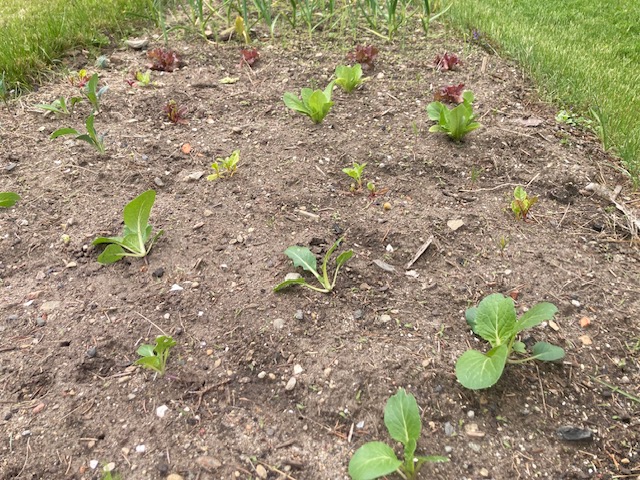
Summer is upon us! Our warm weather starts are ready to go into the ground: tomatoes, peppers, cucumbers, basil, and potatoes. Our cold weather starts do well and grow ever upright.



Art Predates Agriculture
Posted: May 16, 2025 Filed under: Art & Healing, consciousness, What is an Art Farm | Tags: authors, ethics, history, philosophy 2 Comments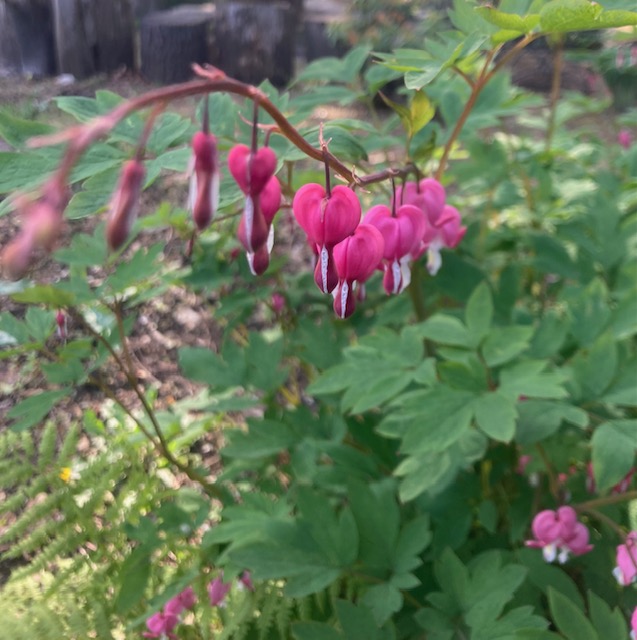
Civilization began, it is widely believed, with the advent of agriculture. The time was around 10,000 BC and the place was the Fertile Crescent, which is the present day Middle East. Sheep and pigs were first domesticated, followed by plants such as flax, wheat, barley and lentils. The nomadic hunter-gatherers settled into agricultural communities, developed irrigation systems and established permanent settlements.
It should be noted that this definition of “civilization” speaks to the cultures of the Abrahamic religions (Muslim, Judaism and Christianity). The Clovis culture, however, were precursors to the Indigenous peoples of the America’s, and between 15,000 to 20,000 years ago developed stone tools, as well as agriculture, engineering, astronomy, trade, civic and monumental architecture. Some established permanent or urban settlements, but all did not forsake their nomadic lifestyle. There is not one civilization, but many co-inhabiting this planet.
However civilization may be defined, the plain fact is long before we worked the soil to plant seeds, the hunter gatherers were digging to get clay and earth based pigments for painting the caves at Altamira and Lascaux; art making predates agriculture, which is to say it predates civilization, which speaks to its fundamental role in shaping human life. Mark making is meaning making, hard-wired in our DNA, the act of making is a core means of problem-solving, both utilitarian and ideational.
Ellen Dissanayake is an ethno-anthropologist whose writings synthesize disciplines ranging from evolutionary biology to cognitive and developmental psychology. She lived for fifteen years in non-Western countries (Sri Lanka, Papua New Guinea, India and Nigeria) among indigenous pre-literate peoples and found that all shared the trait of embellishing their tools in non-utilitarian ways; the act of “making pretty” is consistent across the globe. This lead her to develop “…a unique perspective that considers the arts to be normal, natural, and necessary components of our evolved nature as humans.”
Far more than practical, the act of making is healing. Art therapy is based upon this insight, which, since the 1940s, has been used in conjunction with traditional psychotherapy, to provide a non-verbal avenue for exploring emotions and experiences. The simple act of making can help treat a wide range of mental health issues and support emotional well-being, based upon the interconnectedness of mind, body, and spirit.
Works of art such as the Sistine Chapel, a human achievement of extraordinary scale, can be overwhelming and lead most of us to cower, and say “I can’t draw.” But that seems ego-driven, as we are schooled in a comparative and competitive paradigm, which blocks the fact that art making is biologically and psychologically at the core of everyone’s individual life. Art, and the act of making, become the great equalizer.
One of the lessons of carpentry – which is to say making in the practical sense – is that adverbs and adjectives do not pertain; the wall is plumb or it is not, the corner square or it is not, the house will long endure or it will not. There is something exquisitely liberating in that plain fact. More “sophisticated” professions do not fall under this simple truth, for example, politics and the law are based upon argumentation and persuasion rather than objective truth. The word “sophisticated” is derived from the Sophists, in Ancient Greece, who excelled in clever deception, using rhetoric to win arguments regardless of the truth.
In a world that is increasingly argumentative, clever and AI-interconnected, the simple act of making can become a grounding and centering force. Let us proclaim there are four necessities in life: food, clothing, shelter and beauty; “making pretty” creates beauty while making becomes the means to achieve all the former. And all of which become an act of healing.
___________________________
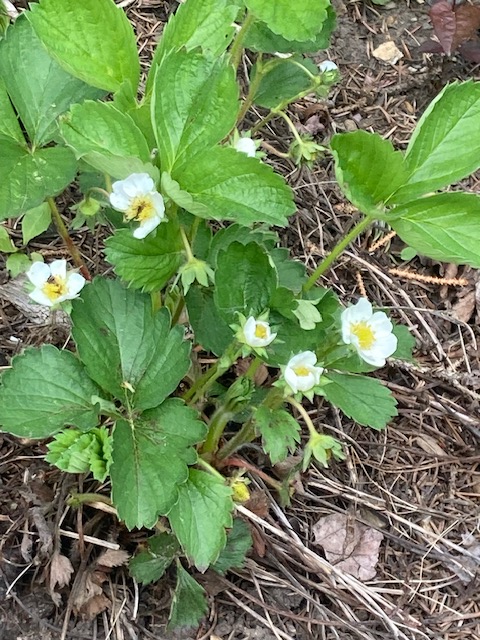
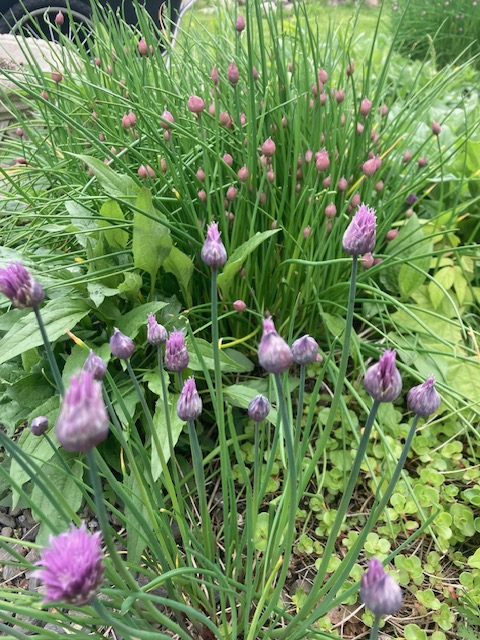
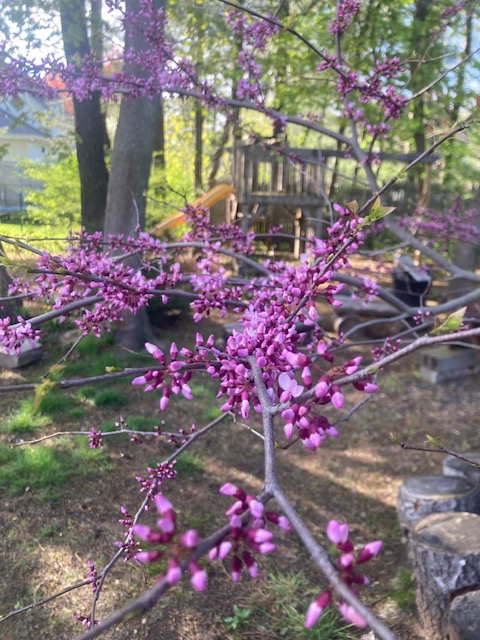
Plants push up, fruit trees blossom, and pollinators abound!




Isaac in Isolation
Posted: April 18, 2025 Filed under: Child Centered Activities | Tags: alchemy, books, consciousness, history, Isaac Newton, philosophy, rational mind, science 1 Comment
In 1665 the plague descended upon London, forcing all the residents to go into isolation. The COVID-19 of its day, in an age before plumbing or electricity, before iPhones and apps, the isolation was complete to a degree that we can barely fathom today.
A 22-year old named Isaac used his solitude well, conceiving the laws of infinitesimal calculus. Leibniz is credited with developing Calculus but young Isaac was 8 years ahead of him. Einstein has hailed the insights as “perhaps the greatest advance in thought.”
At the age of 44 Isaac walked in the gardens of Cambridge University and observed an apple falling straight down to the earth. So he surmised and proceeded to publish, in 1687, Principia which established the foundation for classical mechanics. A manuscript from the Royal Society retells this conversation of 15 April 1726, when Isaac told a colleague how the idea came to him:
“we went into the garden, & drank thea under the shade of some appletrees, only he, & myself. amidst other discourse, he told me, he was just in the same situation, as when formerly, the notion of gravitation came into his mind. “why should that apple always descend perpendicularly to the ground,” thought he to him self: occasion’d by the fall of an apple, as he sat in a comtemplative mood: “why should it not go sideways, or upwards? but constantly to the earths centre? assuredly, the reason is, that the earth draws it. there must be a drawing power in matter. & the sum of the drawing power in the matter of the earth must be in the earths center, not in any side of the earth. therefore dos this apple fall perpendicularly, or toward the center. if matter thus draws matter; it must be in proportion of its quantity. therefore the apple draws the earth, as well as the earth draws the apple.”
By the age of 55 Isaac had been named, by the British Crown, the Warden of the Mint, and then served as the Master of the Mint for 30-years. In contemporary terms, the Master was essentially the Chairman of the Federal Reserve, responsible to ensure the value and to assay the gold content of the King’s coins.
At the age of 62 the King bestowed upon him Knighthood, which is why we universally refer to him as Sir Isaac Newton, one of the towering figures in history, a paragon of rational thought.
What is less well known of Sir Isaac is that he was a leading alchemist of his day. The irony is almost mind-boggling: when alchemy was a crime punishable by death by public hanging the Master of the Mint was busy trying to turn base metals into gold. It is said of more than 10 million words of notes taken by Newton, 1 million at least pertained to alchemy. His interest was more than just a passing curiosity. By any conventional thought, that is an idea laughably hard to grasp.
What if alchemy is not about base metals turned into gold, but rather a symbolic language for the pursuit of higher consciousness? In the three-dimensional realm of conventional thought, where the laws of physics and Darwinian materialism reign supreme, what better symbolism could there be than “base metals” and “gold” referring to the path to wisdom of a greater whole.
Carl Jung in his Alchemy and Psychology and Fabricius in Alchemy: The Medieval Alchemists and Their Royal Art suggest that this is, in fact, the more accurate understanding. In The Foundations of Newton’s Alchemy, B.J.T. Dobbs argues that “Newton’s primary goal was not the study of nature for its own sake but rather an attempt to establish a unified system that would have included both natural and divine principles.” Newton was a critical link between the Renaissance Hermeticism and the rational chemistry and mechanics of the scientific revolution; in moving the scientific world forward, he looked back upon Neoplatonism, which in turn drew upon the writings of Hermes Trismegistus, the towering Hellenistic sage.
History teaches that higher consciousness threatens conventional thought. In 33 AD the self-righteous Pharisees had the radical street preacher put to death by public hanging. Martin Luther King had an FBI file and was assassinated for arguing that “all people are created equal.” In the year 2025, the pious among us ban books from libraries that challenge their narrow minded sense of self. The orthodox, it seems, are not expansive but restrictive and limiting.
Newton was wise never to publish his alchemical writings. In fact, many of them were burned by a fire; the story told that a dog knocked over a candle in his study, but one wonders what was the risk to his reputation for that intellectual pursuit. He remained, in a sense, in isolation throughout his life for his pursuit of alchemy.
The record shows that when Newton stepped down from the 2nd Lucasian Professorship of Mathematics – considered the single most prestigious professorship in the world – his replacement, William Whiston excoriated Newton publicly for his highly unorthodox views. No doubt Professor Whiston was smug in his self righteous words and considered the case closed. But in fact, it may be that he had simply locked himself, and his peers, inside the box of self limiting, rational thought.
The world is more vast than we tend to conceive. It would seem the challenge of our times now is to expand our collective higher consciousness, to awaken and more fully hear and embrace those “mystic chords…of our better angels.”
________________________________




The Curve of Consciousness
Posted: September 27, 2024 Filed under: consciousness | Tags: consciousness, philosophy, quantum-physics, rational mind, science, space time continuum, spirituality 2 Comments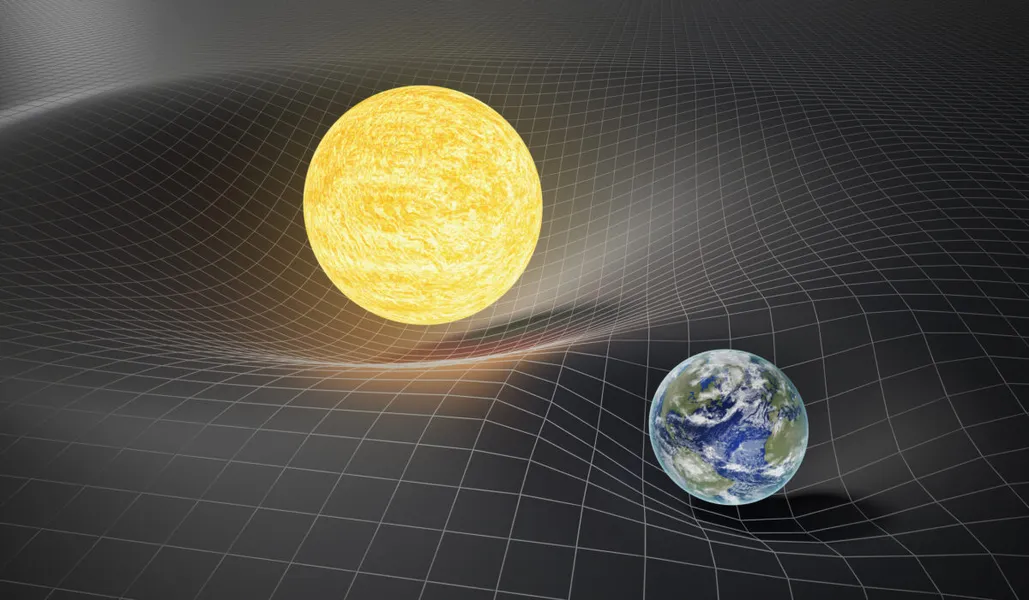
Carlo Rovelli is an Italian theoretical physicist with a sterling gift for writing, in English, clear sentences on complex ideas. In “Seven Brief Lessons on Physics” he traces the arc of modern physics from Isaac Newton’s 1687 straight mechanical worldview where bodies move through space and time passes uniformly to the now confirmed existence of quarks and, in 2013, the discovery of the Higgs boson, a fundamental sub-atomic particle; the most basic building blocks of a curvilinear universe.
Einstein’s milestone 1919 insight was that “the gravitational field is not diffused through space; the gravitational field is that space itself….Space is no longer something distinct from matter – it is one of the “material” components of the world. An entity that undulates, flexes, curves, twists. The whole of space can expand and contract.”
Max Planck had a radical idea that energy was not a continuous flow, but instead was “quanta,” or packets, a/k/a small building blocks. Einstein, again, cracked the code, in his 1905 annus mirabilis papers when he wrote, “…the energy of a light ray spreading out from a point source is not continuously distributed over an increasing space but consists of a finite number of “energy quanta” which are localized at points of space, which move without dividing, and which can only be produced and absorbed as complete units.”
Einstein’s idea was rejected as sheer nonsense, until 1925 when a group of physicists in Copenhagen, lead by Niels Bohr, worked out the mathematical equations behind the theory.
The world of quantum mechanics is not predictable, can only be spoken of in terms of probabilities. Roselli describes this as “…very far from the mechanical world of Newton…the world [of quantum mechanics] is a continuous, restless swarming of things, a continuous coming to light and disappearance of ephemeral entities. A set of vibrations, as in the switched-on hippie world of the 1960s. A world of happenings, not of things.”
In the year of our Lord 2024, physics teaches us that, “There is no longer space that “contains” the world, and there is no longer time “in which” events occur. There are only elementary processes wherein quanta of space and matter continually interact with one another. The illusion of space and time that continues around us is a blurred vision of this swarming of elementary processes.”
I present this as background to an idea that just as space time is a curved dynamic field, so too, by analogy, is human consciousness; in the years going forward our ideas of relationships and fundamental rights may flower in unforeseen dimensions. The “straight and narrow” ethics of Augustine, Calvin and Cotton Mather – to name just a few – may become antiquated just as Greek myth now is seen as mere child’s play.
Whether history repeats or rhymes, the fact is that we have been here before. Augustine of Hippo, the towering Church Father, wrote circa 400, “…it is not necessary to probe into the nature of things, as was done by those whom the Greeks called physici…It is enough for the Christian to believe that the only cause of all created things, whether heavenly or earthly, whether visible or invisible, is the goodness of the Creator, the one true God; and that nothing exists but Himself that does not derive its existence from Him.” The Dark Ages followed when the Western Roman Empire fell, trade became stagnant, the Black Plague ravaged the land, scientific thought was discouraged.
Come the sixteenth century, a Polish mathematician calculated the rotations of the planets, and confirmed that the Sun, in fact, is the center of our galaxy. The mathematician, also a Catholic Canon, was savvy and prefaced his work “To The Most Holy Lord, Pope Paul III” begging indulgence, “How I came to dare to conceive such motion of the Earth, contrary to the received opinion of the Mathematicians and indeed contrary to the impression of the senses, is what your Holiness will rather expect to hear. So I should like your Holiness to know that I was induced to think of a method of computing the motions of the spheres by nothing else than the knowledge of the Mathematicians are inconsistent in these investigations.” Copernicus endeavored only to check the mathematics but his “Book of Revolutions” changed the course of history.
Galileo, equally brilliant, more bold and less savvy, championed and then scientifically proved the Copernican heliocentrism, for which he was tried by the Roman Inquisition and found “vehemently suspect of heresy.” Galileo is called the father of observational astronomy, classical physics, the scientific method and modern science. Popes Paul III and V are mere footnotes in history.
The flowering of Renaissance humanism was in full swing in those times, and consider the intellectual and cultural advances concurrent with the scientific revolution: Leonardo da Vinci, Michelangelo, Raphael were active in their studios; Erasmus and Descartes were thinking; Shakespeare and John Milton wrote epic poems and plays; Johannes Kepler and Isaac Newton advanced scientific thought. Whether science was the cause or effect, the fact is that the breadth of thought – what I call consciousness – expanded wildly during this period.
So what then might our “curve of consciousness” bring? Consider these contemporary facts:
- Science has proven that trees communicate and share rescources among themselves via the underground “mycorrhizal network” transferring water, nitrogen, carbon and other minerals; the stronger helping the weaker to survive. Peter Wohlleben has called this network “the woodwide web” allowing trees to communicate.
- Researchers at MIT and other universities are beginning to use Artificial Intelligence to decode the language of humpback whales “with a confidence level of 96 percent.”
- In 2008 the Republic of Ecuador drafted and approved a new constitution recognizing the rights of nature and ecosystems, making them legally enforceable. The preamble states: “RECOGNIZING our age-old roots, wrought by women and men from various peoples, CELEBRATING nature, the Pacha Mama (Mother Earth), of which we are a part and which is vital to our existence, INVOKING the name of God and recognizing our diverse forms of religion and spirituality, CALLING UPON the wisdom of all the cultures that enrich us as a society, AS HEIRS to social liberation struggles against all forms of domination and colonialism AND with a profound commitment to the present and to the future, Hereby decide to build…”
To my mind the coming flowering of consciousness will celebrate unity in diversity. Anthropocentrism may give way to an acceptance that all life is one. Genesis 1:26 where “…God said, Let us make man in our image, after our likeness: and let them have dominion over the fish of the sea, and over the fowl of the air, and over the cattle, and over all the earth, and over every creeping thing that creepeth upon the earth” would seem a shibboleth soon to fall, perhaps replaced and finally embraced by Romans 13:10 “Love your neighbor as yourself. Love does no harm to a neighbor. Therefore love is the fulfillment of the law.”
To all of this, I quote Martin Luther King, “…Free at last, free at last, thank God almighty we are free at last.”
_____________________________________________________________________________
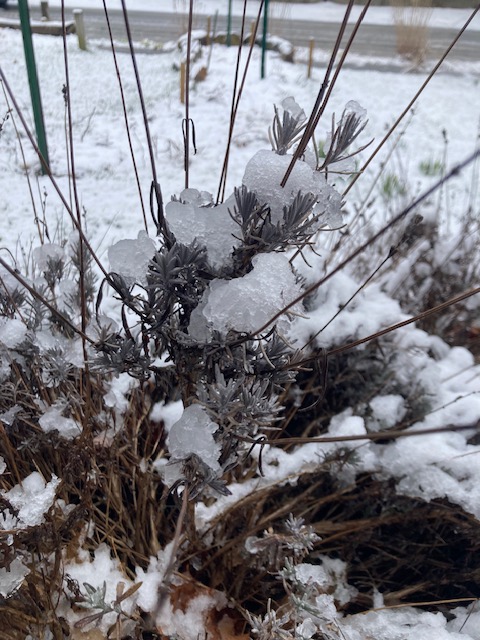
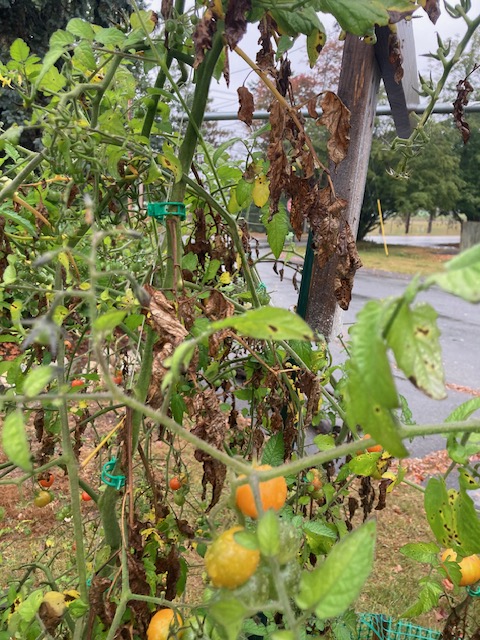
The radiant reds and orange of summer subside, while brown and sienna now dominate the garden. Beans are ripening. We move closer to the Solstice.





 an Art Farm