New Orleans, The Library of Congress, the pits
Posted: February 14, 2025 Filed under: Chronicles of a First Time Parent, Money & Banking, Portfolio - David's work, What is an Art Farm | Tags: australia, history, libraries, library automation, news, RMG Consultants, technology 1 Comment
In the summer of 1988 we traveled to New Orleans, another food-rich destination, for the ALA Annual Conference. What I experienced changed the direction of my life: Thos Moser Cabinetmakers, from Auburn, Maine, had a vast display of its solid Cherry tables and study carrels, Ash-spindled chairs and rockers. I stopped in my tracks, in awe that people built this…by hand! Douglas thrived in the virtual world of IT but I was drawn to the tactile, the tangible, the act of making.
RMG continued to grow, more people hired to word process the documents until we outgrew our office in a two-bedroom condominium in a residential high-rise. The condo-building did not allow an office but we were on a mission so we expanded into the condominium next door. Pat McClintock, a librarian from Kentucky joined the team. RMG already had an office on the East Coast – inside the DC Beltway – and would soon add one in Southern California.
RMG Consultants ran the table during that era, its client list grew to more than 1,000 libraries internationally:
- The Library of Congress & national libraries of Australia, New Zealand, South Africa.
- Academic and research libraries throughout the U.S., Australia, New Zealand and South Africa, and in Abu Dhabi, Canada, Egypt, Kuwait
- State library agencies and public libraries throughout the U.S. – small, medium, large, very large
- Urban public libraries, including, e.g.: NYPL, Brooklyn, Queens, Miami-Dade, Cincinnati, Cleveland, Cuyahoga County, Dallas, Dayton, DC Public, Fort Worth, LA County, Hong Kong Public Libraries, Shanghai Library
- Many library automation consortia, of all types and sizes – including the largest public, academic, and multi-type ones — in the U.S., Australia, South Africa
- Public sector library jurisdictions: e.g., city, county, province, school, state, regional libraries.
Our work days began slowly, then built to a crescendo when deadlines loomed. The Consultants pushed deadlines to the last, which meant we lived or died by overnight delivery. FedEx is commonplace today, but in the 1980s it was revolutionary. FedEx began as a college term paper idea in 1965 – when Douglas was 1 – but officially took flight in April 1973 when 14 aircraft delivered 186 packages to 26 US cities. The “Overnight Letter” was not offered until 1981 which is just about when Rob launched RMG Consultants. RMG relied on the “Overnight Letter;” it allowed extra time, which ensured deadlines were pressed harder, later. We would work until the very last minute, then I would run to my car, beeline to the near west side, to make the 9pm deadline. I knew the FedEx staff on a first name basis.
Where I am a dreamer, Douglas was street smart and resourceful. More than once, after meeting the deadline we would let loose and head deeper into the barrio, to Humboldt Park. A neighborhood not for an Anglo after dark, Douglas knew just where to go, what to say, how to buy on the street. It is all legal now, so we were just ahead of our time, but it was edgy, the very sharp edge of danger which Douglas knew how to navigate.
In the summer of 1989, Rob was offered a corporate consultancy with Sears Roebuck & Company the consumer goods behemoth. It was not a typical RMG assignment but the job paid well and growth requires cash flow. Rob reached out to Howard Dillon for help, an action that would forever change Douglas’ life and generations going forward.
Howard knew of a young librarian, a single mother, in the Business Library at the University of Chicago. Interested in new opportunities, she agreed to take on the job. Her first day on site went well. Erik Lekberg, a part-timer on our team, went along as her assistant. Afterwards he spoke admiringly of her acumen, praised her humor, “She was a lot of fun to work with!”
And so Laurie Nelson met Douglas. They worked well together. Laurie felt that spark and Douglas fanned that flame. Laurie, and her daughter Emily, became a part of our pod; Laurie and I were in our thirties, Douglas and Brian in their twenties, Emily not even ten, we had great fun together, endlessly.
RMG moved that year into a new office – a legitimate office space – with a conference room, word processing area, private office for Pat and room for Rob anywhere. We added more staff. We continued to grow. Erik Lekberg’s brother Tal was a skilled carpenter who helped me finish the space and then I painted the walls. We moved in and RMG moved forward. Then I was offered a job at the Chicago Board of Trade on the financial futures floor. As I told Rob and Pat that I was leaving, I felt I was breaking a bond but they were gracious and understood.
My Father and Grandfather were stock and bond men, but I was drawn – for an unknown reason – to financial futures and options and so I worked on the floor of the Chicago Board of Trade’s 30-Year U.S. Treasury Bond futures. The “open outcry” auction is long gone, but in those days brokers and traders stood jammed into “pits” where they would scream at each other, waving their arms in bright colored jackets, buying or selling more than $645 billion dollars worth – per day – of US Treasury bond futures. Capitalism in its most raw pure form. I began as a lowly runner then was promoted to “squawker” providing the “play-by-play” commentary via the telephone to the Prudential Bache trading desk in lower Manhattan. It was a macabre and unappealing place to work, but the experience would prove providential.
Enterprising computer scientists could make a fortune through library automation and as the new decade dawned the marketplace began to mature. Mergers and acquisitions began and Data Research Associates, one of the legacy automation firms, went public with an IPO in 1992.
Data Research Associates was the brainchild of Mike Mellinger, a larger-than-life software engineer, who studied Applied Math & Computer Science at Washington University, class of 1971, then wrote the ATLAS software for the St Louis Public Library and Cleveland Public Library. In the tradition of the authoritarian tech entrepreneur, Mellinger created the product and remained the most technically astute person in the company. Rob describes him as among the two most brilliant software engineers in the industry; Vinod Chachra, the other member of that pantheon enters our story three years later, in 1995.
When Mellinger took DRA public, the installed user base had grown to 1,584 libraries, and its revenues were the 4th largest in the industry. Rob McGee’s influence was through contract negotiations, on behalf of libraries that purchased the ATLAS system. Rob’s breadth of knowledge and ruthless objectivity were brought fully to bear at the negotiating table. Mellinger and McGee would tenaciously have at it, the vendor driven by the profit motive, while the consultant served as advocate to the library. Rob’s strategic advantage was that he knew how Mike was thinking, and thus – like a chess match – anticipated his moves. Rob was able to win, which drove performance standards higher, ensuring greater access to information for the library end-user. Rob’s approach was win-win: DRA gained the windfall of a signed contract, while the library enjoyed heightened user service. Having been present at the creation, Rob matured his leadership through contract negotiations.
Like battlefield attorneys who litigate by day, then share a cocktail after hours, nothing was ad hominem. McGee and Mellinger shared the highest respect for each other. DRA used the IPO proceeds to acquire two other vendors, increasing their annual revenues to $38.6 Million. Many vendors, though, chose to remain private, pocketing the robust cash flows from subscription revenues.

4 August 1991
The Vatican, Civil Rights, Hyde Park, San Francisco
Posted: February 7, 2025 Filed under: Chronicles of a First Time Parent, Portfolio - David's work, What is an Art Farm | Tags: ALA Annual Conference, Eugene Gabriel Tisserant, existential-dread, existentialism, FDR, humanity, Inc., integrated library systems, Library Quarterly, RMG Consultants, RMG’s Annual Presidents’ Seminars, suffering, the Civil Rights Act, the-only-thing-we-have-to-fear-is-fear-itself, vatican library, William Madison Randall 2 Comments
William Madison Randall was born 1899 in the Detroit suburb of Belleville. He graduated Central High School at age 16 but due to his young age, completed another year of post-graduate study. He went on to pursue a Bachelor’s and Master’s degree in linguistics at the University of Michigan and worked in the university library helping to reclassify the book collection.
In 1924, Randall enrolled at the Hartford Theological Seminary to begin work on a Ph.D. in Islamic Philosophy, when he was invited by the Carnegie Endowment for International Peace to reorganize and catalog the Vatican Library. There he befriended Eugene Gabriel Tisserant: scholar, librarian and archivist of the Holy Roman Church with whom he became lifelong friends.
Tisserant served as the Vatican Librarian; was Dean of the Sacred College of Cardinals in 1951; presided over the board of presidents at Vatican Council II (1962-1965); accompanied Pope Paul VI on his major voyages to the five continents. In testimony to their friendship, Cardinal Tisserant’s archives are housed with Randall’s at the University of North Carolina Wilmington.
In 1929, William Randall graduated from the Hartford Theological Seminary summa cum laude and became Associate Professor of Library Science at the University of Chicago. He authored several books on Library Science and founded Library Quarterly, a scholarly journal still published today. Twice he traveled to the Middle East on fellowships to research Arabic manuscripts. He spoke 30 languages.
During World War II, Randall was commissioned a Major in the U.S. Army Air Force, sent to Cairo, Egypt as a liaison officer for the British Air Transport Command and then to Accra to assist in the organization of the African branch of the Command. He became an intelligence agent with the Office of Strategic Services in 1943, reporting to the Pentagon and President Roosevelt concerning the Middle East. He spoke Arabic and stories are told that dressed as a waiter he served dinner to Erwin Rommel, the German “Desert Fox,” while gleaning intel for FDR.
In September of 1951, Randall and his first wife were involved in a car accident about ten miles outside of Wilmington, North Carolina. News of the accident spread and Randall was offered, then appointed Dean of Wilmington College. In 1954, Randall married Mary Johnson McGee, who had a son, Robert McGee, from a previous marriage.
Rob McGee had grown up in the segregated South, the world of separate and unequal, then came of age during the era of Emmitt Till’s murder; Rosa Park’s refusal to get out of her seat; the “Southern Manifesto” of Senators and congressmen declaring as unconstitutional the Brown v Board of Education Supreme Court decision; and, in 1957, the Civil Rights Act. The world was changing and William Madison Randall, a “Renaissance Man” of rare breadth infused in Rob a global perspective, inspired him to think beyond the present, to go forward to the future.
When Rob landed in Chicago’s Hyde Park his vision was broad, his work ethic deep, he developed three successive nationally-funded state-of-the art integrated library systems (ILS). Rob served as deputy to Charles T. Payne, Systems Development Librarian, and produced the proposals, systems requirements, systems designs, technical plans, and library automation planning processes that continually advanced the state-of-the-art of library automation. The proof of concept of an integrated library system was developed by Charles Payne at the University of Chicago. Rob was present at the creation.
Hyde Park always attracts stellar talent. Howard Dillon had left OSU and become the Librarian of the Graduate School of Education at Harvard University but in 1975 he joined the U of C Library as Associate Director for Public Services. Howard became part of a strategic thinking group, four librarians – including Rob and Charles Payne – and he recalls, “I remember lunch times when the four of us would head off campus to the cafeteria of one of the nearby theological seminaries for blue-sky thinking or the summer days when we gathered on benches in Harper Quadrangle to eat sack lunches and mull over our ideas and challenges.” Of note, Charles Payne’s nephew is “that skinny kid with the funny name,” former Professor of Law at the University of Chicago: Barack Hussein Obama II. But that is not my story to tell. Mine is the story of library automation and how it changed the life of Douglas Lee Woodhouse.
At the vanguard of library automation Rob McGee saw the need to educate librarians, trustees, and administrators in issues and solutions. Early in 1987 he asked me to organize, promote and manage the first RMG seminar series at the ALA Annual Conference in San Francisco in July. There were multiple offerings, each requiring detailed documents, copied onto different colored paper to easily identify the offerings. Still in the hard copy era and given the cost and time of shipping, I had to make, collate, staple and sort all of it after we arrived in San Francisco. I also had to manage the registration as more than 200 librarians had signed up.
The RMG Seminars became a staple of the ALA Conferences, for 31 years. At the Summer Annual conference, RMG spoke to the librarians. At the Mid-Winter, RMG’s Annual Presidents’ Seminars (The View from the Top) would invite global ILS company executives to focus on industry initiatives and trends. Rob McGee developed the topics and themes, and lead the seminars, which consistently identified trends and predicted the future of library automation. Driven to teach and to lead, Rob worked both sides of the aisle, education always the goal. On a personal note, in San Francisco, 1987, I discovered the joy of an expense account in an extraordinary food town. Rob’s trust in me was absolute.
In August, Douglas pulled into town and, on the strength of the seminar program things really picked up. Douglas began as a filing clerk and helped on word processing. He had an aptitude for technology, a moxie about business, the work load was increasing: his timing was ideal.
There was a spark between Douglas and me, and given my temperament – ready, willing and able to shovel coal – and Douglas’ unique capacity to fan the flame, our spark ignited combustion which we converted into growth. Brian, my brother, provided ballast, through his rigorously keen mind and a willingness to wrestle ideas with Douglas and me, both in the office or while throwing darts or drinking beer after work. We three formed an easy and effective team.
Rob’s value proposition was simple: if we kept up with his pace, he gave us carte blanche. He trusted Douglas, Brian and me to make the right decisions, and looking back says, “I got the good part of the deal…all that we were able to accomplish as a team, all on the fly.” His demands were intense: driven, tenacious, unyielding, unconditionally committed to access to information, libraries as a civic space, a learning opportunity. His negotiating style was to dominate the vendor on behalf of his client, even correcting, during negotiations, the grammar of vendors’ contracts. His breadth of knowledge was vast, his attention to detail a laser focus, and we three kept the operation steady, stable and growing.
To be continued…
…next week…Thos Moser in NOLA; going global; love at the threshold; life in the pits, open outcry 30-Year U.S. Treasury Bond futures…
Beginnings
Posted: January 31, 2025 Filed under: Chronicles of a First Time Parent, What is an Art Farm | Tags: books, free public library, libraries, library, news, reading, RMG Consultants 1 CommentDouglas Lee Woodhouse has died.
This is our story.
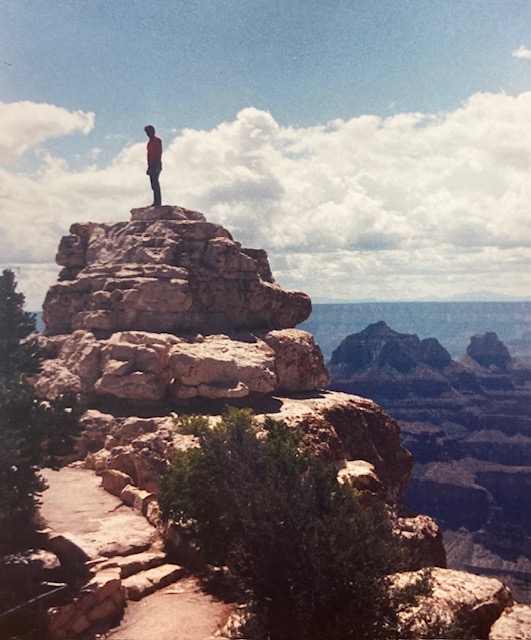
He wanted to drive to the desert, eat grapefruits while sitting cross legged playing his guitar. He went west, our young man, but made it not to the 100th meridian but to 87.629 degrees, which is Chicago, the City of Broad Shoulders, where he was welcomed with open arms.
Jack Kerouac’s “On The Road” was his sacred text, his mantra: “There was nowhere to go but everywhere, so just keep on rolling under the stars.” Destination unknown, Douglas Lee Woodhouse set out from his family home on Hollywood Avenue in Cincinnati. Nancy, his Mother, years later told me the punch line: “When he got into his Volkswagen, there was no gas! I had to drive him to the gas station to get enough gas to drive his car to the station to fill up!!”
North by northwest, Douglas arrived in Deerfield, Illinois where he “broke and entered,” which is to say he rummaged around the garage to find the “hidden” key, then let himself into his Aunt Barbara’s – my Mother’s – house whereupon he sat cross legged on the living room rug, played his guitar and sang. No desert, no grapefruits, but still silence until Aunt Barbara arrived home, most surprised, and called me promptly, “Douglas is sitting on my living room floor playing his guitar…and singing…I don’t know what to do! Can you help? Can he come to you? Now?!” “Certainly,” I said and a new life began.
Our roots were decades in the making. I was born 1961, and he arrived in 1964. We were cousins and crossed paths on family trips to Cincinnati, our Mothers’ childhood home, the brick house on North Cliff Lane built at the height of the depression among the Castles of Clifton. John F. Glaser, known as the “King of Coal” was a salesman active in the coal and home heating industry of the Ohio River Valley, while Lucille was sentry at the stove, a bountiful feast for anyone, for everyone who came to visit. It was a grand place to be young.
When Douglas arrived, I lived in the barrio, Noble at Erie, on Chicago’s Near-West side, in a very drafty large third floor walk-up. There was plenty of room for him to set up camp. The neighborhood was edgy and unpolished, working-class families and artists with a gang selling drugs from the corner one block away. We were a long way from the Castles of Clifton.
I worked at RMG Consultants, Inc., a library automation consulting firm, and my career began comically in the winter of 1985. A Senior at Northwestern University, I was hired to do word processing but was soon fired. While being fired I recommended my younger brother Brian, age 17, a junior in high school, whom they hired part time. They offered me a job painting the office, which, being unemployed, I accepted. While I painted, a deadline emergency arose, and so I closed the paint can and sat down with great focus to finish all the documents. Impressed, the Business Manager thereupon offered me her full-time position, as she was planning to leave the company. A stunning turn around.
RMG was at the vanguard when the library card catalog was becoming a relic, IT automation ascendant on the horizon. No less than the New Yorker wrote an expose about the change, card catalogs replaced with computers, the physical cabinet and notated 3×5 cards discarded from our collective past. To put 1985 in perspective, Steve Jobs had not yet been fired from Apple, Elon Musk was a freshman in high school in apartheid South Africa, Larry Page and Sergey Brin middle school students, Mark Zuckerberg in diapers. The future stretched out broadly, while the origin of library automation began the year Douglas was born.
In 1964, Howard Dillon, a new, young librarian at the Ohio State University Libraries was given the assignment to look into the library automation business and report to the library director and his cabinet. Howard began identifying and exchanging correspondence with persons in other libraries who were engaged in interesting experiments and projects. In October of that year, in Philadelphia, at the 27th annual meeting of the American Documentation Institute he rented a hotel meeting room for two days and gathered 21 of his correspondents for their first face-to-face discussions. There was great enthusiasm for this idea, and the librarians began a correspondence detailing projects, experiments or ambitions. The correspondence became formal, published as the “Newsletter on Library Automation.” Issue #1 was December 10, 1964.
Having no name, the group was referred to as the “Dillon Committee,” which name was used until the autumn of 1965 when the group organized themselves as the Committee On Library Automation (COLA) and elected leadership. COLA described itself as, “…an informal group of librarians formed to provide a means of exchanging information or research and development of automated systems applicable to libraries.”
Charles Payne – another key figure in our story – was elected Vice Chairman and Chairman Elect, while Howard Dillon served as the Editor. COLA pursued affiliation with an existing professional organization and in 1966 were formally recognized, when the council of the American Library Association (ALA) voted to create the Information Science and Automation Division (ISAD). The final COLA Newsletter, #44, was issued September 1969 when a new world was entered.
Rob McGee – founder of RMG Consultants – began as a Doctoral student at the University of Chicago’s Graduate Library School in 1965, already holding a Masters in Library Science from the University of North Carolina, and soon to study in Scotland, where he would receive a Diploma in Computing Science from the University of Glasgow. In the autumn of 1967 he returned to Hyde Park, and began at the University of Chicago Library Systems Development Office. In many ways this was a second career, he had been shelving books since he was 9-years old, at the Community College library in Wilmington, North Carolina. He also worked in the local paper mill and, in Washington State, 100-hour work weeks picking peas for the Green Giant Cannery. He grew up well versed in sheer physical labor, under the heat of the summer sun.
Born in Washington, DC, Rob grew up in Four Oaks, and then Wilmington, North Carolina during the Jim Crow era. His library experience began young, riding his bike to pick up 78 RPM “talking books” for his Grandmother and, for himself, grabbing as many books as would fit in his bike basket. In an era before television, the library loomed large, his Aunt Mil a role model and legendary teacher, reading historical fiction to students, stoking their interest to learn from books available at the local library.
Coming of age among World War II vets, learning on the GI Bill, those were different times in the Deep South. Rob saw the Free Public Library as a bedrock civic institution and once William Madison Randall joined the family Rob’s perspective became global. Library automation began in 1964, but as it pertains to the life of Douglas Lee Woodhouse foundationally it goes much further back.
To be continued…
…next week…the Vatican Library, an intelligence agent to President Franklin D Roosevelt, “that skinny kid with a funny name,” Thos Moser furniture in New Orleans….
 an Art Farm