The Grandest Cataract in New England
Posted: September 12, 2024 Filed under: Art & Healing, Portfolio - David's work, What is an Art Farm | Tags: Androscoggin River, Cancer Valley, Edmund Muskie, Hugh Chisholm, Public Art, Restoration, Rumford 2 CommentsRumford Falls, Maine is situated where the Concord, Ellis, and Swift rivers converge into the Androscoggin River, which form the watershed of the Western Maine mountains. At the Falls, called the “the grandest cataract in New England,” the Androscoggin drops a total of 176 feet over a sheer wall of granite.

In our pre-industrial age, indigenous peoples gathered there to hunt, fish and trade furs from the Lakes Region of Maine. In 1882, history forever changed when industrialist Hugh Chisholm grasped the Falls’ potential for the manufacture of paper.
Chisholm first built a railroad, then a mill for his Oxford Paper Company, which grew to become the founding asset of International Paper Company, the corporate behemoth, still active today. A Utopian, he also built planned community housing for the workers in his mills, which housing became a model for the nation. Chisholm hired architects to build great buildings in Rumford, those architects also having designed the Waldorf Astoria in Manhattan, and the Copley Plaza in Boston. At its peak, in the 1930s, Rumford held its own with Manhattan, but today it has fallen deeply into the abyss.

Rumford, and the surrounding River Valley towns of Maine, are known nationally as “Cancer Valley” given the incredibly high rates of cancer among its mill-working inhabitants. Four out of five children are food insecure, while Rumford has the highest special education population in the state of Maine. The opioid crisis has run rampant, and Rumford’s rate of crime is now the highest in Maine.
Rumford Falls is but one, among many cities, ravaged by the flight of capitalist money, ever in pursuit of profit. The New York Times recently reported, “Milwaukee was once known as the ‘machine shop of the world.’ In the 1950s, nearly 60 percent of the city’s adult population worked in manufacturing…. By 2021, Milwaukee had lost more than 80 percent of its manufacturing jobs (barely 5 percent of those that remained were unionized), and it had the second-highest poverty rate of any large American city…. Between 1997 and 2020, more than 90,000 factories closed, partly as a result of NAFTA and similar agreements.”
Last Sunday, I was in Rumford Falls helping on a Public Art project. Although the politics of free trade is vitally important, my work focused upon the power of art, the agency of making, and the process of civic discourse; how does a community rebuild once the rivers of cash flow have dried up?
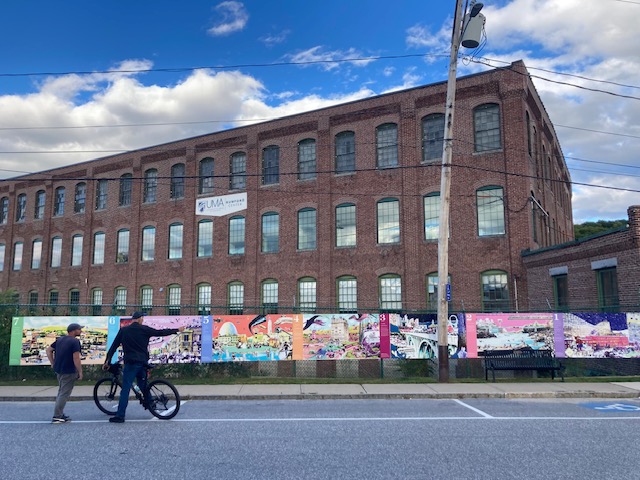
A real estate developer recently purchased Rumford’s old mill building for the price of $1 USD, and she has received a grant from the Department of Agriculture to put solar panels on top of the mill, and another from the National Parks Foundation “historic preservation” fund with the condition of “community engagement.” The developer promptly called Chris Miller, and asked, “I have the building, and a chain link fence out front. Can you do something of civic engagement?” Chris pondered the problem.

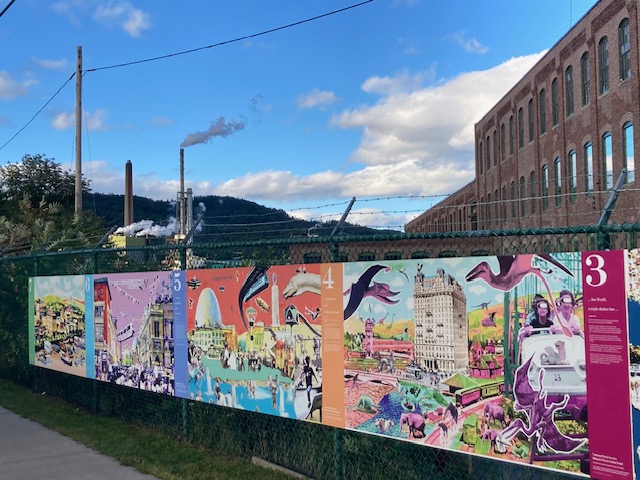
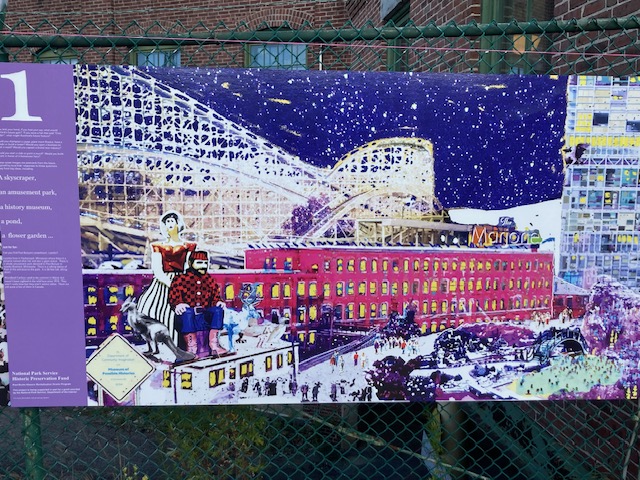
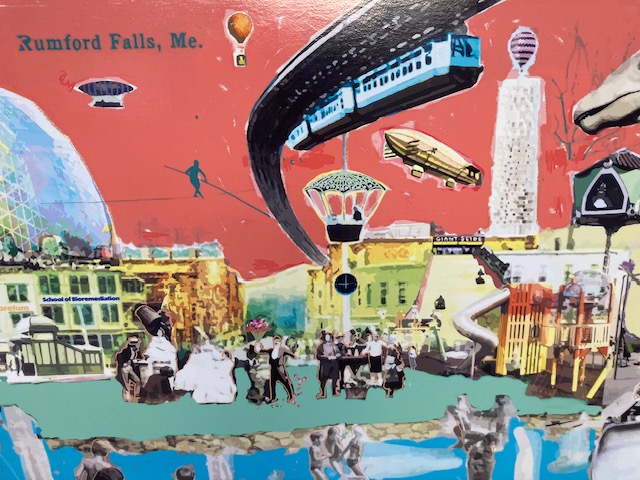
He decided to ask the citizens of Rumford what their desired future might be? Adults declined to respond, but a classroom of 3rd grade students enthusiastically spoke up. Chris’ question was “If you lent your hand, if you had your say, what would Rumford’s future gain? If you wore a hat that said “Civic Leader,” what might Rumford’s future feature? Would you champion a cause, plant more flowers, have a parade or build a tower? Would you open a business to meet a need? Would you captain a brand new industry? Would you start a club or paint a mural? Would you build a park in honor of a hometown hero?”
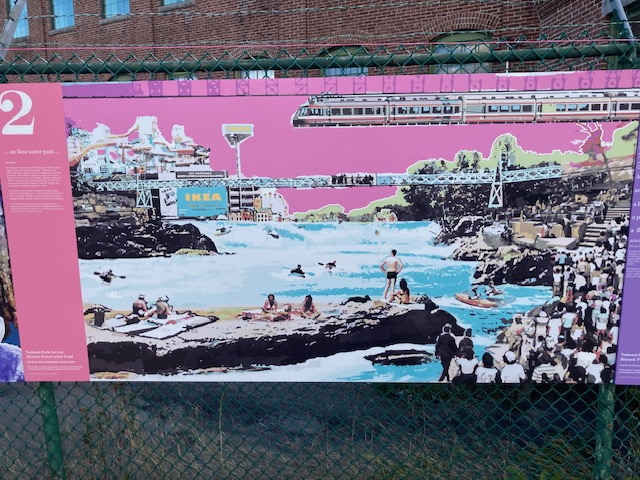
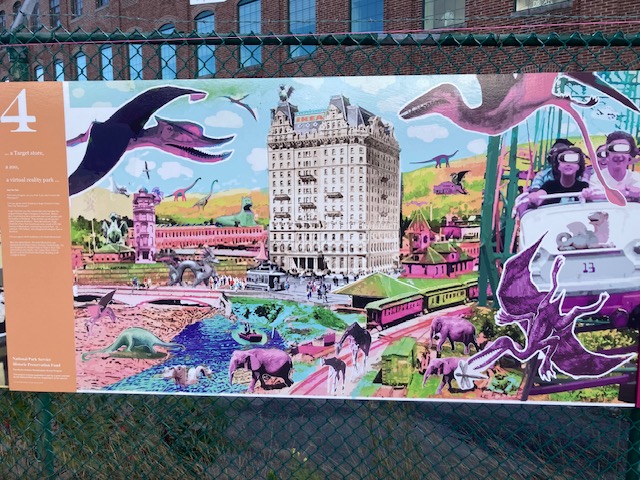
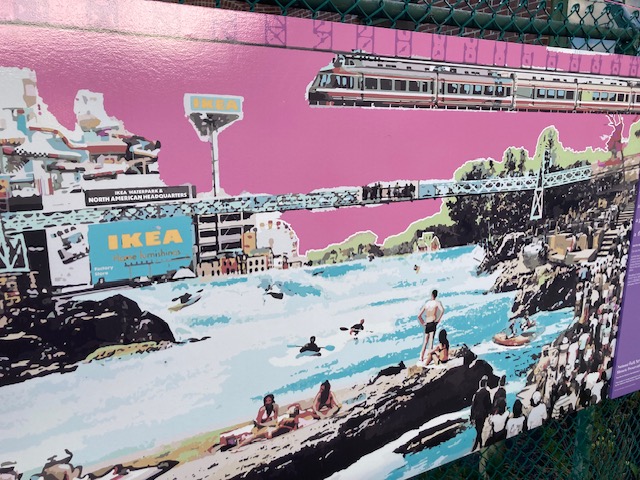
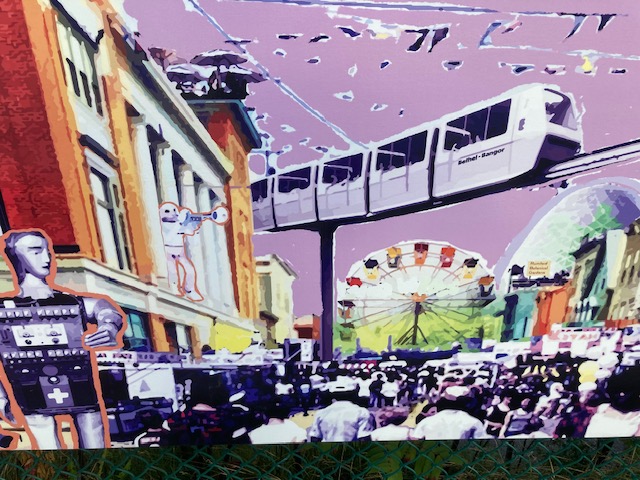
The 8- and 9-year old students offered fantastical ideas: a skyscraper, an amusement park, an IKEA water park, trains running upside down. Gathering their bold ideas, Chris set them down graphically in the style of a picture postcard, then printed on vinyl adhesive which he affixed to seven 4×8 sheets of 1/2” masonite. My role was minimal, priming and painting the boards and helping Chris hang them upon the chain link fence.
His design links to Rumford’s past, given that Hugh Chisholm made his first fortune printing picture postcards, holding the monopoly contract with the United States Postal Service to print all of the picture postcards sold in United States post offices at the turn of the 19th century. The Rumford Mill produced all those postcards, as it grew into its peak production years.
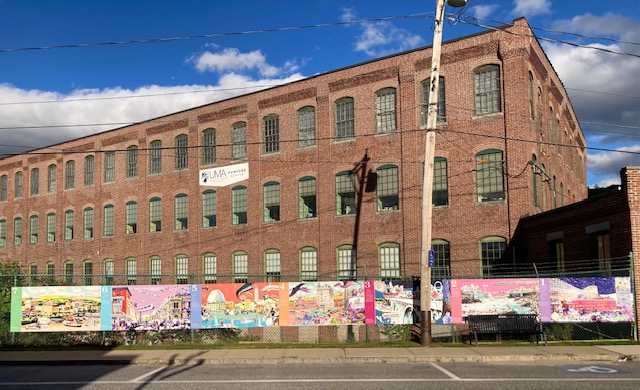
The children of today very likely could become the leaders of our future. Rumford’s native son, Edmund Muskie, was born there in 1914 and then wrote and championed both the Clean Air Act and the Clean Water Act in the 1970s. His political leanings have been demonized by many industrialists, but one has to wonder how his Rumford childhood shaped his environmental thoughts.
Restoration, it seems, is the work of our times. The task in Rumford is how to build a new economic base, to clean up after decades of toxic waste, and to heal generations of families whose lives have been shaped by the working conditions at the Mill and power plant on the Androscoggin River. Chris’ “picture postcards” are but one very small step, but Rumford’s task of recovery does move forward.







 an Art Farm