Copernican Moment
Posted: April 3, 2026 Filed under: consciousness, Farming off the Farm, What is an Art Farm | Tags: artificial-intelligence, consciousness, philosophy, science, spirituality 1 Comment
“The earth is flat” held firm for tens of thousands of years, until Aristotle, during a lunar eclipse, noticed circular shadows and thought differently: the Earth must be round. But still, all thought, the Earth must be at the center of the universe: “geocentrism” was a given.
And then, in 1543, a Renaissance polymath spoke truth to power, publishing De revolutionibus orbium coelestium (On the Revolutions of the Celestial Spheres), the defining and pioneering moment in the Scientific Revolution. Nicolaus Copernicus changed the world.
Johannes Kepler, the German mathematician and musical theorist, followed suit, between 1608 and 1621, with the three laws of planetary motion, a much needed defense of Copernicanism. Rene Descartes, in 1641, sealed the deal with his Meditations on First Philosophy; “Cogito, ergo sum” and Cartesian coordinates became the law of the rational mind.
From Copernicus to Descartes, in 98 years, the modern world was conceived, a conceptual shift so profound that life on planet Earth irrevocably changed. Rational science is so central to our age that it is hard to fathom how bold and pioneering were these men who challenged the Pope, Emperors and Kings, the entrenched orthodoxy, and the learned guardians of Medieval culture.
Martin Luther, no wallflower, reportedly said, “This fool wishes to reverse the entire science of astronomy; but sacred Scripture tells us that Joshua commanded the Sun to stand still, and not the Earth.” Calvin wrote, “Who will venture to place the authority of Copernicus above that of the Holy Spirit?”
Descartes, in fact, replaced the God-centered with the human-centered universe, and then separated the mind from the physical body and world, a duality that reigns still. But now, we are at a “Copernican moment of redefinition” of what it means to be human, argues Michael Pollan, the widely read author, journalist and professor, in his new book “A World Appears.”
The science of consciousness emerged in the 1960s as a niche fringe among eccentrics, then became mainstream by the 1990s, as Nobel-laureates Francis Crick (the DNA double-helix) and Gerald Edelman (unlocking antibody structures) published papers on neuroscience and consciousness. With the advent of AI, consciousness has become a high priority scientific field. Science empirically proves the physical world has stunning and myriad examples of intelligence, consciousness even, so the question pertains: what if the world is not the cartesian 2 or 3-dimensions, but multi-dimensional, not either-or but both-and?
Darwin, Pollan writes, “suggested that we think of the plant as a kind of upside down animal, with its main sensory organs and ‘brain’ on the bottom, underground, and its sexual organs on top, aboveground.” Man was the measure of all things, but in 2012, at Cambridge University, esteemed scientists gathered to issue the Cambridge Declaration on Consciousness, “the weight of evidence indicates that humans are not unique in possessing the neurological substrates that generate consciousness.”
Pollan describes Mimosa pudica, a tropical plant that can be taught to ignore a stressor, and remember what it has learned for more than twenty-eight days. “Plants can send and receive signals from other plants and alter their behavior in response to those signals. They can distinguish kin from competitors and both from their own selves.”
Intelligence is basically “the ability to solve problems,” so Stefano Mancuso, a plant scientist at the University of Florence, developed an experiment in which the root of a corn plant navigates its way through a maze, to locate and feast upon a quantity of ammonium nitrate – a cheese equivalent – which is to say, a great reward to a plant. The experiment has been repeated many times, with the exact same results.
Pollan continues, “In addition to sensing gravity, moisture, light, pressure, and hardness, root tips can also sense volume, nitrogen, phosphorus, salt, microbes, various toxins, and chemical signals from neighboring plants and fungi. Roots about to encounter an impenetrable obstacle or a toxic substance change course before they make contact with it.”
The intelligence of plants leads to the work of Suzanne Simard, the forest ecologist, whose work on the Mother Trees is empirically proven: fungi and roots facilitate communication and interaction between trees and plants, by exchanging carbon, water, nutrients and defense signals. Rather than competition, nature is cooperative. Which changes forever the Darwinian model of rational self interest.
In the “year of our lord 2026” artificial intelligence is being used to decode the communication among whales, crows, dolphins, elephants, primates and rodents. And so it might be that not “we the people” but all life “is created equal,” which means this “Copernican moment” brings the realization that intelligence – perhaps consciousness – is empirically found to be widespread, neither narrow nor limited to humankind.
So let’s revisit Descartes’ duality, the mind body split, in a world where men, since the advent of agriculture, have held the dominant role. Antonio Damasio, a Professor of Psychology, Philosophy, and Neurology, at the University of Southern California, and, additionally, an adjunct professor at the Salk Institute, believes that male scientists long considered feeling too “feminine” to seriously study. “It is one of the paradoxes of computer science,” he writes, “that the ‘higher’ capabilities we once thought of as uniquely human—reason, language, intelligence—have proved easier for machines to master than the more elemental capabilities we share with animals, including feelings and emotions.”
Pundits would have us believe the scepter of AI hangs overhead, but prudence urges that we remember AI has been modeled by and upon the narrow confines of logic, algorithms and statistical probability, not the elemental array of emotions that make up the extraordinary depth and breadth of life, among all species. I am not downplaying the serious risks of AI but pointing to emotional vitality as a largely under explored and resilient domain. AI is a tool, and every tradesperson knows we need be smarter than our tools. Once we accept that intelligence is pervasive far beyond mere humans, even gender fluidity seems but one small step for humankind. It is a wild time in which my children come of age.
Rumors of social decay are not exaggerated, but they may be an early indicator of a more fundamental flowering that begs to emerge. Multi-dimensional consciousness may be to the mono-rational what monotheism is to panentheism; an expanded consciousness neither makes science moot, nor does it push God aside, but expands dynamically the potential for understanding and embracing all of life, which could bring new solutions to today’s ever increasing problems.
Annaka Harris, author of “Conscious: A Brief Guide to the Fundamental Mystery of the Mind,” explains why consciousness is foundational and ubiquitous:
We’ve done all our science with the assumption that consciousness emerges at a certain level of information processing. But what if we started from the opposite assumption — that consciousness is fundamental and everywhere? Instead of treating conscious experience as a byproduct, we’d treat it as the foundation. That might help us understand phenomena we’ve struggled with.
There’s something exciting about realizing that something you felt 99% sure about wasn’t quite right — or was entirely wrong. It paves the way for new questions and better understanding. If we’re willing to admit we have made incorrect assumptions and apply our tools more creatively, we might finally get somewhere. We might start seeing the Universe for what it is — maybe even as conscious.
Oneness
Posted: January 1, 2026 Filed under: Art & Healing, Chronicles of a First Time Parent, consciousness, What is an Art Farm | Tags: anagarika govinda, consciousness, philosophy, science, spirituality, Thomas berry 2 Comments
Having built a whale, we decided to make a movie on the topic “all life is one.”
Having finished the short film, I sought funds from the Maine Arts Commission.
Having to substantiate my body of work as an artist, I referenced “An Art Farm.”
Whereupon, I realized our art farm had been mostly inactive since 2015 and so on 31 March 2024 I wrote “Crossing the Rubicon” about delivering the Whale north to the Wabanaki nation. I did not win the grant, but I did continue to write, and for 94 continuous weeks now I have posted short essays.
In a sense these are weekly postcards to my Mother, a chance to share thoughts that otherwise would not come up in our occasional phone conversations. More importantly, they allow me to mine thoughts that arise at 2am, to chase down loose threads and weave them, as if into tapestries, at best like those of the Renaissance rich in detail and color, telling stories of this strange and troubling moment in time.
An overarching theme seems to be Spiritual Ecology, a field of inquiry of which I only recently became aware. Rudolf Steiner is considered a visionary, having described a “co-evolution of spirituality and nature.” I learned of Steiner back in my Chicago days from a Gaia-centric friend at the vanguard. Pierre Teilhard de Chardin, also considered a founder, almost one century ago, wrote of a ”consciousness of the divinity within every particle of life, even the most dense material.” In “The Phenomenon of Man” he foresaw that “Science, philosophy and religion are bound to converge as they draw nearer to the whole.”
My Mother actively discussed de Chardin in her college days, and within the social circle of her childhood in Clifton of the Queen City, Cincinnati, Ohio, as well as at our dinner table. Father Sullivan, elder of Holy Cross Parish, once described my Mother as a “pantheist;” I suspect he meant that as a criticism but which she rightly took as a compliment! Perhaps, what the Father actually meant was panentheist (God in all things) not pantheist (God is all things), but regardless, since my childhood the tenets of Spiritual Ecology have been laid down as plain common sense.
On a family road trip west to the Grand Tetons, my Mother handed me a copy of John Muir’s biography. I was enthralled, in the backseat, while crossing the endless great plains. Decades ago I read Thomas Berry, also considered at the vanguard, who emphasized “returning to a sense of wonder and reverence for the natural world.” More than my share of Thoreau and Wendell Berry have I read, as well as David Abrams’ “The Spell of the Sensuous.” Joanna Macy has been celebrated among the Wise Women here at the art farm, while Emergence magazine is on my subscription list, the product of Emmanuel Vaughan-Lee, a Sufi trained multi-media maven on topics of a collective evolutionary expansion toward oneness.
But what would be this consciousness of oneness? The Renaissance is an historic example of a shift in consciousness, the “awakening” or “rebirth” of Europe, away from the Church-dominated Medieval era to embrace humanism, scientific inquiry, individualism, a flourishing of arts and culture. Rene Descartes, living at the end of the Renaissance, is considered foundational to modernity, his “cogito, ergo sum” defining the thinking rational self. But “cogito” is only one part of the whole self, and it can easily fall into the binary, mono-dimensional thinking of either-or, rather than both-and.
Newton’s Laws of Physics state an object is either at rest or in motion, but quantum mechanics allows an object to inhabit two states at once. Our logic has lead to AI which is a massive accomplishment, but it might either destroy us or bring far-reaching benefits. The “us versus them” is endlessly argued by politicians, the strongman’s lever using fear to divide and conquer. A spiritual ecology pursued only through the rational seems destined to failure. An expansive and inclusive approach is needed to embrace the breadth, depth and interconnectedness of both the natural world and ourselves.
“Creative Meditation and Multi-Dimensional Consciousness,” by Lama Anagarika Govinda, is insightful toward this life-affirming goal. He describes the “one-dimensional logic which…cuts the world apart with the knife of its ‘Either-Or,’” and then introduces “…a new way of thinking, an extended multi-dimensional logic which is as different from the classical Aristotelian logic as Euclidian geometry is from Einstein’s theory of relativity.” He presents this using the coordinates of an x-y axis. “If we regard the horizontal as the direction of our time-space development (unfolding), then the vertical is the direction of our going within, toward the universal center of our being and thus the realization of the timeless presence of all potentialities of existence in the organic structure of the whole of the living universe. This is what the poets call the ‘eternity of the moment’ which can be experienced in the state of complete inwardness…such as happens during meditation and creative inspiration.”
It is no small undertaking, a 21st century renaissance awakening to multi-dimensional consciousness not among the few, but ultimately we, the people, of the planet. Small-minded politicians and capitalists will pursue their goals of domination, and so this seems a necessary path out of the madness, deeper within. It is beyond the scope of one short essay to speak to such fullness, but this seems a direction for our art farm to pursue in the new year.
…and here is a link to the short film on the topic that we are part of the ecosystem, that all life is one, which set this ship – which is an art farm – to sail on this oceanic odyssey:
https://www.picdrop.com/claytonsimoncic/C39UK57ncx
The short film was produced with Anna Dibble. Clayton Simoncic was the photographer and editor.
_________________________________
Since it is written “the last shall be first,” I shall end this post and honor the Benham Family tradition, that good things come to those who begin a new month, on the first day with the first words: “Rabbit, Rabbit.”
May good things come to all people in the new year.
Ice Cream Revelations
Posted: May 2, 2025 Filed under: Child Centered Activities, Chronicles of a First Time Parent, consciousness, What is an Art Farm | Tags: Carl Jung, creativity, dreams, Mayan Long Count Calendar, Primate of Ireland, psychology, Revealtion 17, saint malachy, semi dwarf apple tree, spirituality, writing 1 Comment
I recently went driving at night with my children to go eat ice cream. Pope Francis having died, my daughter mentioned Tik Tok talk of the prophecy of Saint Malachy. As it were, I’m familiar with those prophecies, having heard about them almost 30 years ago.
Saint Malachy lived in Northern Ireland in the 1100s. Born Máel Máedóc, he served as Archbishop of Armagh and was the Primate of All Ireland – the highest ranking position in the Catholic and Episcopalian Church of Ireland. His predecessor was no less than Saint Patrick, known as the “Apostle of Ireland,” venerated as a saint in the Catholic Church, the Lutheran Church, the Church of Ireland, and in the Eastern Orthodox Church. ‘Tis no small role to be the Primate of All Ireland.
Malachy’s prophecy presaged 112 more popes before the Last Judgment. Pope Francis happens to be that 112th pope. The prophecy is widely debunked, but on social media it seems to be generating great interest.
My daughter explained the conventional view, that following the last Pope will come the rapture, when the dead and living believers will be lifted up in the air, ascending to heaven at the Second Coming of Christ. My son, a deep thinking Sagittarean, questioned, “what about the others?” I clarified, “…the Buddhist, the Muslim, the child of Indigenous parents…?”
My son questioned more deeply, “How can a God of love exclude half of the world’s population?” My daughter repeated the factual statement that the faithful believe theirs alone shall be redemption. When she spoke of the risen Christ, I queried about John 14:12 “These and greater deeds ye shall do” which means to raise the dead, to walk on water, to feed loaves and fishes to the masses…come one come all – he says – we the people all have that power. Who among us shall believe, and act?
And so we drove, into the dark night, eating our ice cream.
I reminded them that the world in fact came to an end on 12/12/12, just over 12 years ago. Such was the popular view, pre-Tik Tok. I spoke of the Mayan Long Count calendar, the end of a 5,126 year-long cycle. 250-950 AD was the Mayans’ Classic period, the peak of their large-scale construction, urbanism, monumental inscriptions, and significant intellectual and artistic development. Their flowering has been likened to that of Renaissance Italy or Classical Greece. Everyone reading this essay today knows that the world did not end on 12/12/12; the Mayan calendar’s end marked only a new beginning. In Hindu terms, this is Shiva’s cosmic dance, his never ending destruction creation cycle.
A friend has read the Book of Revelations and suggests that the current Commander in Chief is the 8th King of the Roman Empire, Revelation 17, “destined for destruction,” the Antichrist. Indeed we can read the “two beasts” as representing opposing forces of evil: one from the sea (Manhattan and Florida) is a political power that dominates the world, a healed gash to its head, seeking to establish himself as a pagan deity, while releasing scorpions. The beast from the earth (Africa), the False Prophet, helps the sea beast gain global control, sends fire from heaven and promotes the worship of the beast from the sea and works to deceive people through signs and wonder.
Carl Jung came to mind, in Psychology and Alchemy his observation that religions perfectly coopted the archetypes to their narrative. Scriptural writing to my mind seems symbolic more than a factual narrative. The end of one narrative is but the beginning of another.
Talk of the end of the world is not for the faint of heart. As we drove, as we ate our two scoops of ice cream in waffle cones, the popular song from 40 years ago by the band REM came to mind, “It’s the end of the world as we know it, and I feel fine.”
And so we ate our ice cream. We will figure it out in the light of day. The sun will rise, life will go on, world without end, amen.
__________________________________
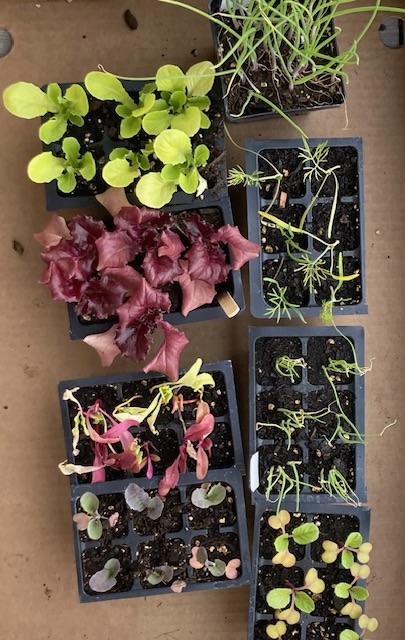
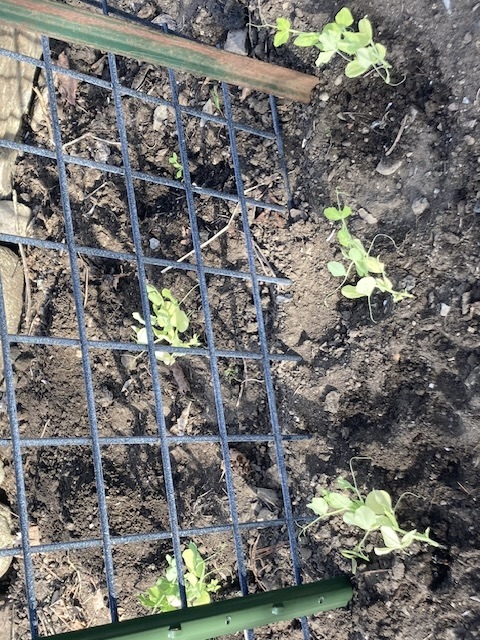
Gaia pushes up the Garlic while cold weather starts go into the ground: Kale, Chard, Lettuce, Pac Choy, Snap Peas, Fennel, Shallots, Scallions, Rosemary, Parsley and Thyme.

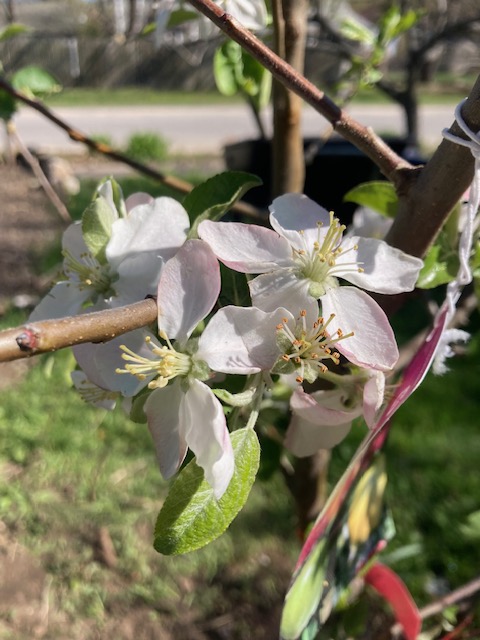
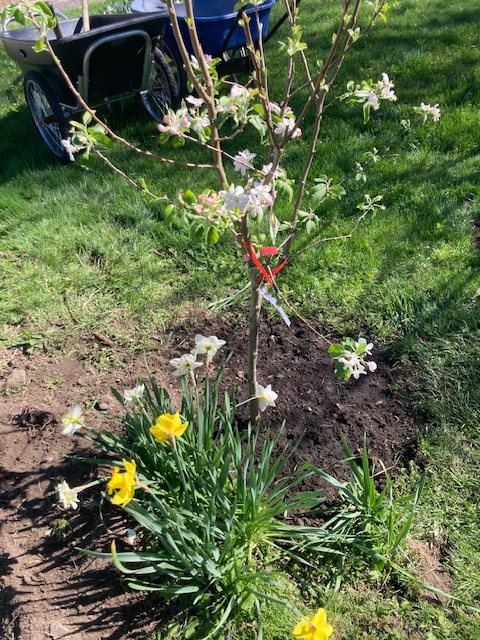
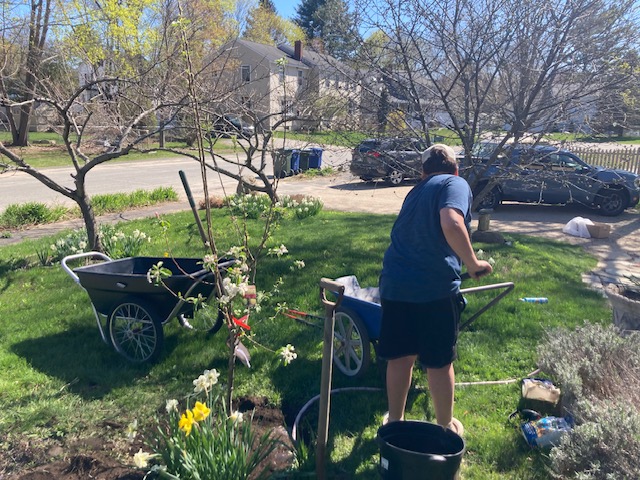
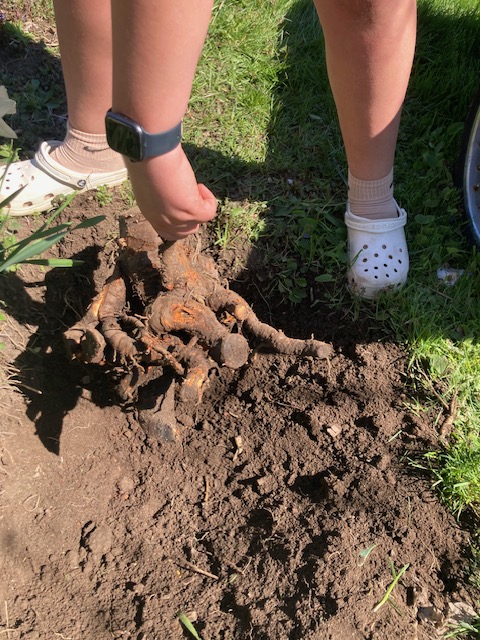
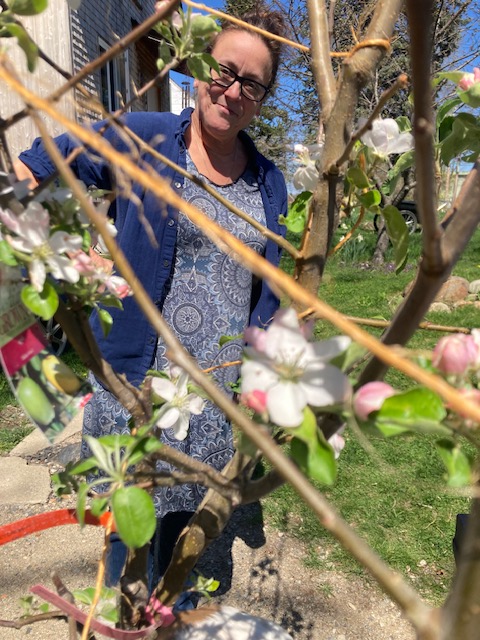
And most importantly, Eve has come to our garden! A 4-in-1 semi-dwarf apple tree, a gift from Grammy Moana to Becca, with four varieties grafted onto the root stock: Fuji, Pink Lady, Honeycrisp, and Ginger Gold. Something for everyone! She joins our two peach trees and a sour cherry tree. I cannot tell a lie, my son cut down our sweet cherry tree last summer, at my instruction. The trunk had a serious gash and its time was ended. Every end is a new beginning, the circle of life, and Eve has taken its place!


The Art Ark
Posted: December 13, 2024 Filed under: Child Centered Activities, Chronicles of a First Time Parent, Portfolio - David's work, What is an Art Farm | Tags: animals, arctic, climate-change, consciousness, Friends School of Portland, poetry, polar bears, spirituality 1 Comment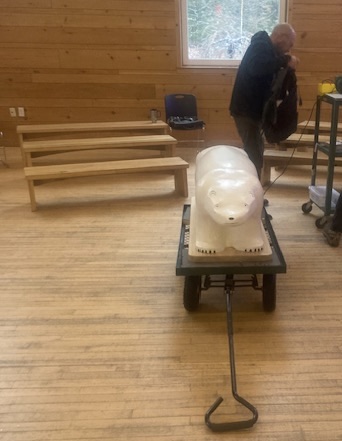
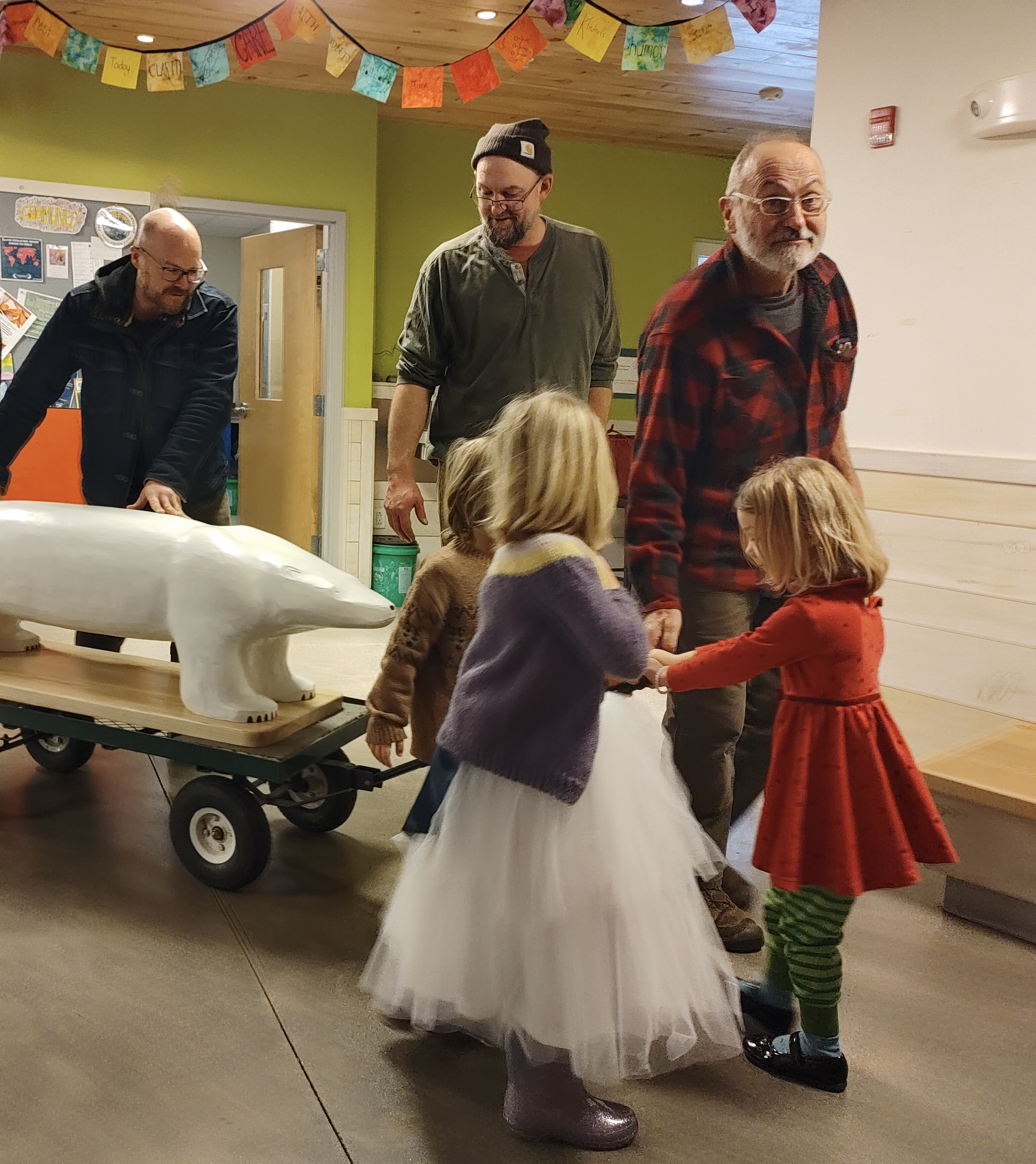
Previously I have told the story of the Sea Monsters, which exhibit came to its end. The monsters were put up for adoption, and then a Friend, a lifelong artist who volunteered for decades in inner city schools, exclaimed, “You need to save the Sea Monsters!!!” She donated funds to cover the costs, which became the catalyst and the adoptions have begun. We delivered Peter the Polar Bear on Wednesday to a full school assembly at the Friends School of Portland.
Historians say Cleopatra’s arrival at the port city of Tarsus to meet Mark Antony, 41 BC, was the most splendid entrance in history. Plutarch described it as “Aphrodite had come to make merry with Dionysus for the good of Asia.” William Shakespeare used a translation of Plutarch to write his tragedy Antony and Cleopatra. Hollywood, 1963, created its blockbuster “Cleopatra,” forever casting Elizabeth Taylor in everyman’s memories. But in the eyes of a Pre-K cherub at the Friends School, the arrival of Peter the Polar Bear must have been every bit as grand. I share here the text of our presentation.
DAVID: I am pleased to introduce Peter the Polar Bear, one of seven Sea Monsters from the Carousel Cosmos, a public art exhibit that had been on display on Portland’s Western Promenade. The exhibit came to an end, and the monsters are now being adopted all around the state. Peter has come to live in the Pre-K room.
Dear Pre-K children, I want you to know that Peter is sturdy and stout. He is a bench.
- You can sit on his back and eat a snack
- You could lie down and take a nap
- If your teacher allowed, you could do a handstand on his head
- Or on your hands and knees, crawl and say “thank you and please…”
- listen carefully, perhaps he will reply…
- Peter is a gentle old Bear.

DAVID: Chris Miller is the polymath maker, the creator of the Carousel Cosmos. He will give a short presentation. But first, everyone please take out your bumblebee thinking caps…tie them on tightly…we will cross pollinate ideas, and with the help of the 8th grade students we will tell a story about circles and sharing.
How does a carousel turn?
STUDENTS: IN A CIRCLE
DAVID: How do planets in outer space move?
STUDENTS: IN A CIRCLE
DAVID: When Quakers gather to meet, how do we sit?
STUDENTS: IN A CIRCLE
DAVID: Peter is made of the wood of ash trees, locally grown. Ash trees grow in the woods here at the Friends School property. The forest teaches us of the circle of life:
STUDENT #1: “Biodiversity” teaches us that the greater the number of species, the more healthy is the ecosystem. Our property is on the border between Eastern Deciduous Forest to the south and Boreal Forest to the north; White Pines and Eastern Hemlocks are dominant on our property’s southern edge, while Hemlocks, Pine, Oak, and Maples surround the building.
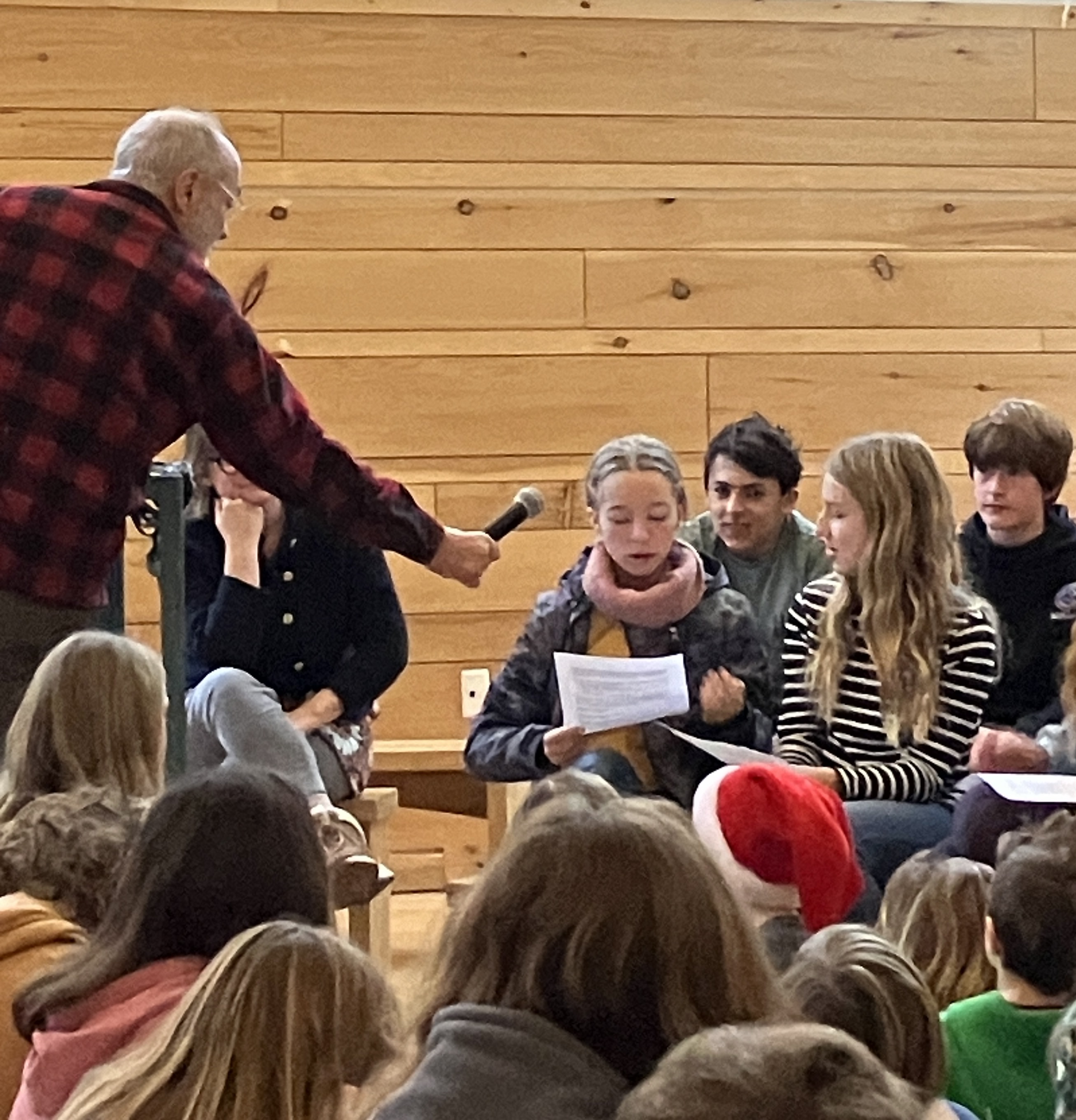
STUDENT #2: American Chestnuts grow in our woods. Although devastated by a blight and almost completely wiped out in America, our Chestnut trees likely are sprouting from the roots of ancient trees that predate the trees currently growing on the land.
STUDENT #3: The white ash and black ash trees grow in the wetland corner of the School property. The emerald ash borer, a jewel beetle native to north-eastern Asia is an invasive insect that feeds on the ash species, decimating these trees. We continue to study this problem.
STUDENT #4: The mycellium network is spread throughout the entire forest, and allows the trees to communicate to each other. Mycelium breaks down organic matter to feed the fungi, plants, and other organisms and connects plants to transfer water, nitrogen, carbon, and other minerals. The strong trees share enzymes with the weaker trees, making the forest healthier.
STUDENT #5: In the circle of life, we can say
- The greater the diversity the healthier the community
- The strong help the weak
- And everyone prospers
- Chris Miller will now speak about more circles and sharing
Chris Miller then stood and spoke about circles and Polar Bears, shared images of his Sea Monsters, how they were designed, and stories of their past. He explained that Polar Bears may have lived where Maine is, but long long ago. A child spoke up and explained pangaea. Chris answered all the children’s questions. The room was silent, in awe as he spoke:
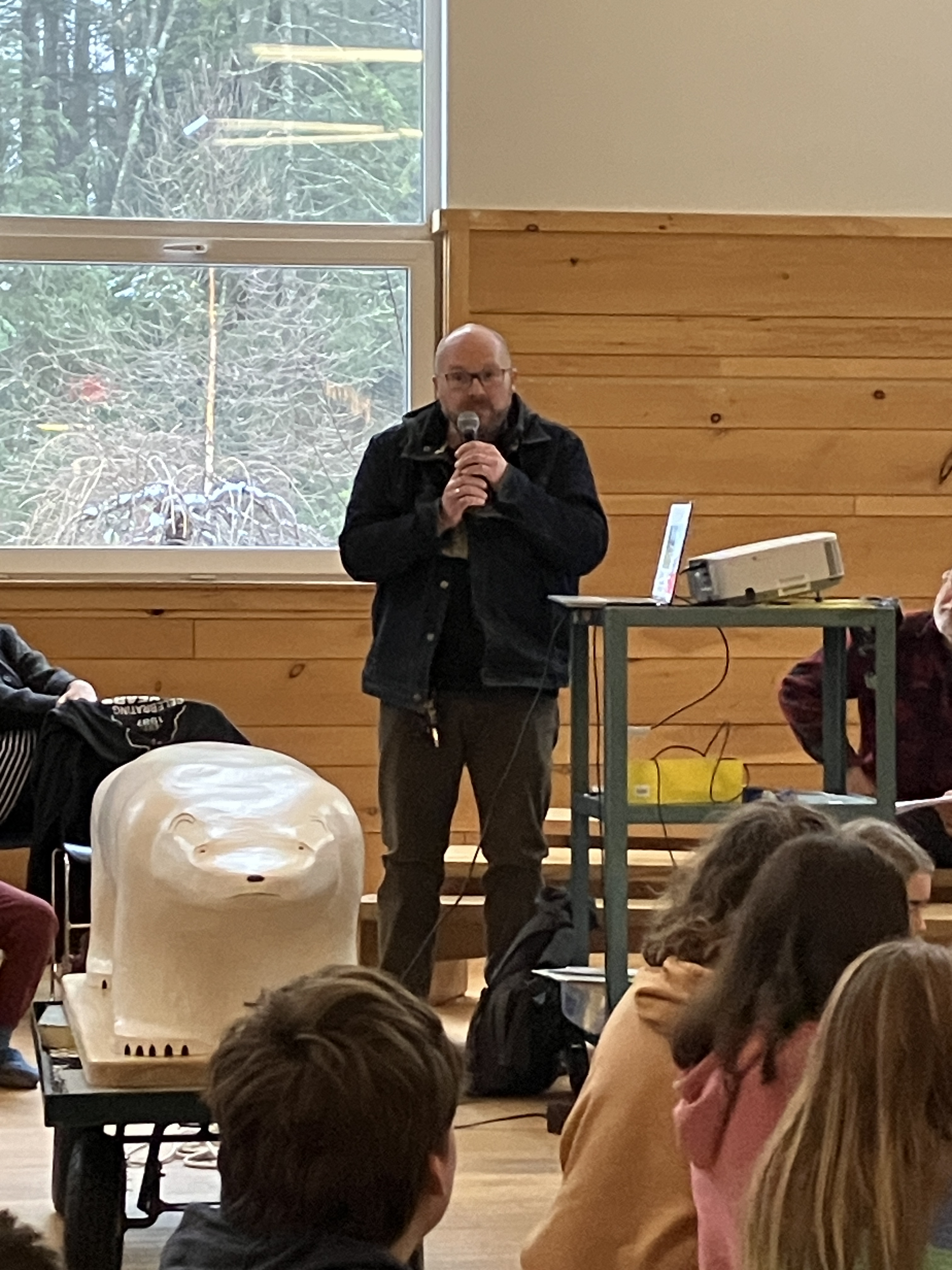
“Gather round. We are all made of the same atoms that the stars are made of too. We are parts of the universe that observe the universe. We are all living, sentient and curious together, here of all places and now of all times. What are the odds? How does it make you feel?
“This carousel is inspired by kindness, adventure, outer space, bedtime stories, dinosaurs and ice cream. It’s inspired by the Western Promenade’s endless views, spectacular sunsets and contemplative atmosphere. It spins the way that the earth spins when the sun sets, in a place where trolleys used to stop, in a small picturesque city with a school community that speaks more than sixty different languages.”
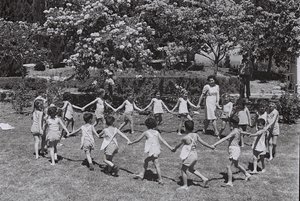
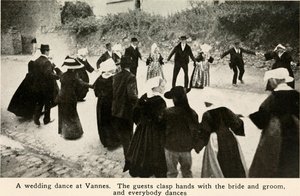
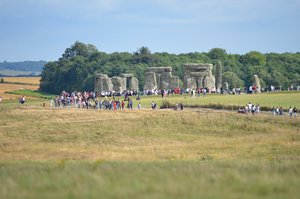
Chris shared images of circles from around the world, over hundreds of years, many people gathered together…




The Pre-K children unveiled a banner they had made:

…and then lead Peter out of the room, down the hall to his new home:


Turning 12
Posted: December 6, 2024 Filed under: Chronicles of a First Time Parent, consciousness, What is an Art Farm | Tags: coming of age rituals, consciousness, hypermasculinity, mental health, mindfulness, religion, spirituality 5 Comments
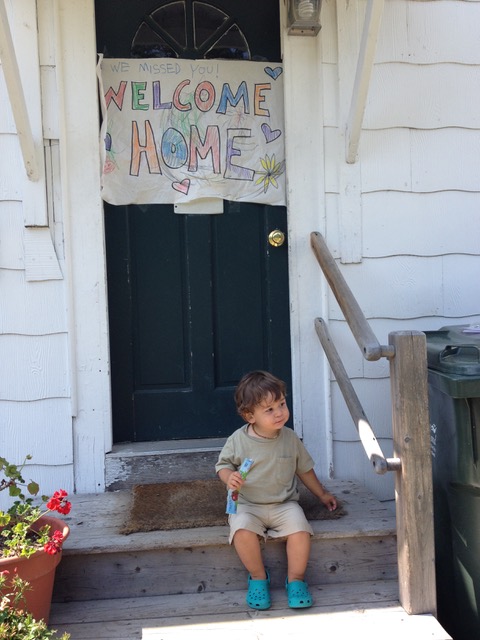
Our son turns 12 next week and I am mulling over rituals to mark this right of passage as our cherub becomes a young man.
I was raised in the Roman Catholic Church and its ritual would have been Confirmation. I have little memory of that, but it appears five hours of community service were required. I do remember wearing white, walking down the aisle and choosing Mark as my name. I chose that name to honor my best friend, who had just suffered a terrible accident in which both his arms were amputated. My choice was one of solidarity.

The Catholic tradition seems neither my nor my son’s path; I find Christian dogma limiting although Christ consciousness tremendously expansive. My faith is a work-in-progress while I am seeking alternatives for raising my son.
In the Amazon, the Satere-Mawe tribe have young men wear a glove filled with bullet ants for 10 minutes. Pushing the threshold of pain is not quite the path I seek. In Ethiopia boys jump over a cow, and in Vanuatu they jump from tall towers with vines tied to their ankles, but manliness, to my mind, is more than a measure of strength and courage.

In the Hebrew tradition the bar mitzvah marks a boy’s coming of age whereupon he begins to assume responsibility for his actions. Responsibility tied to manhood appeals to me. 13 is the age of Bar Mitzvah but to my mind, manhood is not just the number of years spent on the planet. It must be earned through understanding. This ritual, then, is about values and lessons learned.
During the summer my son and I volunteered frequently at the South Portland Food Cupboard. It was an enriching experience, and community service seems relevant in his coming of age. Construction work such as Habitat for Humanity comes to mind. I have heard of Church Youth Groups who undertake community service projects. I am looking for local possibilities.
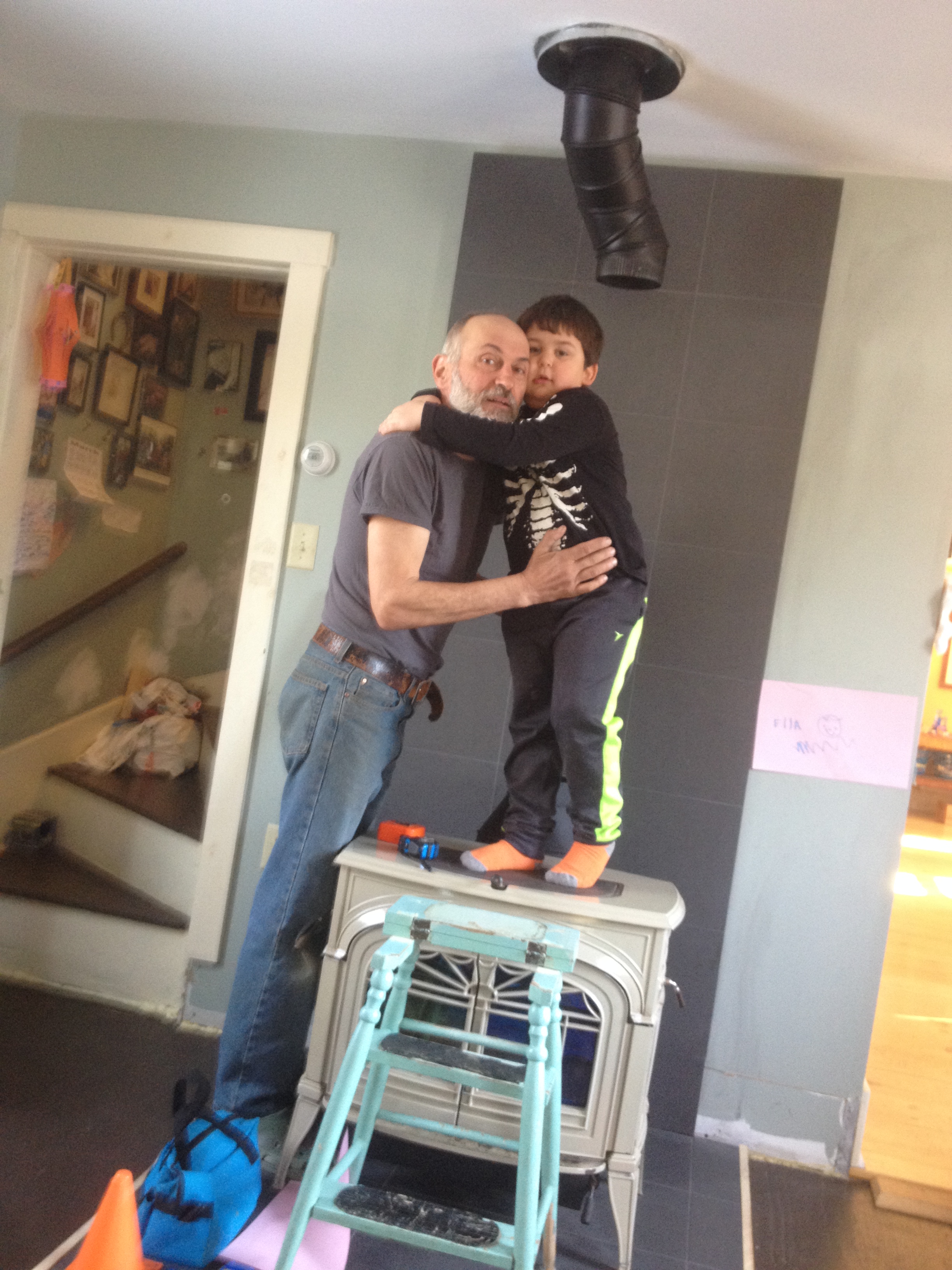
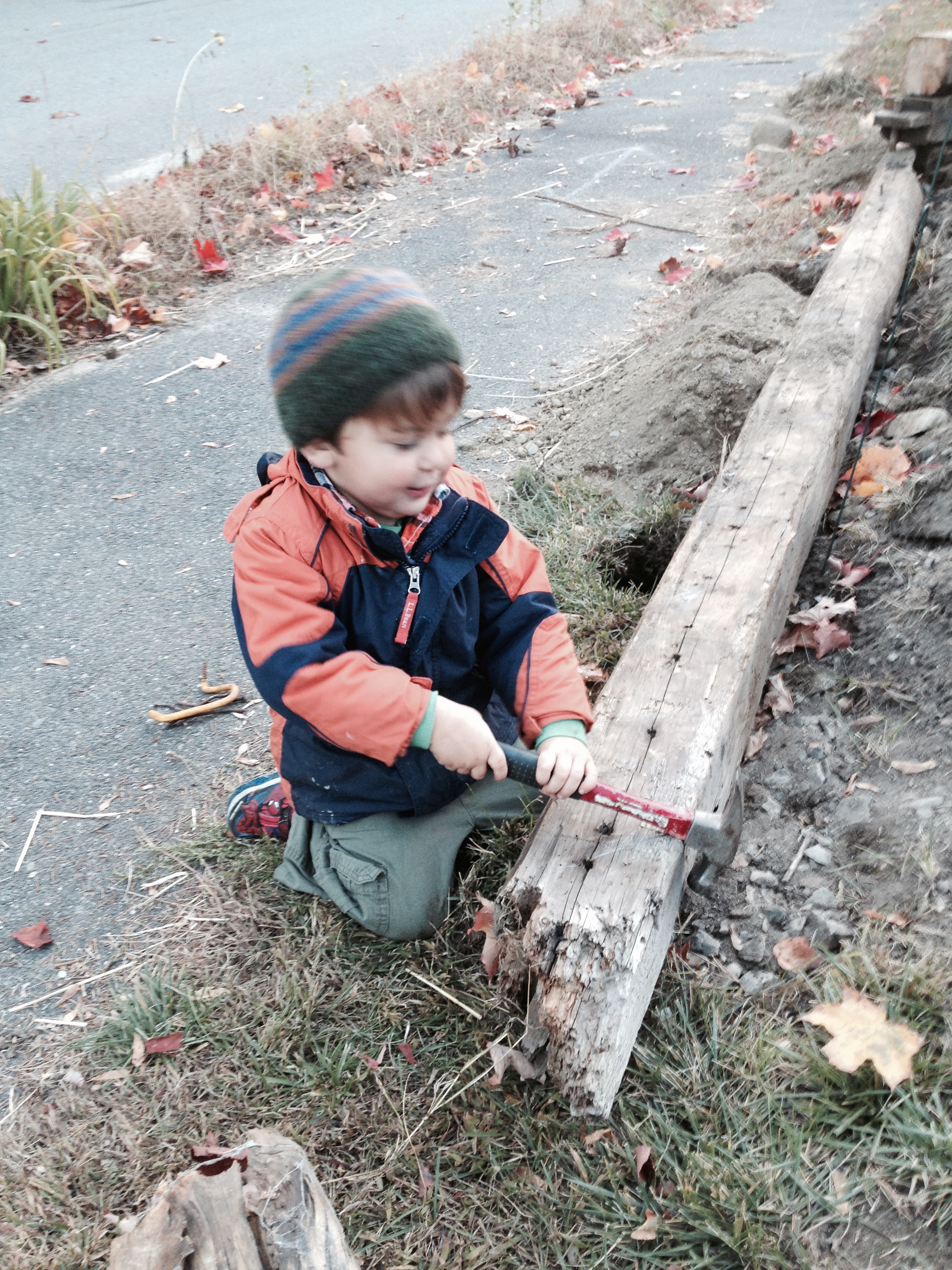
The insights of other men should be another aspect of this plan. My nephew, my son’s cousin, did have a Bar Mitzvah and has agreed to talk with him about the experience, and his own coming of age. A philosopher/carpenter friend has offered to teach more welding, and we may join with a classmate of my son and his father, for a shared experience; working with tools in the act of making. Another friend, whose son also is the same age, is loaning us a lathe for turning wood, and that may be another opportunity for input from other men in the community. My son will benefit from hearing more than my views.
And then there is the topic of sexuality. My Father’s coming-of-age speech to me was as comic as it was lacking. It was haltingly brief, when he simply asked, “Do you have any questions?” Feeling the tension, of course I replied, “No,” whereupon he handed me a paperback book on Catholic morals. I recall the author was aghast at a recent 6th grade school field trip, where the girls wore red lipstick and hosiery. Just blame it on the girls remains the dogmatic view. What I learned of sexuality came from my older Brother and the locker room, but my son deserves better than that.

The pious among us claim that traditional morality teaches the male as the leader, with male-female relationships the only acceptable norm. I regret to inform them that history teaches otherwise. The Christian era has been relatively brief, while Ancient Greece, Rome and China openly practiced homosexuality and pederasty. LGBTQ may arguably be the historical norm and reversion to the mean would seem natural. My son will benefit from thinking not in centuries but in millenia.
The process of writing this has become the means to outline a plan. Among the core values this DIY ritual should include are:
- compassion and cooperation are keys to a healthy masculinity
- no means no, and might does not make right.
- emotional intelligence has greater value than sheer intellectual horsepower
- listen to your heart, not just your head; be curious, ask questions, follow your passion
- practical problem-solving skills provide a grounded self-confidence
- making is hard-wired in our DNA; art predates agriculture, and therefore civilization itself
- Integrity presumes courage; let your word be your bond
- energy follows thought; actions have consequences


The Curve of Consciousness
Posted: September 27, 2024 Filed under: consciousness | Tags: consciousness, philosophy, quantum-physics, rational mind, science, space time continuum, spirituality 2 Comments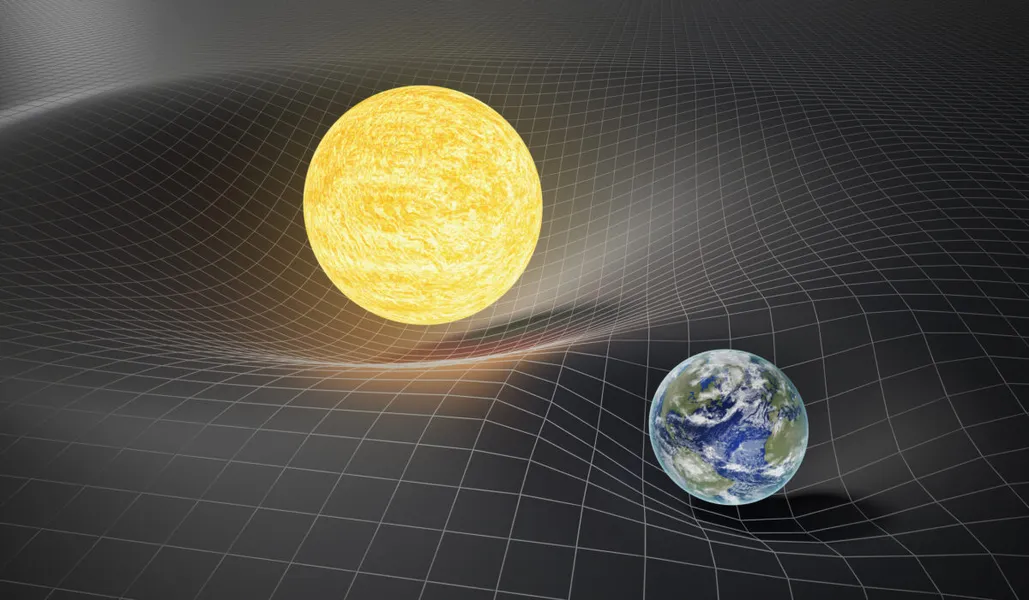
Carlo Rovelli is an Italian theoretical physicist with a sterling gift for writing, in English, clear sentences on complex ideas. In “Seven Brief Lessons on Physics” he traces the arc of modern physics from Isaac Newton’s 1687 straight mechanical worldview where bodies move through space and time passes uniformly to the now confirmed existence of quarks and, in 2013, the discovery of the Higgs boson, a fundamental sub-atomic particle; the most basic building blocks of a curvilinear universe.
Einstein’s milestone 1919 insight was that “the gravitational field is not diffused through space; the gravitational field is that space itself….Space is no longer something distinct from matter – it is one of the “material” components of the world. An entity that undulates, flexes, curves, twists. The whole of space can expand and contract.”
Max Planck had a radical idea that energy was not a continuous flow, but instead was “quanta,” or packets, a/k/a small building blocks. Einstein, again, cracked the code, in his 1905 annus mirabilis papers when he wrote, “…the energy of a light ray spreading out from a point source is not continuously distributed over an increasing space but consists of a finite number of “energy quanta” which are localized at points of space, which move without dividing, and which can only be produced and absorbed as complete units.”
Einstein’s idea was rejected as sheer nonsense, until 1925 when a group of physicists in Copenhagen, lead by Niels Bohr, worked out the mathematical equations behind the theory.
The world of quantum mechanics is not predictable, can only be spoken of in terms of probabilities. Roselli describes this as “…very far from the mechanical world of Newton…the world [of quantum mechanics] is a continuous, restless swarming of things, a continuous coming to light and disappearance of ephemeral entities. A set of vibrations, as in the switched-on hippie world of the 1960s. A world of happenings, not of things.”
In the year of our Lord 2024, physics teaches us that, “There is no longer space that “contains” the world, and there is no longer time “in which” events occur. There are only elementary processes wherein quanta of space and matter continually interact with one another. The illusion of space and time that continues around us is a blurred vision of this swarming of elementary processes.”
I present this as background to an idea that just as space time is a curved dynamic field, so too, by analogy, is human consciousness; in the years going forward our ideas of relationships and fundamental rights may flower in unforeseen dimensions. The “straight and narrow” ethics of Augustine, Calvin and Cotton Mather – to name just a few – may become antiquated just as Greek myth now is seen as mere child’s play.
Whether history repeats or rhymes, the fact is that we have been here before. Augustine of Hippo, the towering Church Father, wrote circa 400, “…it is not necessary to probe into the nature of things, as was done by those whom the Greeks called physici…It is enough for the Christian to believe that the only cause of all created things, whether heavenly or earthly, whether visible or invisible, is the goodness of the Creator, the one true God; and that nothing exists but Himself that does not derive its existence from Him.” The Dark Ages followed when the Western Roman Empire fell, trade became stagnant, the Black Plague ravaged the land, scientific thought was discouraged.
Come the sixteenth century, a Polish mathematician calculated the rotations of the planets, and confirmed that the Sun, in fact, is the center of our galaxy. The mathematician, also a Catholic Canon, was savvy and prefaced his work “To The Most Holy Lord, Pope Paul III” begging indulgence, “How I came to dare to conceive such motion of the Earth, contrary to the received opinion of the Mathematicians and indeed contrary to the impression of the senses, is what your Holiness will rather expect to hear. So I should like your Holiness to know that I was induced to think of a method of computing the motions of the spheres by nothing else than the knowledge of the Mathematicians are inconsistent in these investigations.” Copernicus endeavored only to check the mathematics but his “Book of Revolutions” changed the course of history.
Galileo, equally brilliant, more bold and less savvy, championed and then scientifically proved the Copernican heliocentrism, for which he was tried by the Roman Inquisition and found “vehemently suspect of heresy.” Galileo is called the father of observational astronomy, classical physics, the scientific method and modern science. Popes Paul III and V are mere footnotes in history.
The flowering of Renaissance humanism was in full swing in those times, and consider the intellectual and cultural advances concurrent with the scientific revolution: Leonardo da Vinci, Michelangelo, Raphael were active in their studios; Erasmus and Descartes were thinking; Shakespeare and John Milton wrote epic poems and plays; Johannes Kepler and Isaac Newton advanced scientific thought. Whether science was the cause or effect, the fact is that the breadth of thought – what I call consciousness – expanded wildly during this period.
So what then might our “curve of consciousness” bring? Consider these contemporary facts:
- Science has proven that trees communicate and share rescources among themselves via the underground “mycorrhizal network” transferring water, nitrogen, carbon and other minerals; the stronger helping the weaker to survive. Peter Wohlleben has called this network “the woodwide web” allowing trees to communicate.
- Researchers at MIT and other universities are beginning to use Artificial Intelligence to decode the language of humpback whales “with a confidence level of 96 percent.”
- In 2008 the Republic of Ecuador drafted and approved a new constitution recognizing the rights of nature and ecosystems, making them legally enforceable. The preamble states: “RECOGNIZING our age-old roots, wrought by women and men from various peoples, CELEBRATING nature, the Pacha Mama (Mother Earth), of which we are a part and which is vital to our existence, INVOKING the name of God and recognizing our diverse forms of religion and spirituality, CALLING UPON the wisdom of all the cultures that enrich us as a society, AS HEIRS to social liberation struggles against all forms of domination and colonialism AND with a profound commitment to the present and to the future, Hereby decide to build…”
To my mind the coming flowering of consciousness will celebrate unity in diversity. Anthropocentrism may give way to an acceptance that all life is one. Genesis 1:26 where “…God said, Let us make man in our image, after our likeness: and let them have dominion over the fish of the sea, and over the fowl of the air, and over the cattle, and over all the earth, and over every creeping thing that creepeth upon the earth” would seem a shibboleth soon to fall, perhaps replaced and finally embraced by Romans 13:10 “Love your neighbor as yourself. Love does no harm to a neighbor. Therefore love is the fulfillment of the law.”
To all of this, I quote Martin Luther King, “…Free at last, free at last, thank God almighty we are free at last.”
_____________________________________________________________________________
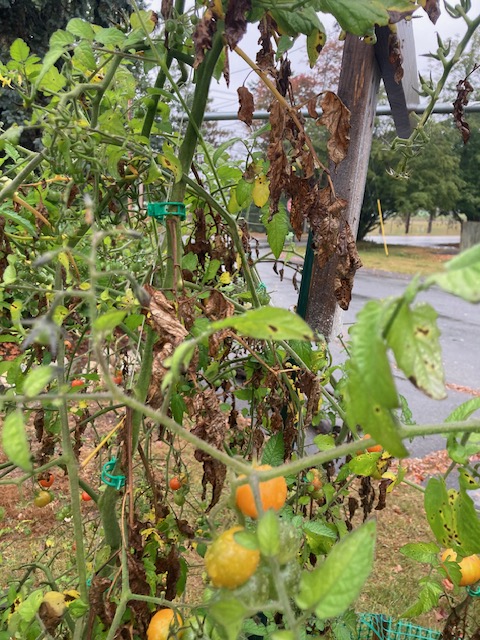
The radiant reds and orange of summer subside, while brown and sienna now dominate the garden. Beans are ripening. We move closer to the Solstice.





Greater Things
Posted: July 26, 2024 Filed under: Art & Healing, consciousness | Tags: consciousness, rational mind, spirituality 2 CommentsAs a child, raised Roman Catholic, I went to church every Sunday, and to confession on the Holy Week high holidays, plus a few times each year. My sins at most then were venial, not mortal, certainly never cardinal, and, as I stammered for words to describe my offense, at my earthly Father’s instruction, I would take to my knee and ask forgiveness for my sins.
As a University student, I read the New Testament in Koine Greek. My interest in the bible is as literature, not as dogma; I do not read the Bible, but it is important to know, if only as the lingua franca among the 2.4 billion Christians of this world.
My Mother quoted Matthew 22:37-38 as the pillar of the faith, which she paraphrased as “Love and you have fulfilled the law.” A fine path, indeed, and I am thankful for that guidance. To my mind, and in my experience, however, John 14:12 speaks to the core:
“Verily, verily, I say unto you, He that believeth on me, the works that I do shall he do also; and greater works than these shall he do; because I go unto my Father.”
Greater works than these?
As a Federalist approaches the law, let us read this sentence literally, as the Founding Father (sic) meant by his own words. Given that the Gospel of John opens “In the beginning was the word…” we do well to begin with the grammar.
Yeshua, the street preacher, spoke either koine (marketplace Greek) or Aramaic; his name is a late form of the Biblical Hebrew “Joshua,” which is spelled Iesous in Greek and Jesus in Latin. The gospels were written in the Koine because that was more popular than Aramaic, thus reaching a wider audience and so approximately 100-years after his death Matthew, Mark, Luke and John wrote Yeshua’s story in Greek, later translated into Latin, known as The Vulgate; in 1522 William Tyndale translated the work into English (for which in 1536 he was strangled and then burned at the stake) but his work informed the translators of the King James Bible, a masterpiece of writing, published in 1611. It is this version from which I here quote.
The street preacher begins with the hortative clause “Verily, verily, I say unto you,” a teacher’s exclamation, for emphasis, to his listeners.
The subject is “he,” the object is “the works,” and “do” is the verb, in the subjunctive mood. Rarely used in contemporary English, the subjunctive is critical here; the indicative mood states facts, certainty, while the subjunctive mood – “shall do” – expresses potential. In other words, the avatar has opened the prospect of free will, the freedom to choose, challenging the listener to what we could do, rather than what we will do.
The sentence has three subordinate clauses, the first of which – “that believeth on me” – expands the subject phrase. “That I do” refines the direct object, while the third – “because I go” – is causative. Grammatical subordination is not necessarily logical subordination; were his going to the Father the sole cause of our salvation, then our acts would be secondary, almost like a “get out of jail free” card. Faith must be active, not passive, and emphasis here is upon doing; the fact of the matter remains the cause is subordinate to the acts, the doings, to the potential of the believer.
“Greater works than these” is an independent clause expanding that which is done – the miracles, from the Latin word miraculum, meaning “object of wonder” – which every parochial school child knows to include (but are not limited to) walking on water, feeding the 5,000, raising Lazarus from the dead.
The sentence is complex, written in hyperbaton, a rhetorical figure that inverts the normal order of words for added emphasis. But if we focus upon the subject, verb and object – like bowling pins lined up for a strike – it makes plain “He that believeth…shall do…the works, and greater works than these.”
Judge next, as an activist might rule from the bench, interpreting the text in a contemporary context. Carl Jung pertains here, and the subordinate clause of causation “because I go unto my Father” must then refer not to an anthropomorphic God, but to the wise old man, the archetypal male of the collective unconscious, a universal archetype of wisdom and insight. Jung believed every male psyche has a female aspect (anima) and every female psyche a male aspect (animus); so then “go unto my Father” is a personification of the wise masculine spirit within the balanced whole of higher consciousness, which is, to my mind, the “Christ” consciousness, the “anointed” one.
As children we learned English grammar. As adults can we learn to expand our consciousness? Who among us shall be so meek as to act upon, rather than merely to believe in, the miracles?
To speak of walking on water, of healing the sick, or raising the dead is to confront the laws of classical physics, to confound the rational mind, to go beyond the prosaic, to enter the realm of poetry.
Hard pressed to imagine such a state of enlightened being, we do well to ponder the words of the God-intoxicated Persian, the poet Hafiz, who wrote, circa 1350, “I Have Learned So Much”:
I
Have
Learned
So much from God
That I can no longer
Call Myself
A Christian, a Hindu, a Muslim,
A Buddhist, a Jew.
The Truth has shared so much of Itself
With me
That I can no longer call myself
A man, a woman, an angel
Or even pure
Soul.
Love has
Befriended Hafiz so completely
It has turned to ash
And freed
Me
Of every concept and image
My mind has ever known.
[NOTE: My grammatical exegesis here has been refined with the help of my dear friend, Bob Ultimo. A classmate in Latin, we read together in the dark dinghy basement of Kresge Hall, Northwestern University 1983-85. He stayed the course, gained a Masters in Latin, taught for many years the Trivium (grammar, dialectic, rhetoric), currently teaches and writes on grammar and writing. A man in his prime, Magister Ultimo is a master of his craft. Given there is “a mysterious link between grammar and the mind” his clarity of verbal construction, keenness of thought, and deft wording are well worth following at writingsmartly.com. Thank you, Bob. Thank you, very much.]
* * * * * * * *
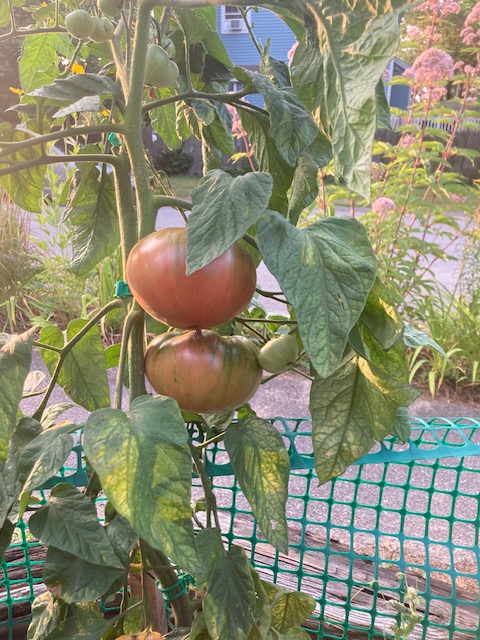
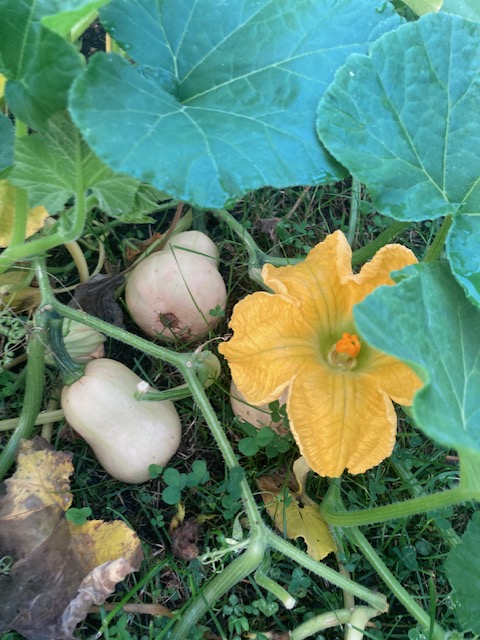
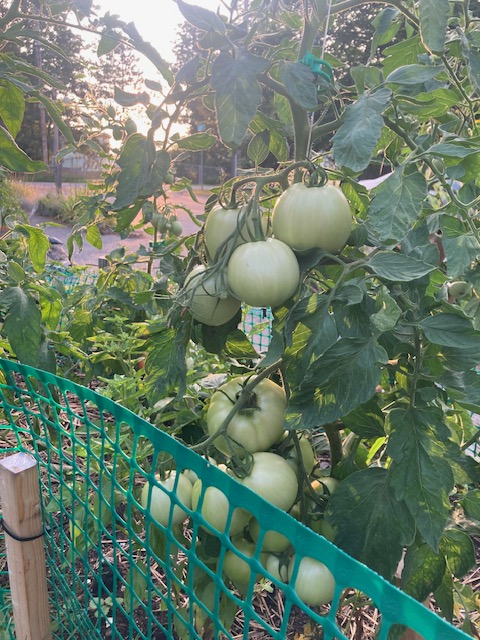
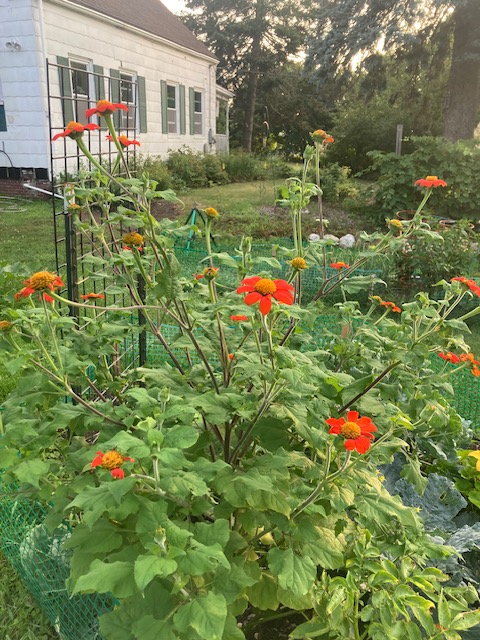
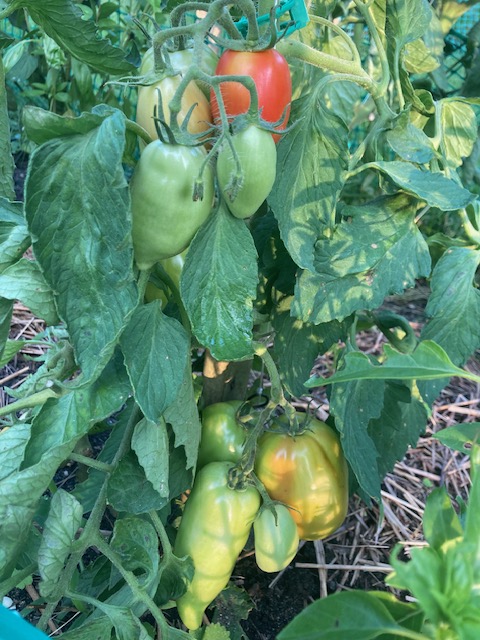
In late July, the fruits ripen and the harvest has begun.





The Patriarch
Posted: June 1, 2024 Filed under: consciousness, What is an Art Farm | Tags: consciousness, spirituality 1 Comment
It is generally considered there were six cradles of civilization on Planet Earth: Mesopotamia; ancient Egypt, India and China; the Caral-Supe of coastal Peru, and the Olmec of Mexico.
Mesopotamia, known as the Fertile Crescent, is significant as the location of the Neolithic Revolution circa 10,000 BCE, from which arose the invention of the wheel, the planting of cereal crops, the development of cursive script, mathematics, astronomy and agriculture.
The Kingdom of Sumer, situated between the Tigris and Euphrates rivers, is known for its innovations in language, governance, and architecture; the Sumerians are considered the creators of civilization as modern humans understand it.
The Akkadian Empire followed, reaching its political peak between the 24th and 22nd centuries BCE and generally regarded as the first empire in history.
The Babylonian empire arose circa 1894 BCE and became the dominant power under Hammurabi, an extraordinary leader who gave himself the title “King of Babylon, Sumer and Akkad and of the four quarters of the world.” Most well known for his detailed legal code, part of which remains on display in the Louvre, Hammurabai ranks highly among the great lawgivers of history. But he is not among the Patriarchs.
In southern Mesopotamia, maybe in the city of Camarina, or likely in the city of Ur, although most commonly believed to have been Ur of the Chaldeans was born, circa 1951 BCE, a male named Abraham, who once grown, heard the divine voice command, “And I will make of thee a great nation, and I will bless thee and make thy name great and thou shall be a blessing.” In an empire of polytheism, Abraham followed a singular voice and became the Patriarch of monotheism.
Abba Solomon Eban, the author of “My People: The Story of the Jews” tells the story of the Jewish odyssey as “…not a chronicle of remote, superhuman warriors. It does not resemble the vision a resplendent heroic world such as the Greeks and other ancient peoples saw as their original state. …In subsequent literature and memory the Hebrew nation looked back to its first ancestor as the prototype of two virtues: goodness and warmth in human relations and utter resignation, beyond mere humility, to the divine will. Both Christian and Muslim traditions accept the historic authenticity of Abraham and admit him as their spiritual ancestor. But to the Jews he is the first and unique Patriarch, the model of Hebrew excellence. Inspired by his covenant and welded together by the memories of three generations descended from his loins, the Children of Israel, precariously settled in Egypt, cross the frontier into established history in the middle of the second millennium B.C.E.”
Ancestry is important, and the loins of Abraham are central both to Judaism and to the Christian faith. Biblical tradition holds that the Twelve Tribes of Israel are the descendants of Jacob, descended from Abraham. Chartres Cathedral, considered the high point of French Gothic art, has stained glass windows on the west wall showing the genealogy of the Royal House of David, in the form of a tree which springs from the loins of Jesse – he, a descendant of Jacob, and thus of Abraham – to reach its flowering in the carpenter’s son from Nazareth.
There is neither historical nor archeological evidence of Abraham. More than one-hundred years of searching in the desert have produced no evidence of this man considered the founding father of the relationship between the Jews and God, the spiritual progenitor of all Christians and Eastern Orthodox, and in Islam, a link in the chain of prophets beginning with Adam and culminating in Muhammad.
With more than 2.6 billion Christians and Eastern Orthodox plus 1.9 billion Muslims plus approximately 15.2 million Jews, more than half of the world’s population regard Abraham as a central pillar of their faith. And Abraham’s heirs – whether biological or spiritual – have often been at war, among themselves.
War is of this world, not of the divine. Constantine, of In Hoc Signo Vinces fame, converted to Christianity, while commanding the largest Roman army. He hired as tutor to his son a philosopher named Lucius Caecilius Lactantius, who taught that the goals of any political power were always, “to extend the boundaries which are violently taken from others, to increase the power of the state, to improve the revenues,” by latrocinium, which in Latin means “violence and robbery.”
The Nazarene, avatar of consciousness, Abraham’s grandson – the 54th as counted by Luke or the 43rd as per Matthew – Jesus taught, “Render unto Caesar the things that are Caesar’s, and unto God the things that are God’s.” The Holy Roman Emperor was a Caesar, and the teachings of latrocinium were passed down. The Empire would rule for more than 1,000 years, until the 1800s.
Pope Urban called for the First Crusade, in 1096, to slay the infidels in the Holy Land. With alacrity his orders were carried out, thirty thousand people killed in three days. Raymond of Aguilers described it, “Piles of heads, hands and feet were to be seen. Men rode in blood up to their knees and bridle reins. Indeed it was a just and splendid judgment of God that this place should be filled with the blood of unbelievers.”
Robert the Monk, an abbot in France, argued the Muslims were a “vile and abominable race,” “despicable, degenerate and enslaved by demons,” “absolutely alien to God,” and “fit only for extermination.”
Many of the Knights stayed closer to home, in Europe, as Abba Eban writes, “ ‘Kill a Jew and save your soul’ became the shortcut taken by many a zealous Crusader. A small number of Jews accepted baptism to remain alive; the majority refused, and died.”
To the slaying, the Muslims responded in kind, an eye-for-an-eye, and Holy Jihad began. Between 1096 and 1272 there were a total of nine Crusades, until 1291 when the Egyptian Mamelukes drove the Crusaders out of the Holy City.
The story of Abraham has played out over more than 120 generations, and one is tempted to wonder for how many more generations will the Righteous continue their brutally horrid and inhumane fight? We would do well to contemplate Abraham’s cardinal virtues: “goodness and warmth in human relations and utter resignation, beyond mere humility, to the divine will.”
Be like a cat
Posted: May 25, 2024 Filed under: Chronicles of a First Time Parent, consciousness, What is an Art Farm | Tags: consciousness, rational mind, spirituality Leave a comment
Back in the aughts, when I lived in Chicago, I studied Qigong with Dr. Paul Hannah. In Chinese, Qi means “air” or “breath” but in a metaphysical sense it is “vital energy.” Gong means cultivation. Qigong is the cultivation of that vital energy, as a non-martial art.
Dr. Hannah had grown up in the inner city projects in Chicago, and learned Tai Chi – the Chinese martial art – in order to defend himself, and thus avoid joining a gang; his ability to defeat the gang members in combat was his protection and way out of the projects. He became a board-certified psychiatrist, as well as a Tai Chi Master, with additional studies in acupuncture, Qigong and energy healing. https://www.hannahsholistichealing.com/
During my sessions he would have me stand in a half-crouched position, arms outstretched at shoulder-height in a circle, my finger tips almost touching, for an unbearably long time. He would leave the room, and later return with hot herbal tea. I believe he was training me to empty my mind and become aware of something else.
On the wall of the studio was a poster of a black panther, gazing forward, directly into the camera. He explained the concept of observing without becoming engaged, of being present with neither future nor past, neither time nor space. Dr. Hannah told me that poster had gotten him through college.
I did not then know the idea of mindfulness, but would now understand his instructions as my introduction. Thich Nhat Hanh has written, “When I eat an orange, I can eat the orange as an act of meditation. Holding the orange in the palm of my hand, I look at it mindfully. I take a long time to look at the orange with mindfulness. Breathing in, there is an orange in my hand. Breathing out, I smile at the orange.”
During that same period, I practiced Qigong with a practitioner of Chinese medicine, including acupuncture. During one session at his office, he introduced me to a colleague from China, who was considered a Master of Qigong. I was told this man had not eaten solid food for many years; he drank liquids, but metastasized the inner chi for his sustenance. Such a concept is beyond both my comprehension and experience, however, I was and remain willing to suspend disbelief. Perhaps such is possible, and I should not cut myself off from such a possibility. We have entered the realm of the suprarational.
Here in South Portland, Ryan Nitz is an acupuncturist with a community clinic. He treats many patients onsite at his clinic and, quite interestingly, has begun treating patients via remote. I do not mean by a tele-health zoom session, but rather, from his office in South Portland, Maine he treats patients in, say, Kansas or California. He does not use needles, but instead the “subtle energies” to manifest healing in the patient. https://www.mainecenterforacupuncture.com/
Essentially this is a form of Reiki, the Japanese form of energy healing; “rei” means universal and “ki” means life energy. Clearly now, we are beyond the bounds of western allopathic medicine. As Dr. Paul Hannah taught me, “be like a cat,” suspend disbelief and calm the mind while focusing on the energy present.
At the vanguard of energy, one meets some mighty cool cats!

The Alpha and the irrational
Posted: May 11, 2024 Filed under: Art & Healing, Farming off the Farm, What is an Art Farm | Tags: consciousness, rational mind, spirituality 1 CommentIf one subscribes to the Great Man Theory, then history is defined by the deeds of great men; highly unique individuals whose attributes – intellect, courage, leadership or divine inspiration – have a decisive historical effect. Thomas Carlyle developed the theory, and wrote:
“Universal History, the history of what man has accomplished in this world, is at bottom the History of the Great Men who have worked here. They were the leaders of men, these great ones; the modelers, patterns, and in a wide sense creators, of whatsoever the general mass of men contrived to do or to attain; all things that we see standing accomplished in the world are properly the outer material result, the practical realization and embodiment, of Thoughts that dwelt in the Great Men sent into the world: the soul of the whole world’s history, it may justly be considered, were the history of these.”
Pythagorus of Samos, the ancient Ionian Greek philosopher and polymath, certainly ranks among these alpha males. He has been credited with mathematical and scientific discoveries, including the Pythagorean theorem, Pythagorean tuning, the five regular solids, the Theory of Proportions, the sphericity of the Earth and the identity of the morning and evening stars as the planet Venus. His ideas are ubiquitous: Plato’s dialogues exhibit his teachings, every high school student memorizes his theorem, and every carpenter or engineer uses the 3-4-5 triangle to square a room.

He saw beyond the material realm, and further developed ideas of mysticism. His “metempsychosis” – which means the “transmigration of souls” – holds that every soul is immortal and, upon death, enters a new body. He also devised the doctrine of musica universalis– literally universal music, also called music of the spheres or harmony of the spheres – which holds that the planets move according to mathematical equations and thus resonate to produce an inaudible symphony of music. The 16th century astronomer Johannes Kepler further developed this idea, although he felt the music was not audible but could be heard by the soul.
Aristotle characterized the musica universalis as follows:
“…since on our earth the motion of bodies far inferior in size and in speed of movement [produce a noise]. Also, when the sun and the moon, they say, and all the stars, so great in number and in size, are moving with so rapid a motion, how should they not produce a sound immensely great? Starting from this argument and from the observation that their speeds, as measured by their distances, are in the same ratios as musical concordances, they assert that the sound given forth by the circular movement of the stars is a harmony.”
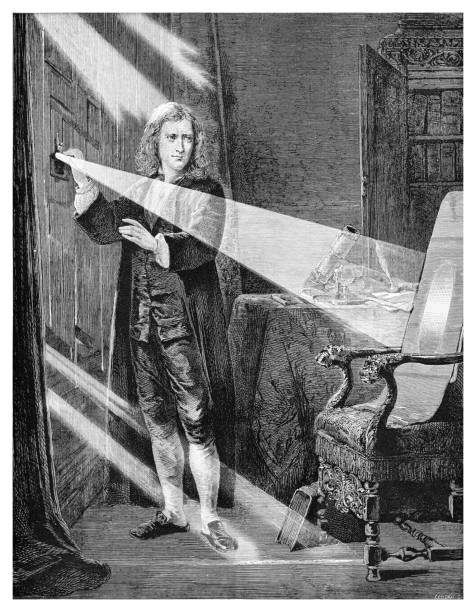
Clearly, Pythagorus was a big thinker, and his ideas influenced Isaac Newton, another of the alpha males. Newton – who established classical mechanics, invented calculus, formulated the laws of motion and universal gravitation – was a paragon of the rational scientific mind. Newton was a Great Man, by definition. He also was a leading alchemist.
In its purest form, alchemy is concerned not with turning base metals into gold, but as a symbolic language guiding the transmutation of the physical self into the ascendent consciousness of the anointed. Of an estimated ten million words of writing in Newton’s papers, approximately one million – 10% – deal with alchemy. This was more than a passing interest.
John Maynard Keynes, the Cambridge economist who restructured the post-WW2 global financial system – easily ranking him among the Great Men – had this to say about Newton:
“Newton was not the first of the age of reason. He was the last of the magicians, the last of the Babylonians and Sumerians, the last great mind which looked out on the visible and intellectual world with the same eyes as those who began to build our intellectual inheritance rather less than 10,000 years ago. Isaac Newton, a posthumous child born with no father on Christmas Day, 1642, was the last wonderchild to whom the Magi could do sincere and appropriate homage.”
Let us pause and consider: just as Pythagorus explained the physical realm he also saw celestial harmony beyond the physical; Newton mastered not only scientific thought but was a leading alchemist of his day. Two of the paragons of the rational alpha mind had secret lives as mystics.
The Western intellectual tradition is based entirely on the rational, and anything beyond the rational is defined by the negative form – “irrational” – which is decidedly pejorative. As wrote Carl Jung, ““Everything that the modern mind cannot define it regards as insane.” Pythagorus was denigrated as a cult leader. During Newton’s life, the English Crown considered alchemy to be a heresy, punishable by death. The burning of his alchemical writings perhaps was not an accident.
What if we expand our concepts and consider connections not defined by measurable facts? What if we begin to use the term “supra-rational”? No less than Albert Einstein – the modern paragon of rational thought – was compelled in this regard. In 1930 he published an essay “Religion and Science” which described the sense of awe and mystery which he termed a “cosmic religion” of “superpersonal content.” Einstein counseled to move beyond the anthropomorphic concept of god to “the sublimity and marvelous order which reveal themselves in nature … to experience the universe as a single significant whole.”

For Einstein, “science without religion is lame, religion without science is blind.” He said “God is a mystery. But a comprehensible mystery. I have nothing but awe when I observe the laws of nature. There are not laws without a lawgiver, but how does this lawgiver look? Certainly not like a man magnified. …some centuries ago I would have been burned or hanged. Nonetheless, I would have been in good company.”
The “Great Man Theory” was advanced in the 19th century Victorian era. In the 21st century we need to move forward, and expand the scope, even beyond gender, to all life, beyond the “either/or” and toward the “both/and” mindset.
I should like to propose that the “Great Man” be replaced by the “Great Soul,” and that we look beyond the rational, the material, the physical, and embrace the whole cloth, the harmony and music of “our higher angels,” the music of the spheres, “to experience the universe as a single significant whole.”
In fact, this “Great Soul” is in use; in the Hindu language, “Mahatma” from the Sanskrit word “mahātman,” literally means “great-souled.” Mahatma Ghandi is but one exemplar of this path.
The seeds of a new future surround us. We can be hopeful.
 an Art Farm