Tiny Cathedral
Posted: December 5, 2025 Filed under: Permaculture & Home Renovation, Portfolio - David's work 1 Comment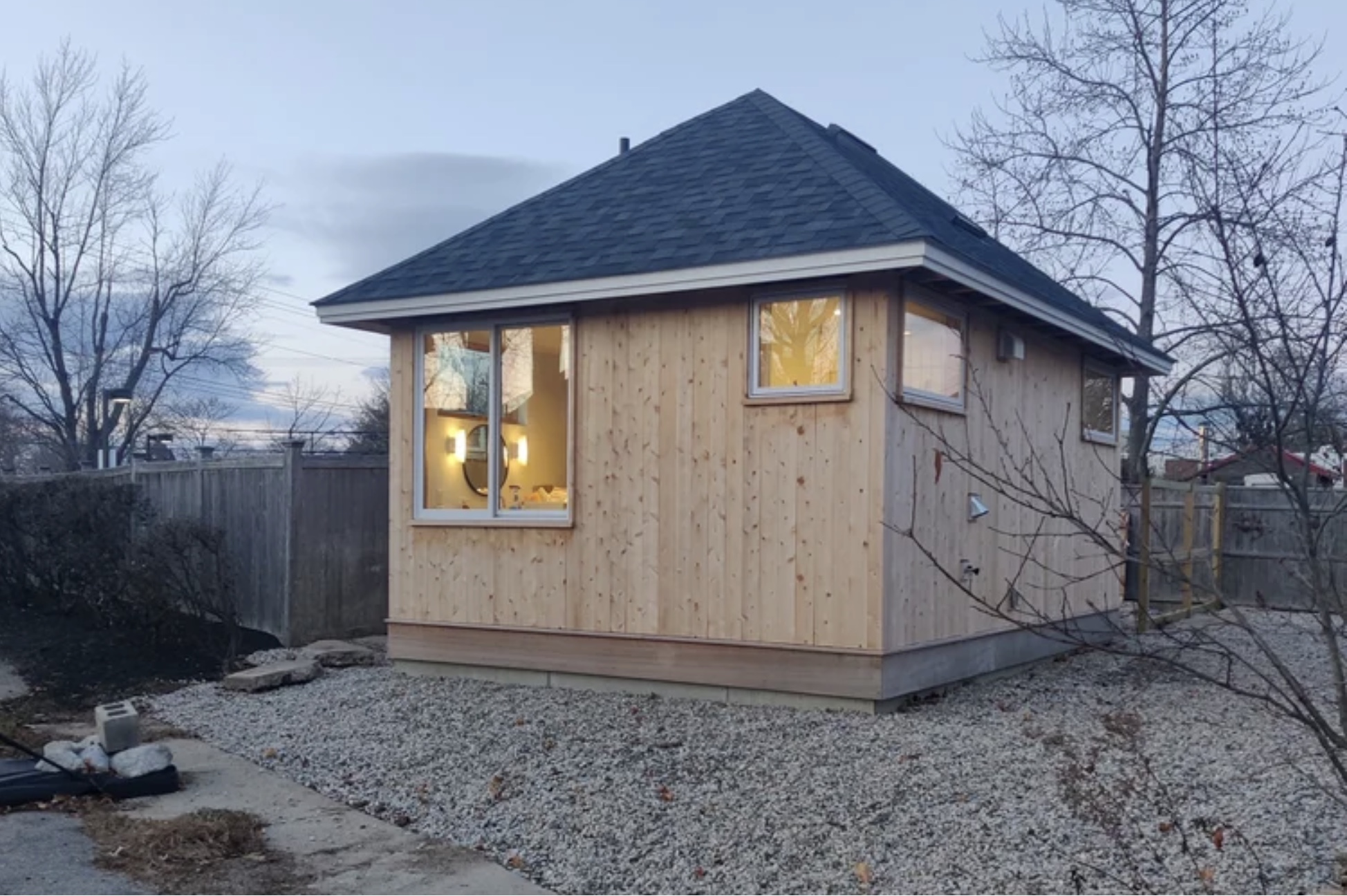
Not long ago we built a tiny cathedral at the top of Meetinghouse Hill. The hill was so named back in 1733 when the Purpooduck meeting house was built. “The old Meeting House was a large, square, two-storied, unpainted building, without a tower, with a porch on the front end which served as an entry. There were two outside doors, reached by two steps which ran the entire length of the porch. It was a great barn-like looking structure. The pulpit was an elaborate affair. It stood on one post elevated about eight or ten feet above the floor. It was reached by a flight of winding stairs.”
Our tiny cathedral was, in prosaic terms, the conversion of a non-conforming 106-year old garage into an apartment for a Mother-In-Law who lives in Switzerland. “Non-conforming” is a term of art of the Code Enforcement Office for a legally established building that no longer meets the current zoning laws. You can renovate but can neither expand nor replace those structures. There was not an inch to spare.

The 106-year old garage had serious issues but exactly one positive: it could provide the Mother-In-Law with the privacy of a 220 square foot bedroom “suite.” We had a chance to make something majestic. In order to effect this transformation we jacked up and moved the building off its existing slab, dug down to excavate and pour new stem walls with footings then used a crane to lift the garage back into place, exactly where it had been.

The Copp Brothers from Cumberland accomplished this Herculean task. For three generations they have been jacking and moving buildings and, like the “Ghostbusters,” the Uncles and Nephews arrived in a converted ambulance filled with tools of their trade. In less than 90 minutes they rolled the structure onto the street and onto the side yard. The crane lift back took less time.
The Professor – who currently teaches my son science by means of welding and small engine repair – was the mastermind of the project. When he showed up we got to work on the carpentry, plumbing, insulation, heating, roofing and siding. The electric work was straightforward, but the plumbing and bringing water to the garage was a challenge. Thankfully, the professor owns every tool known to mankind and has consummate skill using them all. No problem was insurmountable.
Because the space was limited, we added insulation to the outside of the building. The building remained exactly on its original footprint, and we expanded outward and upward, adding recycled foam insulation – 3” to the walls and 6” on the roof – to create a weathertight envelope that exceeded the new energy efficient Code requirements.
The homeowner, a trained architect who makes sculpture, designed the suite to maximize light, by means of windows, sliding glass doors and skylights. More than 20% of the wall space is windows, and that is how the garage became cathedral-like. Titus Burckhardt, a Swiss artist and art historian, has written, “When a Byzantine poet says, of the fullness of light in the vast inner space of the church, that it seems that ’the space is not illumined by the sun from without, but rather the illumination originates within,’ he is expressing an artistic ideal which Gothic architecture also sought to realize in its own way, by the introduction of transparent walls of stained glass.”
We did not use stained glass, but the amount of light filling that tiny suite is simply majestic. The story is told in detail here: https://npdworkshop.com/the-mother-in-law
The tiny cathedral represents one solution to the housing crisis. In 1850 the average American home was 888 square feet for 5.5 people. By 2015 homes had ballooned to 2,496 square feet for 2.5 people, on average. McMansions average 4,000 square feet, can grow upwards of 6,000 square feet, housing an average of 2.5 people. The trend shows a culture drunk in our profligacy.
The State of Maine needs 84,000 new housing units by 2030 to meet demand and to support the workforce. Maine’s median household income is approximately $90,730, while the median home price is $355,000. Affordability clearly is a major issue. The “supersize me” culture needs to wake up, and rather than build larger, we need to build smaller and smarter.
In Maine H.P. 1224 – L.D. 1829 was recently passed as “An Act to Build Housing for Maine Families and Attract Workers to Maine Businesses.” The law both increases housing density by 2 1/2 times while decreasing the lot size to 5,000 square feet per unit in areas with public water and sewer. This means smaller homes on much smaller lots, which makes the Tiny Cathedral a herald of things to come.

 an Art Farm
a wonder! just pored over the many many images in the attached article, and oh MY, what a thing of beauty. you find your way into the very core of ingenious in all its iterations.