The sine qua non of my childhood, Eugenius and I grew up together in the era when Steve McQueen was a motorcycle riding bad-boy grey-sweatshirt-wearing prisoner-of-war locked in the “Cooler” of a Nazi POW camp. The sweatshirt was plain grey, no logo; the 1960s an era long before branding became “merch.”
Waking at dawn, Eugenius and I would eat non-sugared cold cereal in 2% white milk, lace up our black Stride Rite sneakers, pull grey sweatshirts over our head, then dash off, running until well past dark, endlessly in the woods and along the creek of our childhood home. Our mates were the Aiston brothers – Chris and Kevin – who went barefoot, even in winter. The youngest of 10 children, plus more than 20 cats, Rudy the Rooster and his flock of hens, and a Great Dane named Mukhuba, a name of African origin which means “strength or resilience;” life at the Aistons was at the vanguard of the counter culture. Our home was centrist-conservative, but we were allowed to run free, so long as we were home for dinner, hands scrubbed and seated at the table at 6pm, sharp.
We were joined at the hip. Touched by the muse, he learned the piano, so I taught myself the drums. Eventually I went to Art School and drummed with a Ghanian Tribesman Master Drummer, then dropped out, so when our Father, two months later, dropped dead suddenly, at age 52, I moved north to Milwaukee to run with Eugenius again.
He was in college. Following the centrist-conservative path, he studied Business Administration – Marketing at Marquette University. Following his heart, he rode the bus across town to study jazz theory at the Milwaukee Conservatory of Music.
At Marquette, I audited a Philosophy of Aesthetics class, read James Joyce’s “Ulysses” with a Knight of Malta (from West Allis, WI), discussed theology with a radical Benedictine monk, who taught freedom, simplicity and the enjoyment of sensory creation, “Desire is not sin. Desire is love waiting to happen.”
Eugenius’ jazz teacher was a man named King, a pianist-educator-mentor regaled as “avuncular and oracular.” King, who co-founded the degree-granting jazz studies program at the Conservatory, was widely known as a child-prodigy who became a harmonic genius. He grew up in Southern Illinois, received a Masters in Music in Nashville, Tennessee, then, during Jim Crow, emerged from the tradition of Earl “Father” Hines, bridging early jazz with bebop. A traveling jazzman, by night the King would get the white WASPs dancing, then slept in his car; no room at the Inn, the era of “separate but equal.” As if.
Seated beside the 5 packs-per-day chain-smoking King, Eugenius drank of the mysteries of harmonic theory, how to build chords, the conceptualization of “common tones,” the Circle of Fifths: the inner workings of the Muse and her music. Mante Ellis, a jazz guitarist and cofounder of that jazz program, remembers the King this way:
[He] would teach you all about everything, why it works like that. He was a monster wasn’t he?… he’d pick like F# lydian or something and make a kid go, ok, “F#”, you know, and he’d go through it and when you’d stumble he’d laugh. And he’d go up to you, because he wanted everyone to know everything. But the line he kept coming back to was, “The human mind tolerates what gives it pleasure, and what gives it pleasure is what it can do without thinking.”
And when he taught, he taught thorough. It wasn’t just a scale, he taught you why the scale, and why each note in that scale became a part of a family and the whole world was harmonious. Each tone in every scale is harmonious with itself. That’s why, you know… I thought about that. You go back and little simple shit that he taught, if you know that, man, it’s easier at the top.
What is sound? Well, sounds are vibrations that are controlled. If he asked anything about it, he’d ask what does 440 mean? 440 vibrations per second. Anything that vibrates is going to produce that sound. And what he meant by harmonious, you got even numbers and uneven numbers of vibrations. The even numbers won’t conflict. Uneven numbers and even numbers (hits fists together). Common sense. So, you studied with him, man you learned everything. The overtone series and all of that shit. Aw, man, he taught me all of that shit.
Eugenius as pupil, the King’s parting advice was, “You need to go break your heart. Then you will return to what you love.” In Milwaukee, we were kids “chasing the voodoo down” but as life moves on, so did we.
After Milwaukee, I studied Classical Literatures and Languages, while Eugenius moved to Kansas, a traveling salesmen hawking medical supplies. He was accepted into the Kellogg School of Business, Northwestern University’s world-ranking MBA program, but on the seventh day, walked into the legendary Dean Donald P. Jacobs’ office and announced, “I am going to drop out.” “To do what?” “To study classical piano,” Eugenius replied. Caught off guard, the imperious Dean Jacobs said, “No one has ever told me that. I wish you well.”
Having dropped out, west went the young Eugenius, and I rode along, his small Honda pulling a U-Haul trailer. We crossed the Rocky Mountains, the New Mexico desert by night, our destination the mile-high desert plains of Prescott Valley, Arizona. He found a studio apartment, bought a Steinway B, then slept under it because there was no room for a bed. He followed his heart.
Eventually I too moved west, lived with him again but then moved to Hootenanny Holler, Arizona, on my vision quest to create a currency based upon people’s ability to communicate. That was 1993, when the internet was young, a wild future was nascent. Data fuels the internet, and peoples’ communicating drives the data. What I saw was upwards of $300 Billion per year in profits, which if owned by the community, rather than capitalists, could become a vital force for the common good. I flew too close to the sun, crashed and burned. As the King had said, “You need to go break your heart. Then you will return to what you love.”
Decades have passed. I picked myself up, moved to Maine, worked as a carpenter and public art fabricator, but now homeschool my son at the “dawn of the post literate age.” I am increasingly convinced that rational self interest is self-limiting; that world culture is reaching a Copernican moment, when the mere rational needs to expand and embrace the intuitive, the heart, and its underlying motivations rather than the mind and its ego. So who better to call than Eugenius, to co-create a class “Math as Music: the Liminal Edge of the Rational and Intuitive.”
In the first class, Eugenius introduced the mechanics of the piano: 88 keys at 200 pounds of pressure per string, so >220 strings = 18 tons of stress, approximately 163.64 pounds of pressure per string. The lowest note, A0, needs a string 6’8” while the highest note, C8, is 1”; the physics of sound – discovered by Pythagorus, the Greek philosopher – states pitch is inversely proportional to a string’s length.
My son knows that when a vehicle passes, it emits a sound; not the engine noise, but the “whooshing” sound of displacement, an object moving through space. Pythagorus also knew that. So when Eugenius taught about harmonic overtones, the infinite sequence of harmonic pitches whose frequency is an integer multiple of any fundamental, originating tone, it was no stretch to talk about the “Music of the Spheres.”
Pythagorus intuited that the “whooshing” sound of celestial bodies – the sun, moon, and planets – produce a sound proportional to their motion, speed and size; Pythagorus saw perfect mathematical ratios creating a cosmic celestial harmony bathing the universe. Human life on Planet Earth seems chaotic, but the Music of the Spheres posits the cosmos is divinely ordered and harmonic.
It is only a hop, skip and jump from Pythagorus to Johannes Kepler’s Third Law of Planetary Motion, known as the “law of harmonies:” the square of a planet’s orbital period is directly proportional to the cube of the average distance from the Sun. Simply put, planets further from the sun take longer to orbit the sun. Kepler, strongly influenced by Pythagorus, was both a mathematician and a musical theorist, and his master work is known as Harmonice Mundi (The Harmony of the World).
So it this math or is it music? Is it jazz, or classical? Is life both-and rather than either-or? To an engineer coincidence is not correlation, but to a jazz musician coincidence can be inspiration. We are chasing that voodoo down. “Math as Music” is a playful exploration of pattern recognition, which is fundamental to intelligence.
Eugenius put it this way, “Curiosity plus repetition creates discovery and awareness. And the LOVE of LIFE instills a wonder and awe to understand the whole jiggling universe of which we are a quantum particle.”
Here at the Art Farm Homeschool Academy, I wear multiple hats, and some days require me to switch back and forth rapidly. On Wednesday, I worked as Headmaster, Serpent of Caesar, pest control carpenter, and then Science Assistant.
As the Serpent of Caesar, acting for and on behalf of a private school, I am knee deep in a lawsuit concerning its building with a leaking roof. Ongoing for more than a year, it has been an all consuming slog, even though mine is a part-time job.
Late in the game now, we are working on a settlement where the roofer will repair its work. Lawsuits are essentially about money – a battle to get the insurance companies to open their coffers – and so an in-kind repair, at no cost, is highly unusual. The attorney – whom I shall call Themis – has said in 40 years of construction litigation, she has never seen a defendant offer to repair its failure. That would seem generous, but the quid pro quo is that the roofer wants a release from all future claims concerning its work, and that legal document is no small task to wordsmith.
Themis and I have been working toward that, and on Wednesday, surprisingly, the roofer’s attorney agreed to our proposed language. What had progressed very slowly suddenly went live, and I needed the Board to approve or reject the Agreement.
Over morning coffee, while work emails sailed inbound, I had been organizing my son’s day. For language arts, his assignment was to read from “Letters to his Son by the Earl of Chesterfield on the Fine Art of becoming a MAN OF THE WORLD and a GENTLEMAN.” The letters, written from 1739 until 1771, by the Right Honorable Earl to his illegitimate son served as a guide to etiquette and insights about diplomacy, politics and “the pursuit of excellence.” The Earl’s son, born of a commoner, would never be fully accepted into aristocratic society, but the father was committed to his hope. The Magister assigned for my son Letter III that describes the virtues of learning Greek, rather than Latin.
Pray mind your Greek particularly; for to know Greek very well is to be really learned: there is no great credit in knowing Latin, for everybody knows it; and it is only a shame not to know it. Besides that, you will understand Latin a great deal the better for understanding Greek very well; a great number of Latin words, especially the technical words, being derived from the Greek.
So, while my Son read Lord Chesterfield, I worked on the legal settlement, until, at 10am, when my son and the Magister had their class on the Greek accent rules, I changed hats, became pest control carpenter and went outside to check on our house.
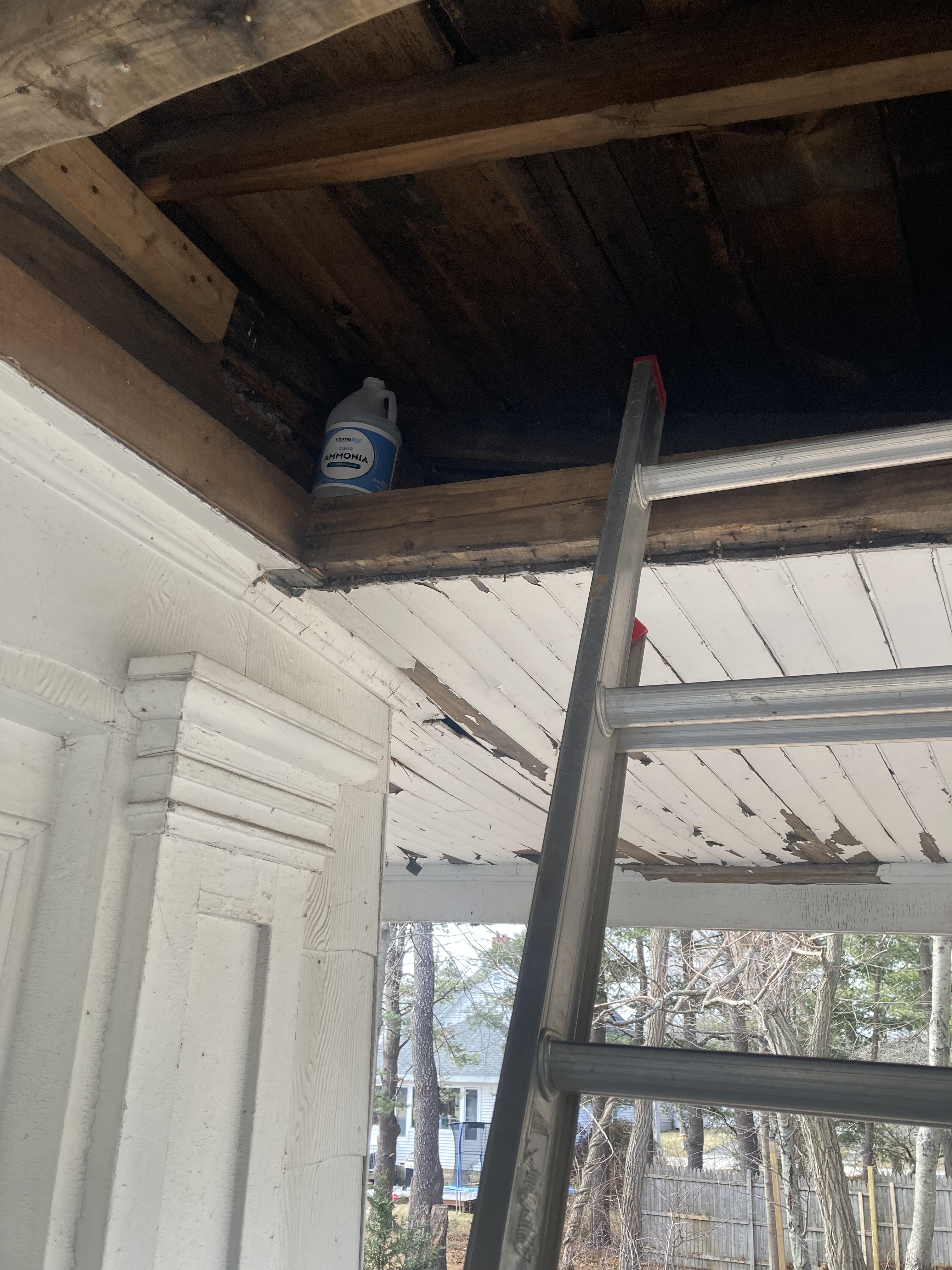
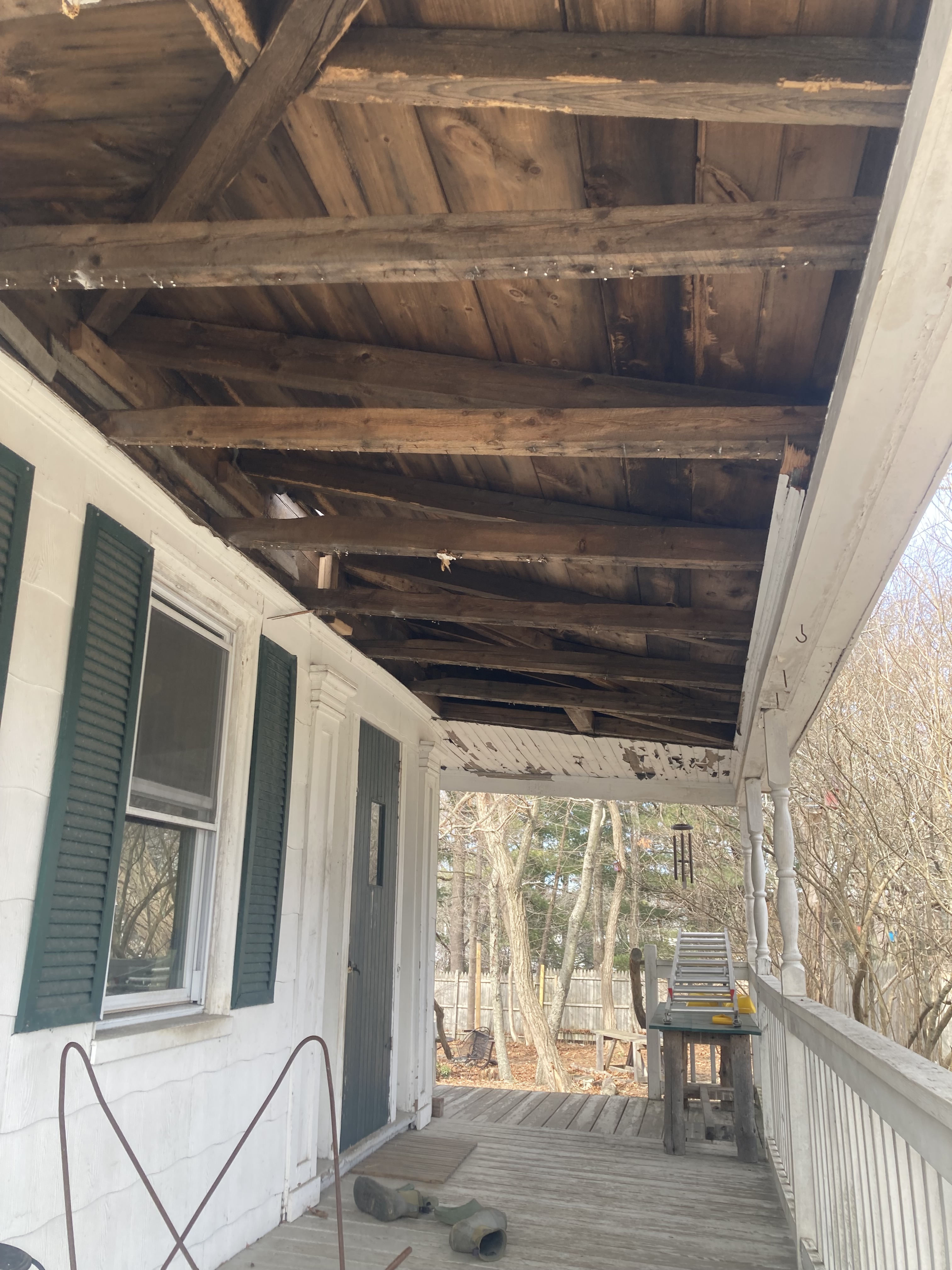
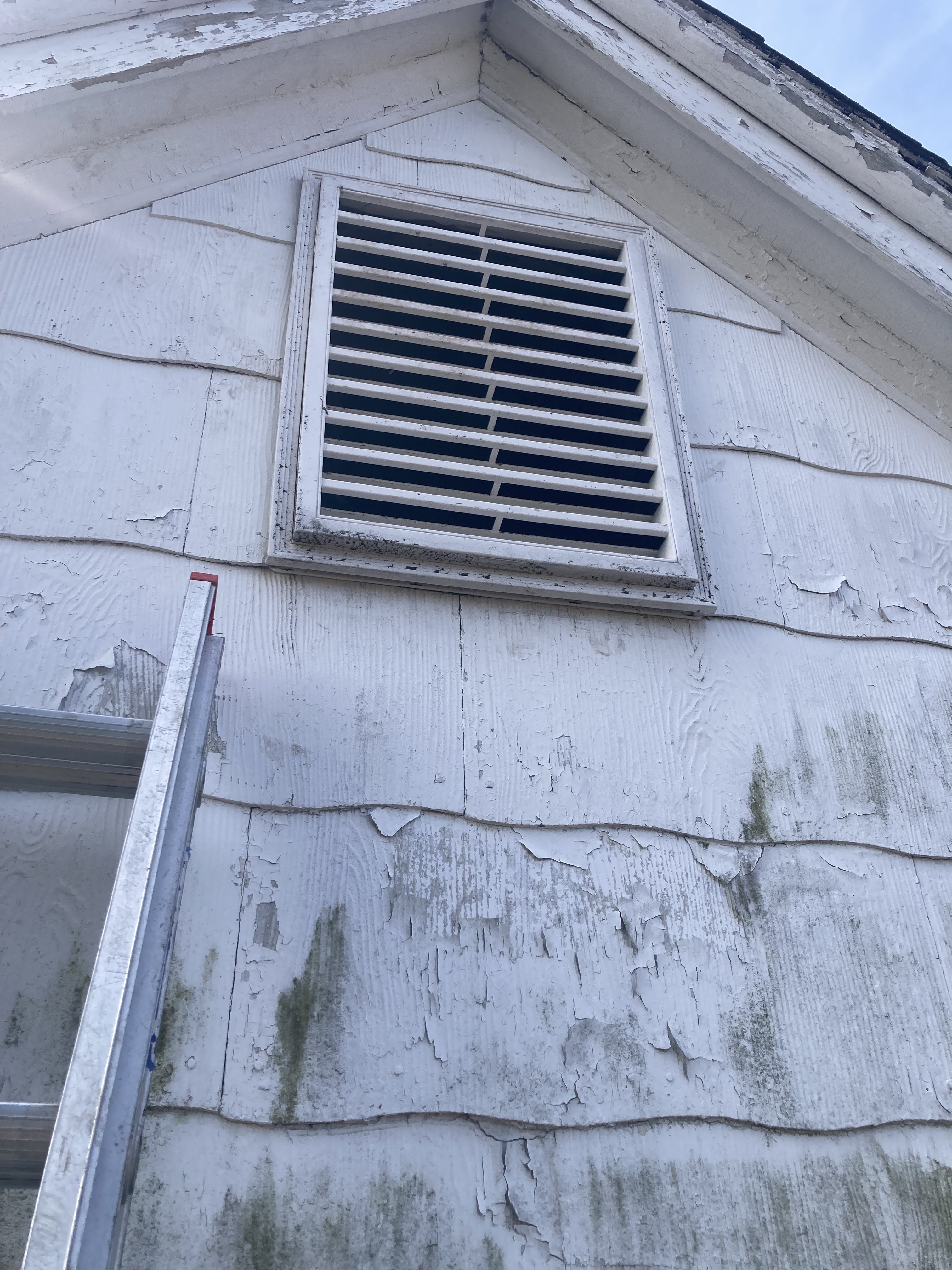
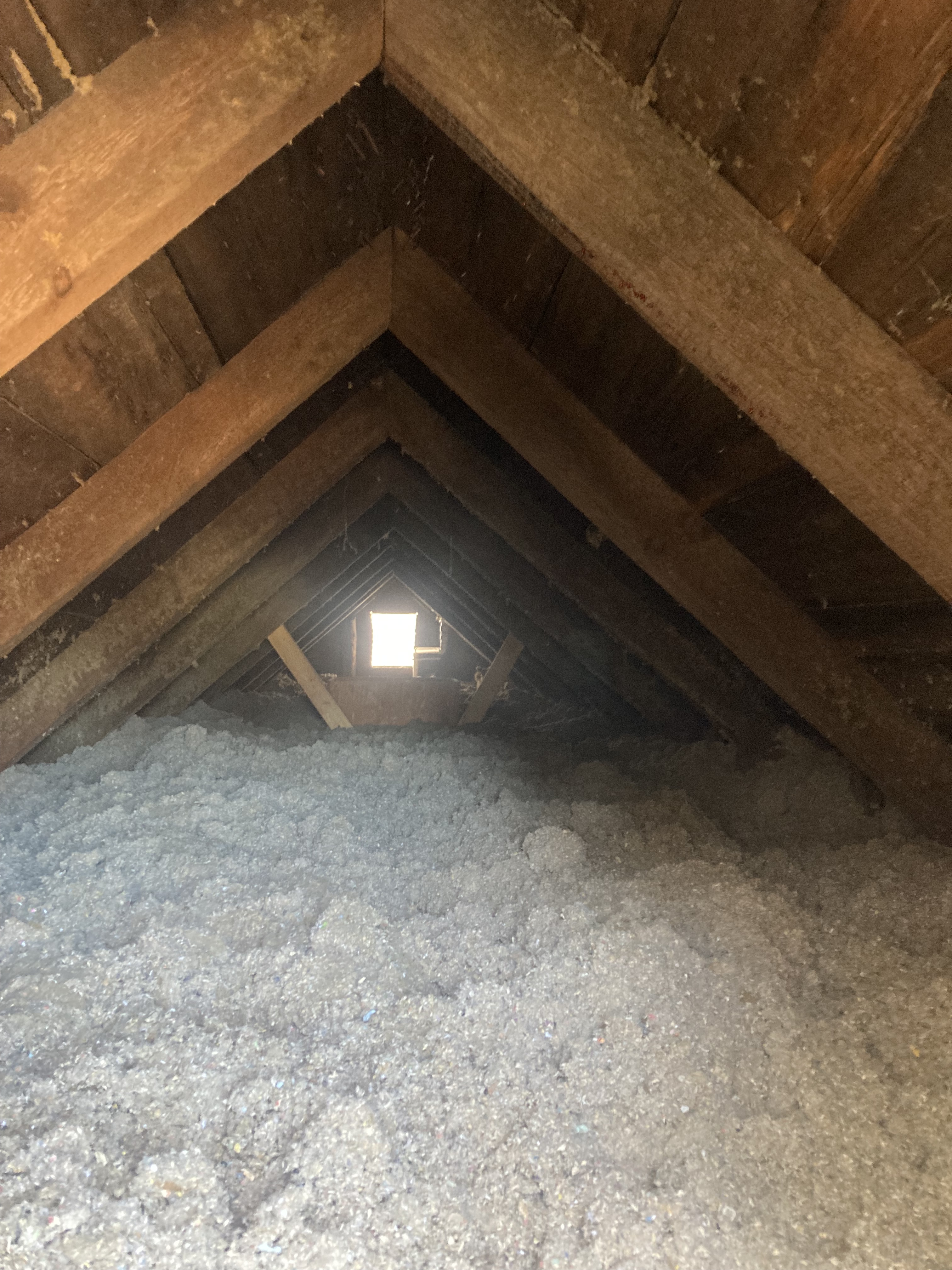
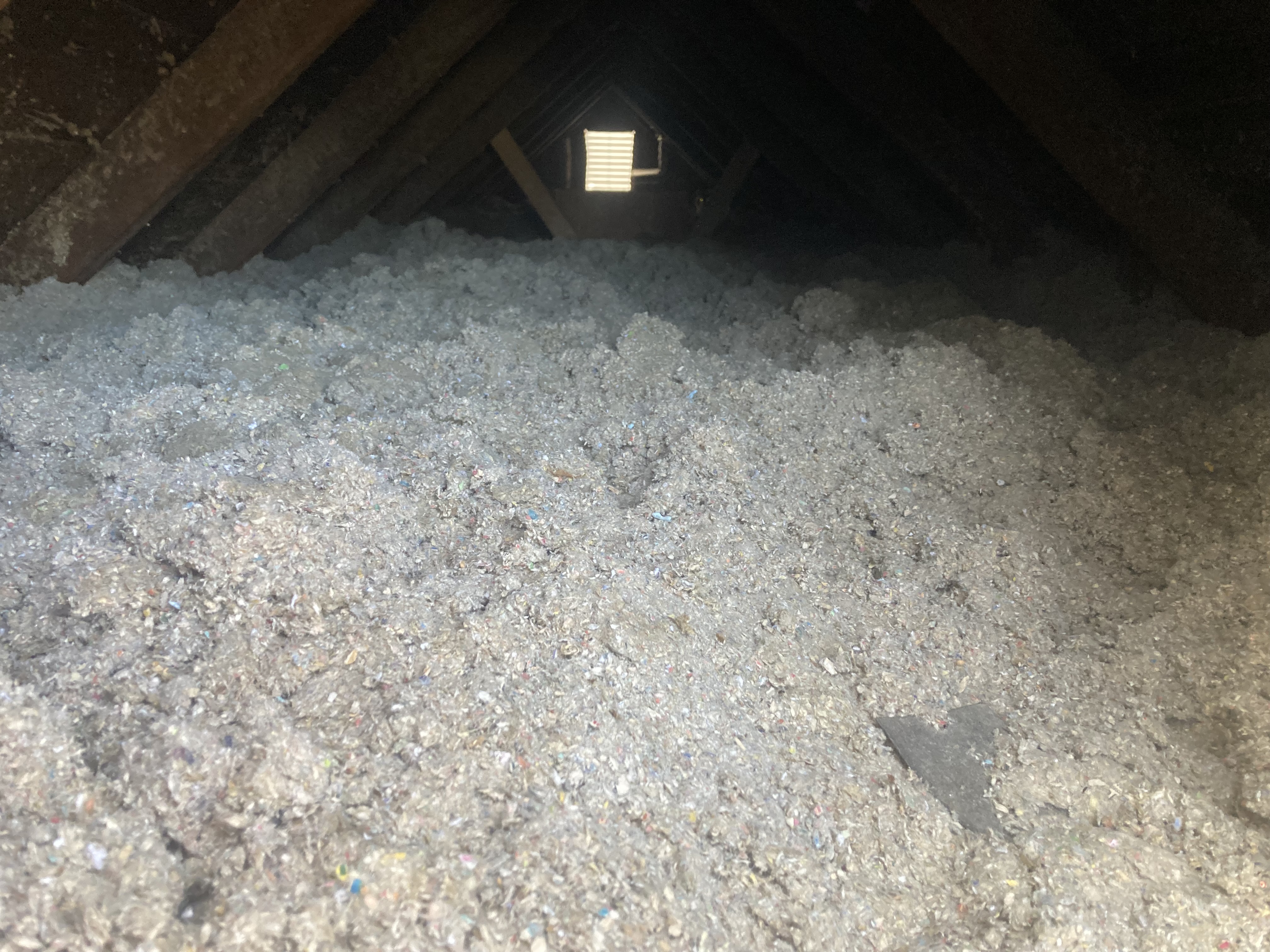
My daughter had heard something scratching up in the attic above her bedroom. A serious problem. The attic vent had come loose, which left a gaping hole into which some rodent had entered. My only choice was to haul out the ladder, set it upon the porch roof, climb up to see who was there, and put the vent back in place. But raccoons had lived in the porch ceiling last summer, and eaten through both the asphalt shingles as well as the boarding below. Climbing up a ladder set upon the roof was fraught with risk but that rodent needed to go and the vent needed to be put back.
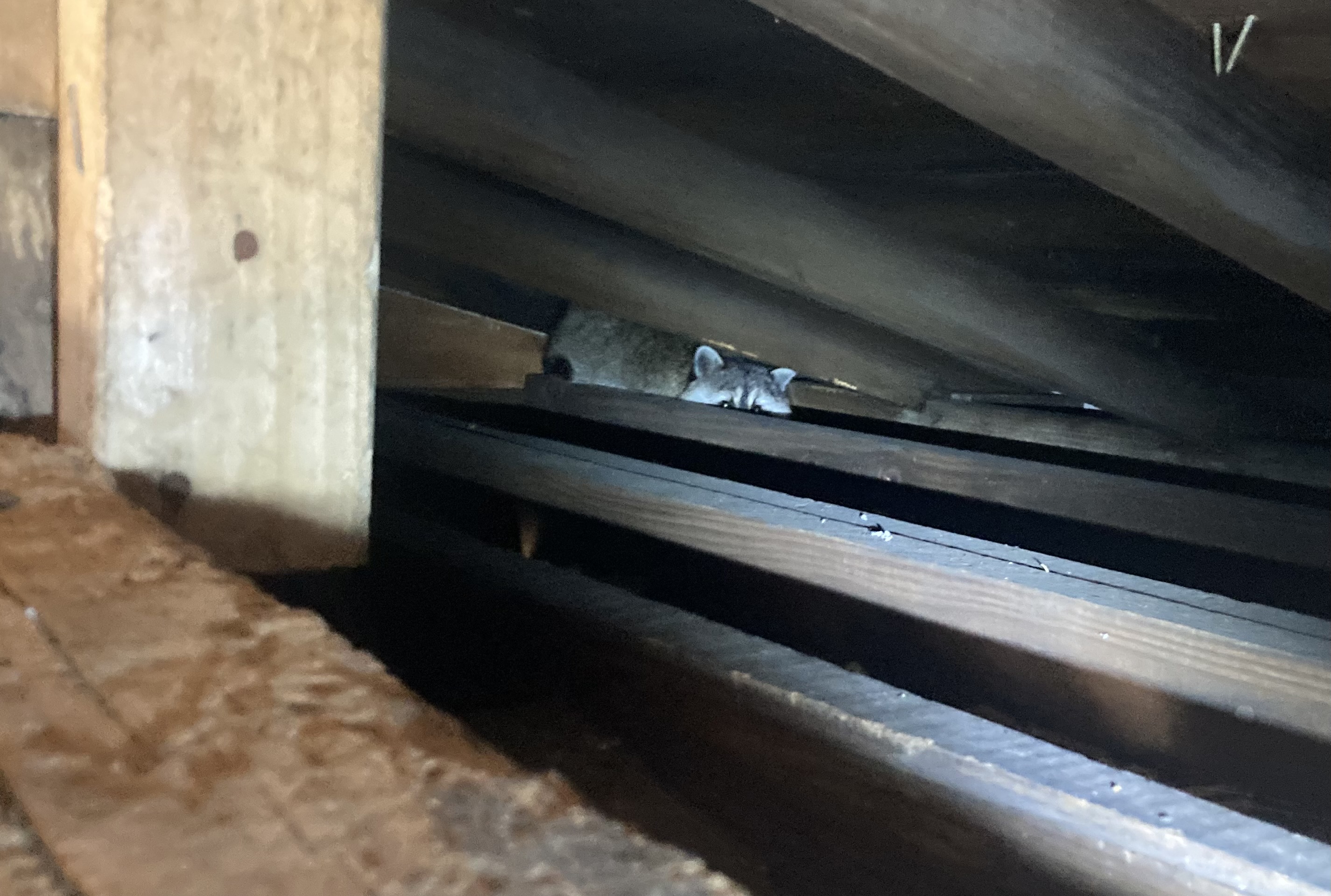
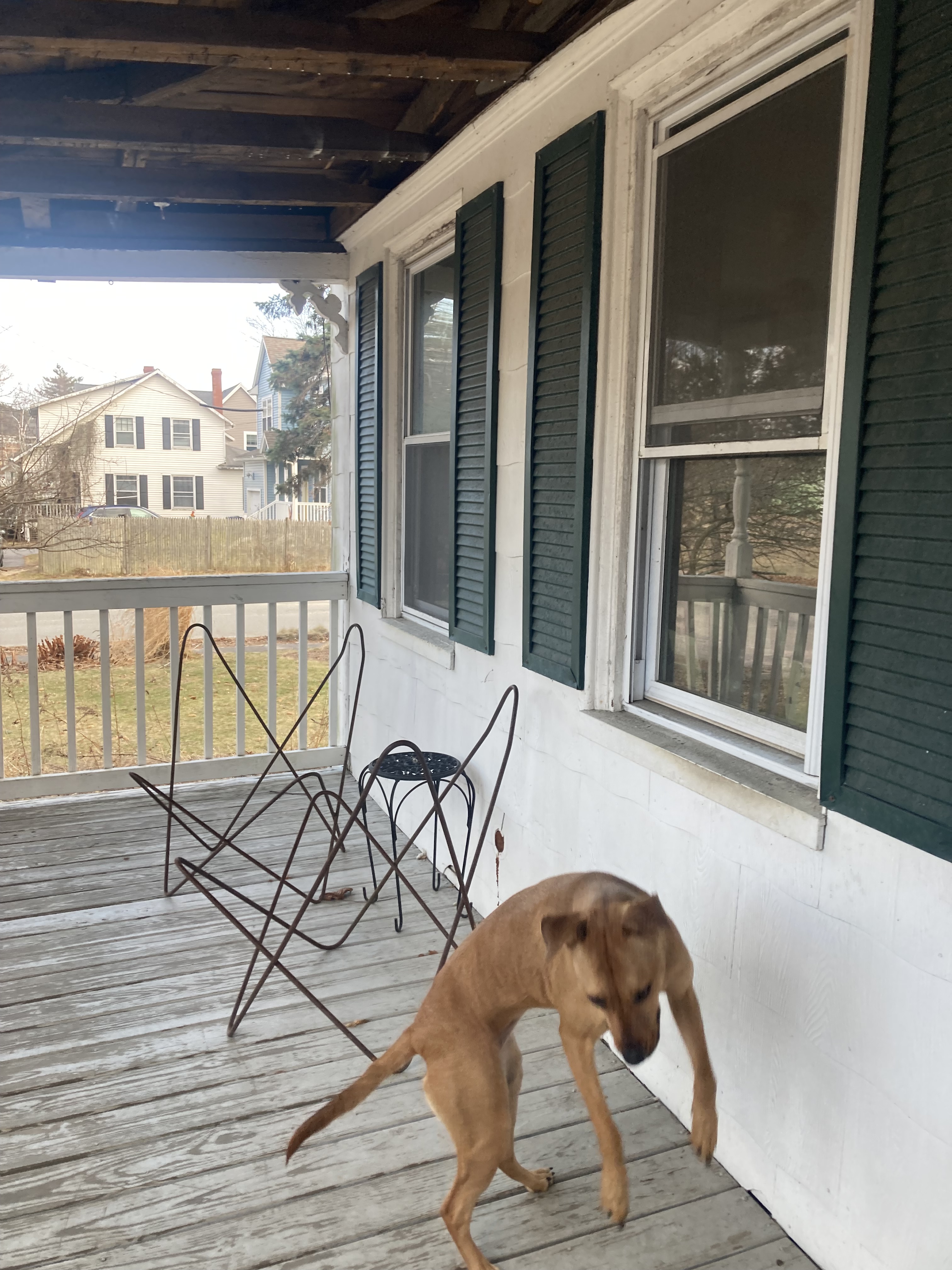
The attic was empty, so I reattached the vent cover, but noticed a raccoon had taken up residence elsewhere. They had left the attic – which was good – but moved above the porch ceiling – not good. Our Pit Bull-Rottweiler rescue puppy was going ballistic at the sound of my climbing above, plus the smell of the Raccoon overhead.
Pit Bulls are descended from the Greek Molossian “dogs of war” while Rottweilers are from the drover dogs of the Roman legion, used to herd cattle to feed the elite soldiers as they crossed the Alps into Germany. Pit Bulls are ferociously loyal to their owner, so our puppy was literally climbing the walls to protect me.
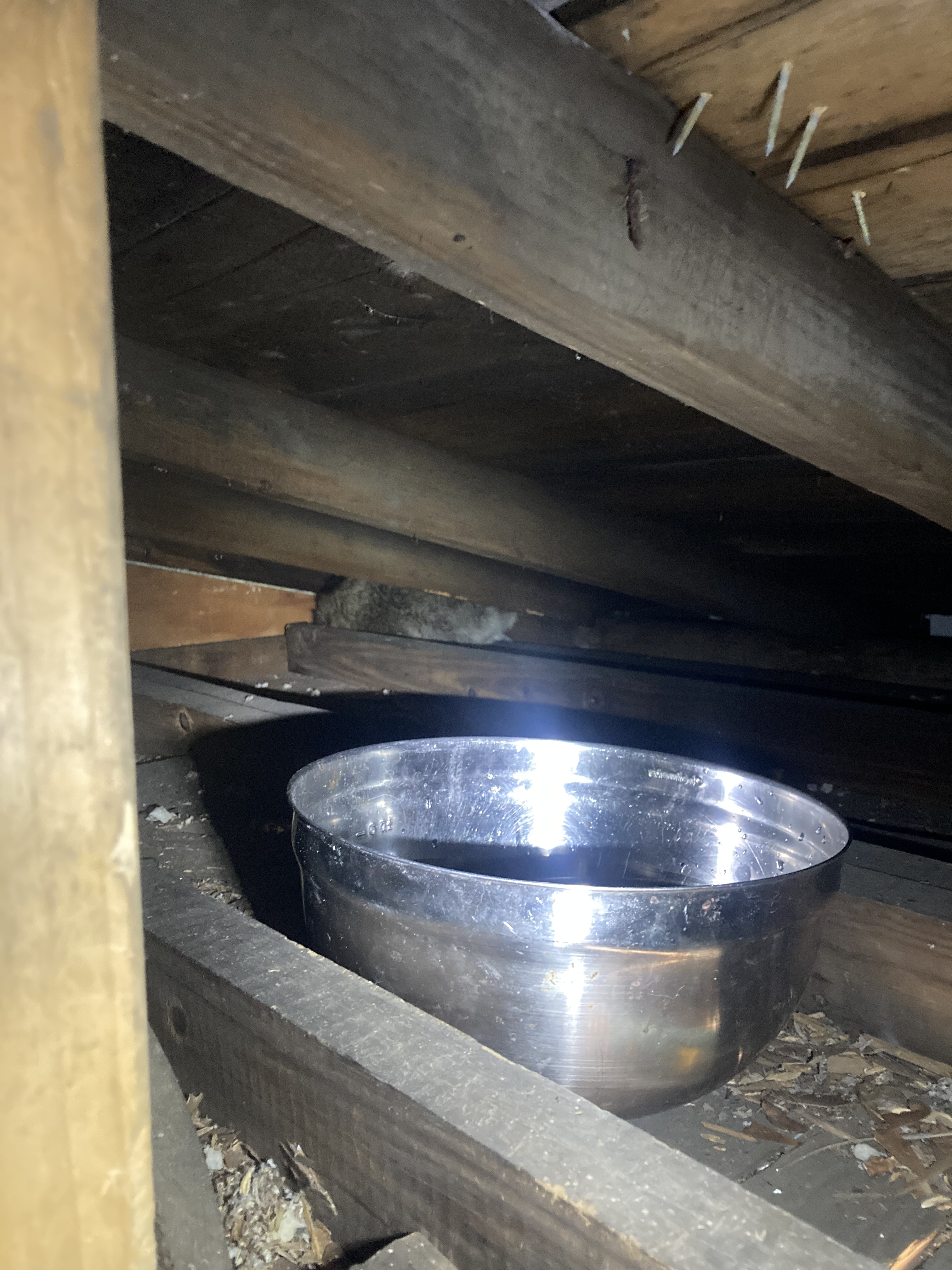
Raccoons are awfully cute, but we do not want them living in our house. Eviction was needed. A friend, from Vermont, told me that ammonia poured into a bowl is the trick because the rodent will move to get away from that smell. So as our puppy howled running to and fro, I climbed up and poured one gallon of ammonia into a metal bowl set above the porch ceiling. The Raccoon huddled in the far corner, hiding. The ammonia worked. The porch is vacant again. Truth is stranger than fiction. I still need to close off the porch ceiling, but things have calmed down.
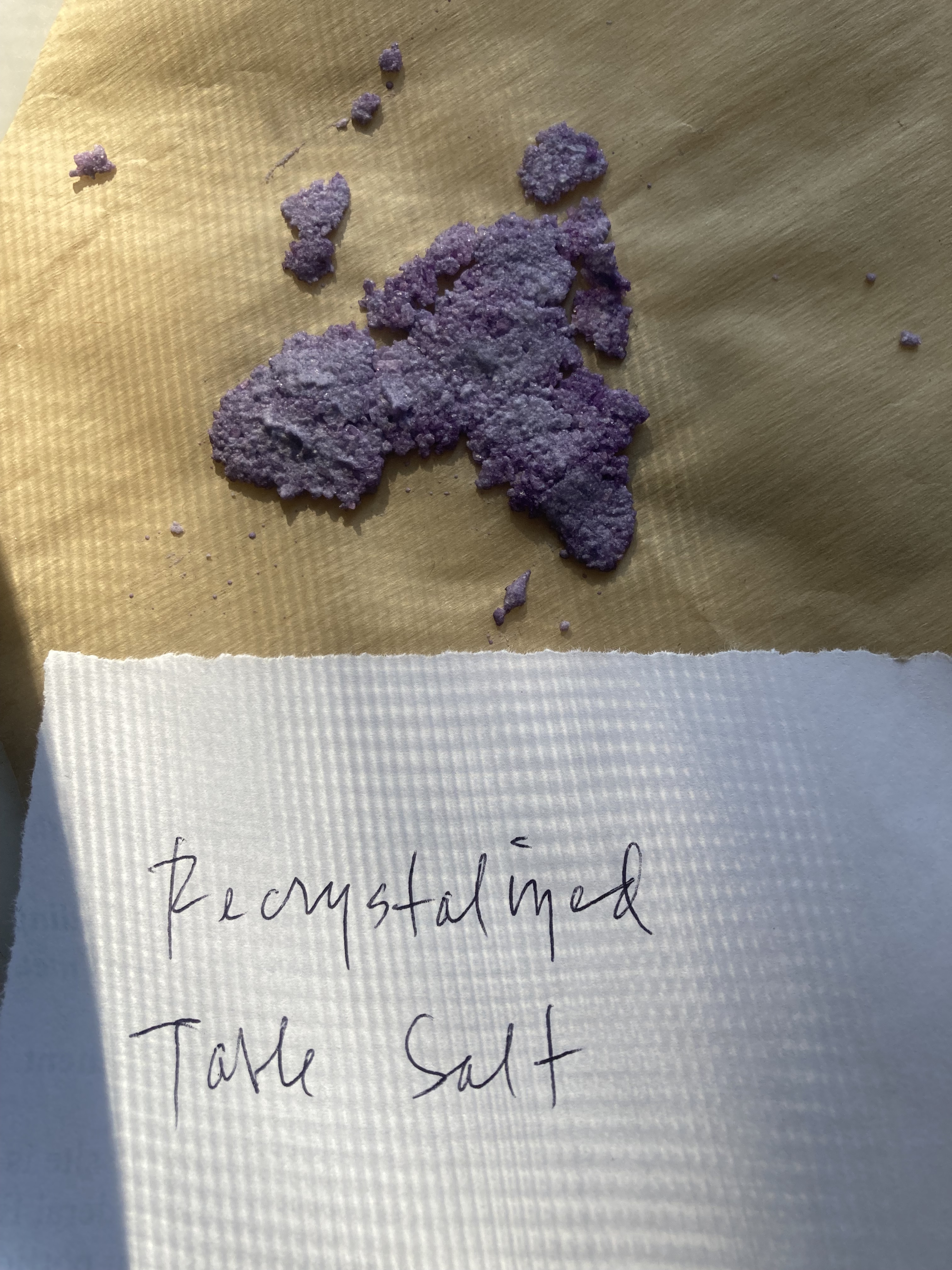
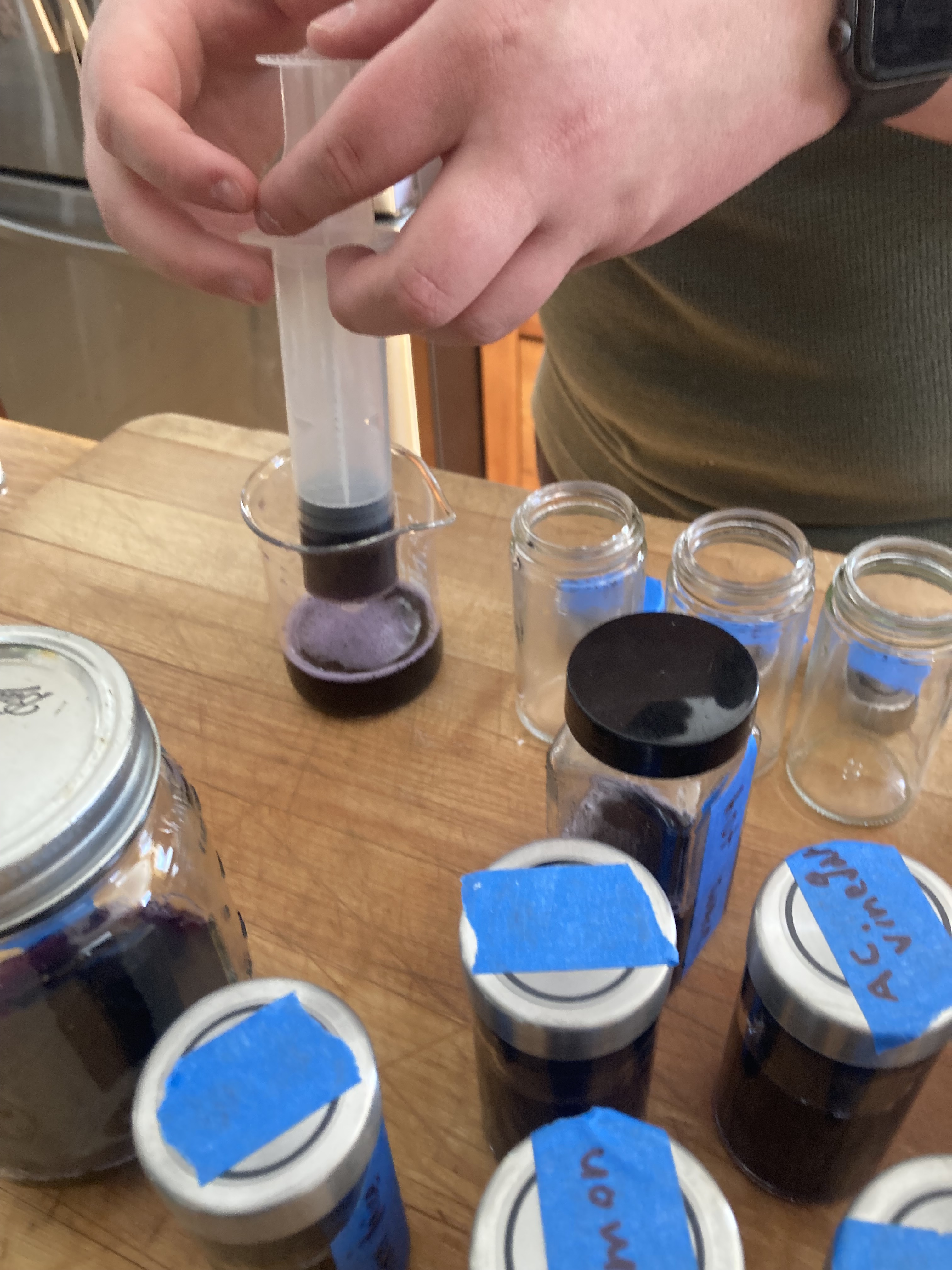
Having finished the eviction, I went inside to work more on the lawsuit plus to help with science, which included recrystallizing kosher salt from our Red Cabbage Ph experiment. In my son’s last class the Mother Tree had taught, “Ph is a measure of hydrogen in solution. Solvent + Solute = Solution. Something that is water soluble is hydrophilic. Something that is not water soluble is hydrophobic. For the Ph Solvent is the water and Solute is the stuff added to create the solution. Water is what communicates to life.” Let’s communicate to life!
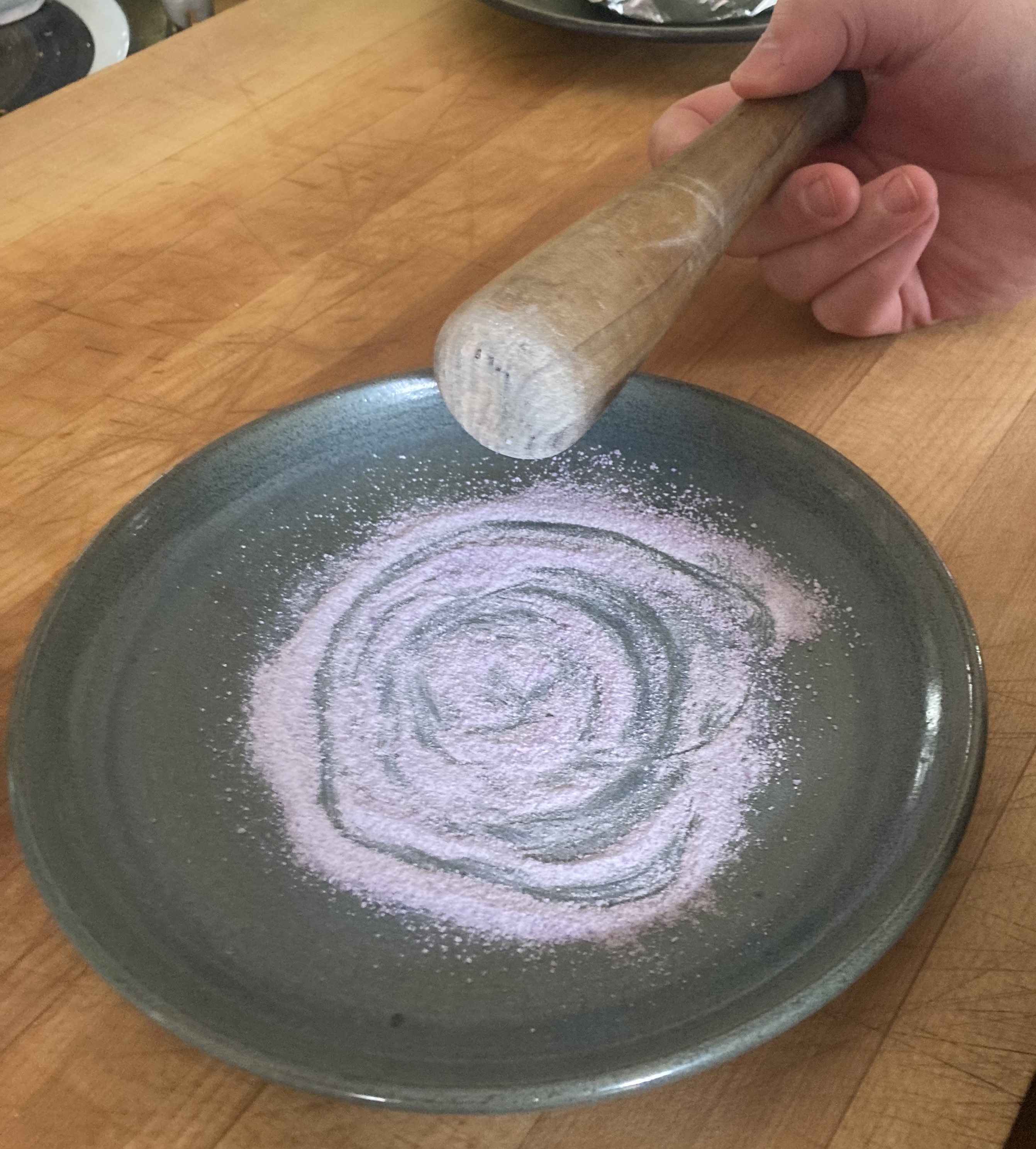
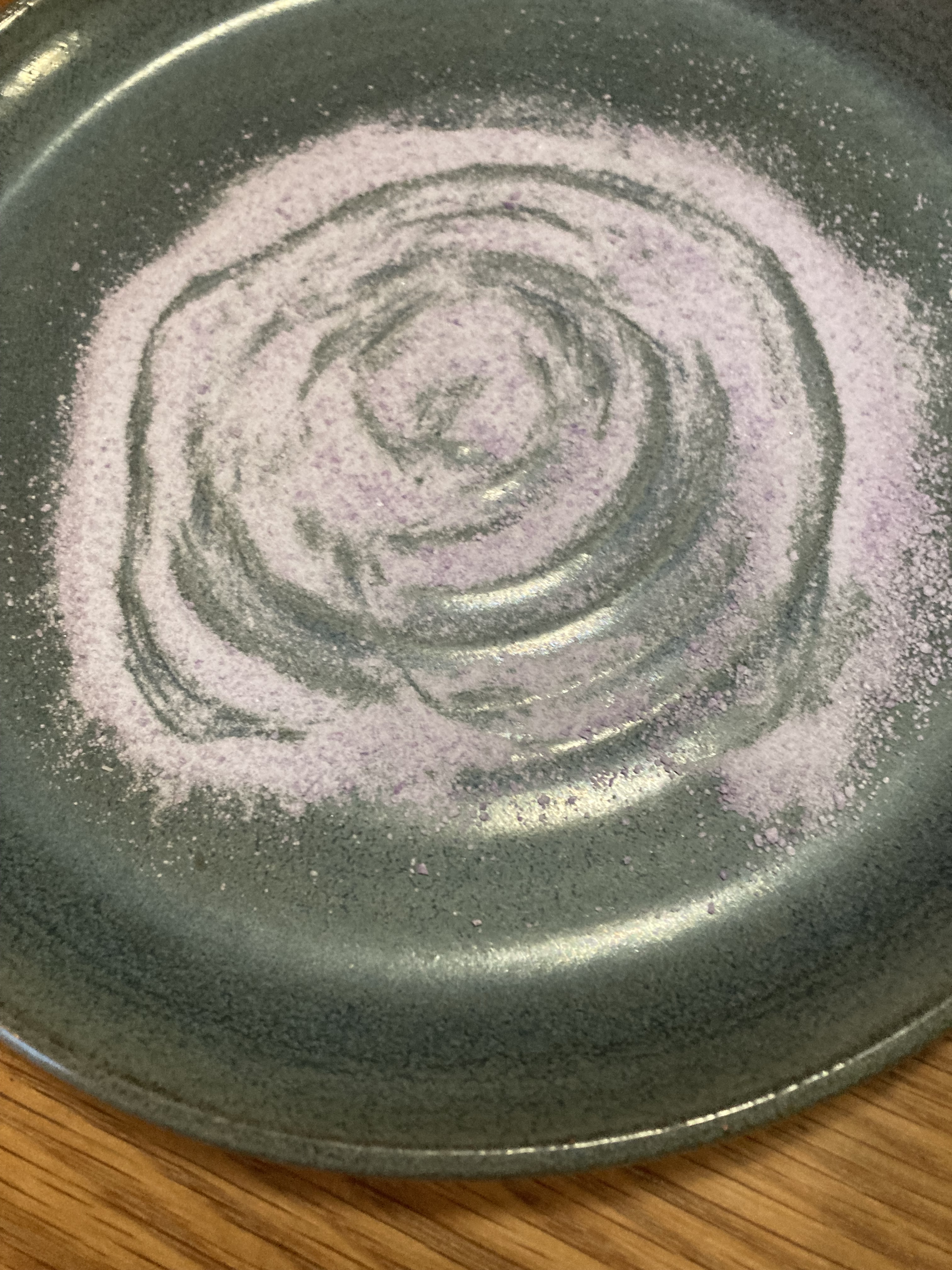
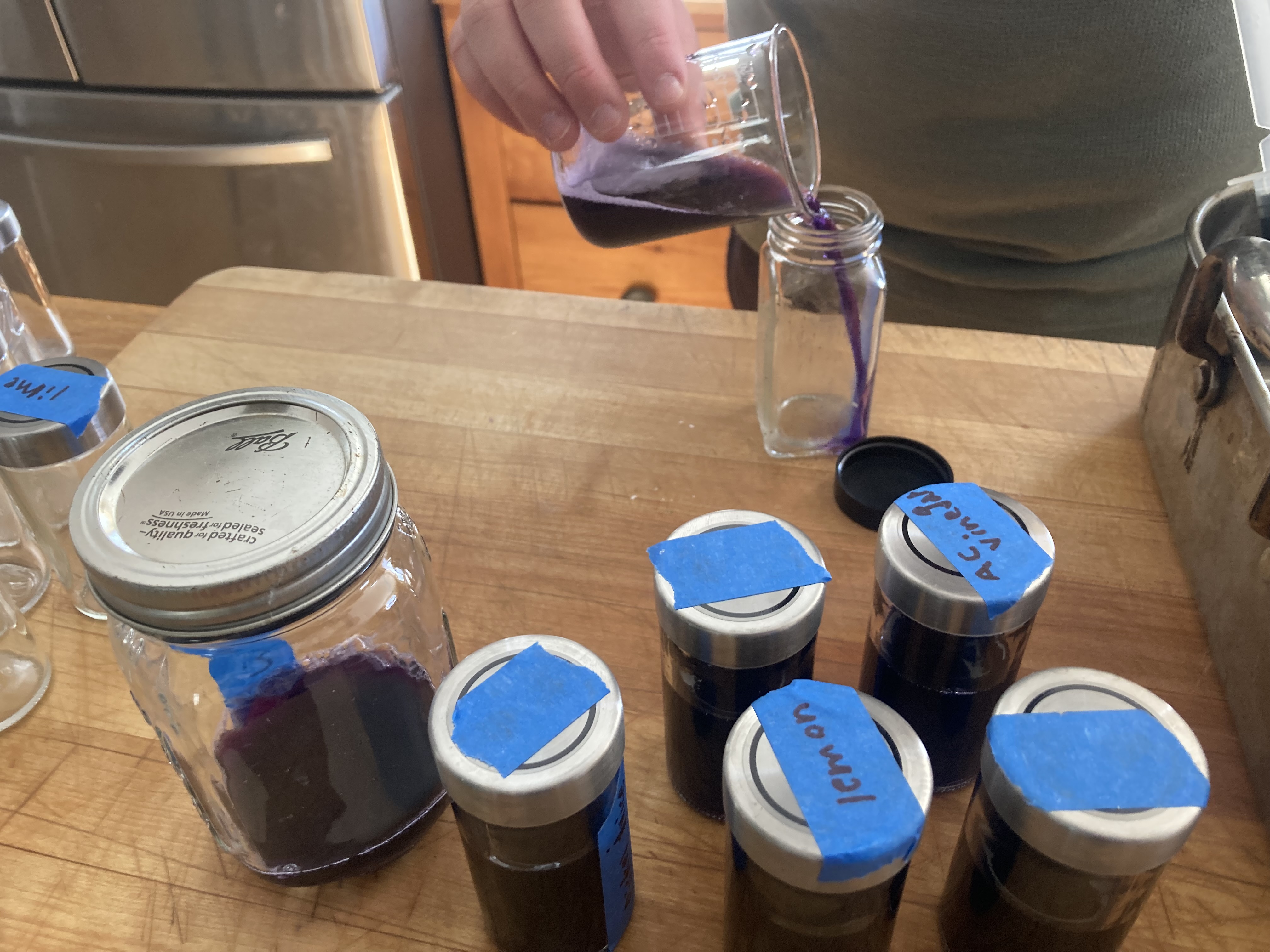
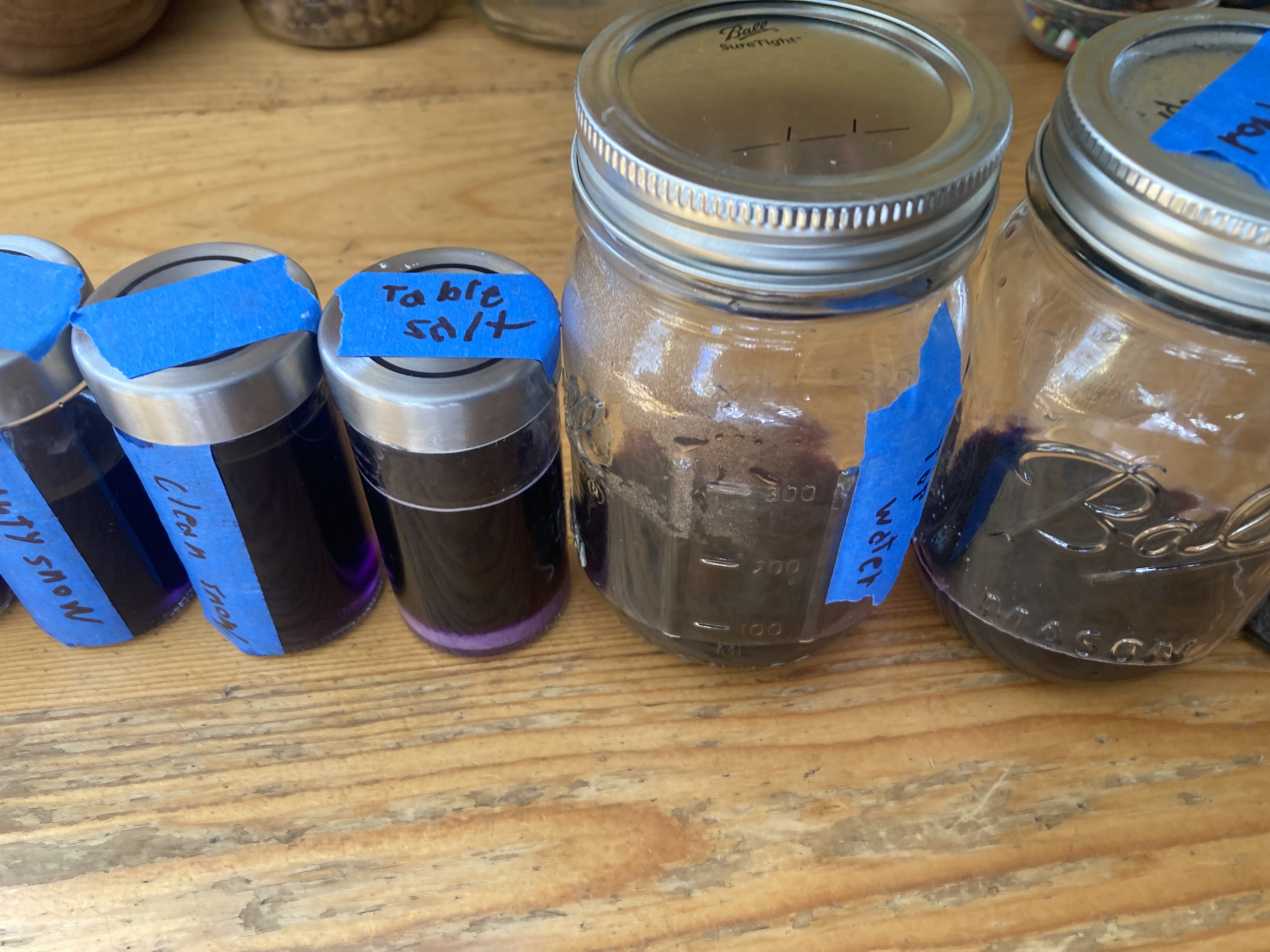
My son poured the red cabbage solvent from the jar, which left the solute – the purple salt – at the bottom. He scraped that out, spread it upon a plate to dry, then used a mortar and pestle to break the hardened salt. Admiring his creation, he commented, “We took table salt which is a solid. Put it in a red cabbage liquid. Turned some amount into a liquid. Took it out and turned it back into a solid, by using gas, an evaporation, which is covering all three states of matter: liquid, solid and gas.” I could not, in my wildest dreams, conjure that sentence so I am learning that he is factually correct. The homeschooling goes surprisingly well lately.
It is a curious fact that I am able to do this because I have a part time job, and am not allowed – by law – to earn much income. Social Security functions by a little known algorithm >62 + <18 = 2.027x, where FRA is 67. I am older than 62 and my son is 13. Both he and I receive benefits, with a cap on my income until I reach full retirement age (FRA). If you exceed that cap, the clawback is draconian, which means, in a culture driven to maximize income at all costs, my path is different. Time is on my side, plus just enough income, and time, for parenting as for life, is worth more than its weight in gold.
Lord Chesterfield taught that time was the most precious asset, its “true value” was to “snatch, seize and enjoy every moment.” We are in agreement.
__________________________________
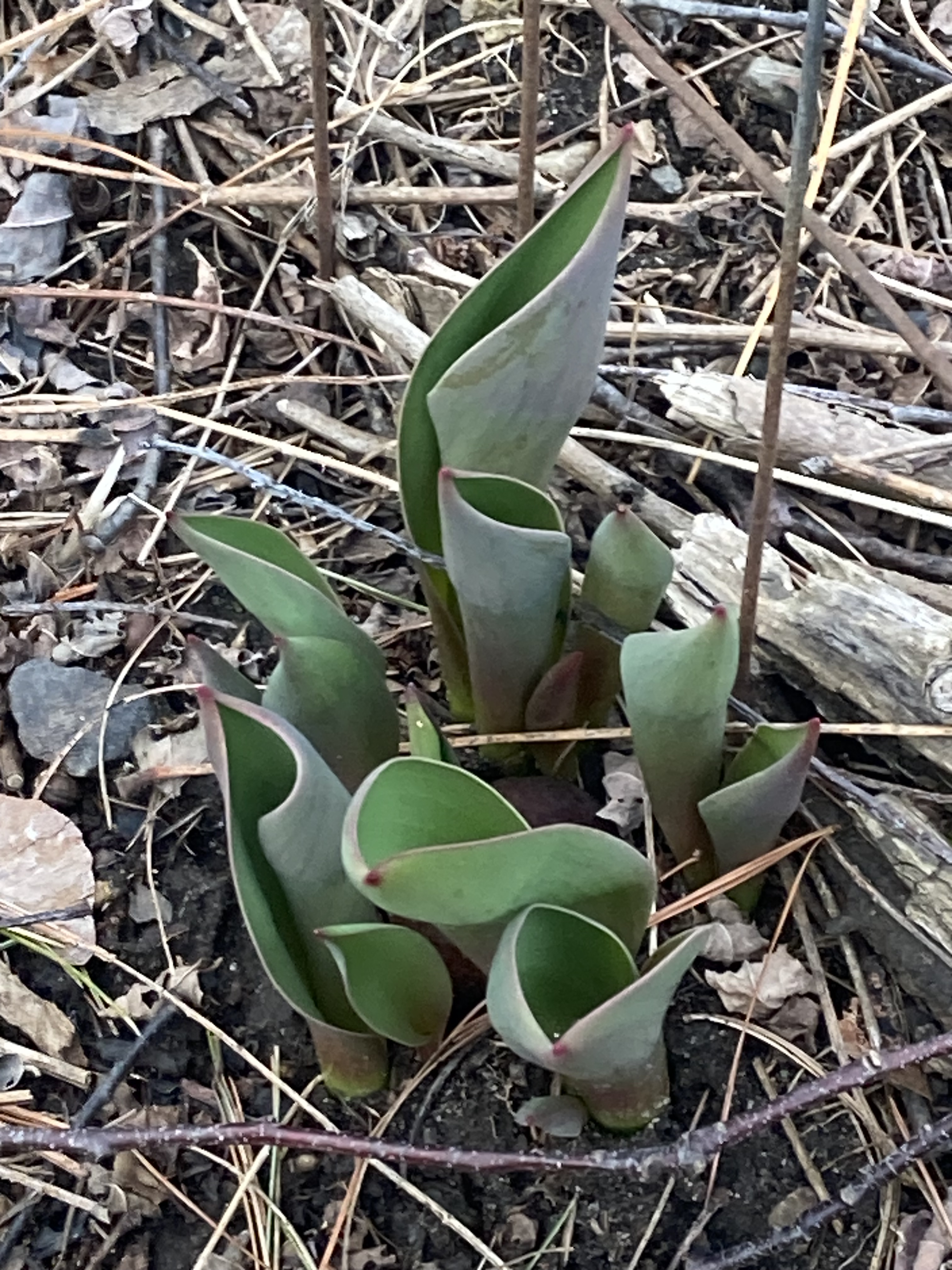
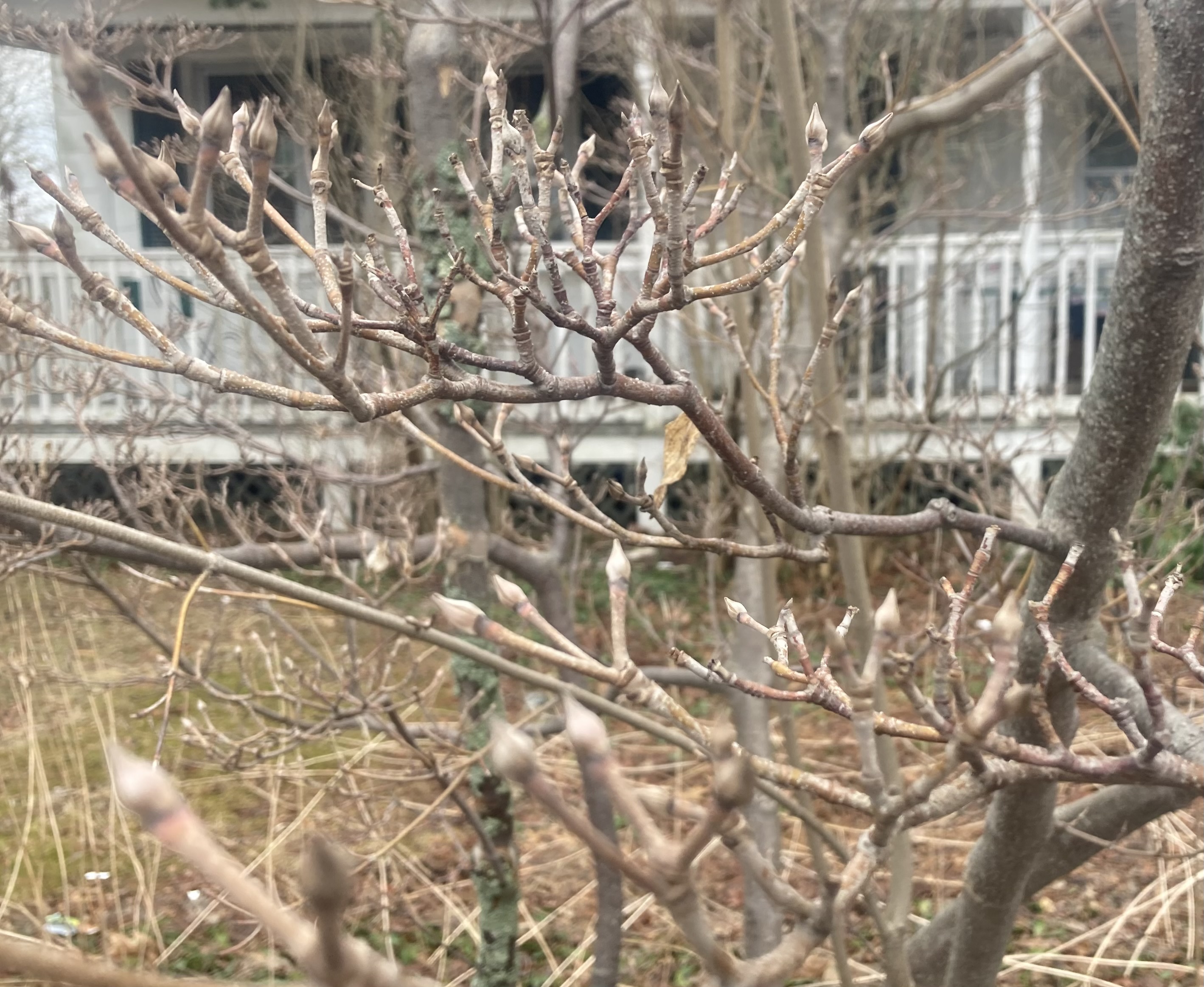
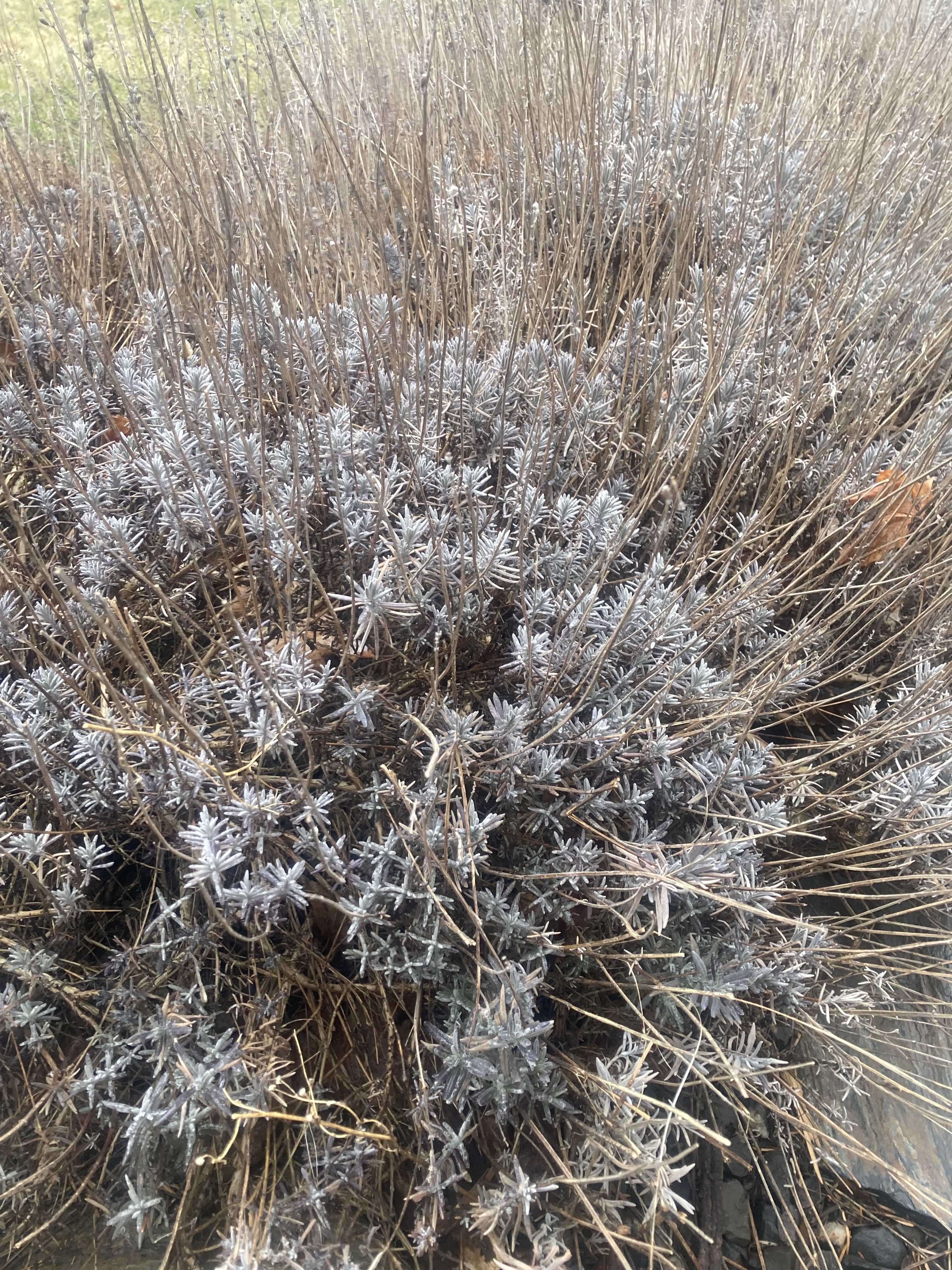
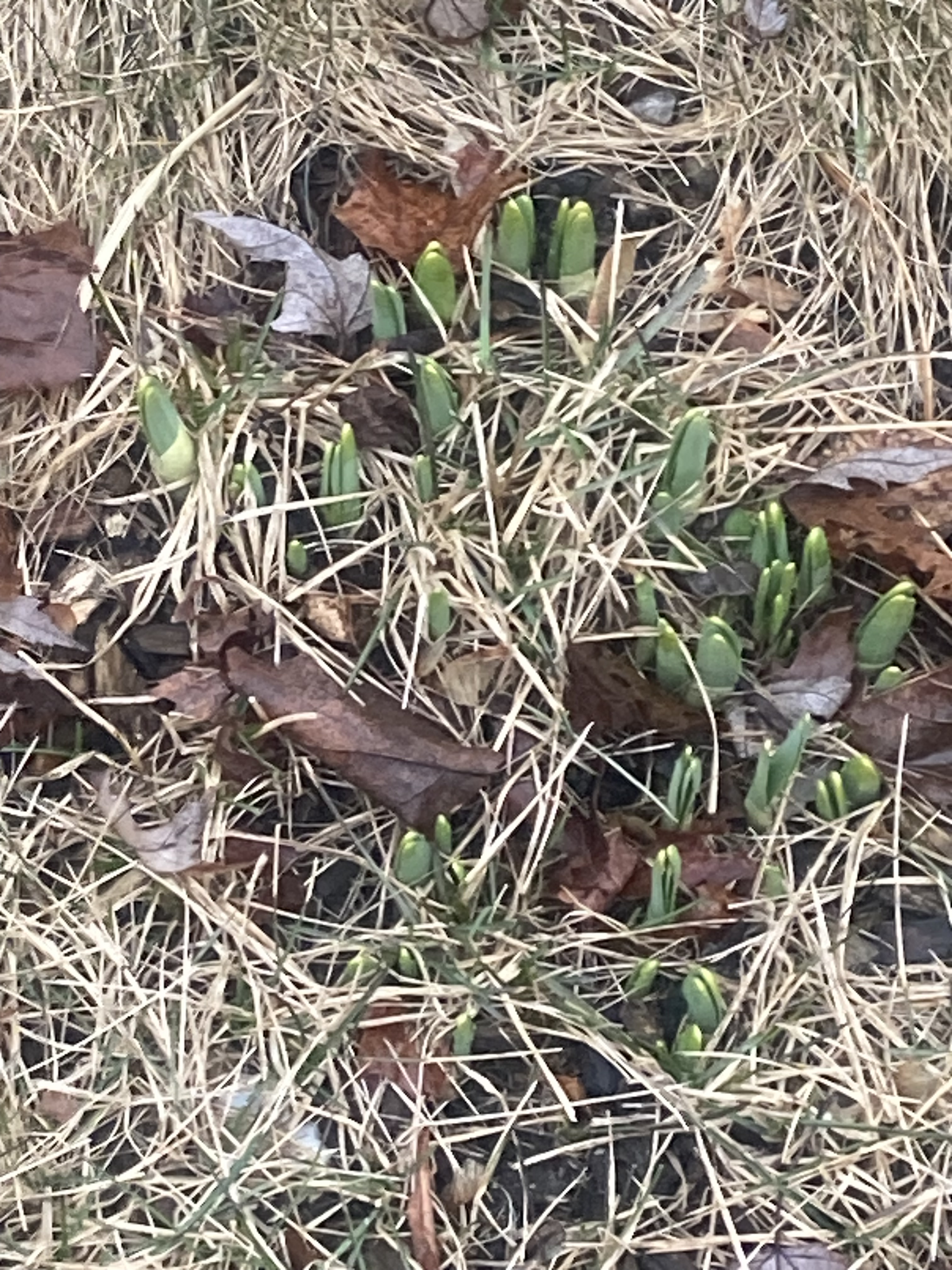
Spring has sprung! Happy first Friday! Carpe diem!!!
Nettlesting is a Mother Tree, whom I met, almost 30-years ago, in the Fulton Market District on Chicago’s near west-side. When that city was the “Hog Butcher to the World” that neighborhood was home to its meatpacking warehouses, but circa 1998, gentrification spread, and we each occasioned to be there for a Childrens’ art exhibit. She walked up, we started talking.
In 2000, our paths crossed again, in Chicago’s Financial District canyons, on LaSalle Street, outside the once venerable Harris Bank, which now has been merged into the global behemoth BMO. I was preparing to depart for the Philippines – a land of smoke and mirrors – on my oxymoronic quest for “Humanitarian Finance” while she was preparing to WWOOF (Worldwide Opportunities on Organic Farms) in the full sunlight of Southern Australia.
Being a Mother Tree, she is a steward of Gaia who thrives at the vanguard of soil and soul. Like a zen koan, she is not an artist, but one might say she is an eARTheart-ist.
In 2004, she planted six kernels of “Golden Bantam” organic heirloom 1902 sweet corn in a shopping cart and then proceeded to push it around Chicago’s dense urban core. People were confronted by food growing, rather than food as a commodity purchased in a store. “Know your food, know your farmer” came alive on street corners. [Search You Tube for “Field Trip. A cart full of Corn Hit’s the Road.”]
In 2006, Sandor Katz, the NY Times best selling author, profiled her guerrilla gardening in his book “The Revolution Will Not Be Microwaved.” By 2012 she was named as one of Utne Reader’s “Twelve Visionaries Who Are Changing Your World.” That now ancient history was prologue, however, to the work she has gone on to pursue.
In 2020 she travelled in the Ecuadorian Amazon basin and worked with Indigenous peoples as well as local growers, developing classes on soil and remediation. The BBC reported this, quoting her, “The ultimate goal is to create an ecosystem of native plants and crops that can be farmed sustainably while also cleaning up the oil. I’m trying to have people re-engage with certain subtle complexities of nature…”. https://www.bbc.com/future/article/20200316-cleaning-up-the-oil-spills-of-the-amazon-rainforest.
Her “Soil Keepers” program grew out of this effort, and has now been taught to more than 250 students around the United States, as well as in Qatar, Finland, Poland, and Ecuador. https://socialecologies.net/
Over the years we have kept in touch and she recently came east to soak in the rocky coast of Maine. Our oceanic expanse served as counterbalance to the Great Lakes’ prairie. She and my son M got along quite comfortably and an idea was hatched.
Science is not my strong suit. In high school Chemistry, the concept of a mole as “a unit of measurement to quantify the amount of a substance, representing exactly 6.022 × 10²³ elementary entities (atoms, molecules, ions, or particles)” was bewildering. I dropped out post haste to study ceramics. I never looked back.
Necessity, though, is the mother of homeschool innovation. Between M’s needs and my lack of science training, when the Mother Tree offered to teach him soil science I accepted post haste; what I call soil science is, more precisely, applied biogeochemistry, starting with applied chemistry through field work and kitchen-based experiments. It is amazing what red cabbage can teach about Ph.
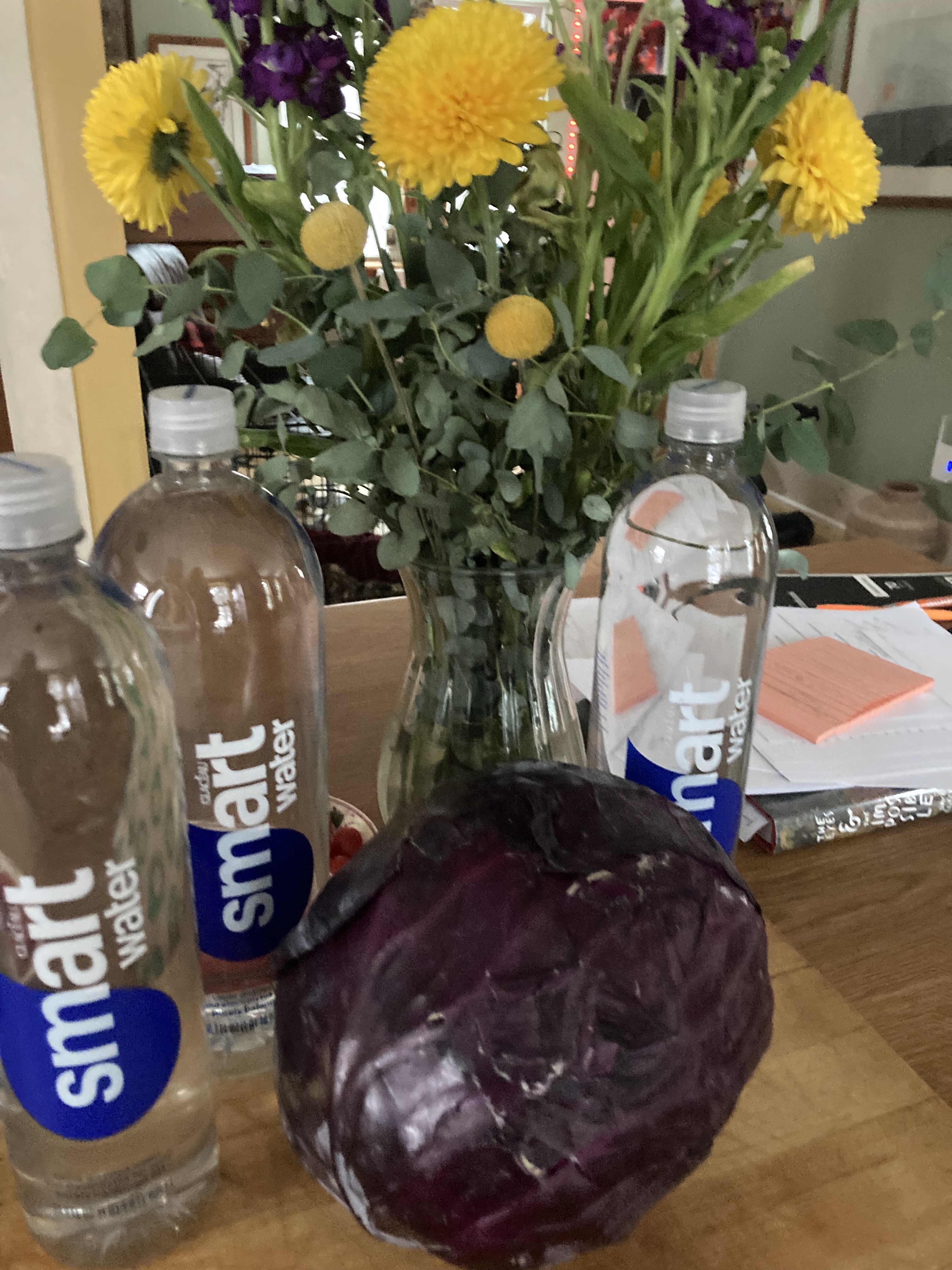
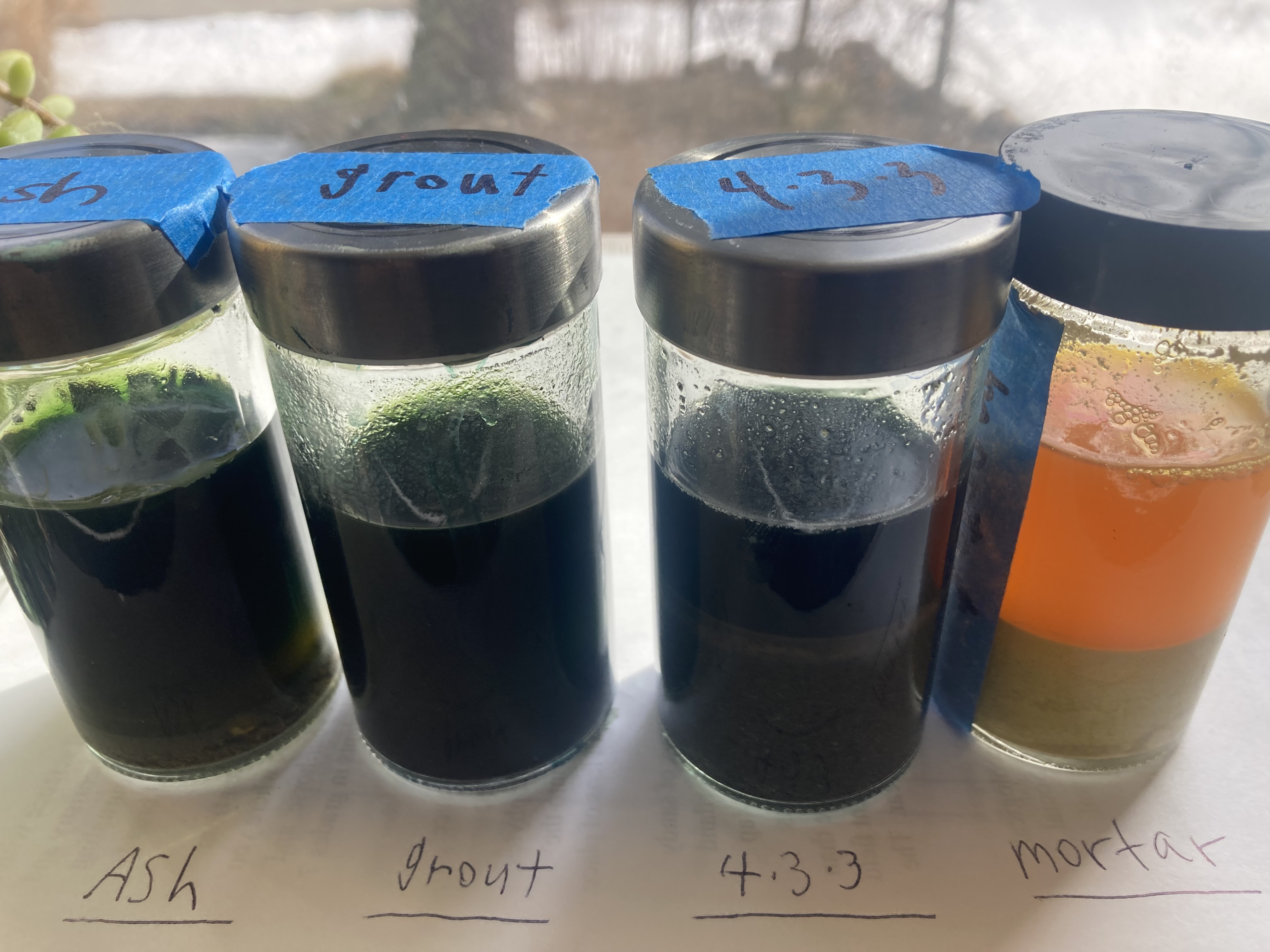
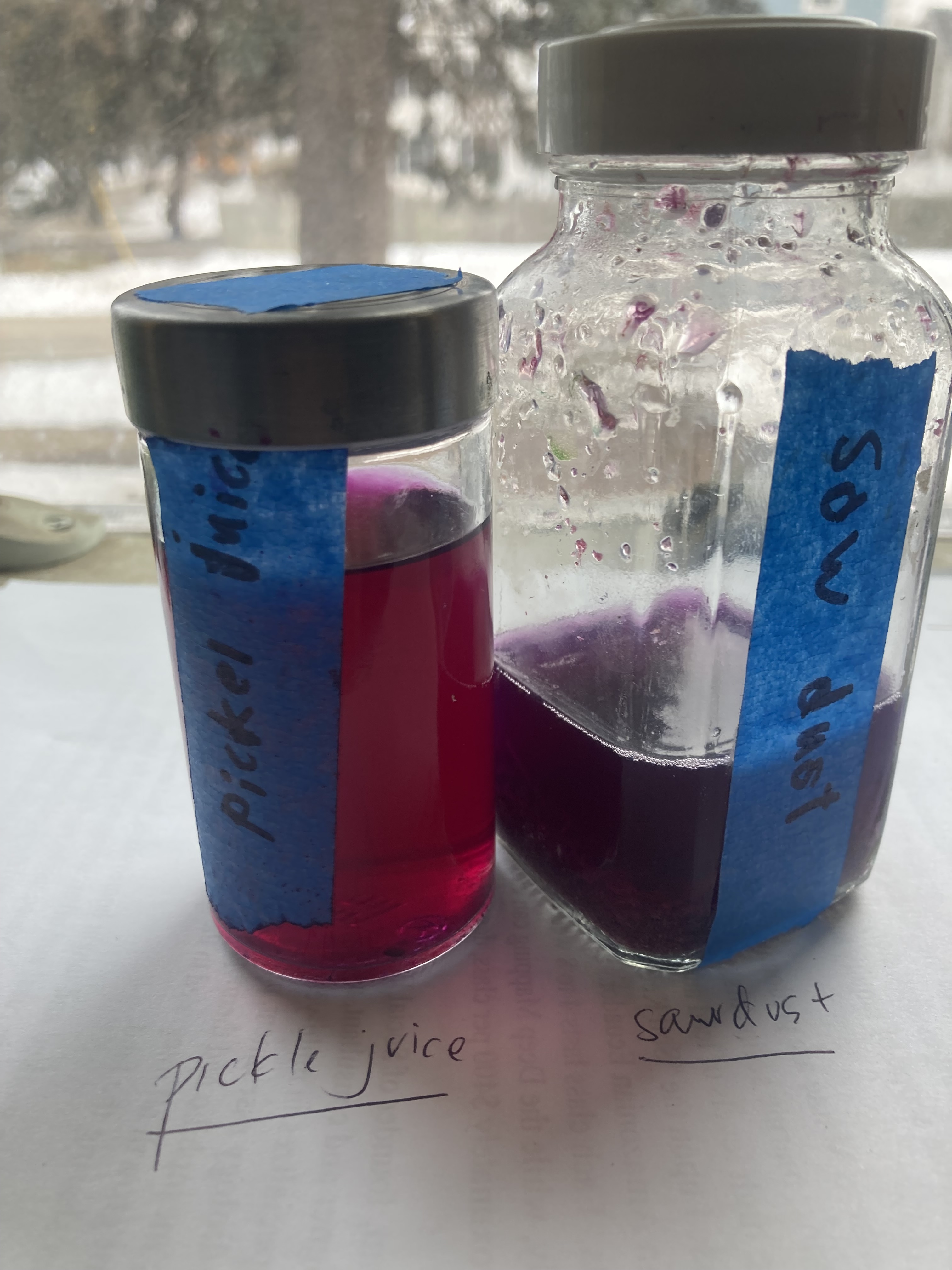
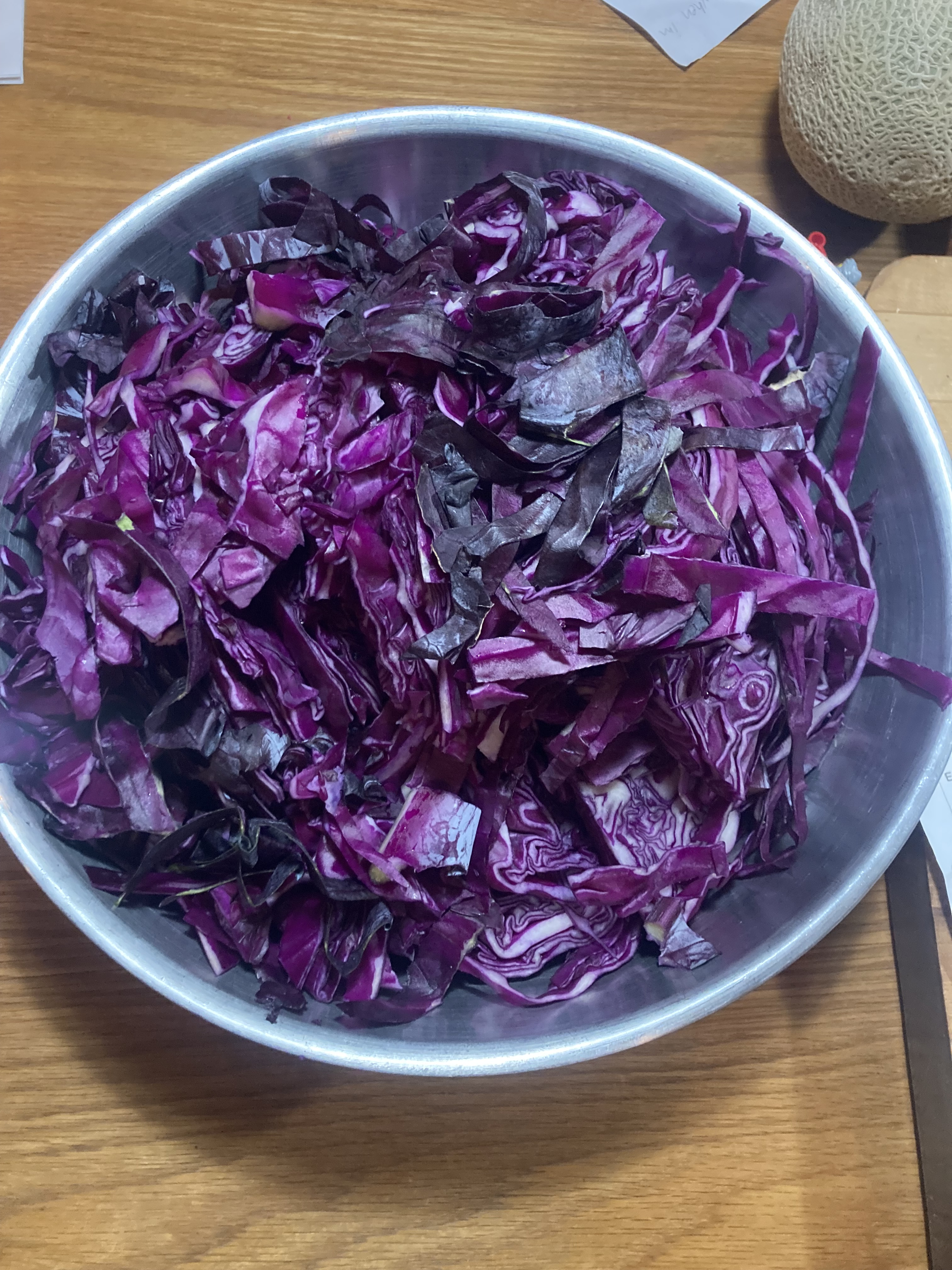
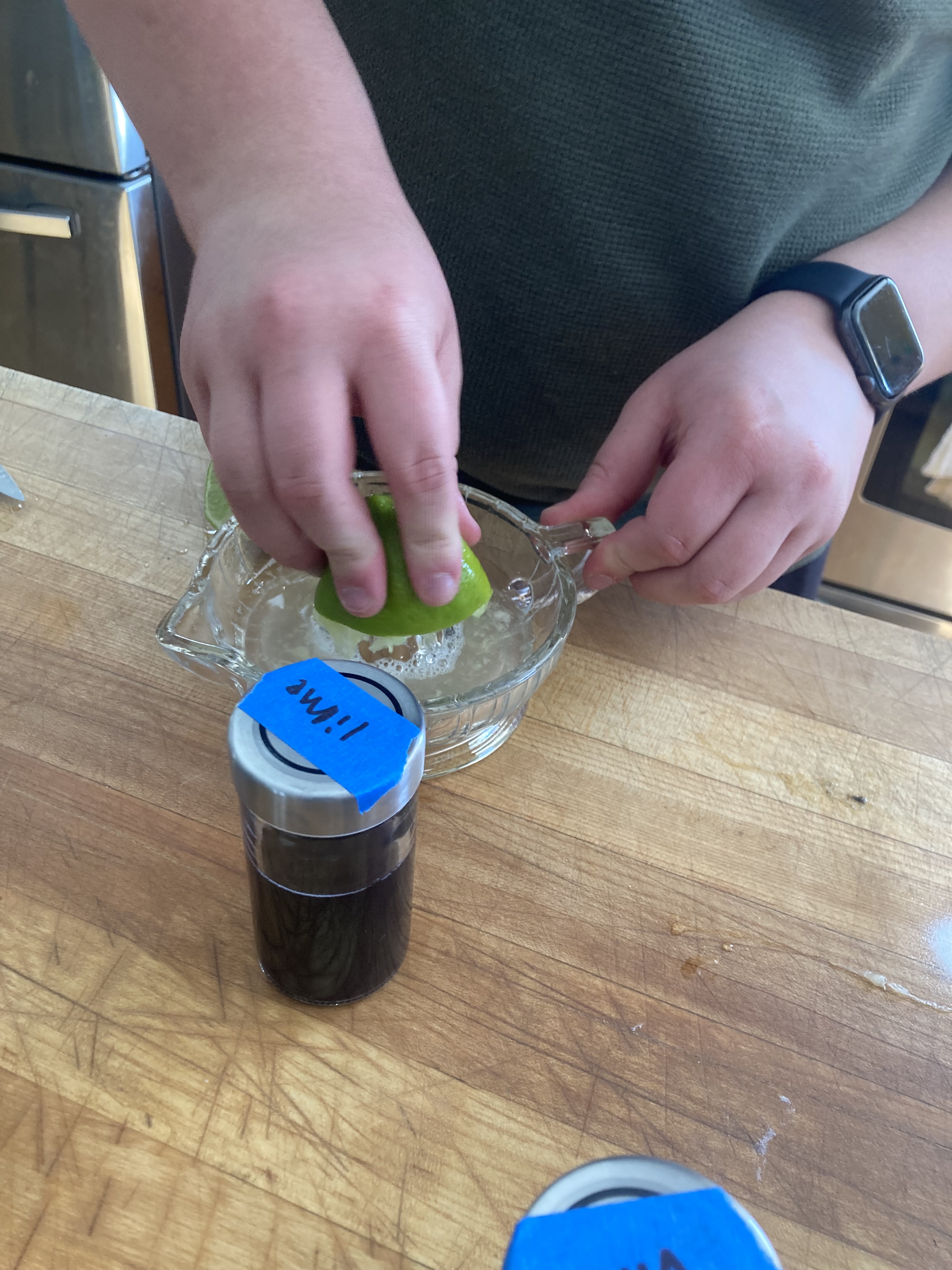
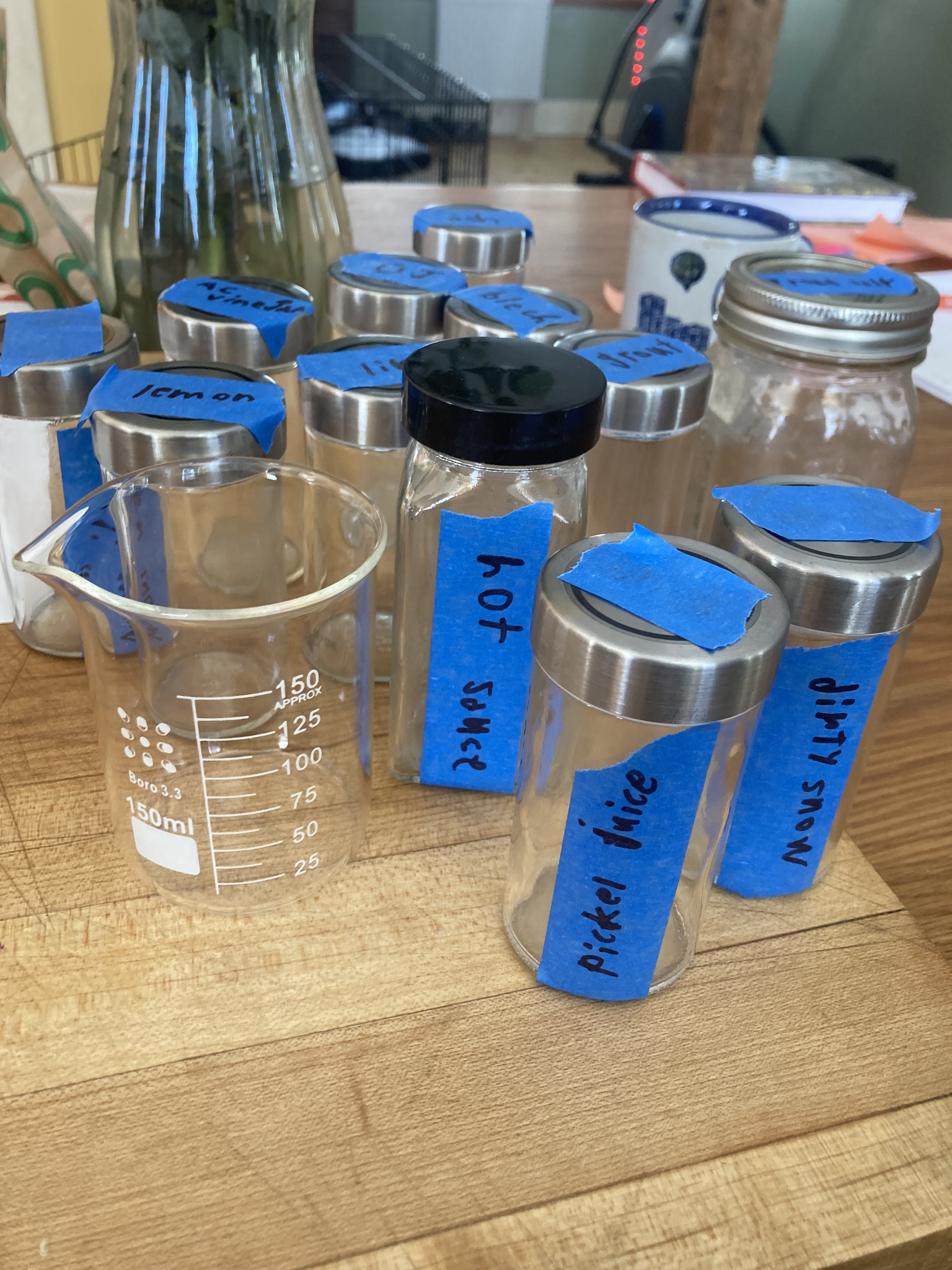
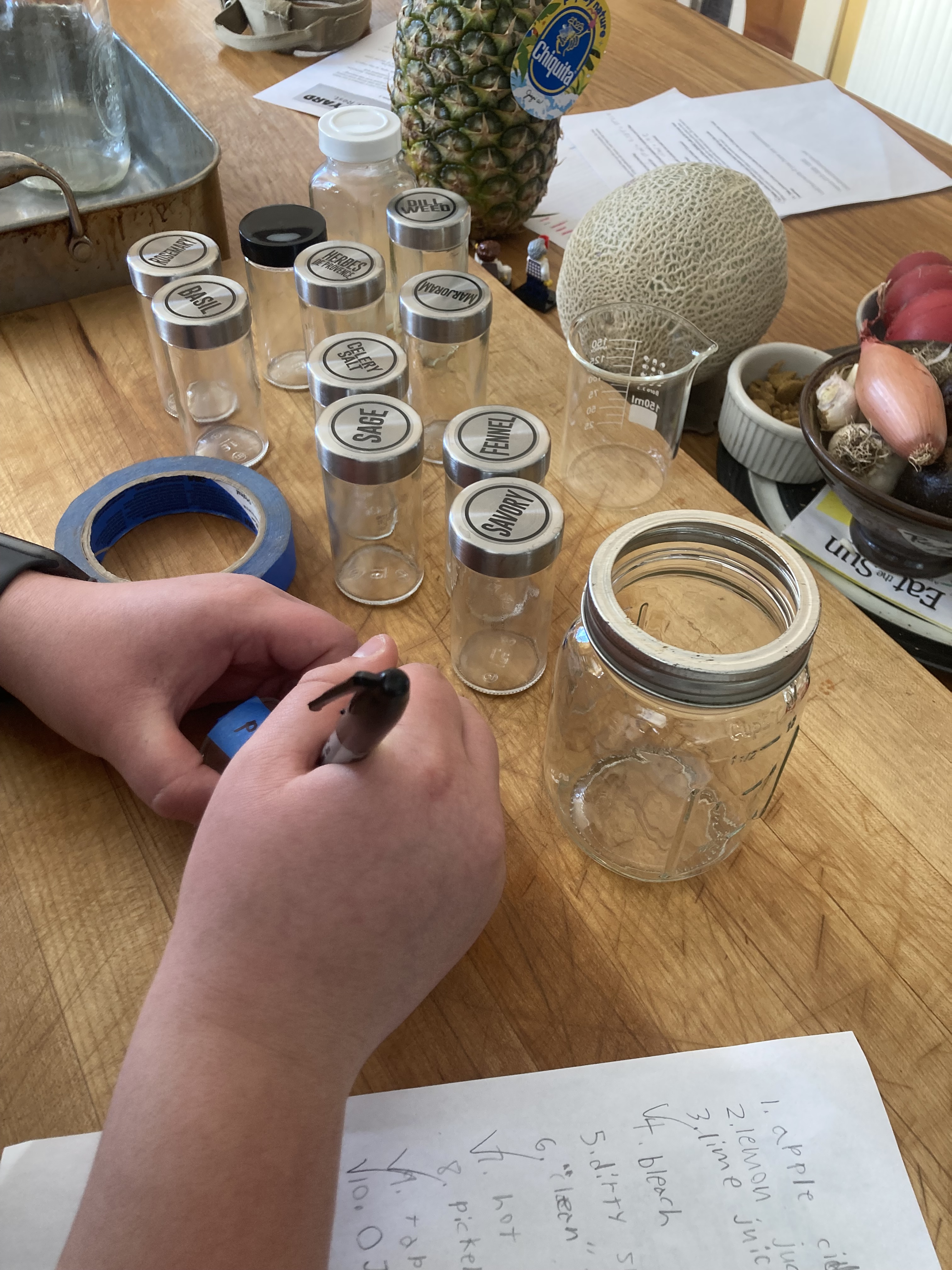
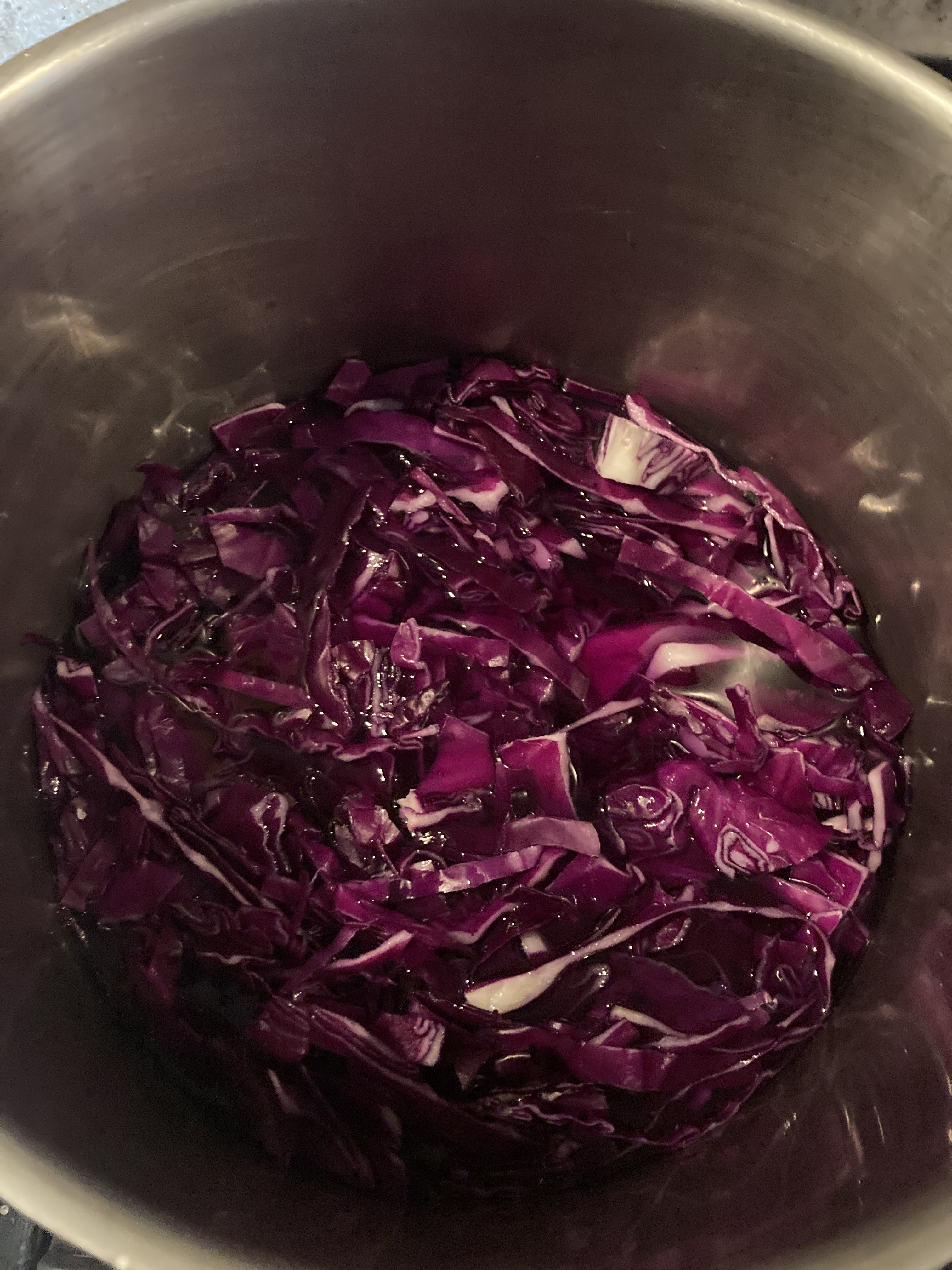
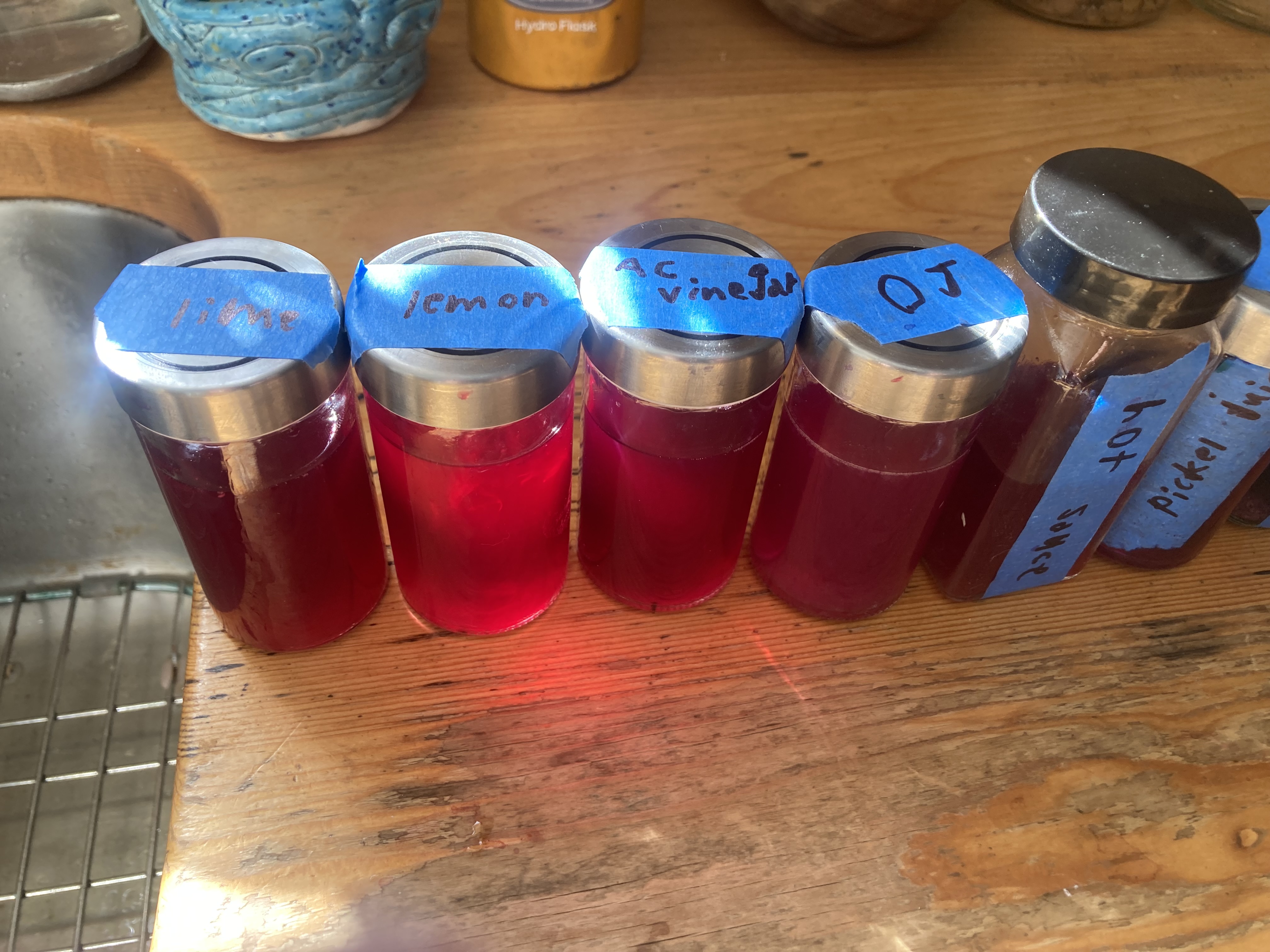
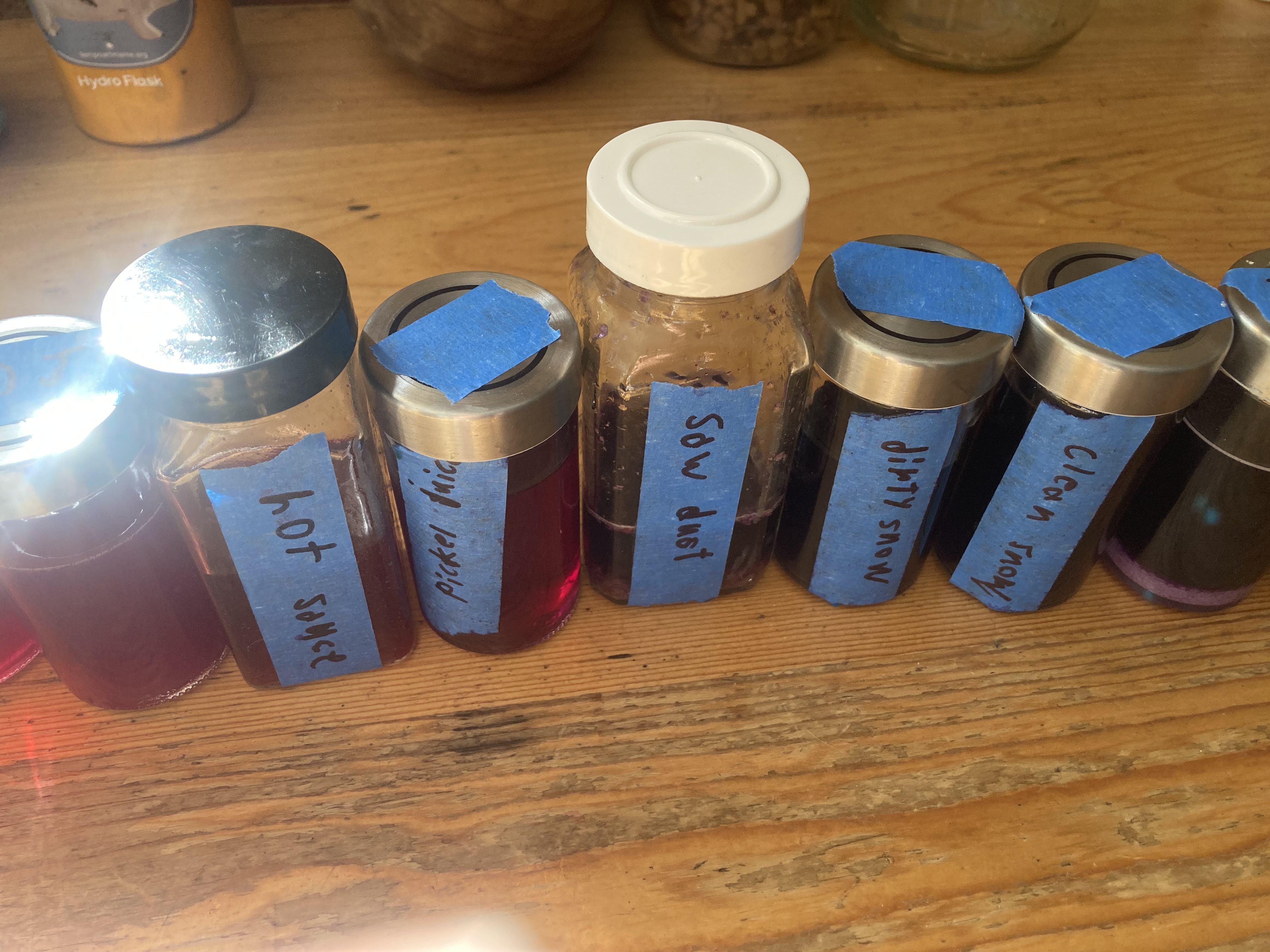
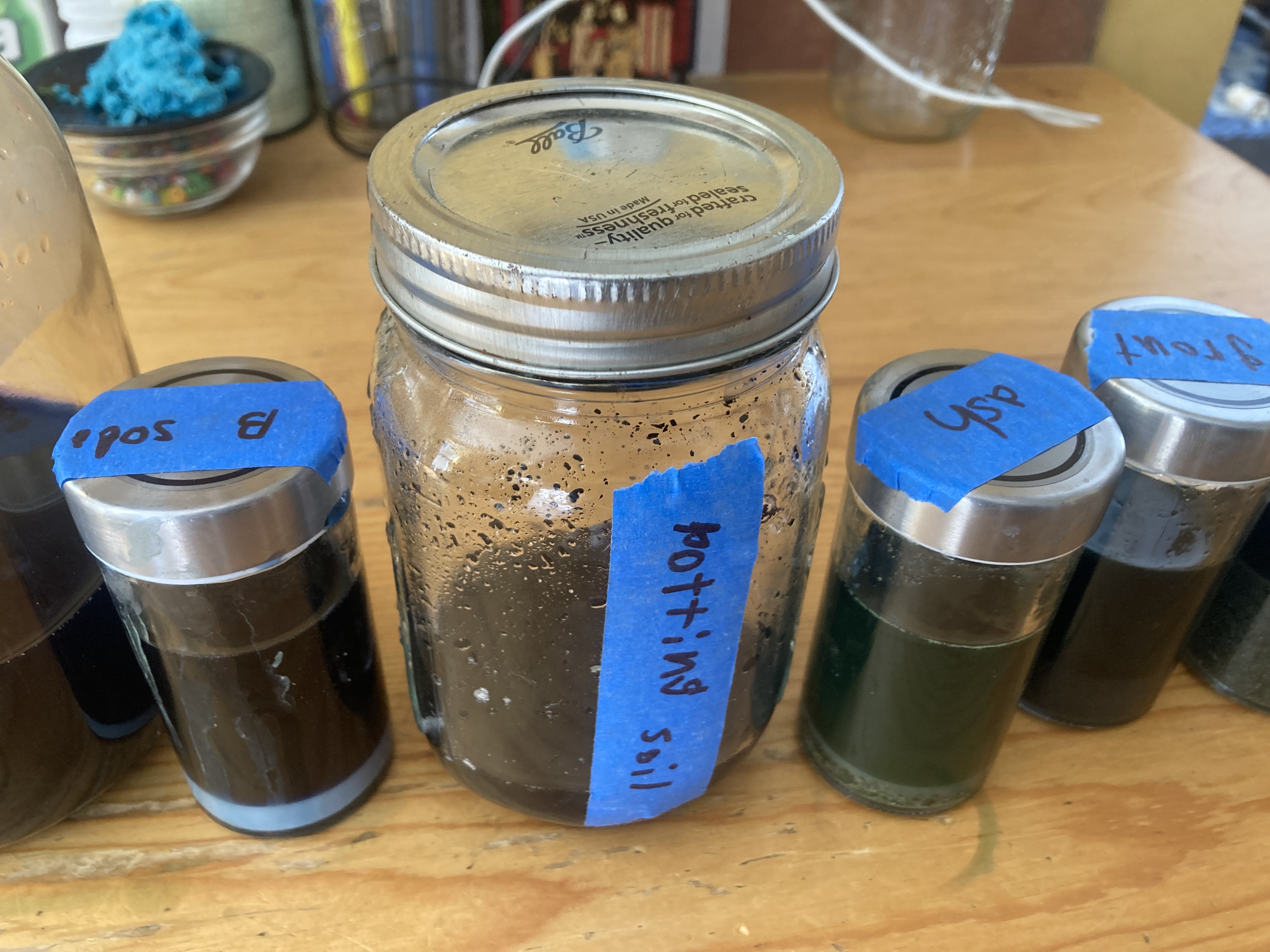
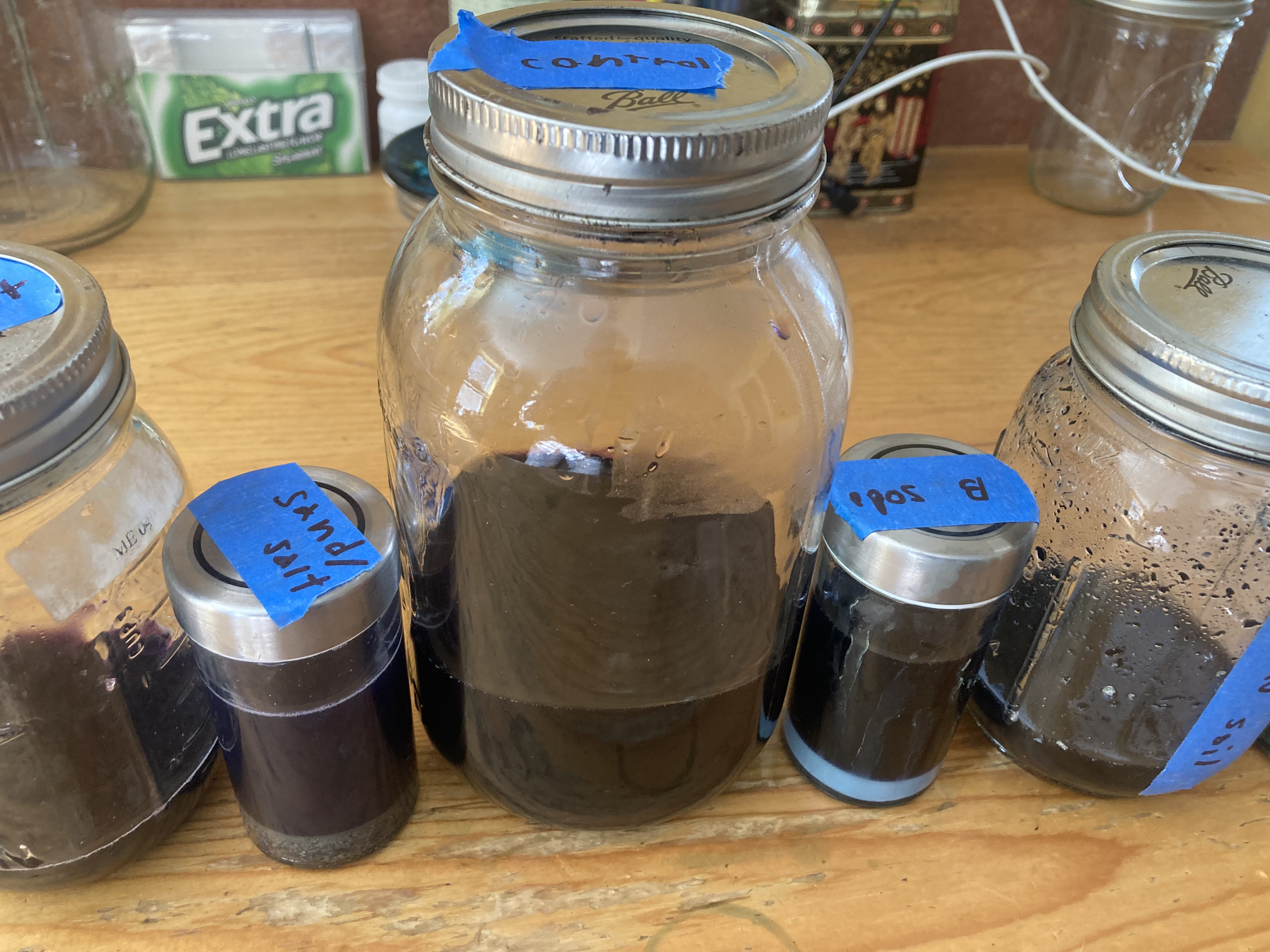
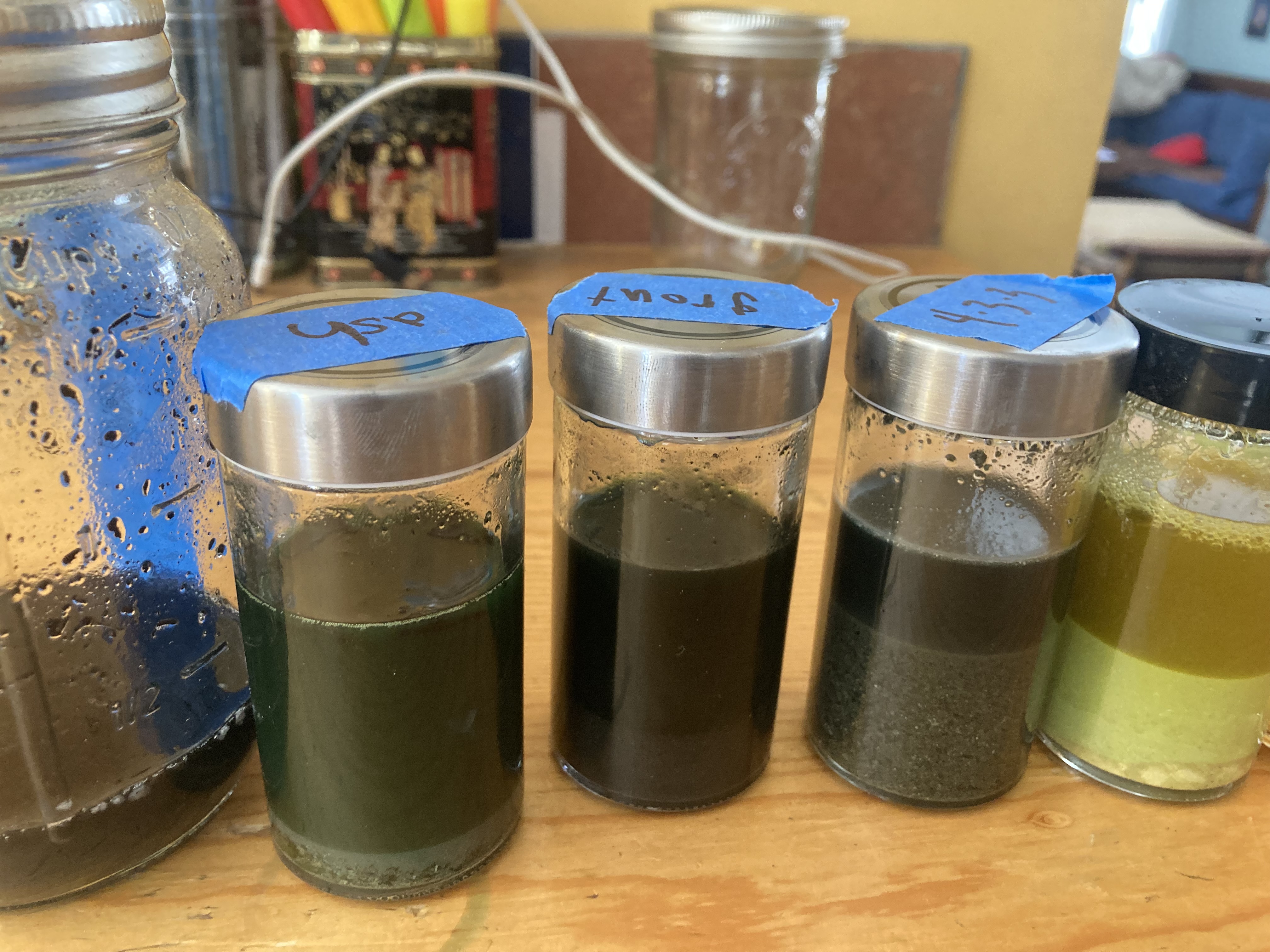
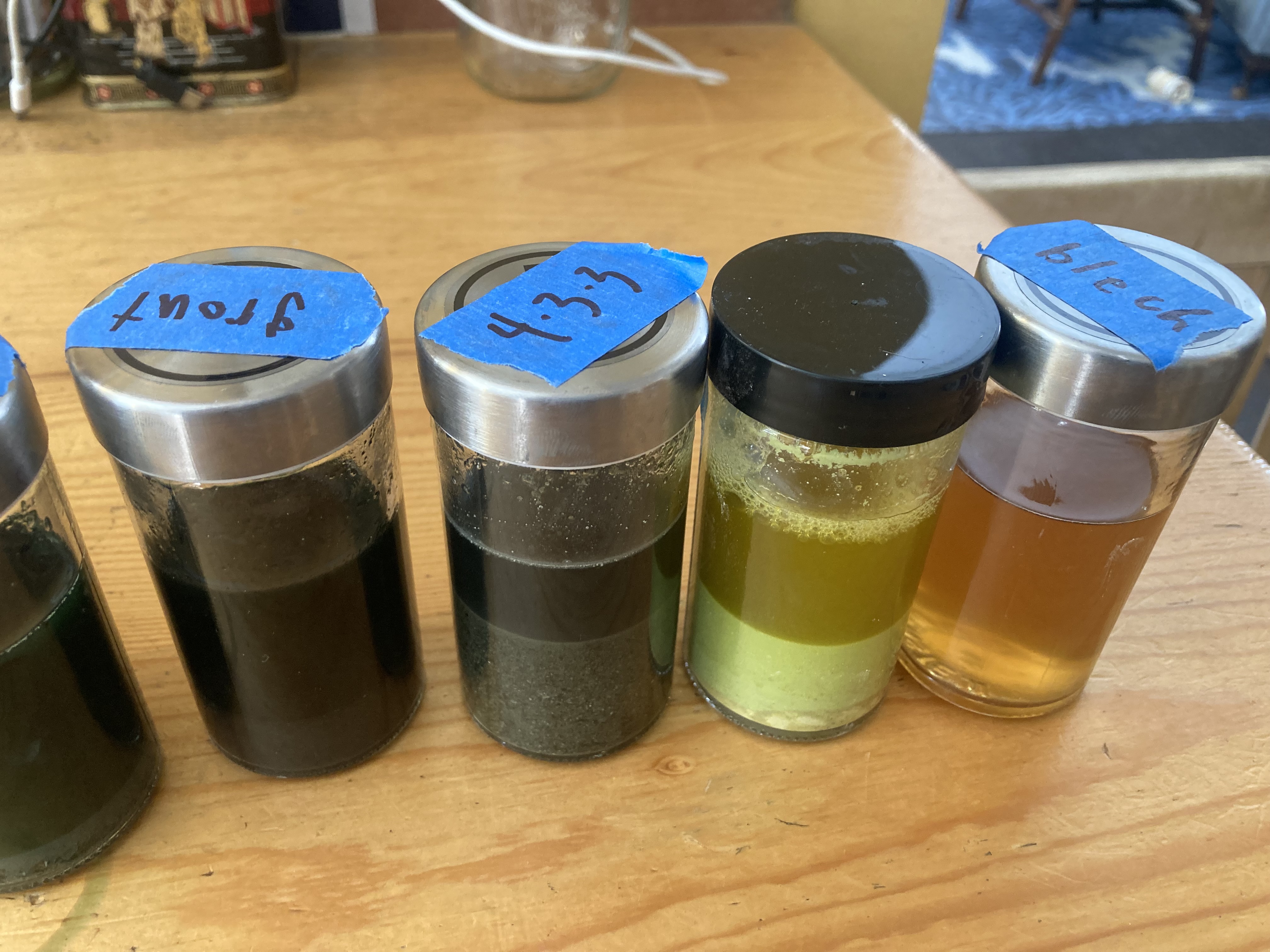
This week we rolled up our sleeves. Following the Soil Keeper’s lesson plan, we finely chopped 5.4 pounds of red cabbage and then boiled it in one gallon of neutral Ph water. M selected 20 household items, then put 15ml of each into a small jar with 50ml of the deep purple cabbage water. The materials included lime and lemon juice, apple cider vinegar, pickle juice and hot sauce; clean snow, dirty snow, calcium chloride salt, and a salt/sand blend; wood ash and sawdust, an organic 4-3-3 fertilizer, mortar and grout (from the tiling); bleach, baking soda and table salt.
With the certainty that is science, before our very eyes the cabbage water changed color depending upon the acidity or alkalinity of the materials. The acids turned pink, while the alkaline moved to green or even yellow.
By day three, we made notes about the experiment; more precisely, my son wrote out sentences. As we began, he commented, “I remember Science class in 5th or 6th grade always taking notes. I find it hard to take notes.”
He began with simple sentences, but as his excitement grew, they became compound and complex: “Lime was the most acidic. The most alkaline was bleach. The “Midnight Black” grout went from black to light green, and slowly became a darker green in the layers; the grout mix fell to the bottom because it was heavier. The 4-3-3 mix was next to the mortar….”
We talked and drilled deeper. While tiling, the Professor had mentioned that Lime was an ingredient in mortar. M researched and discovered (a) mortar contains lime from dolomitic limestone, (b) lime comes from rocks that contain 80% or more of calcium or magnesium carbonate, (c) Espoma Bio-Tone 4-3-3 contains calcium (at 5%) and magnesium (at 1%), and (d) he concluded, “Therefore, it makes sense that 4-3-3 mix and mortar are next to each other on my Ph scale because they both contain the main ingredients in lime.”
Excitedly, he reasoned, “What lime is doing to the soil is technically the same thing as calcium supplements do to humans.” He paused, then said, “Wait, it is not the same thing…” and so he corrected his sentence to [emphasis added], “What lime is doing to the soil is related to what calcium supplements do to humans. Calcium, to humans, supplements human bones. Calcium, in soil, supplements the cell walls.”
He then asked, “what is dirt made of?” Soil, he learned, contains minerals 45%, air 25%, water 25% and organic matter is 5%, while its texture is the ratio of sand, silt and clay particles.
He exclaimed, “I have never been so invested in a science lesson! This is fun…this is genuinely fun!!!”
About the circle of life, he discovered, “nutrient transfer: plants take up essential elements from the soil and convert them to organic matter consumed by humans.” Did someone say, “know your food, know your farmer” ?
Having only just begun, he pondered why pickle juice and sawdust were beside each other on his Ph scale. His research lead to this conclusion: “The reason pickle juice and sawdust were next to each other was because pine and spruce are softwoods, and more acidic than hardwoods. We got the sawdust from the table saw, and have been cutting pine and spruce for the tiling work. That makes sense.”
“Just two more questions?” he pleaded. He chased down that softwoods are more acidic than hardwoods due to acidic resins, while oak is a hardwood that can be more acidic. Pickle juice is highly acidic, typically 2.5 to 3.9. In contrast, sawdust from pine, spruce, fir is neutral to slightly acidic; pine = 4.1 to 5.3, spruce = 4.7 to 5.8, fir = 5.2 to 5.9. “So, pine is more acidic while fir is more neutral,” he concluded.
“What if we try this again in the summer? We can test the soil when the plants are growing!”
And so our Red Cabbage Ph experiment came to an end. His bristling excitement a testimony to what happens when a student sits beside a Mother Tree, pondering soil and soul.
_______________________
NB: The astute reader may have noticed that here at an Art Farm we use no proper nouns. That is intentional, to underscore the mythopoetic, more than the rational. For example, whatever Ultimate Truth may be, it has more than 1,000 names, which is to say proper nouns, none of which capture the grandeur or sublimity of that whole, many of which lead only to wars.
Humans give names to bring order and cognitive structure to a complex world; naming divides subject from object, while “being” remains intransitive, a verb which takes no object. “Divide and conquer” is a tool of would-be authoritarians and Emperors which leads us to fight to the bottom. In these challenging times, then, let us be together, undivided, to rise to new heights and an expansion of consciousness. And to that end, my pronoun is “We.”
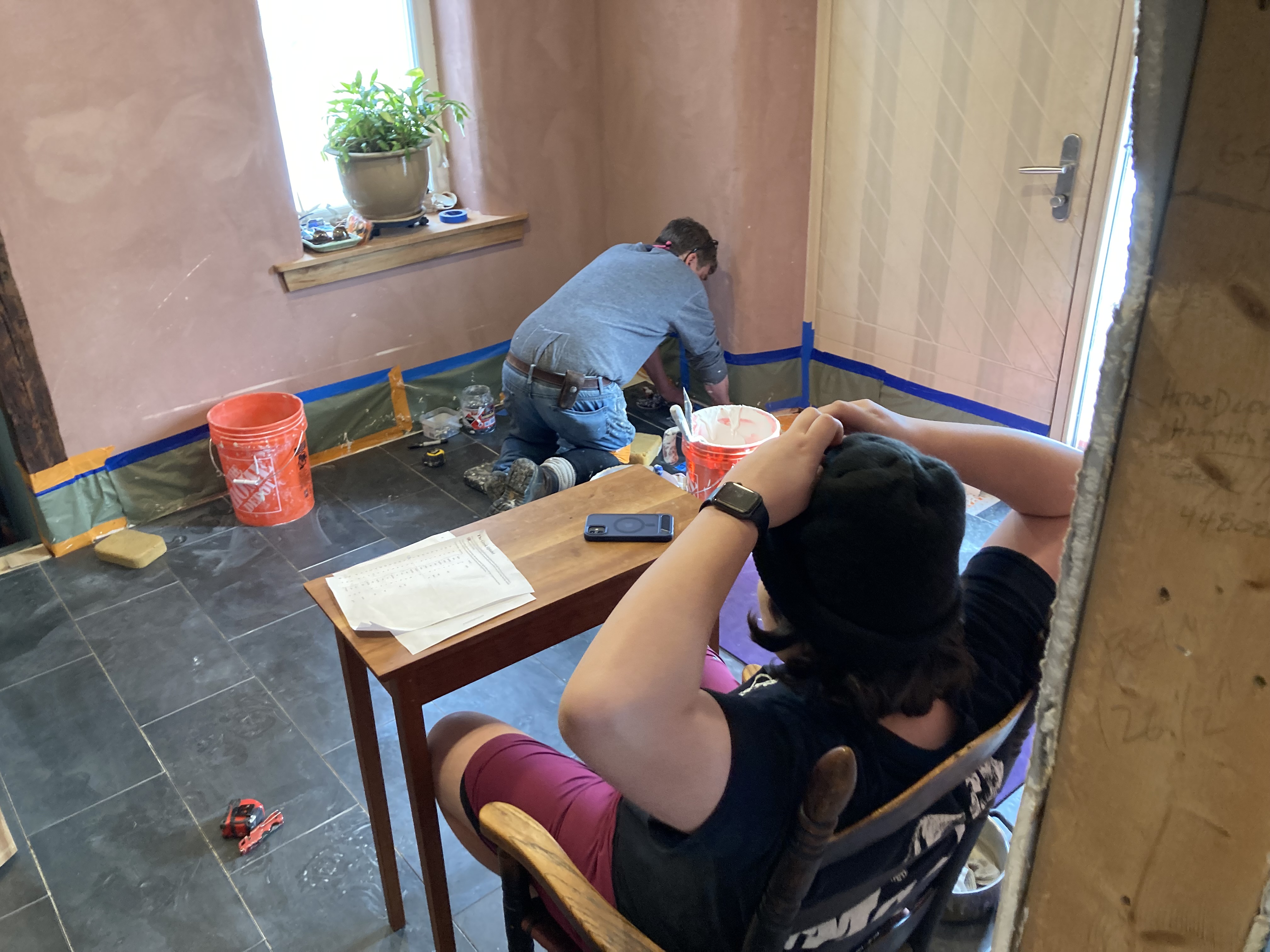
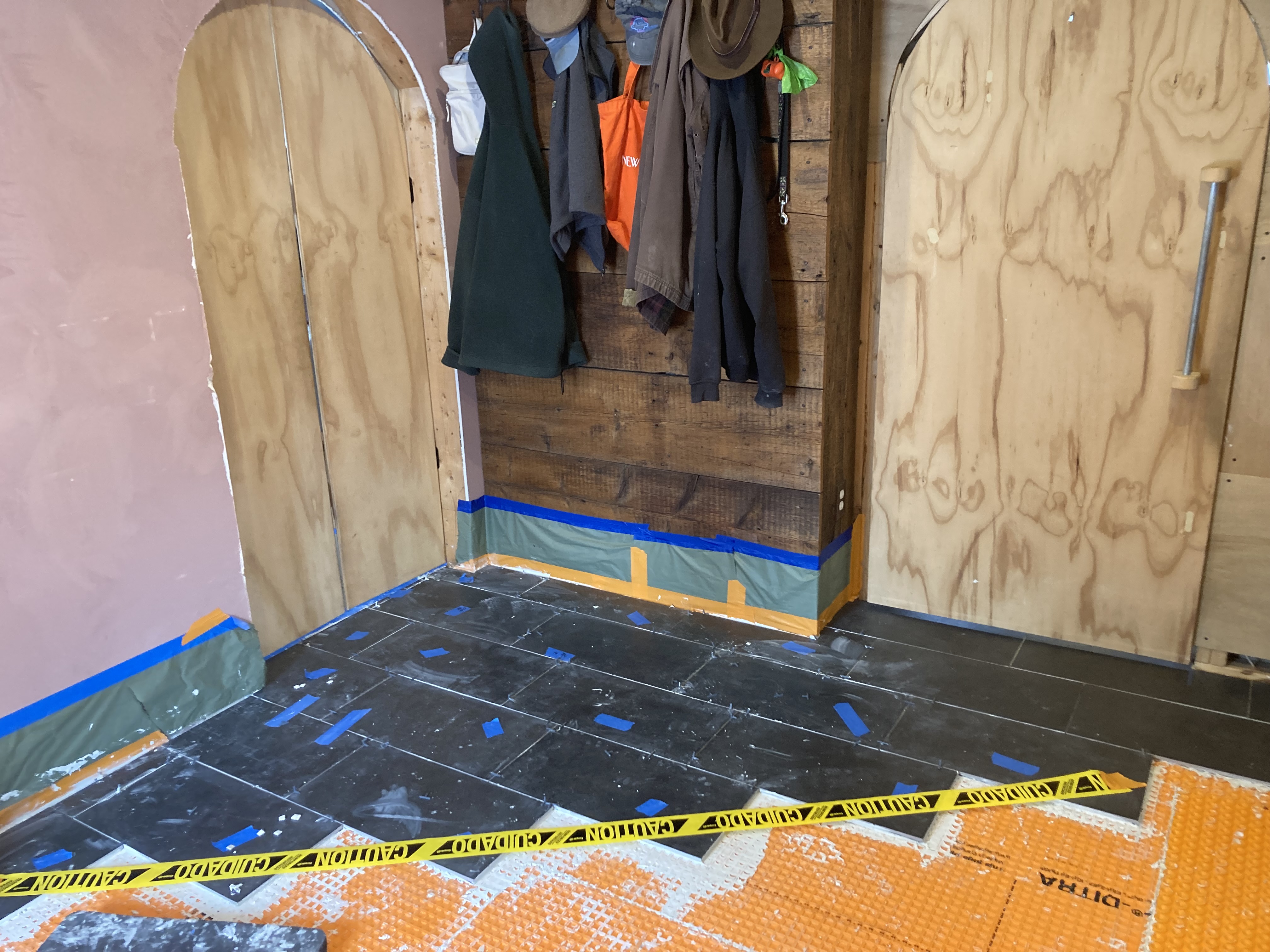
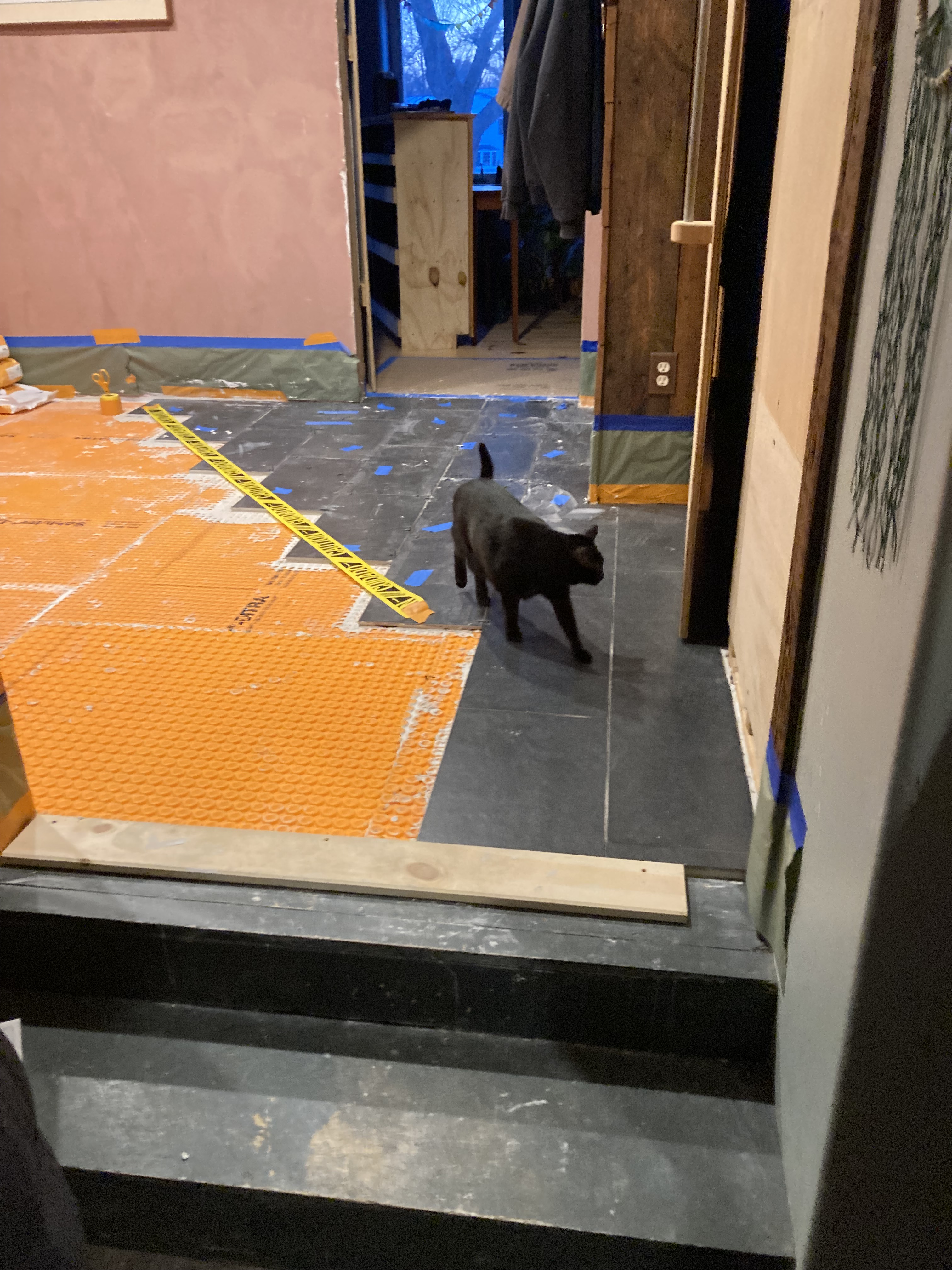
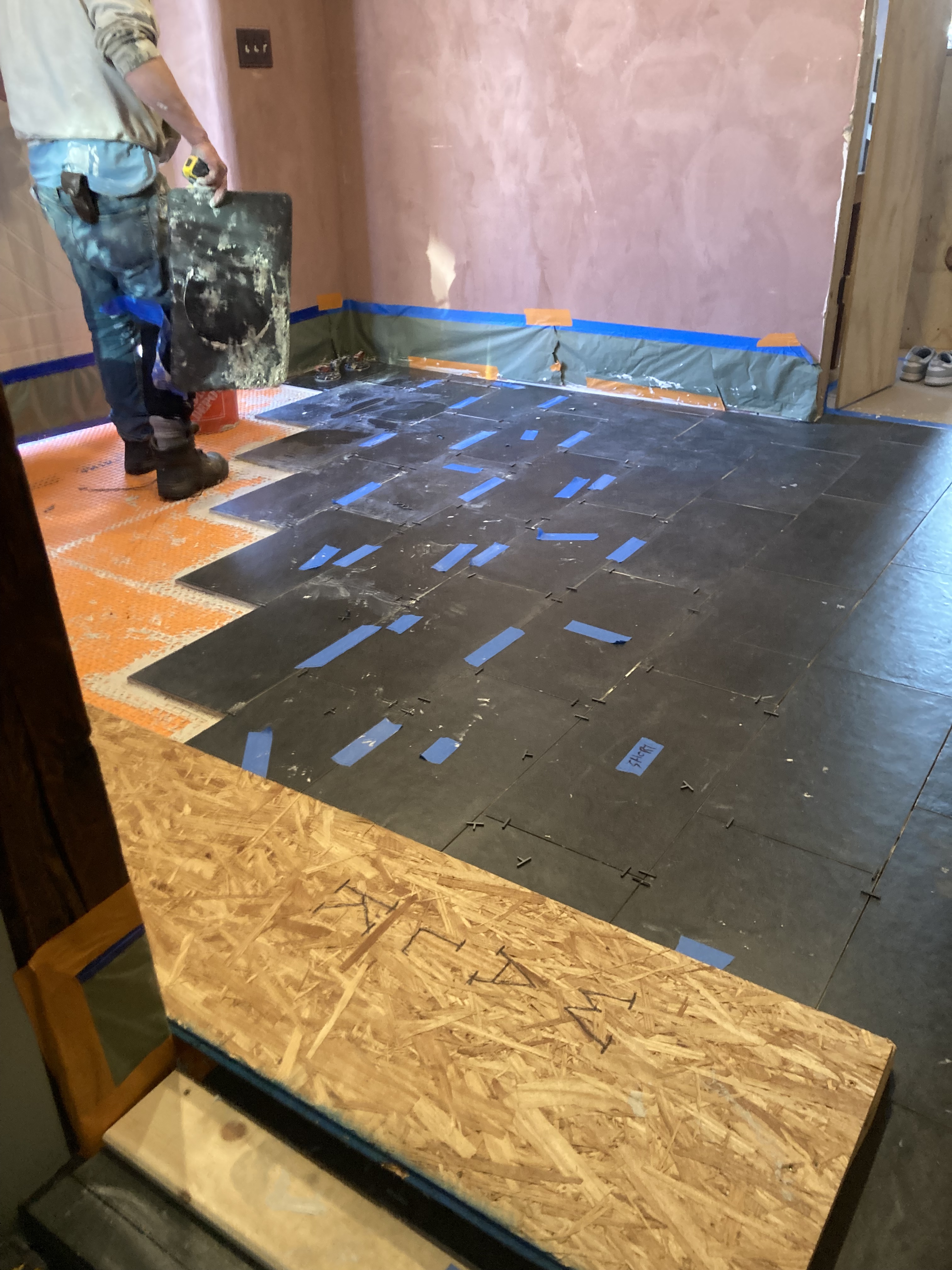
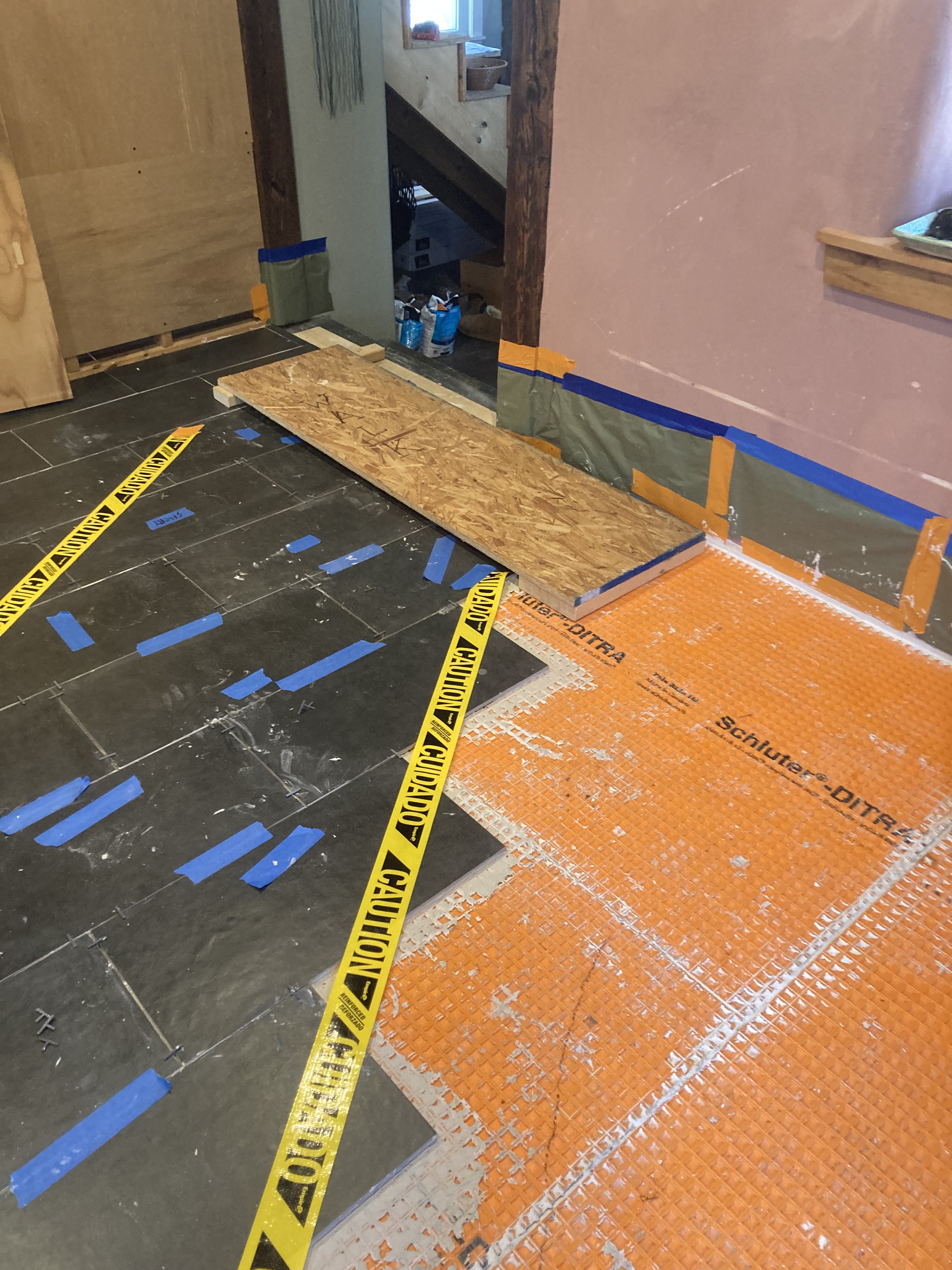
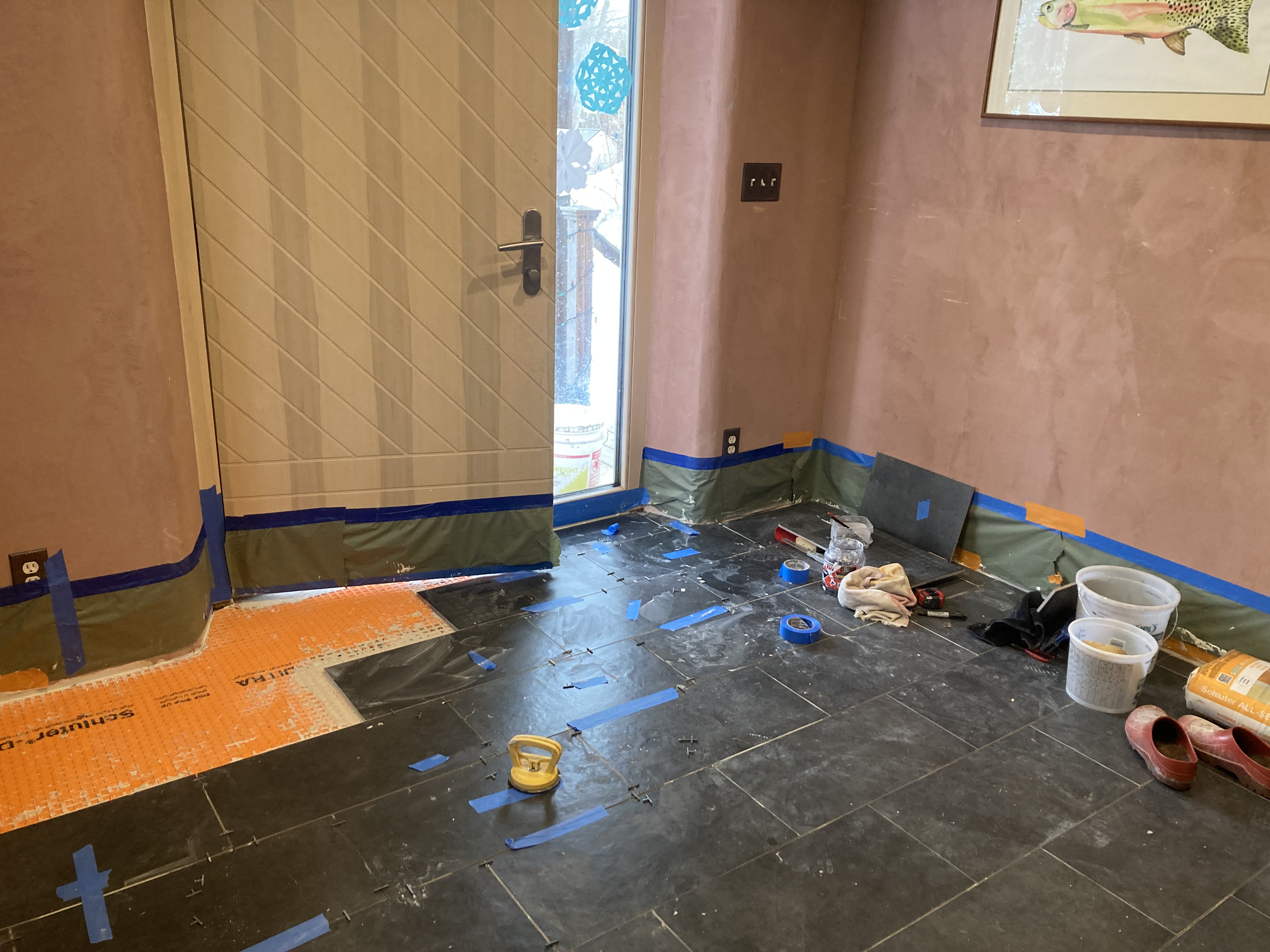
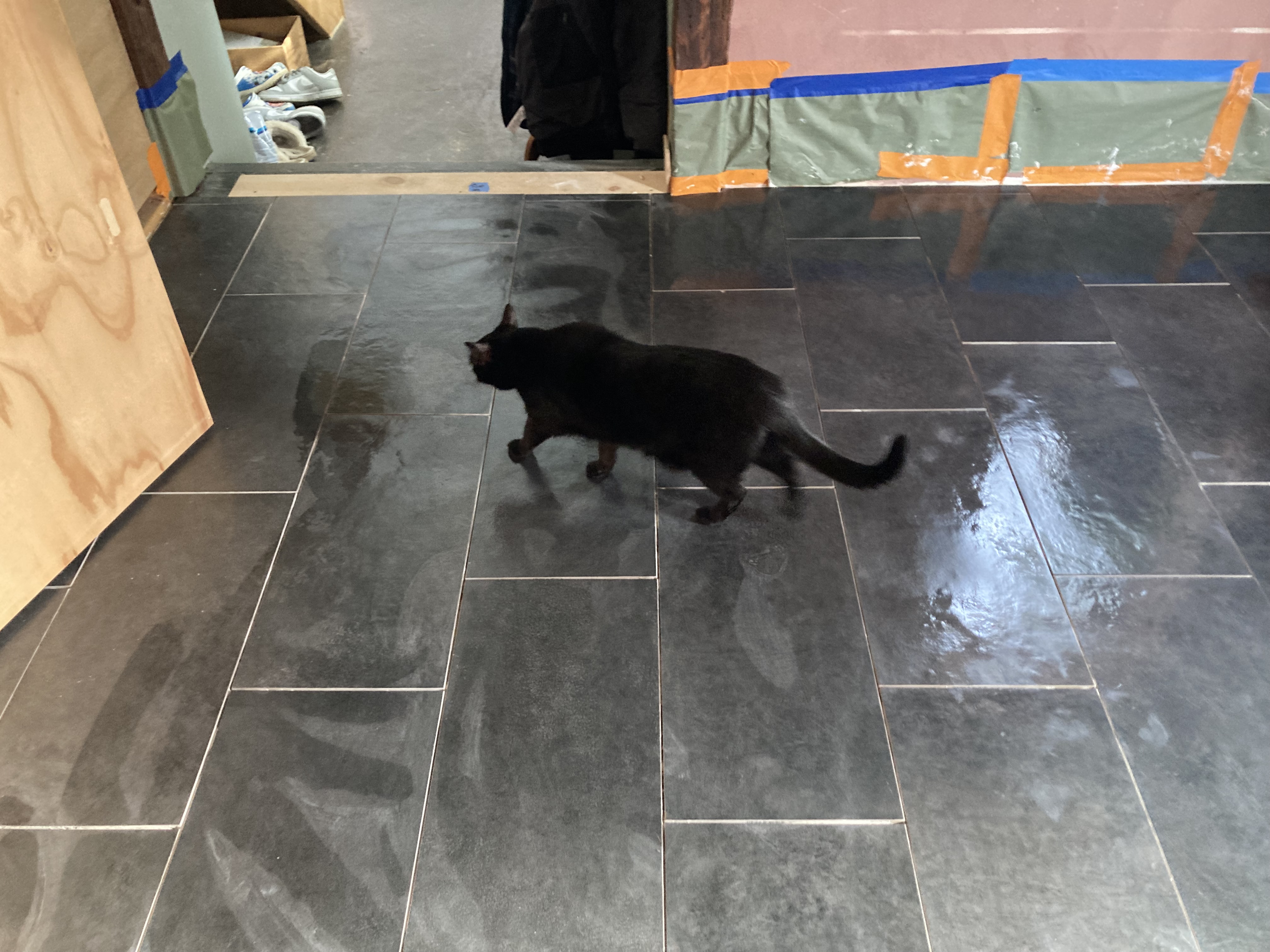
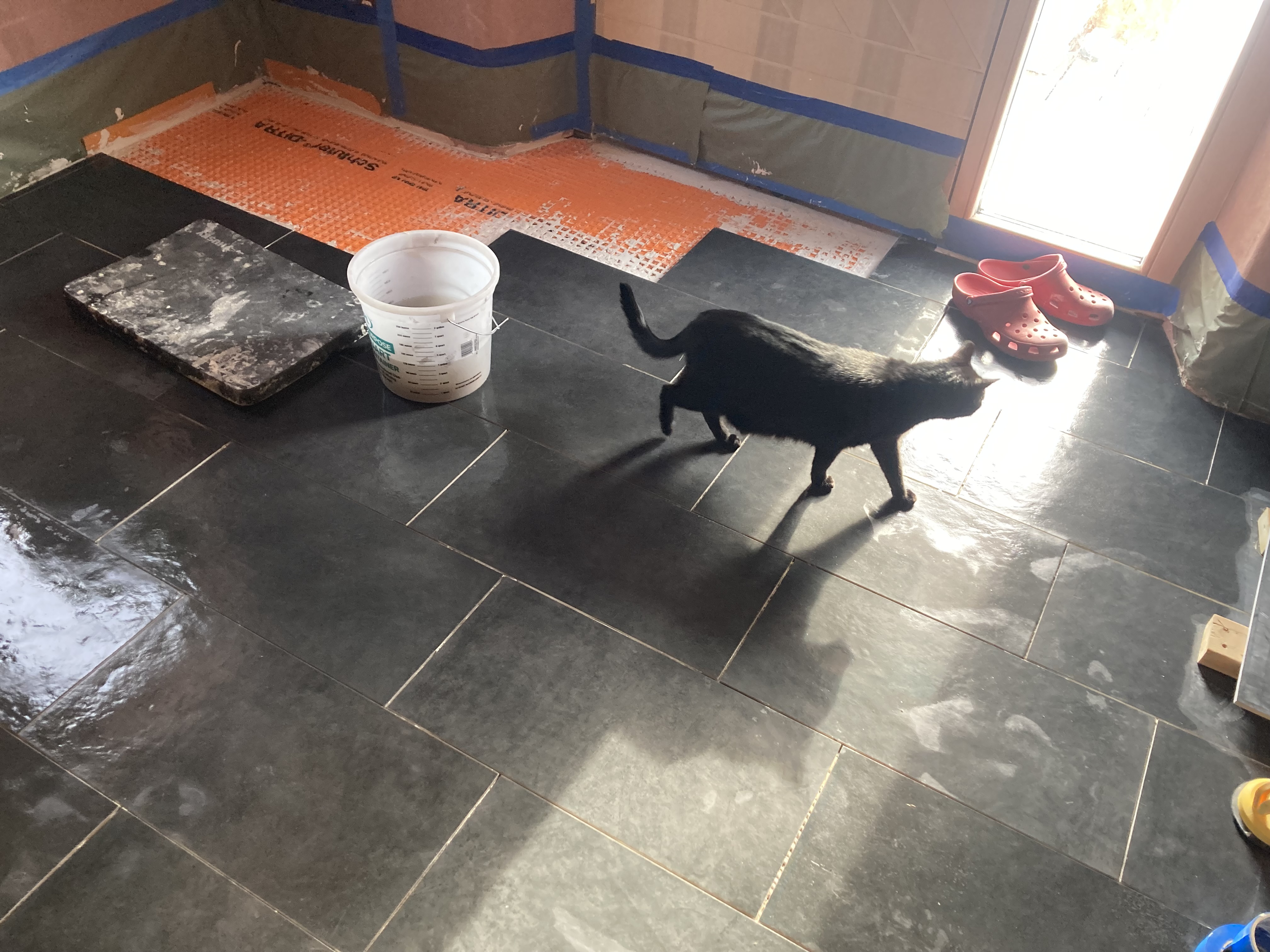
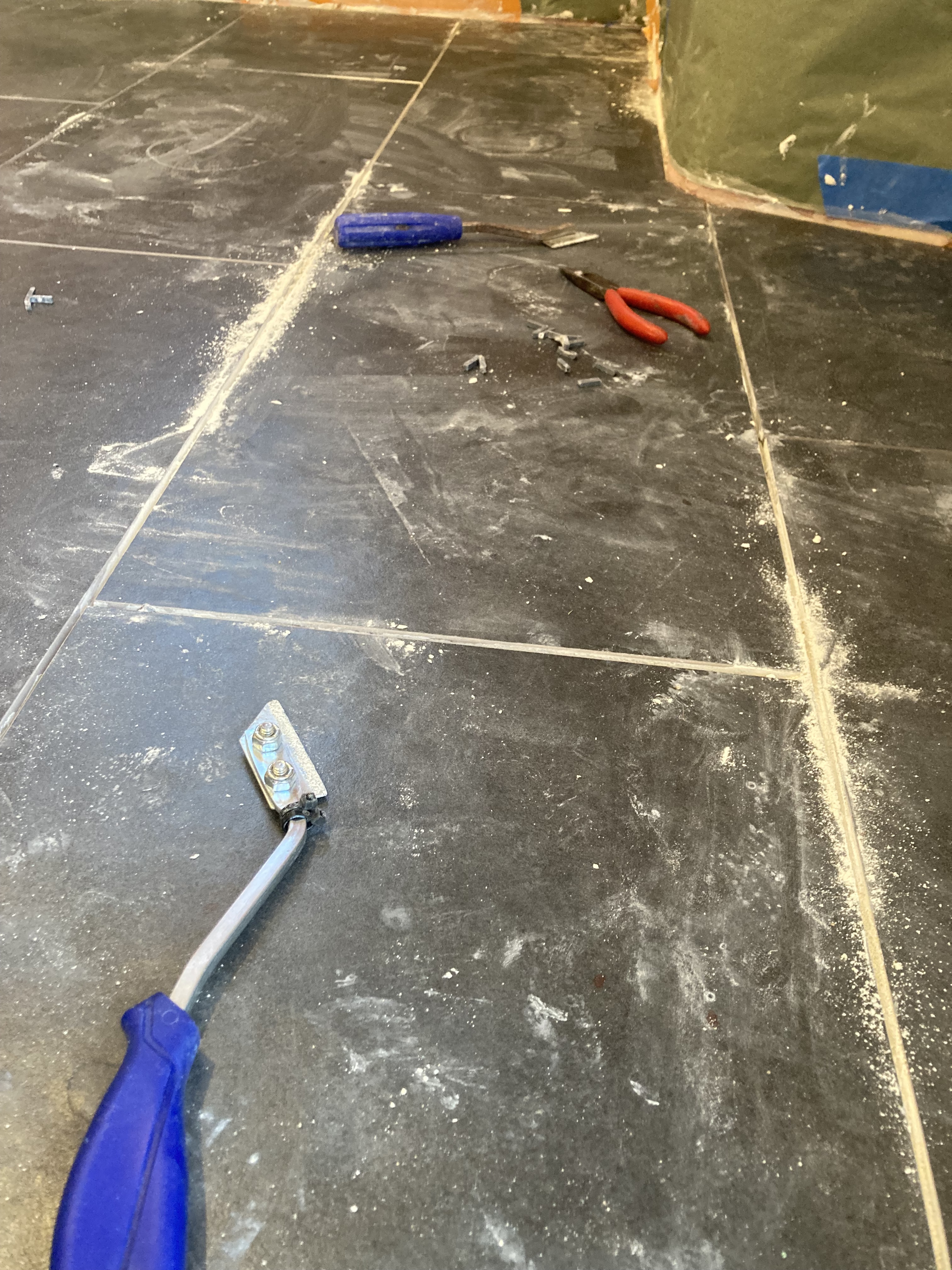
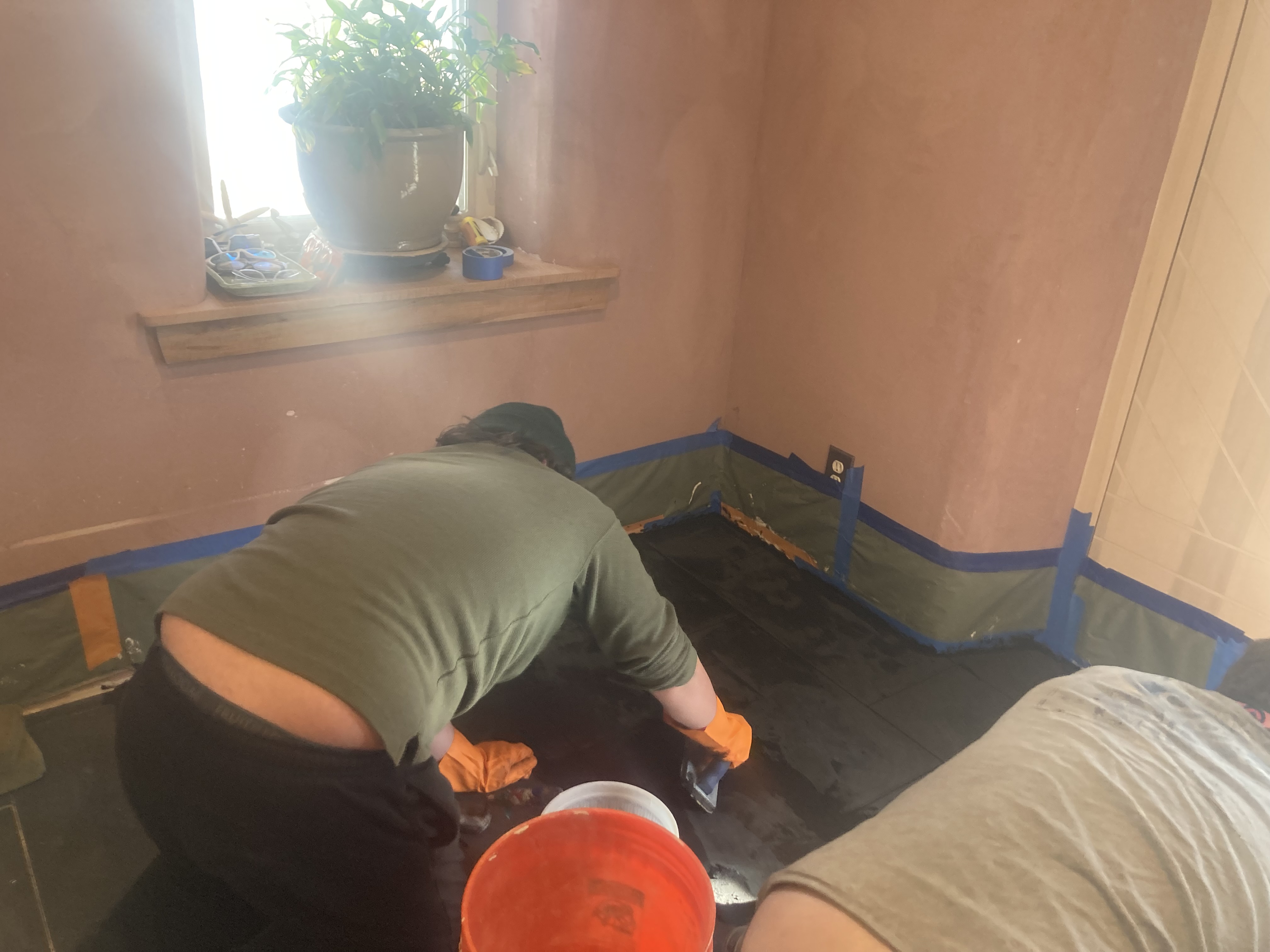
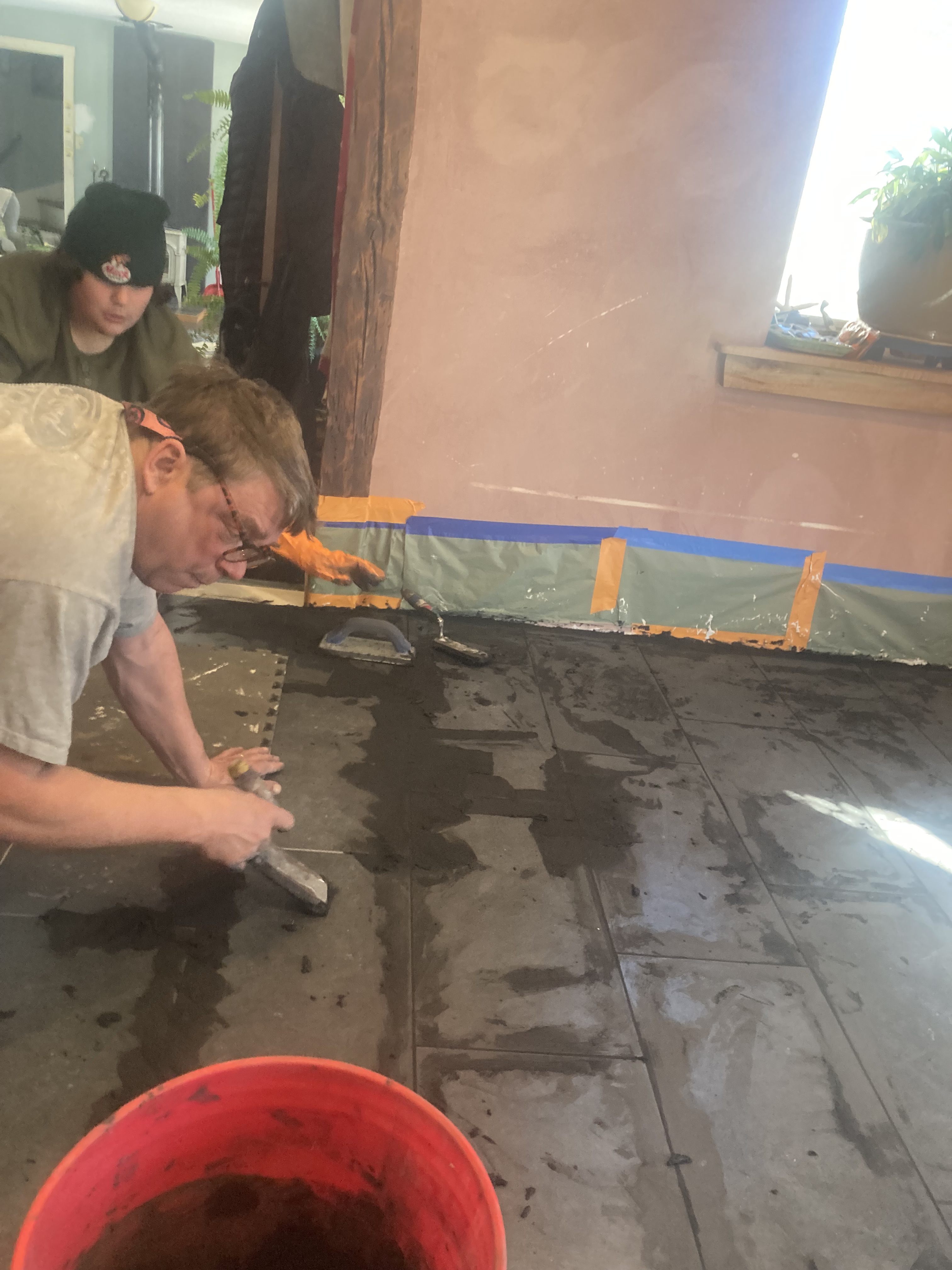
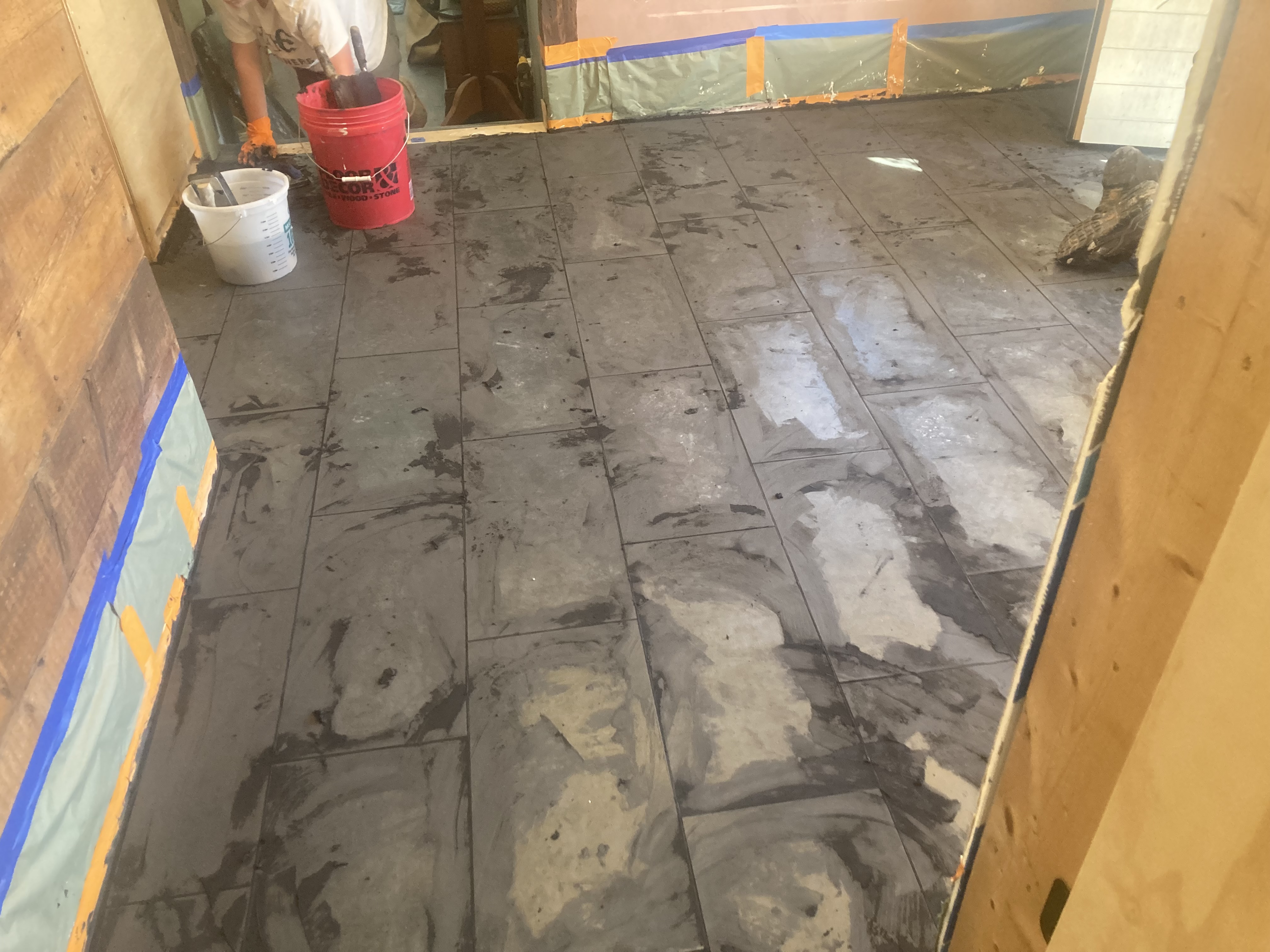
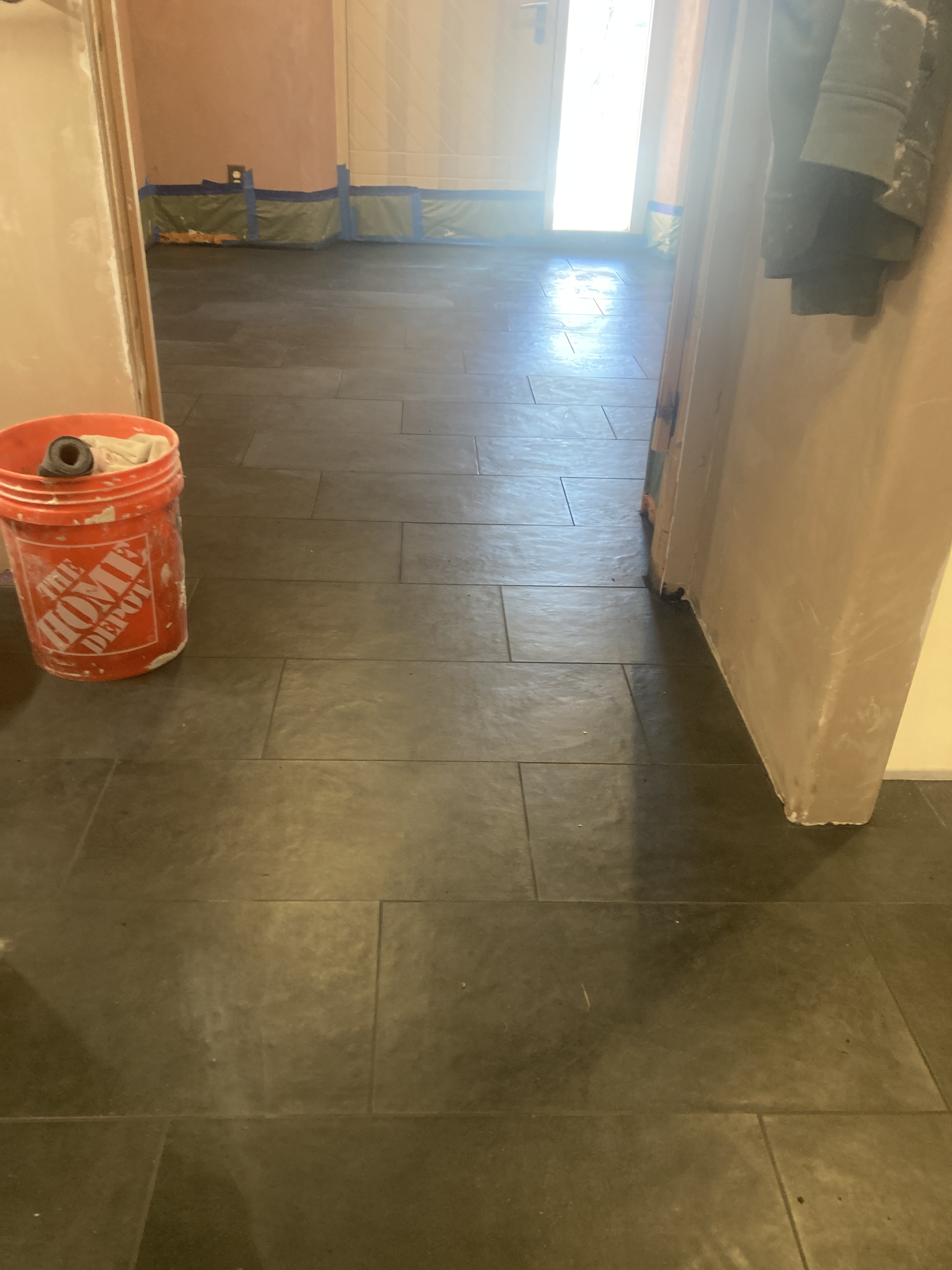
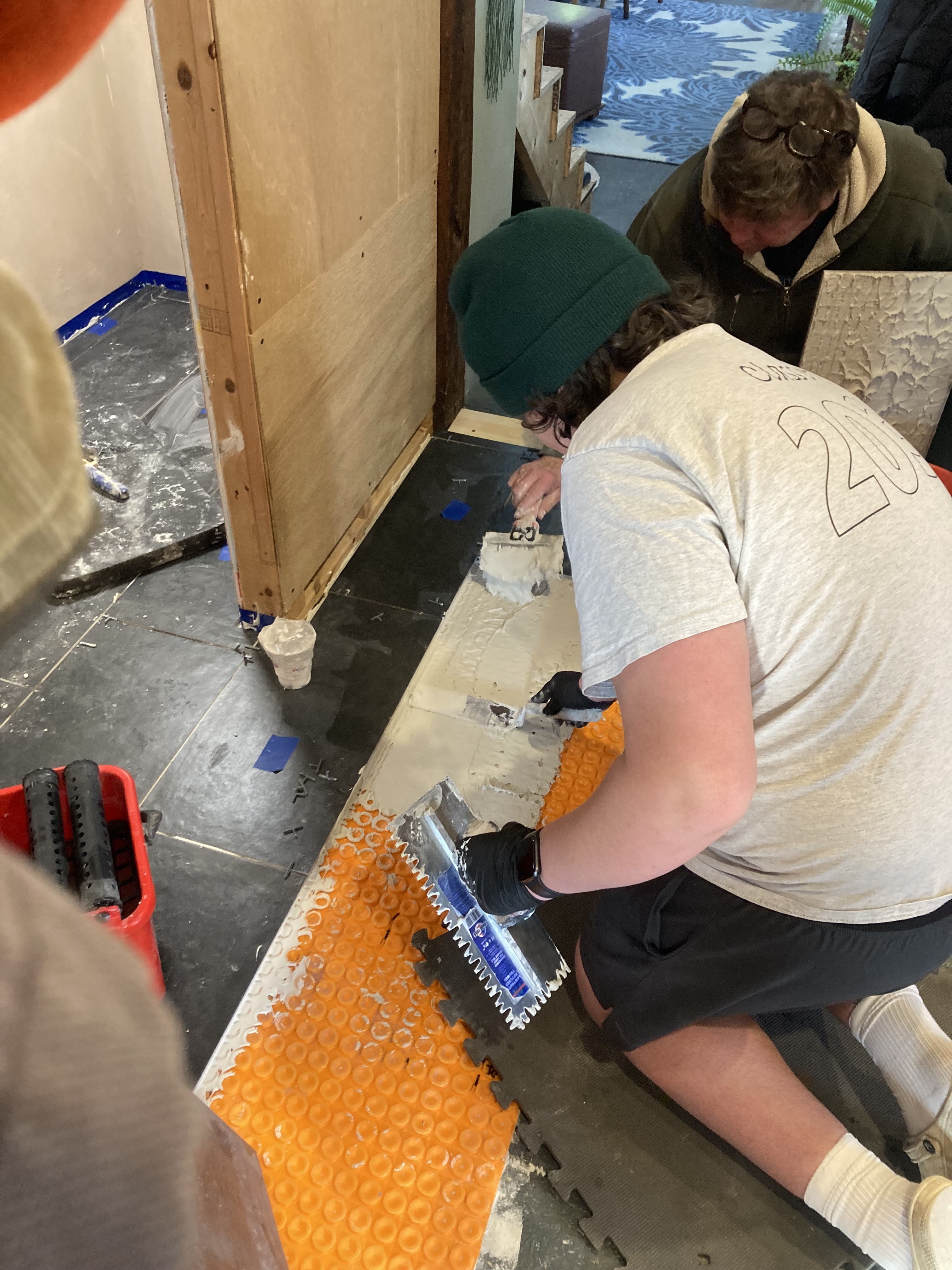
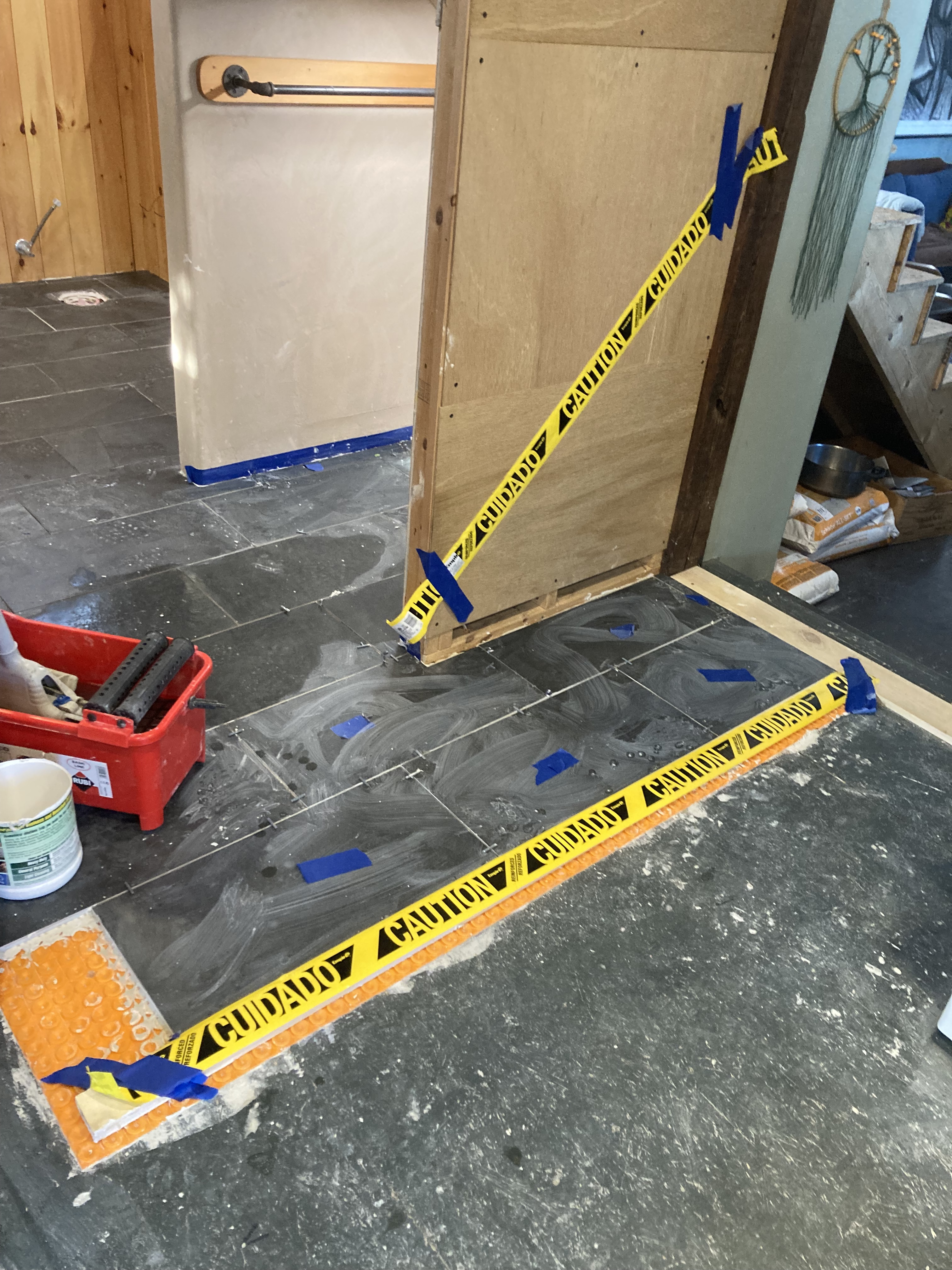
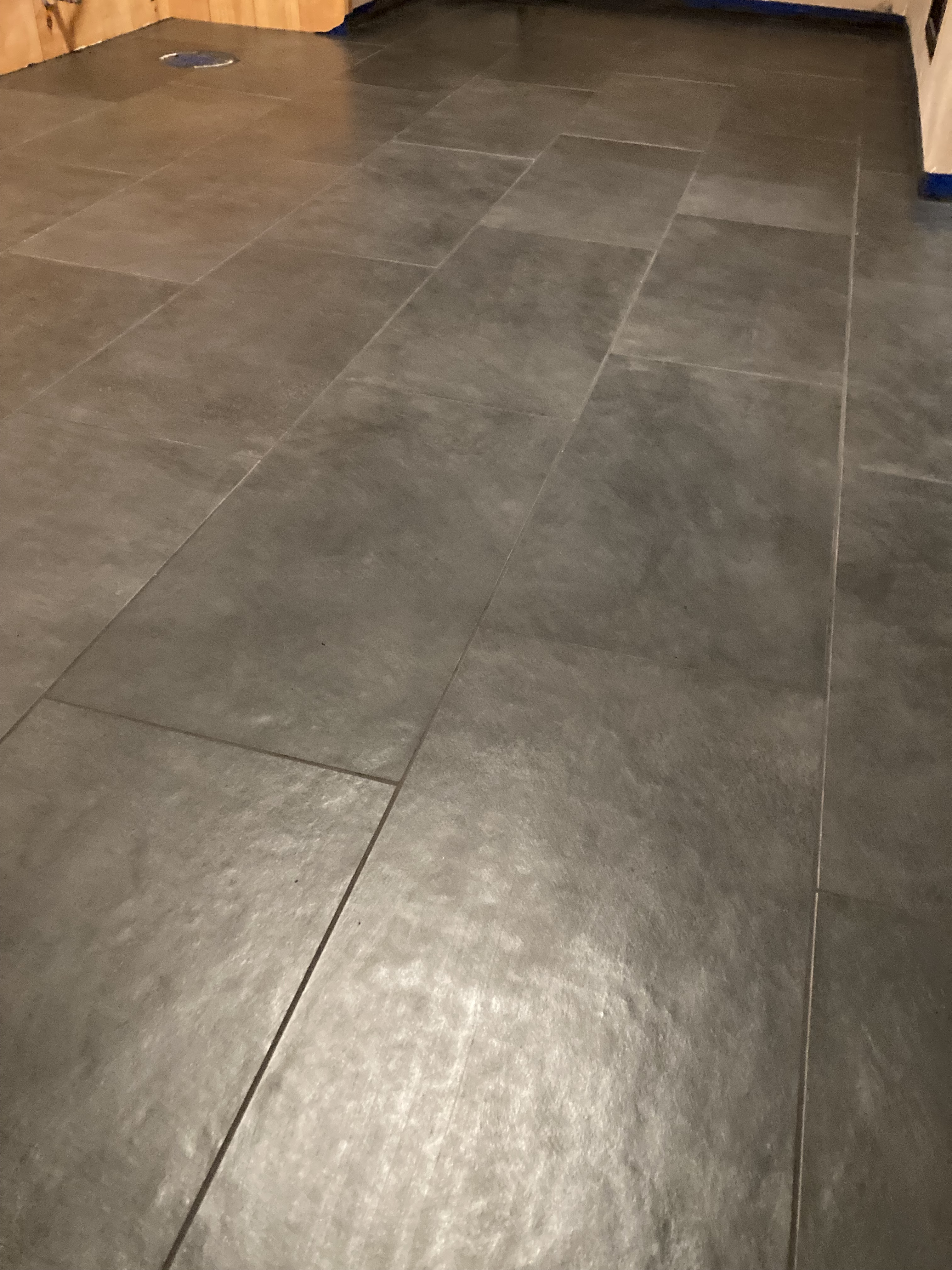
Misery loves company, which is why we did the tiling work as a team, laying 259 square feet of tiles on hands and knees. The work is finished now and indeed, “teamwork makes the dream work,” which saying the end result has proved.
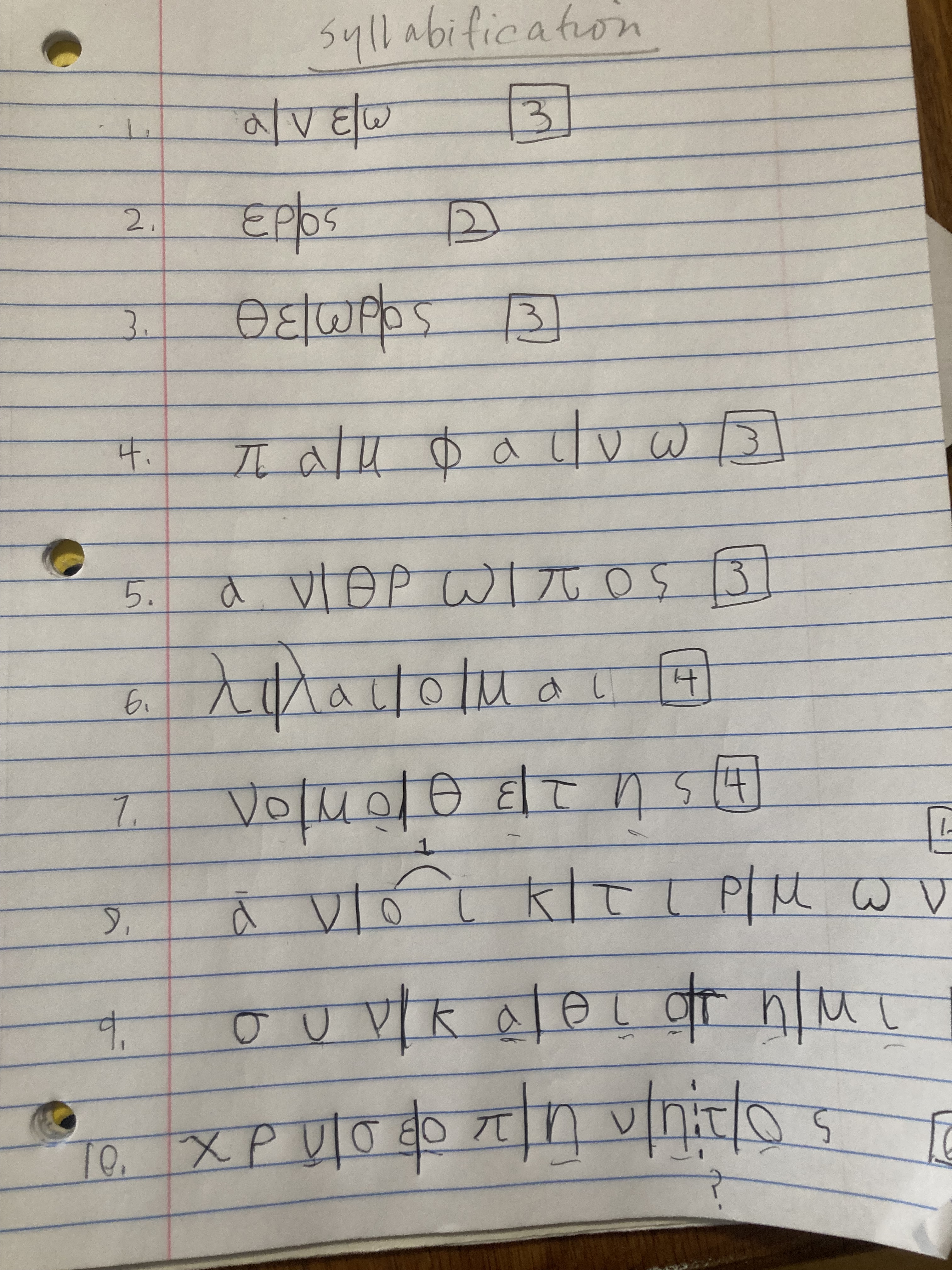
To make a distraction from tiling, we played the “Greek Syllabification” game. In fact, this was a lesson in logical thinking and, even though the local schools were on February Break, our Art Farm Academy remained open for business.
My son’s Language Arts teacher, known as “The Magister,” created the game as, “…an excellent, brief object lesson in logical thinking…a fitting complement to his thinking about and then articulating how an English sentence can be composed one way or another to suit the purpose of the statement. …it’s time to slyly ratchet up his ability to think and express himself more critically–and at the same time build his pride and confidence, which the strangeness of the Greek can occasion.”
I dared not tell my son this was an assignment, but instead spoke of the “game,” with four basic rules:
Every word is made up of syllables and consonants.
Every syllable makes one sound.
The sound of a syllable is made by a vowel, or by a consonant with a vowel.
To syllabify means to divide a word into its syllables.
Seven letters are vowels in Greek: α, ε, η, ι, ο, ω, υ. The combinations of αι and οι make up one vowel, which combination is called a diphthong. A Greek word has as many syllables as it has vowels or diphthongs.
While the Professor and I worked on our hands and knees, my son set up a table and chair, and we began. The contrast in postures was as comical as playing the game was wildly impractical. But we pushed on enough to lay both the game’s ground rules as well as more tiles.
Another assignment during last week was to calculate the degrees of the triangle formed from our first day’s tiling work. My son knows that every triangle contains 180 degrees, and our day’s work was a right triangle, meaning a 90 degree angle at the base. Using a tape measure, we found the hypotenuse was 115″ but the sides were not equal – one was 71” while the other was 90” – and if not equal then the angles could not both be 45 degrees. We needed trigonometry, not geometry, to solve the ratio of the sides of a right-triangle to find a specific angle.
My daughter, who excels in high school, was amazed that we would tackle trigonometry but such was the task at hand. Conventional schooling regards trigonometry as a subject for Junior or Senior year of high school, but anyone in the trades learns that you use the tool when needed. My son has already studied ratios so this was a chance to apply that knowledge.
Our problem, it turns out, has been discussed as far back as the Babylonians and Egyptians; was refined by the Greek astronomers, but Aryabhata, an Indian mathematician, discovered the terms used today: sine and cosine.
The word “sine” is derived from the Latin “sinus” which means “fold in a garment,” but that was a mistranslation of the Sanskrit word “jya-ardha” which meant “half a bowstring;” the Sanskrit derived from Persian, which, in turn, came from the Greek “χορδή” which meant “a bow string made of gut.”
The Babylonian, Egyptian and Greek astronomers were trying to understand arcs in a circle, which is the shape of the cosmos. Trigonometry became their language to divide a circle in order to map the heavens, and thereby understand the movement of celestial bodies. Rich history lay behind the very tangible question of the triangle we laid on day one of our mudroom tiling.
“Sine” is simply the ratio between the right triangle’s hypotenuse and its opposite side; the 71″ Opposite divided by the 115″ Hypotenuse equals 0.617. Converting that ratio into an angle requires the inverse function known as the arcsin; given the known sides we want to know the angle they form, the space between. Because the math to calculate the arcsin is complex, we used a calculator, but the concept became clear: our tiling had angles of 90, 38, and 52 degrees (which add up to 180). Not surprisingly, the Greek letter theta θ is used to represent the unknown angle. The strangeness that Greek can occasion!
Our Art Farm, then, teaches a practical truth that life is about problem solving, not meeting the metrics of a school curriculum. And in the “there are no coincidences” department, the Goddess happened to read to us a passage written by Melody Beattie about solving problems:
When we spend more time reacting to a problem than we do solving it, we miss the point. We miss the lesson; we miss the gift. Problems are a part of life. So are solutions.
A problem doesn’t mean life is negative or horrible. Having a problem doesn’t mean a person is deficient. All people have problems.
Recovery does not mean immunity to or exemption from problems; recovery means learning to face and solve problems, knowing they will appear regularly. We can trust our ability to find solutions and know we’re not doing it alone. Having problems does not mean life is picking on us. Some problems are part of life; others are ours to solve, and we’ll grow in necessary ways in the process.
Face and solve today’s problems.Don’t worry needlessly about tomorrow’s.When they appear, we’ll have the resources necessary to solve them.
Indeed, our core curriculum increasingly is the very practical lesson of stepping up to life to solve problems. And about that game of Greek Syllabification? By Sunday my son had finished the task. Greek is the least of the lesson. The point is to play by the rules and gain confidence in approaching and working through the unknown. Some serious mental gymnastics ensued, as he worked this through, including pronouncing the words after breaking them into the syllables.
1) ανεω (silently) 3 syllables: α νε ω
2) ερος (love) 2 syllables: ε ρος
3) θεωρος (spectator) 3 syllables: θε ω ρος
4) παμφαινω (to shine) 3 syllables: παμ φαι νω
5) ανθρωπος (man) 3 syllables: αν θρω πος
6) λιλαιομαι (to desire) 4 syllables: λι λαι ο μαι
7) νομοθετης (lawgiver) 4 syllables: νο μο θε της
8) ανοικτιρμων (merciless) 4 syllables: αν οικ τιρ μων
Greek has 8 distinct words for love. Sanskrit has 96. English, 1.
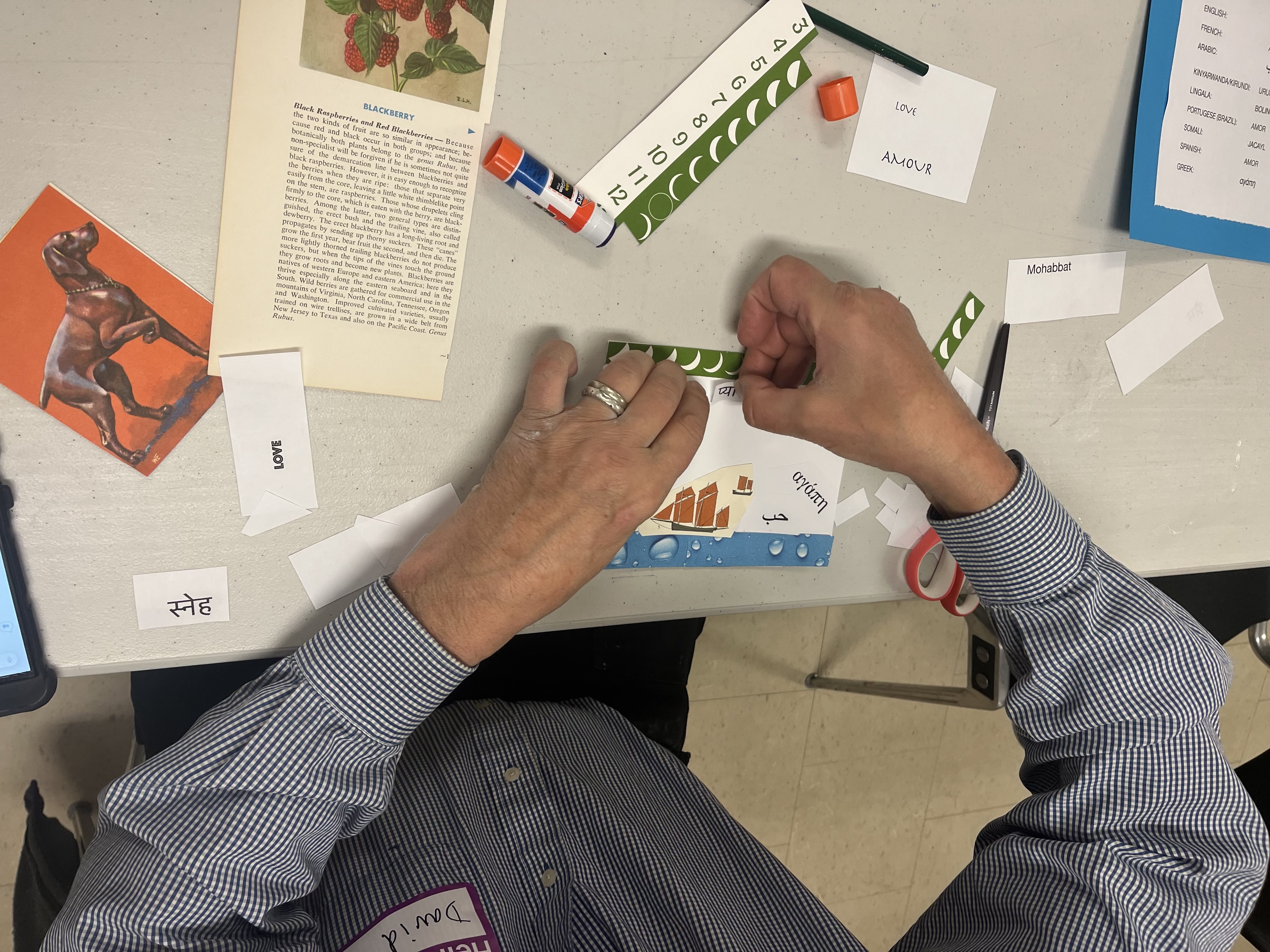
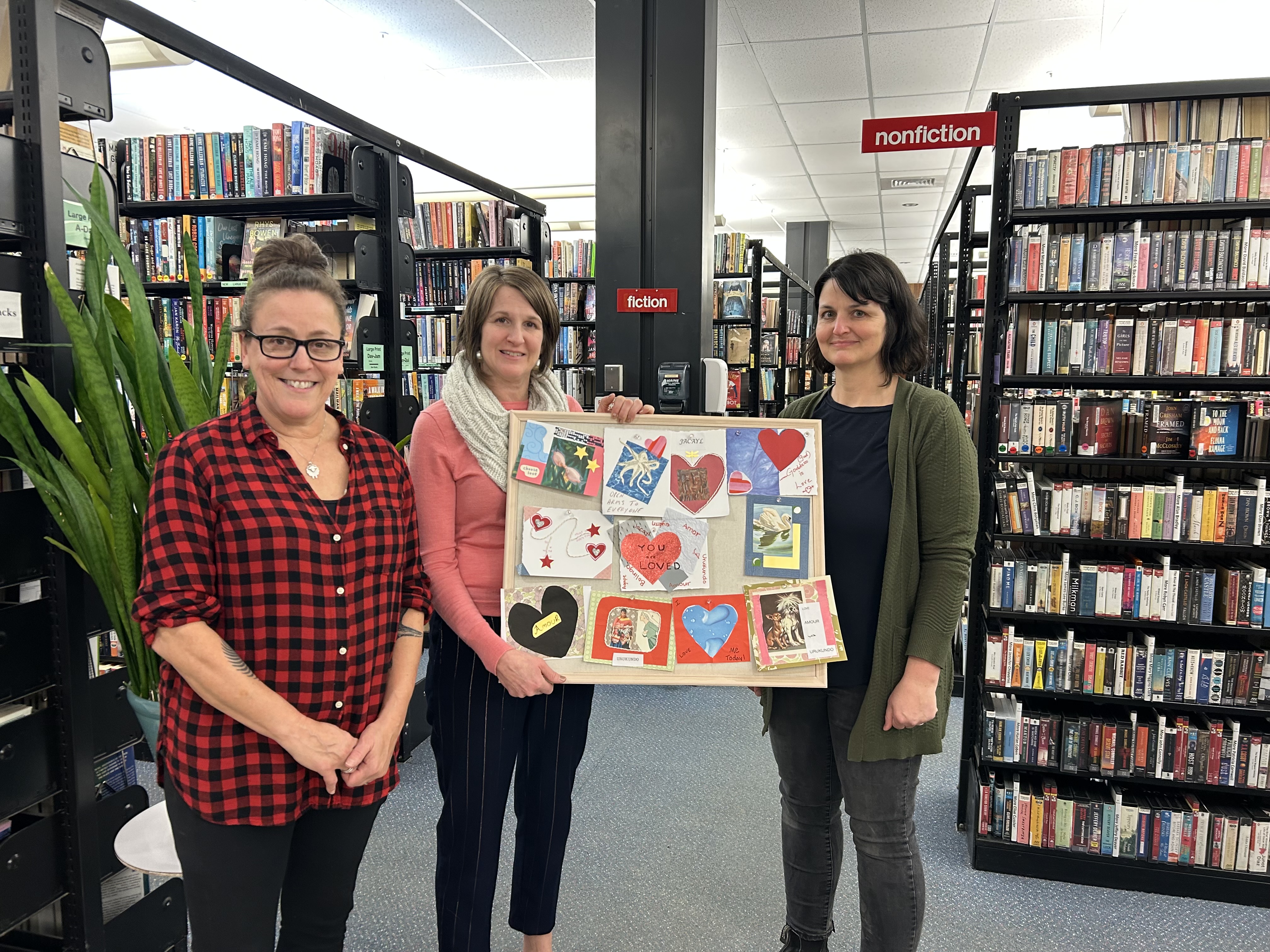
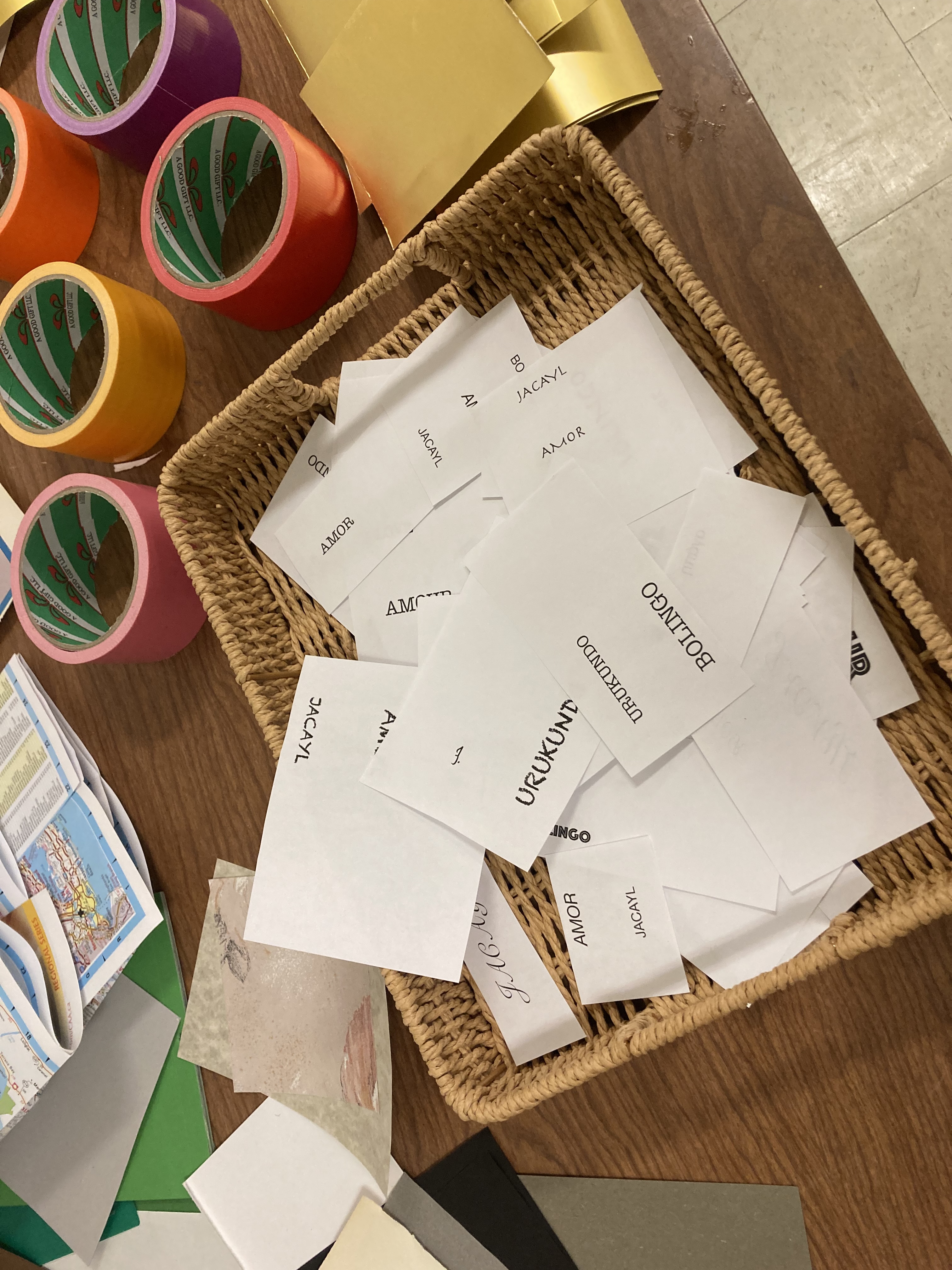
In South Portland Public Schools over 35 different languages are spoken, with the primary languages being Arabic, French, Kinyarwanda/Kirundi, Lingala, Portuguese, Somali, Spanish and English. Love here is most frequently spoken as Amour, حب, Urukundo, Bolingo, Amor, Jacayl, Amor and αγάπη. Adding in Sanskrit and Hindi we have प्रेम, प्यार, Mohabbat, and स्नेह. All saying the same, merely different vowels and consonants.
Valentines Day presented an opportunity to underscore the many languages of love through a “Postcards from the Heart” art-making experiential held at the South Portland Public Library. The curly haired Goddess with whom I live developed the idea with colleagues and then served as the leader for this life-affirming response to the masked jackals rampaging our communities locally and nationally. Love is an antidote to fear, or as the Governor of Illinois said this week, “love is the light that gets you through a long night.”
The small minded Christian Nationalists argue that English is the one and only “pure” language of these United States. But we “the tired, the poor, the huddled masses, yearning to breathe free” know the truth is far more varied, nuanced and beautifully complex. The Postcards quietly acknowledged this, and gave people a chance to express themselves in a non-violent and compassionate way.
When authoritarian anger rips our communities asunder, when protests rightfully organize, and food drives bring meals to those unable to go to work or school, art-making might seem a trivial pursuit, but its healing power is unquestioned and clinically proven. The process of non-verbal expression creates a safe space to explore feelings, especially for trauma survivors. The act of creation triggers the release of “feel good” chemical messengers – dopamine and serotonin – which are uplifting and promote resilience. Externalizing our emotions offers perspective and empowers the maker.
Open to the public, 27 people participated with ages ranging from elementary school age children to elderly. One group of 15 from a women’s shelter wanted to attend but that would have overwhelmed the space.
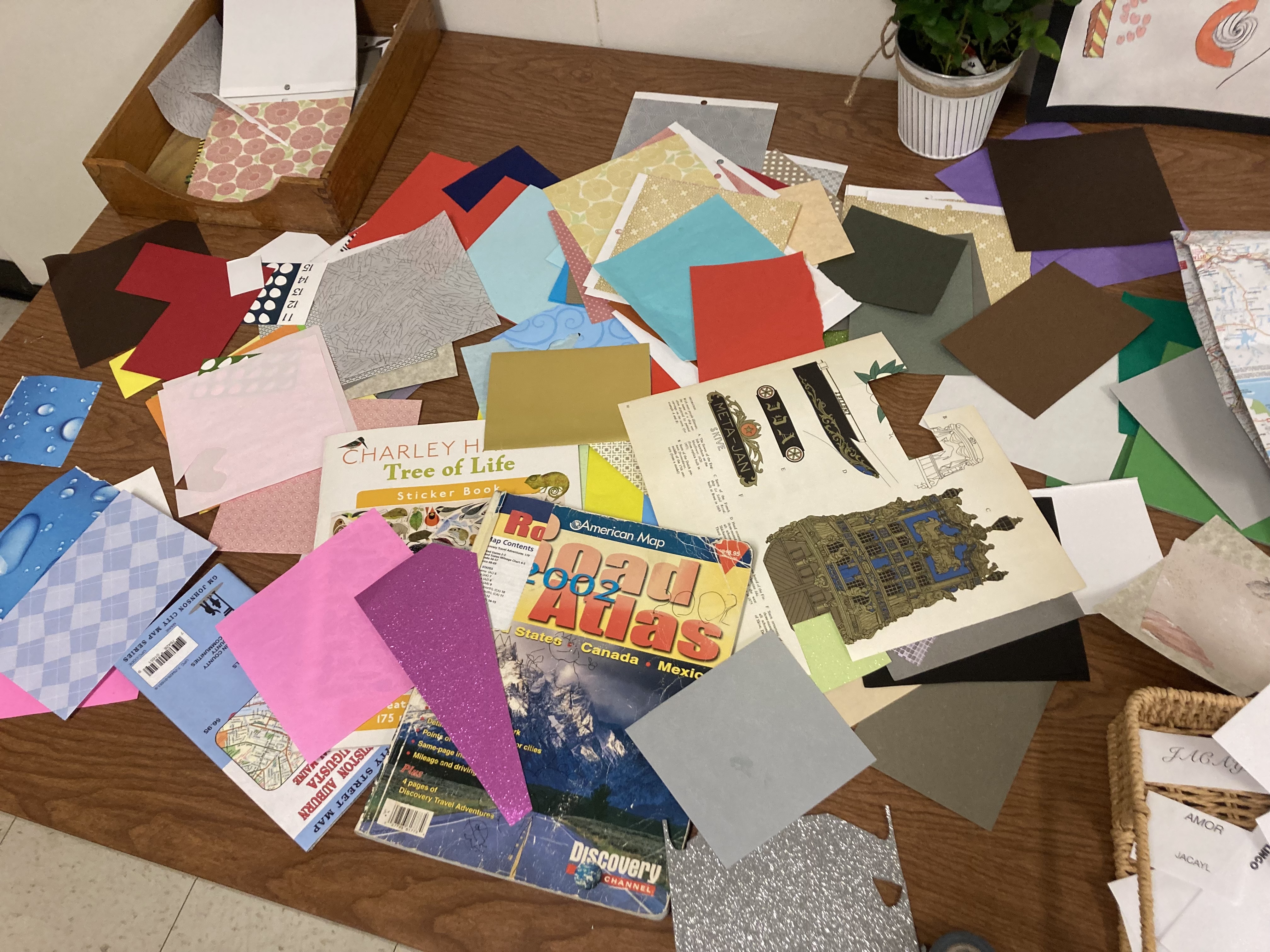
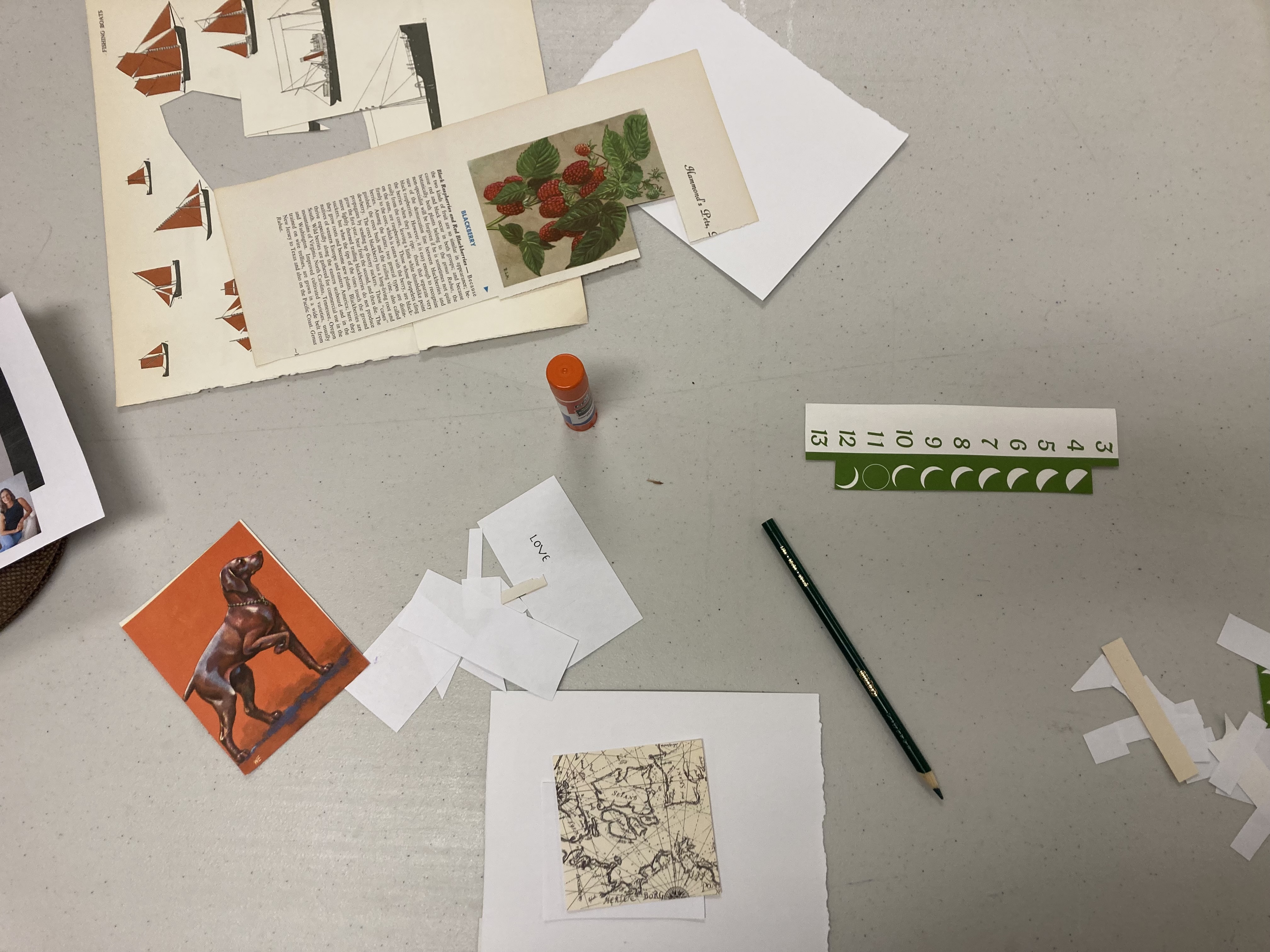
I participated in one 45-minute session, gluing images of the Moon cycle, cutouts from old picture books, and “love” from 10 different languages. 7 other women participated, one of whom was older and wore delightfully eccentric glasses, while the other 6 were young women from a “sober house.” Everyone was engaged, focused silently on their work. At the end we walked about looking at each others’ creations, all of which were as varied and diverse as the forms and expressions of love. There was a deep sense of connection in a non-verbal form.
A friend, who works with immigrant women, strongly wanted to invite those women but feared they would not want to risk coming out in public. The idea has been raised about creating art-making kits that can be delivered to homebound people so that they also might give voice to their love, in any language. A local group, Maine Needs, appears to be doing something along these lines.
The City of South Portland has a wellness program for its staff, and a librarian pondered whether art-therapy could be engaged for them. The idea is scalable and replicable, and the need for healing only grows in these times of Mammon and the cult of personality.
“Geometry is knowledge of the eternally existent,” said the Greek sage. So fundamental is this truth that every middle school includes geometry in its curricula.
Coming of age, children, enter into the exquisite beauty of geometric truth. Regardless of language spoken, color of your skin, which church, temple or forest you worship in, the eternal truths – πr2 (area of a circle) or 2πr (circumference of a circle) or πr(r+l) = πr[r+√(h2+r2)] (total surface of a cone), et cetera – pertain. Greek letters are used to label these eternal truths.
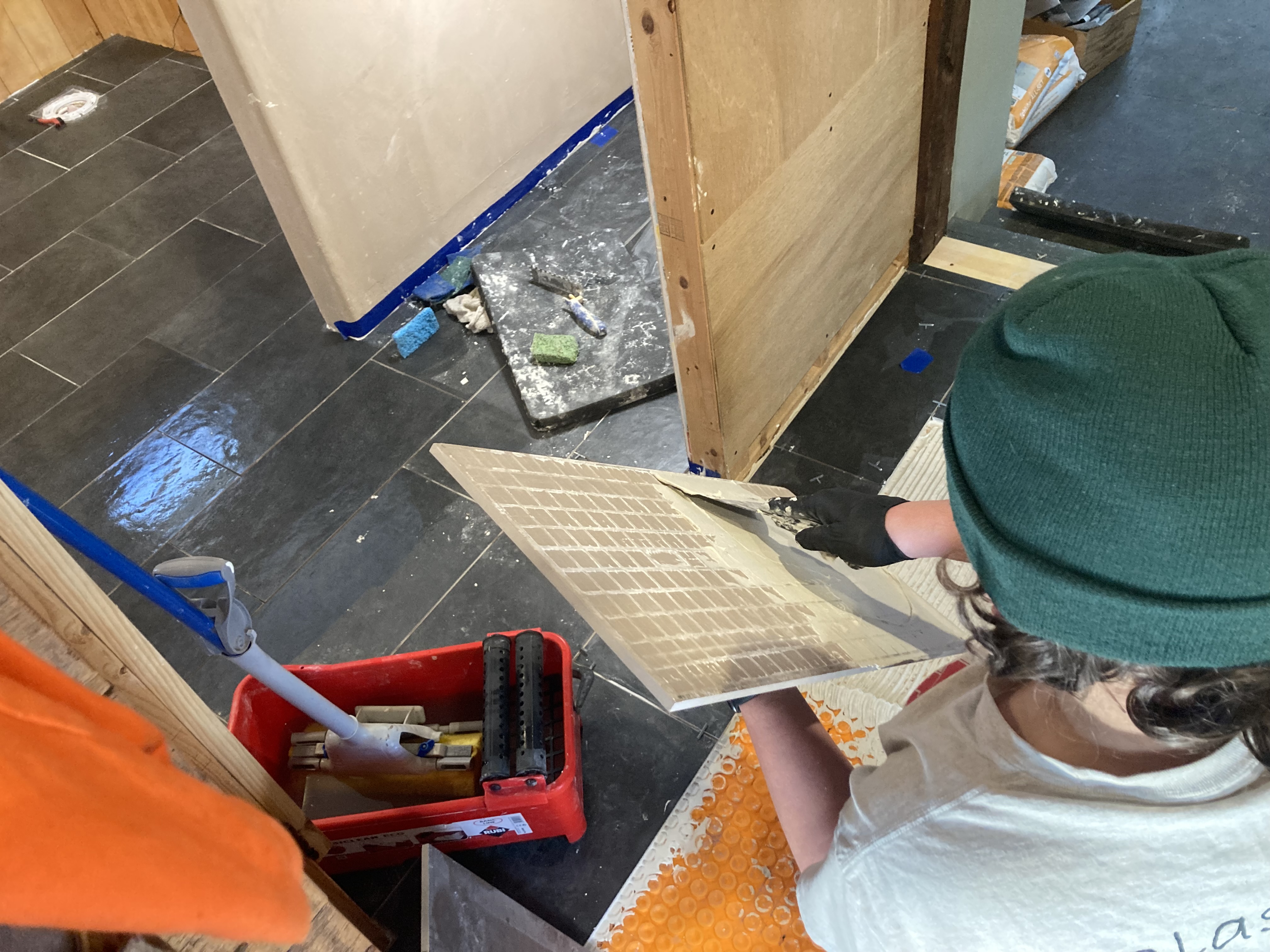
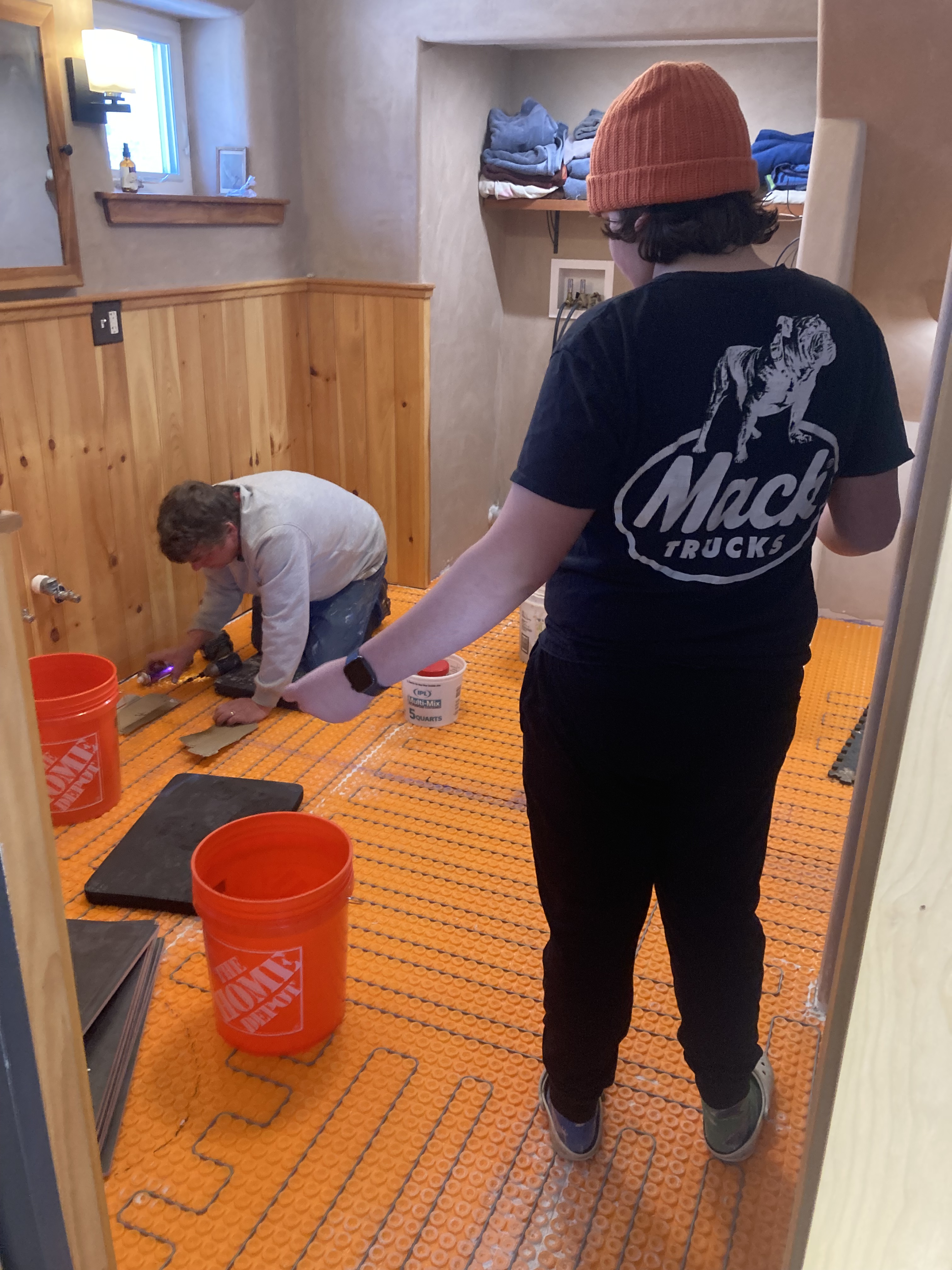
At our Art Farm Homeschool Academy we study surface area in the conventional way, using worksheets and word problems. But, on hands and knees, we examine the floor closely, teaching math as tactile, not just conceptual. Last week we discussed electric currents and Ohms. This week we turn to tiling, which is a form of applied geometry and chemistry, using hand tools to spread mortar and setting tiles to create one continuous surface.
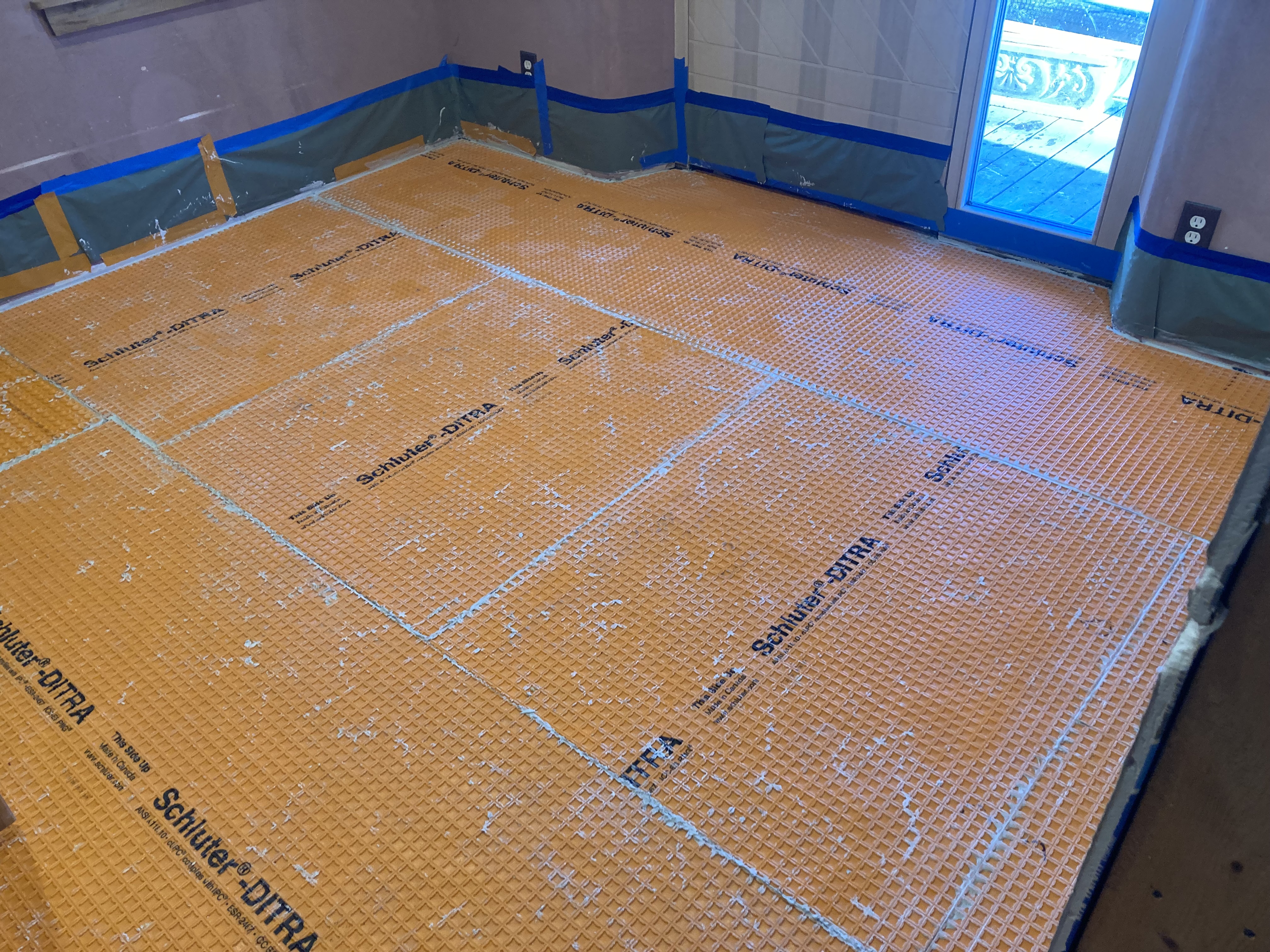
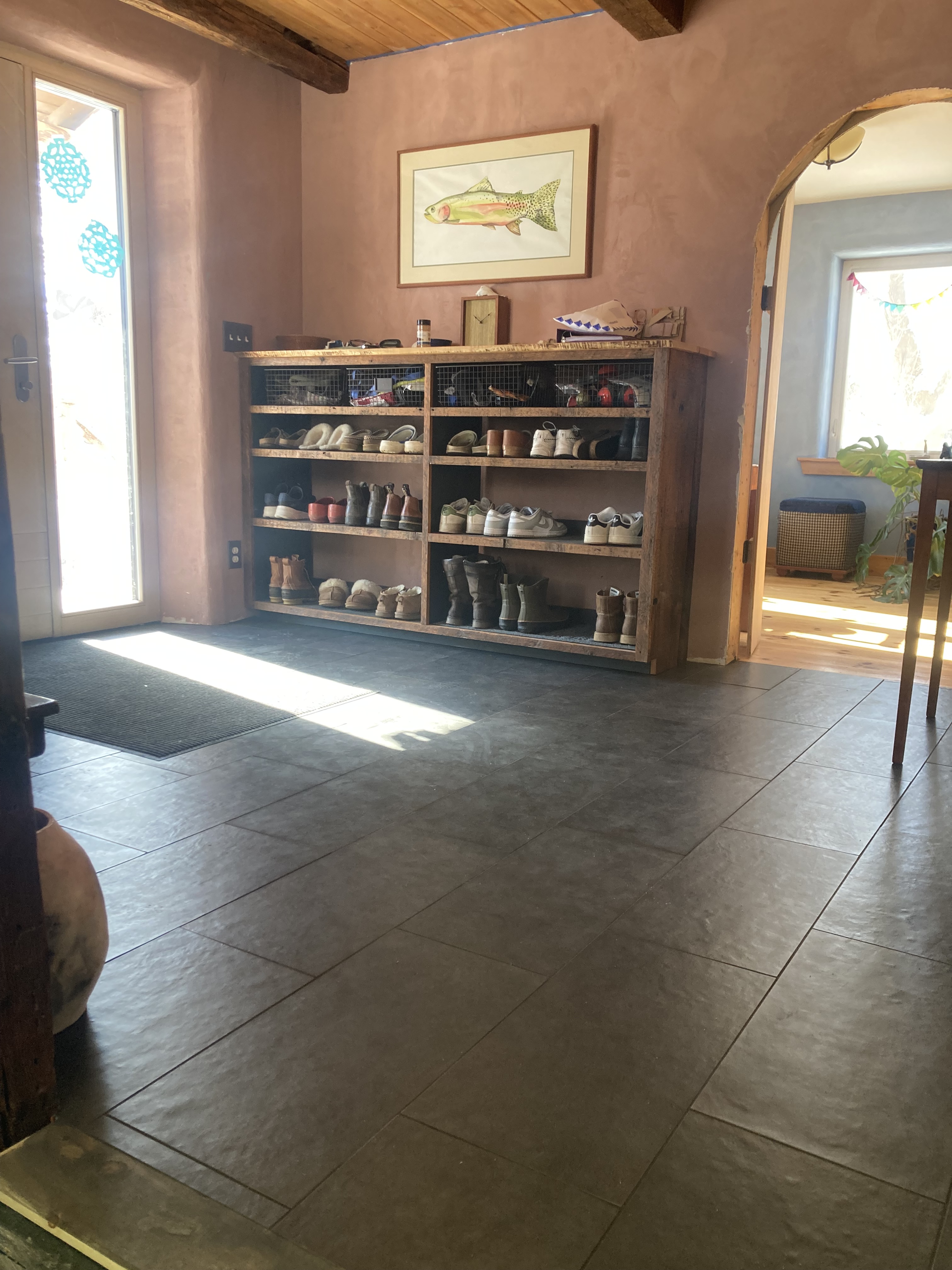
We began with Pythagorus. To establish the layout, we needed to determine the exact right angle to the exterior wall, so the warhorse a2 + b2 = c2 was used. After marking the right angle, the center line was snapped and the layout became clear. We used tiles 12” x 24” (2 square feet each) and my son quickly calculated the bathroom surface area was 136 square feet.
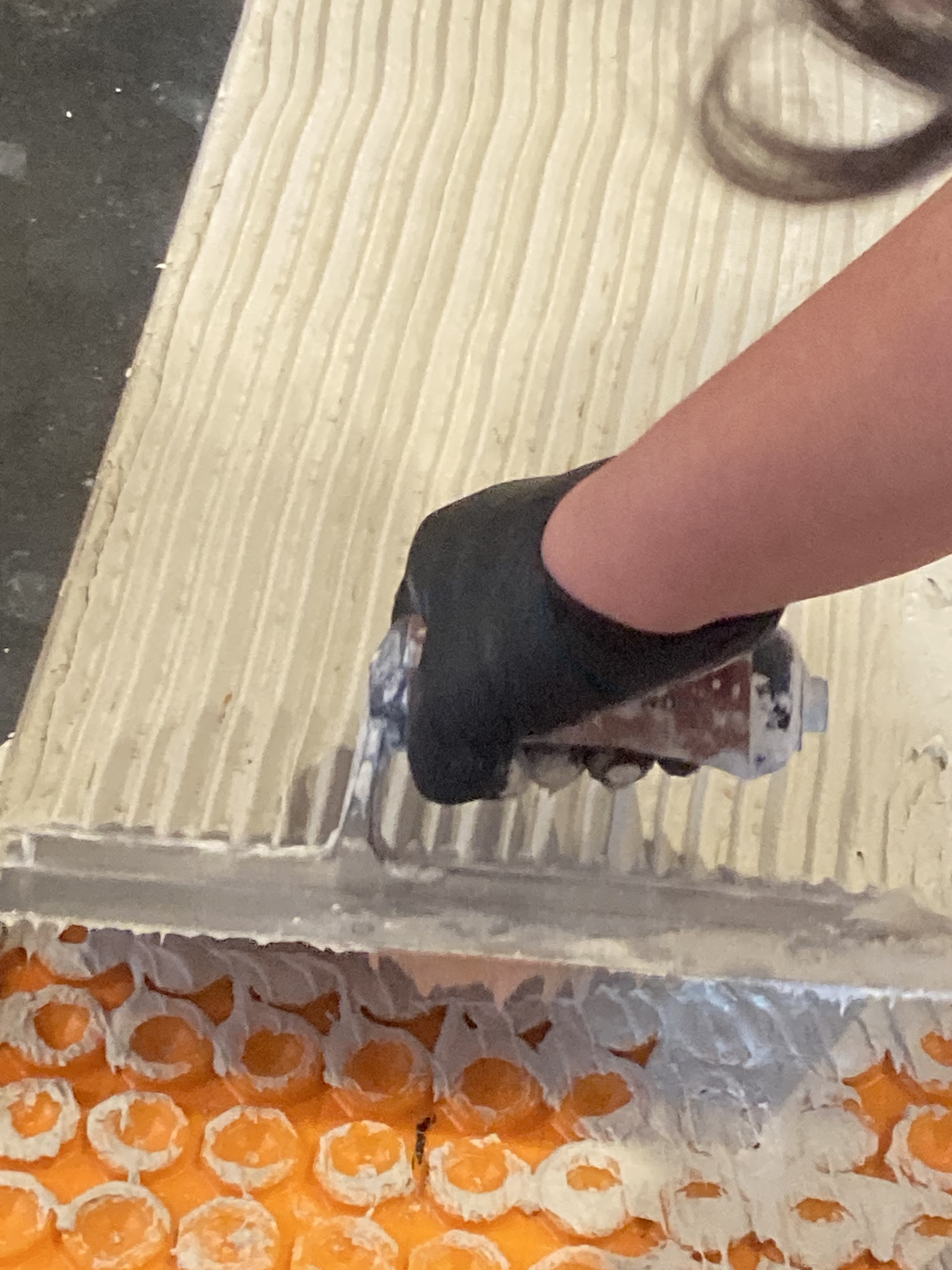
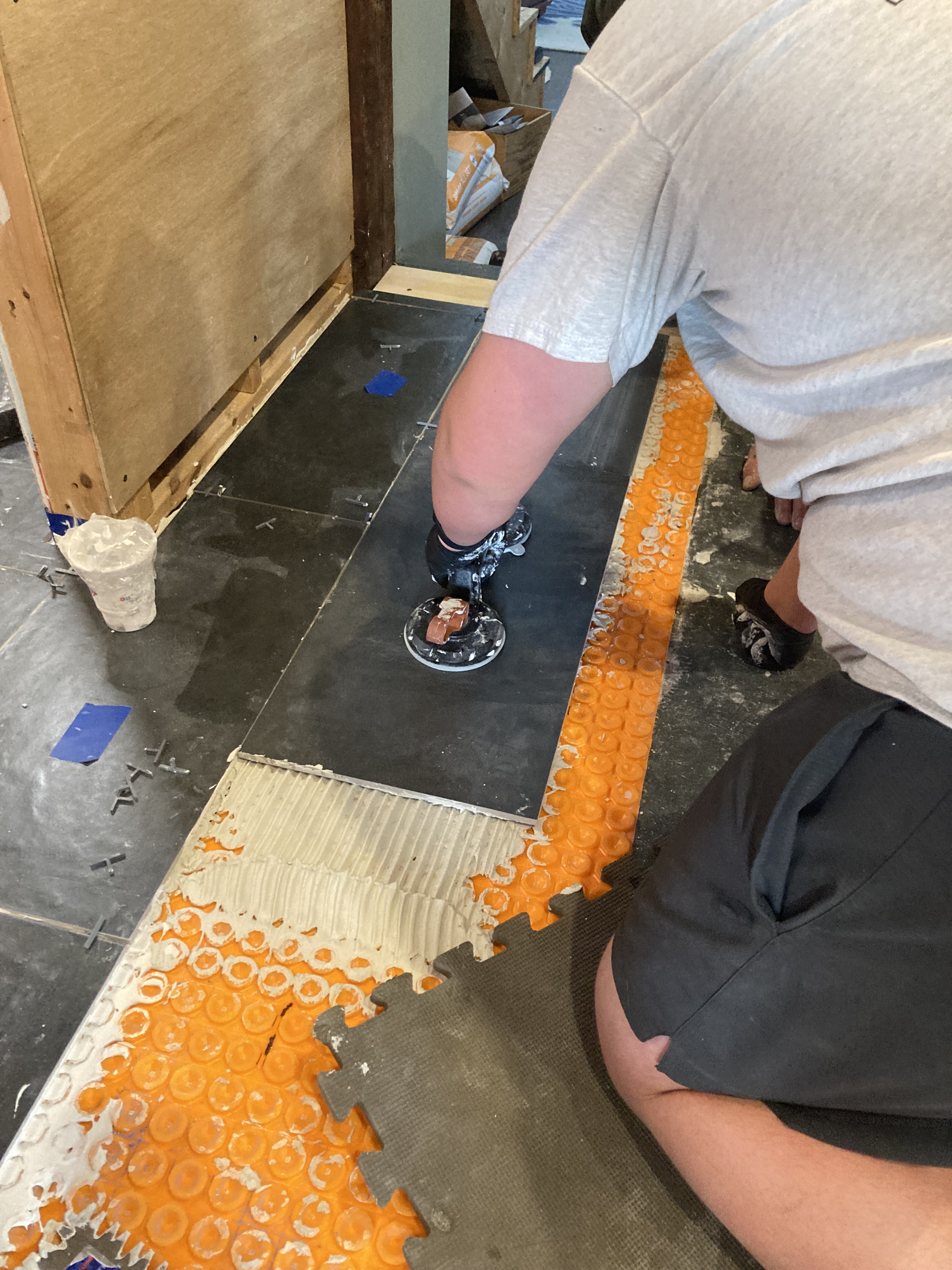
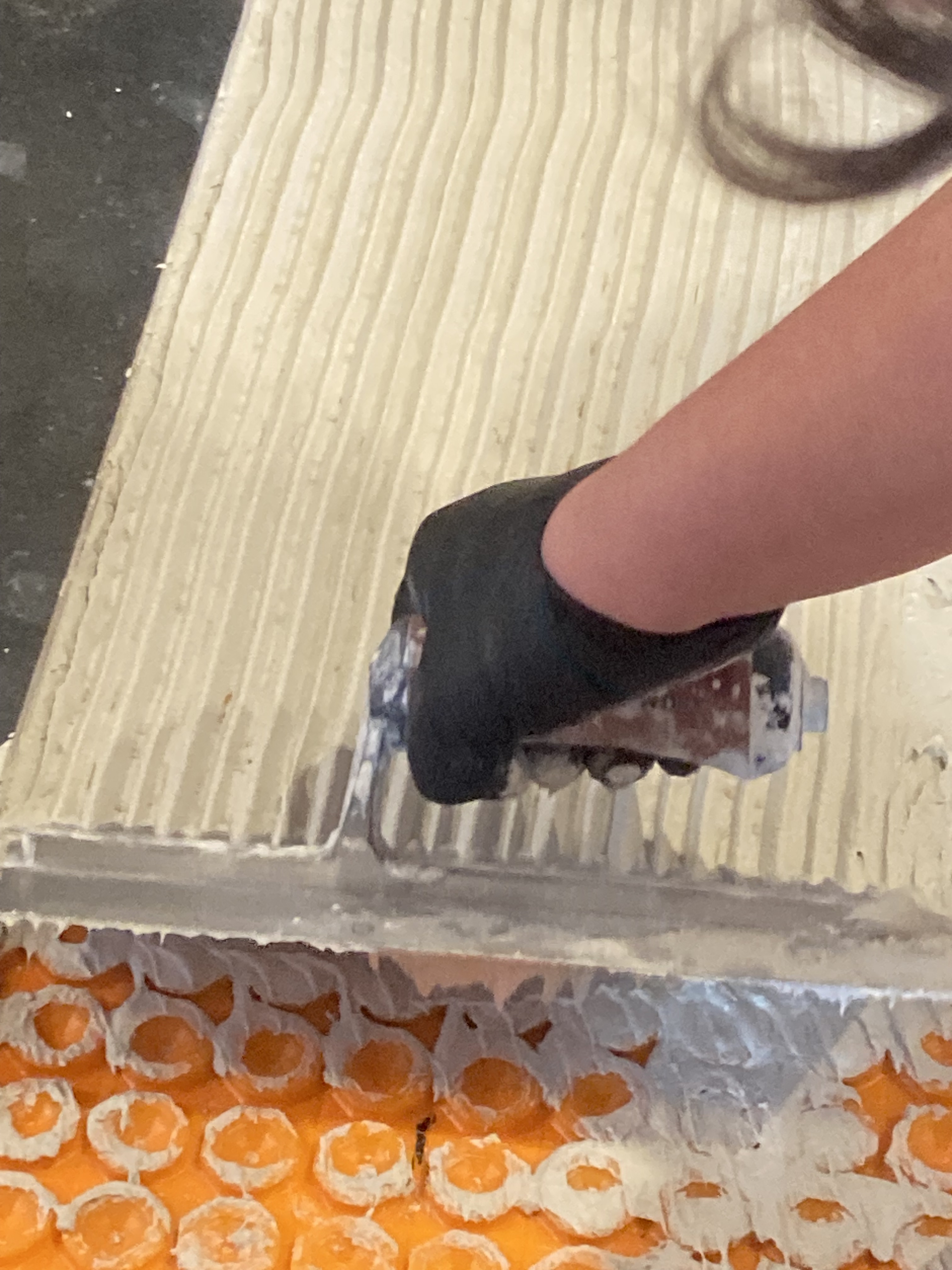
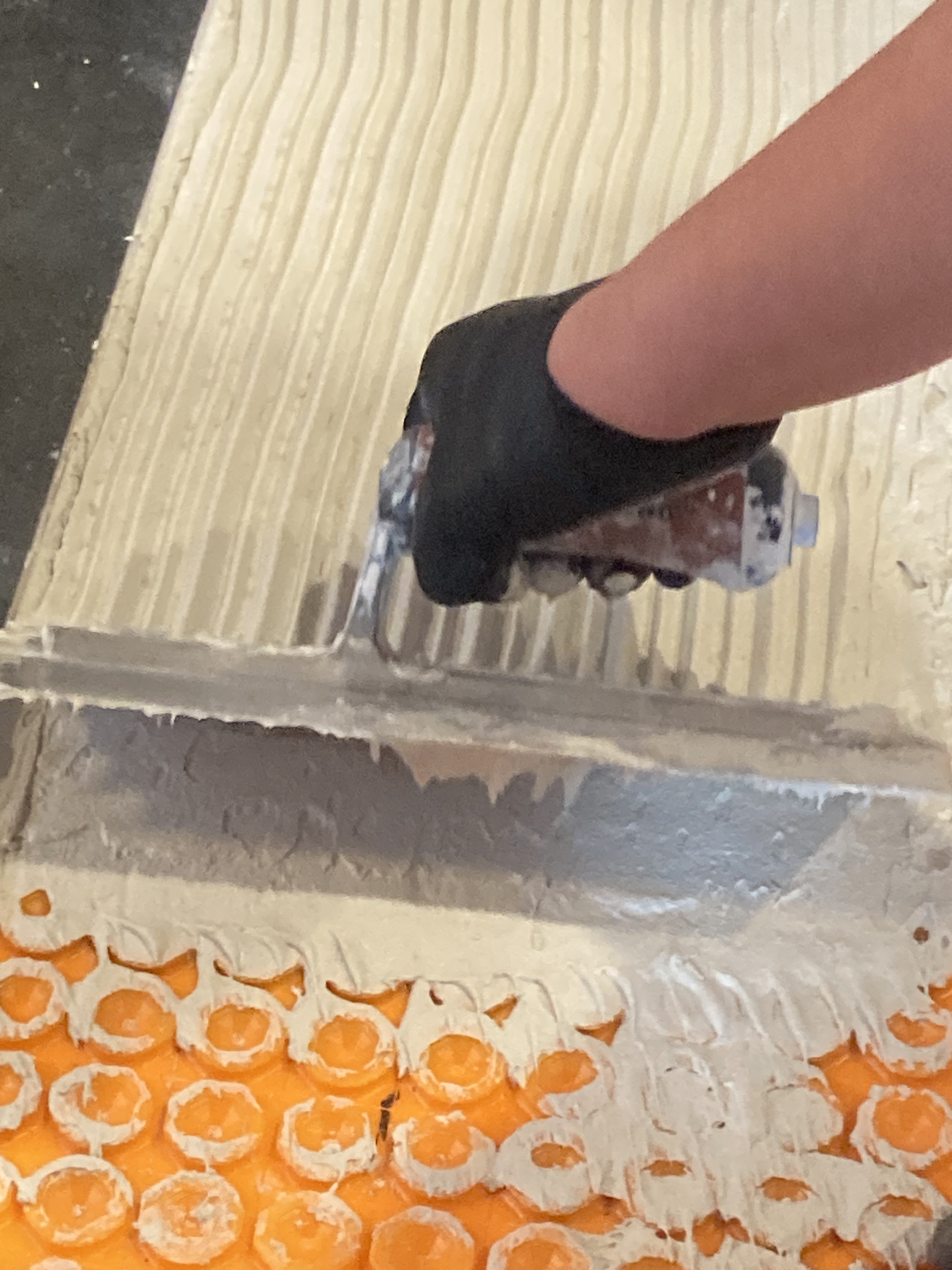
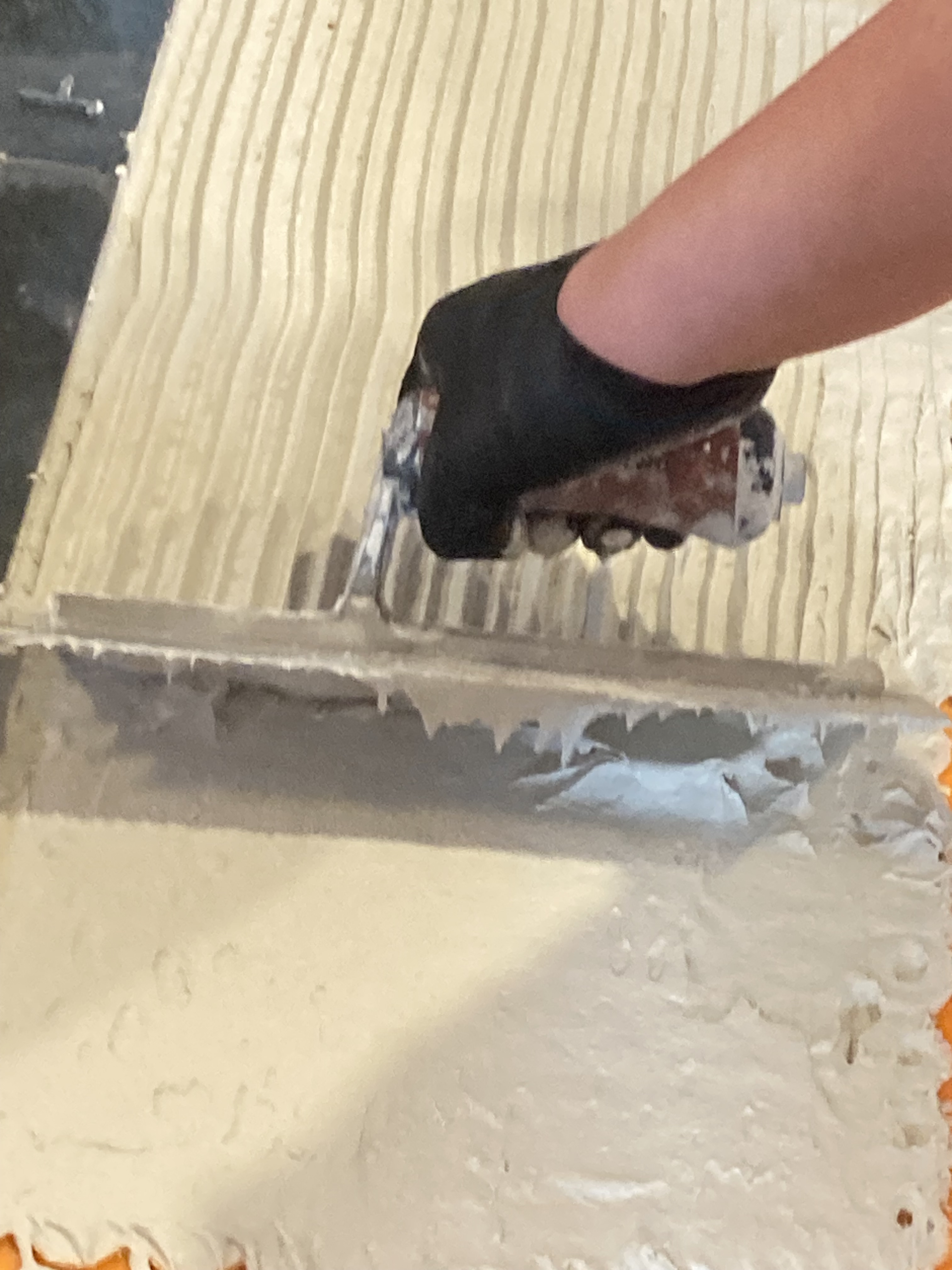
Tiling is about surface, not volume; each tile must be flush at all four corners. My son learned how to spread mortar, which again is about geometry. A notched trowel is the tool, and depending on the size of the notch – 1/8” or 1/4” or 1/2” – the amount of mortar spread will vary greatly. More importantly, the angle of the trowel impacts the thickness of the mortar, which is to say the volume. The Professor used a sawtooth trowel and he taught that the proper angle was just below 45 degrees.
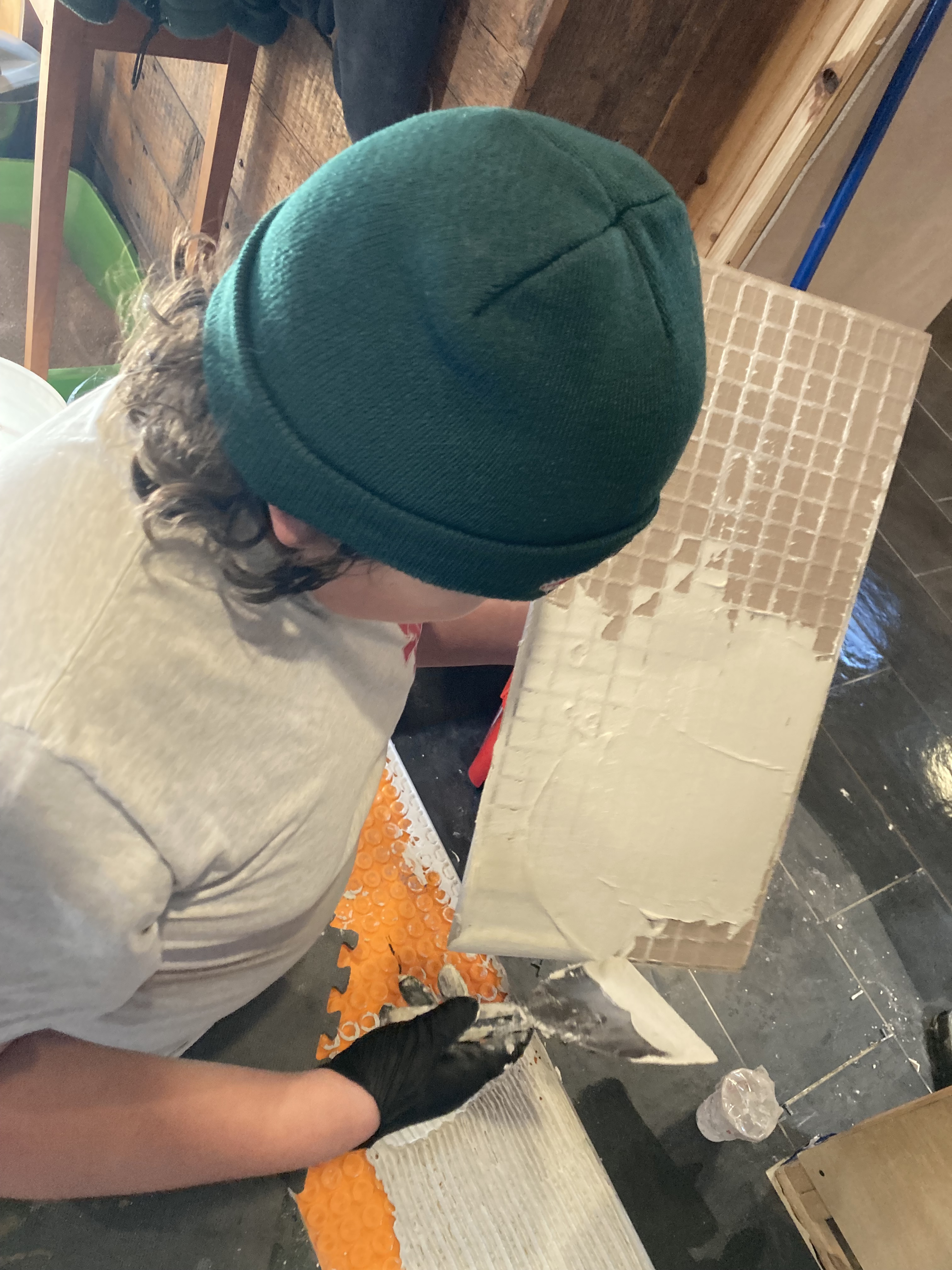
To spread mortar is “to butter the tile.” We “double buttered,” applying mortar both to the floor, as well as to the back of the tile, in order to create a stronger bond. The tile is then set in place and gently pushed back and forth, to eliminate any gaps from the sawtooth troweled mortar, and to set the tile firmly and evenly in place.
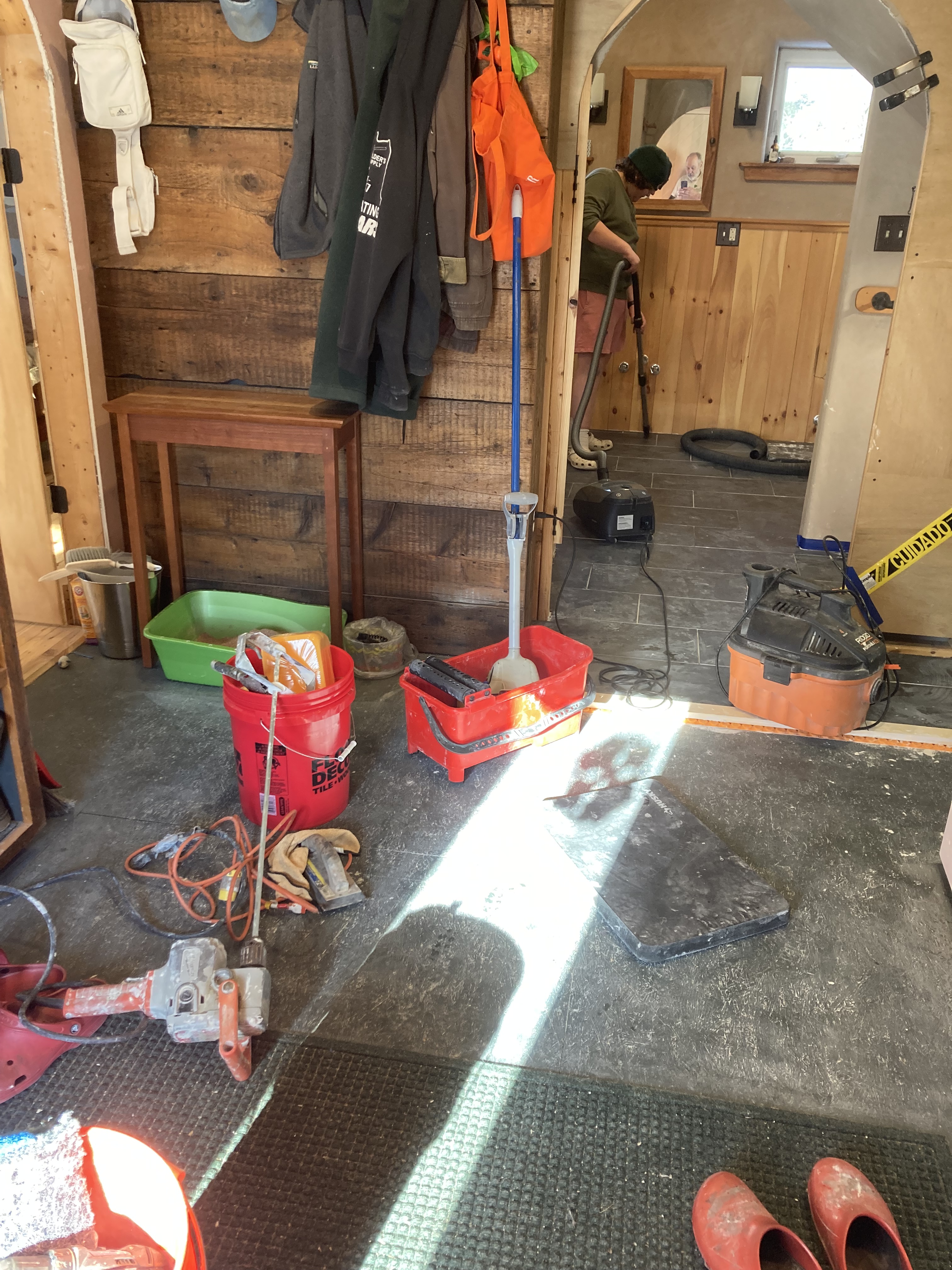
Tiling a bathroom floor is immensely disruptive. We had to pull the toilet and bathtub, there was no laundry for more than a week, showers were intermittent. When an object fell down the drain line we had to vacuum it out. For anyone with obsessive tendencies, the process is like chasing, or being chased by, the dragon. It was a long hard week.
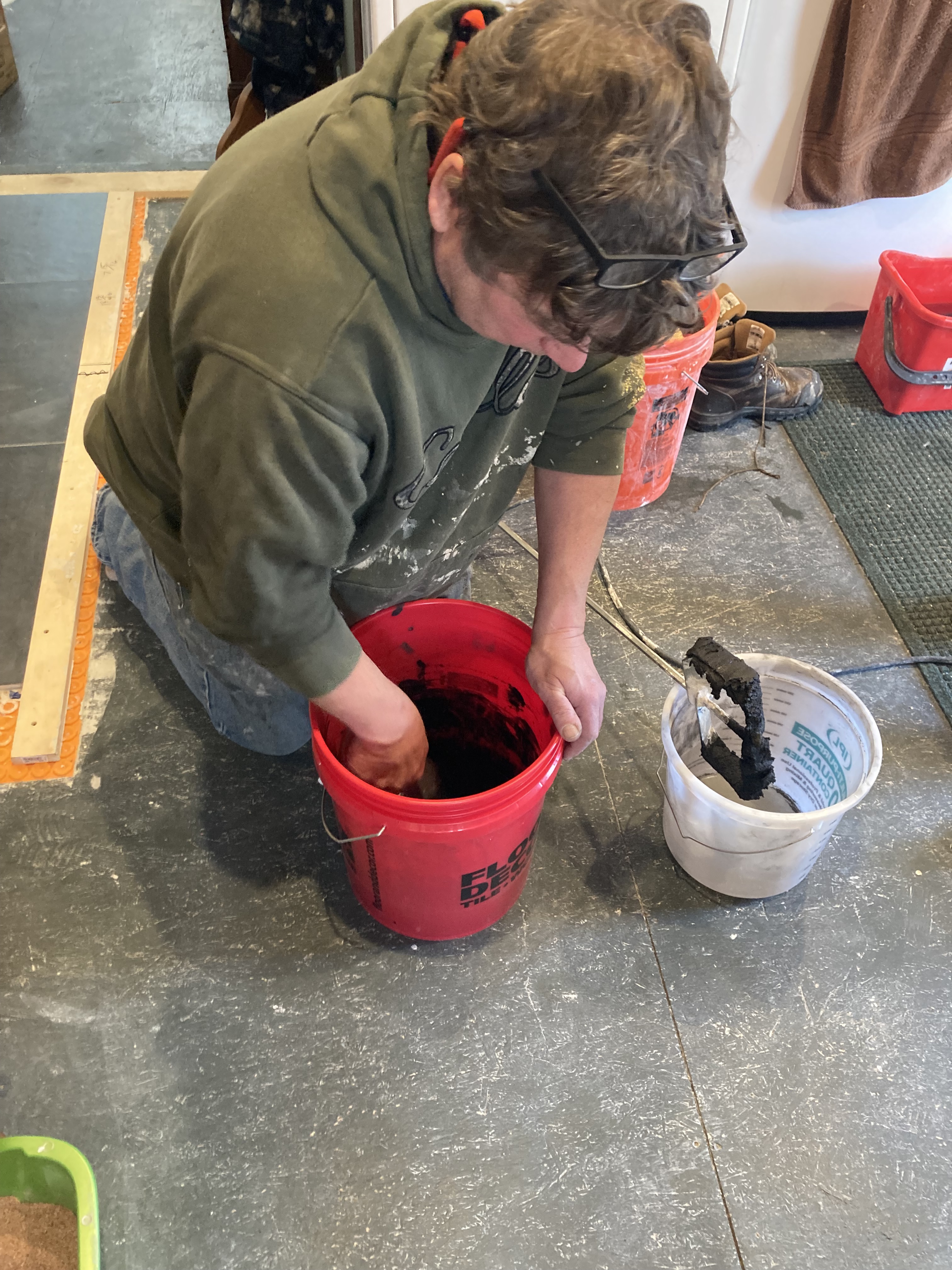
On the final day we set the grout, but the instructions wildly under stated the area covered by one bag. Mid-way through we had to mix a second bag – which meant cleaning the tools and the bucket, getting fresh water, mixing more – but the working time was a factor for the grout already set. If the grout cures before it is all set then you have a major problem. We were racing the clock. What we thought would be smooth teamwork became a gauntlet. Like a farm boy, my son hustled, taking orders in real time.
The marathon was grueling. Our teamwork was successful, the timing worked out, the end result wonderful, the washer and dryer in place and operating again. The radiant heat is working, programmed to 74 degrees at 5:30am, cooler to 62 during the day, and then reheat for the evening, back to 60 for the night hours. Verily, verily, I say unto thee, our blessings abound!
Through this gauntlet of fire my son is learning what the Greek sage said, so long ago, “Number rules the universe.”
His full title is the “Pema Professor,” to honor Pema Chödrön, the American-born Tibetan Buddhist. The Professor came to our house and held class in the bathroom, not about Om – the sacred syllable – but about Ohms, the measurement of electrical resistance in circuits or conductors.
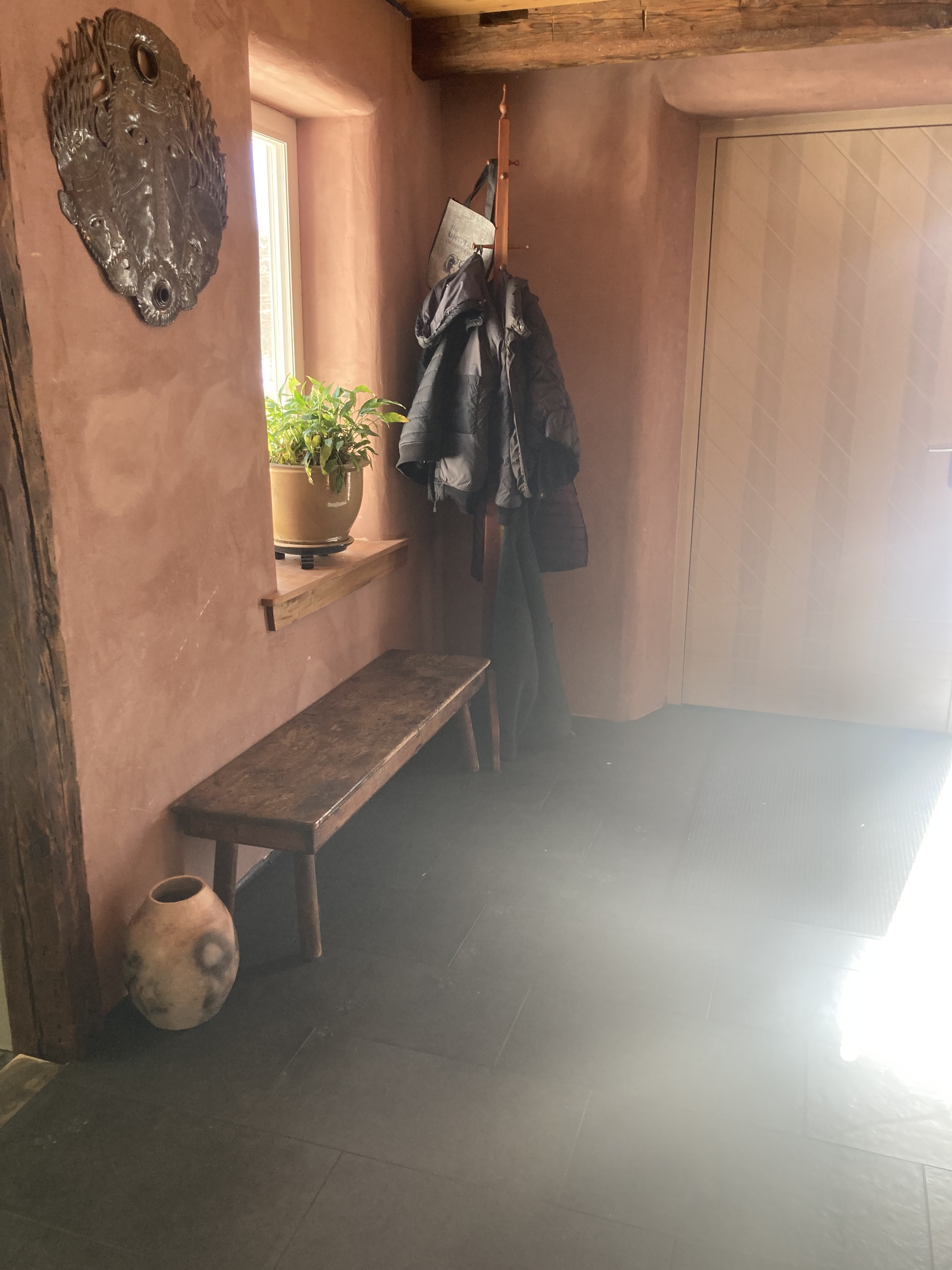
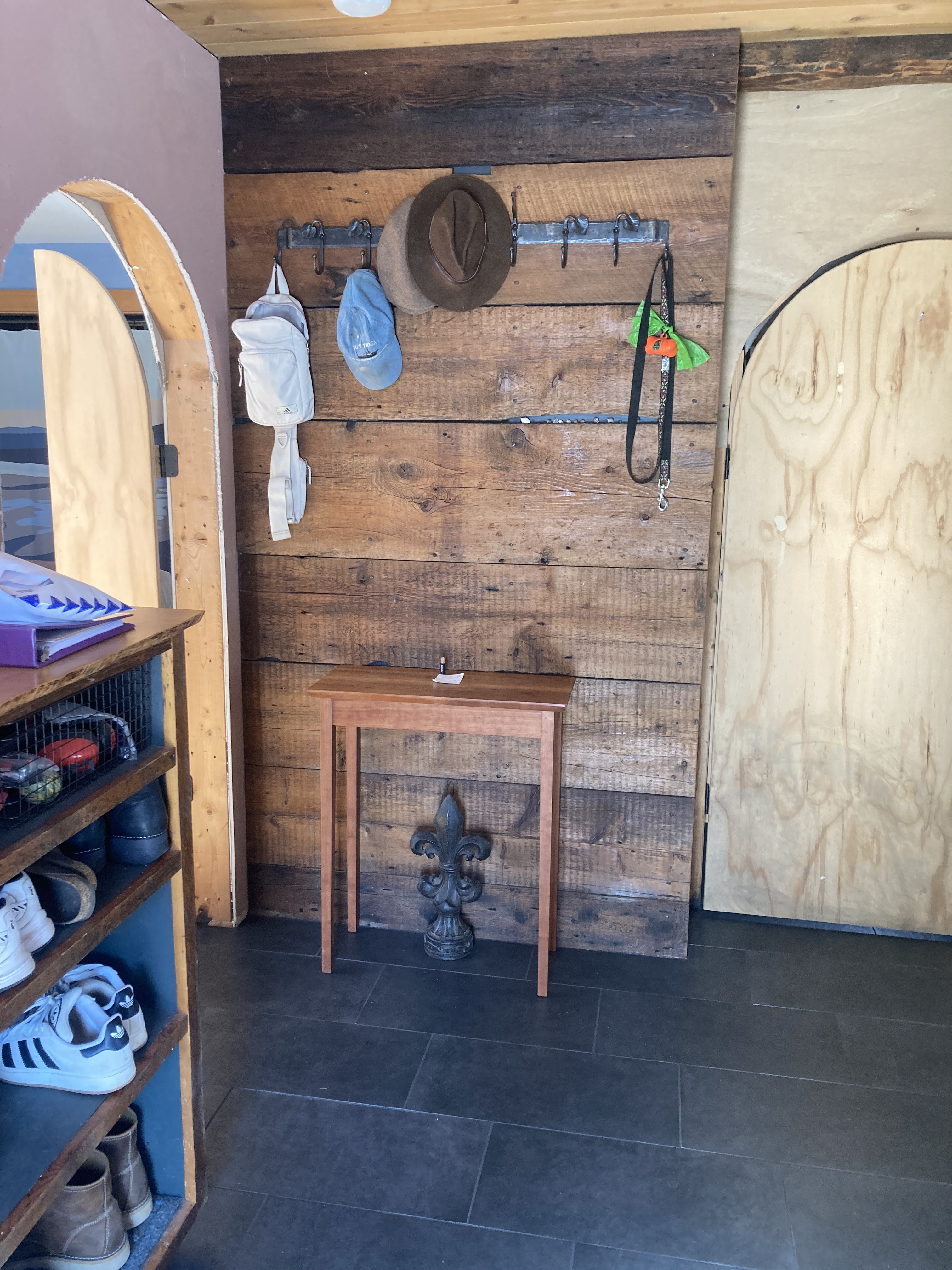
We are doing the finish work, finally, in the bathroom we added onto our house back in 2017. For nine years that room has had the basic plumbing but no heat, and a subfloor painted grey. Immense is our blessing to be able to do this finish work now, when masked jackels rampage our community, when our brown skinned neighbors stay indoors afraid to leave their house, more than 200 people having been arrested and absconded during “Operation Catch of the Day,” while so many homeless still live on street corners begging for coins; that we are able to afford such luxury now is a privilege not lost upon us. But still, our addition needs to be finished.
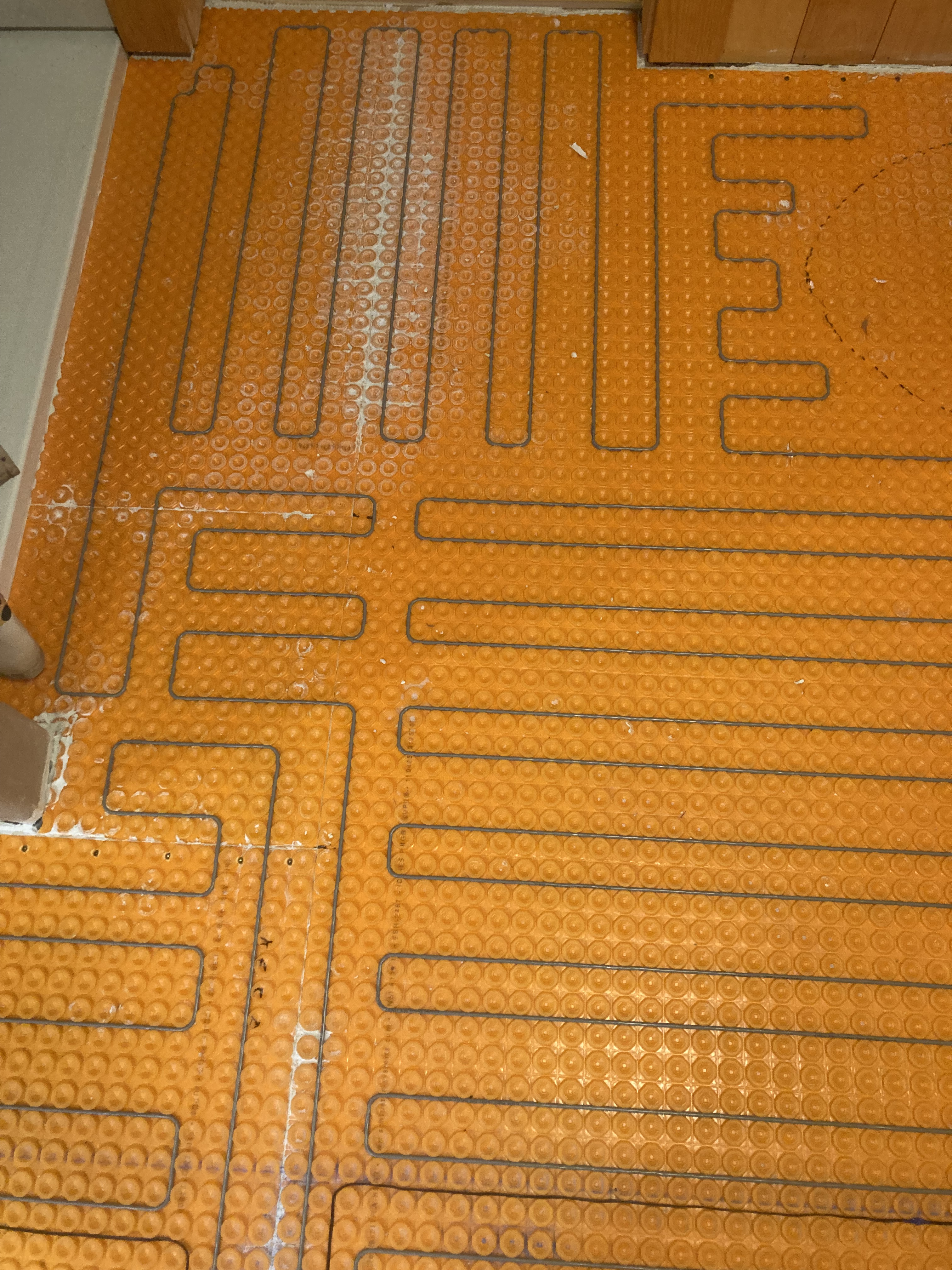
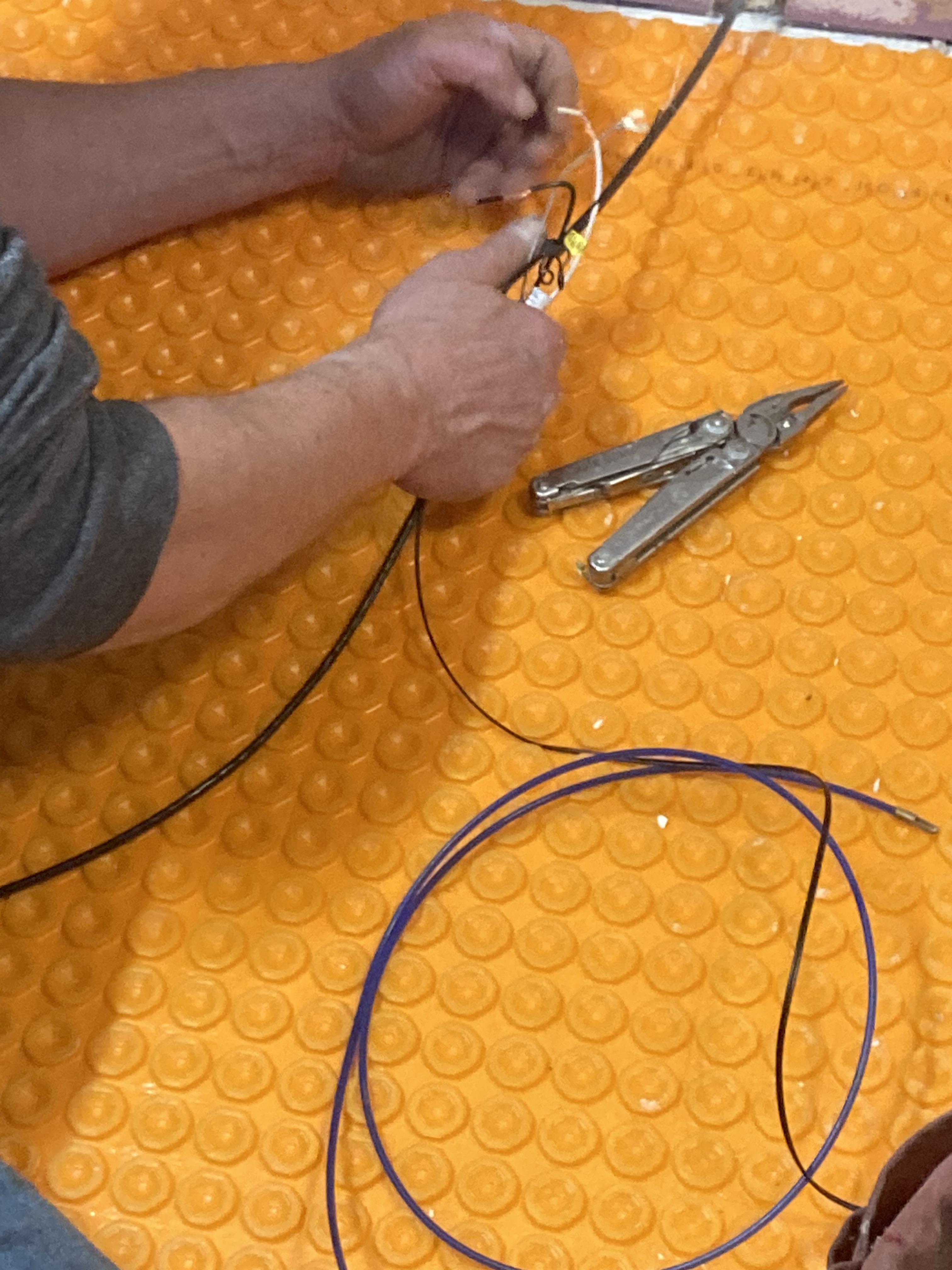
We are laying electric radiant heat on the bathroom floor, and then tiling. The Cadillac approach. The process begins by laying a waterproof uncoupling membrane which prevents tiles from cracking if the wooden subfloor moves. Into the membrane’s grid, we snapped in place 84 square feet of heating cable. That wire connects to a 15 amp Ground Fault Circuit Interrupter circuit breaker. Before laying tile, we needed to test both the Ohm resistance in the cable and its ground fault continuity, to ensure the integrity of the cable and circuit.
An Ohm is the measure of resistance, an object’s opposition to a flow of electric current. That resistance to flow creates friction, which friction creates heat, which is what we desire in the floor of the bathroom. We need to test this before laying tile.
Ohm’s formula is R = V/I, where V is voltage – the push driving the flow of electric charge – and I is current – the electric charge that flows past a specific point in a complete electric circuit. The formula for resistance was discovered by George Ohm, a high school teacher in Cologne, Germany, who published his theory and formula in 1827. The academics rejected his idea, but in 1841 Ohm was recognized and received the Royal Society’s Copley Medal. The unit of electrical resistance, the Ohm, is named in his honor.
In Language Arts my son has been learning the Greek alphabet. By happy coincidence, the Greek letter omega (Ω) is the symbol for ohms, chosen because its sound is similar to Ohm’s last name. Everything seems concordant here at the art farm.
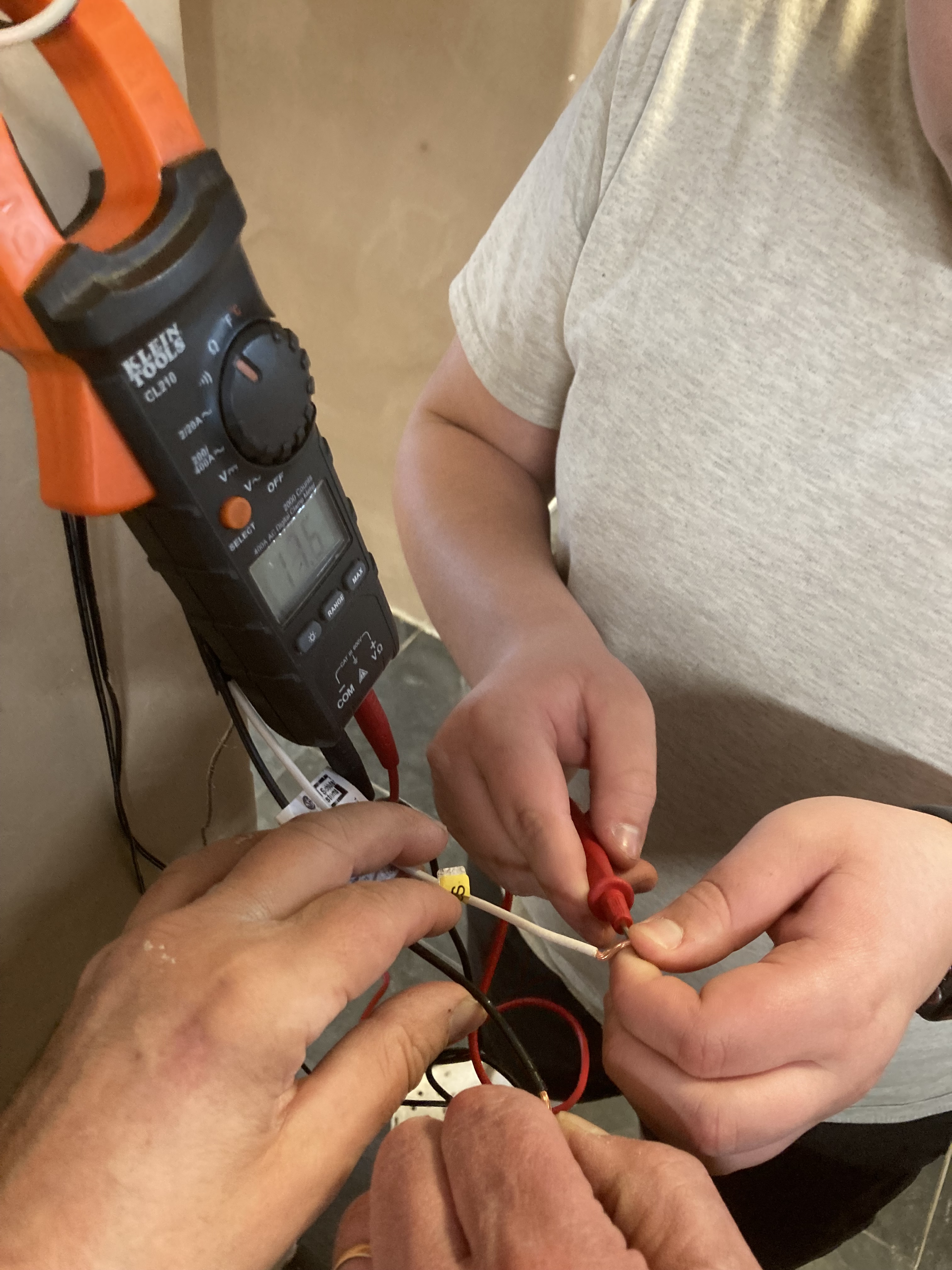
To install the radiant floor heating cable, we made multiple tests of “conductor resistance” to ensure the circuit was functional. We used the Professor’s megohmmeter to take an ohms reading between the two power leads. At the factory the cable tested 14.8 ohms, but our test before installation was 14.1, after cable installation was 14.2, and after tile installation was 13.4. The manufacturer allows a 10% variance, so we remain within that range. Our test was positive and we proceed.
Of note, if the tester uses his fingers to press the megohmmeter leads against the copper lines, then the resistance reading shows the resistance through his body; he has become a part of the circuit. As a homeschool experiential, my son tested the resistance that way and got a reading of 4.3 ohms. The Professor did same and had a 4.7 ohm reading. The lower the ohms the easier electricity flows through a circuit. The circuit breaker was off so he was not at risk. Salt and magnesium in my son’s body can account for the difference because they are conductive electrolytes which increase the flow of electricity. My son does take a magnesium supplement so there is a line of reasoning here.
And so life goes here at an art farm. Ohms not om, our homeschool tutorial was one step the toward tiling the new bathroom. Updates to follow, as this journey continues.
Two wise women demonstrate the ancient wisdom, passed down millennia, of the Emerald Tablet: “That which is above is from that which is below, and that which is below is from that which is above,”
The “Sibyl of the Rhine” is our first wise woman, the polymath writer, composer, philosopher, mystic and visionary of the High Middle Ages. The Abbess of several Benedictine monasteries, the breadth of her intellect included being a founder of scientific natural history in Germany. A truly remarkable and wise woman was Hildegard van Bingen.
Hildegard’s central theme was Vriditas, a Latin term meaning “greenness” but with added nuance of vitality, growth and lushness; the creative life-giving force of nature and spirit. Simply stated, physical well-being is the “greening power” of Gaia, that relates both to the physical and to the spiritual. As above, so below; all life is one, all is connected.
Her scientific master work is the Book of the Subtleties of the Diverse Nature of Creatures. Divided into two sections, the Physica is a comprehensive treatise and medicinal catalog of plants, fish, birds, insects and minerals, while the Causae et Curae emphasized the causes of disease and their corresponding natural treatments.
Hildegard closely observed the plants in her monastery’s garden and how – as Babs Mahany wrote – “stem and bud absorbed the sunlight [which] brought the fronds’ unfurling.” Her closely observed empirical observations combined with mystical visions detailed that which is above ground.
The “wood wide web” scientist, the forest ecologist and professor of the underground, is our second wise woman. Dr. Suzanne Simard is a titan among modern scientists, who challenged the conventional view that ecosystems are competitive and forests are simply the source of timber or pulp. Over decades she researched and discovered the cooperative nature of forests through roots and fungal networks, the mycorrhizal, that facilitate nutrient, water, sugar and carbon exchange; a chemical signaling between trees communicating stress and providing a network for communal support.
Dr. Simard identified century old “Mother Trees” that nurture younger seedlings, sending nutrients outward to feed and sustain the weaker, baby trees. Her Mother Tree Project is rooted in the idea that forests are deeply interconnected ecosystems, social creatures demonstrating traits of cooperative civil society.
Soil is not “dirt,” but a vital and complex life source of sharing and exchange, the basis upon which life unfurls. The soil maven Nance Klehm in her book, “The Soil Keepers,” described it: “When we stand on land, we stand on the ones who have come before us. We stand on our ancestors. We realize we have inherited their legacy, the way they perceived land, the way they lived with the ground, the way their hands worked the soil, or didn’t.”
As above there is light, so below there is darkness;
As above vriditas unfurling, so below nutrients and sugars flow;
As above oxygen creation, so below communication and exchange;
As above the lotus flower, so below the mud.
All is interconnected, the cosmic dance of Gaia.
The Emerald Tablet is a foundational text, attributed to the Hellenistic figure Hermes Trismegistus, who integrated Greek and Egyptian wisdom into a body of knowledge on the interrelationship between the material and the divine. The teachings influenced both Pythagorus and Plato, formed the basis of Gnosticism and Neoplatonism, were key to Renaissance humanists.
The Emerald Tablet was most likely written in the Syriac language of the Fertile Crescent, but the first extant text appeared in the Arabic, during the Islamic Golden Age, written by Jābir ibn Ḥayyān, the “Father of Chemistry.” From the 12th century onward multiple Latin translations followed, introducing the text to Europe and then in 1680, seven years before publishing his magnum opus The Principia, Isaac Newton made an English translation. More recently, it significantly influenced the work of Madame Blavatsky, William Butler Yeats, and Carl Jung.
And two wise women, 900 years apart, exemplify the enduring truth of “as above, so below,” the essence of the Emerald Tablet. Here is the full text in English from the Arabic of Jābir ibn Ḥayyān:
Truth! Certainty! That in which there is no doubt!
That which is above is from that which is below, and that which is below is from that which is above,
working the miracles of one [thing]. As all things were from One.
Its father is the Sun and its mother the Moon.
The Earth carried it in her belly, and the Wind nourished it in her belly,
as Earth which shall become Fire.
Feed the Earth from that which is subtle,
with the greatest power. It ascends from the earth to the heaven
and becomes ruler over that which is above and that which is below.
حقا يقينا لا شك فيه إن الأعلى من الأسفل والأسفل من الأعلى عمل العجائب من واحد كما كانت الأشياء كلها من واحد وأبوه الشمس وأمه القمر حملته الأرض في بطنها وغذته الريح في بطنها نار صارت أرضا اغذوا الأرض من اللطيف بقوة القوى يصعد من الأرض إلى السماء فيكون مسلطا على الأعلى والأسفل
Henry Ford’s broad vision for business success included that his vendors and subcontractors should make a reasonable profit from doing business with the Ford Motor Company. Wholistic, he understood that everyone in the supply chain should be treated fairly for the system to thrive. He famously said, “A business absolutely devoted to service will have only one worry about profits. They will be embarrassingly large.”
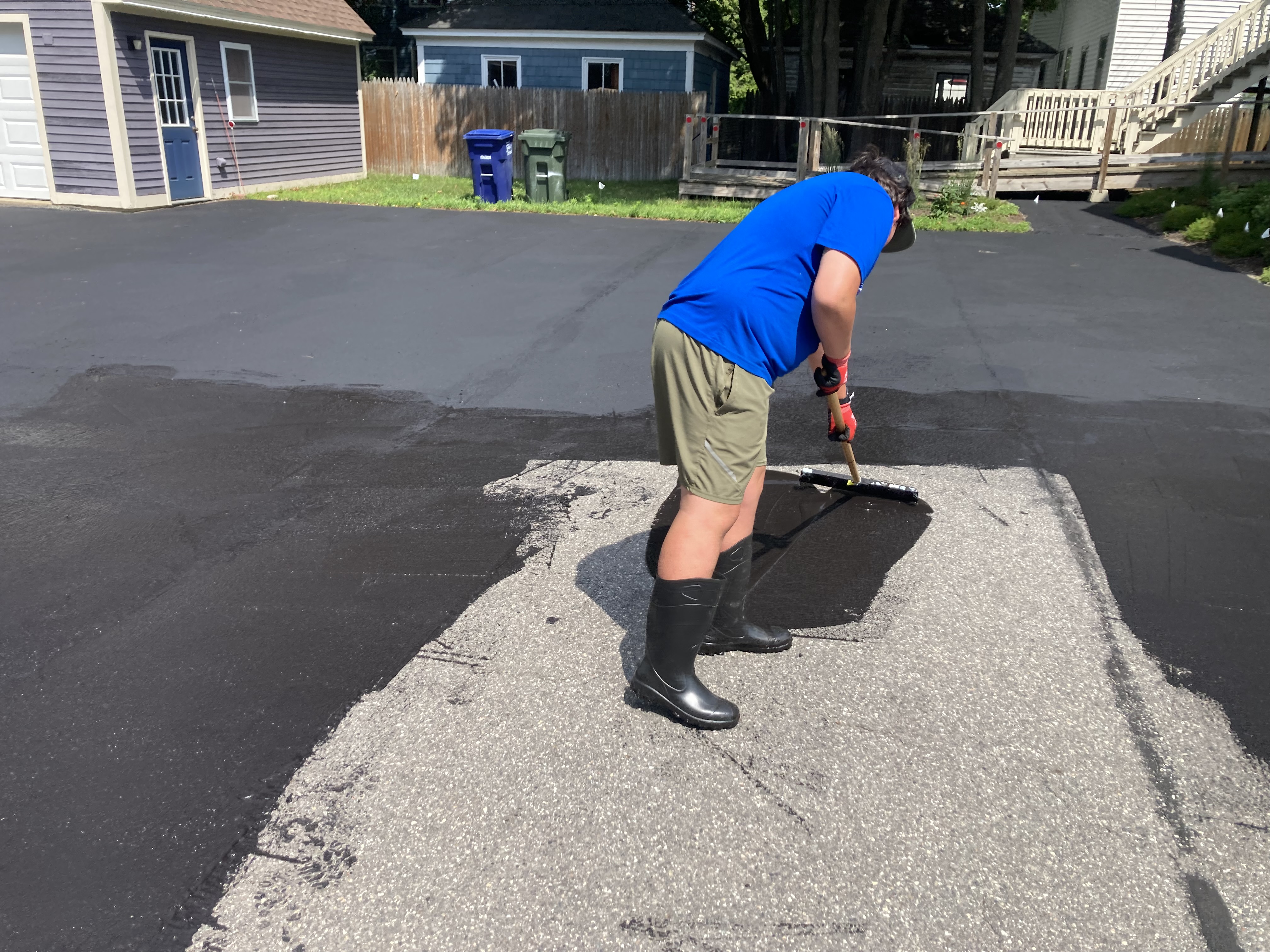
My son and I talked about this during the summer, when he took a job seal-coating a 5,004 square foot parking lot. It was his job – I, his crew and driver – but I advised that he should issue a quote in advance, so the client knew what to expect. With great confidence he named his price including a modest profit. The client understood the final invoice would be on a time and materials basis.
The job went well, but in fact was more demanding that expected. The crew pulled it through, but when it came time to submit the final bill my son realized that what had seemed – in advance – like a windfall, felt too small after the fact. He learned what hard labor meant and wanted to charge more. And so we talked about Henry Ford and what a “reasonable profit” meant. In the end, he settled on a 20% profit which equalled $52.50. The client was pleased and paid the bill gladly.
About Henry Ford we have kept talking, and our history curriculum is built around the farm boy from Dearborn who quit school with a 6th grade education. Encouraged by Thomas Edison, in 1903 he founded the Ford Motor Company. Models N, T and A followed and his River Rouge Complex would become the world’s largest, iconic and most efficient integrated factory. Detroit has a rich history, and Mo-Town adds a phenomenal soundtrack.
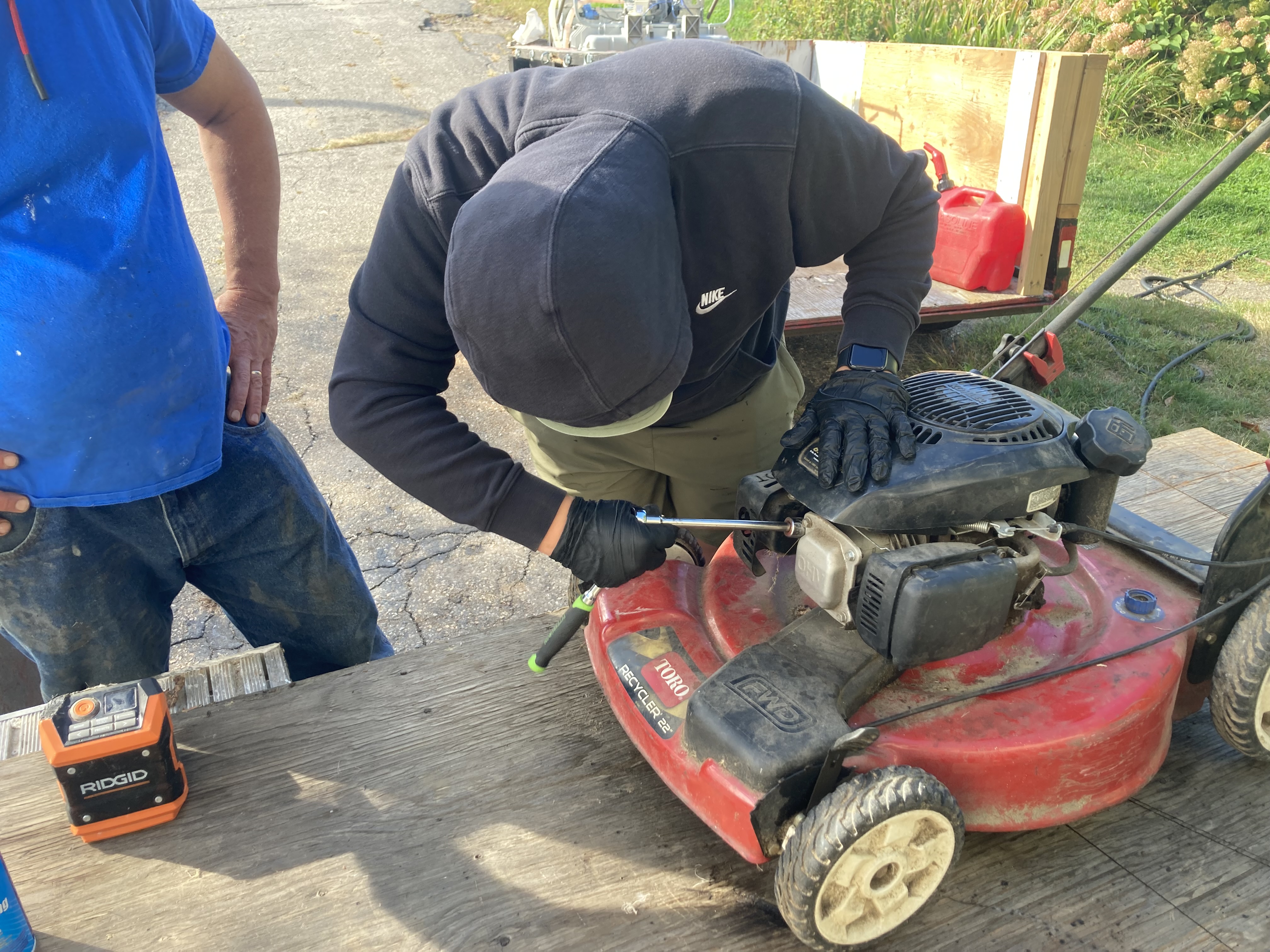
To make history tangible, we drove to the Professor’s house in Lyman, Maine to work on a small internal combustion engine. The Professor is a journeyman carpenter/philosopher, who not only has every tool known to mankind, but knows how to use them all! Pedagogy unfolded under a shade tree at the Lyman town center.
The Professor sagely required my son to write a summary of the experience. Given the complexity, my son dictated while I was his scribe, and we then parsed the grammar – nouns, common or proper and concrete or abstract; verbs and adverbs; prepositional phrases and their objects; subordinate clauses – and ended up with his summation:
“With Professor Nate, I worked on a Toro Recycler lawn mower with a 22” deck. The first thing we did was try to start it. It would not start. We realized that it did not have an air filter.
“We put it up on a table and looked at the spark plug. The spark plug had a lot of carbon, so we tested the plug to see if it had a spark. It did, but it was orange. The color of the spark can determine how much voltage is being generated from the engine. Red is poor, orange means power but weak, a blue spark is a strong: voltage follows the rainbow spectrum. Our plug had an orange spark. Nate had a new plug that we tested, but it had no spark at all.
“So then we tried using some 1,000 grit sand paper to sand off some of the carbon from the tip. After trying that we tested the original plug again and it had improved. We put it back into the motor, tightened it first by hand and then used a torque wrench, with approximately 30 foot-pounds of torque.
“We checked the oil and gas. We drained the gas bowl, which is under the engine on the left, to see if there was dirt in the fuel. There were specks of dirt and rust, and the fuel was green from the stabilizer. After we drained it, the fuel looked good.
“The Toro Recycler is supposed to have front wheel drive but it wasn’t working. We took the cover off and one of the belts was completely snapped. There was a stick lodged in the belt and a lot of grass had built up inside the housing of the belt. We put the belt cover back on. That should be the problem for the drive.
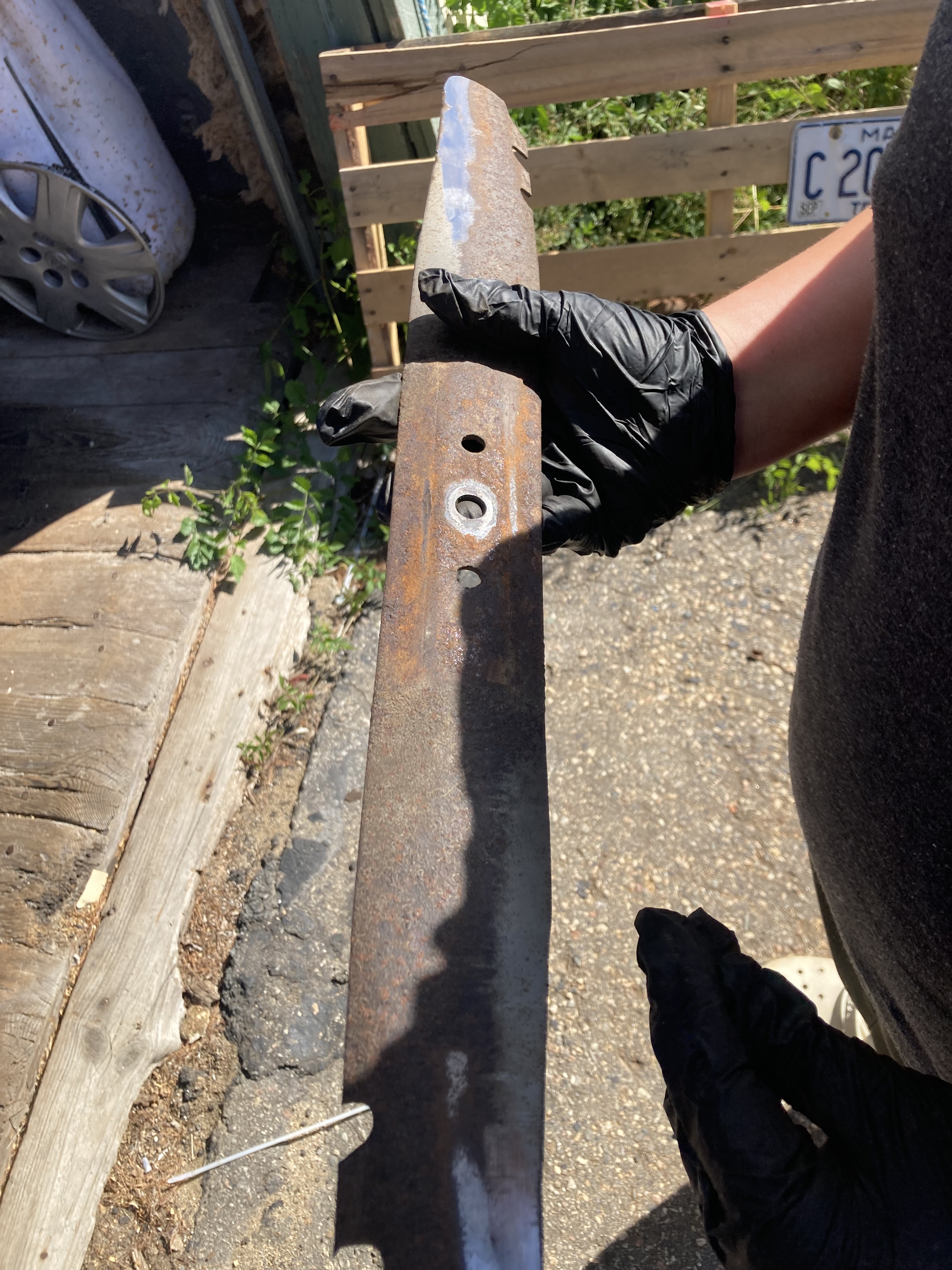
“We took the blade off using a pneumatic impact driver. We sharpened the blade, simply grinding the edge down. We put the blade back on using the torque wrench.
“We put the mower back on the ground and it started. It did not sound great at first, but slowly the sound improved as the motor circulated the new gas through the engine. It mowed well.
“Next we will get a new air filter, new drive belts and a blade. We need to clean the mower. We are also studying Volts, Amps, Ohms and Watts as part of our science class.”
While the Professor teaches the “how-to,” my son’s cousin, the Lizard-whisperer, is teaching him the pure science of electricity and magnetism; voltage and current; protons, neutrons and electrostatic fields. From all angles we are unpacking the mystery and majesty of an internal combustion engine.
The lead photo above is my son’s Great Grandfather John, standing proudly beside his Ford Model A touring car, circa 1928. John was a coal salesman in the Ohio River Valley, who made frequent trips throughout the coal rich hills of Appalachia. His car was for work more than pleasure.
John’s customers included Detroit Edison; he would purchase the entire output of mines in Eastern Kentucky and Ohio and then ship the coal north by the train load. But John’s coal did not fire Henry’s furnaces.
Henry’s revolutionary self-sufficiency controlled costs by owning the entire production process: 16 coal mines powering the electric plants that generated the voltage to run the steel mills producing the parts for the cars ever rolling down that assembly line at the Ford Motor Company’s River Rouge Complex.
A 6th grade drop out has much to teach our 7th grade home schooler.
In the annals of wise women, Lou Andreas-Salomé’s name is writ large. Born February 1861 in St. Petersburg, Russia to parents of French Huguenot and Northern German descent, she was the youngest of six children, the only girl. She attended her brothers’ classes learning Russian, German and French, rejected the orthodoxy of her family’s Protestant faith but embraced philosophy, literature and religion. She attended the University of Zurich – one of the few schools then accepting women – and studied logic, history of philosophy, ancient philosophy, psychology and theology.
At the age of 21 she met Friedrich Nietzsche, who immediately fell in love with her. But she rejected his advance, instead wanting to live and study as “brother and sister” and form an academic commune along with Paul Ree, a German author. Nietzsche accepted and they toured Italy with Salomé’s Mother.
One of the titans of German Philosophy, at the age of 24 Nietzsche had been named the Chair of the Department of Classical Philology at the University of Basel. He remains among the youngest tenured professors of Classics in the history of academia. His brilliance was to an extreme.
Walter Kaufmann, in his classic work “The Portable Nietzsche” wrote, “There are philosophers who can write and those who cannot. Most of the great philosophers belong to the first group. There are also, much more rarely, philosophers who can write too well for their own good – as philosophers.” Plato, he says is one example while “Nietzsche furnishes a more recent and no less striking example.”
Lou Salomé was his muse, which she later became to Rainer Maria Rilke – the great German poet – when he was the Personal Secretary to Auguste Rodin, one of the greatest stone carvers of all times, easily a peer of Phidias and the Ancient Greeks. In rarified artistic and intellectual circles, Lou Salomé was at the top of the game.
Dionysus is our subject, Salomé is our guide, but Nietzsche holds the key. Kaufmann wrote, “…few writers in any age were so full of ideas – fruitful, if not acceptable – and it is clear why [Nietzsche] has steadily exerted a unique fascination on the most diverse minds and why he is still so eminently worth reading.”
At the age of 25, Nietzsche wrote “The Birth of Tragedy” which is considered foundational, a revolutionary work of philosophy, aesthetics, and cultural criticism. His groundbreaking thesis argued that the greatest works of art – which define a society – combine the Apollonian (order, reason and form) with the Dionysian (chaos, ecstasy and raw emotion) into one complimentary whole. An example of the Apollonian would be Johann Sebastian Bach’s “Well Tempered Clavier” while Jimi Hendrix’s “Voodoo Chile” is Dionysian. The Burning Man festival is pure Dionysian.
Classical Greek Tragedy, he reasoned, reached the apex of artistic expression by using an ordered beautiful form to give voice to the primal, universal unity. Nietzsche wrote, “The two creative tendencies [Apollo and Dionysus] developed alongside one another, usually in fierce opposition, each by its taunts forcing the other to more energetic production, both perpetuating in a discordant concord that agon which the term art but feebly denominates: until at last, by the thaumaturgy of an Hellenic act of will, the pair accepted the yoke of marriage and, in this condition, begot Attic tragedy, which exhibits the salient features of both parents.”
The result was cathartic; life’s meaninglessness overcome through art. Aesthetics became more central than rationalism, with art and psychology moved to the core pushing metaphysics and science to the side. Nietzsche forged a new paradigm, and his writing influenced Sigmund Freud, who also happened to be a close friend of Lou Salomé.
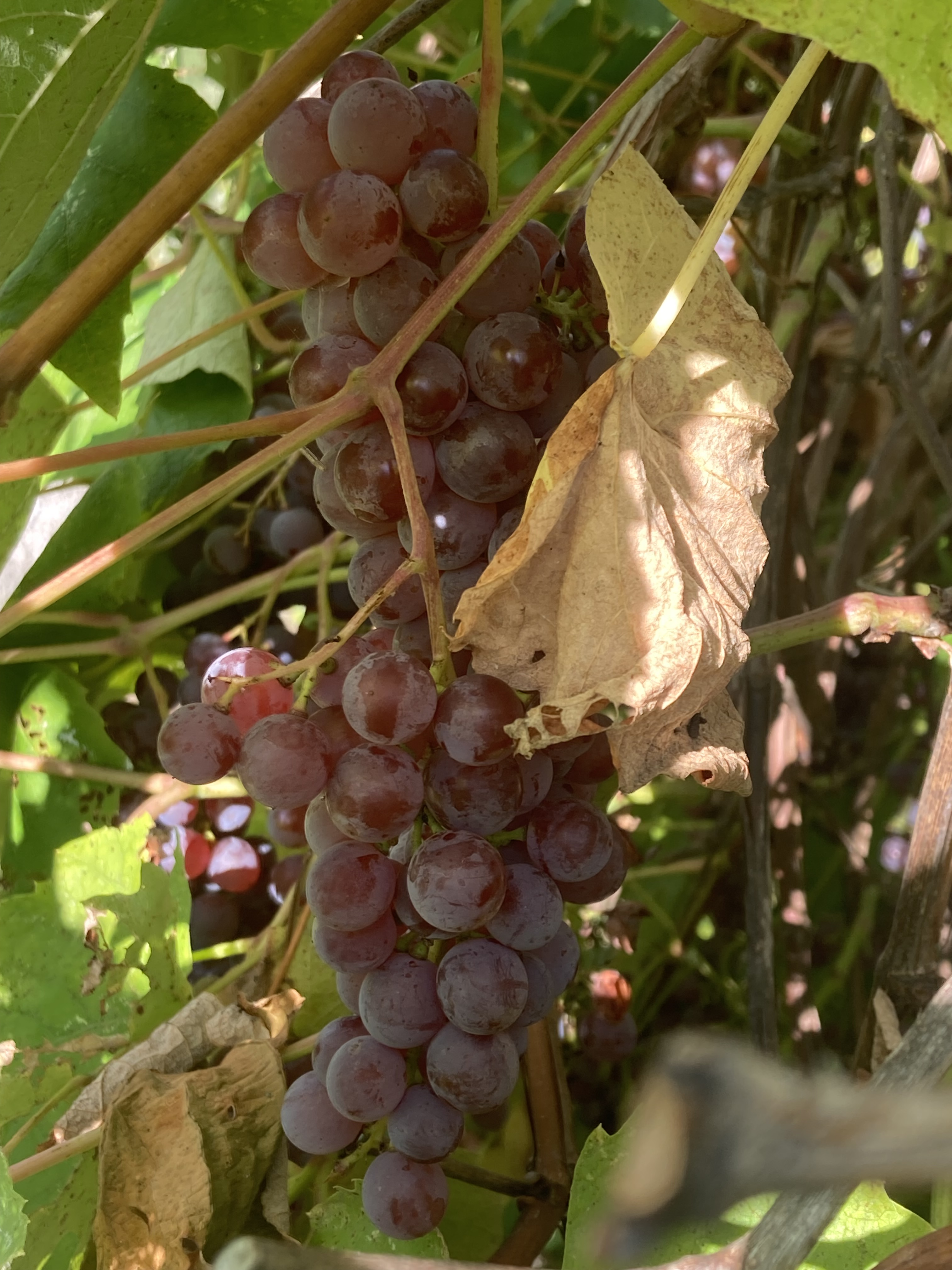
Greek tragedy came to my mind when a young friend, she herself on the path to wisdom, recently brought fresh home-pressed grape juice to our house. Grapes are the symbol of Dionysus and the connection was clear: her grape juice was the elixir of the God.
Having picked Concord grapes by the bushel with our other friends Rebekah, Peter and Mason, she explained, “We picked the grapes individually, sent them through a masher, then Peter heated them up before sending them through the juicing machine. He tried in the press but it kept sending the juice everywhere so he switched to a tomato juicer. That seemed to operate more like a standard juicer.” In other words the must was strained into juice rich, dark and sublime. With our children, we all broke bread and drank of the vine, the form of the Last Supper transformed as testimony to the raw and primal essence which is the end of summer; a new tradition born.
Truths held self-evident at our Art Farm include “art predates agriculture” and “the purpose of life is healing.” The Dionysian speaks to that, which simple truth the grape juice made manifest.

























































 an Art Farm