Big Ideas in Miniature
Posted: January 17, 2025 Filed under: Child Centered Activities, Chronicles of a First Time Parent, Portfolio - David's work, What is an Art Farm | Tags: art, books, making, photography, woodturning 2 Comments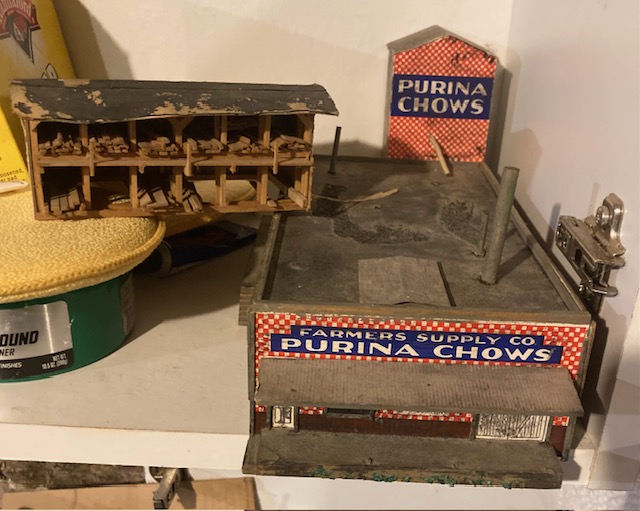
During my junior high school years – grades 6 thru 8 – I became enchanted by model trains and built an HO-scale train table in the basement. There was a mountain and tunnel; a small town with roads; a rail siding with buildings and sheds.
As my skills grew, so too the complexity of the layout. Tools were foreign to my father so I did it all on my own. Frustrated at times for no input I learned to be resourceful. Long before google and you tube, I subscribed to “Model Railroading” magazine to see what other people were doing.
There are no photos of the layout, nor do I remember any ever taken. I was in my own world, away in the basement, which brought great contentment. A few of the buildings remain, now stored in a box in our basement.
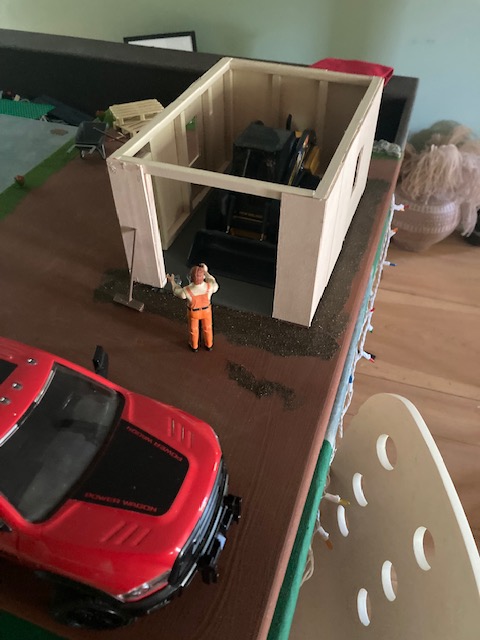
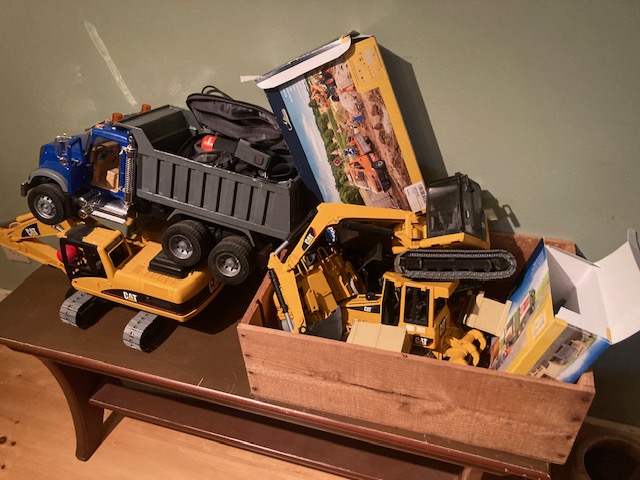
My son, of his own urging, has taken up a similar hobby, although his interest is heavy equipment and road construction. He began at age 8 – in the 2nd grade – so I handled the carpentry, but at his design. The first table was a 4×8 plywood sheet, cut to have to drop wings, which he painted. The table was placed just off our kitchen, a remarkably central location.
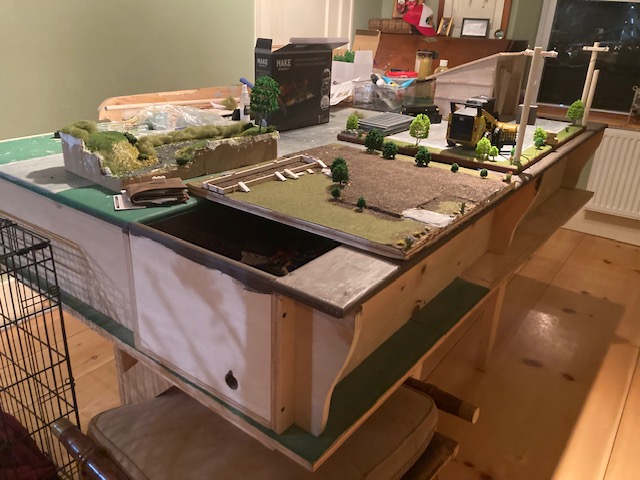
During COVID to break the monotony he and I would drive around town looking for road construction. Delays were desired. By chance there was a major project at that time, replacing sewers along the main artery.
Thus, a major renovation occurred on his table, the wings made permanently upright, a trench “cut” along the length, with the table raised 10” to create a space where he could lay down pipe in his imaginary world.
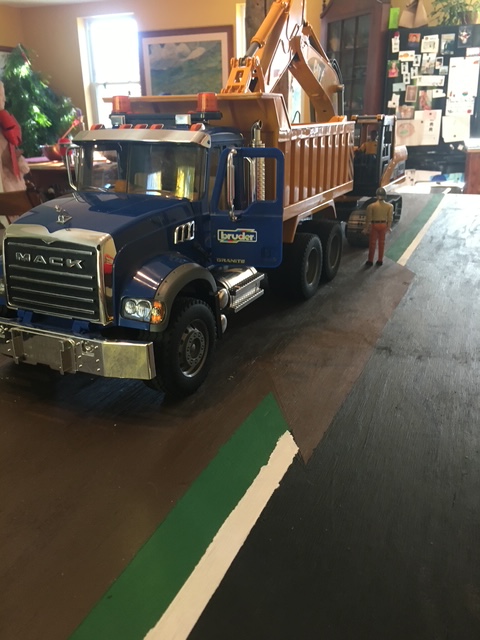
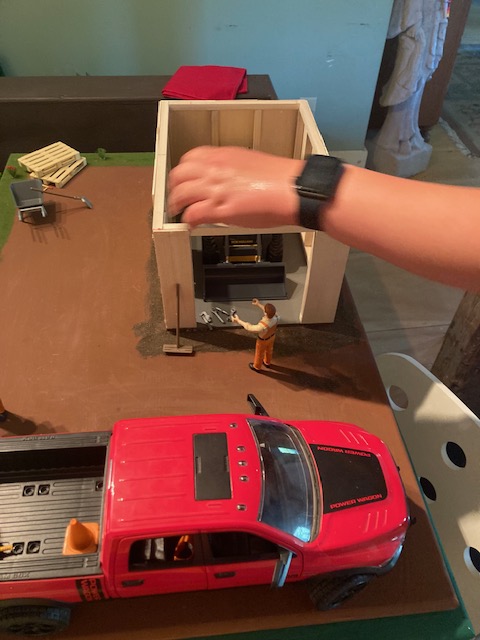
The table has gone through many iterations and now he builds dioramas, small stages displaying workers building roads or the yard where tools and equipment are stored.
The evolution of the table has been fascinating to watch, as he remains fully engaged building his dreams at his table in the hearth of our home.



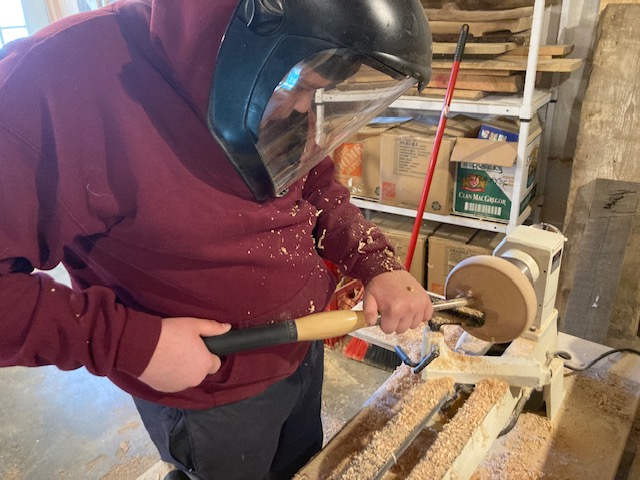
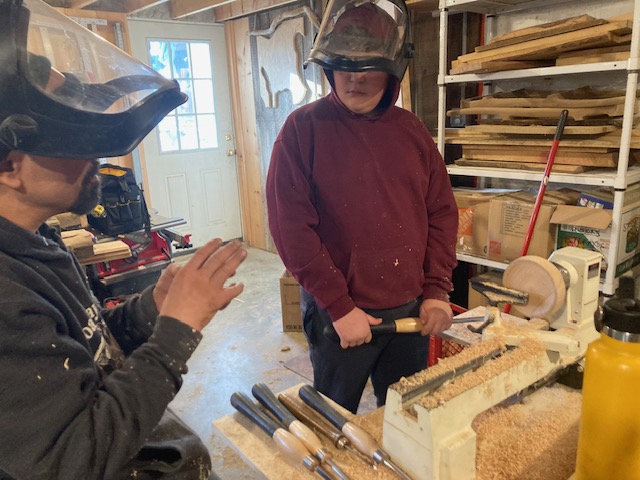
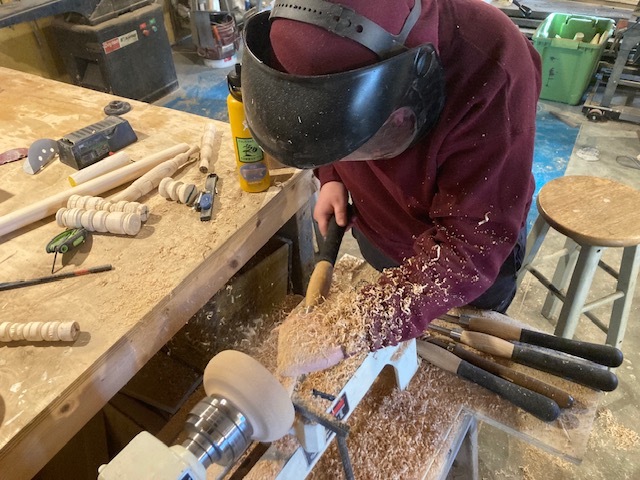
In other news, this week we had our first lesson in woodturning. Jose, a local woodworker, came to our workshop. A friend has loaned us a small lathe on which we turned a bowl made out of quilted maple, which I oiled and he presented to Mama. In two hours, he experienced the mystery of making, the satisfaction of completion and the joy of gifting an object hand made.
Dreams made manifest is an empowering experience.




God and Caesar at Middle School
Posted: January 10, 2025 Filed under: Child Centered Activities, Chronicles of a First Time Parent | Tags: education, homeschool, homeschooling, mental health, mythology, parenting, rational mind 1 Comment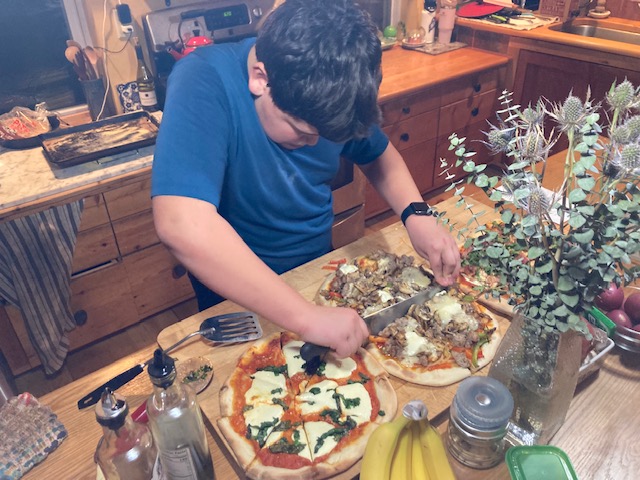
John Stuart Mill has been much on my mind, of late. This 19th century English philosopher – called the most influential thinker in the history of liberalism – advocated proportional representation, the emancipation of women, and the development of labor organizations and farm cooperatives. More importantly, he was home schooled by his Father.
During the midwinter holidays, I pondered home schooling my son. We talked, I read the Maine statute on home schooling and wrote a “Letter of Intent to Home School” for submission to the local Superintendent. In the end, we deferred to our Son, who decided NOT to homeschool now, but to remain in the Middle School. I stood down but my thoughts once written stand as a manifesto of my son’s education, at his time coming of age.
William F. Buckley then came to mind. The Yale educated public intellectual, considered the founder of the modern conservative movement, he – of my Father’s generation – criticized Yale for “forcing collectivist, Keynesian, and secularist ideology on students…denying any sense of individualism by teaching them to embrace the ideas of liberalism.” Buckley’s “God and Man at Yale: The Superstitions of ‘Academic Freedom’” has endured and became a central pillar of the American conservative movement.
I am no Yale man. At Northwestern, I read the Classics and advocate not individualism but that all life is one; neither Caesar nor religious dogma are my Master; consciousness in the whole of the divine feminine grounded in the compassionate masculine, be that my polestar.
Here then is my manifesto on the education of the young man who must need find his own path, while following my footsteps. Lacking any formal title, I call this “God and Caesar at Middle School.”
Dear Sir,
Respectfully, I write to inform you that [my son], age 12, shall be withdrawn from SoPo Middle School effective 4 January 2025. Pursuant to M.R.S. 20-A §5001-A(3)(A)(4) this is my written notice of intent to provide home instruction.
My approach to pedagogy combines the intellectual rigor of John Stuart Mill’s education grounded in the emotional intelligence of a 21st century global citizen. The classical tradition shall be paramount as we look to the future.
Geometry and physics shall be taught in the applied sense. Our Greek Revival Farmhouse requires extensive renovations, and working with me, [he] shall learn both the practical skills of building and the mathematical truth that Pythagorus resides in every corner. “Measure twice, cut once” goes the maxim; the 3-4-5 triangle every carpenter’s adage. Thus he will learn.
There is a tradition of a carpenter’s son becoming a leader. As I teach the practical, so too the mystical; Pythagorus also taught of celestial harmony – the Music of the Spheres – and so [he] shall learn the broad plain of Athenian philosophy.
We shall ponder both God and Caesar, the twin domains of the Western Intellectual tradition. “Ad Maiorem Dei Gloriam” may be our motto, and we would begin with John “Ἐν ἀρχῇ ἦν ὁ Λόγος” but translate “Λόγος” in all languages, all cultures: Allah, YHWH, Elohim, Bhagavan, Iraivan, Gitche Manitou, Xu, Unkulunkulu, to name but a few. There is no monopoly on the truth and in the comparison he shall learn critical thinking, and respect for other points of view.
If we read “Percy Jackson” then also Ovid’s “Metamorphosis.” To my mind mythology is not mere childish fiction but the symbolic language of archetypal truth. Carl Jung, a man of science who studied the mind – the “logos” of the psyche – wrote that religions perfectly coopted the archetypes onto their narrative. “Percy Jackson” may be an engaging fiction but also something deeper. So shall I teach literature.
When Persephone returns, come spring, [he] shall labor in the gardens of our Art Farm in Sopo, and at Frinklepod Farm in Arundel, and also the Cold Brook Farm in Sherman, Maine. [He] shall drive and maintain heavy equipment and work with his hands, in the dirt. I shall teach connections, that all life is one.
We have taken classes in welding, and shall now learn wood turning, and [he] will learn the practical art – literally “art” in Latin means “skill” – both of Hephaestus, of Prometheus and of Daedalus. Art making predates agriculture, which is to say it predates civilization. It is a priori. It is hard-wired in our DNA. So then shall we build skills, both practical and conceptual.
Life itself will be [his] classroom. He will both be schooled at least 175 days per annum but educated full time; I vouchsafe that your metrics will be met, which I shall report annually, in arrears on 1 September, in writing as required by law.
My full time job is parenting and my bread labor is maintaining – part time – the physical plant and property of the Friends School of Portland. Through that school I intend to hire a certified State of Maine teacher to oversee my pedagogy.
Finally, for his socialization I expect [he] will continue to participate in extracurricular activities at the Sopo schools. I understand this is permitted under Title 20-A, Section 5021.
We have crossed the Rubicon. Let the new year begin!
Please confirm acceptance of this missive. I shall be happy to discuss this at your convenience, but our decision has been made.
A copy of this written notice has been hand delivered to the Middle School Principal.
Best regards,
David
Truths Held Self Evident
Posted: January 3, 2025 Filed under: Child Centered Activities, Chronicles of a First Time Parent, consciousness, What is an Art Farm | Tags: consciousness, Great potato famine, healing, hypermasculinity, intergenerational trauma, mental health, trauma 1 Comment
Among truths held self evident, that healing is the purpose of life must be central. But this view challenges the conventional A-list: asset acquisition, accomplishment, accumulation of wealth, accolade, acclaim, awards, advancement…to name but a few.
“He who dies with the most toys wins” is the popular path, but life’s hard labors will come to our doorstep, at which time the question is whether we step up or cower. Our future hangs upon the response.
Easier it is to kick the can down the road. John Maynard Keynes, the economist of destiny, who structured the post-WW2 financial reconstruction, famously said, “In the long run, we are all dead.” But life’s grim reaper is one keen accountant, and even if we choose to ignore, intergenerational trauma will settle all accounts going forward.
“Intergenerational trauma” was a new concept to me until a few years ago when my wife, a Licensed Clinical Professional Counselor spoke of it. Since then the term keeps popping up and it seems to define something of our zeitgeist. Some among us may claim this is just “a hoax from China” but scientific fact argues against brazen disregard.
Epigenetics is the science of how environmental and behavioral factors alter gene activity without changing the DNA sequence. The term “epigenetics” comes from the Greek word epi- which means “on or above.” Originally introduced in 1942, the field has grown rapidly since 2004, when the genome was fully sequenced.
Among its findings are that environmental factors can influence the health and traits over three generations through epigenetic change passed down via sperm and egg cells; the “transgenerational” effect impacts grandchildren even though they were not directly exposed to the original environmental factor. In other words, even the untold family stories shape who we are, and become.
“Beneath every railroad tie there lies a dead Irishman” is an adage describing the struggles of the Irish emigres. My father’s ancestors immigrated to the United States circa 1850. We do not have records, but believe the Mahany clan were from the city of Cork, in the County of Munster where the Great Potato Famine raged. Between 1845 and 1855 more than 1.5 million adults and children – all enduring trauma – left Ireland seeking refuge in America.
The railroads were major employers of the Irish, and the Mahany family followed that path. Daniel M Mahany/Mahoney, my great-grandfather, was born in Kentucky in 1860, the era of the Civil War, the Confederate South; intense tension among the Catholics, immigrants and the Protestant natives; machine politics and its rogues’ gallery of gang violence. As a laborer on the L&N Railroad his work must have been extremely difficult, and how he dealt with those tensions, or even traumas, once home is left unspoken.
My Father said little, next to nothing, about his family of origin and I can only wonder what traumas lie buried, untold stories of a painful past, but which still shape our gene pool. I am the third generation of Daniel Mahany’s child D.J. Mahany
One of five siblings, I process this neither in a vacuum nor by committee. The path of healing is deeply personal, each of us bringing to bear the untold complexities of our own lived lives. But plain is the historical record, factual is the science, and now is my moment.
I wonder if the turbulence of our times is not, to some degree, a long overdue reckoning of intergenerational trauma. There seems a purging of the collective id; the hypermasculine posturing, saber rattling of geo-political Oligarchs, the comic pretensions of World Wrestling Entertainment, all of which seem a masking of unhealed traumas endured and too long accrued. Mass violence marked the 20th century – the “century of genocide” – and I wonder if now comes the time when accounts need be settled.
My children are the fourth generation. My parenting choices have the potential to be liberating. Nothing can be more important to me now, at this stage of my life, than healing as the only thing that matters, that the future may be made more clear, centered in the light.
The Art Ark
Posted: December 13, 2024 Filed under: Child Centered Activities, Chronicles of a First Time Parent, Portfolio - David's work, What is an Art Farm | Tags: animals, arctic, climate-change, consciousness, Friends School of Portland, poetry, polar bears, spirituality 1 Comment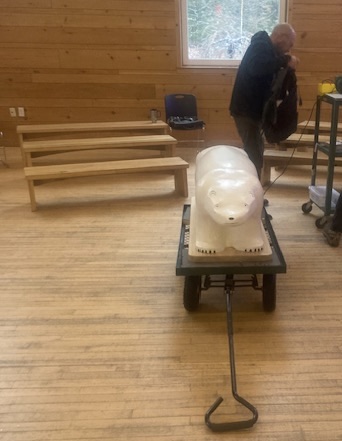
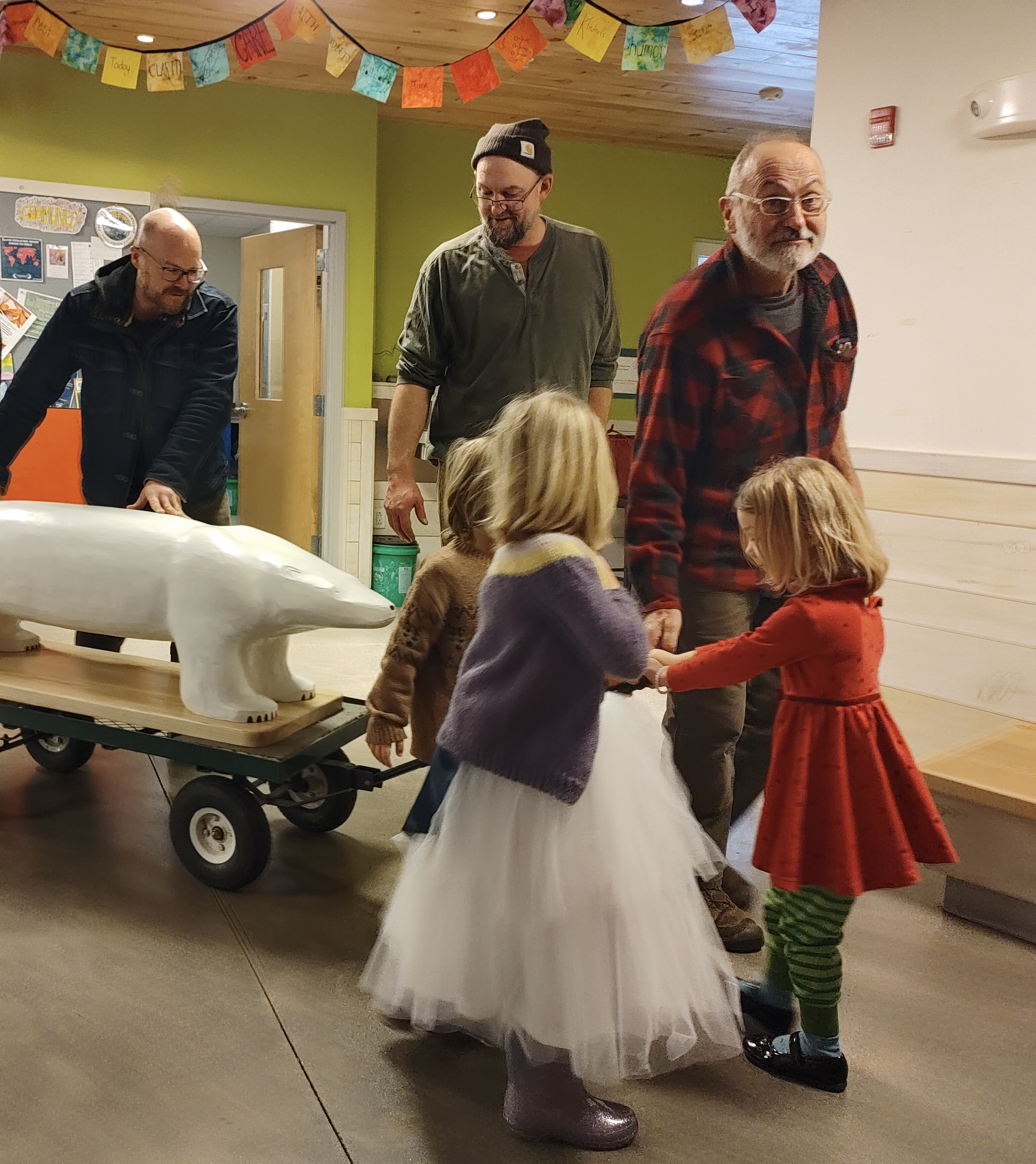
Previously I have told the story of the Sea Monsters, which exhibit came to its end. The monsters were put up for adoption, and then a Friend, a lifelong artist who volunteered for decades in inner city schools, exclaimed, “You need to save the Sea Monsters!!!” She donated funds to cover the costs, which became the catalyst and the adoptions have begun. We delivered Peter the Polar Bear on Wednesday to a full school assembly at the Friends School of Portland.
Historians say Cleopatra’s arrival at the port city of Tarsus to meet Mark Antony, 41 BC, was the most splendid entrance in history. Plutarch described it as “Aphrodite had come to make merry with Dionysus for the good of Asia.” William Shakespeare used a translation of Plutarch to write his tragedy Antony and Cleopatra. Hollywood, 1963, created its blockbuster “Cleopatra,” forever casting Elizabeth Taylor in everyman’s memories. But in the eyes of a Pre-K cherub at the Friends School, the arrival of Peter the Polar Bear must have been every bit as grand. I share here the text of our presentation.
DAVID: I am pleased to introduce Peter the Polar Bear, one of seven Sea Monsters from the Carousel Cosmos, a public art exhibit that had been on display on Portland’s Western Promenade. The exhibit came to an end, and the monsters are now being adopted all around the state. Peter has come to live in the Pre-K room.
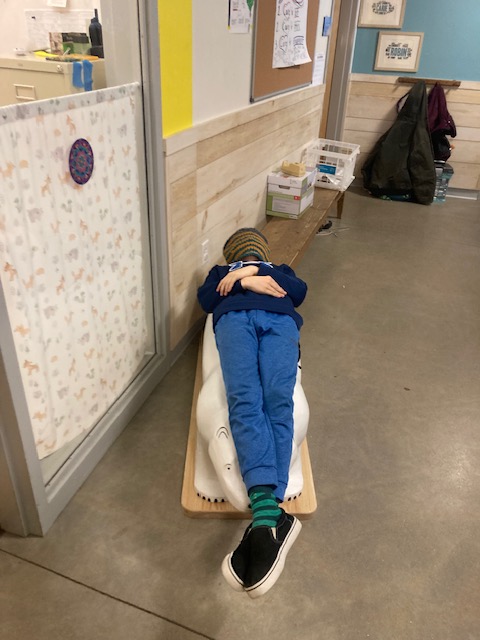
Dear Pre-K children, I want you to know that Peter is sturdy and stout. He is a bench.
- You can sit on his back and eat a snack
- You could lie down and take a nap
- If your teacher allowed, you could do a handstand on his head
- Or on your hands and knees, crawl and say “thank you and please…”
- listen carefully, perhaps he will reply…
- Peter is a gentle old Bear.

DAVID: Chris Miller is the polymath maker, the creator of the Carousel Cosmos. He will give a short presentation. But first, everyone please take out your bumblebee thinking caps…tie them on tightly…we will cross pollinate ideas, and with the help of the 8th grade students we will tell a story about circles and sharing.
How does a carousel turn?
STUDENTS: IN A CIRCLE
DAVID: How do planets in outer space move?
STUDENTS: IN A CIRCLE
DAVID: When Quakers gather to meet, how do we sit?
STUDENTS: IN A CIRCLE
DAVID: Peter is made of the wood of ash trees, locally grown. Ash trees grow in the woods here at the Friends School property. The forest teaches us of the circle of life:
STUDENT #1: “Biodiversity” teaches us that the greater the number of species, the more healthy is the ecosystem. Our property is on the border between Eastern Deciduous Forest to the south and Boreal Forest to the north; White Pines and Eastern Hemlocks are dominant on our property’s southern edge, while Hemlocks, Pine, Oak, and Maples surround the building.
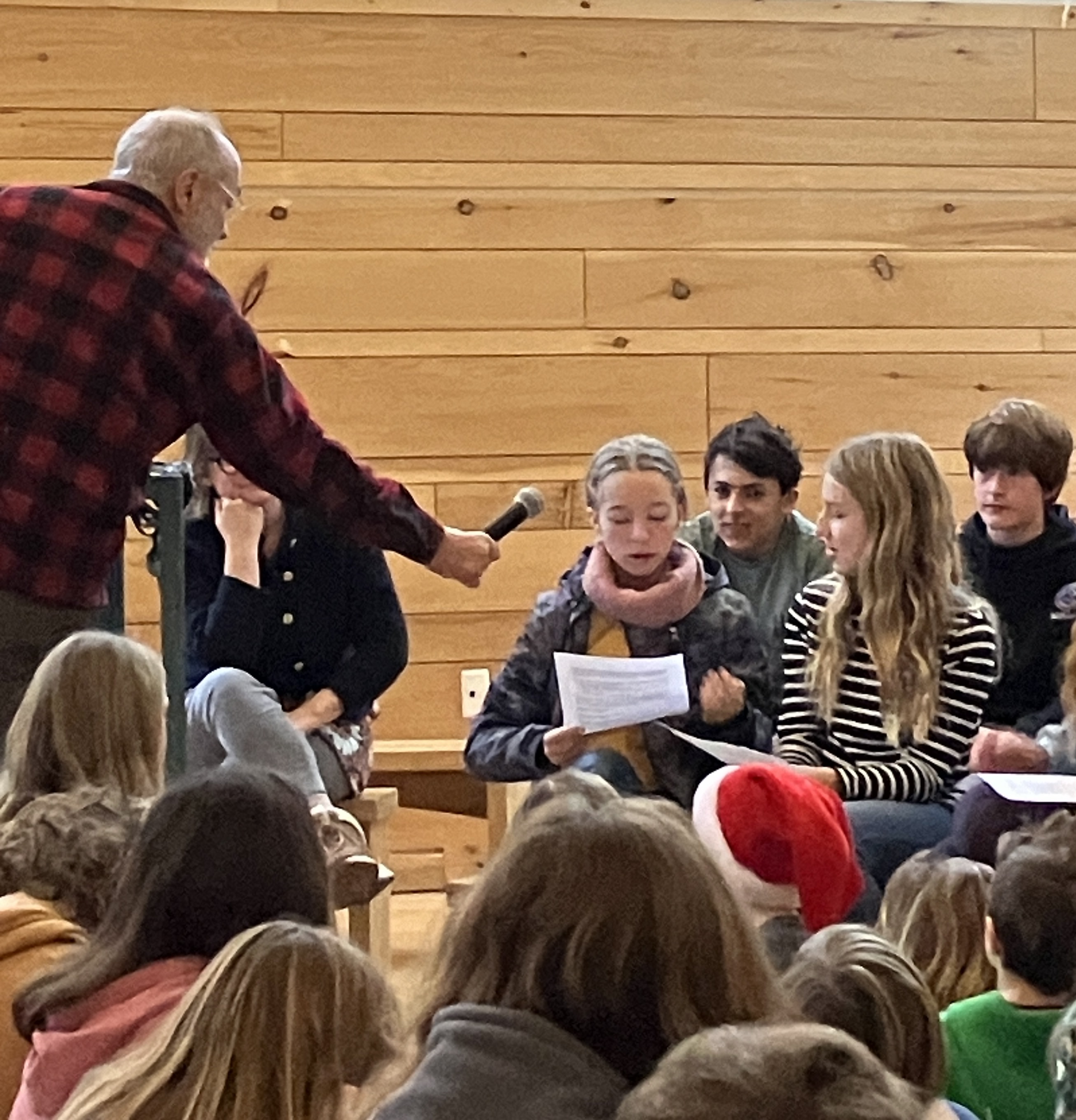
STUDENT #2: American Chestnuts grow in our woods. Although devastated by a blight and almost completely wiped out in America, our Chestnut trees likely are sprouting from the roots of ancient trees that predate the trees currently growing on the land.
STUDENT #3: The white ash and black ash trees grow in the wetland corner of the School property. The emerald ash borer, a jewel beetle native to north-eastern Asia is an invasive insect that feeds on the ash species, decimating these trees. We continue to study this problem.
STUDENT #4: The mycellium network is spread throughout the entire forest, and allows the trees to communicate to each other. Mycelium breaks down organic matter to feed the fungi, plants, and other organisms and connects plants to transfer water, nitrogen, carbon, and other minerals. The strong trees share enzymes with the weaker trees, making the forest healthier.
STUDENT #5: In the circle of life, we can say
- The greater the diversity the healthier the community
- The strong help the weak
- And everyone prospers
- Chris Miller will now speak about more circles and sharing
Chris Miller then stood and spoke about circles and Polar Bears, shared images of his Sea Monsters, how they were designed, and stories of their past. He explained that Polar Bears may have lived where Maine is, but long long ago. A child spoke up and explained pangaea. Chris answered all the children’s questions. The room was silent, in awe as he spoke:
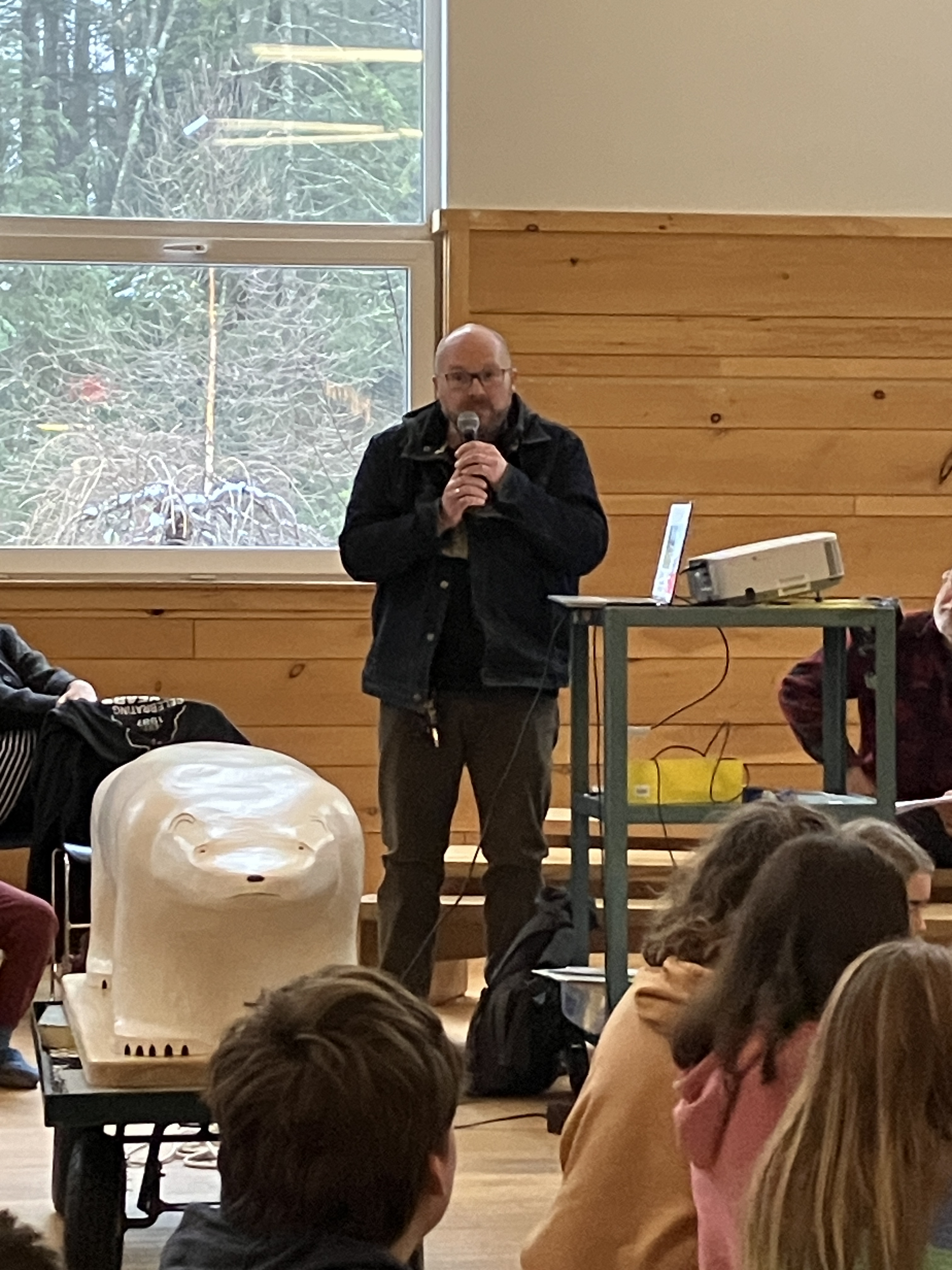
“Gather round. We are all made of the same atoms that the stars are made of too. We are parts of the universe that observe the universe. We are all living, sentient and curious together, here of all places and now of all times. What are the odds? How does it make you feel?
“This carousel is inspired by kindness, adventure, outer space, bedtime stories, dinosaurs and ice cream. It’s inspired by the Western Promenade’s endless views, spectacular sunsets and contemplative atmosphere. It spins the way that the earth spins when the sun sets, in a place where trolleys used to stop, in a small picturesque city with a school community that speaks more than sixty different languages.”
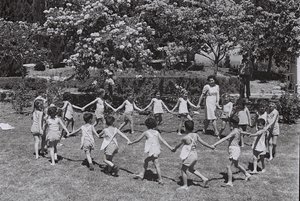
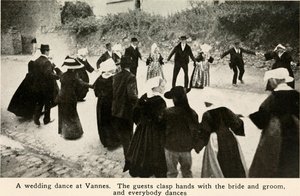
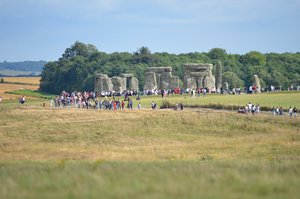
Chris shared images of circles from around the world, over hundreds of years, many people gathered together…




The Pre-K children unveiled a banner they had made:

…and then lead Peter out of the room, down the hall to his new home:

Volts and Arc
Posted: November 22, 2024 Filed under: Chronicles of a First Time Parent, Farming off the Farm, Little Green Thumbs, Permaculture & Home Renovation | Tags: Factory 3, line welds, MIG welding, tap welds, weld pool, welding 1 Comment
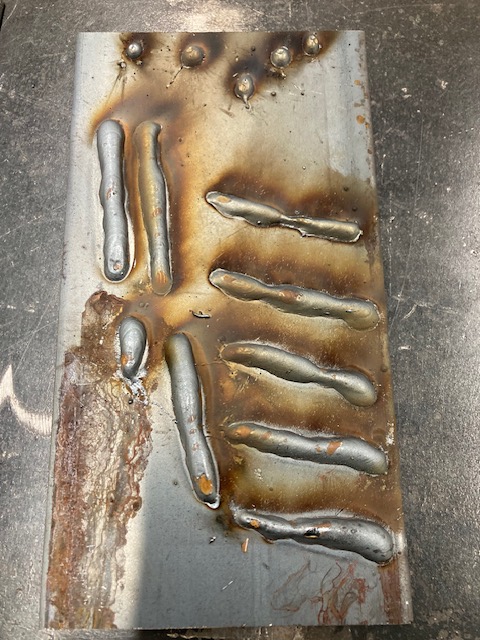
Recently my son and I took a MIG Welding class. Having no experience with welding we were absolute novices, eager to go.
We took the class at Factory 3, a local makerspace that provides work studios for artists, classes for the general public, a community to local makers. A vast open space, exceptionally well appointed with tools and equipment. Beau, the teacher, was superb, answering my many questions. Quickly arcing light was in our hands! There is no looking back.
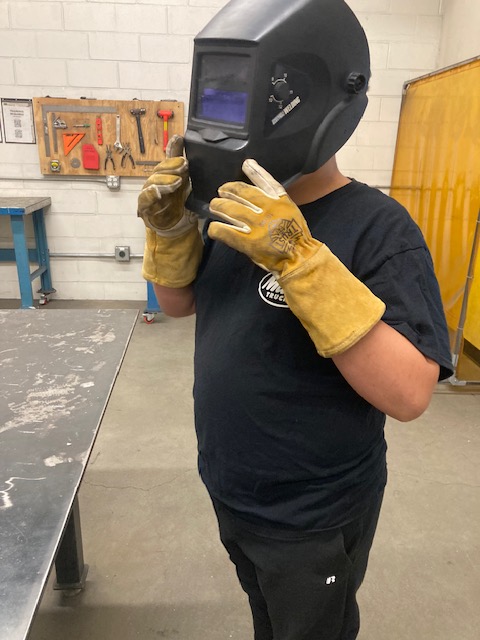
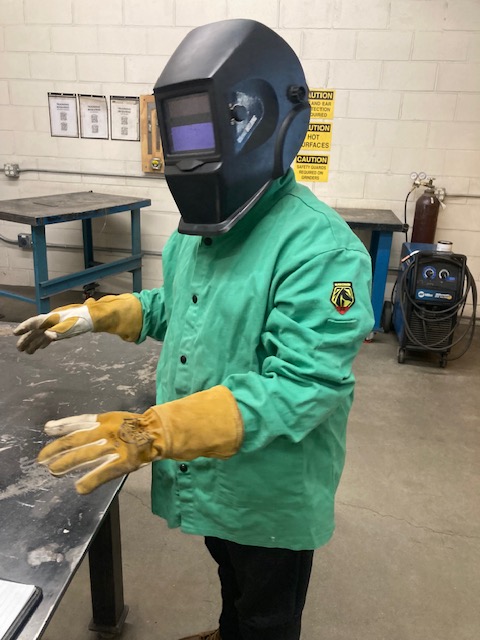
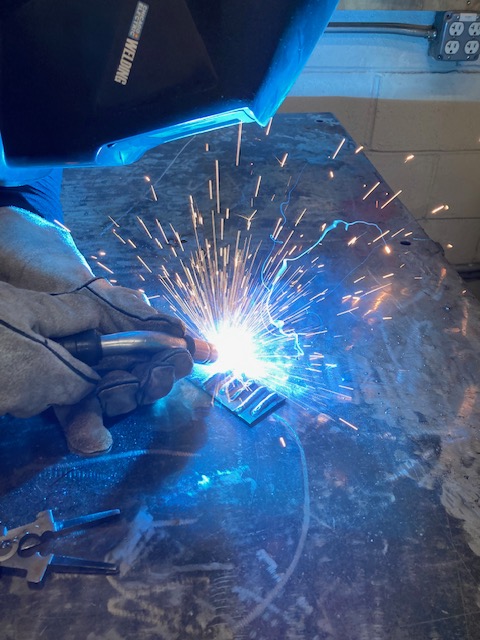
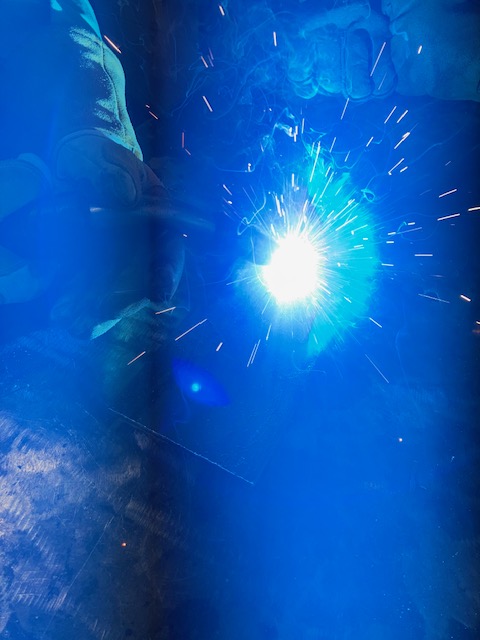
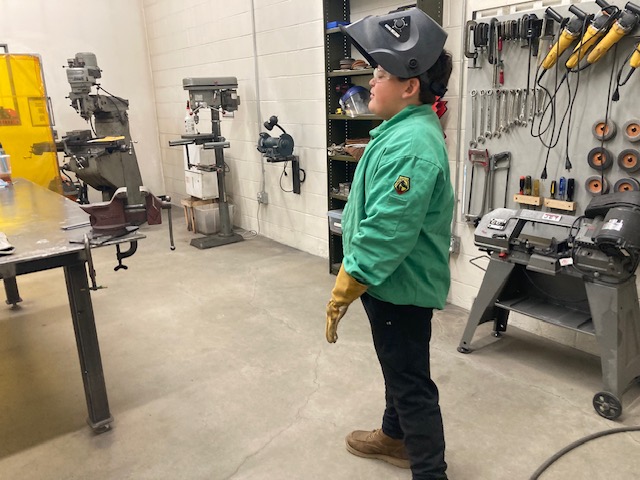
MIG welding uses an electric arc, not fire. The arc is intense, so intense that it could cause sunburn or severe damage to the eyes; to protect our skin we wore a welding jacket and long pants, to protect our eyes an auto darkening helmet.
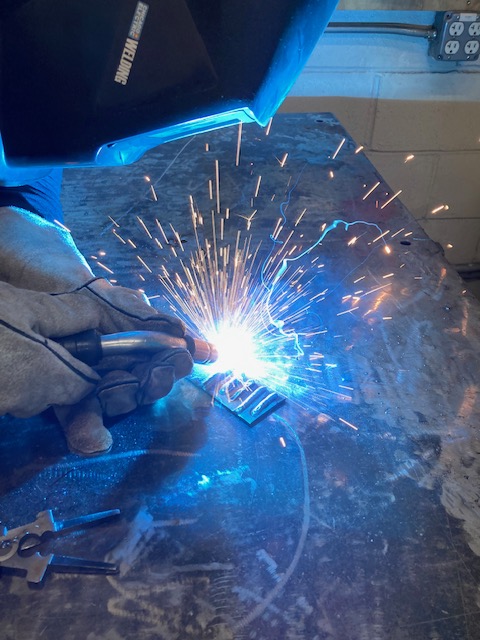
MIG stands for Metal Inert Gas, which is a process that fuses two pieces of metal together using 240 volt electricity and a steel alloy wire with copper coating. A constant voltage power supply creates an electric arc between the base metal and a wire electrode that is continuously fed through the welding gun, into the weld pool. A ground cable was clamped to the metal work table, and then positive electricity flows from the welding gun through the table.
The metal inert gas was 75% argon and 25% C02. The gas is non-flammable and serves to create a shield around the arc, preventing oxygen and water vapor from getting into the weld pool. Water would cause rust, which would make the weld fail over time.
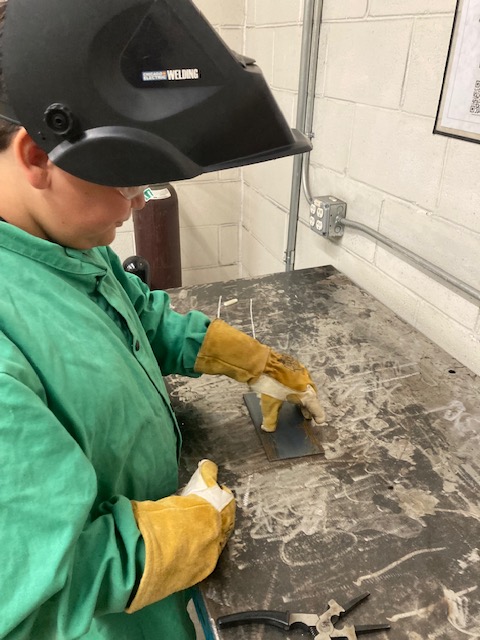
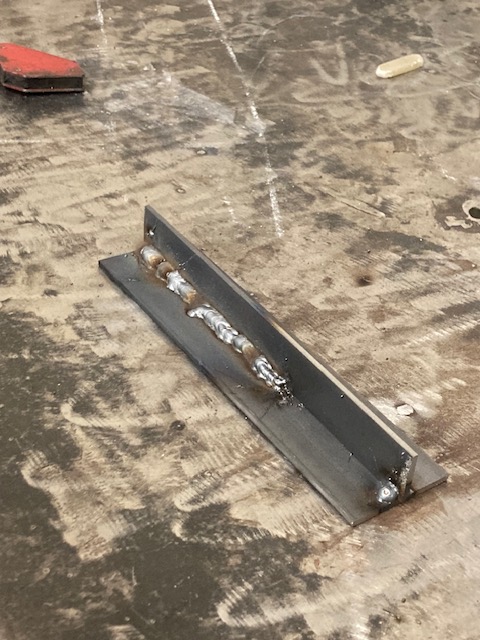
Our tasks were basic, a series of “tap welds,” a temporary weld to hold the two pieces in place and a “line weld” which is the continuous weld along a joint, permanently fusing the two pieces of metal together.
The one hour class opened a new world of material and technique. Project ideas came flooding in. We have two staircases that need railings. Another class seems in the offing. A local friend who welds has offered to teach us more.
New materials. New techniques. Much to be made.



_________________________________
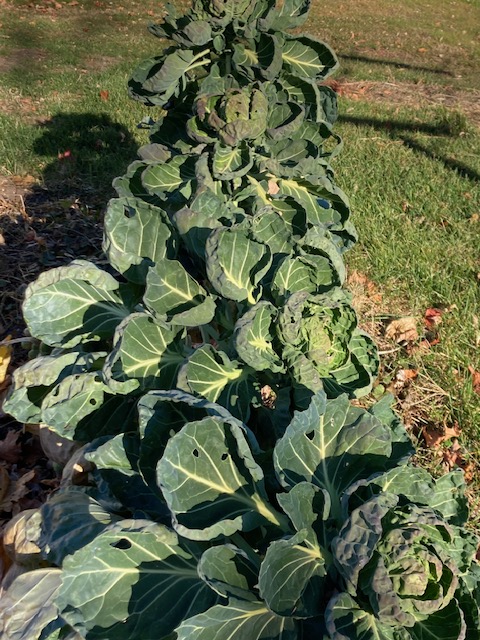
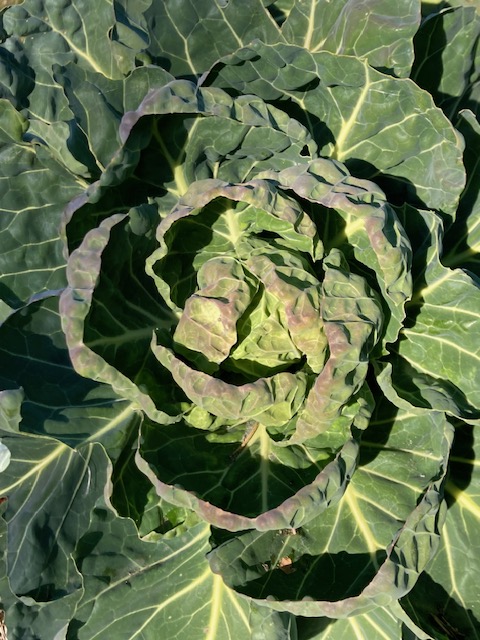
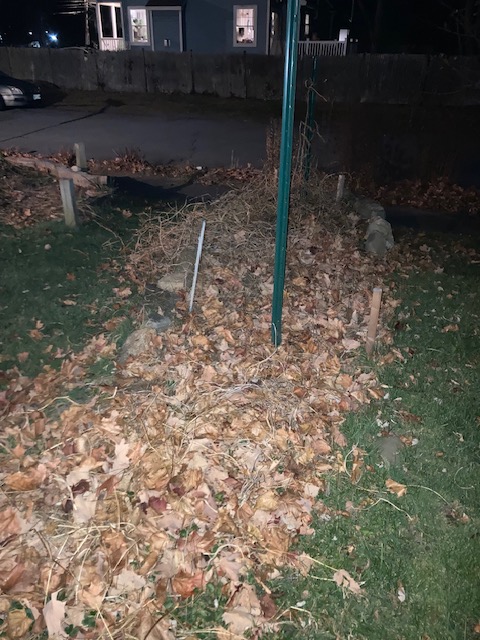
Gardens are gleaned, emptied, final cabbage harvested, Brussel Sprouts alone remain. Soon we plant garlic, for a late spring harvest. A season of abundance has come to its end. We pause now for winter.



Like a Pearl
Posted: November 1, 2024 Filed under: Child Centered Activities, Chronicles of a First Time Parent, Farming off the Farm, What is an Art Farm | Tags: animal rescue, animals, dog, dogs, Grammy Rose Dog Rescue, pets 4 Comments
During the Great Plague of London, in 1655, a 22-year old named Isaac was sequestered. He used his isolation to invent “infinitesimal calculus,” the study of continual change. A remarkable achievement, hinting at great things to come from Sir Isaac Newton.
During the Covid lock down, our time of isolation, the Wentworths of Acton, Maine were sequestered and similarly productive, in an entirely different way. They used their time to construct six residential-style dog cabins, a welcome center with offices, a conference center and retail gift shop plus an Ice Cream Parlor and 18-hole Mini-Golf course.
The family has owned the land for generations, as far back as the American Revolution – their forebears served beside George Washington – and they wanted to honor the memory of their Grandmother “Grammy” Rose Kessler Wentworth. The buildings were completed over 18-months and in 2022 the Grammy Rose Dog Rescue & Sanctuary began operations. The Ice Cream and Mini-Golf generate revenues making it a self-supporting rescue center. https://grammyrose.org/
They entered adoption agreements with “kill shelters” around the country, primarily in the Deep South. There are so many stray dogs down there that the Sheriffs routinely pick them up from the side of roads and, rather than euthanize them, ship the dogs north to New England for adoption. Think of it as a modern day abolitionist above-ground railway.

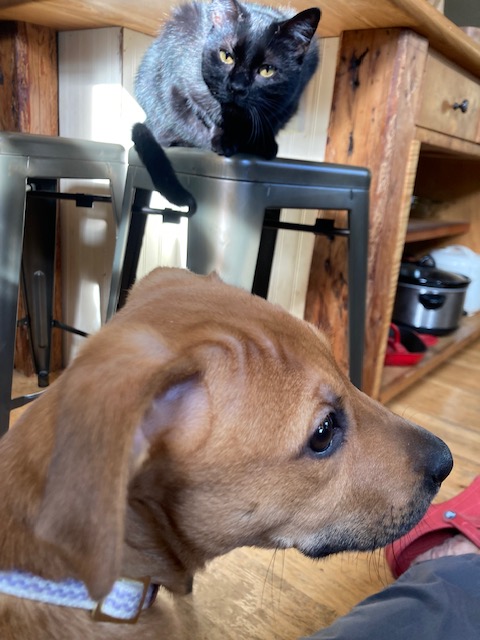
We drove to Acton last Friday ostensibly “to look” at a puppy. But no one drives one hour one-way just “to look” so it was no surprise that we returned home with a 9-week old female puppy, recently arrived from Webster Parish in northwest Louisiana. The Mother was a lab-mix while the Father is unknown. She appears to have some Rhodesian Ridgeback in her.
Her adopted name was “Jayne Mansfield” honoring the 1950s “bomb shell” movie star and Playboy Playmate, whose IQ reportedly was 149, at the genius level. Hopefully our puppy was named for that trait.

We mused over names. My daughter offered Maisie, and I chimed in Mae, both of which, it turns out are derived from a Scottish Gaelic word, derived from the Ancient Greek “margarites” meaning pearl. Luminous indeed, and given her high energy, we are calling her “Crazy Maisie Mae.” She is a handful, 24/7.
Our art farm is home now to two adults, two children, two rescue dogs from the South and two rescue cats, one from Puerto Rico and the other from Oklahoma. Meanwhile, back in Acton, Grammy Rose keeps rescuing dogs, 35 having been adopted during the month of October.




Sea Monsters a/k/a Carousel Cosmos
Posted: September 6, 2024 Filed under: Art & Healing, Child Centered Activities, Gallery - Visual, Portfolio - David's work | Tags: cosmic carousel, new paradigm design workshop 2 Comments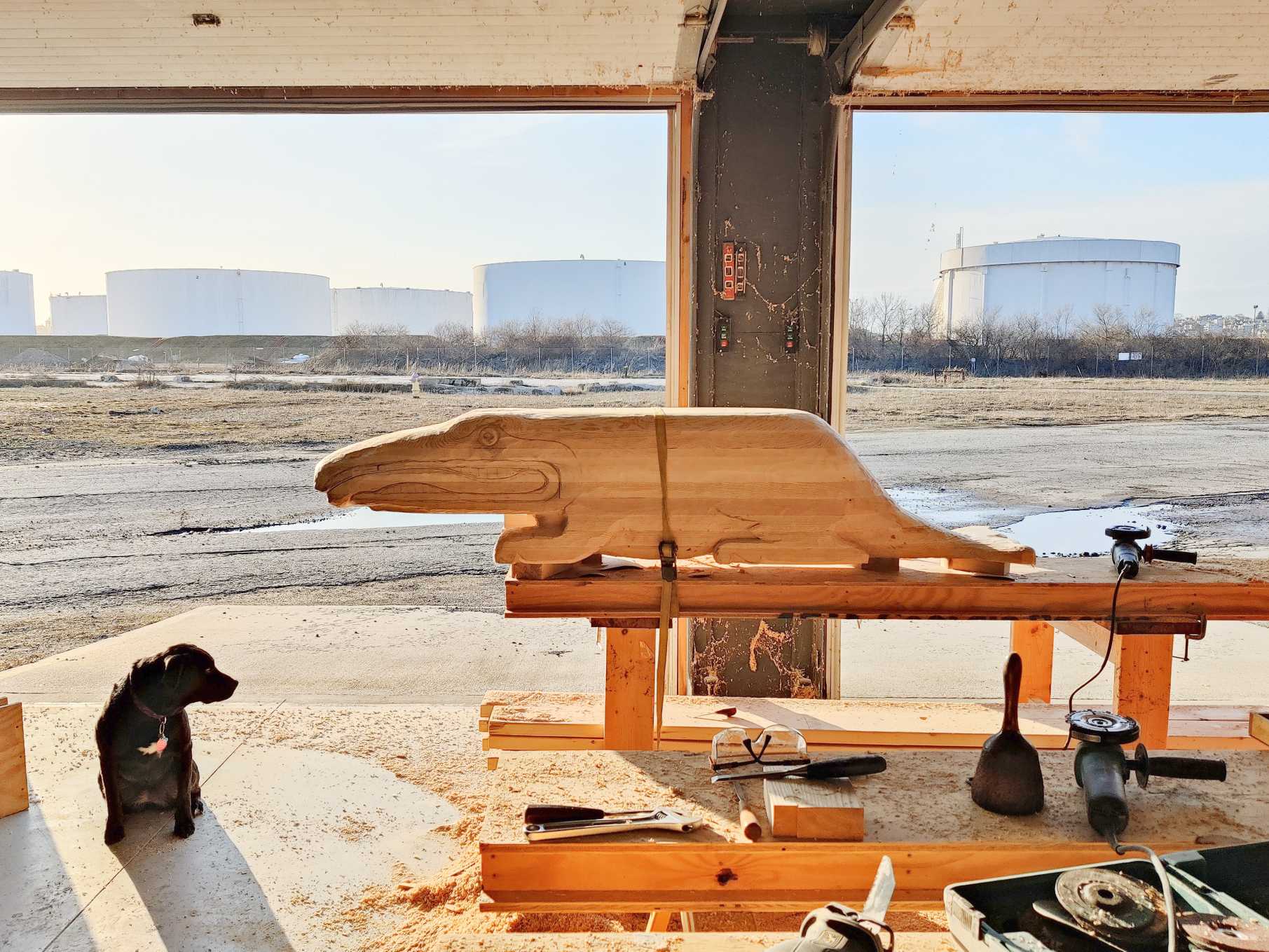
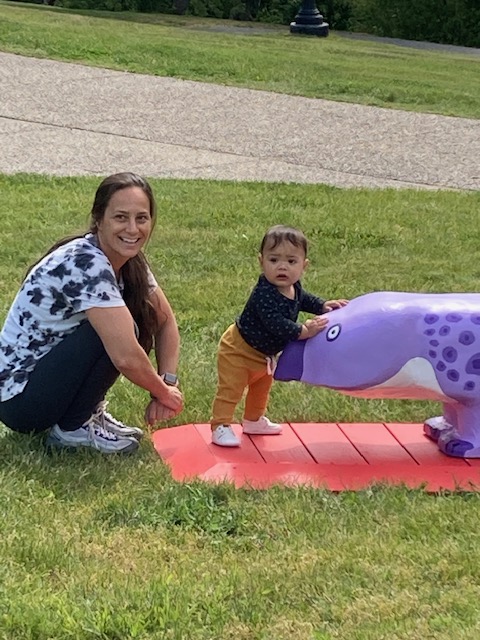
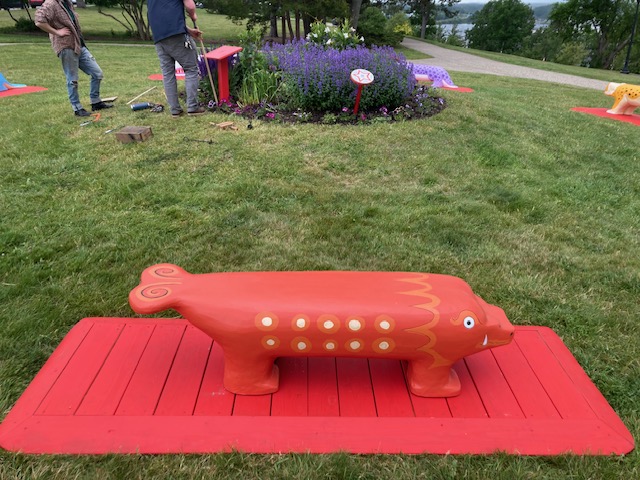
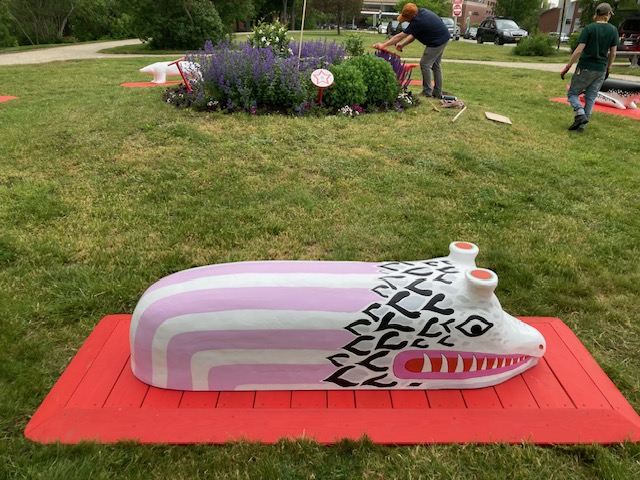
In April 2023 I had the pleasure of making Sea Monsters for a public art display in Portland’s West End. Chris Miller, the polymath maker, received the commission and hired me to help build seven creatures which likely could have lived on Portland’s Peninsula over the past 250-million years, give or take a few millennia, or even “just last Tuesday.”
“Carousel Cosmos” is the official title and the seven creatures are a Polar Bear, Humpback Whale, Saber Toothed Cat, Walrus, Rhyncosaur (an extinct herbivorous Triassic archosauromorph reptile), Dragon, Crenatocetus (an extinct genus of protocetid early whale).
Chris wrote, “They are dragons, lions, bears and sea monsters, the usual suspects in the greatest bedtime stories of all time. They have many names in many languages. They’ve made cameos as constellations that might be older than writing, older than the first cities, or the wheel. Some are mythological, some are just misunderstood. They invite you to explore the cosmos starting right here, on a journey to greater understanding.”
One really must visit the installation, but at the least you can visit them online: http://npdworkshop.com/carousel-cosmos

We built the creatures using a “stack laminate” process just as carousel horses have been built since 1799: layers of 8/4 ash (2” thick) were stacked then glued to create the three-dimensional form, which we then carved and painted. With as many as nine layers per creature, Chris used computer modeling software to draw the final shape, then “deconstruct” it to show the shape of each successive layer.

The son of a carpenter, Chris studied sculpture at the Art Institute of Chicago, and then architecture at MIT. His vision is a unique combination of those three influences.

The word “genius” normally is defined in terms of sheer intellectual horsepower – Newton and Einstein, the commonplace exemplars – but a more insightful meaning is in the derivation of the word, from Latin, which means “guiding spirit.”
For having walked the hallowed halls among the MIT Masters, Chris has retained the childlike wonder of growing up amidst the flora and fauna, woods and water of Fifty Lakes, Crow Wing County, Minnesota. His sterling genius guided him not only to conceive, design and build, but also to write this summary of the Carousel Cosmos:
“This carousel is inspired by kindness, adventure, outer space, bedtime stories, dinosaurs and ice cream. It’s inspired by the Western Promenade’s endless views, spectacular sunsets and contemplative atmosphere. It spins the way that the earth spins when the sun sets, in a place where trolleys used to stop, in a small picturesque city with a school community that speaks more than sixty different languages.”
Lest anyone think my statements are grandiose rather than grounded, I submit this photo as Exhibit A:




Climb aboard! Let’s go for a spin!!
School of Sharks
Posted: August 16, 2024 Filed under: Child Centered Activities, Gallery - Visual, Portfolio - David's work | Tags: ceiling mural, one percent for art, sharks 1 Comment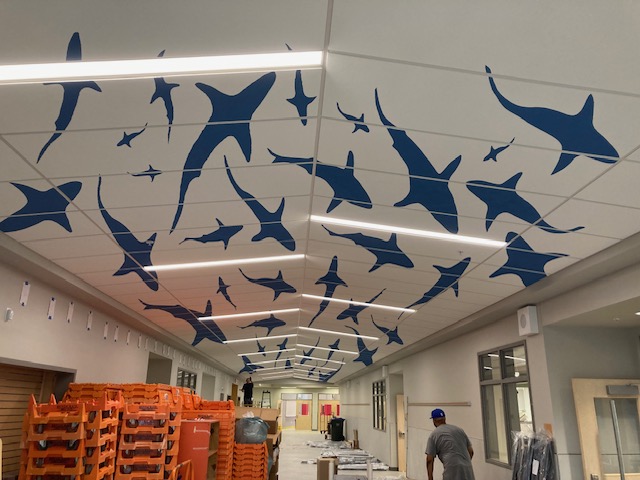
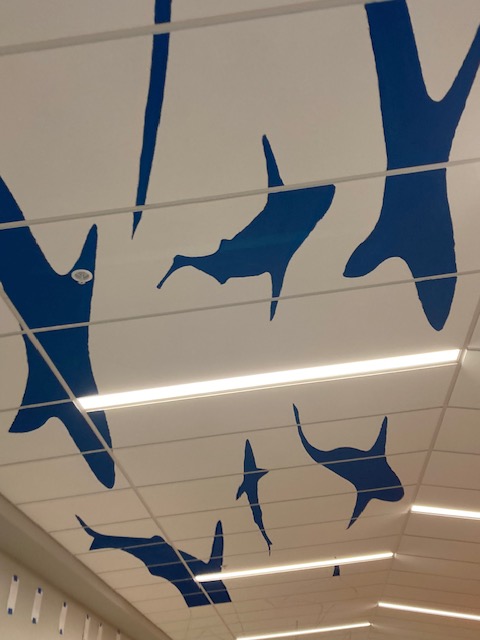
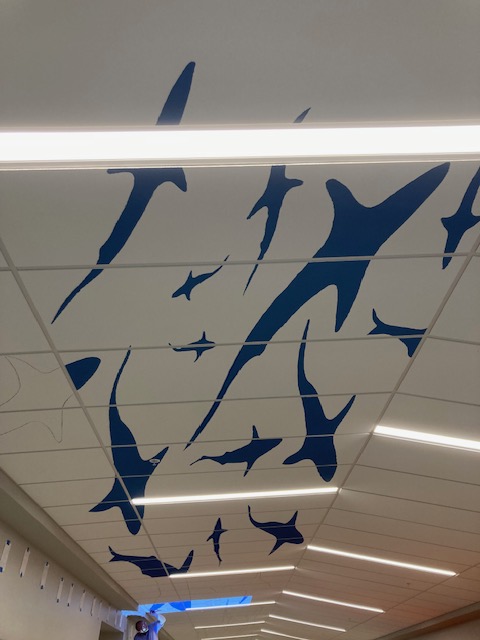
One year ago, summer of 2023, I worked on painting a ceiling mural at the new South Portland Middle School. Chris Miller, a polymath maker, very good friend and father of two young boys had received a commission and needed help. I gladly answered the call.
His design originally called for a pod of humpback whales in silhouette painted on the ceiling of the school’s central corridor. The Principal held a vote and the students selected “Sharks” as the new school’s mascot, and so a last minute change was called for. Chris complied and the whales became sharks, swimming overhead. http://npdworkshop.com/pod-cosmos
In designing the mural he envisioned the school of sharks swimming in outer space, then he mapped the sharks onto the central corridor ceiling, from the point of view of a fifth grade child, standing at the school’s entrance. His goal was to capture awe and wonder, with distortion a part of the design. The technique he used is called anamorphosis, which he described as follows:
“Anamorphosis is an optical illusion by which an image appears distorted but becomes clear when viewed from a key viewpoint, unique angle or through a particular lens. I want my kids and their classmates to learn to listen to people who have different perspectives and espouse different beliefs. I want them to be curious, open and inquiring- to strive for agreement and consensus through informed discussion.
“The mural’s key image will appear completely clear and undistorted from just one point of view. Someone just under five feet tall would see it, if they stood just inside the corridor with their back to the wall between the two lobby doors. From other viewpoints and as students travel down the length of the corridor, these silhouettes will appear increasingly stretched, and distorted to varying degrees of abstraction.
“The root of the word cosmopolitanism is Cosmos. It’s an ancient Greek concept of the universe as a well-ordered system. It presumes that all things can in theory, be made clear. I want my kids and their classmates to be relentless in search of both questions and answers. I also want them to cultivate a sense of wonder, though childhood, adolescence and into adulthood.”
These ideas carried the day, and Chris was awarded the commission. In Maine the “Percent for Art” law provides for art in public buildings, by setting aside one percent of the construction budget to purchase original works of art for new or renovated buildings receiving state funds. Some may say this is progressive waste, but I say it is arch-conservative, given that art predates agriculture and mark-making on cave ceilings shows that art is at the core of humankind’s quest for meaning. Maine has simply acknowledged same.
The Middle School budget was $69 Million, so art was heavy on the docket. The architects were so taken with his idea that they moved his mural onto the central corridor of the school, where every child every day will pass among the building entrance, the library, cafeteria and gym. Pride of place indeed.
Chris handled the design and layout. I handled the brush. It was a marvelous project with which to be involved. Best of all, how often in life do you get the chance to write to your Mother: “Michelangelo ain’t got nothing on me!! I am painting a ceiling mural in the new SoPo Middle School!!”




0, 1, 1, 2, 3, 5, 8…
Posted: July 4, 2024 Filed under: Farming off the Farm, Gallery - Visual, Little Green Thumbs, Permaculture & Home Renovation | Tags: fibonacci sequence, golden ratio, phi 2 Comments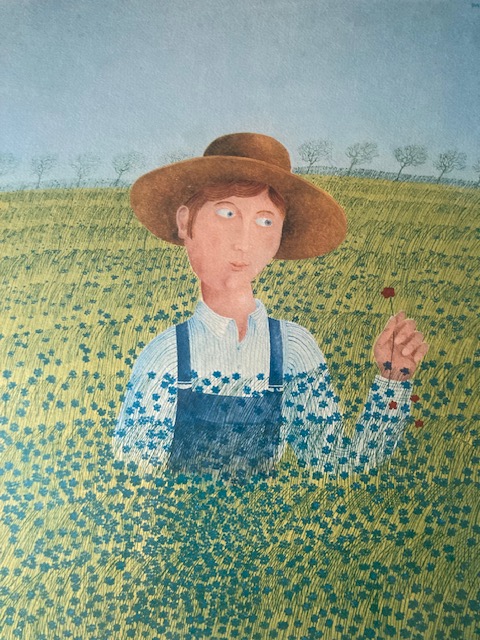
Donald J. Glaser was a rare bird, a beautiful soul, who loved beauty, and traveled the world in its search. My uncle, he was born in August 1924, studied at the Parsons School of Design in NYC, then entered the seminary but dropped out, remained a “permanent bachelor” and in 1951 found his calling as a buyer of art and antiques. In the golden age, when department stores were locally owned paragons of regional taste, at Stewart Dry Goods, in Louisville, Kentucky, he ran the home furnishings boutique.
For more than 45 years he circumnavigated the globe, annually, from East to West buying the best: silks in Hong Kong, brass in Bombay, furniture in Italy, paintings in England. “Good things last” was his motto. In 1972 Associated Dry Goods bought the regional company, and Don became the buyer, and had furniture made, for an entire national chain.
He was my Godfather, and sometime in the 1970s while traveling in the South of France, Don saw in a gallery a portrait that reminded him of me. It arrived at our house, an unannounced surprise from afar.
A truer portrait never was made. How many times I have pondered its meanings. It hangs now in the stairs to my son’s room. The young boy gazes into a flower, and what does he see in his hand, but the universe in stunning mathematical order. I speak, of course, of the Fibonacci sequence.
The Fibonacci numbers were first described in Asian Indian mathematics circa 200 BC by Pingala on possible patterns of Sanskrit poetry formed from syllables of two lengths. The Italian mathematician Leonardo of Pisa, also known as Fibonacci, introduced the sequence to Western European mathematics in 1202. Because the West has been dominant, his name has reigned supreme.
The Fibonacci sequence is a pattern wherein each number is equal to the sum of the preceding two numbers. The sequence begins 0, 1, 1, 2, 3, 5, 8, 13, 21, 34, 55, 89, 144, 233 … and goes on to infinity.
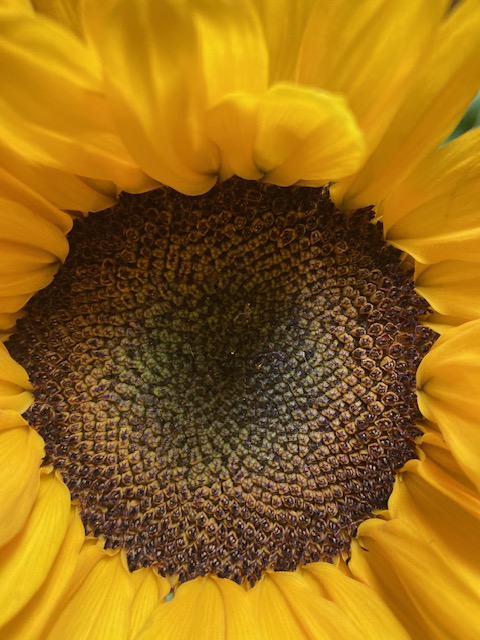
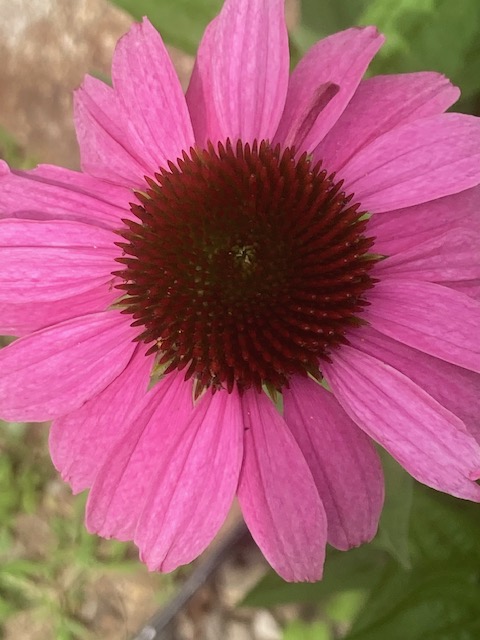
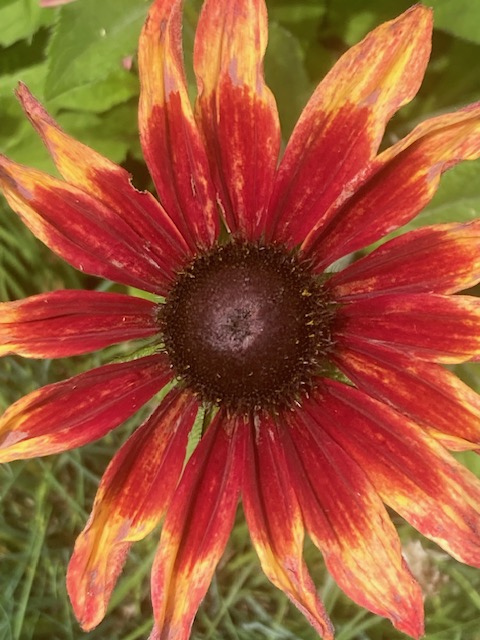
The Fibonacci sequence is manifest throughout nature, prominently in the spirals of Sunflower seed heads, that radiate from the center. The numbers of these spirals, when counted in opposite directions, are often consecutive Fibonacci numbers. The sequence also appears in the branching of trees, the arrangement of leaves on a stem, fruit sprouts of a pineapple, an artichoke, in pine cone bracts; a tiling of Fibonacci squares forms the nautilus shell, which appears also in the spiral of a hurricane and galaxies across the cosmos. The sequence does not appear everywhere but its presence is abundant.

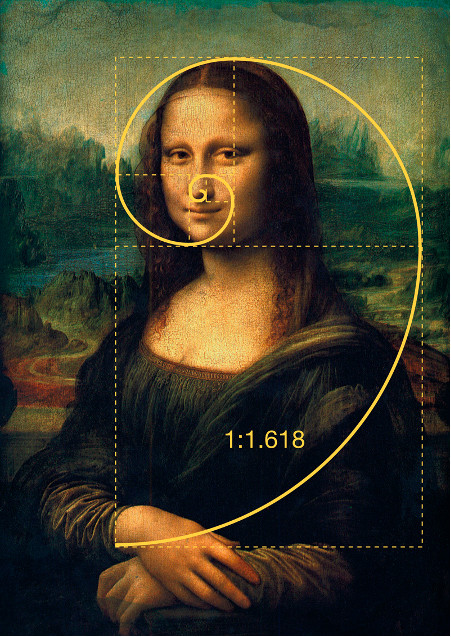
Fibonacci is related, mathematically, to the golden ratio – 1.618 – which is ubiquitous, though hidden in plain sight; credit cards and every drivers license replicate this rectangular form, based on reciprocal numbers of height to width.
The Golden Ratio, also known as Phi, is found throughout art and architecture. Many find the ratio in the Great Pyramid of Giza, and the Greek Parthenon in Athens (although a mathematician at the University of Maine has challenged that). In Renaissance art it was present among many of the master works, notably in Leonardo de Vinci’s Mona Lisa. In the modern era, the golden ratio has informed the art of Seurat, Picasso, Gris, Duchamp, Debussey, Le Corbusier, and Mondrian, to name but a few.
When gathering flowers for a bouquet, pause to ponder the breadth of universal beauty, ever present, bundled within your arms.

Here at an art farm, our gardens are lush and due to the heat, fruits ripen almost two weeks ahead of schedule.
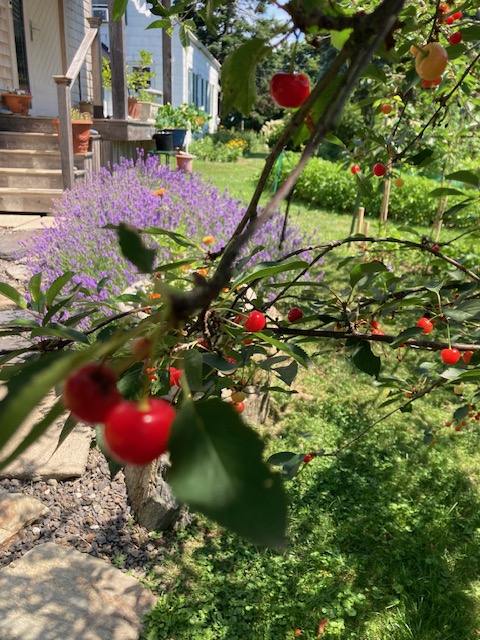
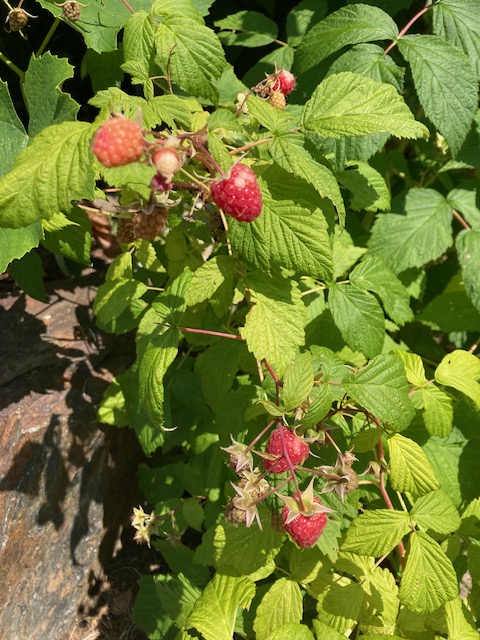
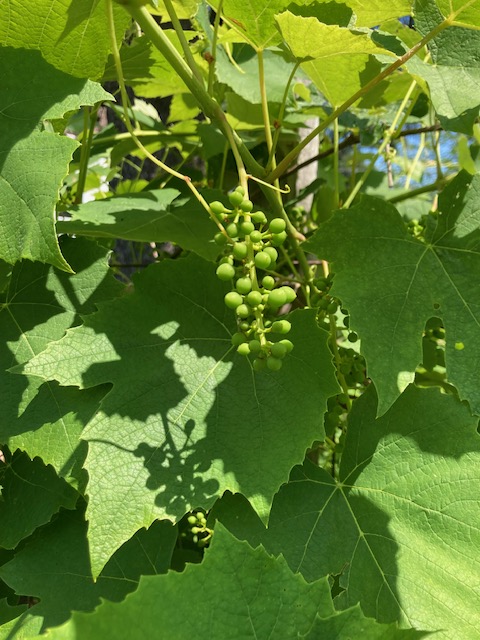
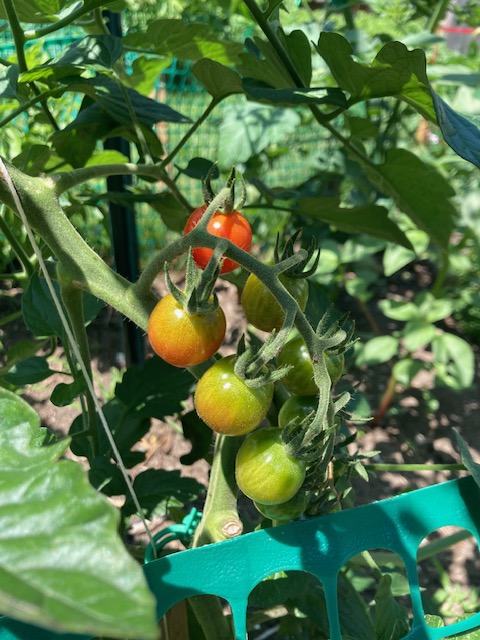
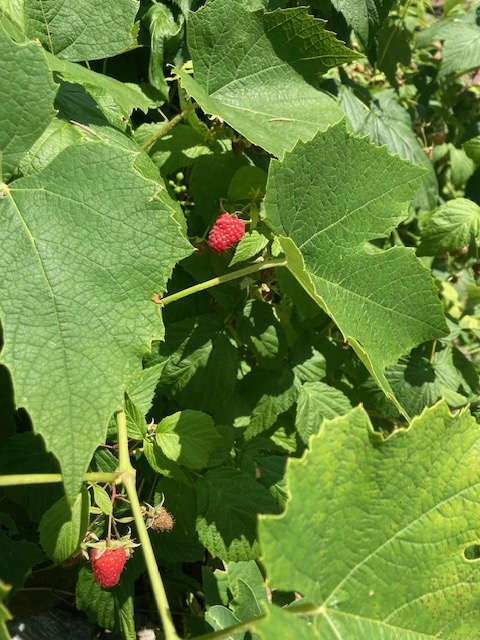
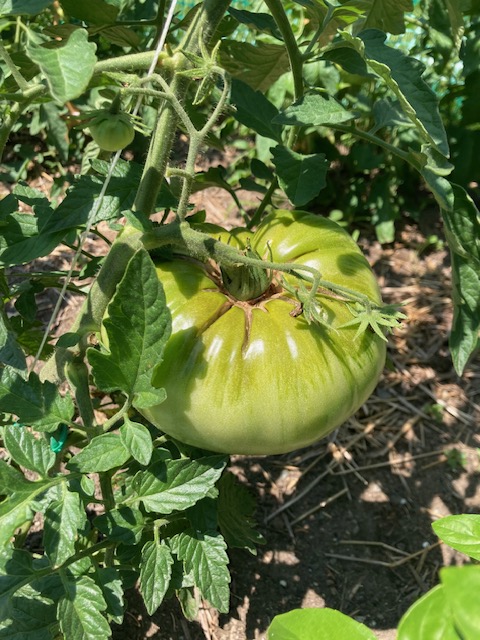
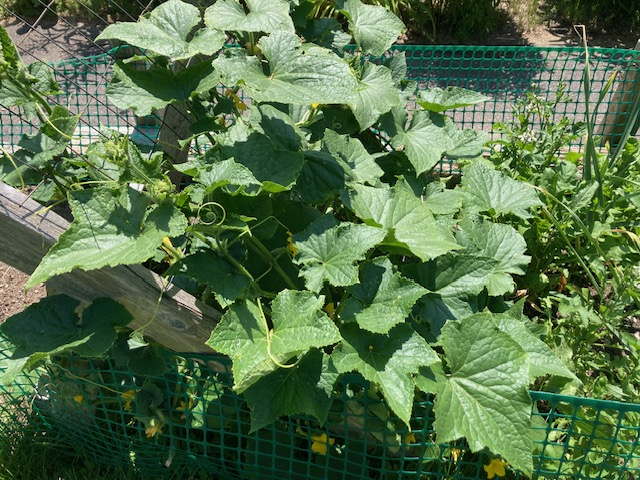
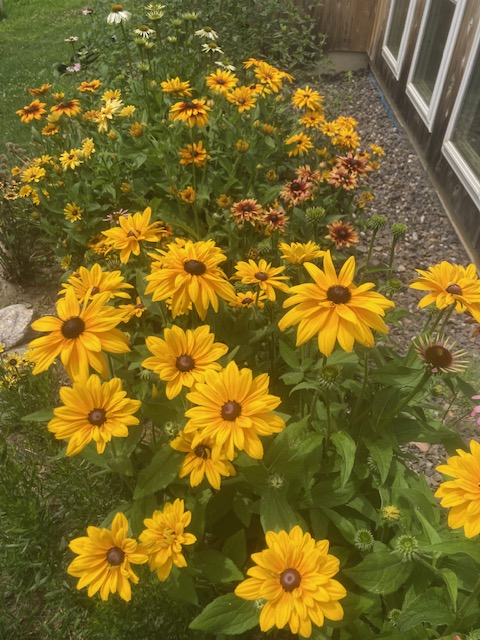
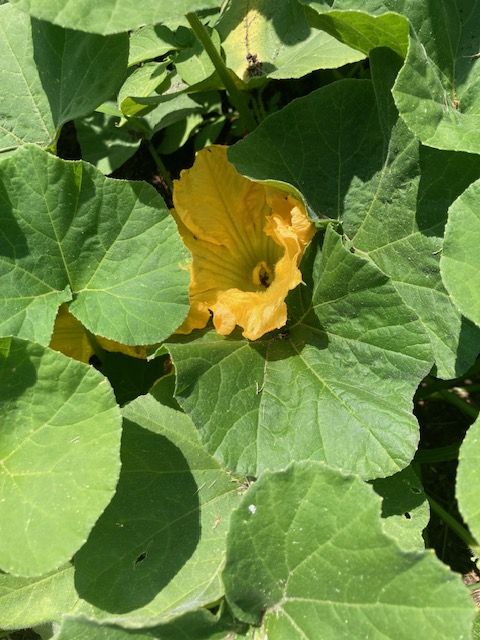
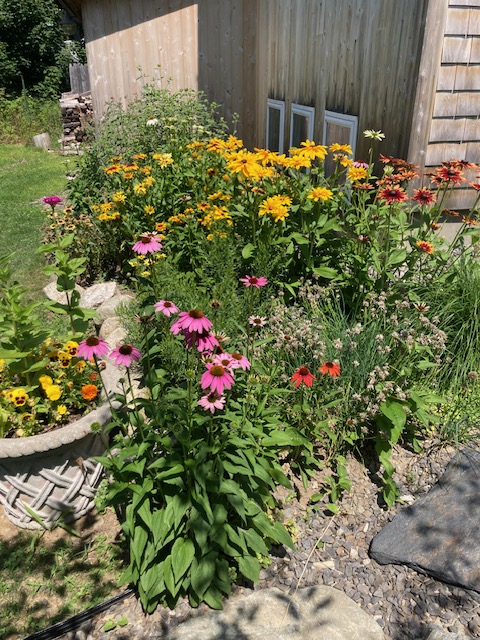
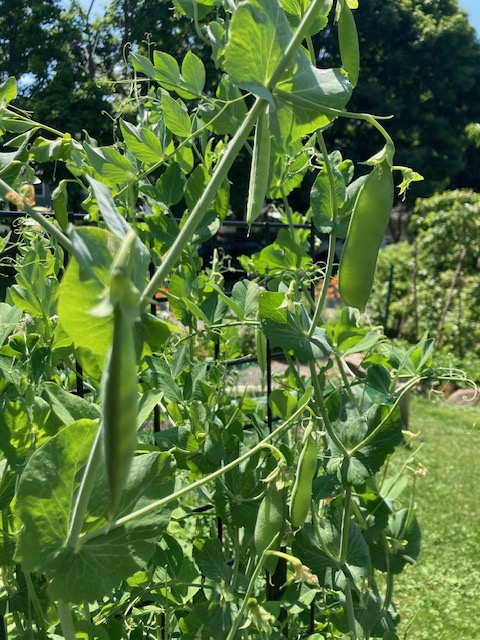
Growing up, the Midwestern mantra was corn “knee high by the 4th of July.” In Zone 5 coastal Maine, the snap peas tower at 5′ tall, tomatoes ripen, cucumbers flower while the grapes fatten; raspberries and cherries – radiant red – hang for the picking, while the coneflower and echinacea proudly display their Fibonacci ways.


NOTE: Credit here need be shared with Richard M. Neumann, a mensch and lover of mathematics, who shared valuable insights to Fibonacci and phi, including gifting me the book “The Golden Ratio: the story of phi, the world’s most astonishing number” written by Mario Livio, (c)2002.
Garlic Scapes and Landscapes
Posted: June 15, 2024 Filed under: Child Centered Activities, Chronicles of a First Time Parent, Farming off the Farm, What is an Art Farm 2 CommentsBy the stars, it is late spring. By the warm temperatures and school having ended, it is summer. In our garden, it is the time when garlic stretches the curlicue scapes wildly upwards to the sun.

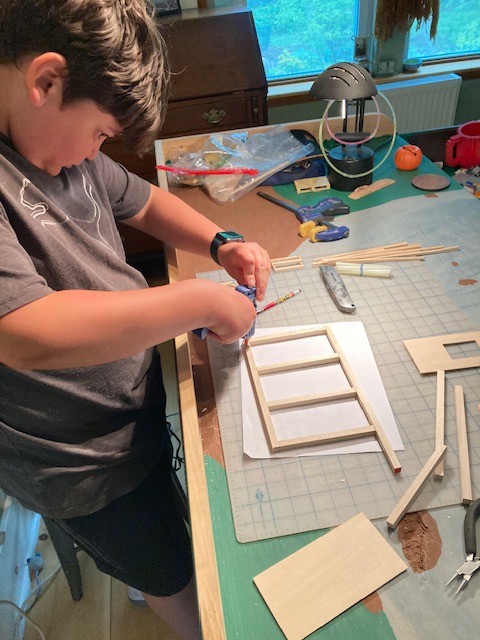
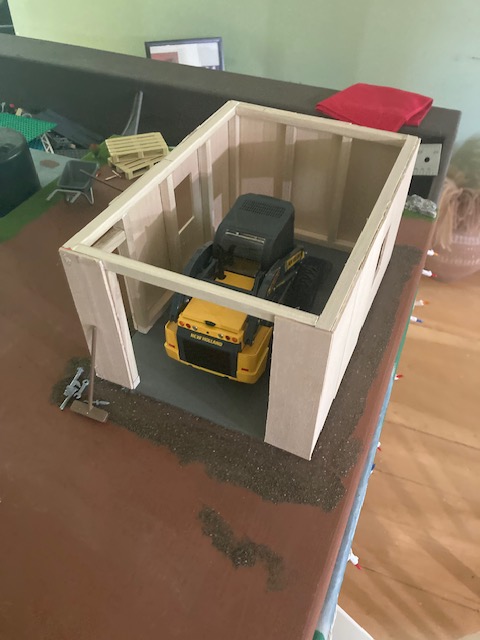
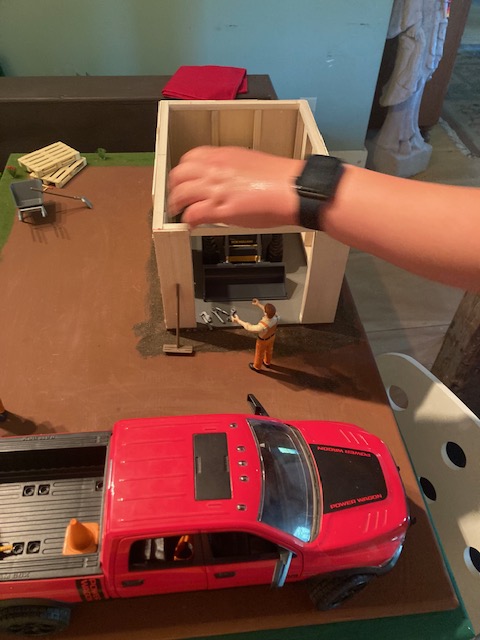
Summer brings heavy equipment to the farm, and equipment requires outbuildings, so we have been building, albeit in 1/16th scale.



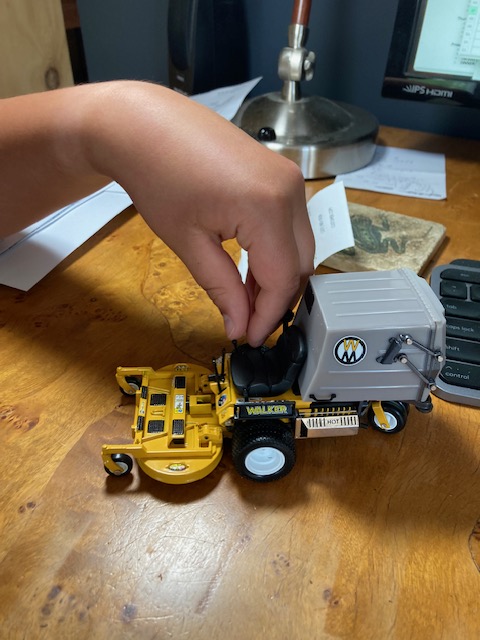
And finally, a new lawnmower, for a field of dreams, also in 1/16th scale.
 an Art Farm