Unabridged
Posted: October 4, 2024 Filed under: Chronicles of a First Time Parent, Farming off the Farm, What is an Art Farm | Tags: books, dictionary, language, unabridged dictionary, words, writing 2 Comments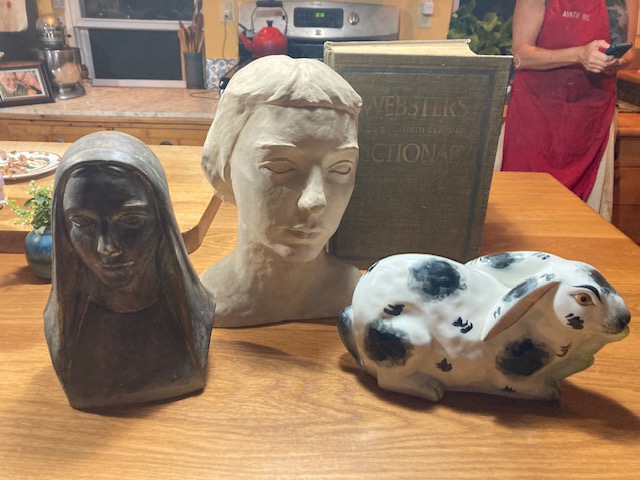
In my childhood, pride of place was given to a Webster’s New Twentieth Century Dictionary of the English Language, Unabridged, second edition (c) 1966. The massive book laid open, upon a bookstand that my Mother built, in the family room always beside the dinner table. Quick and easy reference was close at hand.
At 2,129 pages, plus addenda, the Webster’s weighs in at approximately 13 pounds, begins with “a” (first letter of the Roman and English alphabet: from the Greek alpha, a borrowing from the Phoenician) and ends with “zythum” (a malt beverage brewed by ancient Egyptians). The masterpiece is “based upon the broad foundations laid down by Noah Webster.” Such informed my childhood.
My frugal Mother, born in the Depression, bought groceries strictly on a budget, and received S&H Green Stamps for every purchase. We saved those stamps, compiled them into books, then drove to Glenview, Illinois to redeem same. The dictionary was purchased with Green Stamps, a day of victory, that I recall vividly, still.
Of the Silent Generation, she and millions of her peers diligently saved the Green Stamps. The Sperry & Hutchinson Company was founded in 1896 and operated until the 1980s, when consumerism became the vogue and frugality faded. But over 90 years the Beinecke family made a fortune, and funded the Beinecke Rare Book & Manuscript Library at Yale. In Greenwich, Connecticut, their 66-acre estate is now for sale for the first time, at an asking price of $35 Million, after more than four generations in the family. https://www.nytimes.com/2024/09/16/realestate/beinecke-estate-greenwich.html?smid=nytcore-ios-share&referringSource=articleShare
In my childhood home, words reigned supreme. My Father was a wordsmith, an Irish extrovert, who knew not the difference between a hammer or a screwdriver, but most certainly knew his nouns and verbs; subjects and objects; gerundives, gerunds, and participles; how to compose a sentence, how to frame his thoughts. When advertising came of age he worked as a Mad Man; known as the “Grocery Guru” his specialty was food merchandising. His gift of words allowed him to travel the world, holding meetings in Munich, giving speeches in Sydney; he commuted to his Manhattan office for lunch then flew home for dinner. He was published in multiple periodicals, and monthly in “Advertising Age,” then an upstart, which has become the standard bearer of the trade. After his death, my Mother continued the column for two years, writing “Consumer’s Viewpoint” telling the “Big Boys and Fat Cats” what she thought of their products.
And always, in our home, the Webster’s stood as stanchion, a ready reference, near at hand.
Last year my Mother sold the family home, and we emptied its rooms. Saving the dictionary was high on my list. I stored it at my sister’s, and then in August hauled it back home to Maine, along with sculptures my Mother had made. It was something of a cruel and unusual ask to have my children carry the tome through TSA at O’Hare Airport, but that I did. To my mind that task sealed their fate to the written word. Such is their origin story.
Growing up in the digital age of Google, my children may disregard the heavy analog hard copy book, a dull relic from the distant past. But long may it last on their bookshelves, and my hope is that it will endure as a reminder of their lineage. Languages change over time, such is their nature, but the story of the English language, derived from the German and Latin, and our ability to use words to frame our thoughts is an enduring aspect of our mind’s capacity to understand. I remain steadfast that there is a mysterious link between grammar and the mind.
A hard copy dictionary, then, is a bastion of that tradition. And for my children to understand same, is to know of their past. And so this Unabridged Dictionary is an heirloom of the highest regard here in our home. Purchased through frugality, cherished over many years.
______________________________________
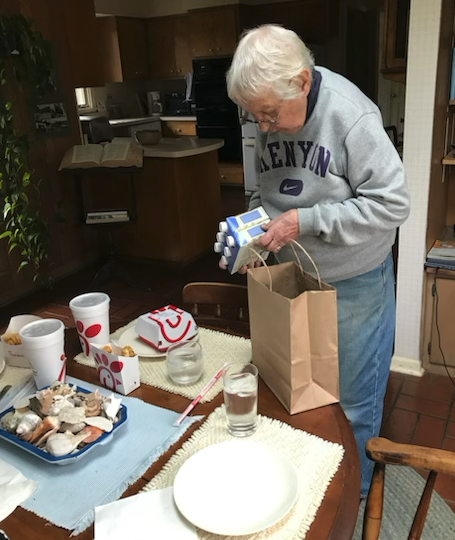
Note: Kudos and thanks to Babs, of whom I say the apple fell not far from the tree. By kind permission of, I borrowed her phrase “…meetings in Munich, speeches in Sydney…”. And she provided the family room photo with dictionary and stand ever the sentry, the rear guard. Many thanks! 🥰
Joy of Aging
Posted: September 20, 2024 Filed under: Farming off the Farm, Permaculture & Home Renovation, What is an Art Farm | Tags: cranky uncle, silver tsunami 1 Comment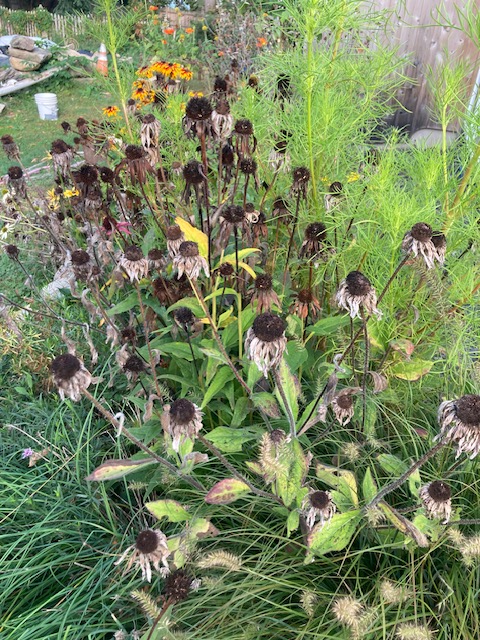
In my limited experience, there is a joy in aging. Certainly not the aching joints or onset of arthritis, but in the relaxed confidence, an acceptance of self. Well beyond the age of peer pressure, I have concern neither about my haircut, nor the shoes that I wear, all of which are quite liberating.
The cliche of the “Cranky Uncle” is but one example. At the Thanksgiving table, he lets loose in too blunt a manner which may be simply that he has achieved, at last, a “devil may care” attitude, a sense that time is of the essence. The accuracy of his information tends to be of little concern, to himself at least. The “Cranky Uncle,” in fact, is so ubiquitous that it has become the name of an app that “builds resilience against misinformation.” https://crankyuncle.com/
If the “Cranky Uncle” is the dark side of anger, then the uplift of mirth was expressed by Jenny Jones, the British poet, in her famous work, “Warning: when I am an old woman I shall wear purple.” Her poem was twice voted Britain’s best-loved poem, and she was described as “one of Britain’s best loved poets.” Her words were proof that we can age with grace and wit, a singular independence. We would do well to follow her lead.
These thoughts come to mind because the “silver tsunami” has begun with over 10,000 people per day now turning age 65. By 2030 more than 73 million Baby Boomers will be over age 65, a demographic shift of unparalleled scale.
I am a Baby Boomer, born at its tail end. I therefore feel eligible to opine that we have skimmed the cream, and the world we leave to our children’s children, is, I fear, darkened by the shadow of our deeds.
Early in the Boomer era, an active idealism rose: civil rights, voting rights, environmental protections, the Clean Water Act, a woman’s right to choose, and protests against endless wars of the Empire.
As a young boy, I went one night to my long-haired neighbors, to help paint cars for a convoy to a Vietnam War/anti-Nixon protest. I loved it, all of it, the idealism and sense of community (among some but certainly not all).
By 1980, when the Boomers’ careers had begun the zeitgeist changed; capitalism roared into vogue, taxes were cut, deregulation began. The success of the Boomers seems unparalleled:
- In 1967 the movie “The Graduate” contained the prophetic line, “Plastics…there is a great future in plastics.” Fifty-seven years later every person on the planet ingests about 5 grams of microplastic every week – the equivalent of a credit card – eaten every week, every year by every person, all 8.1 billion of us, with no end in sight. More than likely, the quantity will increase.
- In our insatiable quest for red meat, more than 185 million acres of the Amazon River basin have been clear cut since 1978; food production accounts for one-quarter of the world’s greenhouse gas emissions and takes up half of the planet’s habitable surface. A diet that includes beef has 10 times the climate impact of a plant-based diet.
- The “fast fashion” industry is responsible for over 20% of global water pollution while producing 100 billion garments per year, of which 92 million tons end up in landfills, the equivalent of one semi truck of waste every second, every day. The average consumer throws away 81.5 pounds of clothes every year.
- The richest one-fifth of the world’s population possess 80 times the income of the poorest one-fifth, and the richest one-fifth uses over 86% of the world’s resources. In America, the top 0.1% average wealth is $1.52 billion USD per household.
- From 1979 to 2022 wages grew 32.9% for the bottom 90%, 171.7% for the top 1%, and 344.4% for the top 0.1% of the USA population.
- More than 99 million people now face emergency levels of hunger, while more than 1.1 million people are in the grips of catastrophic hunger.
- Baby boomers will bequest a total of $72.6 trillion in assets through 2045.
The transfer of assets is defined in financial terms but represents essentially a set of values which will govern how those funds will be used. If we think of $72 trillion as a lever, with values as its fulcrum, then Archimedes comes to mind: “Give me a lever long enough and a fulcrum on which to place it, and I shall move the world.” Change is still possible.
Another poet wrote “This is the way the world ends/Not with a bang but a whimper.” We might replace “bang” with “boom” while “whimper” could yet become “win.” This is a matter of some urgency as the silver tsunami rolls on.
I am a parent now, raising children coming of age. My approach here is to be forthright about what we have done and with what they must deal; I value honesty more than politeness, and future generations should be clear sighted, to act with compassion and a commitment to social justice. A certain non-conformance may be required, and to that end the “Warning” of Jenny Jones, indeed pertains:
When I am an old woman I shall wear purple
With a red hat which doesn’t go, and doesn’t suit me.
And I shall spend my pension on brandy and summer gloves
And satin sandals, and say we’ve no money for butter.
I shall sit down on the pavement when I’m tired
And gobble up samples in shops and press alarm bells
And run my stick along the public railings
And make up for the sobriety of my youth.
I shall go out in my slippers in the rain
And pick flowers in other people’s gardens
And learn to spit.
You can wear terrible shirts and grow more fat
And eat three pounds of sausages at a go
Or only bread and pickle for a week
And hoard pens and pencils and beermats and things in boxes.
But now we must have clothes that keep us dry
And pay our rent and not swear in the street
And set a good example for the children.
We must have friends to dinner and read the papers.
But maybe I ought to practise a little now?
So people who know me are not too shocked and surprised
When suddenly I am old, and start to wear purple.
_________________________________________________________________________________________
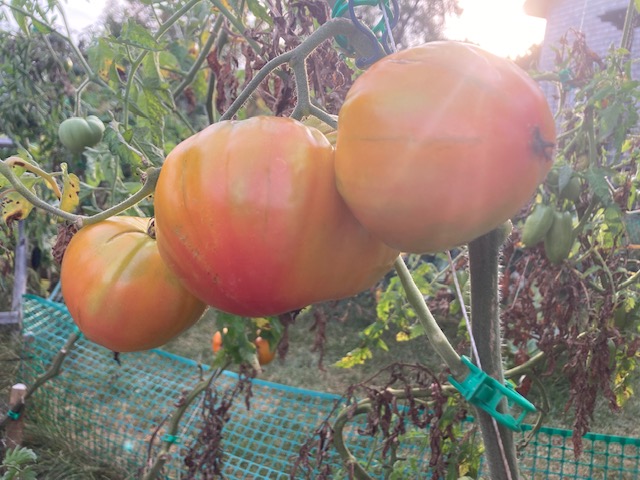
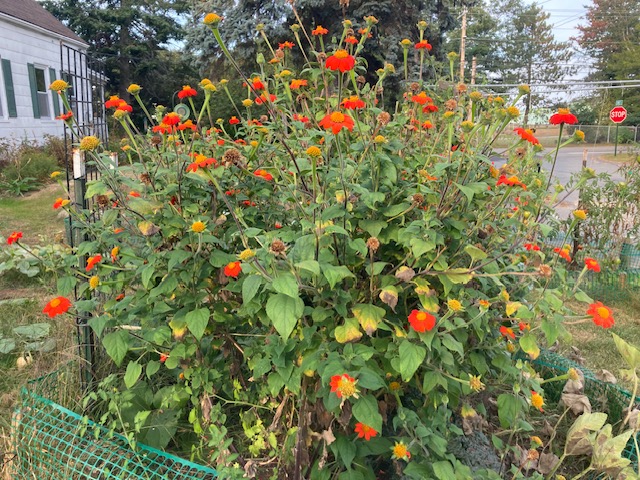
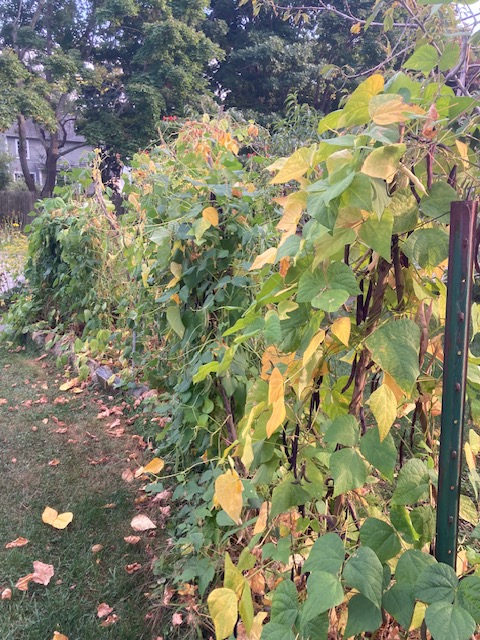
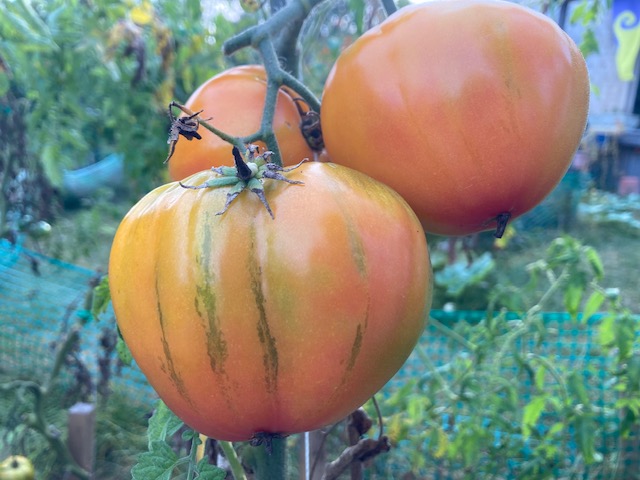
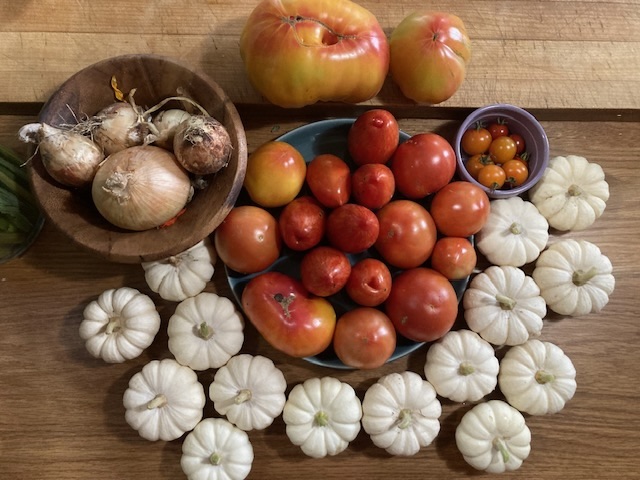
The thrum of summer has quieted, the Supermoon Full Moon Lunar Eclipse passed on Tuesday, cool nights of autumn descend: Pole beans ripen, Winter squash come to its full, Brussel Sprouts fatten, Poblanos produce still, Tomatoes remain abundant, the Cucumbers are spent, while Tithonia still shouts “look at me!!!” We will plant garlic come November.




Saturday on the Street
Posted: August 9, 2024 Filed under: Art & Healing, Farming off the Farm, Permaculture & Home Renovation, What is an Art Farm | Tags: Norway maples, tree work 3 Comments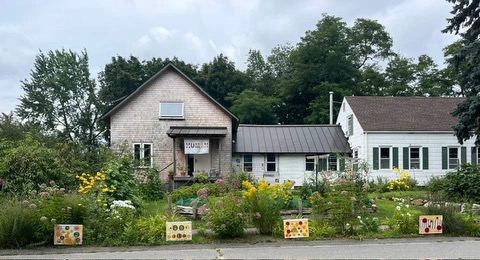
In 1830, in South Portland (known then as Cape Elizabeth) a New England farmhouse was built and its barn completed by 1848. The town’s population was 1,696 people and only six families lived on the street where the farm was located. The farm most certainly had significant acreage.
In 1999, South Portland’s population had grown to 23,324, and the last remaining farmland surrounding this farmhouse was sold off to make a development of six homes. In modern times developers put their road wherever best suits their plan but in 1830 the builders sited the home thoughtfully, based upon the sun’s path; they needed to maximize the solar gain as a heat source. The home’s location then determined where went the developer’s road and the old front yard was paved to put in a street named in honor of the developer’s daughter. The home, which we purchased in 2012, was left with a smaller, but still full sun front yard, enough space to garden and grow food and fruits.
We have felt guided here in creating a healing space. Neighbors have brought wounded birds into our garden, tucking them under the plants, as a place to heal. Young Mothers bring their infants to gaze and we gift them vine ripened tomatoes. We grow less as a matter of sustenance and more as a gift to be given, to be shared.

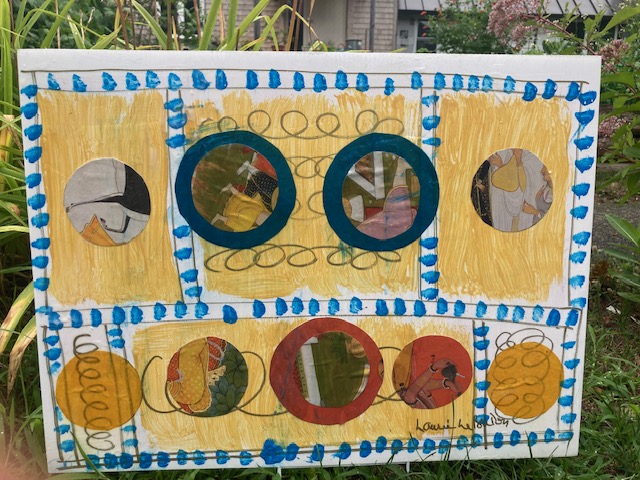
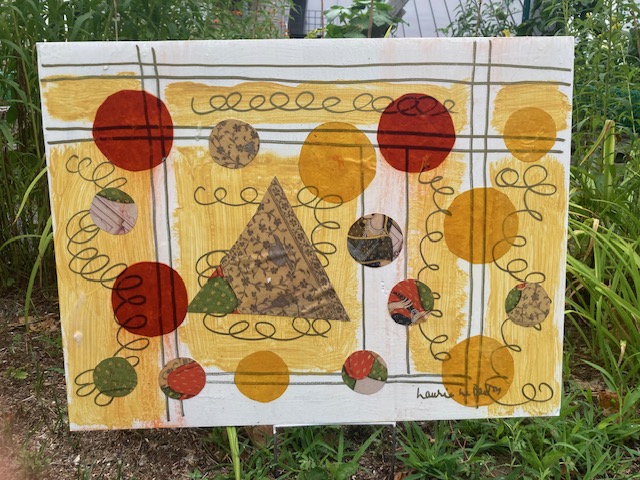
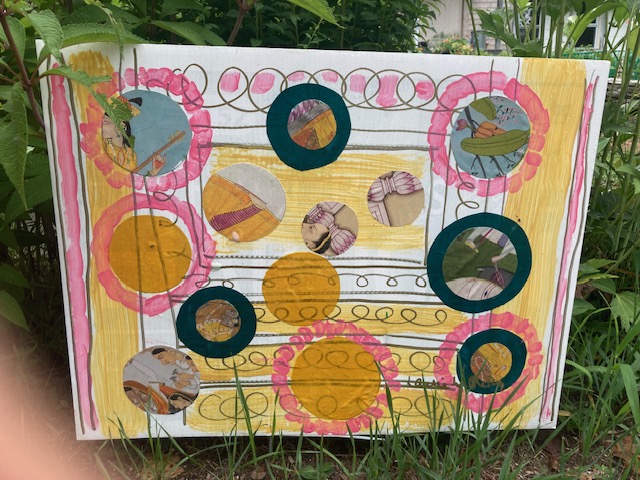
Saturday on our street was very active. Art work arrived from Chicago, from our dear friend Laurie LeBreton, a sculptor whose work combines handmade paper and mixed media. She explains, “I work to access something beyond our concrete world and to find meaning and comfort as I do so. Recent themes have included healing, refuge and ritual.” If yard placards tend to promote politics, Laurie’s speak to art and healing. We embraced Laurie’s generosity and eagerly put them on our side of the street. https://www.laurielebreton.net/

Also on Saturday, very large gooseneck trailers arrived to unload massive paving equipment, parked on the other side of the street. A dialectic began between the mechanized and the natural. If our “Orwellian” week was a “heavy equipment summer camp,” then this week has been about “massive paving equipment and road grinding at night.” My son was over-the-moon delighted. On Sunday night the City began grinding streets here, and the equipment has moved to several other jobs in town. Nightly we have driven to see them work.
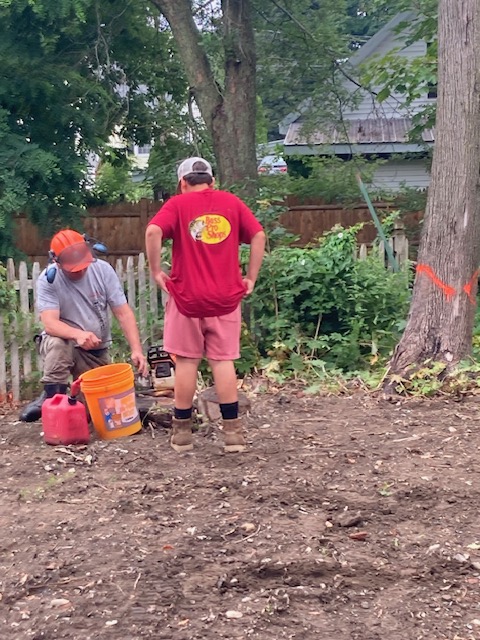
Also on Saturday our work on the invasive Norway Maples continued. Our friend Nate arrived, a journeyman carpenter, master of many trades, and he brought tools for tree work. Nate taught my son how to use a come along, how to sharpen a chain saw, and to use the Phythagorean Theorem to calculate where the tree would fall. My son put on his work boots and got busy.
Norway Maples are not native to America. They were brought here first in 1756, by a nurseryman in Philadelphia, and became popular as an ideal street tree. During the 1970s when the Dutch Elm Disease decimated the urban canopy, the Norway Maples became ever more prominent, but the trees promote a monoculture and grow rapidly, spreading seeds by the wind. They shade out competition. Because they grow fast, their wood grain is long, not tight, and they easily sheer and crack in heavy weather, which has become increasingly more prominent here in Southern Maine.

Two years ago, during a late autumn wind storm, a Norway Maple, with 8” trunk, split and fell onto our swimming pool. Thankfully we were able to repair the pool. Last winter, a much larger Maple, 18” diameter, splintered and fell into the neighbors yard. It leaned precipitously, and my intuition told me not to DIY but to get help.
Nate used the “come along” – a sort of ratchet winch – to direct the tree away from the neighbors yard and to his designated spot. My son worked the come along, tightening the line by cranking to pull the tree down, as Nate cut into the trunk.


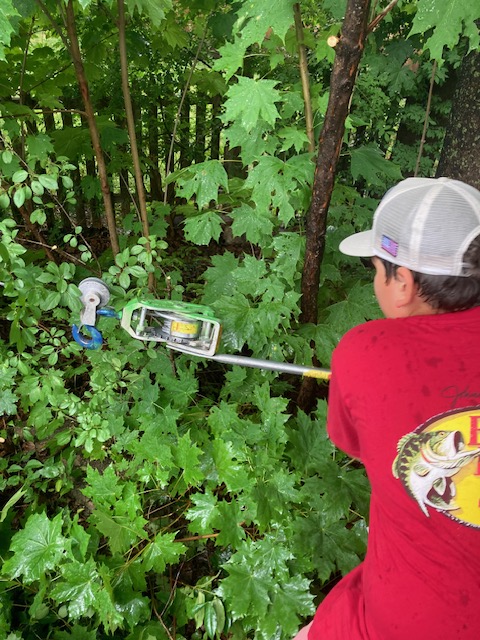
It took a village but the tree is felled, and we have firewood for our winter.

All Is Well Again
Posted: August 2, 2024 Filed under: Farming off the Farm, Permaculture & Home Renovation, What is an Art Farm | Tags: embedded energy, renovation 2 Comments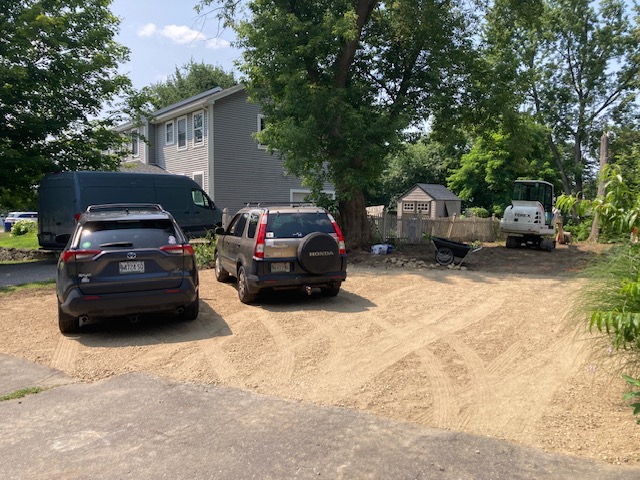
On 22 July I wrote about circumstances “Orwellian,” but on 2 August I can report that “all is well again.” We have cured the problem: gone is the gravel pile, our insurance will not be terminated, and we have made arrangements to switch to another carrier at end of this month.
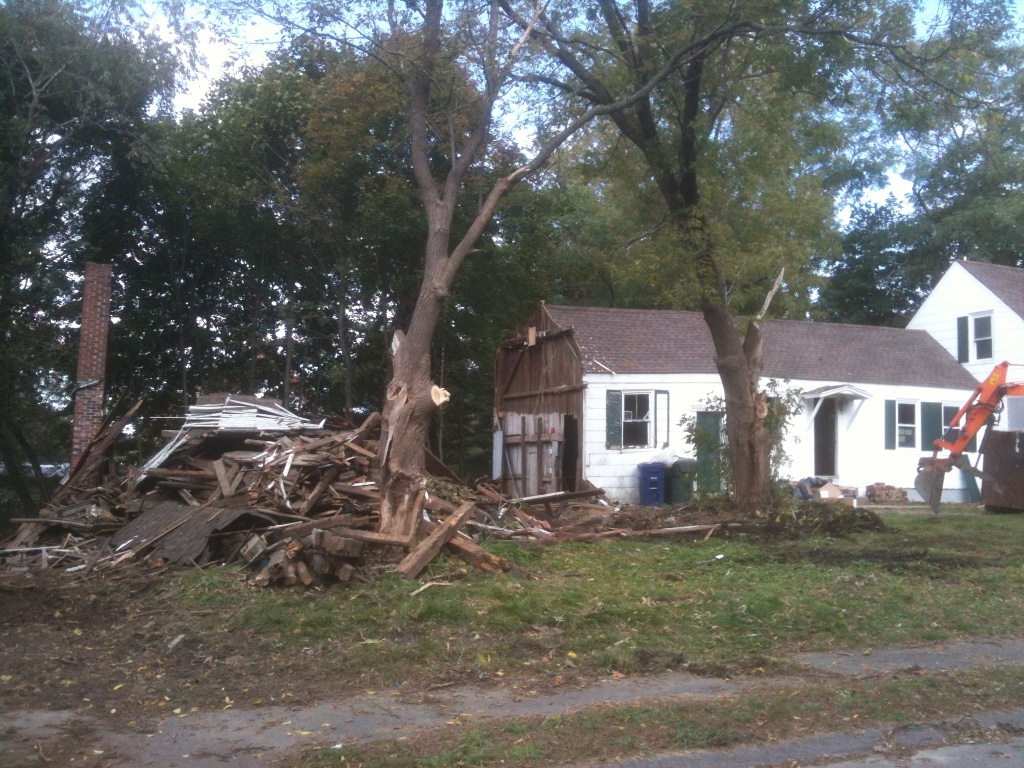
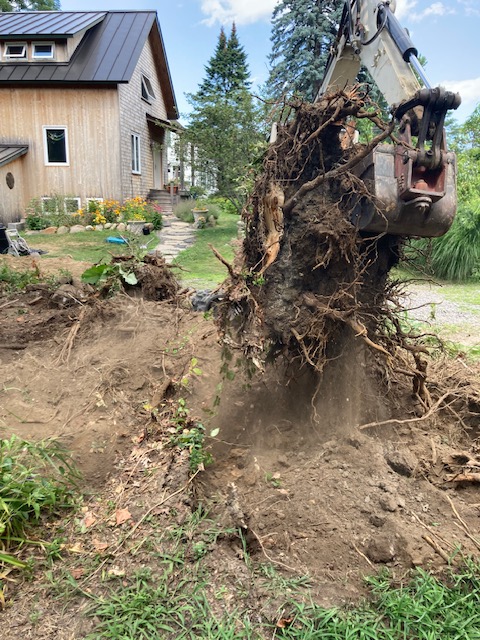
The project was twelve years in the making. When we bought the farm, Labor Day 2012, our son was in utero and my wife in her third-trimester. We had but little money, and less time to make any renovations. The barn was beyond repair – beyond our budget, more precisely – so we tore that down. I saved as many beams and sheathing boards as I could but the rest was hauled away. Nine yards of rubble, from two brick chimneys and concrete sidewalks remained, overgrown by invasive plants. Last week, having moved the gravel and made the driveway larger, we continued north to grub out more than 50 stumps – along 50 linear feet of fence line – of the rapidly growing, invasive Norway Maple.
Our farmhouse, in the classic New England style of “big house, little house, back house, barn,” is 200 years old, built when Andrew Jackson was the 7th President of the United States. The barn was completed in 1840, which I know for a fact, having saved one beam with that date proudly carved by the makers into the wood. All materials used in this house were sourced locally, within a mile or two, trees felled, then moved and milled by hand.
Some of the barn sheathing boards are 26” wide, and given the growth rate of pine trees, we can deduce that the tree from which that wood came sprouted circa 1681, which is five years before the English King James established the “Dominion of New England” which covered all of New England and the Mid-Atlantic colonies. The Charter of Pennsylvania, sovereign and independent from the Dominion, was signed by King Charles in 1681 granting the Quakers land for religious freedom.
Restoring this home is a yeoman’s task. We bought the home at a foreclosure price, plus 20-years of hard labor. We are only halfway toward our goal. In doing this work we are not making this home great again; “never better” is my goal. The home never had insulation and was cold and drafty. We have super-insulated more than half, but work remains. I will need to rebuild the foundation of the Ell, while we live in the house. The invasive Maples are an ongoing nuisance.
The charm of the hand built home seems to be its simplicity, its economy of purpose. I have neither the income nor interest in anything opulent. I seek not a monument to myself. For the driveway project I chose gravel, which is underwhelming to many, but to my mind the better choice because it is both less expensive and fully functional. I have learned that I am happier living on a dirt road, and on my half-acre I have chosen same.
More importantly, in terms of environmental impact, gravel has a minimal carbon footprint compared to the very high embedded energy – the petroleum consumed both in manufacturing and applying – of asphalt pavement. Hard though it may be for my children to grasp this point, it is my responsibility to model sustainability, to the extent possible.
My curse is the adage “a carpenter’s home is never finished.” And so life goes, but in the meantime all is well again, never better.
* * * * * * * * *
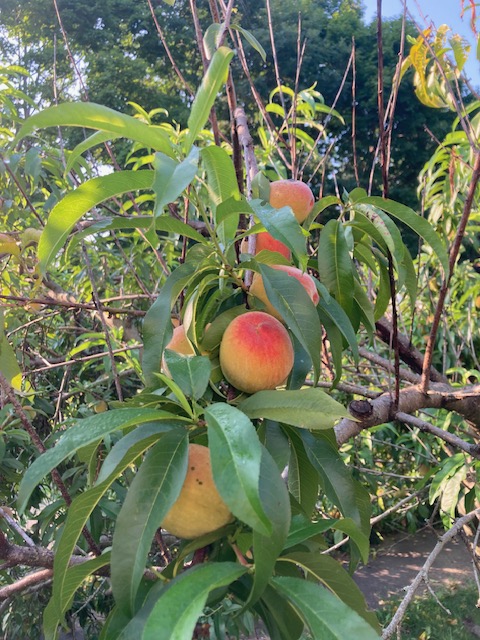
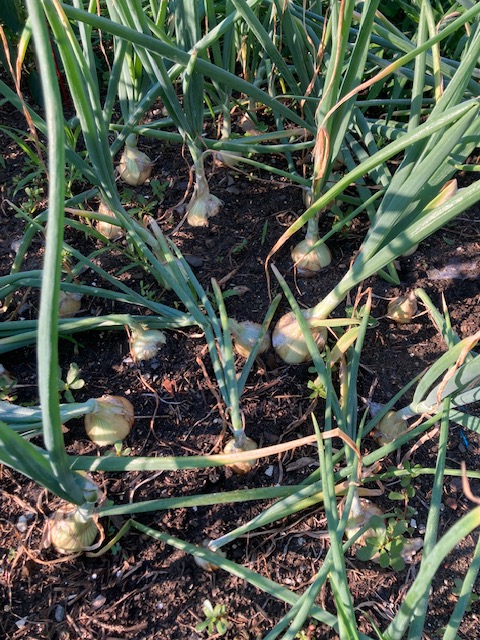
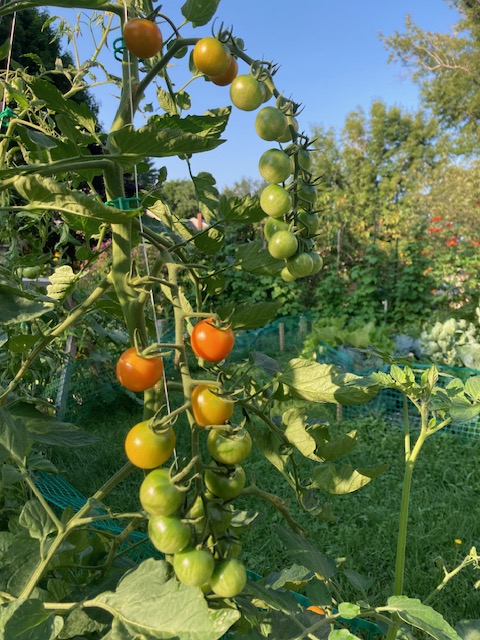
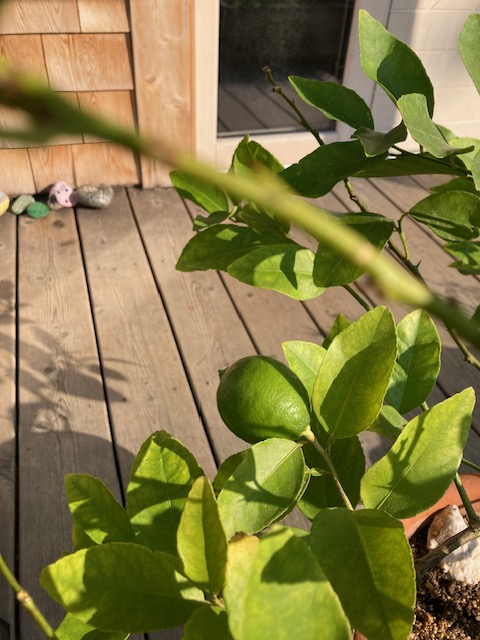
The abundance of August has arrived. Onions and potatoes need be harvested, Italian Frying peppers await us, we pickle cucumbers then give armfuls away, fruits – tomatoes, grapes, peaches – tower overhead, our lime tree provides the citrus for a Gin & Tonic.



Orwellian
Posted: July 19, 2024 Filed under: Chronicles of a First Time Parent, Farming off the Farm, Permaculture & Home Renovation, What is an Art Farm | Tags: george orwell, homeowners insurance 2 Comments
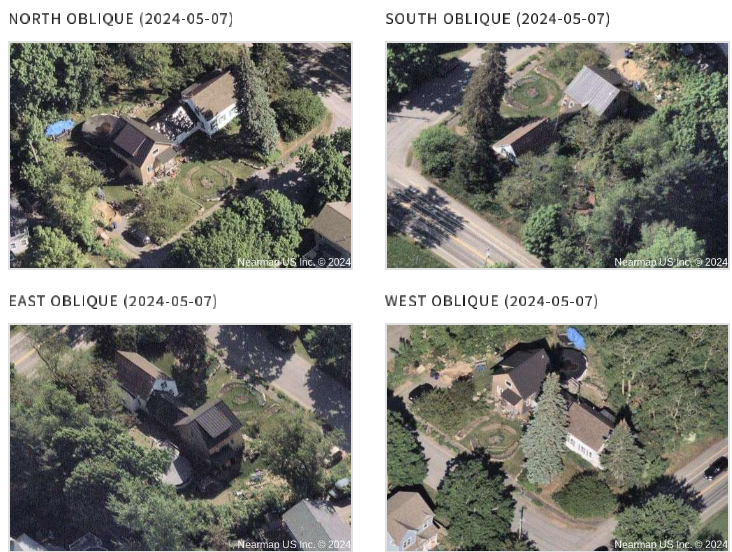
In May a satellite flew over our house and took photos. On 11 June we received a notice – with photos above and below – that our homeowners insurance would be cancelled, due to a “safety hazard on your property…[which] increases the chance for injury or damage to your property.” I contacted our broker and inquired whether some “Desk Sergeant” had scanned the photos and made such a call?

The Broker wrote back, “As for a live officer in the back, I would assume it’s more akin to a machine learning/AI algorithm scanning pictures and flagging unusual things, although that is pure speculation on my part. To the best of my knowledge, the only issue is the gravel at the end of the driveway, confirmed. I had to speak with an underwriter at Nationwide yesterday to even ascertain what the problem was.”
We were told we had until 30 August to cure the problem, but in late June we received notice, and were given 22 July as a cease and desist date.
We recently visited family in Western Massachusetts, and standing upon their driveway, we talked about the asphalt. One section is newer, another older, with swales and cracks. “My Homeowner’s Policy has been cancelled” she said, “because of . . . picky stuff like these cracks. The company cited a number of issues, but all of them were picky…” An agent had walked the property looking for issues, which found, then moved her into the high-risk pool, at a substantial cost increase.
In the 10-year period from 2014 to 2023 extreme weather has caused disaster events at a cost of $183 Billion Dollars. The underwriters’ rational self-interest – unlike a good neighbor – argues they cut losses by moving homeowners out of their coverage into the high-risk pool. Gravel at the end of our driveway put us in that category. Caveat emptor.
Thankfully I work in the trades, and our friend Jim has spent decades doing site work, building roads deep in the Maine Woods for loggers. In fact, Jim is both the solution and cause of our problem, having dumped – at my request – the gravel here in our yard, left overs from a tiny house job we did together. We need to expand our driveway, and free material helps.
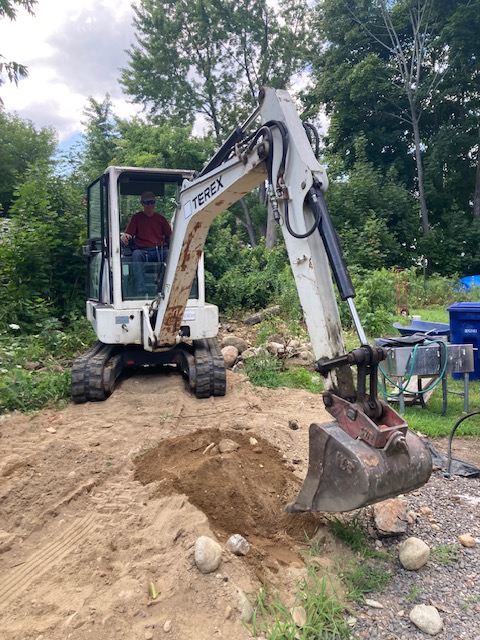
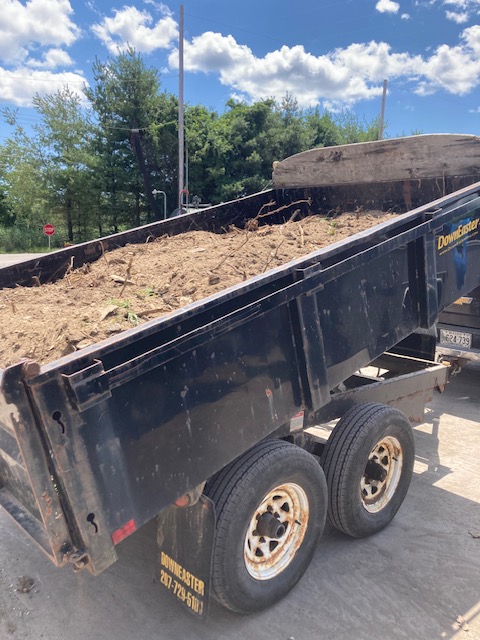
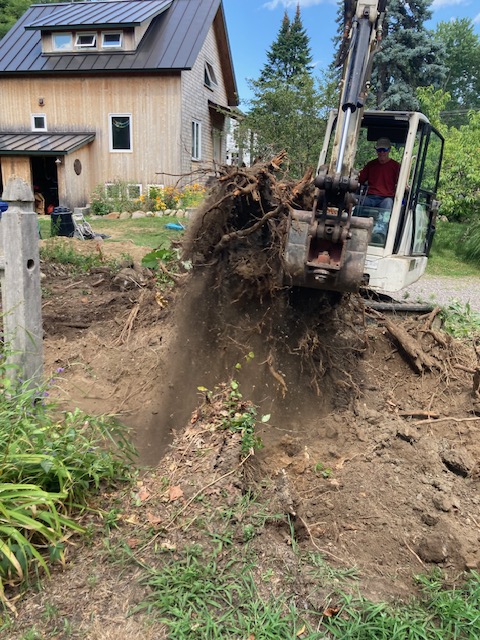
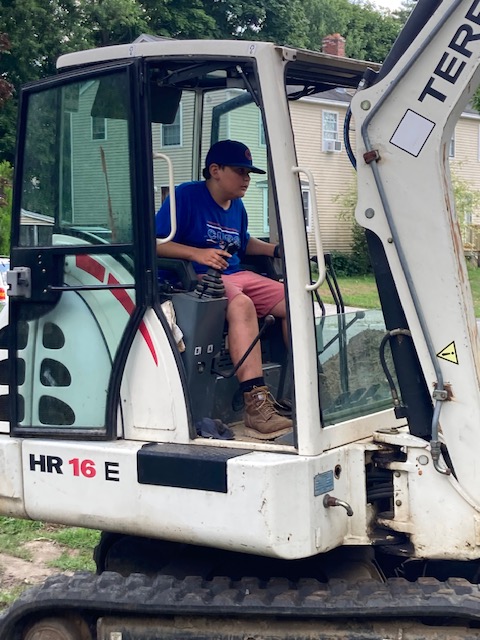
Time now is of the essence, and given the heavy equipment this is a mere trifle. Jim has arrived and we have removed 9 cubic yards of rubble, 3 cubic yards of tree stumps. We will remove approximately 15 tons of soil, and then move the gravel into that space.
Our soil is infested with knotweed, the highly invasive plant, and very few dumps will take soil with knotweed. I found one yard which will incinerate it, at a very high cost of $145 per ton. I will not be sneaky and lie. So we hauled 4 tons off, and will spread the rest in our side yard, then plant grass seed. A compromise lower cost solution.
We will meet the deadline. We will then give notice we are changing carriers, having improved our coverage at no additional cost. A larger parking area makes sense as my daughter will soon get her driver’s license. My son this week had a summer camp of site work with heavy equipment. So life goes restoring a 200-year old New England farmhouse





0, 1, 1, 2, 3, 5, 8…
Posted: July 4, 2024 Filed under: Farming off the Farm, Gallery - Visual, Little Green Thumbs, Permaculture & Home Renovation | Tags: fibonacci sequence, golden ratio, phi 2 Comments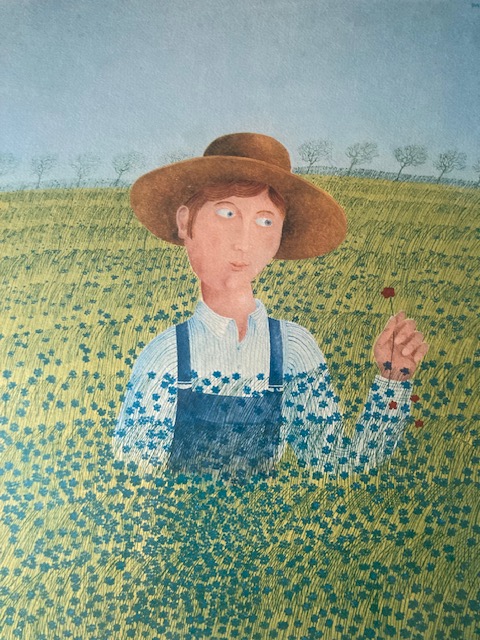
Donald J. Glaser was a rare bird, a beautiful soul, who loved beauty, and traveled the world in its search. My uncle, he was born in August 1924, studied at the Parsons School of Design in NYC, then entered the seminary but dropped out, remained a “permanent bachelor” and in 1951 found his calling as a buyer of art and antiques. In the golden age, when department stores were locally owned paragons of regional taste, at Stewart Dry Goods, in Louisville, Kentucky, he ran the home furnishings boutique.
For more than 45 years he circumnavigated the globe, annually, from East to West buying the best: silks in Hong Kong, brass in Bombay, furniture in Italy, paintings in England. “Good things last” was his motto. In 1972 Associated Dry Goods bought the regional company, and Don became the buyer, and had furniture made, for an entire national chain.
He was my Godfather, and sometime in the 1970s while traveling in the South of France, Don saw in a gallery a portrait that reminded him of me. It arrived at our house, an unannounced surprise from afar.
A truer portrait never was made. How many times I have pondered its meanings. It hangs now in the stairs to my son’s room. The young boy gazes into a flower, and what does he see in his hand, but the universe in stunning mathematical order. I speak, of course, of the Fibonacci sequence.

The Fibonacci numbers were first described in Asian Indian mathematics circa 200 BC by Pingala on possible patterns of Sanskrit poetry formed from syllables of two lengths. The Italian mathematician Leonardo of Pisa, also known as Fibonacci, introduced the sequence to Western European mathematics in 1202. Because the West has been dominant, his name has reigned supreme.
The Fibonacci sequence is a pattern wherein each number is equal to the sum of the preceding two numbers. The sequence begins 0, 1, 1, 2, 3, 5, 8, 13, 21, 34, 55, 89, 144, 233 … and goes on to infinity.
The Fibonacci sequence is manifest throughout nature, prominently in the spirals of Sunflower seed heads, that radiate from the center. The numbers of these spirals, when counted in opposite directions, are often consecutive Fibonacci numbers. The sequence also appears in the branching of trees, the arrangement of leaves on a stem, fruit sprouts of a pineapple, an artichoke, in pine cone bracts; a tiling of Fibonacci squares forms the nautilus shell, which appears also in the spiral of a hurricane and galaxies across the cosmos. The sequence does not appear everywhere but its presence is abundant.

Fibonacci is related, mathematically, to the golden ratio – 1.618 – which is ubiquitous, though hidden in plain sight; credit cards and every drivers license replicate this rectangular form, based on reciprocal numbers of height to width.
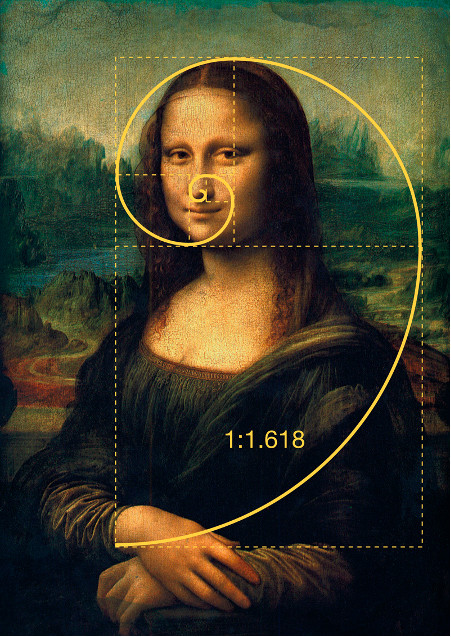
The Golden Ratio, also known as Phi, is found throughout art and architecture. Many find the ratio in the Great Pyramid of Giza, and the Greek Parthenon in Athens (although a mathematician at the University of Maine has challenged that). In Renaissance art it was present among many of the master works, notably in Leonardo de Vinci’s Mona Lisa. In the modern era, the golden ratio has informed the art of Seurat, Picasso, Gris, Duchamp, Debussey, Le Corbusier, and Mondrian, to name but a few.
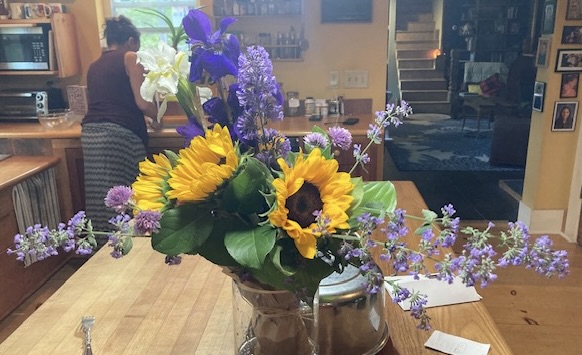
When gathering flowers for a bouquet, pause to ponder the breadth of universal beauty, ever present, bundled within your arms.
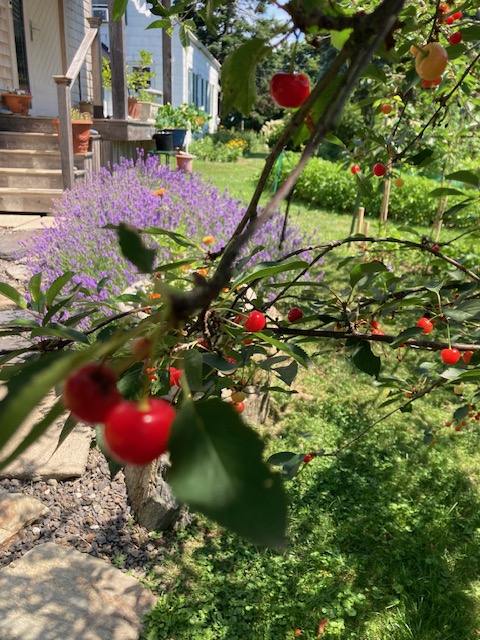
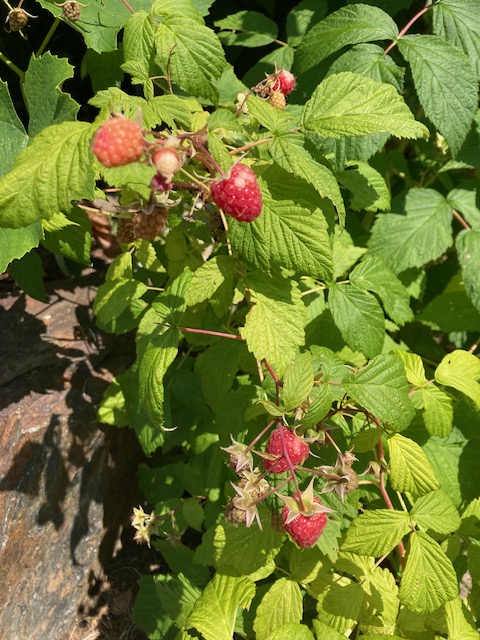
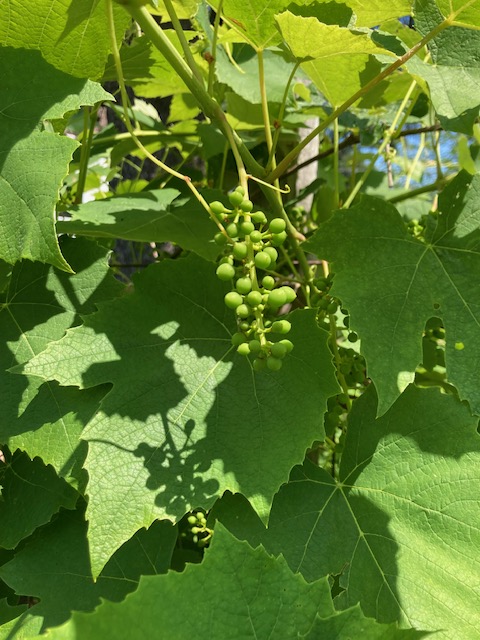
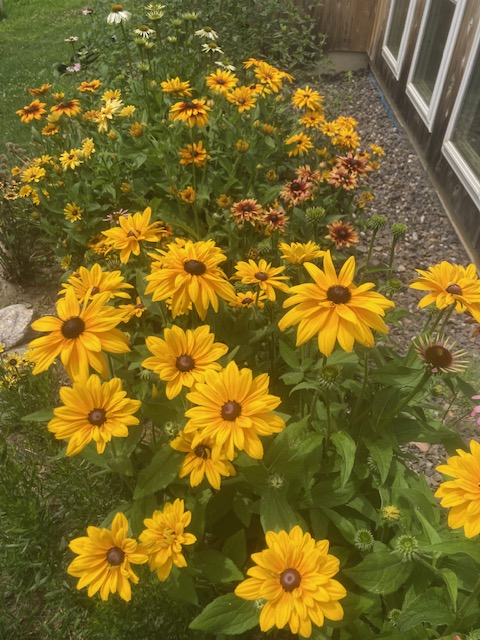
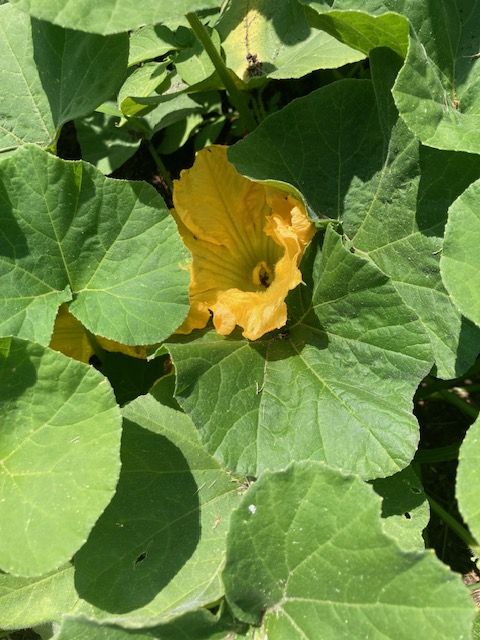
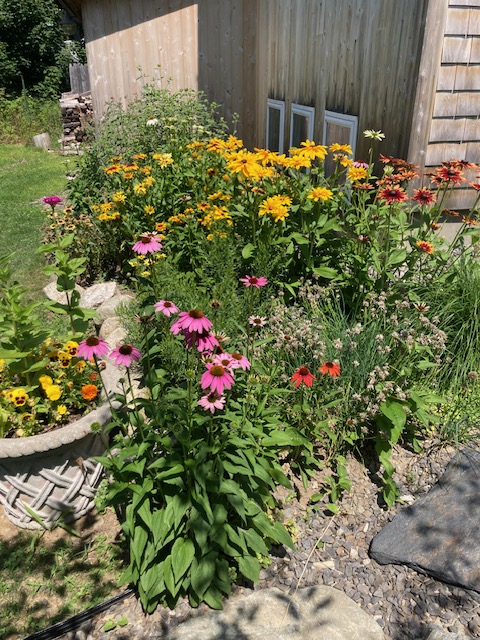
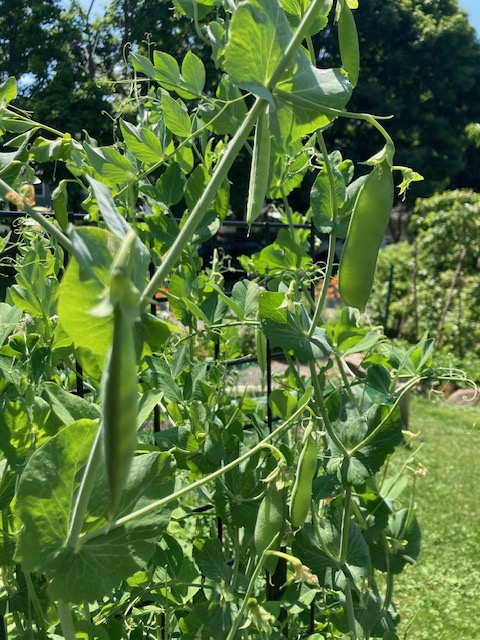
Here at an art farm, our gardens are lush and due to the heat, fruits ripen almost two weeks ahead of schedule.
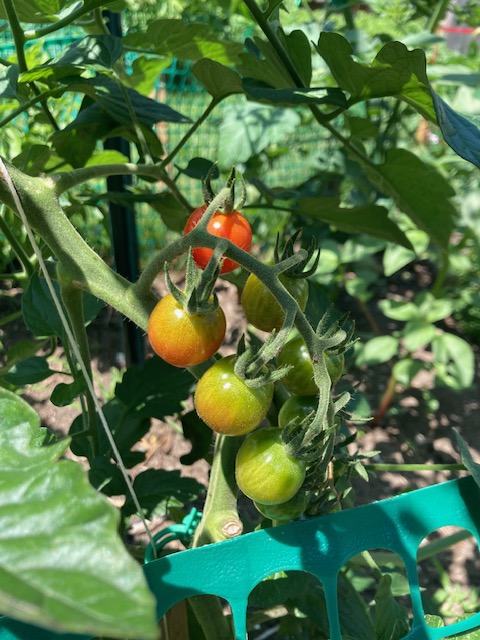
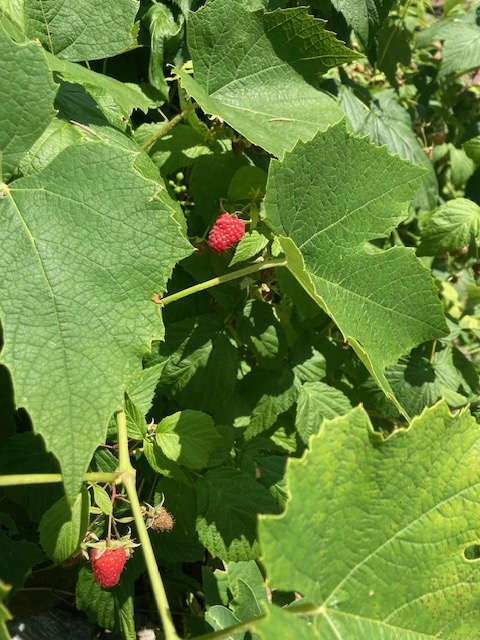
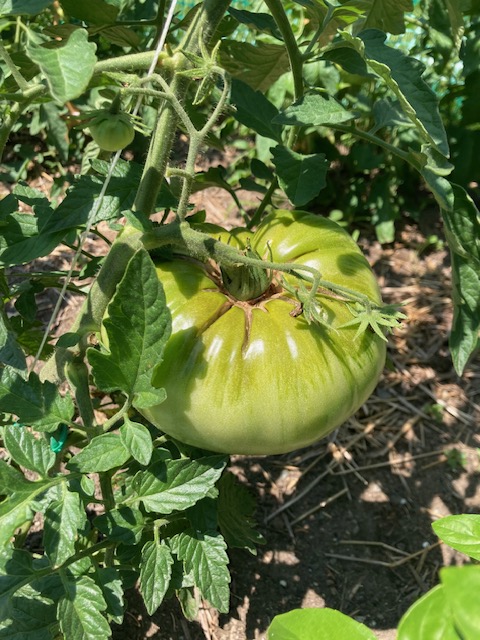
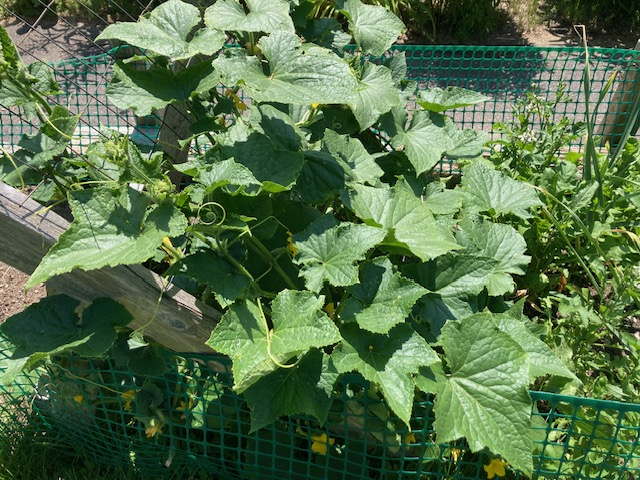
Growing up, the Midwestern mantra was corn “knee high by the 4th of July.” In Zone 5 coastal Maine, the snap peas tower at 5′ tall, tomatoes ripen, cucumbers flower while the grapes fatten; raspberries and cherries – radiant red – hang for the picking, while the coneflower and echinacea proudly display their Fibonacci ways.




NOTE: Credit here need be shared with Richard M. Neumann, a mensch and lover of mathematics, who shared valuable insights to Fibonacci and phi, including gifting me the book “The Golden Ratio: the story of phi, the world’s most astonishing number” written by Mario Livio, (c)2002.
Impeccable
Posted: June 21, 2024 Filed under: Chronicles of a First Time Parent, consciousness, Farming off the Farm | Tags: consciousness 2 Comments
When I was a child, the popular saying was “a man’s word is his bond.” I haven’t heard that expression now in decades.
King Solomon, David’s son, long ago commented “In all thy getting, get understanding.” For the better part of 40-years, the getting, it seems, has been primarily – for the few – immense material wealth. The 10 Commandments now seem laughably old fashioned.
Among ancient civilizations wisdom was rich, and we do well to revisit our past. The Toltec, a Meso-American culture that predates the Aztec, held four precepts to be key. Don Miquel Ruiz, a descendent of the Toltec, wrote “The Four Agreements” about “self-limiting beliefs.” The book, copyright 1997, has been published in 52 languages worldwide, and spent one decade as a New York Times bestseller.
The first precept, which he calls an “Agreement” is deceptively simple: “Be impeccable in your word.” He writes, “Your word is the power that you have to create. It is through the word that you manifest everything. Regardless what language you speak, your intent manifests through the word. What you dream, what you feel, and what you really are, will all be manifested through the word.”
“In the beginning was the Word, and the word was God” is the opening statement of the Christian Gospel of John. Ruiz explains and expands, “The word is not just a sound or a written symbol. The word is a force; it is the power you have to express and communicate, to think, and thereby to create events in your life. But like a sword with two edges, your word can create the most beautiful dream, or your word can destroy everything around you. One edge is the misuse of the word, which creates a living hell. The other edge is the impeccability of the word, which will only create beauty, love, and heaven on earth.”
As there is light, so there is darkness, which principle was embodied in the brilliant German orator whose message of fear and hatred manipulated a country of highly intelligent people. Again Ruiz, “He led them into a world war with just the power of his word. He convinced others to commit the most atrocious acts of violence. He activated people’s fears with the word, and like a big explosion, there was killing and war all around the world. …He sent out all those seeds of fear, and they grew very strong and beautifully achieved massive destruction.”
It is worth remembering that Hitler rose to power through a democratic election, via the German Workers Party, in 1932. Having campaigned as a populist, he consolidated power as a demon.
The Agreement’s verb is “impeccable,” which is derived from the Latin prefix in-, meaning “not,” and the verb peccare, meaning “to sin;” to be impeccable is to be without sin, but to the Toltec sin was different from the Christian meaning. Ruiz explains, “A sin is anything that you do which goes against yourself. Everything you feel or believe or say that goes against yourself is a sin. When you are impeccable, you take responsibility for your actions, but you do not judge or blame yourself. Being impeccable with your word is the correct use of your energy; it means to use your energy in the direction of truth and love for yourself.”
Simple truths are easily understood. Or are they? While driving on errands with my son, we talk about these. Again and again, to help guide his future, I draw from the past.
The Toltec had four agreements:
- Be impeccable with your word
- Don’t take anything personally
- Don’t make assumptions
- Always do your best
To this I would add two more:
- Let integrity be your bank account
- Let compassion, more than logic, guide your path
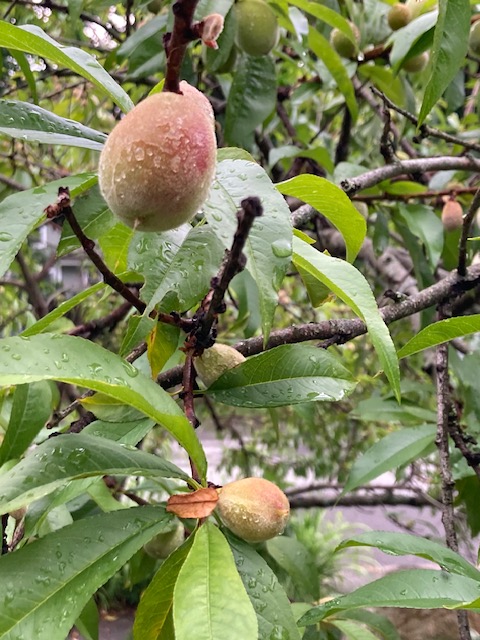
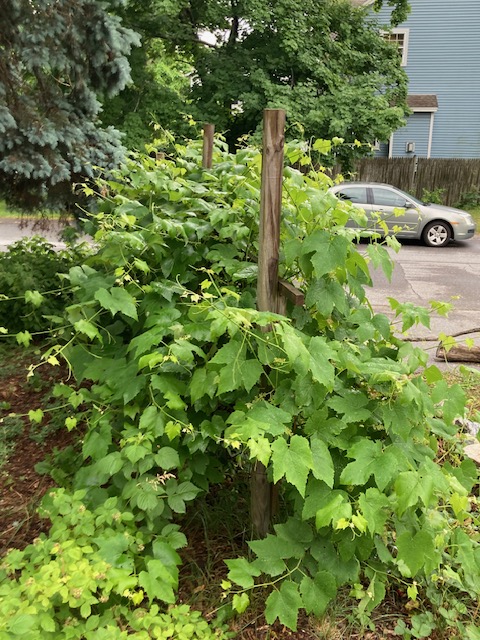
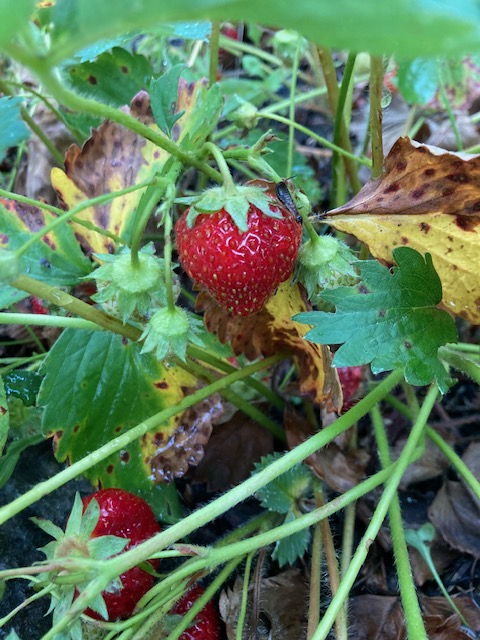
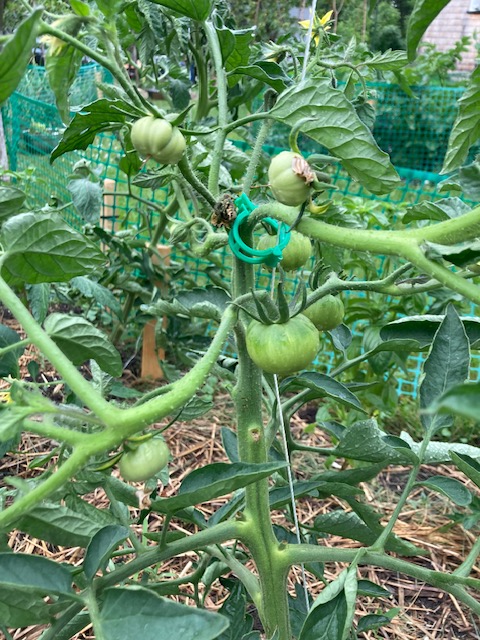
At this sun drenched solstice, fruits ripen and vines reach ever higher…






Garlic Scapes and Landscapes
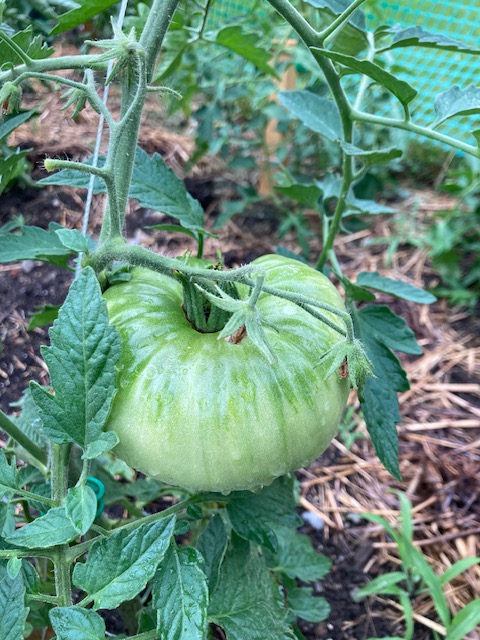
Posted: June 15, 2024 Filed under: Child Centered Activities, Chronicles of a First Time Parent, Farming off the Farm, What is an Art Farm 2 CommentsBy the stars, it is late spring. By the warm temperatures and school having ended, it is summer. In our garden, it is the time when garlic stretches the curlicue scapes wildly upwards to the sun.

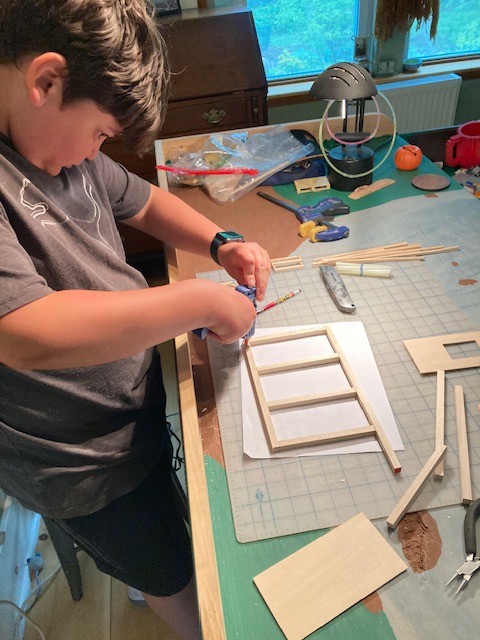
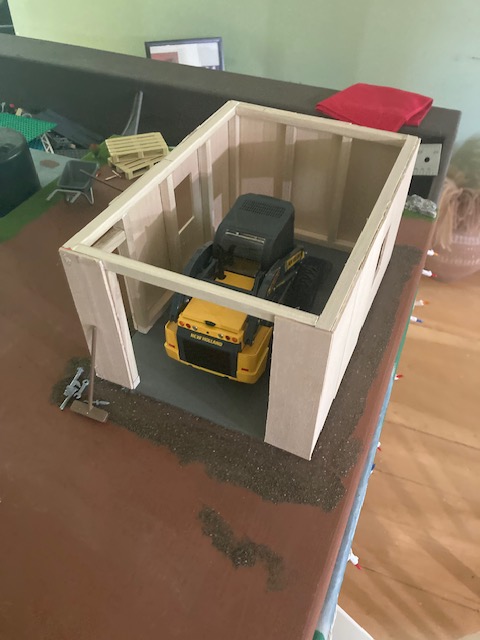
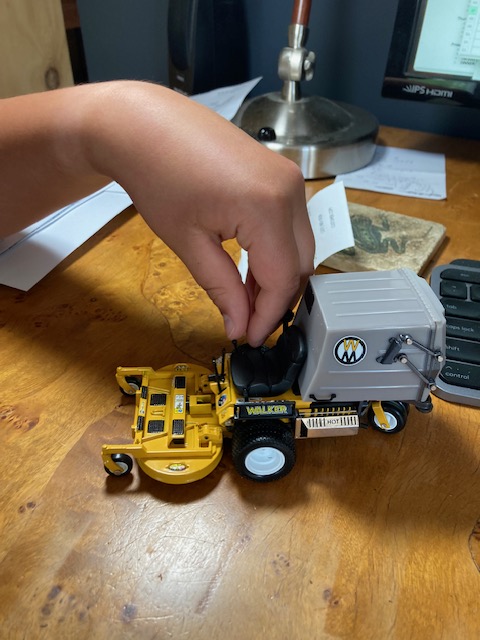
Summer brings heavy equipment to the farm, and equipment requires outbuildings, so we have been building, albeit in 1/16th scale.



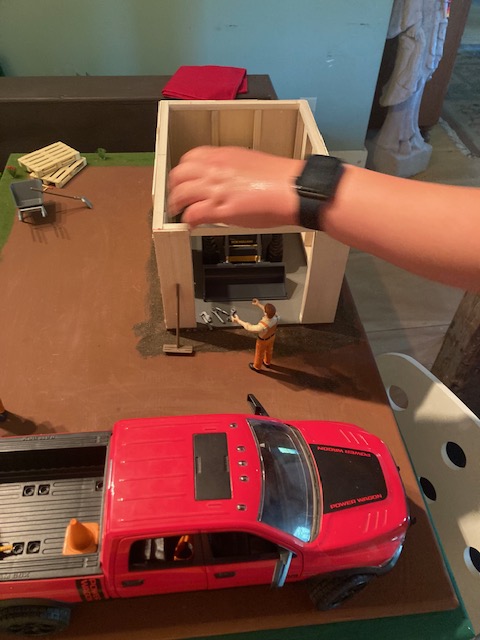
And finally, a new lawnmower, for a field of dreams, also in 1/16th scale.
Planting Potatoes
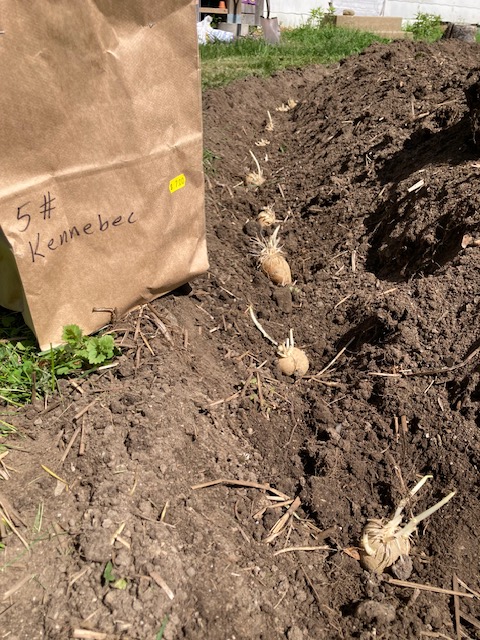
Posted: June 8, 2024 Filed under: Farming off the Farm, What is an Art Farm | Tags: irish american 2 CommentsHere at our Art Farm, we have been planting potatoes, three varieties this year: Dark Red Norland, Kennebec White, and Russian Banana Fingerlings. We have some “volunteers” returning from last year, never harvested. The bounty continues. Norland are early to mature, Kennebec are mid-season, Russian Banana are late to produce, which means potatoes all summer long.
Although of Irish heritage, I plant potatoes because, like a foraging groundhog, it is simply divine to rummage through the dirt and pull up a bouquet of spuds, hanging upon the vine. Gaia’s abundance is never closer at hand.

My long-deceased father rarely or never spoke about his origins, and through ancestry.com we have learned the barest of an outline. Phillip Mahaney immigrated, we believe, from the city of Cork, in the County of Munster, Ireland to the United States in 1850. The Great Potato Famine impacted that region, and between 1845 and 1855 more than 1.5 million adults and children left Ireland seeking refuge in America.
Thaddeus Shannon was born in Kildimo South, Miltown Malbay, County Clare, Ireland at the ancestral home named “Annagh Bridge House.” Thaddeus was not the eldest and therefore would not inherit the family farm, so he immigrated to the United States in 1884. Both Phillip and Thaddeus entered America on the Eastern seaboard, but traveled west to Bourbon County, in the bluegrass region of Kentucky. Their descendants – my grandparents – were married in June of 1924 in Paris, Kentucky.
The railroads were major employers of the Irish, and for the Mahany and Shannon families that is certainly the case. The Louisville & Nashville Railroad – “The Old Reliable” – was a major carrier serving fourteen states throughout the southern USA, and between 1880 and 1950 no less than 21 members of our extended family worked on those lines. The list of positions includes: Laborer, Shop Laborer or Section Laborer; Yard Master, Track Supervisor or Section Foreman (Boss); Machinist, Clerk or Messenger; Car Inspector, Brakeman, Conductor, Engineer or Head Engineer. My father’s first job, in 1944 at age 16, was Messenger at the Paris, Kentucky depot.

The sheer physical labor of the rail crews must have been daunting and the saying “Beneath every railroad tie there lies a dead Irishman” describes the struggles of the emigres. Although we know virtually nothing of our ancestors’ experience, something that happened but 10 miles from our farm tells a bone chilling story.
In the winter of 1864 the Royal Mail Ship “Bohemian” sailed from Liverpool, England to Quebec, Canada via Portland, Maine. A 295-foot, three-masted, bark-rigged ship, the Bohemian was also equipped with a 500-horsepower, double-cylinder steam engine, a screw propeller and six watertight bulkheads; the vessel’s design was considered very safe. On that final voyage there were 219 passengers with 99 crew members on board. 19 of the passengers were in cabins, while the remaining 200 were Irish immigrants in steerage.
“Steerage” class, effectively third or fourth class accommodations, was named because these passengers slept in the mechanical rooms of the ships, rather than cabins or public spaces. The passengers in steerage were literally looked down upon by the upper class passengers traveling on the decks above. The following description, from 1906, describes the conditions:
“[They] are positively packed like cattle, making a walk on deck when the weather is good, absolutely impossible, while to breathe clean air below in rough weather, when the hatches are down is an equal impossibility. The stenches become unbearable… [and the] division between the sexes is not carefully looked after, and the young women who are quartered among the married passengers have neither the privacy to which they are entitled nor are they much more protected than if they were living promiscuously. The food, which is miserable, is dealt out of huge kettles into the dinner pails provided by the steamship company.”
At 8pm on 22 February, amidst heavy fog, the ship struck Alden’s Rock, just off of Cape Elizabeth, Maine. The hull plates were ripped open and fire broke out. The Captain tried to run the ship to shore, but ran aground on Broad Cove Rock. Panic ensued. The first lifeboat safely transported 80 passengers to land. The Captain’s command was not “Women and children first” but the crew and upper class English went first. The Irish immigrants went last, and many – including women and children – jumped for life over board. More than 40 passengers and two crew members died at sea. Twelve of the bodies, thought to be Irish steerage passengers, were buried in a mass grave in Calvary Cemetery, Portland, Maine. During the exodus from the Great Potato Famine, an estimated 17,000 Irish immigrants were lost at sea attempting to migrate.
The topic of potatoes can stir an Irishman to great passion. An Irishman from Kentucky, whose ancestors lived in Henry County, not far from our Bourbon County, Wendell Berry wrote an essay, published in the Whole Earth Catalog in 1969, about the Civil Rights, Anti-War and environmental movements:
“The mentality that exploits and destroys the natural environment is the same that abuses racial and economic minorities, that imposes on young men the tyranny of the military draft, that makes war against peasants and women and children with the indifference of technology.
“The Confucian Great Digest says that the “chief way for the production of wealth” (and he is talking about real goods, not money) is “that the producers be many and that the mere consumers be few….” But even in the much-publicized rebellion of the young against the materialism of the affluent society, the consumer mentality is too often still intact: …In this state of total consumerism – which is to say a state of helpless dependence on things and services and ideas and motives that we have forgotten how to provide ourselves – all meaningful contact between ourselves and the earth is broken. We do not understand the earth in terms either of what it offers us or of what it requires of us, and I think it is the rule that people inevitably destroy what they do not understand.
Most of us, for example, not only do not know how to produce the best food in the best way – we don’t know how to produce any kind in any way. Our model citizen is a sophisticate who before puberty understands how to produce a baby, but who at the age of thirty will not know how to produce a potato. And for this condition we have elaborate rationalizations, instructing us that dependence for everything on somebody else is efficient and economical and a scientific miracle. I say, instead, that it is madness, mass produced.”
Some among us may not agree with his sentiments, but certainly we all can agree that upon the topic of potatoes an Irishman will have much to say.
Pro Pollinator
Posted: May 18, 2024 Filed under: Farming off the Farm | Tags: no mow may, pollinators 3 CommentsOn the one hand, the “No Mow May” movement encourages not to cut the lawn so the pollinators have more terrain to forage.
On the other hand, our son loves to use tools, and the lawn mower beckons.
Our negotiated settlement was (a) cut the grass and (b) leave the dandelions. A decidedly unusual look but it seemed everyone wins. He did well!
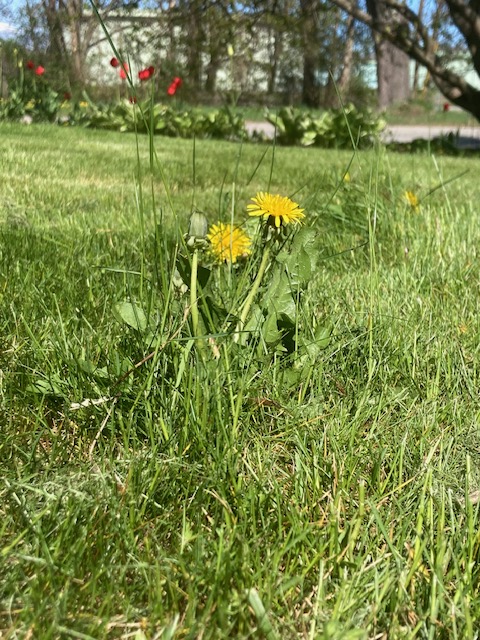
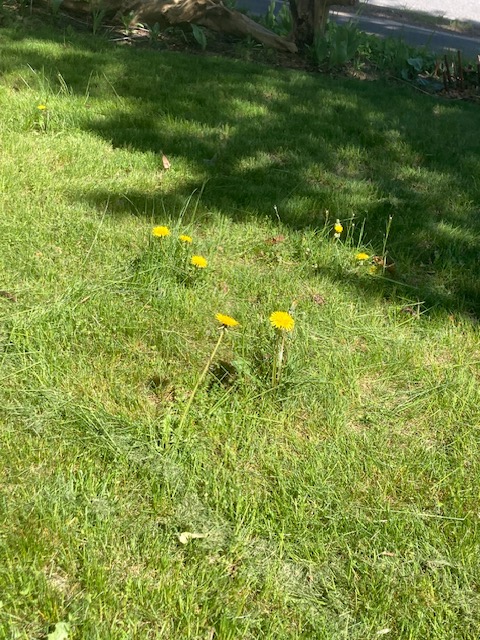
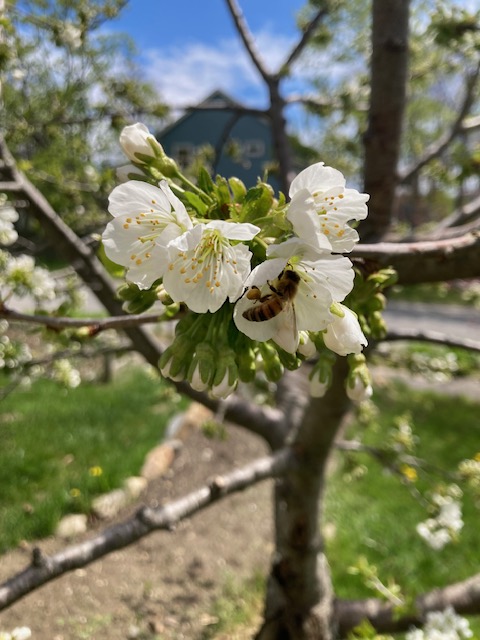
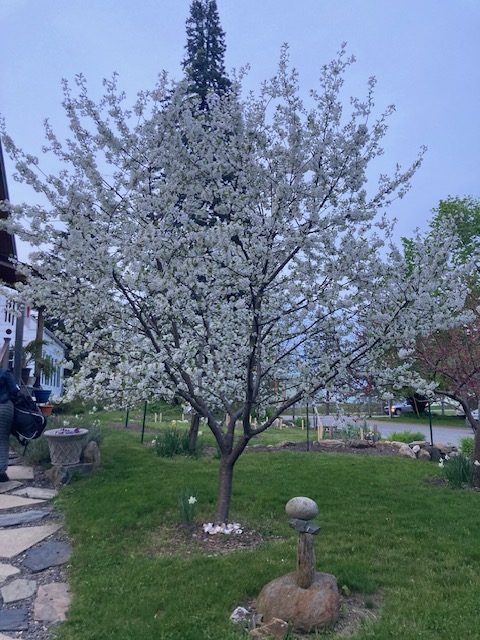
The pollinators are out in force at our art farm. The fruit trees are in full bloom, and dandelions abound.

In terms of sheer will to live, we must give an award to the milkweed pushing through the asphalt sidewalk!

And finally, behold the grandeur of fruit coming to be. It has been a cool damp spring, which means the flowers have thrived, for an unusually long duration. This week we will plant the warm weather starts: tomatoes, eggplant, peppers, herbs and sundry annuals.

 an Art Farm