Sea Monsters a/k/a Carousel Cosmos
Posted: September 6, 2024 Filed under: Art & Healing, Child Centered Activities, Gallery - Visual, Portfolio - David's work | Tags: cosmic carousel, new paradigm design workshop 2 Comments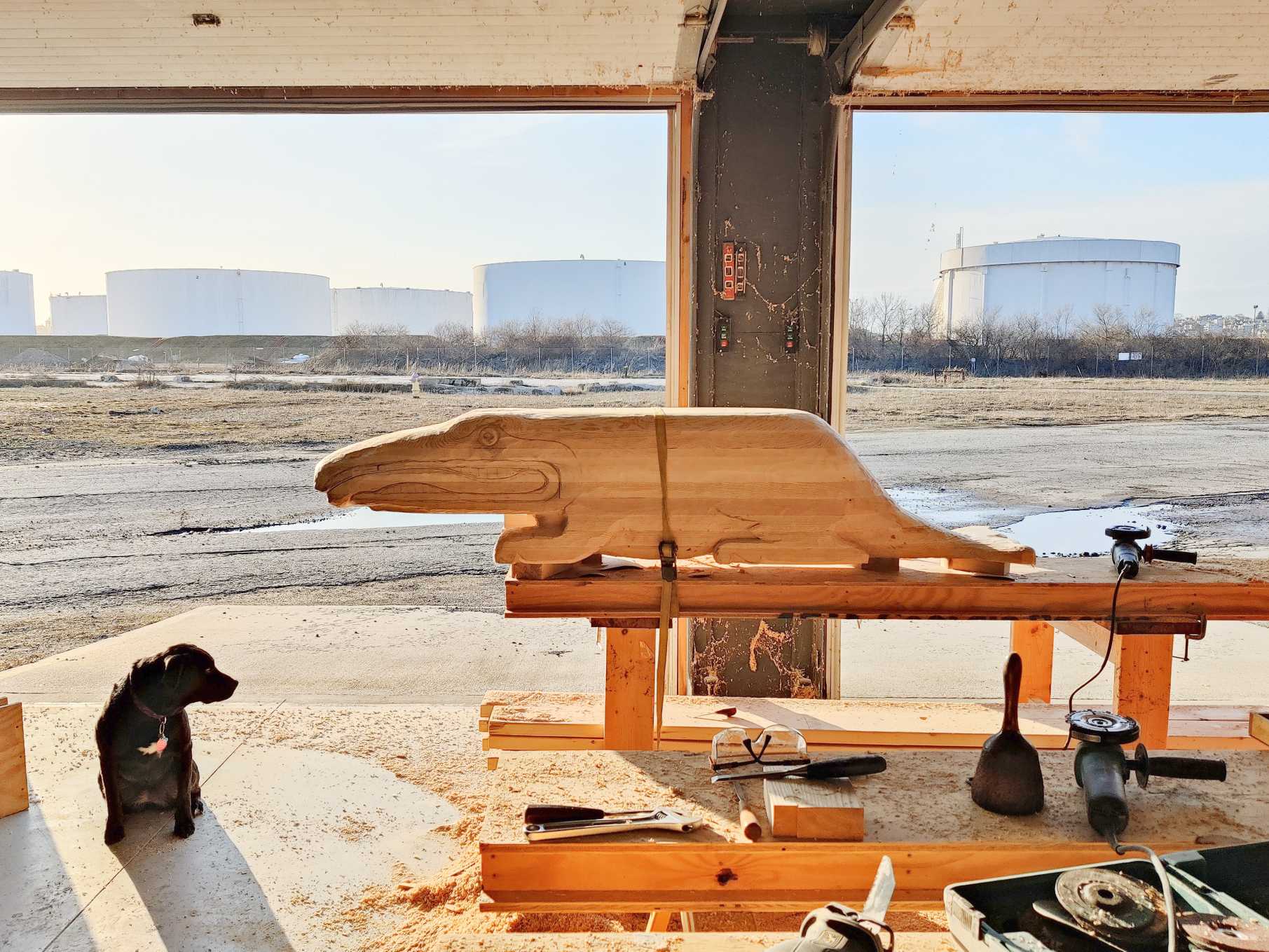
In April 2023 I had the pleasure of making Sea Monsters for a public art display in Portland’s West End. Chris Miller, the polymath maker, received the commission and hired me to help build seven creatures which likely could have lived on Portland’s Peninsula over the past 250-million years, give or take a few millennia, or even “just last Tuesday.”
“Carousel Cosmos” is the official title and the seven creatures are a Polar Bear, Humpback Whale, Saber Toothed Cat, Walrus, Rhyncosaur (an extinct herbivorous Triassic archosauromorph reptile), Dragon, Crenatocetus (an extinct genus of protocetid early whale).
Chris wrote, “They are dragons, lions, bears and sea monsters, the usual suspects in the greatest bedtime stories of all time. They have many names in many languages. They’ve made cameos as constellations that might be older than writing, older than the first cities, or the wheel. Some are mythological, some are just misunderstood. They invite you to explore the cosmos starting right here, on a journey to greater understanding.”
One really must visit the installation, but at the least you can visit them online: http://npdworkshop.com/carousel-cosmos

We built the creatures using a “stack laminate” process just as carousel horses have been built since 1799: layers of 8/4 ash (2” thick) were stacked then glued to create the three-dimensional form, which we then carved and painted. With as many as nine layers per creature, Chris used computer modeling software to draw the final shape, then “deconstruct” it to show the shape of each successive layer.

The son of a carpenter, Chris studied sculpture at the Art Institute of Chicago, and then architecture at MIT. His vision is a unique combination of those three influences.

The word “genius” normally is defined in terms of sheer intellectual horsepower – Newton and Einstein, the commonplace exemplars – but a more insightful meaning is in the derivation of the word, from Latin, which means “guiding spirit.”
For having walked the hallowed halls among the MIT Masters, Chris has retained the childlike wonder of growing up amidst the flora and fauna, woods and water of Fifty Lakes, Crow Wing County, Minnesota. His sterling genius guided him not only to conceive, design and build, but also to write this summary of the Carousel Cosmos:
“This carousel is inspired by kindness, adventure, outer space, bedtime stories, dinosaurs and ice cream. It’s inspired by the Western Promenade’s endless views, spectacular sunsets and contemplative atmosphere. It spins the way that the earth spins when the sun sets, in a place where trolleys used to stop, in a small picturesque city with a school community that speaks more than sixty different languages.”
Lest anyone think my statements are grandiose rather than grounded, I submit this photo as Exhibit A:
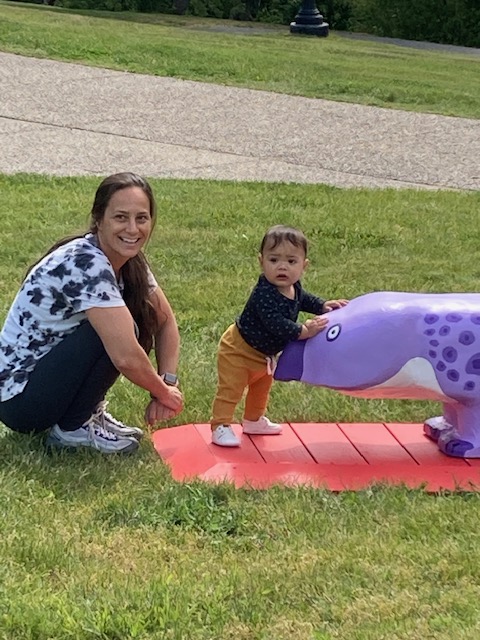
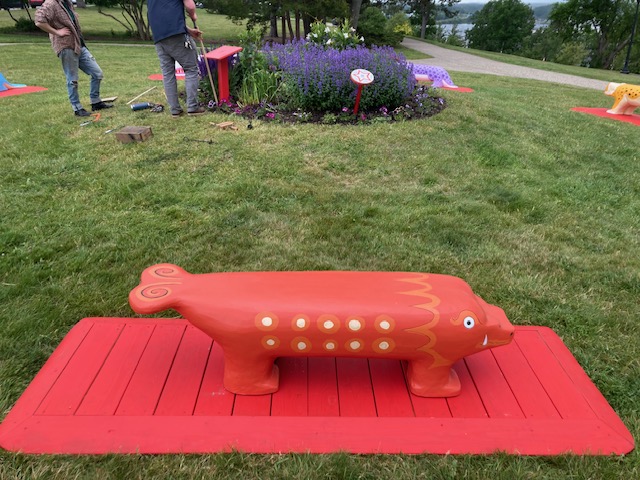


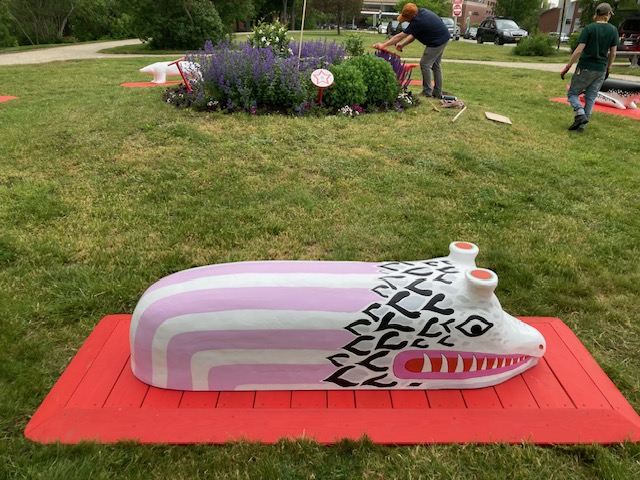


Climb aboard! Let’s go for a spin!!
School of Sharks
Posted: August 16, 2024 Filed under: Child Centered Activities, Gallery - Visual, Portfolio - David's work | Tags: ceiling mural, one percent for art, sharks 1 Comment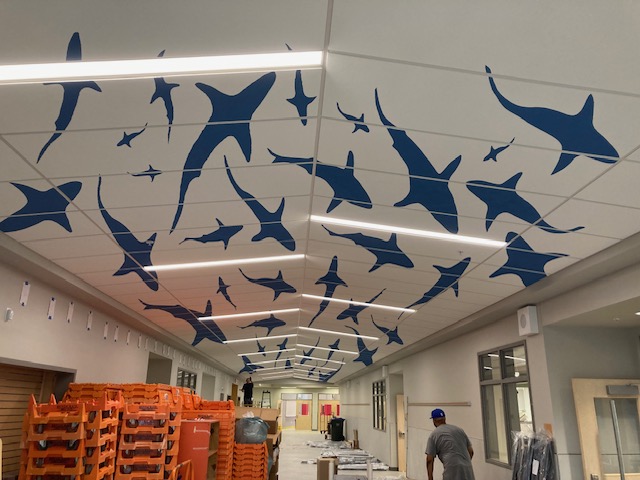
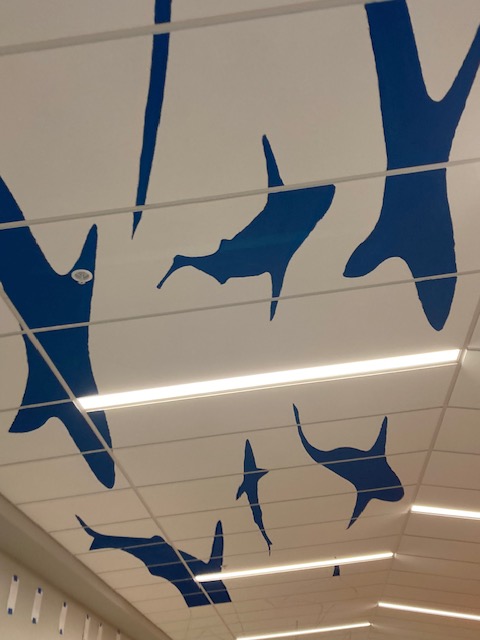
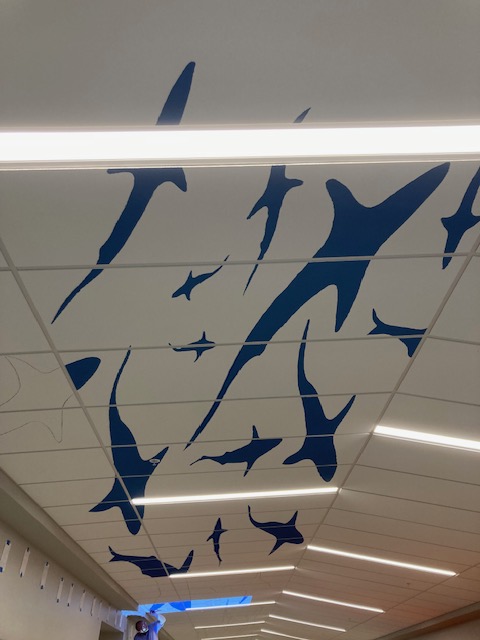
One year ago, summer of 2023, I worked on painting a ceiling mural at the new South Portland Middle School. Chris Miller, a polymath maker, very good friend and father of two young boys had received a commission and needed help. I gladly answered the call.
His design originally called for a pod of humpback whales in silhouette painted on the ceiling of the school’s central corridor. The Principal held a vote and the students selected “Sharks” as the new school’s mascot, and so a last minute change was called for. Chris complied and the whales became sharks, swimming overhead. http://npdworkshop.com/pod-cosmos
In designing the mural he envisioned the school of sharks swimming in outer space, then he mapped the sharks onto the central corridor ceiling, from the point of view of a fifth grade child, standing at the school’s entrance. His goal was to capture awe and wonder, with distortion a part of the design. The technique he used is called anamorphosis, which he described as follows:
“Anamorphosis is an optical illusion by which an image appears distorted but becomes clear when viewed from a key viewpoint, unique angle or through a particular lens. I want my kids and their classmates to learn to listen to people who have different perspectives and espouse different beliefs. I want them to be curious, open and inquiring- to strive for agreement and consensus through informed discussion.
“The mural’s key image will appear completely clear and undistorted from just one point of view. Someone just under five feet tall would see it, if they stood just inside the corridor with their back to the wall between the two lobby doors. From other viewpoints and as students travel down the length of the corridor, these silhouettes will appear increasingly stretched, and distorted to varying degrees of abstraction.
“The root of the word cosmopolitanism is Cosmos. It’s an ancient Greek concept of the universe as a well-ordered system. It presumes that all things can in theory, be made clear. I want my kids and their classmates to be relentless in search of both questions and answers. I also want them to cultivate a sense of wonder, though childhood, adolescence and into adulthood.”
These ideas carried the day, and Chris was awarded the commission. In Maine the “Percent for Art” law provides for art in public buildings, by setting aside one percent of the construction budget to purchase original works of art for new or renovated buildings receiving state funds. Some may say this is progressive waste, but I say it is arch-conservative, given that art predates agriculture and mark-making on cave ceilings shows that art is at the core of humankind’s quest for meaning. Maine has simply acknowledged same.
The Middle School budget was $69 Million, so art was heavy on the docket. The architects were so taken with his idea that they moved his mural onto the central corridor of the school, where every child every day will pass among the building entrance, the library, cafeteria and gym. Pride of place indeed.
Chris handled the design and layout. I handled the brush. It was a marvelous project with which to be involved. Best of all, how often in life do you get the chance to write to your Mother: “Michelangelo ain’t got nothing on me!! I am painting a ceiling mural in the new SoPo Middle School!!”




Crossing the Rubicon, crossing a cultural divide
Posted: March 31, 2024 Filed under: Art & Healing, Portfolio - David's work | Tags: art, exhibition, myth, mythology, spirituality 3 Comments
In 2000 I built, with Andy Rosen, a 25′ sculpture of a North Atlantic Right Whale. The sculpture was part of a collaborative exhibit, about our relationship to the rapidly warming Gulf of Maine, on display in two locations since then. The second exhibit recently came to an end, but as fortune blessed us, we have been able to donate the entire exhibit to the Wabanaki Public Health & Wellness Center in Bangor, Maine.
On the leap day, 29 February, I delivered the whale et al to the Wabanaki Public Health & Wellness Center. I was greeted by enthusiastic people, who welcomed our gift, and all of whom bore a similar resemblance. These were “people of the first light” members among the First Nations, and I powerfully realized that in crossing the Penobscot River I also crossed a cultural divide.
“Sea Change” within my/our culture was “other,” a puzzle, an odd fit. It had been well reviewed in the Sunday Press Herald and approximately 60,000 people experienced the exhibit. But we had a hard time getting people to embrace it, institutions especially. A robust PR campaign was promised, but in the end little was done to promote the exhibit. The board seemed to hold it at arms length while the administration neither recognized our donors, nor even acknowledged our “in kind donations.” One of our artists summed it up, “Our exhibit pushed some buttons that the museum was uncomfortable with….” One has to wonder.
We were invited to meet with a local ocean research institute to move the exhibit there, including an educational outreach, but their leaders rejected it, in part because of political issues; they directly said they could not take the whale because it touched upon the fisheries issue. Their major supporter is the fisheries industry. So our exhibit had run its course, its welcome worn out, and would have been hauled to the landfill.
To the Wabanaki it is a cherished asset, which they will use to help teach future generations (emphasis plural) about their link to the land. They welcomed my delivery not as plywood and tree trunk, not as wire and fabric, but a component of health and wellness. Their community has serious issues of addiction and mental health; in fact, alcohol, substance use and mental health disorders, suicide, violence, and behavior-related morbidity and mortality in American Indian and Alaska Native communities are disproportionately higher than the rest of the U.S. population. Our exhibit will be expanded into an immersive permanent exhibit in the Cafe of their Bangor center, showing the integration of life, the sustaining power of the Penobscot River, the grand web from Katahadin to Cashes Ledge, that all life is one.
What to my/our culture had become detritus is, to the Wabanaki, a most obvious opportunity. This has come to challenge me in a way reminiscent of paradox to Kierkegaard.
In the Oxford English Dictionary myth has two definitions. The first being “a traditional story, especially one concerning the early history of a people or explaining some natural or social phenomenon, and typically involving supernatural beings or events” with the second “a widely held but false belief or idea.” To my mind, in common parlance myth has become a pejorative term.
Carl Jung wrote, ““Everything that the modern mind cannot define it regards as insane.” Within our Western tradition of rationalism, dominated by monotheism, it is striking to note that one of our Great Men, the maven of rational insight and the material world, Sir Isaac Newton, led a secret life as a leading alchemist. He refused to publish his alchemical work – indeed, it was burned in a fire – perhaps for fear of scorn and rejection. The English Crown issued severe penalties for alchemy, including public hangings. Within our culture heretics have been burned at the stake, and witches sentenced to death.
Art-making predates agriculture, and thus predates civilization. Archetypes would seem to predate religion. Jung thought so, observing that organized religions had perfectly adapted the archetypes to their ritual stories. He wrote this not to denigrate religion, but, as a man of science, to pursue his “study of the soul.” The word archetype is derived from the Greek ἀρχῇ which is also, interestingly, the first noun [Ἐν ἀρχῇ ἦν ὁ Λόγος] of the “Book of Books,” the dominant sacred text within our Western tradition.
The word “archetype” first appeared in the English language during the 1500s, and conceptually relates to the Platonic forms, so I feel on solid ground considering them a priori and the religious narrative secondary. I am growing in certainty that archetypes may be the keyhole through which the light of consciousness shines, with myth providing the keys to unlock the “many rooms in my Father’s house.”
The act of making, to my mind, then is one means to manifest these truths.
Allow me to close with this story from the First Nations:
Whale witnessed the events that led to the settling of Turtle Island (North America) and has kept the records and knowledge of the Motherland alive. It is said that Mu (the Motherland) will rise again when the fire comes from the sky and lands in another ocean on Mother Earth. All of Earth’s children will have to unite and honor all ways and all races in order to survive.

 an Art Farm