The Vatican, Civil Rights, Hyde Park, San Francisco
Posted: February 7, 2025 Filed under: Chronicles of a First Time Parent, Portfolio - David's work, What is an Art Farm | Tags: ALA Annual Conference, Eugene Gabriel Tisserant, existential-dread, existentialism, FDR, humanity, Inc., integrated library systems, Library Quarterly, RMG Consultants, RMG’s Annual Presidents’ Seminars, suffering, the Civil Rights Act, the-only-thing-we-have-to-fear-is-fear-itself, vatican library, William Madison Randall 2 Comments
William Madison Randall was born 1899 in the Detroit suburb of Belleville. He graduated Central High School at age 16 but due to his young age, completed another year of post-graduate study. He went on to pursue a Bachelor’s and Master’s degree in linguistics at the University of Michigan and worked in the university library helping to reclassify the book collection.
In 1924, Randall enrolled at the Hartford Theological Seminary to begin work on a Ph.D. in Islamic Philosophy, when he was invited by the Carnegie Endowment for International Peace to reorganize and catalog the Vatican Library. There he befriended Eugene Gabriel Tisserant: scholar, librarian and archivist of the Holy Roman Church with whom he became lifelong friends.
Tisserant served as the Vatican Librarian; was Dean of the Sacred College of Cardinals in 1951; presided over the board of presidents at Vatican Council II (1962-1965); accompanied Pope Paul VI on his major voyages to the five continents. In testimony to their friendship, Cardinal Tisserant’s archives are housed with Randall’s at the University of North Carolina Wilmington.
In 1929, William Randall graduated from the Hartford Theological Seminary summa cum laude and became Associate Professor of Library Science at the University of Chicago. He authored several books on Library Science and founded Library Quarterly, a scholarly journal still published today. Twice he traveled to the Middle East on fellowships to research Arabic manuscripts. He spoke 30 languages.
During World War II, Randall was commissioned a Major in the U.S. Army Air Force, sent to Cairo, Egypt as a liaison officer for the British Air Transport Command and then to Accra to assist in the organization of the African branch of the Command. He became an intelligence agent with the Office of Strategic Services in 1943, reporting to the Pentagon and President Roosevelt concerning the Middle East. He spoke Arabic and stories are told that dressed as a waiter he served dinner to Erwin Rommel, the German “Desert Fox,” while gleaning intel for FDR.
In September of 1951, Randall and his first wife were involved in a car accident about ten miles outside of Wilmington, North Carolina. News of the accident spread and Randall was offered, then appointed Dean of Wilmington College. In 1954, Randall married Mary Johnson McGee, who had a son, Robert McGee, from a previous marriage.
Rob McGee had grown up in the segregated South, the world of separate and unequal, then came of age during the era of Emmitt Till’s murder; Rosa Park’s refusal to get out of her seat; the “Southern Manifesto” of Senators and congressmen declaring as unconstitutional the Brown v Board of Education Supreme Court decision; and, in 1957, the Civil Rights Act. The world was changing and William Madison Randall, a “Renaissance Man” of rare breadth infused in Rob a global perspective, inspired him to think beyond the present, to go forward to the future.
When Rob landed in Chicago’s Hyde Park his vision was broad, his work ethic deep, he developed three successive nationally-funded state-of-the art integrated library systems (ILS). Rob served as deputy to Charles T. Payne, Systems Development Librarian, and produced the proposals, systems requirements, systems designs, technical plans, and library automation planning processes that continually advanced the state-of-the-art of library automation. The proof of concept of an integrated library system was developed by Charles Payne at the University of Chicago. Rob was present at the creation.
Hyde Park always attracts stellar talent. Howard Dillon had left OSU and become the Librarian of the Graduate School of Education at Harvard University but in 1975 he joined the U of C Library as Associate Director for Public Services. Howard became part of a strategic thinking group, four librarians – including Rob and Charles Payne – and he recalls, “I remember lunch times when the four of us would head off campus to the cafeteria of one of the nearby theological seminaries for blue-sky thinking or the summer days when we gathered on benches in Harper Quadrangle to eat sack lunches and mull over our ideas and challenges.” Of note, Charles Payne’s nephew is “that skinny kid with the funny name,” former Professor of Law at the University of Chicago: Barack Hussein Obama II. But that is not my story to tell. Mine is the story of library automation and how it changed the life of Douglas Lee Woodhouse.
At the vanguard of library automation Rob McGee saw the need to educate librarians, trustees, and administrators in issues and solutions. Early in 1987 he asked me to organize, promote and manage the first RMG seminar series at the ALA Annual Conference in San Francisco in July. There were multiple offerings, each requiring detailed documents, copied onto different colored paper to easily identify the offerings. Still in the hard copy era and given the cost and time of shipping, I had to make, collate, staple and sort all of it after we arrived in San Francisco. I also had to manage the registration as more than 200 librarians had signed up.
The RMG Seminars became a staple of the ALA Conferences, for 31 years. At the Summer Annual conference, RMG spoke to the librarians. At the Mid-Winter, RMG’s Annual Presidents’ Seminars (The View from the Top) would invite global ILS company executives to focus on industry initiatives and trends. Rob McGee developed the topics and themes, and lead the seminars, which consistently identified trends and predicted the future of library automation. Driven to teach and to lead, Rob worked both sides of the aisle, education always the goal. On a personal note, in San Francisco, 1987, I discovered the joy of an expense account in an extraordinary food town. Rob’s trust in me was absolute.
In August, Douglas pulled into town and, on the strength of the seminar program things really picked up. Douglas began as a filing clerk and helped on word processing. He had an aptitude for technology, a moxie about business, the work load was increasing: his timing was ideal.
There was a spark between Douglas and me, and given my temperament – ready, willing and able to shovel coal – and Douglas’ unique capacity to fan the flame, our spark ignited combustion which we converted into growth. Brian, my brother, provided ballast, through his rigorously keen mind and a willingness to wrestle ideas with Douglas and me, both in the office or while throwing darts or drinking beer after work. We three formed an easy and effective team.
Rob’s value proposition was simple: if we kept up with his pace, he gave us carte blanche. He trusted Douglas, Brian and me to make the right decisions, and looking back says, “I got the good part of the deal…all that we were able to accomplish as a team, all on the fly.” His demands were intense: driven, tenacious, unyielding, unconditionally committed to access to information, libraries as a civic space, a learning opportunity. His negotiating style was to dominate the vendor on behalf of his client, even correcting, during negotiations, the grammar of vendors’ contracts. His breadth of knowledge was vast, his attention to detail a laser focus, and we three kept the operation steady, stable and growing.
To be continued…
…next week…Thos Moser in NOLA; going global; love at the threshold; life in the pits, open outcry 30-Year U.S. Treasury Bond futures…
Beginnings
Posted: January 31, 2025 Filed under: Chronicles of a First Time Parent, What is an Art Farm | Tags: books, free public library, libraries, library, news, reading, RMG Consultants 1 CommentDouglas Lee Woodhouse has died.
This is our story.

He wanted to drive to the desert, eat grapefruits while sitting cross legged playing his guitar. He went west, our young man, but made it not to the 100th meridian but to 87.629 degrees, which is Chicago, the City of Broad Shoulders, where he was welcomed with open arms.
Jack Kerouac’s “On The Road” was his sacred text, his mantra: “There was nowhere to go but everywhere, so just keep on rolling under the stars.” Destination unknown, Douglas Lee Woodhouse set out from his family home on Hollywood Avenue in Cincinnati. Nancy, his Mother, years later told me the punch line: “When he got into his Volkswagen, there was no gas! I had to drive him to the gas station to get enough gas to drive his car to the station to fill up!!”
North by northwest, Douglas arrived in Deerfield, Illinois where he “broke and entered,” which is to say he rummaged around the garage to find the “hidden” key, then let himself into his Aunt Barbara’s – my Mother’s – house whereupon he sat cross legged on the living room rug, played his guitar and sang. No desert, no grapefruits, but still silence until Aunt Barbara arrived home, most surprised, and called me promptly, “Douglas is sitting on my living room floor playing his guitar…and singing…I don’t know what to do! Can you help? Can he come to you? Now?!” “Certainly,” I said and a new life began.
Our roots were decades in the making. I was born 1961, and he arrived in 1964. We were cousins and crossed paths on family trips to Cincinnati, our Mothers’ childhood home, the brick house on North Cliff Lane built at the height of the depression among the Castles of Clifton. John F. Glaser, known as the “King of Coal” was a salesman active in the coal and home heating industry of the Ohio River Valley, while Lucille was sentry at the stove, a bountiful feast for anyone, for everyone who came to visit. It was a grand place to be young.
When Douglas arrived, I lived in the barrio, Noble at Erie, on Chicago’s Near-West side, in a very drafty large third floor walk-up. There was plenty of room for him to set up camp. The neighborhood was edgy and unpolished, working-class families and artists with a gang selling drugs from the corner one block away. We were a long way from the Castles of Clifton.
I worked at RMG Consultants, Inc., a library automation consulting firm, and my career began comically in the winter of 1985. A Senior at Northwestern University, I was hired to do word processing but was soon fired. While being fired I recommended my younger brother Brian, age 17, a junior in high school, whom they hired part time. They offered me a job painting the office, which, being unemployed, I accepted. While I painted, a deadline emergency arose, and so I closed the paint can and sat down with great focus to finish all the documents. Impressed, the Business Manager thereupon offered me her full-time position, as she was planning to leave the company. A stunning turn around.
RMG was at the vanguard when the library card catalog was becoming a relic, IT automation ascendant on the horizon. No less than the New Yorker wrote an expose about the change, card catalogs replaced with computers, the physical cabinet and notated 3×5 cards discarded from our collective past. To put 1985 in perspective, Steve Jobs had not yet been fired from Apple, Elon Musk was a freshman in high school in apartheid South Africa, Larry Page and Sergey Brin middle school students, Mark Zuckerberg in diapers. The future stretched out broadly, while the origin of library automation began the year Douglas was born.
In 1964, Howard Dillon, a new, young librarian at the Ohio State University Libraries was given the assignment to look into the library automation business and report to the library director and his cabinet. Howard began identifying and exchanging correspondence with persons in other libraries who were engaged in interesting experiments and projects. In October of that year, in Philadelphia, at the 27th annual meeting of the American Documentation Institute he rented a hotel meeting room for two days and gathered 21 of his correspondents for their first face-to-face discussions. There was great enthusiasm for this idea, and the librarians began a correspondence detailing projects, experiments or ambitions. The correspondence became formal, published as the “Newsletter on Library Automation.” Issue #1 was December 10, 1964.
Having no name, the group was referred to as the “Dillon Committee,” which name was used until the autumn of 1965 when the group organized themselves as the Committee On Library Automation (COLA) and elected leadership. COLA described itself as, “…an informal group of librarians formed to provide a means of exchanging information or research and development of automated systems applicable to libraries.”
Charles Payne – another key figure in our story – was elected Vice Chairman and Chairman Elect, while Howard Dillon served as the Editor. COLA pursued affiliation with an existing professional organization and in 1966 were formally recognized, when the council of the American Library Association (ALA) voted to create the Information Science and Automation Division (ISAD). The final COLA Newsletter, #44, was issued September 1969 when a new world was entered.
Rob McGee – founder of RMG Consultants – began as a Doctoral student at the University of Chicago’s Graduate Library School in 1965, already holding a Masters in Library Science from the University of North Carolina, and soon to study in Scotland, where he would receive a Diploma in Computing Science from the University of Glasgow. In the autumn of 1967 he returned to Hyde Park, and began at the University of Chicago Library Systems Development Office. In many ways this was a second career, he had been shelving books since he was 9-years old, at the Community College library in Wilmington, North Carolina. He also worked in the local paper mill and, in Washington State, 100-hour work weeks picking peas for the Green Giant Cannery. He grew up well versed in sheer physical labor, under the heat of the summer sun.
Born in Washington, DC, Rob grew up in Four Oaks, and then Wilmington, North Carolina during the Jim Crow era. His library experience began young, riding his bike to pick up 78 RPM “talking books” for his Grandmother and, for himself, grabbing as many books as would fit in his bike basket. In an era before television, the library loomed large, his Aunt Mil a role model and legendary teacher, reading historical fiction to students, stoking their interest to learn from books available at the local library.
Coming of age among World War II vets, learning on the GI Bill, those were different times in the Deep South. Rob saw the Free Public Library as a bedrock civic institution and once William Madison Randall joined the family Rob’s perspective became global. Library automation began in 1964, but as it pertains to the life of Douglas Lee Woodhouse foundationally it goes much further back.
To be continued…
…next week…the Vatican Library, an intelligence agent to President Franklin D Roosevelt, “that skinny kid with a funny name,” Thos Moser furniture in New Orleans….
Aloft in the Loft
Posted: January 24, 2025 Filed under: Art & Healing, Chronicles of a First Time Parent, Gallery - Visual, Portfolio - David's work, What is an Art Farm | Tags: kimchi, Martin Luther King 4 Comments
Working on this Greek Revival New England farmhouse I have learned important lessons, especially the frugality of the Yankee makers. When everything was hand hewn, nothing was wasted.
The knee wall is a paragon of thrift; by adding 4’ to the exterior walls, the roof is raised enough to gain a room that otherwise would be a dark attic. In 2018 we rebuilt the barn and I used this trick to gain – for the price of some 2×4 studs – 529 square feet of additional space. I call this the loft, and built it with no specific use in mind. Intuitively it made sense, and then covid came, the sheetrock having just been hung, so the loft became an office for my wife’s therapeutic counseling work. It was unfinished but providential.
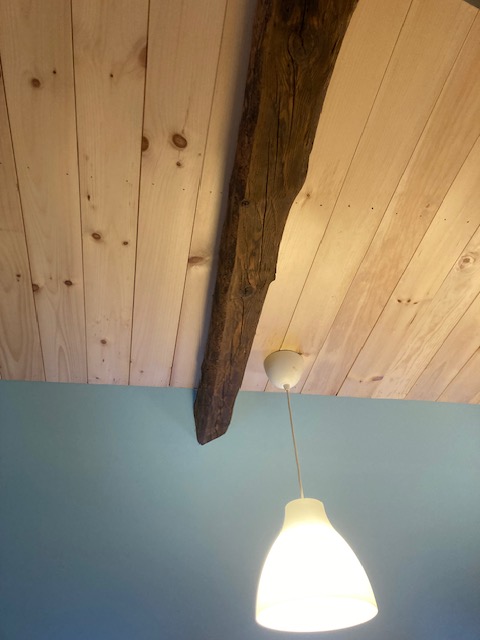
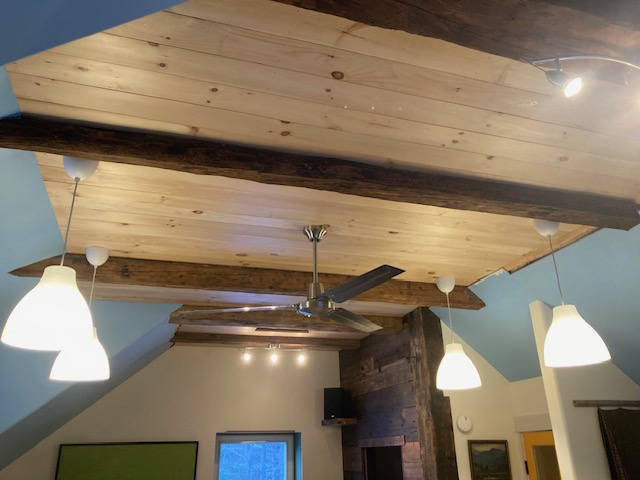
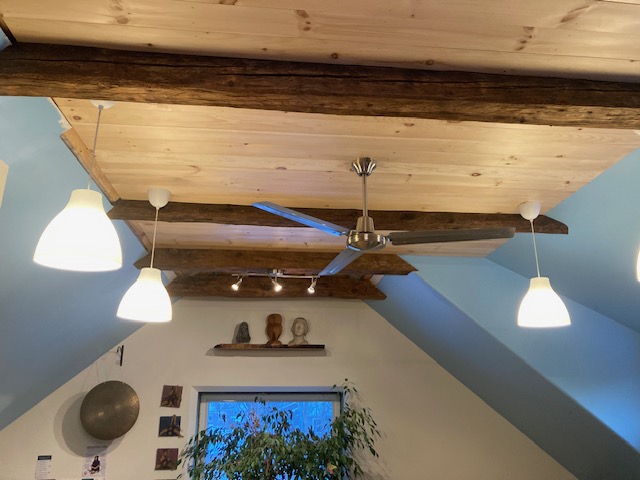
Lately I have pursued the finish work and the loft has been transformed. I put pine boarding on the ceiling, which required custom cuts around some of the original barn beams. Using old boards triples my labor but it seems worth the effort.
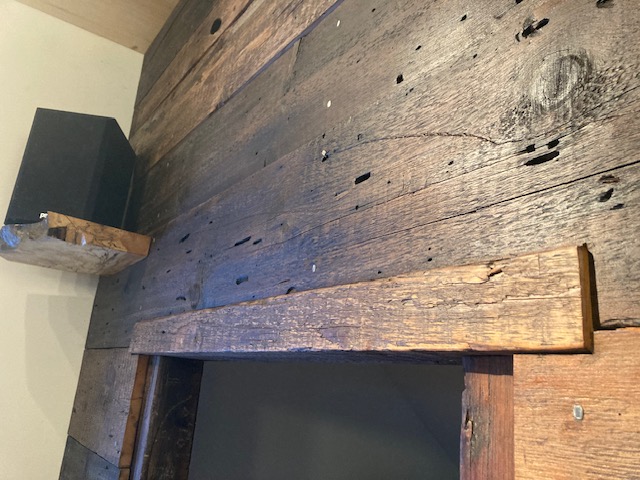
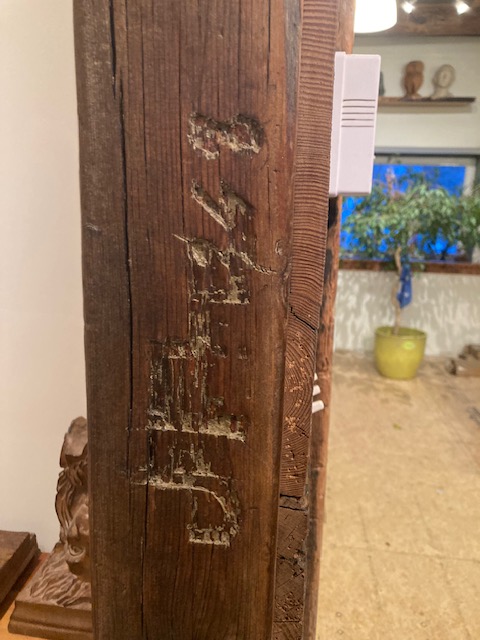
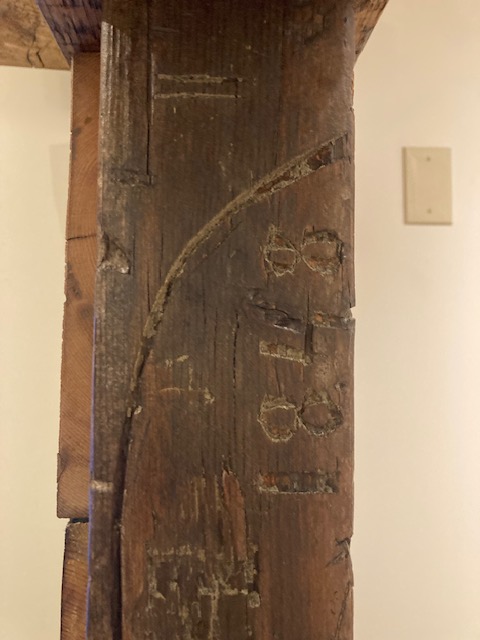
To create a storage nook, I built a wall with its door framed using a barn beam carved by the makers and dated 1848. The barn boards on that wall come from trees cut down then, which means those trees sprouted from seed circa 1700. George Washington was not yet born when our barn had taken root!
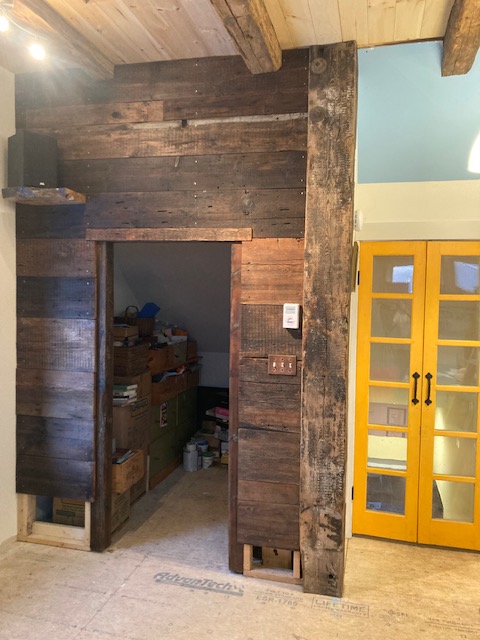
The barn boards are weathered and rough, with knots and worm holes; a poetry of the material. Several years ago I built furniture for Thos Moser, whose solid black cherry tables and chairs are American classics. Tom uses the heartwood only and rejects any sap wood, thus throwing 40% of his material away. An extravagant waste and testimony to the vanity of the buyer who seeks an unblemished life. If only that were possible, but as a colleague often said to me, “How do you know you’ve been alive if you don’t have scars to show for it?!!!”
I bought odd lot leftovers of prefinished flooring, a random mixture of five species – Ash, Cherry, White Oak, Maple, Douglas Fir – with varying stains and sheen. The floor will not be typically uniform but more like a smorgasbord charcuterie. I paid about $0.15 on the $1.00 so the savings are substantial. That is the next task.

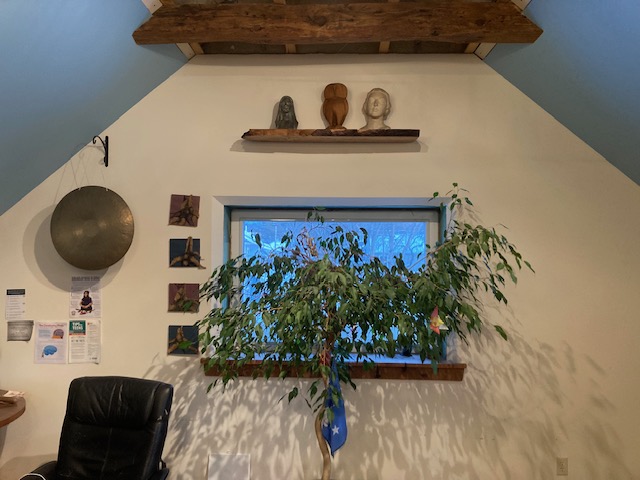
For a window sill I made end-grain parquet, cutting a stout old beam – 12″ x 6″ – into thin slices, reglued them like a checkerboard, then planed down and used epoxy to fill the aged cracks, until finally I had a board that I could cut to fit the sill opening. It is aged and rough and wildly elegant. May I age so, too.
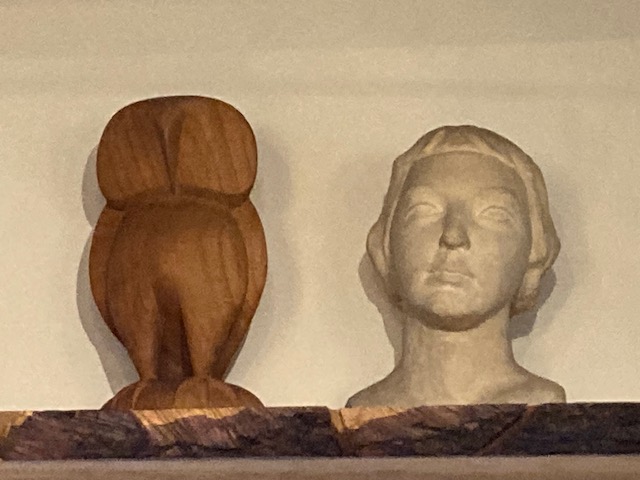
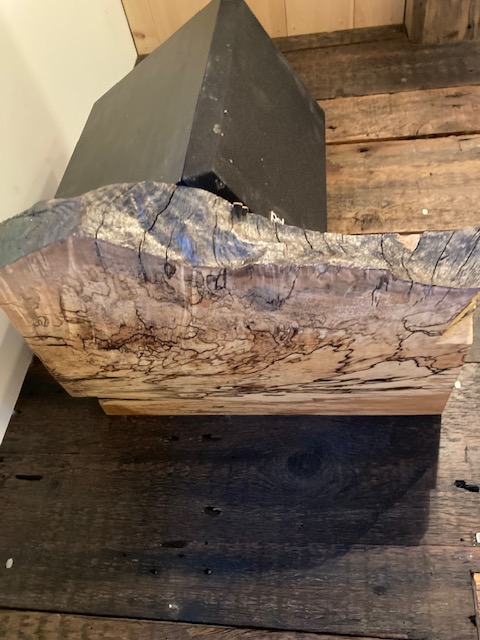
High overhead, in pride of place, is the pièce de résistance, a floating shelf of a burled Alder slab that I hauled East when we moved from Chicago decades ago. Sitting upon the shelf is the self portrait of an artist made when she was 19-years old, and a second bust that she made as well. That artist has long nurtured my own interest, encouraged me along this very winding path of making. I saved her pieces when the family home was sold last autumn, and now they – she, symbolically – watches from high overhead, a sentry to our making in the loft art studio of our Art Farm.




_______________________________
In other news, this week we did more fermenting to make a le Roi Borgne special batch “MLKing-chi.” My son and I delivered them as night fell, a random act of kindness in times of darkness. Indeed, “What’s your dream?”





Big Ideas in Miniature
Posted: January 17, 2025 Filed under: Child Centered Activities, Chronicles of a First Time Parent, Portfolio - David's work, What is an Art Farm | Tags: art, books, making, photography, woodturning 2 Comments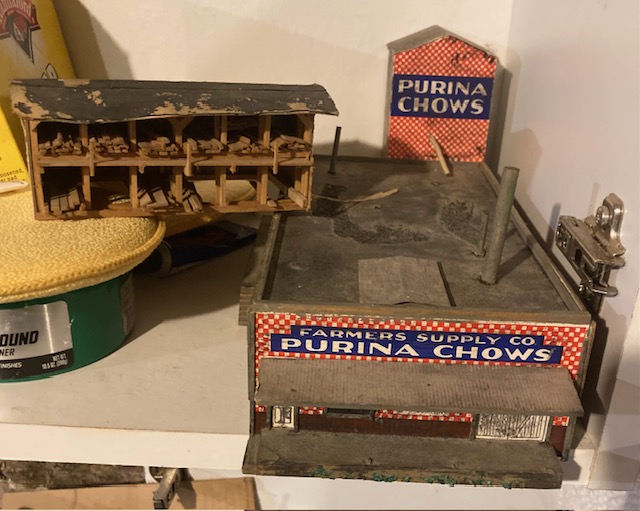
During my junior high school years – grades 6 thru 8 – I became enchanted by model trains and built an HO-scale train table in the basement. There was a mountain and tunnel; a small town with roads; a rail siding with buildings and sheds.
As my skills grew, so too the complexity of the layout. Tools were foreign to my father so I did it all on my own. Frustrated at times for no input I learned to be resourceful. Long before google and you tube, I subscribed to “Model Railroading” magazine to see what other people were doing.
There are no photos of the layout, nor do I remember any ever taken. I was in my own world, away in the basement, which brought great contentment. A few of the buildings remain, now stored in a box in our basement.
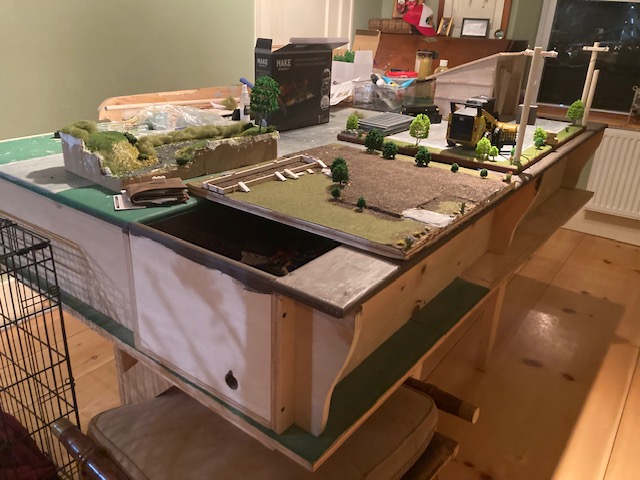
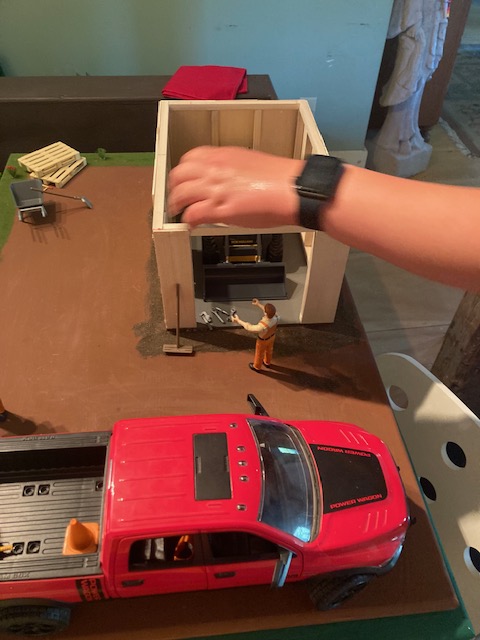
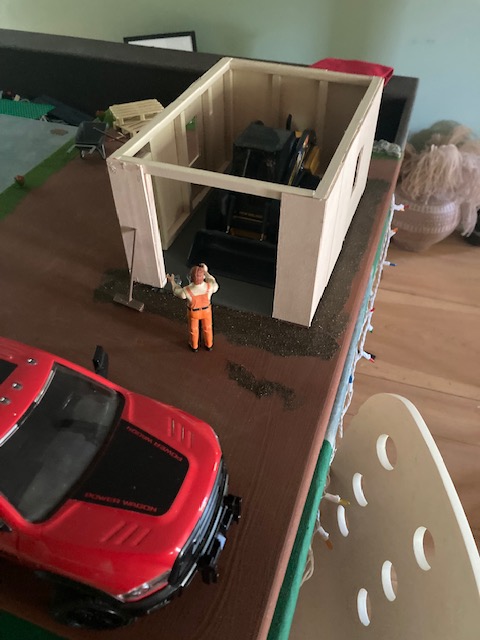
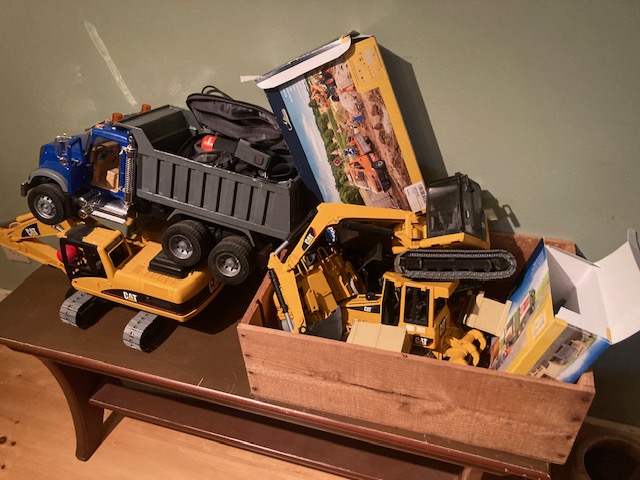
My son, of his own urging, has taken up a similar hobby, although his interest is heavy equipment and road construction. He began at age 8 – in the 2nd grade – so I handled the carpentry, but at his design. The first table was a 4×8 plywood sheet, cut to have to drop wings, which he painted. The table was placed just off our kitchen, a remarkably central location.
During COVID to break the monotony he and I would drive around town looking for road construction. Delays were desired. By chance there was a major project at that time, replacing sewers along the main artery.
Thus, a major renovation occurred on his table, the wings made permanently upright, a trench “cut” along the length, with the table raised 10” to create a space where he could lay down pipe in his imaginary world.
The table has gone through many iterations and now he builds dioramas, small stages displaying workers building roads or the yard where tools and equipment are stored.
The evolution of the table has been fascinating to watch, as he remains fully engaged building his dreams at his table in the hearth of our home.




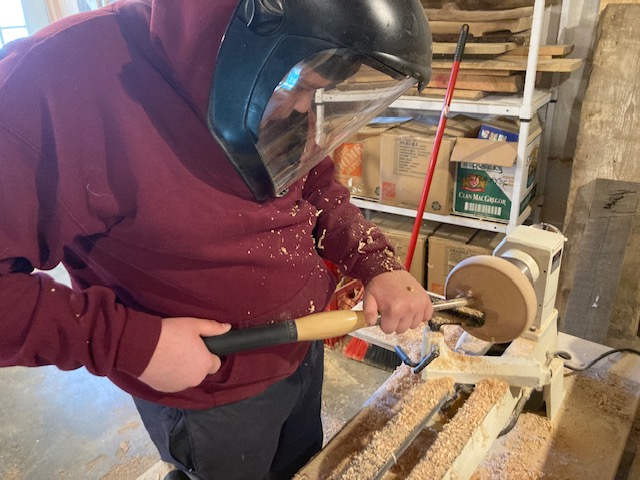
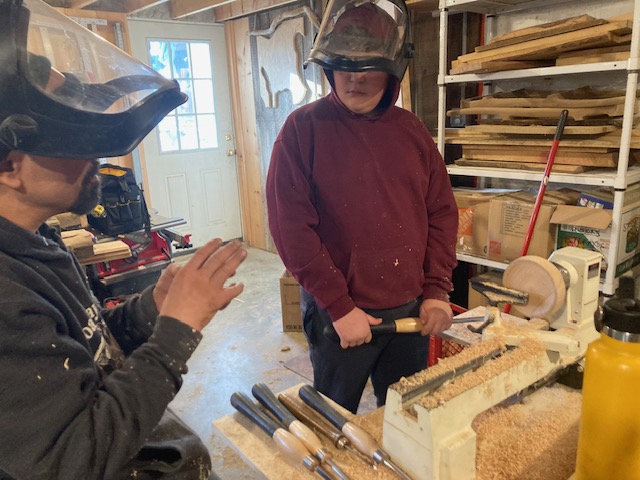
In other news, this week we had our first lesson in woodturning. Jose, a local woodworker, came to our workshop. A friend has loaned us a small lathe on which we turned a bowl made out of quilted maple, which I oiled and he presented to Mama. In two hours, he experienced the mystery of making, the satisfaction of completion and the joy of gifting an object hand made.
Dreams made manifest is an empowering experience.





Truths Held Self Evident
Posted: January 3, 2025 Filed under: Child Centered Activities, Chronicles of a First Time Parent, consciousness, What is an Art Farm | Tags: consciousness, Great potato famine, healing, hypermasculinity, intergenerational trauma, mental health, trauma 1 Comment
Among truths held self evident, that healing is the purpose of life must be central. But this view challenges the conventional A-list: asset acquisition, accomplishment, accumulation of wealth, accolade, acclaim, awards, advancement…to name but a few.
“He who dies with the most toys wins” is the popular path, but life’s hard labors will come to our doorstep, at which time the question is whether we step up or cower. Our future hangs upon the response.
Easier it is to kick the can down the road. John Maynard Keynes, the economist of destiny, who structured the post-WW2 financial reconstruction, famously said, “In the long run, we are all dead.” But life’s grim reaper is one keen accountant, and even if we choose to ignore, intergenerational trauma will settle all accounts going forward.
“Intergenerational trauma” was a new concept to me until a few years ago when my wife, a Licensed Clinical Professional Counselor spoke of it. Since then the term keeps popping up and it seems to define something of our zeitgeist. Some among us may claim this is just “a hoax from China” but scientific fact argues against brazen disregard.
Epigenetics is the science of how environmental and behavioral factors alter gene activity without changing the DNA sequence. The term “epigenetics” comes from the Greek word epi- which means “on or above.” Originally introduced in 1942, the field has grown rapidly since 2004, when the genome was fully sequenced.
Among its findings are that environmental factors can influence the health and traits over three generations through epigenetic change passed down via sperm and egg cells; the “transgenerational” effect impacts grandchildren even though they were not directly exposed to the original environmental factor. In other words, even the untold family stories shape who we are, and become.
“Beneath every railroad tie there lies a dead Irishman” is an adage describing the struggles of the Irish emigres. My father’s ancestors immigrated to the United States circa 1850. We do not have records, but believe the Mahany clan were from the city of Cork, in the County of Munster where the Great Potato Famine raged. Between 1845 and 1855 more than 1.5 million adults and children – all enduring trauma – left Ireland seeking refuge in America.
The railroads were major employers of the Irish, and the Mahany family followed that path. Daniel M Mahany/Mahoney, my great-grandfather, was born in Kentucky in 1860, the era of the Civil War, the Confederate South; intense tension among the Catholics, immigrants and the Protestant natives; machine politics and its rogues’ gallery of gang violence. As a laborer on the L&N Railroad his work must have been extremely difficult, and how he dealt with those tensions, or even traumas, once home is left unspoken.
My Father said little, next to nothing, about his family of origin and I can only wonder what traumas lie buried, untold stories of a painful past, but which still shape our gene pool. I am the third generation of Daniel Mahany’s child D.J. Mahany
One of five siblings, I process this neither in a vacuum nor by committee. The path of healing is deeply personal, each of us bringing to bear the untold complexities of our own lived lives. But plain is the historical record, factual is the science, and now is my moment.
I wonder if the turbulence of our times is not, to some degree, a long overdue reckoning of intergenerational trauma. There seems a purging of the collective id; the hypermasculine posturing, saber rattling of geo-political Oligarchs, the comic pretensions of World Wrestling Entertainment, all of which seem a masking of unhealed traumas endured and too long accrued. Mass violence marked the 20th century – the “century of genocide” – and I wonder if now comes the time when accounts need be settled.
My children are the fourth generation. My parenting choices have the potential to be liberating. Nothing can be more important to me now, at this stage of my life, than healing as the only thing that matters, that the future may be made more clear, centered in the light.
Outlaw Light Bulbs
Posted: December 27, 2024 Filed under: Portfolio - David's work, What is an Art Farm | Tags: 179d tax credit, electrical, energy efficiency, Fluorescent bulbs, led, light, lighting, Oberon Initiatives, sustainability Leave a comment
My bread labor these days is tending the buildings and grounds of the Friends School of Portland, a Quaker school of decency, thoughtfulness and kindness. A remarkable place to take shelter from the storm.
In October I went to change a light bulb, but learned that all fluorescent bulbs will soon be outlawed in the State of Maine. That got me thinking and I came up with a plan. I share below the announcement I sent to all faculty and staff.
Hear Ye, Hear Ye:
- in order to produce more light, consume less energy, and eliminate annual maintenance,
- every light fixture will be replaced in the original building: every closet, bathroom, hallway, office, Meeting & Big Room, Lobby and classrooms.
- this will be done the week of 29 December during the year-end holidays.
These are the headlines.
If curious to learn more, then read on below….
Dear Friends, all:
We regret to inform you that all the light bulbs in the 2015 building will be illegal in 12 months. We cite Maine Statute 1672, Title 38; Chapter 16-B, subsection 4-A: “Beginning January 1, 2026, a person may not offer for sale, sell or distribute as a new manufactured product a compact fluorescent mercury-added lamp or a linear fluorescent mercury-added lamp.”
The classic joke of the “Borscht Belt” comedians began, “how many men does it take to change a light bulb…?” Being smarter than that, we shall NOT change bulbs but replace every fixture. 222 to be exact.
Fear not, this will be done over the Holiday break, even late at night, so your New Years return will be like nothing ever happened, everything “back to normal.”
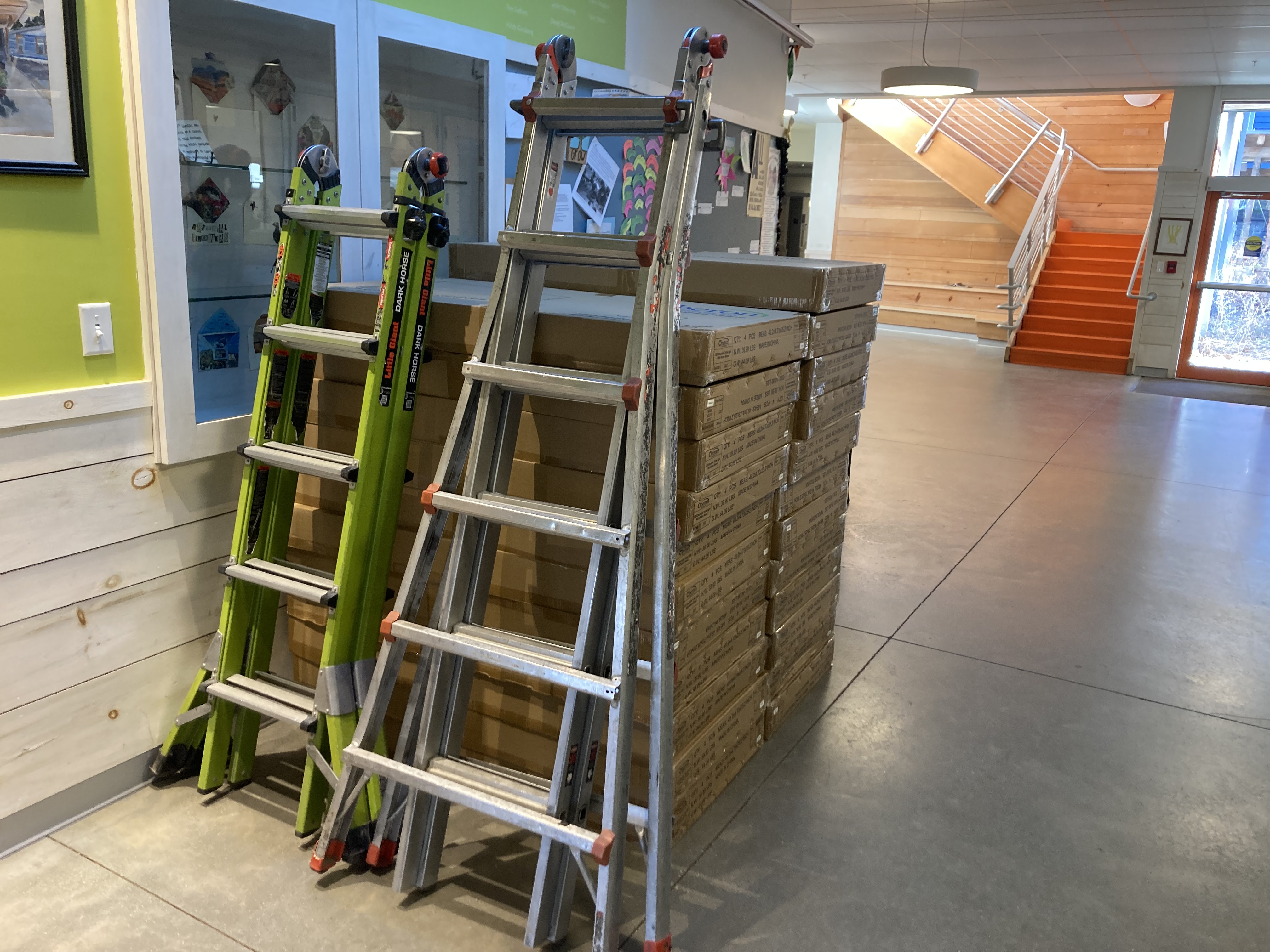
We have hired Oberon Initiatives, a turn-key contractor from south of the border – Massachusetts, that is. Our due diligence confirmed that their every client whom we contacted gave glowing 5-star reviews.
The pendant style classroom lights will be replaced with flush mount LEDs. The new fixtures will produce more light, consume fewer watts, thus increase our energy efficiency. More importantly, they will require no annual maintenance. Blessings, and savings, abound.
Money most certainly is the creation of humans, not of the divine, and as any clever, kosher CPA knows, numbers can be made to work any of several ways. Technically money is a “fungible commodity” and thus tradable, which allows us significantly to reduce the cost of the project.
Our project will benefit from both Efficiency Maine rebates for saving energy plus a 179d tax credit assigned to Oberon Initiatives, as project contractor. Friends School is tax-exempt and does not pay taxes but we have had substantial repairs – $55,252 specifically – related to energy efficiency and the building envelope.
The repairs include roofing and carpentry but those nouns do not qualify. Those skills have, however, improved our “building envelope” and that term falls both within the Passive House criteria and the definitions of section 179d of the IRS code.
Using the “building envelope” phrase to define our project will allow us to maximize the credit, for an estimated total of $15,970. Oberon will take a fee for arranging the credit and Friends School of Portland will receive a check from Oberon in the amount of $9,582. Our net cost for the LED upgrade project will be $5,283.
Allow me to state for clarity: to replace 222 outlawed light fixtures, our out-of-pocket cost will be $5,283 which equals $24 per fixture, parts AND labor. The 179d tax credit is the result of the Inflation Reduction Act of 2022 and we state for the record:
- the outgoing administration has materially benefitted Friends School of Portland
- the incoming administration almost certainly will reduce energy Efficiency Maine rebates
- carpe diem, and so we proceed without delay.
The great German writer Goethe, on his death bed, famously said, “Mehr Licht! Mehr Licht!” (“More light, more light!!). Friends School shall in fact have more light, just after the solstice, which is to say just as the light returns.
Legal in the New Year! May this be a harbinger of many more good things to come.
Respectfully,
dpm
The Art Ark
Posted: December 13, 2024 Filed under: Child Centered Activities, Chronicles of a First Time Parent, Portfolio - David's work, What is an Art Farm | Tags: animals, arctic, climate-change, consciousness, Friends School of Portland, poetry, polar bears, spirituality 1 Comment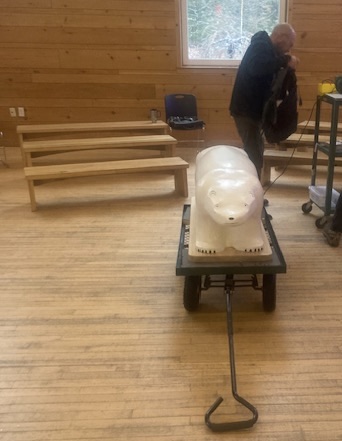
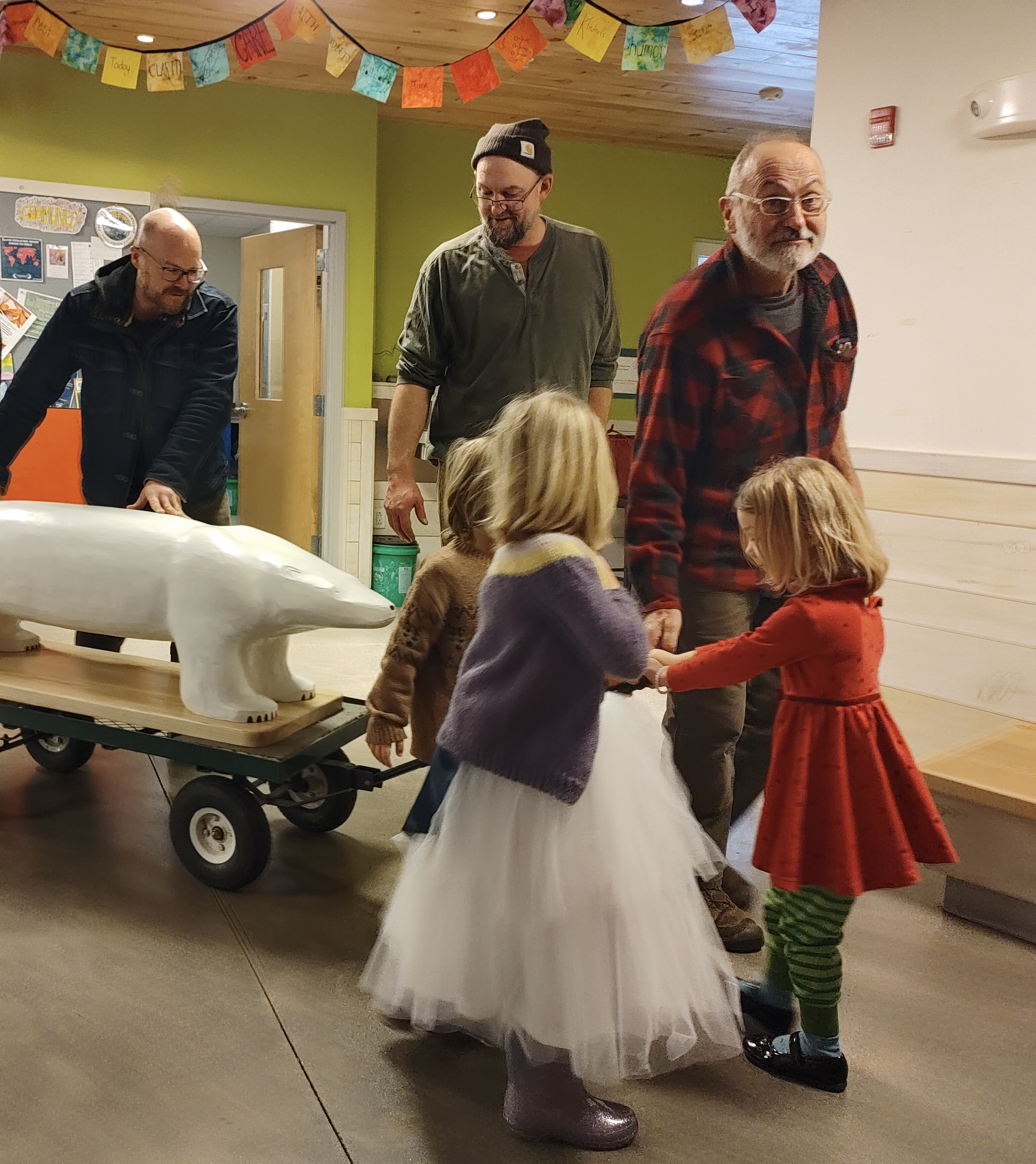
Previously I have told the story of the Sea Monsters, which exhibit came to its end. The monsters were put up for adoption, and then a Friend, a lifelong artist who volunteered for decades in inner city schools, exclaimed, “You need to save the Sea Monsters!!!” She donated funds to cover the costs, which became the catalyst and the adoptions have begun. We delivered Peter the Polar Bear on Wednesday to a full school assembly at the Friends School of Portland.
Historians say Cleopatra’s arrival at the port city of Tarsus to meet Mark Antony, 41 BC, was the most splendid entrance in history. Plutarch described it as “Aphrodite had come to make merry with Dionysus for the good of Asia.” William Shakespeare used a translation of Plutarch to write his tragedy Antony and Cleopatra. Hollywood, 1963, created its blockbuster “Cleopatra,” forever casting Elizabeth Taylor in everyman’s memories. But in the eyes of a Pre-K cherub at the Friends School, the arrival of Peter the Polar Bear must have been every bit as grand. I share here the text of our presentation.
DAVID: I am pleased to introduce Peter the Polar Bear, one of seven Sea Monsters from the Carousel Cosmos, a public art exhibit that had been on display on Portland’s Western Promenade. The exhibit came to an end, and the monsters are now being adopted all around the state. Peter has come to live in the Pre-K room.
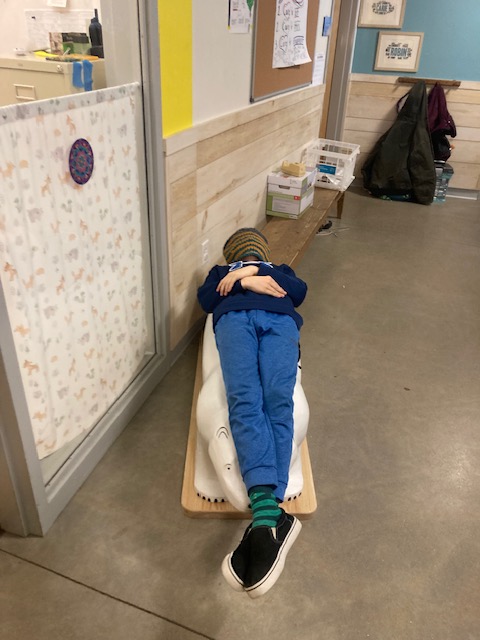
Dear Pre-K children, I want you to know that Peter is sturdy and stout. He is a bench.
- You can sit on his back and eat a snack
- You could lie down and take a nap
- If your teacher allowed, you could do a handstand on his head
- Or on your hands and knees, crawl and say “thank you and please…”
- listen carefully, perhaps he will reply…
- Peter is a gentle old Bear.

DAVID: Chris Miller is the polymath maker, the creator of the Carousel Cosmos. He will give a short presentation. But first, everyone please take out your bumblebee thinking caps…tie them on tightly…we will cross pollinate ideas, and with the help of the 8th grade students we will tell a story about circles and sharing.
How does a carousel turn?
STUDENTS: IN A CIRCLE
DAVID: How do planets in outer space move?
STUDENTS: IN A CIRCLE
DAVID: When Quakers gather to meet, how do we sit?
STUDENTS: IN A CIRCLE
DAVID: Peter is made of the wood of ash trees, locally grown. Ash trees grow in the woods here at the Friends School property. The forest teaches us of the circle of life:
STUDENT #1: “Biodiversity” teaches us that the greater the number of species, the more healthy is the ecosystem. Our property is on the border between Eastern Deciduous Forest to the south and Boreal Forest to the north; White Pines and Eastern Hemlocks are dominant on our property’s southern edge, while Hemlocks, Pine, Oak, and Maples surround the building.
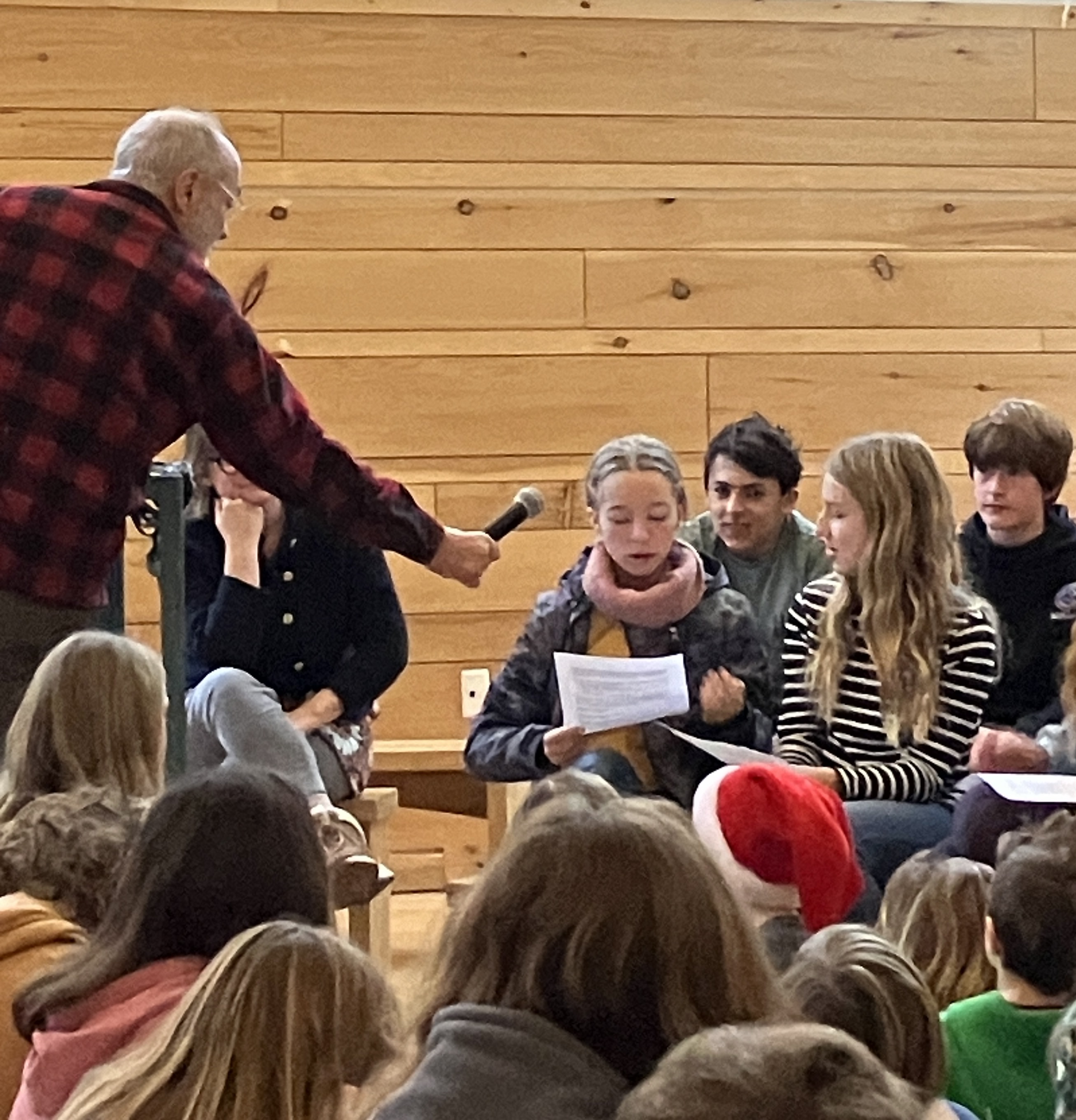
STUDENT #2: American Chestnuts grow in our woods. Although devastated by a blight and almost completely wiped out in America, our Chestnut trees likely are sprouting from the roots of ancient trees that predate the trees currently growing on the land.
STUDENT #3: The white ash and black ash trees grow in the wetland corner of the School property. The emerald ash borer, a jewel beetle native to north-eastern Asia is an invasive insect that feeds on the ash species, decimating these trees. We continue to study this problem.
STUDENT #4: The mycellium network is spread throughout the entire forest, and allows the trees to communicate to each other. Mycelium breaks down organic matter to feed the fungi, plants, and other organisms and connects plants to transfer water, nitrogen, carbon, and other minerals. The strong trees share enzymes with the weaker trees, making the forest healthier.
STUDENT #5: In the circle of life, we can say
- The greater the diversity the healthier the community
- The strong help the weak
- And everyone prospers
- Chris Miller will now speak about more circles and sharing
Chris Miller then stood and spoke about circles and Polar Bears, shared images of his Sea Monsters, how they were designed, and stories of their past. He explained that Polar Bears may have lived where Maine is, but long long ago. A child spoke up and explained pangaea. Chris answered all the children’s questions. The room was silent, in awe as he spoke:
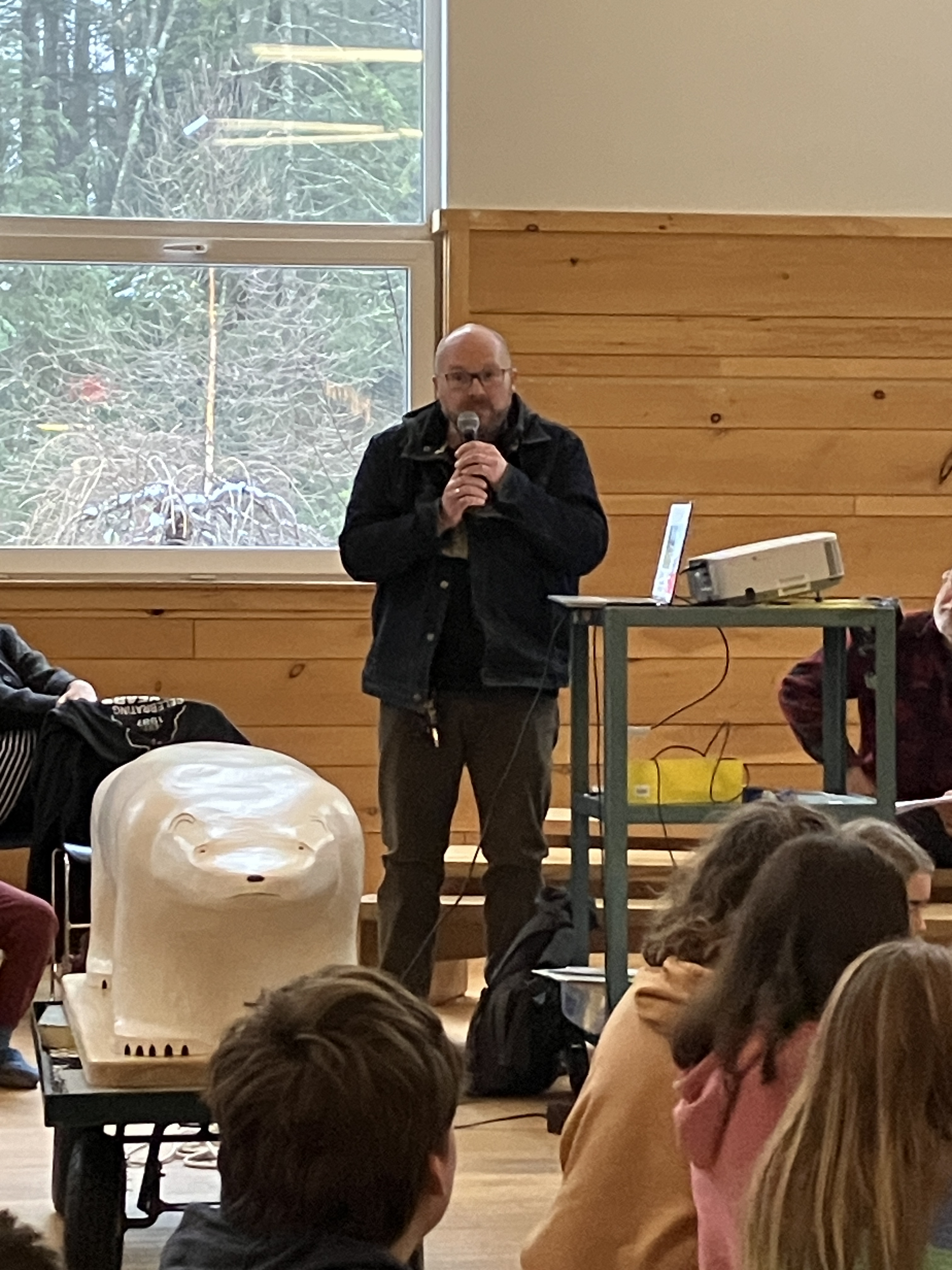
“Gather round. We are all made of the same atoms that the stars are made of too. We are parts of the universe that observe the universe. We are all living, sentient and curious together, here of all places and now of all times. What are the odds? How does it make you feel?
“This carousel is inspired by kindness, adventure, outer space, bedtime stories, dinosaurs and ice cream. It’s inspired by the Western Promenade’s endless views, spectacular sunsets and contemplative atmosphere. It spins the way that the earth spins when the sun sets, in a place where trolleys used to stop, in a small picturesque city with a school community that speaks more than sixty different languages.”
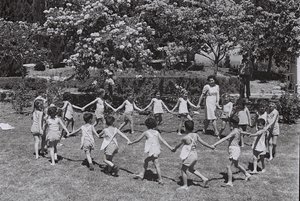
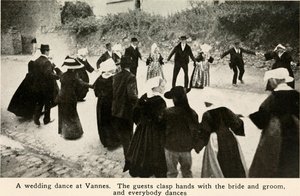
Chris shared images of circles from around the world, over hundreds of years, many people gathered together…




The Pre-K children unveiled a banner they had made:

…and then lead Peter out of the room, down the hall to his new home:

Turning 12
Posted: December 6, 2024 Filed under: Chronicles of a First Time Parent, consciousness, What is an Art Farm | Tags: coming of age rituals, consciousness, hypermasculinity, mental health, mindfulness, religion, spirituality 5 Comments
Our son turns 12 next week and I am mulling over rituals to mark this right of passage as our cherub becomes a young man.
I was raised in the Roman Catholic Church and its ritual would have been Confirmation. I have little memory of that, but it appears five hours of community service were required. I do remember wearing white, walking down the aisle and choosing Mark as my name. I chose that name to honor my best friend, who had just suffered a terrible accident in which both his arms were amputated. My choice was one of solidarity.

The Catholic tradition seems neither my nor my son’s path; I find Christian dogma limiting although Christ consciousness tremendously expansive. My faith is a work-in-progress while I am seeking alternatives for raising my son.
In the Amazon, the Satere-Mawe tribe have young men wear a glove filled with bullet ants for 10 minutes. Pushing the threshold of pain is not quite the path I seek. In Ethiopia boys jump over a cow, and in Vanuatu they jump from tall towers with vines tied to their ankles, but manliness, to my mind, is more than a measure of strength and courage.

In the Hebrew tradition the bar mitzvah marks a boy’s coming of age whereupon he begins to assume responsibility for his actions. Responsibility tied to manhood appeals to me. 13 is the age of Bar Mitzvah but to my mind, manhood is not just the number of years spent on the planet. It must be earned through understanding. This ritual, then, is about values and lessons learned.
During the summer my son and I volunteered frequently at the South Portland Food Cupboard. It was an enriching experience, and community service seems relevant in his coming of age. Construction work such as Habitat for Humanity comes to mind. I have heard of Church Youth Groups who undertake community service projects. I am looking for local possibilities.
The insights of other men should be another aspect of this plan. My nephew, my son’s cousin, did have a Bar Mitzvah and has agreed to talk with him about the experience, and his own coming of age. A philosopher/carpenter friend has offered to teach more welding, and we may join with a classmate of my son and his father, for a shared experience; working with tools in the act of making. Another friend, whose son also is the same age, is loaning us a lathe for turning wood, and that may be another opportunity for input from other men in the community. My son will benefit from hearing more than my views.
And then there is the topic of sexuality. My Father’s coming-of-age speech to me was as comic as it was lacking. It was haltingly brief, when he simply asked, “Do you have any questions?” Feeling the tension, of course I replied, “No,” whereupon he handed me a paperback book on Catholic morals. I recall the author was aghast at a recent 6th grade school field trip, where the girls wore red lipstick and hosiery. Just blame it on the girls remains the dogmatic view. What I learned of sexuality came from my older Brother and the locker room, but my son deserves better than that.

The pious among us claim that traditional morality teaches the male as the leader, with male-female relationships the only acceptable norm. I regret to inform them that history teaches otherwise. The Christian era has been relatively brief, while Ancient Greece, Rome and China openly practiced homosexuality and pederasty. LGBTQ may arguably be the historical norm and reversion to the mean would seem natural. My son will benefit from thinking not in centuries but in millenia.
The process of writing this has become the means to outline a plan. Among the core values this DIY ritual should include are:
- compassion and cooperation are keys to a healthy masculinity
- no means no, and might does not make right.
- emotional intelligence has greater value than sheer intellectual horsepower
- listen to your heart, not just your head; be curious, ask questions, follow your passion
- practical problem-solving skills provide a grounded self-confidence
- making is hard-wired in our DNA; art predates agriculture, and therefore civilization itself
- Integrity presumes courage; let your word be your bond
- energy follows thought; actions have consequences



Failure and Forgiveness
Posted: November 15, 2024 Filed under: Art & Healing, Chronicles of a First Time Parent, consciousness, Money & Banking, What is an Art Farm | Tags: authoritarian, bankruptcy, contemplation, failure, faith, forgiveness, jurisprudence, naivete, redemption, sufi 2 Comments
In my life the most meaningful lessons were learned from my failures more than any success. Would that it were different, but such, in my experience, has been the lesson learned. I suspect I am not alone here.
The consumer marketing machine, it seems, plays on everyone’s hopes for the good life: the getaway cruise, the flashy new car, the land of milk and honey, lifestyles of the rich and famous. To my mind these are diversions, distractions, from the hard work of honest integrity.
Among my failures was being held in contempt of court, United States Federal Court, Northern District of Illinois. It dragged on for months, and one day into the courtroom United States Marshalls entered, guns holstered, locked and loaded. My counsel nervously waited to petition on my behalf, but surprisingly, they had come not for me. I did not go to jail.

A banker from Lichtenstein did go to prison to serve a three-year term. I was a co-defendant in a lawsuit concerning off-shore Trust Asset Management, guilty not of fraud but of naïveté. The case eventually was settled. The experience gave me reason deeply to reconsider.
Following that settlement I filed a Chapter 7 bankruptcy, which taught me the remarkable experience of forgiveness. It is extraordinary to learn – in the first person – that forgiveness lies at the core of American civil jurisprudence.
Our system of justice is fundamentally about redemption and resolution. In practice often such may seem not the case – for profit prisons, for example – but forgiveness, in fact, does seem to lie at the core. Is not the hope for a better future the American dream? Such, at least, has been my personal experience.
In beginning that new chapter I further learned to let integrity be my bank account. Our culture deifies money. We are drunk in the belief that wealth must equal intelligence and character. We could be no further from the truth.
When I was a boy the popular phrase was “A man’s word is his bond.” Long out of date that is now. Our delusions are different from the truth, which remains that our character is key, that integrity is – in the end – all that matters.
I am not alone in feeling a seismic shift unfolding. This week I received a missive from a Franciscan monk, the founder of the Center for Action and Contemplation, who wrote:
“I have been increasingly convinced that we need a worldwide paradigm shift…(which) becomes necessary when the previous paradigm becomes so full of holes and patchwork “fixes” that a complete overhaul – which once looked utterly threatening – now appears as a lifeline. [We must] move beyond the reward/punishment paradigm.”

He told the Sufi-inspired story “The Angel with the Torch and the Pail”
“An angel was walking down the streets of the world carrying a torch in one hand and a pail of water in the other. A person asked the angel, “What are you doing with that torch and pail? The angel said, “With the torch I am burning down the mansions of heaven, and with the pail I am putting out the fires of hell. Then, and only then, will we see who truly loves God.”
The monk concluded by saying, “The most loving people I have met across the world in my lifetime of teaching and traveling all seemed to know that if love is the goal, it must be love for everybody.”
The bromance playing out on social media and in the halls of government is not about love for everybody. The situation in America is child’s play to the global trend toward authoritarian strongmen. To my mind most certainly this will result in a humanitarian failure, which would force we the people, on this small planet, deep into reevaluation.
We must own our failures before we can be reborn. Once we do that, what if redemption and love become the result of these uncertain times?

Redemption and Return
Posted: November 8, 2024 Filed under: Art & Healing, consciousness, What is an Art Farm | Tags: alpha males, books, divine feminine, greek-mythology, Homer, hypermasculinity, Iliad, mythology, Plato, the Republic, thucydides, trojan-war 1 Comment
Recently, at the Friends School of Portland, I watched a performance of the Iliad that was remarkable; horrid and harrowing, vast and engaging, a testimony to the power of theatre.
The Fig Tree Committee, a group of Quakers from Portland, Oregon presents “An Iliad” to correctional facilities and the communities that surround them. Over 3,500 people, most of whom were incarcerated, have seen the production. In the Quaker vernacular, their work is a “leading” as it “…knits together audiences on both sides of the prison walls by using one of the world’s oldest stories to examine the cycles of violence, trauma, displacement, and hope for healing that unite us all.” https://www.figtreecommittee.org/
The Iliad, central to Classical literature, stands at the apex of Epic Poetry. Homer, the bard, is said to have written the poem circa 800 BC, retelling stories from the late Bronze Age circa 1,000 BC. The story revolves around Paris, a Trojan Prince, who abducted Helen, the wife of Meneleus, the Greek King. Extraordinary was Helen’s beauty, her’s “the face that launched 1,000 ships.” The poet sagely never describes her face, leaving that to the reader’s imagination.
For 10 long years the Greeks battled the Trojans, always to a standstill, which test of endurance is indeed the stuff of legend. The story – hypermasculinity and the alpha males’ dominance – is remarkably relevant to the world today. The Access Hollywood tapes seem but a modern day retelling of Paris abducting Helen.
The Fig Tree’s production used metadrama to connect the classic to the contemporary through the epic catalog of the 1,000 ships. The bard made plain such breadth by listing the many young men killed, but from American, rather than Greek towns, including Evanston, Illinois where long ago I read the Iliad in the Greek. That catalog foreshadowed what was to come, and what is playing out in America today.
Building to the play’s climax, the bard recited a brutally long catalog of wars – Ancient Greece through Europe to modern day Middle East and Gaza – 3,000 years summarized that took us ever deeper into the maze, to face the Minotaur; not half man half beast, but rather the vain beastial side of Aristotle’s “political animal.”
The Peloponnesian War – Sparta versus Athens, 431-404 BC – centered on the issue that “might makes right.” Thucydides, the Greek Historian, in 410BC wrote, “… right, as the world goes, is only in question between equals in power, while the strong do what they can and the weak suffer what they must.” “Might makes right” is the moral antithesis of the path to compassion.
Plato, the Athenian philosopher, wrote the Republic, 375 BC, arguing that democracy was unworkable, “Until philosophers are kings, or the kings and princes of this world have the spirit and power of philosophy … cities will never have rest from their evils,—no, nor the human race, as I believe,—and then only will this our State have a possibility of life and behold the light of day.”
The polite phrase is “Philosopher King” but the literal translation is “Benevolent Dictator.” The authoritarian strongman does seem ascendant now. Many say Victor Orbán is a modern day exemplar of the Philosopher King but his is an illiberal democracy, rule by the minority not “we the people.” Might makes right remains the macho battle cry and let’s be honest: hypermasculine alpha males have run the table for more than 3,000 years.
To my mind, the deeper long-term trend is that the Divine Feminine is ascendant, while the alphas, like dinosaurs, will fight to the bottom to preserve their long enjoyed patriarchy. I speak of masculine traits, not gender, and write this not to condemn but with compassion to decry so many generations of boys raised to be men who fight more than forgive, for whom “making a killing in the market” is a red badge of courage. Radical, indeed, was the street preacher, 2000 years ago, who dared say, “the meek shall inherit the earth.”
At the end of the March from Selma, Martin Luther King stood on the steps of the Alabama State Capital, and said, “The arc of the moral universe is long, but it tends toward justice.” The Iliad tells the same story. This masterpiece of literature is ultimately a story of redemption, the release of anger and hubristic pride.
At the Iliad’s end, Achilles speaks to Priam, the last King of the Trojans, and releases to him the body of Hektor, his son, whom Achilles had slain in battle. Each having lost everything, Achilles – the greatest among the Greek heroes, which is to say the paragon of the alpha male – found within himself redemption and gave back to Priam the body of his son, to be buried, returned to his native soil.
If the greatest of Greek heroes could find forgiveness and compassion, then certainly, so too, can we the people.
Work is to be done.
Let us be about it.
Now.
_______________________________________________________
I quote here from the Richmond Lattimore translation, Prius supplicating Achilles, the response of Achilles, the anointing of Hektor’s body, and the slaying of the “gleaming sheep” for a shared meal of Thanksgiving:
“Achilleus like the gods, remember your father, one who
is of years like mine, and on the door-sill of sorrowful old age.
And they who dwell nearby encompass him and afflict him,
nor is there any to defend him against the wrath, the destruction.
Yet surely he, when he hears of you and that you are still living,
is gladdened within his heart and all his days he is hopeful
that he will see his beloved son come home from the Troad.
But for me, my destiny was evil. I have had the noblest
of sons in Troy, but I say not one of them is left to me. (24.486-94)
“So he spoke, and stirred in the other a passion of grieving
for his own father. He took the old man’s hand and pushed him
gently away, and the two remembered, as Priam sat huddled
at the feet of Achilleus and wept close for manslaughtering Hektor
and Achilleus wept now for his own father, now again
for Patroklos. The sound of their mourning moved in the house. Then
when great Achilleus had taken full satisfaction in sorrow
and the passion for it had gone from his mind and body, thereafter
he rose from his chair, and took the old man by the hand, and set him
on his feet again, in pity for the grey head and the grey beard,
and spoke to him and addressed him in winged words: ‘Ah, unlucky,
surely you have had much evil to endure in your spirit.
How could you dare to come alone to the ships of the Achaians
and before my eyes when I am one who have killed in such numbers
such brave sons of yours? The heart in you is iron. Come, then,
and sit down upon this chair, and you and I will even let
our sorrows lie still in the heart for all our grieving. There is not
any advantage to be won from grim lamentation. (24.507-24)
“Then when the serving-maids had washed the corpse and anointed it
with olive oil, they threw a fair great cloak and a tunic
about him, and Achilleus himself lifted him and laid him
on a litter, and his friends helped him lift it to the smooth-polished
mule wagon. He groaned then, and called by name on his beloved
companion: ‘Be not angry with me, Patroklos, if you discover,
though you be in the house of Hades, that I gave back great Hektor
to his loved father, for the ransom he gave me was not unworthy.
I will give you yourshare of the spoils, as much as is fitting.’
“So spoke great Achilleus and went back into the shelter
and sat down on the elaborate couch from which he had risen,
against the inward wall, and now spoke his word to Priam:
‘Your son is given back to you, aged sir, as you asked it.
He lies on a bier. When dawn shows you yourself shall see him
as you take him away. Now you and I must remember our supper. (24.587-602)
“So spoke fleet Achilleus and sprang to his feet and slaughtered
a gleaming sheep, and his friends skinned it and butchered it fairly,
and cut up the meat expertly into small pieces, and spitted them,
and roasted all carefully and took off the pieces.
Automedon took the bread and set it out on the table
in fair baskets, while Achilleus served the meats. And thereon
they put their hands to the good things that lay ready before them.
But when they had put aside their desire for eating and drinking,
Priam, son of Dardanos, gazed upon Achilleus, wondering
at his size and beauty, for he seemed like an outright vision
of gods. Achilleus in turn gazed on Dardanian Priam
and wondered, as he saw his brave looks and listened to him talking.
But when they had taken their fill of gazing one on the other,
first of the two to speak was the aged man, Priam the godlike:
‘Give me, beloved of Zeus, a place to sleep presently, so that
we may even go to bed and take the pleasure of sweet sleep.
For my eyes have not closed underneath my lids since that time
when my son lost his life beneath your hands, but always
I have been grieving and brooding over my numberless sorrows
and wallowed in the muck about my courtyard’s enclosure.
Now I have tasted food again and have let the gleaming
wine go down my throat. Before, I had tasted nothing.’
He spoke, and Achilleus ordered his serving-maids and companions
to make a bed in the porch’s shelter and to lay upon it
fine underbedding of purple, and spread blankets above it
and fleecy robes to be an over-all covering.” (24.620-646)
 an Art Farm