Like a Pearl
Posted: November 1, 2024 Filed under: Child Centered Activities, Chronicles of a First Time Parent, Farming off the Farm, What is an Art Farm | Tags: animal rescue, animals, dog, dogs, Grammy Rose Dog Rescue, pets 4 Comments
During the Great Plague of London, in 1655, a 22-year old named Isaac was sequestered. He used his isolation to invent “infinitesimal calculus,” the study of continual change. A remarkable achievement, hinting at great things to come from Sir Isaac Newton.
During the Covid lock down, our time of isolation, the Wentworths of Acton, Maine were sequestered and similarly productive, in an entirely different way. They used their time to construct six residential-style dog cabins, a welcome center with offices, a conference center and retail gift shop plus an Ice Cream Parlor and 18-hole Mini-Golf course.
The family has owned the land for generations, as far back as the American Revolution – their forebears served beside George Washington – and they wanted to honor the memory of their Grandmother “Grammy” Rose Kessler Wentworth. The buildings were completed over 18-months and in 2022 the Grammy Rose Dog Rescue & Sanctuary began operations. The Ice Cream and Mini-Golf generate revenues making it a self-supporting rescue center. https://grammyrose.org/
They entered adoption agreements with “kill shelters” around the country, primarily in the Deep South. There are so many stray dogs down there that the Sheriffs routinely pick them up from the side of roads and, rather than euthanize them, ship the dogs north to New England for adoption. Think of it as a modern day abolitionist above-ground railway.

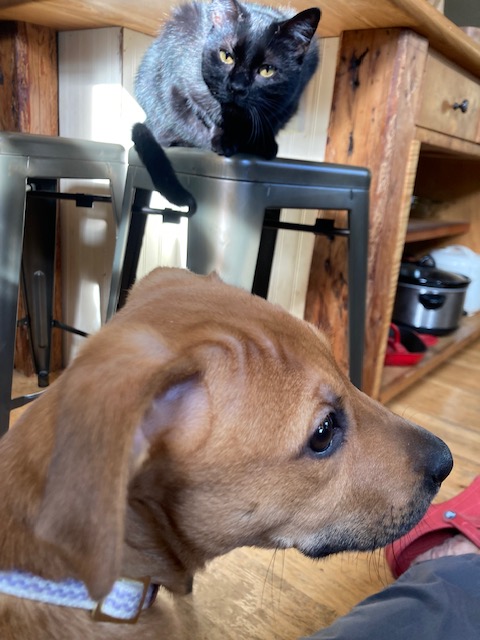
We drove to Acton last Friday ostensibly “to look” at a puppy. But no one drives one hour one-way just “to look” so it was no surprise that we returned home with a 9-week old female puppy, recently arrived from Webster Parish in northwest Louisiana. The Mother was a lab-mix while the Father is unknown. She appears to have some Rhodesian Ridgeback in her.
Her adopted name was “Jayne Mansfield” honoring the 1950s “bomb shell” movie star and Playboy Playmate, whose IQ reportedly was 149, at the genius level. Hopefully our puppy was named for that trait.

We mused over names. My daughter offered Maisie, and I chimed in Mae, both of which, it turns out are derived from a Scottish Gaelic word, derived from the Ancient Greek “margarites” meaning pearl. Luminous indeed, and given her high energy, we are calling her “Crazy Maisie Mae.” She is a handful, 24/7.
Our art farm is home now to two adults, two children, two rescue dogs from the South and two rescue cats, one from Puerto Rico and the other from Oklahoma. Meanwhile, back in Acton, Grammy Rose keeps rescuing dogs, 35 having been adopted during the month of October.




Solitary Confinement
Posted: October 25, 2024 Filed under: Chronicles of a First Time Parent, Permaculture & Home Renovation, Portfolio - David's work, What is an Art Farm | Tags: american-history, Andrew Jackson, medicated worm syrup, presidents, Trail of Tears 1 Comment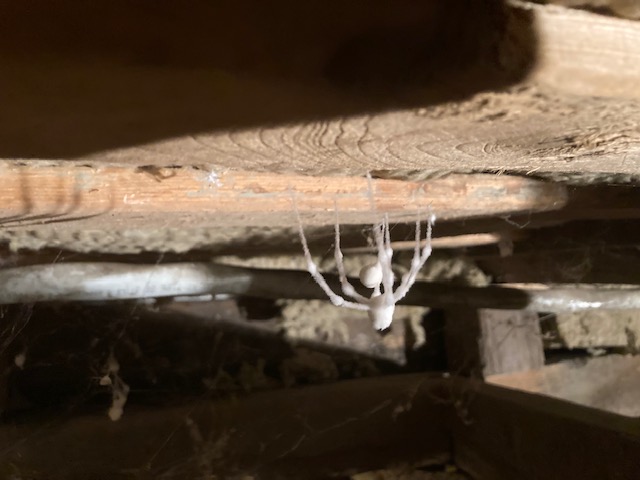
The 7th and 11th Presidents of the United States were titans from Tennessee, Andrew Jackson and James Polk. Polk was a disciple of Jackson, and both fought bitterly against the Second Bank of the United States arguing that it was a capitalist monopoly favoring the Eastern states. Jackson paid off the national debt, but also instigated the “Trail of Tears” ethnic cleansing, the relocation of tens of thousands of Native Americans, forced to walk from their ancestral homelands to lands “west of the river Mississippi.” A polarizing figure, Jackson advocated for ordinary Americans and preserved the union of states, but was denigrated for his racial policies.

1830 through 1848, in South Portland, Maine, C.D.W., a carpenter, built a farmhouse with a crew of thirteen. By day, they labored cutting trees and hauling rocks, to lay the rubble foundation and hew the timbers for the post and beam home. At day’s end, they had no hot showers (indoor plumbing began in Boston 1829, only for the rich) and their food was harvested or hunted from their gardens or woods (green grocers did not become common until circa 1916). Hard were the conditions under which those workers labored.
On Labor Day 2012, we bought the house and barn that C.D.W. built, then began an energy efficient upgrade. My wife was in her third trimester, so time was of the essence. Money was tight. A permacultural builder and crew helped gut and super insulate the main house, converting from kerosene to natural gas. Short on funds, we had to tear down the barn. On Thanksgiving day we moved in, when two weeks later our son arrived into our Greek Revival New England Farmhouse. In 2017 we were fortunate to rebuild the barn, adding a second bathroom, a loft and workshop. Which left the Ell as the last remaining unfinished section.
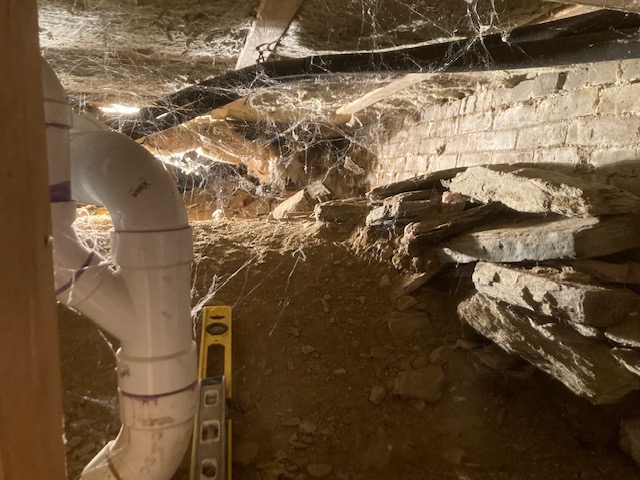
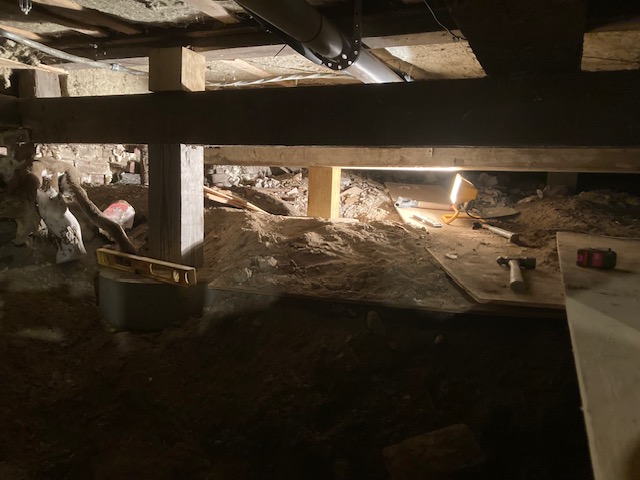
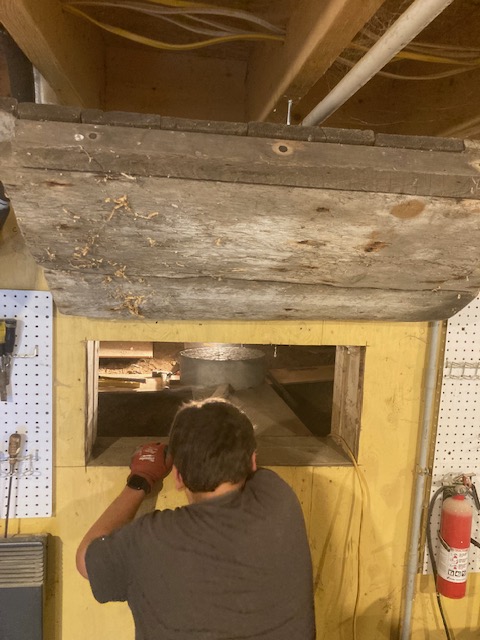
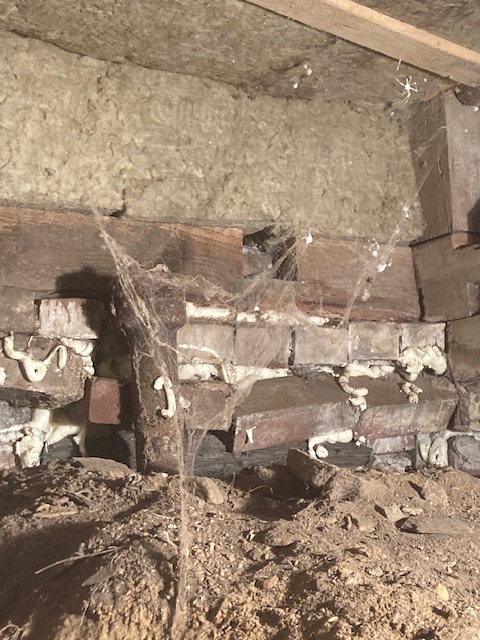
A prudent man would have passed on the home. A rich man would have torn down the Ell. But I was short on cash and long on hope, so I bought the farm in “as-is” condition, at a foreclosure price plus 20-years’ hard labor. I have begun now, finally, restoring the Ell. Before I can do the finish work, I need to rebuild the foundation, and before that, to stabilize the floor system. This work is done in the crawlspace, which means my hard labor now is essentially solitary confinement.

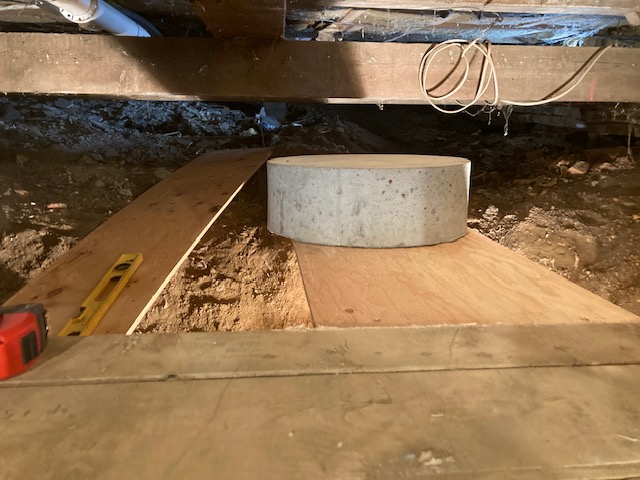
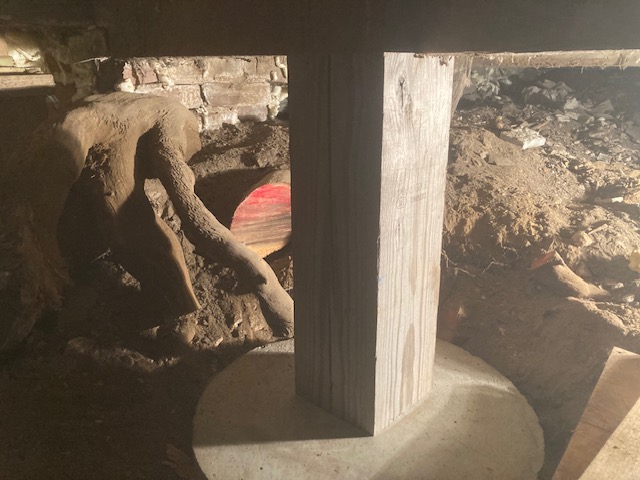
To secure the floor system I need to set ten concrete pads, upon each of which a post is hammered into place to stabilize the existing 1830 floor joists, with a gusset to lock the posts and prevent movement. Building standards were vastly different then, so I have to bring all of this up to code, with 36” to 16” of working space. Each concrete pad is difficult, while several are incredibly challenging. I had two choices: either mix concrete in the crawlspace and then bucket it into location OR pull a pre-cast block, weighing 130 pounds, into a pre-dug hole. Given “pick your poison,” I chose the latter, the pre-cast.
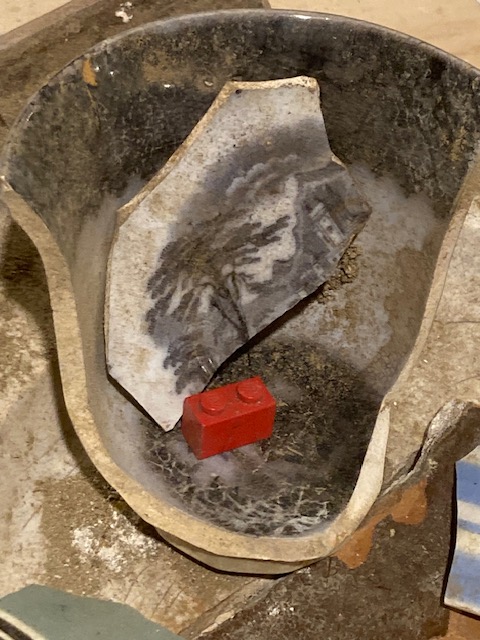
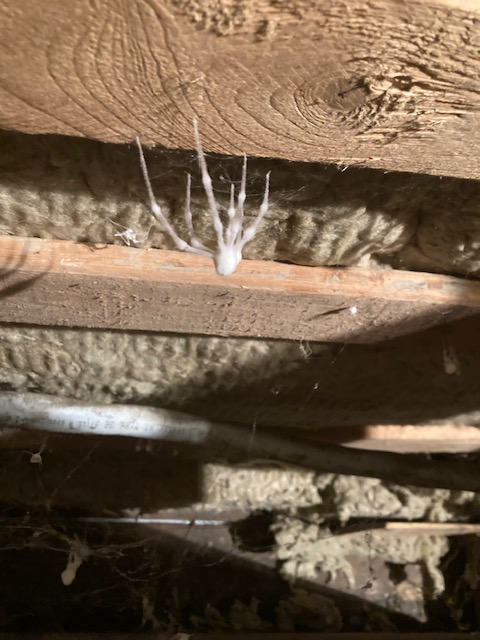
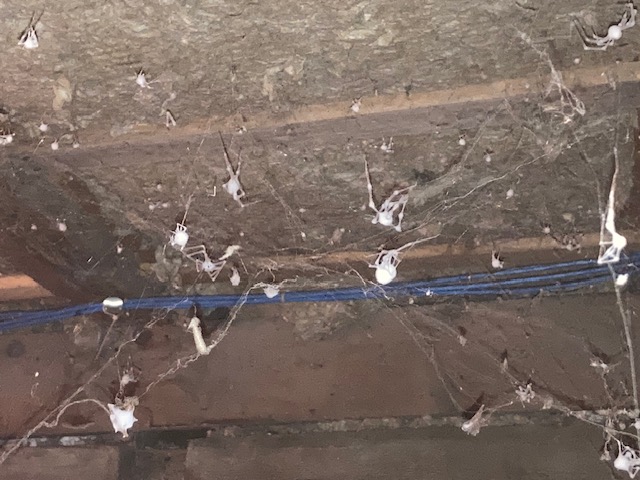
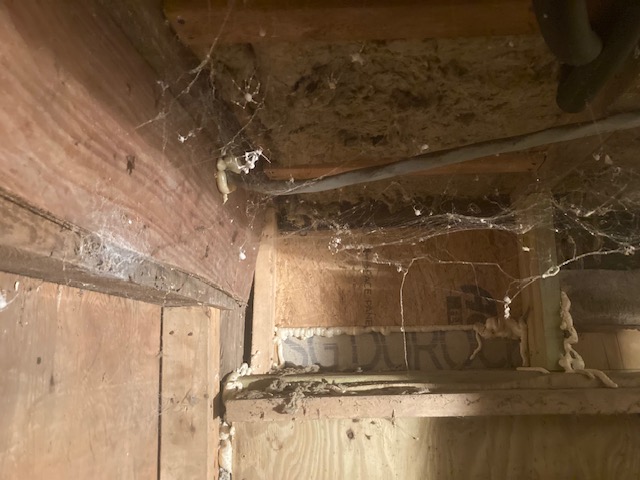
The crawlspace is macabre and surreal. Everywhere overhead abound spider webs and carcasses, covered in a white mold/fungus on the exoskeleton. Rats have lived in that crawlspace and in the dirt lay remnants of former lives in this house: chards of broken china with pastoral scenes, an oyster shell, shoe leather, a glass bottle of “Medicated Worm Syrup” made by Hobensack’s in Philadelphia circa 1845, and two lego pieces. In 1850 the Dyer family purchased this home, where their son John was born in one of the bedrooms. If someone was born here, how many have died here, over the past 200 years?
As a boy, I watched “The Great Escape,” Steve McQueen’s 1963 action film telling the story of World War II prisoners of war, digging a tunnel to escape from Stalag Luft III, a Nazi concentration camp. In one scene, the tunnel collapses, burying the character played by Charles Bronson. Many times I have thought on that during my crawling.
Let me be clear: never would I do this as paid work-for-hire. But for my wife and children I will and I have crawled on my back and my belly, with minimal leverage, to move concrete pads into place, hammering posts, affixing gussets to make stable the floor system.
My Father, dead now 43 years, has the last laugh. So many times he said to me, “David, you can get used to hanging if you have to.” I heard that, then, as a boy, in terms of my own life. But now, as a Father, I understand that for your children you go out of your way even when that means laboring in a crawlspace among desiccated spiders, remnants of rats.
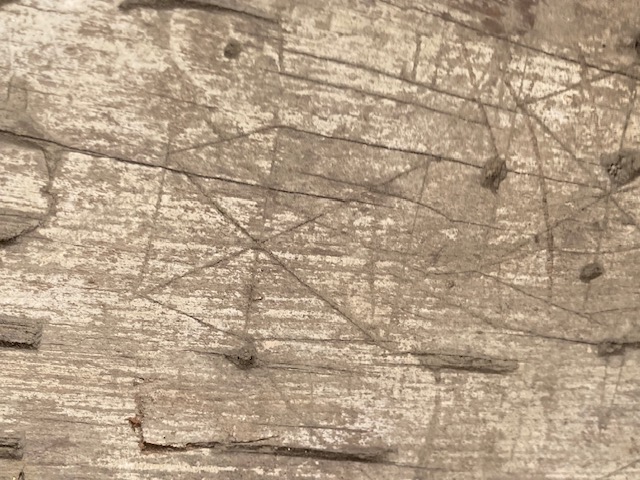
In the end, the work has been done, and I left my mark, on a beam – as did C.D.W. and crew – showing for the record that, Autumn 2024, DPM labored here, to make stable the world in which his children grow, and from which they will go forward, into the world.





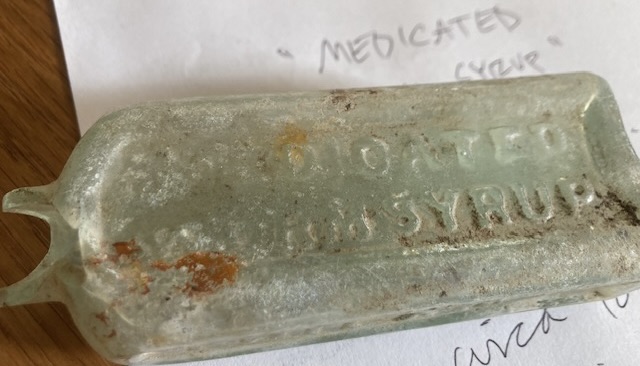
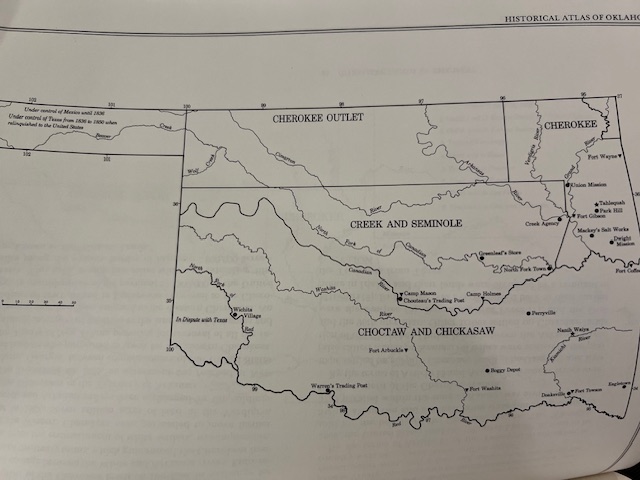
Professor Kristy Feldhousen-Giles has been most helpful with insights into the Indian Removal Act of 1830. The Nations were relocated “west of the river Mississippi” but no tribes were relocated west of the 100th meridian as that was under control of Mexico in 1830, and later under the Republic of Texas. The Battle of the Alamo was fought February through March 1836. The nationalist faction of Texans sought the expulsion of the Native Americans and the expansion of Texas to the Pacific Ocean.
Here is a map of the Indian resettlement 1830-1855 from the Historical Atlas of Oklahoma.
Here is the text of the Indian Removal Act, as authorized by the United States Congress, May 28, 1830.
Fairy Museum of Natural Wonder
Posted: October 18, 2024 Filed under: Art & Healing, Farming off the Farm, Portfolio - David's work, What is an Art Farm | Tags: art, Farmington 1 Comment
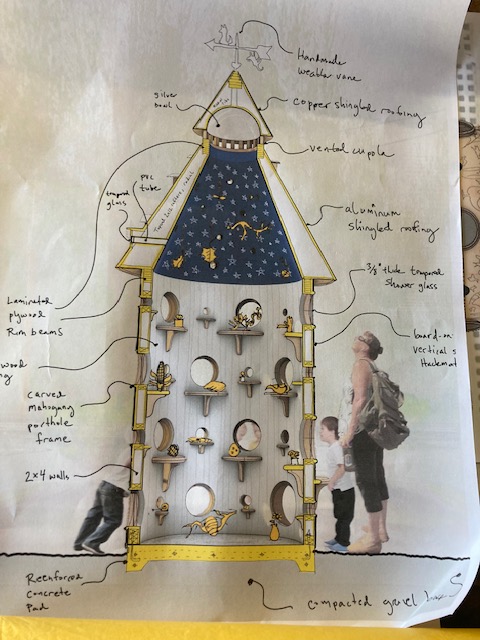
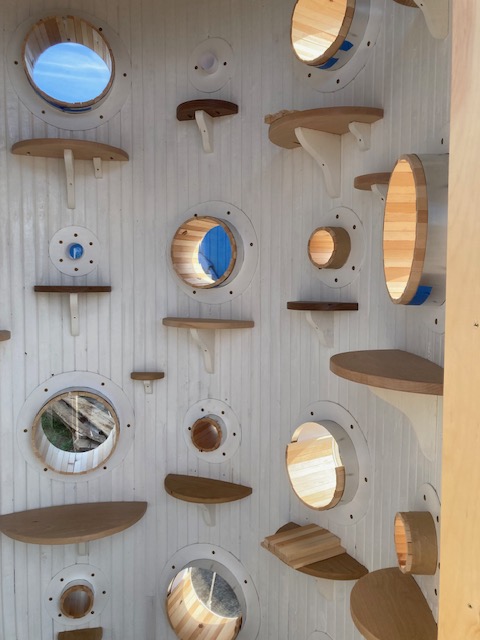
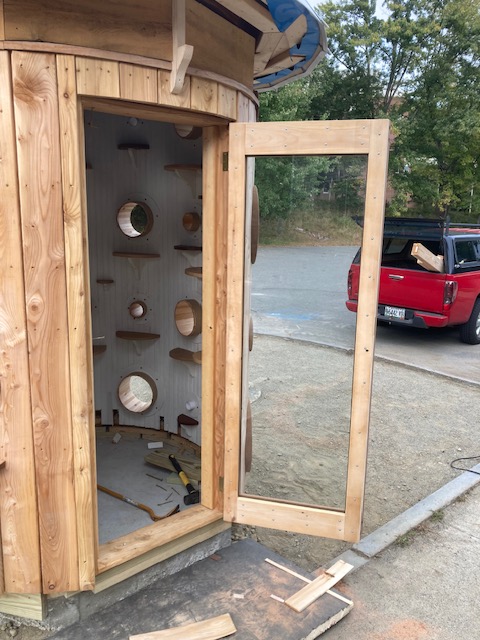
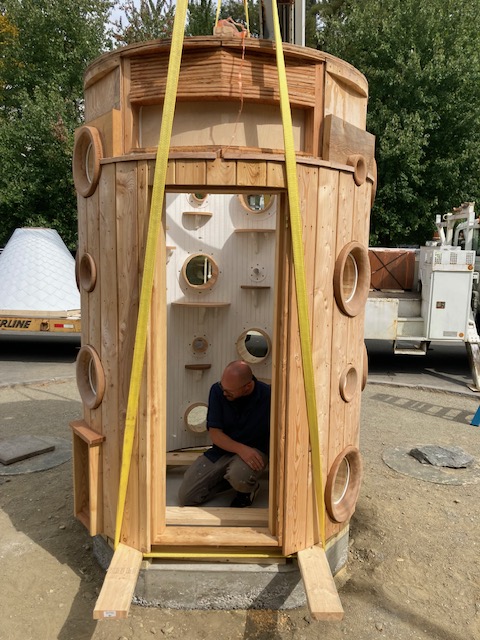
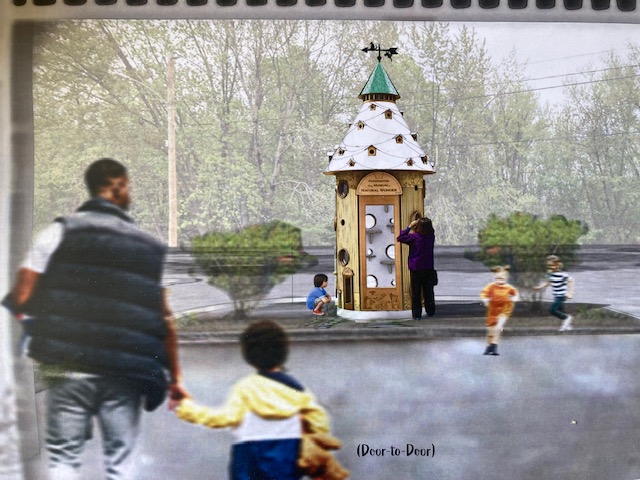
The “Farmington Fairy Museum of Natural Wonder” is a building of magical wonder and whimsy, built to the scale of a 5- or 6-year old child, coming to be, in a world of exquisite beauty and grace.
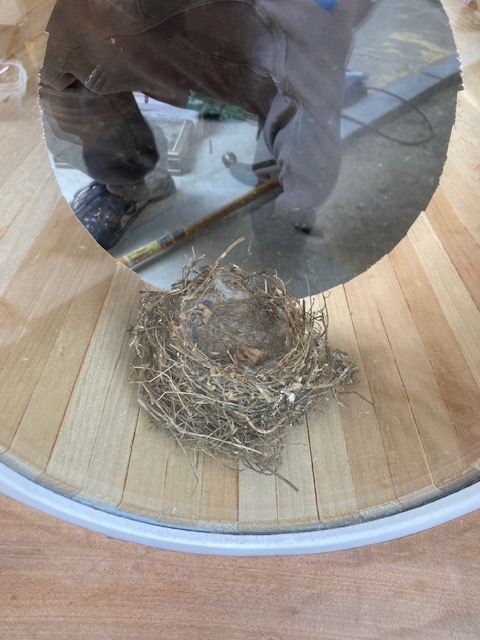
Funded by the University of Maine at Farmington’s School of Education, Early Childhood Development, the Museum will be used as part of their pre-school teacher training program. Enrolled children will curate rotating exhibits, displaying natural wonders gathered on sojourns into nature. Found items – a stick, a stone, a shell, a leaf or feather – will be placed by the children on display upon shelves nestled beside porthole windows.
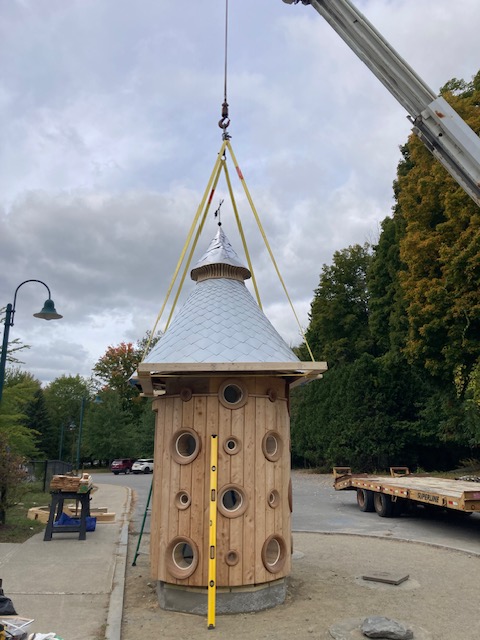
The design is as complex as it is compelling. Consider these facts:
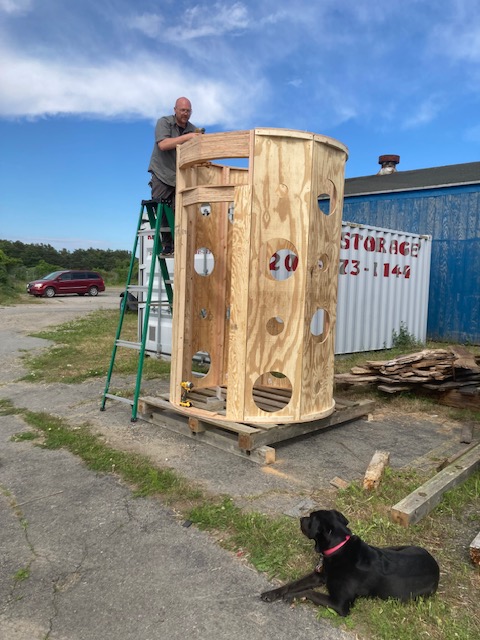
- framed as a dodecahedron, with 1/2” plywood sheathed to 2×4 studs cut at 18.5 degree angles;
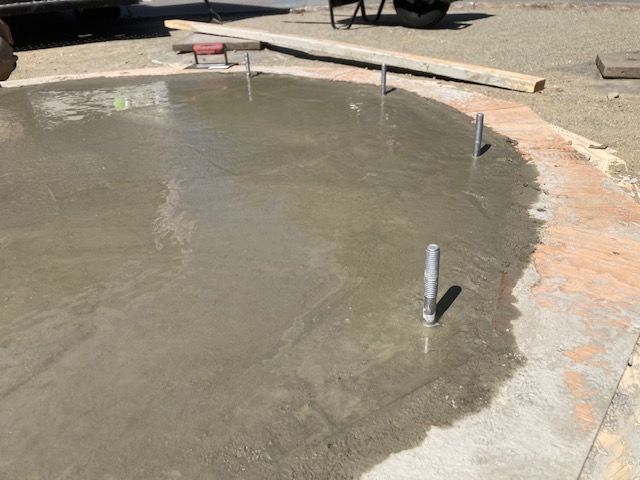
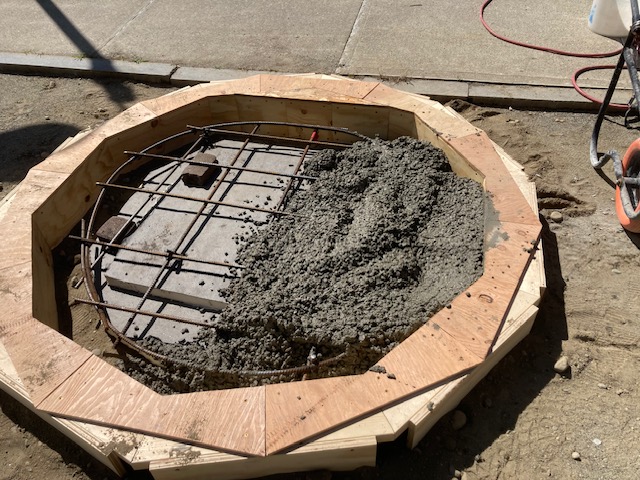
- the 6″ slab foundation used 14.4 cubic feet of concrete, with rebar mesh reinforcement;
- sheathed in native-Maine Tamarack, using board on batten style;
- 31 circular windows of 5 sizes, all parts custom built; 1/2” plate glass sandwiched in “Kuwaiti plywood,” with a rubber gasket air seal then faced with 2” ribbon mahogany exterior trim, cut on the bias, grain running horizontally, so water flows away from the structure;
- a Squirrel gargoyle stands guard over the custom made, ribbon mahogany entry door
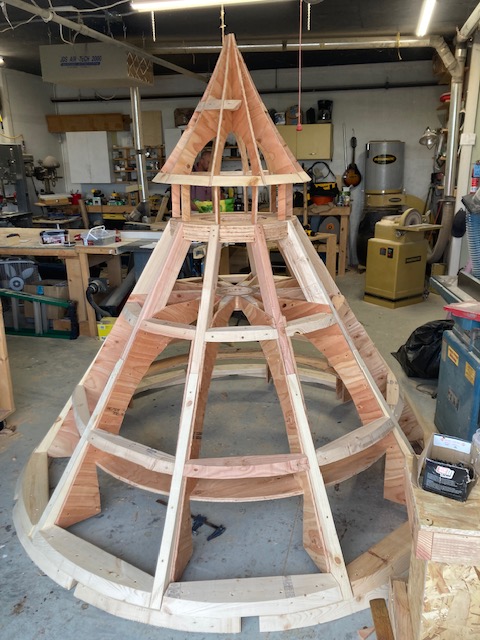
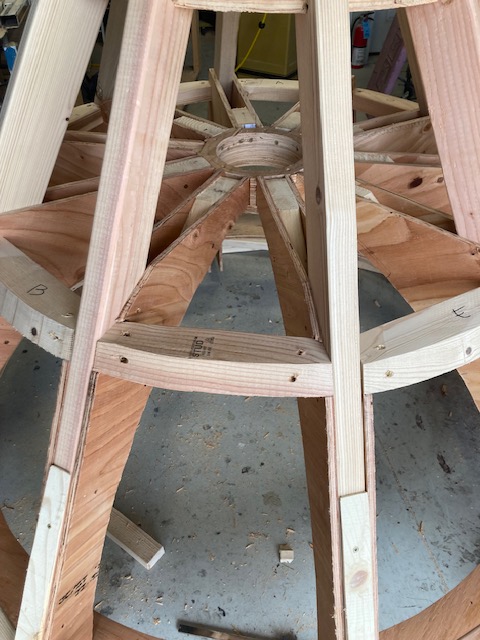
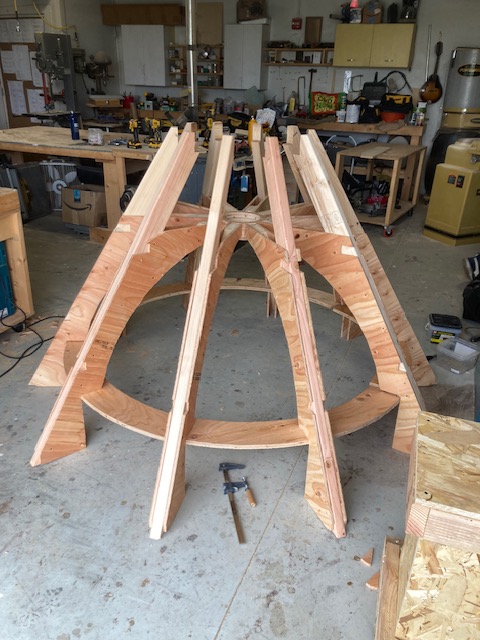
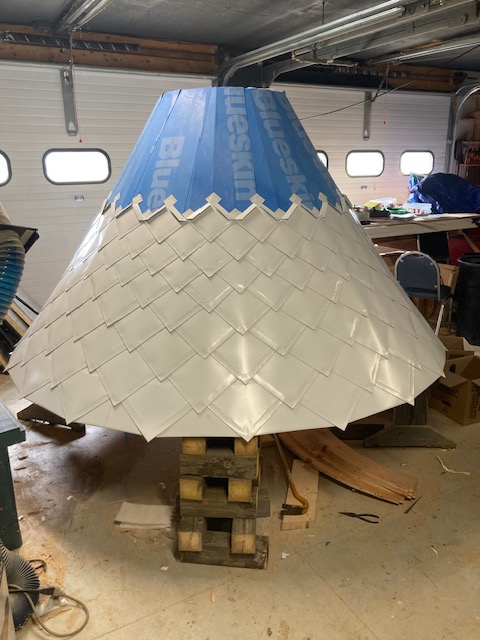
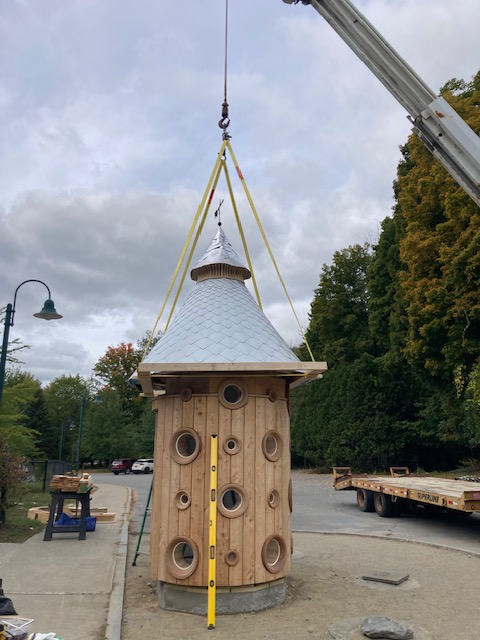
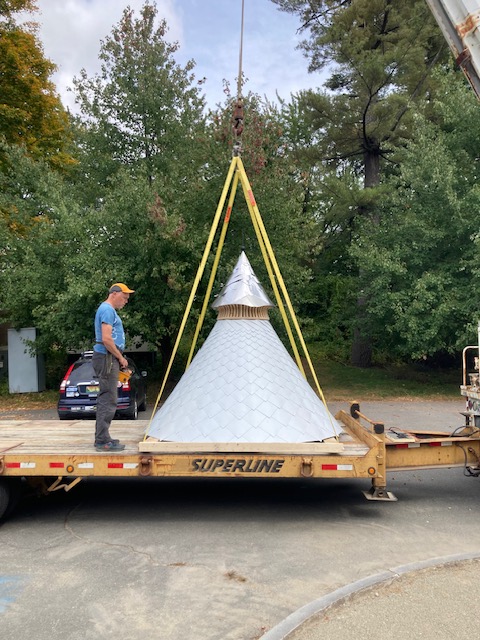
- a Basilica dome, framed by laminated plywood, covered with 480 aluminum shingles, all custom cut, bent to shape, then hand nailed into place;
- “purple martin” mini birdhouses nestled in, for good measure, among the metal shingles;
- a Cupola towers over all, covered in 31 galvanized shingles, cut from aluminum flashing;
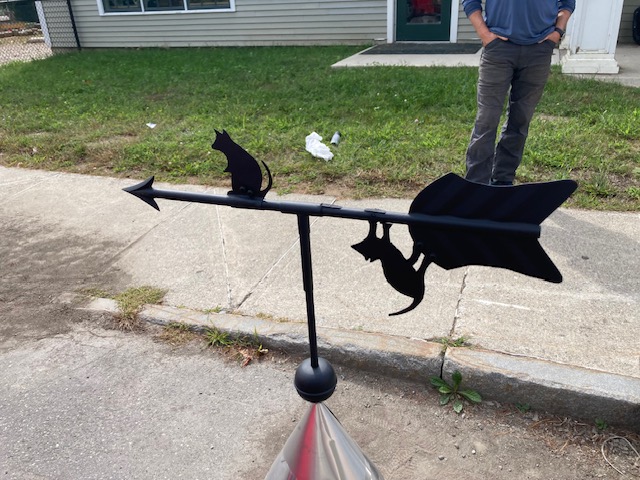
- upon which, like a cherry on top, sets the weather vane, with mice running to and fro.
In Southern Maine, everyone, it seems is a carpenter, or a DIY warrior at the least; but few, if any, could build such a structure, let alone conceive, design, and draw same. The Museum is the brain child of Chris Miller. It has been my highest honor to assist as his mere carpenter.
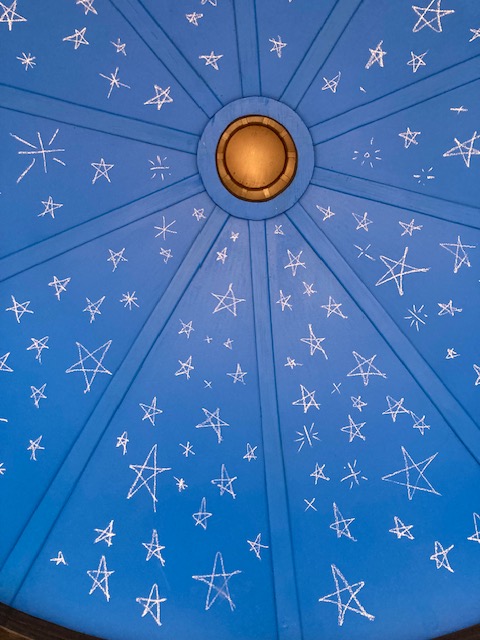
Inside the Basilica dome, Chris has painted the starry night sky, and through a keyhole oculus, the golden glow of the sun lies beyond. The Vatican may have Saint Peter’s Basilica and the Sistine Chapel ceiling, but Farmington has the Fairy Museum; Bernini and Michelangelo could do no better than Miller has done.

We built the Museum at Chris’ studio in South Portland, then moved the structure 72 miles north to Farmington. Jesse Salisbury, a sculptor of large granite and hard stones, graciously helped on this task. An artist friend once said to me, “The coolest people on Earth live in Maine,” and Jesse is exhibit A of same. Jesse’s story is almost fantastical, and I speak from personal experience as my daughter and I visited his studio, when she was 5 years old.
Jesse was born Downeast, a fisherman’s son. He began carving wood while in grammar school, but then his father became the Founding Director of the Portland Fish Exchange, America’s first all-display fresh seafood auction that opened in 1986. This lead to his Father becoming the Attache for Asian Fisheries, at the USA Embassy in Tokyo, Japan. In Tokyo, Jesse attended high school and began his formal artistic training, including with traditional ceramic artists. https://www.jessesalisbury.com/
His path lead back to Steuben, Maine where he and his father built his studio by felling trees, milling them into beams, to create a 32’ x 64’ post & beam workshop with design room, stone cutting, metal forging, fabricating and equipment repair shops. As a young man he foraged rocks from the fields Downeast, hauling them in his pick-up truck, but when the scale of his work increased, he purchased used heavy equipment from Bangor Hydro, the utility generating hydroelectric power on the Penobscot River.
Jesse and his Father laid 70 feet of train tracks, so that granite slabs weighing 10-tons or more easily move through the studio, from the wire saw to its indoor and outdoor fabrication areas. Jesse has carved and transported major installations throughout Maine, the Atlantic Seacoast, and maritime Canada. His work has also been displayed in Japan, China, South Korea, Egypt, and New Zealand. In his spare time, he founded the Schoodic International Sculpture Symposium, a ten-year project which resulted in a world class collection of large granite works that make up the Maine Sculpture Trail. https://www.schoodicsculpture.org/
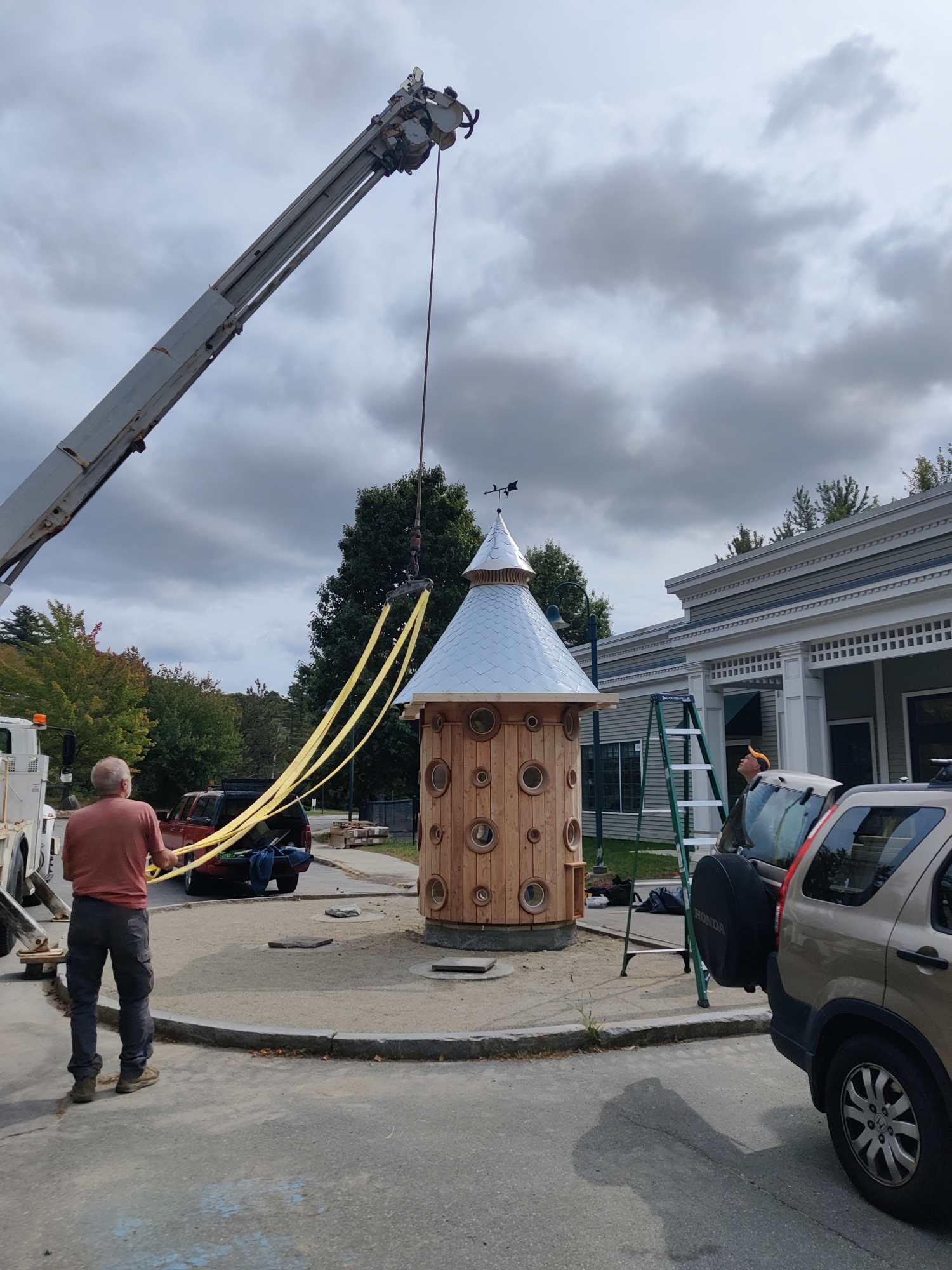
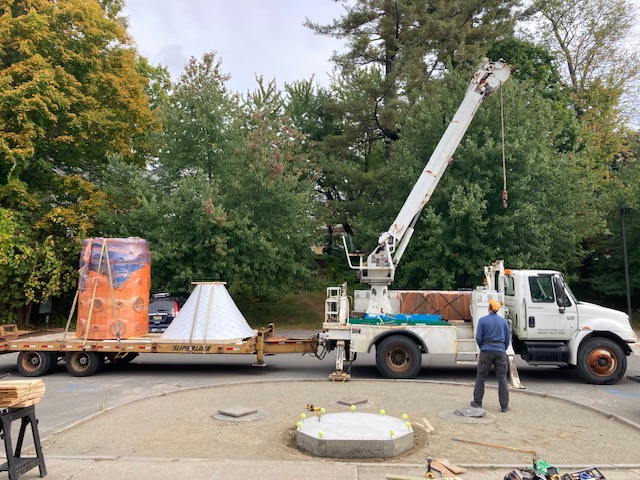
We made two trips north. First, Chris and I poured the dodecahedron concrete foundation, a 6” slab reinforced with rebar and anchor bolts set in the concrete. The forms, of course, were custom built. For the second trip, Jesse arrived at Chris’ studio on a Friday. His boom truck hoisted the structures easily onto his trailer. We strapped them down, then early on a Saturday morning convoyed North as misty fog hung upon the Casco Bay.
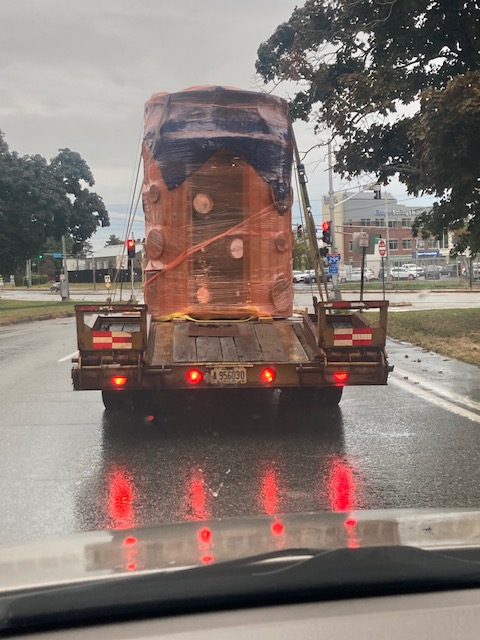
In Farmington, the sun was shining. On that idyllic September day, as crimson and golden leaves fluttered down, the installation went easily, each section stacked up, each upon the one below. A deus ex machina, indeed. The “silo” was anchored to the slab’s sill plate and the weather vane set atop the cupola.
By dusk we were gone. Chris returned later to apply finishing details.
And then, one Monday morning, children arrived at their daycare astonished to behold this creation. Like the “Night Before Christmas” I imagine they uttered, “When what to my wondering eyes should appear/But a Fairy Museum overnight landed here!!”













Walking
Posted: October 10, 2024 Filed under: Chronicles of a First Time Parent, Farming off the Farm, What is an Art Farm | Tags: AFSP, anxiety, depression, mental health, NAMI, suicide, suicide prevention 1 Comment
5 October was day 279 of 2024. Year-to-date, 274 lives have been taken by suicide in Maine.
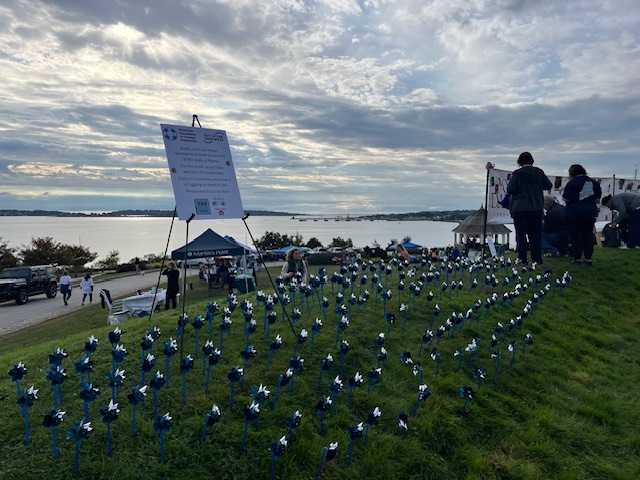
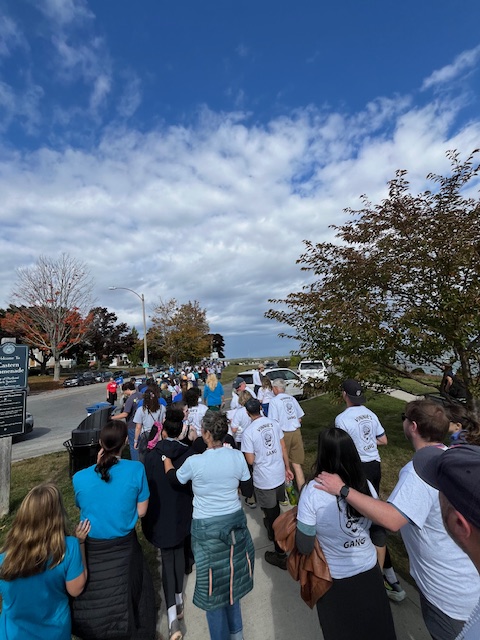
Last Saturday, on the Eastern Prom, “we the people,” deplorables and elite gathered to meet, to give voice, to bear witness, and to walk in support of Suicide Prevention. 800 people walked 2.2 miles with the majestic Casco Bay stretched out around us.
More than $120,000 was raised. Under the name “Healing Life” our family raised $820. We are eternally grateful for the support of our family and friends. We all went the distance. We all came together. Actions speak louder than words and as a family we shall do this again, a repetitive routine exemplifying our commitment to community.
In the early hours it rained, but the sun broke through. Beads of many colors were passed out: White for loss of a child, Red for loss of a partner, Gold for loss of a parent, every color of the spectrum, every reason to support suicide prevention, even rainbow beads in support of LGBTQ. One older man wore a rainbow shirt, that read, “Be a Good Human.” So simple, yet so hard.

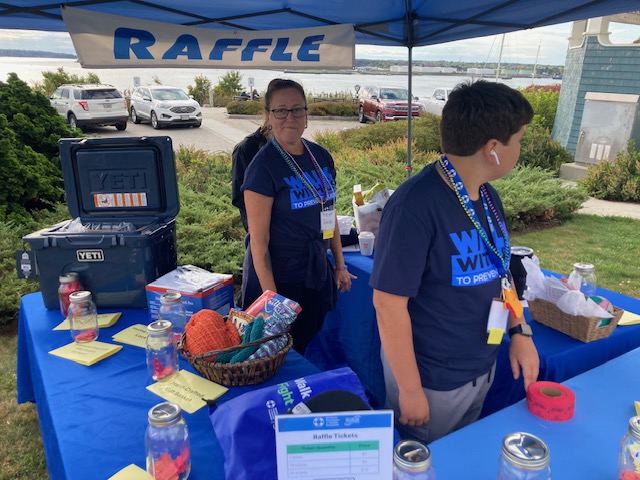
We worked the raffle table, which was a chance to engage with many people. One young child, age 6 perhaps, wore gold beads and a placard around their neck, bearing the single word, all caps, “DAD.” The Mother, now a widow, struggled to pay, and we helped her through the digital payment. As it turned out she won two raffle prizes.
She was one among many, all touched by the dark sceptre of death by suicide. Emotions were raw, so very hard to look life straight in the eye. But we did. We all did. And we walked in support of a cause.
The American Foundation for Suicide Prevention (AFSP) funds scientific research and public policy advocacy on a national level. AFSP Maine is one of a nationwide network of chapters, doing the grass roots work focusing on eliminating the loss of life from suicide. Members of our community were recognized, stood up, each story of loss told. It was gruesome, and yet, in our bearing witness hope was present.
In the South Portland Public Schools a Director of Mental and Behavioral Health has been hired, and people from the National Alliance of Mental Health, the CDC and AFSP are lending a hand. A team has been assembled and a community response is taking root. Our task now is that such hope is nurtured and blossoms.
I spoke to my daughter about my childhood, when shame reigned supreme, when no one would dare speak of suicide or mental health. To put this in context, I spoke of my Grandmother, whose first born child, in 1923, died of SIDS at 21 days then was told by her Doctors, “just go home and forget about it.”
As if.
Long is the road to greater acceptance, to understanding, but on 5 October, along the eastern Promenade of Maine, 800 people walked 2.2 miles.
Chairman Mao famously quoted the Taoist Master Lao Tzu, who said, in the 6th century BC, “the journey of a thousand miles begins beneath one’s feet.” Let us now stand together, let us walk and go forward, let us heal, we the people. Our childrens’ lives depend upon this simple truth.




_______________________________________________________
In our gardens, our variety of Butternut Squash has been harvested; Tomatoes produce their last; Pole Beans come in this week; Cosmos finally sings aloud in chorus; Mums reside on the entry porch.


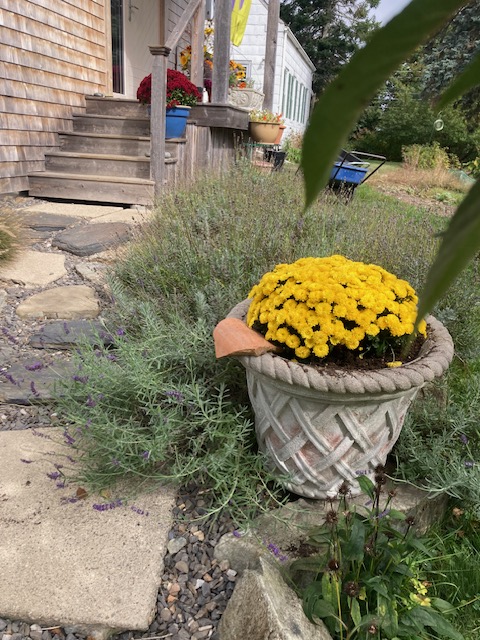

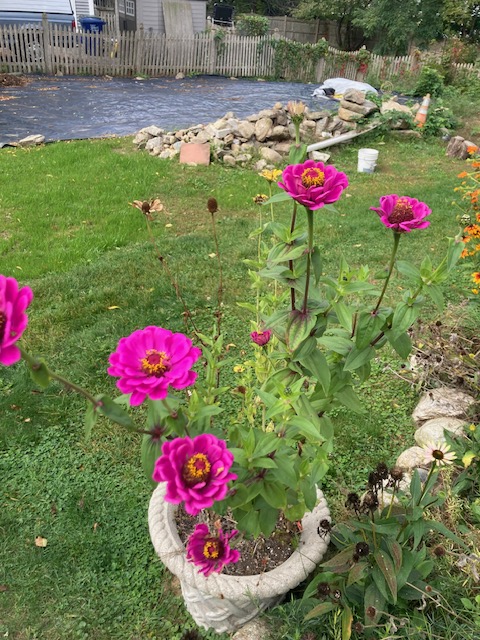



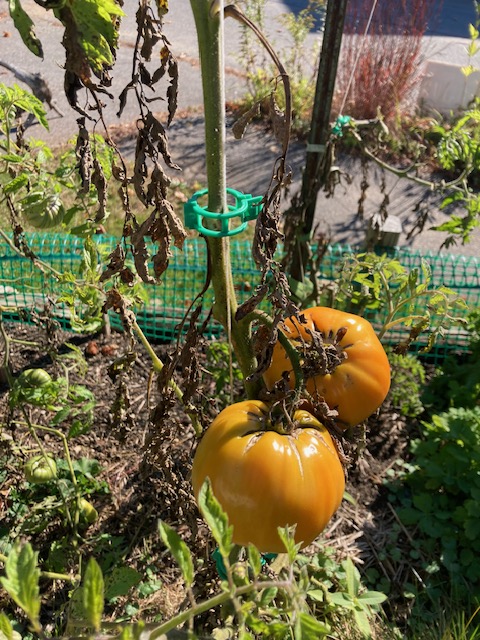

___________________________________________________
And tonight, in the sky overhead, the Northern Lights showered above, a heart, it seems, in the first photo. Enjoy…










Unabridged
Posted: October 4, 2024 Filed under: Chronicles of a First Time Parent, Farming off the Farm, What is an Art Farm | Tags: books, dictionary, language, unabridged dictionary, words, writing 2 Comments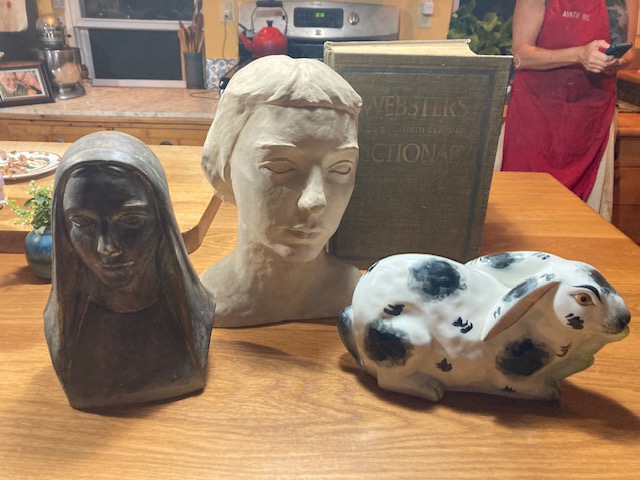
In my childhood, pride of place was given to a Webster’s New Twentieth Century Dictionary of the English Language, Unabridged, second edition (c) 1966. The massive book laid open, upon a bookstand that my Mother built, in the family room always beside the dinner table. Quick and easy reference was close at hand.
At 2,129 pages, plus addenda, the Webster’s weighs in at approximately 13 pounds, begins with “a” (first letter of the Roman and English alphabet: from the Greek alpha, a borrowing from the Phoenician) and ends with “zythum” (a malt beverage brewed by ancient Egyptians). The masterpiece is “based upon the broad foundations laid down by Noah Webster.” Such informed my childhood.
My frugal Mother, born in the Depression, bought groceries strictly on a budget, and received S&H Green Stamps for every purchase. We saved those stamps, compiled them into books, then drove to Glenview, Illinois to redeem same. The dictionary was purchased with Green Stamps, a day of victory, that I recall vividly, still.
Of the Silent Generation, she and millions of her peers diligently saved the Green Stamps. The Sperry & Hutchinson Company was founded in 1896 and operated until the 1980s, when consumerism became the vogue and frugality faded. But over 90 years the Beinecke family made a fortune, and funded the Beinecke Rare Book & Manuscript Library at Yale. In Greenwich, Connecticut, their 66-acre estate is now for sale for the first time, at an asking price of $35 Million, after more than four generations in the family. https://www.nytimes.com/2024/09/16/realestate/beinecke-estate-greenwich.html?smid=nytcore-ios-share&referringSource=articleShare
In my childhood home, words reigned supreme. My Father was a wordsmith, an Irish extrovert, who knew not the difference between a hammer or a screwdriver, but most certainly knew his nouns and verbs; subjects and objects; gerundives, gerunds, and participles; how to compose a sentence, how to frame his thoughts. When advertising came of age he worked as a Mad Man; known as the “Grocery Guru” his specialty was food merchandising. His gift of words allowed him to travel the world, holding meetings in Munich, giving speeches in Sydney; he commuted to his Manhattan office for lunch then flew home for dinner. He was published in multiple periodicals, and monthly in “Advertising Age,” then an upstart, which has become the standard bearer of the trade. After his death, my Mother continued the column for two years, writing “Consumer’s Viewpoint” telling the “Big Boys and Fat Cats” what she thought of their products.
And always, in our home, the Webster’s stood as stanchion, a ready reference, near at hand.
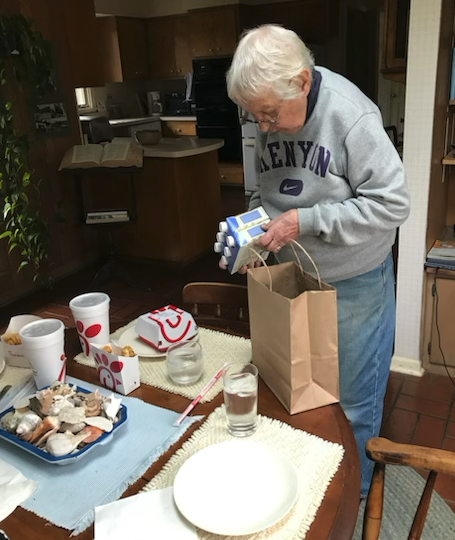
Last year my Mother sold the family home, and we emptied its rooms. Saving the dictionary was high on my list. I stored it at my sister’s, and then in August hauled it back home to Maine, along with sculptures my Mother had made. It was something of a cruel and unusual ask to have my children carry the tome through TSA at O’Hare Airport, but that I did. To my mind that task sealed their fate to the written word. Such is their origin story.
Growing up in the digital age of Google, my children may disregard the heavy analog hard copy book, a dull relic from the distant past. But long may it last on their bookshelves, and my hope is that it will endure as a reminder of their lineage. Languages change over time, such is their nature, but the story of the English language, derived from the German and Latin, and our ability to use words to frame our thoughts is an enduring aspect of our mind’s capacity to understand. I remain steadfast that there is a mysterious link between grammar and the mind.
A hard copy dictionary, then, is a bastion of that tradition. And for my children to understand same, is to know of their past. And so this Unabridged Dictionary is an heirloom of the highest regard here in our home. Purchased through frugality, cherished over many years.
______________________________________
Note: Kudos and thanks to Babs, of whom I say the apple fell not far from the tree. By kind permission of, I borrowed her phrase “…meetings in Munich, speeches in Sydney…”. And she provided the family room photo with dictionary and stand ever the sentry, the rear guard. Many thanks! 🥰
Joy of Aging
Posted: September 20, 2024 Filed under: Farming off the Farm, Permaculture & Home Renovation, What is an Art Farm | Tags: cranky uncle, silver tsunami 1 Comment
In my limited experience, there is a joy in aging. Certainly not the aching joints or onset of arthritis, but in the relaxed confidence, an acceptance of self. Well beyond the age of peer pressure, I have concern neither about my haircut, nor the shoes that I wear, all of which are quite liberating.
The cliche of the “Cranky Uncle” is but one example. At the Thanksgiving table, he lets loose in too blunt a manner which may be simply that he has achieved, at last, a “devil may care” attitude, a sense that time is of the essence. The accuracy of his information tends to be of little concern, to himself at least. The “Cranky Uncle,” in fact, is so ubiquitous that it has become the name of an app that “builds resilience against misinformation.” https://crankyuncle.com/
If the “Cranky Uncle” is the dark side of anger, then the uplift of mirth was expressed by Jenny Jones, the British poet, in her famous work, “Warning: when I am an old woman I shall wear purple.” Her poem was twice voted Britain’s best-loved poem, and she was described as “one of Britain’s best loved poets.” Her words were proof that we can age with grace and wit, a singular independence. We would do well to follow her lead.
These thoughts come to mind because the “silver tsunami” has begun with over 10,000 people per day now turning age 65. By 2030 more than 73 million Baby Boomers will be over age 65, a demographic shift of unparalleled scale.
I am a Baby Boomer, born at its tail end. I therefore feel eligible to opine that we have skimmed the cream, and the world we leave to our children’s children, is, I fear, darkened by the shadow of our deeds.
Early in the Boomer era, an active idealism rose: civil rights, voting rights, environmental protections, the Clean Water Act, a woman’s right to choose, and protests against endless wars of the Empire.
As a young boy, I went one night to my long-haired neighbors, to help paint cars for a convoy to a Vietnam War/anti-Nixon protest. I loved it, all of it, the idealism and sense of community (among some but certainly not all).
By 1980, when the Boomers’ careers had begun the zeitgeist changed; capitalism roared into vogue, taxes were cut, deregulation began. The success of the Boomers seems unparalleled:
- In 1967 the movie “The Graduate” contained the prophetic line, “Plastics…there is a great future in plastics.” Fifty-seven years later every person on the planet ingests about 5 grams of microplastic every week – the equivalent of a credit card – eaten every week, every year by every person, all 8.1 billion of us, with no end in sight. More than likely, the quantity will increase.
- In our insatiable quest for red meat, more than 185 million acres of the Amazon River basin have been clear cut since 1978; food production accounts for one-quarter of the world’s greenhouse gas emissions and takes up half of the planet’s habitable surface. A diet that includes beef has 10 times the climate impact of a plant-based diet.
- The “fast fashion” industry is responsible for over 20% of global water pollution while producing 100 billion garments per year, of which 92 million tons end up in landfills, the equivalent of one semi truck of waste every second, every day. The average consumer throws away 81.5 pounds of clothes every year.
- The richest one-fifth of the world’s population possess 80 times the income of the poorest one-fifth, and the richest one-fifth uses over 86% of the world’s resources. In America, the top 0.1% average wealth is $1.52 billion USD per household.
- From 1979 to 2022 wages grew 32.9% for the bottom 90%, 171.7% for the top 1%, and 344.4% for the top 0.1% of the USA population.
- More than 99 million people now face emergency levels of hunger, while more than 1.1 million people are in the grips of catastrophic hunger.
- Baby boomers will bequest a total of $72.6 trillion in assets through 2045.
The transfer of assets is defined in financial terms but represents essentially a set of values which will govern how those funds will be used. If we think of $72 trillion as a lever, with values as its fulcrum, then Archimedes comes to mind: “Give me a lever long enough and a fulcrum on which to place it, and I shall move the world.” Change is still possible.
Another poet wrote “This is the way the world ends/Not with a bang but a whimper.” We might replace “bang” with “boom” while “whimper” could yet become “win.” This is a matter of some urgency as the silver tsunami rolls on.
I am a parent now, raising children coming of age. My approach here is to be forthright about what we have done and with what they must deal; I value honesty more than politeness, and future generations should be clear sighted, to act with compassion and a commitment to social justice. A certain non-conformance may be required, and to that end the “Warning” of Jenny Jones, indeed pertains:
When I am an old woman I shall wear purple
With a red hat which doesn’t go, and doesn’t suit me.
And I shall spend my pension on brandy and summer gloves
And satin sandals, and say we’ve no money for butter.
I shall sit down on the pavement when I’m tired
And gobble up samples in shops and press alarm bells
And run my stick along the public railings
And make up for the sobriety of my youth.
I shall go out in my slippers in the rain
And pick flowers in other people’s gardens
And learn to spit.
You can wear terrible shirts and grow more fat
And eat three pounds of sausages at a go
Or only bread and pickle for a week
And hoard pens and pencils and beermats and things in boxes.
But now we must have clothes that keep us dry
And pay our rent and not swear in the street
And set a good example for the children.
We must have friends to dinner and read the papers.
But maybe I ought to practise a little now?
So people who know me are not too shocked and surprised
When suddenly I am old, and start to wear purple.
_________________________________________________________________________________________
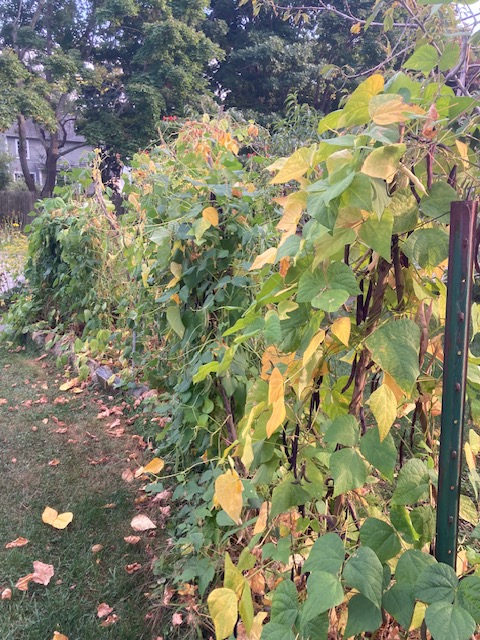
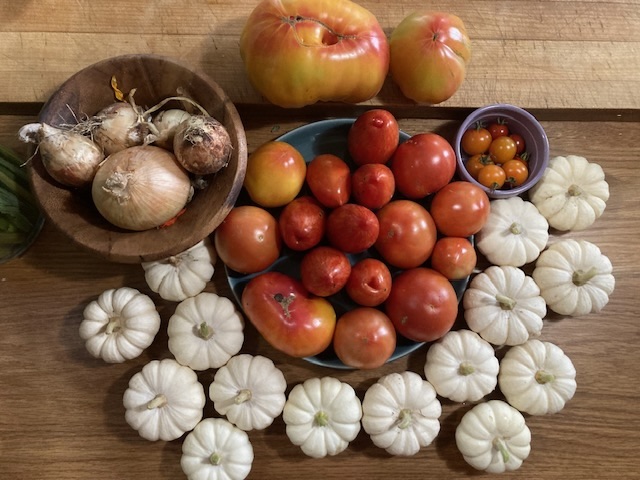
The thrum of summer has quieted, the Supermoon Full Moon Lunar Eclipse passed on Tuesday, cool nights of autumn descend: Pole beans ripen, Winter squash come to its full, Brussel Sprouts fatten, Poblanos produce still, Tomatoes remain abundant, the Cucumbers are spent, while Tithonia still shouts “look at me!!!” We will plant garlic come November.







The Grandest Cataract in New England
Posted: September 12, 2024 Filed under: Art & Healing, Portfolio - David's work, What is an Art Farm | Tags: Androscoggin River, Cancer Valley, Edmund Muskie, Hugh Chisholm, Public Art, Restoration, Rumford 2 CommentsRumford Falls, Maine is situated where the Concord, Ellis, and Swift rivers converge into the Androscoggin River, which form the watershed of the Western Maine mountains. At the Falls, called the “the grandest cataract in New England,” the Androscoggin drops a total of 176 feet over a sheer wall of granite.

In our pre-industrial age, indigenous peoples gathered there to hunt, fish and trade furs from the Lakes Region of Maine. In 1882, history forever changed when industrialist Hugh Chisholm grasped the Falls’ potential for the manufacture of paper.
Chisholm first built a railroad, then a mill for his Oxford Paper Company, which grew to become the founding asset of International Paper Company, the corporate behemoth, still active today. A Utopian, he also built planned community housing for the workers in his mills, which housing became a model for the nation. Chisholm hired architects to build great buildings in Rumford, those architects also having designed the Waldorf Astoria in Manhattan, and the Copley Plaza in Boston. At its peak, in the 1930s, Rumford held its own with Manhattan, but today it has fallen deeply into the abyss.

Rumford, and the surrounding River Valley towns of Maine, are known nationally as “Cancer Valley” given the incredibly high rates of cancer among its mill-working inhabitants. Four out of five children are food insecure, while Rumford has the highest special education population in the state of Maine. The opioid crisis has run rampant, and Rumford’s rate of crime is now the highest in Maine.
Rumford Falls is but one, among many cities, ravaged by the flight of capitalist money, ever in pursuit of profit. The New York Times recently reported, “Milwaukee was once known as the ‘machine shop of the world.’ In the 1950s, nearly 60 percent of the city’s adult population worked in manufacturing…. By 2021, Milwaukee had lost more than 80 percent of its manufacturing jobs (barely 5 percent of those that remained were unionized), and it had the second-highest poverty rate of any large American city…. Between 1997 and 2020, more than 90,000 factories closed, partly as a result of NAFTA and similar agreements.”
Last Sunday, I was in Rumford Falls helping on a Public Art project. Although the politics of free trade is vitally important, my work focused upon the power of art, the agency of making, and the process of civic discourse; how does a community rebuild once the rivers of cash flow have dried up?
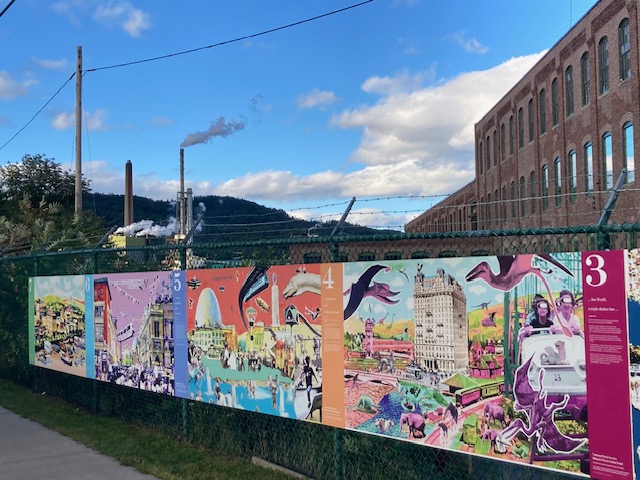
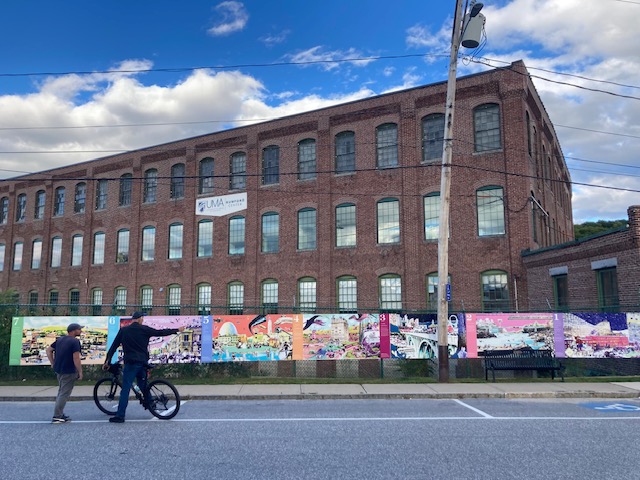
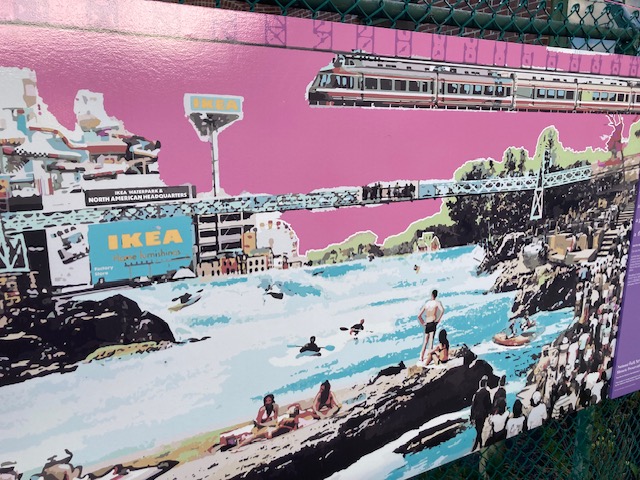
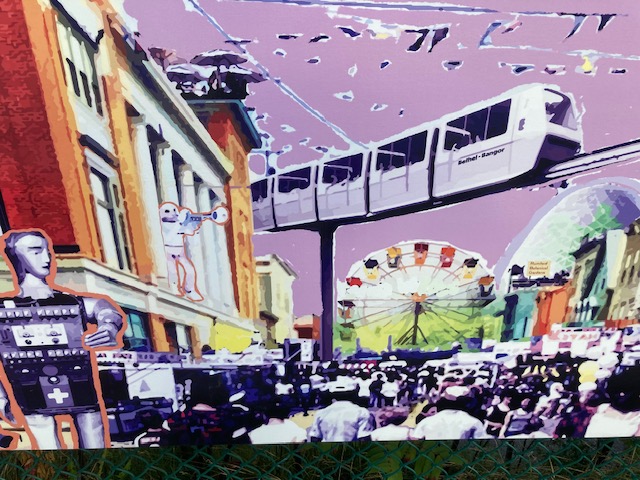
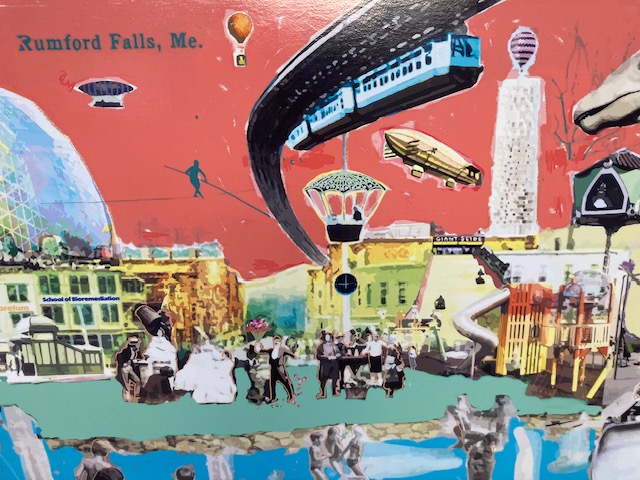
A real estate developer recently purchased Rumford’s old mill building for the price of $1 USD, and she has received a grant from the Department of Agriculture to put solar panels on top of the mill, and another from the National Parks Foundation “historic preservation” fund with the condition of “community engagement.” The developer promptly called Chris Miller, and asked, “I have the building, and a chain link fence out front. Can you do something of civic engagement?” Chris pondered the problem.

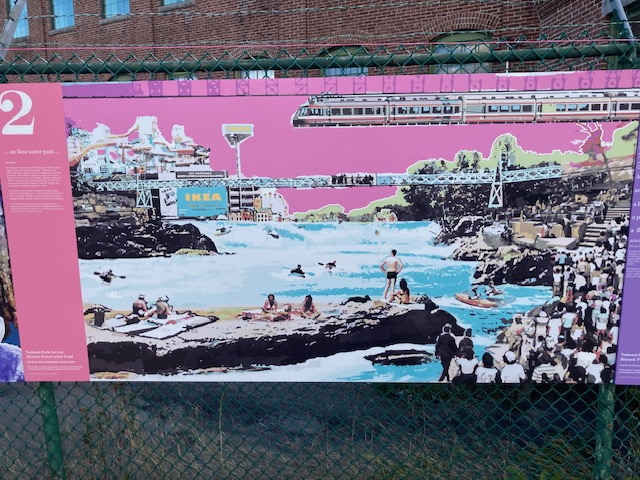
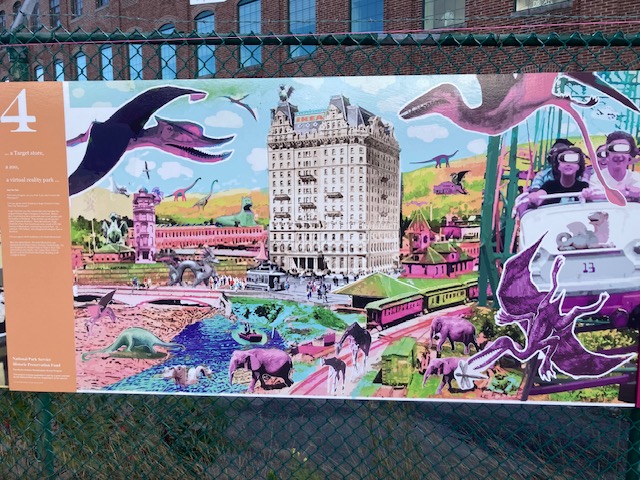
He decided to ask the citizens of Rumford what their desired future might be? Adults declined to respond, but a classroom of 3rd grade students enthusiastically spoke up. Chris’ question was “If you lent your hand, if you had your say, what would Rumford’s future gain? If you wore a hat that said “Civic Leader,” what might Rumford’s future feature? Would you champion a cause, plant more flowers, have a parade or build a tower? Would you open a business to meet a need? Would you captain a brand new industry? Would you start a club or paint a mural? Would you build a park in honor of a hometown hero?”
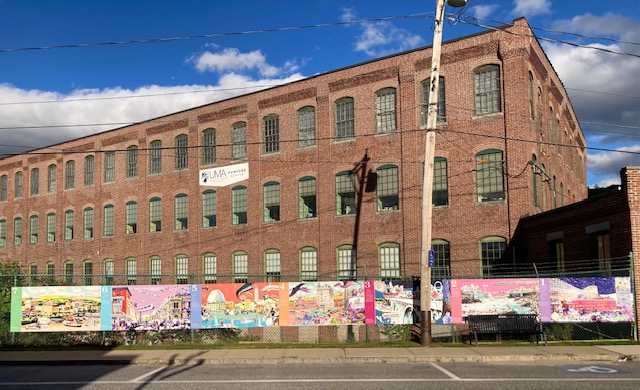
The 8- and 9-year old students offered fantastical ideas: a skyscraper, an amusement park, an IKEA water park, trains running upside down. Gathering their bold ideas, Chris set them down graphically in the style of a picture postcard, then printed on vinyl adhesive which he affixed to seven 4×8 sheets of 1/2” masonite. My role was minimal, priming and painting the boards and helping Chris hang them upon the chain link fence.
His design links to Rumford’s past, given that Hugh Chisholm made his first fortune printing picture postcards, holding the monopoly contract with the United States Postal Service to print all of the picture postcards sold in United States post offices at the turn of the 19th century. The Rumford Mill produced all those postcards, as it grew into its peak production years.
The children of today very likely could become the leaders of our future. Rumford’s native son, Edmund Muskie, was born there in 1914 and then wrote and championed both the Clean Air Act and the Clean Water Act in the 1970s. His political leanings have been demonized by many industrialists, but one has to wonder how his Rumford childhood shaped his environmental thoughts.
Restoration, it seems, is the work of our times. The task in Rumford is how to build a new economic base, to clean up after decades of toxic waste, and to heal generations of families whose lives have been shaped by the working conditions at the Mill and power plant on the Androscoggin River. Chris’ “picture postcards” are but one very small step, but Rumford’s task of recovery does move forward.








When Tears Become Bullets
Posted: August 22, 2024 Filed under: Chronicles of a First Time Parent, consciousness, Permaculture & Home Renovation, What is an Art Farm | Tags: hypermasculinity, jackson katz, the boy code, william pollock 2 Comments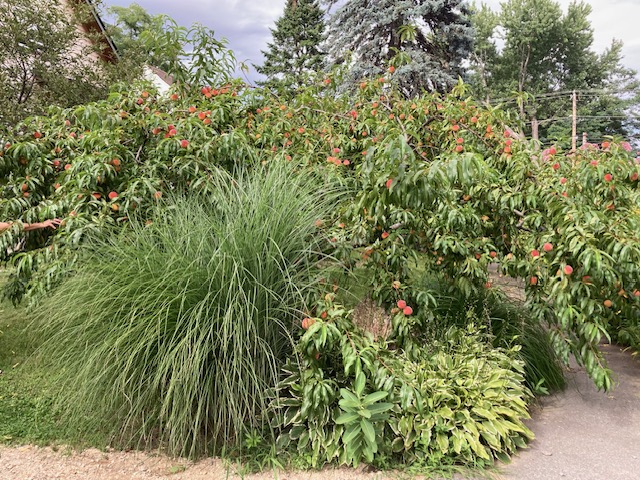
In 2001, I met and soon moved in with a remarkable young woman, an art therapist, who had worked with young children at Byrd Elementary School at Chicago’s Cabrini Green housing project, as well as in the Robert Taylor Homes and Cook County Hospital. Working with inner-city boys, she was driven to thread the emotional needle, to help them move forward.
In that studio apartment, on her bookshelf, was ”Real Boys” written by William Pollock, PhD about “the myths of boyhood,” how our society shapes boys to become men. I tried repeatedly to crack that cover but could not. It cut too close to my core.
I quote now the four core tenets of what Pollock called “the Boy Code”:
“The sturdy oak: Men should be stoic, stable, and independent. A man never never shows weakness…boys are not to share pain or grieve openly.
Give ‘em hell: This is the stance of some of our sports coaches, of roles played by John Wayne, Clint Eastwood, and Bruce Lee, a stance based on a false self, of extreme daring, bravado, and attraction to violence.
The “big wheel”: This is the imperative men and boys feel to achieve status, dominance, and power. Or, understood another way, the “big wheel refers to the way in which boys and men are taught to avoid shame at all costs, to wear the mask of coolness, to act as though everything is under control….
“No sissy stuff:” Perhaps the most traumatizing and dangerous injunction thrust on boys and men is the literal gender straight jacket that prohibits boys from expressing feelings or urges seen as “feminine” – dependence, warmth, empathy.”
In short, big boys don’t cry. When I was young, my father – who lived to seize the brass ring, to slay the dragon, to climb the mountain, then died young – he repeatedly told me, “David, you can get used to hanging if you have to.” My football coaches always rhymed “no pain, no gain!” I fault neither my Father nor the coaches, as they only passed on what they had been taught. About all this, Pollock cautioned, “when boys cannot cry, their tears become bullets.”
Bullets, of course, can be metaphorical, and but one example would be the Wall Street “Masters of the Universe” among whom “might is right” with finance a zero sum game of domination, power and control. Consider hedge funds buying up the foreclosed housing stock and then raising rents, in the midst of a housing shortage. Or private equity buying medical practices, to maximize profits at the expense of patient care.
The first rule of the Boy Code is that we don’t talk about the Boy Code. I violate masculinity in writing this meditation upon raising a daughter and son in a culture where hypermasculinity is the norm. I speak here not of the male gender but the masculine traits, as taught.
Jackson Katz, a male pioneer in women’s studies, has written a book titled “Man Enough?” about the “Politics of Presidential Masculinity.” Presidential campaigns are described “…as the center stage of an ongoing national debate about manhood, a kind of quadrennial referendum on what type of man—or one day, woman—embodies not only our ideological beliefs, but our very identity as a nation….how fears of appearing weak and vulnerable end up shaping candidates’ actual policy positions…”
I write here neither to praise nor denigrate any candidate. My concern is our culture of dominance. In this time of hypermasculinity, where we demonize “other,” be they immigrants, the extreme right, the “marxist” left, Neo-nazis, ad infinitum, I am compelled to ask what if the problem is not “them” but us? It is so easy to point and blame “them” but infinitely more challenging to say it is our system of beliefs, self-reinforcing, which perpetuate cycles of violence, a culture of dominance rather than compassion.
Jackson Katz gave a TED Talk titled “Violence against women – it’s a men’s issue.” He makes the subtly persuasive point that rational self interest in a patriarchal society becomes a self-reinforcing system of belief; there is no conspiracy but a self interest in maintaining the status quo rather than embracing change. By analogy, Newton’s First Law of Motion here pertains, that a system of domination will persist until it is acted upon by an external force strong enough to bring change. https://www.ted.com/talks/jackson_katz_violence_against_women_it_s_a_men_s_issue?subtitle=en
“It takes a village” becomes my curse. In our home we raise children to value empathy, compassion and emotional intelligence, but the world into which they go – are schooled, coached and policed – there predominates the hypermasculine. How do we raise our children to be compassionate when their peers practice dominance? “Gentle as a dove, wise as a serpent,” comes to mind.
As a child, I would read the Sunday comics seated below my Father, while he devoured the business news. Pogo, the political satire, ran in those comics, with its theme “We have met the enemy, and He is us.” More than fifty years have passed and some demonize the “Deep State” or “them” but I ask, what if Pogo really was right? What then, if we ourselves are the problem?
An honest awareness seems a necessary starting point in a new dialogue.
* * * * * * * * *
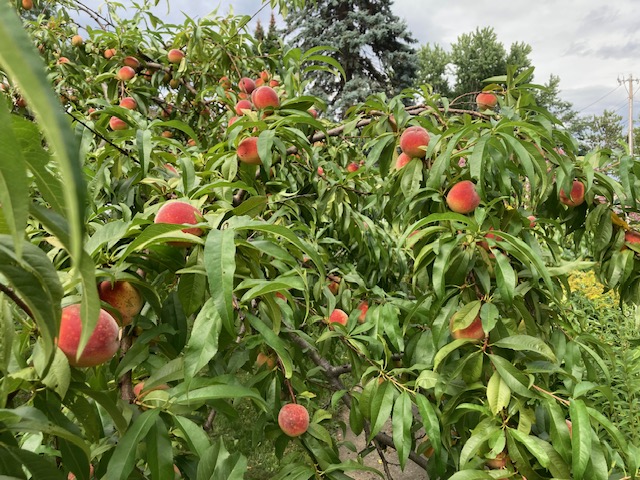
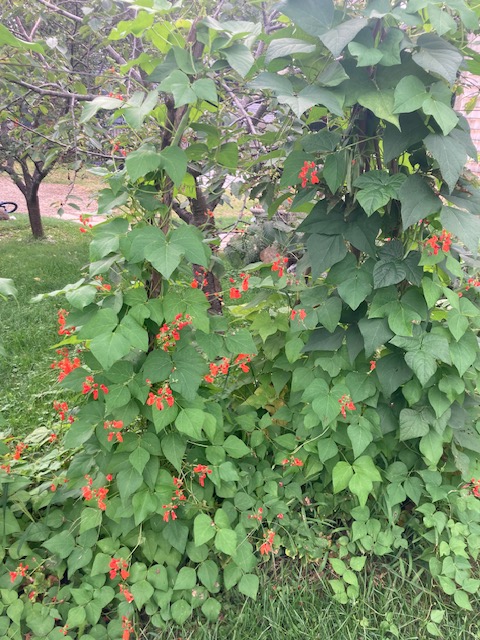
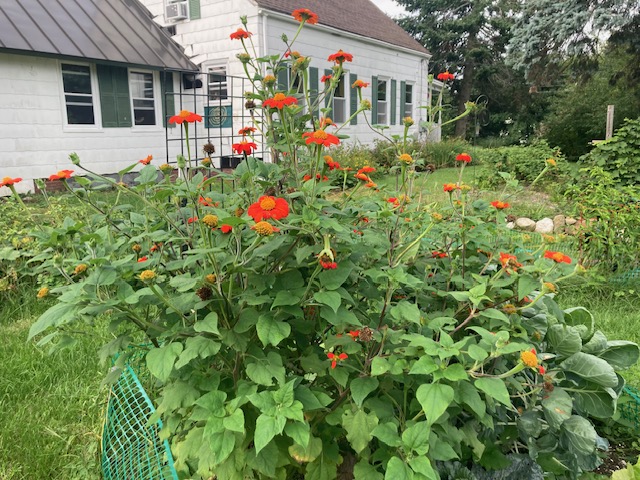
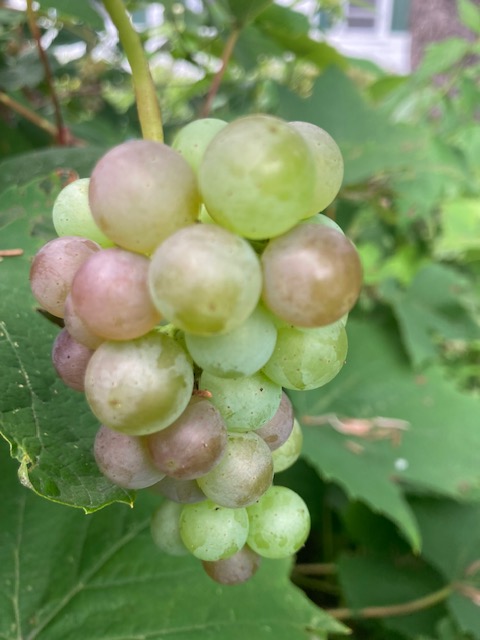
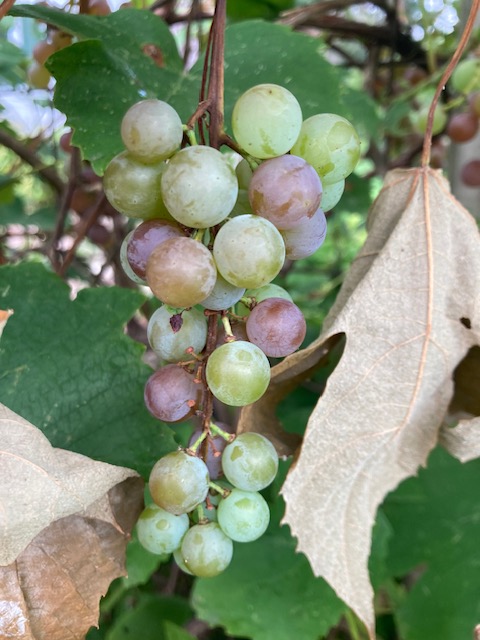
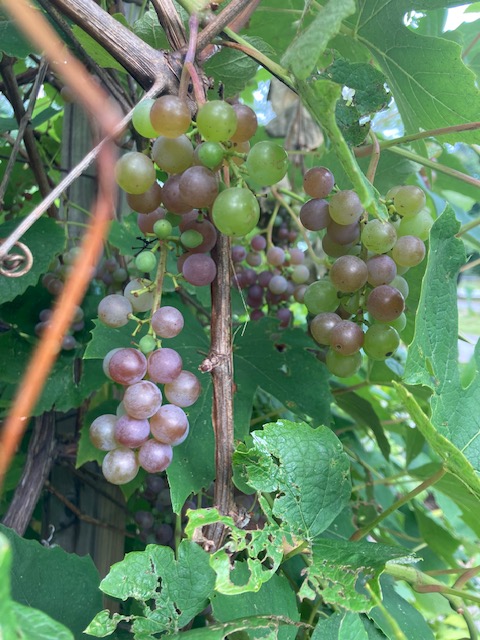
Here at an art farm Bacchus has arrived bearing wild seedless Champagne grapes. Jimmy Nardello Italian Frying Peppers are abundant. Tomatoes exceed our capacity to use. Pole beans flower, to attract hummingbirds. Butternut squash grow on the vine. Peaches are ripe for the picking. We bring bushels of produce to the Food Cupboard.




Saturday on the Street
Posted: August 9, 2024 Filed under: Art & Healing, Farming off the Farm, Permaculture & Home Renovation, What is an Art Farm | Tags: Norway maples, tree work 3 Comments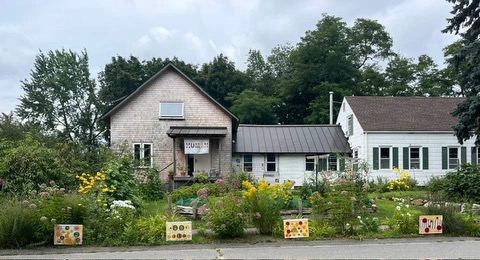
In 1830, in South Portland (known then as Cape Elizabeth) a New England farmhouse was built and its barn completed by 1848. The town’s population was 1,696 people and only six families lived on the street where the farm was located. The farm most certainly had significant acreage.
In 1999, South Portland’s population had grown to 23,324, and the last remaining farmland surrounding this farmhouse was sold off to make a development of six homes. In modern times developers put their road wherever best suits their plan but in 1830 the builders sited the home thoughtfully, based upon the sun’s path; they needed to maximize the solar gain as a heat source. The home’s location then determined where went the developer’s road and the old front yard was paved to put in a street named in honor of the developer’s daughter. The home, which we purchased in 2012, was left with a smaller, but still full sun front yard, enough space to garden and grow food and fruits.
We have felt guided here in creating a healing space. Neighbors have brought wounded birds into our garden, tucking them under the plants, as a place to heal. Young Mothers bring their infants to gaze and we gift them vine ripened tomatoes. We grow less as a matter of sustenance and more as a gift to be given, to be shared.

Saturday on our street was very active. Art work arrived from Chicago, from our dear friend Laurie LeBreton, a sculptor whose work combines handmade paper and mixed media. She explains, “I work to access something beyond our concrete world and to find meaning and comfort as I do so. Recent themes have included healing, refuge and ritual.” If yard placards tend to promote politics, Laurie’s speak to art and healing. We embraced Laurie’s generosity and eagerly put them on our side of the street. https://www.laurielebreton.net/

Also on Saturday, very large gooseneck trailers arrived to unload massive paving equipment, parked on the other side of the street. A dialectic began between the mechanized and the natural. If our “Orwellian” week was a “heavy equipment summer camp,” then this week has been about “massive paving equipment and road grinding at night.” My son was over-the-moon delighted. On Sunday night the City began grinding streets here, and the equipment has moved to several other jobs in town. Nightly we have driven to see them work.
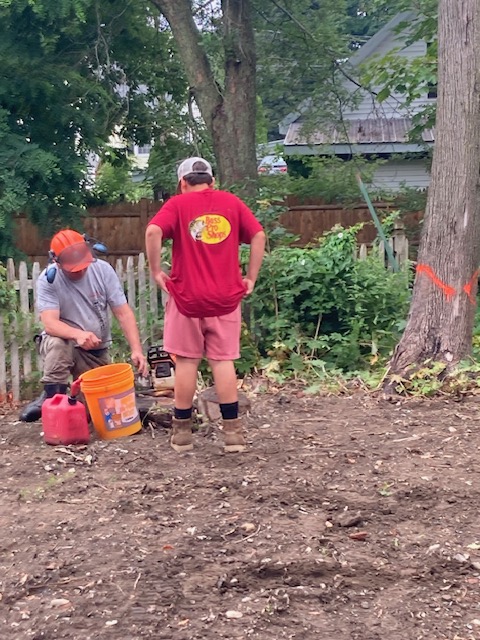
Also on Saturday our work on the invasive Norway Maples continued. Our friend Nate arrived, a journeyman carpenter, master of many trades, and he brought tools for tree work. Nate taught my son how to use a come along, how to sharpen a chain saw, and to use the Phythagorean Theorem to calculate where the tree would fall. My son put on his work boots and got busy.
Norway Maples are not native to America. They were brought here first in 1756, by a nurseryman in Philadelphia, and became popular as an ideal street tree. During the 1970s when the Dutch Elm Disease decimated the urban canopy, the Norway Maples became ever more prominent, but the trees promote a monoculture and grow rapidly, spreading seeds by the wind. They shade out competition. Because they grow fast, their wood grain is long, not tight, and they easily sheer and crack in heavy weather, which has become increasingly more prominent here in Southern Maine.

Two years ago, during a late autumn wind storm, a Norway Maple, with 8” trunk, split and fell onto our swimming pool. Thankfully we were able to repair the pool. Last winter, a much larger Maple, 18” diameter, splintered and fell into the neighbors yard. It leaned precipitously, and my intuition told me not to DIY but to get help.
Nate used the “come along” – a sort of ratchet winch – to direct the tree away from the neighbors yard and to his designated spot. My son worked the come along, tightening the line by cranking to pull the tree down, as Nate cut into the trunk.


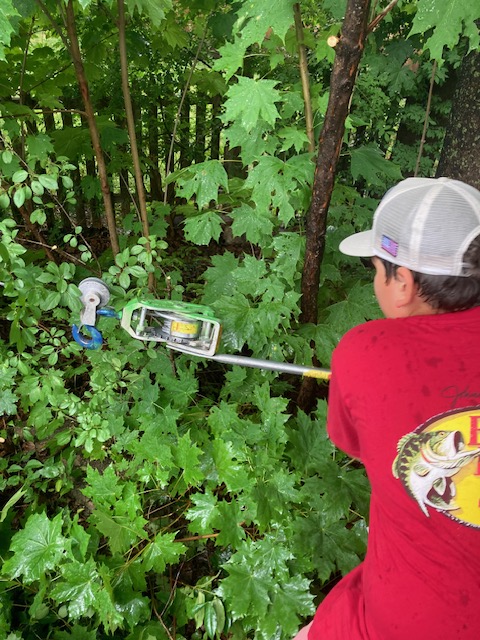
It took a village but the tree is felled, and we have firewood for our winter.
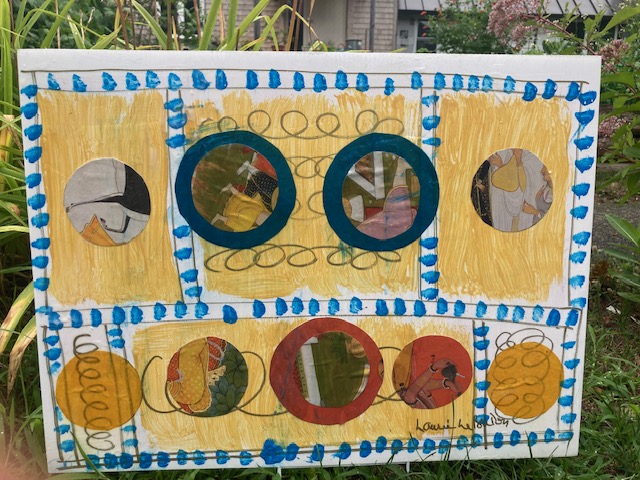

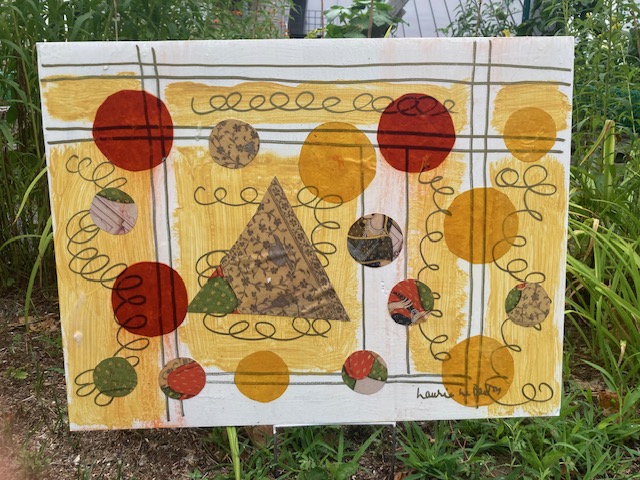
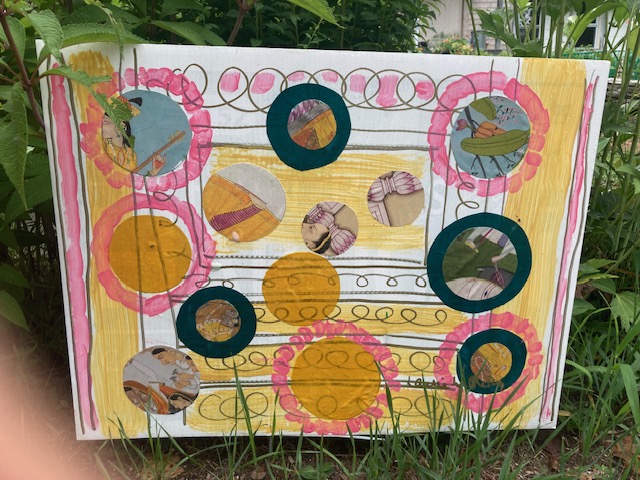
All Is Well Again
Posted: August 2, 2024 Filed under: Farming off the Farm, Permaculture & Home Renovation, What is an Art Farm | Tags: embedded energy, renovation 2 Comments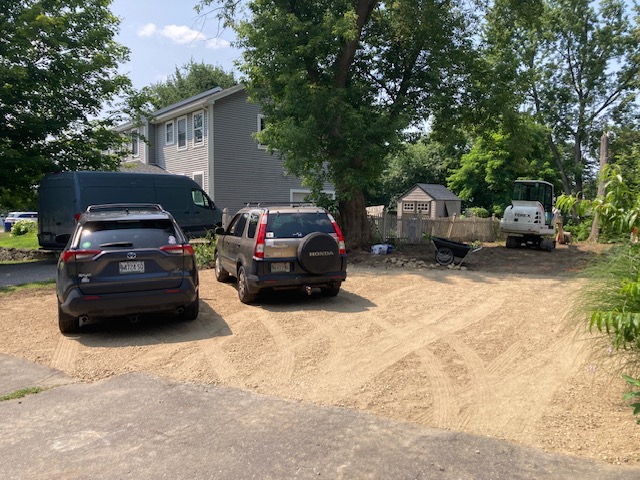
On 22 July I wrote about circumstances “Orwellian,” but on 2 August I can report that “all is well again.” We have cured the problem: gone is the gravel pile, our insurance will not be terminated, and we have made arrangements to switch to another carrier at end of this month.
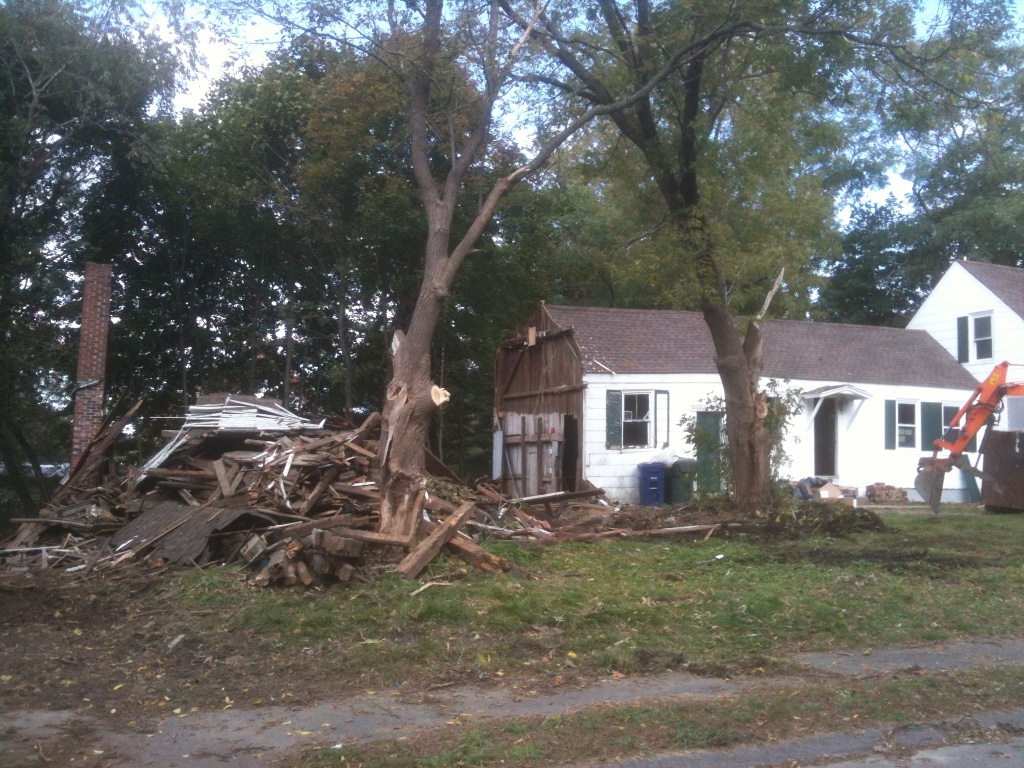
The project was twelve years in the making. When we bought the farm, Labor Day 2012, our son was in utero and my wife in her third-trimester. We had but little money, and less time to make any renovations. The barn was beyond repair – beyond our budget, more precisely – so we tore that down. I saved as many beams and sheathing boards as I could but the rest was hauled away. Nine yards of rubble, from two brick chimneys and concrete sidewalks remained, overgrown by invasive plants. Last week, having moved the gravel and made the driveway larger, we continued north to grub out more than 50 stumps – along 50 linear feet of fence line – of the rapidly growing, invasive Norway Maple.
Our farmhouse, in the classic New England style of “big house, little house, back house, barn,” is 200 years old, built when Andrew Jackson was the 7th President of the United States. The barn was completed in 1840, which I know for a fact, having saved one beam with that date proudly carved by the makers into the wood. All materials used in this house were sourced locally, within a mile or two, trees felled, then moved and milled by hand.
Some of the barn sheathing boards are 26” wide, and given the growth rate of pine trees, we can deduce that the tree from which that wood came sprouted circa 1681, which is five years before the English King James established the “Dominion of New England” which covered all of New England and the Mid-Atlantic colonies. The Charter of Pennsylvania, sovereign and independent from the Dominion, was signed by King Charles in 1681 granting the Quakers land for religious freedom.
Restoring this home is a yeoman’s task. We bought the home at a foreclosure price, plus 20-years of hard labor. We are only halfway toward our goal. In doing this work we are not making this home great again; “never better” is my goal. The home never had insulation and was cold and drafty. We have super-insulated more than half, but work remains. I will need to rebuild the foundation of the Ell, while we live in the house. The invasive Maples are an ongoing nuisance.
The charm of the hand built home seems to be its simplicity, its economy of purpose. I have neither the income nor interest in anything opulent. I seek not a monument to myself. For the driveway project I chose gravel, which is underwhelming to many, but to my mind the better choice because it is both less expensive and fully functional. I have learned that I am happier living on a dirt road, and on my half-acre I have chosen same.
More importantly, in terms of environmental impact, gravel has a minimal carbon footprint compared to the very high embedded energy – the petroleum consumed both in manufacturing and applying – of asphalt pavement. Hard though it may be for my children to grasp this point, it is my responsibility to model sustainability, to the extent possible.
My curse is the adage “a carpenter’s home is never finished.” And so life goes, but in the meantime all is well again, never better.
* * * * * * * * *
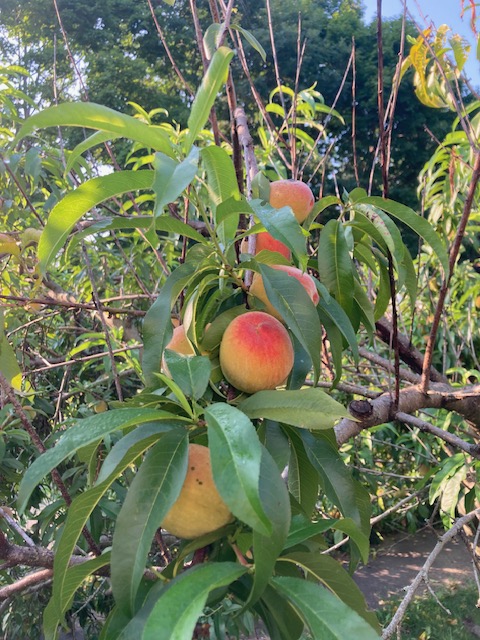
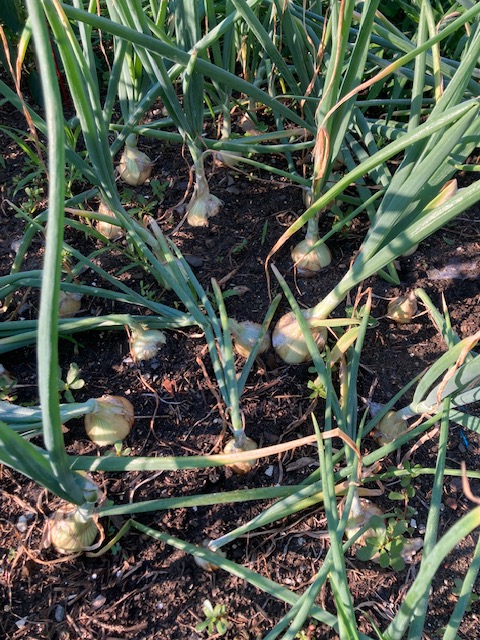
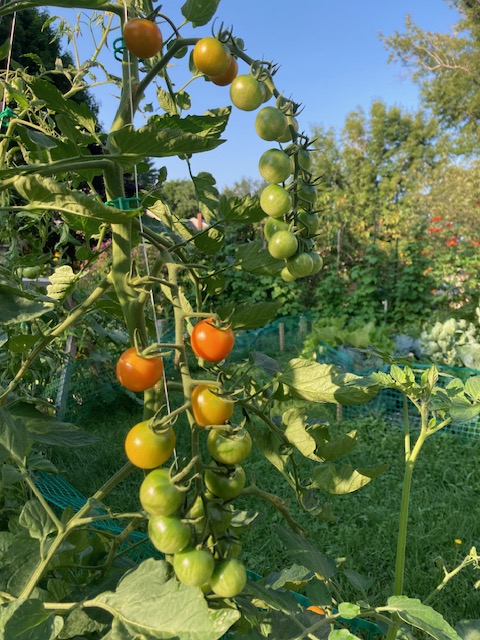
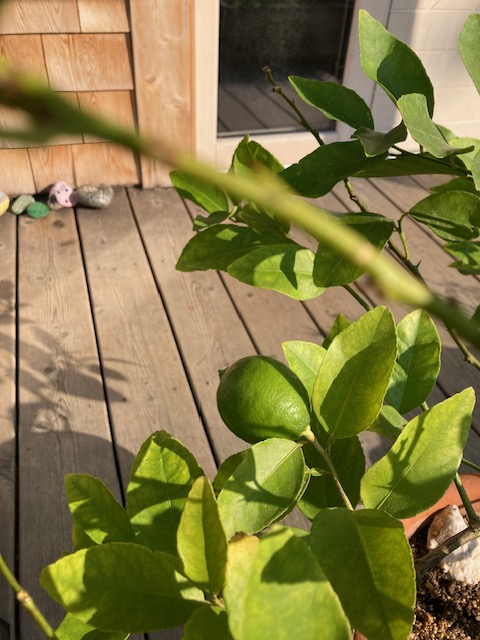
The abundance of August has arrived. Onions and potatoes need be harvested, Italian Frying peppers await us, we pickle cucumbers then give armfuls away, fruits – tomatoes, grapes, peaches – tower overhead, our lime tree provides the citrus for a Gin & Tonic.



 an Art Farm