In Memoriam
Posted: January 9, 2026 Filed under: Art & Healing, consciousness 3 Comments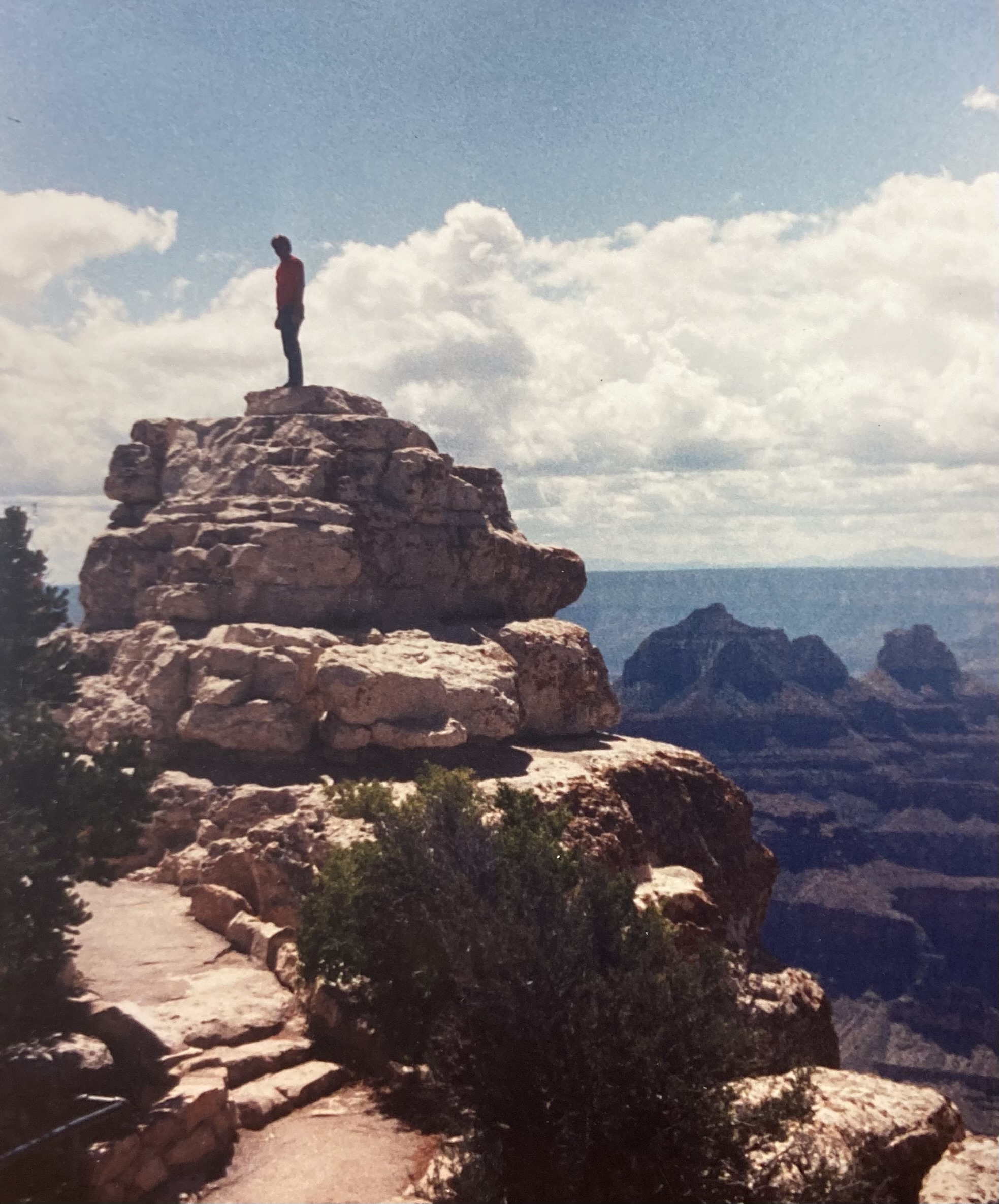
Remembering and honoring Douglas Lee Woodhouse
July 9, 1964 born, died January 6, 2025
rest in peace, Brother.
Oneness
Posted: January 1, 2026 Filed under: Art & Healing, Chronicles of a First Time Parent, consciousness, What is an Art Farm | Tags: anagarika govinda, consciousness, philosophy, science, spirituality, Thomas berry 2 Comments
Having built a whale, we decided to make a movie on the topic “all life is one.”
Having finished the short film, I sought funds from the Maine Arts Commission.
Having to substantiate my body of work as an artist, I referenced “An Art Farm.”
Whereupon, I realized our art farm had been mostly inactive since 2015 and so on 31 March 2024 I wrote “Crossing the Rubicon” about delivering the Whale north to the Wabanaki nation. I did not win the grant, but I did continue to write, and for 94 continuous weeks now I have posted short essays.
In a sense these are weekly postcards to my Mother, a chance to share thoughts that otherwise would not come up in our occasional phone conversations. More importantly, they allow me to mine thoughts that arise at 2am, to chase down loose threads and weave them, as if into tapestries, at best like those of the Renaissance rich in detail and color, telling stories of this strange and troubling moment in time.
An overarching theme seems to be Spiritual Ecology, a field of inquiry of which I only recently became aware. Rudolf Steiner is considered a visionary, having described a “co-evolution of spirituality and nature.” I learned of Steiner back in my Chicago days from a Gaia-centric friend at the vanguard. Pierre Teilhard de Chardin, also considered a founder, almost one century ago, wrote of a ”consciousness of the divinity within every particle of life, even the most dense material.” In “The Phenomenon of Man” he foresaw that “Science, philosophy and religion are bound to converge as they draw nearer to the whole.”
My Mother actively discussed de Chardin in her college days, and within the social circle of her childhood in Clifton of the Queen City, Cincinnati, Ohio, as well as at our dinner table. Father Sullivan, elder of Holy Cross Parish, once described my Mother as a “pantheist;” I suspect he meant that as a criticism but which she rightly took as a compliment! Perhaps, what the Father actually meant was panentheist (God in all things) not pantheist (God is all things), but regardless, since my childhood the tenets of Spiritual Ecology have been laid down as plain common sense.
On a family road trip west to the Grand Tetons, my Mother handed me a copy of John Muir’s biography. I was enthralled, in the backseat, while crossing the endless great plains. Decades ago I read Thomas Berry, also considered at the vanguard, who emphasized “returning to a sense of wonder and reverence for the natural world.” More than my share of Thoreau and Wendell Berry have I read, as well as David Abrams’ “The Spell of the Sensuous.” Joanna Macy has been celebrated among the Wise Women here at the art farm, while Emergence magazine is on my subscription list, the product of Emmanuel Vaughan-Lee, a Sufi trained multi-media maven on topics of a collective evolutionary expansion toward oneness.
But what would be this consciousness of oneness? The Renaissance is an historic example of a shift in consciousness, the “awakening” or “rebirth” of Europe, away from the Church-dominated Medieval era to embrace humanism, scientific inquiry, individualism, a flourishing of arts and culture. Rene Descartes, living at the end of the Renaissance, is considered foundational to modernity, his “cogito, ergo sum” defining the thinking rational self. But “cogito” is only one part of the whole self, and it can easily fall into the binary, mono-dimensional thinking of either-or, rather than both-and.
Newton’s Laws of Physics state an object is either at rest or in motion, but quantum mechanics allows an object to inhabit two states at once. Our logic has lead to AI which is a massive accomplishment, but it might either destroy us or bring far-reaching benefits. The “us versus them” is endlessly argued by politicians, the strongman’s lever using fear to divide and conquer. A spiritual ecology pursued only through the rational seems destined to failure. An expansive and inclusive approach is needed to embrace the breadth, depth and interconnectedness of both the natural world and ourselves.
“Creative Meditation and Multi-Dimensional Consciousness,” by Lama Anagarika Govinda, is insightful toward this life-affirming goal. He describes the “one-dimensional logic which…cuts the world apart with the knife of its ‘Either-Or,’” and then introduces “…a new way of thinking, an extended multi-dimensional logic which is as different from the classical Aristotelian logic as Euclidian geometry is from Einstein’s theory of relativity.” He presents this using the coordinates of an x-y axis. “If we regard the horizontal as the direction of our time-space development (unfolding), then the vertical is the direction of our going within, toward the universal center of our being and thus the realization of the timeless presence of all potentialities of existence in the organic structure of the whole of the living universe. This is what the poets call the ‘eternity of the moment’ which can be experienced in the state of complete inwardness…such as happens during meditation and creative inspiration.”
It is no small undertaking, a 21st century renaissance awakening to multi-dimensional consciousness not among the few, but ultimately we, the people, of the planet. Small-minded politicians and capitalists will pursue their goals of domination, and so this seems a necessary path out of the madness, deeper within. It is beyond the scope of one short essay to speak to such fullness, but this seems a direction for our art farm to pursue in the new year.
…and here is a link to the short film on the topic that we are part of the ecosystem, that all life is one, which set this ship – which is an art farm – to sail on this oceanic odyssey:
https://www.picdrop.com/claytonsimoncic/C39UK57ncx
The short film was produced with Anna Dibble. Clayton Simoncic was the photographer and editor.
_________________________________
Since it is written “the last shall be first,” I shall end this post and honor the Benham Family tradition, that good things come to those who begin a new month, on the first day with the first words: “Rabbit, Rabbit.”
May good things come to all people in the new year.
As Above, So Below
Posted: December 26, 2025 Filed under: consciousness, Little Green Thumbs, Portfolio - Elena's work | Tags: hildegard-von-bingen, mother-trees 1 Comment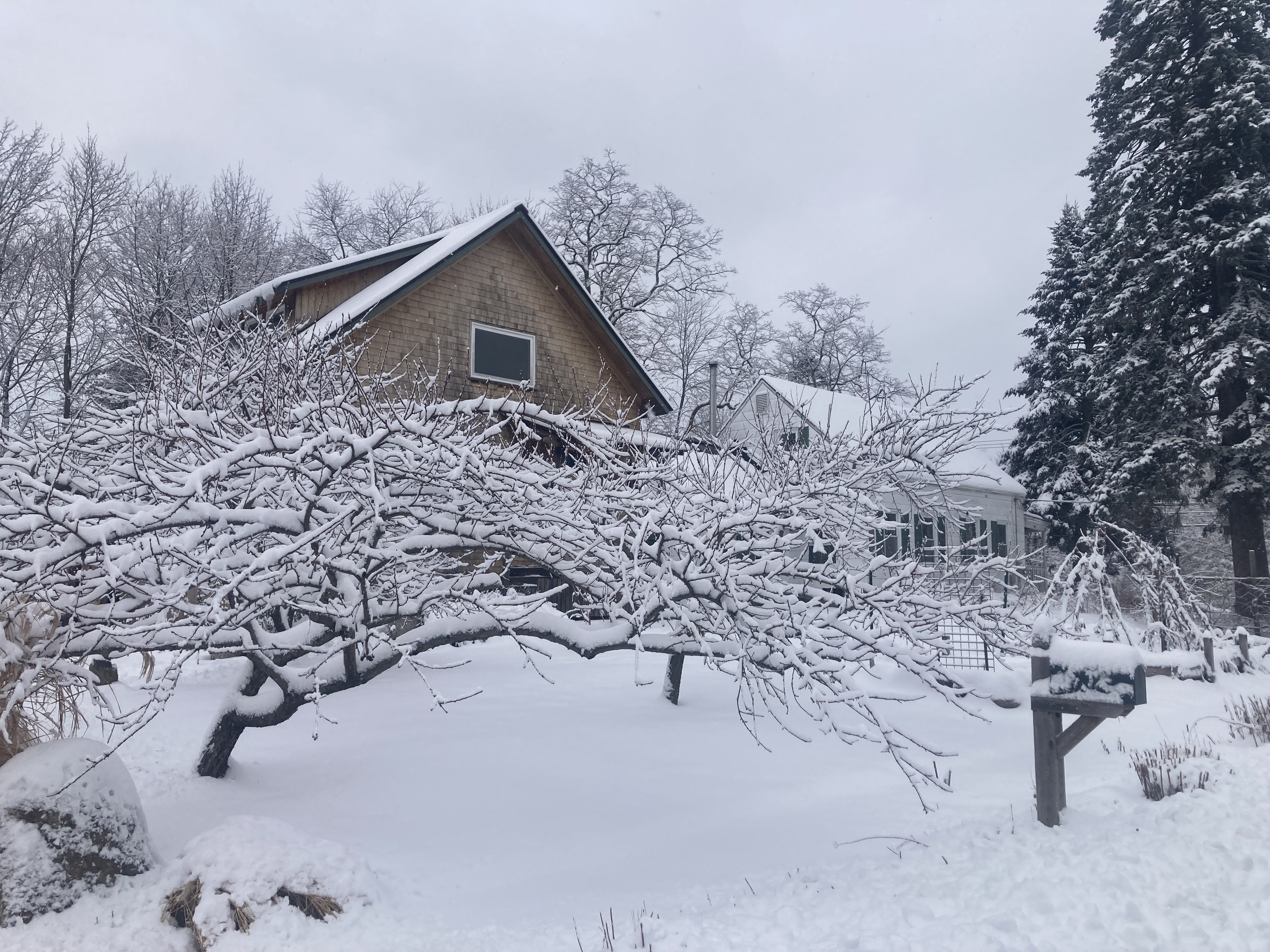
Two wise women demonstrate the ancient wisdom, passed down millennia, of the Emerald Tablet: “That which is above is from that which is below, and that which is below is from that which is above,”
The “Sibyl of the Rhine” is our first wise woman, the polymath writer, composer, philosopher, mystic and visionary of the High Middle Ages. The Abbess of several Benedictine monasteries, the breadth of her intellect included being a founder of scientific natural history in Germany. A truly remarkable and wise woman was Hildegard van Bingen.
Hildegard’s central theme was Vriditas, a Latin term meaning “greenness” but with added nuance of vitality, growth and lushness; the creative life-giving force of nature and spirit. Simply stated, physical well-being is the “greening power” of Gaia, that relates both to the physical and to the spiritual. As above, so below; all life is one, all is connected.
Her scientific master work is the Book of the Subtleties of the Diverse Nature of Creatures. Divided into two sections, the Physica is a comprehensive treatise and medicinal catalog of plants, fish, birds, insects and minerals, while the Causae et Curae emphasized the causes of disease and their corresponding natural treatments.
Hildegard closely observed the plants in her monastery’s garden and how – as Babs Mahany wrote – “stem and bud absorbed the sunlight [which] brought the fronds’ unfurling.” Her closely observed empirical observations combined with mystical visions detailed that which is above ground.
The “wood wide web” scientist, the forest ecologist and professor of the underground, is our second wise woman. Dr. Suzanne Simard is a titan among modern scientists, who challenged the conventional view that ecosystems are competitive and forests are simply the source of timber or pulp. Over decades she researched and discovered the cooperative nature of forests through roots and fungal networks, the mycorrhizal, that facilitate nutrient, water, sugar and carbon exchange; a chemical signaling between trees communicating stress and providing a network for communal support.
Dr. Simard identified century old “Mother Trees” that nurture younger seedlings, sending nutrients outward to feed and sustain the weaker, baby trees. Her Mother Tree Project is rooted in the idea that forests are deeply interconnected ecosystems, social creatures demonstrating traits of cooperative civil society.
Soil is not “dirt,” but a vital and complex life source of sharing and exchange, the basis upon which life unfurls. The soil maven Nance Klehm in her book, “The Soil Keepers,” described it: “When we stand on land, we stand on the ones who have come before us. We stand on our ancestors. We realize we have inherited their legacy, the way they perceived land, the way they lived with the ground, the way their hands worked the soil, or didn’t.”
As above there is light, so below there is darkness;
As above vriditas unfurling, so below nutrients and sugars flow;
As above oxygen creation, so below communication and exchange;
As above the lotus flower, so below the mud.
All is interconnected, the cosmic dance of Gaia.
The Emerald Tablet is a foundational text, attributed to the Hellenistic figure Hermes Trismegistus, who integrated Greek and Egyptian wisdom into a body of knowledge on the interrelationship between the material and the divine. The teachings influenced both Pythagorus and Plato, formed the basis of Gnosticism and Neoplatonism, were key to Renaissance humanists.
The Emerald Tablet was most likely written in the Syriac language of the Fertile Crescent, but the first extant text appeared in the Arabic, during the Islamic Golden Age, written by Jābir ibn Ḥayyān, the “Father of Chemistry.” From the 12th century onward multiple Latin translations followed, introducing the text to Europe and then in 1680, seven years before publishing his magnum opus The Principia, Isaac Newton made an English translation. More recently, it significantly influenced the work of Madame Blavatsky, William Butler Yeats, and Carl Jung.
And two wise women, 900 years apart, exemplify the enduring truth of “as above, so below,” the essence of the Emerald Tablet. Here is the full text in English from the Arabic of Jābir ibn Ḥayyān:
Truth! Certainty! That in which there is no doubt!
That which is above is from that which is below, and that which is below is from that which is above,
working the miracles of one [thing]. As all things were from One.
Its father is the Sun and its mother the Moon.
The Earth carried it in her belly, and the Wind nourished it in her belly,
as Earth which shall become Fire.
Feed the Earth from that which is subtle,
with the greatest power. It ascends from the earth to the heaven
and becomes ruler over that which is above and that which is below.
حقا يقينا لا شك فيه
إن الأعلى من الأسفل والأسفل من الأعلى
عمل العجائب من واحد كما كانت الأشياء كلها من واحد
وأبوه الشمس وأمه القمر
حملته الأرض في بطنها وغذته الريح في بطنها
نار صارت أرضا
اغذوا الأرض من اللطيف
بقوة القوى يصعد من الأرض إلى السماء
فيكون مسلطا على الأعلى والأسفل
________________________________________
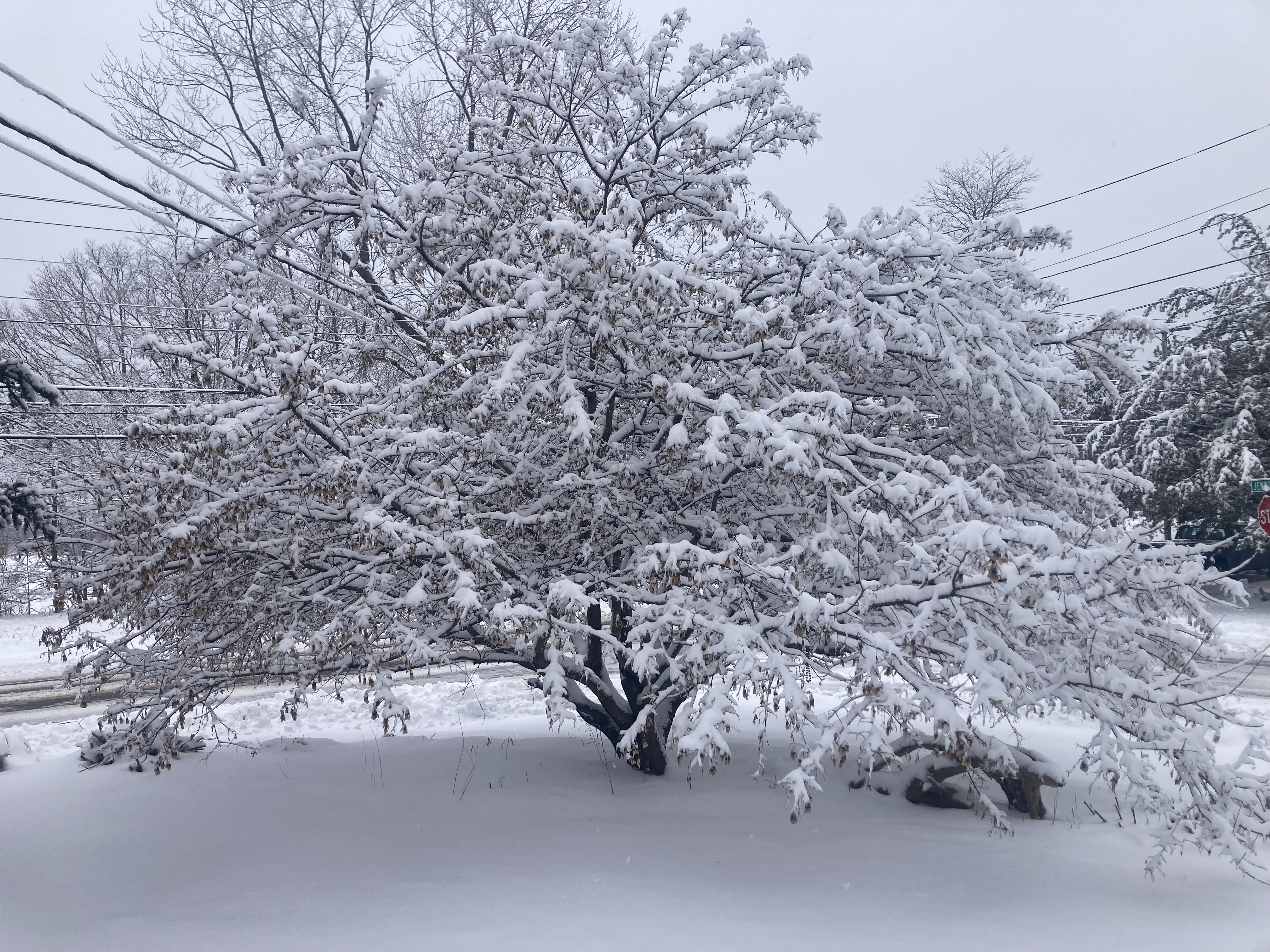
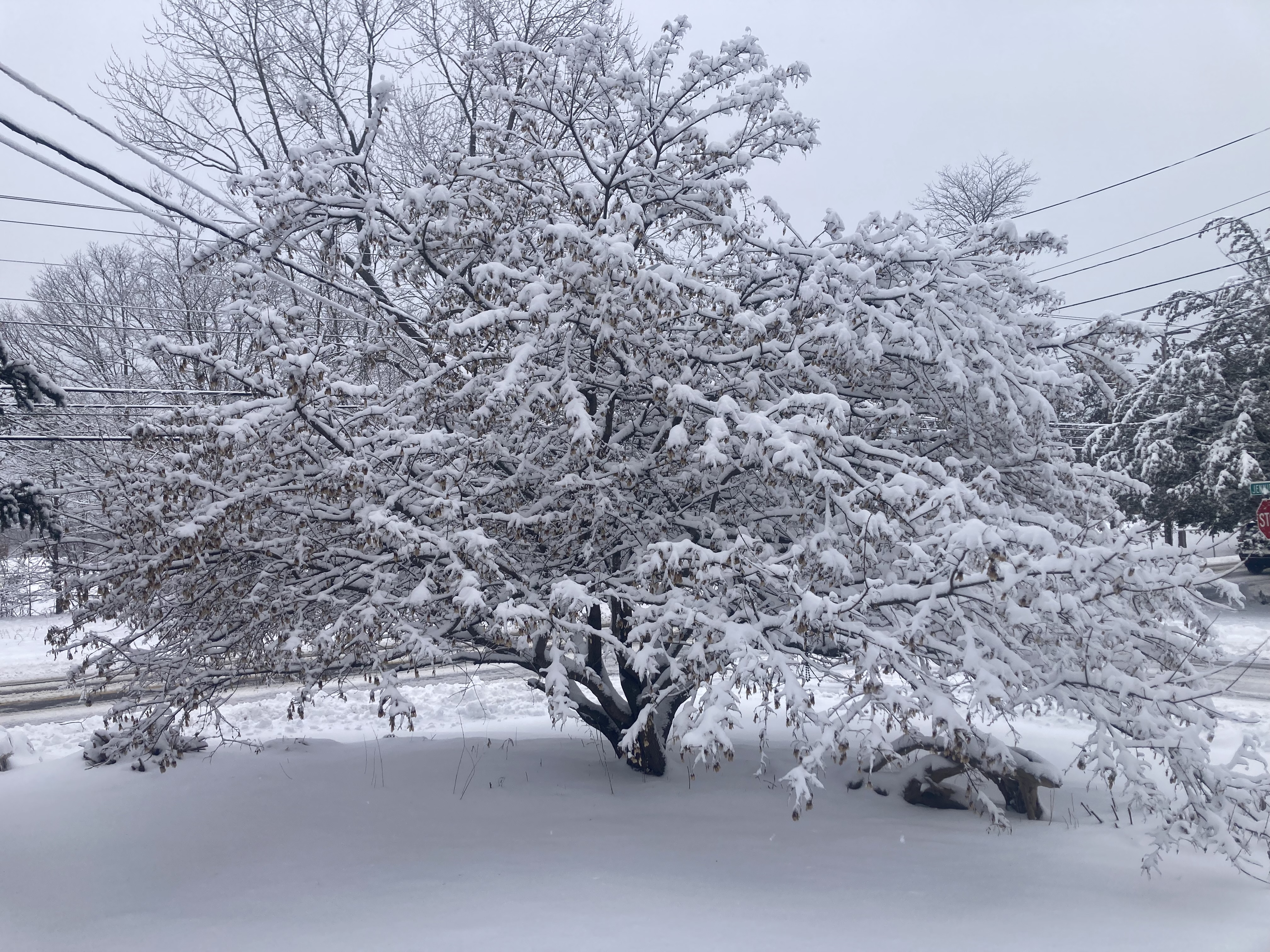
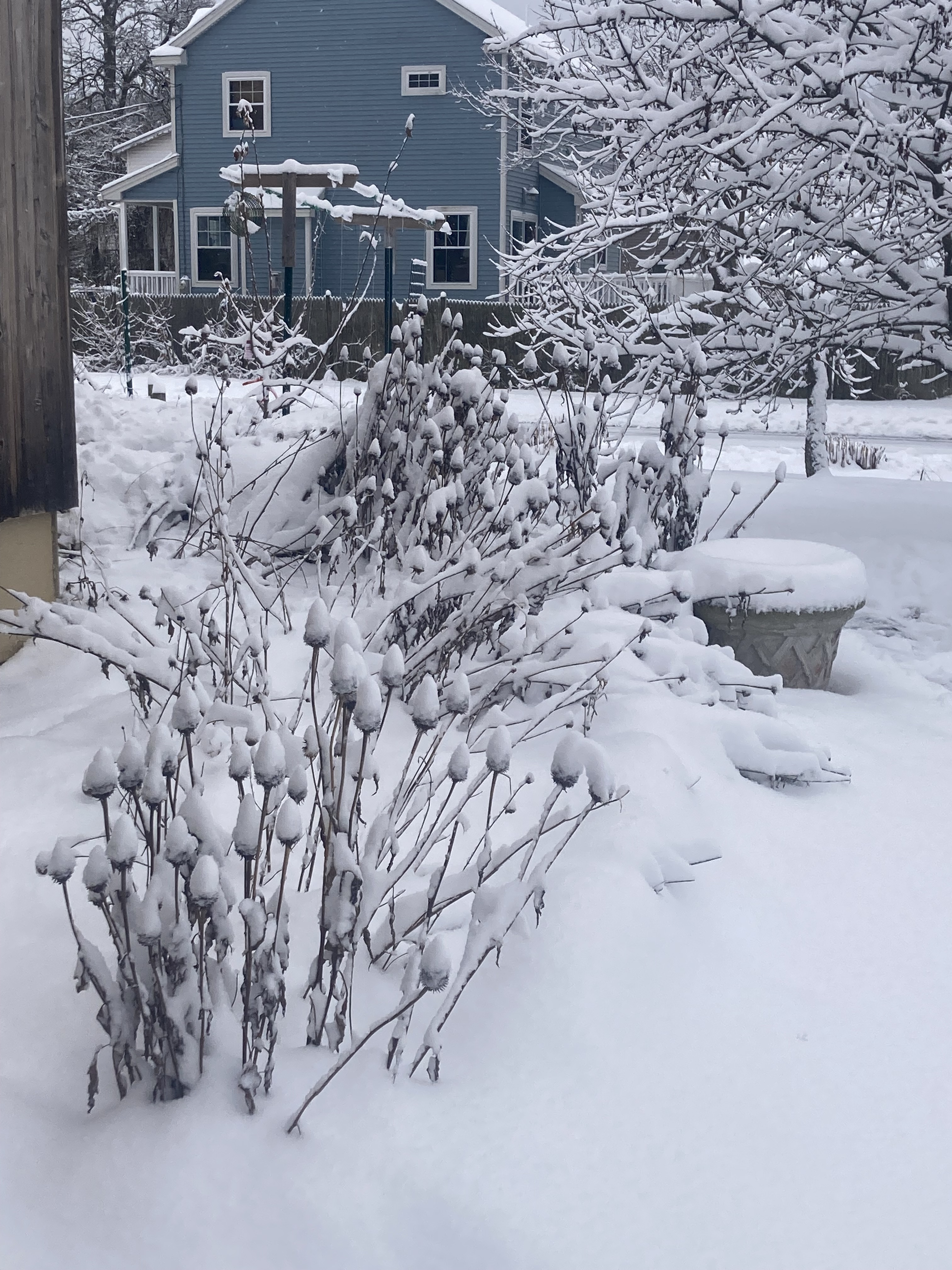
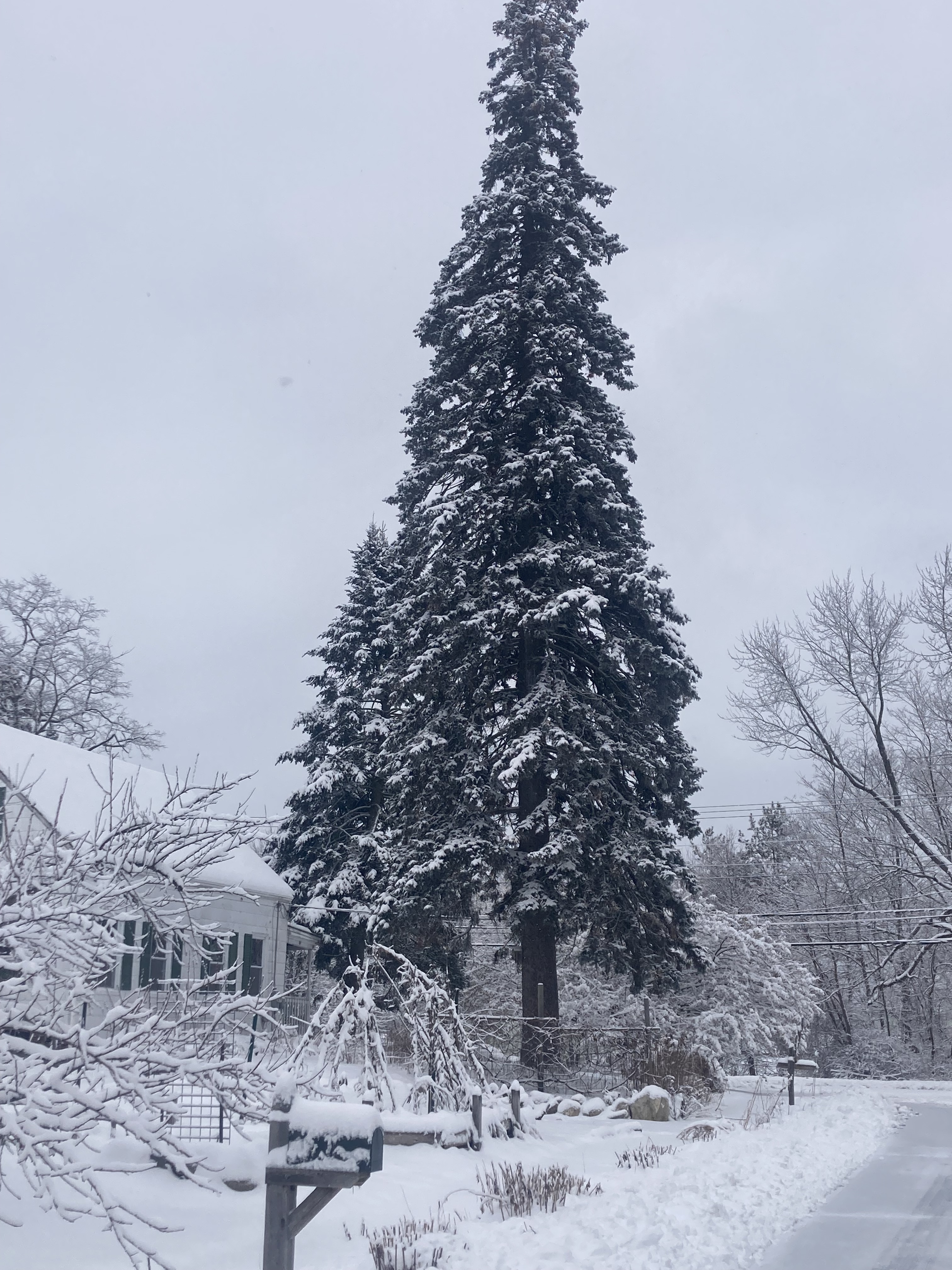
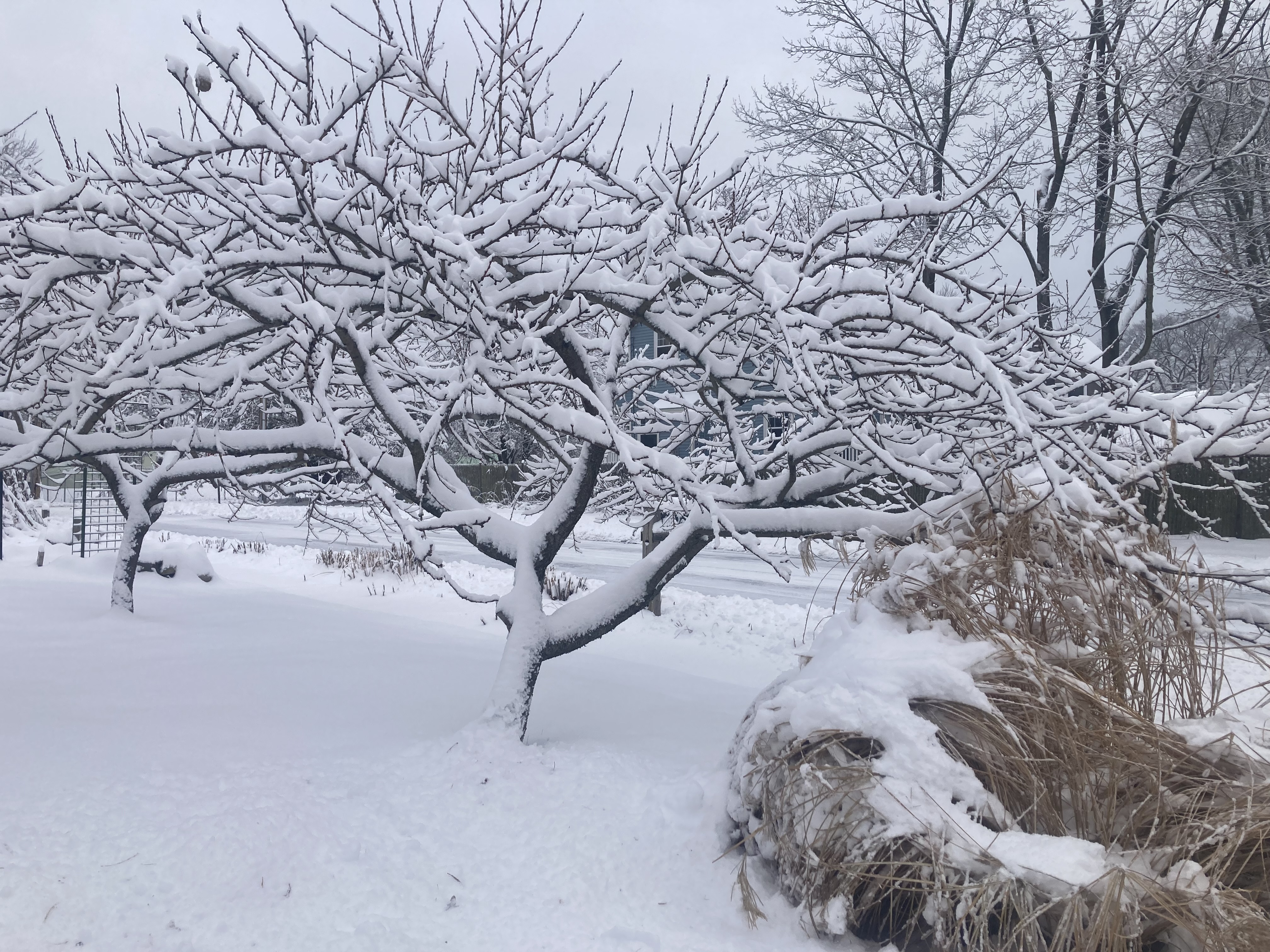
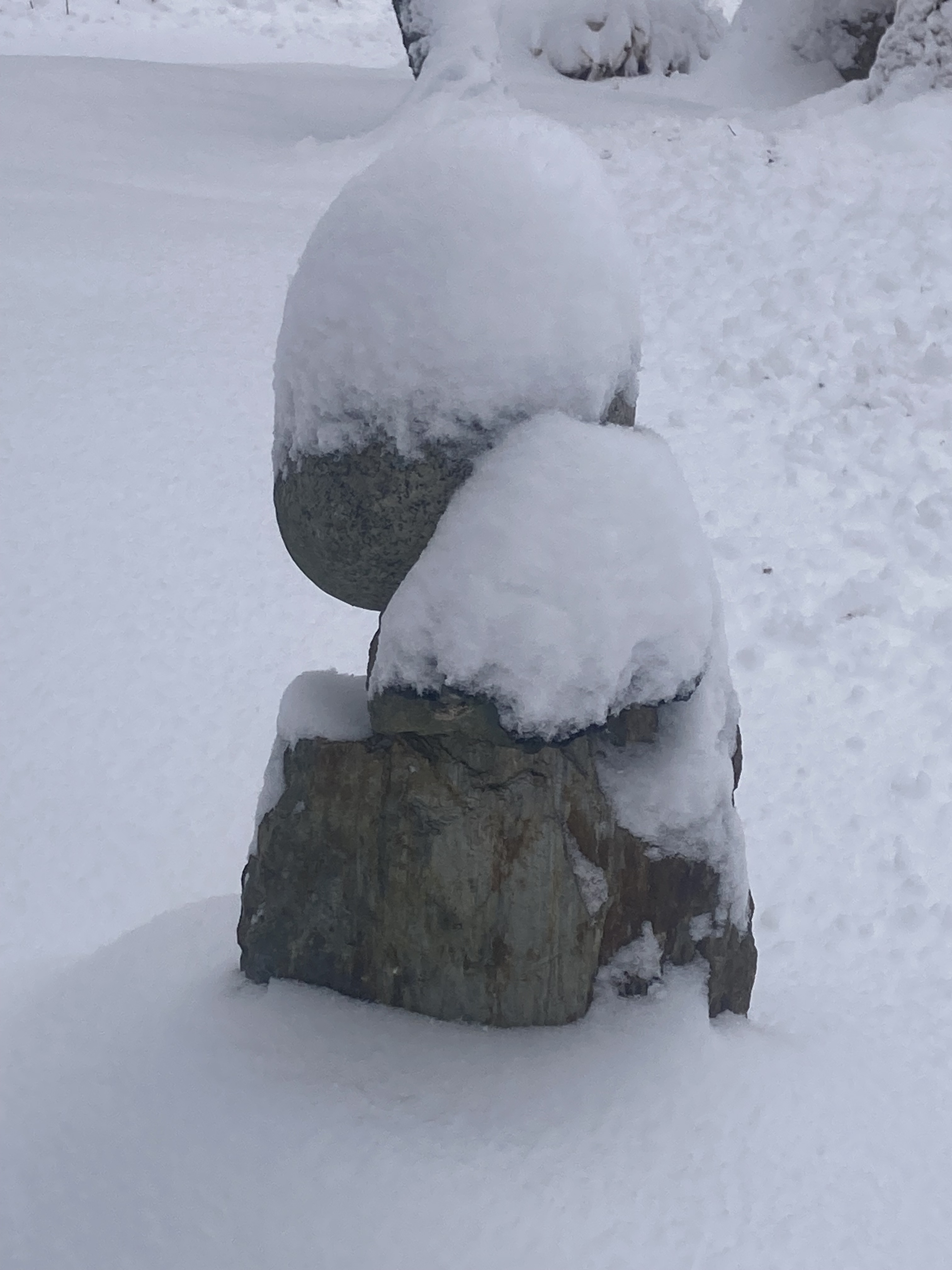
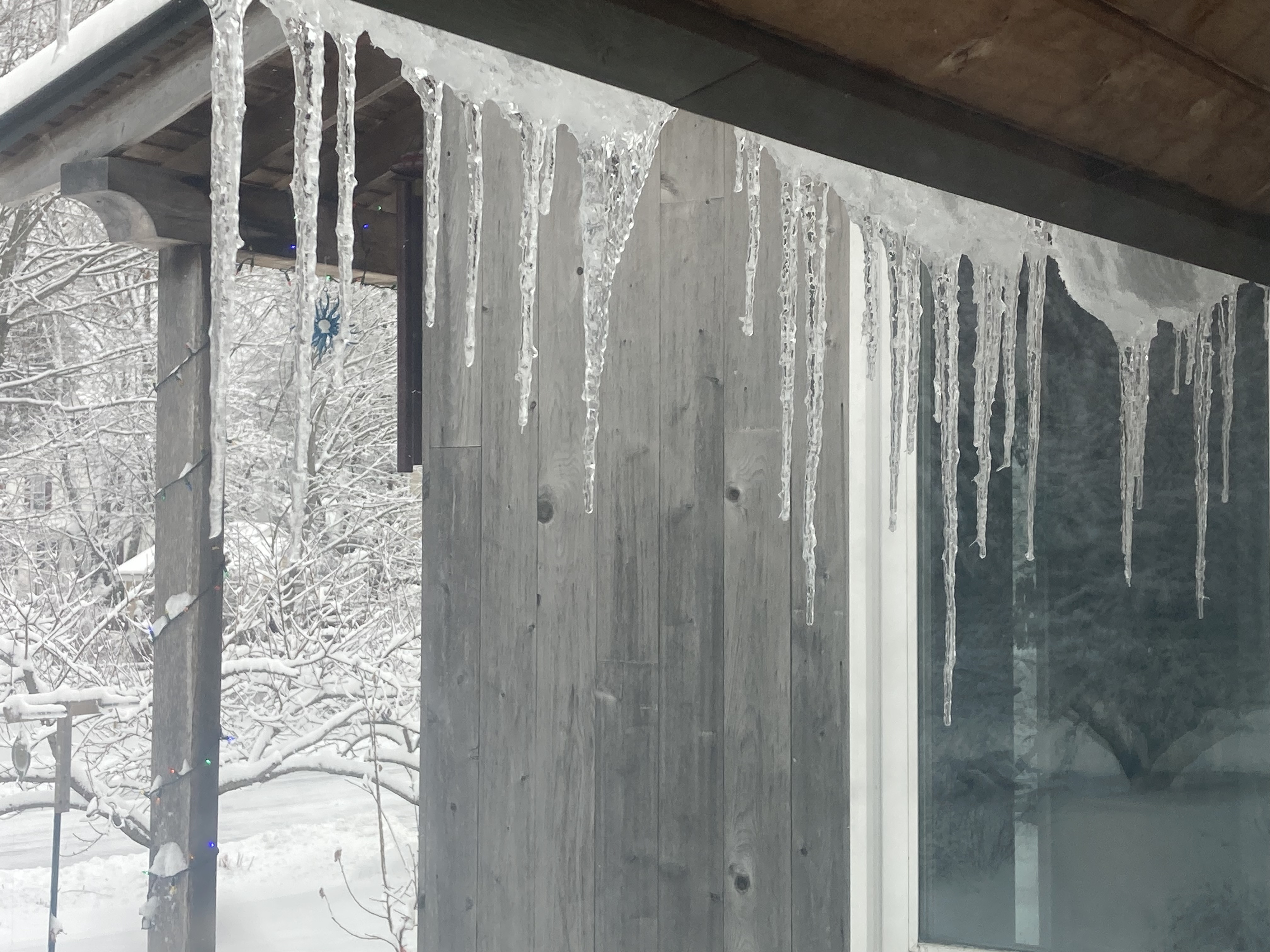
Snow here, photos by Elena where marked.




















Internal Alchemy
Posted: December 19, 2025 Filed under: consciousness | Tags: consciousness, meditation, mindfulness 1 Comment
Article 36 of the Ecuadorian Constitution states, “Those persons who have reached sixty-five years of age shall be considered to be elderly.” And the elderly shall receive free health care, paid work, universal retirement, tax exemptions and access to housing that ensures a decent life.
The United States has no such declaration. The Centers for Disease Control defines an “older adult” as 60 years of age, but age 65 marks eligibility for Medicare. The Age Discrimination in Employment Act of 1978 ended mandatory retirement and currently it is illegal to force anyone to retire.
In Europe, the average retirement age is 65 to 67, although the Nordic countries tend upwards to age 70. It seems entirely possible that Western civilization has radically understated human potential.
Ching-Yuen was a Chinese herbalist, born maybe circa 1677, who died in 1933. He retired from his military career at age 78, and received from the imperial government birthday cards on his 100th, 150th and 200th birthdays. Time Magazine reported on this in May 2012. Ching-Yuen’s advice on longevity was simply: “Keep a quiet heart, sit like a tortoise, walk sprightly like a pigeon and sleep like a dog.”
Baird T. Spaulding’s “Life and Teaching of the Masters of the Far East” tells of his trek to Persia and the Orient in 1894 where he made contact with “the Great Masters of the Himalayas,” people living 600 or more years. Spaulding explains the central teaching as, “The Masters accept that Buddha represents the Way to Enlightenment, but they clearly set forth that the Christ Consciousness is Enlightenment, or a state of consciousness for which we are all seeking – the Christ light of every individual; therefore, the light of every child born into the world.” He describes acts of higher consciousness, such as walking on water or manifesting food to feed the masses.
Cuie Wenze is a legendary Chinese physician from the Qin Dynasty who reportedly lived to be 300 years old through holistic life nourishment, balancing the physical, mental and spiritual. Gee Yule, another Taoist alchemist, lived a reported 280 years by cultivating the Three Treasures: Jing (essence) Qi (vital energy) and Shen (spirit) through practices like meditation, breathing and alchemy. There are many records of such lives, if one seeks out these stories.
Years ago, while I was learning Qi Gong I was introduced to a practitioner of Chinese medicine whom, I was told, had not eaten food in years, instead existing on the inner Qi he had cultivated. Whether fact or fiction, it was hubris of me to make any rational decision about this. Wisdom, it seemed, was in suspending disbelief and simply observing this man.
From Epicurus through the enlightenment up to our present day, Western rationalism has been materialist. “Food, clothing and shelter” define the basic needs, and given an “us versus them” mindset in competition for limited resources, is it any surprise the 20th century was history’s bloodiest with massive atrocities of human-caused slaughter. Rational self interest is, ultimately, self limiting.
“An eye for an eye only ends up making the whole world blind,” Gandhi said. “The unmentionable odor of death” the poet Auden wrote, on the night when World War II broke out. And now, late in 2025 authoritarian strongmen become dominant, consciousness seems curated by algorithms and increasingly by artificial intelligence. This is our choice, not a fait accompli, and so could “beauty and truth” be added to humans’ basic needs? Can we expand our sense of self?
To the materialist rational mind this seems wildly unrealistic, while to the Taoist this is internal alchemy. Sir Isaac Newton, paragon of the rational scientific mind, was also – coincidentally – a leading alchemist of his day. The laws of physics do pertain, while the metaphysics of consciousness – much like quantum mechanics – can broaden our scope, open our minds to new possibilities, an awareness of the subtle energies.
The average U.S. life expectancy has increased to 78.4 years. The trend is positive and allows much room for an expansion of consciousness. What if 65 were viewed not as aged, but as an opening, an opportunity to move inward away from the external pressures of daily life? 10,000 Boomers per day are now turning 65, with nearly 1 billion people over 65 world wide by 2030, and more than 1.5 billion by 2050. An unparalleled force for good could be unleashed if we transform consciousness.
The solstice brings a return of light. May this year’s return be both literal and figurative.
Closest to the Sun
Posted: December 12, 2025 Filed under: consciousness, Permaculture & Home Renovation, Portfolio - David's work | Tags: ecuador 1 Comment
Chimborazo is a snow covered inactive volcano, the highest mountain in Ecuador and the 39th highest peak in the Andes mountains. Located at the equator, its summit is the farthest point on Earth’s surface from the Earth’s center. To the locals it is “the closest volcano to the sun.”
Ecuador’s biodiversity is nearly unparalleled with diverse habitats and a high concentration of species. The Galapagos Islands, a province of Ecuador, inspired Charles Darwin’s theory of evolution. The Republic of Ecuador’s vast richness was acknowledged in 2008 when the country rewrote its constitution granting citizenship rights to natural habitats, embracing ecological balance, recognizing ecosystems as living entities and allowing citizens to sue on their behalf.
The Constitution’s Preamble states: “We women and men, the sovereign people of Ecuador; RECOGNIZING our age-old roots, wrought by women and men from various peoples, CELEBRATING nature, the Pacha Mama (Mother Earth), of which we are a part and which is vital to our existence, INVOKING the name of God and recognizing our diverse forms of religion and spirituality, CALLING UPON the wisdom of all the cultures that enrich us as a society, AS HEIRS to social liberation struggles against all forms of domination and colonialism AND with a profound commitment to the present and to the future, Hereby decide to build: A new form of public coexistence, in diversity and in harmony with nature, to achieve the good way of living, the sumak kawsay; A society that respects, in all its dimensions, the dignity of individuals and community groups, A democratic country, committed to Latin American integration—the dream of Simón Bolívar and Eloy Alfaro—, peace and solidarity with all peoples of the Earth….”
The basic principles include:
- Sovereignty lies with the people…with national unity in diversity
- Ecuador is a territory of peace
- The human right to water is essential and cannot be waived
- The Ecuadorian State shall promote food sovereignty
- The right…to live in a healthy and ecologically balanced environment that guarantees sustainability and the good way of living (sumac Kawsay), is recognized.
- The right to aesthetic freedom; the right to learn about the historical past of their cultures and to gain access to diverse cultural expressions.
- Education…shall guarantee holistic human development, in the framework of respect for human rights, a sustainable environment, and democracy.
- The State shall guarantee elderly persons…Specialized health care free of charge, as well as free access to medicines
- The State shall guarantee the rights of pregnant and breast-feeding women with free maternal healthcare services
- The right to migrate of persons is recognized. No human being shall be identified or considered as illegal because of his/her migratory status.
There is trouble in paradise, though, as corruption is endemic. Ecuador ranked 121st among 180 countries on the 2024 Corruption Perceptions Index. That put it among the most corrupt public sectors, and below average among countries of the Americas. By comparison, the USA was tied at 28th out of 180 countries, its lowest score since 2012, and its trend has been negative since 2015.
Ecuador is a hub for smuggling drugs produced in neighboring Columbia and Peru. The police, judiciary and executive branches are linked to crime, drug-trafficking and extortion. The World Justice Project’s 2022 report “The Rule of Law in Ecuador” found that “Ecuador saw the largest increases in the percentage of respondents who believe that some or all of the actors across [law enforcement, the executive branch, and the judiciary] are involved in corrupt practices. Among respondents in the Andean region, on average, Ecuadorians most often [three-quarters of all respondents] felt that top government officials engage in authoritarian behavior.…” The constitution speaks of noble ideals while the government is rife with graft.
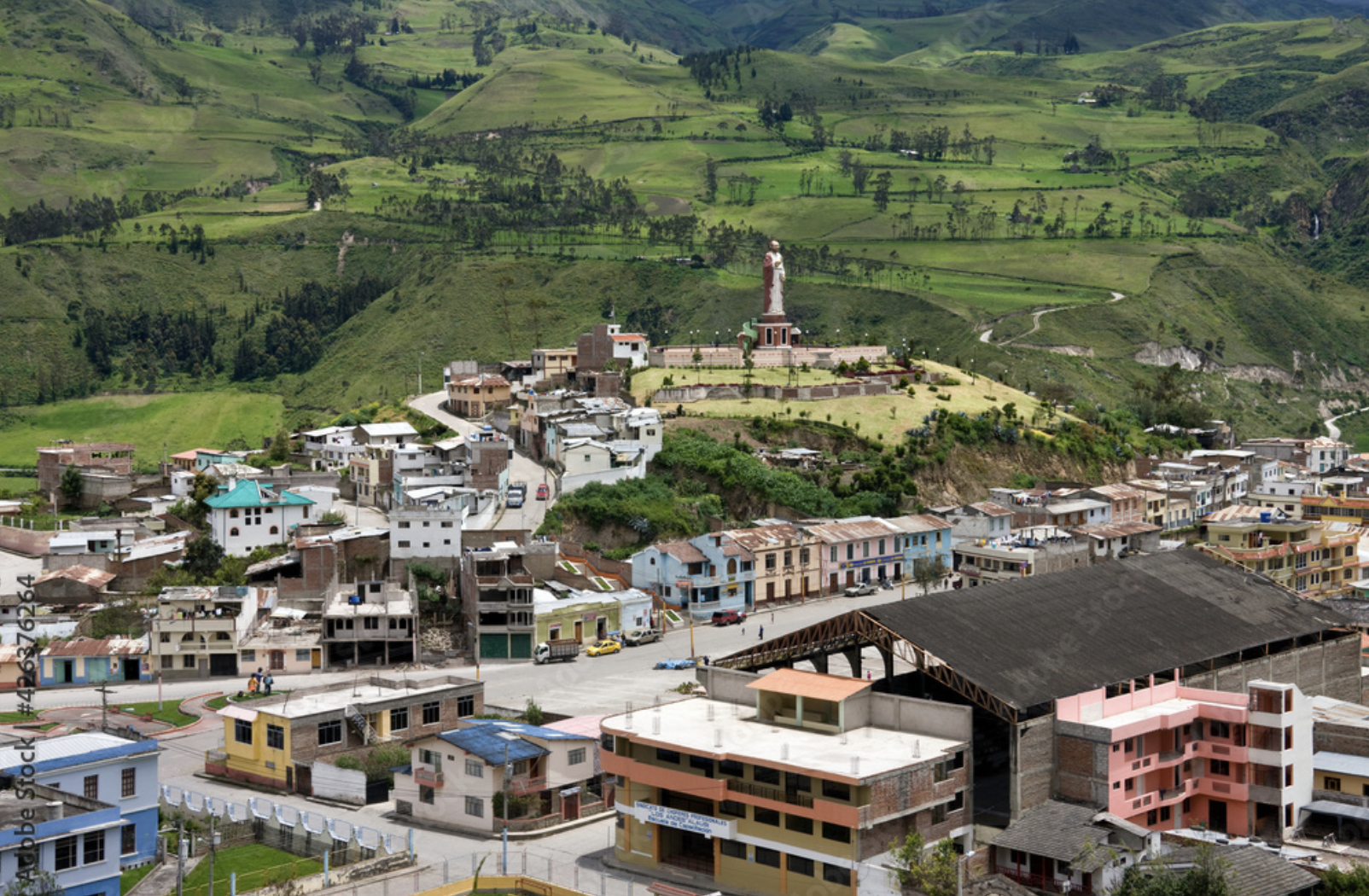
Anthony is a young man who grew up on Chimborazo. He is a father of children growing up in the Andes mountains, but because of the gangs and corruption he lives now in Massachusetts. A roofer, he works all around New England, traveling south to Rhode Island or Connecticut or as far north into Maine and Vermont.
Most all of the roofing crews in Southern Maine now are Hispanic. I see them driving their vans, loaded high with ladders and wheel barrows, doing all of the roofing jobs. For one job on the coast, I needed to remove a chimney on a very steep pitch. I asked the home owner to hire that out, and a Spanish speaking crew arrived. They had no safety equipment but climbed up without hesitation. Growing up in the Andes gives them a natural ease on heights.
The crew did not have the correct equipment and so I called the roofing contractor. Not surprisingly he showed up in his big truck, emblazoned with decals advertising his business. Dressed in sandals and shorts, it seemed we had interrupted him from working on his boat. He stood on the ground, looked up, doing nothing. The crew worked quickly and finished in about 3 hours. Most certainly the $1,500 paid to the boss did not include profit sharing. Every carpenter I know has similar stories to share.
We hired Anthony for the Tiny Cathedral, and by-passed the big-truck contractor. He and his cousin arrived, having driven two and a half hours north from Massachusetts. They did the job quickly and well and were paid cash for a full days wage, travel time included. The home owner still came out ahead, we avoided back-breaking labor, Anthony got a good break.
We shared pizza and beer over lunch. Between his broken English, and my pidgin Spanish, Anthony spoke about his roots, growing up in a small town closest to the sun. He described the exquisite beauty and how the ecotourism industry offers only a sanitized view while avoiding the gang and crime-ridden areas. Opportunity drew him north and he had not seen his son for seven years, nor did he expect to return home for another four years. He misses his son’s childhood but sends home money monthly.
That lunch was more than a year ago, and the self-righteous today likely would regard our act of civility as aiding and abetting. Ours is a transactional age where might makes right, where greed governs the strongmen, where earth is rare only in its industrial and financial value, but history is littered with the names of fallen despots, empires that came to pass. King Xerxes held such commanding power that after a storm destroyed his pontoon bridge, he had the sea whipped 300 times with chains, the engineers beheaded, to punish the sea for its disobedience preventing his Persian Army from conquering Greece. Long forgotten he is while daily still the tides rise and fall.
Wisdom endures on the side of “our age-old roots…the Pacha Mama of which we are a part and which is vital to our existence… diverse forms of religion and spirituality, …of all the cultures that enrich us [in] struggles against all forms of domination and colonialism.”
Closest to the Sun is closest to the light of truth.
Tiny Cathedral
Posted: December 5, 2025 Filed under: Permaculture & Home Renovation, Portfolio - David's work 1 Comment
Not long ago we built a tiny cathedral at the top of Meetinghouse Hill. The hill was so named back in 1733 when the Purpooduck meeting house was built. “The old Meeting House was a large, square, two-storied, unpainted building, without a tower, with a porch on the front end which served as an entry. There were two outside doors, reached by two steps which ran the entire length of the porch. It was a great barn-like looking structure. The pulpit was an elaborate affair. It stood on one post elevated about eight or ten feet above the floor. It was reached by a flight of winding stairs.”
Our tiny cathedral was, in prosaic terms, the conversion of a non-conforming 106-year old garage into an apartment for a Mother-In-Law who lives in Switzerland. “Non-conforming” is a term of art of the Code Enforcement Office for a legally established building that no longer meets the current zoning laws. You can renovate but can neither expand nor replace those structures. There was not an inch to spare.

The 106-year old garage had serious issues but exactly one positive: it could provide the Mother-In-Law with the privacy of a 220 square foot bedroom “suite.” We had a chance to make something majestic. In order to effect this transformation we jacked up and moved the building off its existing slab, dug down to excavate and pour new stem walls with footings then used a crane to lift the garage back into place, exactly where it had been.
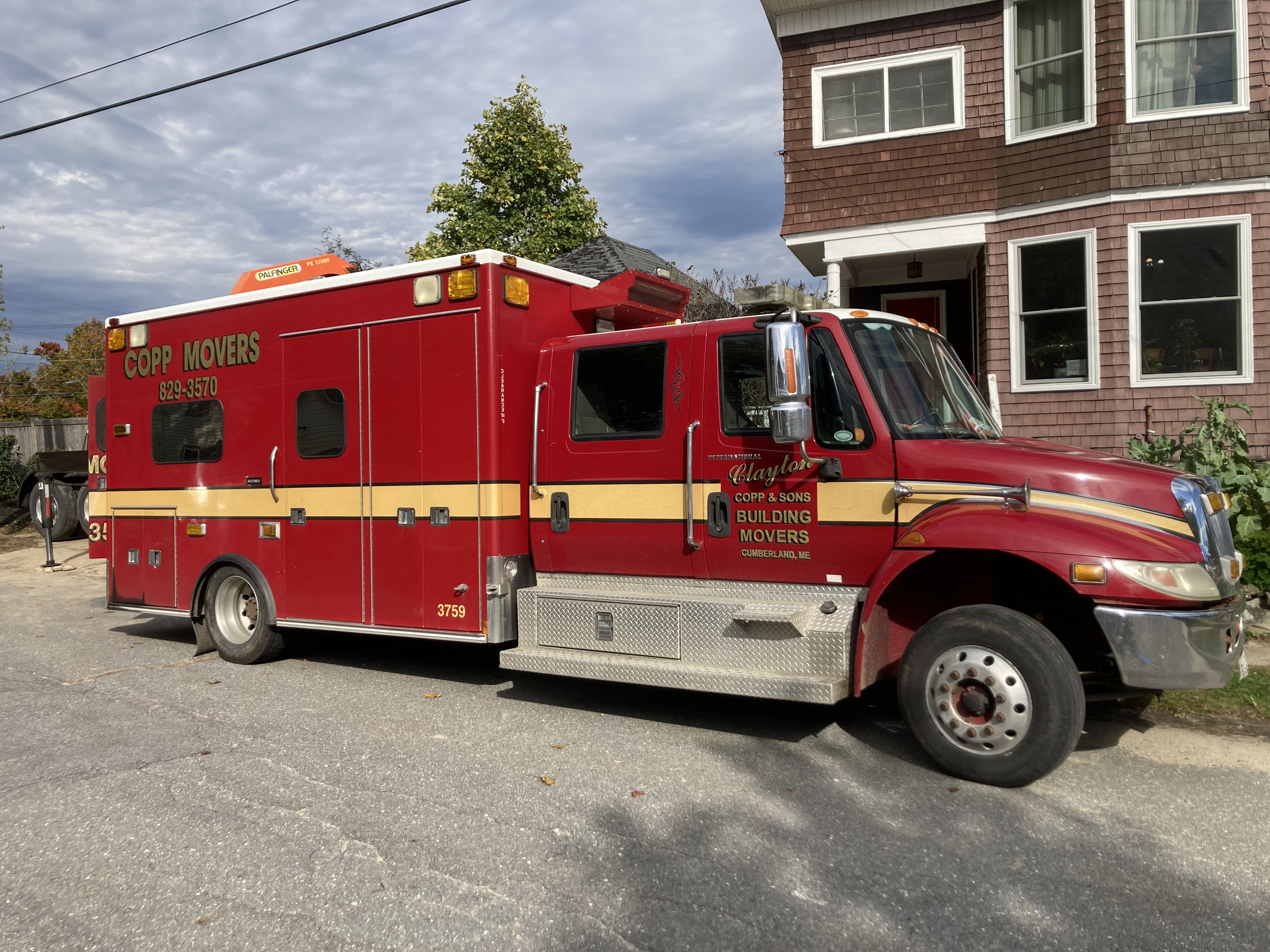
The Copp Brothers from Cumberland accomplished this Herculean task. For three generations they have been jacking and moving buildings and, like the “Ghostbusters,” the Uncles and Nephews arrived in a converted ambulance filled with tools of their trade. In less than 90 minutes they rolled the structure onto the street and onto the side yard. The crane lift back took less time.
The Professor – who currently teaches my son science by means of welding and small engine repair – was the mastermind of the project. When he showed up we got to work on the carpentry, plumbing, insulation, heating, roofing and siding. The electric work was straightforward, but the plumbing and bringing water to the garage was a challenge. Thankfully, the professor owns every tool known to mankind and has consummate skill using them all. No problem was insurmountable.
Because the space was limited, we added insulation to the outside of the building. The building remained exactly on its original footprint, and we expanded outward and upward, adding recycled foam insulation – 3” to the walls and 6” on the roof – to create a weathertight envelope that exceeded the new energy efficient Code requirements.
The homeowner, a trained architect who makes sculpture, designed the suite to maximize light, by means of windows, sliding glass doors and skylights. More than 20% of the wall space is windows, and that is how the garage became cathedral-like. Titus Burckhardt, a Swiss artist and art historian, has written, “When a Byzantine poet says, of the fullness of light in the vast inner space of the church, that it seems that ’the space is not illumined by the sun from without, but rather the illumination originates within,’ he is expressing an artistic ideal which Gothic architecture also sought to realize in its own way, by the introduction of transparent walls of stained glass.”
We did not use stained glass, but the amount of light filling that tiny suite is simply majestic. The story is told in detail here: https://npdworkshop.com/the-mother-in-law
The tiny cathedral represents one solution to the housing crisis. In 1850 the average American home was 888 square feet for 5.5 people. By 2015 homes had ballooned to 2,496 square feet for 2.5 people, on average. McMansions average 4,000 square feet, can grow upwards of 6,000 square feet, housing an average of 2.5 people. The trend shows a culture drunk in our profligacy.
The State of Maine needs 84,000 new housing units by 2030 to meet demand and to support the workforce. Maine’s median household income is approximately $90,730, while the median home price is $355,000. Affordability clearly is a major issue. The “supersize me” culture needs to wake up, and rather than build larger, we need to build smaller and smarter.
In Maine H.P. 1224 – L.D. 1829 was recently passed as “An Act to Build Housing for Maine Families and Attract Workers to Maine Businesses.” The law both increases housing density by 2 1/2 times while decreasing the lot size to 5,000 square feet per unit in areas with public water and sewer. This means smaller homes on much smaller lots, which makes the Tiny Cathedral a herald of things to come.

Well dressed, on the Porch
Posted: November 28, 2025 Filed under: Art & Healing, consciousness, What is an Art Farm 1 Comment
In early September, during our Language Arts class, two young Christian women came to the door, dressed in their “Sunday-go-to-meeting clothes.” To avoid disruption, I hopped up to answer the door.
They politely asked, “We are doing volunteer work and wonder if you would like to hear some good news from the Bible?” I replied, “That is worthy but I am not interested now. I am homeschooling my son. But I ask you this question: what is the true understanding, the meaning of John 14:12?” They thoughtfully began to open their Bibles and I stopped them, saying “Do not answer this now but consider this as you go.”
Two months passed and recently one of the women returned with her father (younger than me), again dressed in their best clothes. The daughter wore the fashionable full length “Little House on the Prairie” style dress with burgundy flats. The father wore a tad-too-bright blue suit, crisply starched white shirt and a natty woven – not silk – tie. They were radiant in their wholesome goodness.
Standing on the front porch, we discussed grammar of the Bible passage: “Verily, verily, I say unto you, He that believeth on me, the works that I do shall he do also; and greater works than these shall he do; because I go unto my Father.”
I explained that “…because I go unto my Father…” is a subordinate clause. They did not see it that way. But grammatically it simply is subordinate to the independent clause, “…the works that I do he shall do also; and greater works than these shall he do…”. I focused on the verb “do” which they exhaustively counseled meant “to preach.” I countered that it referred to actions such as “raise the dead, walk on water, multiply loaves and fishes.” Flabbergasted, he laughed. Who ever heard of such a thing?!!
He opened his tablet and read from the prepared script that missionaries having gone to the ends of the earth – traveling farther than that street preacher ever could – and having reached countless millions of people means the “preaching” is “greater than.” I respectfully averred that the inverted sentence structure is complex; the object “greater works than these” comes first while the subject “he” comes last. But both the demonstrative pronoun “these” and its antecedent “works” are plural so more than just preaching is going on here.
I discussed Isaac Newton – paragon of the rational scientific mind – who also was an alchemist. He (the father) had never heard of alchemy. His daughter remained silent. We were heading into uncharted territory but my point was the deeper insight is needed, not the narrow rational. In fact, alchemy arguably is a symbolic language of higher consciousness, “base metals” turned into gold a perfect metaphor during the time when alchemy was considered heresy, punishable by death. Higher consciousness clearly does threaten the orthodox, and the street preacher – who was an avatar of consciousness – is revered not because he preached but because of what he did, which includes – as the story is told – raising the dead, walking on water, feeding the masses. Later that evening I asked my Daughter her thoughts and she readily said “works means accomplishments.” Preaching may be one of the accomplishments but “greater than” clearly speaks to something far more substantial.
We spoke about translations – from the Aramaic, to the Greek into Latin and now English; multiple languages over millennia – but he said “God guides all the translations” thus “the word is sacred.” An interesting point, but which renders the grammar moot. Even if the word is sacred, our understanding is not automatic. We need to think for ourselves, with grammar the means to insight; “these” is plural.
We briefly discussed Buddhism, which is to say alternate paths to wisdom. “All roads lead to Rome” is the saying but they held firm in their belief that the “King of kings and Lord of lords” reigns supreme.
Alas, our porch chat came to an end. They asked if they could return and I said, “Of course.”
Mr. Sneed and His Eggs
Posted: November 21, 2025 Filed under: Chronicles of a First Time Parent, Money & Banking, Portfolio - Elena's work, What is an Art Farm 2 Comments
The soundtrack of my childhood is best captured in the screech of sneakers on a parquet floor, the sharp, clear trill of a referee’s whistle, its echo down an empty gymnasium. On saturday mornings my father would drive my older brother and me to the Walden School for intramural basketball games. My brother is a gifted natural athlete who thrived there, while I found the game incredibly dull, the challenge of throwing a ball through a hoop entirely lost on me.
From my parent’s perspective it was a brilliant set-up; the house emptied for an entire morning, my Mother had quiet, my Father had no distractions and we returned home exhausted, which ensured a peaceful afternoon. My enduring intramural memory is that Mr. Sneed, who ran the program and was its referee, made his living trading eggs on the floor of the former Chicago Butter & Egg Board.
Eggs, to Mr. Sneed, were a fungible commodity, bought and sold in bulk. Eggs, in our house, were a thing scrambled, served with bacon, raspberry jam and English Muffins, for Sunday Brunch in our Dining Room after the 10:30am guitar mass at Holy Cross Church.
My Father’s day job was food merchandising. Known as the “Grocery Guru,” he wrote and lectured on three continents on how to market food at the retail grocery level. He was a stock and bond man so Mr. Sneed’s world of commodity futures contracts seemed an abstraction; foreign, opaque and mysterious. But there must have been some spark. I followed that path.
During college, I met people who worked in the markets and I visited the floor, experiencing the open outcry pits in action. Sheer bedlam, it was capitalism at its most raw and rapacious: I win, you lose, a buyer for every seller. Eventually I got a job at the Chicago Board of Trade’s Financial Futures floor, where more than $350 Billion in US Treasury bond future contracts change hands daily. It was the pits, an awful place to work, but fascinating all the same.
Eventually I became the “squawker,” reporting the 30-year Treasury bond pit action to a trading desk in Lower Manhattan, giving them an edge on market timing. The Broker for whom I worked had a superstition and would allow me to use black ink only, never red ink, which marks a loss in accounting, which he could not allow under his stead.
Following the pits I ended up managing the food service in a residence for women artists. From my office desk I traded stock options on the S&P 500. While working at a wholesale flower market I traded corn futures. Eventually I ended up trading the 30-year Treasury bond futures not on the floor but from an office. I never did well enough to quit the day job, but I never washed up, either. It was an odd fascination.
And so I came to meet the Wizard, a CPA active in off shore banking who was born in the 1920s in Nemaha County, Kansas. He had been named in honor of the traveling banker who visited the town, “an old Kansas man, born and bred in the heart of the Western Wilderness.” Close to the 100th meridian, it is hard to fathom how remote Nemaha County would have been in that age before electricity, running water and phones. It was Dorothy’s Kansas.

By conventional terms he was the Father of a college classmate, but in truth he was the Wizard of Oz trading the futures markets. He was curious about my experience and we began talking. Eventually he told me about the sanctus sanctorum, the Golden Fleece, the goose that lays the golden egg, which was the “cash forward discounting of 108% bank debentures.” And so into the land of smoke and mirrors I went.
He introduced me to a financier who had helped launch McDonalds and whose Uncle had financed the Hollywood mavens: Marcus Lowe, Samuel Goldwyn and Cecil B. DeMille. I found myself managing discussions with Sheik Mohammed Had, an Emissary and Confidante to the Royal House of Saud. I flew to Manila to meet with a mild-mannered man named Jun, possessor of 100 Metric Tons of Gold Bullion stored in the underground vaults at Kloten, Switzerland. Whether or not he was the illegitimate son of Ferdinand Marcos, the Dictator of the Philippines, was an open question, which is about the way things go in the land of smoke and mirrors. I worked with Abraham, a Christian from the South of India, who possessed a 1 kilogram rough cut emerald, the largest in the world. He was trying to leverage the asset to fund development programs for his community but when the planes struck the Twin Towers, it became all but impossible to work with rare and unusual assets.
I spent hours reading at Northwestern University’s Law Library and stumbled upon Public Law 104-62. Known as the Philanthropy Protection Act of 1995, this exempts certain charitable organizations from federal securities laws. Signed into law by the 2nd Patrician of Kennebunkport, 104-62 is a loophole large enough to drive a Brink’s truck through. I contacted McDermott Will and Emery, the world’s largest tax law firm, but was declined as a client because, “Having checked our entire roster of Associates, no one has ever heard of this law and we feel it would be unethical to learn on your dime.” Although arcane, humanitarian finance is an official law. In the land of smoke and mirrors I found the path less travelled, which proved to be almost impossibly difficult to follow.
While in London, I worked with a CPA from Toronto who had helped Kuwait finance reconstruction after the 1st Patrician’s Iraq-Kuwait War. Following the liberation, the Central Bank of Kuwait revived the Dinar at an exchange rate of USD 3.47 to 1 new Kuwaiti Dinar, making it the strongest currency in the world. That the power to organize, finance and fund can change an entire country has always struck me as fascinating.
At this season of life, these experiences are long in my past. On a recent trip back to Chicago, I took my children to the Board of Trade, but the open outcry markets are gone, replaced by electronic trading. Since 9-11 the Board allows no visitors into the Exchange. This chapter has entirely vanished.
The eggs I buy to feed my family now come unwashed at room temperature, from a local school teacher. Buying as close to the source is as far as imaginable from the fungible commodities of the Chicago markets.
That the power of capitalism can be used at scale to fund the common good remains a compelling idea, which runs counter to rational self-interest. And so I keep one line in the water still, just waiting for when the Great White Whale swims into the Casco Bay.
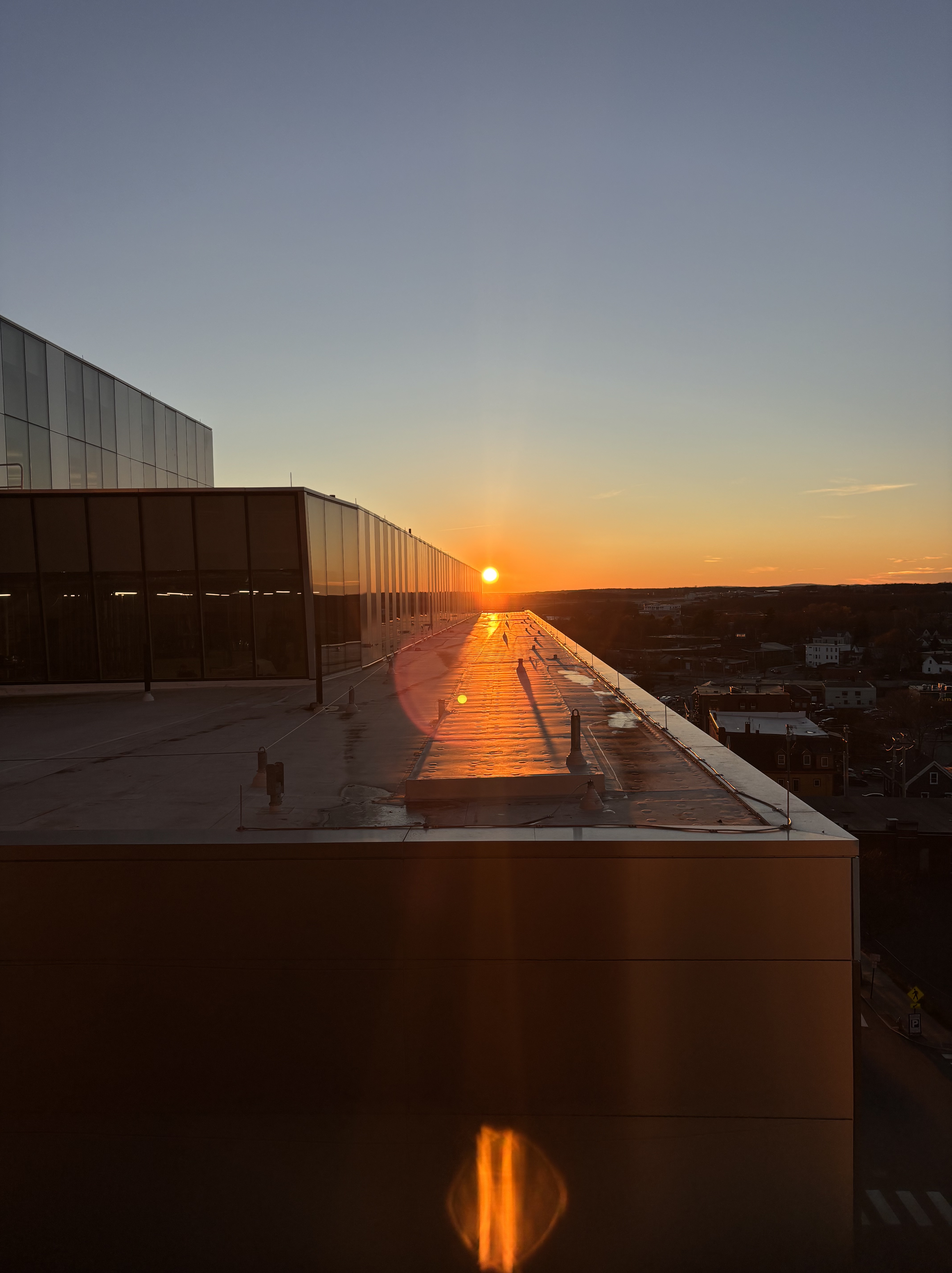
credit where credit is due: photos by Elena
Monetizing Light
Posted: November 14, 2025 Filed under: Money & Banking, What is an Art Farm 3 Comments
Every milli-second of every day for the past 4.6 Billion years, at the center of our solar system nuclear fusion repeatedly has occurred, and will occur; two hydrogen nuclei collide and merge to form a single helium nucleus, thereby releasing energy which powers the sun, which creates light.
As a form of electro-magnetic radiation, the nature of light is to emanate outward from its source, in the form of tiny discrete packets of energy called “quanta” or “photons,” and travel 93 Million miles in 8 minutes and 20 seconds whereupon they warm up a solar array on the roof of the School where I work.
Since 2015 sunlight has been harvested upon that roof, with 430 panels, covering 8,000 square feet, generating approximately 135,000 kWh of electricity per year. When sunlight bathes the solar array, electrons become energized and flow between cell layers, creating an electrical current. The flow of electrons is captured by metal plates and wires; thus, electricity is generated.
Solar power generation was discovered in 1839, and the basic design of a solar collector has endured since the 1970s. It is worth noting, however, that for the past 1.3 Billion years, fungi, and for the past 700 Million years, plants, have been eating light, thereby producing oxygen while decreasing carbon dioxide. Solar power is a stellar advancement, but cumbersome in comparison to the elegant simplicity of the plant kingdom. Still though, let’s sound three cheers for human progress and our role in it!!!
The embodied energy of the solar array (energy consumed to manufacture, ship and install the panels) is approx 260,050 kWh. That amount was offset in 1.9 years and since then the roof’s array has been net positive. Over the past ten years, the school has generated 780,010 kWh which means 842,641 pounds of carbon emissions were not produced, roughly equivalent to 424,754 pounds of coal, 5 tanker trucks of gasoline or 1.1 railcar of coal. The school’s footprint is small, its impact enduring.
By a financial sleight-of-hand the school is able to make money by converting light into power. This is done by selling “Renewable Energy Credits” (REC) to the secondary market where large utilities or carbon-producing industries purchase them to meet state-mandated climate standards. If this seems abstract, then you read well; the REC is a legally defined commodity separate and distinct from the physical electricity itself.
You can spend a dollar only once, and so too, the consumption of energy. What we monetize, then, is not the energy created and consumed but the carbon offset; we monetize not what was done, but what was not done. A subtle distinction, and except for the law of the land, otherwise not possible.
RECs have value not by fact, but by fiat; they have no monetary value except to high-carbon producing utilities and only by decree. In the year 2025, in these United States of America, the shared responsibility of clean air is legislated as a State’s right. 11 states have no REC program; the carbon “red” states are politically raging red (Deep South plus Nebraska, Wyoming and Idaho) while 11 states had programs that are now expired or repealed. All of New England participates, while Maine ranks among the more stringent standards, with 2019 legislation passed to increase Maine’s portion of electricity supplied by renewable energy resources to 80 percent by 2030 and a goal of 100 percent by 2050.
Whether the REC market will continue is an open question, hotly debated as the climate continues to heat up. While America looks back to its carbon rich past, China forges ahead with renewable energy. The Economist reports: “The scale of the renewables revolution in China is almost too vast for the human mind to grasp. China generated 1,826 terawatt-hours of wind and solar electricity in 2024, five times more than the energy contained in all 600 of its nuclear weapons. In the context of the cold war, the distinctive measure of a ‘superpower’ was the combination of a continental span and a world-threatening nuclear arsenal. The coming-together of China’s enormous manufacturing capacity and its ravenous appetite for copious, cheap, domestically produced electricity deserves to be seen in a similar world-changing light. They have made China a new type of superpower: one which deploys clean electricity on a planetary scale.” And very likely the AI race will be won by cheap electricity rather than chips.
All of which brings to mind Martin Luther King’s statement: “it may be true that morality cannot be legislated, but behavior can be regulated.” The RECs provide a vehicle toward a lower carbon future, and the school participates, every minute the sun is shining.
The Serpent of Caesar
Posted: November 7, 2025 Filed under: Chronicles of a First Time Parent, consciousness, What is an Art Farm | Tags: George Fox, Leviathan 1 Comment
I am the “Serpent of Caesar” acting for and on behalf of the Religious Society of Friends local school. I chose this role willingly, in my position as the Facility Director of the physical plant and property. The roof leaks. Even after its repair. And so I lead the Quakers into battle.
Prior to January the terms “construction litigation” and “Forensic Engineer” were not in my vocabulary but now they dominate my thought and action. Some hoped to approach this problem amicably, asking for the help of the Architect and Builders. I turned to the Agreements signed in 2014 when the School’s building project began. Contracts are, by their nature, adversarial; they define the course to cure problems when things go wrong. And a repeatedly leaking roof, clearly, is something gone wrong.
Only an Expert can opine in construction litigation; it takes one licensed Architect to argue against another licensed Architect. As a mere carpenter my opinion is moot. Within the trades, the Plumbers and Electricians are “Masters,” because they are licensed and trained to have and to hold special knowledge. Carpenters, at best, become Journeymen, but none of us dare come to a job site claiming the mantle of “Expert.”
The first Expert retained was indeed a licensed Architect, who showed up on the job site wearing the wrong shoes. He was a cowboy, “all hat, no cattle” and “all sizzle, no steak.” He gladly criticized another Architect’s work, but when asked to design the solution he deferred, saying, “I will have to think about that. My liability insurance might not cover that.” Off into the sunset he rode. I did not look back.
The second Expert retained was a licensed Architect and member of an engineering firm founded by three MIT professors. He, and they, are the Brahmins of Boston. Meticulous and thorough, at an exorbitantly high cost, on one hot day in July they opened up the roof and did find 80% moisture content, 3” down into the insulation. By the nature of the design, to replace any of the insulation you must remove all of the roof.
And so knives were sharpened, a lawsuit was filed. When the investigations were ended, I wrote the Demand Packet to establish the damages sought. The opposing counsel’s counter arguments were brutal, a challenge not to take personally the barbs thrown my way. But they are only doing their job. This fight is about money, and they are its sentries.
The pace of a lawsuit, and its forensic investigation, is slow and ponderous, and this week all of the parties finally gathered in mediation. Dressed in business casual, all parties came bearing sword, saber or pocket stiletto. The opposing counsel – all men – were abrasive in their prevarications and circular reasoning, doing everything possible to point the other way, to avoid the central fact that the roof has failed. It was trench warfare, fought to a draw in the opening round of the long battle ahead.

The origin of our story lies centuries ago in England during the Civil War, also known as “The Great Rebellion.” The Royalists fought the Parliamentarians in a winner take all battle. Life for the Nobles was grand and sumptuous while the tenant farmers struggled, long before electricity or indoor plumbing, working from 6am until 6pm, children beginning to work as young as age 7.
In 1651 “Leviathan” was published with the infamous sentence that “Life is nasty, brutish and short.” This work is foundational for political realism, defining the authority of the State over the individual to avoid the “war of all against all” that results from the pursuit of rational self-interest amidst the absurdity of death.
Also in 1651, a Dissenting Preacher was imprisoned for challenging the orthodoxy of the King’s Church, and his sentence then doubled for refusing to take up arms in Cromwell’s army fighting against the Royalists. That preacher’s core tenet was that the “inward Light” belongs to every man, woman and child; no intermediary is needed to receive divine guidance because the sovereign is not the King but God, itself. And so George Fox formed the Religious Society of Friends.
In 1681 William Penn, one of Fox’s adherents, was granted by King Charles II 45,000 square miles along the North Atlantic Coast of North America. Such then did the Quakers settle on virgin soil, acreage which today constitutes Pennsylvania and Delaware, and a different form of political realism was practiced, which became foundational to the American experience. Colin Woodard, a local historian and author who lives in Freeport, Maine, described Penn’s social experiment:
“Penn envisioned a country where people of different creeds and ethnic backgrounds could live together in harmony. Since his faith led him to believe in inherent goodness of humans, his colony would have no armed forces and would exist in peace with local Indians, paying them for their land and respecting their interests. While all the other American colonies severely restricted the political power of ordinary people, Pennsylvania would extend the vote to almost everyone. The Quaker religion would have no special status within the colony’s government, the Friends wishing to inspire by example, not by coercion.”
Penn’s “Holy Experiment” became the sine qua non as Philadelphia emerged as the largest and most influential city in the Thirteen Colonies. Thomas Jefferson wrote there, in a rented home at 700 Market Street, the most radical progressive sentence in the history of politics: “We the people of the United States, in Order to form a more perfect Union…do ordain and establish this Constitution for the United States of America.”
Friends Schools have been central to this “social contract” and “holy experiment,” in the belief that spiritual, social, and intellectual growth are intertwined. Since 1656, when Quakers first arrived in Maryland, the schools have always taught both boys and girls.
And so 368 years later I arrived at the Quaker school bearing a Transcendentalist message from Ralph Waldo Emerson: “Your goodness must have an edge, else it is none.” Kindness alone is not enough.
Circa 30 AD the street preacher taught in Aramaic: “ܗܐ ܐܢܐ ܡܫܕܪ ܐܢܐ ܠܟܘܢ ܐܝܟ ܐܡܪ̈ܐ ܒܝܬ ܕܐܒܐ؛ ܗܘܘ ܗܟܝ” which circa 120 AD was translated into the Koine Greek – the lingua franca – as “…γίνεσθε οὖν φρόνιμοι ὡς οἱ ὄφεις καὶ ἀκέραιοι ὡς αἱ περιστεραί,” but when the Italians settled the Holy See where Nero’s Circus had been, circa 382 AD, the Latin Vulgate was translated, “Estote ergo prudentes sicut serpentes, et simplices sicut columbae” until 1611 when all the King’s scholars and all the King’s scribes wrote the masterpiece which is the King James Bible: “Behold, I send you forth as sheep in the midst of wolves: be ye therefore wise as serpents, and harmless as doves.”
For two millennia this wisdom’s fulcrum, its hinge, is the humble conjunction and: “wise as serpents, and harmless as doves.” Life’s complexity does not reduce to either/or but more often is both/and, which is especially challenging when waging war over a leaking roof.
 an Art Farm