“All the world is a stage” is repeated so often it has become a cliche. Shakespeare’s monologue from “As You Like It” opens with this:
All the world’s a stage,
And all the men and women merely players;
They have their exits and their entrances;
And one man in his time plays many parts,
His acts being seven ages.
Concerning that stage, Nietzsche argued the apex of artistic achievement and high point of civilization was achieved on stage in Classical Athens by the tragic dramatists, particularly Aeschylus and Sophocles. When their Apollonian and Dionysian met in balance – order, form, reason commingling with chaos, passion, ecstasy – the citizens of Athens confronted both the suffering of life and the majesty of its beauty, experiencing an integrated whole comprising the breadth of the human condition.
But how, precisely, does the stage work?
Who better than a playwright from Chicago’s south side to make plain the inner workings of the stage? David Mamet, winner of the Pulitzer Prize, playwright on Broadway and member of the American Theatre Hall of Fame, screenwriter for Hollywood, author of 223 books, published in 1998 “Three Uses of the Knife: on the nature and purpose of drama.”
He wrote, “It is in our nature to dramatize. At least once a day we reinterpret the weather – an essentially impersonal phenomenon – into an expression of our current view of the universe: ‘Great. It’s raining. Just when I’m blue. Isn’t that just like life?’ The weather is impersonal, and we both understand it and exploit it as dramatic, i.e., having a plot, in order to understand its meaning, for the hero, which is to say for ourselves.”
Drama’s structure plays out in three acts. “In act 1 Our Team takes the field and, indeed, prevails over its opponents, and we, its partisans, feel pride. But before that pride can mature into arrogance this new thing occurs: Our Team makes an error, the other side is inspired and pushes forth with previously unsuspected strength and imagination. Our Team weakens and retreats.”
And so begins act 2, the play’s midlife crisis. Conflict is present, a new set of problems arise. Our attention narrows toward climax, denouement and conclusion, but a challenge must be overcome while the playwright holds the audience’s attention. Again Mamet, “Joseph Campbell calls this period in the belly of the beast – the time in which the artist and the protagonist doubt themselves and wish the journey had never begun.” The ease of act 1 becomes complex.
On rarified occasions, in an auditorium, drama achieves that pinnacle of insight and cultural healing. But more often the drama is bawdy and common, played out on the street, a vaudeville stage or in the daily news.
“The stoics wrote that the excellent king can walk through the streets unguarded. Our contemporary Secret Service spends tens of millions of dollars every time the president and his retinue venture forth.
“Mythologically, the money and the effort are spent not to protect the president’s fragile life – all our lives are fragile but to protect the body politic against the perception that his job is ceremonial, and that for all our attempts to invest it with real power – the Monroe Doctrine, the war powers act, the “button” – there’s no one there but us.
“Our Defense Department (sic) exists neither to ‘maintain our place in the world’ nor to ‘provide security against external threats.’ It exists because we are willing to squander all – wealth, youth, life, peace, honor, everything – to defend ourselves against feelings of our own worthlessness, our own powerlessness.”
What to the Christian mystics is the Trinity, to the German philosophers was thesis, antithesis, synthesis and to playwrights and poets from the dawn of time has been the 3-act structure; the “Rule of Three” as an axiom of psychology and communications provides clarity and order to simplify decision making, to navigate life.
Given conflict, act 3 moves us into climax and resolution. The hero finds within themself the will and strength to continue. What Sophocles called the tragic flaw, Shakespeare termed “this mortal coil,” Nietzsche saw an absurd void, while Mamet writes of “our own worthlessness, our own powerlessness.” Such is our conflict. But reason cannot resolve this.
“The purpose of theatre, like magic, like religion…is to inspire a cleansing awe….Most great drama is about betrayal of one sort or another. A play is about rather terrible things happening to people who are as nice or not as nice as we ourselves are.
“But reason, as we see in our lives, is employed one thousand times as rationale for the one time it may be used to further understanding. And the cleansing lesson of the drama is, at its highest, the worthlessness of reason. In great drama we see this lesson learned by the hero. More important, we undergo the lesson ourselves, as we have our expectations raised only to be dashed, as we find that we have suggested to ourselves the wrong conclusion and that, stripped of our intellectual arrogance, we must acknowledge our sinful, weak, impotent state – and that, having acknowledged it, we may find peace.”
If reason wants to reduce life to an either/or, the dramatist knows that life is a both/and proposition: the apex was reached in the perfect balance between Apollonian order and Dionysian ecstasy. Nietzsche argued that it was art that allowed humans to overcome the absurdity, and so too Mamet:
“It is our nature to elaborate perception into hypotheses and then reduce those hypotheses to information upon which we can act. It is our special adaptive device, equivalent to the bird’s flight – our unique survival tool. And drama, music, and art are our celebration of that tool, exactly like the woodcock’s manic courting flight, the whale’s breaching leap. The excess of ability/energy/skill/ strength/love is expressed in species-specific ways. In goats it is leaping, in humans it is making art.”
Recent world events have brought remarkable promise, for the hope of peace, in a region where crushing violence has been the norm for centuries. It has been achieved by actors on the great stage, using common people as pawns, in their quest for domination. The signing of the Gaza peace plan was described by one publication as “a brutal lesson in realpolitik.”
Realpolitik is the pragmatic approach, valuing practical and material factors while ignoring ethical questions or abstract ideals. The term was first used in Germany in 1853. Niccolo Machiavelli and Henry Kissinger are its standard bearers, but the world today is rife with alpha strongmen practitioners.
“The Great Man Theory” was developed in the same era as realpolitik. The Scottish man of letters, Thomas Carlyle, developed the idea, in 1840, arguing that history is the impact of highly influential individuals – men – of superior intellect, heroic courage, strong leadership even divinely inspired:
“Universal History, the history of what man has accomplished in this world, is at bottom the History of the Great Men who have worked here. They were the leaders of men, these great ones; the modellers, patterns, and in a wide sense creators, of whatsoever the general mass of men contrived to do or to attain; all things that we see standing accomplished in the world are properly the outer material result, the practical realisation and embodiment, of Thoughts that dwelt in the Great Men sent into the world: the soul of the whole world’s history, it may justly be considered, were the history of these.“
Realpolitik is, essentially then, the effect and the Great Man the cause of much of world history. And so these alpha males build monuments to themselves – arches or obelisks or pyramids or ballrooms – to reassure us by the monuments’ material presence, of the superior level of their being, of their vast accomplishments. Immense is the energy and treasury spent to remind us (or actually to reassure themselves), but history teaches that the common people, in fact, can get the last laugh.
Barre, Vermont is known as the “Granite Center of the World.” In the early 1800s vast granite deposits were found, which brought immigrants flooding into the Capital Region of the Green Mountain State. “Barre Gray” granite is sought worldwide for its grain, texture and superior weather resistance. It is estimated that one-third of all monuments in the United States are made from granite quarried in Barre.
Italian stone masons emigrated en masse to Vermont and these dark hair, dark-skinned people were among the lowest of the social register, the Venezuelans of their day. But their work was of the highest quality, and so when John D. Rockefeller – an alpha of American industry – began making plans for his family’s burial sites, his mausoleums and obelisks were crafted by the Italians of Barre. John D was buried beneath a 70’ tall obelisk, the tallest in Lake View Cemetery in Cleveland, from the largest single piece of granite ever quarried in America, carved by the lowly Italian stone masons.
The locals tell the story of how those craftsmen tricked the old man, using superb granite on their work-for-hire while keeping the superior stone for themselves, their night job, handcrafting their own tombstones. Hope Cemetery – called the “Uffizi of Necropolises” – in Barre is famous for the quality of its tombstones, 75% of which were designed by the occupants of the graves.
One might find comfort that when John D. Rockefeller, and those of his social strata, lay upon their death bed, mighty proud of their own accomplishments, self-certain of their immortality, it was the unnamed stone masons of Barre who saw clearly the vanity and sham of their monumentality.
The world today seems to run on realpolitik but let us hold hope that it is we the real people who hold the key to a brighter future. A fact laid bare in Barre, Vermont.
__________________________________
Credit goes to Professor Nate of White River Junction, Vermont who shared the tale of Barre Italians. Thank you, Nate.
As a wee young boy, my parents occasionally on Friday night had cocktail parties. My siblings and I were told to clear out, to go upstairs to our bedrooms so the adults could play. But we would crawl down, then crouch upon the stairway in order to espy the party going on in the Living Room down below.
The men wore blazers and ties, the women skirts and high heels. Booming laughter abounded, cigarette smoke filled the air, until the next morning – like Forensic Detectives – we would examine the ash trays. We could tell who smoked each cigarette by the lipstick. Sharp-edged Aunt Ruth always came dressed with lips scarlet red. I was certain then that the adults had everything figured out. Life seemed just a series of choices, easily navigated, victory preordained.
As a young man, in my 30s and 40s, I came to realize how foolish I had been. Adults, by and large, had no grand understanding, life was but a battle of inches, decisions made at best with partial understanding. The simplicity of my childhood gave way to a bewilderingly broad vista, across which my peers pursued their sense of self. Careers being launched, some moved with bravado and found early success, others less certain struggled to get by, some dropped out all together. I moved off grid, then battled for social justice, flew too close to the sun and crashed, ending up working with my hands. I chose to live close to the ground.
Now in my 60s, life changes yet again, and I adjust, best as I can. Almost certainly I am finished framing houses (never say never). My peers – who pursued a more conventional path – are likely approaching retirement, many as grandparents. My children still live at home; there is much work yet to be done, which I tackle not with the vigor of mid-life, but seeking a more balanced sustainable approach.
And then I consider my Mother, she in her 90s, how different must life become, yet again, 30-years hence. The family house has been sold, she has moved into an assisted living facility. She seems happy and content, the food is quite good, she is respected, life’s complexity pared to a contemplative calm.
I become aware of a parallax of perception, which must be the subjectivity of how we understand our life, which perception seems far different from life itself. Parallax is an abstract noun, defined as “the apparent displacement or the difference in apparent direction of an object as seen from two different points not on a straight line with the object. especially : the angular difference in direction of a celestial body as measured from two points on the earth’s orbit.” The simplest example, which everyone has experienced, is the effect of objects viewed from a speeding car. The closer objects seem to quickly pass by, while objects in the distance appear to move slowly. But the objects are stationary while it is the viewer who is moving.
In this age of alternative facts, we are bombarded by the constant noise and babel of social media. In an age when might makes right, the sheer onslaught of images and news is overwhelming. We seem to thrive on arguing, rather than simply co-existing. “Rational self interest” is our central logic, but might that be self-limiting, in fact? What if the underlying cultural assumptions are ill-founded? What if, to use an analogy, we are looking through the binoculars from the wrong end, making what is easily near at hand seem impossibly far away? Which only would amplify the parallax of our perception.
Few are my answers but many my questions. Increasingly it feels like a cultural re-examination is just over the horizon. So it may be wise to pause and consider the Roman Stoic Lucius Annaeus Seneca, who counseled, “All life is a preparation for the moment of death.”
Whether death be near or far, it seems time to settle our emotional accounts, to let calm the ripples on the pond of our collective consciousness.
_________________________________
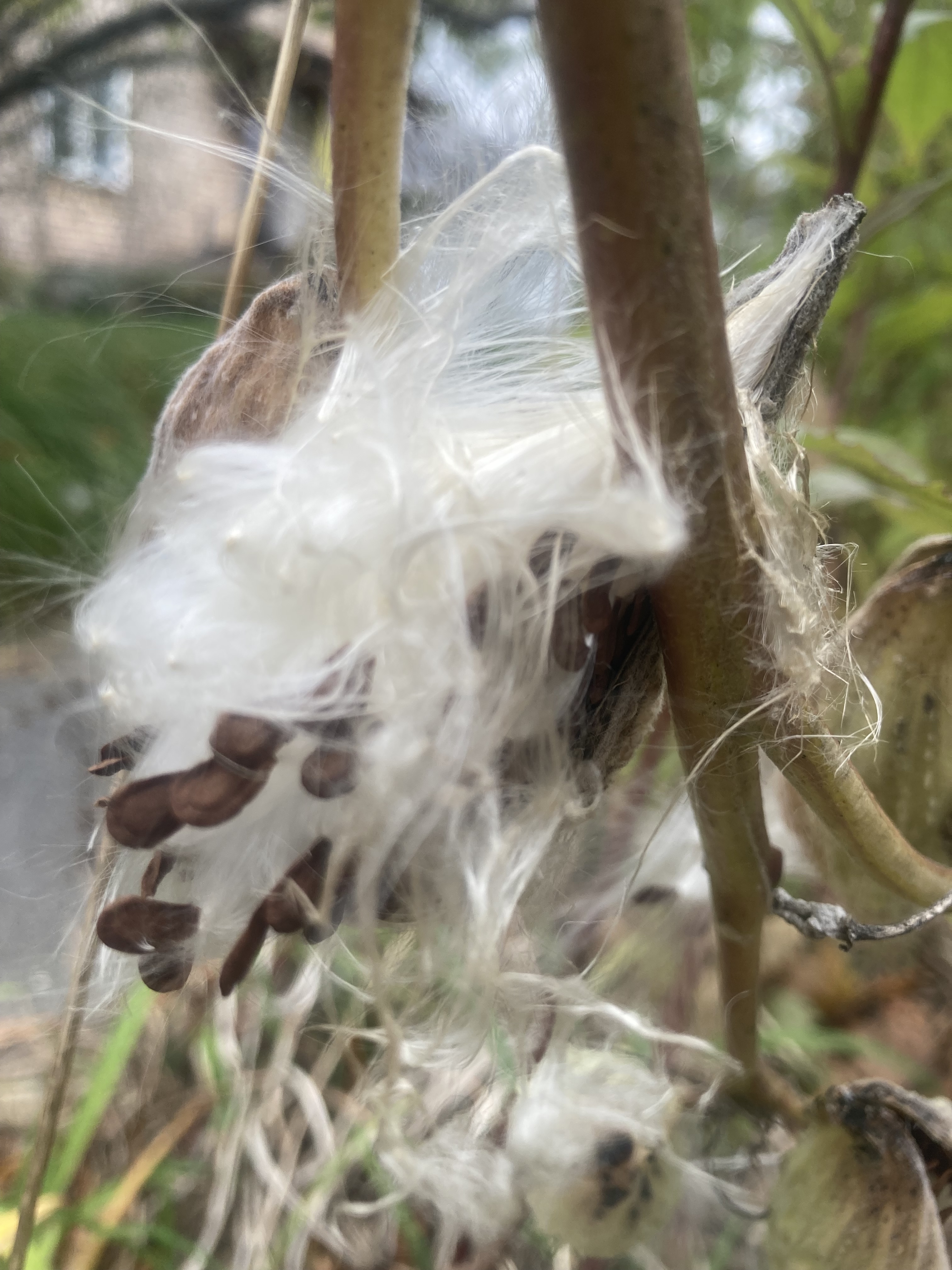
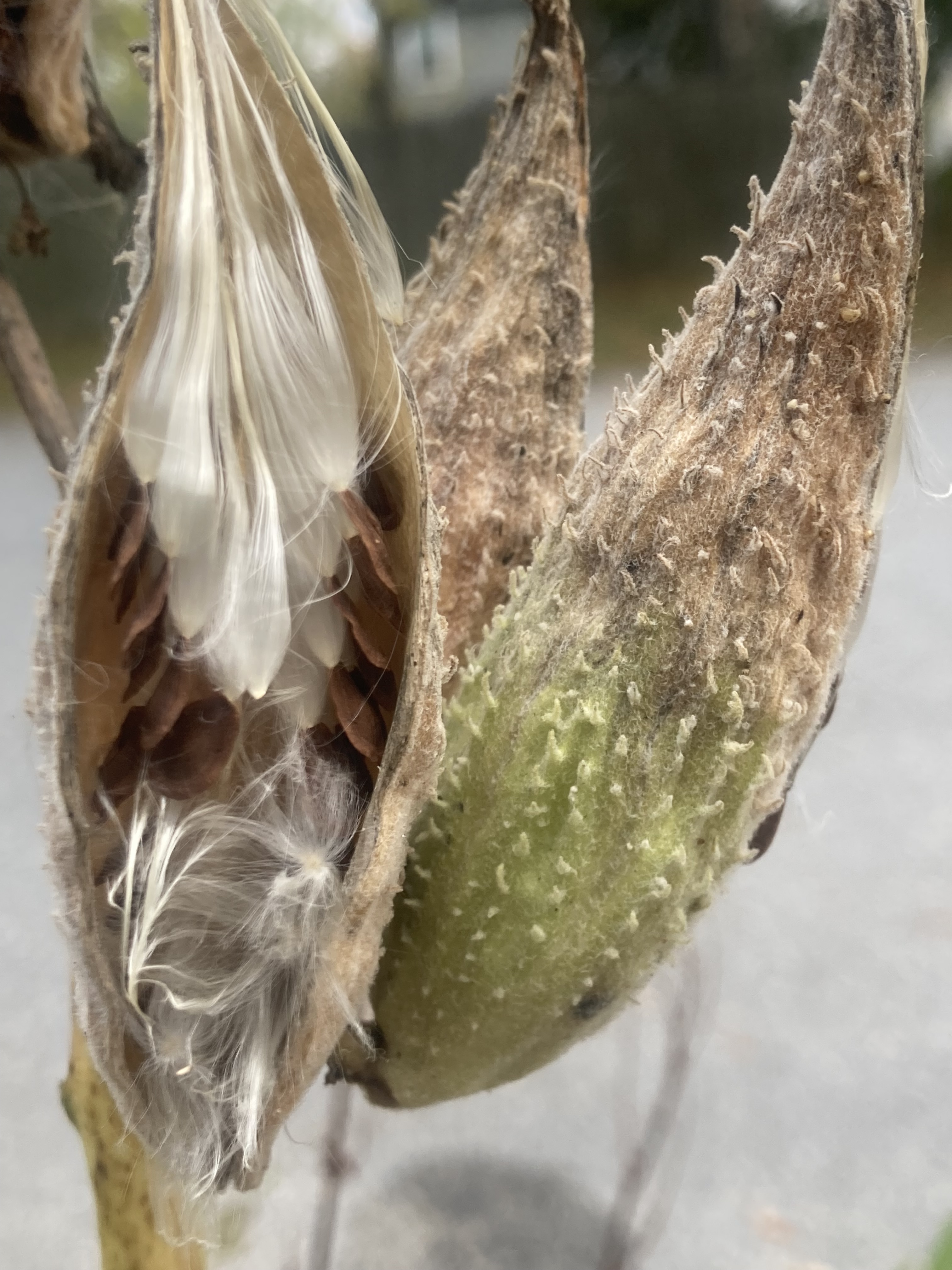
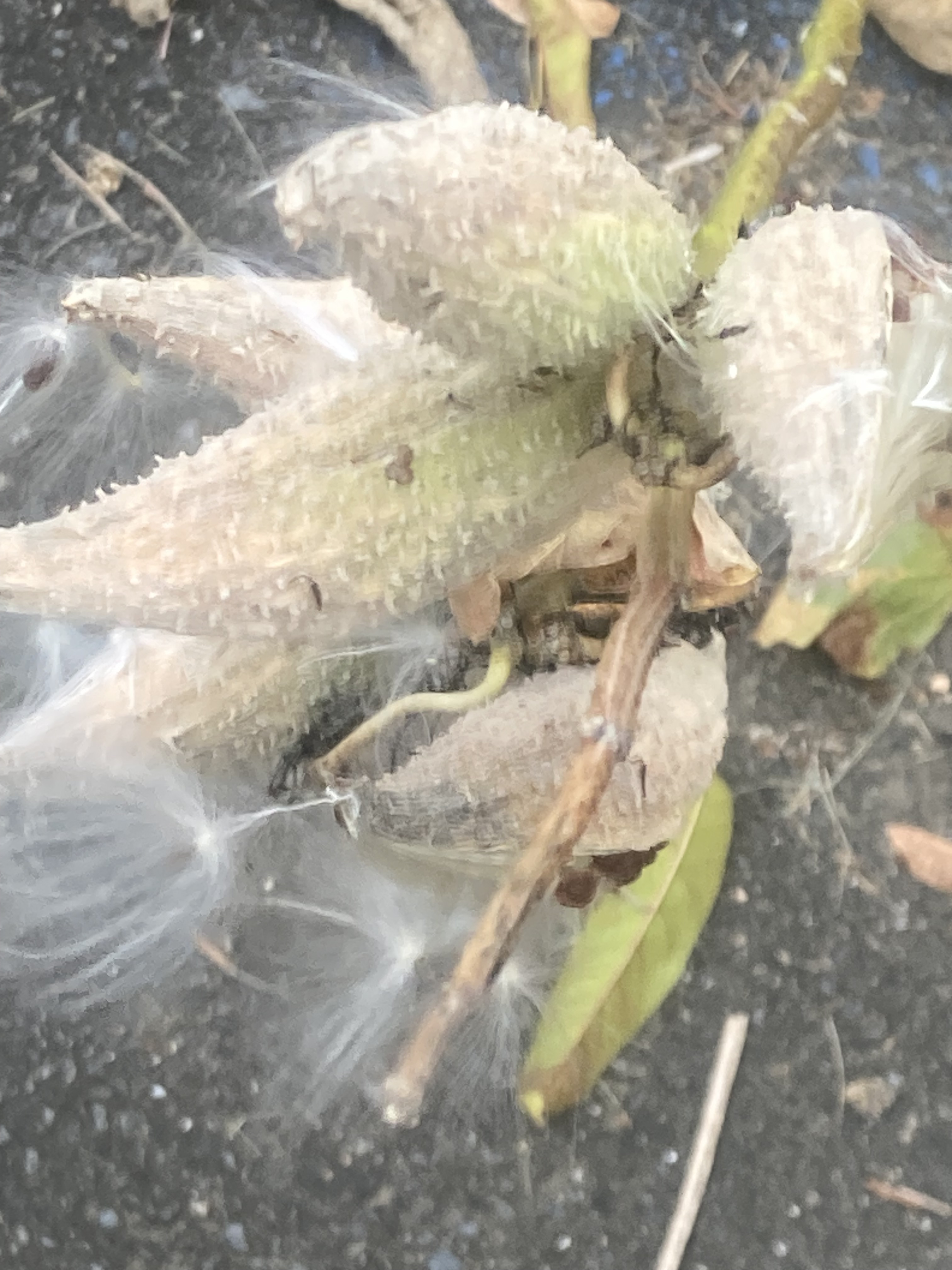
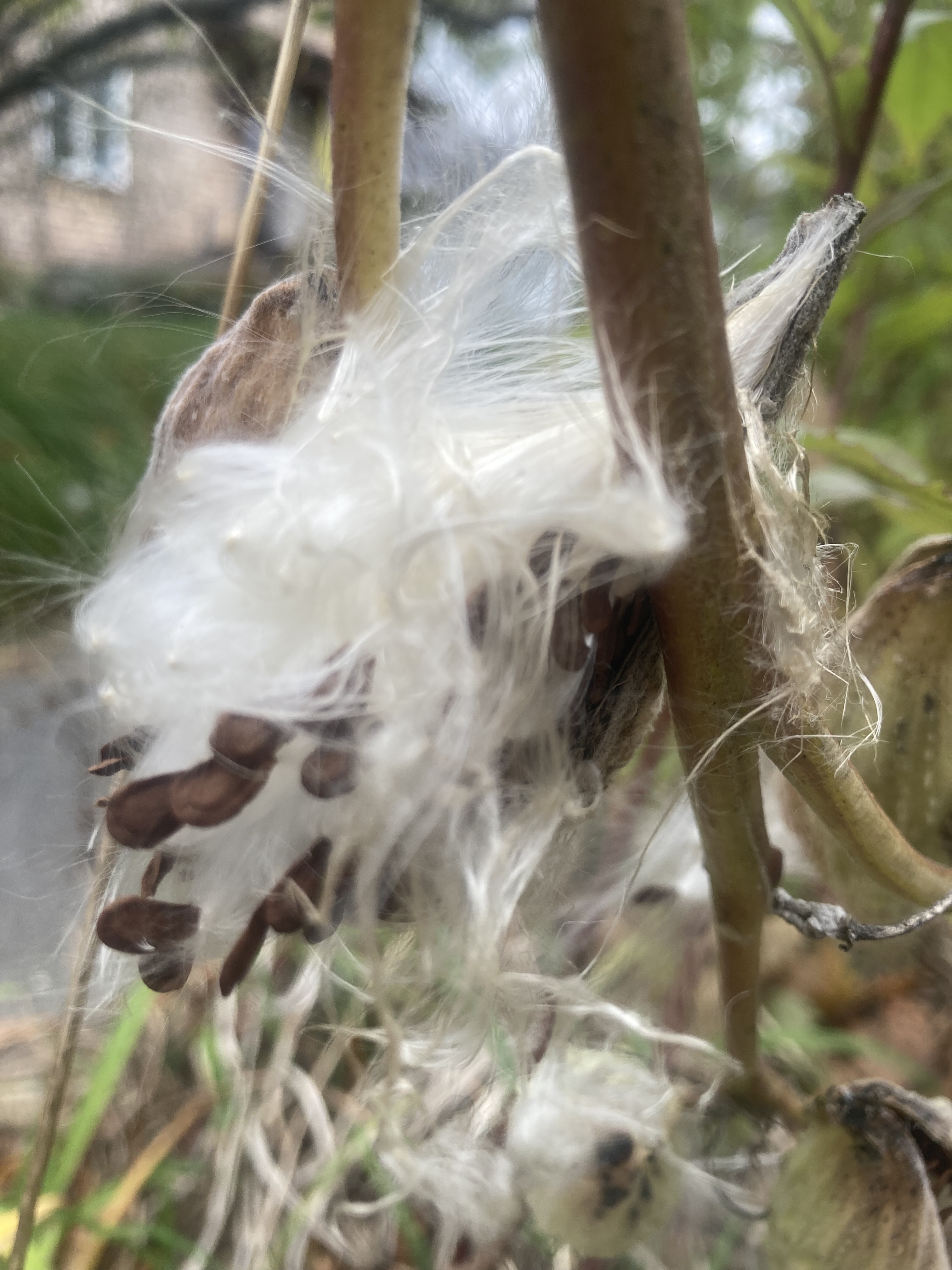
Persephone soon departs, the dark season is just weeks away. The Milkweed blows. Mary Oliver comes to mind.
The milkweed now with their many pods are standing like a country of dry women. The wind lifts their flat leaves and drops them. This is not kind, but they retain a certain crisp glamour; moreover, it’s easy to believe each one was once young and delicate, also frightened; also capable of a certain amount of rough joy. I wish you would walk with me out into the world. I wish you could see what has to happen, how each one crackles like a blessing over its thin children as they rush away.
When I was a child growing up in Deerfield, Illinois the ancient saying “Money is the root of all evil” still held currency in the culture. People actually thought that way, but now, decades later, that quotation seems less often spoken. An AI search reports that the phrase is popular on social media, but I would not know this since I do not frequent those haunts.
The sentence is a misquote from the Bible 1 Timothy 6:10 “For the love of money is a root of all kinds of evils.” So money itself is value neutral, while its craving and lust are the stuff of sin, a defining trait of this dark age of Mammon.
When I was a child growing up in Deerfield, Illinois there lived a young woman, whose father was from Guatemala and her mother an Anglo, a bi-racial family in a very caucasian Judeo-Christian small town. When her father died young, her mother’s strength held them strong and taught them to take pride in their work, meager as it may be. When that young woman came of age her work ethic and ambition lead her to food service, and eventually to found a catering company – with $300 dollars – called “Food For Thought.”
I worked with that company at its beginning, serving endless platters of Chicken Dijonnaise and Phyllo-wrapped Baked Brie, in the era when the Silver Palate Cookbook was changing the rules of the game, and American Cuisine was taking root. “Food For Thought” grew over the decades to become Chicago’s leading provider of corporate, social, and cultural event services with revenues now exceeding $22 Million per year.
In our Wise Women writings, we have discussed the “Commanding Intellect” – which this young woman had in abundance – but more fundamentally her’s is the gift of “Empathy” which is “the ability to understand and share the feelings of another.” Empathy’s first cousin “Forbearance” is “restraint and tolerance” by “demonstrating patience and showing tolerance toward others who are imperfect or have wronged you.” This woman built Food For Thought but what she did next is the story that bears mention, that demonstrates her wisdom. Commanding intellect built her first business. Empathy expanded her reach.
$80.7 Billion dollars are spent annually in the United States on public prisons and jails. Approximately 4,000 companies work in the for-profit prison industrial complex generating $5.2 Billion dollars in revenue annually. It costs more to send a teenager to a correctional facility than to put them through Northwestern University. Our Heroine reasoned that she could give the “throw away kids,” the gang-affiliated, the pregnant teen mothers, the dispossessed, the least among us a chance, to learn a trade through food service, at a cost less than $10,000 per child. She leveraged her food service savvy toward social justice by opening Curt’s Cafe, in Evanston, Illinois.
Curt’s Cafe (Cultivating Unique Restaurant Training) works to “improve outcomes for young adults (ages 15-24) living in at-risk situations through work and life skills training.” Over 650 students have completed the Cafe’s work and skill training, learning how to prepare and serve a full menu of breakfast and lunch items, how to work the cash register, how to do basic accounting, how to open a checking account, how to find an apartment. Nationally, the recidivism rate for ex-convicts returning to prison is 86% but at Curt’s Cafe only 1% having returned to prison. 1%! The average wage of incarcerated workers is $0.86 per day, but Curt’s Cafe provides its workers a living stipend and hope. These numbers only scratch the surface. The human stories are richer, deeper, and more meaningful.
It is best now to let Susan Trieschmann tell her own story:
_________________________________
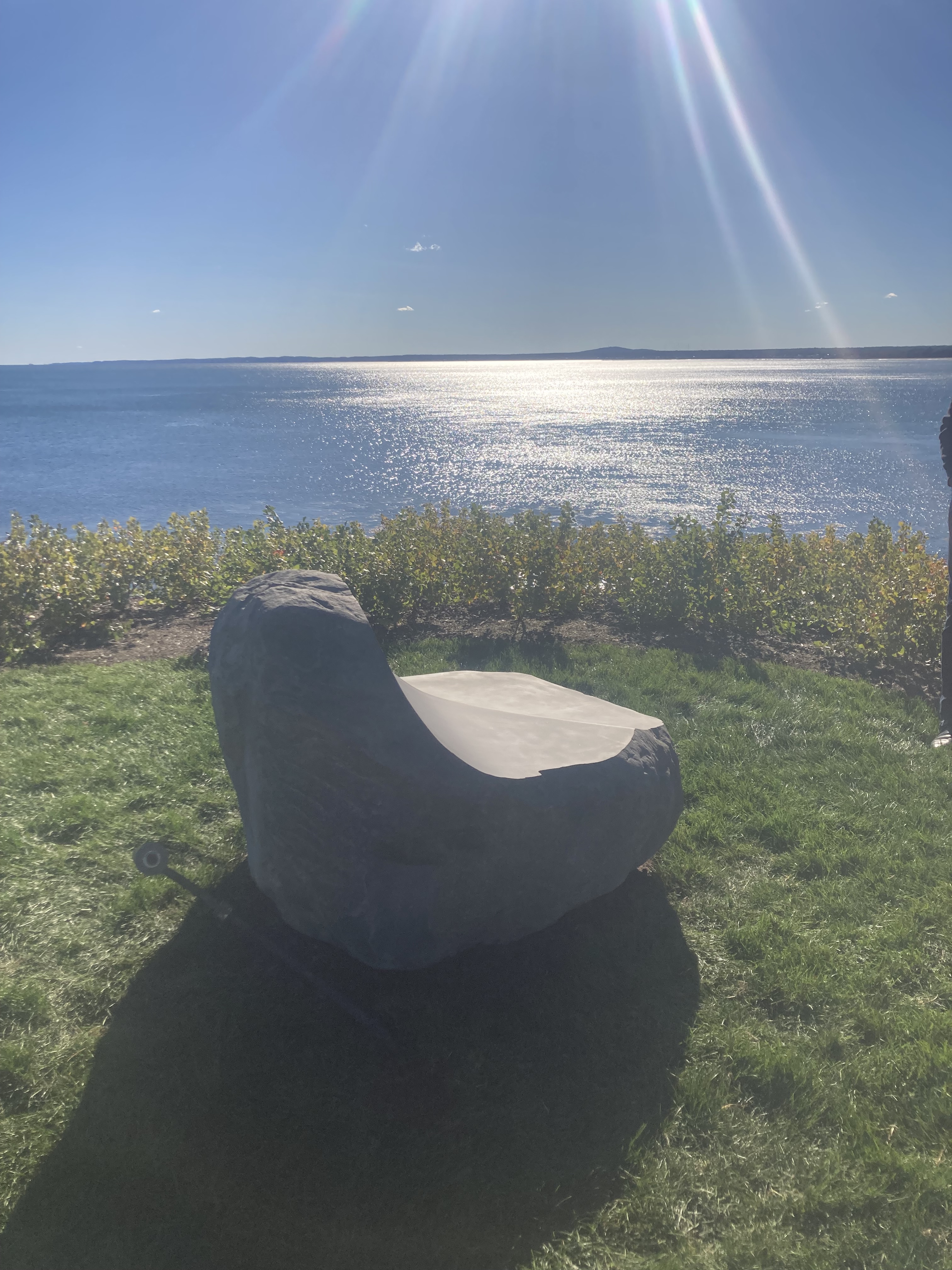
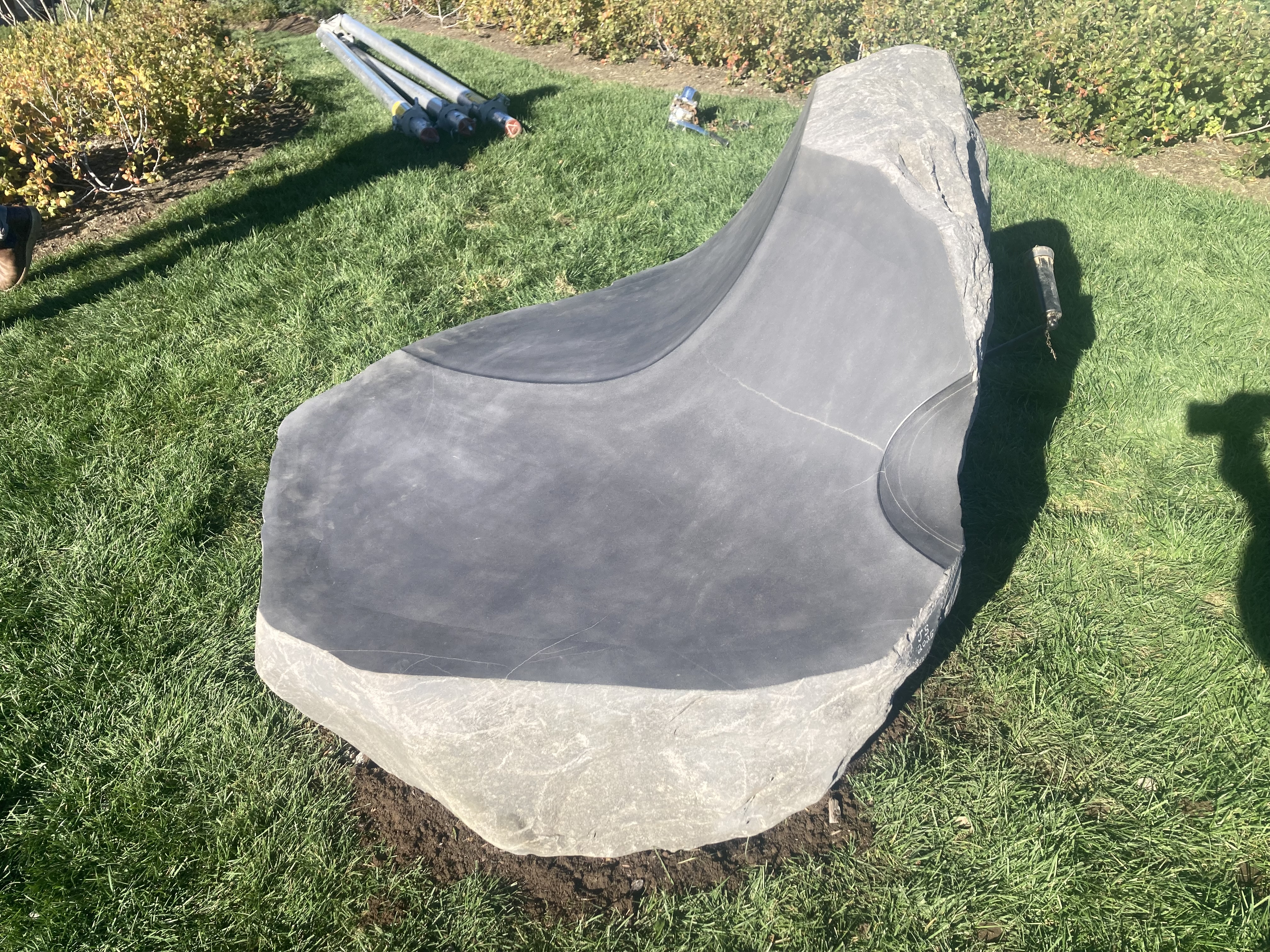
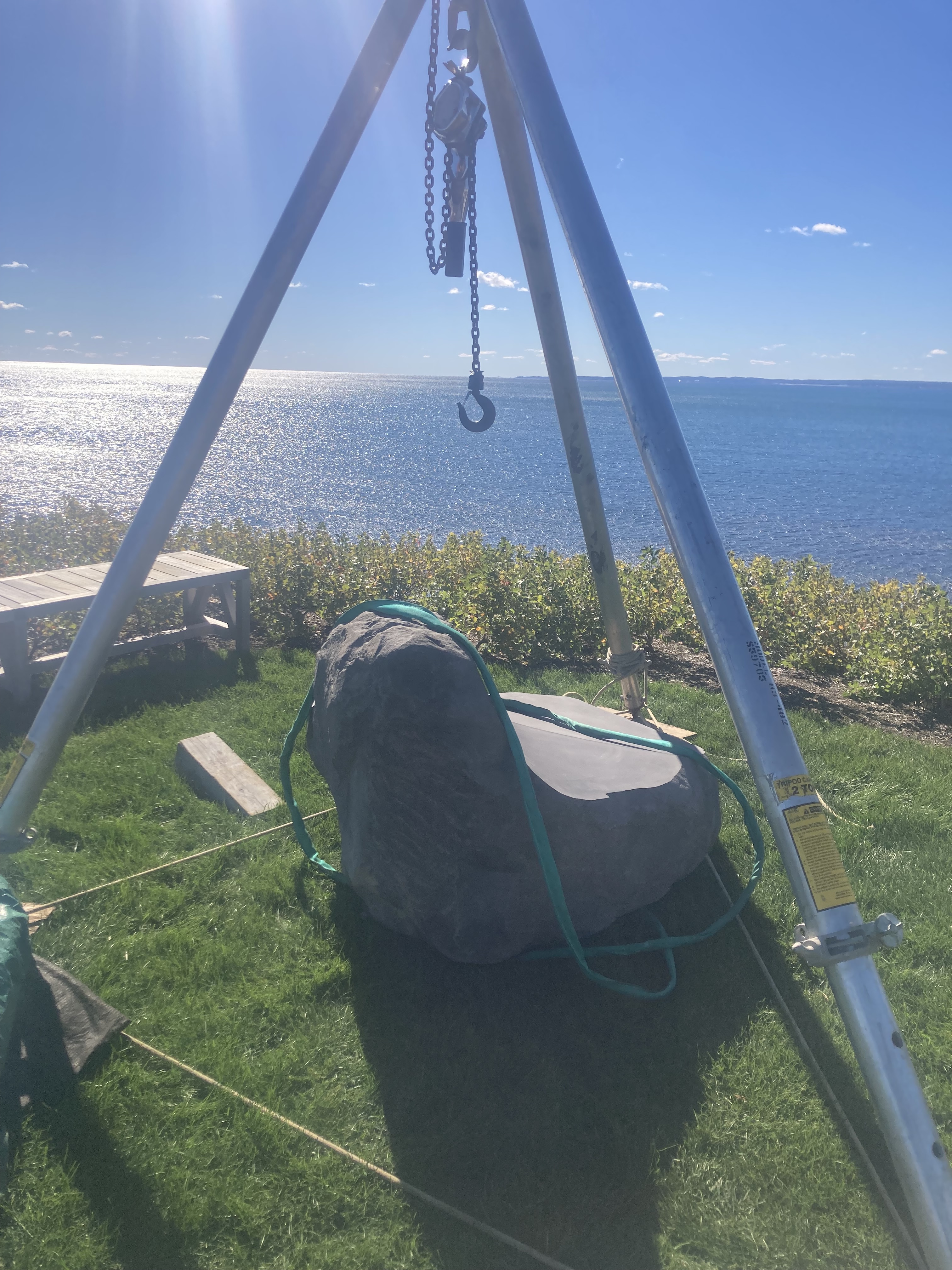
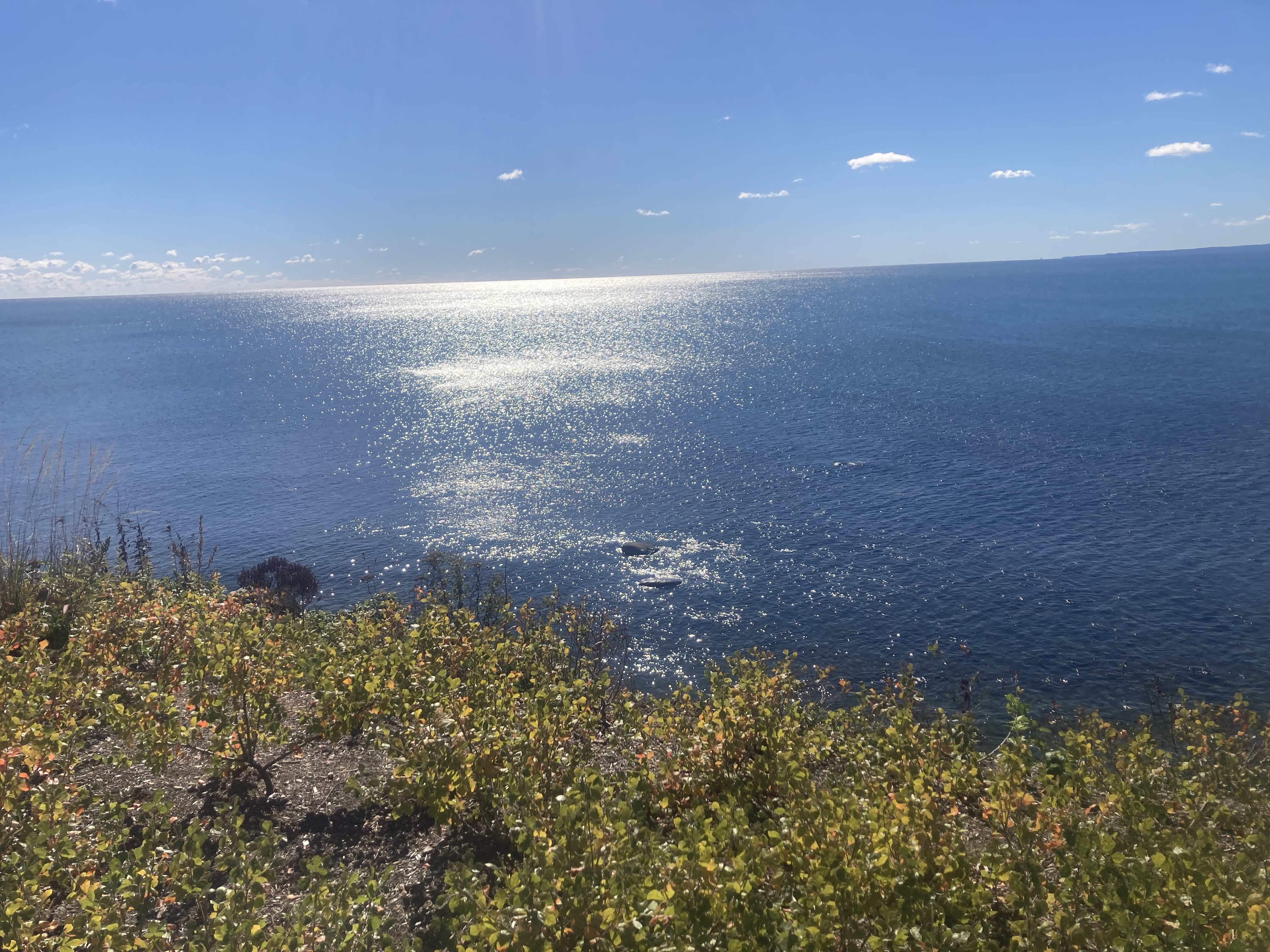
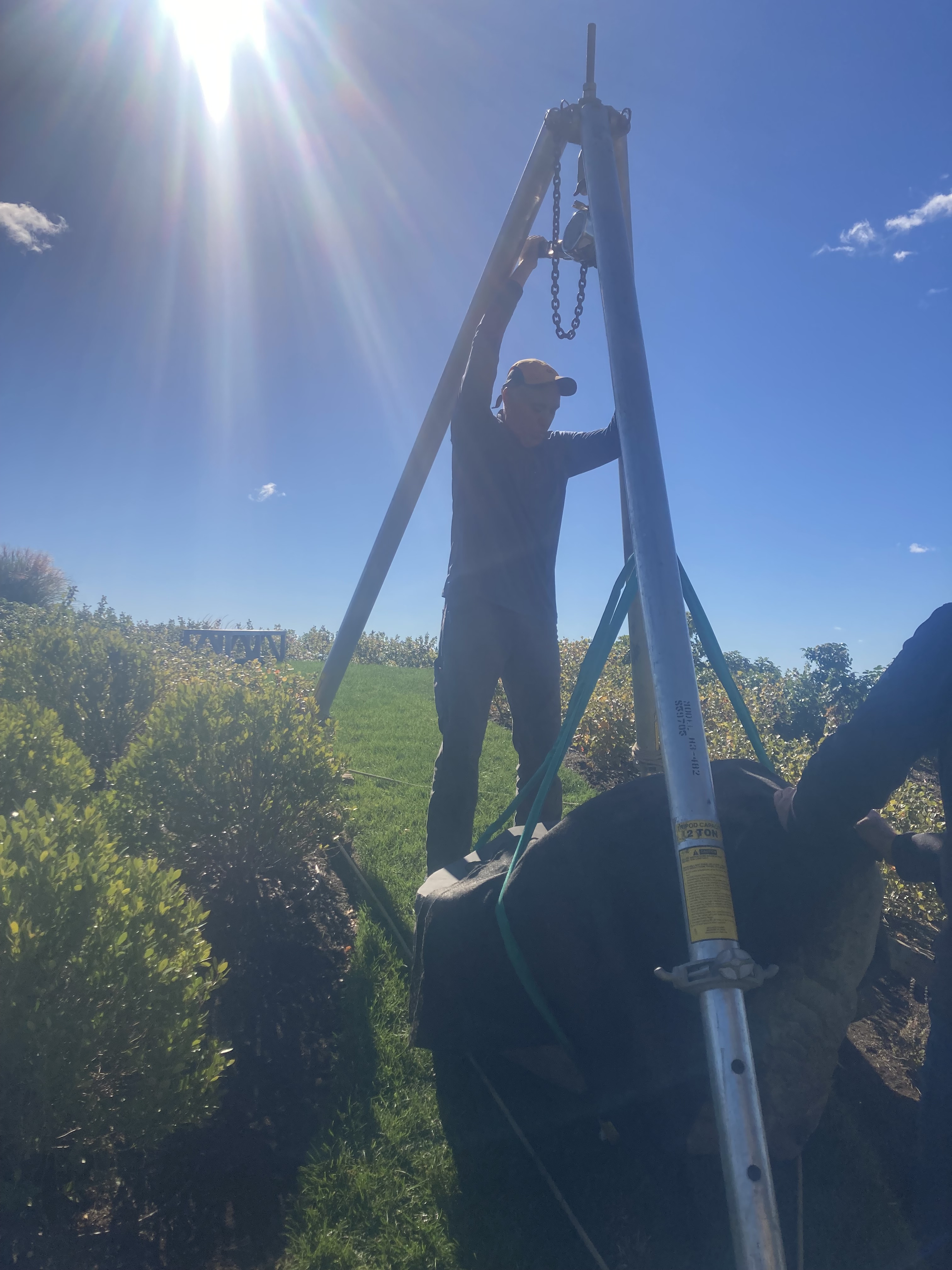
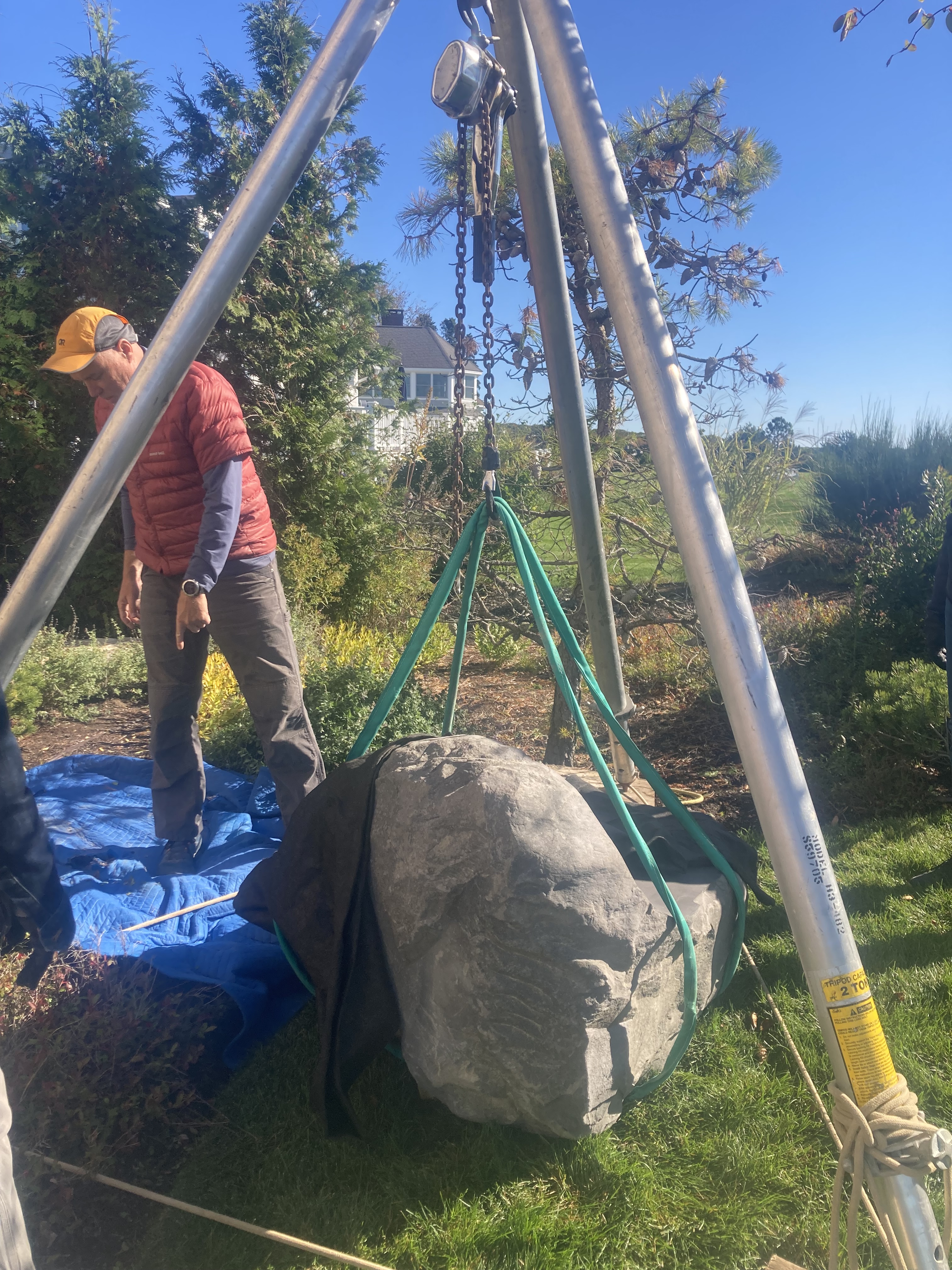
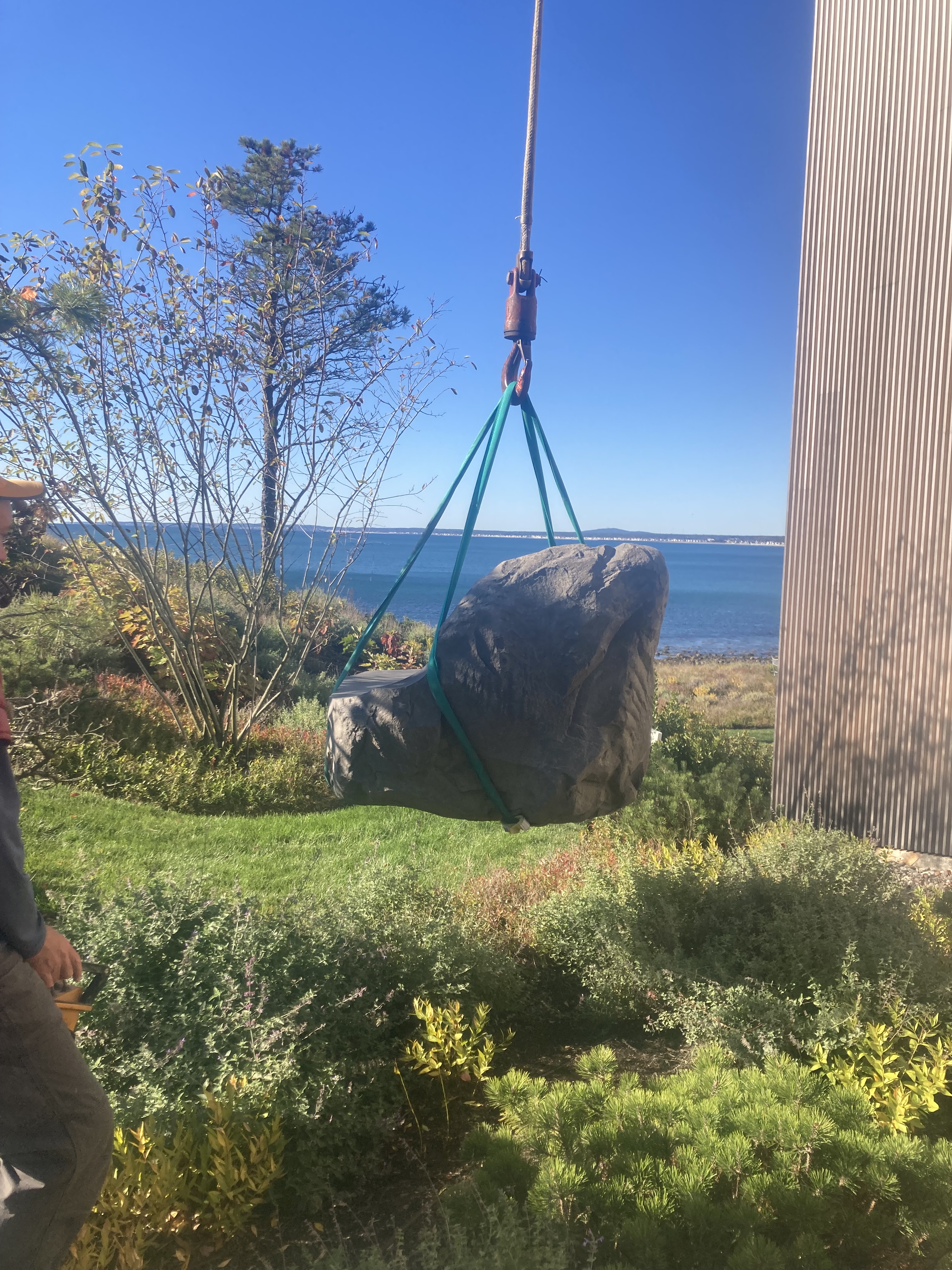
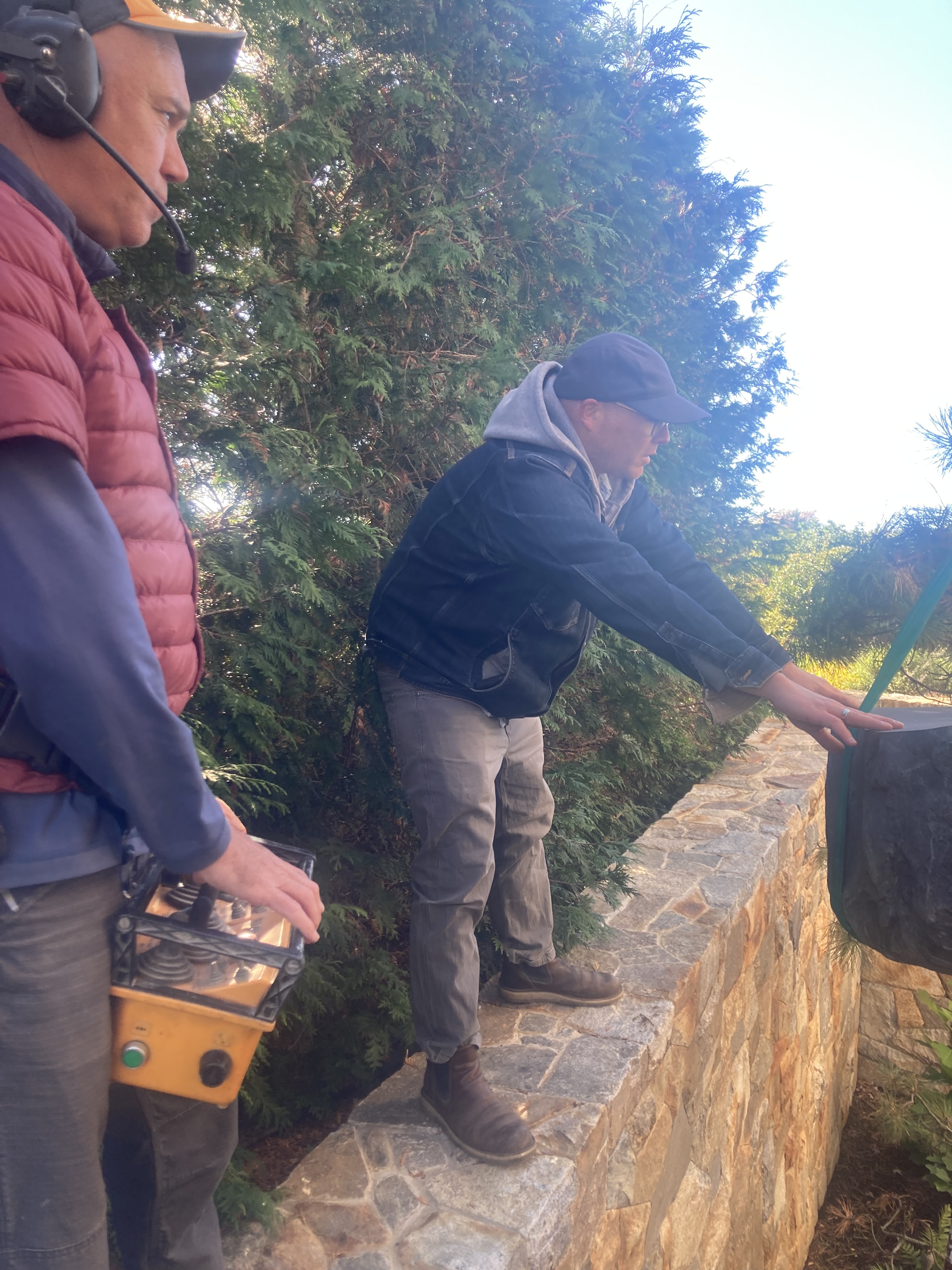
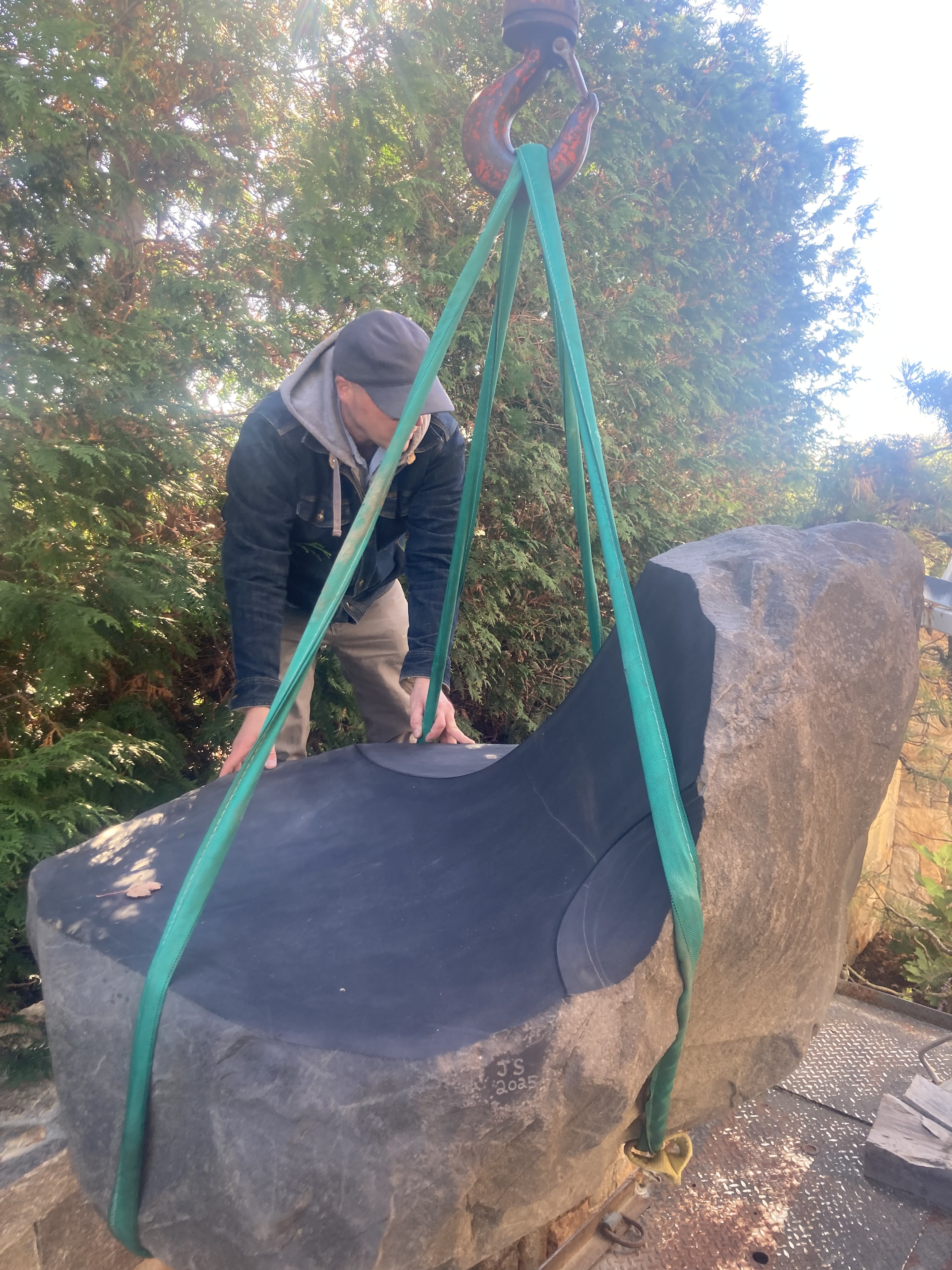
In other news, this week I helped install a sculpture down in Kennebunk. Jesse Salisbury is the esteemed maker of this seat carved from Basalt, a hard black volcanic rock. Heavy lifting 1.5 tons up that hill, but well worth the effort in the end. Ars long, vita brevis.
Two score and three years ago, to discipline my young mind I enrolled to study Latin. Nothing in my past forecast that choice; it was a decision wholly without precedent. My father having just died, I was given the gift of education – anywhere on any topic – and Classical Languages & Literatures was the choice that I made.
Because it was close to my childhood home, I enrolled at Northwestern University. I studied there beside wizened and wise men of letters. Stuart Small taught me Greek and Latin literature, while Erich Heller – a lion among the European literary cognoscenti – and I broke bread, and discussed German literature. Erich made a comment once that is marked indelibly upon my mind, “There is a mysterious link between grammar and the mind.”
In this year 2025, at our Art Farm Academy, my son explores this link as he learns to parse sentences, grammar’s deep structure, whereby thoughts are made manifest. This week’s topic was “The Verbs of Action and the Predicate” wherein my son thought deeply upon verbs transitive or intransitive; objects direct or of prepositions; simple versus complete predicates; adverbs and adverbial phrases. He marked a line dividing the subject from the predicate, determined whether a verb was transitive or intransitive, identified the direct object – when applicable – and demarcated the prepositional phrase. Intellectual heavy lifting, he stayed the course.
In homeschooling, a student cannot hide in a classroom of 20 fidgeting students. This is one-on-one, face-to-face, question and answer. For a young man coming of age, who feels anxious in social settings, his Language Arts class presses buttons. His teacher, the Magister, is firm but fair and it is probable that nothing could benefit him more.
The mysterious link between grammar and the mind is like a yoke, focusing the mind, as it frames our thoughts. For millennia yogis have regarded the yoke as a symbol of union, of body, mind and spirit, which is the “being” at grammar’s root, an inlet to consciousness.
In this age when AI will override STEM, at the dawn of a post-literate society shaped by videos and memes on a screen more than words on a page, nothing could be more salient. The power to focus the mind and to frame thoughts is the power to articulate and to question authority.
Let us parse from among the greatest speeches in American history:
“Four score and seven years ago…” is but a phrase, not even a clause, but has a poetry that most every American can repeat from memory;
“We have nothing to fear, but fear itself” wherein “fear” is both verb and noun;
“I have a dream…” uses subject verb and object to drive the essence of simplicity, clarity and hope;
“Ain’t I a Woman?” changes the syntax to verb and subject but no object, using the vernacular, for emphasis;
“Give me liberty or give me death!” is an impassioned hortative, in binary form: two independent clauses of verb, subject, object using a coordinating conjunction as fulcrum;
“…stay hungry, stay foolish.” repeats an imperative verb, with contrasting adjectives, using parallelism to form an inspirational slogan [delivered by Steven Jobs, 2005, to graduates of Stanford University (but which slogan he lifted from the Whole Earth Catalog)].
At this art farm, our core curriculum centers upon “the grammar of being.” We go forward, building confidence, into the future.
____________________________________
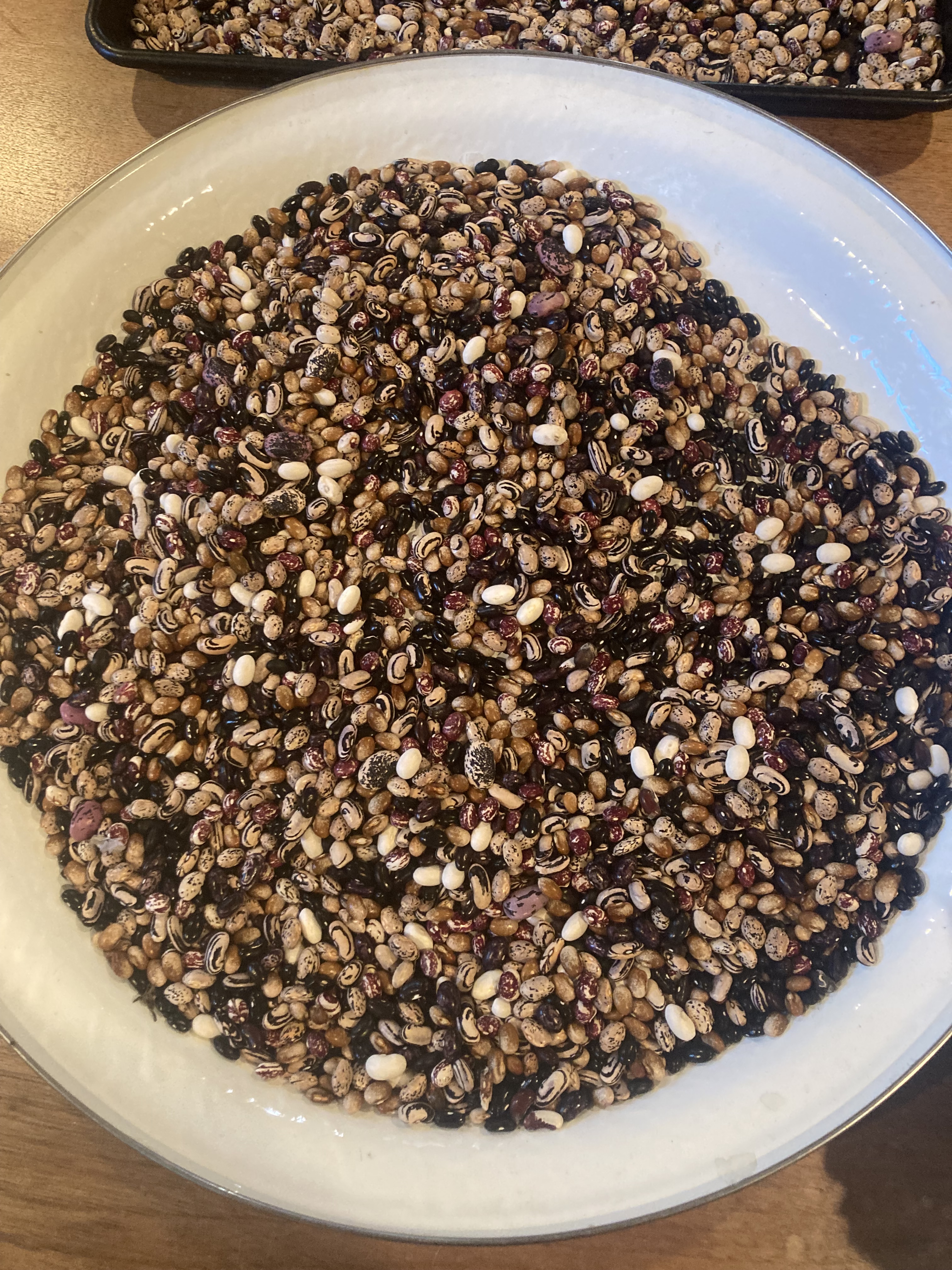
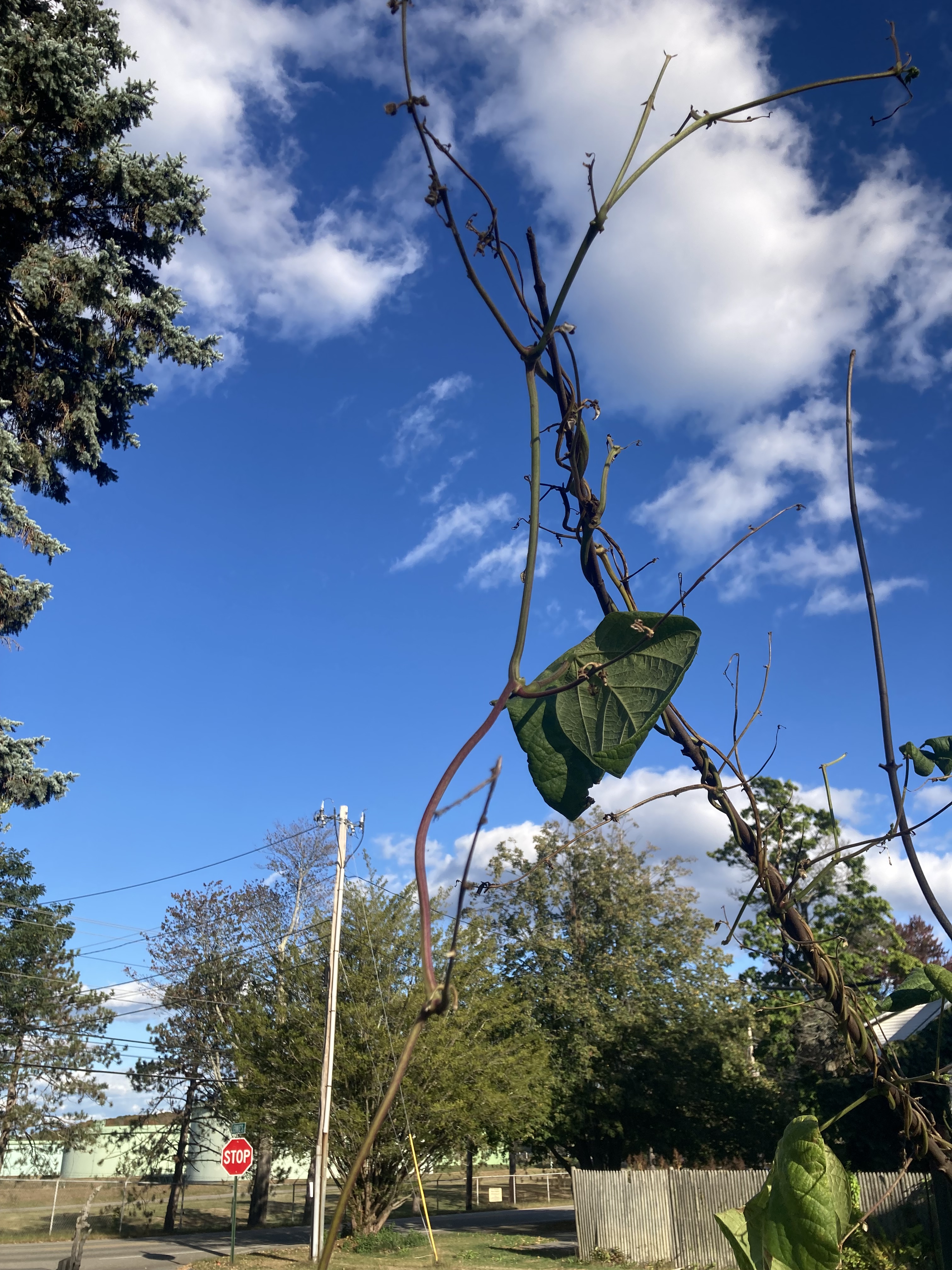
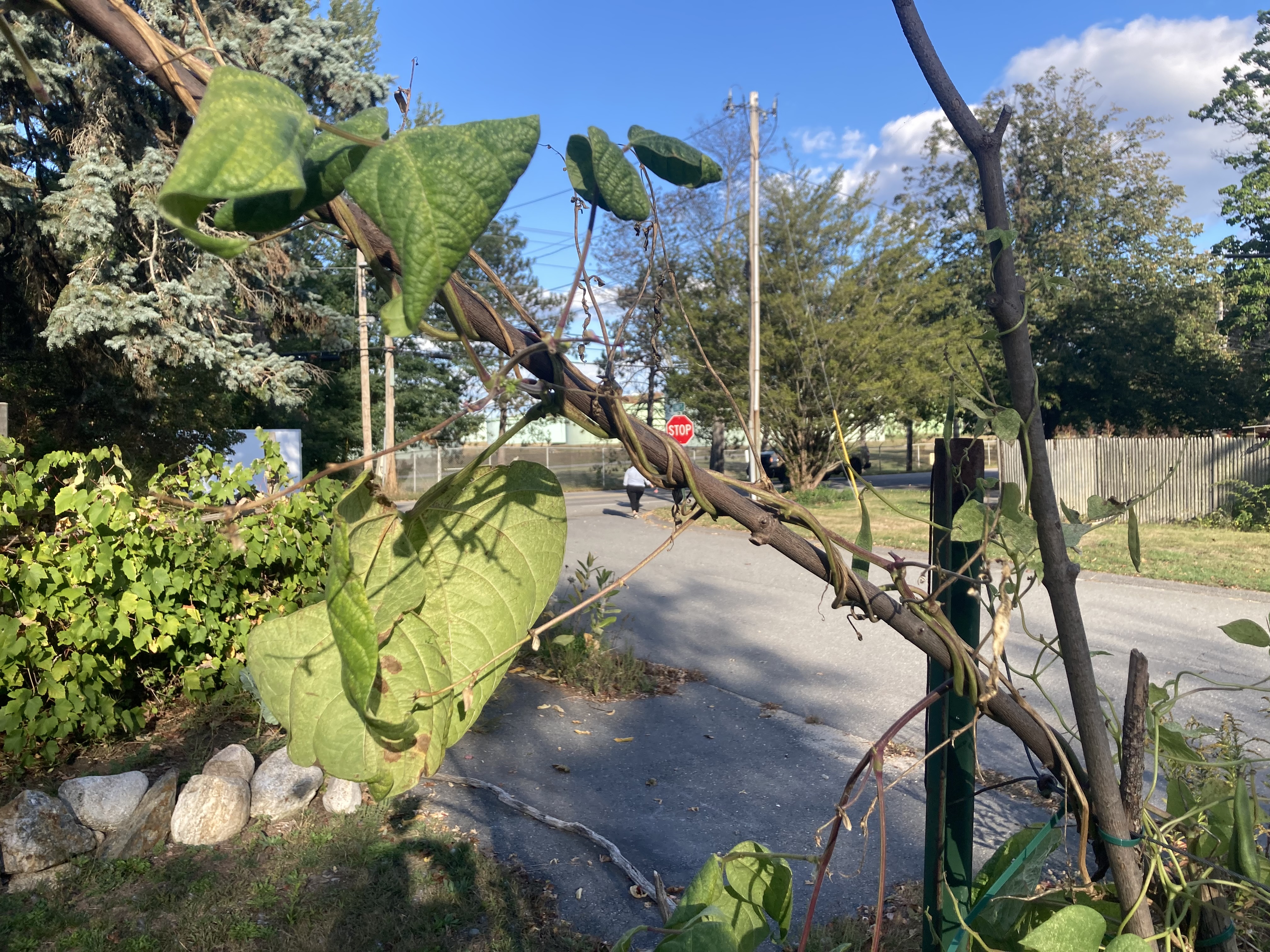
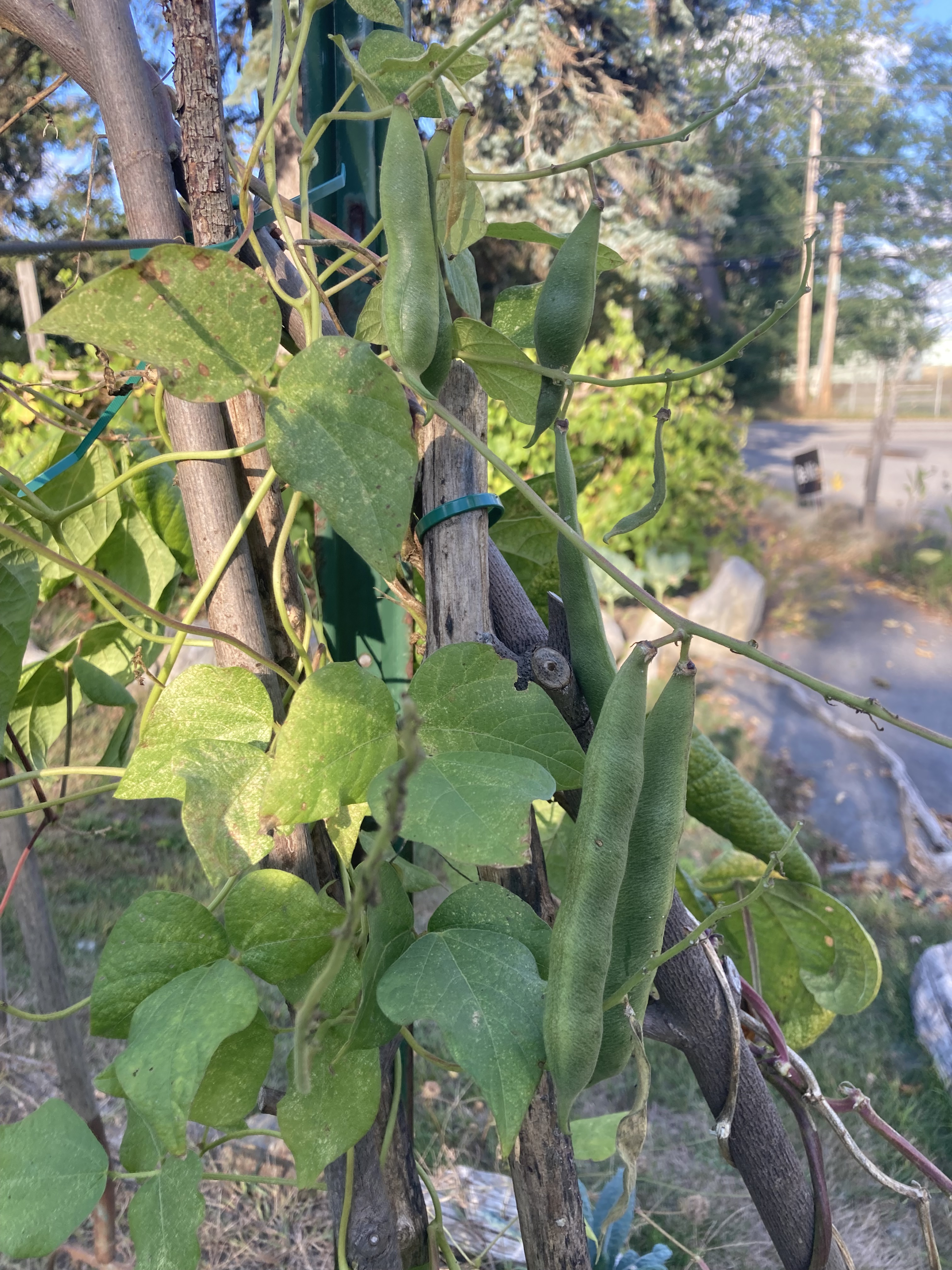
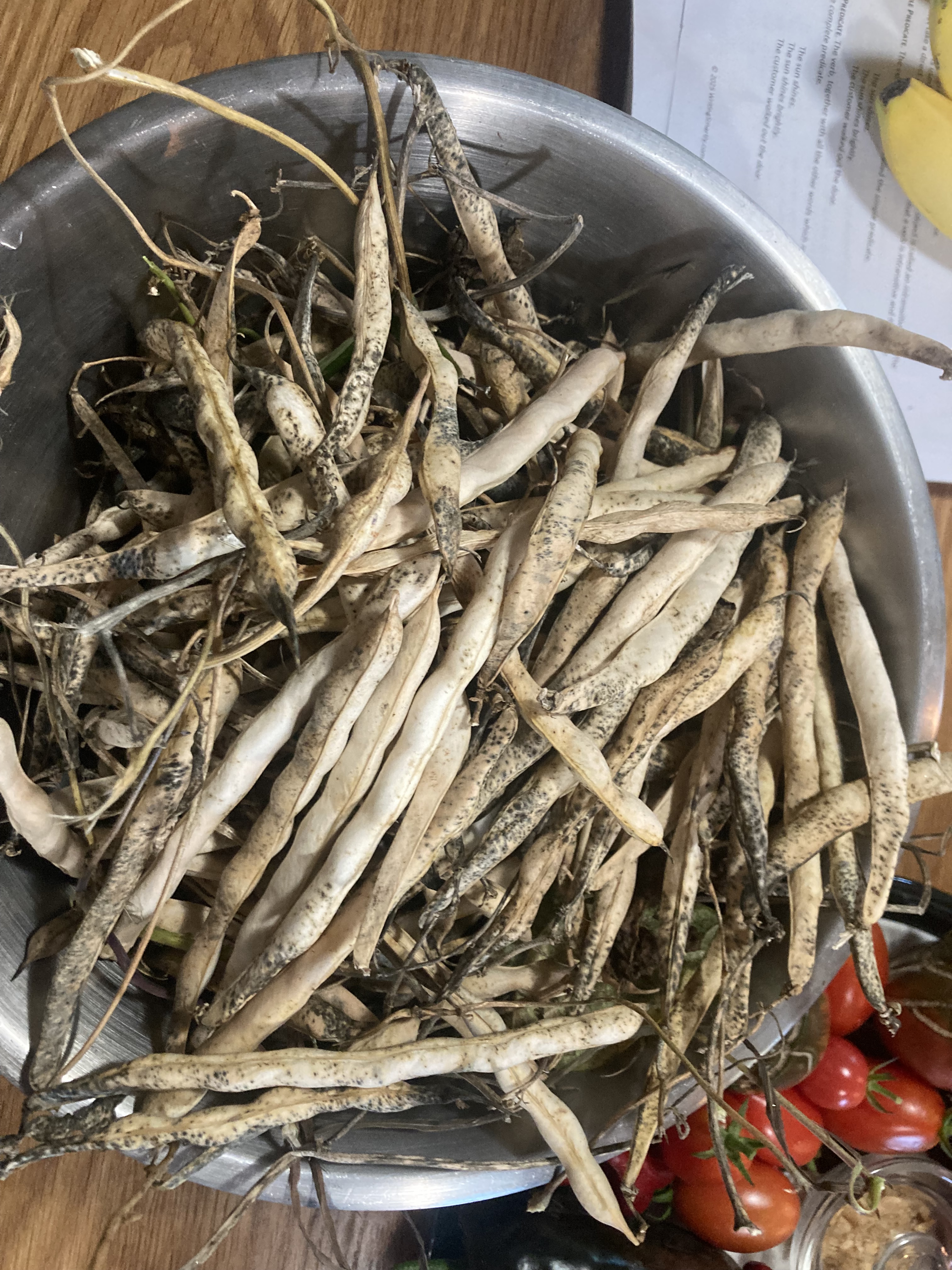
It is October and we glean the garden. Beans harvested, are shelled, put up for winter.
Henry Ford’s broad vision for business success included that his vendors and subcontractors should make a reasonable profit from doing business with the Ford Motor Company. Wholistic, he understood that everyone in the supply chain should be treated fairly for the system to thrive. He famously said, “A business absolutely devoted to service will have only one worry about profits. They will be embarrassingly large.”
My son and I talked about this during the summer, when he took a job seal-coating a 5,004 square foot parking lot. It was his job – I, his crew and driver – but I advised that he should issue a quote in advance, so the client knew what to expect. With great confidence he named his price including a modest profit. The client understood the final invoice would be on a time and materials basis.
The job went well, but in fact was more demanding that expected. The crew pulled it through, but when it came time to submit the final bill my son realized that what had seemed – in advance – like a windfall, felt too small after the fact. He learned what hard labor meant and wanted to charge more. And so we talked about Henry Ford and what a “reasonable profit” meant. In the end, he settled on a 20% profit which equalled $52.50. The client was pleased and paid the bill gladly.
About Henry Ford we have kept talking, and our history curriculum is built around the farm boy from Dearborn who quit school with a 6th grade education. Encouraged by Thomas Edison, in 1903 he founded the Ford Motor Company. Models N, T and A followed and his River Rouge Complex would become the world’s largest, iconic and most efficient integrated factory. Detroit has a rich history, and Mo-Town adds a phenomenal soundtrack.
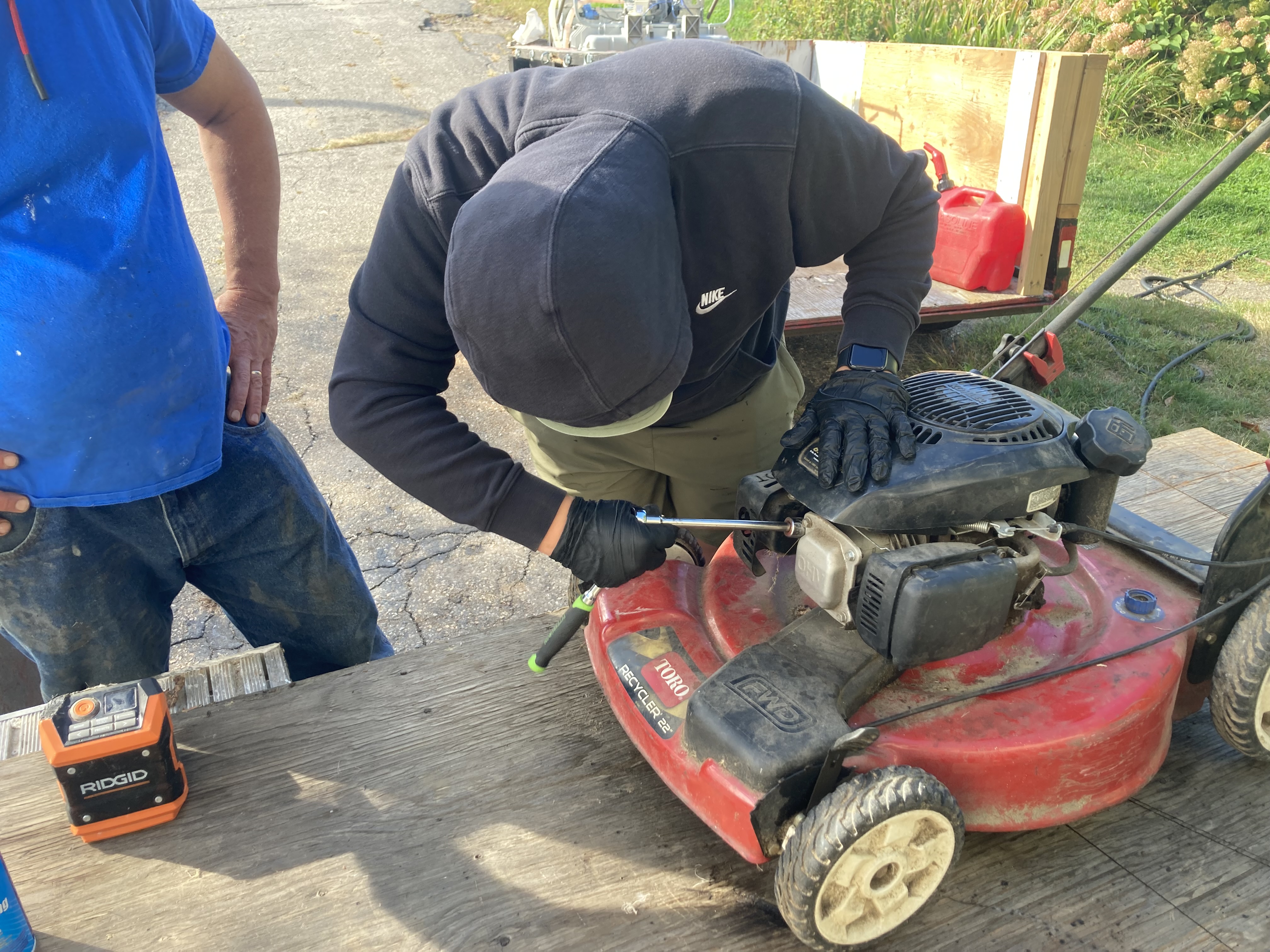
To make history tangible, we drove to the Professor’s house in Lyman, Maine to work on a small internal combustion engine. The Professor is a journeyman carpenter/philosopher, who not only has every tool known to mankind, but knows how to use them all! Pedagogy unfolded under a shade tree at the Lyman town center.
The Professor sagely required my son to write a summary of the experience. Given the complexity, my son dictated while I was his scribe, and we then parsed the grammar – nouns, common or proper and concrete or abstract; verbs and adverbs; prepositional phrases and their objects; subordinate clauses – and ended up with his summation:
“With Professor Nate, I worked on a Toro Recycler lawn mower with a 22” deck. The first thing we did was try to start it. It would not start. We realized that it did not have an air filter.
“We put it up on a table and looked at the spark plug. The spark plug had a lot of carbon, so we tested the plug to see if it had a spark. It did, but it was orange. The color of the spark can determine how much voltage is being generated from the engine. Red is poor, orange means power but weak, a blue spark is a strong: voltage follows the rainbow spectrum. Our plug had an orange spark. Nate had a new plug that we tested, but it had no spark at all.
“So then we tried using some 1,000 grit sand paper to sand off some of the carbon from the tip. After trying that we tested the original plug again and it had improved. We put it back into the motor, tightened it first by hand and then used a torque wrench, with approximately 30 foot-pounds of torque.
“We checked the oil and gas. We drained the gas bowl, which is under the engine on the left, to see if there was dirt in the fuel. There were specks of dirt and rust, and the fuel was green from the stabilizer. After we drained it, the fuel looked good.
“The Toro Recycler is supposed to have front wheel drive but it wasn’t working. We took the cover off and one of the belts was completely snapped. There was a stick lodged in the belt and a lot of grass had built up inside the housing of the belt. We put the belt cover back on. That should be the problem for the drive.
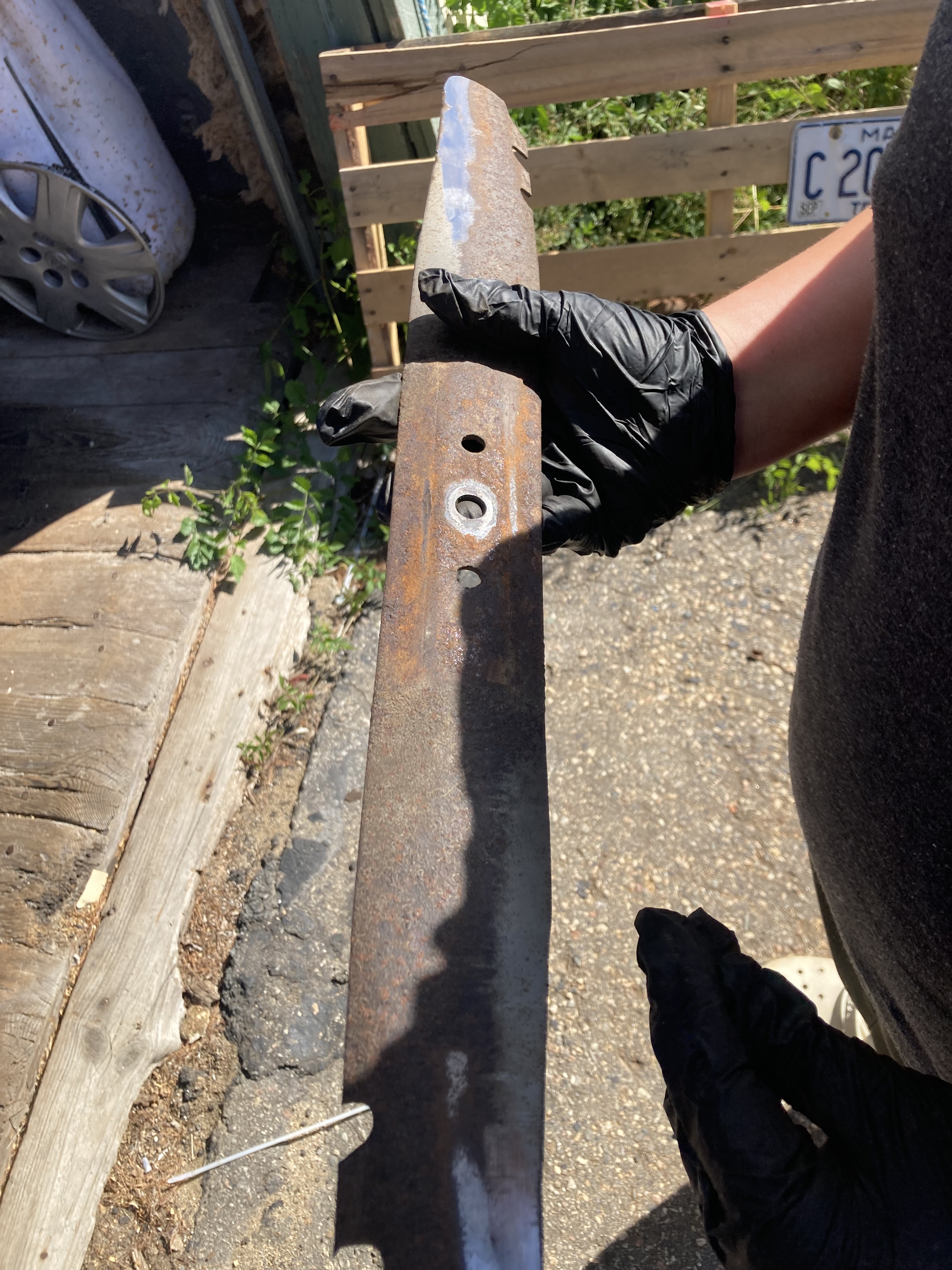
“We took the blade off using a pneumatic impact driver. We sharpened the blade, simply grinding the edge down. We put the blade back on using the torque wrench.
“We put the mower back on the ground and it started. It did not sound great at first, but slowly the sound improved as the motor circulated the new gas through the engine. It mowed well.
“Next we will get a new air filter, new drive belts and a blade. We need to clean the mower. We are also studying Volts, Amps, Ohms and Watts as part of our science class.”
While the Professor teaches the “how-to,” my son’s cousin, the Lizard-whisperer, is teaching him the pure science of electricity and magnetism; voltage and current; protons, neutrons and electrostatic fields. From all angles we are unpacking the mystery and majesty of an internal combustion engine.
The lead photo above is my son’s Great Grandfather John, standing proudly beside his Ford Model A touring car, circa 1928. John was a coal salesman in the Ohio River Valley, who made frequent trips throughout the coal rich hills of Appalachia. His car was for work more than pleasure.
John’s customers included Detroit Edison; he would purchase the entire output of mines in Eastern Kentucky and Ohio and then ship the coal north by the train load. But John’s coal did not fire Henry’s furnaces.
Henry’s revolutionary self-sufficiency controlled costs by owning the entire production process: 16 coal mines powering the electric plants that generated the voltage to run the steel mills producing the parts for the cars ever rolling down that assembly line at the Ford Motor Company’s River Rouge Complex.
A 6th grade drop out has much to teach our 7th grade home schooler.
In the annals of wise women, Lou Andreas-Salomé’s name is writ large. Born February 1861 in St. Petersburg, Russia to parents of French Huguenot and Northern German descent, she was the youngest of six children, the only girl. She attended her brothers’ classes learning Russian, German and French, rejected the orthodoxy of her family’s Protestant faith but embraced philosophy, literature and religion. She attended the University of Zurich – one of the few schools then accepting women – and studied logic, history of philosophy, ancient philosophy, psychology and theology.
At the age of 21 she met Friedrich Nietzsche, who immediately fell in love with her. But she rejected his advance, instead wanting to live and study as “brother and sister” and form an academic commune along with Paul Ree, a German author. Nietzsche accepted and they toured Italy with Salomé’s Mother.
One of the titans of German Philosophy, at the age of 24 Nietzsche had been named the Chair of the Department of Classical Philology at the University of Basel. He remains among the youngest tenured professors of Classics in the history of academia. His brilliance was to an extreme.
Walter Kaufmann, in his classic work “The Portable Nietzsche” wrote, “There are philosophers who can write and those who cannot. Most of the great philosophers belong to the first group. There are also, much more rarely, philosophers who can write too well for their own good – as philosophers.” Plato, he says is one example while “Nietzsche furnishes a more recent and no less striking example.”
Lou Salomé was his muse, which she later became to Rainer Maria Rilke – the great German poet – when he was the Personal Secretary to Auguste Rodin, one of the greatest stone carvers of all times, easily a peer of Phidias and the Ancient Greeks. In rarified artistic and intellectual circles, Lou Salomé was at the top of the game.
Dionysus is our subject, Salomé is our guide, but Nietzsche holds the key. Kaufmann wrote, “…few writers in any age were so full of ideas – fruitful, if not acceptable – and it is clear why [Nietzsche] has steadily exerted a unique fascination on the most diverse minds and why he is still so eminently worth reading.”
At the age of 25, Nietzsche wrote “The Birth of Tragedy” which is considered foundational, a revolutionary work of philosophy, aesthetics, and cultural criticism. His groundbreaking thesis argued that the greatest works of art – which define a society – combine the Apollonian (order, reason and form) with the Dionysian (chaos, ecstasy and raw emotion) into one complimentary whole. An example of the Apollonian would be Johann Sebastian Bach’s “Well Tempered Clavier” while Jimi Hendrix’s “Voodoo Chile” is Dionysian. The Burning Man festival is pure Dionysian.
Classical Greek Tragedy, he reasoned, reached the apex of artistic expression by using an ordered beautiful form to give voice to the primal, universal unity. Nietzsche wrote, “The two creative tendencies [Apollo and Dionysus] developed alongside one another, usually in fierce opposition, each by its taunts forcing the other to more energetic production, both perpetuating in a discordant concord that agon which the term art but feebly denominates: until at last, by the thaumaturgy of an Hellenic act of will, the pair accepted the yoke of marriage and, in this condition, begot Attic tragedy, which exhibits the salient features of both parents.”
The result was cathartic; life’s meaninglessness overcome through art. Aesthetics became more central than rationalism, with art and psychology moved to the core pushing metaphysics and science to the side. Nietzsche forged a new paradigm, and his writing influenced Sigmund Freud, who also happened to be a close friend of Lou Salomé.
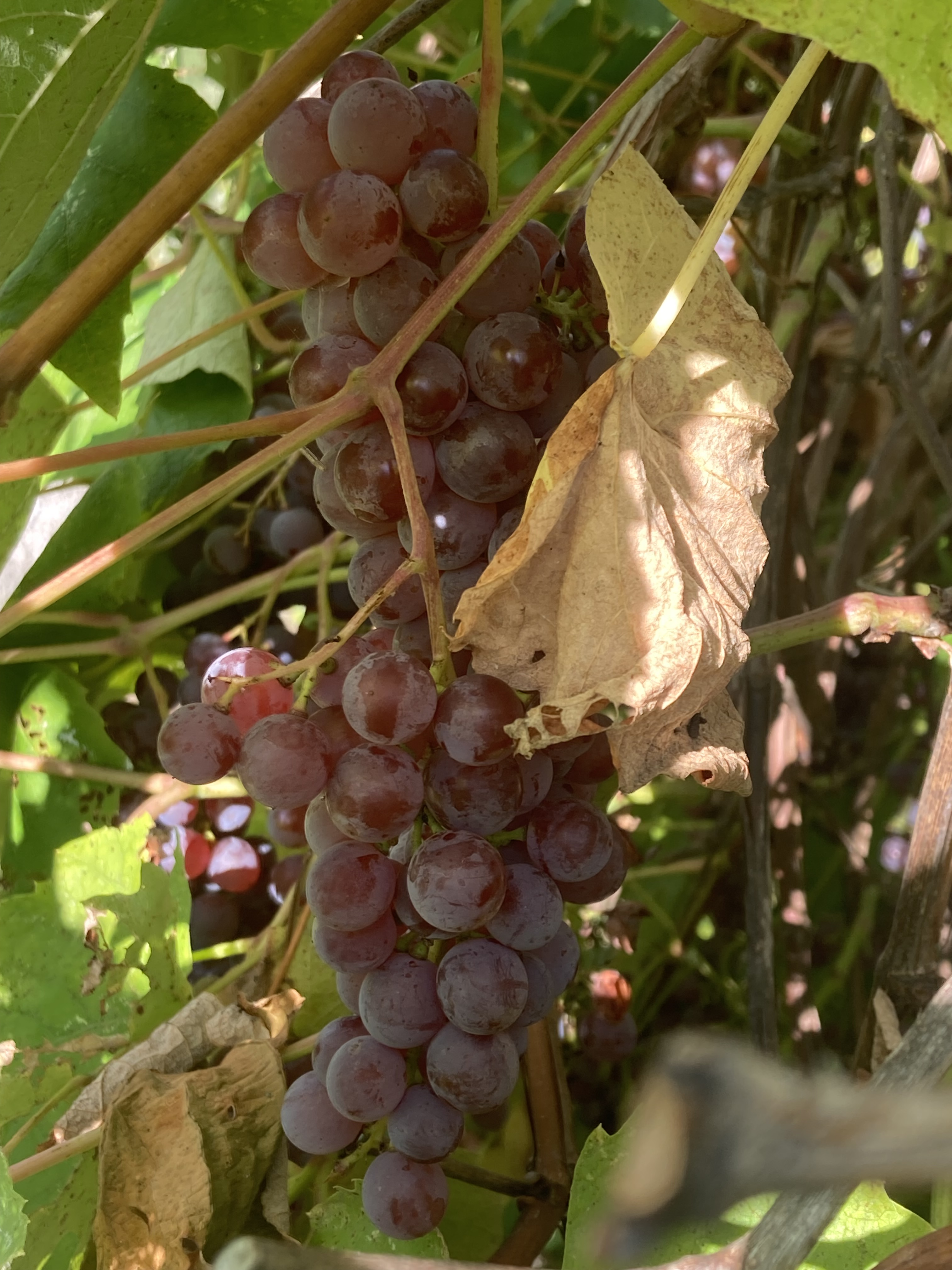
Greek tragedy came to my mind when a young friend, she herself on the path to wisdom, recently brought fresh home-pressed grape juice to our house. Grapes are the symbol of Dionysus and the connection was clear: her grape juice was the elixir of the God.
Having picked Concord grapes by the bushel with our other friends Rebekah, Peter and Mason, she explained, “We picked the grapes individually, sent them through a masher, then Peter heated them up before sending them through the juicing machine. He tried in the press but it kept sending the juice everywhere so he switched to a tomato juicer. That seemed to operate more like a standard juicer.” In other words the must was strained into juice rich, dark and sublime. With our children, we all broke bread and drank of the vine, the form of the Last Supper transformed as testimony to the raw and primal essence which is the end of summer; a new tradition born.
Truths held self-evident at our Art Farm include “art predates agriculture” and “the purpose of life is healing.” The Dionysian speaks to that, which simple truth the grape juice made manifest.
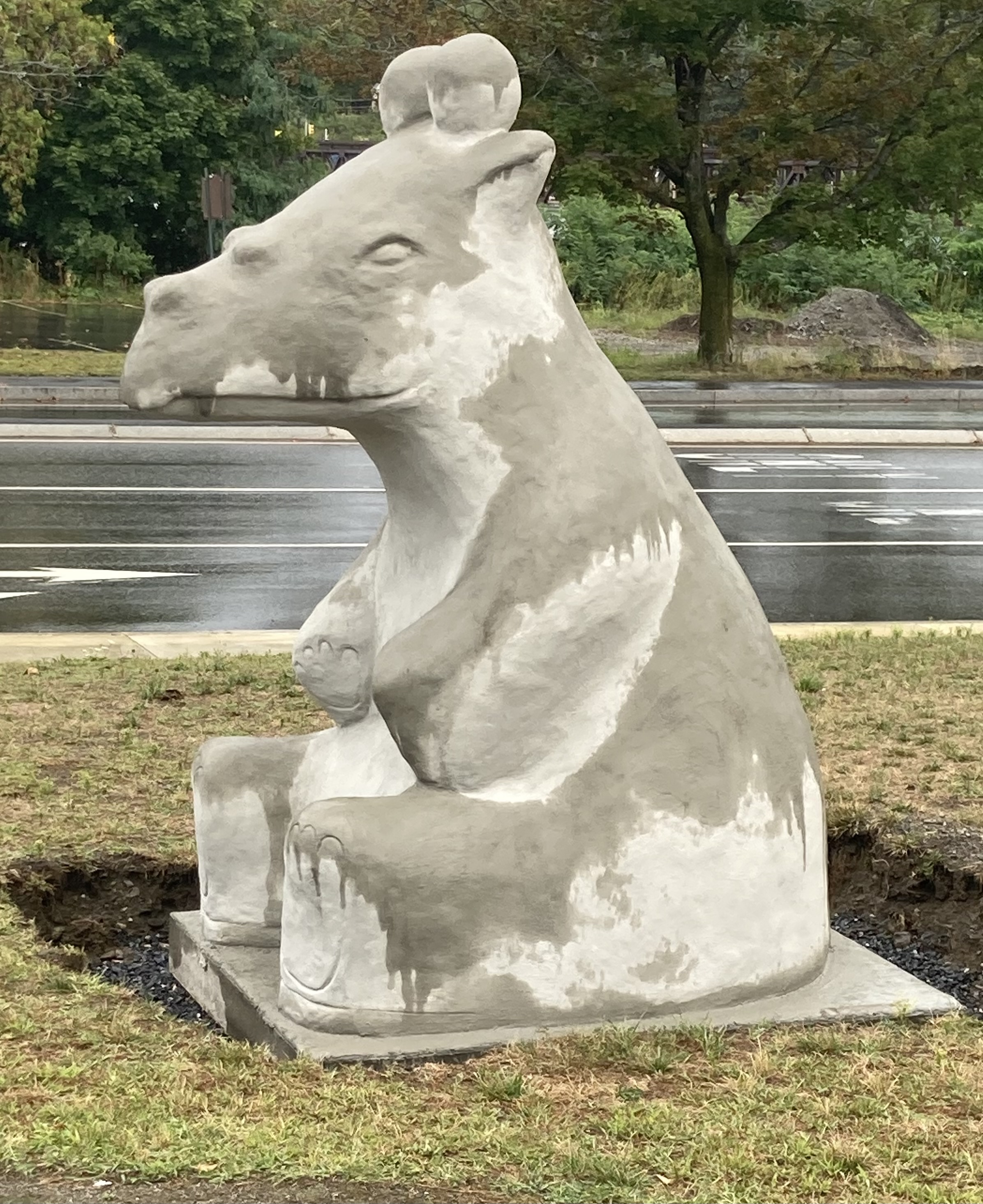
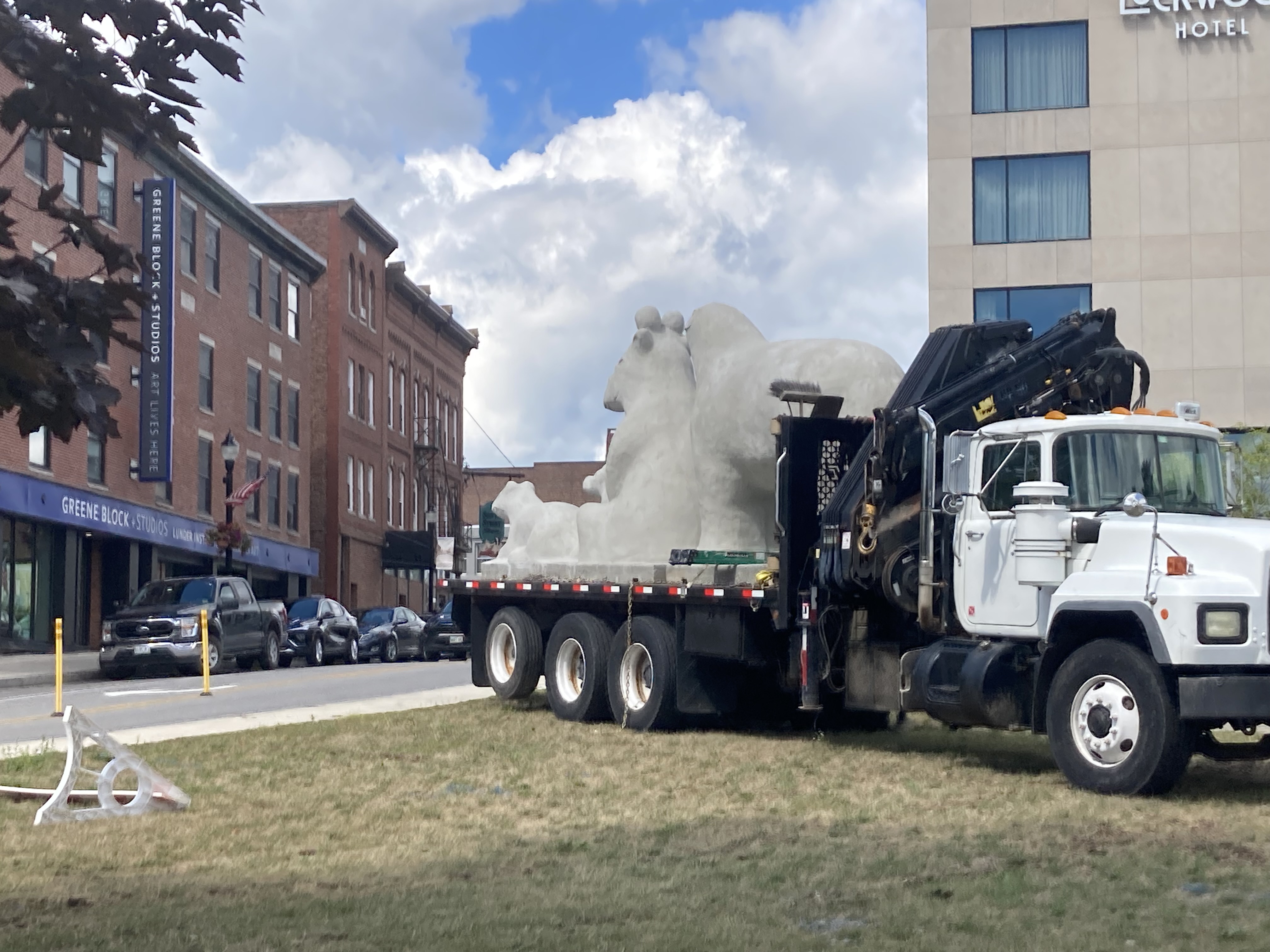
We interrupt our regular “Wise Women” programming to bring this special report of the “Wild Maybes of the Long Green Between.” The polymath maker, Chris Miller, has struck again, siting “visitors from an ancient Earth, as unknowable as the far future,” on the grassy knoll of Levine Park, in Waterville, Maine.
The Wild Maybes are “honorary crossing guards where the deep past and far future meet.” The public welcomed to roam “…in the richness and vastness of time beyond reckoning.” The four Maybes face the cardinal directions of North, East, South and West proudly beside the mighty Kennebec River as it flows ever to the Gulf of Maine.
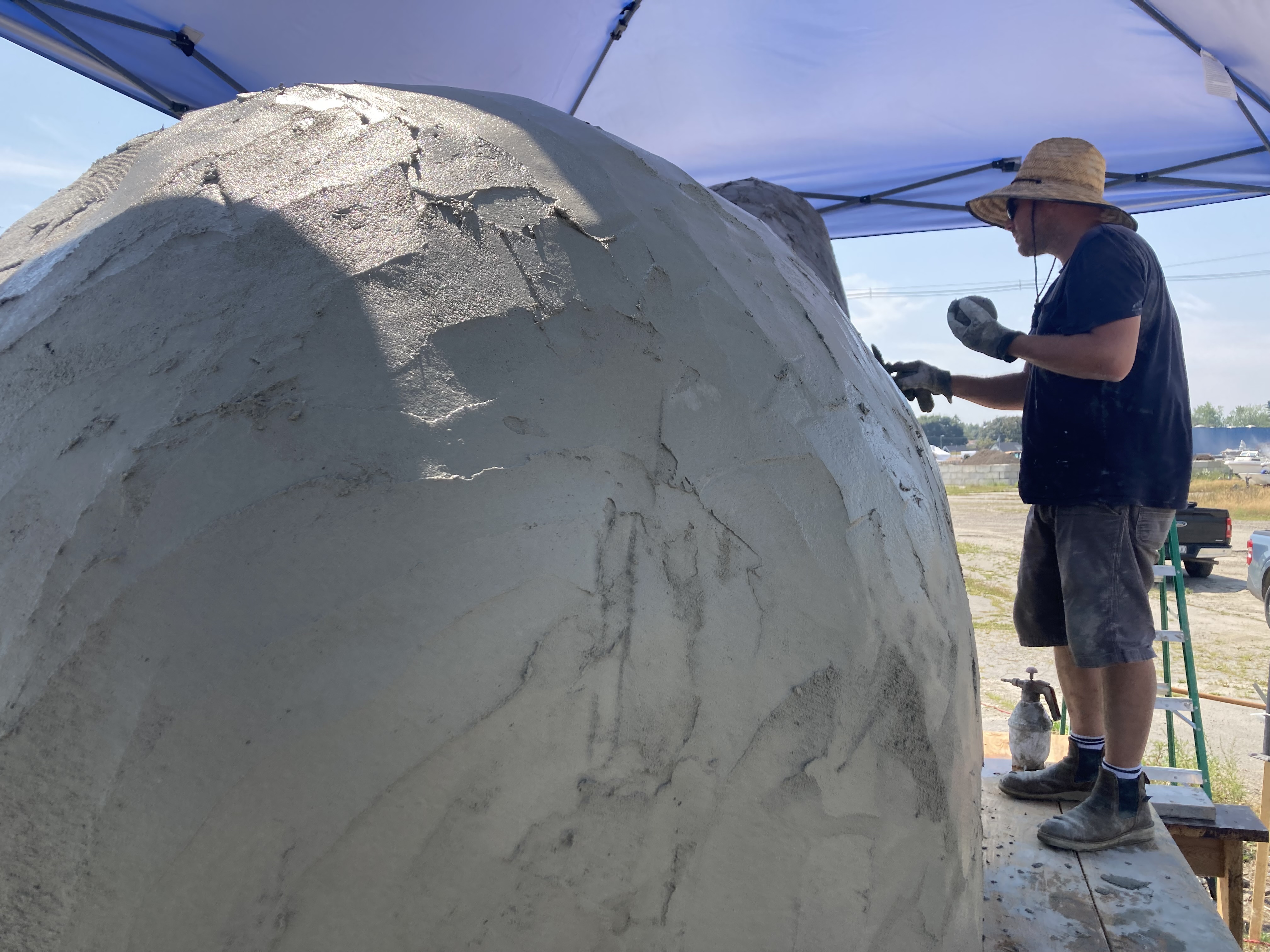
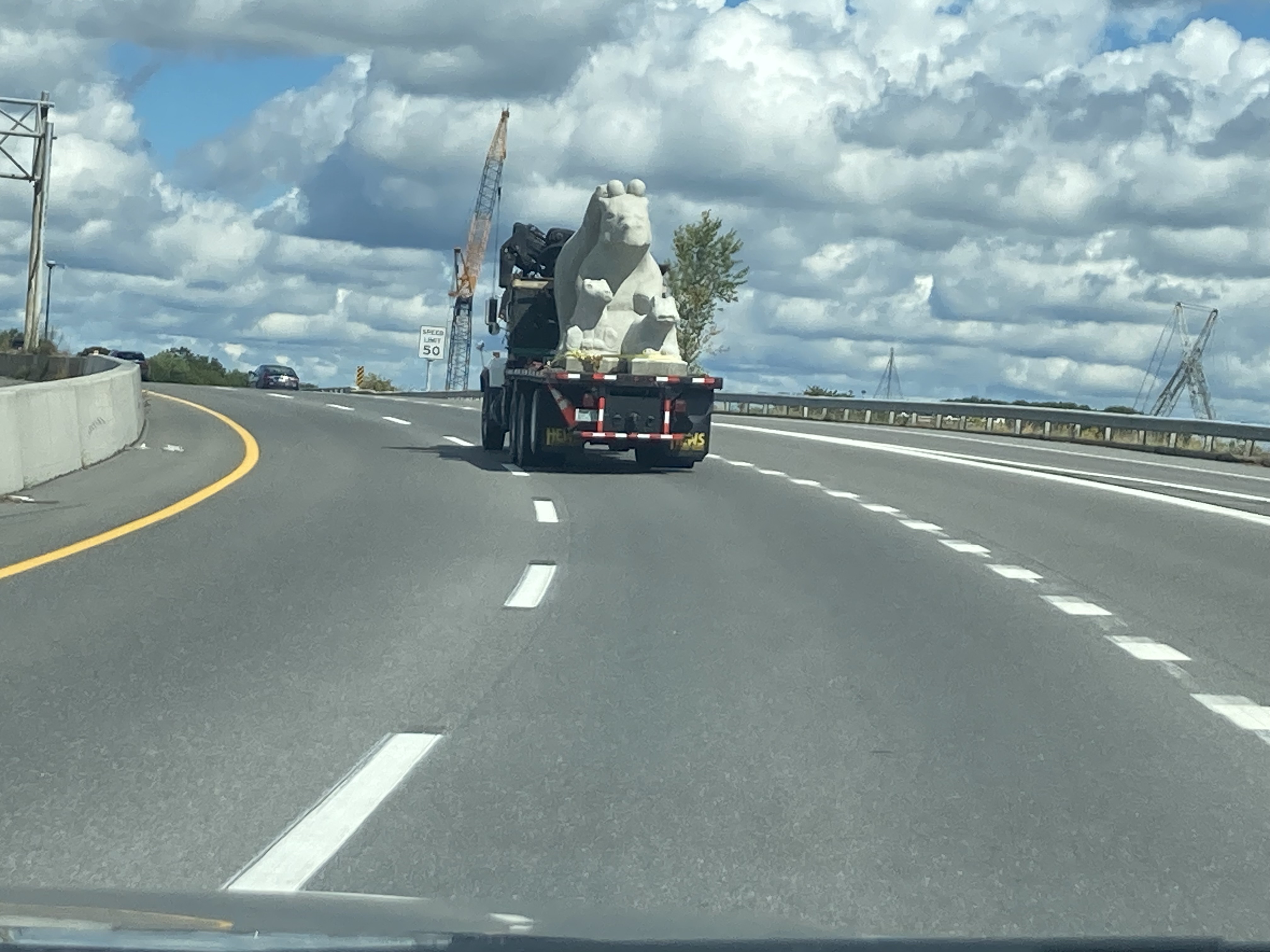
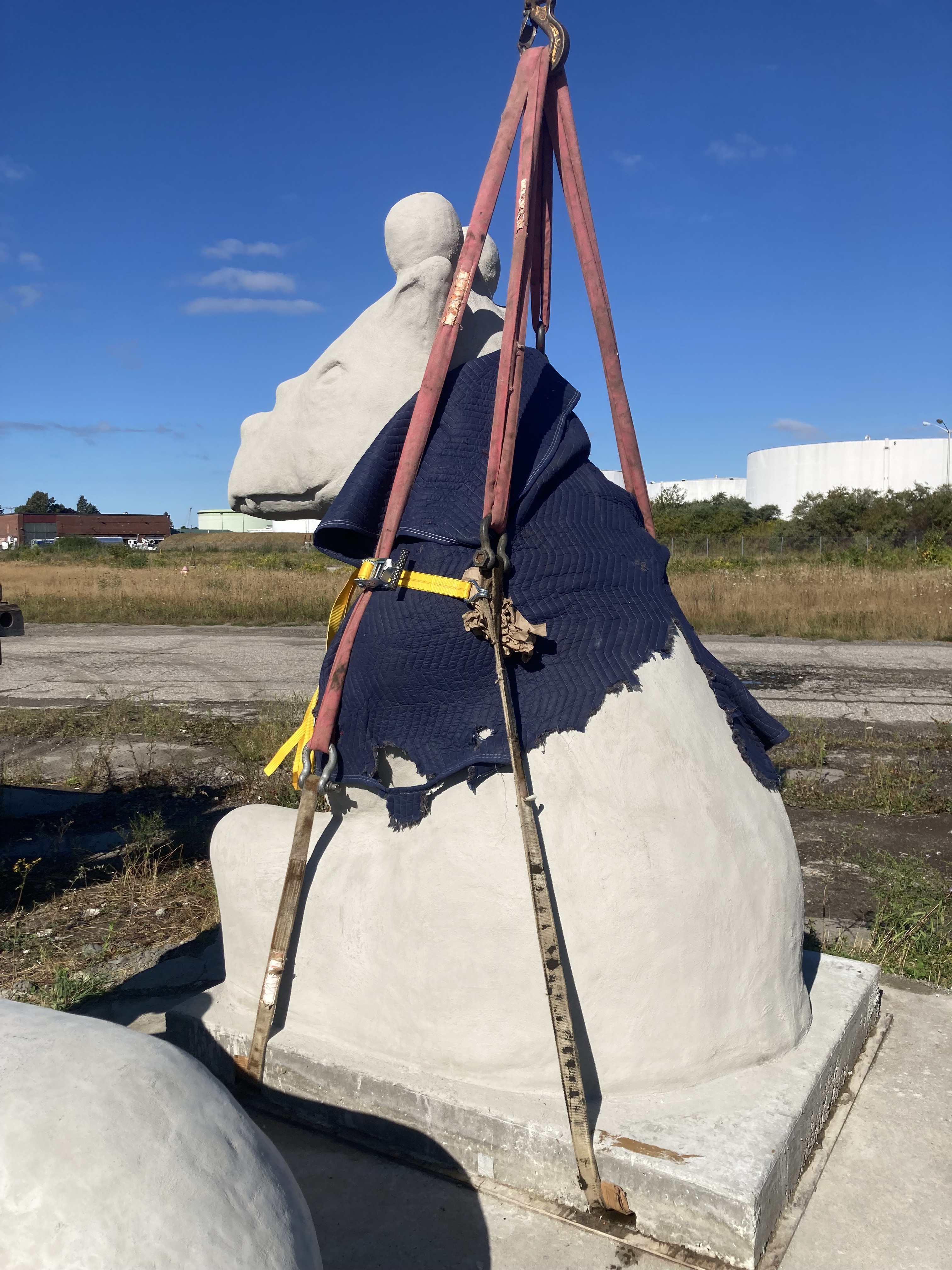
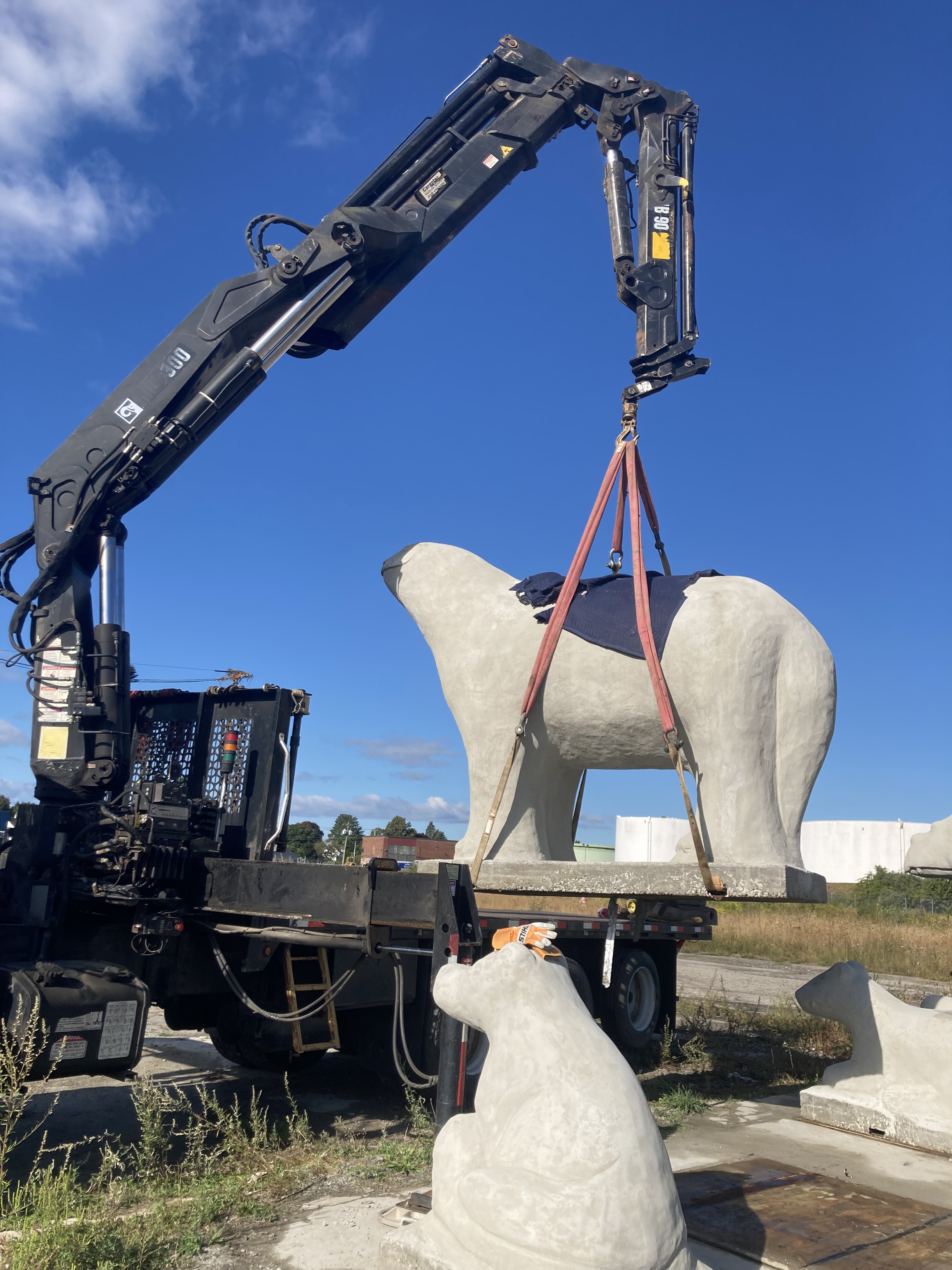
Modeled upon the earliest mammals, just post the dinosaur age, Chris conceived this public art installation as “a puzzle…based on shaky assumptions about dusty old bones.” They were made using a welded steel armature, foam, and structural concrete. I am honored to have been mere fabricator: building forms, cutting and stacking foam, mixing mud, troweling concrete, helping to load and then install: 15,000 pounds hauled 96 miles north.
There are four Maybes:
Uni, the Uintatherium, a beast of the herbivorous Dinocerata mammal that lived in the now United States during the Eocene period;
Eo, the Eocondon, of the triisodontid mesonychian genus that existed in the early Paleocene of Turtle Island (North America);
Cory, a Coryphodon, named from the Greek “peaked tooth” an extinct genus of pantodont mammals, also local, speaking in terms of continents;
Barry, a towering Barylambda, also of the pantodonts, from the middle to Late Paleocene era.
Tick-tock clock time is of man’s making, while Natura moves in other orbits. Chris wrote, “When 2.8 billion seconds ago (in 1934), historian Lewis Mumford pronounced that ‘…the clock, not the steam engine, is the key-machine of the modern industrial age,’ he went on to point out that there are still many other ways to mark time, and surely better ways to experience it. This long, narrow strip of grass, for instance, is a between place. It is the perfect kind of place to escape from the kind of time that is measured in seconds and minutes. Here in this long green between, time flows in seasons and eons, in eras and generations.”
And so Waterville is transformed, and kudos to them for stepping up, underwriting the permanent installation. What a marvelous life unfolds along the rocky coast, Northern terminus of the lower 48.
The often repeated phrase, “Give us this day, our daily bread” must be about soil fertility as much as about hope. The common collegiate phrase “alma mater” is Latin for “nourishing Mother” and so we turn our attention to Gaia, one wise soul herself, the Earth as our nourishing Mother, whose fertile soil gifts freely an abundance beyond compare.
Many soulful stewards of Gaia have I crossed paths with, one of whom was the “Corn Cart Queen.” The common cliche is “know your food, know your farmer,” but the Corn Cart Queen brought that to the fore in Chicago, during the summer season 2003, when she planted Golden Bantam in a shopping cart, then organized people to push the corn cart around the town: Meet your food, meet your farmer.
The Chicago Tribune wrote, “A woman of quiet dedication and passion, she initially planned to push the corn around the city by herself…. However, as word spread about the project, she happily surrendered the cart to a growing community of corn stewards, some of them artists or gardeners themselves. They water it, push it and distribute, if they choose, the small packets of blue corn seeds (three each)… taped to the cart. The seeds are pre-Depression-era corn, which she bought directly from a farmer when she visited Cuernavaca, Mexico.”
The Tribune quoted her, “When people talk about the environment in the city, they always see it as outside themselves. They talk about the lake or whatever. . . . I really want people to see how we consume nature, how we consume corn, how we eat, how we do things — it all has an effect on homelessness, on loss of farms, on history. There’s a 10,000-year history of the domestication of this grass called corn.”
Sandor Katz, the New York Times best selling author, in “The Revolution Will Not Be Microwaved,” wrote about this, “Cornography…was a sort of performance art installation featuring a few stalks of this corn growing in a shopping cart and many different people taking turns, walking it across Chicago.” Katz quoted the Queen, “The corn cart has visited community gardens, toured supermarkets, politicized a street fair, gone out for coffee, and rested in many backyards. When you give someone a seed, it’s such a small gift, but it entails a responsibility to interact with the land.”
Nance Klehm is the “Corn Cart Queen.” As art predates agriculture, her work unfolds at those fertile crossroads; she teaches of our connection, our utter reliance upon, the earth, the sacred ground beneath us. She is a muse among us, having lectured and taught at Chicago’s Museum of Contemporary Art, the Hammer Museum in Los Angeles, the University of Cincinnati, and the Canadian Centre for Architecture in Montreal. She has taught at the University of California – Los Angeles, Northwestern University in Evanston, Illinois, and Dartington College in the United Kingdom, as well as for countless community groups worldwide. This Queen was honored in 2012 as one of Utne Reader’s “Twelve Visionaries Who Are Changing Your World.”
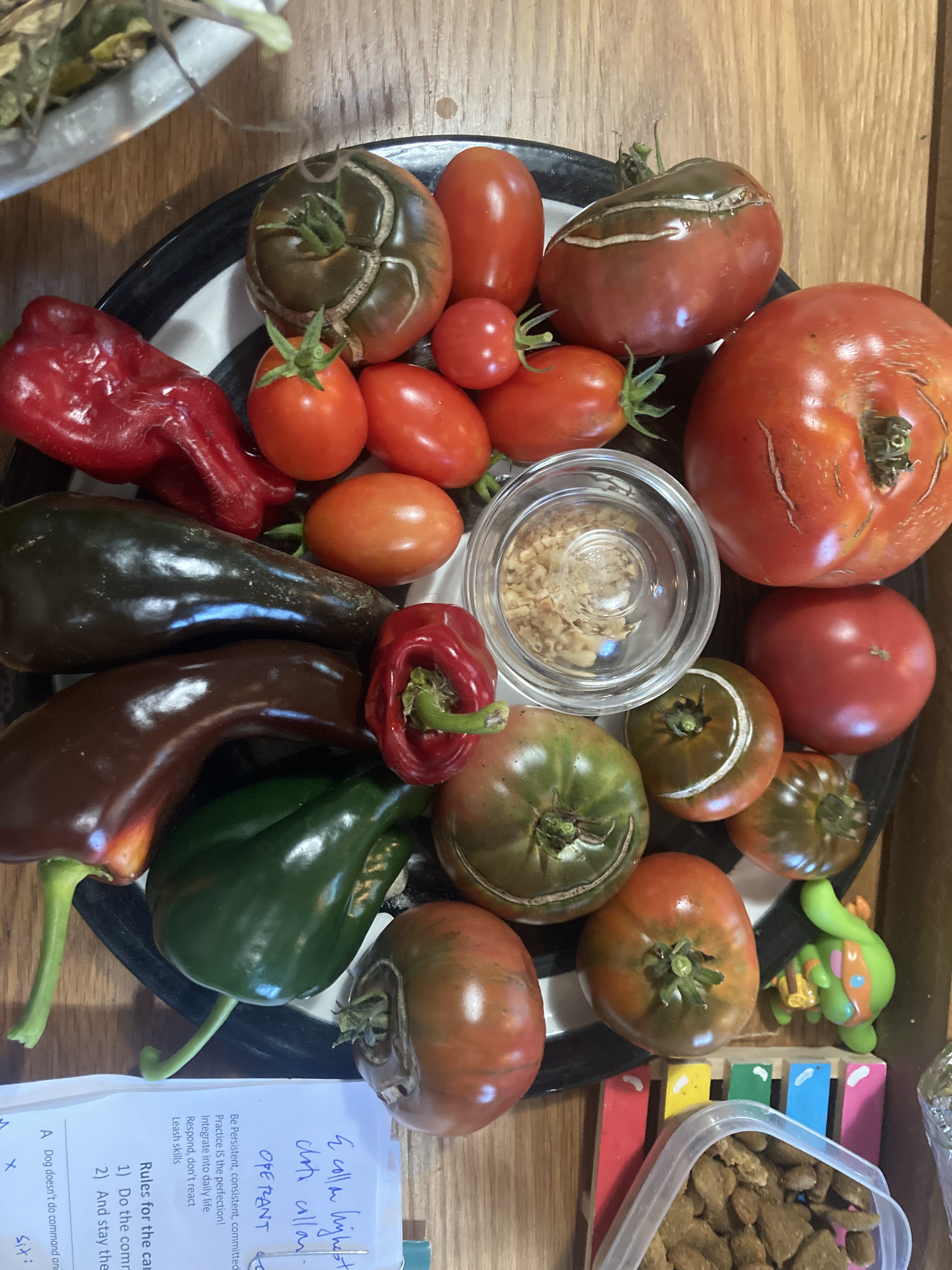
It can be lonely at the vanguard, but Nance always works in community, teaching others the art and science of the soil. Along her path she worked with Flordemayo, a Mayan Elder, who founded The Seed Temple in Estancia, New Mexico. Nance helped assemble the “sacred heritage seeds for future generations.” My family was asked to grow heirloom beans and then give some back to help keep the Temple’s stock alive. For many years now we have grown those seven varieties annually, whereby my children learn first hand that food does not come from a grocery store, that harvesting is harder than consuming but the wild abundance of a fresh grown tomato or peach picked in late August is a joy beyond compare.
Flordemayo herself is one of the 13 Indigenous Grandmothers, all of whom are “committed to supporting all people in reclaiming their relationship with Mother Earth, advocating for a shift toward a more conscious and harmonious connection with nature and all living beings.” The International Council of Thirteen Indigenous Grandmothers come from around the world – Nepal, Brazil, South Dakota, Gabon, Montana, Mexico, Japan, France – as “a collective of women devoted to restoring and uplifting the sacred feminine wisdom that nurtures balance and harmony in the world. [They] stand for peace, justice, human rights, environmental protection, food sovereignty, and the health and welfare of children and the elderly, for today and generations to come.”
Nance and I crossed paths almost 30-years ago, both on Chicago’s west side, and in the LaSalle Street canyons of the financial district; she was outbound to WWOOF in Australia (Worldwide Opportunities on Organic Farms), while I was headed to Manila, the Philippines on a humanitarian finance quest to establish a currency based upon humans’ ability to communicate. Nance’s path always has been more rooted, more practical.
Among her challenges has been pursuing community-based work during the 50-year period – 1975 to 2025 – when American culture shifted dramatically towards rampant consumerism, free market ideology, and unchecked individualism. Talking about my generation – the Baby Boomers – Bill McKibben wrote, “So what the hell happened? How did we go from an America where that kind of modest [suburban] paradise seemed destined to spread to more and more of the country to the doubtful nation we inhabit fifty years later: a society strained by bleak racial and economic inequality, where life expectancy was falling even before a pandemic that deepened our divisions, on a heating planet whose physical future is dangerously in question?”
How did the forward thinking Civil Rights Act of 1964 and the Voting Rights Act of 1965 give way to the radical gerrymandering of our era? Money, banking, free markets and power politics are the domain of mankind, human invention, while the Grandmothers and Queens of Gaia speak of the ground beneath our feet, the soil, everywhere beneath everyone all of the time.
Nance’s 2019 tome, “The Soil Keepers,” makes plain, in her preface, our path forward: “To the entire menagerie of animal, fungal, and plant beings, both the seen and unseen, thank you for your unflinching love and core teachings. I am forever your student.”
All life is one. Life calls to us. We are wise to heed her call.
Credit where credit is due, Elena’s photographs appear here.
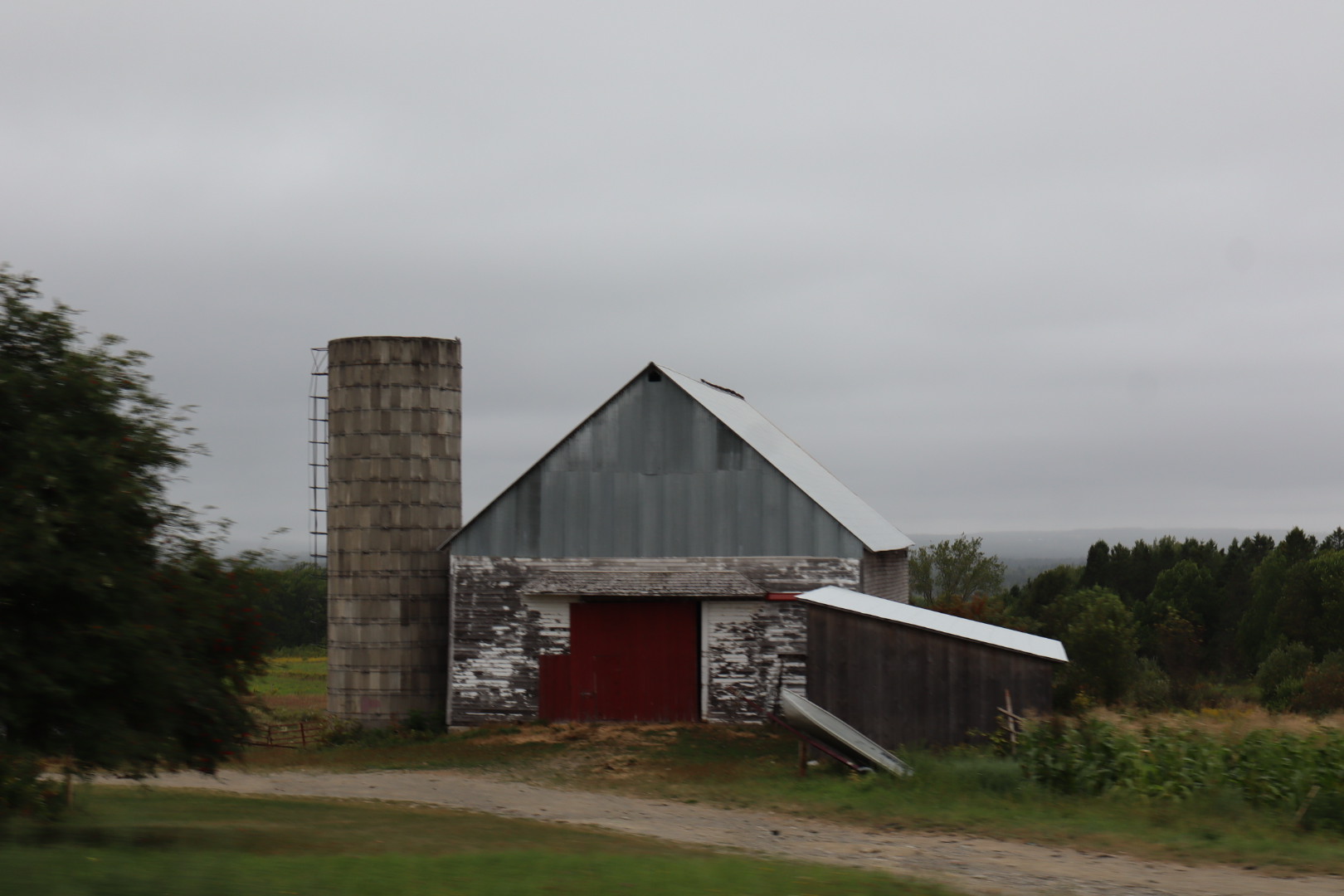
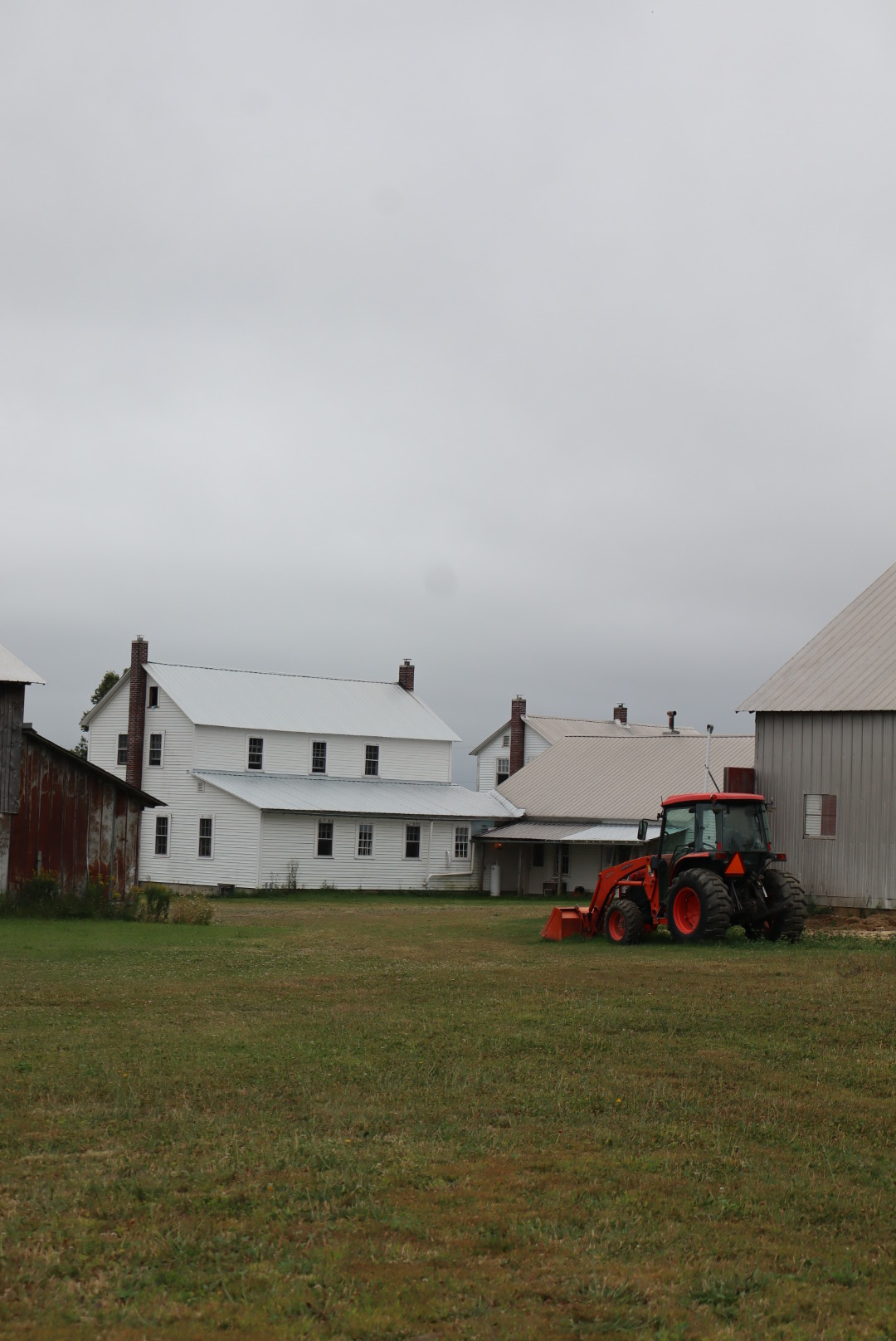
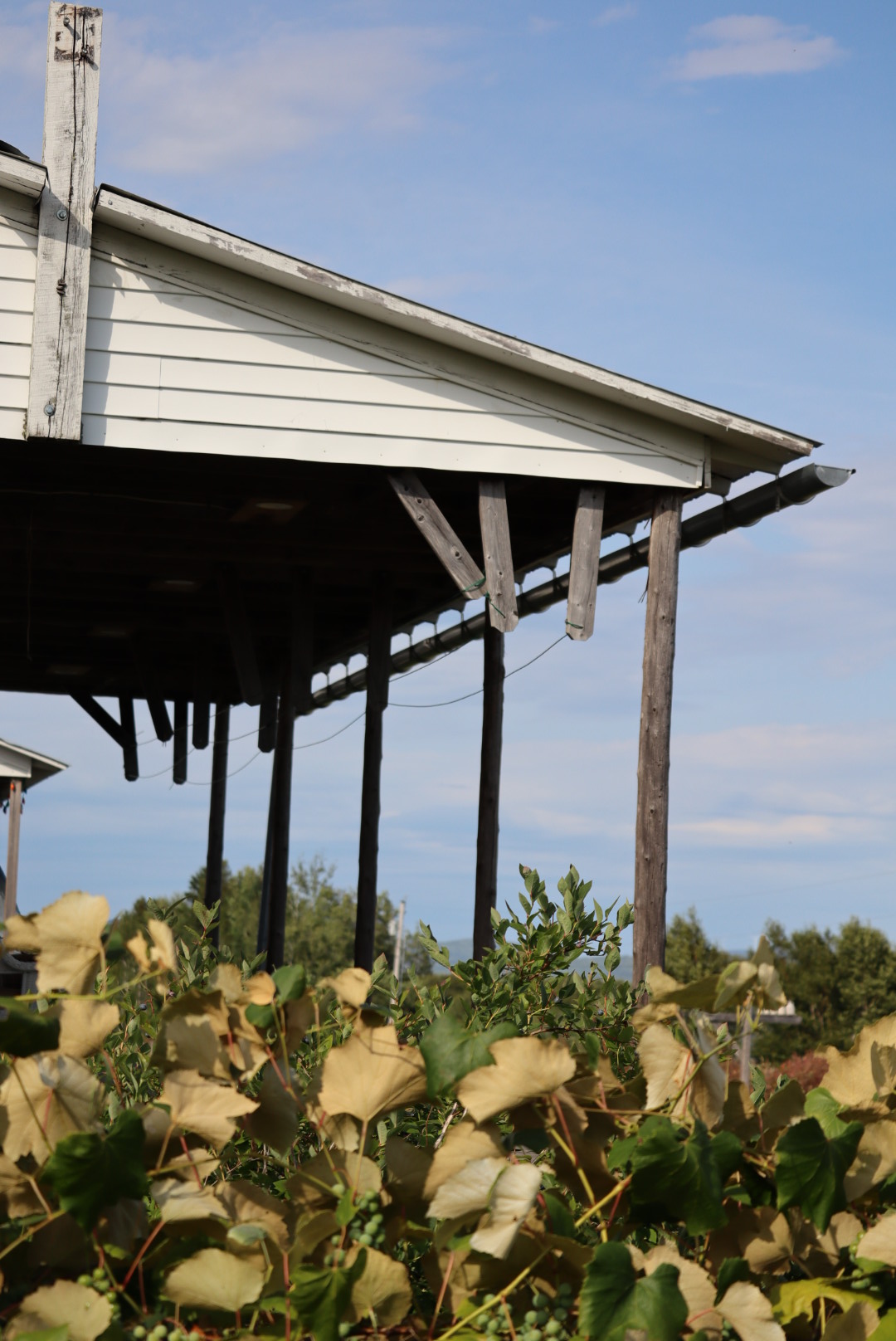
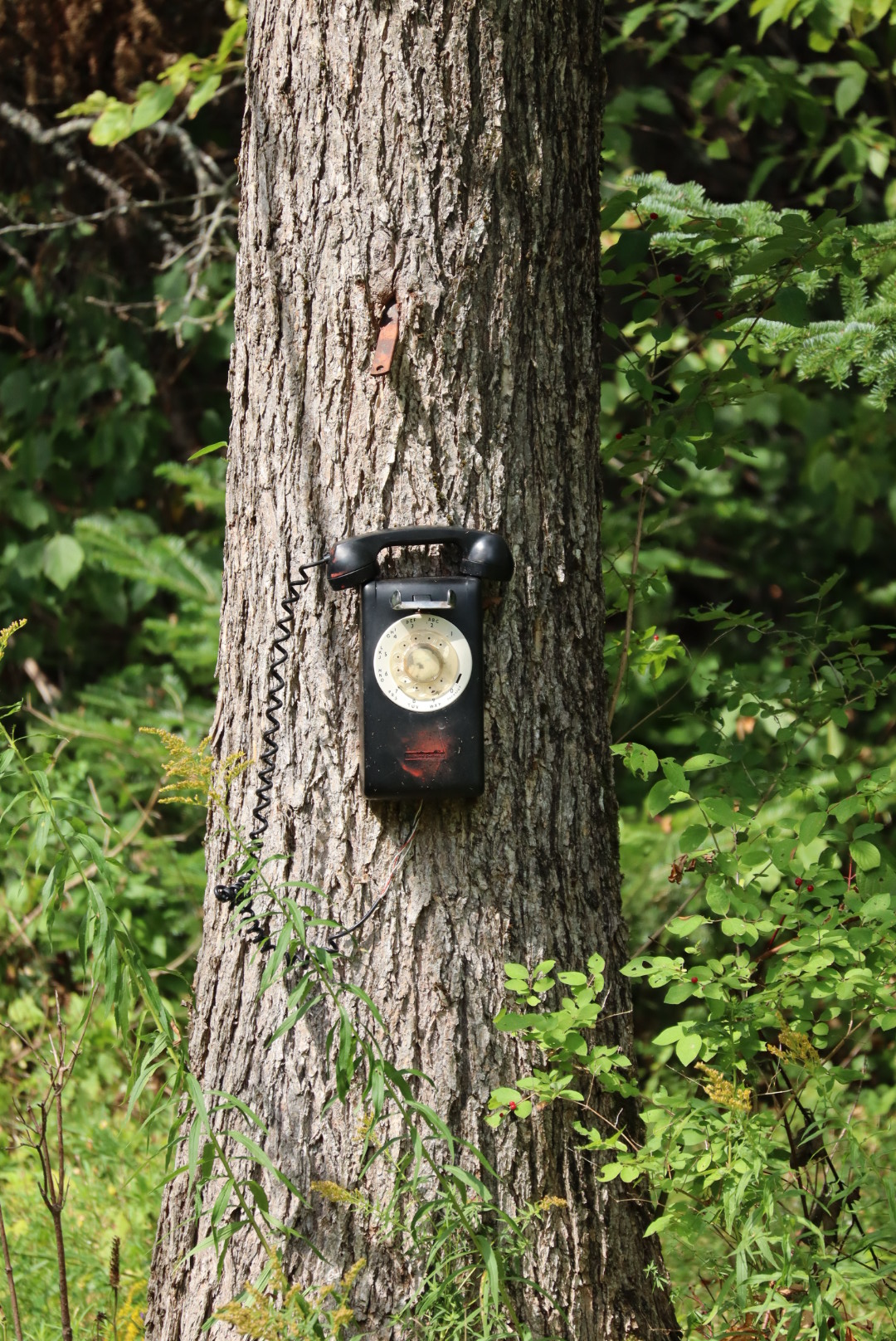
Recently we drove north to nowhere, Cold Brook Road in Southern Aroostook County, Maine. Between 1793 and 1815 Northern Maine was a major producer of wheat, known as “the breadbasket of New England.” In the 1940s and 1950s Aroostook County was the top producer of potatoes in America. Big skies, open vistas, quiet abounds there. Our friend Kirk, a Master Electrician, Master Cabinetmaker, Builder and Humble Farmer welcomed us to his 157 acre-farm in Amish country.



















































 an Art Farm