It Came to Pass
Posted: June 20, 2025 Filed under: Art & Healing, Chronicles of a First Time Parent, consciousness | Tags: CG Jung, hanged man, Isaac Newton, Ryder-Waite, saint paul of the cross, tarot 1 Comment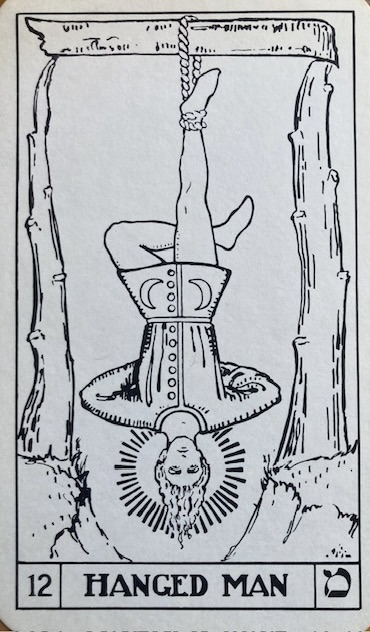
We ended our homeschool science class with the study of tarot. Some may say this is heresy, that tarot is not science, but I defy that line of reasoning. Consider these facts:
- The word “science” is derived from the Latin word “scio” which means “to know” or “to understand.” My son shall be raised to have broad, not narrow, understanding.
- Sir Isaac Newton, the paragon of the rational scientific method, was a lifelong alchemist. The Renaissance alchemists pursued rigorous empirical observation and experimentation; the notion of “active principles” that repel and attract arguably contributed to the theory of universal gravitation.
- Carl Jung, founder of “analytical psychology,” developed the concept of the collective unconscious, which resonates clearly with the tarot’s imagery. At the C.G. Jung Institute, he supervised research on the importance of tarot.
Such then, when I asked my son to pull one card from the Ryder-Waite deck, the “Hanged Man” emerged. At the age of 12, my son pulled card 12 from the deck. Jung referred to this as a synchronicity; events that coincide in time and appear meaningfully related, yet lack a discoverable causal connection. “Causal” speaks to the rational mind, but we were plumbing the subconscious.
At the age of 12 my son comes of age, which is a physical bodily experience as well as a deeply emotional and psychological transformation. Card #12 deals with beliefs that are stored in the subconscious mind, what is handed down. The Hanged Man represents a breaking away from that tradition. As my son comes of age, he becomes his own man.
Carl Jung believed that the archetypes are deeply embedded in the human psyche, and have emerged in the form of religious narratives. Saint Peter, the “Rock” upon which the Catholic church has been built, reportedly was hung upside down, by the Roman Emperor Nero. The hanging took place near the “Circus of Nero” close to the present day Saint Peter’s Basilica. The Cross of Saint Peter, an inverted cross, remains a central image in the arms of the Holy See and the Vatican City.
Let us consider this symbol more deeply. In “Tarot” Paul Foster Case writes, reversal in Hanged Man is “a reversal of thought, a point-of-view which is just the opposite to the accepted by most persons. In this scientific age we know that everything is an expression of the working of the law of cause and effect. …Practical psychology shows the potency of ideas. It demonstrates conclusively the truth that thoughts are the seeds of speech and action, that interpretations are the patterns for experience, that what happens to us is what we have selected, whether the selection be conscious and intentional, or unconscious and unpremeditated.
“The central theme of the hanged man…is that every human personality is completely dependent upon the All, here symbolized by the tree. As soon as this truth is realized, the only logical and sensible course of conduct is a complete surrender. This surrender begins in the mind. It is the submission of the personal consciousness to the direction of the Universal Mind. That submission is foreshadowed even in the picture of the Magician, who derives all his power from above. Until we know that of ourselves we can do nothing, we shall never attain the adeptship. The greater the adept, the more complete his personal self-surrender.”
Saint Peter of the Cross, in founding the Church during the Roman Empire, most definitely followed “a reversal of thought, a point-of-view which is just the opposite to the accepted by most persons.” To pursue this further we drove to Western Maine, to sit with a Reiki Energy Master, a White Witch, and talk about the tarot. This Master, as a child, lived in Morocco, Athens and Cairo; living now in the Lakes Region she is not provincial but broad in her understanding.
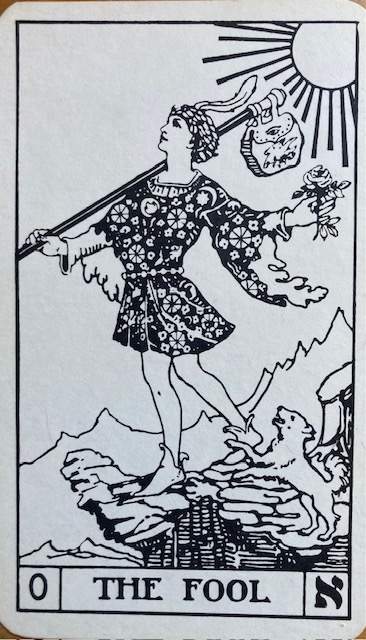
She explained that tarot is the journey to wisdom. The journey begins at 0, when you know nothing, and then you go through life. The Fool is ready to jump off the cliff. #1 the Magician has tools to become grounded, spiritual. #2 the High Priestess has intuition. #12 the Hanged Man is saying “take your time, there is no rush.”
She spoke of card #13 Death. She asked my son what he thought of death and he paused, then replied, “I think death is not good, it is bad.” She explained that death can be seen as a change, that all things must pass and transform. In that sense death is not bad, it is just change; it can be hard, very hard, but it is part of life. “The old self of the Hanged Man is changing. This is the death of the old way. Your Dad’s belief system will die off and you will choose your own.” She spoke about spirituality. My son explained that he had no religious practice. She encouraged a nature based approach. As my son comes of age, he will make many choices, his own.
Many cards had been lain on the table. As we cleaned up, the last card picked up was #13 Death. Again, synchronous, the Master commented, “You are all going through a transition.”
And so our season of homeschooling has ended.

No Room at the Inn
Posted: June 13, 2025 Filed under: Chronicles of a First Time Parent, Farming off the Farm, What is an Art Farm | Tags: Epirus, Greco-Roman, molloxssian hounds, pitbulls 3 Comments
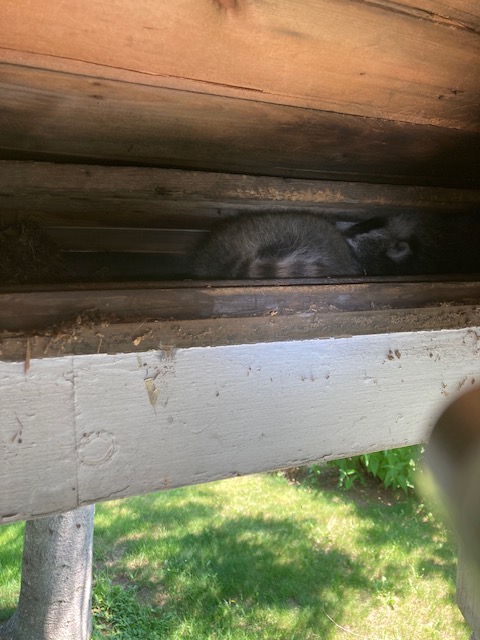
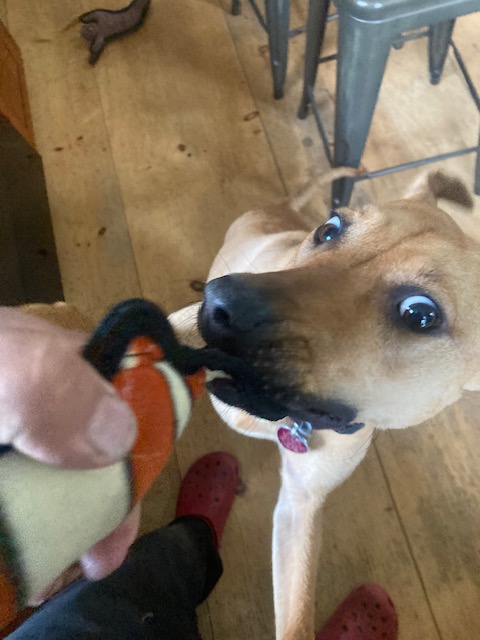
Our Art Farm resembles Noah’s Ark: two adults, two children, two rescue cats, and two rescue dogs all live here. Recently a Mother Raccoon moved into the ceiling above our porch, and with four kits, that became too much.
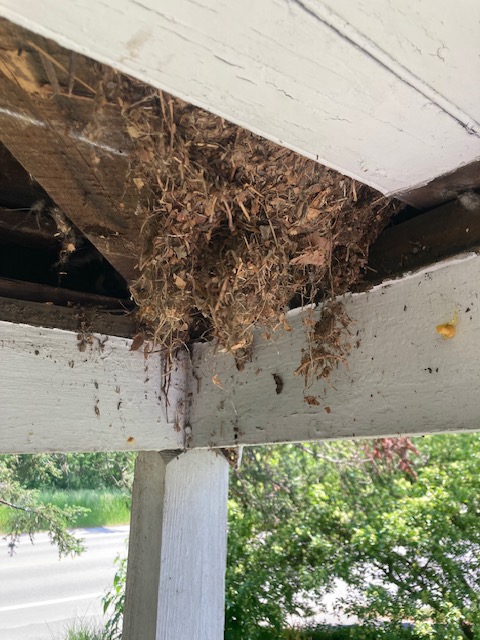
Her tenacity was remarkable. To gain access she gnawed through the fascia boards and the asphalt shingles. Last autumn I tried to discourage her by covering the access points with lead flashing, but she persisted and then chewed through the ceiling boards and more shingles. Neighbors stopped to tell me about our four-footed squatter. She would lean against the asphalt shingles, stare at my son through his bedroom window, like Mae West daring him to come and get her. I knew we had a problem but it rose to a climax when, at 3:30am last Thursday, our pitbull puppy needed to go out and, given the commotion above, refused to come back inside.
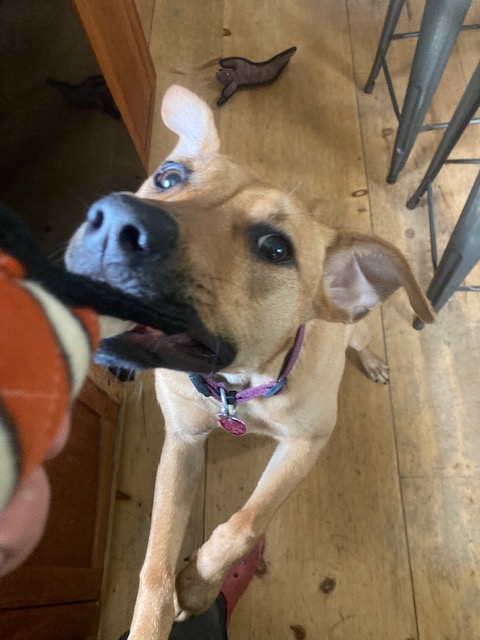
Our pitbull puppy is an animal of the most remarkable agility and athleticism. To see her on the prowl is to marvel at the animal kingdom. Pitbulls get a bad rap, but intensely loyal and loving to their owner, they are descended from the Mollossian hounds, the ancient dogs of war. The Greek kingdom of Epirus trained the hounds for war and herding. Shakespeare’s “Julius Caesar,” Marc Anthony’s line, “Cry havoc, let slip the dogs of war” is historically accurate. In Greek mythology, the goddess Artemis gave to Procris a dog that never failed to catch its prey. In the predawn light our puppy exhibited her heritage, racing across our front porch and back yard in search of her prey.

Our puppy was rescued from the streets of Webster Parish in Louisiana, and is 60% Pitbull, 27% Rottweiler, and 13% “Supermutt.” The Rottweiler breed evolved when the German barbarians bred sheep dogs with the mastiff-type dogs used by the Roman army on its military campaign through ancient Europe in the 1st century AD. Our loyal puppy is of Greco-Roman descent, proud to protect us at all hours of the day and night.
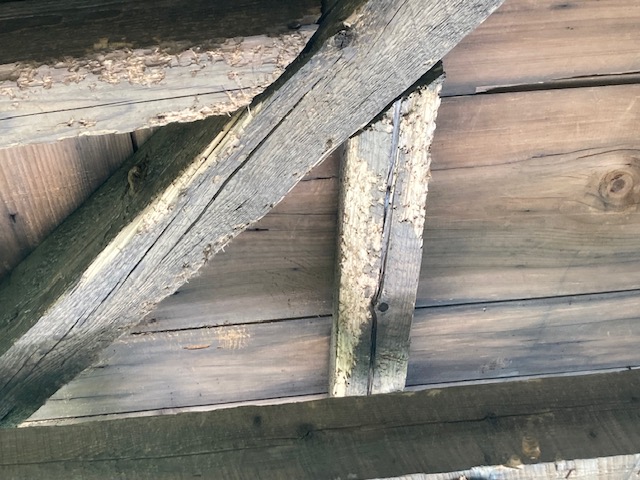
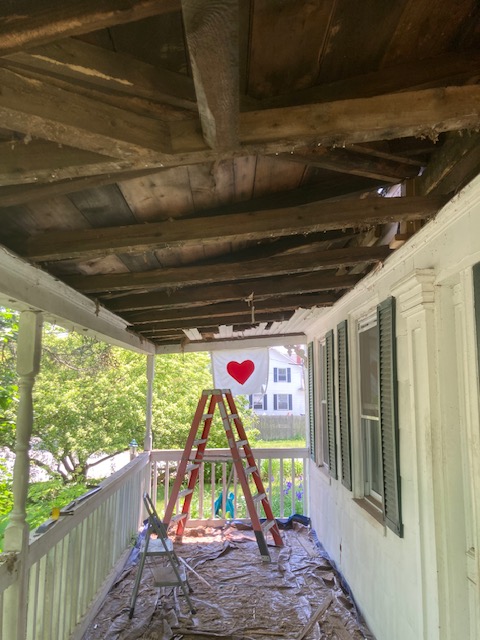
By mid-morning I began to rip out the ceiling boards. They were in quite bad shape and needed either to be repainted or removed. In fact, we plan to remove the entire front porch – it is not original to the house – so my task was both a step in that direction as well as a means to encourage the raccoons to move out.
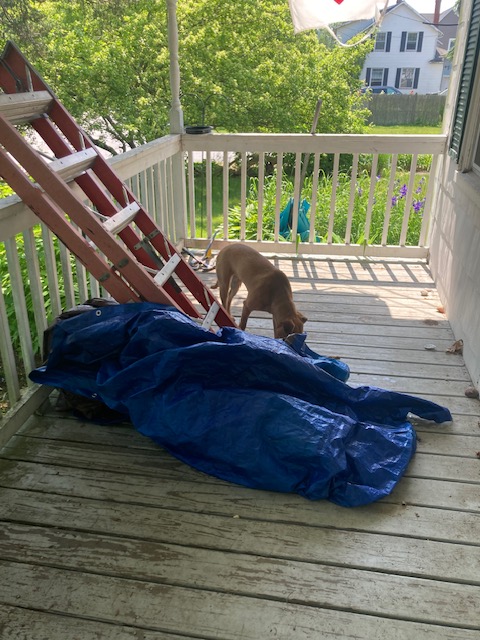
The job was messy. Our puppy stayed inside while I laid out a tarp to catch the debris and the paint chips, which most likely were lead paint. I wore a mask and detritus rained down upon me. Animals have been living in that space for many years. Decades ago, word must have gotten around the town. Pre-covid, House Sparrows made their home there. It was awful. There in the corner cowered a raccoon. I stayed clear, and continued removing other boards. I needed to open up the entire front section of the porch ceiling.
I reached out to an animal rescue service, and the news became bad. Raccoons carry several parasites, including roundworm. A cornered mother can be vicious. No one was available to come trap and remove them, so the plan was to let them make their exit on their own time. Eventually the kits scurried about on the beams overhead. While their Mother went off in search of a new home, our puppy could hear the kits crying on the porch and stirred up great havoc, inside our house. Our puppy’s true nature was on full display. She could not be let out into the yard.
Throughout the afternoon the Mother worked her magic, carrying the kits – no longer so small – one-at-a-time by the scruff of their necks down our lilac bushes. We do not know where she went. One kit remained, and wailed for mama, but eventually Mama returned and then quiet filled the air. Later that evening, I took our puppy on a leash out into the backyard. She sniffed the air, and looked all around, even overhead, but nothing was turned up.
Quiet has returned to our front porch. My 4:00 am outings are less agitated. The Mother and kits have moved on. We wish them well and meant no harm, but there simply was no room at our inn.






Concrete π
Posted: June 6, 2025 Filed under: Child Centered Activities, Chronicles of a First Time Parent, What is an Art Farm | Tags: archimedes, concrete, habeas corpus, pi 2 Comments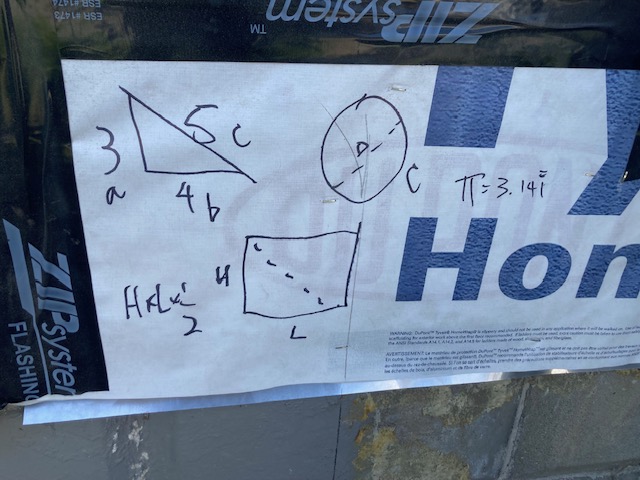
This week’s homeschool question was “How many US Presidents have suspended Habeas Corpus?” The answer, of course, is 7:
- Andrew Jackson at the Battle of New Orleans, by his sole order declared martial law (he was the commanding General, not yet the 7th USA President)
- Abraham Lincoln, by Executive Order, to rein in the “Cooperheads” a/k/a the Peace Democrats
- Ulysses S Grant, by Congressional act, suspended in nine counties in South Carolina
- Theodore Roosevelt, 1902, by Congressional Act, suppressed civil unrest in the Philippines
- Franklin Delano Roosevelt, 1941, by means of the Hawaiian Organic Act authorized suspension of habeas following the attack on Pearl Harbor, but in 1942, by Executive Order allowed a military tribunal to try and convict eight German saboteurs
- Bill Clinton, following the Oklahoma City bombing, signed the Antiterrorism and Effective Death Penalty Act of 1996
- George W. Bush, in 2001, by the Presidential Military Order authorized enemy combatants to be held indefinitely at Guantanamo Bay. But in Hamdi v. Rumsfeld (2004) the U.S. Supreme Court re-confirmed the right of every American citizen to access habeas corpus even when declared to be an enemy combatant.
All of these were in times of a crisis, and several of them included martial law. Given the dense history, my son’s Cousin, the Professor, zoomed in for a chat. The Professor has been published in the Stanford Law Review, where he argued that habeas is “a tool for We the People to insist that when our agents in government exercise our delegated penal powers, they remain faithful to our sovereign will.”
He went on to explain, “Given widespread consensus that English history should and does drive American habeas jurisprudence, and that the sovereigntist account of that history should now be treated as authoritative, it is puzzling that American courts and scholars have continued to cling to libertarian frameworks. Meanwhile, American habeas law is in crisis, with an ideologically cross-cutting array of scholars and jurists criticizing it as intellectually incoherent, practically ineffectual, and extravagantly wasteful. Over the Supreme Court’s past three Terms, Justice Neil Gorsuch has led a charge to hollow out federal postconviction habeas almost entirely, arguing that habeas courts should ask only whether the sentencing court was one of general criminal jurisdiction—and not whether it violated federal constitutional law en route to entering the petitioner’s judgment of conviction.”
My son and the Professor discussed all of this, at length. They compared the crisis of the Civil War to the current immigration brouhaha. My son reasoned that Mr. S Miller, “wants it to be really simple, immigrants get picked up, and locked up.” The Professor concurred, describing a “logistical simplicity.” My son continued, “There are many immigrants, some are illegal, but it is not like Abe Lincoln at the Civil War, now [suspension of habeas] is not really necessary. Suspending habeas should be a last resort. I don’t know what problems – it is about people’s free will – but on a large level it would fill up the jails.” The Professor concluded by speaking of Aristotle’s concept of the good.
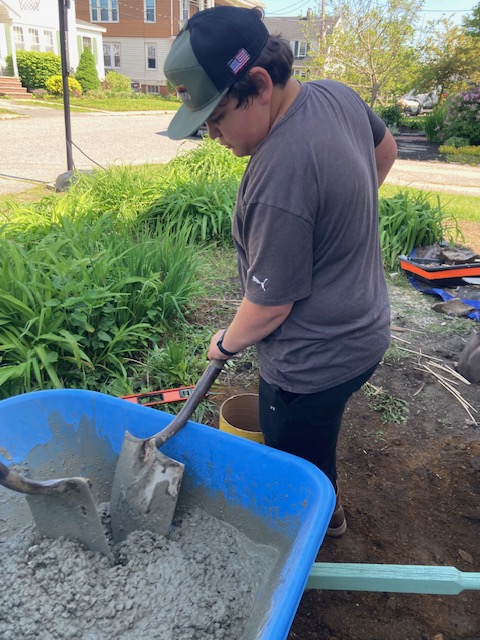
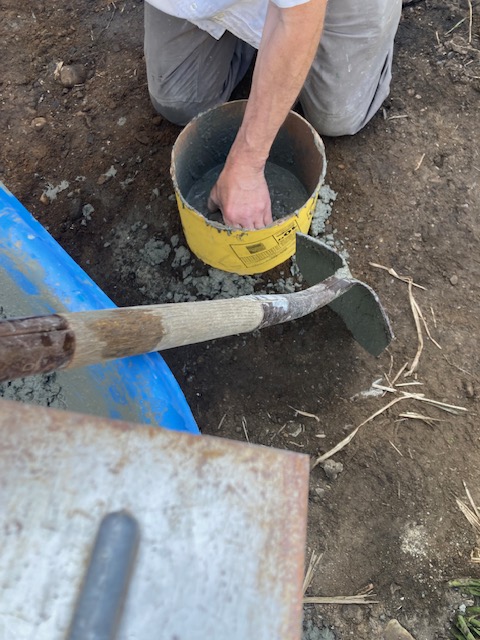
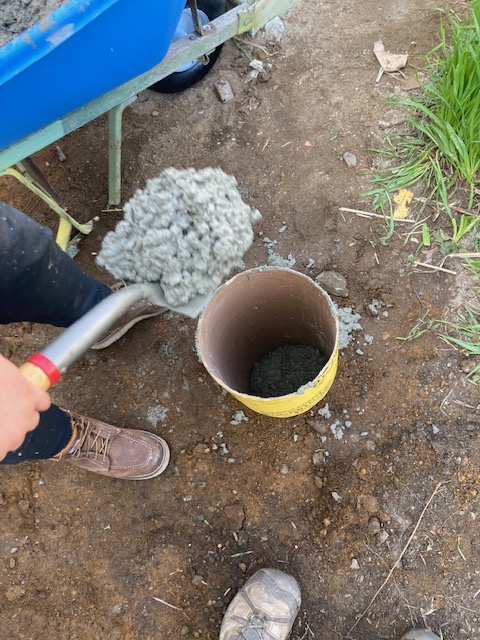
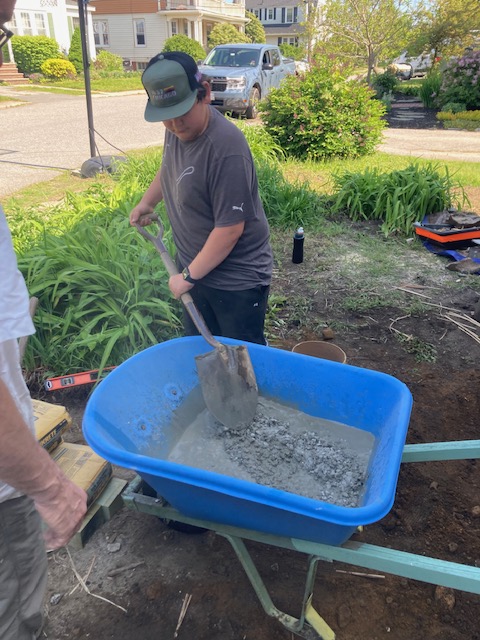
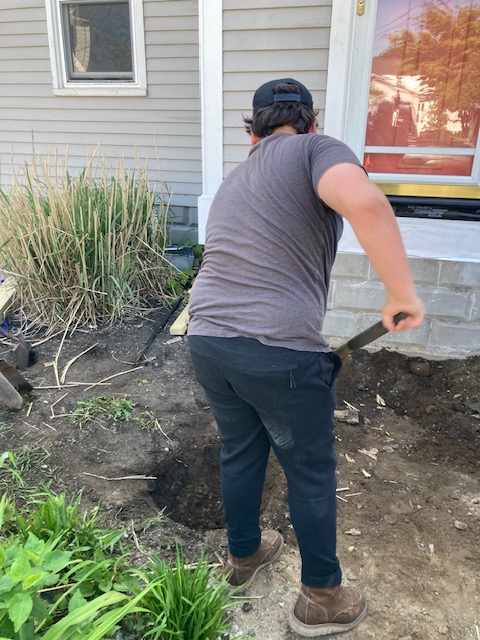
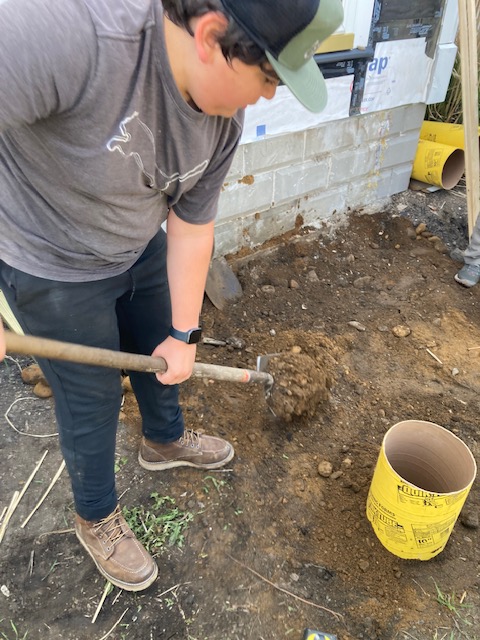
As a counterbalance to these abstractions, we poured concrete. The front entry of a friend’s home was demolished when his neighbor drove her car backwards, at a very high speed, into the front of his home. Remarkably, the driver avoided the house but smashed the stairs. Insurance paid little – no surprise there – so our marching orders are to be frugal. We are making it work, and my son is part of the crew. Child labor laws do not pertain in our homeschooling.

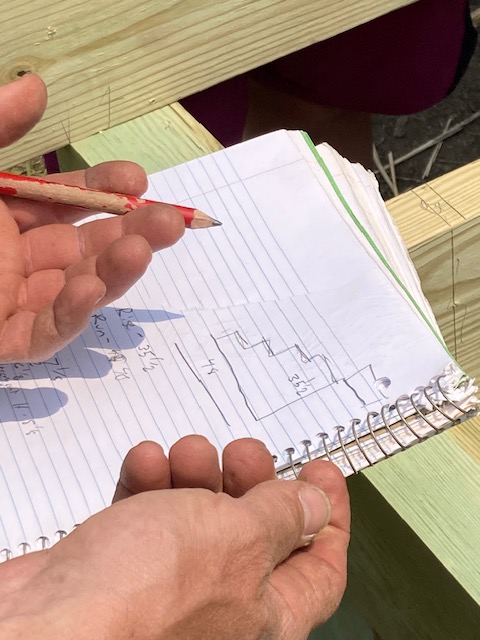
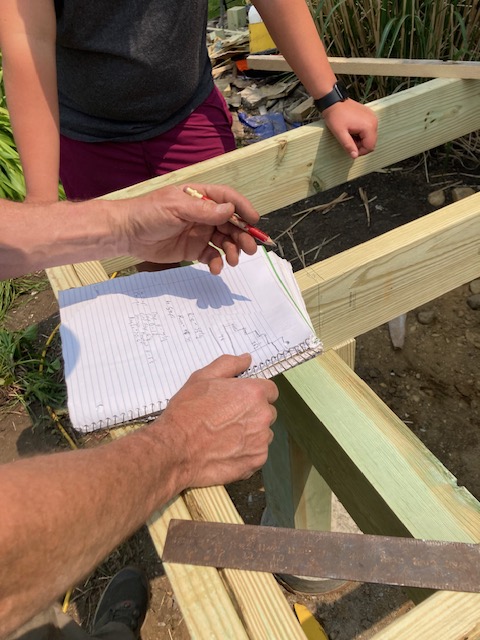
The new entry will have a platform about 4’ high, with four steps to it. This is applied geometry and we discussed the area of a rectangle [width x length], the area of a triangle [1/2(width x length)] and the volume of a column [V=π r2 * h]. We needed to calculate the volume to know how much concrete to buy. To place the footings, we located two points at right angles and parallel to the house. Pythagorus solved that question. We used the 3,4,5 triangle; given a2 + b2 = c2 then 9 + 16 = 25 marked the exact locations where we would dig.
Like construction, learning requires a solid foundation. We began at the bottom and dug holes. We discussed the history of “Pi”, and its application to our task. “Pi” is the ratio of a circle’s circumference to its diameter. The Babylonians approximated Pi at 3. The Egyptians refined it to 3.1605, and then Archimedes of Syracuse hit the mark by using the Pythagorean Theorem. He drew a circle and two boxes; one box fit inside the circle and one circumscribed the exterior. He reasoned the area of the circle was between the area of the polygons and thus Pi would be between 3.1408 and 3.14285. The Chinese mathematician Zu Chongzhi took a different route, performing lengthy calculations with hundreds of square roots to calculate the ratio at 355/113, which is 3.14159292035. Centuries later, in 1706, the Englishman William Jones decided to name the ratio “π” which is the first letter of the Greek word “perimetros”, which means “circumference”.
Our project’s head carpenter is a journeyman Master Carpenter, who has built homes on the islands of Maine for decades. Building on an island requires the ultimate resourcefulness; everything used is carried by boat to the job site and so waste is minimal. A calm and wise teacher, he explained use of a sight level, how to square the platform, how to measure and cut stair risers. The platform he built is remarkably strong and the client is pleased. My son hopes to handle the landscaping that follows.
Driving to and from the job site, my son spoke of the satisfaction of helping people using practical problem solving. My son also commented that jobs based upon information pay higher than jobs in physical labor. I will not sugar coat that truth: the annual salary of an average Professor of Law is $173,000 while the most skilled carpenter earns around $80,000 per year. Such are the values of this society (although AI looms large). My son’s path is unknown and we expose him to the yin and the yang, the full range of ideas and labor, as he comes of age.
About that volume, my son correctly calculated that each column was 2.8 cubic feet, which required 480 pounds of concrete. A heavy load, I was thankful for a young assistant.







The Anti-Readymade
Posted: May 30, 2025 Filed under: Chronicles of a First Time Parent, Farming off the Farm, Gallery - Visual, Portfolio - David's work | Tags: Baroness Elsa von Freytag-Loringhoven, brancusi, dada, duchamp 2 Comments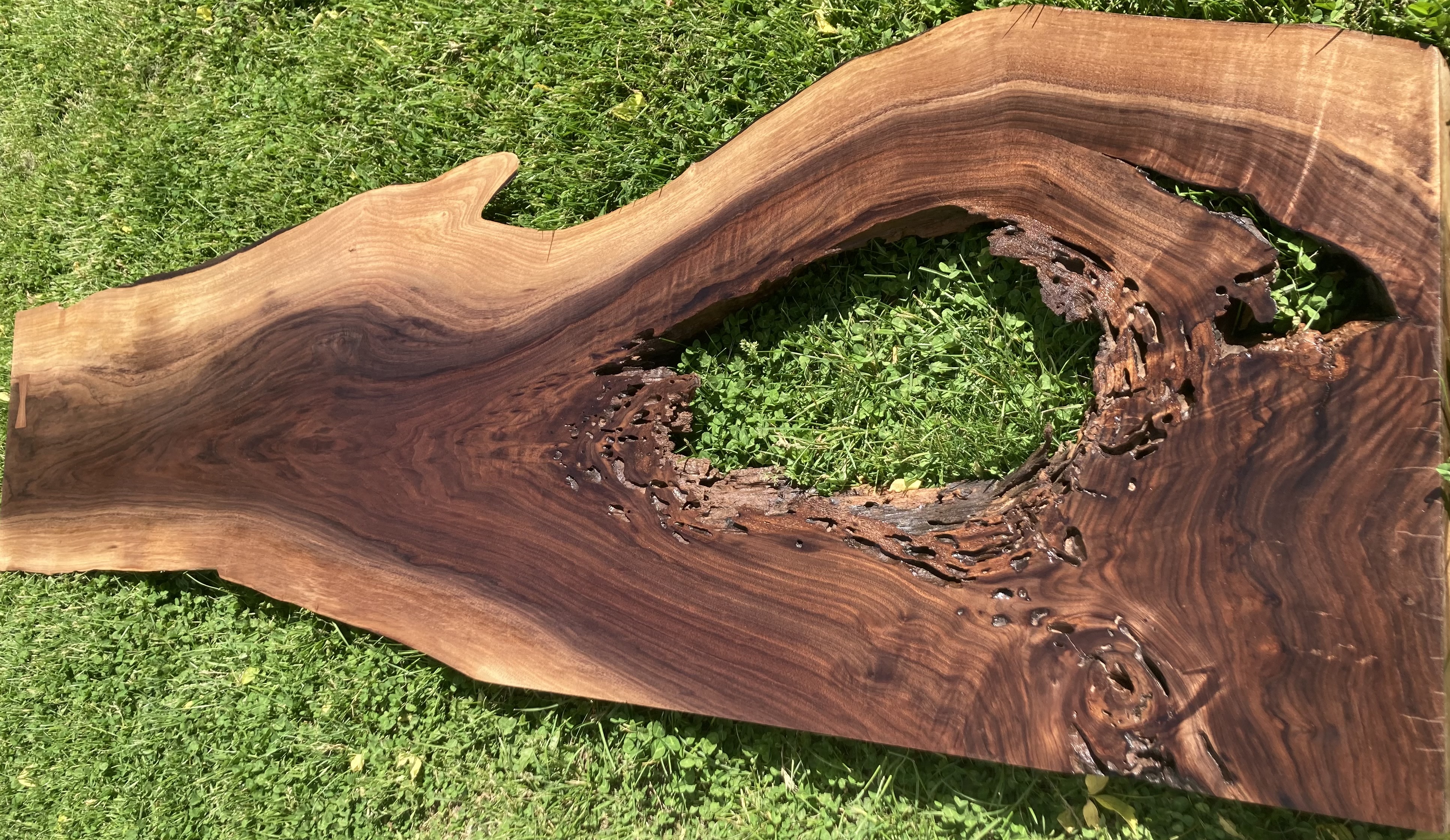
Marcel Duchamp, arguably the most influential artist of the 20th century, turned the art world upside down, in 1917, when he submitted a porcelain urinal as art for the inaugural Independent Artists’ exhibition in the Grand Central Palace of New York City. “Fountain” signed by R Mutt was rejected, which only drove that readymade sculpture to define the dada movement.
But wait…the Baroness Elsa von Freytag-Loringhoven more likely was its actual creator. R Mutt, a/k/a Duchamp elbowed her out. The Baroness embodied Dada, fought at the vanguard of the avant-garde to expose the irrationality of conformity and capitalism. Jane Heap, a publisher active in the development of modernism, described the Baroness as “the only one living anywhere who dresses Dada, loves Dada, lives Dada.” The Baroness Elsa appears to have been R Mutt.
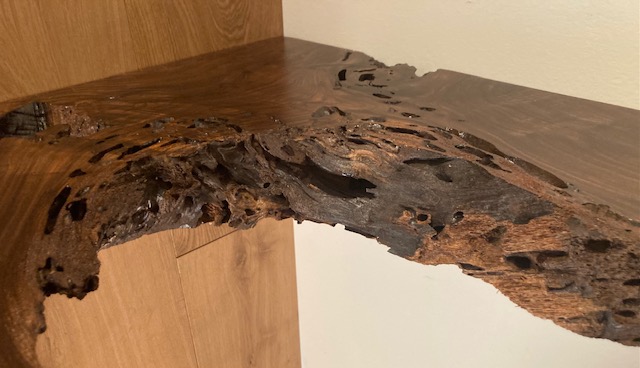
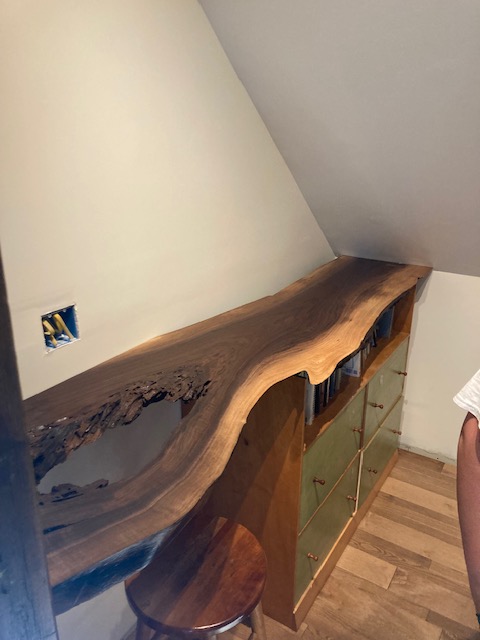
108 years later, when social media breeds conformity and capitalism reigns supreme, we are proud to present the Anti-Readymade: an object of exquisite natural beauty rendered into a utilitarian object of limited practical use. A countertop in my new office.
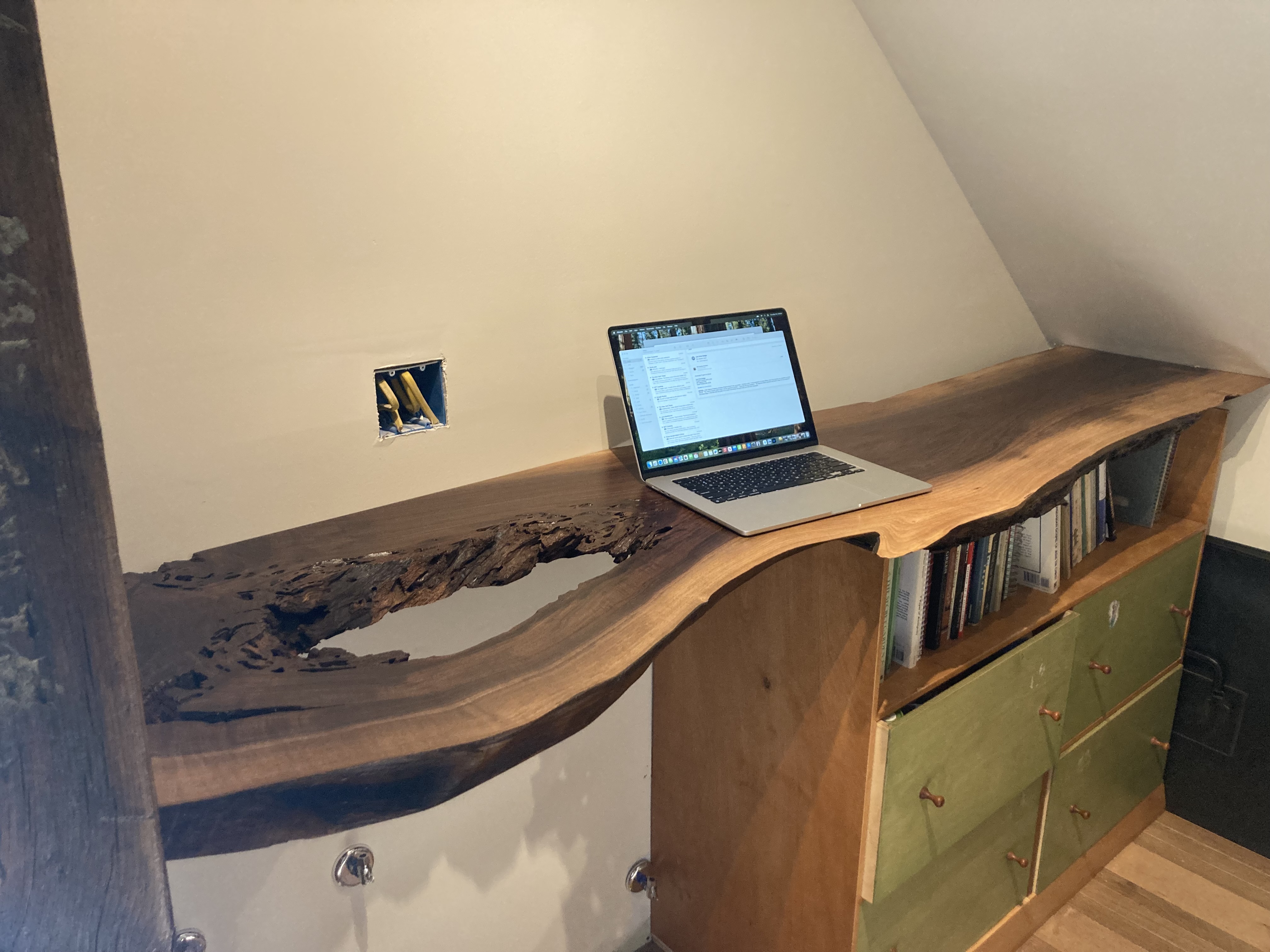
The slab is 2.25” thick American black walnut, which I happened to espie last December while at a lumberyard buying odd-lot flooring for our loft’s “charcuterie board” floor. I was seized by its commanding poetry, and given that my corporate bank account had excess capital, a tax write off was available. In our loft I had framed a wall using original boards from our 1840 barn, torn down when we first renovated the house. Boards cut and milled in 1840 would have sprouted circa 1700, so the history here equals the poetry. I sit here now as I write.
If beauty is in the eye of the beholder, then consider this from my childrens’ eyes. They remember when our loft was being framed, my son shoveled snow out the empty window openings. Just before COVID a friend helped me hang sheetrock, so when the shutdown began my wife had a home office. The nook wall is built of 325 year old boards, given a new life. Friends have loaned tools, John Hart built a bookcase then helped inlay the bowtie joint, my son helped clean out the many divots and found a walnut! The wild wood grain shouts out, and the hole speaks of the unknown where the “unusable” has been made beautiful in a community effort.
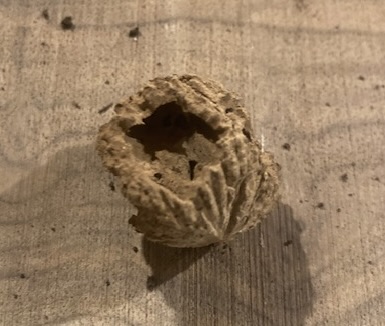
And what about that hole at the center? It screams of the void. Our zeitgeist, it seems, is a call to leap into the void. Musashi, the 16th century Samurai Master and strategist, considered a “sword saint” in Japan, taught that one must “strike from the void.” This means to strike using a calm, natural, intuitive approach, free of tension and over analysis. When stillness and clarity coincide, the body and spirit are in harmony.
And so our Anti-Readymade now stands ever ready, willing and able to remind us that stillness and clarity are keys to navigating these turbulent times.



___________________________________
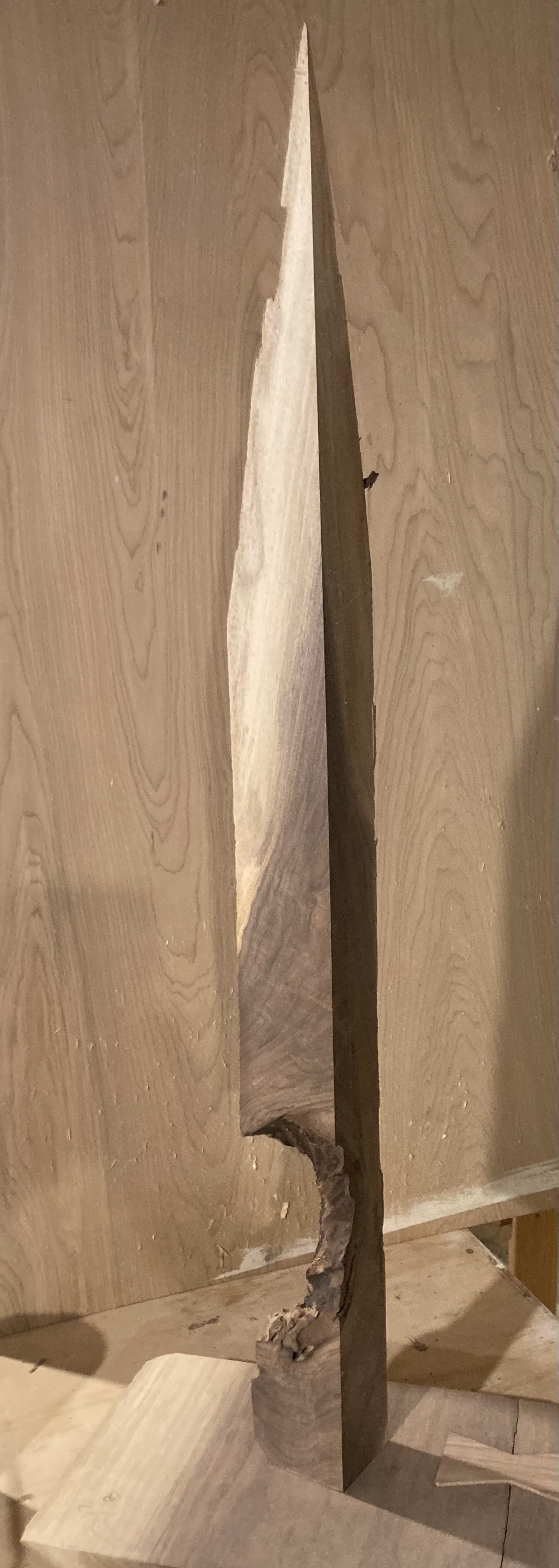
Even the slab cutoffs are sculptural. When squaring the slab’s end, this piece was cut off, which sings of Brancusi. It will become yet another piece in our mix-it-up loft.

True or False ?
Posted: May 23, 2025 Filed under: Child Centered Activities, Chronicles of a First Time Parent, What is an Art Farm | Tags: history, Magna Carta, philosophy, Plato, Socrates 1 Comment
This week in homeschooling, a true/false question arose: Is habeas corpus “…a constitutional right that the president has to be able to remove people from this country”? We have, by coincidence, been studying habeas corpus for the past seven weeks so this question did not come out of the blue. What has been wildly surprising is to see the topic so hotly discussed in the news.
Our humanities seminar has been titled “Habeas Corpus, Habeas Vox,” which I described in my blog dated 11 April. We began by considering those words. My son knows that a hearse carries a dead body, which is a “corpse,” so the Latin word corpus was readily understood. Habeas corpus, he knows, has something to do with a body, rather than a Presidential right.
But what to make of that Latin verb habeas? We approached that by studying the Ancient Greeks. The Spartans governed by a combination of diarchy (two kings ruled), oligarchy with limited democracy. The Athenians, however, invented direct democracy, not representative democracy like our modern form. From Athens we jumped to Medieval England to read about the Magna Carta. In his “end-of-week” essay on 2 May my son wrote:
This week in Humanities we studied the legacy of Greece. Greece is located on the Mediterranean Sea. In Classical Greece, Athens was a city state that created democracy, but only the men citizens could vote; slaves and women could not vote.
The Greeks were known for the arts, architecture and philosophy. In Athens there was a teacher named Socrates, known for teaching by the “Socratic Method” which was asking questions to engage his students. Socrates was put to death by the courts because they thought he was corrupting his students. One of his students was Plato, who wrote the Republic, which is his views of democracy.
Something else we studied was English history. I read about the Magna Carta, a document that gives liberties granted to the English people. The English Barons and Nobles argued and threatened a Civil War unless King John granted those rights. King John was very greedy and selfish. The Magna Carta was settled on June 15, 1215 when King John affixed his seal.
The Magna Carta gives guarantees for the people as a whole. The people could not be convicted of their crimes unless they were lawfully convicted. The Barons (Nobles) had the right to declare war upon the King. The Magna Carta is considered one of the basic documents of British law.
Next week we will do studying more on English history!
We next proceeded to study the English Bill of Rights, and then the USA Constitution. Last week, my son wrote:
This week, Harvard University discovered they had an original copy of the Magna Carta. There are seven original copies, and Harvard just happened to have one. In 2007 an original copy of the Magna Carta sold for $21.3 Million Dollars. This could not have come at a better time!
The Magna Carta was written in cursive script on a sheepskin parchment 810 years ago. It is a legal document that gave power from the King to a small group of Men. What the Magna Carta did was similar to the Greek direct democracy, by including people in political discussion, instead of the King alone.
The British Bill of Rights, signed in 1689, which is 336 years ago, was a sort of New Age version of the Magna Carta. For nowadays, the new age of the Magna Carta would be the Declaration of Independence. The British Bill of Rights basically gave everyone a fair trial and banned cruel and unnecessary punishment.
All of these political texts – the Magna Carta, the British Bill of Rights, the American Declaration of Independence, and all other that I have not mentioned – have slowly but surely lead up to what we have today; having “freedom,” a fair trial, and due process. Whether you like the current President of the United States or not, he continues to challenge these monumental, historic and foundational concepts.
Next week we will study the 1st Amendment and Abraham Lincoln’s Habeas Corpus Suspension Act. Harvard University’s discovery of an original copy of the Magna Carta is a wild coincidence as we are studying all this!!
I should mention that the essays are entirely my son’s concepts and phrasing, but together we edit them. As his scribe, I raise questions of grammar, word choice and structure; using the Socratic method, I challenge him but he decides as he dictates. We use library books as primary sources to frame the concepts, which he rephrases into his own words. If he does not know the word “plagiarism” he most certainly knows to avoid the practice.
As the school year draws to its close, we are preparing for a debate – 6th grade version – on the essential nature of government. Plato, the Athenian philosopher, argued that democracy is not viable, and the ideal form of government is a “benevolent dictator” more politely referred to as the Philosopher King. This is an argument for absolute strength in the Executive branch. In the current American moment, the occupant of that office is reviled by some as a dictator, and praised by no one as benevolent. My son shall argue in the affirmative that the strong leader must not only be unchecked and absolute in his control, but guided by good will, even compassion.
My son’s cousin, a Professor of Law, shall present the challenging argument, that “We the people” is a most radical proposition, but ultimately, an essential truth. We shall leave to him to define precisely how the many can actively support the one well being of the state. He shall argue that habeas corpus, which is due process, which is the rule of law, is the key to that functioning: the “Great Writ of Popular Sovereignty.”
My son clearly knew the answer to the true/false question, and summed the matter up well, saying, “Do you know how embarrassing it is when a 12-year old knows habeas corpus better than an adult?!! That is really embarrassing! It just makes Americans look really dumb!” He shall be fully prepared to debate what is good, what is benevolent, what is effective leadership for the state.
______________________________
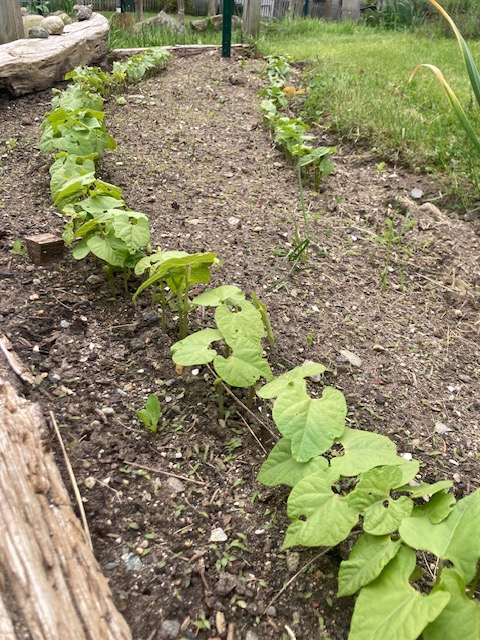
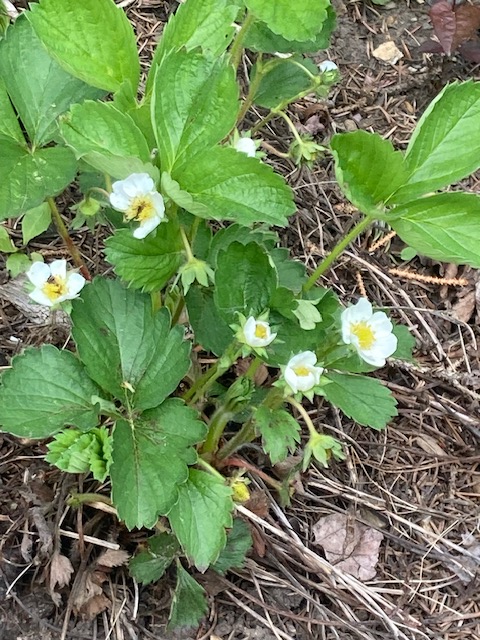
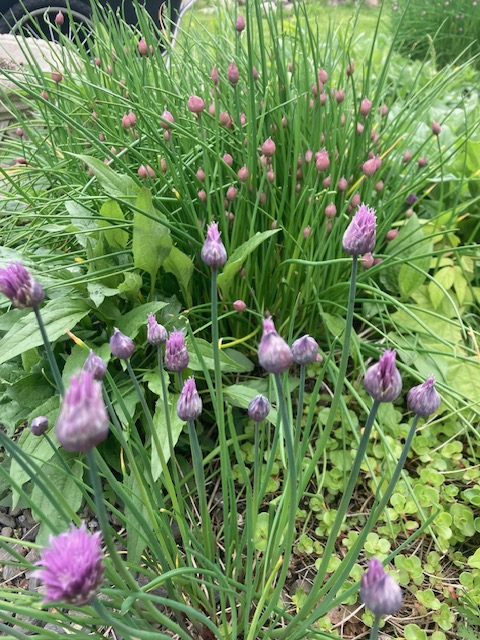
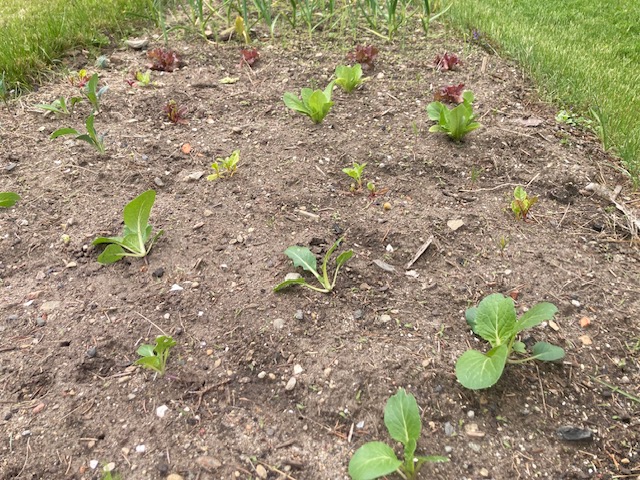
Summer is upon us! Our warm weather starts are ready to go into the ground: tomatoes, peppers, cucumbers, basil, and potatoes. Our cold weather starts do well and grow ever upright.



Art Predates Agriculture
Posted: May 16, 2025 Filed under: Art & Healing, consciousness, What is an Art Farm | Tags: authors, ethics, history, philosophy 2 Comments
Civilization began, it is widely believed, with the advent of agriculture. The time was around 10,000 BC and the place was the Fertile Crescent, which is the present day Middle East. Sheep and pigs were first domesticated, followed by plants such as flax, wheat, barley and lentils. The nomadic hunter-gatherers settled into agricultural communities, developed irrigation systems and established permanent settlements.
It should be noted that this definition of “civilization” speaks to the cultures of the Abrahamic religions (Muslim, Judaism and Christianity). The Clovis culture, however, were precursors to the Indigenous peoples of the America’s, and between 15,000 to 20,000 years ago developed stone tools, as well as agriculture, engineering, astronomy, trade, civic and monumental architecture. Some established permanent or urban settlements, but all did not forsake their nomadic lifestyle. There is not one civilization, but many co-inhabiting this planet.
However civilization may be defined, the plain fact is long before we worked the soil to plant seeds, the hunter gatherers were digging to get clay and earth based pigments for painting the caves at Altamira and Lascaux; art making predates agriculture, which is to say it predates civilization, which speaks to its fundamental role in shaping human life. Mark making is meaning making, hard-wired in our DNA, the act of making is a core means of problem-solving, both utilitarian and ideational.
Ellen Dissanayake is an ethno-anthropologist whose writings synthesize disciplines ranging from evolutionary biology to cognitive and developmental psychology. She lived for fifteen years in non-Western countries (Sri Lanka, Papua New Guinea, India and Nigeria) among indigenous pre-literate peoples and found that all shared the trait of embellishing their tools in non-utilitarian ways; the act of “making pretty” is consistent across the globe. This lead her to develop “…a unique perspective that considers the arts to be normal, natural, and necessary components of our evolved nature as humans.”
Far more than practical, the act of making is healing. Art therapy is based upon this insight, which, since the 1940s, has been used in conjunction with traditional psychotherapy, to provide a non-verbal avenue for exploring emotions and experiences. The simple act of making can help treat a wide range of mental health issues and support emotional well-being, based upon the interconnectedness of mind, body, and spirit.
Works of art such as the Sistine Chapel, a human achievement of extraordinary scale, can be overwhelming and lead most of us to cower, and say “I can’t draw.” But that seems ego-driven, as we are schooled in a comparative and competitive paradigm, which blocks the fact that art making is biologically and psychologically at the core of everyone’s individual life. Art, and the act of making, become the great equalizer.
One of the lessons of carpentry – which is to say making in the practical sense – is that adverbs and adjectives do not pertain; the wall is plumb or it is not, the corner square or it is not, the house will long endure or it will not. There is something exquisitely liberating in that plain fact. More “sophisticated” professions do not fall under this simple truth, for example, politics and the law are based upon argumentation and persuasion rather than objective truth. The word “sophisticated” is derived from the Sophists, in Ancient Greece, who excelled in clever deception, using rhetoric to win arguments regardless of the truth.
In a world that is increasingly argumentative, clever and AI-interconnected, the simple act of making can become a grounding and centering force. Let us proclaim there are four necessities in life: food, clothing, shelter and beauty; “making pretty” creates beauty while making becomes the means to achieve all the former. And all of which become an act of healing.
___________________________
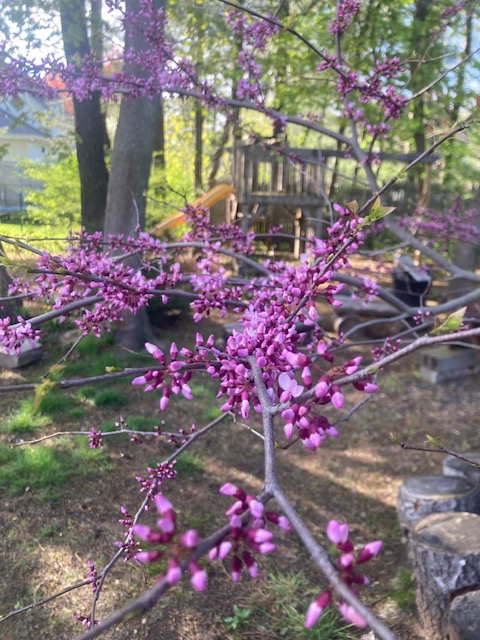
Plants push up, fruit trees blossom, and pollinators abound!




Forex Foray
Posted: May 9, 2025 Filed under: Chronicles of a First Time Parent, Money & Banking | Tags: economy, finance, history, money, politics Leave a comment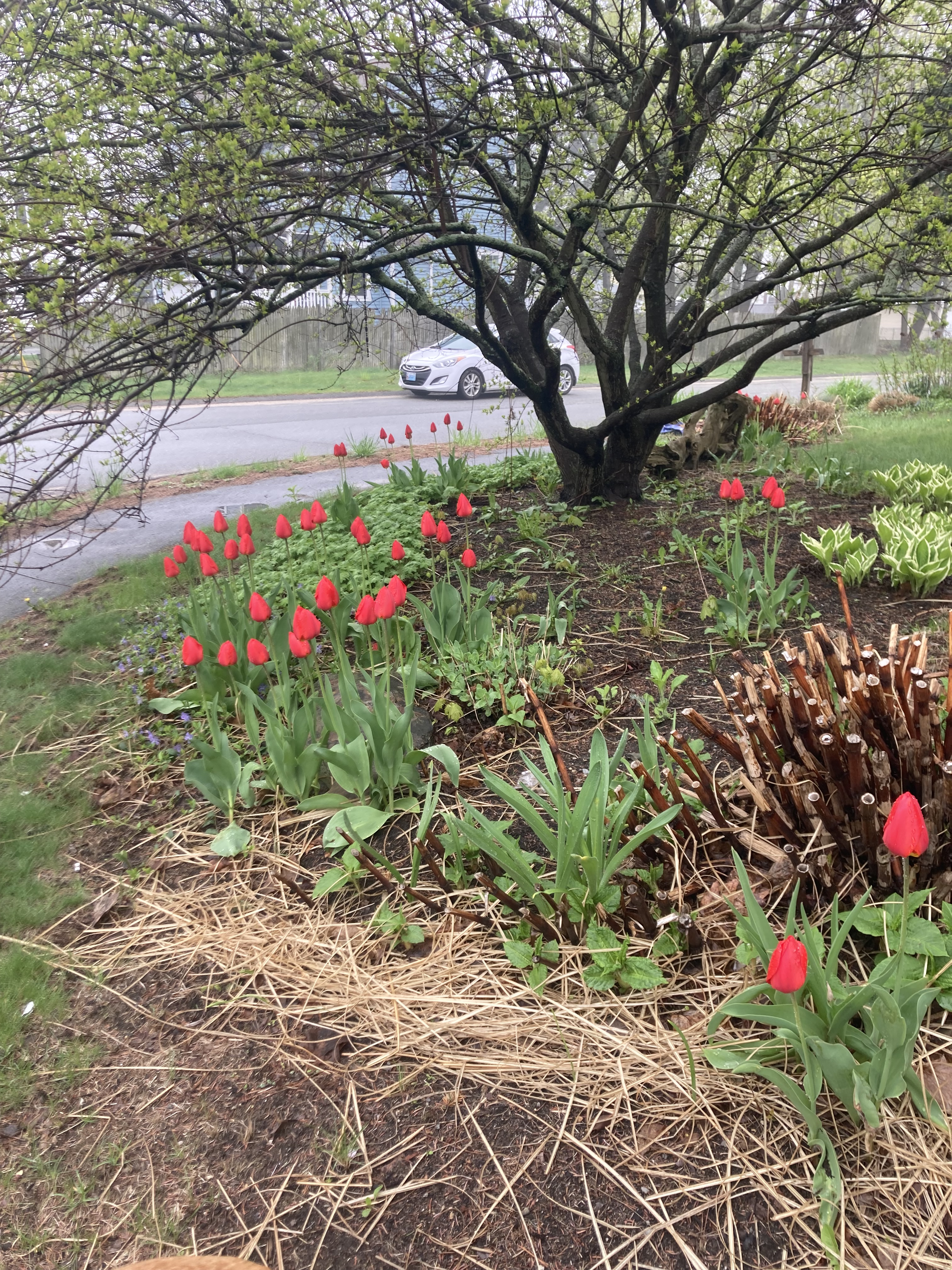
For your next dinner party, an interesting parlor game is to ask the question, “What is the strongest currency in the world?” The answer will stump many, and most likely, will surprise all.
My son and I talked about this recently. We were at our Credit Union and he asked about gold in their vaults – they have none – which lead to gold backing the United States Dollar (USD) – there is none.
I quoted the old joke, “There is not enough gold in Fort Knox…” and explained the Nixon Shock, when on the hot summer night of 15 August 1971, Richard Nixon – by Executive Order – suspended the convertibility of US dollars into gold. With a stroke of his pen, Nixon unilaterally ended the post World War II Bretton Woods monetary system.
In Latin “fiat” means “let it be done,” an authoritative decree and in monetary terms the USD is a “fiat” currency; there is no underlying asset base because it is secured only by “the promise to pay.” In an era of rising national debt and hyper-partisan politics, that promise to pay can seem frightfully uncertain.
“Isn’t the USD the strongest currency” my son sagely asked? I explained that the USD is the world’s reserve currency, and so the strength of all currencies is in comparison to it. Some currencies are weaker (less value) while others are stronger.
As most people would, my son reasoned the strongest currency must be either in Europe or Asia, “Asia produces so much.” Economic output logically focuses on the “Group of 7” leading industrialized nations: Canada, France, Germany, Italy, Japan, the United Kingdom and the USA. Our bias inherently is G7-centric.
We continued to talk, and he said, “No, it must be in the Middle East! They have so much oil.” He was onto something, and I told him, in fact, the Kuwaiti Dinar is the strongest currency in the world. The next three strongest currencies are also from the Middle East: Bahraini dinar, Omani rial and the Jordanian dinar. All are net exporters of oil, with a strong inflow of foreign currencies and stable governments.
A few years ago we drove north to Montreal, Canada. Before the trip my son and I went to a currency exchange to buy Canadian Dollars. He paid $1.00 USD to purchase about $1.25 Canadian Dollars. In other words, when he bought a Lego set in Canada it cost less than it would back at home; his money went further. A valuable lesson, and we had many fine meals on the cheap.
The lesson here is that the value of money is relative, not fixed. Long ago money was backed by gold, now it is fiat, while oil is becoming a dominant base of value. All oil sales are settled in United States Dollars – known as “petrodollars” – but China and Saudi Arabia have begun to settle in Chinese Yuan. The USD now is declining. The global movement seems away from fiat to asset-backed currencies. The omnipotence of oil backed currency would seem to make the transition to clean energy more difficult by an order of magnitude.
In the age when gold was the standard, there were arguments for both Gold and Silver to serve as the underlying basis. William Jennings Bryan’s historic speech advocating bimetallism, delivered in 1896 in Chicago, ranks among the finest examples of oratory in world history.
The gold proponents were the monied class on the East Coast. The silver constituency were the workers, the masses, the common man. Bryan reasoned:
“The man who is employed for wages is as much a business man as his employer; the attorney in a country town…the merchant at the cross-roads store…the farmer who goes forth in the morning and toils all day,.. the miners who go down a thousand feet into the earth…are as much business men as the few financial magnates who, in a back room, corner the money of the world. We come to speak of this broader class of business men.”
He then addressed the gold proponents, and argued against supply-side economics:
“There are two ideas of government. There are those who believe that, if you will only legislate to make the well-to-do prosperous, their prosperity will leak through on those below. The Democratic idea, however, has been that if you legislate to make the masses prosperous, their prosperity will find its way up through every class which rests upon them.”
He rhetorically cut down the gold position, advocating the bimetal monetary basis to support the common man, and then in crescendo, rose to his time-honored conclusion:
“Having behind us the producing masses of this nation and the world, supported by the commercial interests, the laboring interests, and the toilers everywhere, we will answer their demand for a gold standard by saying to them: “You shall not press down upon the brow of labor this crown of thorns; you shall not crucify mankind upon a cross of gold.”
Dead silence filled the Chicago Coliseum. Bryan feared he had missed his mark, until pandemonium broke out and he was raised onto the shoulders of delegates. “Bedlam broke loose, delirium reigned supreme” the Washington Post reported.
Gold, silver, fiat, or oil…in a world of constant change, the lesson for my son is that integrity need be his bank account, his word his bond, character alone counts. By that true standard he will do well regardless of the rising or falling tides of money and banking.
__________________________
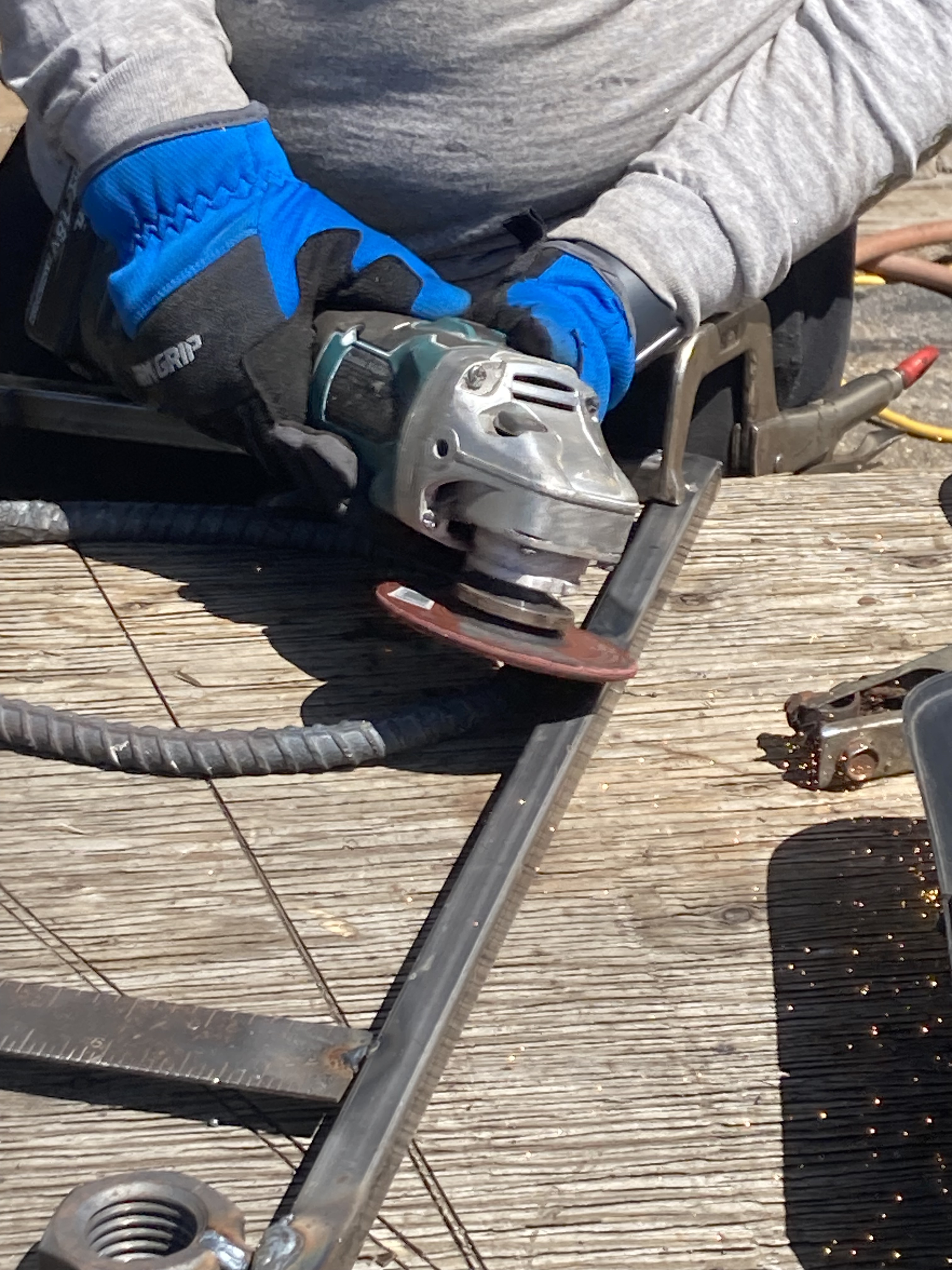
In our home school chemistry class, solid progress had been made, my son has made his mark.


Ice Cream Revelations
Posted: May 2, 2025 Filed under: Child Centered Activities, Chronicles of a First Time Parent, consciousness, What is an Art Farm | Tags: Carl Jung, creativity, dreams, Mayan Long Count Calendar, Primate of Ireland, psychology, Revealtion 17, saint malachy, semi dwarf apple tree, spirituality, writing 1 Comment
I recently went driving at night with my children to go eat ice cream. Pope Francis having died, my daughter mentioned Tik Tok talk of the prophecy of Saint Malachy. As it were, I’m familiar with those prophecies, having heard about them almost 30 years ago.
Saint Malachy lived in Northern Ireland in the 1100s. Born Máel Máedóc, he served as Archbishop of Armagh and was the Primate of All Ireland – the highest ranking position in the Catholic and Episcopalian Church of Ireland. His predecessor was no less than Saint Patrick, known as the “Apostle of Ireland,” venerated as a saint in the Catholic Church, the Lutheran Church, the Church of Ireland, and in the Eastern Orthodox Church. ‘Tis no small role to be the Primate of All Ireland.
Malachy’s prophecy presaged 112 more popes before the Last Judgment. Pope Francis happens to be that 112th pope. The prophecy is widely debunked, but on social media it seems to be generating great interest.
My daughter explained the conventional view, that following the last Pope will come the rapture, when the dead and living believers will be lifted up in the air, ascending to heaven at the Second Coming of Christ. My son, a deep thinking Sagittarean, questioned, “what about the others?” I clarified, “…the Buddhist, the Muslim, the child of Indigenous parents…?”
My son questioned more deeply, “How can a God of love exclude half of the world’s population?” My daughter repeated the factual statement that the faithful believe theirs alone shall be redemption. When she spoke of the risen Christ, I queried about John 14:12 “These and greater deeds ye shall do” which means to raise the dead, to walk on water, to feed loaves and fishes to the masses…come one come all – he says – we the people all have that power. Who among us shall believe, and act?
And so we drove, into the dark night, eating our ice cream.
I reminded them that the world in fact came to an end on 12/12/12, just over 12 years ago. Such was the popular view, pre-Tik Tok. I spoke of the Mayan Long Count calendar, the end of a 5,126 year-long cycle. 250-950 AD was the Mayans’ Classic period, the peak of their large-scale construction, urbanism, monumental inscriptions, and significant intellectual and artistic development. Their flowering has been likened to that of Renaissance Italy or Classical Greece. Everyone reading this essay today knows that the world did not end on 12/12/12; the Mayan calendar’s end marked only a new beginning. In Hindu terms, this is Shiva’s cosmic dance, his never ending destruction creation cycle.
A friend has read the Book of Revelations and suggests that the current Commander in Chief is the 8th King of the Roman Empire, Revelation 17, “destined for destruction,” the Antichrist. Indeed we can read the “two beasts” as representing opposing forces of evil: one from the sea (Manhattan and Florida) is a political power that dominates the world, a healed gash to its head, seeking to establish himself as a pagan deity, while releasing scorpions. The beast from the earth (Africa), the False Prophet, helps the sea beast gain global control, sends fire from heaven and promotes the worship of the beast from the sea and works to deceive people through signs and wonder.
Carl Jung came to mind, in Psychology and Alchemy his observation that religions perfectly coopted the archetypes to their narrative. Scriptural writing to my mind seems symbolic more than a factual narrative. The end of one narrative is but the beginning of another.
Talk of the end of the world is not for the faint of heart. As we drove, as we ate our two scoops of ice cream in waffle cones, the popular song from 40 years ago by the band REM came to mind, “It’s the end of the world as we know it, and I feel fine.”
And so we ate our ice cream. We will figure it out in the light of day. The sun will rise, life will go on, world without end, amen.
__________________________________
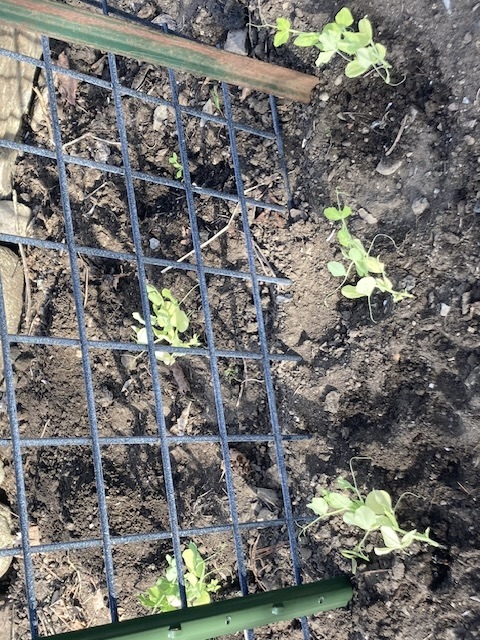
Gaia pushes up the Garlic while cold weather starts go into the ground: Kale, Chard, Lettuce, Pac Choy, Snap Peas, Fennel, Shallots, Scallions, Rosemary, Parsley and Thyme.


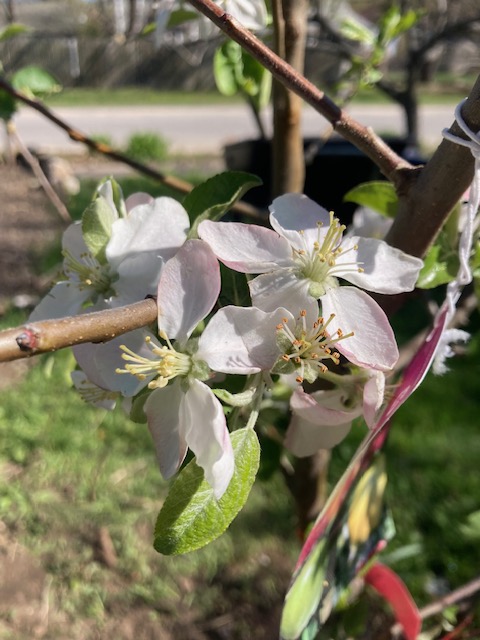
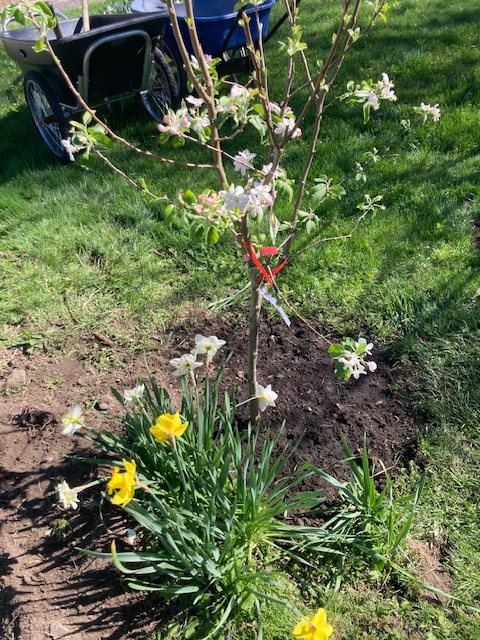
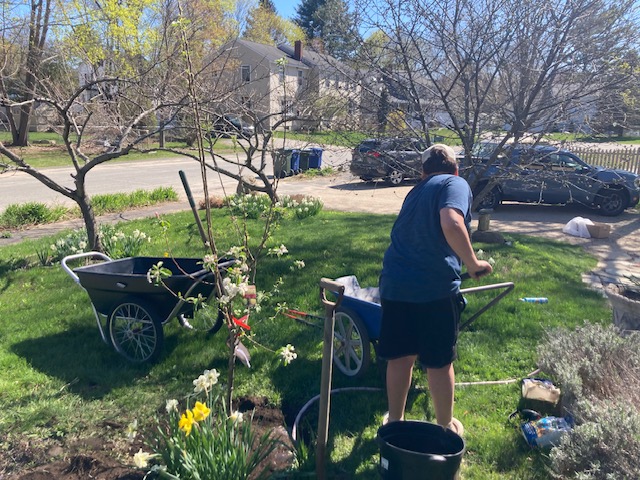
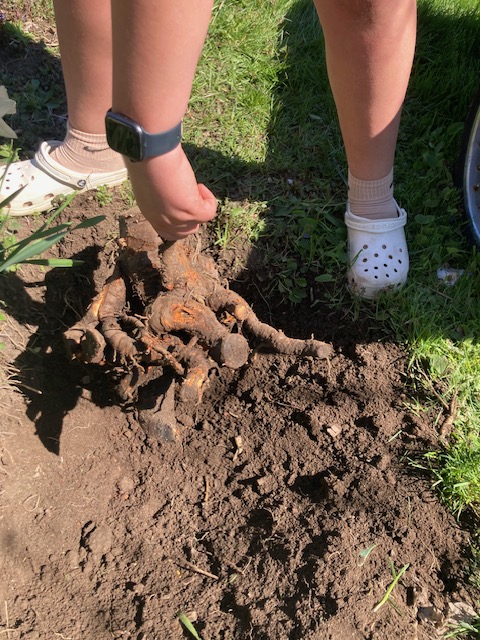
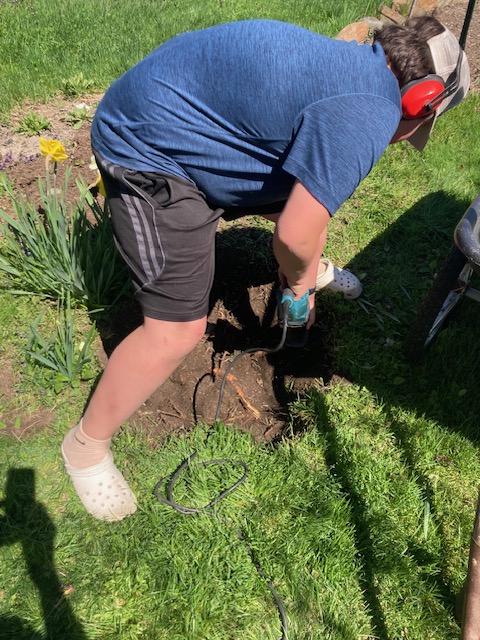
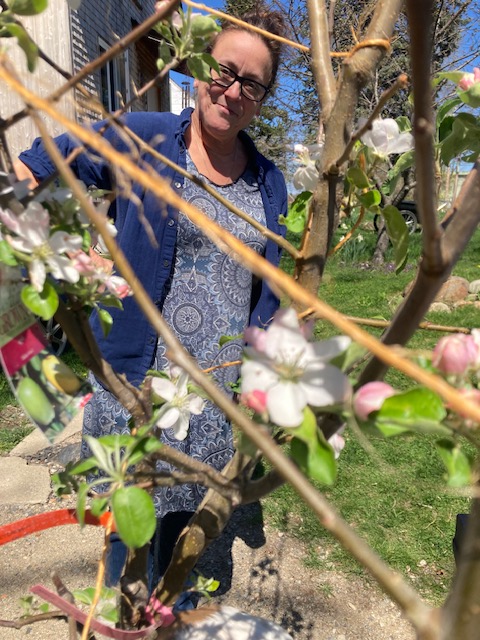
And most importantly, Eve has come to our garden! A 4-in-1 semi-dwarf apple tree, a gift from Grammy Moana to Becca, with four varieties grafted onto the root stock: Fuji, Pink Lady, Honeycrisp, and Ginger Gold. Something for everyone! She joins our two peach trees and a sour cherry tree. I cannot tell a lie, my son cut down our sweet cherry tree last summer, at my instruction. The trunk had a serious gash and its time was ended. Every end is a new beginning, the circle of life, and Eve has taken its place!


Swashbuckling Swamp Tales
Posted: April 25, 2025 Filed under: Child Centered Activities, Chronicles of a First Time Parent, Portfolio - Elena's work Leave a comment
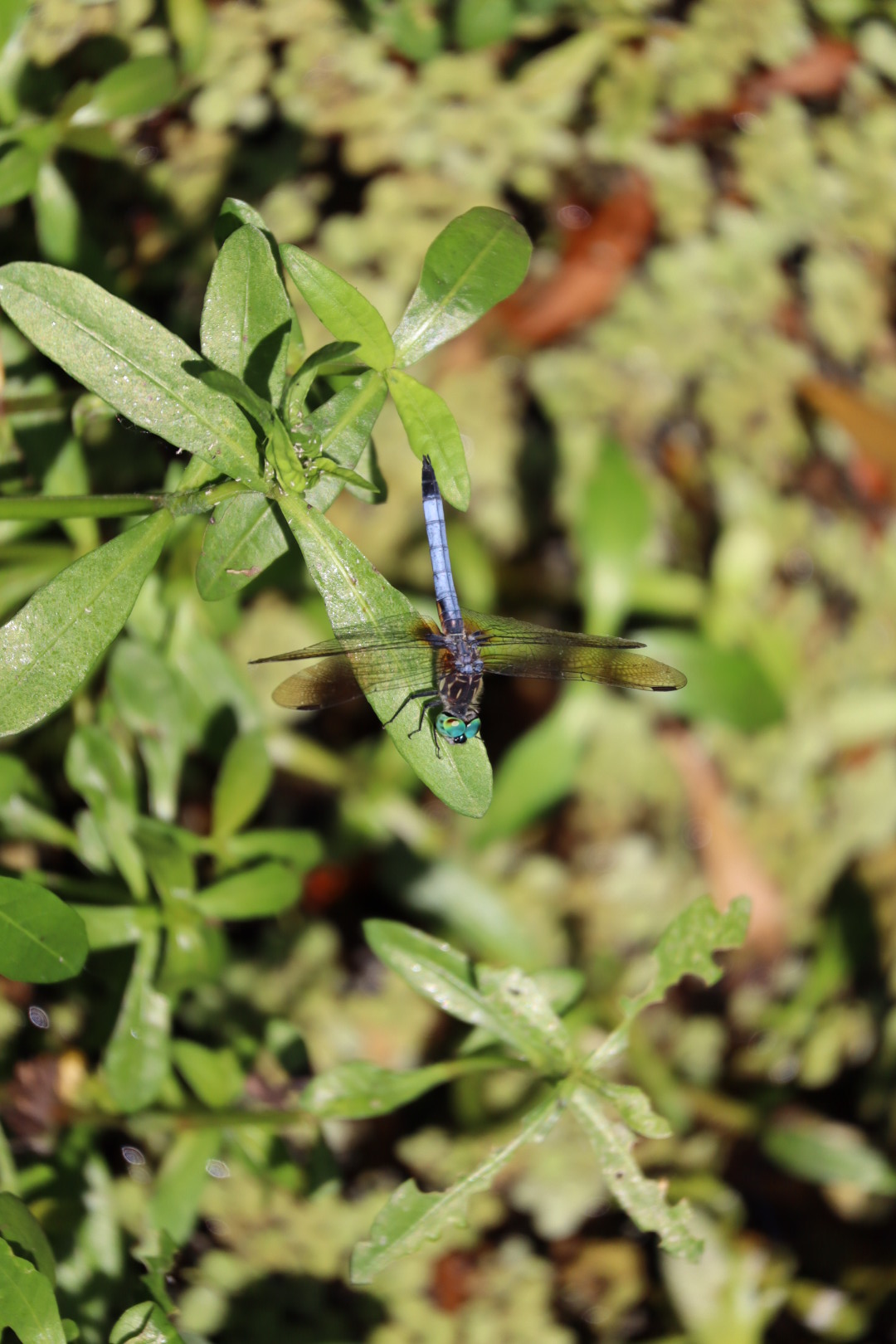
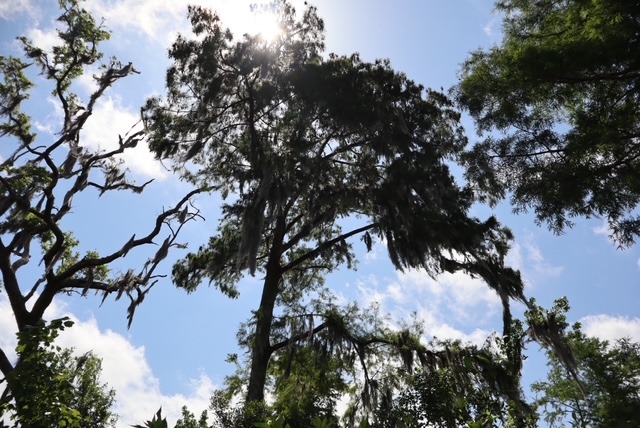
The children and I recently walked the swamp trails at 29°56’33” N by 89°59’39” W, the Barataria Preserve in the Mississippi River Delta of Louisiana. Long ago this was the land of Jean Lafitte, a swashbuckling rogue of French or Spanish or Haitian descent, a pirate and slave trader, as handsome as he was cunning and shrewd, who played all sides against the others in the era when Thomas Jefferson purchased Louisiana from the French in 1803.
During the war of 1812, King George III of England offered Lafitte and his men citizenship and land grants if they would fight for the British. Lafitte shrewdly leveraged that offer to form an alliance with the Americans – his piracy was easier against US Revenue agents than the British Navy – but then after Andrew Jackson agreed to a full pardon for all of his men, Lafitte’s troops fought with Jackson to defeat the British at the battle of New Orleans. The pirates’ skill with artillery was greater than the British Navy and Andrew Jackson praised their “courage and fidelity.”
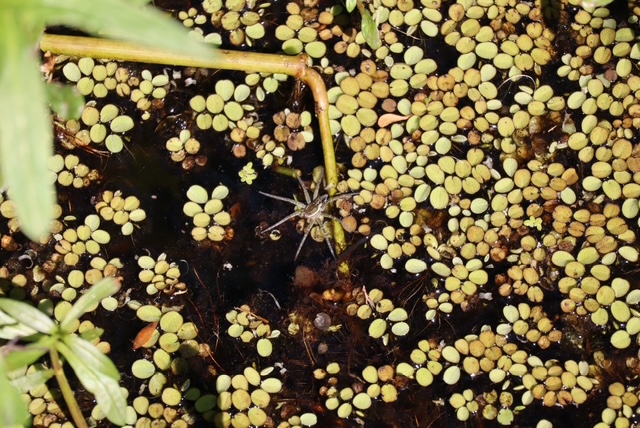
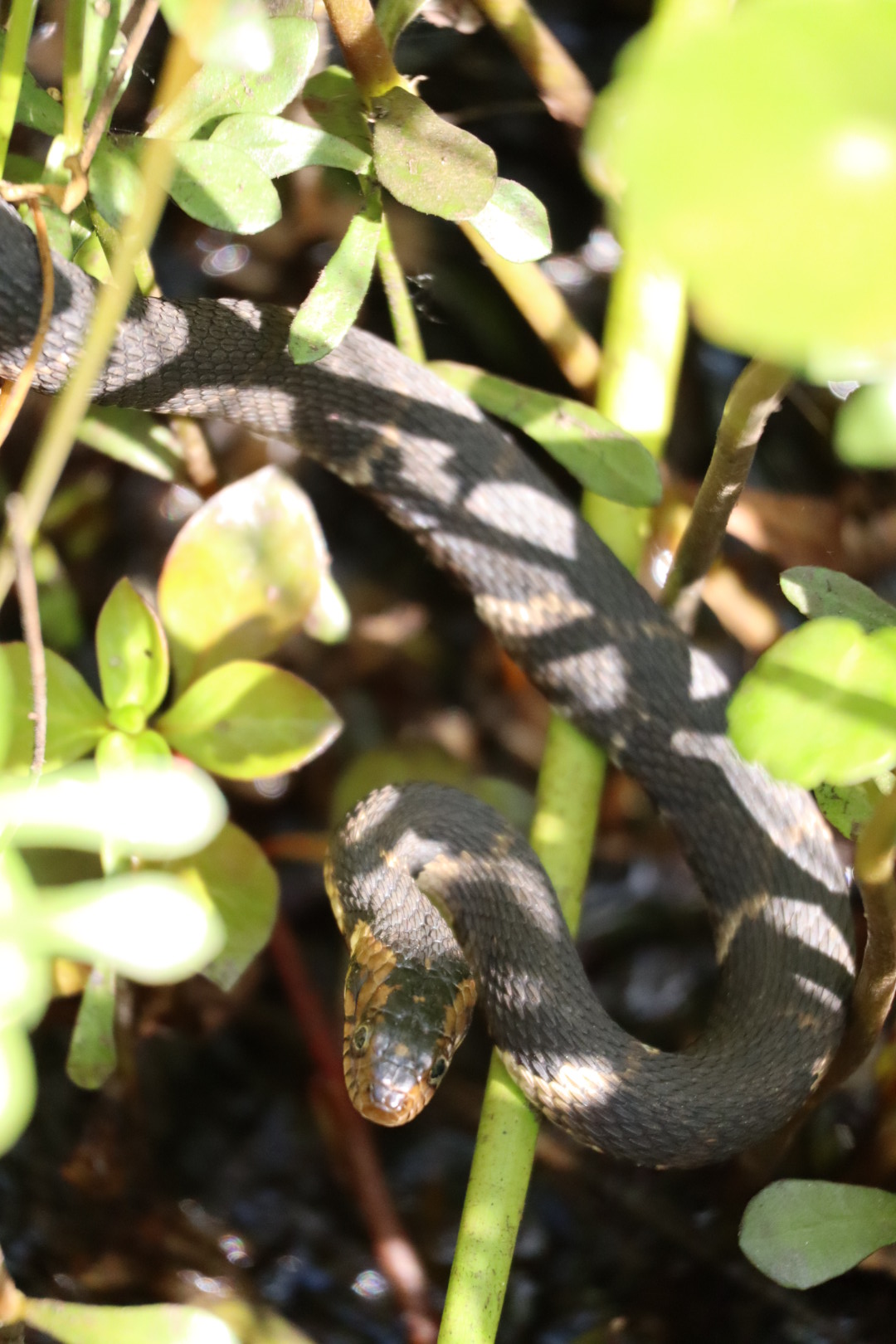
During the Mexican War of Independence in 1815, Lafitte and his brother acted as spies for Spain, which allowed them to develop Galveston Island as another smuggling base outside the authority of the United States. The swashbuckling history was of great interest to me, but my children only wanted to see an alligator. To no avail though, as the temperatures were warm enough that the gators laid low, hidden in the water to stay cool from the sun’s heat. We saw no gators, but plenty of snakes, frogs and spiders.







Isaac in Isolation
Posted: April 18, 2025 Filed under: Child Centered Activities | Tags: alchemy, books, consciousness, history, Isaac Newton, philosophy, rational mind, science 1 Comment
In 1665 the plague descended upon London, forcing all the residents to go into isolation. The COVID-19 of its day, in an age before plumbing or electricity, before iPhones and apps, the isolation was complete to a degree that we can barely fathom today.
A 22-year old named Isaac used his solitude well, conceiving the laws of infinitesimal calculus. Leibniz is credited with developing Calculus but young Isaac was 8 years ahead of him. Einstein has hailed the insights as “perhaps the greatest advance in thought.”
At the age of 44 Isaac walked in the gardens of Cambridge University and observed an apple falling straight down to the earth. So he surmised and proceeded to publish, in 1687, Principia which established the foundation for classical mechanics. A manuscript from the Royal Society retells this conversation of 15 April 1726, when Isaac told a colleague how the idea came to him:
“we went into the garden, & drank thea under the shade of some appletrees, only he, & myself. amidst other discourse, he told me, he was just in the same situation, as when formerly, the notion of gravitation came into his mind. “why should that apple always descend perpendicularly to the ground,” thought he to him self: occasion’d by the fall of an apple, as he sat in a comtemplative mood: “why should it not go sideways, or upwards? but constantly to the earths centre? assuredly, the reason is, that the earth draws it. there must be a drawing power in matter. & the sum of the drawing power in the matter of the earth must be in the earths center, not in any side of the earth. therefore dos this apple fall perpendicularly, or toward the center. if matter thus draws matter; it must be in proportion of its quantity. therefore the apple draws the earth, as well as the earth draws the apple.”
By the age of 55 Isaac had been named, by the British Crown, the Warden of the Mint, and then served as the Master of the Mint for 30-years. In contemporary terms, the Master was essentially the Chairman of the Federal Reserve, responsible to ensure the value and to assay the gold content of the King’s coins.
At the age of 62 the King bestowed upon him Knighthood, which is why we universally refer to him as Sir Isaac Newton, one of the towering figures in history, a paragon of rational thought.
What is less well known of Sir Isaac is that he was a leading alchemist of his day. The irony is almost mind-boggling: when alchemy was a crime punishable by death by public hanging the Master of the Mint was busy trying to turn base metals into gold. It is said of more than 10 million words of notes taken by Newton, 1 million at least pertained to alchemy. His interest was more than just a passing curiosity. By any conventional thought, that is an idea laughably hard to grasp.
What if alchemy is not about base metals turned into gold, but rather a symbolic language for the pursuit of higher consciousness? In the three-dimensional realm of conventional thought, where the laws of physics and Darwinian materialism reign supreme, what better symbolism could there be than “base metals” and “gold” referring to the path to wisdom of a greater whole.
Carl Jung in his Alchemy and Psychology and Fabricius in Alchemy: The Medieval Alchemists and Their Royal Art suggest that this is, in fact, the more accurate understanding. In The Foundations of Newton’s Alchemy, B.J.T. Dobbs argues that “Newton’s primary goal was not the study of nature for its own sake but rather an attempt to establish a unified system that would have included both natural and divine principles.” Newton was a critical link between the Renaissance Hermeticism and the rational chemistry and mechanics of the scientific revolution; in moving the scientific world forward, he looked back upon Neoplatonism, which in turn drew upon the writings of Hermes Trismegistus, the towering Hellenistic sage.
History teaches that higher consciousness threatens conventional thought. In 33 AD the self-righteous Pharisees had the radical street preacher put to death by public hanging. Martin Luther King had an FBI file and was assassinated for arguing that “all people are created equal.” In the year 2025, the pious among us ban books from libraries that challenge their narrow minded sense of self. The orthodox, it seems, are not expansive but restrictive and limiting.
Newton was wise never to publish his alchemical writings. In fact, many of them were burned by a fire; the story told that a dog knocked over a candle in his study, but one wonders what was the risk to his reputation for that intellectual pursuit. He remained, in a sense, in isolation throughout his life for his pursuit of alchemy.
The record shows that when Newton stepped down from the 2nd Lucasian Professorship of Mathematics – considered the single most prestigious professorship in the world – his replacement, William Whiston excoriated Newton publicly for his highly unorthodox views. No doubt Professor Whiston was smug in his self righteous words and considered the case closed. But in fact, it may be that he had simply locked himself, and his peers, inside the box of self limiting, rational thought.
The world is more vast than we tend to conceive. It would seem the challenge of our times now is to expand our collective higher consciousness, to awaken and more fully hear and embrace those “mystic chords…of our better angels.”
________________________________


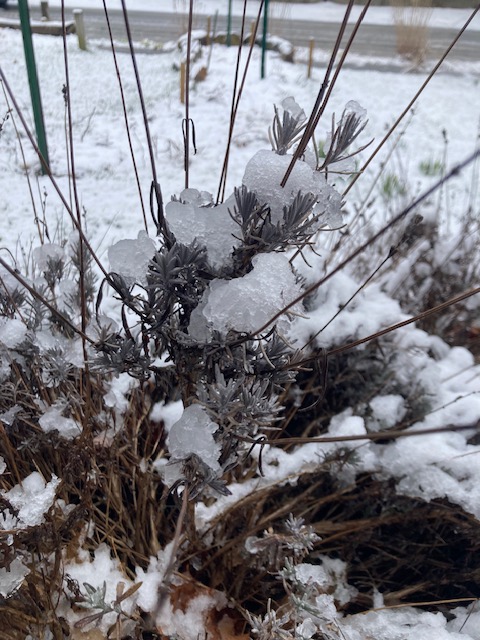


 an Art Farm