When Tears Become Bullets
Posted: August 22, 2024 Filed under: Chronicles of a First Time Parent, consciousness, Permaculture & Home Renovation, What is an Art Farm | Tags: hypermasculinity, jackson katz, the boy code, william pollock 2 Comments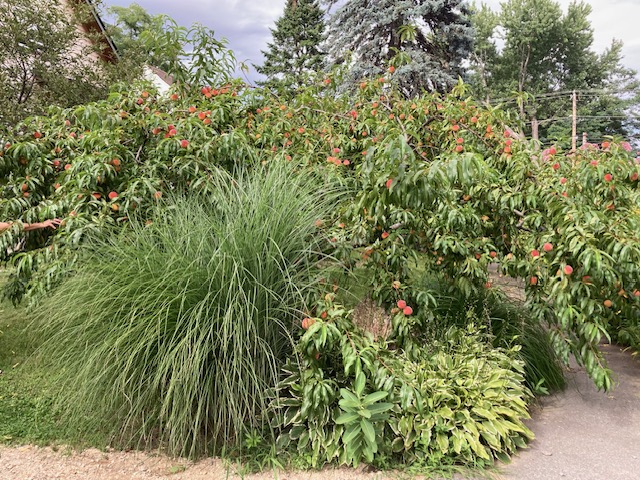
In 2001, I met and soon moved in with a remarkable young woman, an art therapist, who had worked with young children at Byrd Elementary School at Chicago’s Cabrini Green housing project, as well as in the Robert Taylor Homes and Cook County Hospital. Working with inner-city boys, she was driven to thread the emotional needle, to help them move forward.
In that studio apartment, on her bookshelf, was ”Real Boys” written by William Pollock, PhD about “the myths of boyhood,” how our society shapes boys to become men. I tried repeatedly to crack that cover but could not. It cut too close to my core.
I quote now the four core tenets of what Pollock called “the Boy Code”:
“The sturdy oak: Men should be stoic, stable, and independent. A man never never shows weakness…boys are not to share pain or grieve openly.
Give ‘em hell: This is the stance of some of our sports coaches, of roles played by John Wayne, Clint Eastwood, and Bruce Lee, a stance based on a false self, of extreme daring, bravado, and attraction to violence.
The “big wheel”: This is the imperative men and boys feel to achieve status, dominance, and power. Or, understood another way, the “big wheel refers to the way in which boys and men are taught to avoid shame at all costs, to wear the mask of coolness, to act as though everything is under control….
“No sissy stuff:” Perhaps the most traumatizing and dangerous injunction thrust on boys and men is the literal gender straight jacket that prohibits boys from expressing feelings or urges seen as “feminine” – dependence, warmth, empathy.”
In short, big boys don’t cry. When I was young, my father – who lived to seize the brass ring, to slay the dragon, to climb the mountain, then died young – he repeatedly told me, “David, you can get used to hanging if you have to.” My football coaches always rhymed “no pain, no gain!” I fault neither my Father nor the coaches, as they only passed on what they had been taught. About all this, Pollock cautioned, “when boys cannot cry, their tears become bullets.”
Bullets, of course, can be metaphorical, and but one example would be the Wall Street “Masters of the Universe” among whom “might is right” with finance a zero sum game of domination, power and control. Consider hedge funds buying up the foreclosed housing stock and then raising rents, in the midst of a housing shortage. Or private equity buying medical practices, to maximize profits at the expense of patient care.
The first rule of the Boy Code is that we don’t talk about the Boy Code. I violate masculinity in writing this meditation upon raising a daughter and son in a culture where hypermasculinity is the norm. I speak here not of the male gender but the masculine traits, as taught.
Jackson Katz, a male pioneer in women’s studies, has written a book titled “Man Enough?” about the “Politics of Presidential Masculinity.” Presidential campaigns are described “…as the center stage of an ongoing national debate about manhood, a kind of quadrennial referendum on what type of man—or one day, woman—embodies not only our ideological beliefs, but our very identity as a nation….how fears of appearing weak and vulnerable end up shaping candidates’ actual policy positions…”
I write here neither to praise nor denigrate any candidate. My concern is our culture of dominance. In this time of hypermasculinity, where we demonize “other,” be they immigrants, the extreme right, the “marxist” left, Neo-nazis, ad infinitum, I am compelled to ask what if the problem is not “them” but us? It is so easy to point and blame “them” but infinitely more challenging to say it is our system of beliefs, self-reinforcing, which perpetuate cycles of violence, a culture of dominance rather than compassion.
Jackson Katz gave a TED Talk titled “Violence against women – it’s a men’s issue.” He makes the subtly persuasive point that rational self interest in a patriarchal society becomes a self-reinforcing system of belief; there is no conspiracy but a self interest in maintaining the status quo rather than embracing change. By analogy, Newton’s First Law of Motion here pertains, that a system of domination will persist until it is acted upon by an external force strong enough to bring change. https://www.ted.com/talks/jackson_katz_violence_against_women_it_s_a_men_s_issue?subtitle=en
“It takes a village” becomes my curse. In our home we raise children to value empathy, compassion and emotional intelligence, but the world into which they go – are schooled, coached and policed – there predominates the hypermasculine. How do we raise our children to be compassionate when their peers practice dominance? “Gentle as a dove, wise as a serpent,” comes to mind.
As a child, I would read the Sunday comics seated below my Father, while he devoured the business news. Pogo, the political satire, ran in those comics, with its theme “We have met the enemy, and He is us.” More than fifty years have passed and some demonize the “Deep State” or “them” but I ask, what if Pogo really was right? What then, if we ourselves are the problem?
An honest awareness seems a necessary starting point in a new dialogue.
* * * * * * * * *
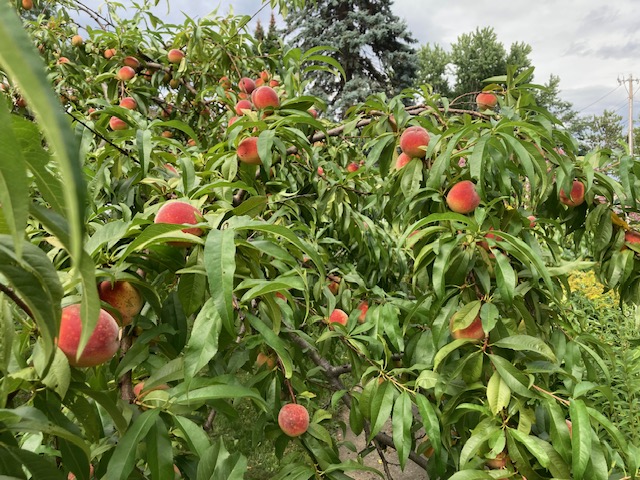
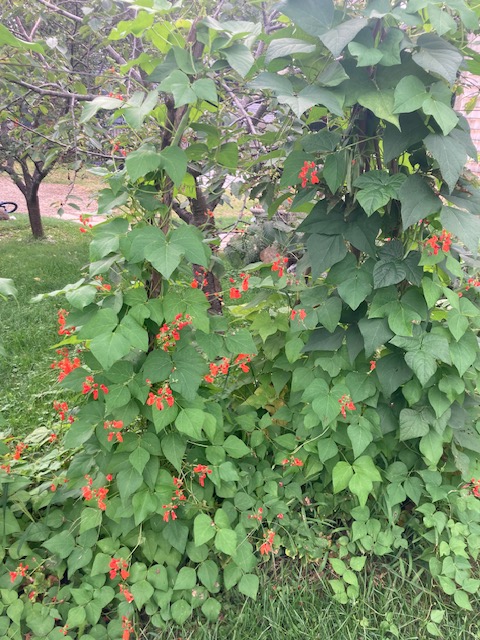
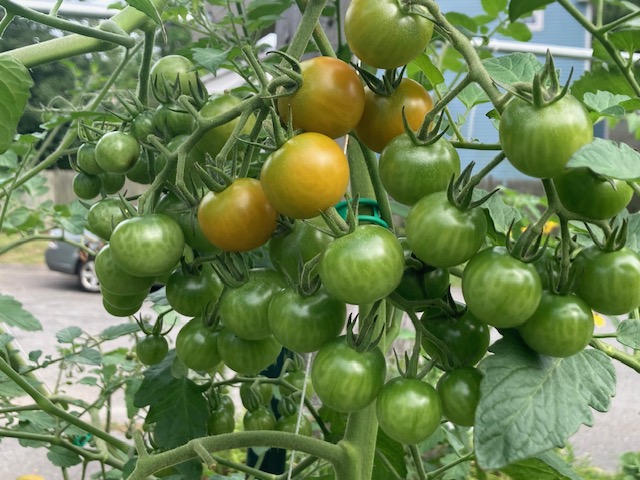
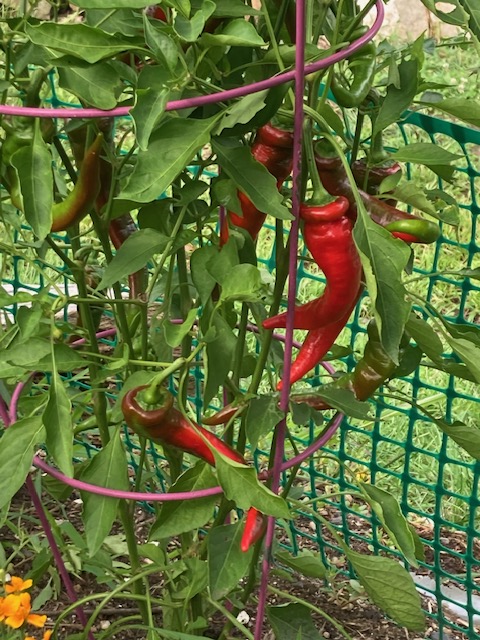
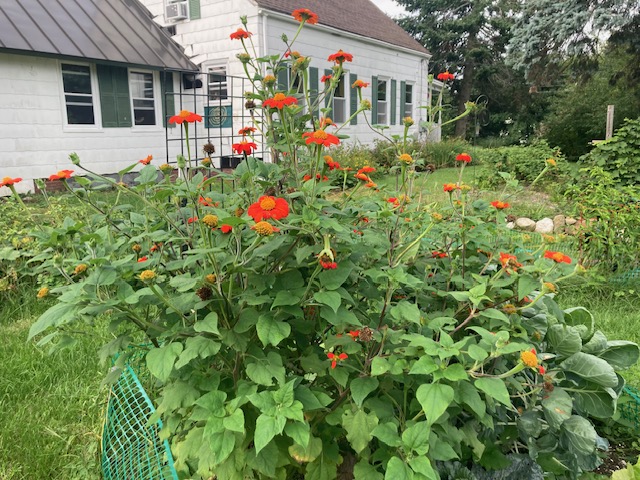
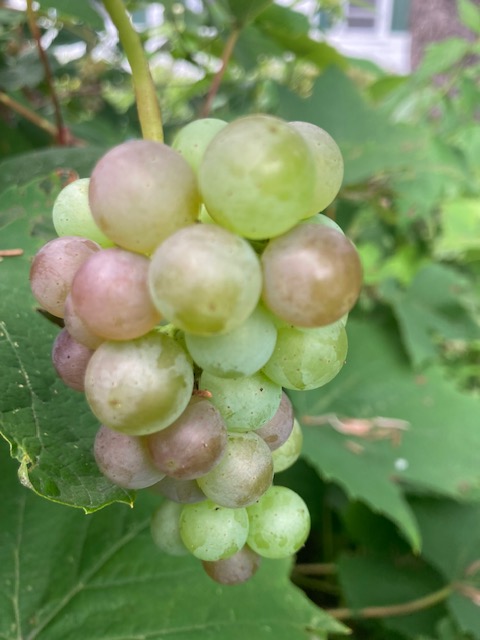
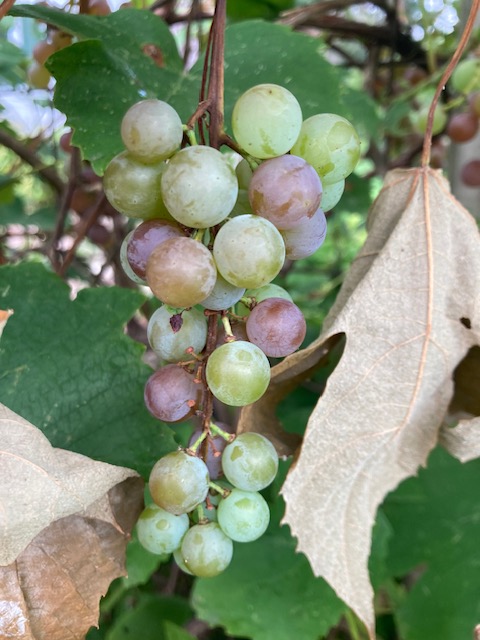
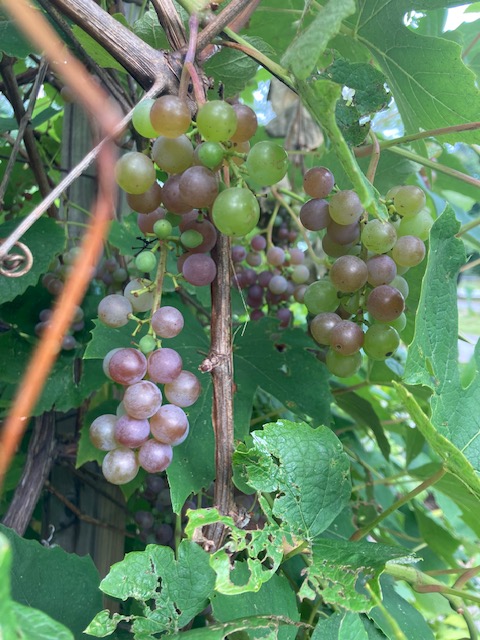
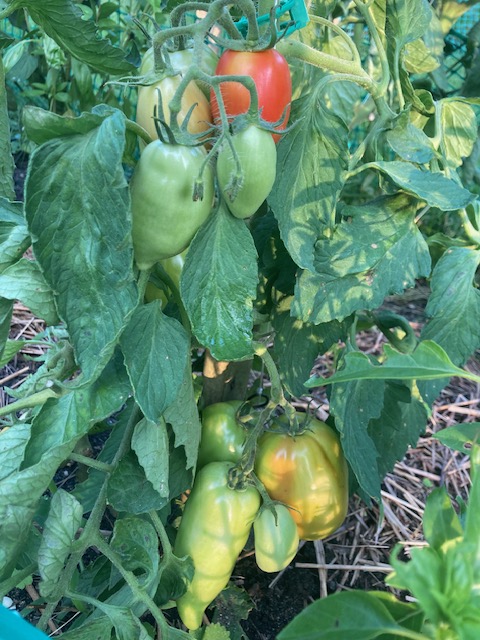
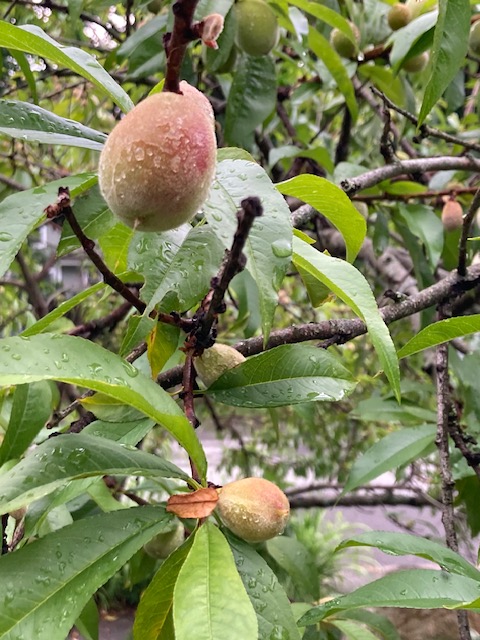
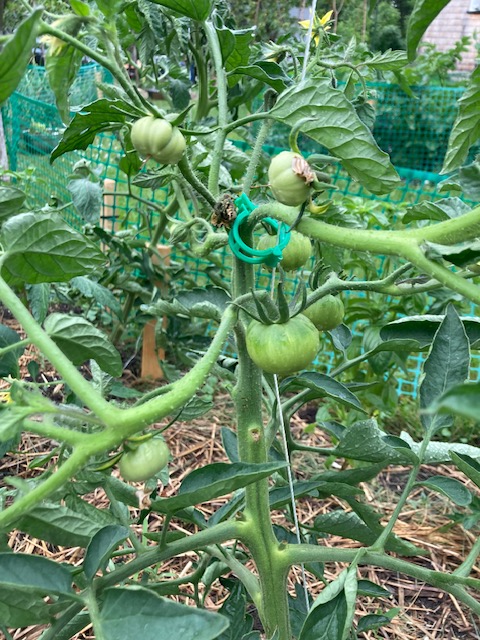
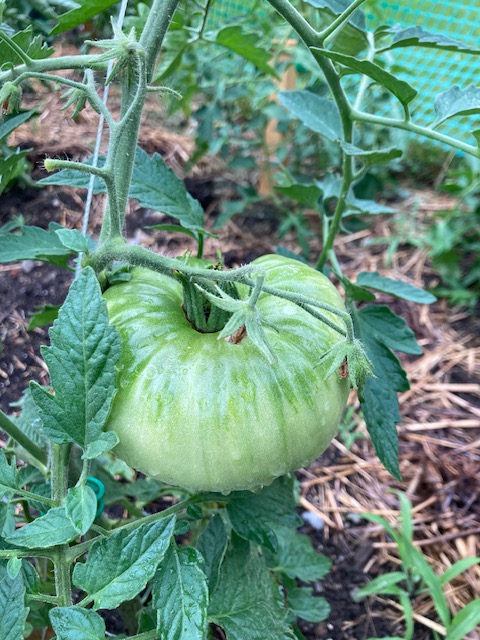
Here at an art farm Bacchus has arrived bearing wild seedless Champagne grapes. Jimmy Nardello Italian Frying Peppers are abundant. Tomatoes exceed our capacity to use. Pole beans flower, to attract hummingbirds. Butternut squash grow on the vine. Peaches are ripe for the picking. We bring bushels of produce to the Food Cupboard.


School of Sharks
Posted: August 16, 2024 Filed under: Child Centered Activities, Gallery - Visual, Portfolio - David's work | Tags: ceiling mural, one percent for art, sharks 1 Comment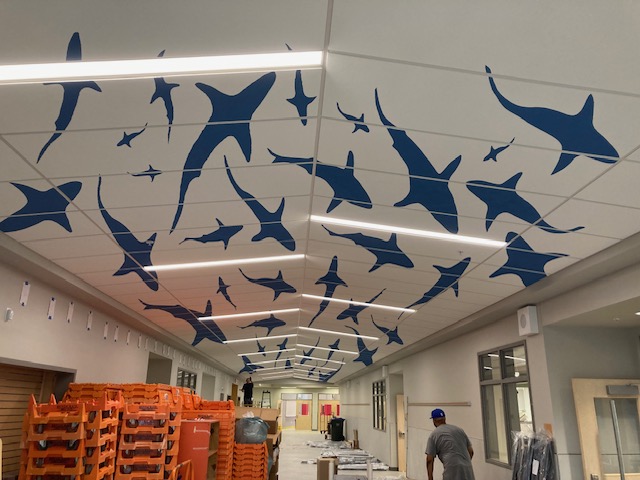
One year ago, summer of 2023, I worked on painting a ceiling mural at the new South Portland Middle School. Chris Miller, a polymath maker, very good friend and father of two young boys had received a commission and needed help. I gladly answered the call.
His design originally called for a pod of humpback whales in silhouette painted on the ceiling of the school’s central corridor. The Principal held a vote and the students selected “Sharks” as the new school’s mascot, and so a last minute change was called for. Chris complied and the whales became sharks, swimming overhead. http://npdworkshop.com/pod-cosmos
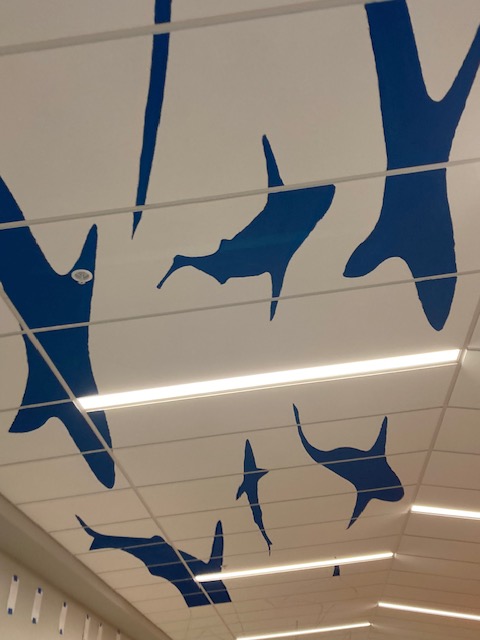
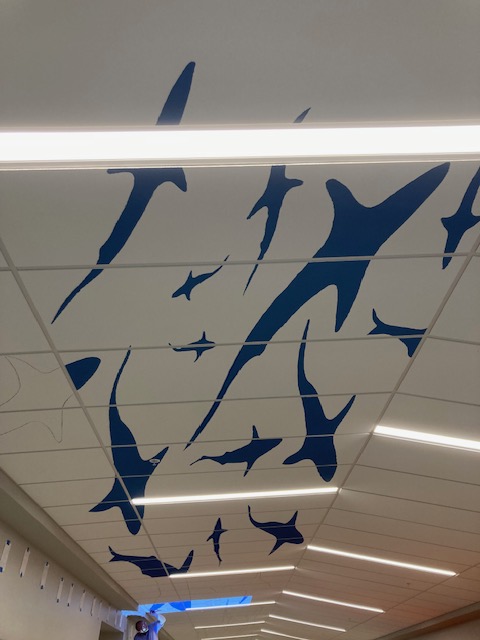
In designing the mural he envisioned the school of sharks swimming in outer space, then he mapped the sharks onto the central corridor ceiling, from the point of view of a fifth grade child, standing at the school’s entrance. His goal was to capture awe and wonder, with distortion a part of the design. The technique he used is called anamorphosis, which he described as follows:
“Anamorphosis is an optical illusion by which an image appears distorted but becomes clear when viewed from a key viewpoint, unique angle or through a particular lens. I want my kids and their classmates to learn to listen to people who have different perspectives and espouse different beliefs. I want them to be curious, open and inquiring- to strive for agreement and consensus through informed discussion.
“The mural’s key image will appear completely clear and undistorted from just one point of view. Someone just under five feet tall would see it, if they stood just inside the corridor with their back to the wall between the two lobby doors. From other viewpoints and as students travel down the length of the corridor, these silhouettes will appear increasingly stretched, and distorted to varying degrees of abstraction.
“The root of the word cosmopolitanism is Cosmos. It’s an ancient Greek concept of the universe as a well-ordered system. It presumes that all things can in theory, be made clear. I want my kids and their classmates to be relentless in search of both questions and answers. I also want them to cultivate a sense of wonder, though childhood, adolescence and into adulthood.”
These ideas carried the day, and Chris was awarded the commission. In Maine the “Percent for Art” law provides for art in public buildings, by setting aside one percent of the construction budget to purchase original works of art for new or renovated buildings receiving state funds. Some may say this is progressive waste, but I say it is arch-conservative, given that art predates agriculture and mark-making on cave ceilings shows that art is at the core of humankind’s quest for meaning. Maine has simply acknowledged same.
The Middle School budget was $69 Million, so art was heavy on the docket. The architects were so taken with his idea that they moved his mural onto the central corridor of the school, where every child every day will pass among the building entrance, the library, cafeteria and gym. Pride of place indeed.
Chris handled the design and layout. I handled the brush. It was a marvelous project with which to be involved. Best of all, how often in life do you get the chance to write to your Mother: “Michelangelo ain’t got nothing on me!! I am painting a ceiling mural in the new SoPo Middle School!!”




Saturday on the Street
Posted: August 9, 2024 Filed under: Art & Healing, Farming off the Farm, Permaculture & Home Renovation, What is an Art Farm | Tags: Norway maples, tree work 3 Comments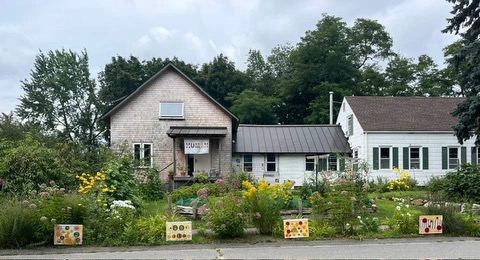
In 1830, in South Portland (known then as Cape Elizabeth) a New England farmhouse was built and its barn completed by 1848. The town’s population was 1,696 people and only six families lived on the street where the farm was located. The farm most certainly had significant acreage.
In 1999, South Portland’s population had grown to 23,324, and the last remaining farmland surrounding this farmhouse was sold off to make a development of six homes. In modern times developers put their road wherever best suits their plan but in 1830 the builders sited the home thoughtfully, based upon the sun’s path; they needed to maximize the solar gain as a heat source. The home’s location then determined where went the developer’s road and the old front yard was paved to put in a street named in honor of the developer’s daughter. The home, which we purchased in 2012, was left with a smaller, but still full sun front yard, enough space to garden and grow food and fruits.
We have felt guided here in creating a healing space. Neighbors have brought wounded birds into our garden, tucking them under the plants, as a place to heal. Young Mothers bring their infants to gaze and we gift them vine ripened tomatoes. We grow less as a matter of sustenance and more as a gift to be given, to be shared.

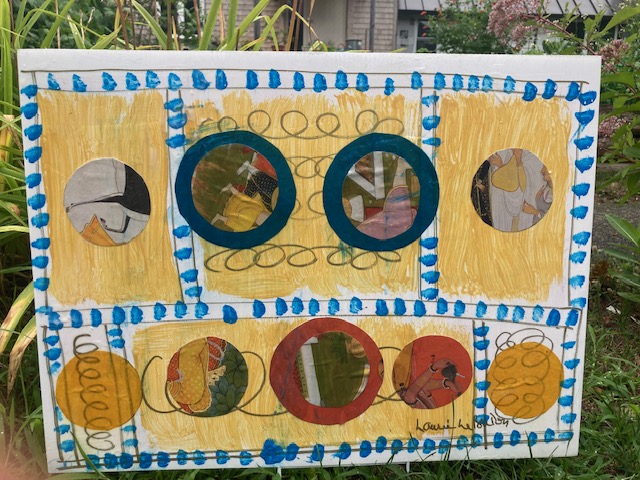
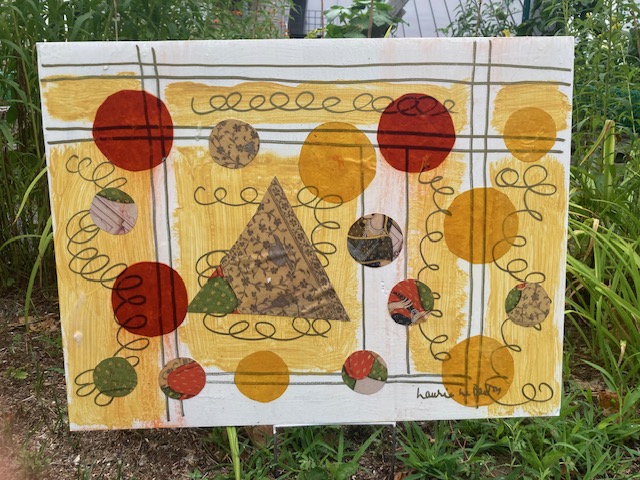
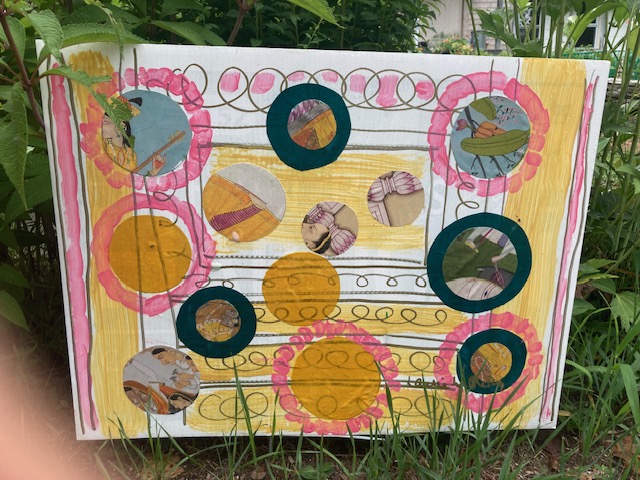
Saturday on our street was very active. Art work arrived from Chicago, from our dear friend Laurie LeBreton, a sculptor whose work combines handmade paper and mixed media. She explains, “I work to access something beyond our concrete world and to find meaning and comfort as I do so. Recent themes have included healing, refuge and ritual.” If yard placards tend to promote politics, Laurie’s speak to art and healing. We embraced Laurie’s generosity and eagerly put them on our side of the street. https://www.laurielebreton.net/

Also on Saturday, very large gooseneck trailers arrived to unload massive paving equipment, parked on the other side of the street. A dialectic began between the mechanized and the natural. If our “Orwellian” week was a “heavy equipment summer camp,” then this week has been about “massive paving equipment and road grinding at night.” My son was over-the-moon delighted. On Sunday night the City began grinding streets here, and the equipment has moved to several other jobs in town. Nightly we have driven to see them work.
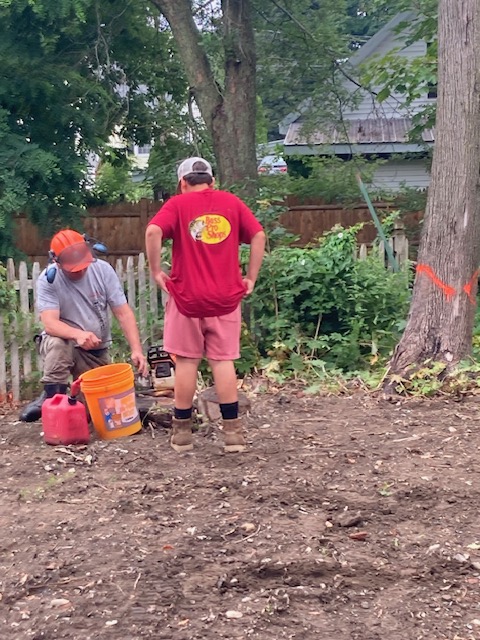
Also on Saturday our work on the invasive Norway Maples continued. Our friend Nate arrived, a journeyman carpenter, master of many trades, and he brought tools for tree work. Nate taught my son how to use a come along, how to sharpen a chain saw, and to use the Phythagorean Theorem to calculate where the tree would fall. My son put on his work boots and got busy.
Norway Maples are not native to America. They were brought here first in 1756, by a nurseryman in Philadelphia, and became popular as an ideal street tree. During the 1970s when the Dutch Elm Disease decimated the urban canopy, the Norway Maples became ever more prominent, but the trees promote a monoculture and grow rapidly, spreading seeds by the wind. They shade out competition. Because they grow fast, their wood grain is long, not tight, and they easily sheer and crack in heavy weather, which has become increasingly more prominent here in Southern Maine.

Two years ago, during a late autumn wind storm, a Norway Maple, with 8” trunk, split and fell onto our swimming pool. Thankfully we were able to repair the pool. Last winter, a much larger Maple, 18” diameter, splintered and fell into the neighbors yard. It leaned precipitously, and my intuition told me not to DIY but to get help.
Nate used the “come along” – a sort of ratchet winch – to direct the tree away from the neighbors yard and to his designated spot. My son worked the come along, tightening the line by cranking to pull the tree down, as Nate cut into the trunk.


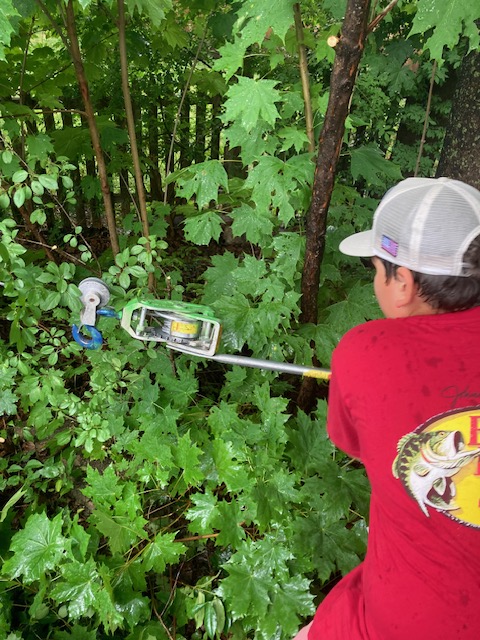
It took a village but the tree is felled, and we have firewood for our winter.

All Is Well Again
Posted: August 2, 2024 Filed under: Farming off the Farm, Permaculture & Home Renovation, What is an Art Farm | Tags: embedded energy, renovation 2 Comments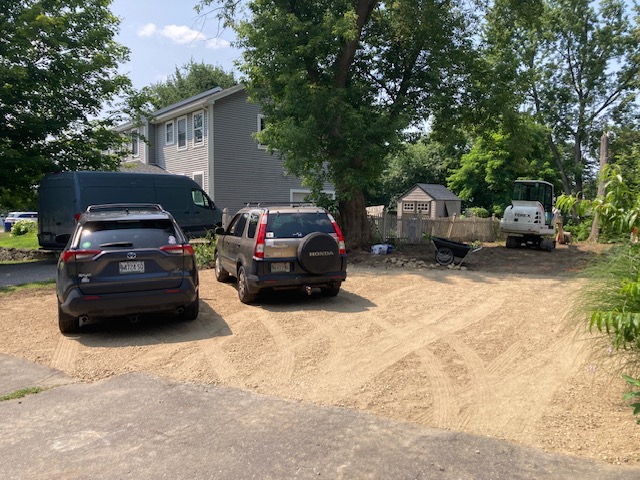
On 22 July I wrote about circumstances “Orwellian,” but on 2 August I can report that “all is well again.” We have cured the problem: gone is the gravel pile, our insurance will not be terminated, and we have made arrangements to switch to another carrier at end of this month.
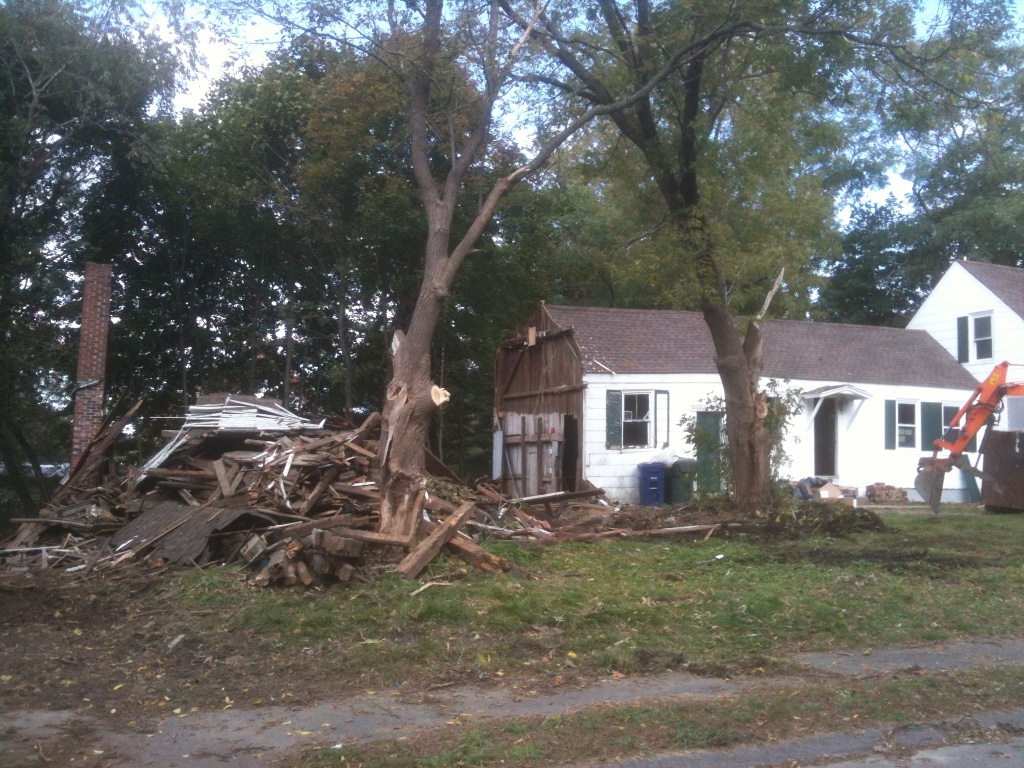
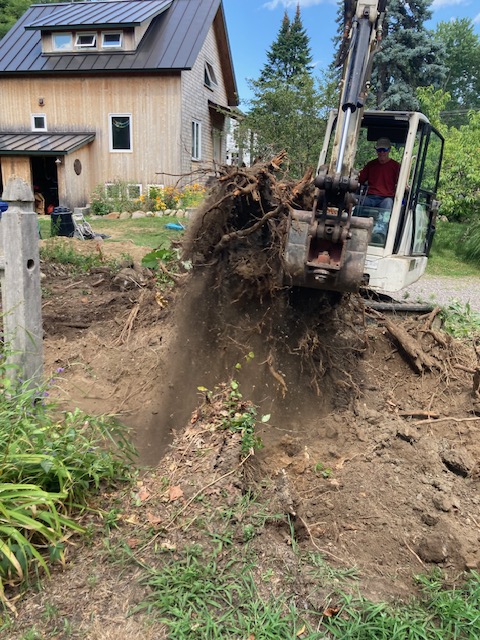
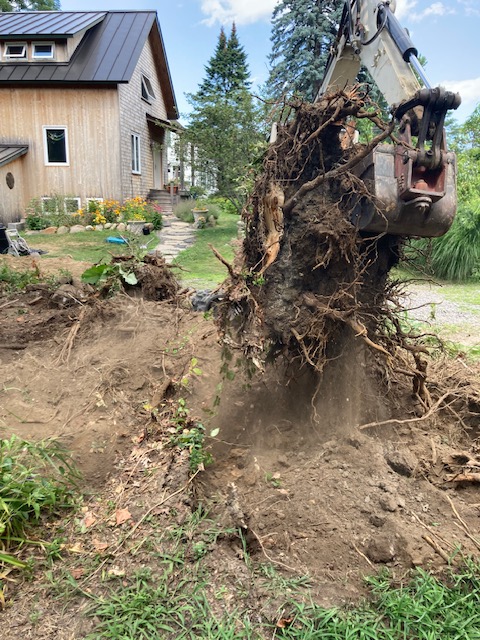
The project was twelve years in the making. When we bought the farm, Labor Day 2012, our son was in utero and my wife in her third-trimester. We had but little money, and less time to make any renovations. The barn was beyond repair – beyond our budget, more precisely – so we tore that down. I saved as many beams and sheathing boards as I could but the rest was hauled away. Nine yards of rubble, from two brick chimneys and concrete sidewalks remained, overgrown by invasive plants. Last week, having moved the gravel and made the driveway larger, we continued north to grub out more than 50 stumps – along 50 linear feet of fence line – of the rapidly growing, invasive Norway Maple.
Our farmhouse, in the classic New England style of “big house, little house, back house, barn,” is 200 years old, built when Andrew Jackson was the 7th President of the United States. The barn was completed in 1840, which I know for a fact, having saved one beam with that date proudly carved by the makers into the wood. All materials used in this house were sourced locally, within a mile or two, trees felled, then moved and milled by hand.
Some of the barn sheathing boards are 26” wide, and given the growth rate of pine trees, we can deduce that the tree from which that wood came sprouted circa 1681, which is five years before the English King James established the “Dominion of New England” which covered all of New England and the Mid-Atlantic colonies. The Charter of Pennsylvania, sovereign and independent from the Dominion, was signed by King Charles in 1681 granting the Quakers land for religious freedom.
Restoring this home is a yeoman’s task. We bought the home at a foreclosure price, plus 20-years of hard labor. We are only halfway toward our goal. In doing this work we are not making this home great again; “never better” is my goal. The home never had insulation and was cold and drafty. We have super-insulated more than half, but work remains. I will need to rebuild the foundation of the Ell, while we live in the house. The invasive Maples are an ongoing nuisance.
The charm of the hand built home seems to be its simplicity, its economy of purpose. I have neither the income nor interest in anything opulent. I seek not a monument to myself. For the driveway project I chose gravel, which is underwhelming to many, but to my mind the better choice because it is both less expensive and fully functional. I have learned that I am happier living on a dirt road, and on my half-acre I have chosen same.
More importantly, in terms of environmental impact, gravel has a minimal carbon footprint compared to the very high embedded energy – the petroleum consumed both in manufacturing and applying – of asphalt pavement. Hard though it may be for my children to grasp this point, it is my responsibility to model sustainability, to the extent possible.
My curse is the adage “a carpenter’s home is never finished.” And so life goes, but in the meantime all is well again, never better.
* * * * * * * * *
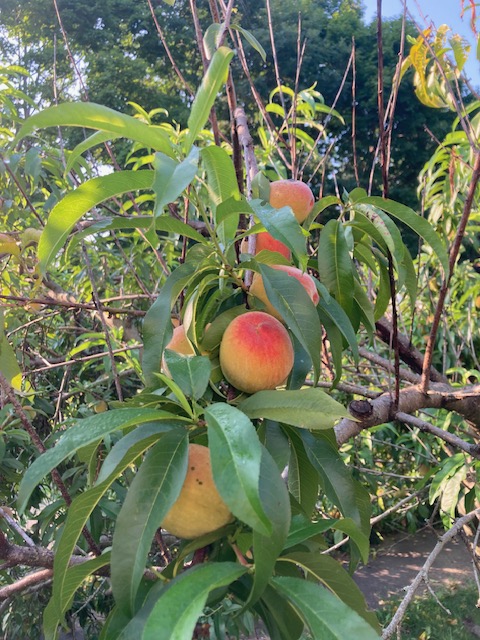
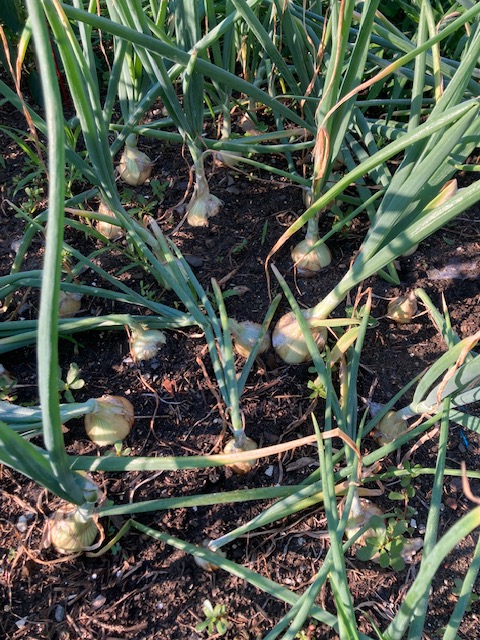
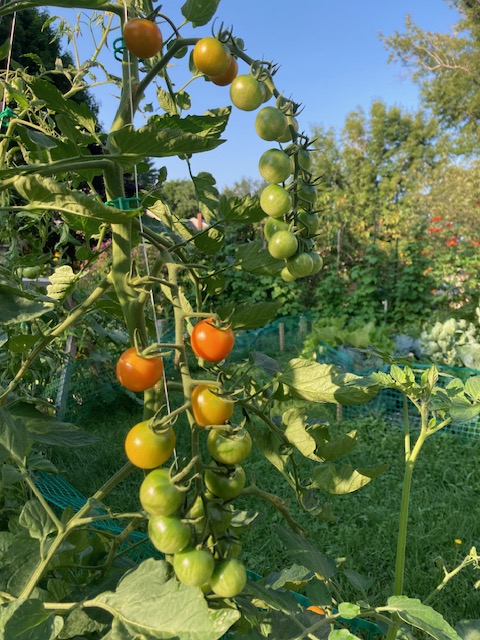
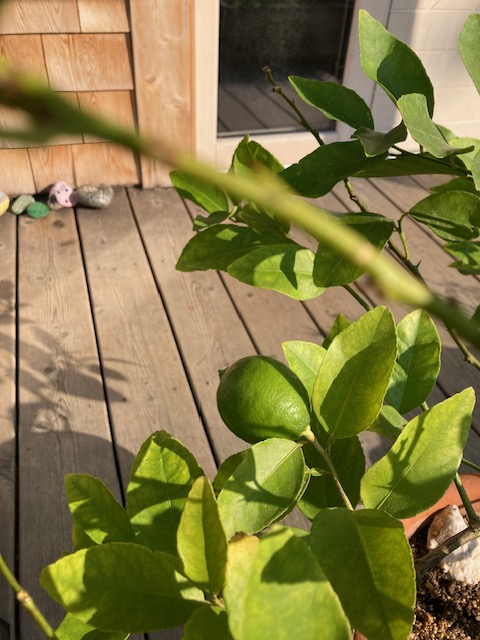
The abundance of August has arrived. Onions and potatoes need be harvested, Italian Frying peppers await us, we pickle cucumbers then give armfuls away, fruits – tomatoes, grapes, peaches – tower overhead, our lime tree provides the citrus for a Gin & Tonic.



Greater Things
Posted: July 26, 2024 Filed under: Art & Healing, consciousness | Tags: consciousness, rational mind, spirituality 2 CommentsAs a child, raised Roman Catholic, I went to church every Sunday, and to confession on the Holy Week high holidays, plus a few times each year. My sins at most then were venial, not mortal, certainly never cardinal, and, as I stammered for words to describe my offense, at my earthly Father’s instruction, I would take to my knee and ask forgiveness for my sins.
As a University student, I read the New Testament in Koine Greek. My interest in the bible is as literature, not as dogma; I do not read the Bible, but it is important to know, if only as the lingua franca among the 2.4 billion Christians of this world.
My Mother quoted Matthew 22:37-38 as the pillar of the faith, which she paraphrased as “Love and you have fulfilled the law.” A fine path, indeed, and I am thankful for that guidance. To my mind, and in my experience, however, John 14:12 speaks to the core:
“Verily, verily, I say unto you, He that believeth on me, the works that I do shall he do also; and greater works than these shall he do; because I go unto my Father.”
Greater works than these?
As a Federalist approaches the law, let us read this sentence literally, as the Founding Father (sic) meant by his own words. Given that the Gospel of John opens “In the beginning was the word…” we do well to begin with the grammar.
Yeshua, the street preacher, spoke either koine (marketplace Greek) or Aramaic; his name is a late form of the Biblical Hebrew “Joshua,” which is spelled Iesous in Greek and Jesus in Latin. The gospels were written in the Koine because that was more popular than Aramaic, thus reaching a wider audience and so approximately 100-years after his death Matthew, Mark, Luke and John wrote Yeshua’s story in Greek, later translated into Latin, known as The Vulgate; in 1522 William Tyndale translated the work into English (for which in 1536 he was strangled and then burned at the stake) but his work informed the translators of the King James Bible, a masterpiece of writing, published in 1611. It is this version from which I here quote.
The street preacher begins with the hortative clause “Verily, verily, I say unto you,” a teacher’s exclamation, for emphasis, to his listeners.
The subject is “he,” the object is “the works,” and “do” is the verb, in the subjunctive mood. Rarely used in contemporary English, the subjunctive is critical here; the indicative mood states facts, certainty, while the subjunctive mood – “shall do” – expresses potential. In other words, the avatar has opened the prospect of free will, the freedom to choose, challenging the listener to what we could do, rather than what we will do.
The sentence has three subordinate clauses, the first of which – “that believeth on me” – expands the subject phrase. “That I do” refines the direct object, while the third – “because I go” – is causative. Grammatical subordination is not necessarily logical subordination; were his going to the Father the sole cause of our salvation, then our acts would be secondary, almost like a “get out of jail free” card. Faith must be active, not passive, and emphasis here is upon doing; the fact of the matter remains the cause is subordinate to the acts, the doings, to the potential of the believer.
“Greater works than these” is an independent clause expanding that which is done – the miracles, from the Latin word miraculum, meaning “object of wonder” – which every parochial school child knows to include (but are not limited to) walking on water, feeding the 5,000, raising Lazarus from the dead.
The sentence is complex, written in hyperbaton, a rhetorical figure that inverts the normal order of words for added emphasis. But if we focus upon the subject, verb and object – like bowling pins lined up for a strike – it makes plain “He that believeth…shall do…the works, and greater works than these.”
Judge next, as an activist might rule from the bench, interpreting the text in a contemporary context. Carl Jung pertains here, and the subordinate clause of causation “because I go unto my Father” must then refer not to an anthropomorphic God, but to the wise old man, the archetypal male of the collective unconscious, a universal archetype of wisdom and insight. Jung believed every male psyche has a female aspect (anima) and every female psyche a male aspect (animus); so then “go unto my Father” is a personification of the wise masculine spirit within the balanced whole of higher consciousness, which is, to my mind, the “Christ” consciousness, the “anointed” one.
As children we learned English grammar. As adults can we learn to expand our consciousness? Who among us shall be so meek as to act upon, rather than merely to believe in, the miracles?
To speak of walking on water, of healing the sick, or raising the dead is to confront the laws of classical physics, to confound the rational mind, to go beyond the prosaic, to enter the realm of poetry.
Hard pressed to imagine such a state of enlightened being, we do well to ponder the words of the God-intoxicated Persian, the poet Hafiz, who wrote, circa 1350, “I Have Learned So Much”:
I
Have
Learned
So much from God
That I can no longer
Call Myself
A Christian, a Hindu, a Muslim,
A Buddhist, a Jew.
The Truth has shared so much of Itself
With me
That I can no longer call myself
A man, a woman, an angel
Or even pure
Soul.
Love has
Befriended Hafiz so completely
It has turned to ash
And freed
Me
Of every concept and image
My mind has ever known.
[NOTE: My grammatical exegesis here has been refined with the help of my dear friend, Bob Ultimo. A classmate in Latin, we read together in the dark dinghy basement of Kresge Hall, Northwestern University 1983-85. He stayed the course, gained a Masters in Latin, taught for many years the Trivium (grammar, dialectic, rhetoric), currently teaches and writes on grammar and writing. A man in his prime, Magister Ultimo is a master of his craft. Given there is “a mysterious link between grammar and the mind” his clarity of verbal construction, keenness of thought, and deft wording are well worth following at writingsmartly.com. Thank you, Bob. Thank you, very much.]
* * * * * * * *
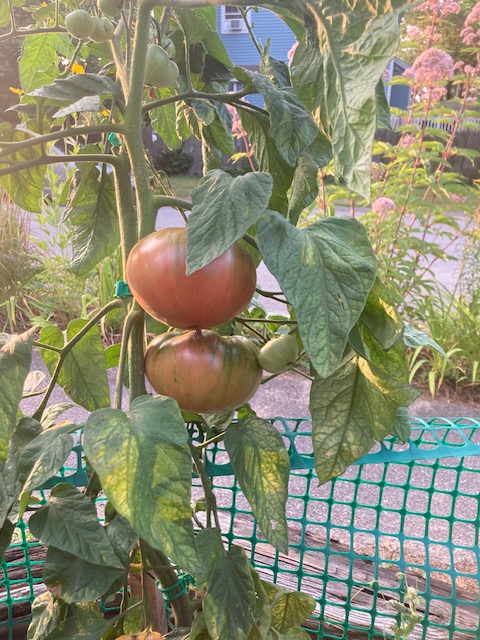
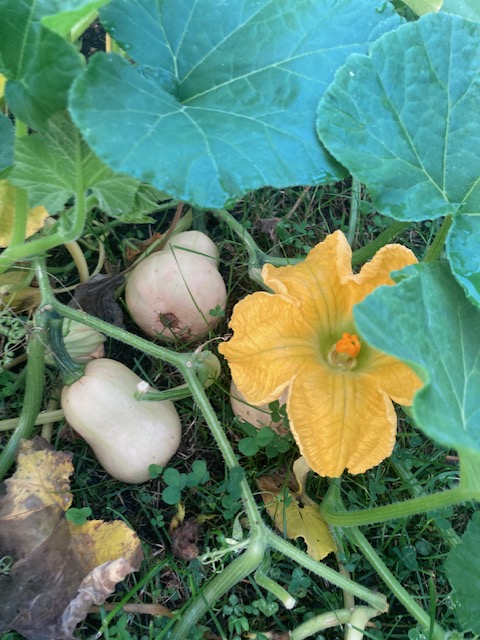
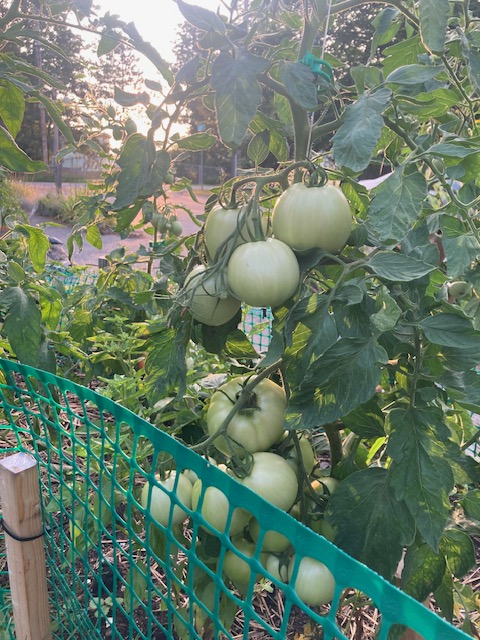
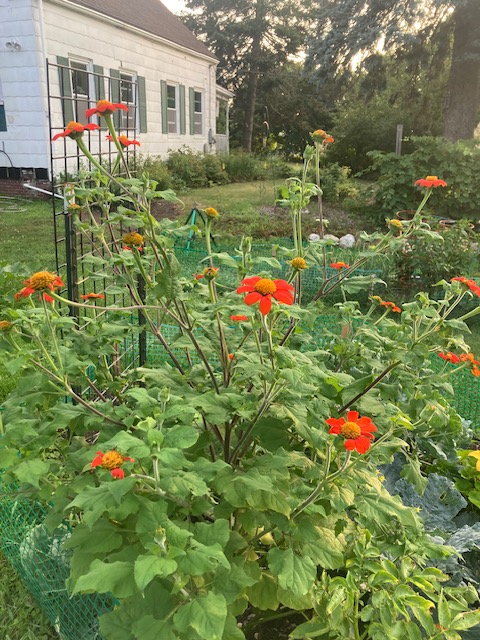
In late July, the fruits ripen and the harvest has begun.





Orwellian
Posted: July 19, 2024 Filed under: Chronicles of a First Time Parent, Farming off the Farm, Permaculture & Home Renovation, What is an Art Farm | Tags: george orwell, homeowners insurance 2 Comments
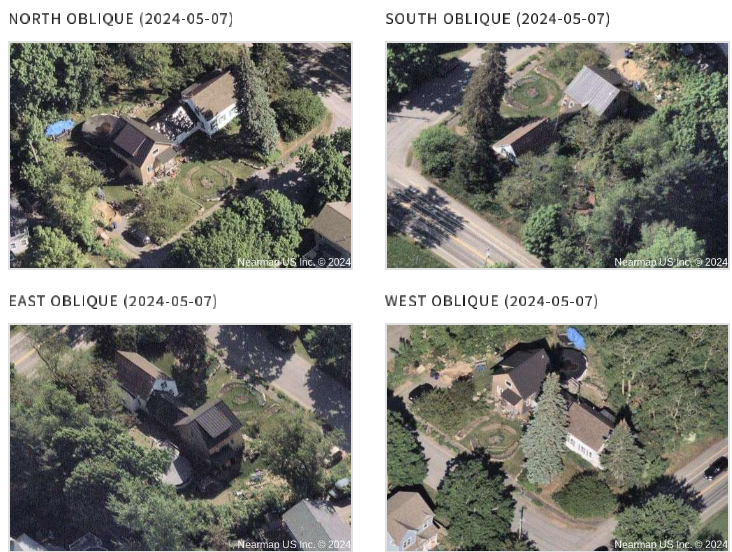
In May a satellite flew over our house and took photos. On 11 June we received a notice – with photos above and below – that our homeowners insurance would be cancelled, due to a “safety hazard on your property…[which] increases the chance for injury or damage to your property.” I contacted our broker and inquired whether some “Desk Sergeant” had scanned the photos and made such a call?

The Broker wrote back, “As for a live officer in the back, I would assume it’s more akin to a machine learning/AI algorithm scanning pictures and flagging unusual things, although that is pure speculation on my part. To the best of my knowledge, the only issue is the gravel at the end of the driveway, confirmed. I had to speak with an underwriter at Nationwide yesterday to even ascertain what the problem was.”
We were told we had until 30 August to cure the problem, but in late June we received notice, and were given 22 July as a cease and desist date.
We recently visited family in Western Massachusetts, and standing upon their driveway, we talked about the asphalt. One section is newer, another older, with swales and cracks. “My Homeowner’s Policy has been cancelled” she said, “because of . . . picky stuff like these cracks. The company cited a number of issues, but all of them were picky…” An agent had walked the property looking for issues, which found, then moved her into the high-risk pool, at a substantial cost increase.
In the 10-year period from 2014 to 2023 extreme weather has caused disaster events at a cost of $183 Billion Dollars. The underwriters’ rational self-interest – unlike a good neighbor – argues they cut losses by moving homeowners out of their coverage into the high-risk pool. Gravel at the end of our driveway put us in that category. Caveat emptor.
Thankfully I work in the trades, and our friend Jim has spent decades doing site work, building roads deep in the Maine Woods for loggers. In fact, Jim is both the solution and cause of our problem, having dumped – at my request – the gravel here in our yard, left overs from a tiny house job we did together. We need to expand our driveway, and free material helps.
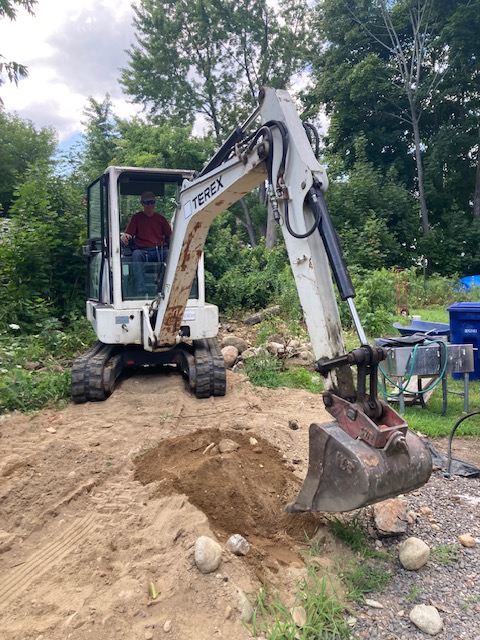
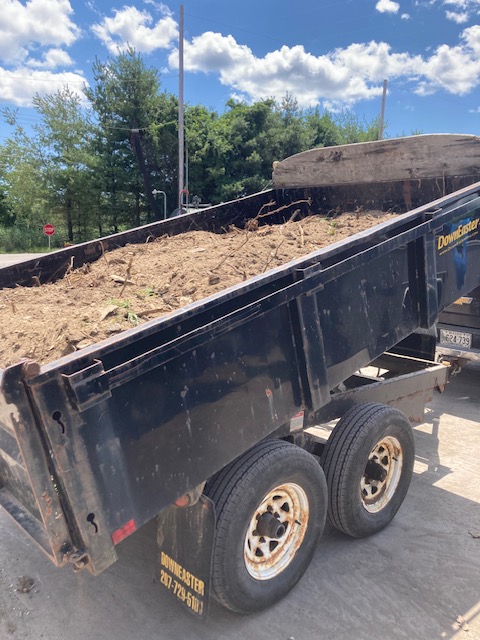
Time now is of the essence, and given the heavy equipment this is a mere trifle. Jim has arrived and we have removed 9 cubic yards of rubble, 3 cubic yards of tree stumps. We will remove approximately 15 tons of soil, and then move the gravel into that space.
Our soil is infested with knotweed, the highly invasive plant, and very few dumps will take soil with knotweed. I found one yard which will incinerate it, at a very high cost of $145 per ton. I will not be sneaky and lie. So we hauled 4 tons off, and will spread the rest in our side yard, then plant grass seed. A compromise lower cost solution.
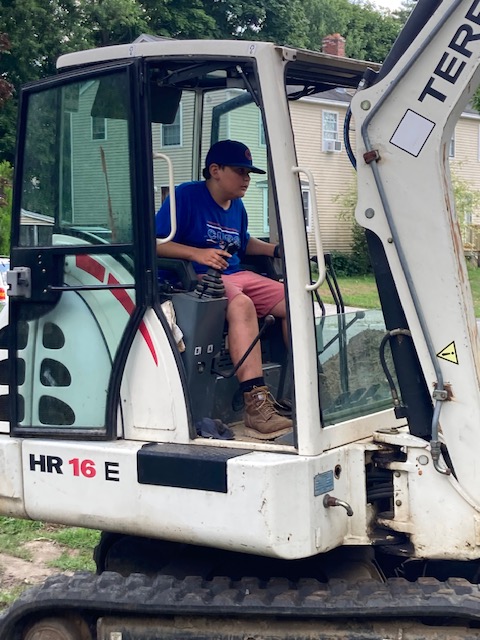
We will meet the deadline. We will then give notice we are changing carriers, having improved our coverage at no additional cost. A larger parking area makes sense as my daughter will soon get her driver’s license. My son this week had a summer camp of site work with heavy equipment. So life goes restoring a 200-year old New England farmhouse





Abundance and Need
Posted: July 12, 2024 Filed under: Chronicles of a First Time Parent 4 Comments“Is that your Grandson?” he asked. “No,” I replied, proudly, “my Son. I have followed my own path in this life.” “Are you retired?” he continued. “No. My full time job is parenting. I do carpentry to pay the bills.”
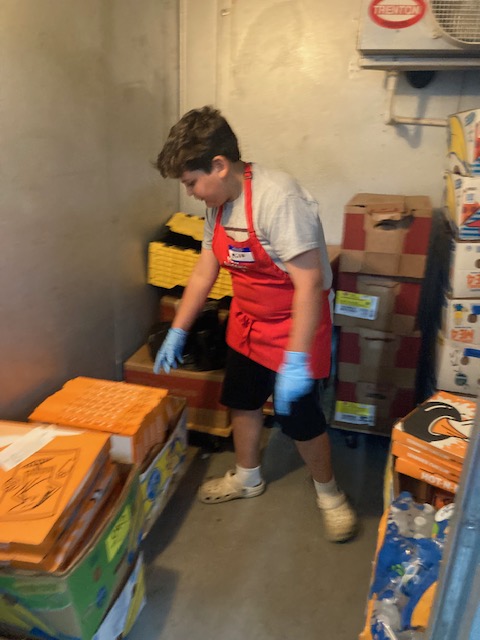
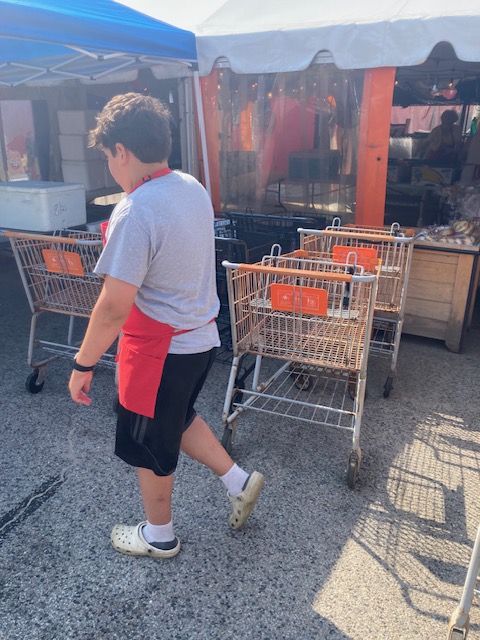
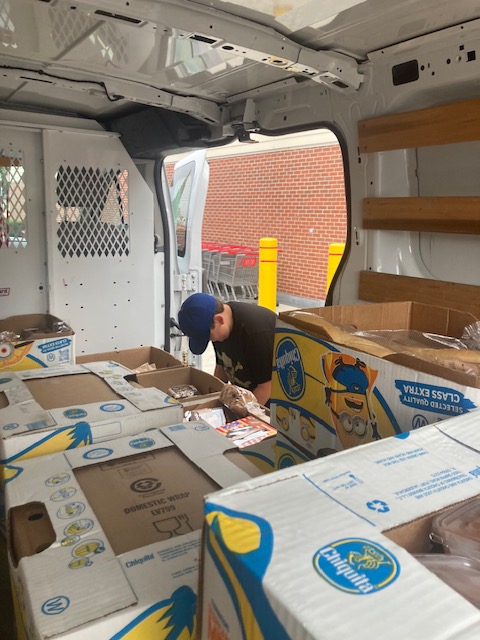
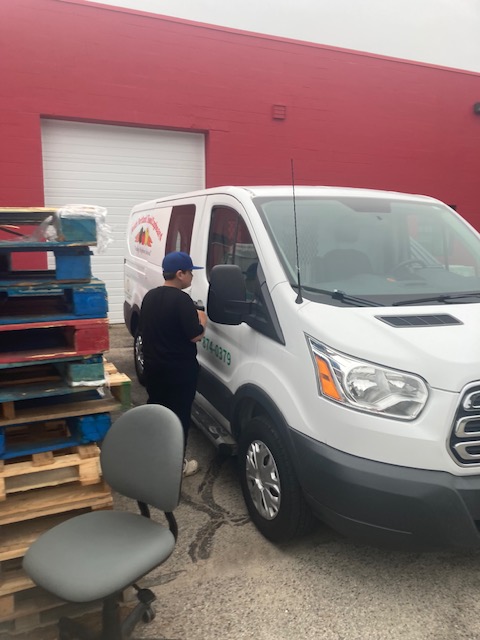
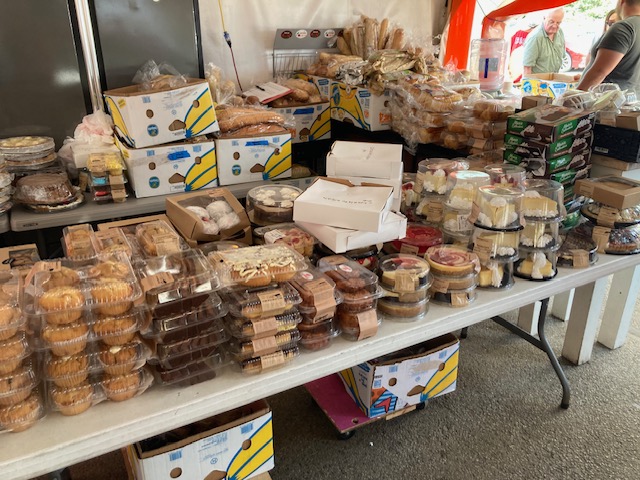
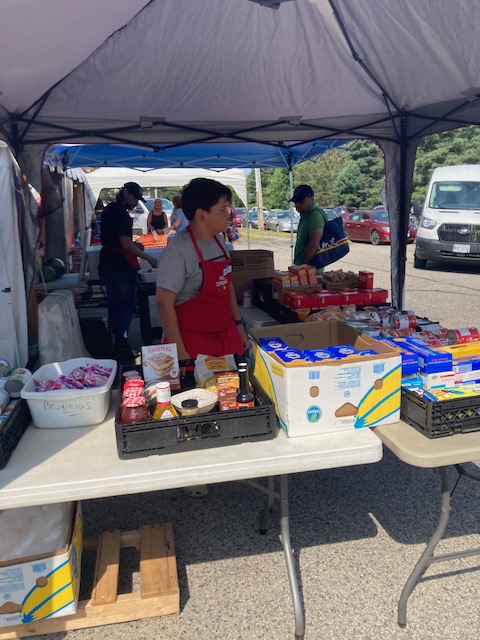
My son and I volunteered this week at the South Portland Food Cupboard. We pulled two shifts: one in “Food Distribution” (handing out food) and one in “Food Rescue” (driving the van to pick up out-of-date items). The Food Cupboard operates seven days per week, serving 800 families per week, which equals about 3,200 or 4,000 people, every week.
In the world’s richest country, the most consumptive society ever on the planet, food insecurity is a very real problem. According to the USDA, 12.8 percent of U.S. households – one in eight households – are food insecure at least some time during the year. That means: 44 million people, 13 million children, 100% of counties in America experience food insecurity.
Peter, the Warehouse Manager, told me, “There is no shortage of food. It is a problem of logistics.” Such, then, is the mission of the Food Cupboard, with its two vans, to scour our County to gather, sort, then distribute the food. The abundance is mind boggling. The need is humbling.
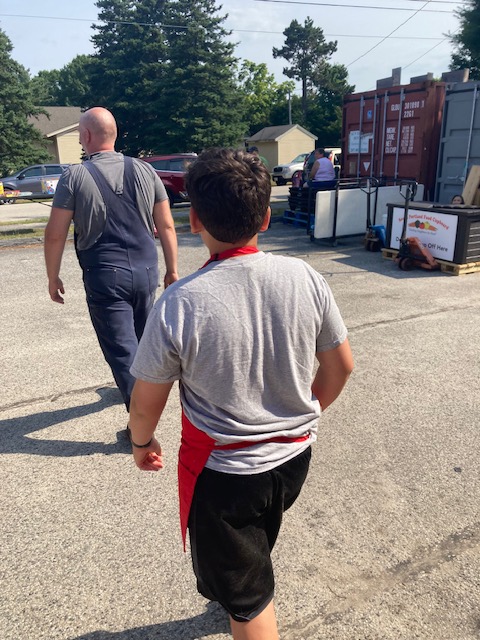
In another time and place, say, along the Sea of Galilee, this was the loaves and fishes, 5,000 fed – lepers, prostitutes, the unwashed – the “deplorables” some would say, but on that day they were healed and then fed.
Here in South Portland, on the second Tuesday of July, many supplicants were old and infirm but others were young and hip, fashionably dressed, manicured nails, dyed hair. The only question asked is “What do you want?” Proof of income is not required.
My son has an aptitude and logic for logistics and he found the work – the sorting and packing, the order of sequence – compelling. The apple does not fall far from the tree. During the 1990s, while I lived at home with my Mother, we volunteered weekly with other women of her parish. We would drive north, then cook and prepare food to serve the many food insecure in Waukegan, Illinois. My son and I here can ride our bike to the South Portland Food Cupboard.
Adamantly opposed to any summer camp, he found the volunteer work engrossing, and we will continue to sign up and volunteer. Among a sea of retirees, at age 11 he substantially lowered the median age of the volunteers. My work-for-hire may take a back seat to my role now riding shotgun, as he learns the path of compassion, with food as the means to the end of helping his brethren.
Wonders never cease.



0, 1, 1, 2, 3, 5, 8…
Posted: July 4, 2024 Filed under: Farming off the Farm, Gallery - Visual, Little Green Thumbs, Permaculture & Home Renovation | Tags: fibonacci sequence, golden ratio, phi 2 Comments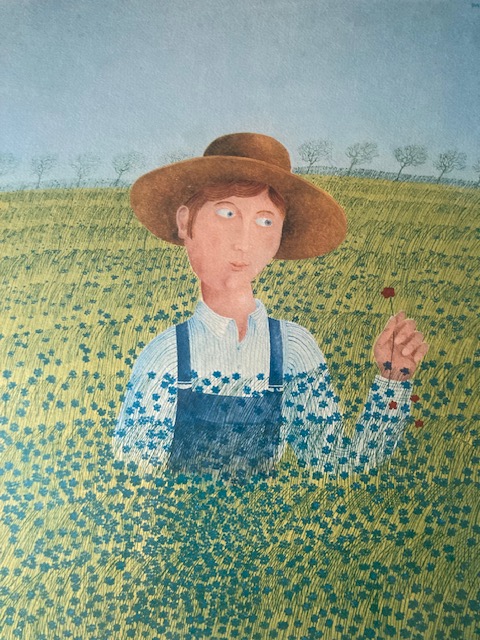
Donald J. Glaser was a rare bird, a beautiful soul, who loved beauty, and traveled the world in its search. My uncle, he was born in August 1924, studied at the Parsons School of Design in NYC, then entered the seminary but dropped out, remained a “permanent bachelor” and in 1951 found his calling as a buyer of art and antiques. In the golden age, when department stores were locally owned paragons of regional taste, at Stewart Dry Goods, in Louisville, Kentucky, he ran the home furnishings boutique.
For more than 45 years he circumnavigated the globe, annually, from East to West buying the best: silks in Hong Kong, brass in Bombay, furniture in Italy, paintings in England. “Good things last” was his motto. In 1972 Associated Dry Goods bought the regional company, and Don became the buyer, and had furniture made, for an entire national chain.
He was my Godfather, and sometime in the 1970s while traveling in the South of France, Don saw in a gallery a portrait that reminded him of me. It arrived at our house, an unannounced surprise from afar.
A truer portrait never was made. How many times I have pondered its meanings. It hangs now in the stairs to my son’s room. The young boy gazes into a flower, and what does he see in his hand, but the universe in stunning mathematical order. I speak, of course, of the Fibonacci sequence.

The Fibonacci numbers were first described in Asian Indian mathematics circa 200 BC by Pingala on possible patterns of Sanskrit poetry formed from syllables of two lengths. The Italian mathematician Leonardo of Pisa, also known as Fibonacci, introduced the sequence to Western European mathematics in 1202. Because the West has been dominant, his name has reigned supreme.
The Fibonacci sequence is a pattern wherein each number is equal to the sum of the preceding two numbers. The sequence begins 0, 1, 1, 2, 3, 5, 8, 13, 21, 34, 55, 89, 144, 233 … and goes on to infinity.
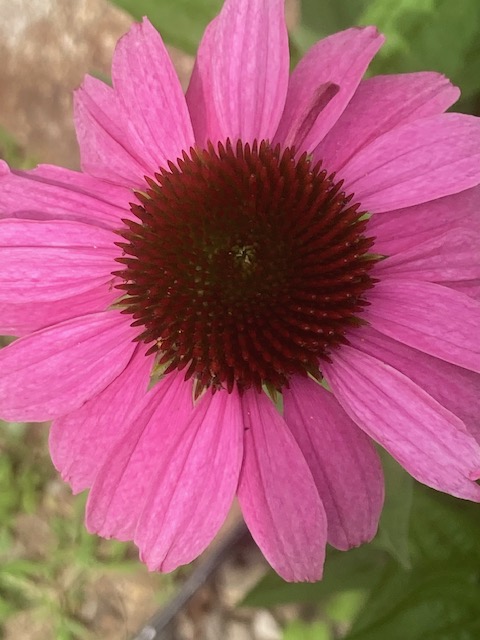
The Fibonacci sequence is manifest throughout nature, prominently in the spirals of Sunflower seed heads, that radiate from the center. The numbers of these spirals, when counted in opposite directions, are often consecutive Fibonacci numbers. The sequence also appears in the branching of trees, the arrangement of leaves on a stem, fruit sprouts of a pineapple, an artichoke, in pine cone bracts; a tiling of Fibonacci squares forms the nautilus shell, which appears also in the spiral of a hurricane and galaxies across the cosmos. The sequence does not appear everywhere but its presence is abundant.

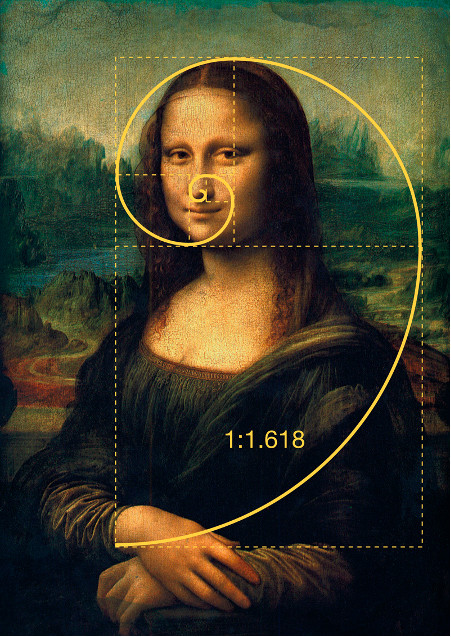
Fibonacci is related, mathematically, to the golden ratio – 1.618 – which is ubiquitous, though hidden in plain sight; credit cards and every drivers license replicate this rectangular form, based on reciprocal numbers of height to width.
The Golden Ratio, also known as Phi, is found throughout art and architecture. Many find the ratio in the Great Pyramid of Giza, and the Greek Parthenon in Athens (although a mathematician at the University of Maine has challenged that). In Renaissance art it was present among many of the master works, notably in Leonardo de Vinci’s Mona Lisa. In the modern era, the golden ratio has informed the art of Seurat, Picasso, Gris, Duchamp, Debussey, Le Corbusier, and Mondrian, to name but a few.
When gathering flowers for a bouquet, pause to ponder the breadth of universal beauty, ever present, bundled within your arms.

Here at an art farm, our gardens are lush and due to the heat, fruits ripen almost two weeks ahead of schedule.
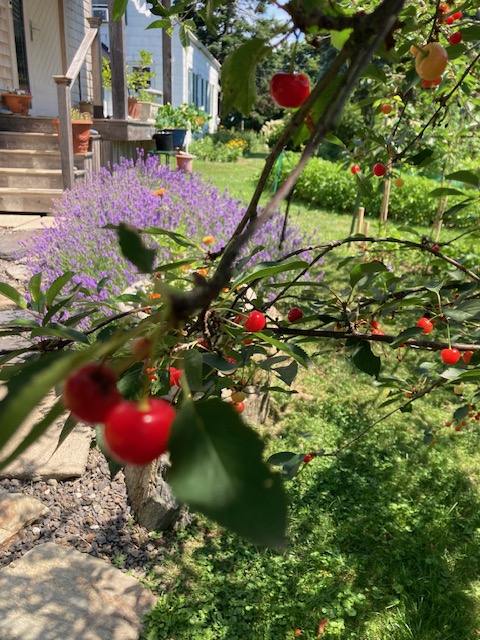
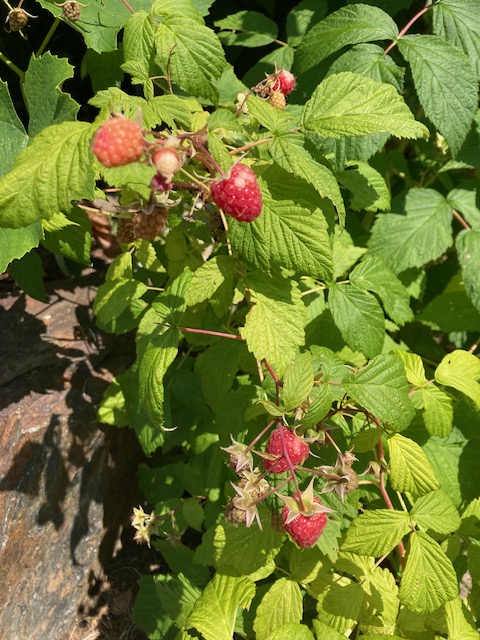
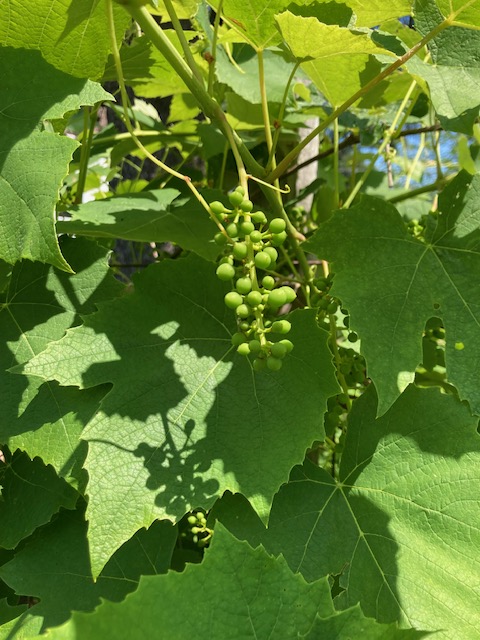
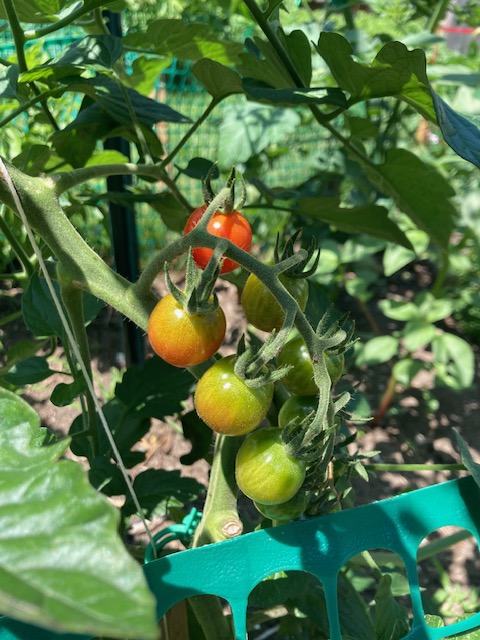
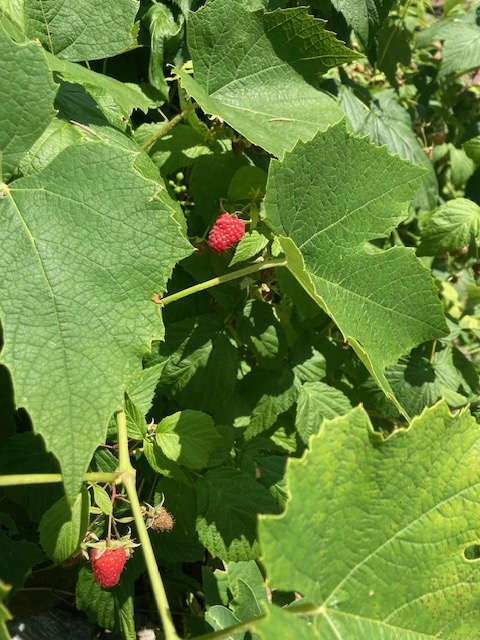
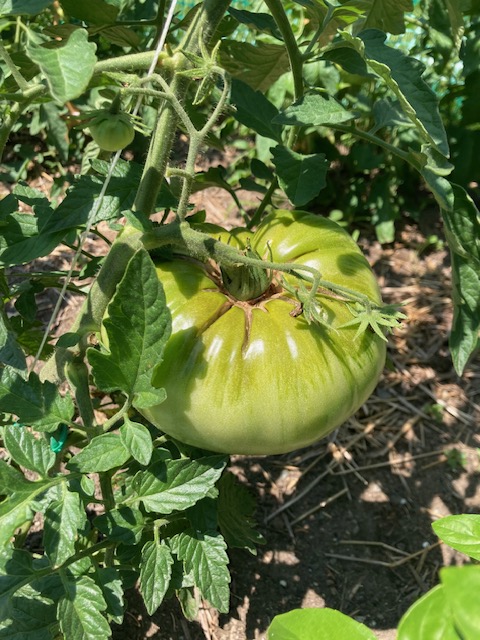
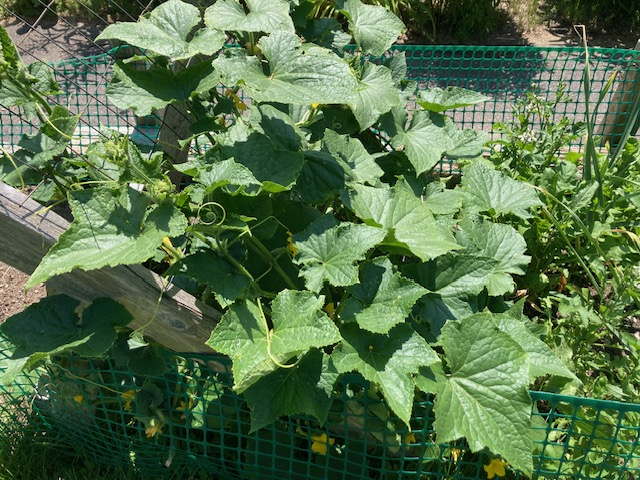
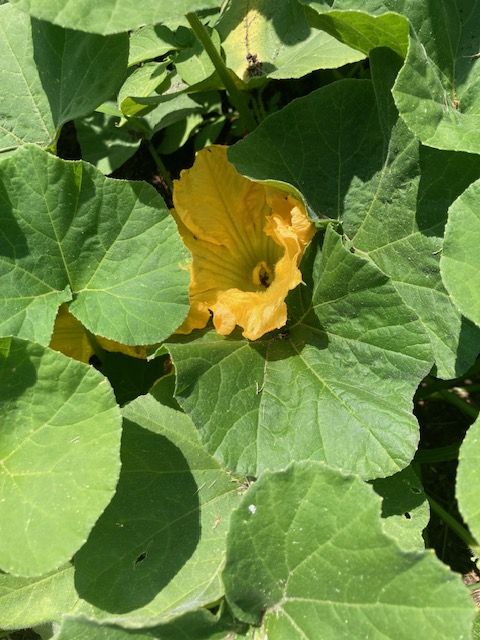
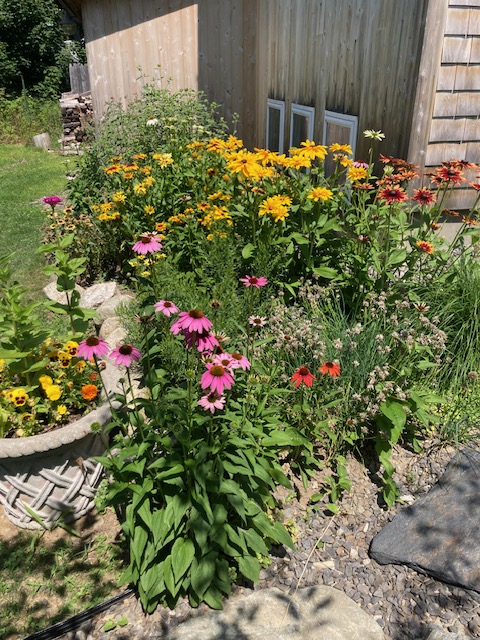
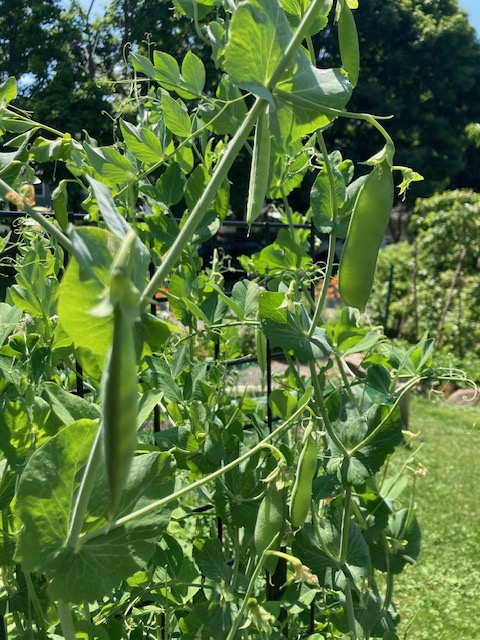
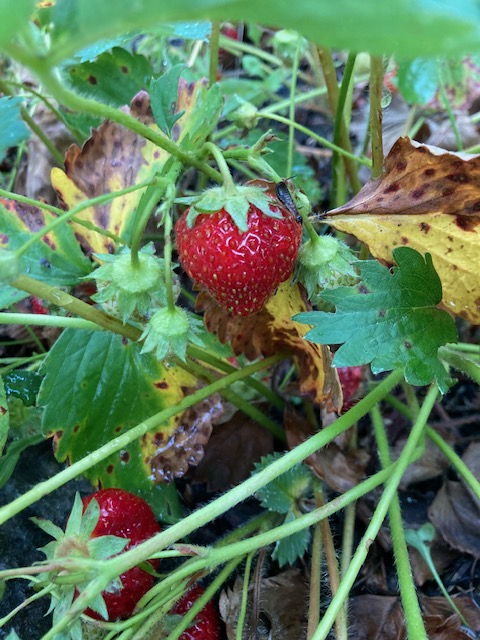
Growing up, the Midwestern mantra was corn “knee high by the 4th of July.” In Zone 5 coastal Maine, the snap peas tower at 5′ tall, tomatoes ripen, cucumbers flower while the grapes fatten; raspberries and cherries – radiant red – hang for the picking, while the coneflower and echinacea proudly display their Fibonacci ways.




NOTE: Credit here need be shared with Richard M. Neumann, a mensch and lover of mathematics, who shared valuable insights to Fibonacci and phi, including gifting me the book “The Golden Ratio: the story of phi, the world’s most astonishing number” written by Mario Livio, (c)2002.
The Underworld and its Archetypes
Posted: June 28, 2024 Filed under: Art & Healing, consciousness | Tags: consciousness, mythology, rational mind 1 Comment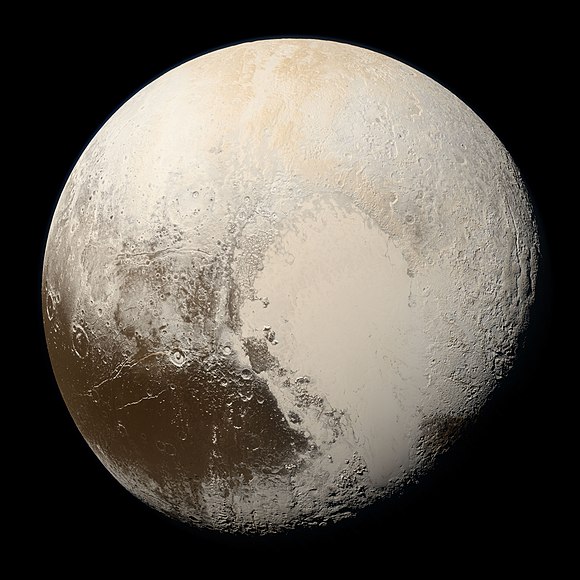
Science began, many say, with the Copernican Revolution, 1543, when a Polish astronomer put forth that the earth revolves around the sun, rather than the Earth at the center. And so began the broader Scientific Revolution, whereupon the foundations were set, and modern science flourished as an autonomous discipline.
But science can be argued to have begun with Aristotle circa 350 BCE, or the heliocentric theories of Philolaus in 5th Century BCE, or even Thales of Miletus, born 626 BCE, one of the seven sages, who broke from mythology to explain the world through deductive reasoning. Science is based upon facts, and the Western Intellectual tradition is rational.
But all cultures have gazed up at the heavens, and tried to decipher meaning. The scientific astronomers – in the West – used Greek mythological figures to christen the constellations of stars, and so mythology towers overhead, still to this day. Stop and consider: science at best is 2,400 years old, while celestial divination is millenia older, common to all cultures, on all continents. We are wise to consider the archetypes in the sky above us, and what we can learn from them.
Pluto, the planet furthest from the sun, was discovered in 1930 and named for the God of the Underworld, of the dead, also known as the Great Destroyer, Transformer and Redeemer.
Pluto, the planet, was present above the United States on July 4, 1776 “When in the course of human events…” fifty-six founding fathers on that date set pen to paper, to sign and to state that, “We hold these truths to be self-evident, that all men are created equal, that they are endowed by their Creator with certain unalienable Rights, that among these are Life, Liberty and the pursuit of Happiness.” So our sovereign nation was declared.
Pluto has a very long arc – specifically 247 years to circumnavigate the sun – and it has now completed one full return, precisely exact on February 2022 through 2024. The Great Destroyer, Transformer and Redeemer is at high noon, dead overhead again, and who among us cannot say that the United States of America is being wrestled to its core, over “truths held self evident”?
What I say here is not scientific fact, but may be an archetypal truth and the question before us, what we the people must decide, is who we are, and who shall we be going forward? Scientific fact does little to help us here. The archetypes seem predominate, and we are wise to pay heed, to seek answers not in the political but at our deeper, more expansive realms.
Fear not. As Pluto is the God of the dead, so too he is the God of wealth and agriculture; the Destroyer, he is also the Redeemer. Persephone, his mistress, would bring back from the underworld new seeds to be planted each spring, to spawn a harvest come fall.
And so as we move through this dark season, may we also see at hand the seeds of an abundant future. Rather than fighting to the bottom, we the people can sow seeds of unity in diversity, we can move past an “either/or” mindset, to a “both/and” embracing and accepting a greater wholeness.
The choice, and its consequences, are ours.

Impeccable
Posted: June 21, 2024 Filed under: Chronicles of a First Time Parent, consciousness, Farming off the Farm | Tags: consciousness 2 Comments
When I was a child, the popular saying was “a man’s word is his bond.” I haven’t heard that expression now in decades.
King Solomon, David’s son, long ago commented “In all thy getting, get understanding.” For the better part of 40-years, the getting, it seems, has been primarily – for the few – immense material wealth. The 10 Commandments now seem laughably old fashioned.
Among ancient civilizations wisdom was rich, and we do well to revisit our past. The Toltec, a Meso-American culture that predates the Aztec, held four precepts to be key. Don Miquel Ruiz, a descendent of the Toltec, wrote “The Four Agreements” about “self-limiting beliefs.” The book, copyright 1997, has been published in 52 languages worldwide, and spent one decade as a New York Times bestseller.
The first precept, which he calls an “Agreement” is deceptively simple: “Be impeccable in your word.” He writes, “Your word is the power that you have to create. It is through the word that you manifest everything. Regardless what language you speak, your intent manifests through the word. What you dream, what you feel, and what you really are, will all be manifested through the word.”
“In the beginning was the Word, and the word was God” is the opening statement of the Christian Gospel of John. Ruiz explains and expands, “The word is not just a sound or a written symbol. The word is a force; it is the power you have to express and communicate, to think, and thereby to create events in your life. But like a sword with two edges, your word can create the most beautiful dream, or your word can destroy everything around you. One edge is the misuse of the word, which creates a living hell. The other edge is the impeccability of the word, which will only create beauty, love, and heaven on earth.”
As there is light, so there is darkness, which principle was embodied in the brilliant German orator whose message of fear and hatred manipulated a country of highly intelligent people. Again Ruiz, “He led them into a world war with just the power of his word. He convinced others to commit the most atrocious acts of violence. He activated people’s fears with the word, and like a big explosion, there was killing and war all around the world. …He sent out all those seeds of fear, and they grew very strong and beautifully achieved massive destruction.”
It is worth remembering that Hitler rose to power through a democratic election, via the German Workers Party, in 1932. Having campaigned as a populist, he consolidated power as a demon.
The Agreement’s verb is “impeccable,” which is derived from the Latin prefix in-, meaning “not,” and the verb peccare, meaning “to sin;” to be impeccable is to be without sin, but to the Toltec sin was different from the Christian meaning. Ruiz explains, “A sin is anything that you do which goes against yourself. Everything you feel or believe or say that goes against yourself is a sin. When you are impeccable, you take responsibility for your actions, but you do not judge or blame yourself. Being impeccable with your word is the correct use of your energy; it means to use your energy in the direction of truth and love for yourself.”
Simple truths are easily understood. Or are they? While driving on errands with my son, we talk about these. Again and again, to help guide his future, I draw from the past.
The Toltec had four agreements:
- Be impeccable with your word
- Don’t take anything personally
- Don’t make assumptions
- Always do your best
To this I would add two more:
- Let integrity be your bank account
- Let compassion, more than logic, guide your path
At this sun drenched solstice, fruits ripen and vines reach ever higher…






 an Art Farm