The Grandest Cataract in New England
Posted: September 12, 2024 Filed under: Art & Healing, Portfolio - David's work, What is an Art Farm | Tags: Androscoggin River, Cancer Valley, Edmund Muskie, Hugh Chisholm, Public Art, Restoration, Rumford 2 CommentsRumford Falls, Maine is situated where the Concord, Ellis, and Swift rivers converge into the Androscoggin River, which form the watershed of the Western Maine mountains. At the Falls, called the “the grandest cataract in New England,” the Androscoggin drops a total of 176 feet over a sheer wall of granite.

In our pre-industrial age, indigenous peoples gathered there to hunt, fish and trade furs from the Lakes Region of Maine. In 1882, history forever changed when industrialist Hugh Chisholm grasped the Falls’ potential for the manufacture of paper.
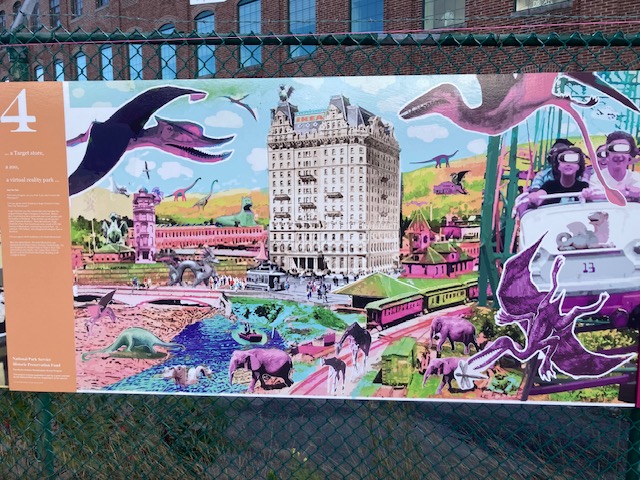
Chisholm first built a railroad, then a mill for his Oxford Paper Company, which grew to become the founding asset of International Paper Company, the corporate behemoth, still active today. A Utopian, he also built planned community housing for the workers in his mills, which housing became a model for the nation. Chisholm hired architects to build great buildings in Rumford, those architects also having designed the Waldorf Astoria in Manhattan, and the Copley Plaza in Boston. At its peak, in the 1930s, Rumford held its own with Manhattan, but today it has fallen deeply into the abyss.

Rumford, and the surrounding River Valley towns of Maine, are known nationally as “Cancer Valley” given the incredibly high rates of cancer among its mill-working inhabitants. Four out of five children are food insecure, while Rumford has the highest special education population in the state of Maine. The opioid crisis has run rampant, and Rumford’s rate of crime is now the highest in Maine.
Rumford Falls is but one, among many cities, ravaged by the flight of capitalist money, ever in pursuit of profit. The New York Times recently reported, “Milwaukee was once known as the ‘machine shop of the world.’ In the 1950s, nearly 60 percent of the city’s adult population worked in manufacturing…. By 2021, Milwaukee had lost more than 80 percent of its manufacturing jobs (barely 5 percent of those that remained were unionized), and it had the second-highest poverty rate of any large American city…. Between 1997 and 2020, more than 90,000 factories closed, partly as a result of NAFTA and similar agreements.”
Last Sunday, I was in Rumford Falls helping on a Public Art project. Although the politics of free trade is vitally important, my work focused upon the power of art, the agency of making, and the process of civic discourse; how does a community rebuild once the rivers of cash flow have dried up?
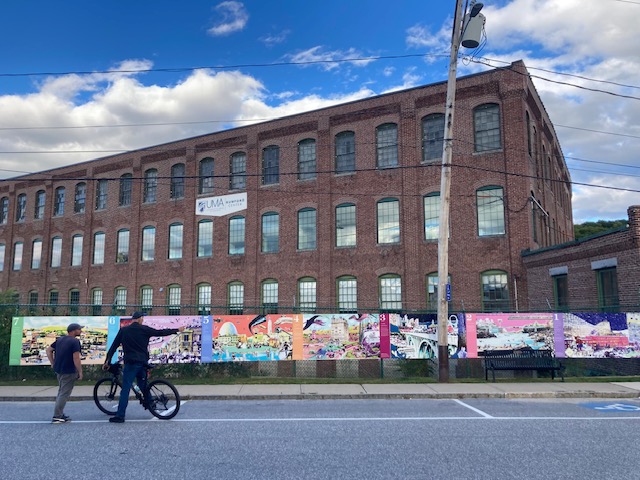
A real estate developer recently purchased Rumford’s old mill building for the price of $1 USD, and she has received a grant from the Department of Agriculture to put solar panels on top of the mill, and another from the National Parks Foundation “historic preservation” fund with the condition of “community engagement.” The developer promptly called Chris Miller, and asked, “I have the building, and a chain link fence out front. Can you do something of civic engagement?” Chris pondered the problem.

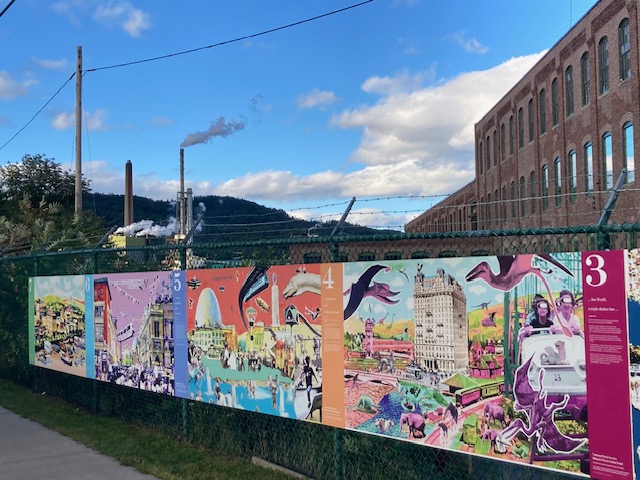
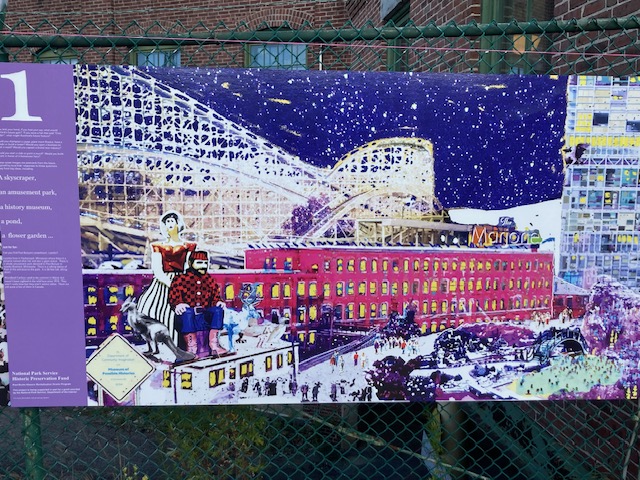
He decided to ask the citizens of Rumford what their desired future might be? Adults declined to respond, but a classroom of 3rd grade students enthusiastically spoke up. Chris’ question was “If you lent your hand, if you had your say, what would Rumford’s future gain? If you wore a hat that said “Civic Leader,” what might Rumford’s future feature? Would you champion a cause, plant more flowers, have a parade or build a tower? Would you open a business to meet a need? Would you captain a brand new industry? Would you start a club or paint a mural? Would you build a park in honor of a hometown hero?”
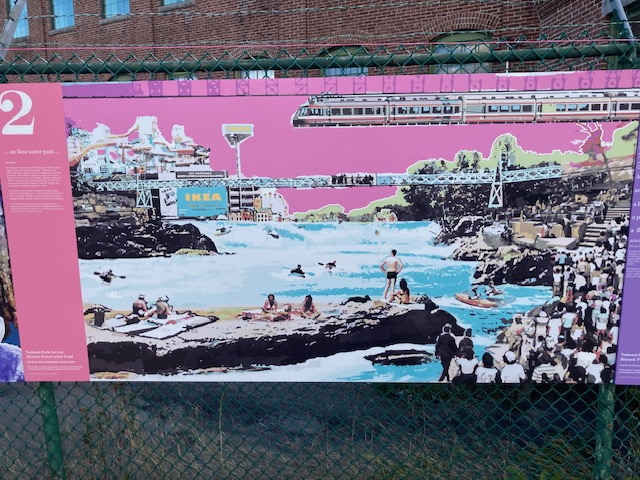
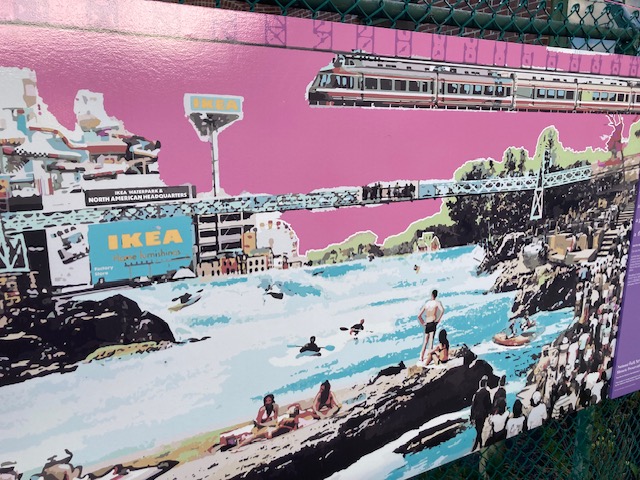
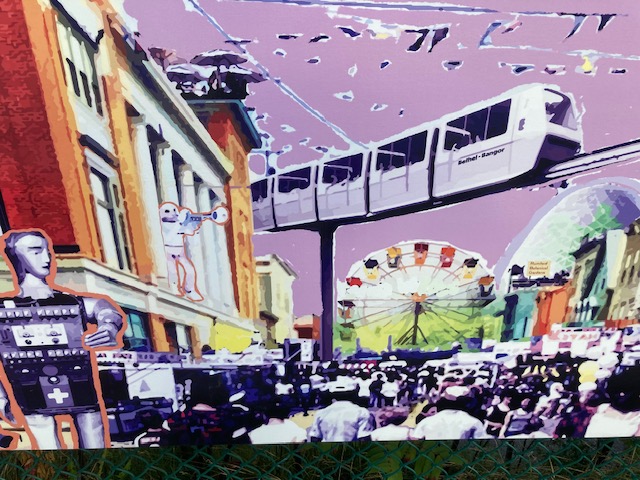
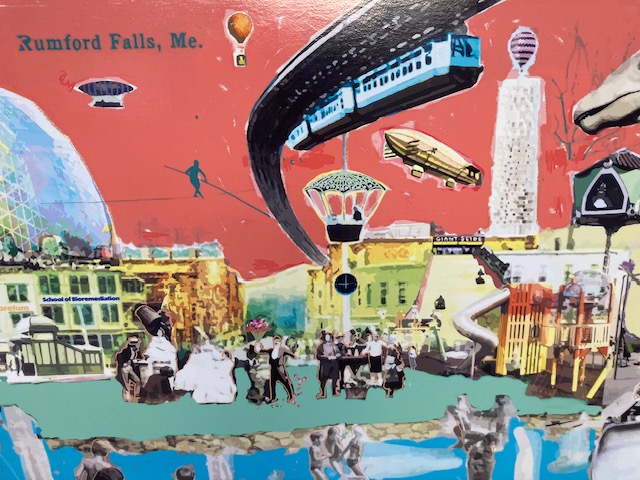
The 8- and 9-year old students offered fantastical ideas: a skyscraper, an amusement park, an IKEA water park, trains running upside down. Gathering their bold ideas, Chris set them down graphically in the style of a picture postcard, then printed on vinyl adhesive which he affixed to seven 4×8 sheets of 1/2” masonite. My role was minimal, priming and painting the boards and helping Chris hang them upon the chain link fence.
His design links to Rumford’s past, given that Hugh Chisholm made his first fortune printing picture postcards, holding the monopoly contract with the United States Postal Service to print all of the picture postcards sold in United States post offices at the turn of the 19th century. The Rumford Mill produced all those postcards, as it grew into its peak production years.
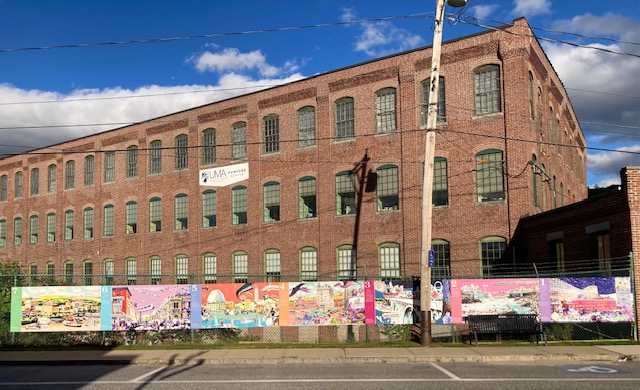
The children of today very likely could become the leaders of our future. Rumford’s native son, Edmund Muskie, was born there in 1914 and then wrote and championed both the Clean Air Act and the Clean Water Act in the 1970s. His political leanings have been demonized by many industrialists, but one has to wonder how his Rumford childhood shaped his environmental thoughts.
Restoration, it seems, is the work of our times. The task in Rumford is how to build a new economic base, to clean up after decades of toxic waste, and to heal generations of families whose lives have been shaped by the working conditions at the Mill and power plant on the Androscoggin River. Chris’ “picture postcards” are but one very small step, but Rumford’s task of recovery does move forward.







Sea Monsters a/k/a Carousel Cosmos
Posted: September 6, 2024 Filed under: Art & Healing, Child Centered Activities, Gallery - Visual, Portfolio - David's work | Tags: cosmic carousel, new paradigm design workshop 2 Comments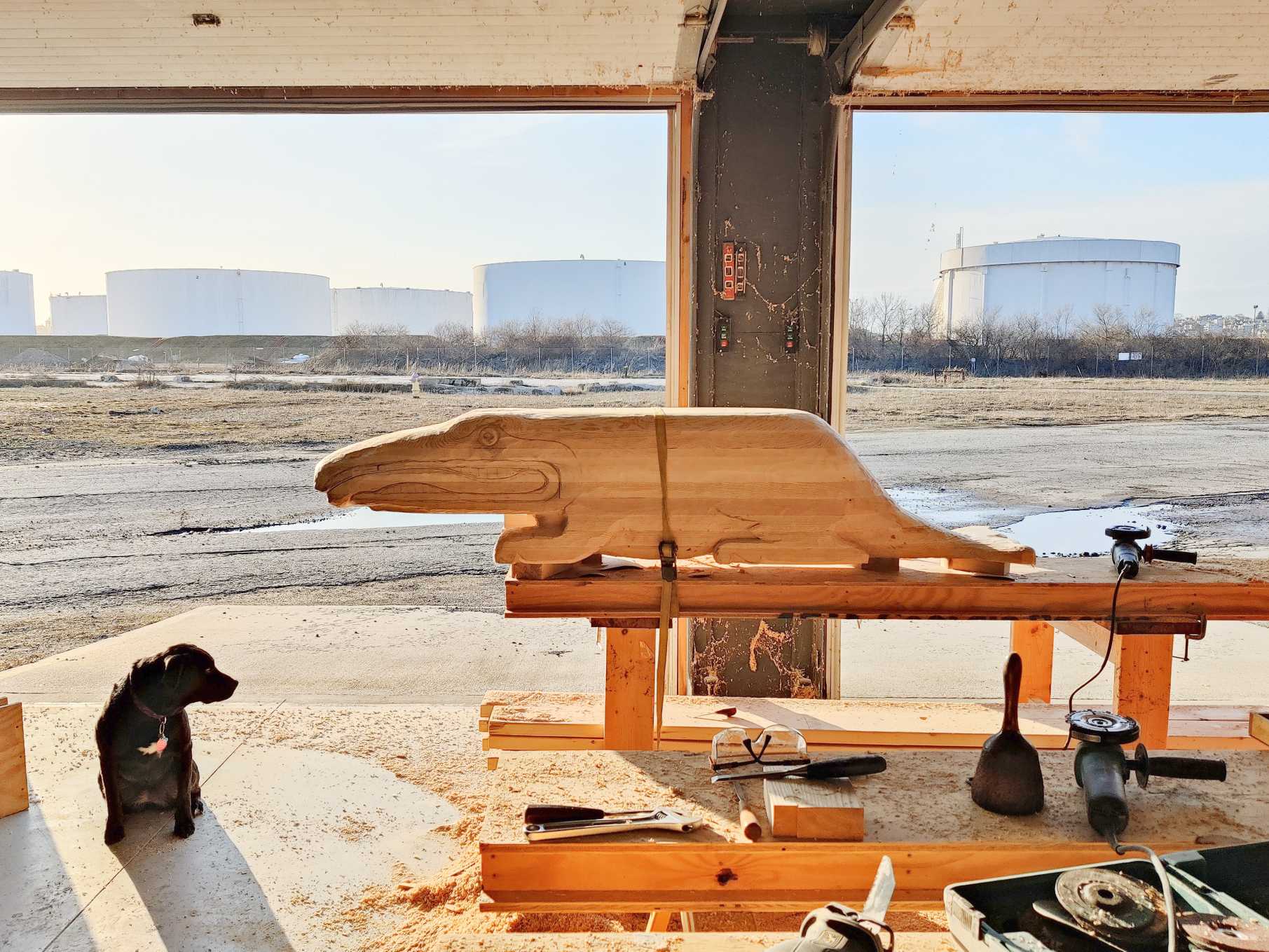
In April 2023 I had the pleasure of making Sea Monsters for a public art display in Portland’s West End. Chris Miller, the polymath maker, received the commission and hired me to help build seven creatures which likely could have lived on Portland’s Peninsula over the past 250-million years, give or take a few millennia, or even “just last Tuesday.”
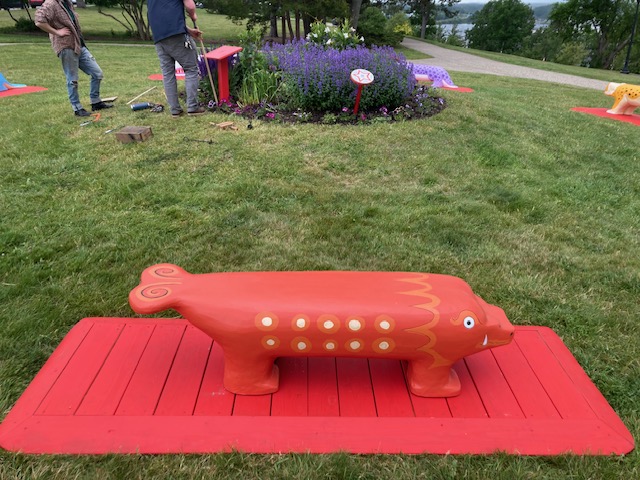
“Carousel Cosmos” is the official title and the seven creatures are a Polar Bear, Humpback Whale, Saber Toothed Cat, Walrus, Rhyncosaur (an extinct herbivorous Triassic archosauromorph reptile), Dragon, Crenatocetus (an extinct genus of protocetid early whale).
Chris wrote, “They are dragons, lions, bears and sea monsters, the usual suspects in the greatest bedtime stories of all time. They have many names in many languages. They’ve made cameos as constellations that might be older than writing, older than the first cities, or the wheel. Some are mythological, some are just misunderstood. They invite you to explore the cosmos starting right here, on a journey to greater understanding.”
One really must visit the installation, but at the least you can visit them online: http://npdworkshop.com/carousel-cosmos

We built the creatures using a “stack laminate” process just as carousel horses have been built since 1799: layers of 8/4 ash (2” thick) were stacked then glued to create the three-dimensional form, which we then carved and painted. With as many as nine layers per creature, Chris used computer modeling software to draw the final shape, then “deconstruct” it to show the shape of each successive layer.

The son of a carpenter, Chris studied sculpture at the Art Institute of Chicago, and then architecture at MIT. His vision is a unique combination of those three influences.

The word “genius” normally is defined in terms of sheer intellectual horsepower – Newton and Einstein, the commonplace exemplars – but a more insightful meaning is in the derivation of the word, from Latin, which means “guiding spirit.”
For having walked the hallowed halls among the MIT Masters, Chris has retained the childlike wonder of growing up amidst the flora and fauna, woods and water of Fifty Lakes, Crow Wing County, Minnesota. His sterling genius guided him not only to conceive, design and build, but also to write this summary of the Carousel Cosmos:
“This carousel is inspired by kindness, adventure, outer space, bedtime stories, dinosaurs and ice cream. It’s inspired by the Western Promenade’s endless views, spectacular sunsets and contemplative atmosphere. It spins the way that the earth spins when the sun sets, in a place where trolleys used to stop, in a small picturesque city with a school community that speaks more than sixty different languages.”
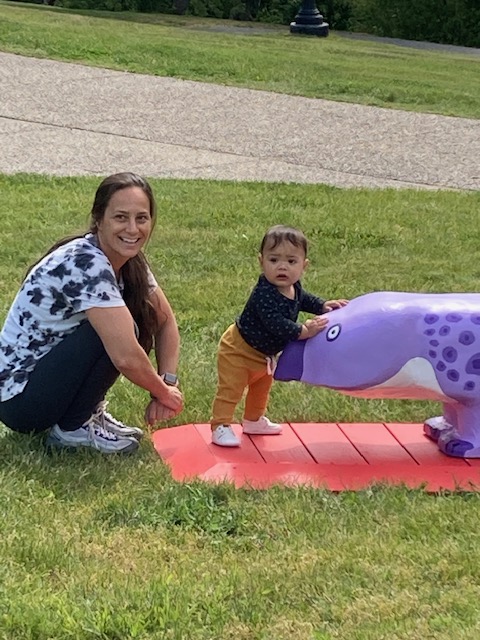
Lest anyone think my statements are grandiose rather than grounded, I submit this photo as Exhibit A:


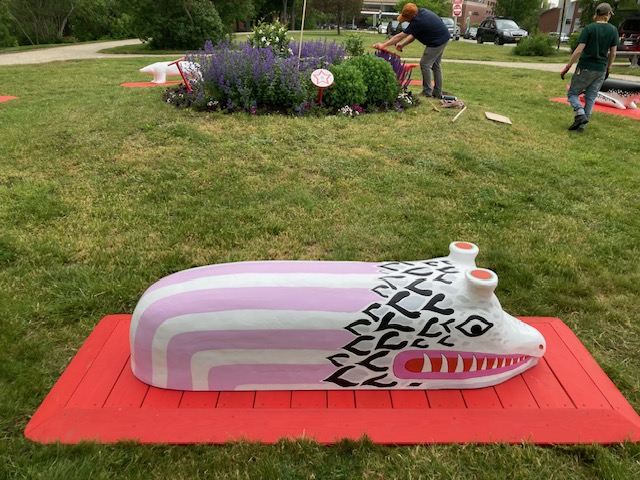


Climb aboard! Let’s go for a spin!!
Quercus Virginianus
Posted: August 28, 2024 Filed under: Art & Healing, Chronicles of a First Time Parent 1 Comment
Quercus Virginianus, the Live Oak tree, is synonymous to the Deep South’s mystique as are Faulkner’s gothic novels. Gothic, indeed, is the architecture of the trees: a circumference up to 35 feet, height up to 70 feet, limbs stretching outward more than 100 feet from the trunk, Spanish Moss tendrils hang to gather nutrients from the wind, rain and sunlight.
A woodworker once told me that in South Carolina a law remains on the books that if two lovers stand beneath a Live Oak tree and exchange vows of their love, then the tree as their witness legally binds the marriage. I cannot prove the fact, but certainly believe its core truth.
Live Oak trees live up to one thousand years. The story is told that in 1771, Étienne de Boré, on his estate which became Audubon Park in New Orleans, planted a Live Oak tree in honor of his bride. At 35 feet in circumference the tree arguably could be closer to 300-years old, known as the “Tree of Life” although officially registered as the Etienne de Boré Oak. Etienne de Boré became the first mayor of New Orleans in 1803.
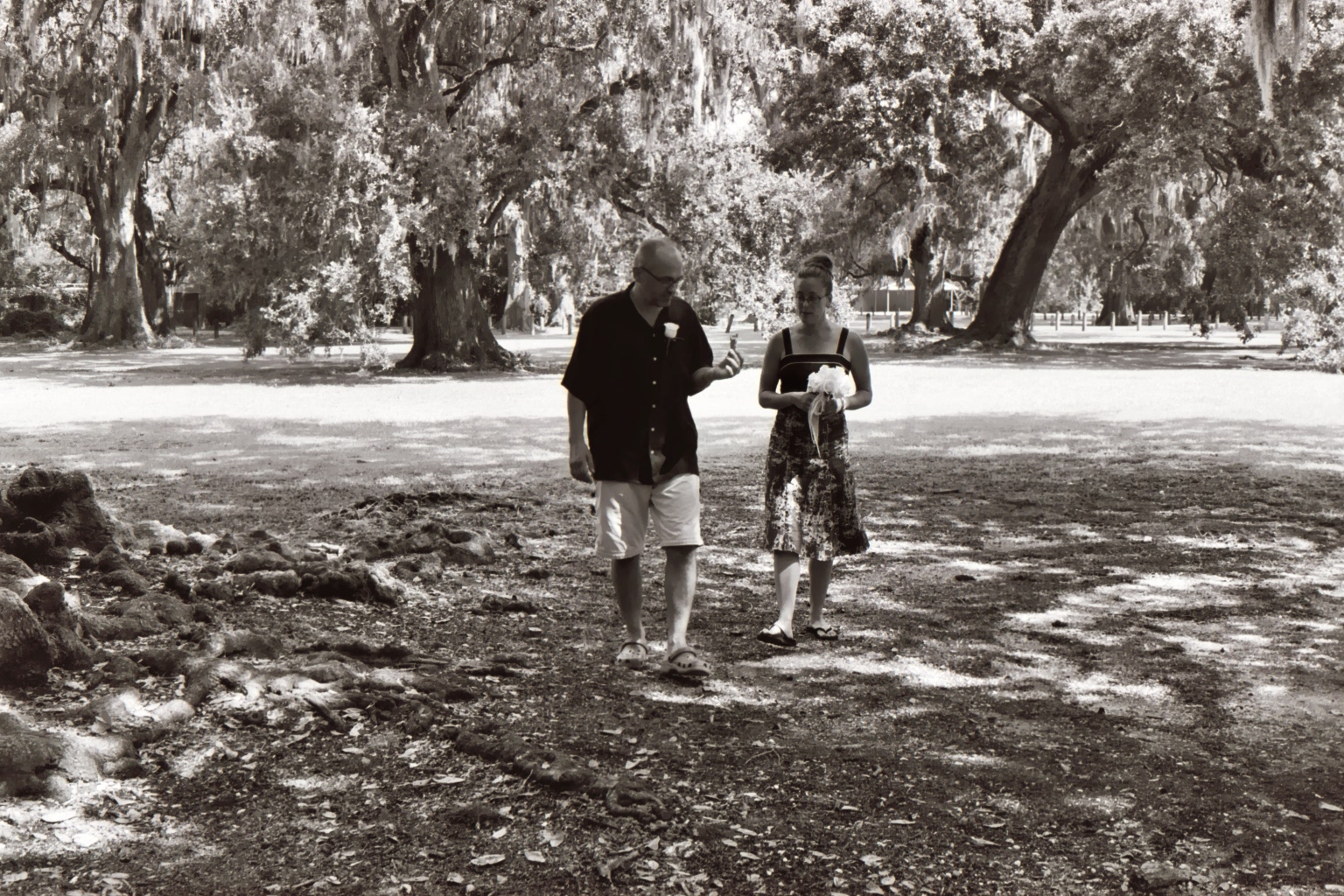
On 28 August 2004 I travelled to Audubon Park to stand beneath the Tree of Life with a soulful strong woman. In true DIY fashion, we wrote our own vows. A Notary Public friend officiated, his wife served as witness (Louisiana is less liberal than South Carolina, at least in terms of trees’ legal standing). We were short one witness, technically, but a woman in black, a total stranger, silently walked up and touched the tree during our exchange of vows, so legally wed we were 28 August in the Tree of Life cathedral.
My vows spoke of “alchemy and the daily renewal.” The traditional “for better or worse” was a given, as I was then a co-defendant in a lawsuit concerning Trust Asset Management and fiduciary duty in United States Federal Court, Northern District of Illinois. My betrothed stood beside me then, she stands beside me now.
2004: on 30 July I was haled into Federal court, where District Judge Matthew Kennelley “granted in part and denied in part” a Summary Judgment on my behalf. My back was against the wall. On 28 August with backs against the Tree of Life, my fiancé and I exchanged vows, and then rings. Next we went to the drive-through daiquiri stand. Later that night we marched in the Second Line of a mid-season Mardi Gras parade. Viva la life of New Orleans!!
Back in Chicago, by autumn of 2004, the lawsuit was settled. The banker from Lichtenstein went to prison. Our union endures. That alone matters.
Twenty years later, we remain together in the light. We raise two bright beautiful children; our life’s work, to be sure. Ours is a remarkable home amidst a wildly creative community, in a place of exquisite beauty, the rocky coast of Maine, on Gaia, circling the sun. My wife holds our family’s center and some day our childrens’ children may say “My Grandfather married one strong soulful woman.”

Saturday on the Street
Posted: August 9, 2024 Filed under: Art & Healing, Farming off the Farm, Permaculture & Home Renovation, What is an Art Farm | Tags: Norway maples, tree work 3 Comments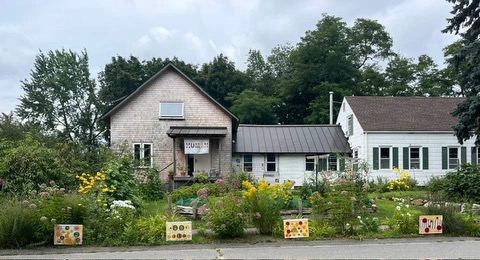
In 1830, in South Portland (known then as Cape Elizabeth) a New England farmhouse was built and its barn completed by 1848. The town’s population was 1,696 people and only six families lived on the street where the farm was located. The farm most certainly had significant acreage.
In 1999, South Portland’s population had grown to 23,324, and the last remaining farmland surrounding this farmhouse was sold off to make a development of six homes. In modern times developers put their road wherever best suits their plan but in 1830 the builders sited the home thoughtfully, based upon the sun’s path; they needed to maximize the solar gain as a heat source. The home’s location then determined where went the developer’s road and the old front yard was paved to put in a street named in honor of the developer’s daughter. The home, which we purchased in 2012, was left with a smaller, but still full sun front yard, enough space to garden and grow food and fruits.
We have felt guided here in creating a healing space. Neighbors have brought wounded birds into our garden, tucking them under the plants, as a place to heal. Young Mothers bring their infants to gaze and we gift them vine ripened tomatoes. We grow less as a matter of sustenance and more as a gift to be given, to be shared.

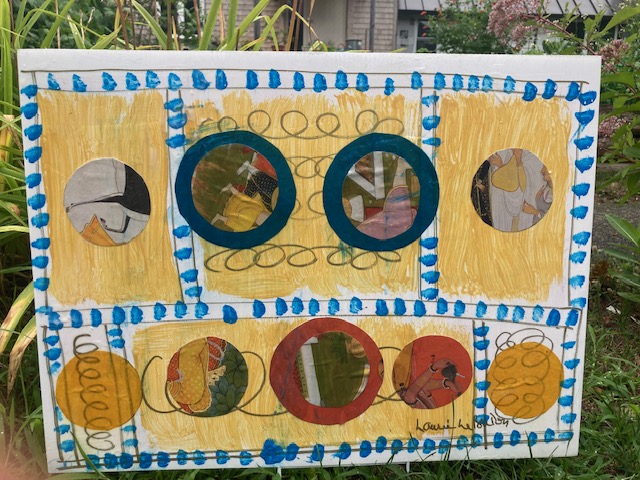
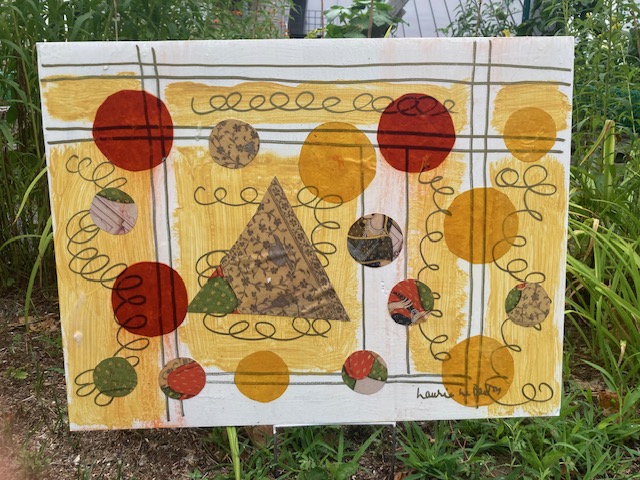
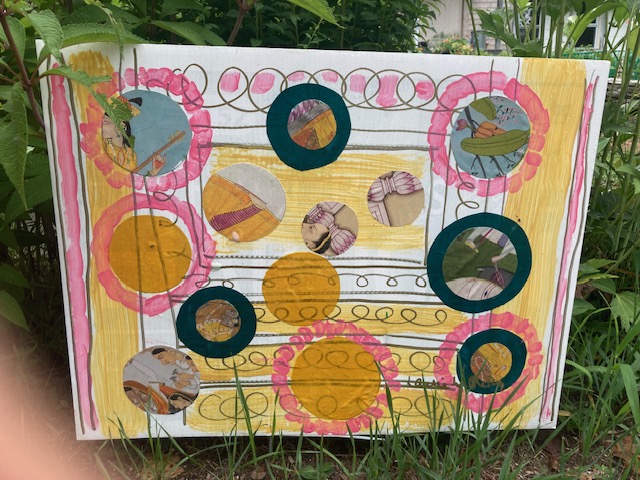
Saturday on our street was very active. Art work arrived from Chicago, from our dear friend Laurie LeBreton, a sculptor whose work combines handmade paper and mixed media. She explains, “I work to access something beyond our concrete world and to find meaning and comfort as I do so. Recent themes have included healing, refuge and ritual.” If yard placards tend to promote politics, Laurie’s speak to art and healing. We embraced Laurie’s generosity and eagerly put them on our side of the street. https://www.laurielebreton.net/

Also on Saturday, very large gooseneck trailers arrived to unload massive paving equipment, parked on the other side of the street. A dialectic began between the mechanized and the natural. If our “Orwellian” week was a “heavy equipment summer camp,” then this week has been about “massive paving equipment and road grinding at night.” My son was over-the-moon delighted. On Sunday night the City began grinding streets here, and the equipment has moved to several other jobs in town. Nightly we have driven to see them work.
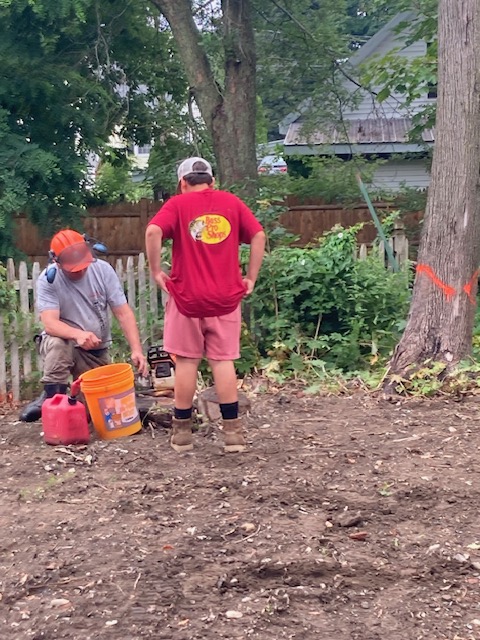
Also on Saturday our work on the invasive Norway Maples continued. Our friend Nate arrived, a journeyman carpenter, master of many trades, and he brought tools for tree work. Nate taught my son how to use a come along, how to sharpen a chain saw, and to use the Phythagorean Theorem to calculate where the tree would fall. My son put on his work boots and got busy.
Norway Maples are not native to America. They were brought here first in 1756, by a nurseryman in Philadelphia, and became popular as an ideal street tree. During the 1970s when the Dutch Elm Disease decimated the urban canopy, the Norway Maples became ever more prominent, but the trees promote a monoculture and grow rapidly, spreading seeds by the wind. They shade out competition. Because they grow fast, their wood grain is long, not tight, and they easily sheer and crack in heavy weather, which has become increasingly more prominent here in Southern Maine.

Two years ago, during a late autumn wind storm, a Norway Maple, with 8” trunk, split and fell onto our swimming pool. Thankfully we were able to repair the pool. Last winter, a much larger Maple, 18” diameter, splintered and fell into the neighbors yard. It leaned precipitously, and my intuition told me not to DIY but to get help.
Nate used the “come along” – a sort of ratchet winch – to direct the tree away from the neighbors yard and to his designated spot. My son worked the come along, tightening the line by cranking to pull the tree down, as Nate cut into the trunk.


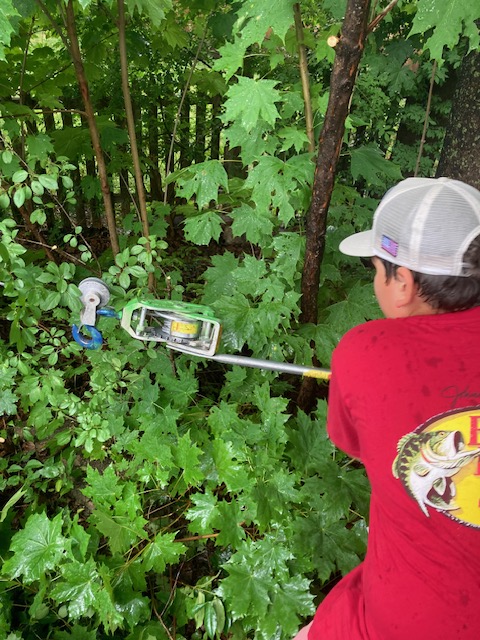
It took a village but the tree is felled, and we have firewood for our winter.

Greater Things
Posted: July 26, 2024 Filed under: Art & Healing, consciousness | Tags: consciousness, rational mind, spirituality 2 CommentsAs a child, raised Roman Catholic, I went to church every Sunday, and to confession on the Holy Week high holidays, plus a few times each year. My sins at most then were venial, not mortal, certainly never cardinal, and, as I stammered for words to describe my offense, at my earthly Father’s instruction, I would take to my knee and ask forgiveness for my sins.
As a University student, I read the New Testament in Koine Greek. My interest in the bible is as literature, not as dogma; I do not read the Bible, but it is important to know, if only as the lingua franca among the 2.4 billion Christians of this world.
My Mother quoted Matthew 22:37-38 as the pillar of the faith, which she paraphrased as “Love and you have fulfilled the law.” A fine path, indeed, and I am thankful for that guidance. To my mind, and in my experience, however, John 14:12 speaks to the core:
“Verily, verily, I say unto you, He that believeth on me, the works that I do shall he do also; and greater works than these shall he do; because I go unto my Father.”
Greater works than these?
As a Federalist approaches the law, let us read this sentence literally, as the Founding Father (sic) meant by his own words. Given that the Gospel of John opens “In the beginning was the word…” we do well to begin with the grammar.
Yeshua, the street preacher, spoke either koine (marketplace Greek) or Aramaic; his name is a late form of the Biblical Hebrew “Joshua,” which is spelled Iesous in Greek and Jesus in Latin. The gospels were written in the Koine because that was more popular than Aramaic, thus reaching a wider audience and so approximately 100-years after his death Matthew, Mark, Luke and John wrote Yeshua’s story in Greek, later translated into Latin, known as The Vulgate; in 1522 William Tyndale translated the work into English (for which in 1536 he was strangled and then burned at the stake) but his work informed the translators of the King James Bible, a masterpiece of writing, published in 1611. It is this version from which I here quote.
The street preacher begins with the hortative clause “Verily, verily, I say unto you,” a teacher’s exclamation, for emphasis, to his listeners.
The subject is “he,” the object is “the works,” and “do” is the verb, in the subjunctive mood. Rarely used in contemporary English, the subjunctive is critical here; the indicative mood states facts, certainty, while the subjunctive mood – “shall do” – expresses potential. In other words, the avatar has opened the prospect of free will, the freedom to choose, challenging the listener to what we could do, rather than what we will do.
The sentence has three subordinate clauses, the first of which – “that believeth on me” – expands the subject phrase. “That I do” refines the direct object, while the third – “because I go” – is causative. Grammatical subordination is not necessarily logical subordination; were his going to the Father the sole cause of our salvation, then our acts would be secondary, almost like a “get out of jail free” card. Faith must be active, not passive, and emphasis here is upon doing; the fact of the matter remains the cause is subordinate to the acts, the doings, to the potential of the believer.
“Greater works than these” is an independent clause expanding that which is done – the miracles, from the Latin word miraculum, meaning “object of wonder” – which every parochial school child knows to include (but are not limited to) walking on water, feeding the 5,000, raising Lazarus from the dead.
The sentence is complex, written in hyperbaton, a rhetorical figure that inverts the normal order of words for added emphasis. But if we focus upon the subject, verb and object – like bowling pins lined up for a strike – it makes plain “He that believeth…shall do…the works, and greater works than these.”
Judge next, as an activist might rule from the bench, interpreting the text in a contemporary context. Carl Jung pertains here, and the subordinate clause of causation “because I go unto my Father” must then refer not to an anthropomorphic God, but to the wise old man, the archetypal male of the collective unconscious, a universal archetype of wisdom and insight. Jung believed every male psyche has a female aspect (anima) and every female psyche a male aspect (animus); so then “go unto my Father” is a personification of the wise masculine spirit within the balanced whole of higher consciousness, which is, to my mind, the “Christ” consciousness, the “anointed” one.
As children we learned English grammar. As adults can we learn to expand our consciousness? Who among us shall be so meek as to act upon, rather than merely to believe in, the miracles?
To speak of walking on water, of healing the sick, or raising the dead is to confront the laws of classical physics, to confound the rational mind, to go beyond the prosaic, to enter the realm of poetry.
Hard pressed to imagine such a state of enlightened being, we do well to ponder the words of the God-intoxicated Persian, the poet Hafiz, who wrote, circa 1350, “I Have Learned So Much”:
I
Have
Learned
So much from God
That I can no longer
Call Myself
A Christian, a Hindu, a Muslim,
A Buddhist, a Jew.
The Truth has shared so much of Itself
With me
That I can no longer call myself
A man, a woman, an angel
Or even pure
Soul.
Love has
Befriended Hafiz so completely
It has turned to ash
And freed
Me
Of every concept and image
My mind has ever known.
[NOTE: My grammatical exegesis here has been refined with the help of my dear friend, Bob Ultimo. A classmate in Latin, we read together in the dark dinghy basement of Kresge Hall, Northwestern University 1983-85. He stayed the course, gained a Masters in Latin, taught for many years the Trivium (grammar, dialectic, rhetoric), currently teaches and writes on grammar and writing. A man in his prime, Magister Ultimo is a master of his craft. Given there is “a mysterious link between grammar and the mind” his clarity of verbal construction, keenness of thought, and deft wording are well worth following at writingsmartly.com. Thank you, Bob. Thank you, very much.]
* * * * * * * *
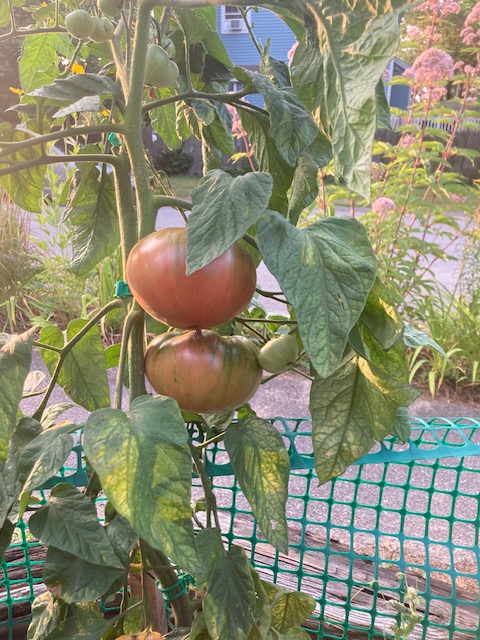
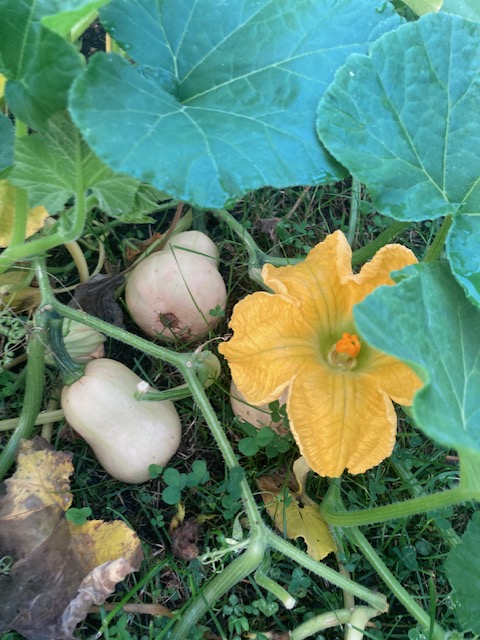
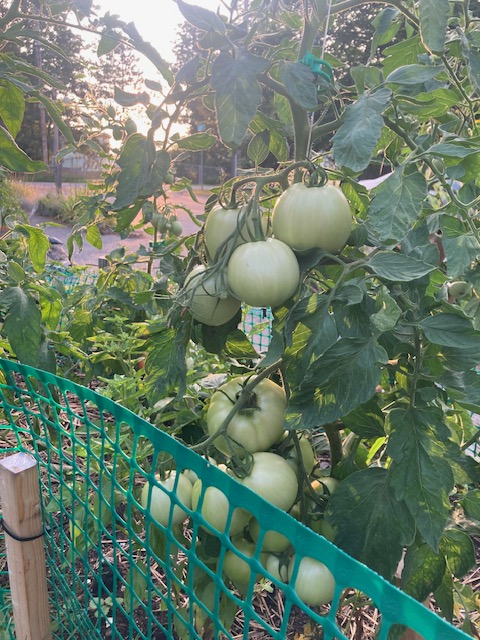
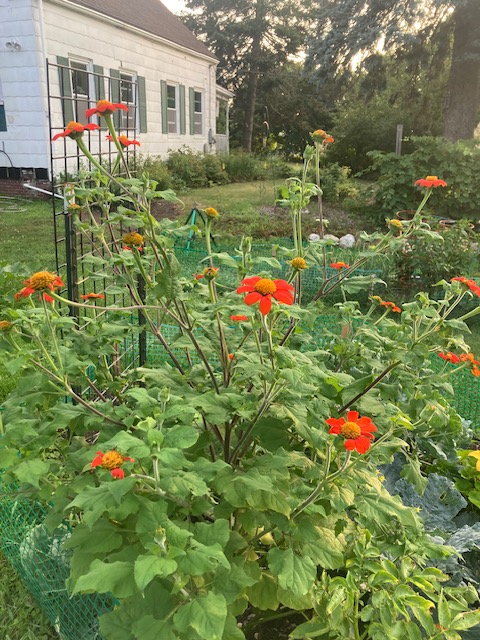
In late July, the fruits ripen and the harvest has begun.






The Underworld and its Archetypes
Posted: June 28, 2024 Filed under: Art & Healing, consciousness | Tags: consciousness, mythology, rational mind 1 Comment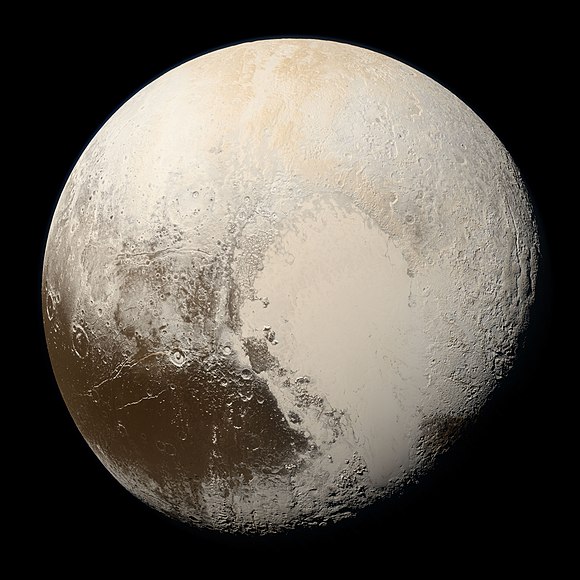
Science began, many say, with the Copernican Revolution, 1543, when a Polish astronomer put forth that the earth revolves around the sun, rather than the Earth at the center. And so began the broader Scientific Revolution, whereupon the foundations were set, and modern science flourished as an autonomous discipline.
But science can be argued to have begun with Aristotle circa 350 BCE, or the heliocentric theories of Philolaus in 5th Century BCE, or even Thales of Miletus, born 626 BCE, one of the seven sages, who broke from mythology to explain the world through deductive reasoning. Science is based upon facts, and the Western Intellectual tradition is rational.
But all cultures have gazed up at the heavens, and tried to decipher meaning. The scientific astronomers – in the West – used Greek mythological figures to christen the constellations of stars, and so mythology towers overhead, still to this day. Stop and consider: science at best is 2,400 years old, while celestial divination is millenia older, common to all cultures, on all continents. We are wise to consider the archetypes in the sky above us, and what we can learn from them.
Pluto, the planet furthest from the sun, was discovered in 1930 and named for the God of the Underworld, of the dead, also known as the Great Destroyer, Transformer and Redeemer.
Pluto, the planet, was present above the United States on July 4, 1776 “When in the course of human events…” fifty-six founding fathers on that date set pen to paper, to sign and to state that, “We hold these truths to be self-evident, that all men are created equal, that they are endowed by their Creator with certain unalienable Rights, that among these are Life, Liberty and the pursuit of Happiness.” So our sovereign nation was declared.
Pluto has a very long arc – specifically 247 years to circumnavigate the sun – and it has now completed one full return, precisely exact on February 2022 through 2024. The Great Destroyer, Transformer and Redeemer is at high noon, dead overhead again, and who among us cannot say that the United States of America is being wrestled to its core, over “truths held self evident”?
What I say here is not scientific fact, but may be an archetypal truth and the question before us, what we the people must decide, is who we are, and who shall we be going forward? Scientific fact does little to help us here. The archetypes seem predominate, and we are wise to pay heed, to seek answers not in the political but at our deeper, more expansive realms.
Fear not. As Pluto is the God of the dead, so too he is the God of wealth and agriculture; the Destroyer, he is also the Redeemer. Persephone, his mistress, would bring back from the underworld new seeds to be planted each spring, to spawn a harvest come fall.
And so as we move through this dark season, may we also see at hand the seeds of an abundant future. Rather than fighting to the bottom, we the people can sow seeds of unity in diversity, we can move past an “either/or” mindset, to a “both/and” embracing and accepting a greater wholeness.
The choice, and its consequences, are ours.

The Alpha and the irrational
Posted: May 11, 2024 Filed under: Art & Healing, Farming off the Farm, What is an Art Farm | Tags: consciousness, rational mind, spirituality 1 CommentIf one subscribes to the Great Man Theory, then history is defined by the deeds of great men; highly unique individuals whose attributes – intellect, courage, leadership or divine inspiration – have a decisive historical effect. Thomas Carlyle developed the theory, and wrote:
“Universal History, the history of what man has accomplished in this world, is at bottom the History of the Great Men who have worked here. They were the leaders of men, these great ones; the modelers, patterns, and in a wide sense creators, of whatsoever the general mass of men contrived to do or to attain; all things that we see standing accomplished in the world are properly the outer material result, the practical realization and embodiment, of Thoughts that dwelt in the Great Men sent into the world: the soul of the whole world’s history, it may justly be considered, were the history of these.”
Pythagorus of Samos, the ancient Ionian Greek philosopher and polymath, certainly ranks among these alpha males. He has been credited with mathematical and scientific discoveries, including the Pythagorean theorem, Pythagorean tuning, the five regular solids, the Theory of Proportions, the sphericity of the Earth and the identity of the morning and evening stars as the planet Venus. His ideas are ubiquitous: Plato’s dialogues exhibit his teachings, every high school student memorizes his theorem, and every carpenter or engineer uses the 3-4-5 triangle to square a room.

He saw beyond the material realm, and further developed ideas of mysticism. His “metempsychosis” – which means the “transmigration of souls” – holds that every soul is immortal and, upon death, enters a new body. He also devised the doctrine of musica universalis– literally universal music, also called music of the spheres or harmony of the spheres – which holds that the planets move according to mathematical equations and thus resonate to produce an inaudible symphony of music. The 16th century astronomer Johannes Kepler further developed this idea, although he felt the music was not audible but could be heard by the soul.
Aristotle characterized the musica universalis as follows:
“…since on our earth the motion of bodies far inferior in size and in speed of movement [produce a noise]. Also, when the sun and the moon, they say, and all the stars, so great in number and in size, are moving with so rapid a motion, how should they not produce a sound immensely great? Starting from this argument and from the observation that their speeds, as measured by their distances, are in the same ratios as musical concordances, they assert that the sound given forth by the circular movement of the stars is a harmony.”
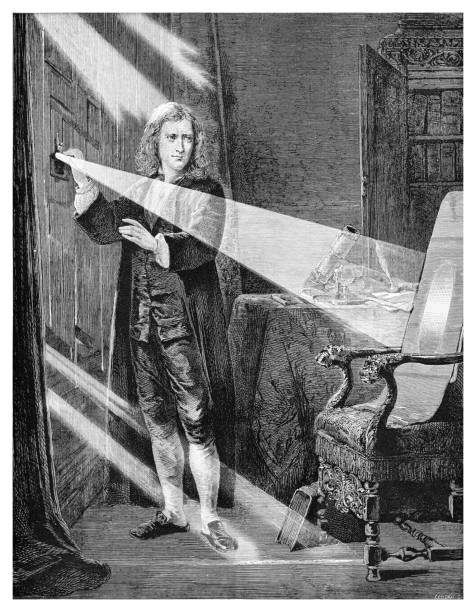
Clearly, Pythagorus was a big thinker, and his ideas influenced Isaac Newton, another of the alpha males. Newton – who established classical mechanics, invented calculus, formulated the laws of motion and universal gravitation – was a paragon of the rational scientific mind. Newton was a Great Man, by definition. He also was a leading alchemist.
In its purest form, alchemy is concerned not with turning base metals into gold, but as a symbolic language guiding the transmutation of the physical self into the ascendent consciousness of the anointed. Of an estimated ten million words of writing in Newton’s papers, approximately one million – 10% – deal with alchemy. This was more than a passing interest.
John Maynard Keynes, the Cambridge economist who restructured the post-WW2 global financial system – easily ranking him among the Great Men – had this to say about Newton:
“Newton was not the first of the age of reason. He was the last of the magicians, the last of the Babylonians and Sumerians, the last great mind which looked out on the visible and intellectual world with the same eyes as those who began to build our intellectual inheritance rather less than 10,000 years ago. Isaac Newton, a posthumous child born with no father on Christmas Day, 1642, was the last wonderchild to whom the Magi could do sincere and appropriate homage.”
Let us pause and consider: just as Pythagorus explained the physical realm he also saw celestial harmony beyond the physical; Newton mastered not only scientific thought but was a leading alchemist of his day. Two of the paragons of the rational alpha mind had secret lives as mystics.
The Western intellectual tradition is based entirely on the rational, and anything beyond the rational is defined by the negative form – “irrational” – which is decidedly pejorative. As wrote Carl Jung, ““Everything that the modern mind cannot define it regards as insane.” Pythagorus was denigrated as a cult leader. During Newton’s life, the English Crown considered alchemy to be a heresy, punishable by death. The burning of his alchemical writings perhaps was not an accident.
What if we expand our concepts and consider connections not defined by measurable facts? What if we begin to use the term “supra-rational”? No less than Albert Einstein – the modern paragon of rational thought – was compelled in this regard. In 1930 he published an essay “Religion and Science” which described the sense of awe and mystery which he termed a “cosmic religion” of “superpersonal content.” Einstein counseled to move beyond the anthropomorphic concept of god to “the sublimity and marvelous order which reveal themselves in nature … to experience the universe as a single significant whole.”

For Einstein, “science without religion is lame, religion without science is blind.” He said “God is a mystery. But a comprehensible mystery. I have nothing but awe when I observe the laws of nature. There are not laws without a lawgiver, but how does this lawgiver look? Certainly not like a man magnified. …some centuries ago I would have been burned or hanged. Nonetheless, I would have been in good company.”
The “Great Man Theory” was advanced in the 19th century Victorian era. In the 21st century we need to move forward, and expand the scope, even beyond gender, to all life, beyond the “either/or” and toward the “both/and” mindset.
I should like to propose that the “Great Man” be replaced by the “Great Soul,” and that we look beyond the rational, the material, the physical, and embrace the whole cloth, the harmony and music of “our higher angels,” the music of the spheres, “to experience the universe as a single significant whole.”
In fact, this “Great Soul” is in use; in the Hindu language, “Mahatma” from the Sanskrit word “mahātman,” literally means “great-souled.” Mahatma Ghandi is but one exemplar of this path.
The seeds of a new future surround us. We can be hopeful.
My pronoun is “We”
Posted: April 25, 2024 Filed under: Art & Healing, Chronicles of a First Time Parent, What is an Art Farm 1 CommentDuring my student days, reading Greek and Latin literature, the heavy hitters – grammatically speaking – were the nouns and verbs; adjectives and adverbs lived the fancy life, drove fast cars, added sparkle and pizazz to any sentence. Pronouns were back bench utility players.
In recent years pronouns have gained a place of prominence, which intrigues me. I first heard about the increasing awareness of pronouns when a friend, serving on the Board of the Friends School of Portland, described this new phenomenon. My children’s teachers now list their pronouns in emails. I am increasingly aware of this social trend.
In my work as a carpenter no one ever asks my pronoun; this topic is never discussed on the job site. And so I should like to announce here, that my pronoun is “We.” I have chosen the first person plural with specific intent, to message my commitment to collaborate, co-create, communicate and cooperate in building community.
I observe people use the third person: he, she, it, they, them. First and second person pronouns do not denote gender, while third person specifically denotes and identifies gender. While I affirm and embrace gender equality, fluidity, and transgender my deeper concerns lie with the increasing fragmentation and divide within our culture. Third person pronouns denote “other” which underscores separation.
The concept of “other” has been a central question of philosophy for centuries, for millenia. Within the European tradition everyone from Hegel to Husserl from Sartre to Simone de Beauvoir has opined upon “other.” In the main, “other” has been used to define “self” but I argue this falls within an “us versus them” mindset. What will it take for us to come together?
We do well to look further back to Plotinus, the Greek founder of Neoplatonism. He taught there is a supreme, totally transcendent “One,” containing no division, multiplicity, or distinction; the “One” was identified with the concept of “Good” and the principle of “Beauty.” Among his quotes is: “When we look outside of that on which we depend we ignore our unity; looking outward we see many faces; look inward and all is one head. If a man could but be turned about, he would see at once God and himself and the All.” First person plural, indeed.
Among the ironies of history is that a slave-holding patrician wrote that sterling sentence which begins “We the people of the United States, in order to form a more perfect Union….” How bold to set down those words, such pioneering thought, while Europeans were focused upon “other.” But slavery, treating some people not only as other but as property, bought and sold, would come to define the central challenge of the United States.
And so it was on 4 March in 1861 that an axe wielding brawny frontiersman, elected the 16th President of the young United States, stood upon the Capital steps, charged with the responsibility of holding together the Union. Abraham Lincoln’s First Inaugural Address outlined his thinking, a constitutional lawyer, on the civil discord simmering among the states. He closed out his speech with an appeal to unity, using the first person plural: “We are not enemies, but friends. We must not be enemies. Though passion may have strained, it must not break our bonds of affection. The mystic chords of memory, stretching from every battle-field, and patriot grave, to every living heart and hearth-stone, all over this broad land, will yet swell the chorus of the Union, when again touched, as surely they will be, by the better angels of our nature.”
If pronouns are to continue to gain in prominence, when the collective id has been let loose, when dark anger rages like a sharp knife in a street fight, in these times now going forward may we the people pursue the blessing of unity, accepting diversity in collaboration and a renewed commitment to community.
May “We” become the vogue, in these times, and going forward.
Crossing the Rubicon, crossing a cultural divide
Posted: March 31, 2024 Filed under: Art & Healing, Portfolio - David's work | Tags: art, exhibition, myth, mythology, spirituality 3 Comments
In 2000 I built, with Andy Rosen, a 25′ sculpture of a North Atlantic Right Whale. The sculpture was part of a collaborative exhibit, about our relationship to the rapidly warming Gulf of Maine, on display in two locations since then. The second exhibit recently came to an end, but as fortune blessed us, we have been able to donate the entire exhibit to the Wabanaki Public Health & Wellness Center in Bangor, Maine.
On the leap day, 29 February, I delivered the whale et al to the Wabanaki Public Health & Wellness Center. I was greeted by enthusiastic people, who welcomed our gift, and all of whom bore a similar resemblance. These were “people of the first light” members among the First Nations, and I powerfully realized that in crossing the Penobscot River I also crossed a cultural divide.
“Sea Change” within my/our culture was “other,” a puzzle, an odd fit. It had been well reviewed in the Sunday Press Herald and approximately 60,000 people experienced the exhibit. But we had a hard time getting people to embrace it, institutions especially. A robust PR campaign was promised, but in the end little was done to promote the exhibit. The board seemed to hold it at arms length while the administration neither recognized our donors, nor even acknowledged our “in kind donations.” One of our artists summed it up, “Our exhibit pushed some buttons that the museum was uncomfortable with….” One has to wonder.
We were invited to meet with a local ocean research institute to move the exhibit there, including an educational outreach, but their leaders rejected it, in part because of political issues; they directly said they could not take the whale because it touched upon the fisheries issue. Their major supporter is the fisheries industry. So our exhibit had run its course, its welcome worn out, and would have been hauled to the landfill.
To the Wabanaki it is a cherished asset, which they will use to help teach future generations (emphasis plural) about their link to the land. They welcomed my delivery not as plywood and tree trunk, not as wire and fabric, but a component of health and wellness. Their community has serious issues of addiction and mental health; in fact, alcohol, substance use and mental health disorders, suicide, violence, and behavior-related morbidity and mortality in American Indian and Alaska Native communities are disproportionately higher than the rest of the U.S. population. Our exhibit will be expanded into an immersive permanent exhibit in the Cafe of their Bangor center, showing the integration of life, the sustaining power of the Penobscot River, the grand web from Katahadin to Cashes Ledge, that all life is one.
What to my/our culture had become detritus is, to the Wabanaki, a most obvious opportunity. This has come to challenge me in a way reminiscent of paradox to Kierkegaard.
In the Oxford English Dictionary myth has two definitions. The first being “a traditional story, especially one concerning the early history of a people or explaining some natural or social phenomenon, and typically involving supernatural beings or events” with the second “a widely held but false belief or idea.” To my mind, in common parlance myth has become a pejorative term.
Carl Jung wrote, ““Everything that the modern mind cannot define it regards as insane.” Within our Western tradition of rationalism, dominated by monotheism, it is striking to note that one of our Great Men, the maven of rational insight and the material world, Sir Isaac Newton, led a secret life as a leading alchemist. He refused to publish his alchemical work – indeed, it was burned in a fire – perhaps for fear of scorn and rejection. The English Crown issued severe penalties for alchemy, including public hangings. Within our culture heretics have been burned at the stake, and witches sentenced to death.
Art-making predates agriculture, and thus predates civilization. Archetypes would seem to predate religion. Jung thought so, observing that organized religions had perfectly adapted the archetypes to their ritual stories. He wrote this not to denigrate religion, but, as a man of science, to pursue his “study of the soul.” The word archetype is derived from the Greek ἀρχῇ which is also, interestingly, the first noun [Ἐν ἀρχῇ ἦν ὁ Λόγος] of the “Book of Books,” the dominant sacred text within our Western tradition.
The word “archetype” first appeared in the English language during the 1500s, and conceptually relates to the Platonic forms, so I feel on solid ground considering them a priori and the religious narrative secondary. I am growing in certainty that archetypes may be the keyhole through which the light of consciousness shines, with myth providing the keys to unlock the “many rooms in my Father’s house.”
The act of making, to my mind, then is one means to manifest these truths.
Allow me to close with this story from the First Nations:
Whale witnessed the events that led to the settling of Turtle Island (North America) and has kept the records and knowledge of the Motherland alive. It is said that Mu (the Motherland) will rise again when the fire comes from the sky and lands in another ocean on Mother Earth. All of Earth’s children will have to unite and honor all ways and all races in order to survive.

Removing Obstacles
Posted: November 24, 2019 Filed under: Art & Healing, Gallery - Visual 1 Comment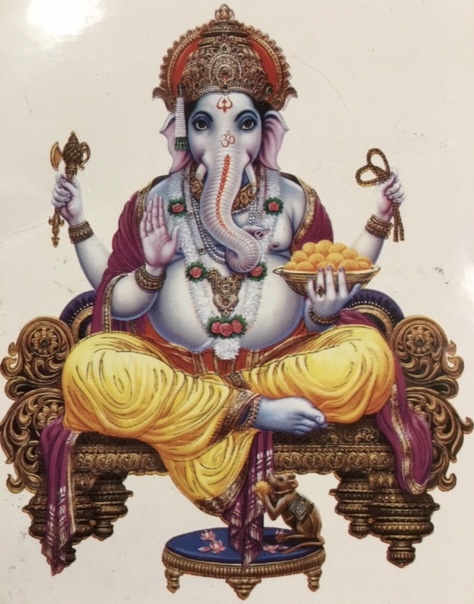

Ganesha has become a comforting figure to me. He is the remover of obstacles and master of wisdom and knowledge. A beloved friend attended the festival of Ganesha in India. She brought with her, an item from our home and placed it on an altar during the festival. I’ve continued to find him in lots of places, or maybe it’s the other way around.
Since my last post, regrettably over a year ago, I have struggled with how to incorporate my surgical screws into some creative effort.
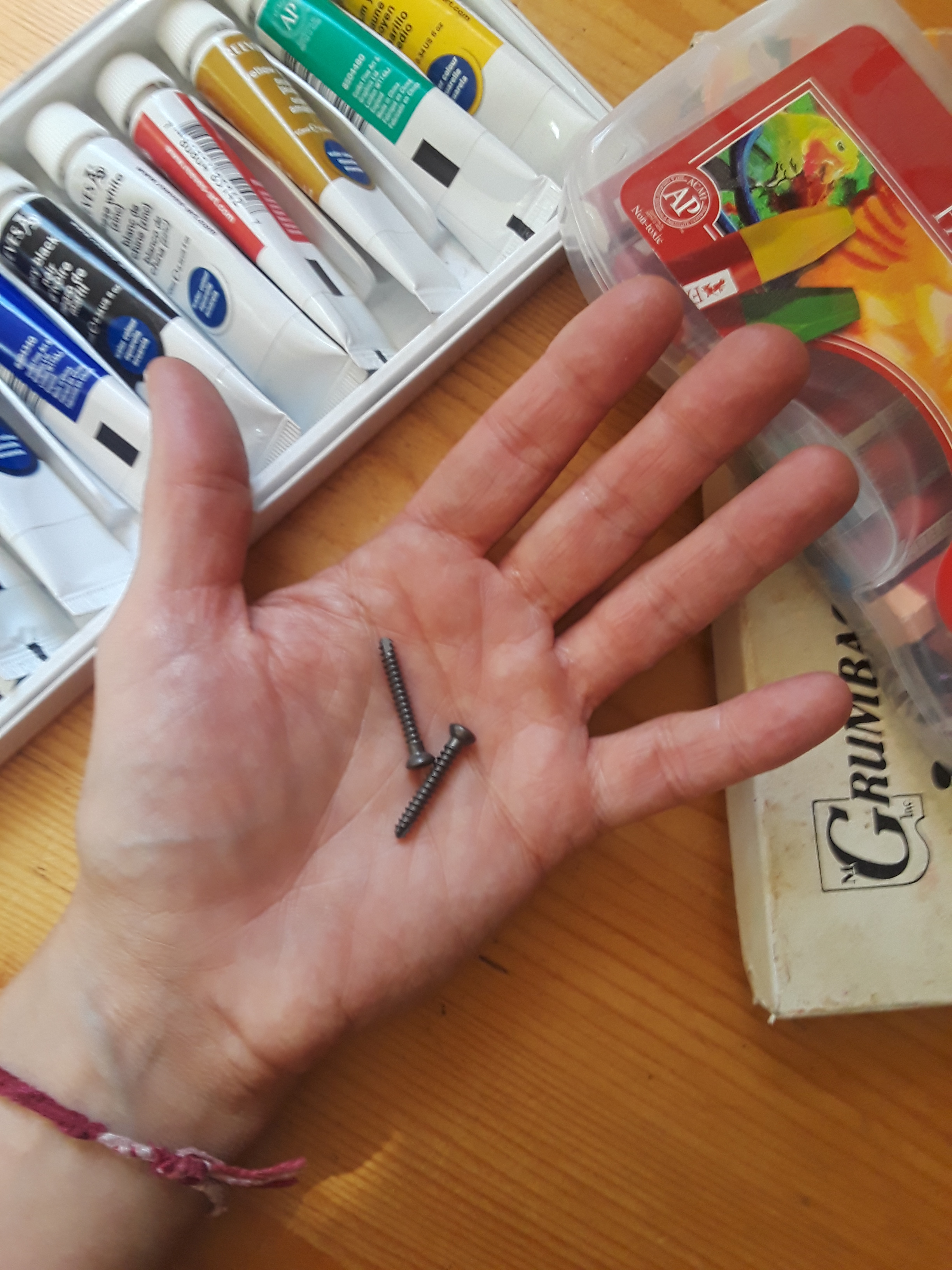
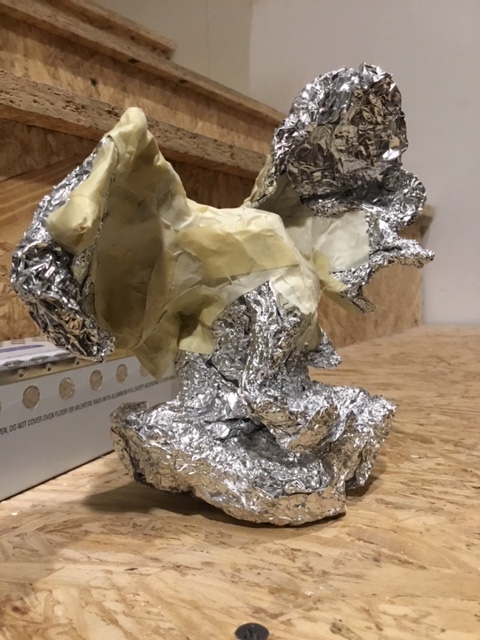
Recently, I’ve been experimenting with clay and simple sculpture materials to recreate my perception of Ganesha, holding symbols of personal obstacles.

To be continued…

 an Art Farm