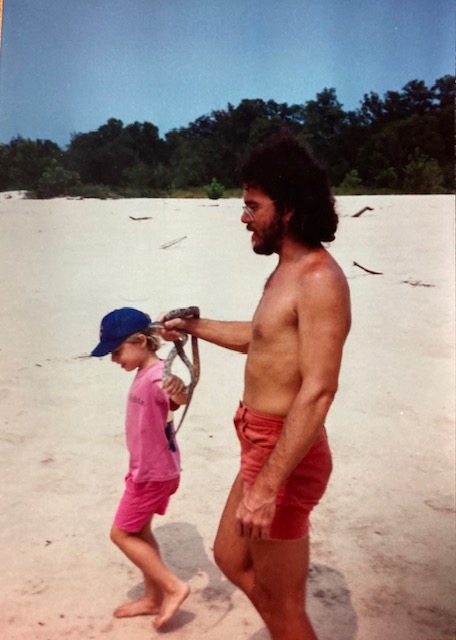
Well dressed, on the Porch
Posted: November 28, 2025 Filed under: Art & Healing, consciousness, What is an Art Farm 1 Comment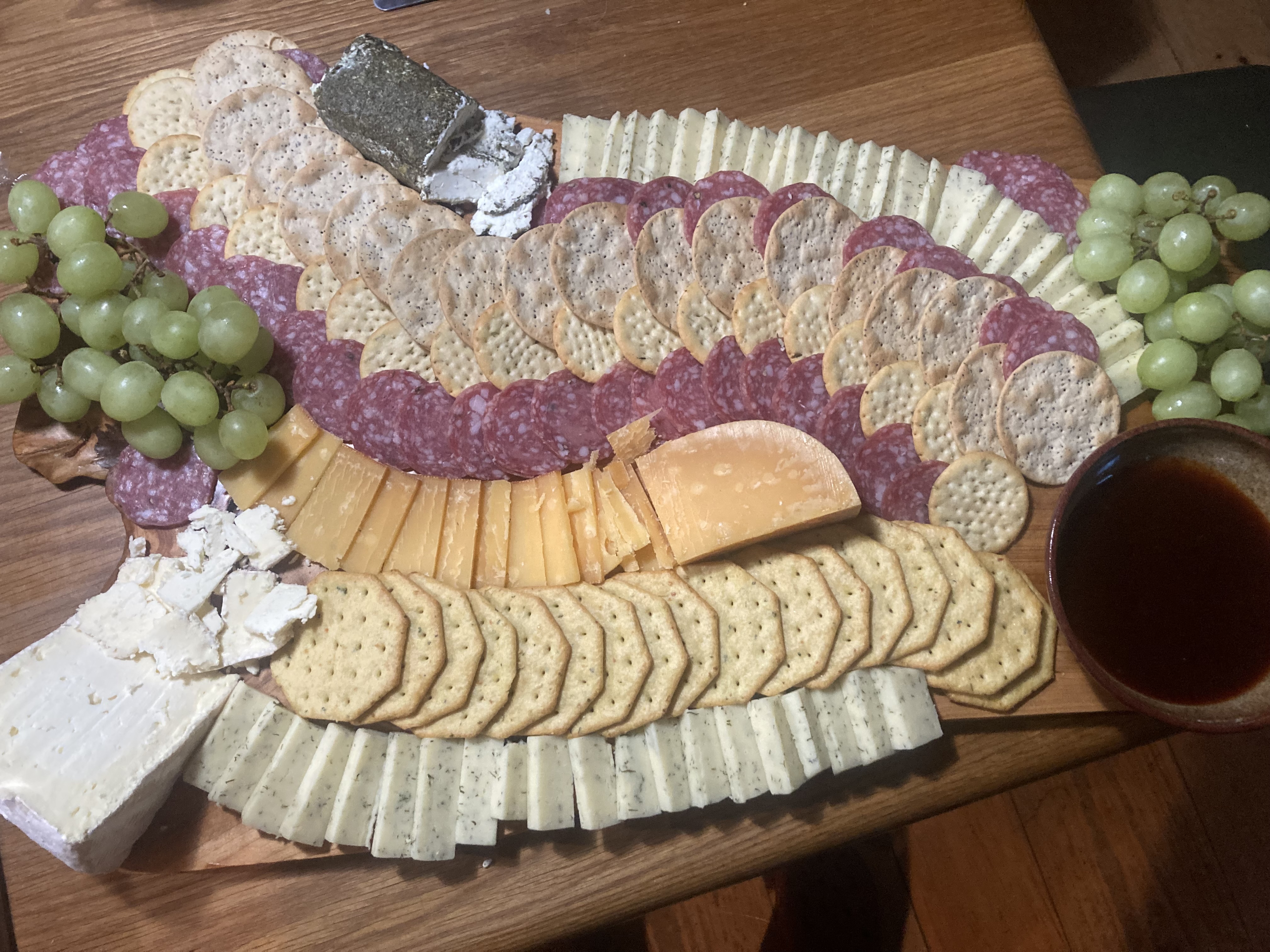
In early September, during our Language Arts class, two young Christian women came to the door, dressed in their “Sunday-go-to-meeting clothes.” To avoid disruption, I hopped up to answer the door.
They politely asked, “We are doing volunteer work and wonder if you would like to hear some good news from the Bible?” I replied, “That is worthy but I am not interested now. I am homeschooling my son. But I ask you this question: what is the true understanding, the meaning of John 14:12?” They thoughtfully began to open their Bibles and I stopped them, saying “Do not answer this now but consider this as you go.”
Two months passed and recently one of the women returned with her father (younger than me), again dressed in their best clothes. The daughter wore the fashionable full length “Little House on the Prairie” style dress with burgundy flats. The father wore a tad-too-bright blue suit, crisply starched white shirt and a natty woven – not silk – tie. They were radiant in their wholesome goodness.
Standing on the front porch, we discussed grammar of the Bible passage: “Verily, verily, I say unto you, He that believeth on me, the works that I do shall he do also; and greater works than these shall he do; because I go unto my Father.”
I explained that “…because I go unto my Father…” is a subordinate clause. They did not see it that way. But grammatically it simply is subordinate to the independent clause, “…the works that I do he shall do also; and greater works than these shall he do…”. I focused on the verb “do” which they exhaustively counseled meant “to preach.” I countered that it referred to actions such as “raise the dead, walk on water, multiply loaves and fishes.” Flabbergasted, he laughed. Who ever heard of such a thing?!!
He opened his tablet and read from the prepared script that missionaries having gone to the ends of the earth – traveling farther than that street preacher ever could – and having reached countless millions of people means the “preaching” is “greater than.” I respectfully averred that the inverted sentence structure is complex; the object “greater works than these” comes first while the subject “he” comes last. But both the demonstrative pronoun “these” and its antecedent “works” are plural so more than just preaching is going on here.
I discussed Isaac Newton – paragon of the rational scientific mind – who also was an alchemist. He (the father) had never heard of alchemy. His daughter remained silent. We were heading into uncharted territory but my point was the deeper insight is needed, not the narrow rational. In fact, alchemy arguably is a symbolic language of higher consciousness, “base metals” turned into gold a perfect metaphor during the time when alchemy was considered heresy, punishable by death. Higher consciousness clearly does threaten the orthodox, and the street preacher – who was an avatar of consciousness – is revered not because he preached but because of what he did, which includes – as the story is told – raising the dead, walking on water, feeding the masses. Later that evening I asked my Daughter her thoughts and she readily said “works means accomplishments.” Preaching may be one of the accomplishments but “greater than” clearly speaks to something far more substantial.
We spoke about translations – from the Aramaic, to the Greek into Latin and now English; multiple languages over millennia – but he said “God guides all the translations” thus “the word is sacred.” An interesting point, but which renders the grammar moot. Even if the word is sacred, our understanding is not automatic. We need to think for ourselves, with grammar the means to insight; “these” is plural.
We briefly discussed Buddhism, which is to say alternate paths to wisdom. “All roads lead to Rome” is the saying but they held firm in their belief that the “King of kings and Lord of lords” reigns supreme.
Alas, our porch chat came to an end. They asked if they could return and I said, “Of course.”
The Grammar of Being
Posted: October 3, 2025 Filed under: Art & Healing, consciousness, What is an Art Farm 1 Comment
Two score and three years ago, to discipline my young mind I enrolled to study Latin. Nothing in my past forecast that choice; it was a decision wholly without precedent. My father having just died, I was given the gift of education – anywhere on any topic – and Classical Languages & Literatures was the choice that I made.
Because it was close to my childhood home, I enrolled at Northwestern University. I studied there beside wizened and wise men of letters. Stuart Small taught me Greek and Latin literature, while Erich Heller – a lion among the European literary cognoscenti – and I broke bread, and discussed German literature. Erich made a comment once that is marked indelibly upon my mind, “There is a mysterious link between grammar and the mind.”
In this year 2025, at our Art Farm Academy, my son explores this link as he learns to parse sentences, grammar’s deep structure, whereby thoughts are made manifest. This week’s topic was “The Verbs of Action and the Predicate” wherein my son thought deeply upon verbs transitive or intransitive; objects direct or of prepositions; simple versus complete predicates; adverbs and adverbial phrases. He marked a line dividing the subject from the predicate, determined whether a verb was transitive or intransitive, identified the direct object – when applicable – and demarcated the prepositional phrase. Intellectual heavy lifting, he stayed the course.
In homeschooling, a student cannot hide in a classroom of 20 fidgeting students. This is one-on-one, face-to-face, question and answer. For a young man coming of age, who feels anxious in social settings, his Language Arts class presses buttons. His teacher, the Magister, is firm but fair and it is probable that nothing could benefit him more.
The mysterious link between grammar and the mind is like a yoke, focusing the mind, as it frames our thoughts. For millennia yogis have regarded the yoke as a symbol of union, of body, mind and spirit, which is the “being” at grammar’s root, an inlet to consciousness.
In this age when AI will override STEM, at the dawn of a post-literate society shaped by videos and memes on a screen more than words on a page, nothing could be more salient. The power to focus the mind and to frame thoughts is the power to articulate and to question authority.
Let us parse from among the greatest speeches in American history:
- “Four score and seven years ago…” is but a phrase, not even a clause, but has a poetry that most every American can repeat from memory;
- “We have nothing to fear, but fear itself” wherein “fear” is both verb and noun;
- “I have a dream…” uses subject verb and object to drive the essence of simplicity, clarity and hope;
- “Ain’t I a Woman?” changes the syntax to verb and subject but no object, using the vernacular, for emphasis;
- “Give me liberty or give me death!” is an impassioned hortative, in binary form: two independent clauses of verb, subject, object using a coordinating conjunction as fulcrum;
- “…stay hungry, stay foolish.” repeats an imperative verb, with contrasting adjectives, using parallelism to form an inspirational slogan [delivered by Steven Jobs, 2005, to graduates of Stanford University (but which slogan he lifted from the Whole Earth Catalog)].
At this art farm, our core curriculum centers upon “the grammar of being.” We go forward, building confidence, into the future.
____________________________________
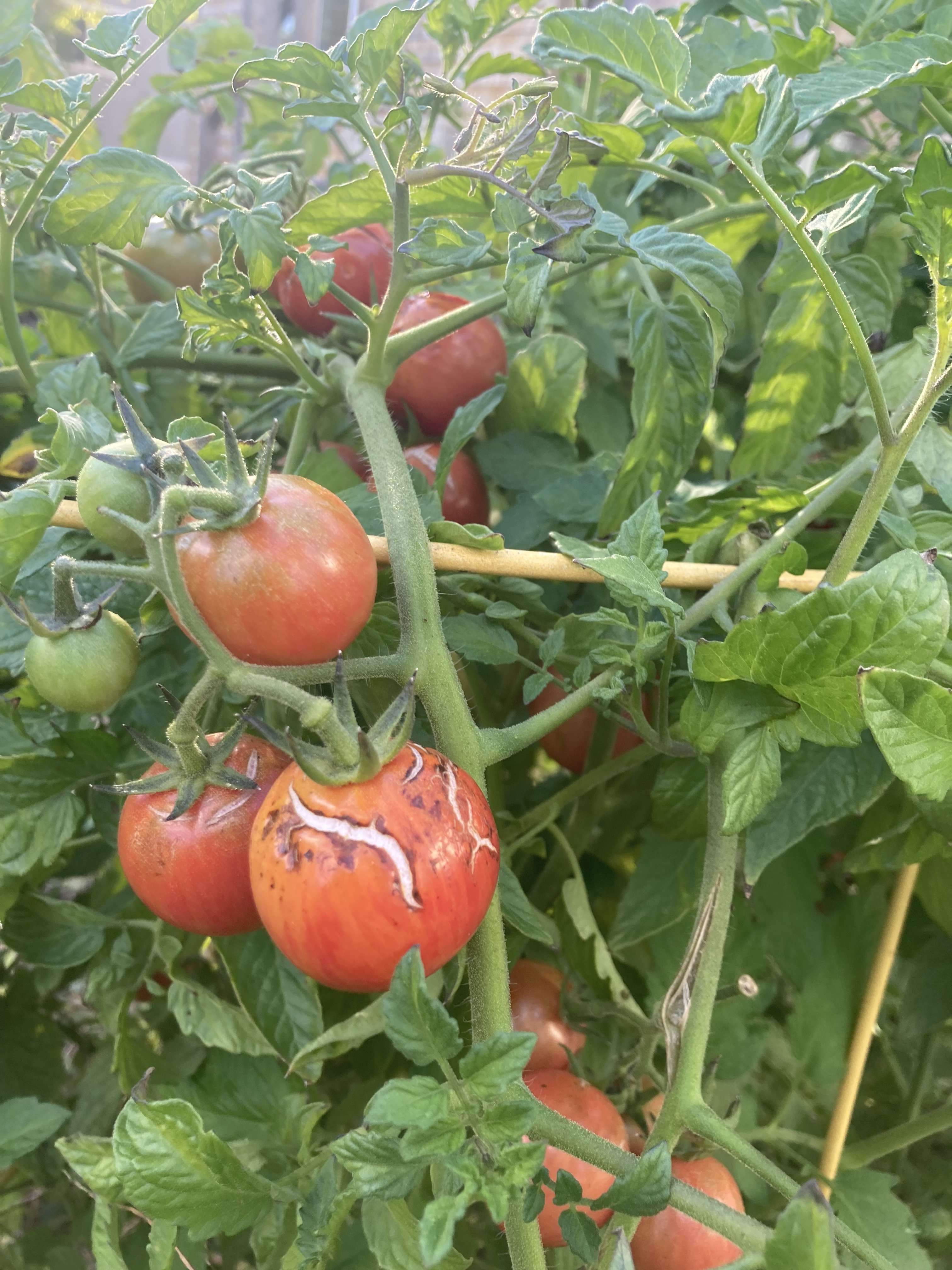
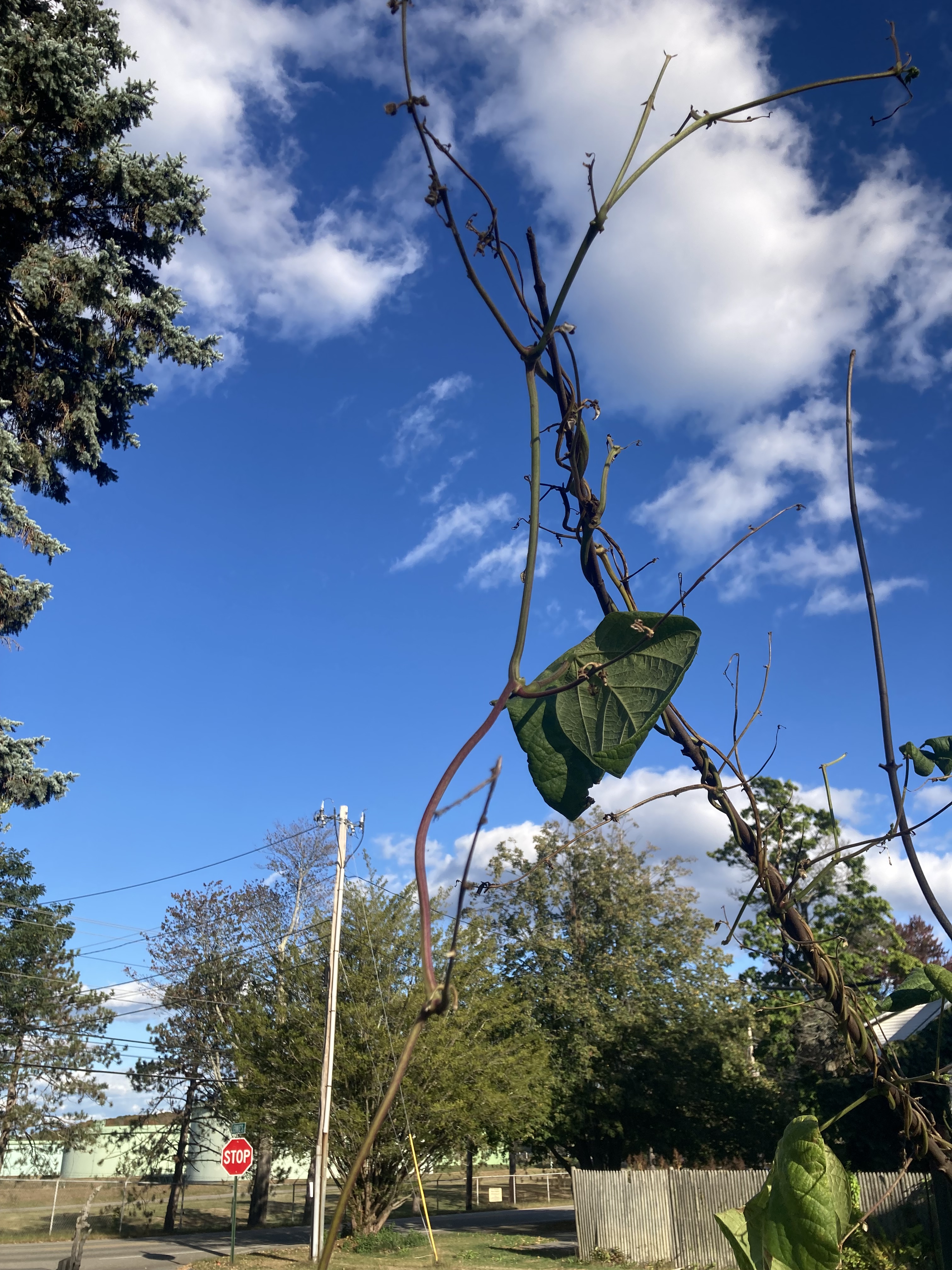
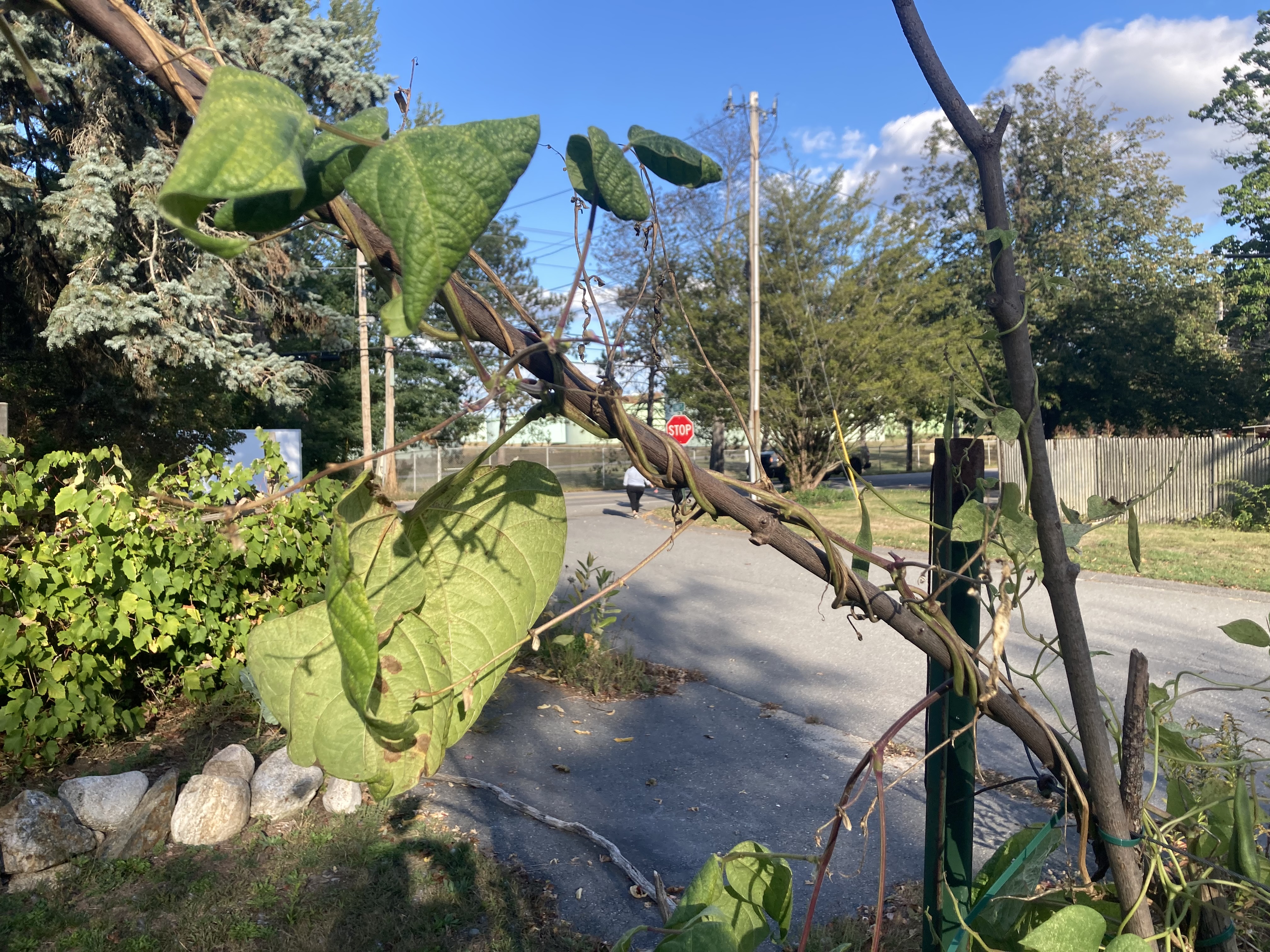
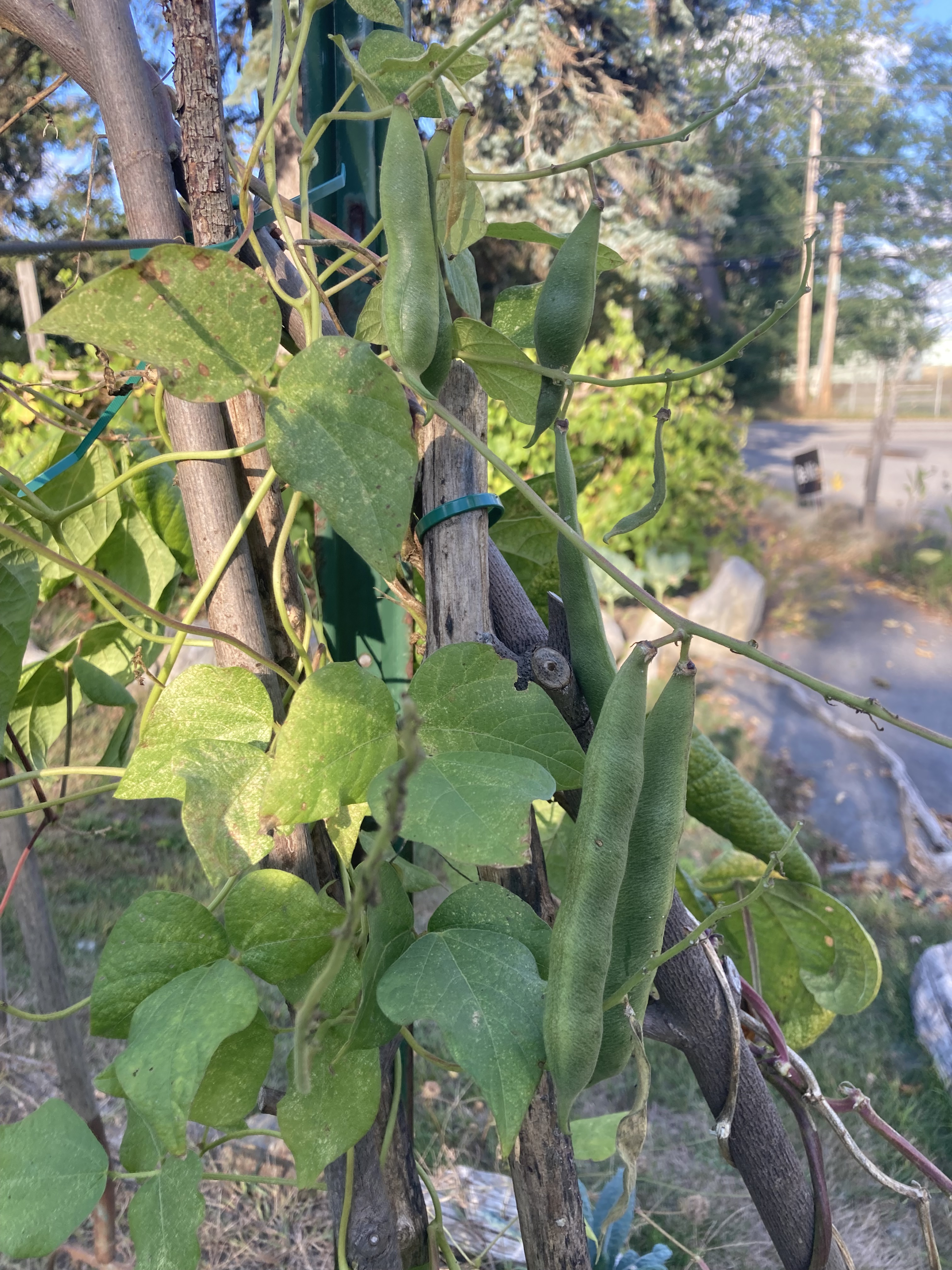
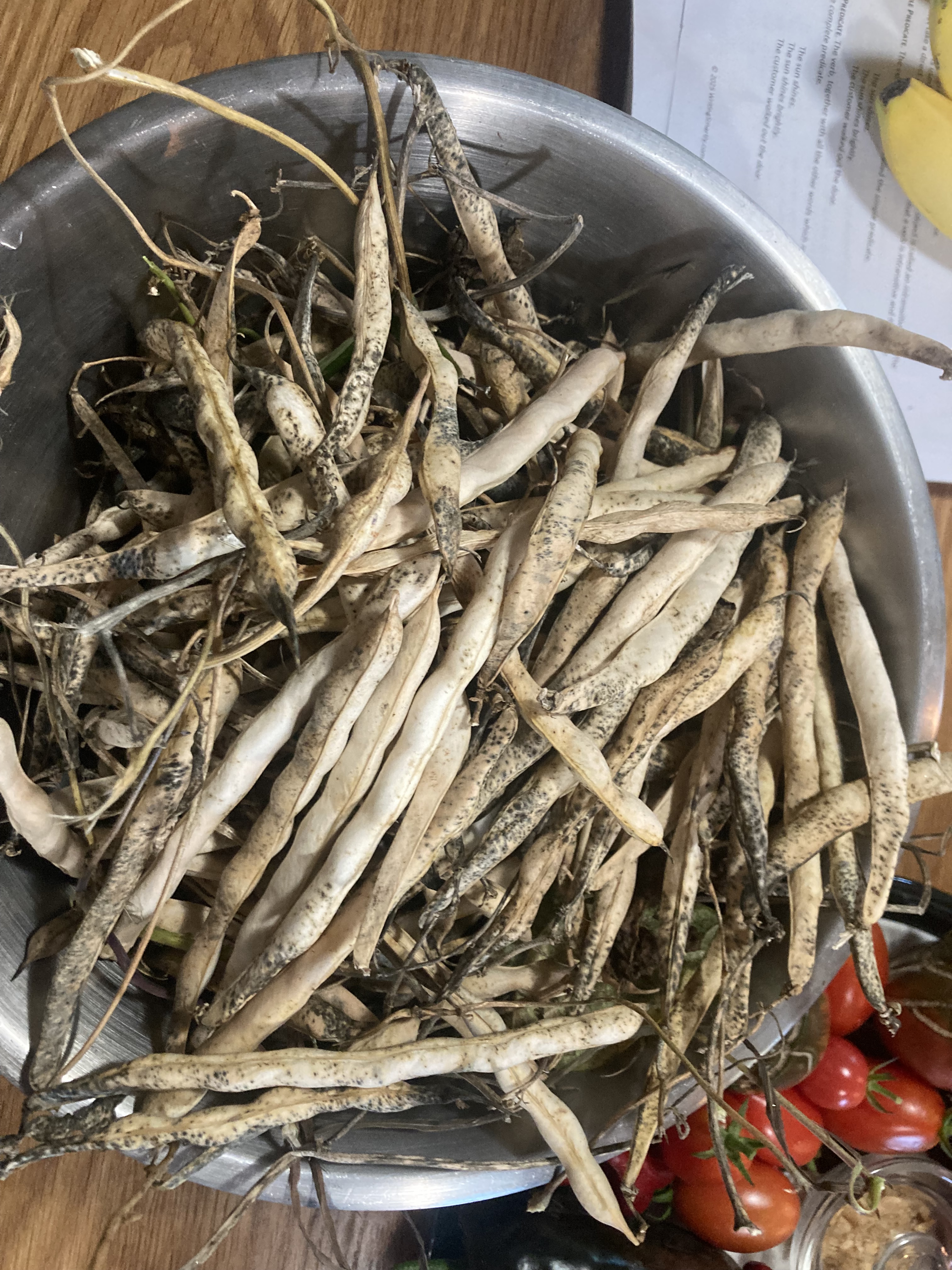
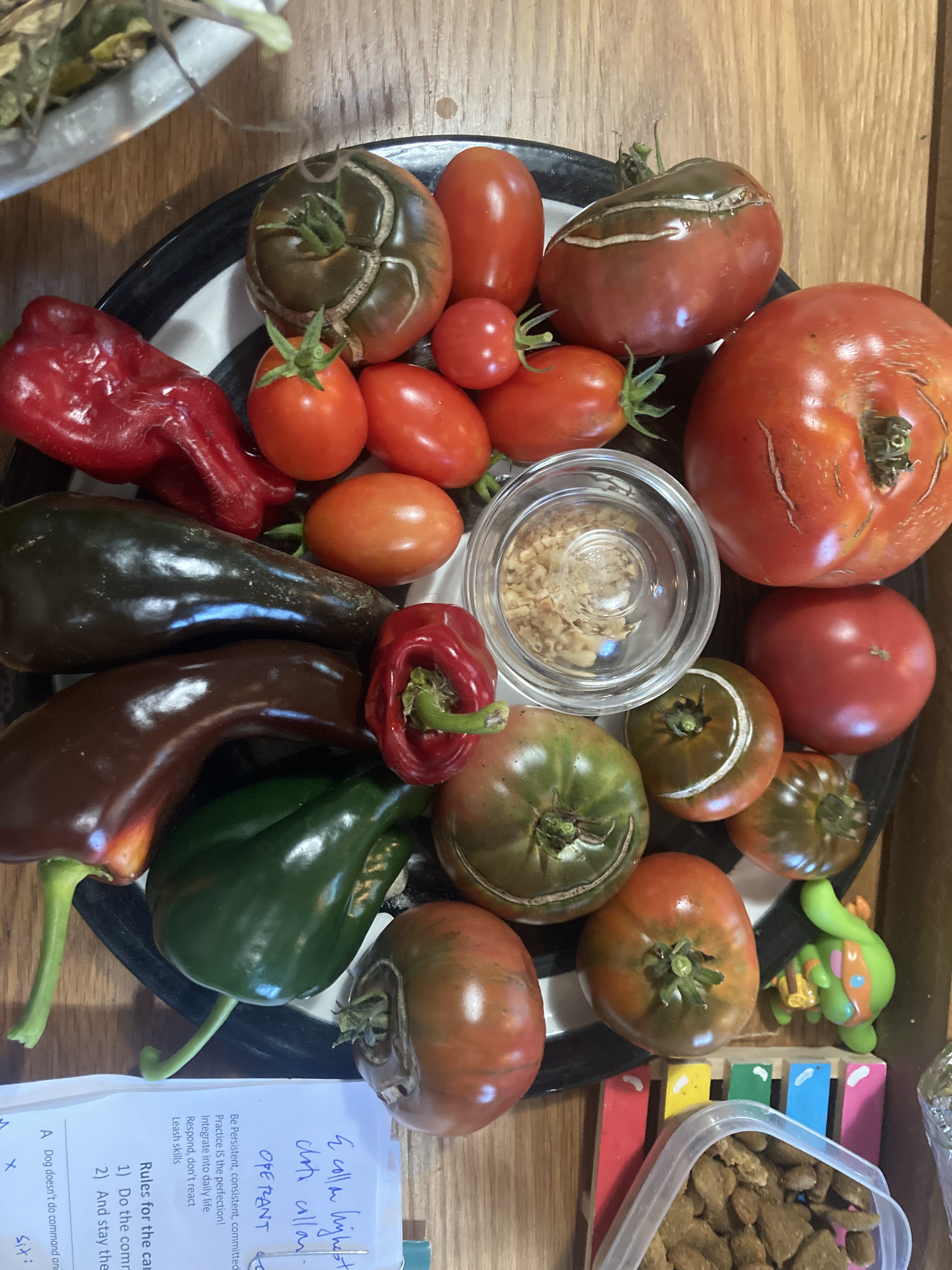
It is October and we glean the garden. Beans harvested, are shelled, put up for winter.




God of the Vine
Posted: September 19, 2025 Filed under: Art & Healing, consciousness, In the Kitchen, Little Green Thumbs, What is an Art Farm | Tags: ancient-greece, Dionysus, feminism, Lou Salome, Neitzsche, Rodin 1 Comment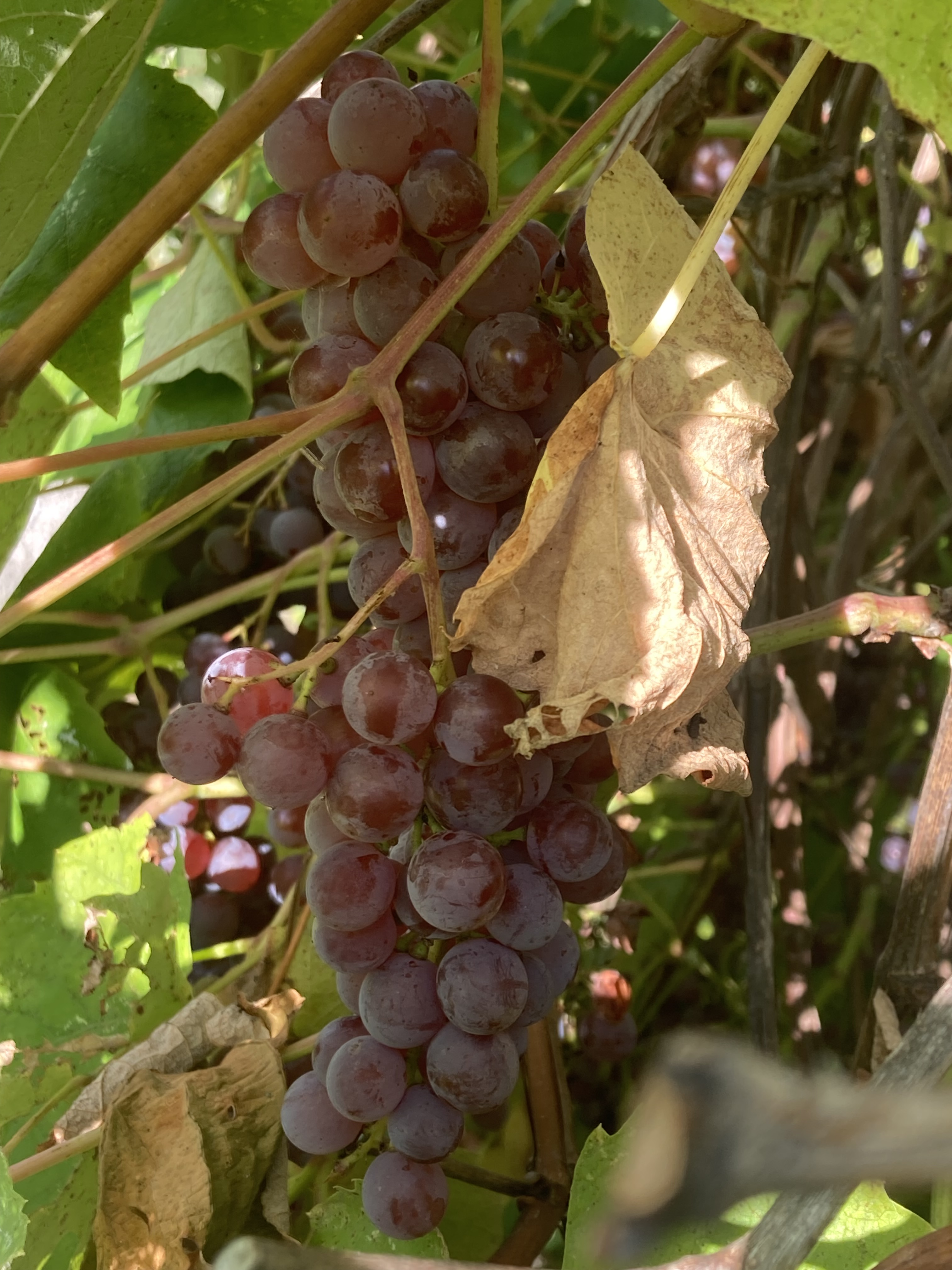
In the annals of wise women, Lou Andreas-Salomé’s name is writ large. Born February 1861 in St. Petersburg, Russia to parents of French Huguenot and Northern German descent, she was the youngest of six children, the only girl. She attended her brothers’ classes learning Russian, German and French, rejected the orthodoxy of her family’s Protestant faith but embraced philosophy, literature and religion. She attended the University of Zurich – one of the few schools then accepting women – and studied logic, history of philosophy, ancient philosophy, psychology and theology.
At the age of 21 she met Friedrich Nietzsche, who immediately fell in love with her. But she rejected his advance, instead wanting to live and study as “brother and sister” and form an academic commune along with Paul Ree, a German author. Nietzsche accepted and they toured Italy with Salomé’s Mother.
One of the titans of German Philosophy, at the age of 24 Nietzsche had been named the Chair of the Department of Classical Philology at the University of Basel. He remains among the youngest tenured professors of Classics in the history of academia. His brilliance was to an extreme.
Walter Kaufmann, in his classic work “The Portable Nietzsche” wrote, “There are philosophers who can write and those who cannot. Most of the great philosophers belong to the first group. There are also, much more rarely, philosophers who can write too well for their own good – as philosophers.” Plato, he says is one example while “Nietzsche furnishes a more recent and no less striking example.”
Lou Salomé was his muse, which she later became to Rainer Maria Rilke – the great German poet – when he was the Personal Secretary to Auguste Rodin, one of the greatest stone carvers of all times, easily a peer of Phidias and the Ancient Greeks. In rarified artistic and intellectual circles, Lou Salomé was at the top of the game.
Dionysus is our subject, Salomé is our guide, but Nietzsche holds the key. Kaufmann wrote, “…few writers in any age were so full of ideas – fruitful, if not acceptable – and it is clear why [Nietzsche] has steadily exerted a unique fascination on the most diverse minds and why he is still so eminently worth reading.”
At the age of 25, Nietzsche wrote “The Birth of Tragedy” which is considered foundational, a revolutionary work of philosophy, aesthetics, and cultural criticism. His groundbreaking thesis argued that the greatest works of art – which define a society – combine the Apollonian (order, reason and form) with the Dionysian (chaos, ecstasy and raw emotion) into one complimentary whole. An example of the Apollonian would be Johann Sebastian Bach’s “Well Tempered Clavier” while Jimi Hendrix’s “Voodoo Chile” is Dionysian. The Burning Man festival is pure Dionysian.
Classical Greek Tragedy, he reasoned, reached the apex of artistic expression by using an ordered beautiful form to give voice to the primal, universal unity. Nietzsche wrote, “The two creative tendencies [Apollo and Dionysus] developed alongside one another, usually in fierce opposition, each by its taunts forcing the other to more energetic production, both perpetuating in a discordant concord that agon which the term art but feebly denominates: until at last, by the thaumaturgy of an Hellenic act of will, the pair accepted the yoke of marriage and, in this condition, begot Attic tragedy, which exhibits the salient features of both parents.”
The result was cathartic; life’s meaninglessness overcome through art. Aesthetics became more central than rationalism, with art and psychology moved to the core pushing metaphysics and science to the side. Nietzsche forged a new paradigm, and his writing influenced Sigmund Freud, who also happened to be a close friend of Lou Salomé.
Greek tragedy came to my mind when a young friend, she herself on the path to wisdom, recently brought fresh home-pressed grape juice to our house. Grapes are the symbol of Dionysus and the connection was clear: her grape juice was the elixir of the God.
Having picked Concord grapes by the bushel with our other friends Rebekah, Peter and Mason, she explained, “We picked the grapes individually, sent them through a masher, then Peter heated them up before sending them through the juicing machine. He tried in the press but it kept sending the juice everywhere so he switched to a tomato juicer. That seemed to operate more like a standard juicer.” In other words the must was strained into juice rich, dark and sublime. With our children, we all broke bread and drank of the vine, the form of the Last Supper transformed as testimony to the raw and primal essence which is the end of summer; a new tradition born.
Truths held self-evident at our Art Farm include “art predates agriculture” and “the purpose of life is healing.” The Dionysian speaks to that, which simple truth the grape juice made manifest.
Fecundity abounds and we are blessed.
Wild Maybes
Posted: September 12, 2025 Filed under: Art & Healing, Portfolio - David's work, What is an Art Farm 2 Comments
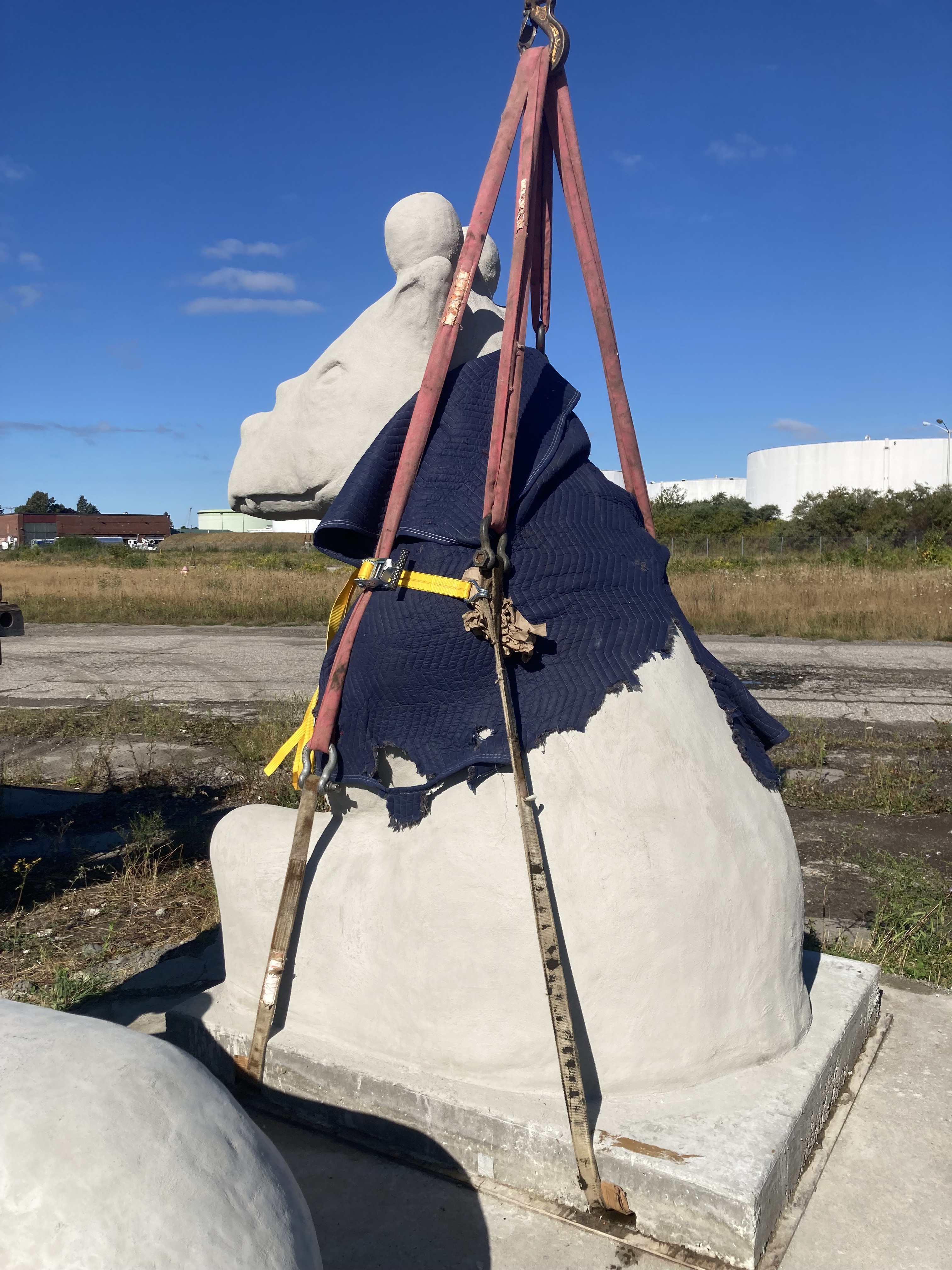
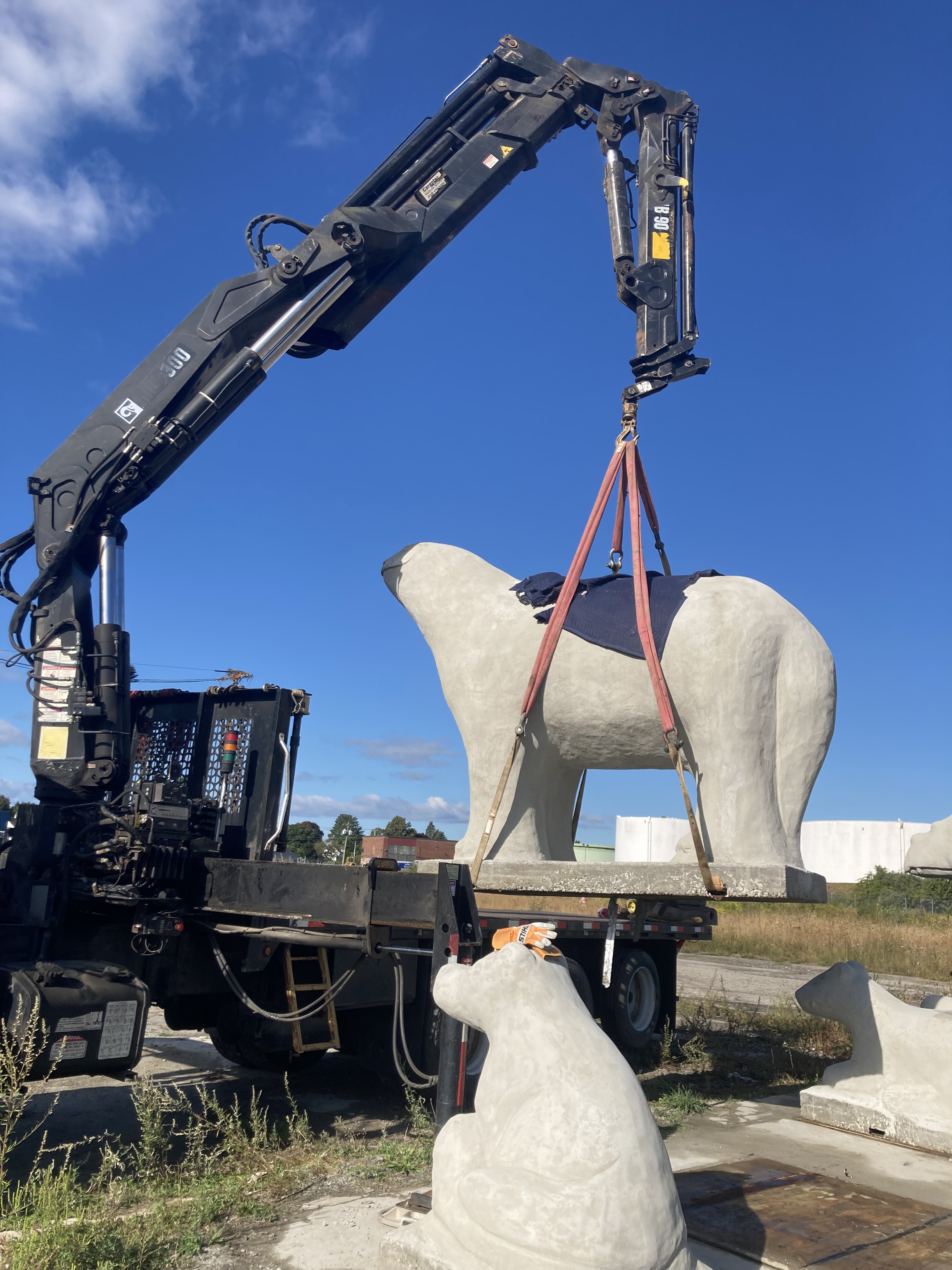
We interrupt our regular “Wise Women” programming to bring this special report of the “Wild Maybes of the Long Green Between.” The polymath maker, Chris Miller, has struck again, siting “visitors from an ancient Earth, as unknowable as the far future,” on the grassy knoll of Levine Park, in Waterville, Maine.
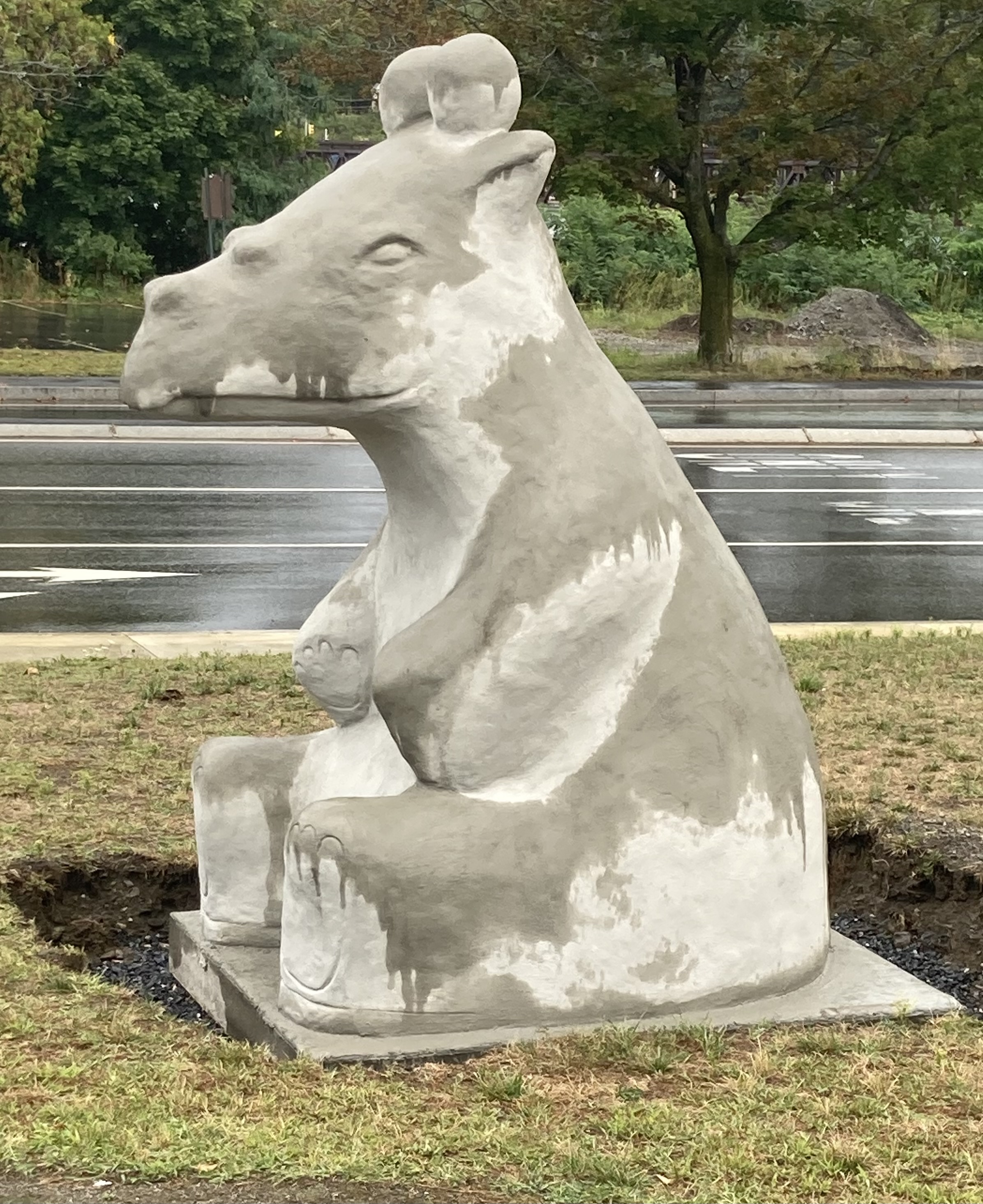
The Wild Maybes are “honorary crossing guards where the deep past and far future meet.” The public welcomed to roam “…in the richness and vastness of time beyond reckoning.” The four Maybes face the cardinal directions of North, East, South and West proudly beside the mighty Kennebec River as it flows ever to the Gulf of Maine.
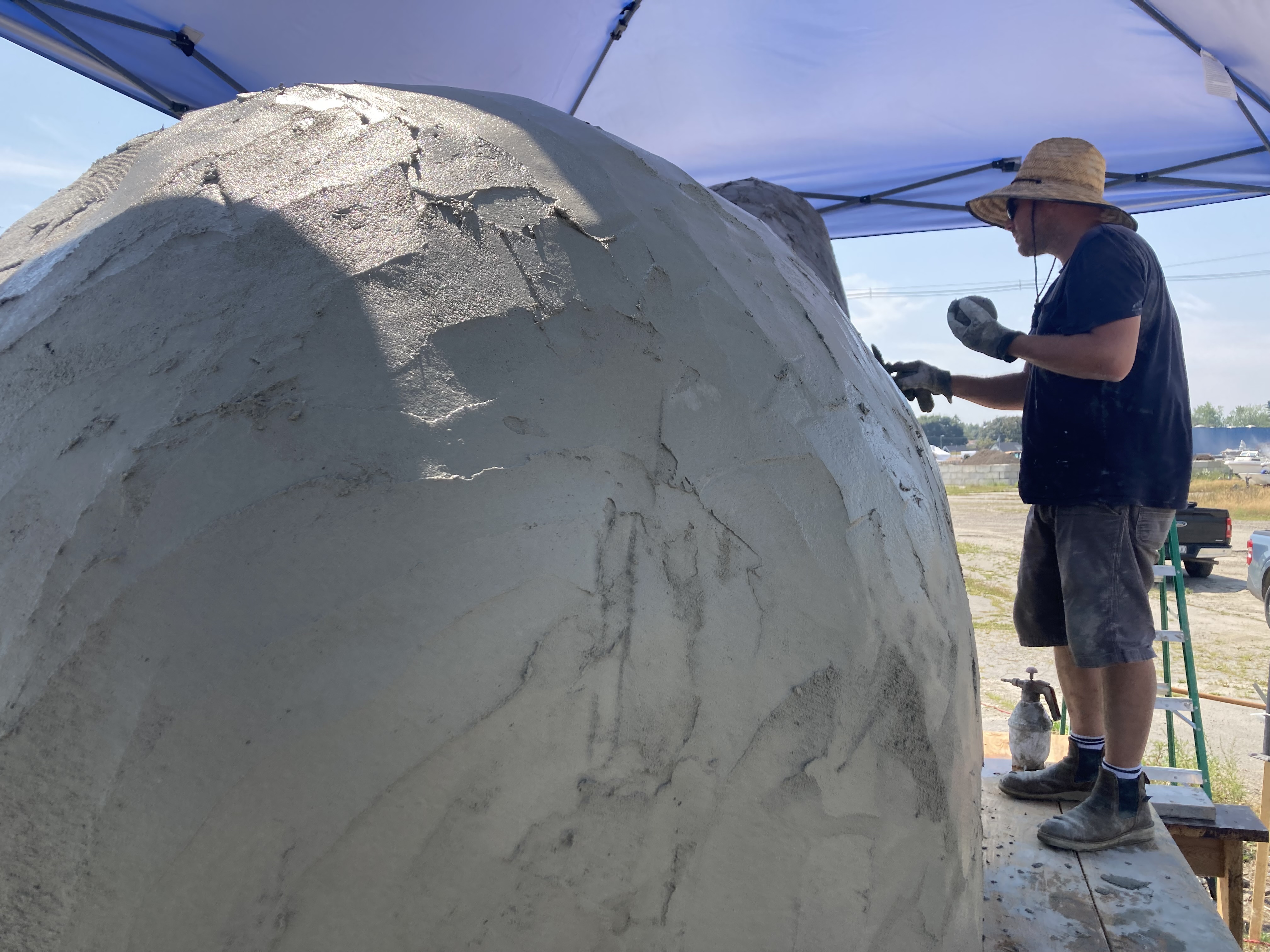
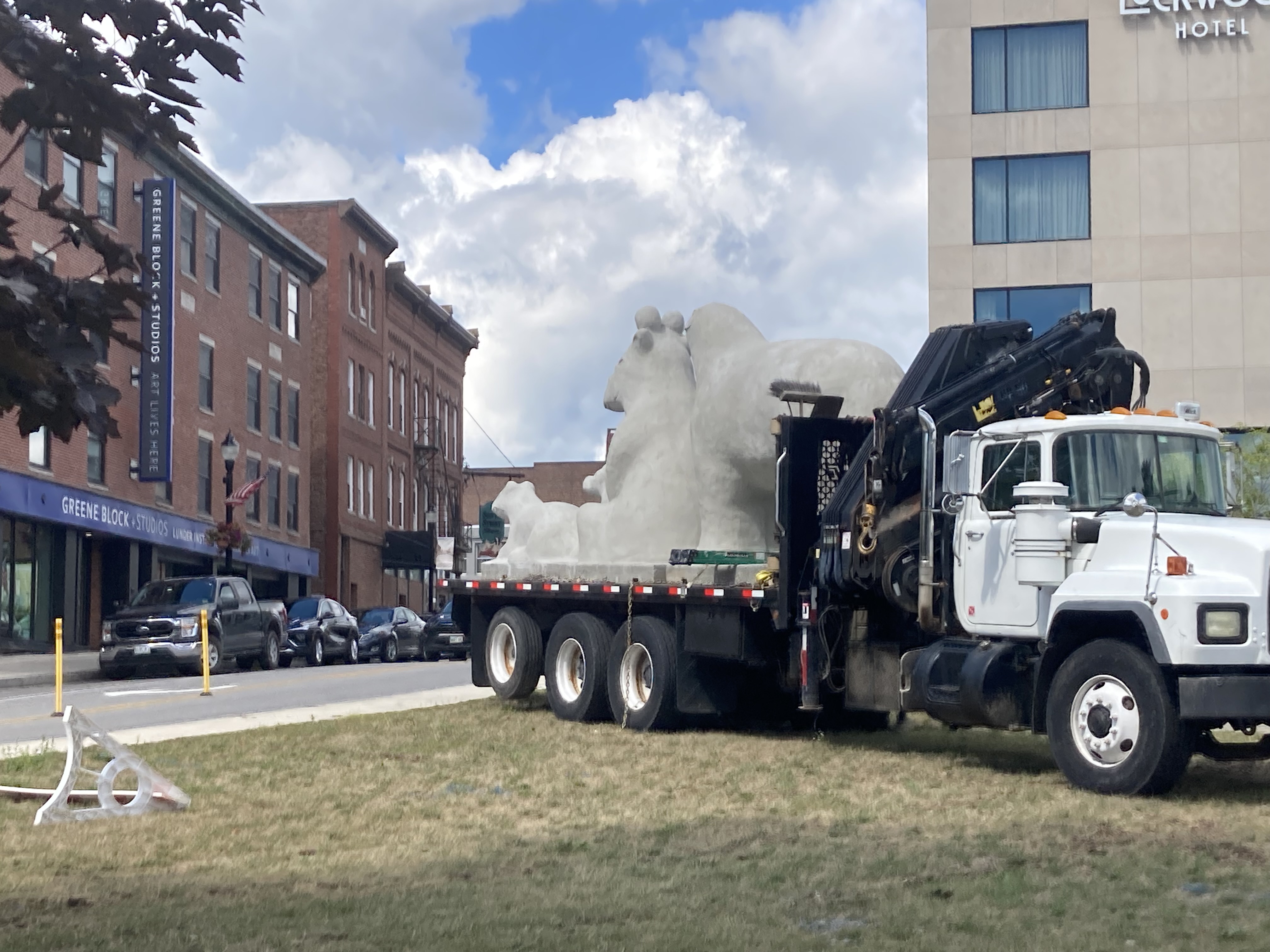
Modeled upon the earliest mammals, just post the dinosaur age, Chris conceived this public art installation as “a puzzle…based on shaky assumptions about dusty old bones.” They were made using a welded steel armature, foam, and structural concrete. I am honored to have been mere fabricator: building forms, cutting and stacking foam, mixing mud, troweling concrete, helping to load and then install: 15,000 pounds hauled 96 miles north.
There are four Maybes:
- Uni, the Uintatherium, a beast of the herbivorous Dinocerata mammal that lived in the now United States during the Eocene period;
- Eo, the Eocondon, of the triisodontid mesonychian genus that existed in the early Paleocene of Turtle Island (North America);
- Cory, a Coryphodon, named from the Greek “peaked tooth” an extinct genus of pantodont mammals, also local, speaking in terms of continents;
- Barry, a towering Barylambda, also of the pantodonts, from the middle to Late Paleocene era.

Tick-tock clock time is of man’s making, while Natura moves in other orbits. Chris wrote, “When 2.8 billion seconds ago (in 1934), historian Lewis Mumford pronounced that ‘…the clock, not the steam engine, is the key-machine of the modern industrial age,’ he went on to point out that there are still many other ways to mark time, and surely better ways to experience it. This long, narrow strip of grass, for instance, is a between place. It is the perfect kind of place to escape from the kind of time that is measured in seconds and minutes. Here in this long green between, time flows in seasons and eons, in eras and generations.”
And so Waterville is transformed, and kudos to them for stepping up, underwriting the permanent installation. What a marvelous life unfolds along the rocky coast, Northern terminus of the lower 48.
For more information about the Wild Maybes, click here: https://npdworkshop.com/wild-maybes









Maria the Jewess
Posted: August 22, 2025 Filed under: Art & Healing, consciousness, What is an Art Farm | Tags: alchemy, art, philosophy 1 Comment
In the 1st century CE, when Roman polytheism reigned supreme, the Jews were persecuted for their monotheism. In that age of male heroes, women were relegated to a second class. An alchemist would have been further still from conventional thought, but it was a trailblazing Jewish woman alchemist who began the intellectual tradition that Sir Isaac Newton would follow 15 centuries later.
Sir Isaac Newton, the paragon of the rational scientific male, in his day was a leading alchemist, when same was considered heresy, punishable by death by public hanging. Compelling then was this Jewish woman’s tradition. Newton transcribed more than 10 million words of notes, consisting of 16 folios, on the subjects of alchemy, religious and historical studies. And they were burned. So who was Mary the Jewess, also known as Maria Prophetissima and Maria the Copt and what did she know?
The Jewish Women’s Archive explains Maria “…was the first non-mythical Jewish woman to write and publish works under her own name. Maria is generally regarded as the first actual alchemist who is not a mythical figure. According to Zosimos of Panoplis, she started an alchemical academy in Alexandria, Egypt, and reportedly excelled at the process of transmutation of base metals into gold. Zosimos wrote a brief account of Maria’s philosophy, called The Four Bodies Are the Aliment of the Tinctures. Maria the Jewess invented several important pieces of chemical apparatus and was also known for a variety of mystical and alchemical sayings.”
Highly inventive, she used ovens made of clay, metal and glass, and formed gaskets using wax, fat, paste made of starch, and clay mixed with fat to seal the joints. Glass allowed the viewer to see the reactions, and allowed work to be done with mercury and sulfurous compounds. She may have been the first person to mention hydrochloric acid, and invented the double-boiler, known even today as the Bain-Marie, as well as the tribikos, a distillation still with three spouts, and the kerotakis, an extractor with a metallic palette inside a vacuum container holding vapors. According to Zosimos, she ground cinnabar [mercury (II) oxide] with mortars and pestles or lead and tin. Her fame endured in both Arab and European alchemy. The Kitāb al-Fihrist (Book Catalogue), by Ibn Al-Nadim in the late 10th century listed her among the 52 most important alchemists.
Her inventive spirit was surpassed by her writings. The “Axiom of Maria” states, “One becomes two, two becomes three, and out of the third comes the one as the fourth.” Carl Jung used this as a metaphor for the principium individuationis, the means by which one thing becomes distinct from other things. From Aristotle through Schopenhauer to Nietzsche this has been a fundamental concept in philosophy.
Concerning the union of opposites, Maria wrote: “Join the male and the female, and you will find what is sought.” As yin and yang define the whole, Maria was ahead of her time. Zosimos of Panopolis, the alchemist and Gnostic mystic, claims that Maria was a peer of Hermes Trismegistus who famously wrote, “As above, so below.” It is said that Maria taught Democritus, the Pre-Socratic philosopher, renowned for formulating an atomic theory of the universe. Reportedly they met in Memphis, Egypt, during the time of Pericles.
For the Greek alchemists ὕδωρ θεῖον, was both divine water and sulphurous water with the alchemical vessel imagined as a baptismal font, and the tincturing vapours of mercury and sulphur likened to the purifying waters of baptism, which perfected and redeemed the initiate. It would seem that the Christian rite of baptism bears alchemical roots.
All rivers lead to the sea, so too the River Jordan, where a woman Jewess holds a baptismal place at the delta basin, whereto wisdom flows down like the rain: as above, so below, indeed. Peace to all.
___________________________________
Credit where credit is due: David Purpur, again. Elena Benham, again. While Gaia gifts us, abundantly…




Samsara
Posted: August 1, 2025 Filed under: Art & Healing, consciousness | Tags: Bardo Thodol, buddhism, samsara, The Work That Reconnects 1 Comment
One bright light has passed, one wise woman who lived at the vanguard. “A wild love for the wild” she lived and saw this time as “a great unraveling toward a life-generating human society.”
An environmental activist, author and scholar of Buddhism, general systems theory and deep ecology, her husband was a Russian scholar and they worked with the CIA in post-war Cold War Germany and then moved to India, where her husband was leading the nascent Peace Corps at the time when the very young Dalai Lama arrived into exile. A life was lived!
As a practicing Buddhist, she understood that life inherently is filled with suffering, that suffering arises from attachment and desire, but suffering can be overcome. Her path to the end of suffering became her teaching, which she called, “the Work that Reconnects.”
She has passed, and in the Buddhist tradition, the Bardo Thodol is now her path: “liberation through hearing during the intermediate state.” Known as “The Tibetan Book of the Dead” this describes the experience of consciousness at the immediate moment of death and the stages to follow during the 49 days of samsara, the “wandering through” between death and rebirth.
She is now – as I write – at day 11, immersed in the light, while her words speak still to we who remain on planet Earth. In a recent interview she said:
“I’m 92 now. I am in this 10th decade of my life. When I follow with rapt attention what is happening with the climate catastrophe, and with the mass extinctions of our siblings of in the creation of this world. I feel that there is, within me a sense that read through Rilke, the translations, and also very much through the work that I have been blessed enough to do called The Work That Reconnects, and that has starts the spiral journey that it is with gratitude. So much gratitude that what’s in it is that we are never abandoned. There is something for us to behold and be part of.
“And to be there, a great moment is there for us to be present. To this incredible moment, we’ve got to realize, we will realize, that we belong to each other. That’s coming forward now. How could we not harvest that understanding in this moment?”
She continued…
“…this sense of opening to the reciprocity of life. It’s a living world. When we cannot be sure, or even have the trust, that complex life forms will endure beyond the next few decades, we’re seeing a huge shattering of life itself. And, and yet having been with Rilke, his trust in life is still with me. So I trust being with life, even though life, the web of life might crumble, but then I’m still with it. I’ll be with it anyway, even in the crumbling. The song is so deep in him.
“For one person to care for another, that is perhaps the most difficult thing required of us. The utmost and final test, the work for which all other work is but a preparation. With our whole being, with all the strength we have gathered, we must learn to love. …As bees gather honey, so do we reap the sweetness from everything and build God.
“Well, it seems clear that we who are alive now are here for something and witnessing something for our planet that has not happened at any time before. And so, we who are alive now and who are called to, who feel called, those of us who feel called to love our world, to love our world has been at the core of every faith tradition, to be grateful for it, to teach ourselves how to see beauty, how to treasure it, how to celebrate, how, if it must disappear, if there’s dying, how to be grateful. Every funeral, every memorial service, is one where you give thanks for the beauty of that life or the quality of what. And so, there’s a need, some of us feel, I know I do, to what is, looks like it must disappear to say, thanks, you’re beautiful. Thank you, mountains. Thank you, rivers.
“And we’re learning, how do you say goodbye to what is sacred and holy? And that goodbye has got to be in deep thanksgiving for having been here, for being part of it. I kind of sound like I’m crying, and I do cry, but I cry from gladness you know. I’m so glad to recognize each other. You can look in each other’s face. See how beautiful we are. It’s not too late to see that. We don’t want to die not knowing how beautiful this is.”
She translated Rilke, the German poet, who saw death as an integral part of the life cycle, as a transformative force that can lead to spiritual growth. Rilke said, “But we must accept our reality and all its immensity. Everything, even the unheard of, must be possible within it. This is, in the end, the only courage required of us. The courage to meet what is strangest and most awesome.”
The soul last known as Joanna Macy met life with an extraordinary courage, and encourages us to follow that path. She has moved onward, to the furthest yet.
Quiet friend who has come so far,
feel how your breathing makes more space around you.
Let this darkness be a bell tower
and you the bell. As you ring,
what batters you becomes your strength.
Move back and forth into the change.
What is it like, such intensity of pain?
If the drink is bitter, turn yourself to wine.
In this uncontainable night,
be the mystery at the crossroads of your senses,
the meaning discovered there.
And if the world has ceased to hear you,
say to the silent earth: I flow.
To the rushing water, speak: I am.
Sonnets to Orpheus II, 29 Rainer Marie Rilke, translated by Joanna Macy
_______________________________
Credit where credit is due: David Purpur opened the Tibetan Book of the Dead and the Egyptian Book of the Dead so many decades ago, and expanded the boundaries of my thought. An interview with Joanna Macy from the podcast On Being can be heard here:
https://podcasts.apple.com/us/podcast/on-being-with-krista-tippett/id150892556?i=1000661063451
___________________________________
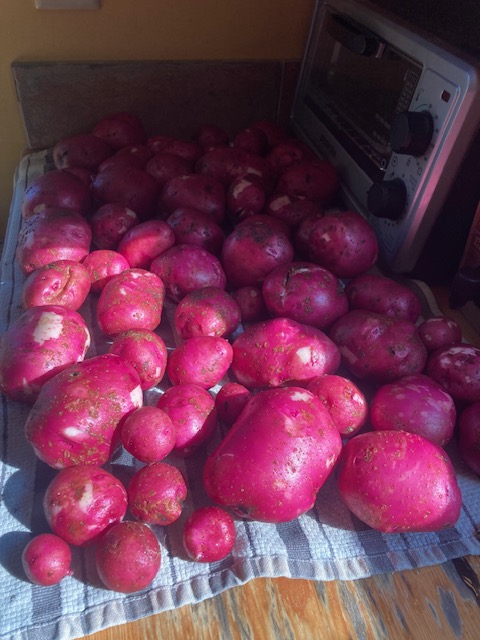
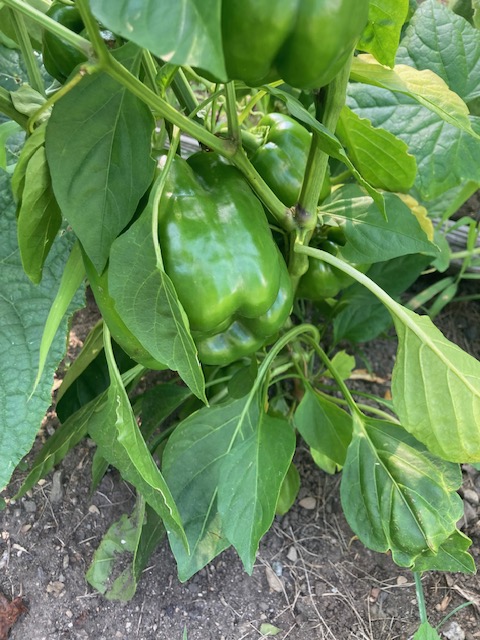
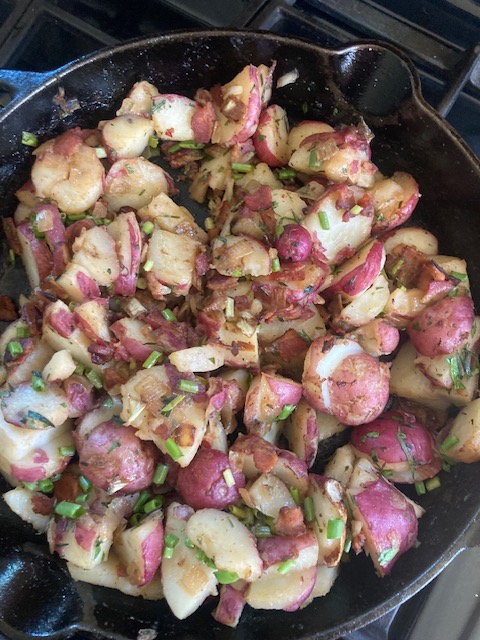
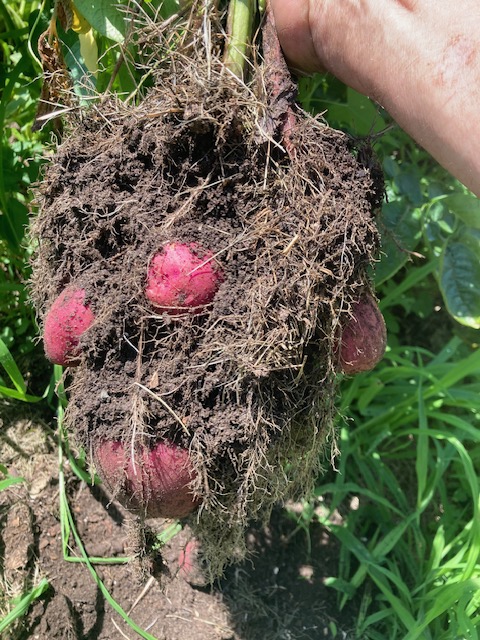
Garlic now hangs to cure, onions and potatoes have been harvested and turned into German Potato Salad, cucumbers into Bread & Butter or Caraway pickles, tomatoes into a delicious balsamic relish. Abundance reigns.




It Came to Pass
Posted: June 20, 2025 Filed under: Art & Healing, Chronicles of a First Time Parent, consciousness | Tags: CG Jung, hanged man, Isaac Newton, Ryder-Waite, saint paul of the cross, tarot 1 Comment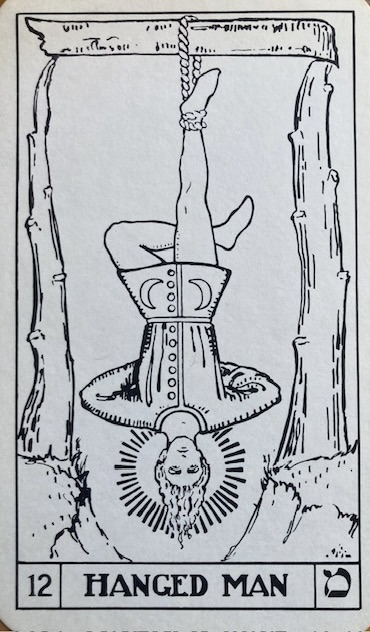
We ended our homeschool science class with the study of tarot. Some may say this is heresy, that tarot is not science, but I defy that line of reasoning. Consider these facts:
- The word “science” is derived from the Latin word “scio” which means “to know” or “to understand.” My son shall be raised to have broad, not narrow, understanding.
- Sir Isaac Newton, the paragon of the rational scientific method, was a lifelong alchemist. The Renaissance alchemists pursued rigorous empirical observation and experimentation; the notion of “active principles” that repel and attract arguably contributed to the theory of universal gravitation.
- Carl Jung, founder of “analytical psychology,” developed the concept of the collective unconscious, which resonates clearly with the tarot’s imagery. At the C.G. Jung Institute, he supervised research on the importance of tarot.
Such then, when I asked my son to pull one card from the Ryder-Waite deck, the “Hanged Man” emerged. At the age of 12, my son pulled card 12 from the deck. Jung referred to this as a synchronicity; events that coincide in time and appear meaningfully related, yet lack a discoverable causal connection. “Causal” speaks to the rational mind, but we were plumbing the subconscious.
At the age of 12 my son comes of age, which is a physical bodily experience as well as a deeply emotional and psychological transformation. Card #12 deals with beliefs that are stored in the subconscious mind, what is handed down. The Hanged Man represents a breaking away from that tradition. As my son comes of age, he becomes his own man.
Carl Jung believed that the archetypes are deeply embedded in the human psyche, and have emerged in the form of religious narratives. Saint Peter, the “Rock” upon which the Catholic church has been built, reportedly was hung upside down, by the Roman Emperor Nero. The hanging took place near the “Circus of Nero” close to the present day Saint Peter’s Basilica. The Cross of Saint Peter, an inverted cross, remains a central image in the arms of the Holy See and the Vatican City.
Let us consider this symbol more deeply. In “Tarot” Paul Foster Case writes, reversal in Hanged Man is “a reversal of thought, a point-of-view which is just the opposite to the accepted by most persons. In this scientific age we know that everything is an expression of the working of the law of cause and effect. …Practical psychology shows the potency of ideas. It demonstrates conclusively the truth that thoughts are the seeds of speech and action, that interpretations are the patterns for experience, that what happens to us is what we have selected, whether the selection be conscious and intentional, or unconscious and unpremeditated.
“The central theme of the hanged man…is that every human personality is completely dependent upon the All, here symbolized by the tree. As soon as this truth is realized, the only logical and sensible course of conduct is a complete surrender. This surrender begins in the mind. It is the submission of the personal consciousness to the direction of the Universal Mind. That submission is foreshadowed even in the picture of the Magician, who derives all his power from above. Until we know that of ourselves we can do nothing, we shall never attain the adeptship. The greater the adept, the more complete his personal self-surrender.”
Saint Peter of the Cross, in founding the Church during the Roman Empire, most definitely followed “a reversal of thought, a point-of-view which is just the opposite to the accepted by most persons.” To pursue this further we drove to Western Maine, to sit with a Reiki Energy Master, a White Witch, and talk about the tarot. This Master, as a child, lived in Morocco, Athens and Cairo; living now in the Lakes Region she is not provincial but broad in her understanding.
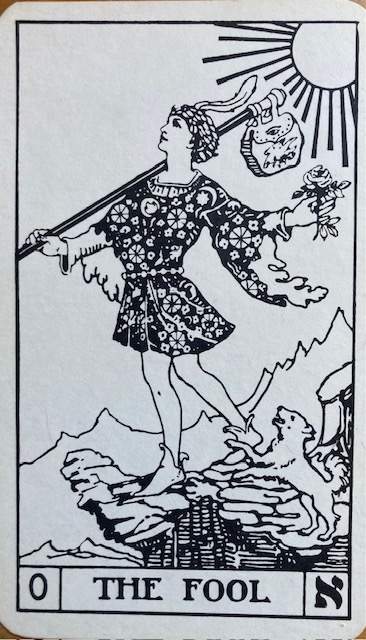
She explained that tarot is the journey to wisdom. The journey begins at 0, when you know nothing, and then you go through life. The Fool is ready to jump off the cliff. #1 the Magician has tools to become grounded, spiritual. #2 the High Priestess has intuition. #12 the Hanged Man is saying “take your time, there is no rush.”
She spoke of card #13 Death. She asked my son what he thought of death and he paused, then replied, “I think death is not good, it is bad.” She explained that death can be seen as a change, that all things must pass and transform. In that sense death is not bad, it is just change; it can be hard, very hard, but it is part of life. “The old self of the Hanged Man is changing. This is the death of the old way. Your Dad’s belief system will die off and you will choose your own.” She spoke about spirituality. My son explained that he had no religious practice. She encouraged a nature based approach. As my son comes of age, he will make many choices, his own.
Many cards had been lain on the table. As we cleaned up, the last card picked up was #13 Death. Again, synchronous, the Master commented, “You are all going through a transition.”
And so our season of homeschooling has ended.

Art Predates Agriculture
Posted: May 16, 2025 Filed under: Art & Healing, consciousness, What is an Art Farm | Tags: authors, ethics, history, philosophy 2 Comments
Civilization began, it is widely believed, with the advent of agriculture. The time was around 10,000 BC and the place was the Fertile Crescent, which is the present day Middle East. Sheep and pigs were first domesticated, followed by plants such as flax, wheat, barley and lentils. The nomadic hunter-gatherers settled into agricultural communities, developed irrigation systems and established permanent settlements.
It should be noted that this definition of “civilization” speaks to the cultures of the Abrahamic religions (Muslim, Judaism and Christianity). The Clovis culture, however, were precursors to the Indigenous peoples of the America’s, and between 15,000 to 20,000 years ago developed stone tools, as well as agriculture, engineering, astronomy, trade, civic and monumental architecture. Some established permanent or urban settlements, but all did not forsake their nomadic lifestyle. There is not one civilization, but many co-inhabiting this planet.
However civilization may be defined, the plain fact is long before we worked the soil to plant seeds, the hunter gatherers were digging to get clay and earth based pigments for painting the caves at Altamira and Lascaux; art making predates agriculture, which is to say it predates civilization, which speaks to its fundamental role in shaping human life. Mark making is meaning making, hard-wired in our DNA, the act of making is a core means of problem-solving, both utilitarian and ideational.
Ellen Dissanayake is an ethno-anthropologist whose writings synthesize disciplines ranging from evolutionary biology to cognitive and developmental psychology. She lived for fifteen years in non-Western countries (Sri Lanka, Papua New Guinea, India and Nigeria) among indigenous pre-literate peoples and found that all shared the trait of embellishing their tools in non-utilitarian ways; the act of “making pretty” is consistent across the globe. This lead her to develop “…a unique perspective that considers the arts to be normal, natural, and necessary components of our evolved nature as humans.”
Far more than practical, the act of making is healing. Art therapy is based upon this insight, which, since the 1940s, has been used in conjunction with traditional psychotherapy, to provide a non-verbal avenue for exploring emotions and experiences. The simple act of making can help treat a wide range of mental health issues and support emotional well-being, based upon the interconnectedness of mind, body, and spirit.
Works of art such as the Sistine Chapel, a human achievement of extraordinary scale, can be overwhelming and lead most of us to cower, and say “I can’t draw.” But that seems ego-driven, as we are schooled in a comparative and competitive paradigm, which blocks the fact that art making is biologically and psychologically at the core of everyone’s individual life. Art, and the act of making, become the great equalizer.
One of the lessons of carpentry – which is to say making in the practical sense – is that adverbs and adjectives do not pertain; the wall is plumb or it is not, the corner square or it is not, the house will long endure or it will not. There is something exquisitely liberating in that plain fact. More “sophisticated” professions do not fall under this simple truth, for example, politics and the law are based upon argumentation and persuasion rather than objective truth. The word “sophisticated” is derived from the Sophists, in Ancient Greece, who excelled in clever deception, using rhetoric to win arguments regardless of the truth.
In a world that is increasingly argumentative, clever and AI-interconnected, the simple act of making can become a grounding and centering force. Let us proclaim there are four necessities in life: food, clothing, shelter and beauty; “making pretty” creates beauty while making becomes the means to achieve all the former. And all of which become an act of healing.
___________________________
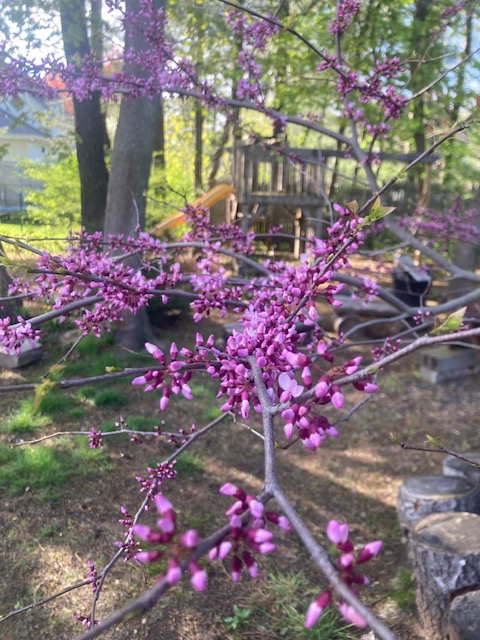
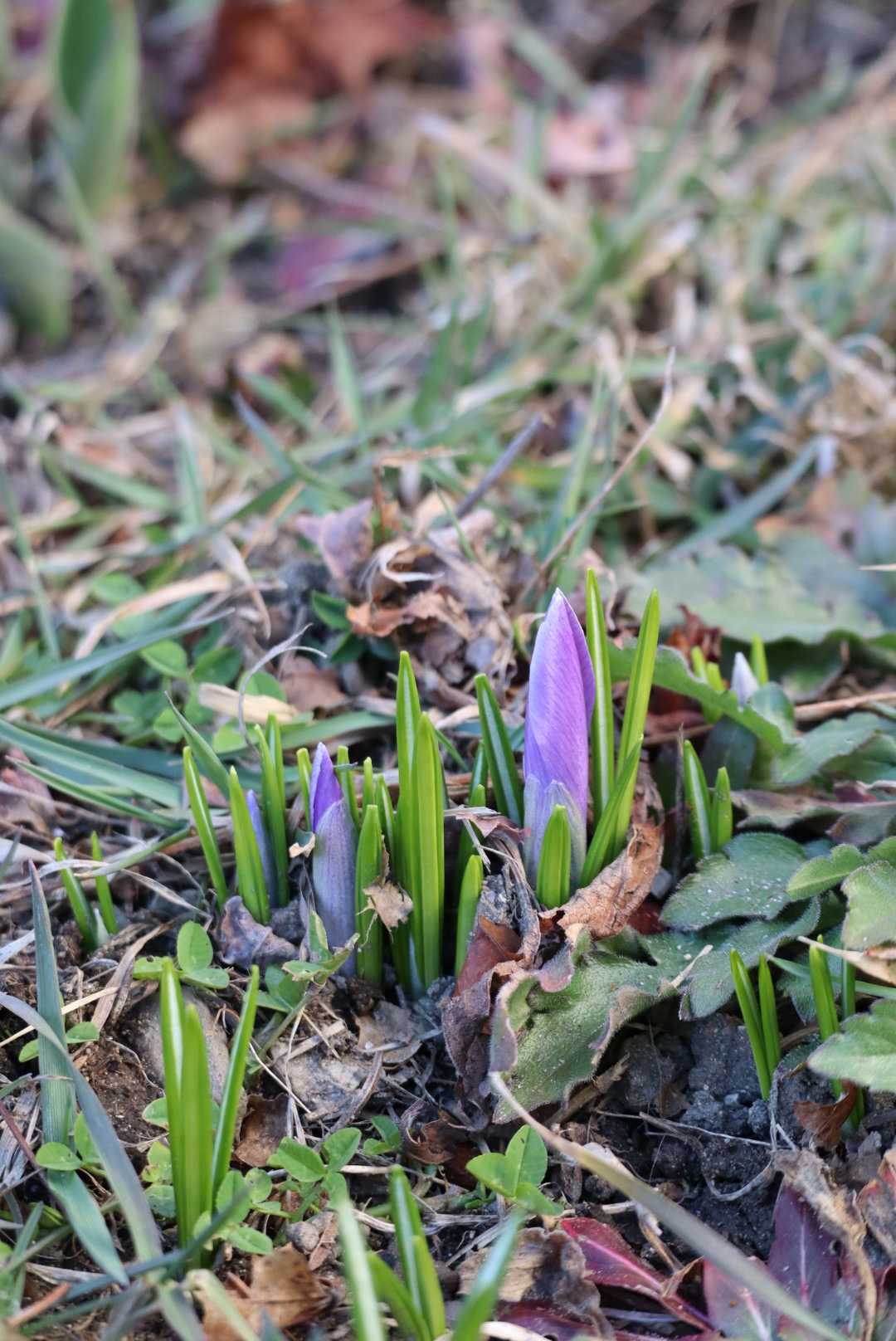
Plants push up, fruit trees blossom, and pollinators abound!




A Wily Problem Solver
Posted: March 28, 2025 Filed under: Art & Healing, Chronicles of a First Time Parent, consciousness | Tags: greek-mythology, Helen, Homer, MMA, mythology, Odysseus, odyssey, pankraton 1 Comment
The desire of the Tech Oligarchs to fight and break things is widely known, clearly displayed. Among this rogue band of Billionaires the intellectual appears to be Marc Andreessen, co-creator of the Mosaic web-browser and co-founder of a Silicon Valley venture capital fund.
On Substack, Mr. Andreessen has written, “I was asked what I think of Mark Zuckerberg’s recent Mixed Martial Arts (MMA) training, Elon Musk’s challenge to a cage fight, and public reports that a Zuckerberg/Musk MMA fight may well happen…perhaps in the actual Roman Colosseum. I said, “I think it’s all great. …it’s important to understand how important – how primal – MMA is in the story of our civilization.”
He proceeds to tell the origin of the sport, “…it was introduced to the actual Greek Olympic Games in 648 BC (!). The Greeks called it “pankration” (παγκράτιον), but it is the same thing – a combination of boxing and wrestling.” Trying to impress us by using the Greek letters – Google Translate is free – in fact Mr. Andreessen is showing his lack of understanding.
The rape and abduction of Helen is central to Greek culture; masculine strength and dominance were key, and the Iliad tells the story of the ten-year fight against the Trojans. Helen’s beauty was so great, her “face that launched one thousand ships” when Menelaus, her husband, the King of Sparta, rallied the Greeks to settle the score for her infidelity.
The Iliad sings the praise of manly heroes skilled in fighting and warfare. But the greatest among the heroes was Odysseus, whose skill was not warfare but resourcefulness, his wily, cunning ability to solve problems.
Of Homer’s two epic poems the Iliad is an ensemble story, while the Odyssey sings of Odysseus, alone, his ten-year homecoming after the Trojan War, his return to Penelope and their marriage bed.
During the War, Odysseus was one of the most trusted counselors and advisors. A voice of reason, renowned for self-restraint and diplomacy, he served as a counter balance to the pugilism among the heroes. His homecoming was filled with travail, the hero’s journey in the most archetypal sense. Consider the challenges he overcame:
- When Achilles’ beloved Patroclus was slain, Odysseus negotiated with Achilles to let the men eat and rest, rather than resume the fight. Funeral games were held and Odysseus wrestled with Ajax “The Greater” and raced with Ajax “The Lesser.” He drew the wrestling match, and with the help of Athena, won the foot race. His manliness well-equaled that of other heroes.
- Odysseus devised the Trojan Horse, and lead the siege within the walls of Troy. This brought the defeat of the Trojans, and the end of the war.
- Homebound from Troy, his ships were driven off course and captured by the Cyclops Polyphemus. He and the Cyclops drank much wine, which allowed Odysseus to blind him and then escape.
- Aeolus, the master of the winds, gifted a leather bag containing all of the winds except the west wind, to ensure his safe trip home. But his sailors opened the bag while Odysseus slept, releasing the winds to create a major storm, driving them off course, when his homeland was within sight.
- They re-embarked and encountered the Laestrygonians – man eating giants – which only Odysseus’ ship escaped. Circe the witch-goddess turned half of his men into swine, then Odysseus and his remaining crew spent one year with her enjoying feast and drink.
- He set sail to the western edge of the world, summoned the spirit of the prophet Tiresias and learned of Penelope threatened by suitors. He sailed onward, past the land of the Sirens, through the dire straits of the Scylla and Charybdis, after which his crew hunted down the sacred cattle of the sun god Helios. A shipwreck followed, in which everyone except Odysseus drowned. He washed ashore, whereupon Calypso, a sea nymph, compelled him to remain her lover for seven years.
- He escaped, set sail, shipwrecked again but befriended the Phaeacians, whose King agreed to deliver Odysseus home, to a hidden harbor on Ithaca, his home island.
- Home after 20-years, he sleuthed the island to learn the status quo. His son Telemachus, now a grown man, also returned from the Trojan War, theirs was a grand reunion, of secrecy.
- His wife Penelope, having held at bay her suitors for decades, announced that whoever could string Odysseus’ rigid bow and shoot an arrow through twelve axe shafts should have her hand in marriage. Dressed as a wandering beggar, Odysseus alone strung the bow and won Penelope’s hand, once again. He and Telemachus, his son, easily slayed the suitors.
- Penelope still could not believe her husband had returned, and so tested him with a ruse: she ordered her servant to move the bed in their wedding chamber. Odysseus protested, knowing this could not be done as he himself had built their wedding bed and knew that one of its legs was a living olive tree. Rooted deeply into the ground, such was the union of Penelope and Odysseus, which survived 20 years of separation.
- To avenge the killing of the Suitors, the citizens of Ithaca rose up, but Athena and Zeus intervened and both sides made peace; after 20 years’ destruction the Odyssey ends with peace and reunion.
In 431 BC, Sparta attacked and defeated Athens, with the justification that “might makes right.” And now, Mr. Andreessen praises the primal, “If it was good enough for Heracles and Theseus, it’s good enough for us. Fight!”
But the apex of Classical Greece – the birthplace of democracy – was the Athenians’ understanding of virtue. From Socrates, to Plato, to his student Aristotle, civic virtue – “arete” – emphasized justice, courage, and moderation for the benefit of the community, rather than the individual. To the Greeks, the most enduring heroic quality was not skill in warfare, but cunning command to solve problems for the civic good.
Elon Musk, called “the smartest 15-year old on the planet,” holds now the keys to the American kingdom. For better or worse, our House seems reduced to Animal House. The tech bros – the puer aeternus – shine in their moment to break and destroy with libertarian glee. But this moment of breaking shall pass – all things pass – and great then shall be our collective need to problem solve.
We the people must rise to the coming moment.
______________________________






Kennebunkport Patrician, Red-Neck Riveria, Skull Valley
Posted: February 21, 2025 Filed under: Art & Healing, Chronicles of a First Time Parent, consciousness, Portfolio - David's work, What is an Art Farm | Tags: history, nature, photography, travel 2 Comments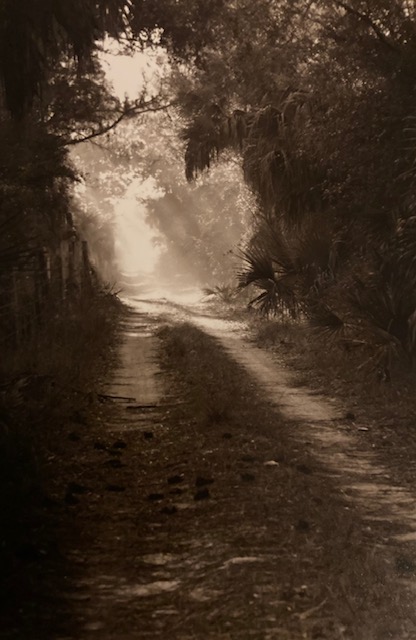
RMG Consultants, Inc. was mission driven, not pursuing rational self interest as conventionally defined. Rob’s mantra was to remain “ruthlessly objective” and have no conflicts of interest. We served the library as civic institution of learning and education.
Douglas became a corporate officer, with increasing responsibilities, was named Vice President of Operations and Treasurer of RMG Consultants, Inc. He encouraged Rob to pursue the for-profit sector and so they launched Infostrat, Inc., then formed an Australian-based company, RMG/CAVAL to pursue the Austral-Asian market. Douglas became an officer of those entities.
On the home front, I had left the barrio, moved north to Rogers Park, on the lakefront. Brian had graduated from Cornell College with a Bachelors of Arts in Economics and Political Science, moved back to Chicago, full-time at RMG, and lived with me. Douglas also moved to Rogers Park, but found a studio apartment off Howard Avenue, at the El terminus. I believe there was a crack house across the hall, and once he heard gunshots while walking on Howard Avenue. We were on very opposite sides of Sheridan Road.
In January 1991, the first patrician from Kennebunkport, Maine announced that Operation Desert Storm – the First Iraq War – would be televised live; we all pulled up chairs around the TV. Tal Lekberg, my carpenter friend, was in the Coast Guard and had been called to active duty in the Persian Gulf. Not knowing if he would return home alive, he brought his entire collection of single malt Scotch Whiskey to our apartment – at least two dozen bottles – asking me to safeguard it. “It’s okay if you drink it. Maybe some will remain if I return.” Like a fox guarding the hen house, we heartily imbibed while watching the destruction of the cradle of civilization, in pursuit of the quest for oil.
December 1991, Douglas and Laurie had decided to get married, and Douglas pined to be wed in Paris, at the Cathedral of Notre Dame, I as their witness. It made great sense and we all bought tickets, flew across the pond; I arrived first, Douglas and Laurie a day or two later. A friend arranged an apartment for me, and Laurie knew someone from the U of C who had a flat there. We met and celebrated love in Paris, when we were young and all life easily opened before us. But Notre Dame was not so easily scheduled and the wedding did not take place. We took the train south to Chartres, and beside the Cathedral I ran the table at a bakery beside the nave doors. I bought one of everything and together we ate pastries, at the foot of Chartres Cathedral. It was grand. Essentially they were married then, but officially it took two months more.
In February 1992 Douglas and Laurie got married. In April I moved off-grid, to Holmes County, Florida’s “red-neck riviera,” to a swamp along the Choctawhatchee River. Such was the synchronicity of the times, that even the swamp had a role in library automation.

In the tradition of eccentric booksellers, Bob Allenson seems worthy of mention. He is a third-generation bookseller of religious literature but his passion is making bibliographies of rare antiquarian books; his “John Henry Newman, 1801 – 1890: A Preliminary Register of Editions from 1818 to 1890, Together with Original Editions Published Posthumously” is the definitive catalog of Newman’s work. Sometime in the 1980s he was hired by the American Theological Library Association to select the texts that would be digitized for their online corpus of theological literature. Bob was still working on that when I moved there.
Alec R. Allenson, Inc., was launched in London, then relocated to Baltimore, Maryland and eventually to Naperville, Illinois. Bob’s father was a businessman who created a successful company selling textbooks and research materials to Christian seminarians. Bob is a Quaker, committed to social justice who joined the March to Selma and has little interest in business. By 1979, he had decided to remove himself from the mainstream culture and purchased acreage along the Choctawhatchee River in rural Westville, Florida, population 261. Wanting to get away, he found his spot. A friend and I packed the Naperville bookstore – a most remarkable experience – and shipped five semi-trailers of books to the swamp, where Bob’s son-in-law Caleb had built two pole-barn houses where the books would be stored, for sale.
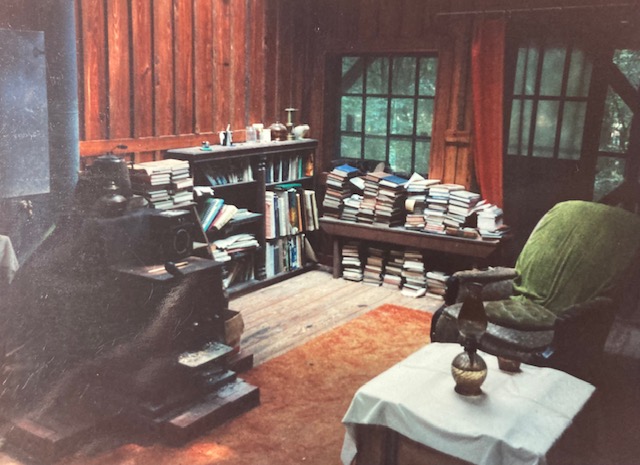
I had kept in touch with Bob, and he asked me to help him with the business. To my mind, at the age of 31, moving off-grid seemed a most sensible thing to do. In April of 1992, Brian and Douglas drove me to Union Station in Chicago, we said goodbye, then I climbed aboard Amtrak’s “City of New Orleans” southbound, down the Mississippi River to New Orleans. I spent the night at a hostel, then boarded a Greyhound Bus east, along the Mississippi and Alabama coast. Somewhere along Florida State Route 20 I got off the bus, then rode my bike north. The Sheriff and his men stopped and questioned me – I stood out like a sore thumb – but let me continue and eventually Bob and his wife Dorothy Ann drove down to pick me up.
Bob embodied his Quaker ideals by visiting prisoners in the State Penitentiary, and, for honesty and transparency, by wearing no clothes. I recall Bob in his kitchen, holding a glass of white wine, cooking ratatouille and lamb chops, discussing the Christian mystics Swedenborg and Meister Eckhart, all while standing buck naked in his birthday suit. To the question, “what’s the recent weather like over there Bob? I’m trying to figure out what to wear?” he replied “Well as far as I’m concerned, you don’t need to wear anything at all.” My guess is he wore clothes to the State Penitentiary.
There was no work to be done, and neither electricity nor running water, so in the swamp – which was, in fact, an oxygen factory – I mostly sat, listened and read. Storm clouds would amass over the Gulf of Mexico, then by afternoon would float north overhead. Almost daily, rain like a typhoon fell, massive amounts of water, relieving the humidity. Caleb and his family also lived in the swamp and at night we would paddle on the river, I in front with a flashlight, scanning for the green eyes of alligators at the water’s level. Once found, they would drop beneath the water and silently swim away, even beneath our canoe. Caleb laughed at his unseasoned passenger from the North.
Eventually it became clear that life there was not sustainable and so I returned to Deerfield, and then unexpectedly, moved out west to Prescott, Arizona. I settled into a trailer, at the foot of a butte, near Skull Valley. By coincidence I had been introduced to an older gentleman, who was active in trading agricultural commodities. Given my background, he was curious of my interests and offered to introduce me to a financier he knew, who purportedly had helped launch McDonald’s Corporation. He had two conditions: I needed to write a Business Plan and get the approval of the Senior Chairman of the Board of McDonald’s Corporation. No small task, although the writing seemed more daunting than the approval, so willing to shovel coal, I was willing to get to work.
The Chicago Tribune had announced an architecture competition for public housing, to redesign the Cabrini-Green projects. I entered. I had met Paolo Soleri, the architect and urban planner – a visionary, widely overlooked – who had built Cosanti and Arcosanti based upon the design of medieval cities of the Italian countryside; he advocated a hyper-dense city surrounded by open space and the natural environment. Living on the high desert, in a trailer with no phone or TV, I began to ponder the social contract, how design manifests those ideas, and the coming impact of unlimited access to information.