Aloft in the Loft
Posted: January 24, 2025 Filed under: Art & Healing, Chronicles of a First Time Parent, Gallery - Visual, Portfolio - David's work, What is an Art Farm | Tags: kimchi, Martin Luther King 4 Comments
Working on this Greek Revival New England farmhouse I have learned important lessons, especially the frugality of the Yankee makers. When everything was hand hewn, nothing was wasted.
The knee wall is a paragon of thrift; by adding 4’ to the exterior walls, the roof is raised enough to gain a room that otherwise would be a dark attic. In 2018 we rebuilt the barn and I used this trick to gain – for the price of some 2×4 studs – 529 square feet of additional space. I call this the loft, and built it with no specific use in mind. Intuitively it made sense, and then covid came, the sheetrock having just been hung, so the loft became an office for my wife’s therapeutic counseling work. It was unfinished but providential.
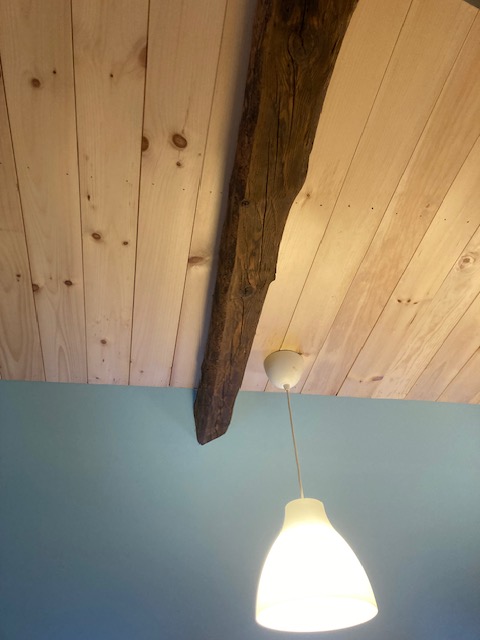
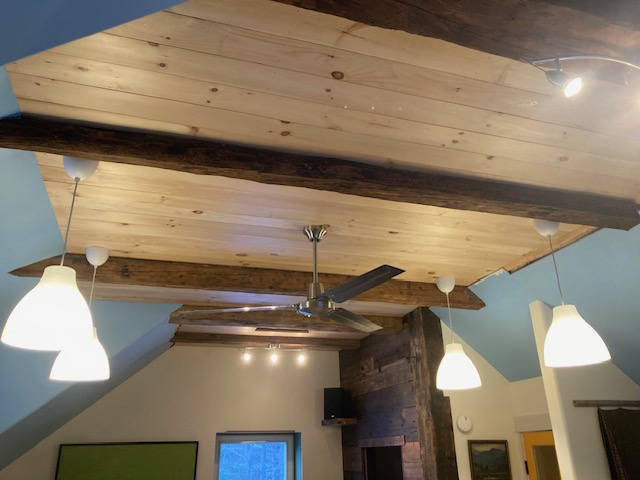
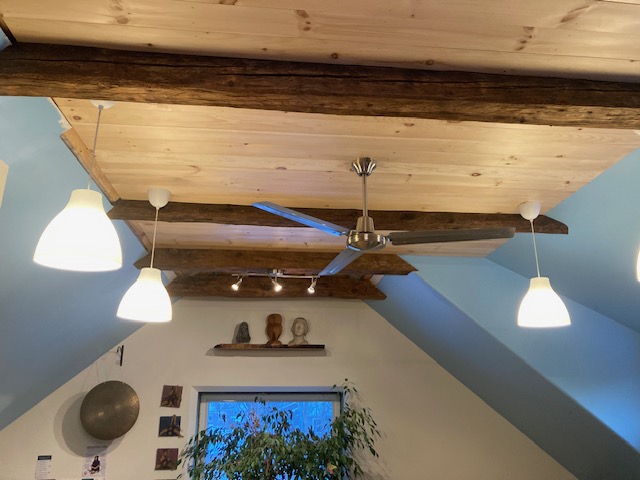
Lately I have pursued the finish work and the loft has been transformed. I put pine boarding on the ceiling, which required custom cuts around some of the original barn beams. Using old boards triples my labor but it seems worth the effort.
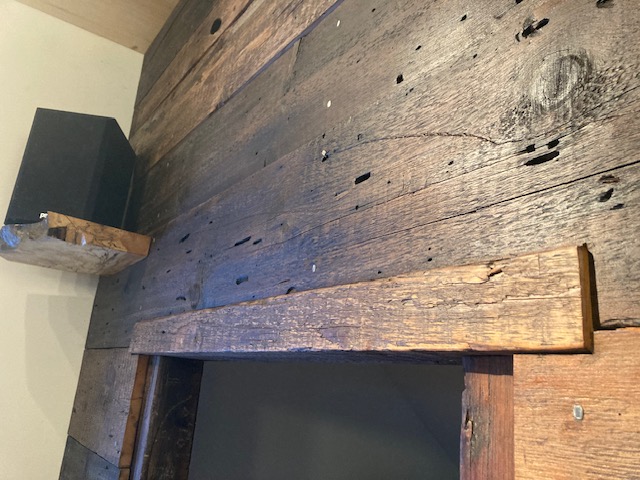
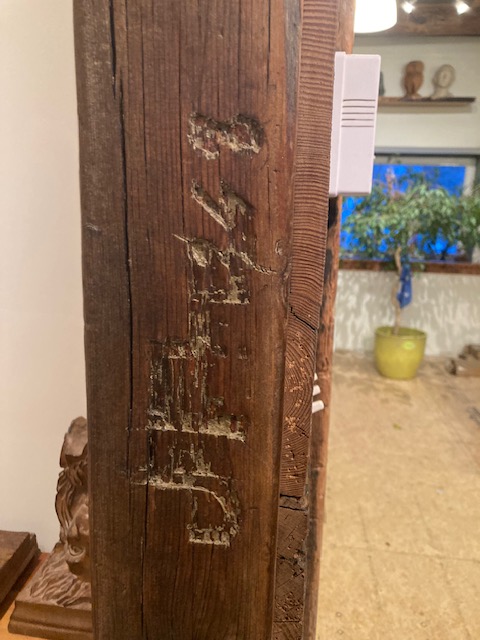
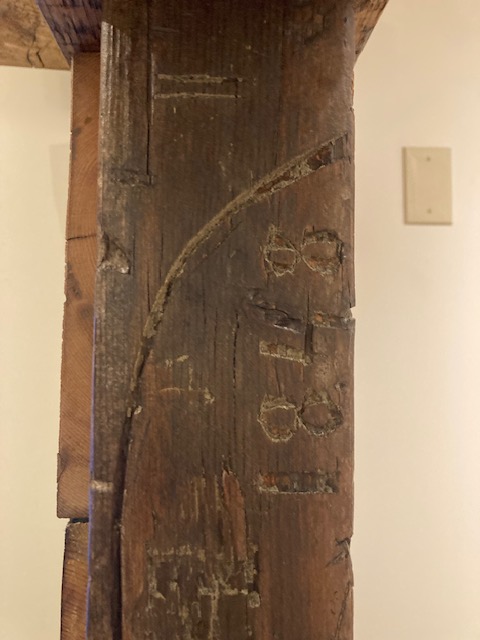
To create a storage nook, I built a wall with its door framed using a barn beam carved by the makers and dated 1848. The barn boards on that wall come from trees cut down then, which means those trees sprouted from seed circa 1700. George Washington was not yet born when our barn had taken root!
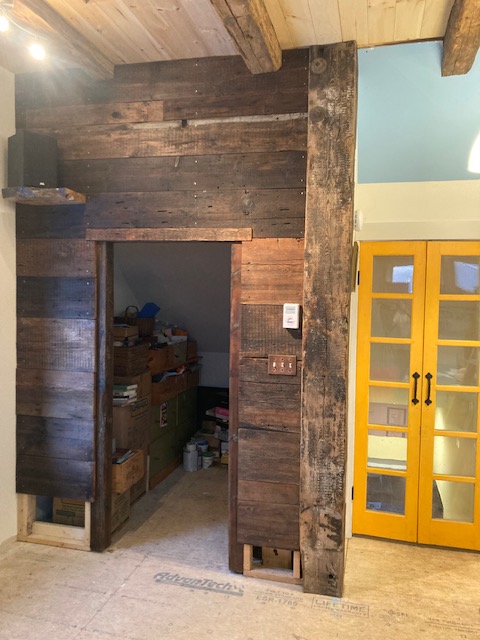
The barn boards are weathered and rough, with knots and worm holes; a poetry of the material. Several years ago I built furniture for Thos Moser, whose solid black cherry tables and chairs are American classics. Tom uses the heartwood only and rejects any sap wood, thus throwing 40% of his material away. An extravagant waste and testimony to the vanity of the buyer who seeks an unblemished life. If only that were possible, but as a colleague often said to me, “How do you know you’ve been alive if you don’t have scars to show for it?!!!”
I bought odd lot leftovers of prefinished flooring, a random mixture of five species – Ash, Cherry, White Oak, Maple, Douglas Fir – with varying stains and sheen. The floor will not be typically uniform but more like a smorgasbord charcuterie. I paid about $0.15 on the $1.00 so the savings are substantial. That is the next task.

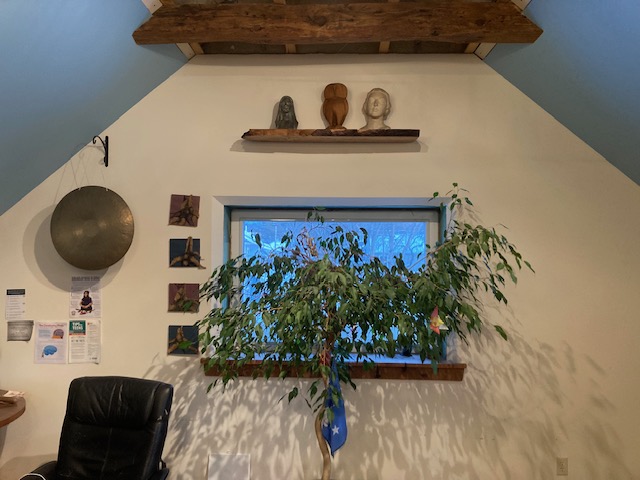
For a window sill I made end-grain parquet, cutting a stout old beam – 12″ x 6″ – into thin slices, reglued them like a checkerboard, then planed down and used epoxy to fill the aged cracks, until finally I had a board that I could cut to fit the sill opening. It is aged and rough and wildly elegant. May I age so, too.
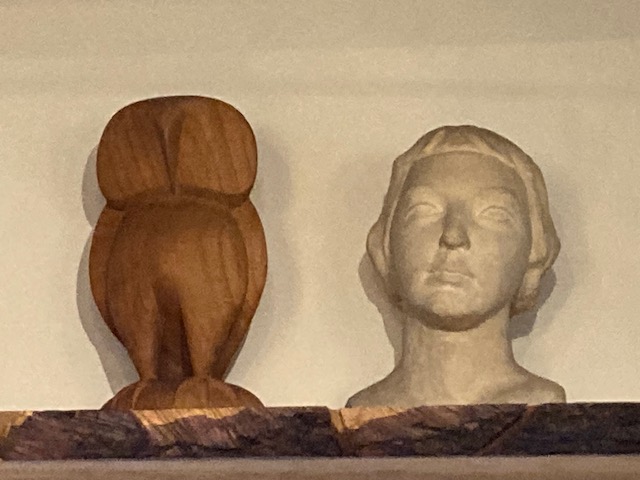
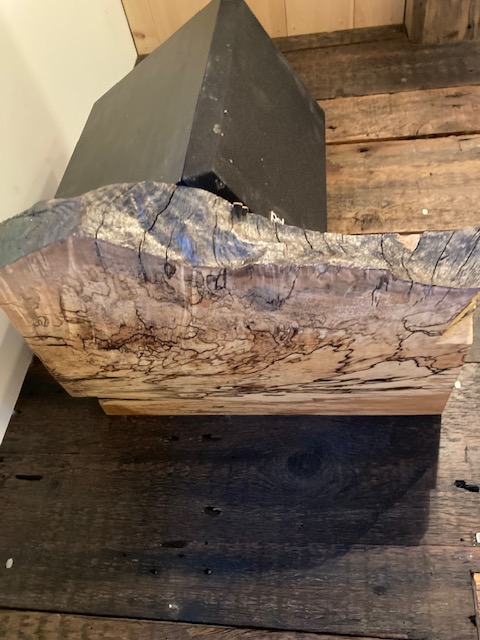
High overhead, in pride of place, is the pièce de résistance, a floating shelf of a burled Alder slab that I hauled East when we moved from Chicago decades ago. Sitting upon the shelf is the self portrait of an artist made when she was 19-years old, and a second bust that she made as well. That artist has long nurtured my own interest, encouraged me along this very winding path of making. I saved her pieces when the family home was sold last autumn, and now they – she, symbolically – watches from high overhead, a sentry to our making in the loft art studio of our Art Farm.




_______________________________
In other news, this week we did more fermenting to make a le Roi Borgne special batch “MLKing-chi.” My son and I delivered them as night fell, a random act of kindness in times of darkness. Indeed, “What’s your dream?”





Failure and Forgiveness
Posted: November 15, 2024 Filed under: Art & Healing, Chronicles of a First Time Parent, consciousness, Money & Banking, What is an Art Farm | Tags: authoritarian, bankruptcy, contemplation, failure, faith, forgiveness, jurisprudence, naivete, redemption, sufi 2 Comments
In my life the most meaningful lessons were learned from my failures more than any success. Would that it were different, but such, in my experience, has been the lesson learned. I suspect I am not alone here.
The consumer marketing machine, it seems, plays on everyone’s hopes for the good life: the getaway cruise, the flashy new car, the land of milk and honey, lifestyles of the rich and famous. To my mind these are diversions, distractions, from the hard work of honest integrity.
Among my failures was being held in contempt of court, United States Federal Court, Northern District of Illinois. It dragged on for months, and one day into the courtroom United States Marshalls entered, guns holstered, locked and loaded. My counsel nervously waited to petition on my behalf, but surprisingly, they had come not for me. I did not go to jail.

A banker from Lichtenstein did go to prison to serve a three-year term. I was a co-defendant in a lawsuit concerning off-shore Trust Asset Management, guilty not of fraud but of naïveté. The case eventually was settled. The experience gave me reason deeply to reconsider.
Following that settlement I filed a Chapter 7 bankruptcy, which taught me the remarkable experience of forgiveness. It is extraordinary to learn – in the first person – that forgiveness lies at the core of American civil jurisprudence.
Our system of justice is fundamentally about redemption and resolution. In practice often such may seem not the case – for profit prisons, for example – but forgiveness, in fact, does seem to lie at the core. Is not the hope for a better future the American dream? Such, at least, has been my personal experience.
In beginning that new chapter I further learned to let integrity be my bank account. Our culture deifies money. We are drunk in the belief that wealth must equal intelligence and character. We could be no further from the truth.
When I was a boy the popular phrase was “A man’s word is his bond.” Long out of date that is now. Our delusions are different from the truth, which remains that our character is key, that integrity is – in the end – all that matters.
I am not alone in feeling a seismic shift unfolding. This week I received a missive from a Franciscan monk, the founder of the Center for Action and Contemplation, who wrote:
“I have been increasingly convinced that we need a worldwide paradigm shift…(which) becomes necessary when the previous paradigm becomes so full of holes and patchwork “fixes” that a complete overhaul – which once looked utterly threatening – now appears as a lifeline. [We must] move beyond the reward/punishment paradigm.”

He told the Sufi-inspired story “The Angel with the Torch and the Pail”
“An angel was walking down the streets of the world carrying a torch in one hand and a pail of water in the other. A person asked the angel, “What are you doing with that torch and pail? The angel said, “With the torch I am burning down the mansions of heaven, and with the pail I am putting out the fires of hell. Then, and only then, will we see who truly loves God.”
The monk concluded by saying, “The most loving people I have met across the world in my lifetime of teaching and traveling all seemed to know that if love is the goal, it must be love for everybody.”
The bromance playing out on social media and in the halls of government is not about love for everybody. The situation in America is child’s play to the global trend toward authoritarian strongmen. To my mind most certainly this will result in a humanitarian failure, which would force we the people, on this small planet, deep into reevaluation.
We must own our failures before we can be reborn. Once we do that, what if redemption and love become the result of these uncertain times?

Redemption and Return
Posted: November 8, 2024 Filed under: Art & Healing, consciousness, What is an Art Farm | Tags: alpha males, books, divine feminine, greek-mythology, Homer, hypermasculinity, Iliad, mythology, Plato, the Republic, thucydides, trojan-war 1 Comment
Recently, at the Friends School of Portland, I watched a performance of the Iliad that was remarkable; horrid and harrowing, vast and engaging, a testimony to the power of theatre.
The Fig Tree Committee, a group of Quakers from Portland, Oregon presents “An Iliad” to correctional facilities and the communities that surround them. Over 3,500 people, most of whom were incarcerated, have seen the production. In the Quaker vernacular, their work is a “leading” as it “…knits together audiences on both sides of the prison walls by using one of the world’s oldest stories to examine the cycles of violence, trauma, displacement, and hope for healing that unite us all.” https://www.figtreecommittee.org/
The Iliad, central to Classical literature, stands at the apex of Epic Poetry. Homer, the bard, is said to have written the poem circa 800 BC, retelling stories from the late Bronze Age circa 1,000 BC. The story revolves around Paris, a Trojan Prince, who abducted Helen, the wife of Meneleus, the Greek King. Extraordinary was Helen’s beauty, her’s “the face that launched 1,000 ships.” The poet sagely never describes her face, leaving that to the reader’s imagination.
For 10 long years the Greeks battled the Trojans, always to a standstill, which test of endurance is indeed the stuff of legend. The story – hypermasculinity and the alpha males’ dominance – is remarkably relevant to the world today. The Access Hollywood tapes seem but a modern day retelling of Paris abducting Helen.
The Fig Tree’s production used metadrama to connect the classic to the contemporary through the epic catalog of the 1,000 ships. The bard made plain such breadth by listing the many young men killed, but from American, rather than Greek towns, including Evanston, Illinois where long ago I read the Iliad in the Greek. That catalog foreshadowed what was to come, and what is playing out in America today.
Building to the play’s climax, the bard recited a brutally long catalog of wars – Ancient Greece through Europe to modern day Middle East and Gaza – 3,000 years summarized that took us ever deeper into the maze, to face the Minotaur; not half man half beast, but rather the vain beastial side of Aristotle’s “political animal.”
The Peloponnesian War – Sparta versus Athens, 431-404 BC – centered on the issue that “might makes right.” Thucydides, the Greek Historian, in 410BC wrote, “… right, as the world goes, is only in question between equals in power, while the strong do what they can and the weak suffer what they must.” “Might makes right” is the moral antithesis of the path to compassion.
Plato, the Athenian philosopher, wrote the Republic, 375 BC, arguing that democracy was unworkable, “Until philosophers are kings, or the kings and princes of this world have the spirit and power of philosophy … cities will never have rest from their evils,—no, nor the human race, as I believe,—and then only will this our State have a possibility of life and behold the light of day.”
The polite phrase is “Philosopher King” but the literal translation is “Benevolent Dictator.” The authoritarian strongman does seem ascendant now. Many say Victor Orbán is a modern day exemplar of the Philosopher King but his is an illiberal democracy, rule by the minority not “we the people.” Might makes right remains the macho battle cry and let’s be honest: hypermasculine alpha males have run the table for more than 3,000 years.
To my mind, the deeper long-term trend is that the Divine Feminine is ascendant, while the alphas, like dinosaurs, will fight to the bottom to preserve their long enjoyed patriarchy. I speak of masculine traits, not gender, and write this not to condemn but with compassion to decry so many generations of boys raised to be men who fight more than forgive, for whom “making a killing in the market” is a red badge of courage. Radical, indeed, was the street preacher, 2000 years ago, who dared say, “the meek shall inherit the earth.”
At the end of the March from Selma, Martin Luther King stood on the steps of the Alabama State Capital, and said, “The arc of the moral universe is long, but it tends toward justice.” The Iliad tells the same story. This masterpiece of literature is ultimately a story of redemption, the release of anger and hubristic pride.
At the Iliad’s end, Achilles speaks to Priam, the last King of the Trojans, and releases to him the body of Hektor, his son, whom Achilles had slain in battle. Each having lost everything, Achilles – the greatest among the Greek heroes, which is to say the paragon of the alpha male – found within himself redemption and gave back to Priam the body of his son, to be buried, returned to his native soil.
If the greatest of Greek heroes could find forgiveness and compassion, then certainly, so too, can we the people.
Work is to be done.
Let us be about it.
Now.
_______________________________________________________
I quote here from the Richmond Lattimore translation, Prius supplicating Achilles, the response of Achilles, the anointing of Hektor’s body, and the slaying of the “gleaming sheep” for a shared meal of Thanksgiving:
“Achilleus like the gods, remember your father, one who
is of years like mine, and on the door-sill of sorrowful old age.
And they who dwell nearby encompass him and afflict him,
nor is there any to defend him against the wrath, the destruction.
Yet surely he, when he hears of you and that you are still living,
is gladdened within his heart and all his days he is hopeful
that he will see his beloved son come home from the Troad.
But for me, my destiny was evil. I have had the noblest
of sons in Troy, but I say not one of them is left to me. (24.486-94)
“So he spoke, and stirred in the other a passion of grieving
for his own father. He took the old man’s hand and pushed him
gently away, and the two remembered, as Priam sat huddled
at the feet of Achilleus and wept close for manslaughtering Hektor
and Achilleus wept now for his own father, now again
for Patroklos. The sound of their mourning moved in the house. Then
when great Achilleus had taken full satisfaction in sorrow
and the passion for it had gone from his mind and body, thereafter
he rose from his chair, and took the old man by the hand, and set him
on his feet again, in pity for the grey head and the grey beard,
and spoke to him and addressed him in winged words: ‘Ah, unlucky,
surely you have had much evil to endure in your spirit.
How could you dare to come alone to the ships of the Achaians
and before my eyes when I am one who have killed in such numbers
such brave sons of yours? The heart in you is iron. Come, then,
and sit down upon this chair, and you and I will even let
our sorrows lie still in the heart for all our grieving. There is not
any advantage to be won from grim lamentation. (24.507-24)
“Then when the serving-maids had washed the corpse and anointed it
with olive oil, they threw a fair great cloak and a tunic
about him, and Achilleus himself lifted him and laid him
on a litter, and his friends helped him lift it to the smooth-polished
mule wagon. He groaned then, and called by name on his beloved
companion: ‘Be not angry with me, Patroklos, if you discover,
though you be in the house of Hades, that I gave back great Hektor
to his loved father, for the ransom he gave me was not unworthy.
I will give you yourshare of the spoils, as much as is fitting.’
“So spoke great Achilleus and went back into the shelter
and sat down on the elaborate couch from which he had risen,
against the inward wall, and now spoke his word to Priam:
‘Your son is given back to you, aged sir, as you asked it.
He lies on a bier. When dawn shows you yourself shall see him
as you take him away. Now you and I must remember our supper. (24.587-602)
“So spoke fleet Achilleus and sprang to his feet and slaughtered
a gleaming sheep, and his friends skinned it and butchered it fairly,
and cut up the meat expertly into small pieces, and spitted them,
and roasted all carefully and took off the pieces.
Automedon took the bread and set it out on the table
in fair baskets, while Achilleus served the meats. And thereon
they put their hands to the good things that lay ready before them.
But when they had put aside their desire for eating and drinking,
Priam, son of Dardanos, gazed upon Achilleus, wondering
at his size and beauty, for he seemed like an outright vision
of gods. Achilleus in turn gazed on Dardanian Priam
and wondered, as he saw his brave looks and listened to him talking.
But when they had taken their fill of gazing one on the other,
first of the two to speak was the aged man, Priam the godlike:
‘Give me, beloved of Zeus, a place to sleep presently, so that
we may even go to bed and take the pleasure of sweet sleep.
For my eyes have not closed underneath my lids since that time
when my son lost his life beneath your hands, but always
I have been grieving and brooding over my numberless sorrows
and wallowed in the muck about my courtyard’s enclosure.
Now I have tasted food again and have let the gleaming
wine go down my throat. Before, I had tasted nothing.’
He spoke, and Achilleus ordered his serving-maids and companions
to make a bed in the porch’s shelter and to lay upon it
fine underbedding of purple, and spread blankets above it
and fleecy robes to be an over-all covering.” (24.620-646)
Fairy Museum of Natural Wonder
Posted: October 18, 2024 Filed under: Art & Healing, Farming off the Farm, Portfolio - David's work, What is an Art Farm | Tags: art, Farmington 1 Comment
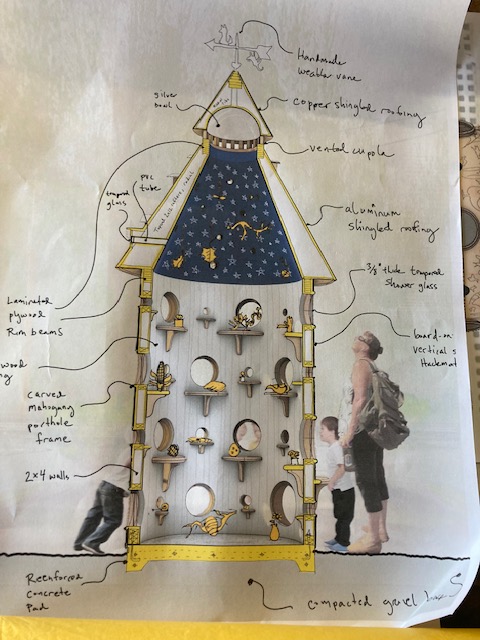
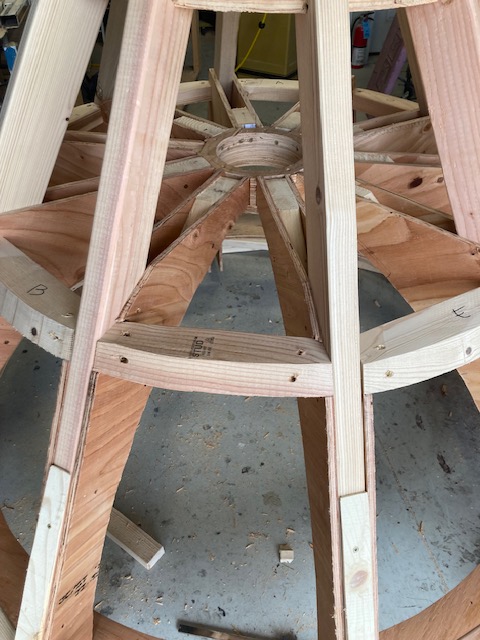
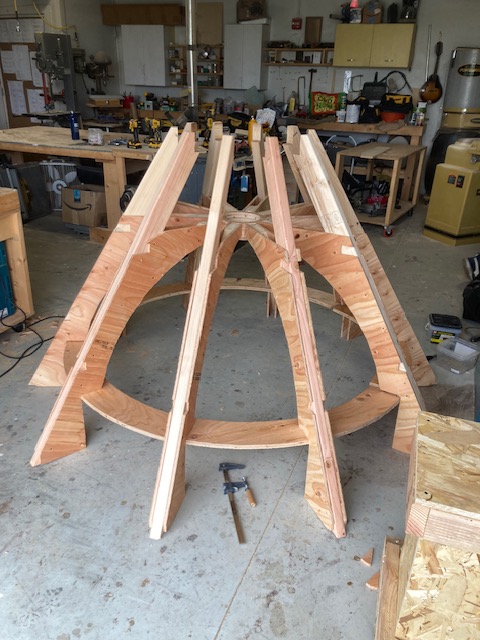
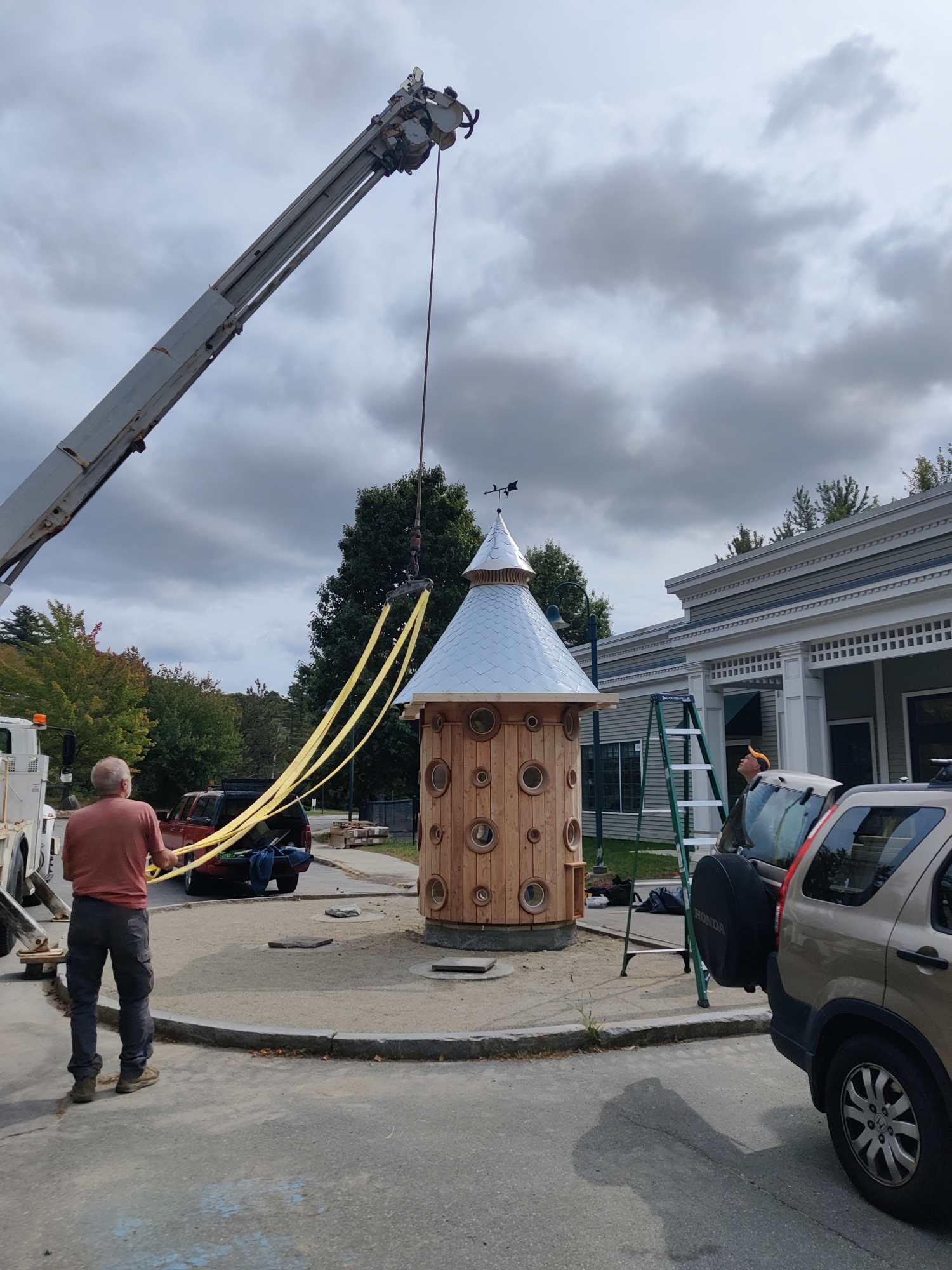
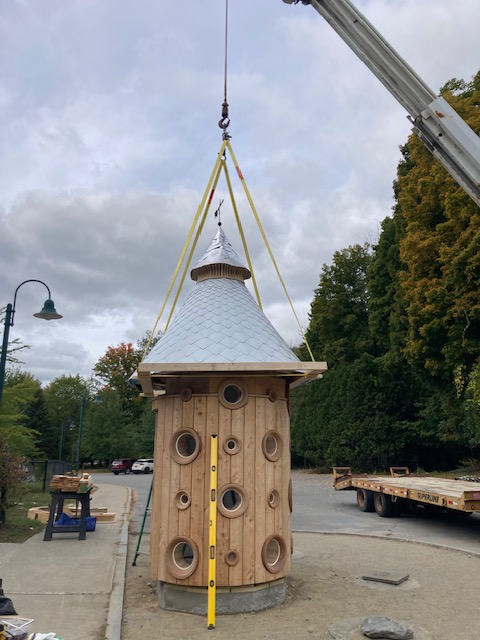
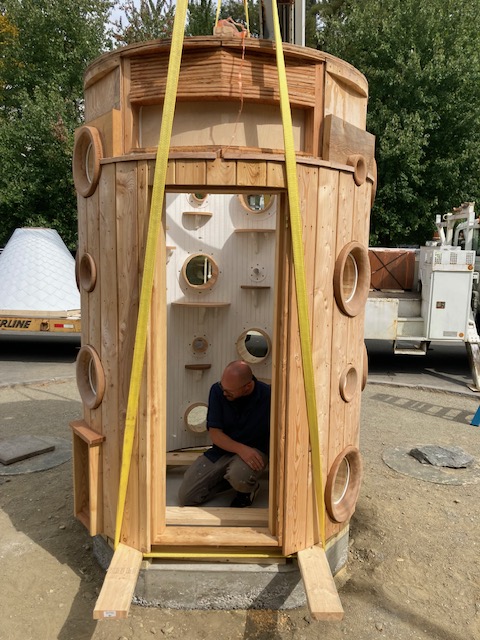
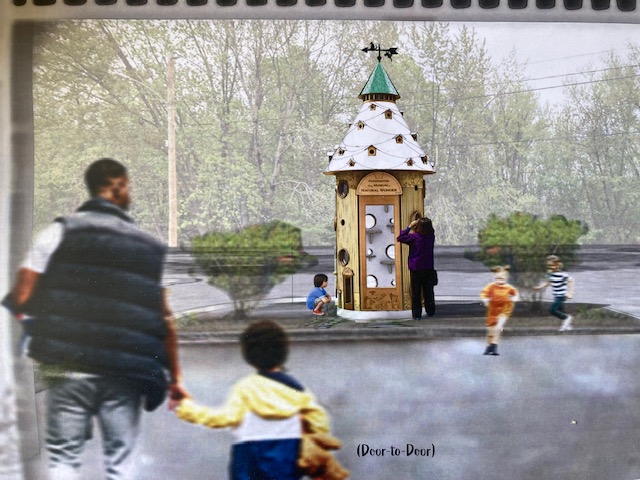
The “Farmington Fairy Museum of Natural Wonder” is a building of magical wonder and whimsy, built to the scale of a 5- or 6-year old child, coming to be, in a world of exquisite beauty and grace.
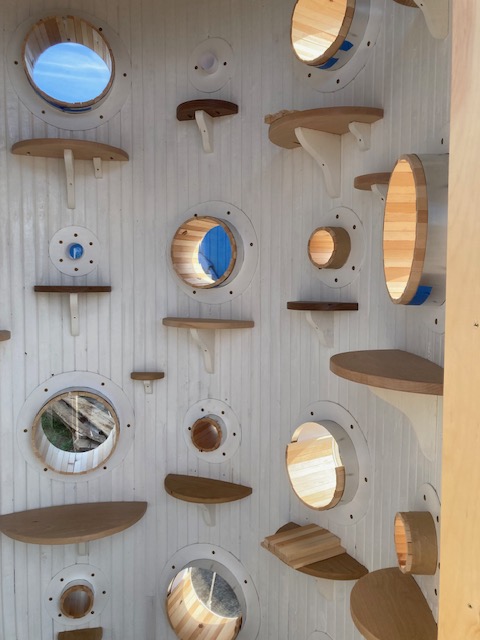
Funded by the University of Maine at Farmington’s School of Education, Early Childhood Development, the Museum will be used as part of their pre-school teacher training program. Enrolled children will curate rotating exhibits, displaying natural wonders gathered on sojourns into nature. Found items – a stick, a stone, a shell, a leaf or feather – will be placed by the children on display upon shelves nestled beside porthole windows.
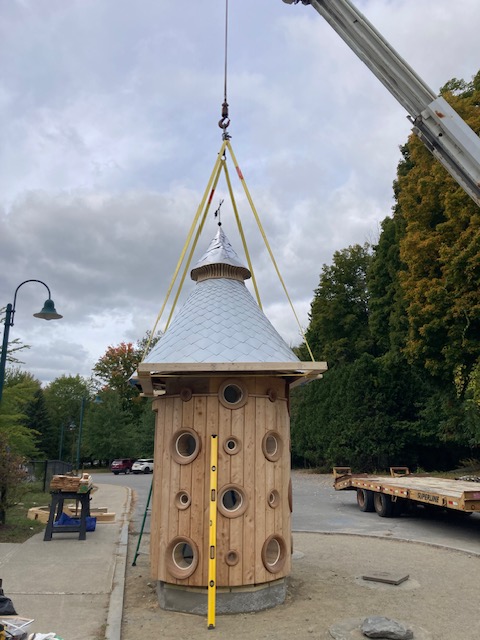
The design is as complex as it is compelling. Consider these facts:
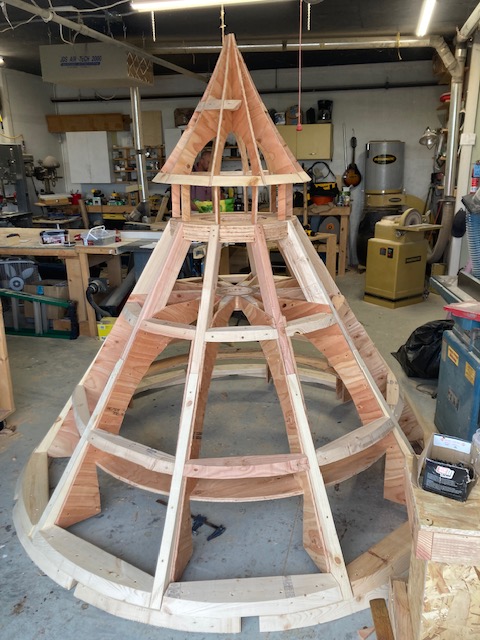
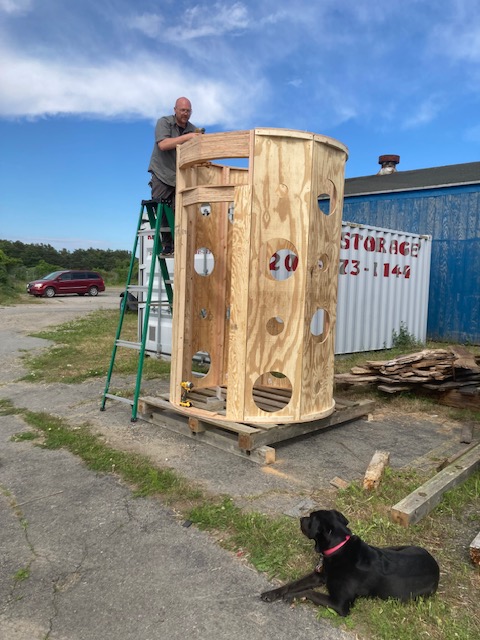
- framed as a dodecahedron, with 1/2” plywood sheathed to 2×4 studs cut at 18.5 degree angles;
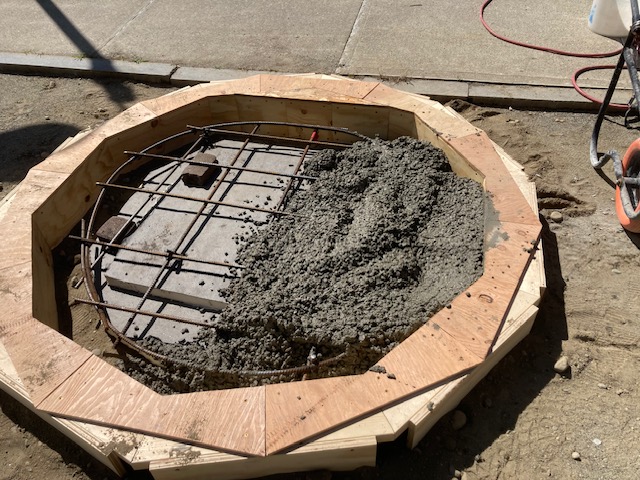
- the 6″ slab foundation used 14.4 cubic feet of concrete, with rebar mesh reinforcement;
- sheathed in native-Maine Tamarack, using board on batten style;
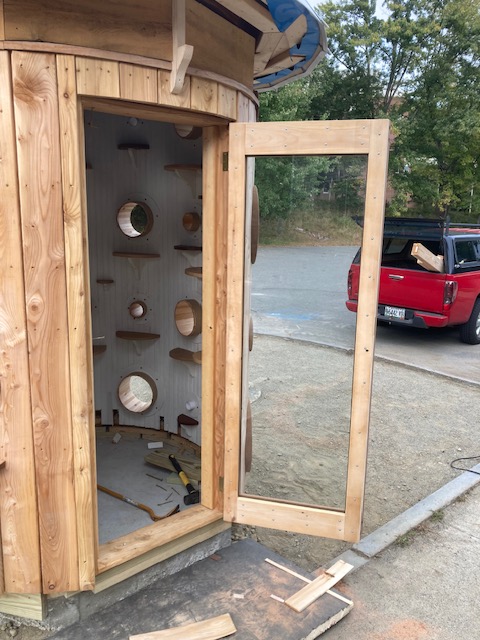
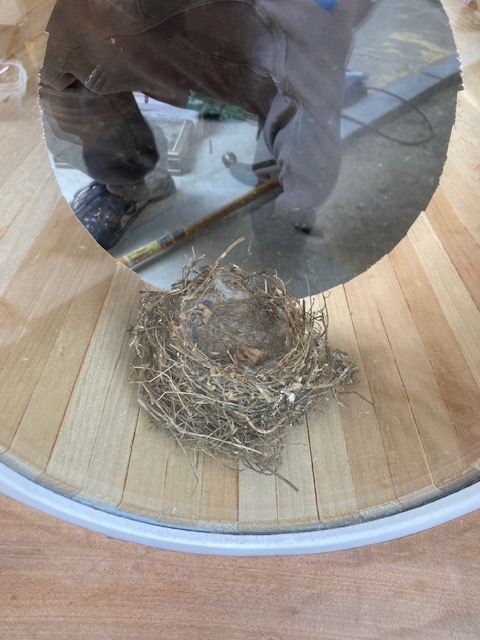
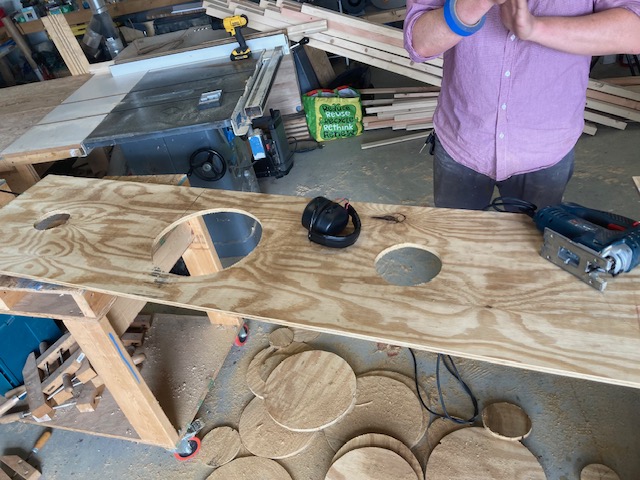
- 31 circular windows of 5 sizes, all parts custom built; 1/2” plate glass sandwiched in “Kuwaiti plywood,” with a rubber gasket air seal then faced with 2” ribbon mahogany exterior trim, cut on the bias, grain running horizontally, so water flows away from the structure;
- a Squirrel gargoyle stands guard over the custom made, ribbon mahogany entry door
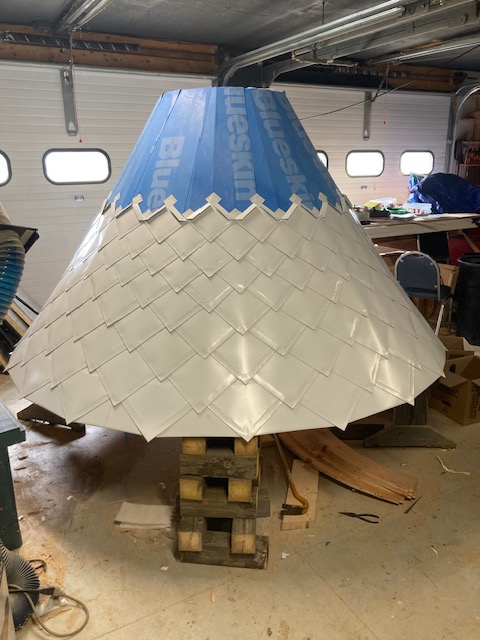
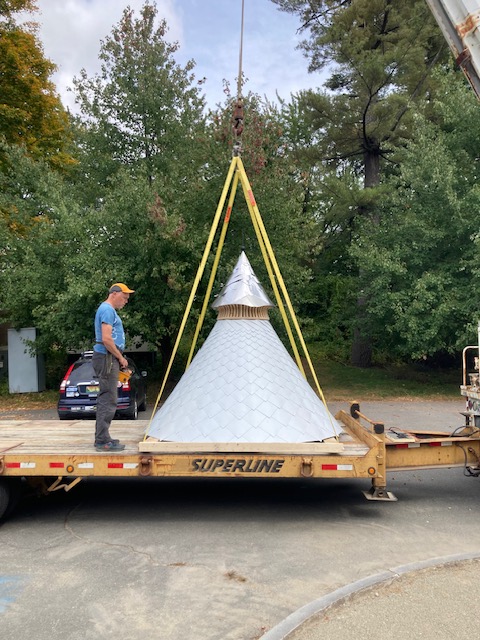
- a Basilica dome, framed by laminated plywood, covered with 480 aluminum shingles, all custom cut, bent to shape, then hand nailed into place;
- “purple martin” mini birdhouses nestled in, for good measure, among the metal shingles;
- a Cupola towers over all, covered in 31 galvanized shingles, cut from aluminum flashing;
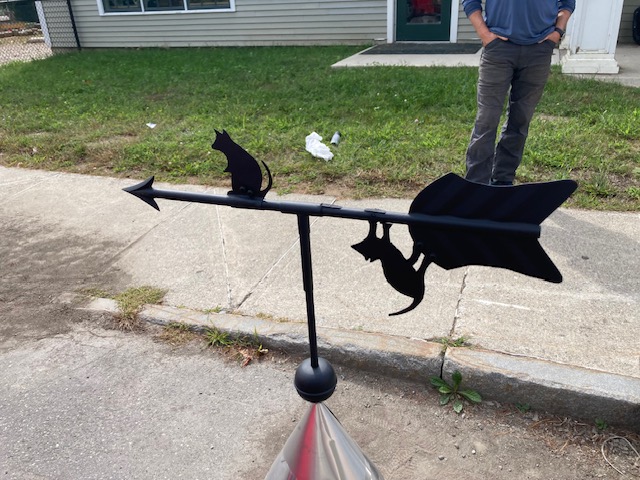
- upon which, like a cherry on top, sets the weather vane, with mice running to and fro.
In Southern Maine, everyone, it seems is a carpenter, or a DIY warrior at the least; but few, if any, could build such a structure, let alone conceive, design, and draw same. The Museum is the brain child of Chris Miller. It has been my highest honor to assist as his mere carpenter.
Inside the Basilica dome, Chris has painted the starry night sky, and through a keyhole oculus, the golden glow of the sun lies beyond. The Vatican may have Saint Peter’s Basilica and the Sistine Chapel ceiling, but Farmington has the Fairy Museum; Bernini and Michelangelo could do no better than Miller has done.

We built the Museum at Chris’ studio in South Portland, then moved the structure 72 miles north to Farmington. Jesse Salisbury, a sculptor of large granite and hard stones, graciously helped on this task. An artist friend once said to me, “The coolest people on Earth live in Maine,” and Jesse is exhibit A of same. Jesse’s story is almost fantastical, and I speak from personal experience as my daughter and I visited his studio, when she was 5 years old.
Jesse was born Downeast, a fisherman’s son. He began carving wood while in grammar school, but then his father became the Founding Director of the Portland Fish Exchange, America’s first all-display fresh seafood auction that opened in 1986. This lead to his Father becoming the Attache for Asian Fisheries, at the USA Embassy in Tokyo, Japan. In Tokyo, Jesse attended high school and began his formal artistic training, including with traditional ceramic artists. https://www.jessesalisbury.com/
His path lead back to Steuben, Maine where he and his father built his studio by felling trees, milling them into beams, to create a 32’ x 64’ post & beam workshop with design room, stone cutting, metal forging, fabricating and equipment repair shops. As a young man he foraged rocks from the fields Downeast, hauling them in his pick-up truck, but when the scale of his work increased, he purchased used heavy equipment from Bangor Hydro, the utility generating hydroelectric power on the Penobscot River.
Jesse and his Father laid 70 feet of train tracks, so that granite slabs weighing 10-tons or more easily move through the studio, from the wire saw to its indoor and outdoor fabrication areas. Jesse has carved and transported major installations throughout Maine, the Atlantic Seacoast, and maritime Canada. His work has also been displayed in Japan, China, South Korea, Egypt, and New Zealand. In his spare time, he founded the Schoodic International Sculpture Symposium, a ten-year project which resulted in a world class collection of large granite works that make up the Maine Sculpture Trail. https://www.schoodicsculpture.org/
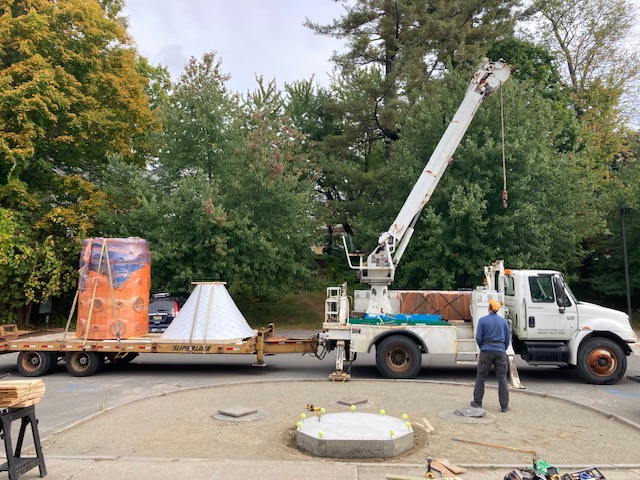
We made two trips north. First, Chris and I poured the dodecahedron concrete foundation, a 6” slab reinforced with rebar and anchor bolts set in the concrete. The forms, of course, were custom built. For the second trip, Jesse arrived at Chris’ studio on a Friday. His boom truck hoisted the structures easily onto his trailer. We strapped them down, then early on a Saturday morning convoyed North as misty fog hung upon the Casco Bay.

In Farmington, the sun was shining. On that idyllic September day, as crimson and golden leaves fluttered down, the installation went easily, each section stacked up, each upon the one below. A deus ex machina, indeed. The “silo” was anchored to the slab’s sill plate and the weather vane set atop the cupola.
By dusk we were gone. Chris returned later to apply finishing details.
And then, one Monday morning, children arrived at their daycare astonished to behold this creation. Like the “Night Before Christmas” I imagine they uttered, “When what to my wondering eyes should appear/But a Fairy Museum overnight landed here!!”















The Grandest Cataract in New England
Posted: September 12, 2024 Filed under: Art & Healing, Portfolio - David's work, What is an Art Farm | Tags: Androscoggin River, Cancer Valley, Edmund Muskie, Hugh Chisholm, Public Art, Restoration, Rumford 2 CommentsRumford Falls, Maine is situated where the Concord, Ellis, and Swift rivers converge into the Androscoggin River, which form the watershed of the Western Maine mountains. At the Falls, called the “the grandest cataract in New England,” the Androscoggin drops a total of 176 feet over a sheer wall of granite.

In our pre-industrial age, indigenous peoples gathered there to hunt, fish and trade furs from the Lakes Region of Maine. In 1882, history forever changed when industrialist Hugh Chisholm grasped the Falls’ potential for the manufacture of paper.
Chisholm first built a railroad, then a mill for his Oxford Paper Company, which grew to become the founding asset of International Paper Company, the corporate behemoth, still active today. A Utopian, he also built planned community housing for the workers in his mills, which housing became a model for the nation. Chisholm hired architects to build great buildings in Rumford, those architects also having designed the Waldorf Astoria in Manhattan, and the Copley Plaza in Boston. At its peak, in the 1930s, Rumford held its own with Manhattan, but today it has fallen deeply into the abyss.

Rumford, and the surrounding River Valley towns of Maine, are known nationally as “Cancer Valley” given the incredibly high rates of cancer among its mill-working inhabitants. Four out of five children are food insecure, while Rumford has the highest special education population in the state of Maine. The opioid crisis has run rampant, and Rumford’s rate of crime is now the highest in Maine.
Rumford Falls is but one, among many cities, ravaged by the flight of capitalist money, ever in pursuit of profit. The New York Times recently reported, “Milwaukee was once known as the ‘machine shop of the world.’ In the 1950s, nearly 60 percent of the city’s adult population worked in manufacturing…. By 2021, Milwaukee had lost more than 80 percent of its manufacturing jobs (barely 5 percent of those that remained were unionized), and it had the second-highest poverty rate of any large American city…. Between 1997 and 2020, more than 90,000 factories closed, partly as a result of NAFTA and similar agreements.”
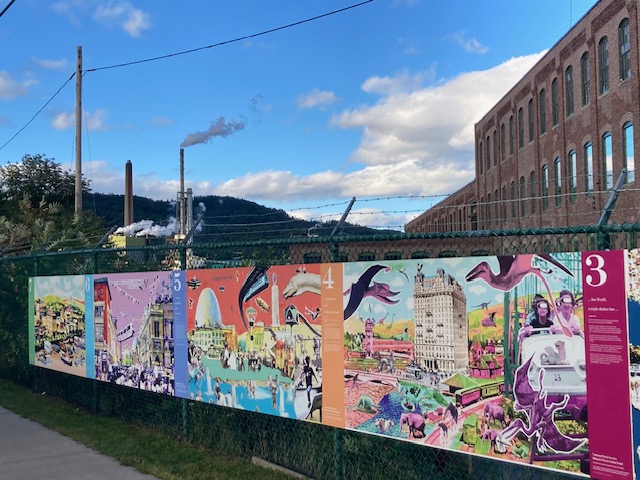
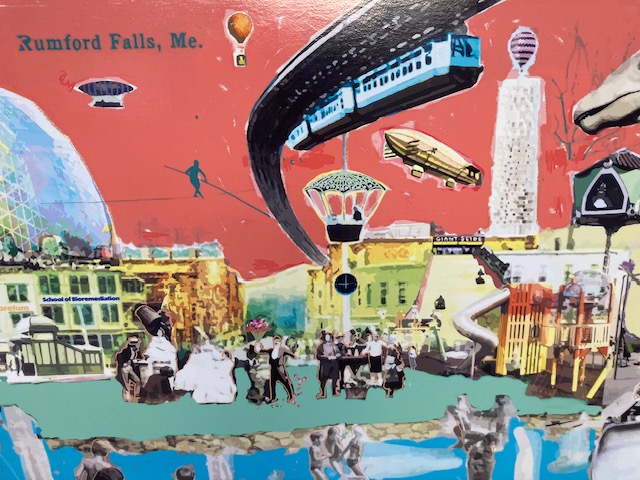
Last Sunday, I was in Rumford Falls helping on a Public Art project. Although the politics of free trade is vitally important, my work focused upon the power of art, the agency of making, and the process of civic discourse; how does a community rebuild once the rivers of cash flow have dried up?
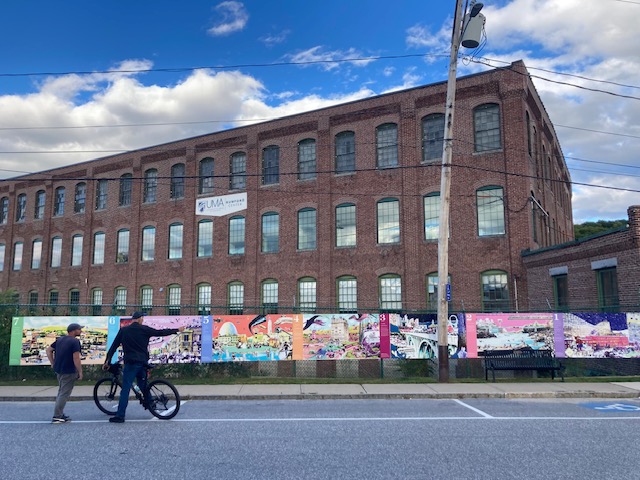
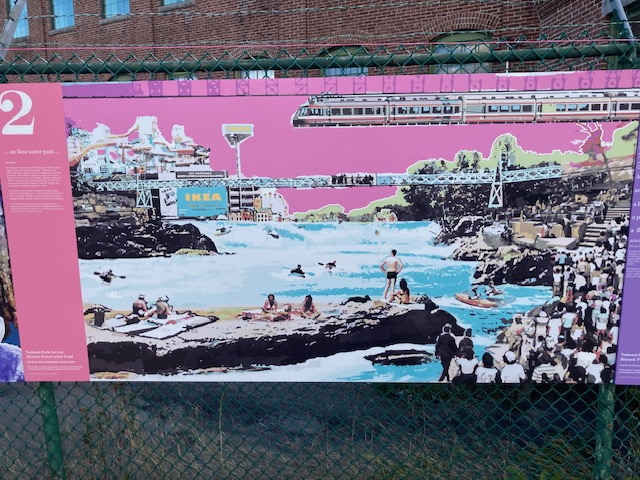
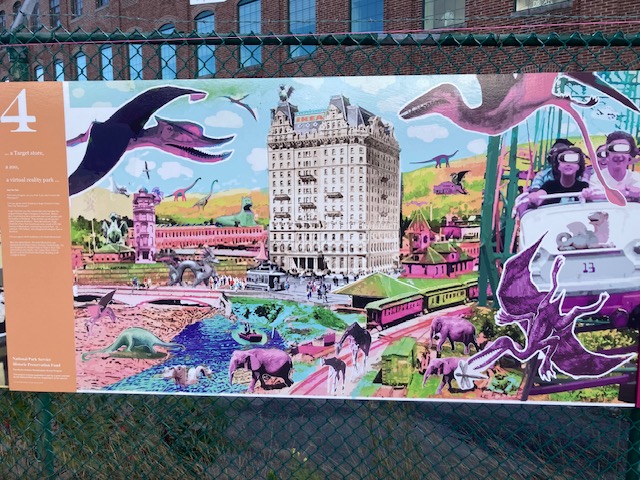
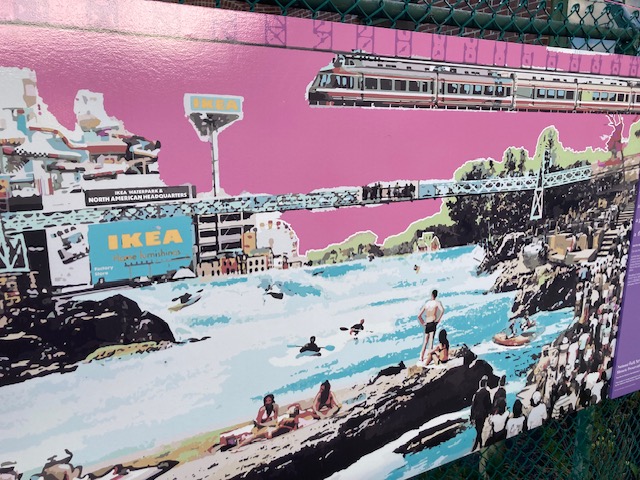
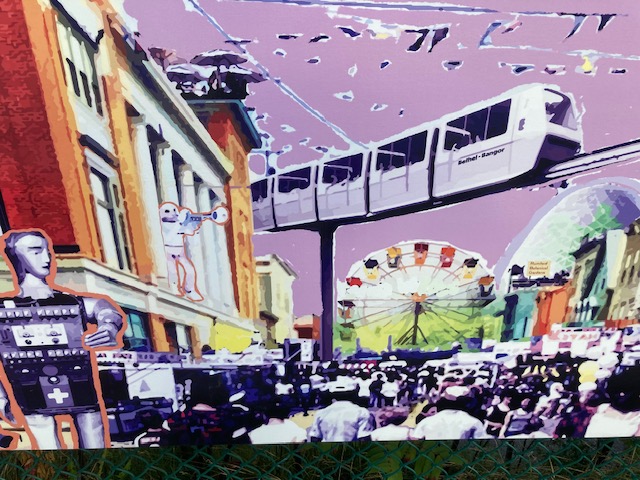
A real estate developer recently purchased Rumford’s old mill building for the price of $1 USD, and she has received a grant from the Department of Agriculture to put solar panels on top of the mill, and another from the National Parks Foundation “historic preservation” fund with the condition of “community engagement.” The developer promptly called Chris Miller, and asked, “I have the building, and a chain link fence out front. Can you do something of civic engagement?” Chris pondered the problem.

He decided to ask the citizens of Rumford what their desired future might be? Adults declined to respond, but a classroom of 3rd grade students enthusiastically spoke up. Chris’ question was “If you lent your hand, if you had your say, what would Rumford’s future gain? If you wore a hat that said “Civic Leader,” what might Rumford’s future feature? Would you champion a cause, plant more flowers, have a parade or build a tower? Would you open a business to meet a need? Would you captain a brand new industry? Would you start a club or paint a mural? Would you build a park in honor of a hometown hero?”
The 8- and 9-year old students offered fantastical ideas: a skyscraper, an amusement park, an IKEA water park, trains running upside down. Gathering their bold ideas, Chris set them down graphically in the style of a picture postcard, then printed on vinyl adhesive which he affixed to seven 4×8 sheets of 1/2” masonite. My role was minimal, priming and painting the boards and helping Chris hang them upon the chain link fence.
His design links to Rumford’s past, given that Hugh Chisholm made his first fortune printing picture postcards, holding the monopoly contract with the United States Postal Service to print all of the picture postcards sold in United States post offices at the turn of the 19th century. The Rumford Mill produced all those postcards, as it grew into its peak production years.

The children of today very likely could become the leaders of our future. Rumford’s native son, Edmund Muskie, was born there in 1914 and then wrote and championed both the Clean Air Act and the Clean Water Act in the 1970s. His political leanings have been demonized by many industrialists, but one has to wonder how his Rumford childhood shaped his environmental thoughts.
Restoration, it seems, is the work of our times. The task in Rumford is how to build a new economic base, to clean up after decades of toxic waste, and to heal generations of families whose lives have been shaped by the working conditions at the Mill and power plant on the Androscoggin River. Chris’ “picture postcards” are but one very small step, but Rumford’s task of recovery does move forward.








Sea Monsters a/k/a Carousel Cosmos
Posted: September 6, 2024 Filed under: Art & Healing, Child Centered Activities, Gallery - Visual, Portfolio - David's work | Tags: cosmic carousel, new paradigm design workshop 2 Comments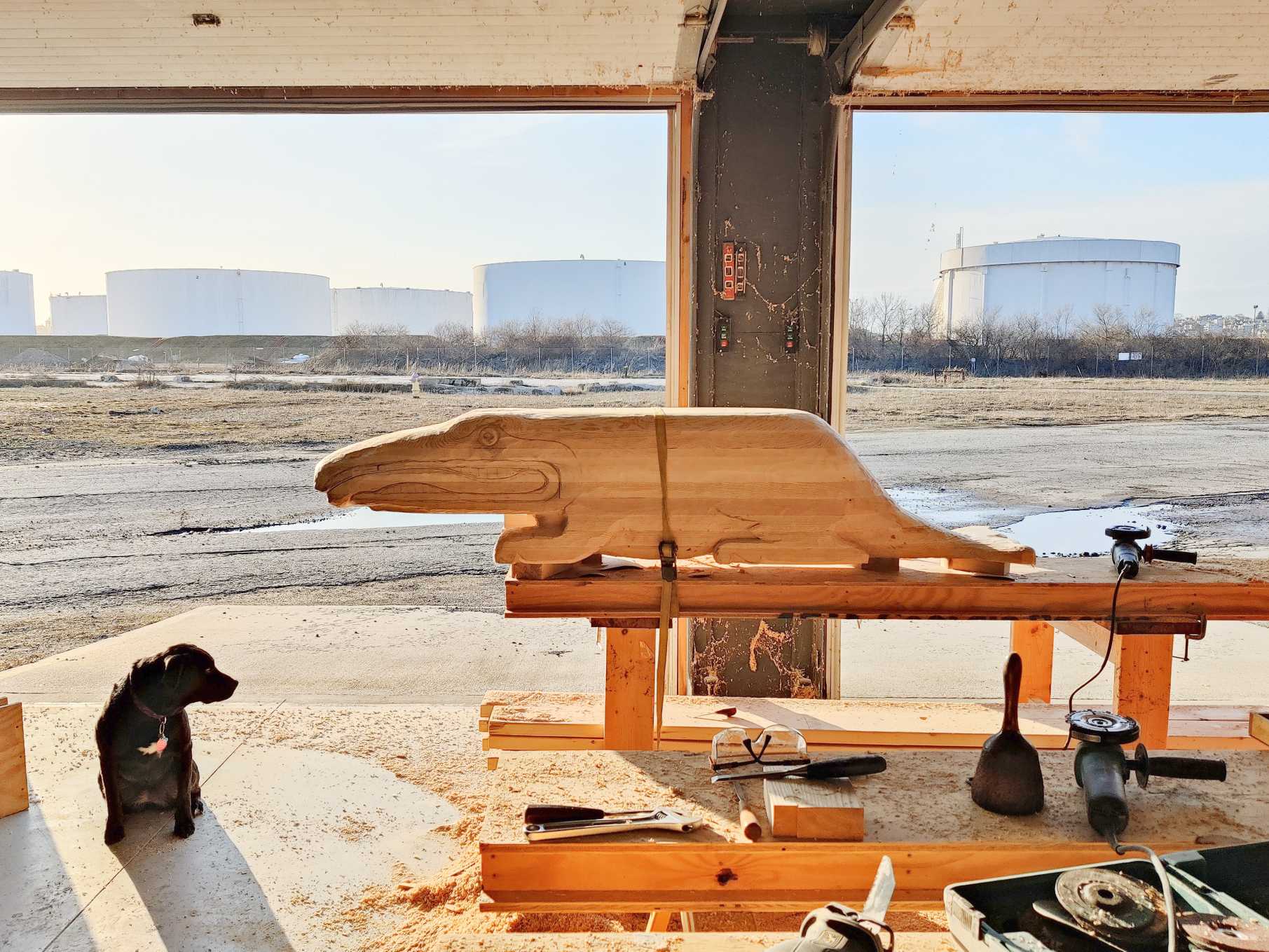
In April 2023 I had the pleasure of making Sea Monsters for a public art display in Portland’s West End. Chris Miller, the polymath maker, received the commission and hired me to help build seven creatures which likely could have lived on Portland’s Peninsula over the past 250-million years, give or take a few millennia, or even “just last Tuesday.”
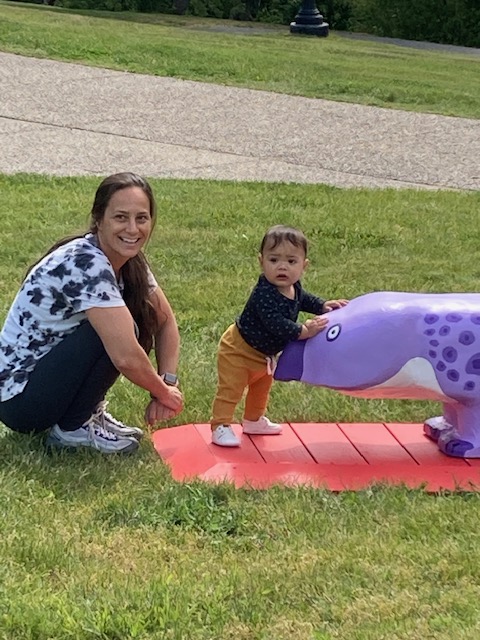
“Carousel Cosmos” is the official title and the seven creatures are a Polar Bear, Humpback Whale, Saber Toothed Cat, Walrus, Rhyncosaur (an extinct herbivorous Triassic archosauromorph reptile), Dragon, Crenatocetus (an extinct genus of protocetid early whale).
Chris wrote, “They are dragons, lions, bears and sea monsters, the usual suspects in the greatest bedtime stories of all time. They have many names in many languages. They’ve made cameos as constellations that might be older than writing, older than the first cities, or the wheel. Some are mythological, some are just misunderstood. They invite you to explore the cosmos starting right here, on a journey to greater understanding.”
One really must visit the installation, but at the least you can visit them online: http://npdworkshop.com/carousel-cosmos

We built the creatures using a “stack laminate” process just as carousel horses have been built since 1799: layers of 8/4 ash (2” thick) were stacked then glued to create the three-dimensional form, which we then carved and painted. With as many as nine layers per creature, Chris used computer modeling software to draw the final shape, then “deconstruct” it to show the shape of each successive layer.

The son of a carpenter, Chris studied sculpture at the Art Institute of Chicago, and then architecture at MIT. His vision is a unique combination of those three influences.

The word “genius” normally is defined in terms of sheer intellectual horsepower – Newton and Einstein, the commonplace exemplars – but a more insightful meaning is in the derivation of the word, from Latin, which means “guiding spirit.”
For having walked the hallowed halls among the MIT Masters, Chris has retained the childlike wonder of growing up amidst the flora and fauna, woods and water of Fifty Lakes, Crow Wing County, Minnesota. His sterling genius guided him not only to conceive, design and build, but also to write this summary of the Carousel Cosmos:
“This carousel is inspired by kindness, adventure, outer space, bedtime stories, dinosaurs and ice cream. It’s inspired by the Western Promenade’s endless views, spectacular sunsets and contemplative atmosphere. It spins the way that the earth spins when the sun sets, in a place where trolleys used to stop, in a small picturesque city with a school community that speaks more than sixty different languages.”
Lest anyone think my statements are grandiose rather than grounded, I submit this photo as Exhibit A:
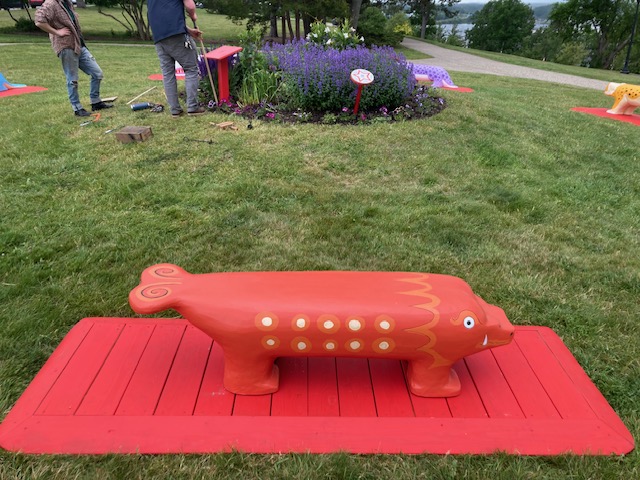


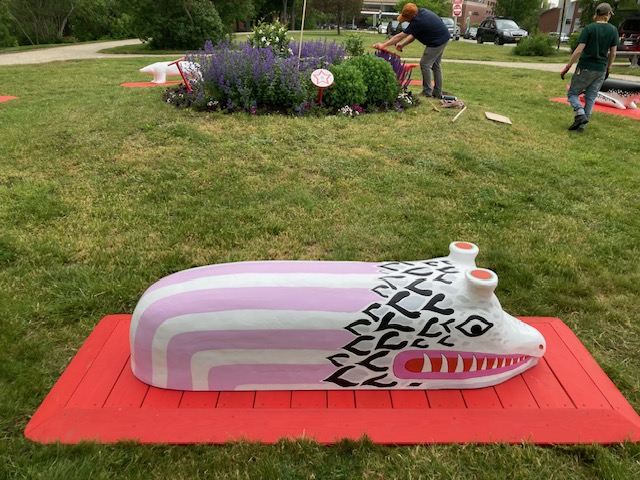


Climb aboard! Let’s go for a spin!!
Quercus Virginianus
Posted: August 28, 2024 Filed under: Art & Healing, Chronicles of a First Time Parent 1 Comment
Quercus Virginianus, the Live Oak tree, is synonymous to the Deep South’s mystique as are Faulkner’s gothic novels. Gothic, indeed, is the architecture of the trees: a circumference up to 35 feet, height up to 70 feet, limbs stretching outward more than 100 feet from the trunk, Spanish Moss tendrils hang to gather nutrients from the wind, rain and sunlight.
A woodworker once told me that in South Carolina a law remains on the books that if two lovers stand beneath a Live Oak tree and exchange vows of their love, then the tree as their witness legally binds the marriage. I cannot prove the fact, but certainly believe its core truth.
Live Oak trees live up to one thousand years. The story is told that in 1771, Étienne de Boré, on his estate which became Audubon Park in New Orleans, planted a Live Oak tree in honor of his bride. At 35 feet in circumference the tree arguably could be closer to 300-years old, known as the “Tree of Life” although officially registered as the Etienne de Boré Oak. Etienne de Boré became the first mayor of New Orleans in 1803.
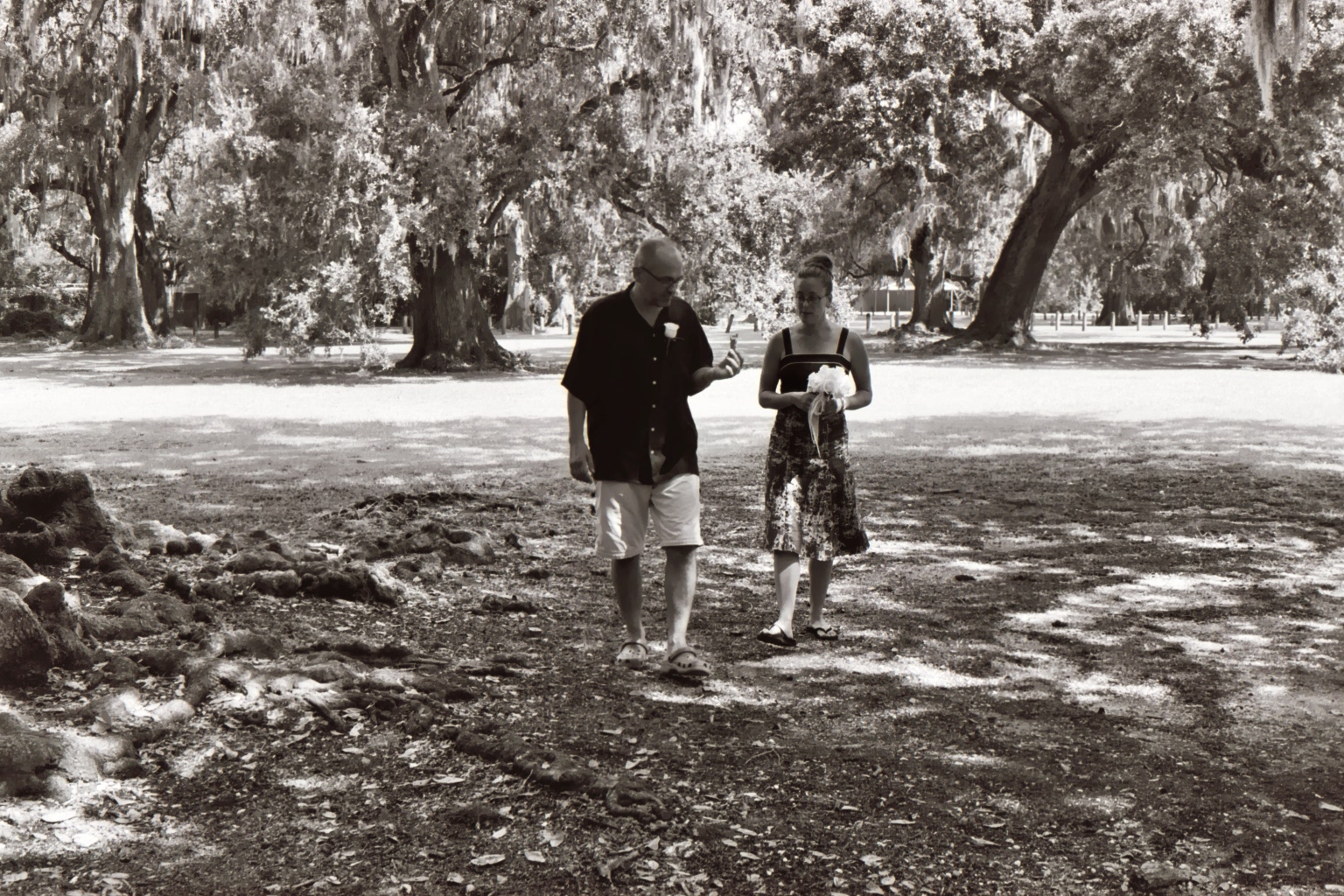
On 28 August 2004 I travelled to Audubon Park to stand beneath the Tree of Life with a soulful strong woman. In true DIY fashion, we wrote our own vows. A Notary Public friend officiated, his wife served as witness (Louisiana is less liberal than South Carolina, at least in terms of trees’ legal standing). We were short one witness, technically, but a woman in black, a total stranger, silently walked up and touched the tree during our exchange of vows, so legally wed we were 28 August in the Tree of Life cathedral.
My vows spoke of “alchemy and the daily renewal.” The traditional “for better or worse” was a given, as I was then a co-defendant in a lawsuit concerning Trust Asset Management and fiduciary duty in United States Federal Court, Northern District of Illinois. My betrothed stood beside me then, she stands beside me now.
2004: on 30 July I was haled into Federal court, where District Judge Matthew Kennelley “granted in part and denied in part” a Summary Judgment on my behalf. My back was against the wall. On 28 August with backs against the Tree of Life, my fiancé and I exchanged vows, and then rings. Next we went to the drive-through daiquiri stand. Later that night we marched in the Second Line of a mid-season Mardi Gras parade. Viva la life of New Orleans!!
Back in Chicago, by autumn of 2004, the lawsuit was settled. The banker from Lichtenstein went to prison. Our union endures. That alone matters.
Twenty years later, we remain together in the light. We raise two bright beautiful children; our life’s work, to be sure. Ours is a remarkable home amidst a wildly creative community, in a place of exquisite beauty, the rocky coast of Maine, on Gaia, circling the sun. My wife holds our family’s center and some day our childrens’ children may say “My Grandfather married one strong soulful woman.”

Saturday on the Street
Posted: August 9, 2024 Filed under: Art & Healing, Farming off the Farm, Permaculture & Home Renovation, What is an Art Farm | Tags: Norway maples, tree work 3 Comments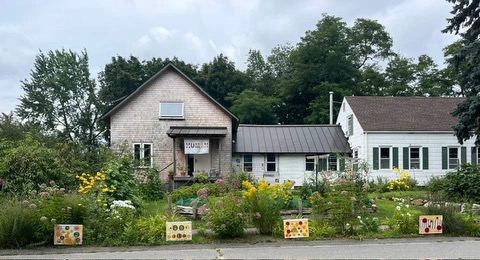
In 1830, in South Portland (known then as Cape Elizabeth) a New England farmhouse was built and its barn completed by 1848. The town’s population was 1,696 people and only six families lived on the street where the farm was located. The farm most certainly had significant acreage.
In 1999, South Portland’s population had grown to 23,324, and the last remaining farmland surrounding this farmhouse was sold off to make a development of six homes. In modern times developers put their road wherever best suits their plan but in 1830 the builders sited the home thoughtfully, based upon the sun’s path; they needed to maximize the solar gain as a heat source. The home’s location then determined where went the developer’s road and the old front yard was paved to put in a street named in honor of the developer’s daughter. The home, which we purchased in 2012, was left with a smaller, but still full sun front yard, enough space to garden and grow food and fruits.
We have felt guided here in creating a healing space. Neighbors have brought wounded birds into our garden, tucking them under the plants, as a place to heal. Young Mothers bring their infants to gaze and we gift them vine ripened tomatoes. We grow less as a matter of sustenance and more as a gift to be given, to be shared.

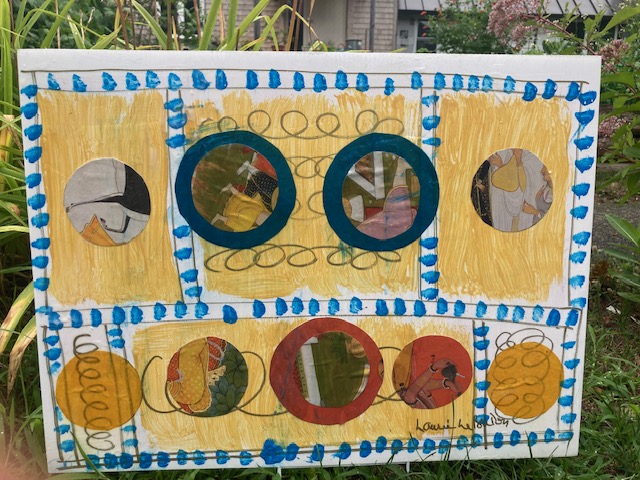
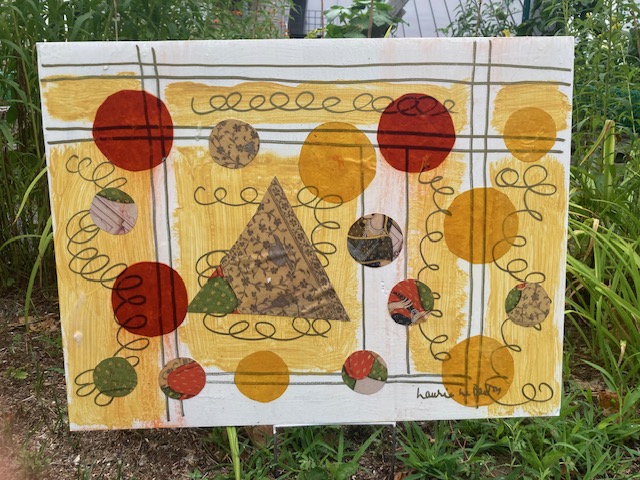
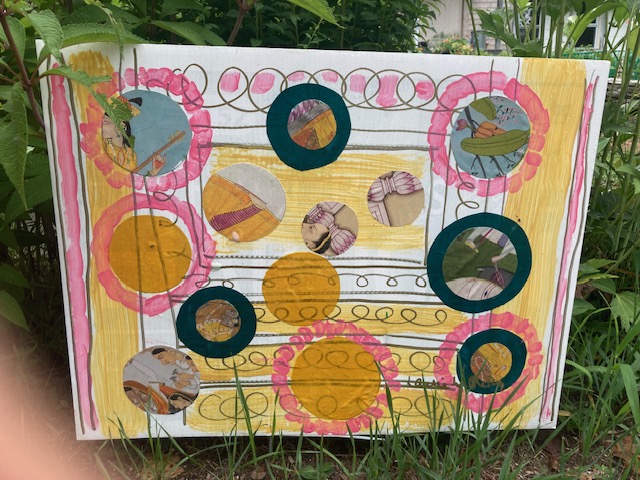
Saturday on our street was very active. Art work arrived from Chicago, from our dear friend Laurie LeBreton, a sculptor whose work combines handmade paper and mixed media. She explains, “I work to access something beyond our concrete world and to find meaning and comfort as I do so. Recent themes have included healing, refuge and ritual.” If yard placards tend to promote politics, Laurie’s speak to art and healing. We embraced Laurie’s generosity and eagerly put them on our side of the street. https://www.laurielebreton.net/

Also on Saturday, very large gooseneck trailers arrived to unload massive paving equipment, parked on the other side of the street. A dialectic began between the mechanized and the natural. If our “Orwellian” week was a “heavy equipment summer camp,” then this week has been about “massive paving equipment and road grinding at night.” My son was over-the-moon delighted. On Sunday night the City began grinding streets here, and the equipment has moved to several other jobs in town. Nightly we have driven to see them work.
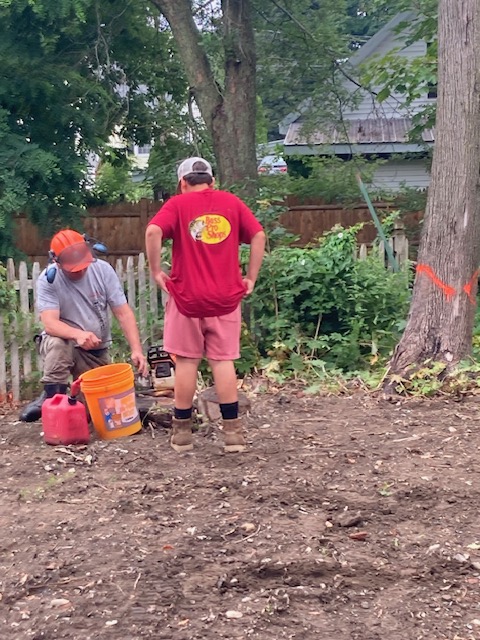
Also on Saturday our work on the invasive Norway Maples continued. Our friend Nate arrived, a journeyman carpenter, master of many trades, and he brought tools for tree work. Nate taught my son how to use a come along, how to sharpen a chain saw, and to use the Phythagorean Theorem to calculate where the tree would fall. My son put on his work boots and got busy.
Norway Maples are not native to America. They were brought here first in 1756, by a nurseryman in Philadelphia, and became popular as an ideal street tree. During the 1970s when the Dutch Elm Disease decimated the urban canopy, the Norway Maples became ever more prominent, but the trees promote a monoculture and grow rapidly, spreading seeds by the wind. They shade out competition. Because they grow fast, their wood grain is long, not tight, and they easily sheer and crack in heavy weather, which has become increasingly more prominent here in Southern Maine.

Two years ago, during a late autumn wind storm, a Norway Maple, with 8” trunk, split and fell onto our swimming pool. Thankfully we were able to repair the pool. Last winter, a much larger Maple, 18” diameter, splintered and fell into the neighbors yard. It leaned precipitously, and my intuition told me not to DIY but to get help.
Nate used the “come along” – a sort of ratchet winch – to direct the tree away from the neighbors yard and to his designated spot. My son worked the come along, tightening the line by cranking to pull the tree down, as Nate cut into the trunk.


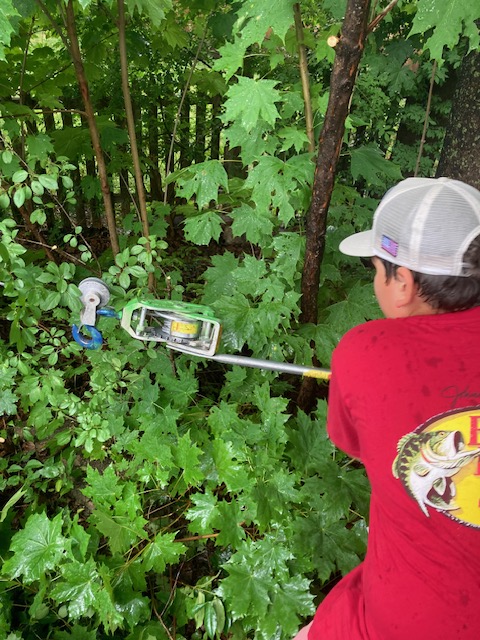
It took a village but the tree is felled, and we have firewood for our winter.

Greater Things
Posted: July 26, 2024 Filed under: Art & Healing, consciousness | Tags: consciousness, rational mind, spirituality 2 CommentsAs a child, raised Roman Catholic, I went to church every Sunday, and to confession on the Holy Week high holidays, plus a few times each year. My sins at most then were venial, not mortal, certainly never cardinal, and, as I stammered for words to describe my offense, at my earthly Father’s instruction, I would take to my knee and ask forgiveness for my sins.
As a University student, I read the New Testament in Koine Greek. My interest in the bible is as literature, not as dogma; I do not read the Bible, but it is important to know, if only as the lingua franca among the 2.4 billion Christians of this world.
My Mother quoted Matthew 22:37-38 as the pillar of the faith, which she paraphrased as “Love and you have fulfilled the law.” A fine path, indeed, and I am thankful for that guidance. To my mind, and in my experience, however, John 14:12 speaks to the core:
“Verily, verily, I say unto you, He that believeth on me, the works that I do shall he do also; and greater works than these shall he do; because I go unto my Father.”
Greater works than these?
As a Federalist approaches the law, let us read this sentence literally, as the Founding Father (sic) meant by his own words. Given that the Gospel of John opens “In the beginning was the word…” we do well to begin with the grammar.
Yeshua, the street preacher, spoke either koine (marketplace Greek) or Aramaic; his name is a late form of the Biblical Hebrew “Joshua,” which is spelled Iesous in Greek and Jesus in Latin. The gospels were written in the Koine because that was more popular than Aramaic, thus reaching a wider audience and so approximately 100-years after his death Matthew, Mark, Luke and John wrote Yeshua’s story in Greek, later translated into Latin, known as The Vulgate; in 1522 William Tyndale translated the work into English (for which in 1536 he was strangled and then burned at the stake) but his work informed the translators of the King James Bible, a masterpiece of writing, published in 1611. It is this version from which I here quote.
The street preacher begins with the hortative clause “Verily, verily, I say unto you,” a teacher’s exclamation, for emphasis, to his listeners.
The subject is “he,” the object is “the works,” and “do” is the verb, in the subjunctive mood. Rarely used in contemporary English, the subjunctive is critical here; the indicative mood states facts, certainty, while the subjunctive mood – “shall do” – expresses potential. In other words, the avatar has opened the prospect of free will, the freedom to choose, challenging the listener to what we could do, rather than what we will do.
The sentence has three subordinate clauses, the first of which – “that believeth on me” – expands the subject phrase. “That I do” refines the direct object, while the third – “because I go” – is causative. Grammatical subordination is not necessarily logical subordination; were his going to the Father the sole cause of our salvation, then our acts would be secondary, almost like a “get out of jail free” card. Faith must be active, not passive, and emphasis here is upon doing; the fact of the matter remains the cause is subordinate to the acts, the doings, to the potential of the believer.
“Greater works than these” is an independent clause expanding that which is done – the miracles, from the Latin word miraculum, meaning “object of wonder” – which every parochial school child knows to include (but are not limited to) walking on water, feeding the 5,000, raising Lazarus from the dead.
The sentence is complex, written in hyperbaton, a rhetorical figure that inverts the normal order of words for added emphasis. But if we focus upon the subject, verb and object – like bowling pins lined up for a strike – it makes plain “He that believeth…shall do…the works, and greater works than these.”
Judge next, as an activist might rule from the bench, interpreting the text in a contemporary context. Carl Jung pertains here, and the subordinate clause of causation “because I go unto my Father” must then refer not to an anthropomorphic God, but to the wise old man, the archetypal male of the collective unconscious, a universal archetype of wisdom and insight. Jung believed every male psyche has a female aspect (anima) and every female psyche a male aspect (animus); so then “go unto my Father” is a personification of the wise masculine spirit within the balanced whole of higher consciousness, which is, to my mind, the “Christ” consciousness, the “anointed” one.
As children we learned English grammar. As adults can we learn to expand our consciousness? Who among us shall be so meek as to act upon, rather than merely to believe in, the miracles?
To speak of walking on water, of healing the sick, or raising the dead is to confront the laws of classical physics, to confound the rational mind, to go beyond the prosaic, to enter the realm of poetry.
Hard pressed to imagine such a state of enlightened being, we do well to ponder the words of the God-intoxicated Persian, the poet Hafiz, who wrote, circa 1350, “I Have Learned So Much”:
I
Have
Learned
So much from God
That I can no longer
Call Myself
A Christian, a Hindu, a Muslim,
A Buddhist, a Jew.
The Truth has shared so much of Itself
With me
That I can no longer call myself
A man, a woman, an angel
Or even pure
Soul.
Love has
Befriended Hafiz so completely
It has turned to ash
And freed
Me
Of every concept and image
My mind has ever known.
[NOTE: My grammatical exegesis here has been refined with the help of my dear friend, Bob Ultimo. A classmate in Latin, we read together in the dark dinghy basement of Kresge Hall, Northwestern University 1983-85. He stayed the course, gained a Masters in Latin, taught for many years the Trivium (grammar, dialectic, rhetoric), currently teaches and writes on grammar and writing. A man in his prime, Magister Ultimo is a master of his craft. Given there is “a mysterious link between grammar and the mind” his clarity of verbal construction, keenness of thought, and deft wording are well worth following at writingsmartly.com. Thank you, Bob. Thank you, very much.]
* * * * * * * *
In late July, the fruits ripen and the harvest has begun.










The Underworld and its Archetypes
Posted: June 28, 2024 Filed under: Art & Healing, consciousness | Tags: consciousness, mythology, rational mind 1 Comment
Science began, many say, with the Copernican Revolution, 1543, when a Polish astronomer put forth that the earth revolves around the sun, rather than the Earth at the center. And so began the broader Scientific Revolution, whereupon the foundations were set, and modern science flourished as an autonomous discipline.
But science can be argued to have begun with Aristotle circa 350 BCE, or the heliocentric theories of Philolaus in 5th Century BCE, or even Thales of Miletus, born 626 BCE, one of the seven sages, who broke from mythology to explain the world through deductive reasoning. Science is based upon facts, and the Western Intellectual tradition is rational.
But all cultures have gazed up at the heavens, and tried to decipher meaning. The scientific astronomers – in the West – used Greek mythological figures to christen the constellations of stars, and so mythology towers overhead, still to this day. Stop and consider: science at best is 2,400 years old, while celestial divination is millenia older, common to all cultures, on all continents. We are wise to consider the archetypes in the sky above us, and what we can learn from them.
Pluto, the planet furthest from the sun, was discovered in 1930 and named for the God of the Underworld, of the dead, also known as the Great Destroyer, Transformer and Redeemer.
Pluto, the planet, was present above the United States on July 4, 1776 “When in the course of human events…” fifty-six founding fathers on that date set pen to paper, to sign and to state that, “We hold these truths to be self-evident, that all men are created equal, that they are endowed by their Creator with certain unalienable Rights, that among these are Life, Liberty and the pursuit of Happiness.” So our sovereign nation was declared.
Pluto has a very long arc – specifically 247 years to circumnavigate the sun – and it has now completed one full return, precisely exact on February 2022 through 2024. The Great Destroyer, Transformer and Redeemer is at high noon, dead overhead again, and who among us cannot say that the United States of America is being wrestled to its core, over “truths held self evident”?
What I say here is not scientific fact, but may be an archetypal truth and the question before us, what we the people must decide, is who we are, and who shall we be going forward? Scientific fact does little to help us here. The archetypes seem predominate, and we are wise to pay heed, to seek answers not in the political but at our deeper, more expansive realms.
Fear not. As Pluto is the God of the dead, so too he is the God of wealth and agriculture; the Destroyer, he is also the Redeemer. Persephone, his mistress, would bring back from the underworld new seeds to be planted each spring, to spawn a harvest come fall.
And so as we move through this dark season, may we also see at hand the seeds of an abundant future. Rather than fighting to the bottom, we the people can sow seeds of unity in diversity, we can move past an “either/or” mindset, to a “both/and” embracing and accepting a greater wholeness.
The choice, and its consequences, are ours.


