Habeas Corpus, Habeas Vox
Posted: April 11, 2025 Filed under: Child Centered Activities, Chronicles of a First Time Parent, consciousness | Tags: constitution, history, politics 2 Comments
One recent morning, my son stood in the kitchen, riveted, listening to the radio. Briskly he spoke, “Dad, how can the President deport citizens for what they say? Isn’t this a violation of their First Amendment rights? When someone enters the country legally, they gain the right of free speech!…upon entry, but they are being deported for saying things the President does not like! They have the right to speak! I don’t understand this!!?” My son’s concern for Free Speech coincides with the right of Due Process.
Knowing it takes a village, I reached out to his cousin WMMK – my nephew – a young law professor who, as it were, is an expert in habeas corpus, which is to say Due Process. WMMK has been published, arguing that habeas corpus is the “…Great Writ of Popular Sovereignty — a tool for We the People to insist that when our agents in government exercise our delegated penal powers, they remain faithful to our sovereign will.” WMMK argues “…the implications for the law of habeas are profound…Paradoxically, shifting from a libertarian to a popular-sovereigntist conception of the writ might yield habeas doctrine more capable of protecting individual liberty.”
My son having raised questions of individual liberty, and given his cousin’s strong clear voice, I decided to create a homeschool Humanities Seminar. Habeas corpus in Latin means “you should have the body.” And where there is a body, there is a voice. Thus we prepare to homeschool “Habeas Corpus, Habeas Vox: Due Process and the 1st Amendment.”
All roads do not lead to Rome. Plato and Aristotle taught that justice within the state held civic virtue (“arete”) as its key; they did not teach specific legal mechanisms to protect individual liberties.
It would take a peasant boy, born in Dardania (present day Balkans) to craft those mechanisms. Justinian – Emperor of the Byzantine Empire – not only built the Hagia Sophia but codified the great Roman jurists; his Corpus Juris Civilis (“Body of Civil Law”) (529-534 AD) endures as the basis of European and International law. But the heavy lifting came in medieval England.
King John was arbitrary and autocratic, and so his Barons spoke up and rebelled. They forced him, in 1215, to sign the Magna Carta which guaranteed “No freeman shall be taken or imprisoned or disseised or exiled or in any way destroyed…except upon the lawful judgement of his peers or the law of the land.” Given habeas vox, so then habeas corpus; the Habeas Corpus Act was codified in 1679 and remains on the statute book to this day: prisoners cannot be held indefinitely without a judicial review of their detention.
The origins of free speech – in the Western tradition – go back to Athenian democracy, in the late 6th or early 5th century BC. They had two concepts of free speech; isegoria was “equality of speech” where all freeborn males had a direct voice in debating and passing laws, while parrhesia was “uninhibited speech,” a culture of tolerance and the free exchange of ideas and criticisms. Erasmus (circa 1500) and Milton (1644) weighed in, but again it was the English Parliament, whose Bill of Rights in 1689 established the constitutional right of freedom of speech. On that recent weekday morning, my son honored that tradition, arguing on behalf of individual liberty.
What then shall our seminar entail? I have begun assembling a reading list to include:
- In Classical Greece justice was the proper functioning of the state as a whole, with community and mutual respect valued higher than individual liberties. The greatest punishment was for the intransigent to be exiled, which is to say to have their voice taken away.
- Justinian’s reign occurred at a hinge point of history. Considered among the greatest, and the last, of the Roman Emperors, his achievements marked the apex of Roman expansion, until a flea carrying the bubonic plague brought massive death: between 25 and 100 Million deaths and the downfall of the empire. The armies of Mohammad easily ransacked both Rome and Persia, and history moved from late antiquity to the medieval world.
- The Magna Carta was foundational to British Common Law, as developed through judicial decisions rather than written codes; “Stare Decisis” means that courts shall follow earlier rulings in similar cases, with precedent as the governing basis. Stability is a virtue. The British Bill of Rights built upon this tradition and became the basis for much of American law.
- The Judiciary Act of 1789 established the American judiciary – the mechanism of due process – and was followed by Amendment One to the USA Constitution, ratified on December 15, 1791: “Congress shall make no law respecting an establishment of religion, or prohibiting the free exercise thereof; or abridging the freedom of speech, or of the press; or the right of the people peaceably to assemble, and to petition the Government for a redress of grievances.”
- Abraham Lincoln suspended the right of habeas corpus at his sole discretion when he signed The Habeas Corpus Suspension Act of 1863. He argued the public safety required it, such as during rebellion or invasion of the Civil War.
- And finally, we will come to the present day, to discuss the fundamental meaning of freedom of speech with American habeas as the vindication not of individual physical liberty, but of popular sovereignty. How does the state protect the voice of “We the People”? WMMK will lead this discussion.
We need pay heed to the fact that for every minute we ponder such noble thoughts, in El Salvador, Kilmar Abrego Garcia is detained wrongfully, without due process, by an administration driven not by justice but reptilian id, anger and revenge for its own gratification; how frail is the law to those who shall not heed its calling. The Magna Carta is but words on paper in the face of any regime that abuses human rights, and these rights must belong not to the privileged few, but to all people created equal.
We study the past to inform our future; patterns of discrimination are the reality against which this philosophy need be understood, in order to raise my son with both an intellectual understanding and the emotional intelligence of a 21st Century global citizen.
______________________
Persephone returns…







A Wily Problem Solver
Posted: March 28, 2025 Filed under: Art & Healing, Chronicles of a First Time Parent, consciousness | Tags: greek-mythology, Helen, Homer, MMA, mythology, Odysseus, odyssey, pankraton 1 Comment
The desire of the Tech Oligarchs to fight and break things is widely known, clearly displayed. Among this rogue band of Billionaires the intellectual appears to be Marc Andreessen, co-creator of the Mosaic web-browser and co-founder of a Silicon Valley venture capital fund.
On Substack, Mr. Andreessen has written, “I was asked what I think of Mark Zuckerberg’s recent Mixed Martial Arts (MMA) training, Elon Musk’s challenge to a cage fight, and public reports that a Zuckerberg/Musk MMA fight may well happen…perhaps in the actual Roman Colosseum. I said, “I think it’s all great. …it’s important to understand how important – how primal – MMA is in the story of our civilization.”
He proceeds to tell the origin of the sport, “…it was introduced to the actual Greek Olympic Games in 648 BC (!). The Greeks called it “pankration” (παγκράτιον), but it is the same thing – a combination of boxing and wrestling.” Trying to impress us by using the Greek letters – Google Translate is free – in fact Mr. Andreessen is showing his lack of understanding.
The rape and abduction of Helen is central to Greek culture; masculine strength and dominance were key, and the Iliad tells the story of the ten-year fight against the Trojans. Helen’s beauty was so great, her “face that launched one thousand ships” when Menelaus, her husband, the King of Sparta, rallied the Greeks to settle the score for her infidelity.
The Iliad sings the praise of manly heroes skilled in fighting and warfare. But the greatest among the heroes was Odysseus, whose skill was not warfare but resourcefulness, his wily, cunning ability to solve problems.
Of Homer’s two epic poems the Iliad is an ensemble story, while the Odyssey sings of Odysseus, alone, his ten-year homecoming after the Trojan War, his return to Penelope and their marriage bed.
During the War, Odysseus was one of the most trusted counselors and advisors. A voice of reason, renowned for self-restraint and diplomacy, he served as a counter balance to the pugilism among the heroes. His homecoming was filled with travail, the hero’s journey in the most archetypal sense. Consider the challenges he overcame:
- When Achilles’ beloved Patroclus was slain, Odysseus negotiated with Achilles to let the men eat and rest, rather than resume the fight. Funeral games were held and Odysseus wrestled with Ajax “The Greater” and raced with Ajax “The Lesser.” He drew the wrestling match, and with the help of Athena, won the foot race. His manliness well-equaled that of other heroes.
- Odysseus devised the Trojan Horse, and lead the siege within the walls of Troy. This brought the defeat of the Trojans, and the end of the war.
- Homebound from Troy, his ships were driven off course and captured by the Cyclops Polyphemus. He and the Cyclops drank much wine, which allowed Odysseus to blind him and then escape.
- Aeolus, the master of the winds, gifted a leather bag containing all of the winds except the west wind, to ensure his safe trip home. But his sailors opened the bag while Odysseus slept, releasing the winds to create a major storm, driving them off course, when his homeland was within sight.
- They re-embarked and encountered the Laestrygonians – man eating giants – which only Odysseus’ ship escaped. Circe the witch-goddess turned half of his men into swine, then Odysseus and his remaining crew spent one year with her enjoying feast and drink.
- He set sail to the western edge of the world, summoned the spirit of the prophet Tiresias and learned of Penelope threatened by suitors. He sailed onward, past the land of the Sirens, through the dire straits of the Scylla and Charybdis, after which his crew hunted down the sacred cattle of the sun god Helios. A shipwreck followed, in which everyone except Odysseus drowned. He washed ashore, whereupon Calypso, a sea nymph, compelled him to remain her lover for seven years.
- He escaped, set sail, shipwrecked again but befriended the Phaeacians, whose King agreed to deliver Odysseus home, to a hidden harbor on Ithaca, his home island.
- Home after 20-years, he sleuthed the island to learn the status quo. His son Telemachus, now a grown man, also returned from the Trojan War, theirs was a grand reunion, of secrecy.
- His wife Penelope, having held at bay her suitors for decades, announced that whoever could string Odysseus’ rigid bow and shoot an arrow through twelve axe shafts should have her hand in marriage. Dressed as a wandering beggar, Odysseus alone strung the bow and won Penelope’s hand, once again. He and Telemachus, his son, easily slayed the suitors.
- Penelope still could not believe her husband had returned, and so tested him with a ruse: she ordered her servant to move the bed in their wedding chamber. Odysseus protested, knowing this could not be done as he himself had built their wedding bed and knew that one of its legs was a living olive tree. Rooted deeply into the ground, such was the union of Penelope and Odysseus, which survived 20 years of separation.
- To avenge the killing of the Suitors, the citizens of Ithaca rose up, but Athena and Zeus intervened and both sides made peace; after 20 years’ destruction the Odyssey ends with peace and reunion.
In 431 BC, Sparta attacked and defeated Athens, with the justification that “might makes right.” And now, Mr. Andreessen praises the primal, “If it was good enough for Heracles and Theseus, it’s good enough for us. Fight!”
But the apex of Classical Greece – the birthplace of democracy – was the Athenians’ understanding of virtue. From Socrates, to Plato, to his student Aristotle, civic virtue – “arete” – emphasized justice, courage, and moderation for the benefit of the community, rather than the individual. To the Greeks, the most enduring heroic quality was not skill in warfare, but cunning command to solve problems for the civic good.
Elon Musk, called “the smartest 15-year old on the planet,” holds now the keys to the American kingdom. For better or worse, our House seems reduced to Animal House. The tech bros – the puer aeternus – shine in their moment to break and destroy with libertarian glee. But this moment of breaking shall pass – all things pass – and great then shall be our collective need to problem solve.
We the people must rise to the coming moment.
______________________________









Senior Chairman of the Board; lunch in lower Manhattan; Dakota’s Coda
Posted: March 14, 2025 Filed under: Chronicles of a First Time Parent, consciousness, Portfolio - David's work, What is an Art Farm 2 Comments
Fred Turner was a titan in American commerce. 1956, in Des Plaines, Illinois, Fred started flipping hamburgers for Ray Kroc; while other young men were hustling to become a corporate Vice President, Turner saw his future: Kroc had a limitless vision, and Turner had the skill and drive to pragmatize the operation, globally. 38 years later, he was the Senior Chairman of the Board of Directors but I knew him as a neighbor, the father of classmates at Holy Cross School, I played the drums in his wife Patty’s jug band.
I wrote a letter requesting a meeting, and mentioned that I had lived off-grid recently. Douglas excoriated me, leaning in slowly, he spoke, “You…can…not…write…that….David! this is…the Chairman of the Board…of McDonald’s!!!” Brazen, I mailed the letter to the headquarters office, but then called Patty at their home.
Cautious at first, Patty happily arranged our meeting. Over a breakfast of eggs and hash browns, I explained my business concept. Fred listened politely, then replied, “If you are going to quote me, say ‘I don’t get it.’”
I always found that phrasing of interest. Having spent a career on quarterly earnings calls, convincing skeptical bankers and financiers of the promise that McDonald’s held, he had been quoted regularly in the Wall Street Journal, the New York Times, any paper reporting the news. Although it was just him and me, he still used that lens, “…if you are going to quote me…”
Having made his fortune selling hamburgers, the digital future was less clear. It was hard, then, to envision Google + You Tube + Starbucks, which essentially is what GDC encompassed. The power behind Global Data was less the media offerings and more the back-end data; with a growing user base the scope would become transformational, as proven in the real world financial success of Facebook and Google. But imagine all profits redounding not to stockholders but to the peoples of this planet, whereby “dignity credit” could be extended based upon local civic participation. GDC was an arbitrage of money and information.
Having met with Fred, it was arranged that I would speak to Edward R. Stavitsky. I had been told that his Uncle had financed Samuel “Goldfish” Goldwyn, Adolph Zukor, Marcus Low, as well as Cecil B. DeMille; with Chase Manhattan Bank, he had financed 100% of 20th Century and 25% for Universal and United Artists studios; had structured the financing of McDonalds Corporation in 1954, “invented” the trilogy structure: operations-franchisee-real estate holding company, which launched the venture. As of 2025, McDonald’s is believed to be the third largest holder of real estate in the world. Bill Gates owns nearly 270,000 acres, while the Catholic Church owns 177,000,000 acres of land.
We spoke on the phone and I was invited to fly out to Los Angeles, to meet in a hotel lobby just off Rodeo Drive. The meeting went well, he was quite friendly and supportive, but “others people money” would be the key. A moment of significance, I stood on the edge of the abyss: I needed to raise $38 Million USD.
My challenge was great. The absolute condition of the Information Alliance was no venture capital, which meant no equity sold. Debt was no option – negative cash flow can service no debt – so the model needed to be an endowment, the academic approach, an asset base generating yield to fund the venture. Progress was slow, very slow, as the calendar turned from 1994 into 1995.
Laurie’s star was ascendent. Employed as a business librarian at Altschuler, Melvoin and Glasser, an accounting and tax-audit firm on Chicago’s Wacker Drive, she was offered a job at Spencer Stuart, a leading global executive search firm. Laurie was lured to London, and so too Douglas, where he enrolled in the London School of Business, a globally respected MBA program, ranked higher than the Business schools of Harvard and the University of Chicago.
The transition was hard. The change complete. Douglas had gone global, on the road, again.
CODA
Our blessings can be our curse. The brilliant mind one wild tiger hard to tame. Douglas was mercurial, like quicksilver: when we were together, he was focused and present, but once apart, he was gone, completely gone. Years passed when we rarely spoke.
I recall standing, after the London move, on a beach in Rogers Park, Chicago, gazing out at the horizon. He spoke of his dream of becoming a college professor. I suspended disbelief until a few years later he was hired to teach at the Kelley School of Business at the University of Indiana. His was the gift of manifestation. Not surprisingly, he became a favorite of the students, annually ranked among the top professors. His light would fill any room, whether a small kitchen or a university lecture hall.
I pursued the endowment for another ten years. Like Sisyphus in an ice storm I struggled to climb that hill. I did deliver funds to Ed Stavitsky and we flew to Wall Street for meetings and meals with the banker, fine red wine not white with fish; contracts were signed but he failed to perform. Whether a potemkin or the real-deal remains an unknown. Ed died in July 1999. I attended his funeral, among many, laid a spadeful of dirt upon his casket.
Eventually I found my way to Maine, to build furniture for Thos Moser Cabinetmakers. I worked the A-shift. It was grounding. I collaborated with my sister on a pair of essays about heirloom furniture – my story was the making, hers the receiving – published in the Chicago Tribune’s Sunday edition. Tom flew me to Chicago to give a demonstration on chair making, then asked me to write an essay about his Customer-in-Residence program. I arranged for Tom to fly to his hometown, Chicago, for a tour of the estate of John Bryan, a major collector of American furniture.
At no one’s request I recruited the Head of the Art History Department at Yale University to create a course on three generations of New England/New York chair making: Hitchcock in the 1800s, Stickley in the 1900s, and Thos Moser into the future. And then on 9 January 2009, after the financial collapse which brought the Great Recession, I was laid off along with half the Thos Moser work force. Profits before collaboration. Money the measure of the man.
I found my way, working as a carpenter, fabricating public art and now, managing the plant and property at the Friends School of Portland.
On 21 December, this past solstice, I called Douglas and we picked up where we left off. We were immediately in synch, as though no time had passed. As our conversation ended, Doug laughed and said, “Hey man, let’s keep in touch more often!”
An opportunity presented itself. I have been thinking about launching a new community project, to teach furniture making to recovering addicts and former convicts. The act of making is at once both practical and therapeutic. My wife is a registered Art Therapist and a Licensed Therapeutic Counselor. I have an idea, she has the credentials, and a woodworker friend is getting a degree in counseling; the elements seem in place.
On 7 January 2025, just before the dawn, as the light returned over the horizon, I found myself thinking about Douglas. There is no one here with his energy, his spark, his purifying flame, and so I thought to reach out, to ask “can we rekindle our flame, chart a new path, ride together, again?”
Five hours later I received the call that he had died.
Bereft, I sat down to write this festschrift “celebration writing” for a deep true friend.
Would that he ride shotgun once again, in spirit, this time.
Rogue Hollywood; from the Library of Alexandria to Carnegie Libraries
Posted: March 7, 2025 Filed under: Chronicles of a First Time Parent, consciousness, Portfolio - David's work, What is an Art Farm | Tags: books, carnegie libraries, cosimo de'medici, Dreamworks SKG, education, history, library of alexandria, technology, travel 1 Comment
Douglas was attending classes in History and Theology at Loyola University but his most serious work was done at the RMG office. He and I were joined at the hip, constant conversation, swapping ideas at a fever pitch.
RMG formed the Information Alliance among leaders in library automation:
- Robert F. Asleson, Esq, had decades of experience as President of five library and information industry companies: University Microfilms International, R.R. Bowker, Information Handling Services, International Thomson Information, Inc., and The Library Corporation. He was thoroughly versed in all issues of copyright clearance.
- Brower Murphy, a self-described “information egalitarian” had pioneered the use of CD-ROM technology for data storage. He then developed NlightN®, a hypermedia universal network allowing a single search across the entire world of published electronic information. This was google before Google, except, created in 1991, it was not designed for the internet.
- Vinod Chachra, President and sole owner of VTLS, Inc. oversaw a staff of 70 with customers in 18 countries, requiring 16 difference languages and multiple character sets and scripts. His software provided a turn-key solution to all library functions.
- Rob McGee and Howard Harris, another RMG Consultant, formed the alliance and Rob acted as editor of the “Concept & Vision” and the business plan.
Our approach to the Worlds Digital Library was direct: “Empowering the individual by access through libraries to the world’s information, ‘anyplace, anytime.’” The philosophy was broad and inclusive, the battle plan was specific and precise. A holding company, the DLC would operate through subsidiaries, each business creating a component of the whole. The first subsidiary was The Index Company, which would:
- digitize book images from collections of widely-used library materials
- compile collections of machine-readable tables-of-contents and back-of-the-book-indexes for subject oriented sets and collections of books
- create and distribute merged collections of the indexed records to provide access to Digital Libraries.
The DLC was the economic engine driving GDC. On paper, the DLC projected a Year 1 loss of ($4.08 M) but turned positive in Year 3 and by Year 5 was in the black at a profit of $6.3 Million USD. At the end of the 20th century, “hockey stick” projections were not uncommon, but questioned by conservative bankers.
On 7 May 1994 the “Concept & Vision” paper was finished, and letters of support were received from:
- Chair of the Virginia State Library Board
- Librarian of Harvard College
- Executive Director of CAVAL (Co-operative Action by Victorian Academic Libraries [Australia])
- President Council on Library Resources
- Deputy Director General, National Library of Australia
- President of the Council of the European Information Industry Association
- Executive Director off the United States National Commission on Libraries and Information Science
It is worth noting some of their comments:
- The Librarian of Harvard College wrote, “There are going to be a number of modest efforts to build the digital library. Yours could be the one most likely to succeed on a large scale.”
- Deputy Director-General of the National Library of Australia wrote, “The approach envisaged in this paper is sensible and shows the appropriate understanding of the current state of the industry which is needed for success to be likely.”
- The President of the Council, European Information Industry Association, “…we shall have no hesitation in bringing this proposal to the attention of our members and examining ways in which we can lay a supportive role in Europe.”
While writing the “Global Data” plan, the landscape in Hollywood was changing. Steven Spielberg, Jeffrey Katzenberg, and David Geffen announced they were going rogue, to create their own live-action and animation film studio. This meant Hollywood’s studio model was being revolutionized, and the financier with whom I was hoping to meet had deep roots – I was told – in that old model. If the paradigm was changing, then I needed to write my own version.
One spring evening at the Chase Street house, Douglas and I sat down at the kitchen table to write “Top-Down meets Bottom-Up” which compared Paramount Communications and Global Dakota Corporation, a $10 Billion colossus versus our $38 Million start up. I was David out to slay Goliath. Working deep into the night, we laid out the categories and filled in the blanks, referencing medieval history through the Internet. Laurie, who is quite savvy in the C-suite, told us it was sheer hubris.
Libraries have been central to all civilizations, throughout recorded time, our collective repository of knowledge, a storehouse of the written word – cuneiform or bound – a place where scholars gather to share knowledge, to push the vanguard. The earliest libraries have been discovered in present-day Syria, and in temple rooms in Sumer (present day Iraq), each in the Cradle of Civilization. The Library of Alexandria, in Cleopatra’s Ptolemaic Egypt reigned among the most significant libraries of the Ancient World, the corpus of Greece and Egypt in one repository, until Julius Caesar’s boys came to town, on military conquest, they burned the library. Dust to dust, ashes to ashes.
30,000 clay tablets from the Library of Ashurbanipal have been discovered at Nineveh – the recorded wealth of Mesopotamia – while the University of Chicago holds baked clay tablets, the administrative backbone of the vast territory of Persia, written in Old Persian, Elamite, and Babylonian languages. The Imperial Library of Constantinople is worthy of mention, authors such as Plato, Aristotle, Demosthenes, Socrates, Thucydides, Homer and Zeno stored and sought. Themeistius, a pagan philosopher and teacher, hired calligraphers and craftsman to produce the actual codices then created a university-like school centered around the library. Lao Tzu, author of the Tao Te Ching, was the keeper of books in the earliest library in China. Into this majestic idea Rob McGee stepped as a young boy, his bike’s basket filled, riding home to 1505 Grace Street with “talking books” for his Grandmother, an armful for himself.
The Free Public Library is not free financially – it is paid for by taxes – so what is free is the access to information. Traditionally libraries had been the private domain of Princes and Kings, Bankers or Clergy. The Renaissance brought an awakening when, in 1444, Cosimo de’Medici created the San Marcos Library, one of the earliest public libraries. Cosimo combined his own extensive collection with the 800 manuscripts of Niccolo de Niccoli, a humanist who worked as a copyist and collator of ancient manuscripts, and was the creator of cursive script, known today as “italics.” Niccolo’s humanist vision was inclusive: “…to the common good, to the public service, to a place open to all, so that all eager for education might be able to harvest from it as from a fertile field the rich fruit of learning.”
Pierpont Morgan’s Library, in the grand style of the Italian Renaissance, was opened to scholars and the public in 1924, the gift of J.P. Morgan, the banker of legend, who indirectly was behind the greatest public library building program in history. In 1901, J.P. Morgan bought the Carnegie Steel Company for $18 Billion (in 2025 dollars), which allowed Andrew Carnegie to vastly expand his brick and mortar ambitions. Between 1883 and 1929 2,509 Carnegie Libraries were built around the world, free to the public. By 1929 almost half of the public libraries in the United States were Carnegie Libraries.
At the end of the 20th Century, many saw change on the horizon, bricks and mortar becoming digital, access universal, which seemed like Archimedes’ fulcrum, upon which we could move the world. Rational self-interest held no motivation for me; e-commerce and social media pale in comparison to the humanist tradition. Douglas, though, had that capitalist urge, and his enthusiasm was grounding for me. He and Rob delivered the Information Alliance which undoubtedly could make the products to drive revenues. The Digital Library Corporation was the core asset, while the Turtle News Network and the community retail outlets expanded our reach.
I played the hand I was dealt. “Top Down Meets Bottom Up” became page 41 of the Global Dakota Business Plan. On 1 July 1994 the Business Plan, with consolidating Pro-Forma Financial Statements, was complete, weighing in at 12 pounds, almost 1,000 pages printed on 100% post consumer recycled paper. Having finished the first task, I tackled the second challenge: a meeting with the Senior Chairman of the Board of McDonald’s Corporation.

Kennebunkport Patrician, Red-Neck Riveria, Skull Valley
Posted: February 21, 2025 Filed under: Art & Healing, Chronicles of a First Time Parent, consciousness, Portfolio - David's work, What is an Art Farm | Tags: history, nature, photography, travel 2 Comments
RMG Consultants, Inc. was mission driven, not pursuing rational self interest as conventionally defined. Rob’s mantra was to remain “ruthlessly objective” and have no conflicts of interest. We served the library as civic institution of learning and education.
Douglas became a corporate officer, with increasing responsibilities, was named Vice President of Operations and Treasurer of RMG Consultants, Inc. He encouraged Rob to pursue the for-profit sector and so they launched Infostrat, Inc., then formed an Australian-based company, RMG/CAVAL to pursue the Austral-Asian market. Douglas became an officer of those entities.
On the home front, I had left the barrio, moved north to Rogers Park, on the lakefront. Brian had graduated from Cornell College with a Bachelors of Arts in Economics and Political Science, moved back to Chicago, full-time at RMG, and lived with me. Douglas also moved to Rogers Park, but found a studio apartment off Howard Avenue, at the El terminus. I believe there was a crack house across the hall, and once he heard gunshots while walking on Howard Avenue. We were on very opposite sides of Sheridan Road.
In January 1991, the first patrician from Kennebunkport, Maine announced that Operation Desert Storm – the First Iraq War – would be televised live; we all pulled up chairs around the TV. Tal Lekberg, my carpenter friend, was in the Coast Guard and had been called to active duty in the Persian Gulf. Not knowing if he would return home alive, he brought his entire collection of single malt Scotch Whiskey to our apartment – at least two dozen bottles – asking me to safeguard it. “It’s okay if you drink it. Maybe some will remain if I return.” Like a fox guarding the hen house, we heartily imbibed while watching the destruction of the cradle of civilization, in pursuit of the quest for oil.
December 1991, Douglas and Laurie had decided to get married, and Douglas pined to be wed in Paris, at the Cathedral of Notre Dame, I as their witness. It made great sense and we all bought tickets, flew across the pond; I arrived first, Douglas and Laurie a day or two later. A friend arranged an apartment for me, and Laurie knew someone from the U of C who had a flat there. We met and celebrated love in Paris, when we were young and all life easily opened before us. But Notre Dame was not so easily scheduled and the wedding did not take place. We took the train south to Chartres, and beside the Cathedral I ran the table at a bakery beside the nave doors. I bought one of everything and together we ate pastries, at the foot of Chartres Cathedral. It was grand. Essentially they were married then, but officially it took two months more.
In February 1992 Douglas and Laurie got married. In April I moved off-grid, to Holmes County, Florida’s “red-neck riviera,” to a swamp along the Choctawhatchee River. Such was the synchronicity of the times, that even the swamp had a role in library automation.

In the tradition of eccentric booksellers, Bob Allenson seems worthy of mention. He is a third-generation bookseller of religious literature but his passion is making bibliographies of rare antiquarian books; his “John Henry Newman, 1801 – 1890: A Preliminary Register of Editions from 1818 to 1890, Together with Original Editions Published Posthumously” is the definitive catalog of Newman’s work. Sometime in the 1980s he was hired by the American Theological Library Association to select the texts that would be digitized for their online corpus of theological literature. Bob was still working on that when I moved there.
Alec R. Allenson, Inc., was launched in London, then relocated to Baltimore, Maryland and eventually to Naperville, Illinois. Bob’s father was a businessman who created a successful company selling textbooks and research materials to Christian seminarians. Bob is a Quaker, committed to social justice who joined the March to Selma and has little interest in business. By 1979, he had decided to remove himself from the mainstream culture and purchased acreage along the Choctawhatchee River in rural Westville, Florida, population 261. Wanting to get away, he found his spot. A friend and I packed the Naperville bookstore – a most remarkable experience – and shipped five semi-trailers of books to the swamp, where Bob’s son-in-law Caleb had built two pole-barn houses where the books would be stored, for sale.
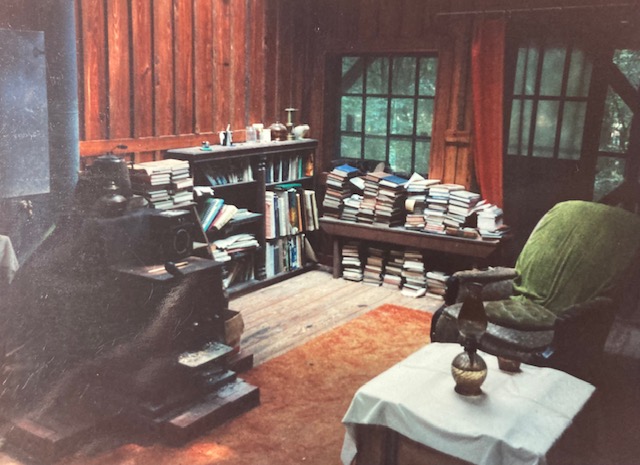
I had kept in touch with Bob, and he asked me to help him with the business. To my mind, at the age of 31, moving off-grid seemed a most sensible thing to do. In April of 1992, Brian and Douglas drove me to Union Station in Chicago, we said goodbye, then I climbed aboard Amtrak’s “City of New Orleans” southbound, down the Mississippi River to New Orleans. I spent the night at a hostel, then boarded a Greyhound Bus east, along the Mississippi and Alabama coast. Somewhere along Florida State Route 20 I got off the bus, then rode my bike north. The Sheriff and his men stopped and questioned me – I stood out like a sore thumb – but let me continue and eventually Bob and his wife Dorothy Ann drove down to pick me up.
Bob embodied his Quaker ideals by visiting prisoners in the State Penitentiary, and, for honesty and transparency, by wearing no clothes. I recall Bob in his kitchen, holding a glass of white wine, cooking ratatouille and lamb chops, discussing the Christian mystics Swedenborg and Meister Eckhart, all while standing buck naked in his birthday suit. To the question, “what’s the recent weather like over there Bob? I’m trying to figure out what to wear?” he replied “Well as far as I’m concerned, you don’t need to wear anything at all.” My guess is he wore clothes to the State Penitentiary.
There was no work to be done, and neither electricity nor running water, so in the swamp – which was, in fact, an oxygen factory – I mostly sat, listened and read. Storm clouds would amass over the Gulf of Mexico, then by afternoon would float north overhead. Almost daily, rain like a typhoon fell, massive amounts of water, relieving the humidity. Caleb and his family also lived in the swamp and at night we would paddle on the river, I in front with a flashlight, scanning for the green eyes of alligators at the water’s level. Once found, they would drop beneath the water and silently swim away, even beneath our canoe. Caleb laughed at his unseasoned passenger from the North.
Eventually it became clear that life there was not sustainable and so I returned to Deerfield, and then unexpectedly, moved out west to Prescott, Arizona. I settled into a trailer, at the foot of a butte, near Skull Valley. By coincidence I had been introduced to an older gentleman, who was active in trading agricultural commodities. Given my background, he was curious of my interests and offered to introduce me to a financier he knew, who purportedly had helped launch McDonald’s Corporation. He had two conditions: I needed to write a Business Plan and get the approval of the Senior Chairman of the Board of McDonald’s Corporation. No small task, although the writing seemed more daunting than the approval, so willing to shovel coal, I was willing to get to work.
The Chicago Tribune had announced an architecture competition for public housing, to redesign the Cabrini-Green projects. I entered. I had met Paolo Soleri, the architect and urban planner – a visionary, widely overlooked – who had built Cosanti and Arcosanti based upon the design of medieval cities of the Italian countryside; he advocated a hyper-dense city surrounded by open space and the natural environment. Living on the high desert, in a trailer with no phone or TV, I began to ponder the social contract, how design manifests those ideas, and the coming impact of unlimited access to information.


Truths Held Self Evident
Posted: January 3, 2025 Filed under: Child Centered Activities, Chronicles of a First Time Parent, consciousness, What is an Art Farm | Tags: consciousness, Great potato famine, healing, hypermasculinity, intergenerational trauma, mental health, trauma 1 Comment
Among truths held self evident, that healing is the purpose of life must be central. But this view challenges the conventional A-list: asset acquisition, accomplishment, accumulation of wealth, accolade, acclaim, awards, advancement…to name but a few.
“He who dies with the most toys wins” is the popular path, but life’s hard labors will come to our doorstep, at which time the question is whether we step up or cower. Our future hangs upon the response.
Easier it is to kick the can down the road. John Maynard Keynes, the economist of destiny, who structured the post-WW2 financial reconstruction, famously said, “In the long run, we are all dead.” But life’s grim reaper is one keen accountant, and even if we choose to ignore, intergenerational trauma will settle all accounts going forward.
“Intergenerational trauma” was a new concept to me until a few years ago when my wife, a Licensed Clinical Professional Counselor spoke of it. Since then the term keeps popping up and it seems to define something of our zeitgeist. Some among us may claim this is just “a hoax from China” but scientific fact argues against brazen disregard.
Epigenetics is the science of how environmental and behavioral factors alter gene activity without changing the DNA sequence. The term “epigenetics” comes from the Greek word epi- which means “on or above.” Originally introduced in 1942, the field has grown rapidly since 2004, when the genome was fully sequenced.
Among its findings are that environmental factors can influence the health and traits over three generations through epigenetic change passed down via sperm and egg cells; the “transgenerational” effect impacts grandchildren even though they were not directly exposed to the original environmental factor. In other words, even the untold family stories shape who we are, and become.
“Beneath every railroad tie there lies a dead Irishman” is an adage describing the struggles of the Irish emigres. My father’s ancestors immigrated to the United States circa 1850. We do not have records, but believe the Mahany clan were from the city of Cork, in the County of Munster where the Great Potato Famine raged. Between 1845 and 1855 more than 1.5 million adults and children – all enduring trauma – left Ireland seeking refuge in America.
The railroads were major employers of the Irish, and the Mahany family followed that path. Daniel M Mahany/Mahoney, my great-grandfather, was born in Kentucky in 1860, the era of the Civil War, the Confederate South; intense tension among the Catholics, immigrants and the Protestant natives; machine politics and its rogues’ gallery of gang violence. As a laborer on the L&N Railroad his work must have been extremely difficult, and how he dealt with those tensions, or even traumas, once home is left unspoken.
My Father said little, next to nothing, about his family of origin and I can only wonder what traumas lie buried, untold stories of a painful past, but which still shape our gene pool. I am the third generation of Daniel Mahany’s child D.J. Mahany
One of five siblings, I process this neither in a vacuum nor by committee. The path of healing is deeply personal, each of us bringing to bear the untold complexities of our own lived lives. But plain is the historical record, factual is the science, and now is my moment.
I wonder if the turbulence of our times is not, to some degree, a long overdue reckoning of intergenerational trauma. There seems a purging of the collective id; the hypermasculine posturing, saber rattling of geo-political Oligarchs, the comic pretensions of World Wrestling Entertainment, all of which seem a masking of unhealed traumas endured and too long accrued. Mass violence marked the 20th century – the “century of genocide” – and I wonder if now comes the time when accounts need be settled.
My children are the fourth generation. My parenting choices have the potential to be liberating. Nothing can be more important to me now, at this stage of my life, than healing as the only thing that matters, that the future may be made more clear, centered in the light.
Turning 12
Posted: December 6, 2024 Filed under: Chronicles of a First Time Parent, consciousness, What is an Art Farm | Tags: coming of age rituals, consciousness, hypermasculinity, mental health, mindfulness, religion, spirituality 5 Comments
Our son turns 12 next week and I am mulling over rituals to mark this right of passage as our cherub becomes a young man.
I was raised in the Roman Catholic Church and its ritual would have been Confirmation. I have little memory of that, but it appears five hours of community service were required. I do remember wearing white, walking down the aisle and choosing Mark as my name. I chose that name to honor my best friend, who had just suffered a terrible accident in which both his arms were amputated. My choice was one of solidarity.

The Catholic tradition seems neither my nor my son’s path; I find Christian dogma limiting although Christ consciousness tremendously expansive. My faith is a work-in-progress while I am seeking alternatives for raising my son.
In the Amazon, the Satere-Mawe tribe have young men wear a glove filled with bullet ants for 10 minutes. Pushing the threshold of pain is not quite the path I seek. In Ethiopia boys jump over a cow, and in Vanuatu they jump from tall towers with vines tied to their ankles, but manliness, to my mind, is more than a measure of strength and courage.

In the Hebrew tradition the bar mitzvah marks a boy’s coming of age whereupon he begins to assume responsibility for his actions. Responsibility tied to manhood appeals to me. 13 is the age of Bar Mitzvah but to my mind, manhood is not just the number of years spent on the planet. It must be earned through understanding. This ritual, then, is about values and lessons learned.
During the summer my son and I volunteered frequently at the South Portland Food Cupboard. It was an enriching experience, and community service seems relevant in his coming of age. Construction work such as Habitat for Humanity comes to mind. I have heard of Church Youth Groups who undertake community service projects. I am looking for local possibilities.

The insights of other men should be another aspect of this plan. My nephew, my son’s cousin, did have a Bar Mitzvah and has agreed to talk with him about the experience, and his own coming of age. A philosopher/carpenter friend has offered to teach more welding, and we may join with a classmate of my son and his father, for a shared experience; working with tools in the act of making. Another friend, whose son also is the same age, is loaning us a lathe for turning wood, and that may be another opportunity for input from other men in the community. My son will benefit from hearing more than my views.
And then there is the topic of sexuality. My Father’s coming-of-age speech to me was as comic as it was lacking. It was haltingly brief, when he simply asked, “Do you have any questions?” Feeling the tension, of course I replied, “No,” whereupon he handed me a paperback book on Catholic morals. I recall the author was aghast at a recent 6th grade school field trip, where the girls wore red lipstick and hosiery. Just blame it on the girls remains the dogmatic view. What I learned of sexuality came from my older Brother and the locker room, but my son deserves better than that.

The pious among us claim that traditional morality teaches the male as the leader, with male-female relationships the only acceptable norm. I regret to inform them that history teaches otherwise. The Christian era has been relatively brief, while Ancient Greece, Rome and China openly practiced homosexuality and pederasty. LGBTQ may arguably be the historical norm and reversion to the mean would seem natural. My son will benefit from thinking not in centuries but in millenia.
The process of writing this has become the means to outline a plan. Among the core values this DIY ritual should include are:
- compassion and cooperation are keys to a healthy masculinity
- no means no, and might does not make right.
- emotional intelligence has greater value than sheer intellectual horsepower
- listen to your heart, not just your head; be curious, ask questions, follow your passion
- practical problem-solving skills provide a grounded self-confidence
- making is hard-wired in our DNA; art predates agriculture, and therefore civilization itself
- Integrity presumes courage; let your word be your bond
- energy follows thought; actions have consequences



Failure and Forgiveness
Posted: November 15, 2024 Filed under: Art & Healing, Chronicles of a First Time Parent, consciousness, Money & Banking, What is an Art Farm | Tags: authoritarian, bankruptcy, contemplation, failure, faith, forgiveness, jurisprudence, naivete, redemption, sufi 2 Comments
In my life the most meaningful lessons were learned from my failures more than any success. Would that it were different, but such, in my experience, has been the lesson learned. I suspect I am not alone here.
The consumer marketing machine, it seems, plays on everyone’s hopes for the good life: the getaway cruise, the flashy new car, the land of milk and honey, lifestyles of the rich and famous. To my mind these are diversions, distractions, from the hard work of honest integrity.
Among my failures was being held in contempt of court, United States Federal Court, Northern District of Illinois. It dragged on for months, and one day into the courtroom United States Marshalls entered, guns holstered, locked and loaded. My counsel nervously waited to petition on my behalf, but surprisingly, they had come not for me. I did not go to jail.

A banker from Lichtenstein did go to prison to serve a three-year term. I was a co-defendant in a lawsuit concerning off-shore Trust Asset Management, guilty not of fraud but of naïveté. The case eventually was settled. The experience gave me reason deeply to reconsider.
Following that settlement I filed a Chapter 7 bankruptcy, which taught me the remarkable experience of forgiveness. It is extraordinary to learn – in the first person – that forgiveness lies at the core of American civil jurisprudence.
Our system of justice is fundamentally about redemption and resolution. In practice often such may seem not the case – for profit prisons, for example – but forgiveness, in fact, does seem to lie at the core. Is not the hope for a better future the American dream? Such, at least, has been my personal experience.
In beginning that new chapter I further learned to let integrity be my bank account. Our culture deifies money. We are drunk in the belief that wealth must equal intelligence and character. We could be no further from the truth.
When I was a boy the popular phrase was “A man’s word is his bond.” Long out of date that is now. Our delusions are different from the truth, which remains that our character is key, that integrity is – in the end – all that matters.
I am not alone in feeling a seismic shift unfolding. This week I received a missive from a Franciscan monk, the founder of the Center for Action and Contemplation, who wrote:
“I have been increasingly convinced that we need a worldwide paradigm shift…(which) becomes necessary when the previous paradigm becomes so full of holes and patchwork “fixes” that a complete overhaul – which once looked utterly threatening – now appears as a lifeline. [We must] move beyond the reward/punishment paradigm.”

He told the Sufi-inspired story “The Angel with the Torch and the Pail”
“An angel was walking down the streets of the world carrying a torch in one hand and a pail of water in the other. A person asked the angel, “What are you doing with that torch and pail? The angel said, “With the torch I am burning down the mansions of heaven, and with the pail I am putting out the fires of hell. Then, and only then, will we see who truly loves God.”
The monk concluded by saying, “The most loving people I have met across the world in my lifetime of teaching and traveling all seemed to know that if love is the goal, it must be love for everybody.”
The bromance playing out on social media and in the halls of government is not about love for everybody. The situation in America is child’s play to the global trend toward authoritarian strongmen. To my mind most certainly this will result in a humanitarian failure, which would force we the people, on this small planet, deep into reevaluation.
We must own our failures before we can be reborn. Once we do that, what if redemption and love become the result of these uncertain times?

Redemption and Return
Posted: November 8, 2024 Filed under: Art & Healing, consciousness, What is an Art Farm | Tags: alpha males, books, divine feminine, greek-mythology, Homer, hypermasculinity, Iliad, mythology, Plato, the Republic, thucydides, trojan-war 1 Comment
Recently, at the Friends School of Portland, I watched a performance of the Iliad that was remarkable; horrid and harrowing, vast and engaging, a testimony to the power of theatre.
The Fig Tree Committee, a group of Quakers from Portland, Oregon presents “An Iliad” to correctional facilities and the communities that surround them. Over 3,500 people, most of whom were incarcerated, have seen the production. In the Quaker vernacular, their work is a “leading” as it “…knits together audiences on both sides of the prison walls by using one of the world’s oldest stories to examine the cycles of violence, trauma, displacement, and hope for healing that unite us all.” https://www.figtreecommittee.org/
The Iliad, central to Classical literature, stands at the apex of Epic Poetry. Homer, the bard, is said to have written the poem circa 800 BC, retelling stories from the late Bronze Age circa 1,000 BC. The story revolves around Paris, a Trojan Prince, who abducted Helen, the wife of Meneleus, the Greek King. Extraordinary was Helen’s beauty, her’s “the face that launched 1,000 ships.” The poet sagely never describes her face, leaving that to the reader’s imagination.
For 10 long years the Greeks battled the Trojans, always to a standstill, which test of endurance is indeed the stuff of legend. The story – hypermasculinity and the alpha males’ dominance – is remarkably relevant to the world today. The Access Hollywood tapes seem but a modern day retelling of Paris abducting Helen.
The Fig Tree’s production used metadrama to connect the classic to the contemporary through the epic catalog of the 1,000 ships. The bard made plain such breadth by listing the many young men killed, but from American, rather than Greek towns, including Evanston, Illinois where long ago I read the Iliad in the Greek. That catalog foreshadowed what was to come, and what is playing out in America today.
Building to the play’s climax, the bard recited a brutally long catalog of wars – Ancient Greece through Europe to modern day Middle East and Gaza – 3,000 years summarized that took us ever deeper into the maze, to face the Minotaur; not half man half beast, but rather the vain beastial side of Aristotle’s “political animal.”
The Peloponnesian War – Sparta versus Athens, 431-404 BC – centered on the issue that “might makes right.” Thucydides, the Greek Historian, in 410BC wrote, “… right, as the world goes, is only in question between equals in power, while the strong do what they can and the weak suffer what they must.” “Might makes right” is the moral antithesis of the path to compassion.
Plato, the Athenian philosopher, wrote the Republic, 375 BC, arguing that democracy was unworkable, “Until philosophers are kings, or the kings and princes of this world have the spirit and power of philosophy … cities will never have rest from their evils,—no, nor the human race, as I believe,—and then only will this our State have a possibility of life and behold the light of day.”
The polite phrase is “Philosopher King” but the literal translation is “Benevolent Dictator.” The authoritarian strongman does seem ascendant now. Many say Victor Orbán is a modern day exemplar of the Philosopher King but his is an illiberal democracy, rule by the minority not “we the people.” Might makes right remains the macho battle cry and let’s be honest: hypermasculine alpha males have run the table for more than 3,000 years.
To my mind, the deeper long-term trend is that the Divine Feminine is ascendant, while the alphas, like dinosaurs, will fight to the bottom to preserve their long enjoyed patriarchy. I speak of masculine traits, not gender, and write this not to condemn but with compassion to decry so many generations of boys raised to be men who fight more than forgive, for whom “making a killing in the market” is a red badge of courage. Radical, indeed, was the street preacher, 2000 years ago, who dared say, “the meek shall inherit the earth.”
At the end of the March from Selma, Martin Luther King stood on the steps of the Alabama State Capital, and said, “The arc of the moral universe is long, but it tends toward justice.” The Iliad tells the same story. This masterpiece of literature is ultimately a story of redemption, the release of anger and hubristic pride.
At the Iliad’s end, Achilles speaks to Priam, the last King of the Trojans, and releases to him the body of Hektor, his son, whom Achilles had slain in battle. Each having lost everything, Achilles – the greatest among the Greek heroes, which is to say the paragon of the alpha male – found within himself redemption and gave back to Priam the body of his son, to be buried, returned to his native soil.
If the greatest of Greek heroes could find forgiveness and compassion, then certainly, so too, can we the people.
Work is to be done.
Let us be about it.
Now.
_______________________________________________________
I quote here from the Richmond Lattimore translation, Prius supplicating Achilles, the response of Achilles, the anointing of Hektor’s body, and the slaying of the “gleaming sheep” for a shared meal of Thanksgiving:
“Achilleus like the gods, remember your father, one who
is of years like mine, and on the door-sill of sorrowful old age.
And they who dwell nearby encompass him and afflict him,
nor is there any to defend him against the wrath, the destruction.
Yet surely he, when he hears of you and that you are still living,
is gladdened within his heart and all his days he is hopeful
that he will see his beloved son come home from the Troad.
But for me, my destiny was evil. I have had the noblest
of sons in Troy, but I say not one of them is left to me. (24.486-94)
“So he spoke, and stirred in the other a passion of grieving
for his own father. He took the old man’s hand and pushed him
gently away, and the two remembered, as Priam sat huddled
at the feet of Achilleus and wept close for manslaughtering Hektor
and Achilleus wept now for his own father, now again
for Patroklos. The sound of their mourning moved in the house. Then
when great Achilleus had taken full satisfaction in sorrow
and the passion for it had gone from his mind and body, thereafter
he rose from his chair, and took the old man by the hand, and set him
on his feet again, in pity for the grey head and the grey beard,
and spoke to him and addressed him in winged words: ‘Ah, unlucky,
surely you have had much evil to endure in your spirit.
How could you dare to come alone to the ships of the Achaians
and before my eyes when I am one who have killed in such numbers
such brave sons of yours? The heart in you is iron. Come, then,
and sit down upon this chair, and you and I will even let
our sorrows lie still in the heart for all our grieving. There is not
any advantage to be won from grim lamentation. (24.507-24)
“Then when the serving-maids had washed the corpse and anointed it
with olive oil, they threw a fair great cloak and a tunic
about him, and Achilleus himself lifted him and laid him
on a litter, and his friends helped him lift it to the smooth-polished
mule wagon. He groaned then, and called by name on his beloved
companion: ‘Be not angry with me, Patroklos, if you discover,
though you be in the house of Hades, that I gave back great Hektor
to his loved father, for the ransom he gave me was not unworthy.
I will give you yourshare of the spoils, as much as is fitting.’
“So spoke great Achilleus and went back into the shelter
and sat down on the elaborate couch from which he had risen,
against the inward wall, and now spoke his word to Priam:
‘Your son is given back to you, aged sir, as you asked it.
He lies on a bier. When dawn shows you yourself shall see him
as you take him away. Now you and I must remember our supper. (24.587-602)
“So spoke fleet Achilleus and sprang to his feet and slaughtered
a gleaming sheep, and his friends skinned it and butchered it fairly,
and cut up the meat expertly into small pieces, and spitted them,
and roasted all carefully and took off the pieces.
Automedon took the bread and set it out on the table
in fair baskets, while Achilleus served the meats. And thereon
they put their hands to the good things that lay ready before them.
But when they had put aside their desire for eating and drinking,
Priam, son of Dardanos, gazed upon Achilleus, wondering
at his size and beauty, for he seemed like an outright vision
of gods. Achilleus in turn gazed on Dardanian Priam
and wondered, as he saw his brave looks and listened to him talking.
But when they had taken their fill of gazing one on the other,
first of the two to speak was the aged man, Priam the godlike:
‘Give me, beloved of Zeus, a place to sleep presently, so that
we may even go to bed and take the pleasure of sweet sleep.
For my eyes have not closed underneath my lids since that time
when my son lost his life beneath your hands, but always
I have been grieving and brooding over my numberless sorrows
and wallowed in the muck about my courtyard’s enclosure.
Now I have tasted food again and have let the gleaming
wine go down my throat. Before, I had tasted nothing.’
He spoke, and Achilleus ordered his serving-maids and companions
to make a bed in the porch’s shelter and to lay upon it
fine underbedding of purple, and spread blankets above it
and fleecy robes to be an over-all covering.” (24.620-646)
The Curve of Consciousness
Posted: September 27, 2024 Filed under: consciousness | Tags: consciousness, philosophy, quantum-physics, rational mind, science, space time continuum, spirituality 2 Comments
Carlo Rovelli is an Italian theoretical physicist with a sterling gift for writing, in English, clear sentences on complex ideas. In “Seven Brief Lessons on Physics” he traces the arc of modern physics from Isaac Newton’s 1687 straight mechanical worldview where bodies move through space and time passes uniformly to the now confirmed existence of quarks and, in 2013, the discovery of the Higgs boson, a fundamental sub-atomic particle; the most basic building blocks of a curvilinear universe.
Einstein’s milestone 1919 insight was that “the gravitational field is not diffused through space; the gravitational field is that space itself….Space is no longer something distinct from matter – it is one of the “material” components of the world. An entity that undulates, flexes, curves, twists. The whole of space can expand and contract.”
Max Planck had a radical idea that energy was not a continuous flow, but instead was “quanta,” or packets, a/k/a small building blocks. Einstein, again, cracked the code, in his 1905 annus mirabilis papers when he wrote, “…the energy of a light ray spreading out from a point source is not continuously distributed over an increasing space but consists of a finite number of “energy quanta” which are localized at points of space, which move without dividing, and which can only be produced and absorbed as complete units.”
Einstein’s idea was rejected as sheer nonsense, until 1925 when a group of physicists in Copenhagen, lead by Niels Bohr, worked out the mathematical equations behind the theory.
The world of quantum mechanics is not predictable, can only be spoken of in terms of probabilities. Roselli describes this as “…very far from the mechanical world of Newton…the world [of quantum mechanics] is a continuous, restless swarming of things, a continuous coming to light and disappearance of ephemeral entities. A set of vibrations, as in the switched-on hippie world of the 1960s. A world of happenings, not of things.”
In the year of our Lord 2024, physics teaches us that, “There is no longer space that “contains” the world, and there is no longer time “in which” events occur. There are only elementary processes wherein quanta of space and matter continually interact with one another. The illusion of space and time that continues around us is a blurred vision of this swarming of elementary processes.”
I present this as background to an idea that just as space time is a curved dynamic field, so too, by analogy, is human consciousness; in the years going forward our ideas of relationships and fundamental rights may flower in unforeseen dimensions. The “straight and narrow” ethics of Augustine, Calvin and Cotton Mather – to name just a few – may become antiquated just as Greek myth now is seen as mere child’s play.
Whether history repeats or rhymes, the fact is that we have been here before. Augustine of Hippo, the towering Church Father, wrote circa 400, “…it is not necessary to probe into the nature of things, as was done by those whom the Greeks called physici…It is enough for the Christian to believe that the only cause of all created things, whether heavenly or earthly, whether visible or invisible, is the goodness of the Creator, the one true God; and that nothing exists but Himself that does not derive its existence from Him.” The Dark Ages followed when the Western Roman Empire fell, trade became stagnant, the Black Plague ravaged the land, scientific thought was discouraged.
Come the sixteenth century, a Polish mathematician calculated the rotations of the planets, and confirmed that the Sun, in fact, is the center of our galaxy. The mathematician, also a Catholic Canon, was savvy and prefaced his work “To The Most Holy Lord, Pope Paul III” begging indulgence, “How I came to dare to conceive such motion of the Earth, contrary to the received opinion of the Mathematicians and indeed contrary to the impression of the senses, is what your Holiness will rather expect to hear. So I should like your Holiness to know that I was induced to think of a method of computing the motions of the spheres by nothing else than the knowledge of the Mathematicians are inconsistent in these investigations.” Copernicus endeavored only to check the mathematics but his “Book of Revolutions” changed the course of history.
Galileo, equally brilliant, more bold and less savvy, championed and then scientifically proved the Copernican heliocentrism, for which he was tried by the Roman Inquisition and found “vehemently suspect of heresy.” Galileo is called the father of observational astronomy, classical physics, the scientific method and modern science. Popes Paul III and V are mere footnotes in history.
The flowering of Renaissance humanism was in full swing in those times, and consider the intellectual and cultural advances concurrent with the scientific revolution: Leonardo da Vinci, Michelangelo, Raphael were active in their studios; Erasmus and Descartes were thinking; Shakespeare and John Milton wrote epic poems and plays; Johannes Kepler and Isaac Newton advanced scientific thought. Whether science was the cause or effect, the fact is that the breadth of thought – what I call consciousness – expanded wildly during this period.
So what then might our “curve of consciousness” bring? Consider these contemporary facts:
- Science has proven that trees communicate and share rescources among themselves via the underground “mycorrhizal network” transferring water, nitrogen, carbon and other minerals; the stronger helping the weaker to survive. Peter Wohlleben has called this network “the woodwide web” allowing trees to communicate.
- Researchers at MIT and other universities are beginning to use Artificial Intelligence to decode the language of humpback whales “with a confidence level of 96 percent.”
- In 2008 the Republic of Ecuador drafted and approved a new constitution recognizing the rights of nature and ecosystems, making them legally enforceable. The preamble states: “RECOGNIZING our age-old roots, wrought by women and men from various peoples, CELEBRATING nature, the Pacha Mama (Mother Earth), of which we are a part and which is vital to our existence, INVOKING the name of God and recognizing our diverse forms of religion and spirituality, CALLING UPON the wisdom of all the cultures that enrich us as a society, AS HEIRS to social liberation struggles against all forms of domination and colonialism AND with a profound commitment to the present and to the future, Hereby decide to build…”
To my mind the coming flowering of consciousness will celebrate unity in diversity. Anthropocentrism may give way to an acceptance that all life is one. Genesis 1:26 where “…God said, Let us make man in our image, after our likeness: and let them have dominion over the fish of the sea, and over the fowl of the air, and over the cattle, and over all the earth, and over every creeping thing that creepeth upon the earth” would seem a shibboleth soon to fall, perhaps replaced and finally embraced by Romans 13:10 “Love your neighbor as yourself. Love does no harm to a neighbor. Therefore love is the fulfillment of the law.”
To all of this, I quote Martin Luther King, “…Free at last, free at last, thank God almighty we are free at last.”
_____________________________________________________________________________
The radiant reds and orange of summer subside, while brown and sienna now dominate the garden. Beans are ripening. We move closer to the Solstice.