God of the Vine
Posted: September 19, 2025 Filed under: Art & Healing, consciousness, In the Kitchen, Little Green Thumbs, What is an Art Farm | Tags: ancient-greece, Dionysus, feminism, Lou Salome, Neitzsche, Rodin 1 Comment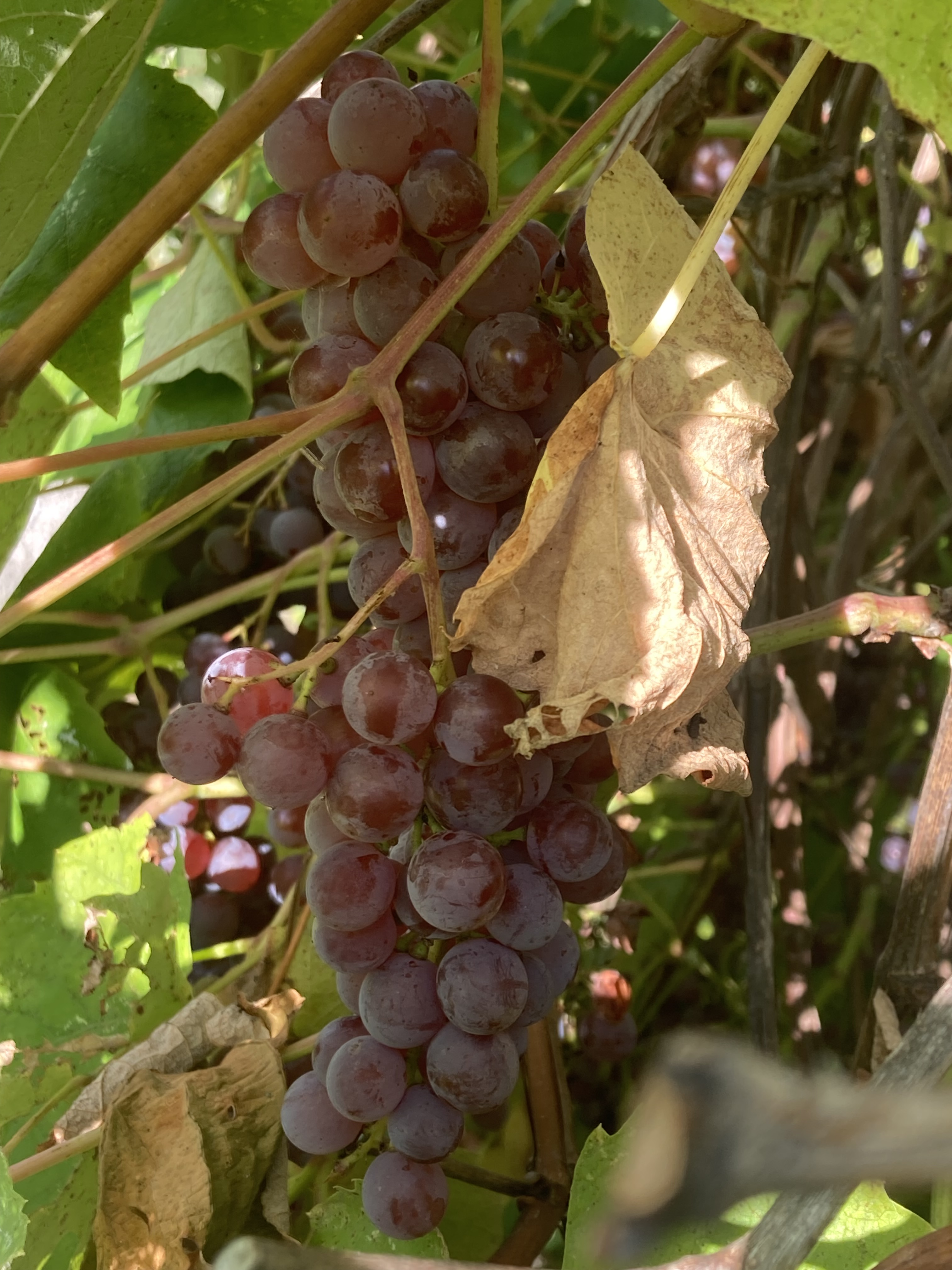
In the annals of wise women, Lou Andreas-Salomé’s name is writ large. Born February 1861 in St. Petersburg, Russia to parents of French Huguenot and Northern German descent, she was the youngest of six children, the only girl. She attended her brothers’ classes learning Russian, German and French, rejected the orthodoxy of her family’s Protestant faith but embraced philosophy, literature and religion. She attended the University of Zurich – one of the few schools then accepting women – and studied logic, history of philosophy, ancient philosophy, psychology and theology.
At the age of 21 she met Friedrich Nietzsche, who immediately fell in love with her. But she rejected his advance, instead wanting to live and study as “brother and sister” and form an academic commune along with Paul Ree, a German author. Nietzsche accepted and they toured Italy with Salomé’s Mother.
One of the titans of German Philosophy, at the age of 24 Nietzsche had been named the Chair of the Department of Classical Philology at the University of Basel. He remains among the youngest tenured professors of Classics in the history of academia. His brilliance was to an extreme.
Walter Kaufmann, in his classic work “The Portable Nietzsche” wrote, “There are philosophers who can write and those who cannot. Most of the great philosophers belong to the first group. There are also, much more rarely, philosophers who can write too well for their own good – as philosophers.” Plato, he says is one example while “Nietzsche furnishes a more recent and no less striking example.”
Lou Salomé was his muse, which she later became to Rainer Maria Rilke – the great German poet – when he was the Personal Secretary to Auguste Rodin, one of the greatest stone carvers of all times, easily a peer of Phidias and the Ancient Greeks. In rarified artistic and intellectual circles, Lou Salomé was at the top of the game.
Dionysus is our subject, Salomé is our guide, but Nietzsche holds the key. Kaufmann wrote, “…few writers in any age were so full of ideas – fruitful, if not acceptable – and it is clear why [Nietzsche] has steadily exerted a unique fascination on the most diverse minds and why he is still so eminently worth reading.”
At the age of 25, Nietzsche wrote “The Birth of Tragedy” which is considered foundational, a revolutionary work of philosophy, aesthetics, and cultural criticism. His groundbreaking thesis argued that the greatest works of art – which define a society – combine the Apollonian (order, reason and form) with the Dionysian (chaos, ecstasy and raw emotion) into one complimentary whole. An example of the Apollonian would be Johann Sebastian Bach’s “Well Tempered Clavier” while Jimi Hendrix’s “Voodoo Chile” is Dionysian. The Burning Man festival is pure Dionysian.
Classical Greek Tragedy, he reasoned, reached the apex of artistic expression by using an ordered beautiful form to give voice to the primal, universal unity. Nietzsche wrote, “The two creative tendencies [Apollo and Dionysus] developed alongside one another, usually in fierce opposition, each by its taunts forcing the other to more energetic production, both perpetuating in a discordant concord that agon which the term art but feebly denominates: until at last, by the thaumaturgy of an Hellenic act of will, the pair accepted the yoke of marriage and, in this condition, begot Attic tragedy, which exhibits the salient features of both parents.”
The result was cathartic; life’s meaninglessness overcome through art. Aesthetics became more central than rationalism, with art and psychology moved to the core pushing metaphysics and science to the side. Nietzsche forged a new paradigm, and his writing influenced Sigmund Freud, who also happened to be a close friend of Lou Salomé.
Greek tragedy came to my mind when a young friend, she herself on the path to wisdom, recently brought fresh home-pressed grape juice to our house. Grapes are the symbol of Dionysus and the connection was clear: her grape juice was the elixir of the God.
Having picked Concord grapes by the bushel with our other friends Rebekah, Peter and Mason, she explained, “We picked the grapes individually, sent them through a masher, then Peter heated them up before sending them through the juicing machine. He tried in the press but it kept sending the juice everywhere so he switched to a tomato juicer. That seemed to operate more like a standard juicer.” In other words the must was strained into juice rich, dark and sublime. With our children, we all broke bread and drank of the vine, the form of the Last Supper transformed as testimony to the raw and primal essence which is the end of summer; a new tradition born.
Truths held self-evident at our Art Farm include “art predates agriculture” and “the purpose of life is healing.” The Dionysian speaks to that, which simple truth the grape juice made manifest.
Fecundity abounds and we are blessed.
“Trust Your Gut!”
Posted: December 20, 2024 Filed under: Chronicles of a First Time Parent, Farming off the Farm, In the Kitchen | Tags: bio-lactate fermentation, fermentation, food, kimchi, locavore, recipe, recipes, vegan Leave a comment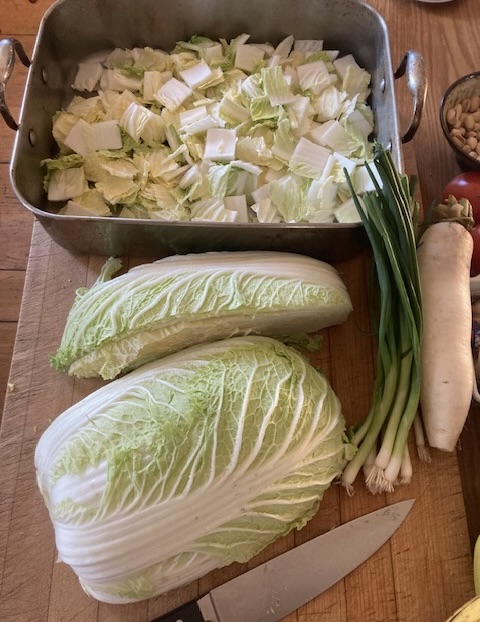
Shiva’s cosmic dance of destruction-creation is active in our kitchen this week. With the holidays here, we chose not to bake but to bio-lactate and the results have been well received. More importantly, our efforts provide healthy probiotics as compared to sugar-laden baked goods.
My daughter and I recently took a Kimchi making class at Frinklepod Farm in Arundel. It was a delightful Father-Daughter outing, and the mysteries of fermentation became clear; the fascinating chemistry whereby glucose, or six-carbon sugars, are converted into cellular energy and lactic acid. The anaerobic process results in an abundance of live microorganisms, probiotics that are highly beneficial for our digestive and immune systems. Trust your gut, indeed!
Fermentation is as old as the hills, has been practiced by everyone, everywhere, longer than memory serves. Good bread ferments; good cheese ferments; yogurt, pickles, sauerkraut…endless is the list. Milk fermentation predates the historical period, which puts the beginning somewhere in the Neolithic Revolution. Recipes for cheese production have been found in Babylonian and Egyptian texts, while Genghis Khan celebrated the Mongolian lunar new year with “white food” – fermented milk – as part of a shamanistic cleansing ritual. Louis Pasteur, active 1850s France, was late to the game.
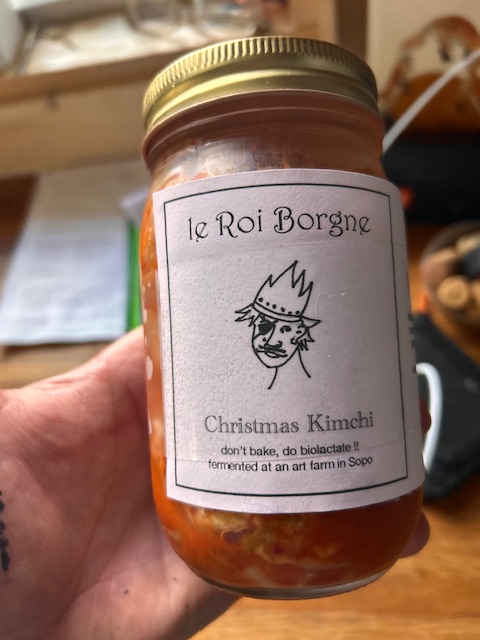
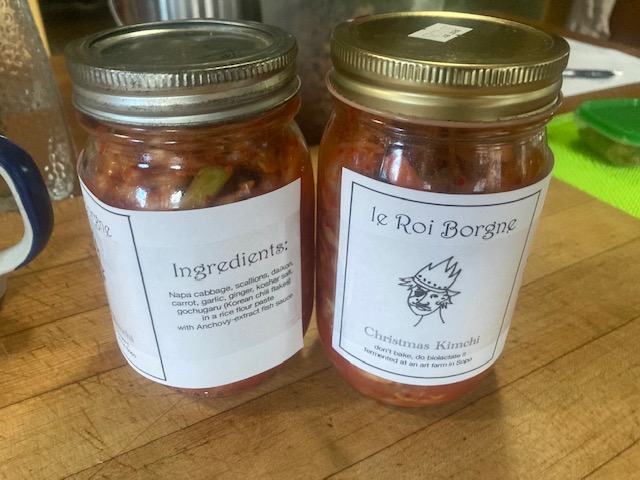
Our “Christmas Kimchi” is named “le Roi Borgne” which hails from the French proverb “Au pays des aveugles, le borgne est roi,” which was popularized by the Dutch humanist Erasmus, who quoted the Latin “in regione caecorum rex est luscus,” to wit: “In the blind world, the one-eyed man is king.” Such truth has informed much of my life’s experience.
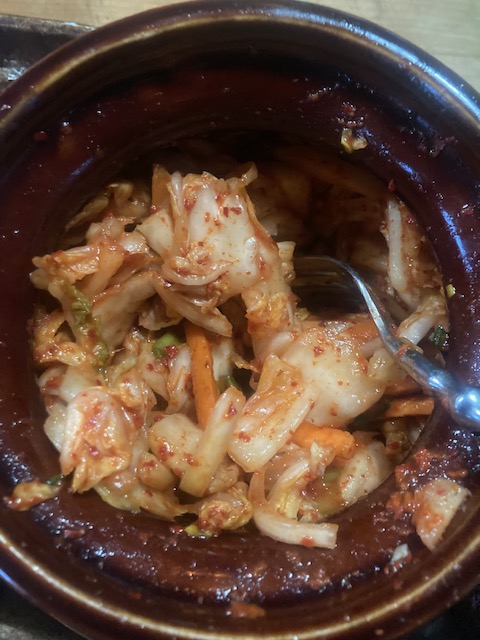
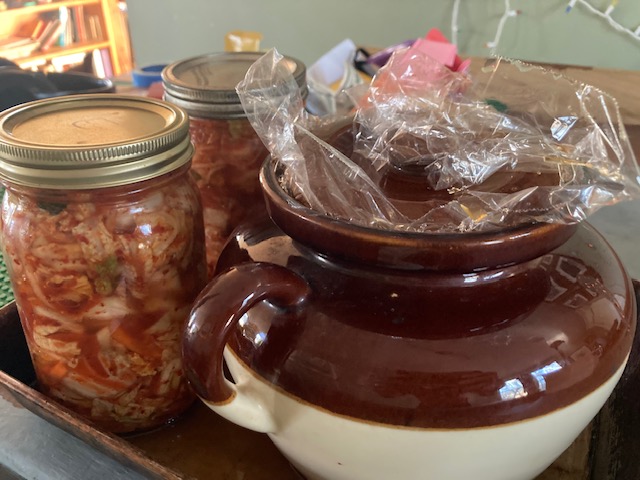
We use Napa Cabbage salted 2.5% by weight, then brined for an hour or two. A rice flour slurry is made with gochugaru (chili pepper flakes), sugar and fish sauce (our “le Roi Borgne” is not vegan), into which “matchstick” carrots, daikon, onion and scallion are tossed. The brine is rinsed from the cabbage and then all is mixed together and sits on the counter – but out of direct sunlight – for about three days.
The result is a delightfully tangy slightly sour kimchi, known as “Tongbaechu,” a Korean traditional style. Here is the recipe we used, viewed 29 Million times.
Serendipity has graced us. The ceramic pot in which we ferment came to us from Corea, Maine. By convention, it is an official Boston Baked Bean pot, which belonged to my wife’s maternal grandfather, but at our art farm it is now a cherished “onggi.”
“Know your food, know your farmer”…well, at Frinklepod Farm, Flora Brown and Noah Wentworth do amazing work, and their class was a godsend. http://frinklepodfarm.com/
Ger, who taught us, is a maker from the mid-coast. Her teaching was clear and cogent, fact-filled while fun. Robust is the wisdom of the locavore culture on this rocky coast. We are the better for it. https://redkettlekimchi.com/

Seed Saving
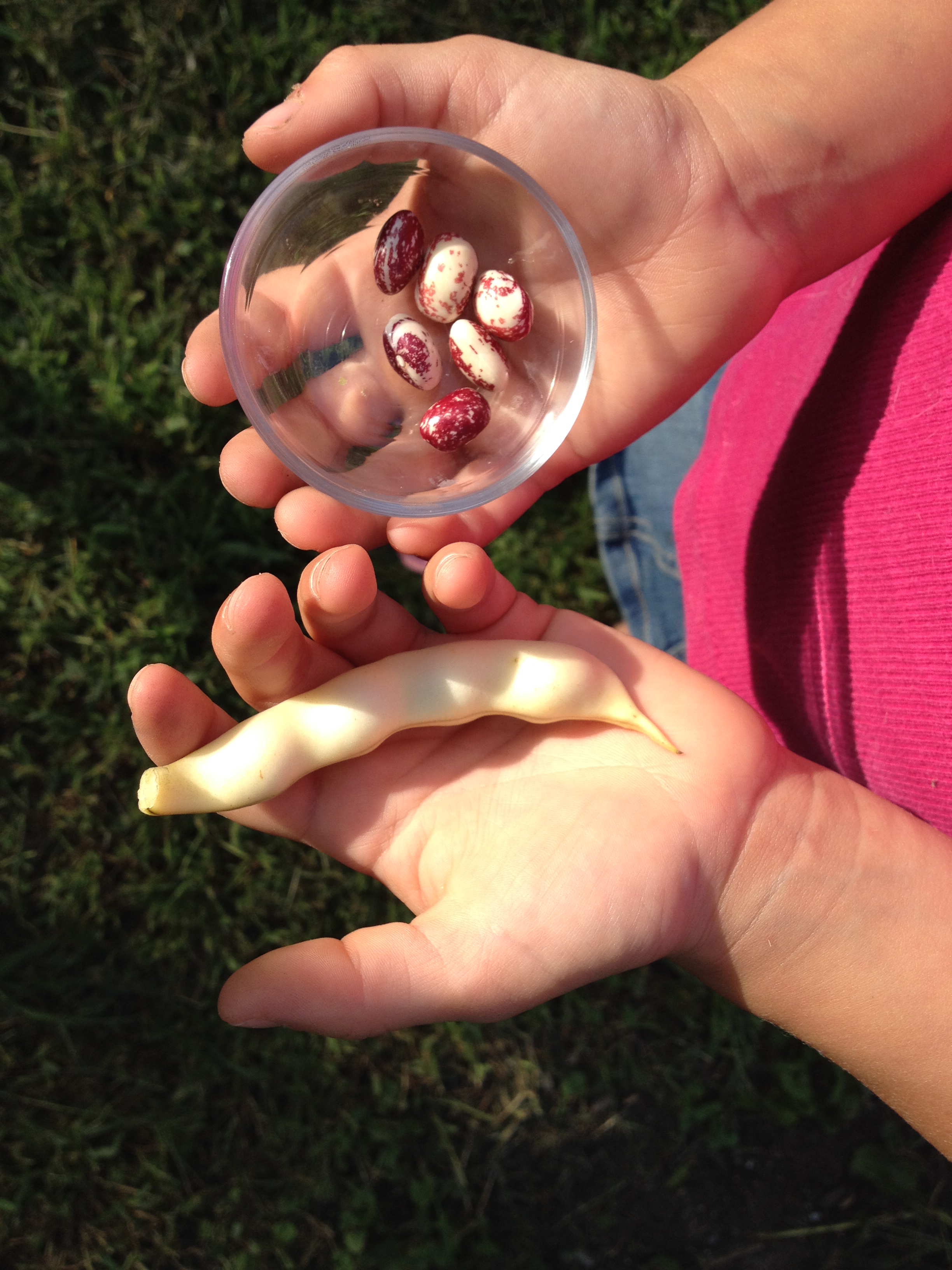
Posted: October 17, 2015 Filed under: Child Centered Activities, Farming off the Farm, In the Kitchen 3 CommentsThis year we grew Good Mother Stallard pole beans for the Seed Temple in Estancia, New Mexico <followthegoldenpath.org>. Our first time growing pole beans, I wasn’t sure how to dry them. While I researched, Ella walked into the garden, plucked from the vine one dried pod, pulled it apart, and…VOILA!…green beans had turned a gorgeous mottled red. Exquisite, fascinating, and a great shared lesson in seed saving.
We planted ten seeds and now have ten x ten x…an abundant cache to send back, to share with friends, and to sow next season.

Chef’s Garden at the Inn
Posted: July 18, 2015 Filed under: Farming off the Farm, In the Kitchen 6 Comments
A concise 6-month history of the Chef’s Garden: in January, on the cold grey day of my first visit to Chebeague Island, I stood on a lawn at the Inn and was asked there to create a Chef’s Garden.

 In March, enthusiasm was high. The chef offered his list of desired plants and my friends at Frinklepod Farm, Noah Wentworth and Flora Brown, started the vegy, herb and flower seedings; David Buchanan, of Portersfield Cider, shared advice on berries and stone fruits; Nance Klehm, from the Seed Temple in Estancia, New Mexico, sent seeds of the 4 sisters: Corn, Pole Beans, Winter Squash and Sunflowers.
In April, Chuck Varney, of Second Wind Farm on Chebeague Island, plowed and turned the sod, we amended the soil, and then tilled to break the clumps. We had neither time nor materials to sheet mulch; on the island, bulk compost and mulch are available only if barged over in a dump truck, so we have worked with the soil at hand. The ground laid fallow a few weeks and then we worked our way across the field picking out roots and clumps of dried grass.
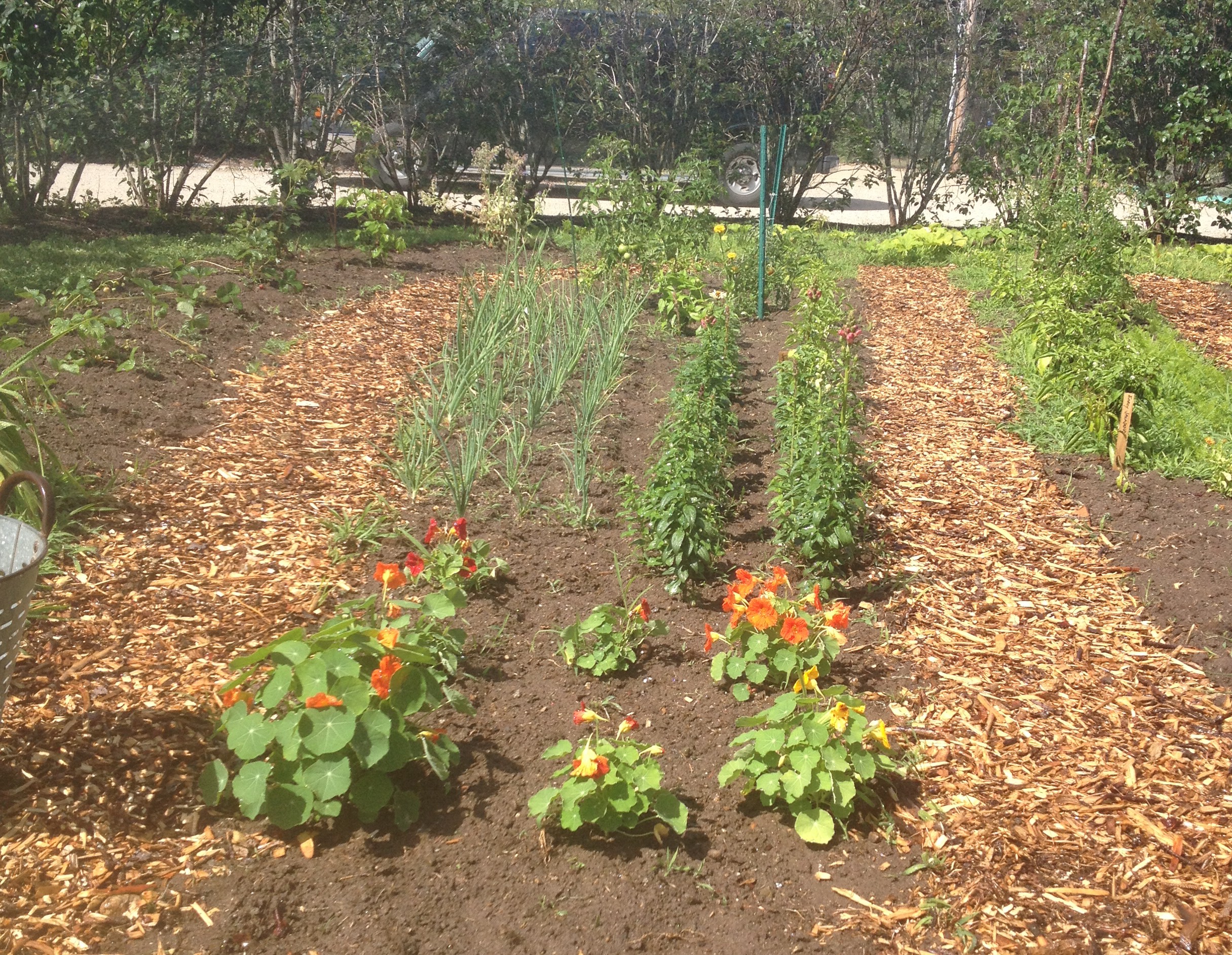
In late-May, on a rain-drenched day, Noah and I hauled across the bay crates filled with the starts and seeds: japanese eggplants, red and white onions, varieties of tomatoes, peppers, butternut and buttercup squash, bush beans, radishes, carrots, beets, slicing cucumbers, and a potager’s array of herbs and flowers. Some seeds failed to germinate. Some plants have been slow to take root. Overall, the garden is flowering and fruits are forming on the vines.

 The chef has said that he walks through the garden to relax during long days in the kitchen. Today, he harvested eggplants, peppers, squash blossoms, herbs and edible flowers for this evening’s menu.
How wonderful to see an idea coming to fruition, and to know that customers have been fed from our shared efforts.
From Tree to Table
Posted: August 18, 2013 Filed under: Farming off the Farm, Gallery - Visual, In the Kitchen, Permaculture & Home Renovation 3 Comments

Dinner Interrupted
Posted: August 6, 2013 Filed under: Child Centered Activities, Farming off the Farm, In the Kitchen, Permaculture & Home Renovation 3 Comments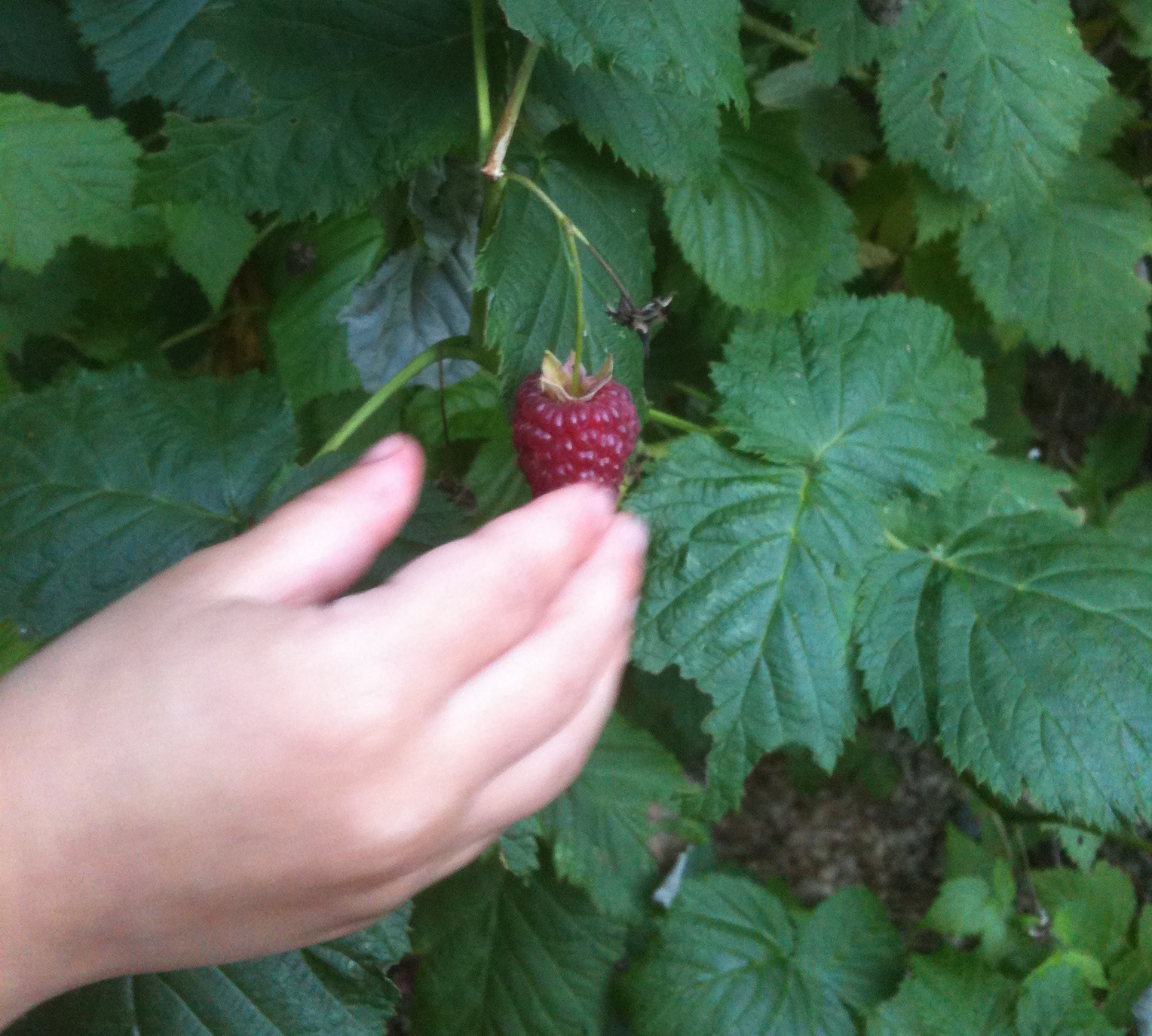
Last night, as we prepared to eat dinner on the porch, our neighbor Steve came walking down the magical path to our house. He told us that there was at least one quart of red raspberries waiting to be picked on the canes growing behind his house. That was a call to arms!
Our four-year old daughter E loves picking berries, and so this offer was the equivalent of Halloween and Christmas combined, in August. We quickly finished our dinner and then E and I ran down the path to Steve’s house.
Like little Sal in the famous story “Blueberries for Sal,” E eats 10 berries for every one she puts into the bucket. Which was not a problem here.


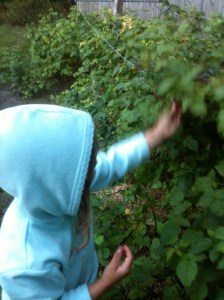
Before too long, she decided to run back home while I continued to fill up the bucket. There was blueberry pie waiting for dessert. Early August in Maine!



First Fruits
Posted: June 30, 2013 Filed under: In the Kitchen, Permaculture & Home Renovation 5 Comments
Our Red Haven peach tree is thriving. We were told not to expect fruit for about three years, but we seem to be ahead of schedule. We are novices here, and curious to learn.
We have room – and dreams – of planting another peach tree, a couple of sour cherry trees (think pie!) and many dwarf apple trees.
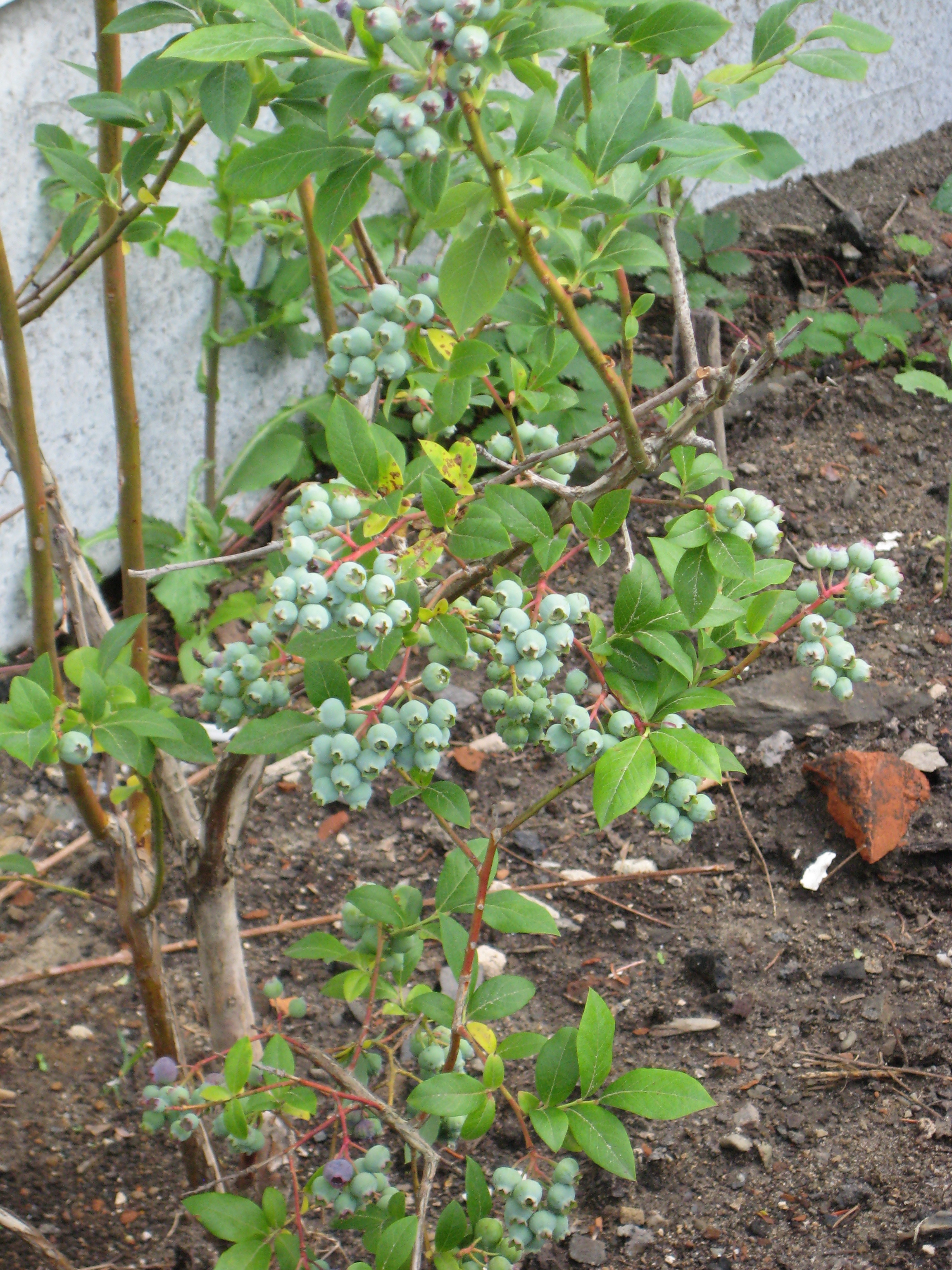
Four highbush blueberry plants fell into our possession; two one gallon plants came from a neighbor, and two quite large and developed plants came from our friends Ann & Kurt, who moved this week from Casco, Maine to New Orleans. What a great remembrance to have fruit from their farm now transplanted here!

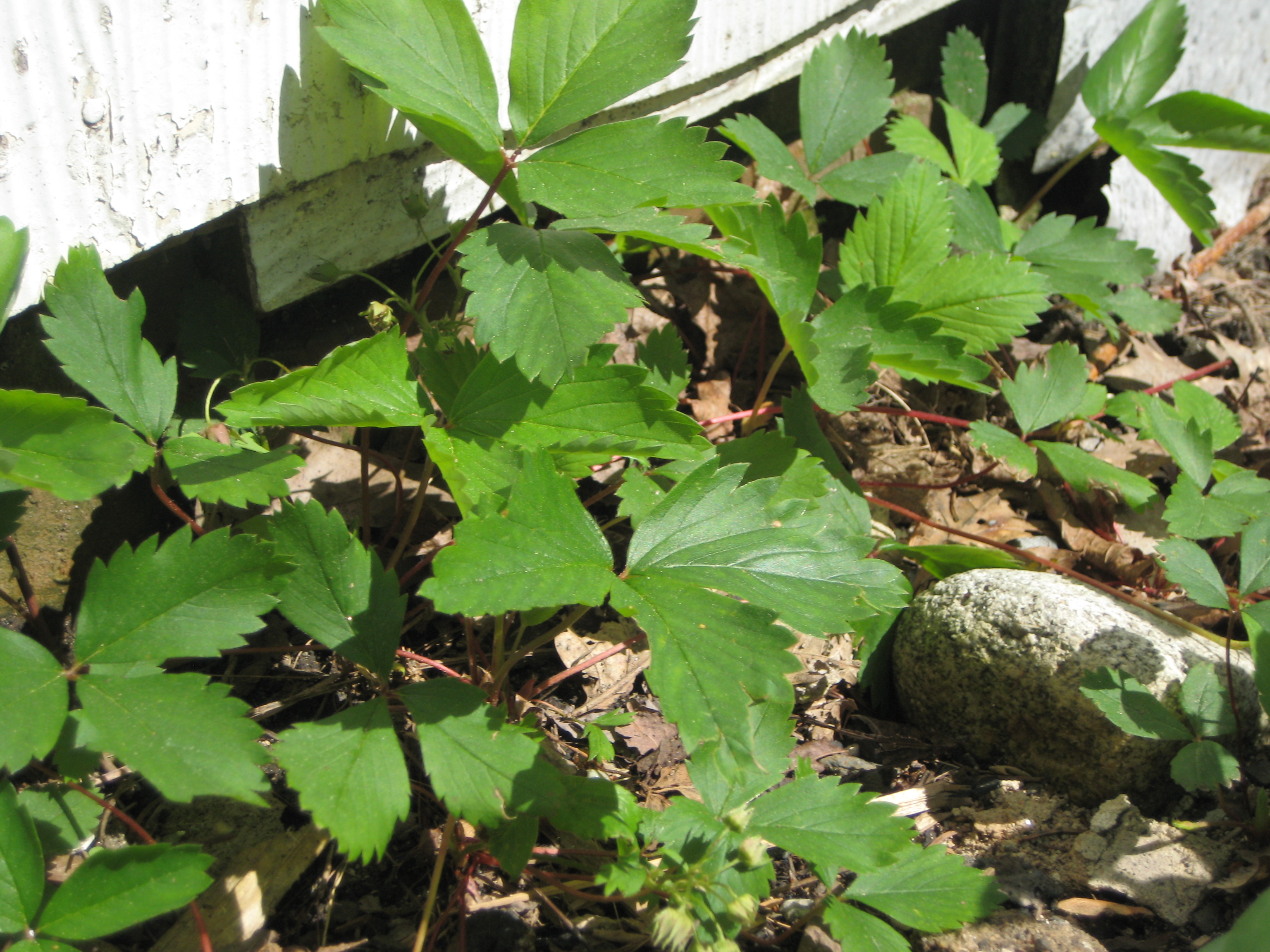
Ann & Kurt also gave us about forty strawberry plants. These were planted yesterday, and with all the rain, the timing was right.

Eleven blackberry canes came from other friends. Those went along the west edge of the backyard, part shade, but those are coming along well.
There are lots of wild berry plants – some strawberry and some raspberry (we think).

The grape stock is a mixed success. One cane is thriving, while the other has done nothing. These are cuttings of a seedless champagne grape that grows at the big house, so we will take some more cuttings and see if we can’t get more started. I am preparing to build a trellis from dead black locust trees, but that project is low on the to-do list right now.

Unplanned Renovations
Posted: May 27, 2013 Filed under: In the Kitchen, Permaculture & Home Renovation 4 Comments
Our property came with a falling down barn and a storm damaged box elder tree. And as sentry overlooking it all, a Pileated Woodpecker.
Our plan for a permacultural renovation was unilateral, and once I noticed our sentry I had a conflict; we were not turning back but we were going to turn him out.
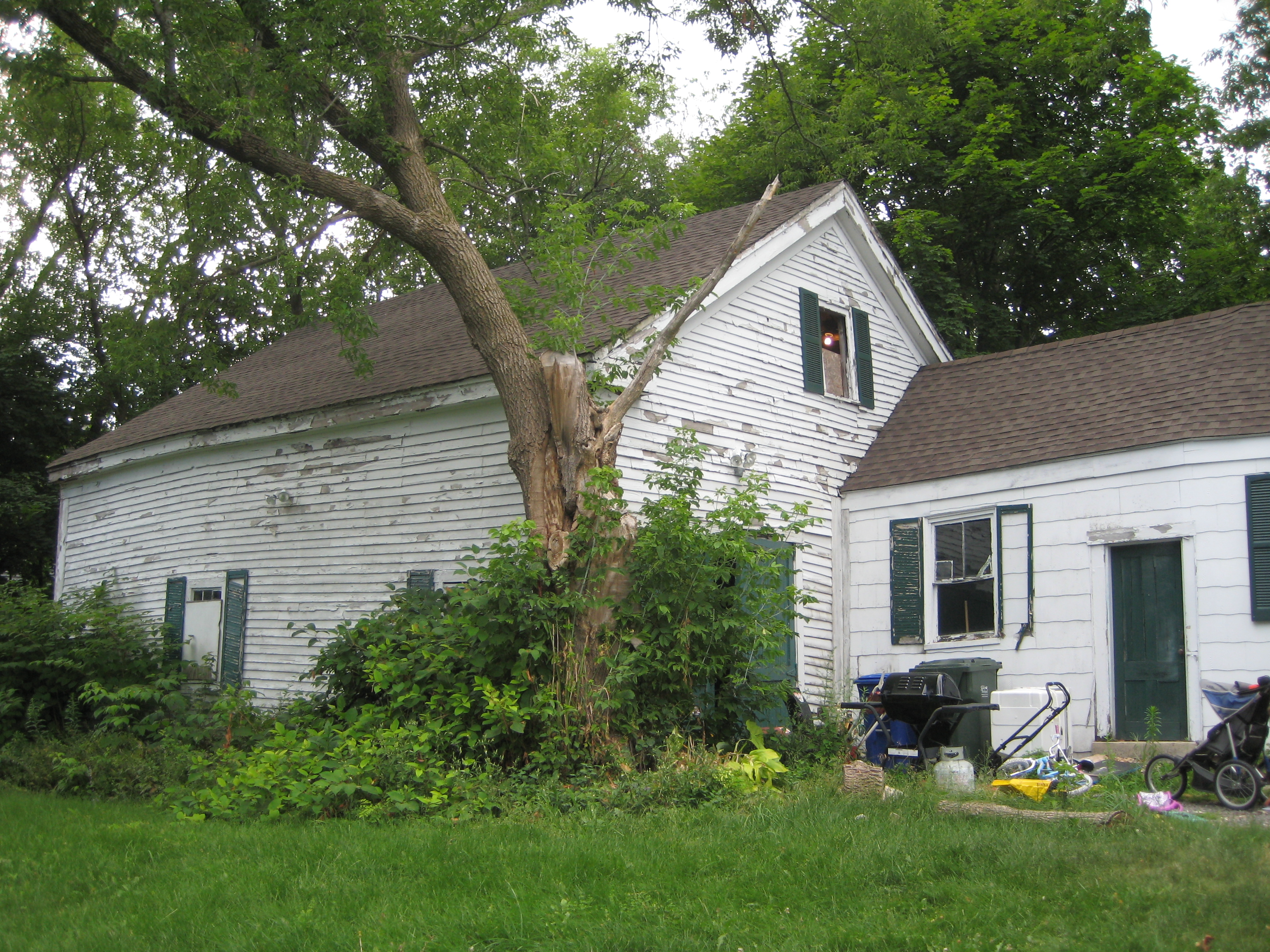

So one balmy afternoon last September, I paused and had a meditation with Mr. Pileated. I doubt it made a difference to him, but I pledged the branch would be remounted somewhere on the farm. He moved on and we moved forward. The branch was saved while the rest was razed.
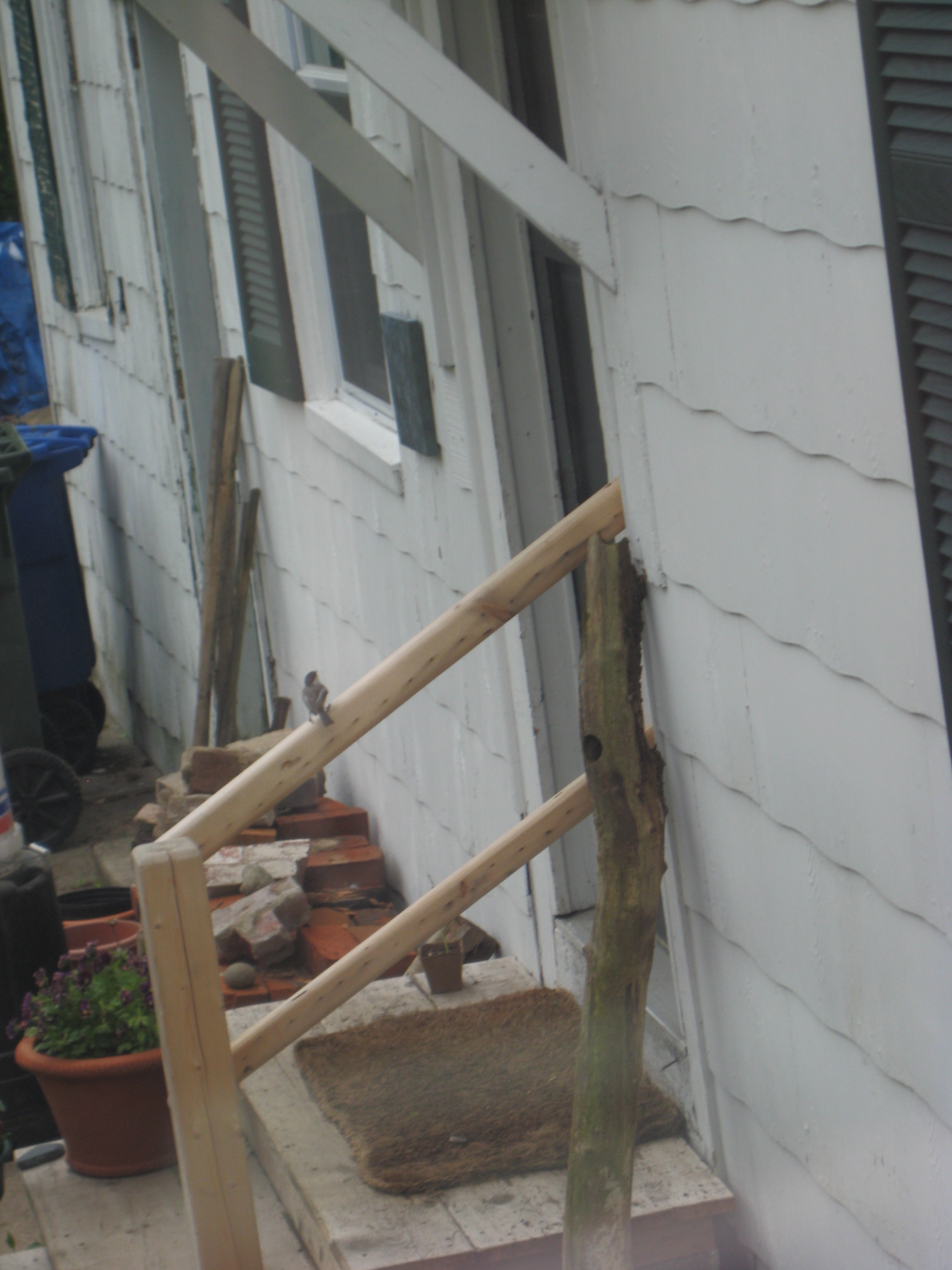
Yesterday I came across that branch lying on the ground. It had spent an ignominous winter buried under the snow. With a welcome recognition, I propped the branch against the stair railing and moved on. Within minutes, a pair of Chickadees moved in.
Becca had been watching this from the kitchen window. She pointed it out and said, “If you are going to move it, do it now!”
With no time to plan, and no tools at hand, I set the log at the back of the new foundation bed and leaned it against the house; protected from foot traffic, close to our bird bath and feeder, and next to the towering Blue Spruce.


The Chickadees are nesting. They shuttle now, non-stop, back and forth between their nest and the blue spruce. Outbound, debris is hauled from the log. They land in the Blue Spruce and release their detritus, then await their partner to make the round trip.
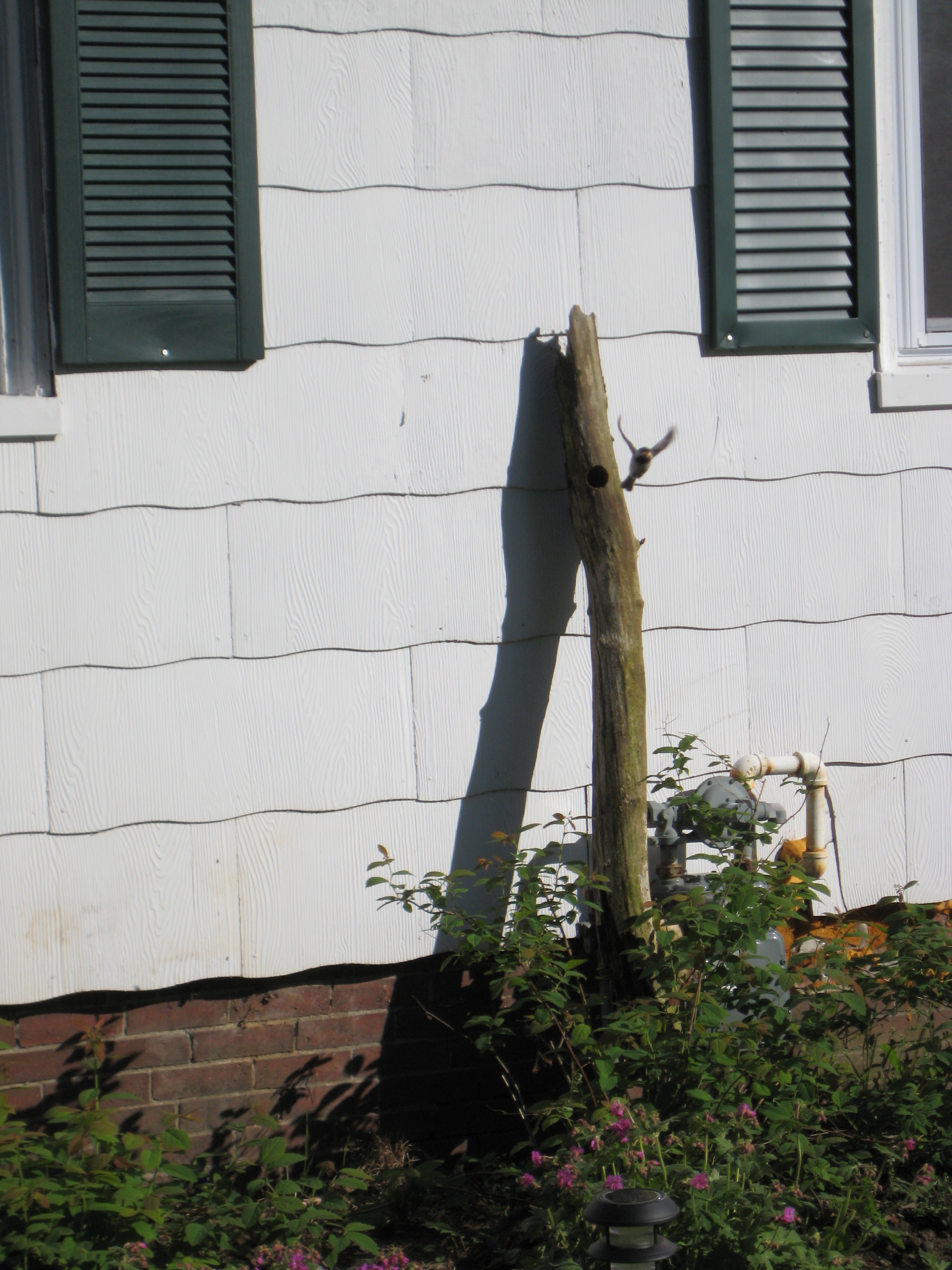
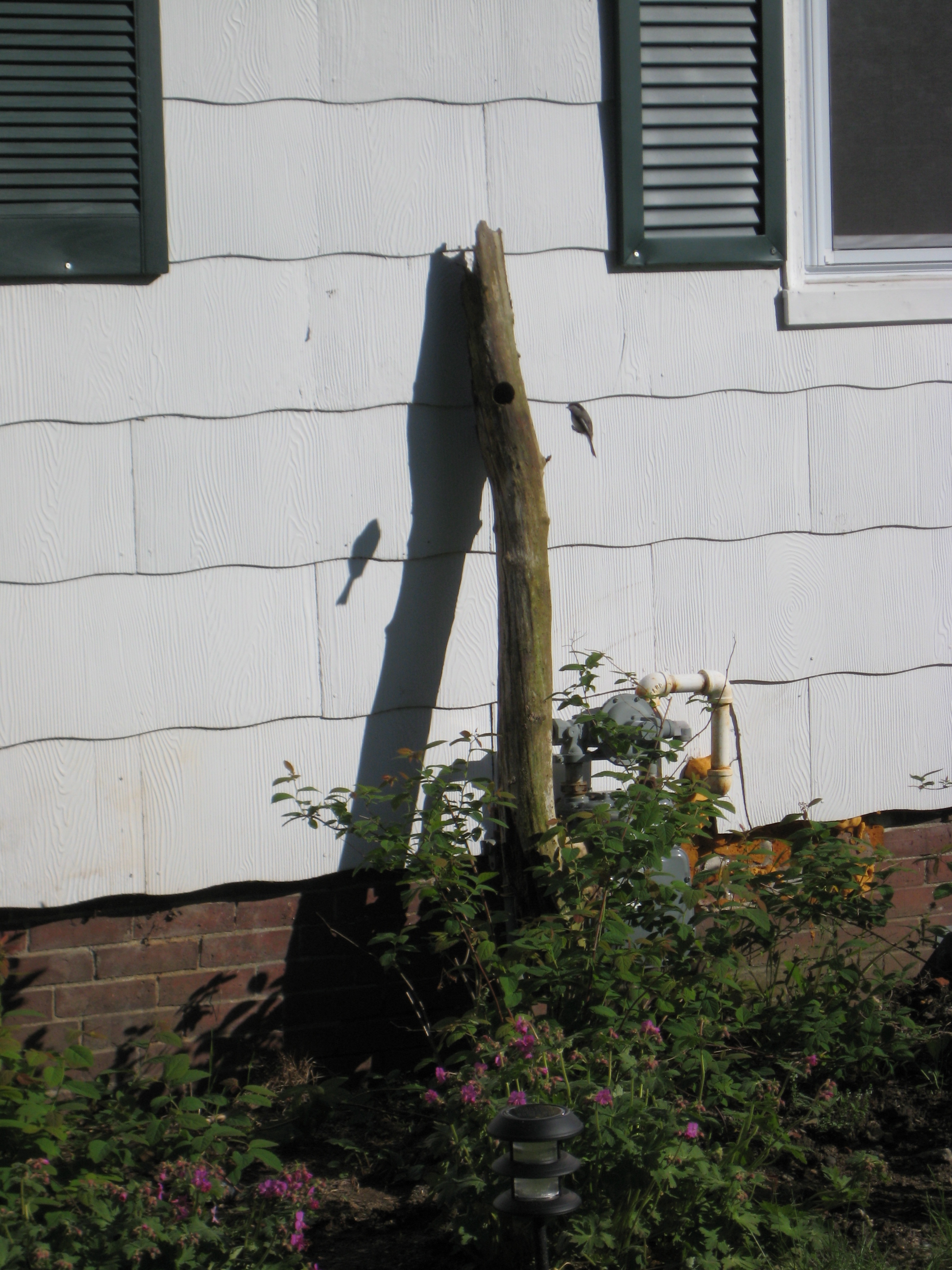
We are able to watch this from our kitchen window.

An amazing show. An affirmation, we hope, of our intentions.

Cardboard Kitchen
Posted: January 9, 2013 Filed under: In the Kitchen, Permaculture & Home Renovation 2 Comments
In pregnancy week 28, late September by the calendar, we grabbed cardboard, an x-acto knife, some markers and headed over to the new house.
This was no art project. I wanted to mock-up the kitchen and walk through the layout of cabinets and the island. I wanted to see how it felt having several people in that space. Better to make changes before they would cost us money.
Scale drawings had been made but what looks good on paper can be deceiving. It paid off; we decided to increase by two inches the distance between the island and the range, and decrease slightly the width of the island – the island is planned at 37″ wide x 84″ long. The island will be comfortably large, but that added floor space will pay dividends on crowded holiday meals.
Our farmhouse has four windows along the south wall, and the only logical place for the kitchen was in the south-west corner. The window sills are 28″ above the floor while standard counter height is 36″. There was no way I would let the counters span in front of the windows (as the previous tenant had done), but that meant I would have to build custom cabinets.
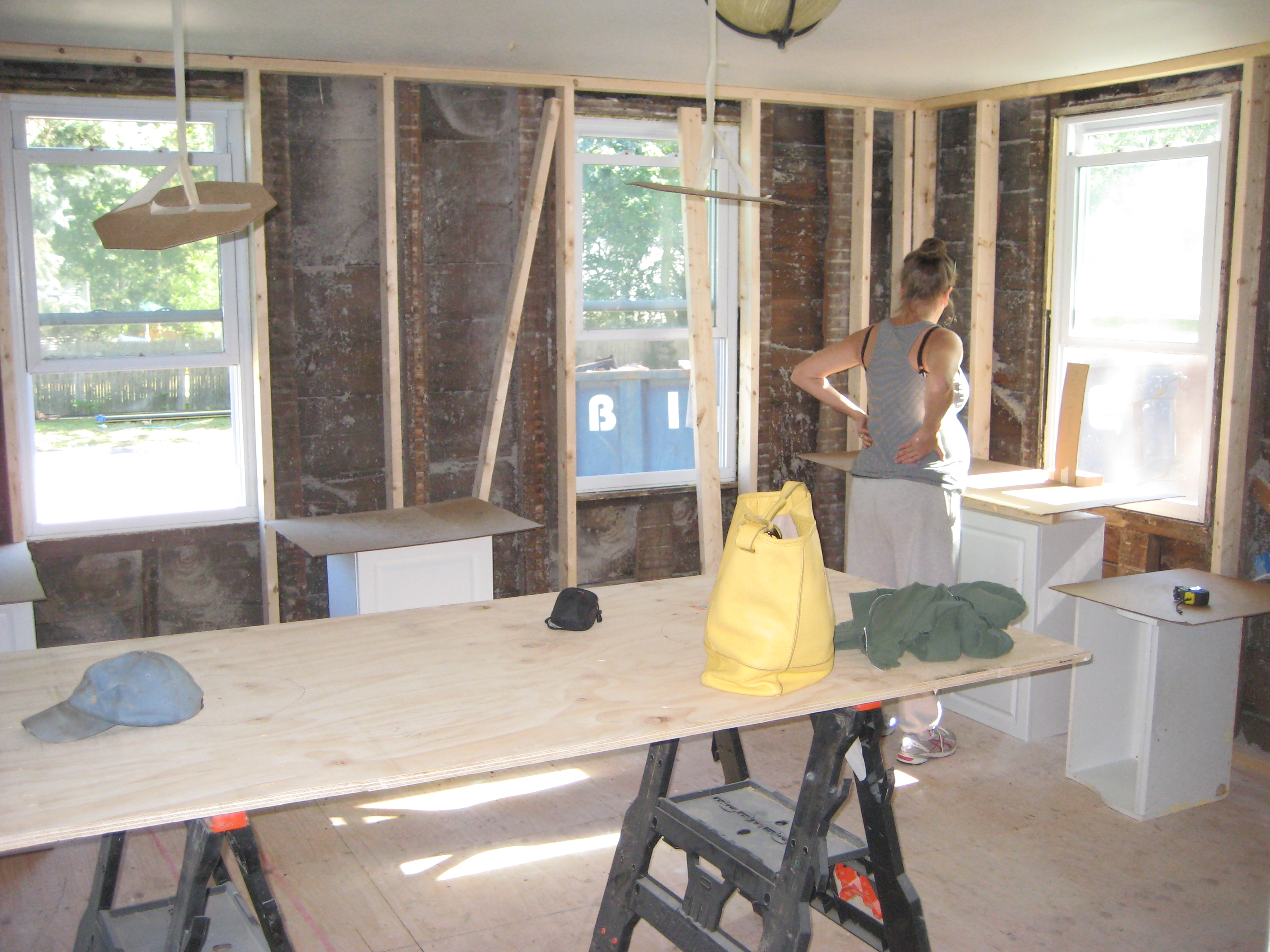
As an act of denial, my initial plan was to use some 2x4s and plywood. Just toss them together and then later build lasting cabinets. But that short term thinking gave way and I ended up using cabinet grade 3/4″ plywood for the carcases. I still haven’t decided on, nor milled up, the face frames. That can wait.

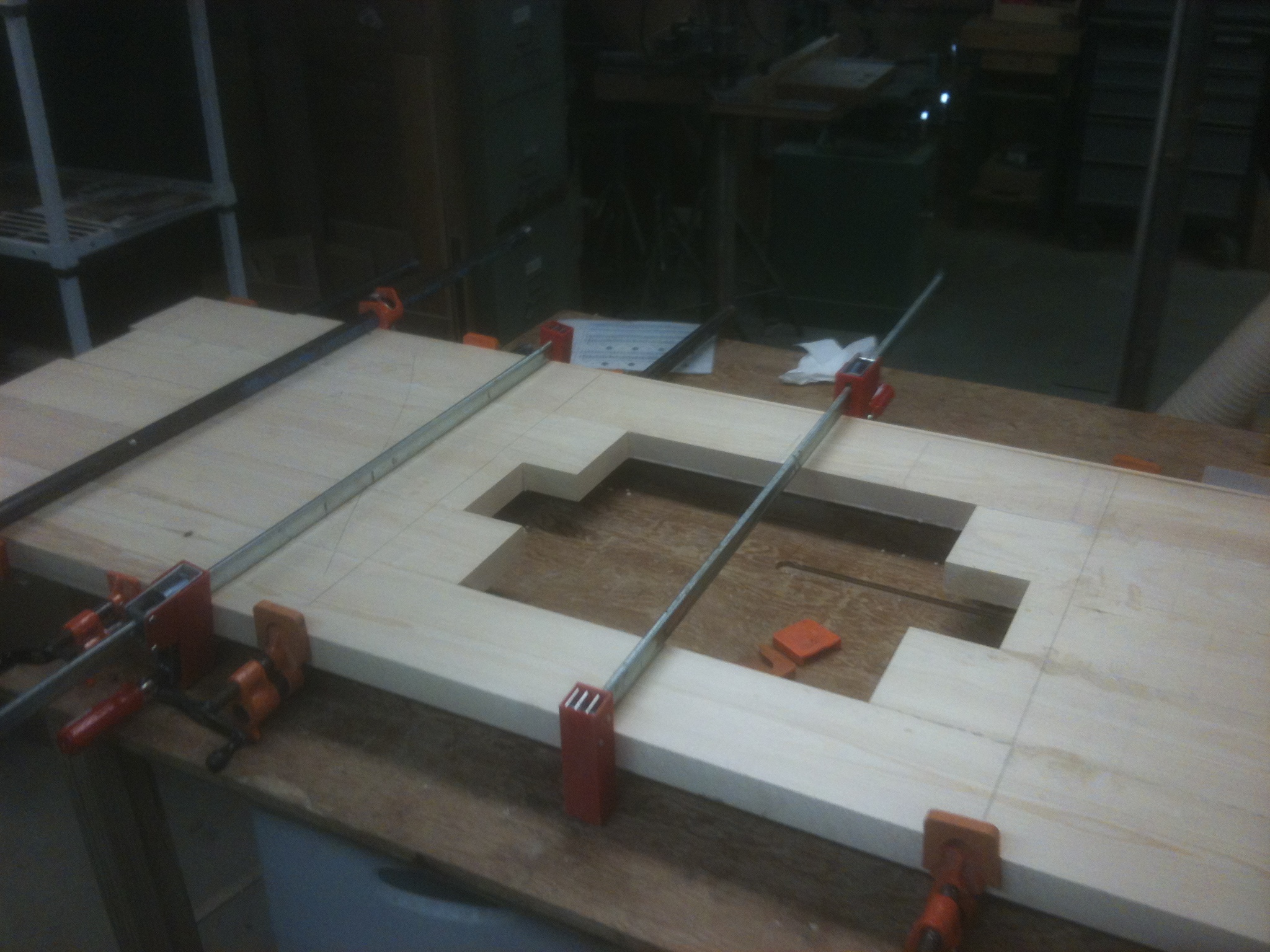
For counter tops my preference would be concrete but there was no way we could afford that. I settled on clear spruce but the sawyer only had enough 8/4 (2″ thick) in stock for the sink counter. Just as well. My budget was getting strained.
I glued up the boards and then ran them through a wide belt sander at a local wood shop. They charged $60 per hour, but it didn’t take very long; an added expense, yes, but worth it to ensure the counter top is absolutely smooth – especially important when putting a bullnose on the edge.


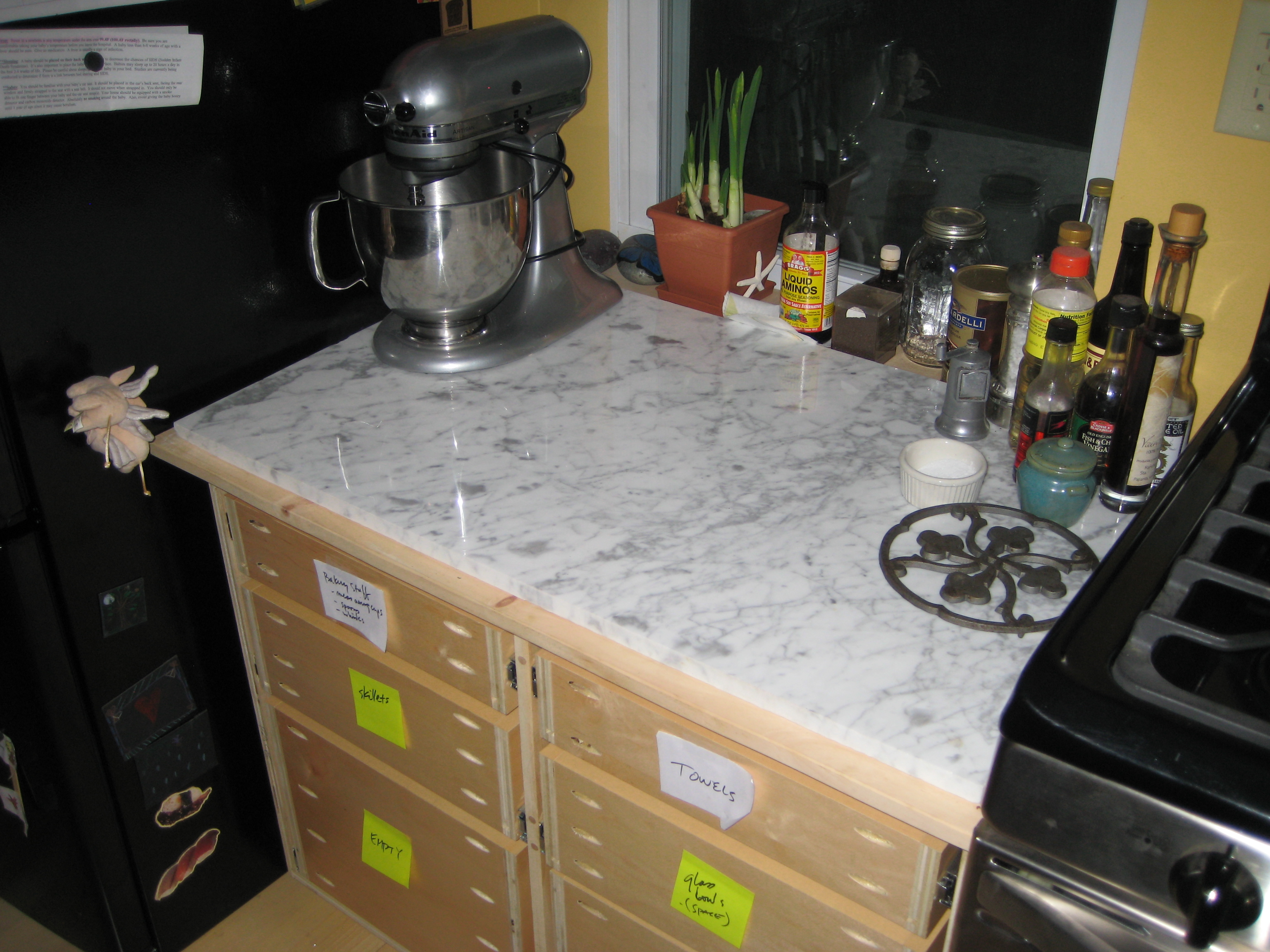
For the cabinets flanking the gas range – the 28″ high cabinets – I resorted to pine boards left over from a tree fort I built as part of my day job. Chock full of knots, this wood is about two grades below #2 pine, but it was free and using it cleared up space in my shed.
For $30 I purchased a slab of white Italian marble from a local kitchen fabricator. They are happy to discount their scrap, but it has an unfinished edge. Not a problem for me. I like to bake and marble is a first rate surface for kneading doughs. Surprisingly, the lower cabinet height is easier on my back and shoulders when kneading.
Scrap evolved into a design theme of our kitchen. But if you look in the right places, scrap can be as good as gold. A pair a solid cherry shaker style cabinet doors came my way. A friend had discarded them, without the panels. By chance, at the big house I had some leftover 1/4″ cherry veneer plywood so I easily made the panels for the doors. I will apply linseed oil.
The doors were designed to go overhead – the curved rail would go at the top – but in my application, under the sink, I will mount them upside down so the pulls are at the top. What I am saving in cost and labor more than makes up for any oddity there.

To benefit from the full southern exposure of our windows, I cut two shelves from a leftover 1/4″ thick glass table top. I screwed a cleat into the jambs and set the shelf where the two sashes meet. It provides an ideal location for growing herbs and bulbs all winter long. The remaining table top glass will make a nice cold frame for our gardens.
Our one splurge in the kitchen would be the two pendant lights that hang over the island. In the back corner of the showroom at Fogg Lighting in Portland, I found a simple galvanized metal shade, part of the Milk-Man collection made by Hi-Lite Manufacturing. They are available at Lowes and other distributers on the web.

The splurge was not so much the light – these were, after all, the least expensive pendant on the showroom floor – but the cord. Black or white cord is free. I would have chosen black, but I was persuaded to find a third option.
My Uncle Donald was a furniture buyer and spent his career traveling the world buying art and antiques. For forty years he made an annual trek, circumnavigating the globe from east to west: Singapore was the best market for brass, Bombay for silks, Florence for furniture and art work, London for…just about anything. His trained eye and sage counsel was “Don’t make the cord the focal point. Black will stand out, white will distract the eye. See if they have cream.”
(We had several long conversations with Donald about room colors. His advice there: “Don’t paint the ceilings white. Add 2 tablespoons of the wall color into the ceiling paint. You won’t notice it, but it will tone down the ceilings just enough. It will soften the room. It will trick the eye. Now, at the paint store they will laugh and say you can’t do that. But tell them that is what you want to do.” In fact, the clerk at the paint store refused to add the paint. “Company regulations,” he said. I had to add the 2 Tbsp myself and only then would he shake the can. You do not notice the ceilings as tinted, but the room does look great. )
But cream, for the light cord, was not an option. They sell, at $6 per foot, a “grey mesh” cord, clear plastic with the silver wires visible. It is very nice, very subtle and harmonizes perfectly with the galvanized metal. $6 per foot is wicked exorbitant, but with ceilings only 7′ 9″ I needed three feet of wire.
I have heard the average kitchen remodel costs upwards of $40,000. Hard to imagine but easy to believe. Using scrap and creative re-use has put our costs far below that mark, but what we save in dollars we are paying for in time and patience. It is a load of work to build a kitchen. We are not done yet. Far from it: I need to build the island, mill the cabinet face frames and drawer faces (I will use barn wood), build several more drawers, make the drawer pulls using beach stones, do some tile work.
With a newborn the progress has slowed considerably. Rightfully so. But we are finding that going slowly allows us to incorporate design changes that reflect our actual patterns of use. Cardboard and patience turn out to be great planning tools.
Christmas Trees are for the Birds
Posted: January 8, 2013 Filed under: Art & Healing, Child Centered Activities, Chronicles of a First Time Parent, In the Kitchen 2 Comments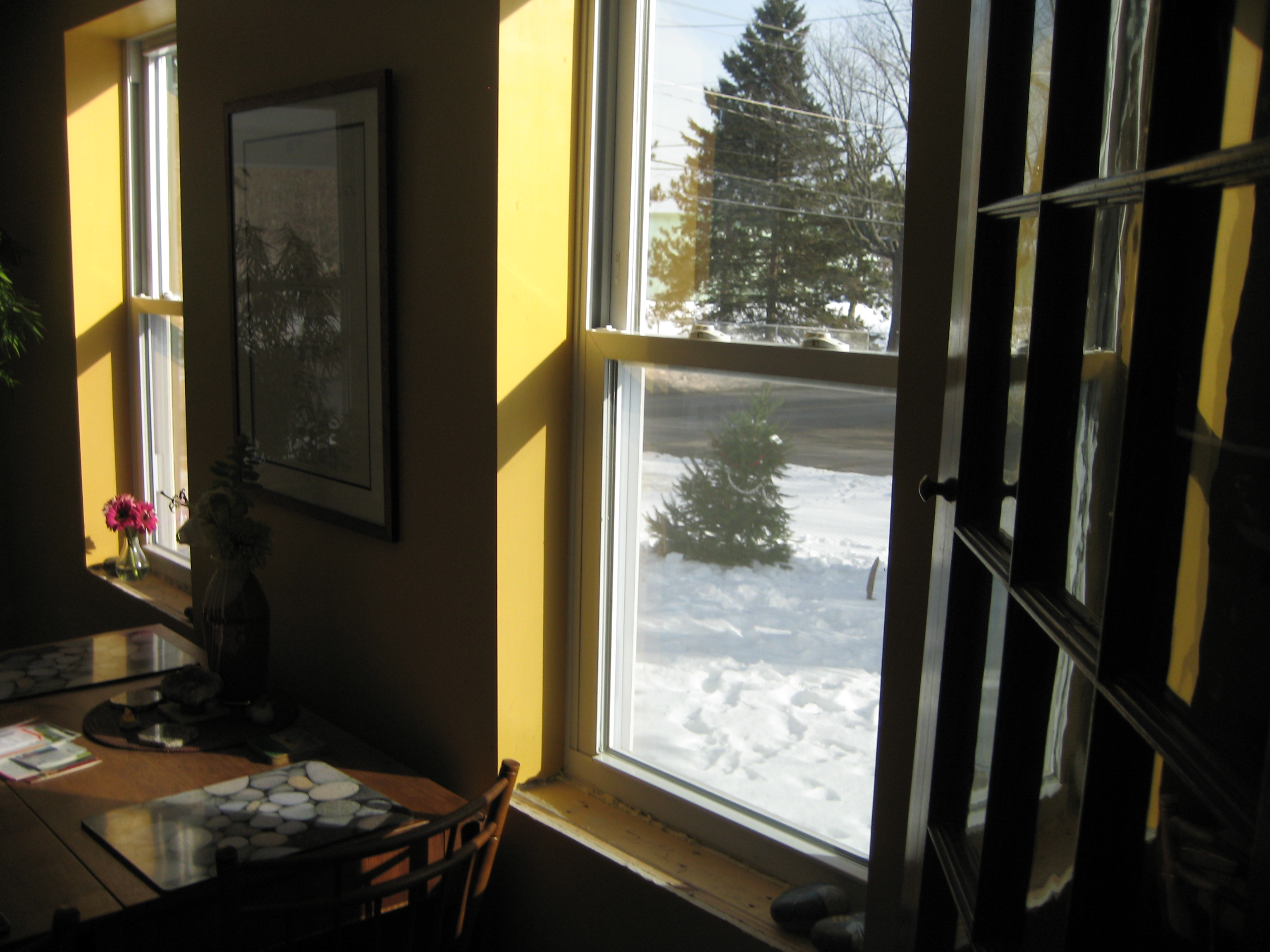
First year ever. We bought a Christmas Tree.
Out into the fields, Little Miss E and I went.
We toasted marshmallows, drank some hot chocolate then ran among the trees, E shouting, “This one! No, this one! No, no this one!!” In the fading light of a mid-December dusk I made a quick choice and cut rapidly with the saw. Oh, what a big event, and its momentum carried through the holidays.
And then last Sunday it was time to take down the tree. Along the roads now, balsams lie discarded, heaped upon the snow banks, so much trash waiting to be carted away. “Where do they go?” E asked, and I really don’t know. It got me wondering.
In our home, the threat of discarding the tree was too great. E had a meltdown. And I had an idea. I remembered my mother, an avid birder, telling me that our feathered friends love to take shelter in the boughs and branches of the trees – whether rooted or cut down does not matter – and so a plan was hatched. “Wait, we can help the birds!”
While Becca grabbed cranberries from the freezer, and a needle and thread, E and I hauled the tree outdoors, into the sunlight of the front yard. We stood the tree upright in the snow.
E was thrilled. Back into the house, she dashed to the art table and insisted “I can do it!” I showed her how to hold the needle and thread, how to position the fingers while pulling the needle through, and she was off. In her typical fashion, she shouted, “I can do it, I can do it. Give me space!”

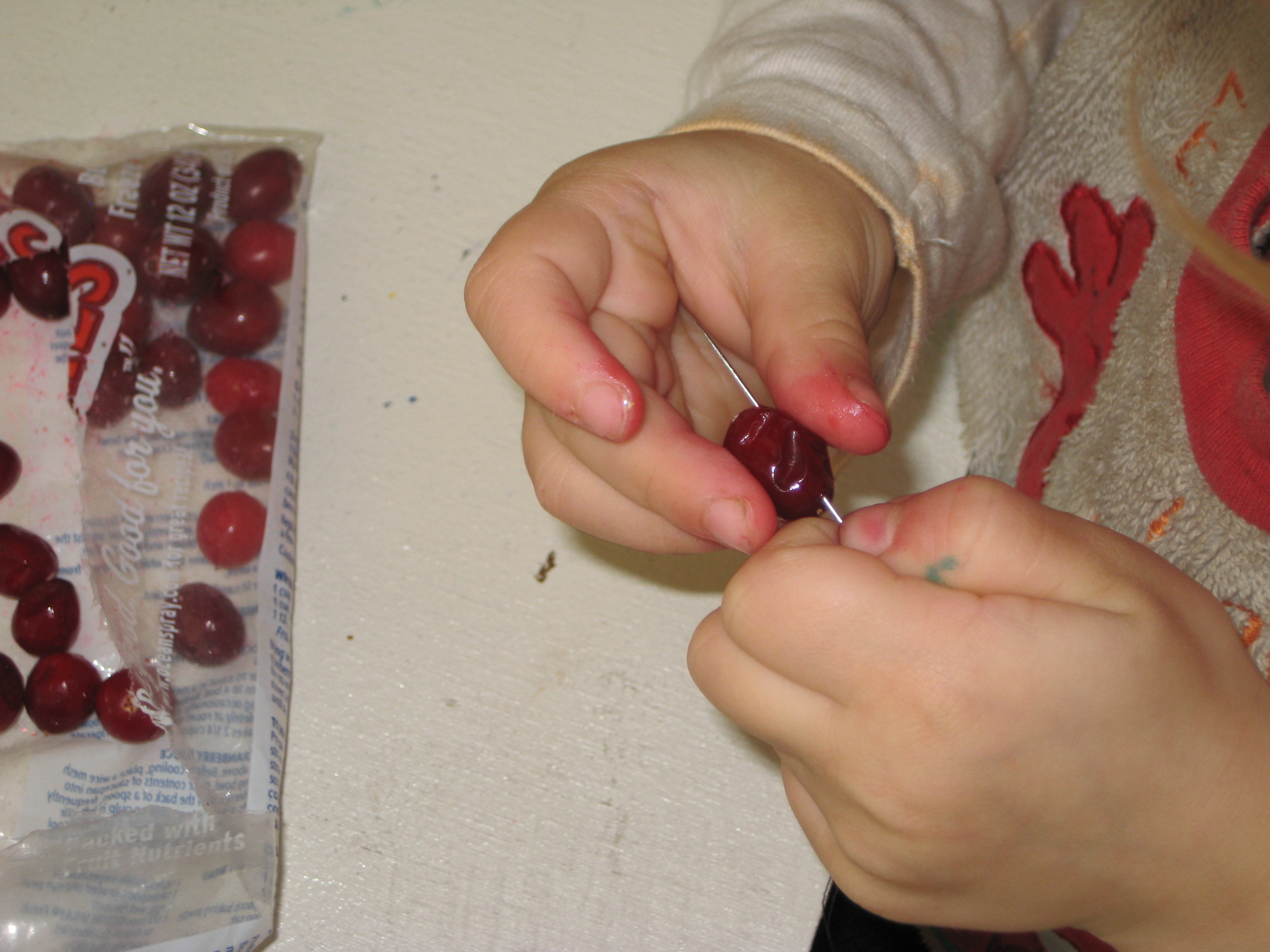
And for good style, she donned rabbit ears. Who knows why. It was quite a look.
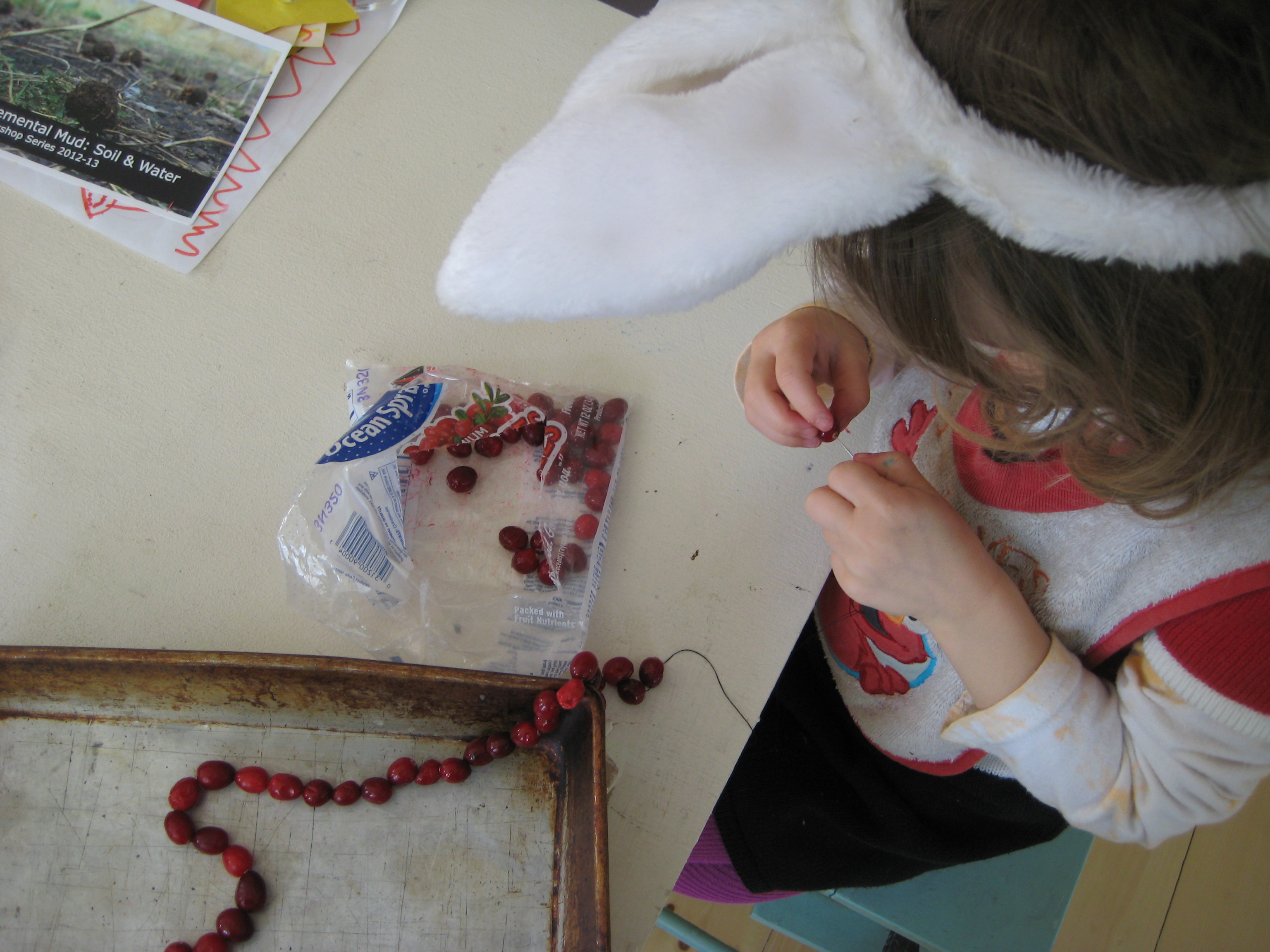
We transitioned from meltdown to excitement. She ate loads of raw berries, then danced as we hung them on the tree. Later, while stringing popcorn, she ate far more than she strung.
But we put together enough garland to encircle the tree several times. And so we answered her question about where our tree will go: at our house, it is for the birds.

 an Art Farm