1/2 = whole
Posted: July 4, 2025 Filed under: Chronicles of a First Time Parent, What is an Art Farm | Tags: law of attraction, portland cement, rumi, Zeno of Elea 1 Comment
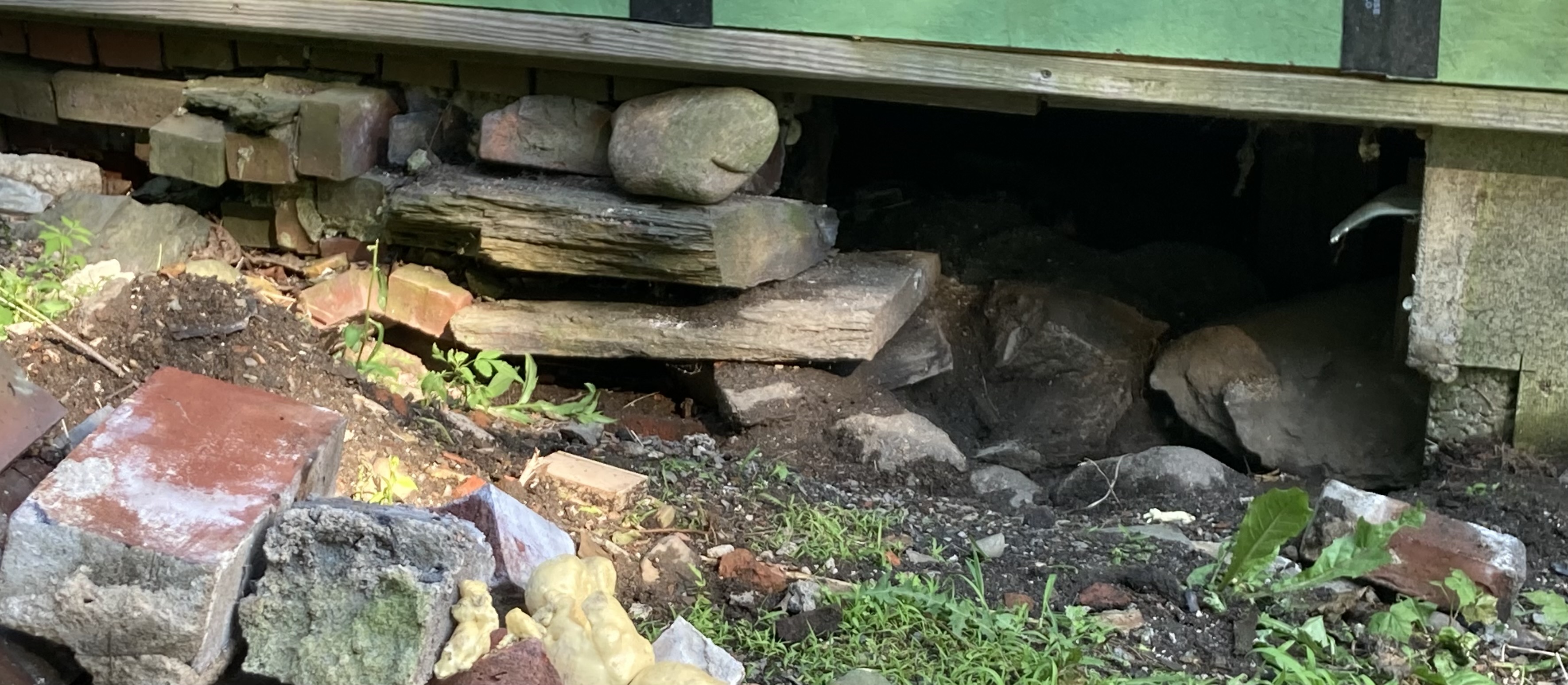
Last October I was in Solitary Confinement, working in our Farmhouse crawlspace to stabilize the floor system of the Ell; a grueling but necessary task. This week I encountered Zeno’s Paradox as I began work on the foundation wall. The floor having been stabilized, I will now remove the entire perimeter wall and then rebuild from the ground up, while working below the house. “Pick your poison” as the saying goes.
Zeno of Elea was a Greek philosopher and mathematician. He was a student of Parmenides who taught monism – essentially, that all life is one – and as such duality and plurality are illusions of the senses. Zeno, a thinker of profound proportion, created logical paradoxes to demonstrate the absurd consequences of common assumptions about motion, change and plurality. The paradoxes of motion, considered his strongest and most famous, were summarized by Aristotle as follows, “That which is in locomotion must arrive at the half-way stage before it arrives at the goal.”
Suppose a Greek peripatetic Philosopher wished to walk to the end of a path. Before he can get there, he must get halfway there. Before arriving halfway, he must get a quarter of the way. Before traveling a quarter, one-eighth; before one-eighth, one-sixteenth; and so on. Thus one must complete an infinite number of tasks, which Zeno maintains is an impossibility given that time is finite. I trust the reader will understand why beginning an Ell foundation rebuild seems like an infinite task.
In 1830 when our farmhouse was built, the carpenter/farmers foraged for materials. Using horse or oxen they would have gone out into the fields to pull boulders back to the job site. Heavy lifting, then a hole was dug (by hand) into which the rocks and boulders were stacked one on top of the other. Mortar and concrete were not used on the foundation, just “dry stack” of large stones in a hole. This is referred to as a “rubble foundation,” which Frank Lloyd Wright used extensively throughout his career.
On top of the rubble a course of bricks were laid, upon which the post and beam structure was built. Mortar in the 1830s was different from concrete today. In 1824 Joseph Aspdin, a British bricklayer, invented Portland Cement by heating clay and limestone at high temperatures to form a strong hydraulic cement. He named his discovery in honor of the stones of the Isle of Portland, in the English Channel, just off the County of Dorset. But South Portland, Maine was a long way from the Isle of Portland, and the makers of this home did not use Portland Cement on their bricks; the mortar they used has disintegrated over these 200 years. And so my challenge of tasks seems to expand, endlessly.
Two and a half millennia after Zeno of Elea posed his paradoxes, their essential truth still challenges the rational mind. It is noteworthy that they were resolved – dare I say – by Jalal al-Din Muhammad Rumi, the 13th century Persian poet and Sufi mystic, more commonly known as Rumi. Essentially he was a monist, seeing the interconnectedness of all beings and the unity of existence. He embraced humanity – all humanity – and believed empathy can foster harmony and inclusion.
He currently ranks among the highest selling poets in the USA, and is revered around the globe; in a time so divisive, this is noteworthy. Consider this poem:
When I run after what I think I want, my days are a furnace of distress and anxiety;
If I sit in my own place of patience, what I need flows to me, and without any pain.
From this I understand that what I want also wants me, is looking for me and attracting me.
There is a great secret in this for anyone who can grasp it.
More commonly this is described as “The Law of Attraction,” which states “the good you seek is seeking you; you only need go halfway.”
And so we can resolve Zeno’s paradox through the mystical insight of the poet, and my foundational task becomes easier. I have hired a journeyman philosopher/carpenter far wiser than I, and hope to hire a crew of workers far stronger than I, so that as a team we shall overcome.



Seven Sages
Posted: June 27, 2025 Filed under: consciousness, Little Green Thumbs, What is an Art Farm | Tags: akpallu, Hammurabai, hokmah, kwan yin, saptarishi, Solon 1 Comment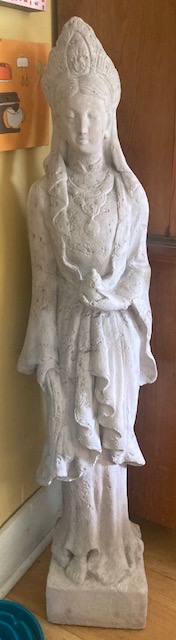
The tradition of the Seven Sages is common to ancient China, India, Persia, Mesopotamia, Greece and Rome. The sages, although different to each culture, always are the enlightened souls who brought wisdom.
To the Chinese, they were the “Seven Sages of the Bamboo Grove,” a group of scholars, writers and musicians of the 3rd century CE. In India, the “Saptarishi” are seven of semi-immortal status, the seers extolled in the Vedas, the sacred texts “not of a man, superhuman…authorless,” revelations of sacred sounds and texts heard by ancient sages after intense yogic meditation. To the Hindu, the seven stars of the Big Dipper represent these seven sages; the Dipper’s handle points to the North Star by which countless wise men have traveled the globe.
The “Apkallu” were the sages of Mesopotamia, the primordial beings, demigods, part man and part fish or bird, associated with human wisdom. In the 7th century BCE Greece, the seven were the philosophers, statesmen, poets and lawgivers renowned for their wisdom. Solon of Athens, a statesman and poet, is honored for his legal reforms, which shaped democracy. Pittacus of Mytilene governed Lesbos where he reduced the power of the nobility, to govern with the support of the common people. Thales of Miletus was a mathematician and astronomer, credited with predicting a solar eclipse, is said to have coined the aphorism “Know thyself,” which was engraved on the Temple of Apollo in Delphi.
The “Seven Wise Masters” is a cycle of stories of Sanskrit, Persian or Hebrew origins, which through the “Seven Sages of Rome” was passed down to German, English, French and Spanish in the form of popular street literature published throughout early modern Europe.
A modern version of this tradition resides above the doors of the House Chamber in the U.S. Capital, known as the “Relief Portrait Plaques of Lawgivers.” Seven (sic) sculptors carved bas relief plaques, using white Vermont marble, to honor 23 governing figures across world culture: Hammurabi, Justinian, Solon, Suleiman, Napoleon and Thomas Jefferson rank among these lawmakers, while Moses holds center court.
Of note, across all of these cultures, all of the sages are men.
In my experience, women rank among the sages who have helped shape my path. It is rather stunning to pause and consider the inherent bias, among world cultures, over millennia, that males alone are the sages. Wisdom, as an abstract concept, would be considered gender-neutral. But grammatically, the word “wisdom” – “hokmah” in Hebrew and “Sophia” in Greek – is feminine. Personified in literature, such as in the Book of Proverbs, wisdom is depicted as a female, referred to as “She” and “Lady Wisdom.
I should like to undertake a summer project to compile a list of the “Seven Women Sages.” It seems a Herculean task to select only seven, but such could be a worthy first pass at this project.
I should like to invite my readers to weigh in on this topic. Over coming weeks I shall endeavor to find stories of great women who have walked among us. Some may be a grandmother, or school nurse, others may be dominant figures of their times, but all shall be told as a counterpoint to the conventional wisdom of the Seven Sages.
In these chaotic times we do well to restore balance.
Note: Thanks go out to David Purpur who helped with information on the Vedic rishis.
______________________________
Our garden pushes ever higher: the Cuke climbs its trellis, fruit forms on the vine, pole beans push tendrils ever higher, greens come daily, grapes reach outward, lavendar is lush, potatoes have been hilled.








No Room at the Inn
Posted: June 13, 2025 Filed under: Chronicles of a First Time Parent, Farming off the Farm, What is an Art Farm | Tags: Epirus, Greco-Roman, molloxssian hounds, pitbulls 3 Comments
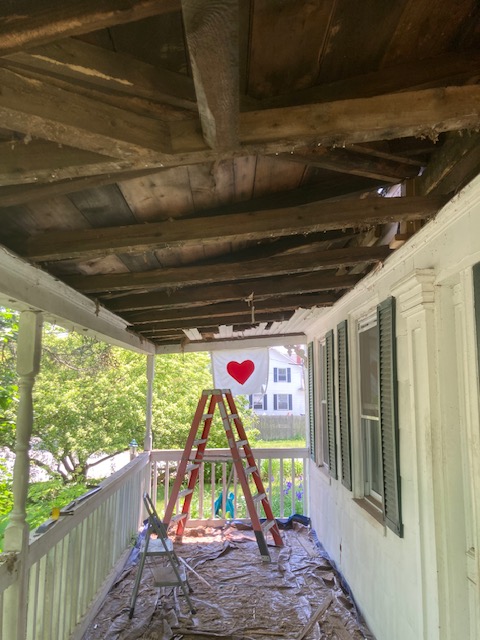
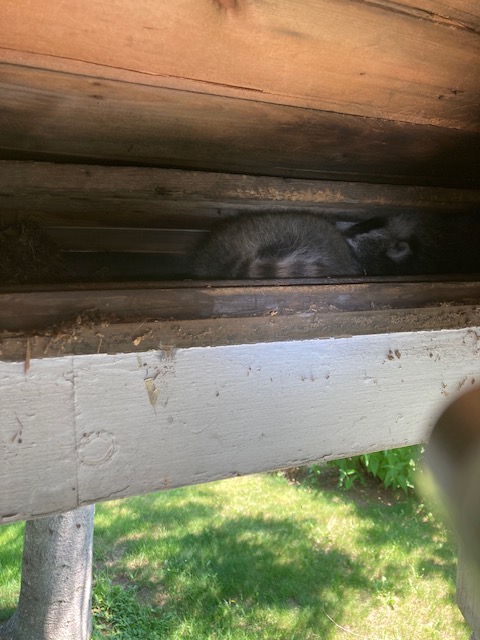
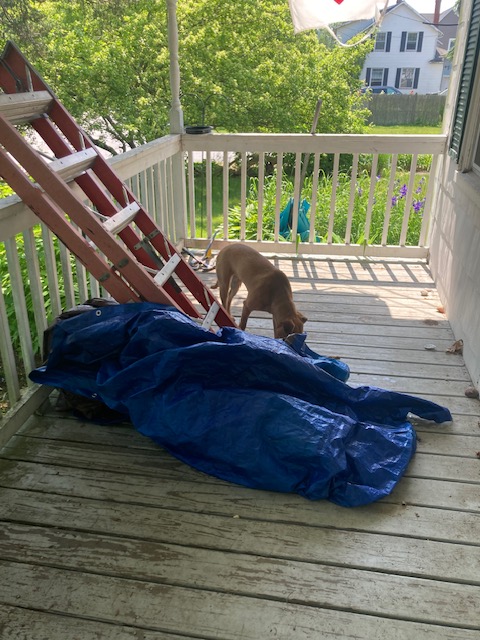
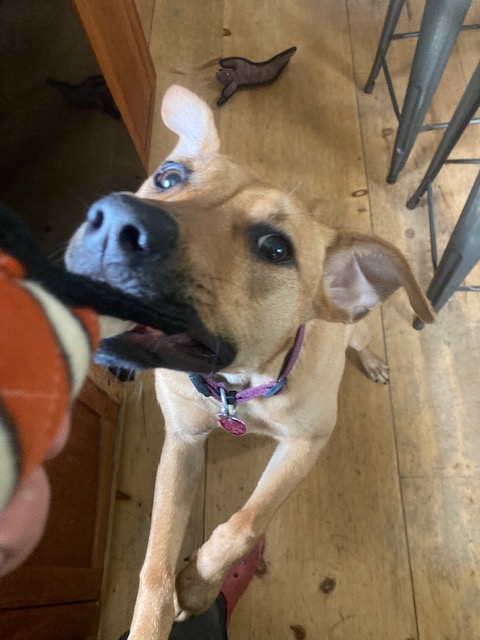
Our Art Farm resembles Noah’s Ark: two adults, two children, two rescue cats, and two rescue dogs all live here. Recently a Mother Raccoon moved into the ceiling above our porch, and with four kits, that became too much.
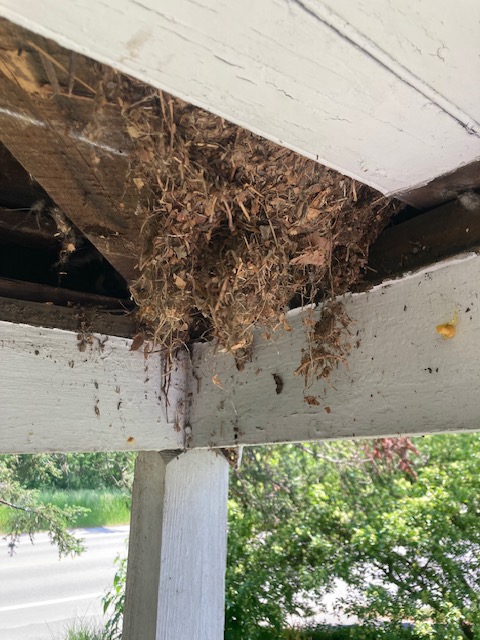
Her tenacity was remarkable. To gain access she gnawed through the fascia boards and the asphalt shingles. Last autumn I tried to discourage her by covering the access points with lead flashing, but she persisted and then chewed through the ceiling boards and more shingles. Neighbors stopped to tell me about our four-footed squatter. She would lean against the asphalt shingles, stare at my son through his bedroom window, like Mae West daring him to come and get her. I knew we had a problem but it rose to a climax when, at 3:30am last Thursday, our pitbull puppy needed to go out and, given the commotion above, refused to come back inside.
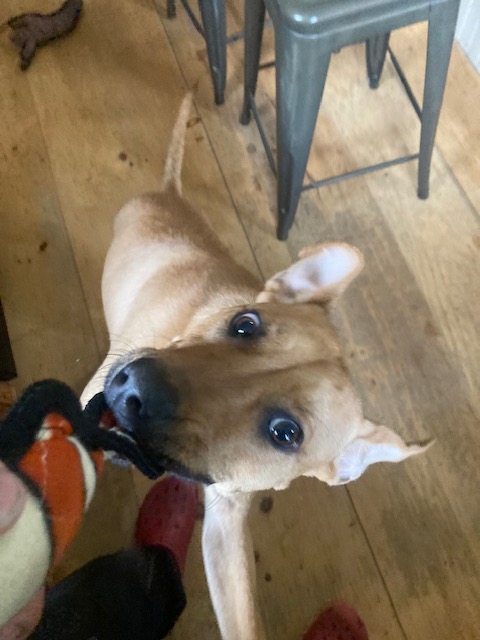
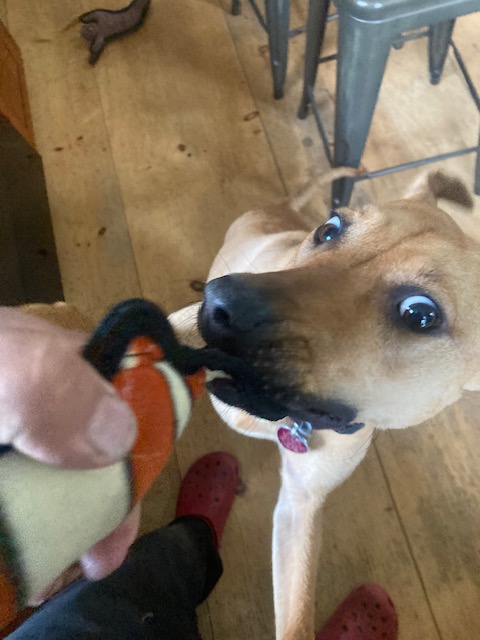
Our pitbull puppy is an animal of the most remarkable agility and athleticism. To see her on the prowl is to marvel at the animal kingdom. Pitbulls get a bad rap, but intensely loyal and loving to their owner, they are descended from the Mollossian hounds, the ancient dogs of war. The Greek kingdom of Epirus trained the hounds for war and herding. Shakespeare’s “Julius Caesar,” Marc Anthony’s line, “Cry havoc, let slip the dogs of war” is historically accurate. In Greek mythology, the goddess Artemis gave to Procris a dog that never failed to catch its prey. In the predawn light our puppy exhibited her heritage, racing across our front porch and back yard in search of her prey.
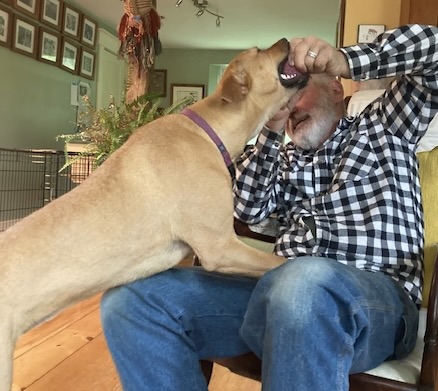
Our puppy was rescued from the streets of Webster Parish in Louisiana, and is 60% Pitbull, 27% Rottweiler, and 13% “Supermutt.” The Rottweiler breed evolved when the German barbarians bred sheep dogs with the mastiff-type dogs used by the Roman army on its military campaign through ancient Europe in the 1st century AD. Our loyal puppy is of Greco-Roman descent, proud to protect us at all hours of the day and night.
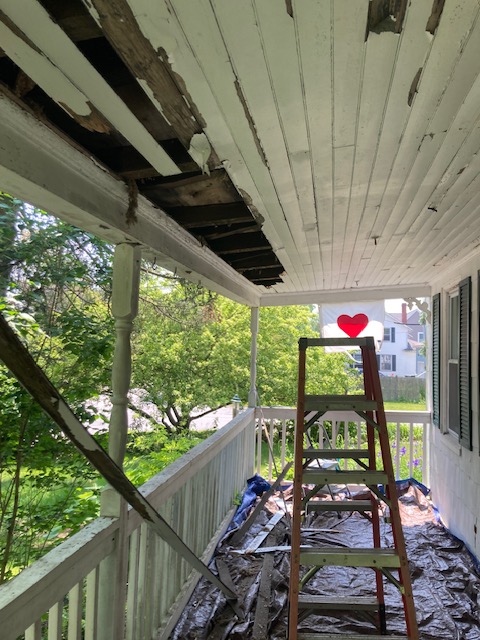
By mid-morning I began to rip out the ceiling boards. They were in quite bad shape and needed either to be repainted or removed. In fact, we plan to remove the entire front porch – it is not original to the house – so my task was both a step in that direction as well as a means to encourage the raccoons to move out.
The job was messy. Our puppy stayed inside while I laid out a tarp to catch the debris and the paint chips, which most likely were lead paint. I wore a mask and detritus rained down upon me. Animals have been living in that space for many years. Decades ago, word must have gotten around the town. Pre-covid, House Sparrows made their home there. It was awful. There in the corner cowered a raccoon. I stayed clear, and continued removing other boards. I needed to open up the entire front section of the porch ceiling.
I reached out to an animal rescue service, and the news became bad. Raccoons carry several parasites, including roundworm. A cornered mother can be vicious. No one was available to come trap and remove them, so the plan was to let them make their exit on their own time. Eventually the kits scurried about on the beams overhead. While their Mother went off in search of a new home, our puppy could hear the kits crying on the porch and stirred up great havoc, inside our house. Our puppy’s true nature was on full display. She could not be let out into the yard.
Throughout the afternoon the Mother worked her magic, carrying the kits – no longer so small – one-at-a-time by the scruff of their necks down our lilac bushes. We do not know where she went. One kit remained, and wailed for mama, but eventually Mama returned and then quiet filled the air. Later that evening, I took our puppy on a leash out into the backyard. She sniffed the air, and looked all around, even overhead, but nothing was turned up.
Quiet has returned to our front porch. My 4:00 am outings are less agitated. The Mother and kits have moved on. We wish them well and meant no harm, but there simply was no room at our inn.




Concrete π
Posted: June 6, 2025 Filed under: Child Centered Activities, Chronicles of a First Time Parent, What is an Art Farm | Tags: archimedes, concrete, habeas corpus, pi 2 Comments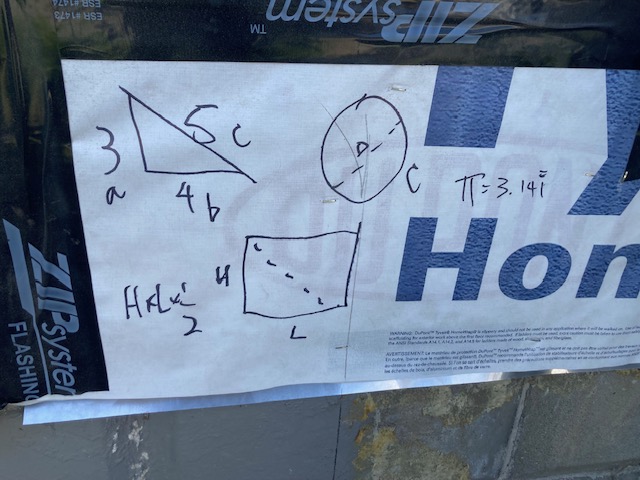
This week’s homeschool question was “How many US Presidents have suspended Habeas Corpus?” The answer, of course, is 7:
- Andrew Jackson at the Battle of New Orleans, by his sole order declared martial law (he was the commanding General, not yet the 7th USA President)
- Abraham Lincoln, by Executive Order, to rein in the “Cooperheads” a/k/a the Peace Democrats
- Ulysses S Grant, by Congressional act, suspended in nine counties in South Carolina
- Theodore Roosevelt, 1902, by Congressional Act, suppressed civil unrest in the Philippines
- Franklin Delano Roosevelt, 1941, by means of the Hawaiian Organic Act authorized suspension of habeas following the attack on Pearl Harbor, but in 1942, by Executive Order allowed a military tribunal to try and convict eight German saboteurs
- Bill Clinton, following the Oklahoma City bombing, signed the Antiterrorism and Effective Death Penalty Act of 1996
- George W. Bush, in 2001, by the Presidential Military Order authorized enemy combatants to be held indefinitely at Guantanamo Bay. But in Hamdi v. Rumsfeld (2004) the U.S. Supreme Court re-confirmed the right of every American citizen to access habeas corpus even when declared to be an enemy combatant.
All of these were in times of a crisis, and several of them included martial law. Given the dense history, my son’s Cousin, the Professor, zoomed in for a chat. The Professor has been published in the Stanford Law Review, where he argued that habeas is “a tool for We the People to insist that when our agents in government exercise our delegated penal powers, they remain faithful to our sovereign will.”
He went on to explain, “Given widespread consensus that English history should and does drive American habeas jurisprudence, and that the sovereigntist account of that history should now be treated as authoritative, it is puzzling that American courts and scholars have continued to cling to libertarian frameworks. Meanwhile, American habeas law is in crisis, with an ideologically cross-cutting array of scholars and jurists criticizing it as intellectually incoherent, practically ineffectual, and extravagantly wasteful. Over the Supreme Court’s past three Terms, Justice Neil Gorsuch has led a charge to hollow out federal postconviction habeas almost entirely, arguing that habeas courts should ask only whether the sentencing court was one of general criminal jurisdiction—and not whether it violated federal constitutional law en route to entering the petitioner’s judgment of conviction.”
My son and the Professor discussed all of this, at length. They compared the crisis of the Civil War to the current immigration brouhaha. My son reasoned that Mr. S Miller, “wants it to be really simple, immigrants get picked up, and locked up.” The Professor concurred, describing a “logistical simplicity.” My son continued, “There are many immigrants, some are illegal, but it is not like Abe Lincoln at the Civil War, now [suspension of habeas] is not really necessary. Suspending habeas should be a last resort. I don’t know what problems – it is about people’s free will – but on a large level it would fill up the jails.” The Professor concluded by speaking of Aristotle’s concept of the good.
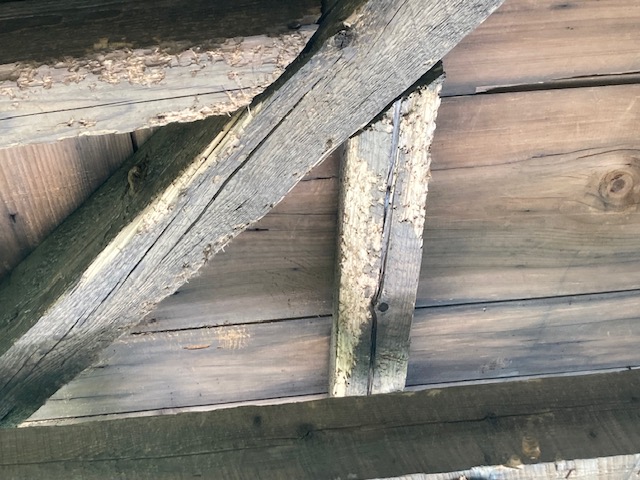
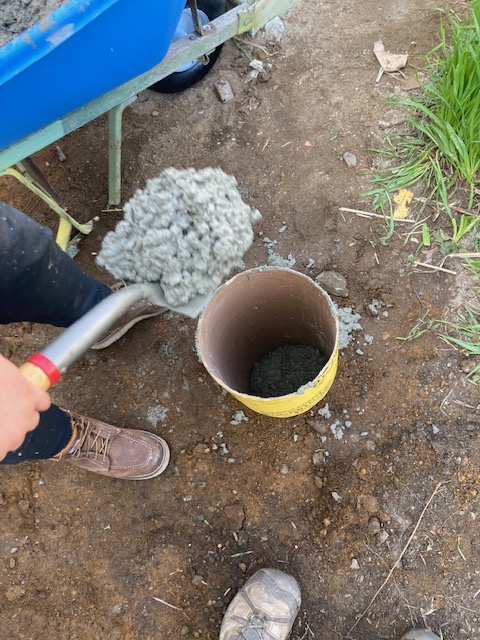
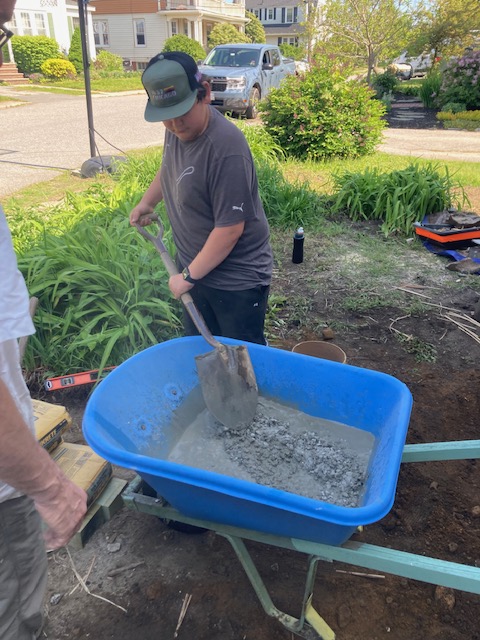
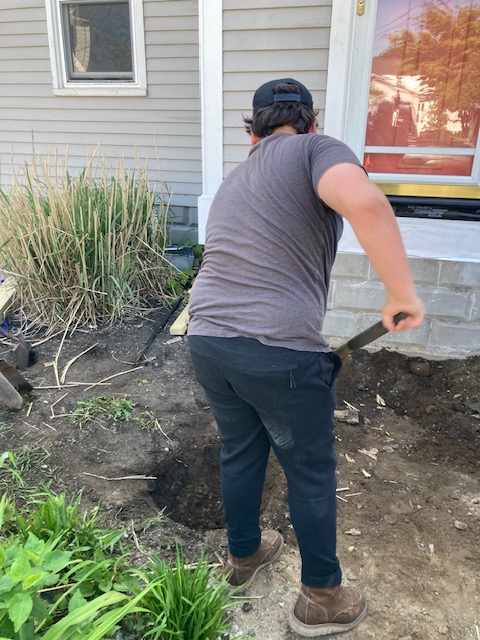
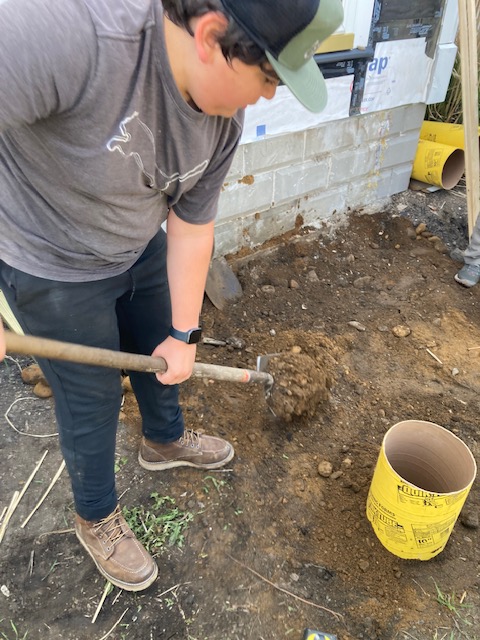
As a counterbalance to these abstractions, we poured concrete. The front entry of a friend’s home was demolished when his neighbor drove her car backwards, at a very high speed, into the front of his home. Remarkably, the driver avoided the house but smashed the stairs. Insurance paid little – no surprise there – so our marching orders are to be frugal. We are making it work, and my son is part of the crew. Child labor laws do not pertain in our homeschooling.
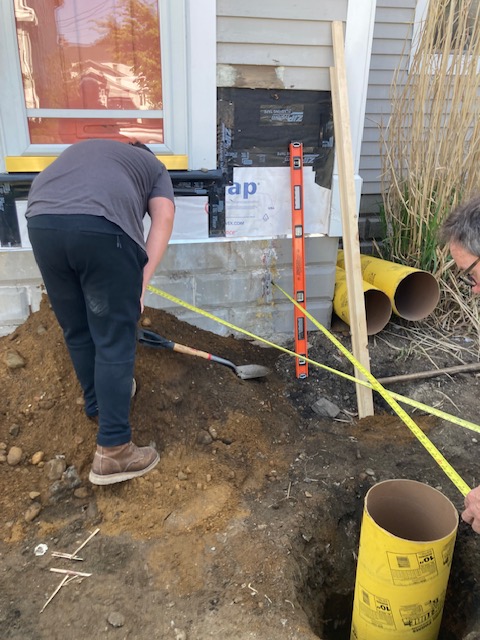
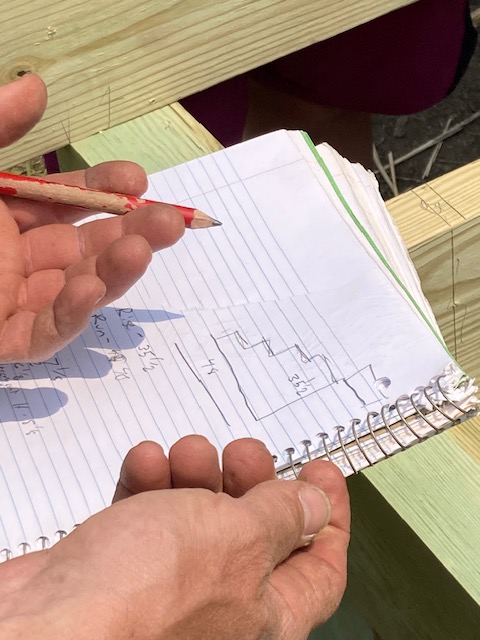
The new entry will have a platform about 4’ high, with four steps to it. This is applied geometry and we discussed the area of a rectangle [width x length], the area of a triangle [1/2(width x length)] and the volume of a column [V=π r2 * h]. We needed to calculate the volume to know how much concrete to buy. To place the footings, we located two points at right angles and parallel to the house. Pythagorus solved that question. We used the 3,4,5 triangle; given a2 + b2 = c2 then 9 + 16 = 25 marked the exact locations where we would dig.
Like construction, learning requires a solid foundation. We began at the bottom and dug holes. We discussed the history of “Pi”, and its application to our task. “Pi” is the ratio of a circle’s circumference to its diameter. The Babylonians approximated Pi at 3. The Egyptians refined it to 3.1605, and then Archimedes of Syracuse hit the mark by using the Pythagorean Theorem. He drew a circle and two boxes; one box fit inside the circle and one circumscribed the exterior. He reasoned the area of the circle was between the area of the polygons and thus Pi would be between 3.1408 and 3.14285. The Chinese mathematician Zu Chongzhi took a different route, performing lengthy calculations with hundreds of square roots to calculate the ratio at 355/113, which is 3.14159292035. Centuries later, in 1706, the Englishman William Jones decided to name the ratio “π” which is the first letter of the Greek word “perimetros”, which means “circumference”.
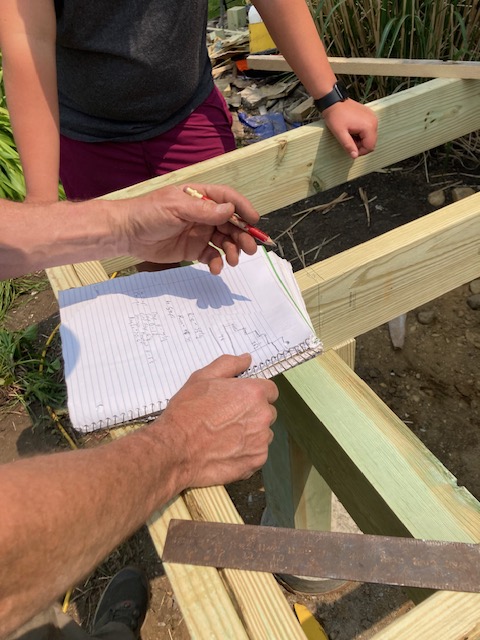
Our project’s head carpenter is a journeyman Master Carpenter, who has built homes on the islands of Maine for decades. Building on an island requires the ultimate resourcefulness; everything used is carried by boat to the job site and so waste is minimal. A calm and wise teacher, he explained use of a sight level, how to square the platform, how to measure and cut stair risers. The platform he built is remarkably strong and the client is pleased. My son hopes to handle the landscaping that follows.
Driving to and from the job site, my son spoke of the satisfaction of helping people using practical problem solving. My son also commented that jobs based upon information pay higher than jobs in physical labor. I will not sugar coat that truth: the annual salary of an average Professor of Law is $173,000 while the most skilled carpenter earns around $80,000 per year. Such are the values of this society (although AI looms large). My son’s path is unknown and we expose him to the yin and the yang, the full range of ideas and labor, as he comes of age.
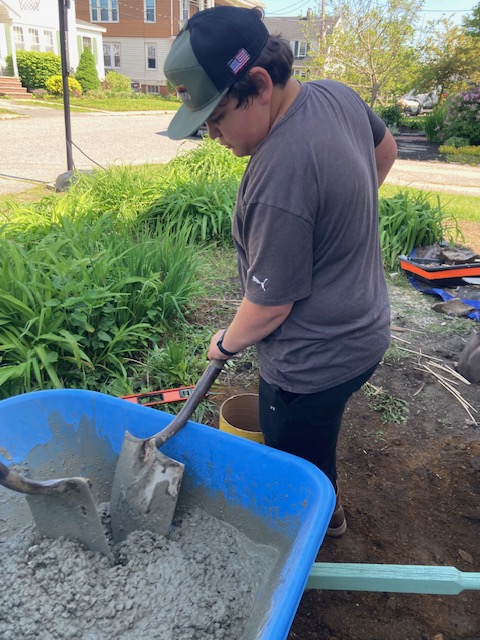
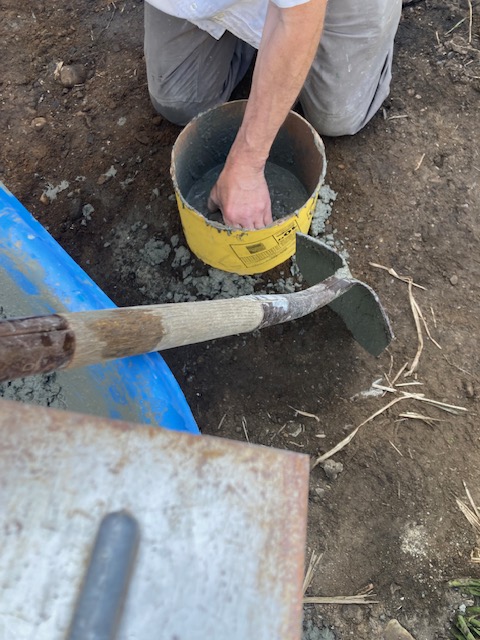
About that volume, my son correctly calculated that each column was 2.8 cubic feet, which required 480 pounds of concrete. A heavy load, I was thankful for a young assistant.







True or False ?
Posted: May 23, 2025 Filed under: Child Centered Activities, Chronicles of a First Time Parent, What is an Art Farm | Tags: history, Magna Carta, philosophy, Plato, Socrates 1 Comment
This week in homeschooling, a true/false question arose: Is habeas corpus “…a constitutional right that the president has to be able to remove people from this country”? We have, by coincidence, been studying habeas corpus for the past seven weeks so this question did not come out of the blue. What has been wildly surprising is to see the topic so hotly discussed in the news.
Our humanities seminar has been titled “Habeas Corpus, Habeas Vox,” which I described in my blog dated 11 April. We began by considering those words. My son knows that a hearse carries a dead body, which is a “corpse,” so the Latin word corpus was readily understood. Habeas corpus, he knows, has something to do with a body, rather than a Presidential right.
But what to make of that Latin verb habeas? We approached that by studying the Ancient Greeks. The Spartans governed by a combination of diarchy (two kings ruled), oligarchy with limited democracy. The Athenians, however, invented direct democracy, not representative democracy like our modern form. From Athens we jumped to Medieval England to read about the Magna Carta. In his “end-of-week” essay on 2 May my son wrote:
This week in Humanities we studied the legacy of Greece. Greece is located on the Mediterranean Sea. In Classical Greece, Athens was a city state that created democracy, but only the men citizens could vote; slaves and women could not vote.
The Greeks were known for the arts, architecture and philosophy. In Athens there was a teacher named Socrates, known for teaching by the “Socratic Method” which was asking questions to engage his students. Socrates was put to death by the courts because they thought he was corrupting his students. One of his students was Plato, who wrote the Republic, which is his views of democracy.
Something else we studied was English history. I read about the Magna Carta, a document that gives liberties granted to the English people. The English Barons and Nobles argued and threatened a Civil War unless King John granted those rights. King John was very greedy and selfish. The Magna Carta was settled on June 15, 1215 when King John affixed his seal.
The Magna Carta gives guarantees for the people as a whole. The people could not be convicted of their crimes unless they were lawfully convicted. The Barons (Nobles) had the right to declare war upon the King. The Magna Carta is considered one of the basic documents of British law.
Next week we will do studying more on English history!
We next proceeded to study the English Bill of Rights, and then the USA Constitution. Last week, my son wrote:
This week, Harvard University discovered they had an original copy of the Magna Carta. There are seven original copies, and Harvard just happened to have one. In 2007 an original copy of the Magna Carta sold for $21.3 Million Dollars. This could not have come at a better time!
The Magna Carta was written in cursive script on a sheepskin parchment 810 years ago. It is a legal document that gave power from the King to a small group of Men. What the Magna Carta did was similar to the Greek direct democracy, by including people in political discussion, instead of the King alone.
The British Bill of Rights, signed in 1689, which is 336 years ago, was a sort of New Age version of the Magna Carta. For nowadays, the new age of the Magna Carta would be the Declaration of Independence. The British Bill of Rights basically gave everyone a fair trial and banned cruel and unnecessary punishment.
All of these political texts – the Magna Carta, the British Bill of Rights, the American Declaration of Independence, and all other that I have not mentioned – have slowly but surely lead up to what we have today; having “freedom,” a fair trial, and due process. Whether you like the current President of the United States or not, he continues to challenge these monumental, historic and foundational concepts.
Next week we will study the 1st Amendment and Abraham Lincoln’s Habeas Corpus Suspension Act. Harvard University’s discovery of an original copy of the Magna Carta is a wild coincidence as we are studying all this!!
I should mention that the essays are entirely my son’s concepts and phrasing, but together we edit them. As his scribe, I raise questions of grammar, word choice and structure; using the Socratic method, I challenge him but he decides as he dictates. We use library books as primary sources to frame the concepts, which he rephrases into his own words. If he does not know the word “plagiarism” he most certainly knows to avoid the practice.
As the school year draws to its close, we are preparing for a debate – 6th grade version – on the essential nature of government. Plato, the Athenian philosopher, argued that democracy is not viable, and the ideal form of government is a “benevolent dictator” more politely referred to as the Philosopher King. This is an argument for absolute strength in the Executive branch. In the current American moment, the occupant of that office is reviled by some as a dictator, and praised by no one as benevolent. My son shall argue in the affirmative that the strong leader must not only be unchecked and absolute in his control, but guided by good will, even compassion.
My son’s cousin, a Professor of Law, shall present the challenging argument, that “We the people” is a most radical proposition, but ultimately, an essential truth. We shall leave to him to define precisely how the many can actively support the one well being of the state. He shall argue that habeas corpus, which is due process, which is the rule of law, is the key to that functioning: the “Great Writ of Popular Sovereignty.”
My son clearly knew the answer to the true/false question, and summed the matter up well, saying, “Do you know how embarrassing it is when a 12-year old knows habeas corpus better than an adult?!! That is really embarrassing! It just makes Americans look really dumb!” He shall be fully prepared to debate what is good, what is benevolent, what is effective leadership for the state.
______________________________
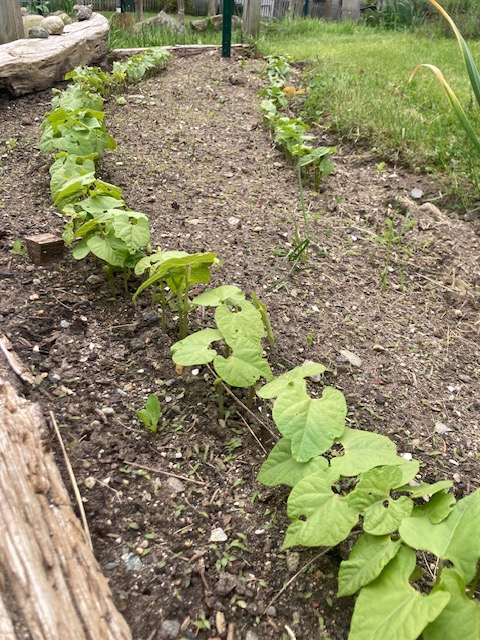
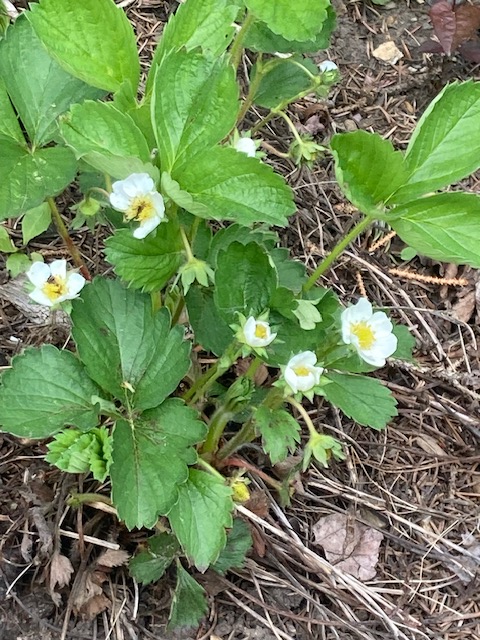
Summer is upon us! Our warm weather starts are ready to go into the ground: tomatoes, peppers, cucumbers, basil, and potatoes. Our cold weather starts do well and grow ever upright.





Art Predates Agriculture
Posted: May 16, 2025 Filed under: Art & Healing, consciousness, What is an Art Farm | Tags: authors, ethics, history, philosophy 2 Comments
Civilization began, it is widely believed, with the advent of agriculture. The time was around 10,000 BC and the place was the Fertile Crescent, which is the present day Middle East. Sheep and pigs were first domesticated, followed by plants such as flax, wheat, barley and lentils. The nomadic hunter-gatherers settled into agricultural communities, developed irrigation systems and established permanent settlements.
It should be noted that this definition of “civilization” speaks to the cultures of the Abrahamic religions (Muslim, Judaism and Christianity). The Clovis culture, however, were precursors to the Indigenous peoples of the America’s, and between 15,000 to 20,000 years ago developed stone tools, as well as agriculture, engineering, astronomy, trade, civic and monumental architecture. Some established permanent or urban settlements, but all did not forsake their nomadic lifestyle. There is not one civilization, but many co-inhabiting this planet.
However civilization may be defined, the plain fact is long before we worked the soil to plant seeds, the hunter gatherers were digging to get clay and earth based pigments for painting the caves at Altamira and Lascaux; art making predates agriculture, which is to say it predates civilization, which speaks to its fundamental role in shaping human life. Mark making is meaning making, hard-wired in our DNA, the act of making is a core means of problem-solving, both utilitarian and ideational.
Ellen Dissanayake is an ethno-anthropologist whose writings synthesize disciplines ranging from evolutionary biology to cognitive and developmental psychology. She lived for fifteen years in non-Western countries (Sri Lanka, Papua New Guinea, India and Nigeria) among indigenous pre-literate peoples and found that all shared the trait of embellishing their tools in non-utilitarian ways; the act of “making pretty” is consistent across the globe. This lead her to develop “…a unique perspective that considers the arts to be normal, natural, and necessary components of our evolved nature as humans.”
Far more than practical, the act of making is healing. Art therapy is based upon this insight, which, since the 1940s, has been used in conjunction with traditional psychotherapy, to provide a non-verbal avenue for exploring emotions and experiences. The simple act of making can help treat a wide range of mental health issues and support emotional well-being, based upon the interconnectedness of mind, body, and spirit.
Works of art such as the Sistine Chapel, a human achievement of extraordinary scale, can be overwhelming and lead most of us to cower, and say “I can’t draw.” But that seems ego-driven, as we are schooled in a comparative and competitive paradigm, which blocks the fact that art making is biologically and psychologically at the core of everyone’s individual life. Art, and the act of making, become the great equalizer.
One of the lessons of carpentry – which is to say making in the practical sense – is that adverbs and adjectives do not pertain; the wall is plumb or it is not, the corner square or it is not, the house will long endure or it will not. There is something exquisitely liberating in that plain fact. More “sophisticated” professions do not fall under this simple truth, for example, politics and the law are based upon argumentation and persuasion rather than objective truth. The word “sophisticated” is derived from the Sophists, in Ancient Greece, who excelled in clever deception, using rhetoric to win arguments regardless of the truth.
In a world that is increasingly argumentative, clever and AI-interconnected, the simple act of making can become a grounding and centering force. Let us proclaim there are four necessities in life: food, clothing, shelter and beauty; “making pretty” creates beauty while making becomes the means to achieve all the former. And all of which become an act of healing.
___________________________
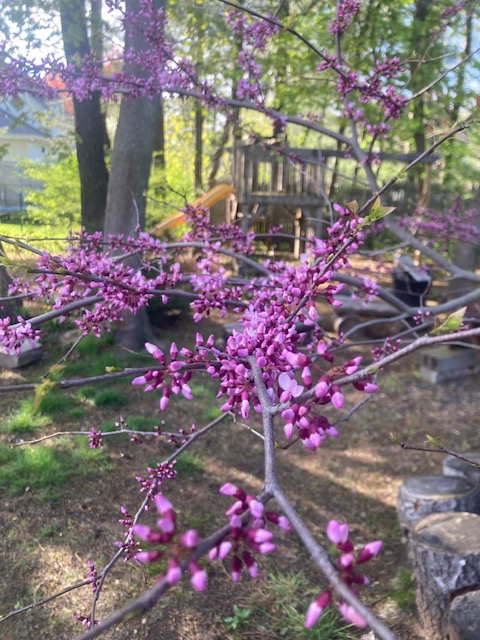
Plants push up, fruit trees blossom, and pollinators abound!




Ice Cream Revelations
Posted: May 2, 2025 Filed under: Child Centered Activities, Chronicles of a First Time Parent, consciousness, What is an Art Farm | Tags: Carl Jung, creativity, dreams, Mayan Long Count Calendar, Primate of Ireland, psychology, Revealtion 17, saint malachy, semi dwarf apple tree, spirituality, writing 1 Comment
I recently went driving at night with my children to go eat ice cream. Pope Francis having died, my daughter mentioned Tik Tok talk of the prophecy of Saint Malachy. As it were, I’m familiar with those prophecies, having heard about them almost 30 years ago.
Saint Malachy lived in Northern Ireland in the 1100s. Born Máel Máedóc, he served as Archbishop of Armagh and was the Primate of All Ireland – the highest ranking position in the Catholic and Episcopalian Church of Ireland. His predecessor was no less than Saint Patrick, known as the “Apostle of Ireland,” venerated as a saint in the Catholic Church, the Lutheran Church, the Church of Ireland, and in the Eastern Orthodox Church. ‘Tis no small role to be the Primate of All Ireland.
Malachy’s prophecy presaged 112 more popes before the Last Judgment. Pope Francis happens to be that 112th pope. The prophecy is widely debunked, but on social media it seems to be generating great interest.
My daughter explained the conventional view, that following the last Pope will come the rapture, when the dead and living believers will be lifted up in the air, ascending to heaven at the Second Coming of Christ. My son, a deep thinking Sagittarean, questioned, “what about the others?” I clarified, “…the Buddhist, the Muslim, the child of Indigenous parents…?”
My son questioned more deeply, “How can a God of love exclude half of the world’s population?” My daughter repeated the factual statement that the faithful believe theirs alone shall be redemption. When she spoke of the risen Christ, I queried about John 14:12 “These and greater deeds ye shall do” which means to raise the dead, to walk on water, to feed loaves and fishes to the masses…come one come all – he says – we the people all have that power. Who among us shall believe, and act?
And so we drove, into the dark night, eating our ice cream.
I reminded them that the world in fact came to an end on 12/12/12, just over 12 years ago. Such was the popular view, pre-Tik Tok. I spoke of the Mayan Long Count calendar, the end of a 5,126 year-long cycle. 250-950 AD was the Mayans’ Classic period, the peak of their large-scale construction, urbanism, monumental inscriptions, and significant intellectual and artistic development. Their flowering has been likened to that of Renaissance Italy or Classical Greece. Everyone reading this essay today knows that the world did not end on 12/12/12; the Mayan calendar’s end marked only a new beginning. In Hindu terms, this is Shiva’s cosmic dance, his never ending destruction creation cycle.
A friend has read the Book of Revelations and suggests that the current Commander in Chief is the 8th King of the Roman Empire, Revelation 17, “destined for destruction,” the Antichrist. Indeed we can read the “two beasts” as representing opposing forces of evil: one from the sea (Manhattan and Florida) is a political power that dominates the world, a healed gash to its head, seeking to establish himself as a pagan deity, while releasing scorpions. The beast from the earth (Africa), the False Prophet, helps the sea beast gain global control, sends fire from heaven and promotes the worship of the beast from the sea and works to deceive people through signs and wonder.
Carl Jung came to mind, in Psychology and Alchemy his observation that religions perfectly coopted the archetypes to their narrative. Scriptural writing to my mind seems symbolic more than a factual narrative. The end of one narrative is but the beginning of another.
Talk of the end of the world is not for the faint of heart. As we drove, as we ate our two scoops of ice cream in waffle cones, the popular song from 40 years ago by the band REM came to mind, “It’s the end of the world as we know it, and I feel fine.”
And so we ate our ice cream. We will figure it out in the light of day. The sun will rise, life will go on, world without end, amen.
__________________________________
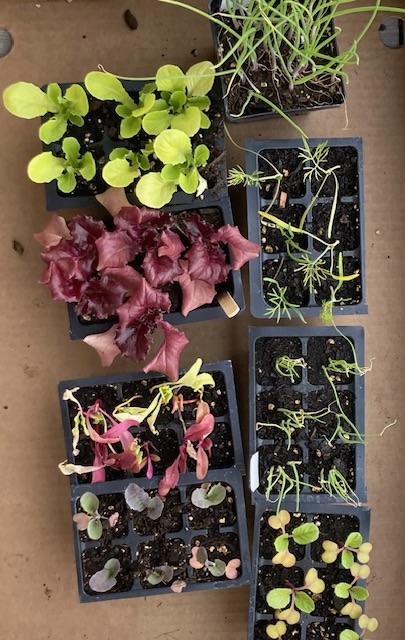
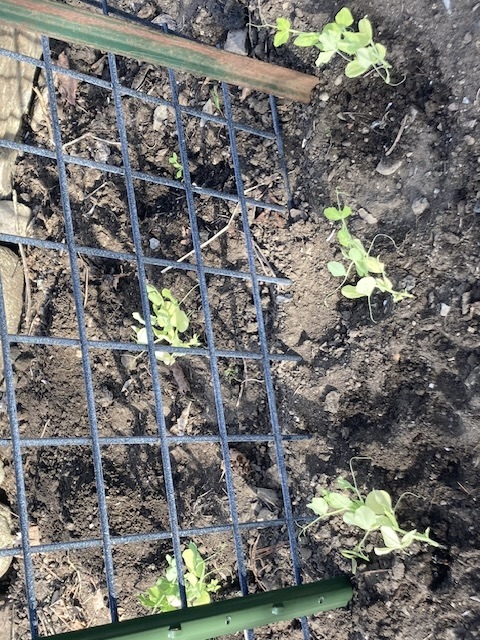
Gaia pushes up the Garlic while cold weather starts go into the ground: Kale, Chard, Lettuce, Pac Choy, Snap Peas, Fennel, Shallots, Scallions, Rosemary, Parsley and Thyme.

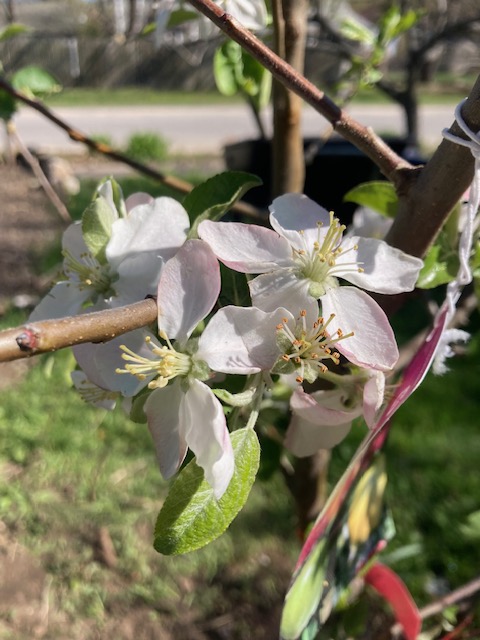
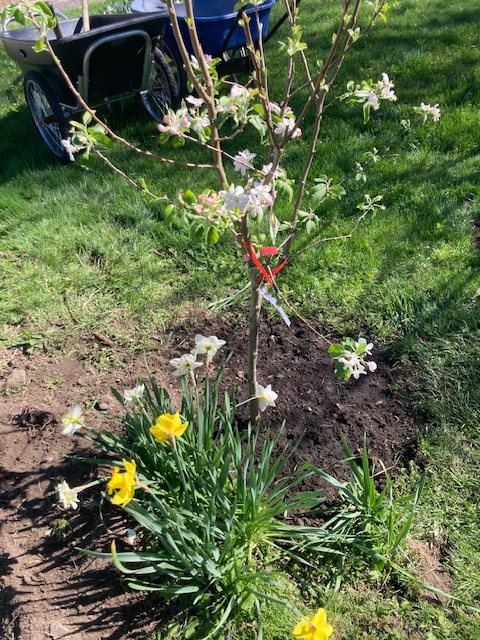
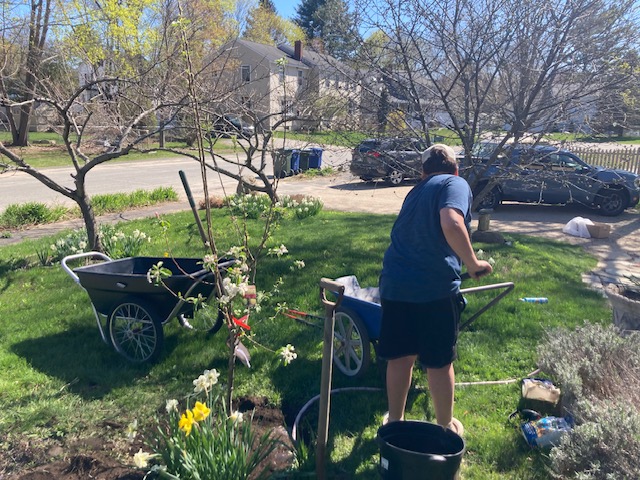
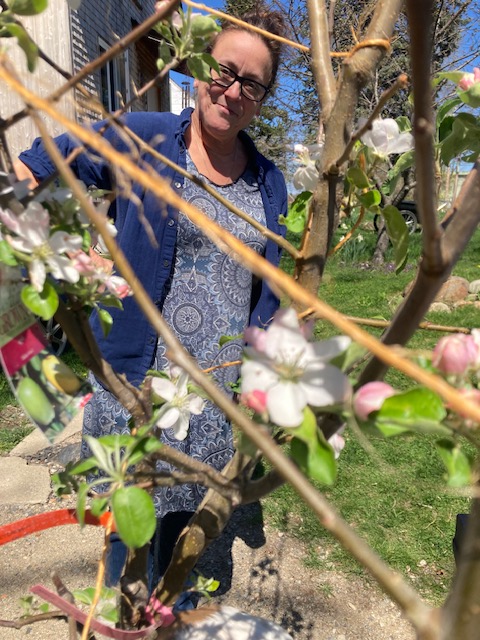
And most importantly, Eve has come to our garden! A 4-in-1 semi-dwarf apple tree, a gift from Grammy Moana to Becca, with four varieties grafted onto the root stock: Fuji, Pink Lady, Honeycrisp, and Ginger Gold. Something for everyone! She joins our two peach trees and a sour cherry tree. I cannot tell a lie, my son cut down our sweet cherry tree last summer, at my instruction. The trunk had a serious gash and its time was ended. Every end is a new beginning, the circle of life, and Eve has taken its place!


Senior Chairman of the Board; lunch in lower Manhattan; Dakota’s Coda
Posted: March 14, 2025 Filed under: Chronicles of a First Time Parent, consciousness, Portfolio - David's work, What is an Art Farm 2 Comments
Fred Turner was a titan in American commerce. 1956, in Des Plaines, Illinois, Fred started flipping hamburgers for Ray Kroc; while other young men were hustling to become a corporate Vice President, Turner saw his future: Kroc had a limitless vision, and Turner had the skill and drive to pragmatize the operation, globally. 38 years later, he was the Senior Chairman of the Board of Directors but I knew him as a neighbor, the father of classmates at Holy Cross School, I played the drums in his wife Patty’s jug band.
I wrote a letter requesting a meeting, and mentioned that I had lived off-grid recently. Douglas excoriated me, leaning in slowly, he spoke, “You…can…not…write…that….David! this is…the Chairman of the Board…of McDonald’s!!!” Brazen, I mailed the letter to the headquarters office, but then called Patty at their home.
Cautious at first, Patty happily arranged our meeting. Over a breakfast of eggs and hash browns, I explained my business concept. Fred listened politely, then replied, “If you are going to quote me, say ‘I don’t get it.’”
I always found that phrasing of interest. Having spent a career on quarterly earnings calls, convincing skeptical bankers and financiers of the promise that McDonald’s held, he had been quoted regularly in the Wall Street Journal, the New York Times, any paper reporting the news. Although it was just him and me, he still used that lens, “…if you are going to quote me…”
Having made his fortune selling hamburgers, the digital future was less clear. It was hard, then, to envision Google + You Tube + Starbucks, which essentially is what GDC encompassed. The power behind Global Data was less the media offerings and more the back-end data; with a growing user base the scope would become transformational, as proven in the real world financial success of Facebook and Google. But imagine all profits redounding not to stockholders but to the peoples of this planet, whereby “dignity credit” could be extended based upon local civic participation. GDC was an arbitrage of money and information.
Having met with Fred, it was arranged that I would speak to Edward R. Stavitsky. I had been told that his Uncle had financed Samuel “Goldfish” Goldwyn, Adolph Zukor, Marcus Low, as well as Cecil B. DeMille; with Chase Manhattan Bank, he had financed 100% of 20th Century and 25% for Universal and United Artists studios; had structured the financing of McDonalds Corporation in 1954, “invented” the trilogy structure: operations-franchisee-real estate holding company, which launched the venture. As of 2025, McDonald’s is believed to be the third largest holder of real estate in the world. Bill Gates owns nearly 270,000 acres, while the Catholic Church owns 177,000,000 acres of land.
We spoke on the phone and I was invited to fly out to Los Angeles, to meet in a hotel lobby just off Rodeo Drive. The meeting went well, he was quite friendly and supportive, but “others people money” would be the key. A moment of significance, I stood on the edge of the abyss: I needed to raise $38 Million USD.
My challenge was great. The absolute condition of the Information Alliance was no venture capital, which meant no equity sold. Debt was no option – negative cash flow can service no debt – so the model needed to be an endowment, the academic approach, an asset base generating yield to fund the venture. Progress was slow, very slow, as the calendar turned from 1994 into 1995.
Laurie’s star was ascendent. Employed as a business librarian at Altschuler, Melvoin and Glasser, an accounting and tax-audit firm on Chicago’s Wacker Drive, she was offered a job at Spencer Stuart, a leading global executive search firm. Laurie was lured to London, and so too Douglas, where he enrolled in the London School of Business, a globally respected MBA program, ranked higher than the Business schools of Harvard and the University of Chicago.
The transition was hard. The change complete. Douglas had gone global, on the road, again.
CODA
Our blessings can be our curse. The brilliant mind one wild tiger hard to tame. Douglas was mercurial, like quicksilver: when we were together, he was focused and present, but once apart, he was gone, completely gone. Years passed when we rarely spoke.
I recall standing, after the London move, on a beach in Rogers Park, Chicago, gazing out at the horizon. He spoke of his dream of becoming a college professor. I suspended disbelief until a few years later he was hired to teach at the Kelley School of Business at the University of Indiana. His was the gift of manifestation. Not surprisingly, he became a favorite of the students, annually ranked among the top professors. His light would fill any room, whether a small kitchen or a university lecture hall.
I pursued the endowment for another ten years. Like Sisyphus in an ice storm I struggled to climb that hill. I did deliver funds to Ed Stavitsky and we flew to Wall Street for meetings and meals with the banker, fine red wine not white with fish; contracts were signed but he failed to perform. Whether a potemkin or the real-deal remains an unknown. Ed died in July 1999. I attended his funeral, among many, laid a spadeful of dirt upon his casket.
Eventually I found my way to Maine, to build furniture for Thos Moser Cabinetmakers. I worked the A-shift. It was grounding. I collaborated with my sister on a pair of essays about heirloom furniture – my story was the making, hers the receiving – published in the Chicago Tribune’s Sunday edition. Tom flew me to Chicago to give a demonstration on chair making, then asked me to write an essay about his Customer-in-Residence program. I arranged for Tom to fly to his hometown, Chicago, for a tour of the estate of John Bryan, a major collector of American furniture.
At no one’s request I recruited the Head of the Art History Department at Yale University to create a course on three generations of New England/New York chair making: Hitchcock in the 1800s, Stickley in the 1900s, and Thos Moser into the future. And then on 9 January 2009, after the financial collapse which brought the Great Recession, I was laid off along with half the Thos Moser work force. Profits before collaboration. Money the measure of the man.
I found my way, working as a carpenter, fabricating public art and now, managing the plant and property at the Friends School of Portland.
On 21 December, this past solstice, I called Douglas and we picked up where we left off. We were immediately in synch, as though no time had passed. As our conversation ended, Doug laughed and said, “Hey man, let’s keep in touch more often!”
An opportunity presented itself. I have been thinking about launching a new community project, to teach furniture making to recovering addicts and former convicts. The act of making is at once both practical and therapeutic. My wife is a registered Art Therapist and a Licensed Therapeutic Counselor. I have an idea, she has the credentials, and a woodworker friend is getting a degree in counseling; the elements seem in place.
On 7 January 2025, just before the dawn, as the light returned over the horizon, I found myself thinking about Douglas. There is no one here with his energy, his spark, his purifying flame, and so I thought to reach out, to ask “can we rekindle our flame, chart a new path, ride together, again?”
Five hours later I received the call that he had died.
Bereft, I sat down to write this festschrift “celebration writing” for a deep true friend.
Would that he ride shotgun once again, in spirit, this time.
Rogue Hollywood; from the Library of Alexandria to Carnegie Libraries
Posted: March 7, 2025 Filed under: Chronicles of a First Time Parent, consciousness, Portfolio - David's work, What is an Art Farm | Tags: books, carnegie libraries, cosimo de'medici, Dreamworks SKG, education, history, library of alexandria, technology, travel 1 Comment
Douglas was attending classes in History and Theology at Loyola University but his most serious work was done at the RMG office. He and I were joined at the hip, constant conversation, swapping ideas at a fever pitch.
RMG formed the Information Alliance among leaders in library automation:
- Robert F. Asleson, Esq, had decades of experience as President of five library and information industry companies: University Microfilms International, R.R. Bowker, Information Handling Services, International Thomson Information, Inc., and The Library Corporation. He was thoroughly versed in all issues of copyright clearance.
- Brower Murphy, a self-described “information egalitarian” had pioneered the use of CD-ROM technology for data storage. He then developed NlightN®, a hypermedia universal network allowing a single search across the entire world of published electronic information. This was google before Google, except, created in 1991, it was not designed for the internet.
- Vinod Chachra, President and sole owner of VTLS, Inc. oversaw a staff of 70 with customers in 18 countries, requiring 16 difference languages and multiple character sets and scripts. His software provided a turn-key solution to all library functions.
- Rob McGee and Howard Harris, another RMG Consultant, formed the alliance and Rob acted as editor of the “Concept & Vision” and the business plan.
Our approach to the Worlds Digital Library was direct: “Empowering the individual by access through libraries to the world’s information, ‘anyplace, anytime.’” The philosophy was broad and inclusive, the battle plan was specific and precise. A holding company, the DLC would operate through subsidiaries, each business creating a component of the whole. The first subsidiary was The Index Company, which would:
- digitize book images from collections of widely-used library materials
- compile collections of machine-readable tables-of-contents and back-of-the-book-indexes for subject oriented sets and collections of books
- create and distribute merged collections of the indexed records to provide access to Digital Libraries.
The DLC was the economic engine driving GDC. On paper, the DLC projected a Year 1 loss of ($4.08 M) but turned positive in Year 3 and by Year 5 was in the black at a profit of $6.3 Million USD. At the end of the 20th century, “hockey stick” projections were not uncommon, but questioned by conservative bankers.
On 7 May 1994 the “Concept & Vision” paper was finished, and letters of support were received from:
- Chair of the Virginia State Library Board
- Librarian of Harvard College
- Executive Director of CAVAL (Co-operative Action by Victorian Academic Libraries [Australia])
- President Council on Library Resources
- Deputy Director General, National Library of Australia
- President of the Council of the European Information Industry Association
- Executive Director off the United States National Commission on Libraries and Information Science
It is worth noting some of their comments:
- The Librarian of Harvard College wrote, “There are going to be a number of modest efforts to build the digital library. Yours could be the one most likely to succeed on a large scale.”
- Deputy Director-General of the National Library of Australia wrote, “The approach envisaged in this paper is sensible and shows the appropriate understanding of the current state of the industry which is needed for success to be likely.”
- The President of the Council, European Information Industry Association, “…we shall have no hesitation in bringing this proposal to the attention of our members and examining ways in which we can lay a supportive role in Europe.”
While writing the “Global Data” plan, the landscape in Hollywood was changing. Steven Spielberg, Jeffrey Katzenberg, and David Geffen announced they were going rogue, to create their own live-action and animation film studio. This meant Hollywood’s studio model was being revolutionized, and the financier with whom I was hoping to meet had deep roots – I was told – in that old model. If the paradigm was changing, then I needed to write my own version.
One spring evening at the Chase Street house, Douglas and I sat down at the kitchen table to write “Top-Down meets Bottom-Up” which compared Paramount Communications and Global Dakota Corporation, a $10 Billion colossus versus our $38 Million start up. I was David out to slay Goliath. Working deep into the night, we laid out the categories and filled in the blanks, referencing medieval history through the Internet. Laurie, who is quite savvy in the C-suite, told us it was sheer hubris.
Libraries have been central to all civilizations, throughout recorded time, our collective repository of knowledge, a storehouse of the written word – cuneiform or bound – a place where scholars gather to share knowledge, to push the vanguard. The earliest libraries have been discovered in present-day Syria, and in temple rooms in Sumer (present day Iraq), each in the Cradle of Civilization. The Library of Alexandria, in Cleopatra’s Ptolemaic Egypt reigned among the most significant libraries of the Ancient World, the corpus of Greece and Egypt in one repository, until Julius Caesar’s boys came to town, on military conquest, they burned the library. Dust to dust, ashes to ashes.
30,000 clay tablets from the Library of Ashurbanipal have been discovered at Nineveh – the recorded wealth of Mesopotamia – while the University of Chicago holds baked clay tablets, the administrative backbone of the vast territory of Persia, written in Old Persian, Elamite, and Babylonian languages. The Imperial Library of Constantinople is worthy of mention, authors such as Plato, Aristotle, Demosthenes, Socrates, Thucydides, Homer and Zeno stored and sought. Themeistius, a pagan philosopher and teacher, hired calligraphers and craftsman to produce the actual codices then created a university-like school centered around the library. Lao Tzu, author of the Tao Te Ching, was the keeper of books in the earliest library in China. Into this majestic idea Rob McGee stepped as a young boy, his bike’s basket filled, riding home to 1505 Grace Street with “talking books” for his Grandmother, an armful for himself.
The Free Public Library is not free financially – it is paid for by taxes – so what is free is the access to information. Traditionally libraries had been the private domain of Princes and Kings, Bankers or Clergy. The Renaissance brought an awakening when, in 1444, Cosimo de’Medici created the San Marcos Library, one of the earliest public libraries. Cosimo combined his own extensive collection with the 800 manuscripts of Niccolo de Niccoli, a humanist who worked as a copyist and collator of ancient manuscripts, and was the creator of cursive script, known today as “italics.” Niccolo’s humanist vision was inclusive: “…to the common good, to the public service, to a place open to all, so that all eager for education might be able to harvest from it as from a fertile field the rich fruit of learning.”
Pierpont Morgan’s Library, in the grand style of the Italian Renaissance, was opened to scholars and the public in 1924, the gift of J.P. Morgan, the banker of legend, who indirectly was behind the greatest public library building program in history. In 1901, J.P. Morgan bought the Carnegie Steel Company for $18 Billion (in 2025 dollars), which allowed Andrew Carnegie to vastly expand his brick and mortar ambitions. Between 1883 and 1929 2,509 Carnegie Libraries were built around the world, free to the public. By 1929 almost half of the public libraries in the United States were Carnegie Libraries.
At the end of the 20th Century, many saw change on the horizon, bricks and mortar becoming digital, access universal, which seemed like Archimedes’ fulcrum, upon which we could move the world. Rational self-interest held no motivation for me; e-commerce and social media pale in comparison to the humanist tradition. Douglas, though, had that capitalist urge, and his enthusiasm was grounding for me. He and Rob delivered the Information Alliance which undoubtedly could make the products to drive revenues. The Digital Library Corporation was the core asset, while the Turtle News Network and the community retail outlets expanded our reach.
I played the hand I was dealt. “Top Down Meets Bottom Up” became page 41 of the Global Dakota Business Plan. On 1 July 1994 the Business Plan, with consolidating Pro-Forma Financial Statements, was complete, weighing in at 12 pounds, almost 1,000 pages printed on 100% post consumer recycled paper. Having finished the first task, I tackled the second challenge: a meeting with the Senior Chairman of the Board of McDonald’s Corporation.

Red V8; the Donner Pass to Cascadia Planet
Posted: February 28, 2025 Filed under: Chronicles of a First Time Parent, Money & Banking, What is an Art Farm | Tags: bioregionalism, digital-marketing, internet-marketing, marketing 2 Comments
June, 1993 Douglas and Laurie moved from Hyde Park (South Greenwood Avenue) to Rogers Park (1336 Chase Street). In August Douglas came west to visit me, and on the spur of the moment, we drove his rented Red V8 Mustang convertible 932 miles north to Montana, where Brian was working in a laundromat at Yellowstone Park. We spent one day there, then drove back to Arizona: 1,800 miles in 72 hours. The long stretch of Utah and Wyoming desert was extraordinarily dull but we were young, full of moxie, Douglas had the corporate Amex, there was no turning back.
In September I was kicked out of the trailer (a consequence of his visit) and moved into a home further west in Hootenanny Holler. The house had a telephone. Douglas and I began talking about the concept of a Digital Library.
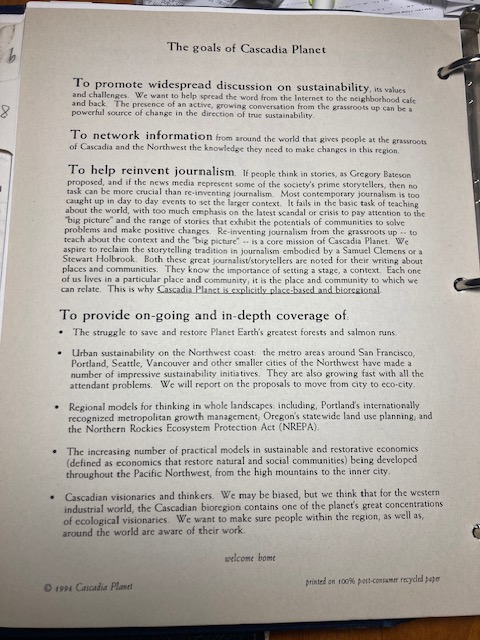
In addition to planning the world’s digital library, I organized a bio-regional news service and drew blue prints for community-based retail outlets. To my mind, the information future could not only be virtual, but need be tethered to life on the planet. I adapted Aristotle’s definition of man as a “political animal” using the tag line “Regardless of the internet’s reach, we will always communicate face-to-face with our neighbors.” I travelled to Vienna, Austria to attend an eco-cities conference, on how to rebuild our human habitat in balance with living systems.
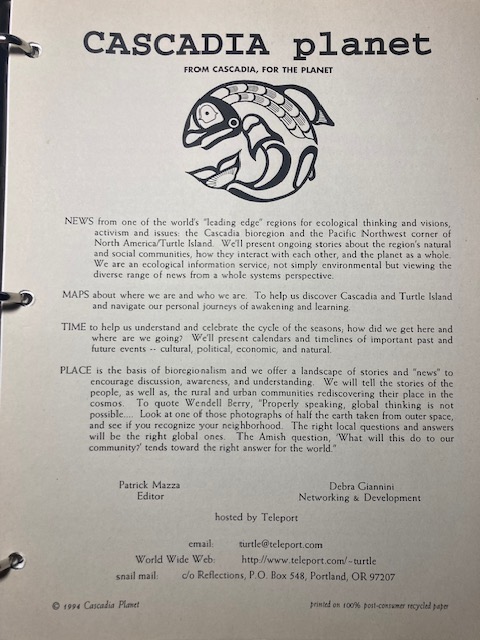
Twice a friend and I drove to Portland, Oregon – crossing the Donner Pass in the Sierra Nevadas in a blizzard – to lay the groundwork for the “Turtle News Network.” “Cascadia Planet” would be the flagship; Cascadia the bioregional name of the Pacific Northwest, as defined through the watersheds of the Columbia, Fraser and Snake Rivers, and the geology of the region. Bioregionalism recognizes not arbitrary political boundaries but the organic flow of water and rock.
There were stories to tell. I raised funds for a video documentary series, in newsmagazine format, profiling the bioregional movement. I met with Patrick Mazza, a journalist, and we developed plans for “Cascadia Planet” a website to include “text, multimedia sound, images, graphs, lists and a web-structure for related Internet searches.” Bear in mind, 1993 was an internet before video, before streaming, fewer than 600 web sites in total, before iPhones or social media apps; Mosaic had just been released and was the first browser to show both texts and images on the same page, a key factor in early acceptance of the World Wide Web. The air was electric with possibility.
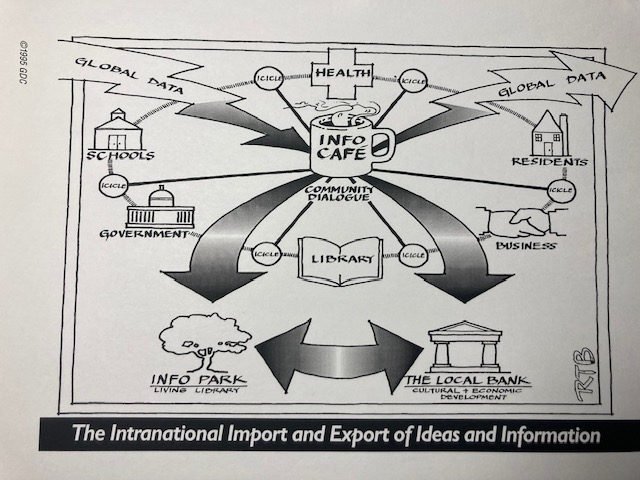
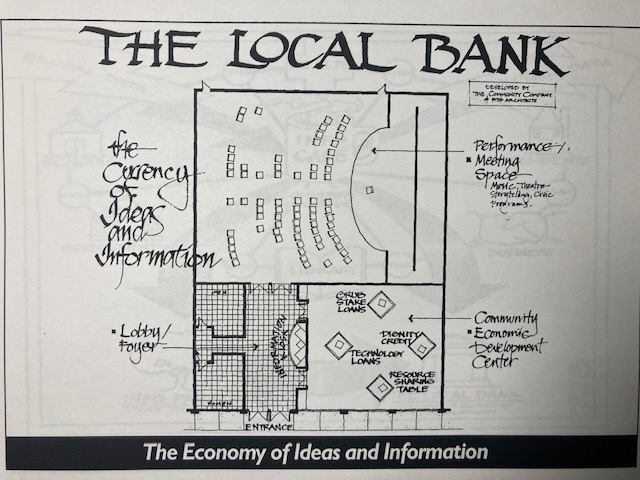
I envisioned three types of retail outlets:
- The Info Cafe: the world of information and the information of your world
- The Info Park: the living library of the information economy
- The Local Bank: the economy of ideas and information
Taken collectively, this was called “Global Data” – the world’s digital library plus a bioregional news network plus local grass-roots community dialogue: “The Intranational Import and Export of Ideas and Information.” Global access to information grounded face-to-face, person-to-person in dialogue with your neighbor, to solve problems, to build a sustainable future. Locavore, indeed.
In October Brian returned to Chicago, moved into the Chase Street house for a few weeks before leasing an apartment in Bucktown. In December I returned to Chicago. Rob gave me a desk space at the old office. We rolled up our sleeves and got to work writing the business plans for this venture.
Powell’s Books Chicago is an independent used bookstore, launched in 1970 to serve the intellectual and general interest community in the Hyde Park neighborhood. Michael Powell, the owner’s father, became intrigued with the store and launched, in 1971, his own used bookstore, “Powell’s City of Books” in Portland, Oregon. At 68,000 square feet – about 1.6 acres – of retail space the flagship store is the largest used bookstore in the world, with reading rooms where people are encouraged to sit and linger. It seemed a model for my Info Cafe.
While I was in Cascadia launching the Turtle News Network, Michael Powell was establishing an internet presence, using email and “file transfer protocol” (FTP) one of the earliest forms of computer interfacing. Powell’s website went live in 1994. “Cascadia Planet” went live in 1994. Further north in Cascadia, there were rumors of a young man named Bezos, who had quit a Wall Street job and was crossing the country, his wife driving, while he wrote a business plan to sell books on the internet. Our goal was access to information, his goal was selling books, all signs pointed to a robust future online.
In February 1994 I formed Global Dakota Corporation (GDC) and Digital Library Corporation (DLC) as State of Illinois C-Corporation holding companies. I sold Non-Voting Preferred shares in GDC to raise about $150,000. The name Global Dakota was chosen to reflect a global alliance of people. “Dakota” comes from the Native American Sioux nation and is a gender-neutral name that means “friend” or “ally.” Global spoke to ubiquity of the world wide web.
Rob and Douglas formed the Information Alliance and February through May wrote both “The Digital Library Corporation Concept and Vision” and the “Business Plan for the Digital Library Corporation.” The strategy of the DLC was cooperation, rather than competition:
“If the Digital Library Corporation is successful in communicating its vision – to improve the use of information resources through cooperative associations among libraries, publishers, and database providers — then the concern about “competition” and its negative elements will be ameliorated. The creation of a Digital Library World is a huge undertaking with plenty of room for a large number of disparate players. Rather than determining that it must be”control” everything pertaining to digital libraries, the DLC must seek to play a key role in shaping and aligning the movement toward digital libraries in a socially responsible manner.”
Brian had a college friend, an engineer with an interest in computers, who went on to become the webmaster at Ameritech, the telecomm giant. Douglas, Brian and I would spend evenings gathered at his house, in a smoke filled room, the Simpsons on the television, while we watched the earliest stages of the internet on the computer and talked about the future. It sounds hopelessly naive, but in those days many people felt the internet could be a positive force for democracy.





 an Art Farm