Gus
Posted: September 25, 2026 Filed under: Child Centered Activities, Portfolio - David's work, What is an Art Farm 2 Comments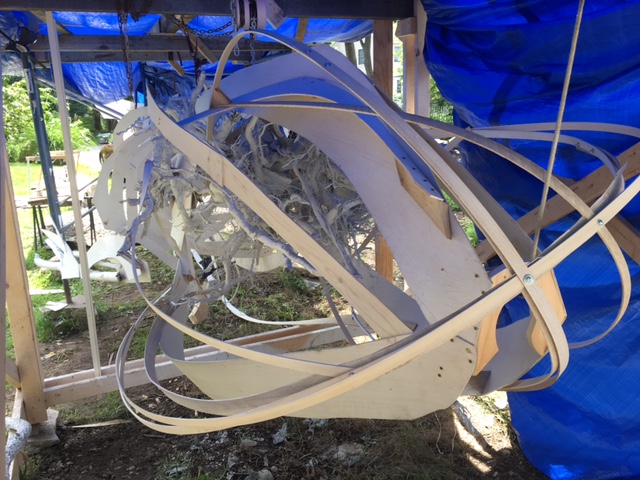
Framing a house rests upon its foundation. Building a whale does not. The whale will be too large to work in my workshop so I need to work outside. I need a series of crates from which to hang the whale, with enough room to work, all of which will be put upon wheels but narrow enough fit through exhibition doorways.
Industrial pipe staging seems an ideal solution but will not allow enough space for the head. Using dimensional lumber – 2x6s for the base, 2x4s for posts – I build a custom crate and double reinforce everything for stability. Weight is less my concern than stability during transit. A pair of 10 foot 2x4s goes on each side, diagonals crisscrossing to prevent the crate from racking.
Plates are installed in each corner where heavy duty casters will be attached when it comes time to move and install the piece. My crate’s dimensions are governed by the entrance doorway of the Bigelow Laboratory of Ocean Sciences. There is no margin of error.
On top of the structure I set an old barn beam – rugged, stout, strong – from which the entire head will hang during construction and every road trip. What I don’t know is that between all the installations, including time in storage, the crate will be in use for more than five years. What I do know is that it needs to be rugged.
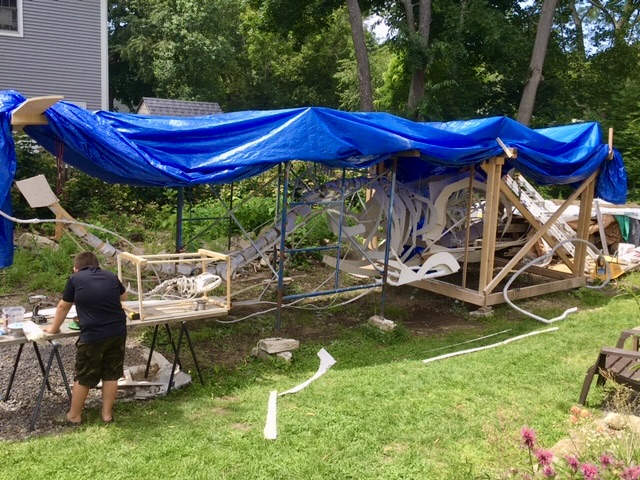
As the sculpture grows, I will assemble a section of pipe staging, 5’ wide by 6’ tall by 7’ long, and spacing the staging a few feet behind the crate, will have a rectangle, about 20 feet in length, inside of which I will work. Planks and boarding – a very simple roof – go on top, upon which I lay a blue tarp, 20 feet by 40 feet, to cover the entire workspace. The studio is basic, watertight, and sufficient. We begin.
The Maven spray painted the root ball and trunk white. It is a surprising choice that moves the materials away from tree closer to his “right frame of mind.” The next task is finding the tipping point, from which the rootball/mind will hang. Engineers use a complex calculus of mass, torque and equilibrium to find the center of gravity. The Maven centers himself, goes quiet, then grabs my drill and a 1/2” boring bit and pulls the trigger. Once the hole is bored, we attach an 11” eye bolt with lock washer to the rootball/mind. Together we hoist it up and hang it from the scaffolding.
Next we begin making the skull. As a whale is not a house, so its skull is not like other mammals. Its skull is something majestic. A whale lives in water so gravity affects its skeleton differently than land-based mammals; buoyancy lifts the whale while gravity pulls down upon land animals. The whale’s face and forehead bones telescope as they move backward and overlap. The upper jaw bones taper forward into the snout. The nasal openings move to the top, not the front, forming the blowhole. The ear bones are detached, acoustically isolated. That complexity belongs to the Maven.
He grabs two sheets of 1/4 inch plywood, painted white, and draws a series of non-Euclidean shapes. I take my jigsaw and cut them out. Using the scraps, he draws several more shapes which I cut out. In short order we have our bones, more or less: mandible, maxilla, premaxilla, supra occipital, exooccipital, basioccipital, frontal, squamosal, nasal and tympanic bulla.
The whale root ball/mind hangs at a comfortable working height. During COVID people are encouraged to keep a 6 foot distance, but building inside my crate we enjoy no such luxury. We are outside, on a perfect early July day, and have work to do.
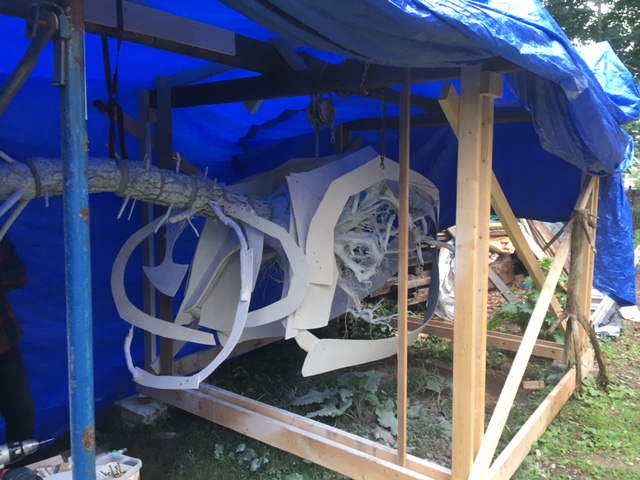
The bones by any name I need to assemble, creating volume in space around, but not touching, the root mind. This is an immense puzzle. When I was a child, a classmate in the 4th grade told me that his father was building a house from the top down. How wild, I thought! It always puzzled me why I remembered that but clearly, it was a premonition of this project: I am building the whale skull from the top down. I have no foundation upon which to frame and the root balls tangle of roots allows no purchase upon which to build.
It is July, peak of the summer, and sour cherries come ripe in our orchard. The Maven wanders off to sit under the Montmorency pie cherry tree. He plucks cherries and gazes off into the distance. Inside my cube of space I am alone, on my own.
Chuang Tzu comes to mind. In his famous story, Cook Ding carves an ox for Lord Wenhui by following the Dao, moving through the empty spaces between the joints, “as though he were performing the Dance of the Mulberry Grove or keeping time to the Jingshou Music.” As a young chef, Ding saw only the mass of a whole animal. After three years of practice, he saw it as parts, not mass. Now, his inner spirit guides rather than physical eyes.
In a moment the solution arises: gussets. A gusset is simply an extra piece of material, added to give more space and strength. They are found in clothing, bags, envelopes and construction. For the skull the gusset solves the question of rigid form. To each of the Maven’s various shapes I attach cleats, using 3/4” stock and wood screws. The cleats can be sculptural in shape. What matters is they are a bracket, mass, attached to the left and right hemispheres, to which I can attach the gusset, “the extra piece of material.” I don’t need specific dimensions. The maven can hold the skull bones, then I can mark the gusset length, cut and sand it, then screw it into place.
During the afternoon I busily build cleat blocks which I attach, then secure using the gussets. The skull is a triangle, narrow above the rootball/mind but wide below. The rear is broad, the front narrow. The maven wants curving shapes for the jowl, which is easy given the flexibility of 1/4″ plywood. I simply cut those pieces longer, then bow them back into place. I have given structure to form.
It works remarkably well. So well I name the whale “Gus.”
Once the skull is assembled, the Maven returns and explains he wants bands surrounding the assembly in space, “like gyroscopic things.” We are using foraged materials and he has some boards, so I rip long thin pieces, 8 feet long by 1 inch wide by 1/16 inch thick. I can bend these easily, and gluing two layers together adds considerable strength. Nothing is structural here, and I can pin them discretely to the mandible using 1 inch #8 panhead machine screws, with washer, lock washer and acorn nut; the assembly arcs up, out, and around, creating complexity and mystery.
The Maven explains, “I want abstract decisions, not the idea why, organic decisions by geometric solutions. The “gyroscopic things” …what are they? Without those Gus loses complexity, and that complexity relates to what a whale is, to what a tree is, what anything is. I want a level of complexity that then feels alive.”
All I know is that we are on a roll.
Red Grooms is an American multimedia artist known for colorful kinetic constructions, using sculpture and painting, to depict hyper-detailed scenes of urban life. The Manhattan art critic G.R. Swenson described him as one of a generation of artists who, “took the world too seriously not to be amused by it.” An absurdist impetuous energy, rich with Marx Brothers’ puns, inform his constructions, which can fill up an entire Manhattan loft or office lobby. His work is legendary. He has been referred to as “a movement of one man that is open to everybody.”
In September 2017 Portland’s Artists’ Rapid Response Team staged a “Codfish Funeral” procession down Congress Street, through the Arts District during one of the First Friday Art Walks. Combining moving projections of water and codfish with live music and dancing it was an artistic response to the dwindling populations of the Atlantic Cod.
Among the artists was one woman, a force of nature, whose name is Anna. She was already familiar with Red Grooms work, and saw the opportunity to combine multimedia with science to raise awareness to the warming temperatures in the Gulf of Maine. She framed the problem in terms of an ecosystem rather than economics.
She worked with science teachers to reach more than 200 students at 16 schools, elementary through college level, in Southern and Mid-Coast Maine. Her idea was simple, which she leveraged through scale and reach.
In 2020, just as the COVID shutdown began, the Bigelow Laboratory for Ocean Sciences asked her to host an exhibit. Nick Record, a senior research scientist at Bigelow became a key ally, “I think both scientists and artists are trying to look at the world through new lenses and show the world in ways people haven’t seen it before. Curiosity and discovery, trial and error, and creativity are essential, whether you’re a scientist, an artist, or somewhere in between.”
The Force of Nature contacted the Maven and proposed the “Majestic Fragility” idea and asked him to build a whale’s head. The Maven did not like her idea, and countered with something else, larger, a complete whale. She agreed. He made a model. She raised the funding. That is where I stepped in.
Because this is COVID, all of the artists work in isolation. Each artist has some component of the ecosystem, but no one will meet, until everyone gathers to install everything at the Bigelow Laboratory. Each artist has one specific component and the ethos is to use foraged or recycled materials. In the Red Grooms spirit, the energy of many colorful parts allows each artist latitude so that the whole will read as one, the individual parts subsumed into the collective.
The idea of foraged and recycled materials relate back to the ideas of Wendell Berry, the American novelist, poet, cultural critic and farmer. “There are no sacred and unsacred places; there are only sacred places and desecrated places. My belief is that our life and the world in it are conditional gifts,” he wrote. Life and existence as gifts, freely given not earned, and we do not “own” the earth but are mere temporary inhabitants. From this view the fisheries are not merely an economic input but part of an integrated ecosystem, entrusted to us on the condition of responsible stewardship. Fighting words to some, but common sense to many; the Force of Nature and her collective are using art to encourage dialogue.
Work on the whale skull proceeds well and we prepare to build the spine. We cut the white painted tree trunk into sections 8 inches long. I bore through each, a not easy task, to allow a 1/2 inch threaded rod, 5 feet long, to pass through. Between each section a smaller disc, cut from a narrower trunk, will be placed, like cartilage. The threaded rods are bendable, the trunk vertebrae strung like garlands on a bough.
The maven’s model rests on a table next to my cube of space workshop. The model gives us reference, but the whale as built becomes its own sculpture. Each vertebrae has small paddle-like pieces attached; odd shaped 1/4” plywood with a dowel attached to pin them into place. The thoracic vertebrae near the skull need ribs forming a cage to protect the heart and lungs. An assembly of curving 1/4” plywood pieces frame the rib cage nicely.
The assembly gets less complex, more narrow as it tapers further down the spine. Each five foot section has a coupling nut with an eyebolt attached at its end. We connect each 5 foot section by a lag bolt with hex nut. Common hardware store items source our materials. We can easily detach each 5 foot section when we move the entire whale.
Overnight rains come. As I lay in my bed I can hear the raindrops on the tarp, and repeatedly at 2am go outside to push the tarps up, to remove pooling water. Gus cannot get wet. It becomes a nightly ritual, which almost seems like a benediction; rains fall gently as Gus readies to move on.
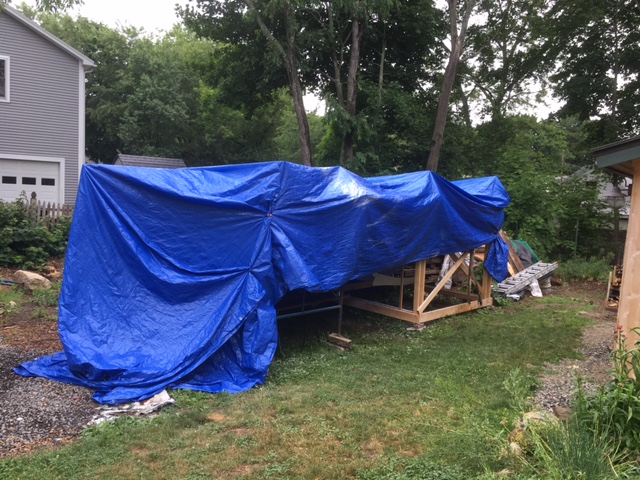
The tail assembly is an exceedingly complex challenge. A whale’s head and its tail are dominant features, so the tail, which technically is a fluke, needs visually to balance out the head. I will secure the fluke to logs on the threaded rod so I first need to figure out how to stabilize it, so it does not rotate. To the maven, I leave the question of width that scales with the head.
Cleats screwed to multiple vertebrae, along the curving spine, will lock the fluke in place. The maven, of course, sees the fluke not as one mass, but as three separate pieces, each at different angles and shapes. Gussets again allow me to create volume in space. The assembly is both not a whale fluke and a whale fluke.
The remaining tasks proceed easily. Using birch logs and random shaped plywood we build two pectoral flippers, the short, broad paddle shaped fins on the side. We attach them to the skull assembly and hang it in space using 1/8” aircraft cable and ferrules.
The final step is more of the “gyroscopic things” for another dash of complexity along the spine. Bittersweet is an aggressive, woody invasive vine in Maine that is a bane to gardeners, but a boon to the Maven. He has foraged long lengths of it, which we attach like garland adorning the spine. Two pieces of bowed 1/4” plywood 4’ wide are attached from the tail to the sternum, adding more volume to the sculpture.
By late August we are wrapping up Gus, four months of work from the aggregate yard to completion. My commission is to build “head scratching wonder and irrational decisions.” By unanimous consent, in collaboration we have achieved that.
We are ready to rent a 25-foot box truck and take the show on the road.
__________________________________
Editor’s Note: Although this story is told using present tense verbs, the whale was actually built in the summer of 2021. The “Majestic Fragility” exhibit was on display at the Bigelow Laboratory of Oceanic Sciences through summer of 2022, then was moved to the Maine Maritime Museum for the “Sea Change” exhibit from February 2023 through 2024. It was moved to Bangor, where the exhibit is expected to become a permanent installation at the Wabanaki Public Health & Wellness center.


how many on the planet can say “i built a whale in my backyard”? how many can tell that tale so beautifully? (to wit: “It is July, peak of summer, and sour cherries come ripe in our orchard.”) answer: very very few. singular; one.
I love this, David. So fascinating. I remember visiting you guys a number of times that summer, and so enjoyed your and Andy’s ongoing conversation – dialogue – kind of like a rap involving construction, physics, philosophy. And then the days at Bigelow with installing the whale’s head, and then the body – I was working upstairs on the Cashes Ledge window for part of that, and again the wonderful rap going on down in the space with you and Andy and Chris Sullivan, and probably Carter Shappy. In this case, less philosophy, more logistics, and many ideas. So good you can get all this down in words. Maybe some day we can find a way to make some sort of film. I have the footage!
>