pressing apples
Posted: October 28, 2012 Filed under: Farming off the Farm, Permaculture & Home Renovation 4 Comments
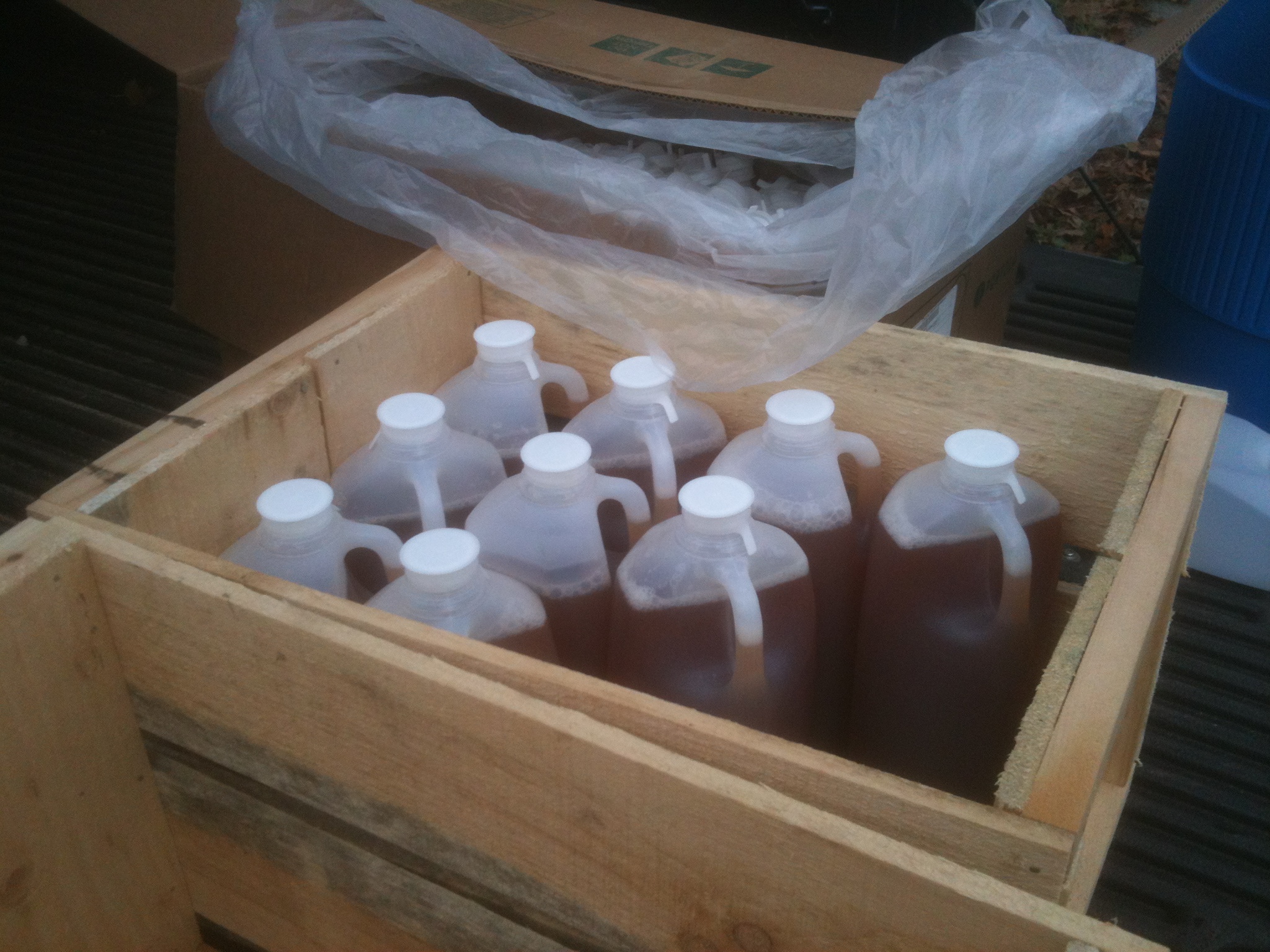
Apples are a staple of New England and I took this afternoon off from the house project to press apples for cider.
At my day job, I tend an orchard of 100-year old apple trees, a mixture of Cortland, Macintosh, Golden Delicious and some unidentified astringent varieties. While not good for eating, the astringent are excellent in cider, adding a complexity to the flavor.
I pressed the apples over at my friend David Buchanan’s farm in Pownal Maine. David has recently had a book ‘TASTE Memory: Forgotten Foods, Lost Flavors, and Why They Matter” published by Chelsea Green Publishing in Vermont.
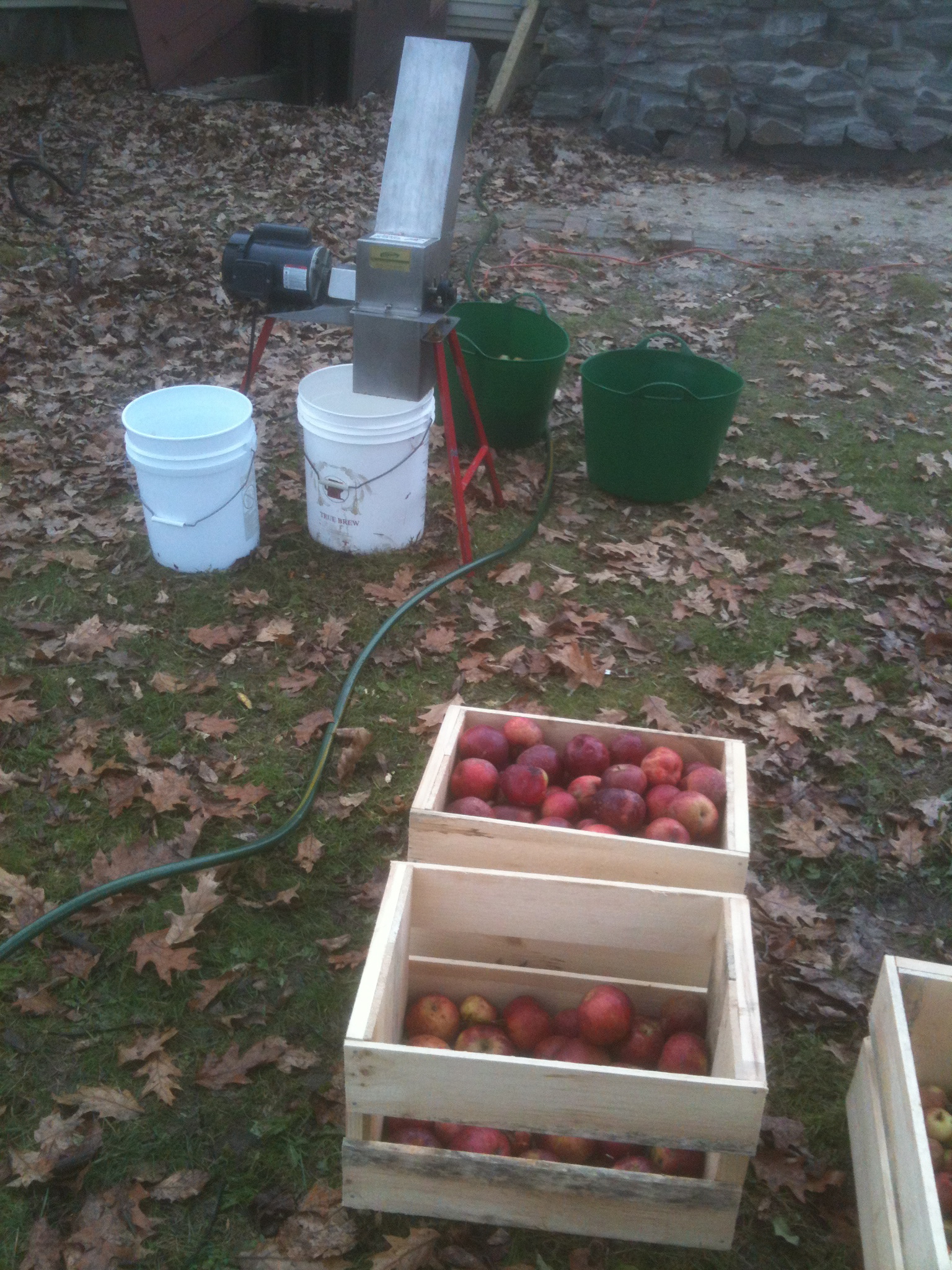
David is a serious cider enthusiast and has a first-rate operation. The first step is grinding the apples. In the photo below you can see the drop shoot, motor and receiving bucket of the grinder.
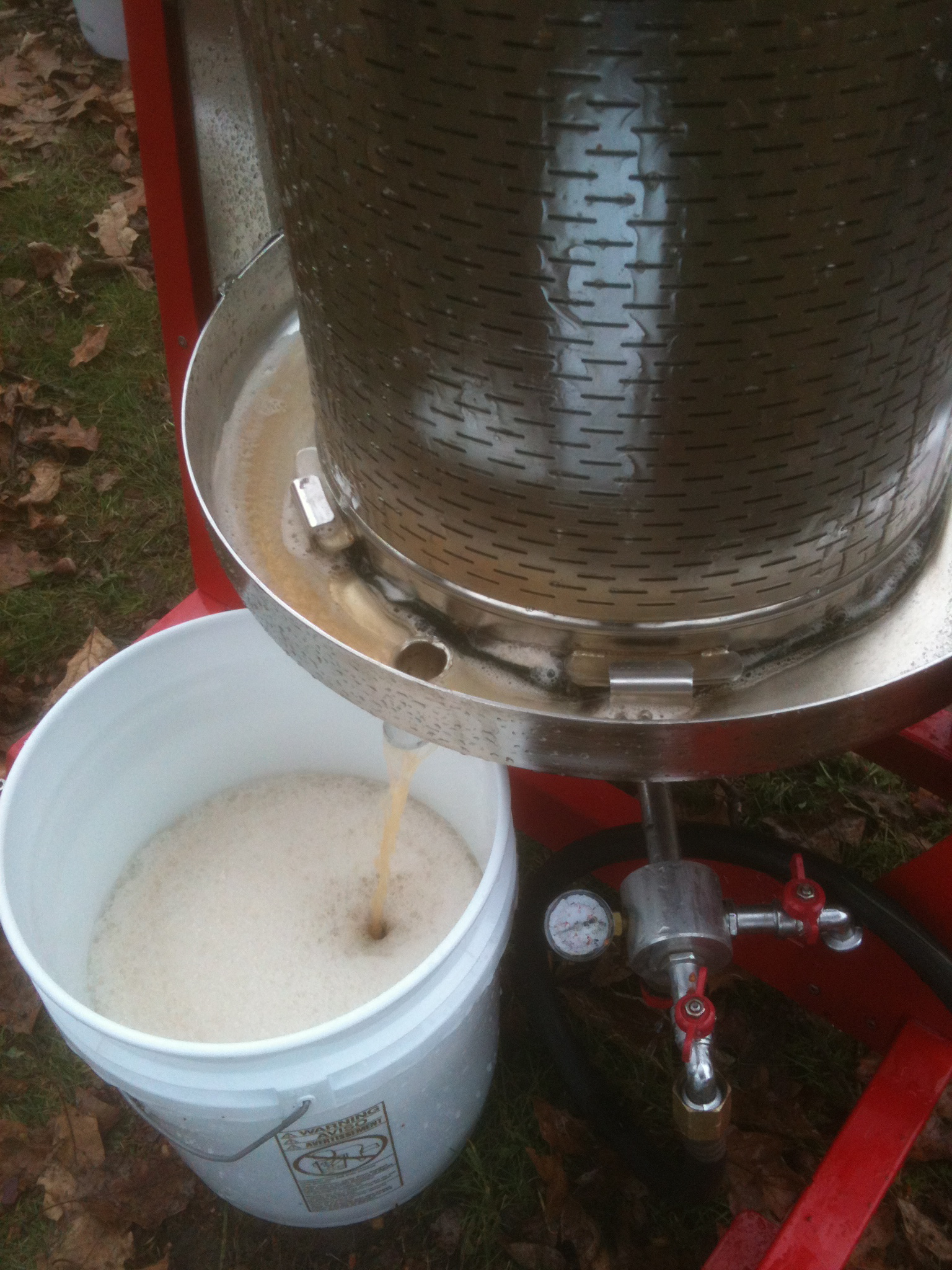
The mash is then placed into the water press. The press has a water bladder in the center of a round metal colander. The apple mash goes inside the colander and the valve is opened, filling the bladder with water. The pressure forces the apples against the metal colander, crushing them and extracting the juice.

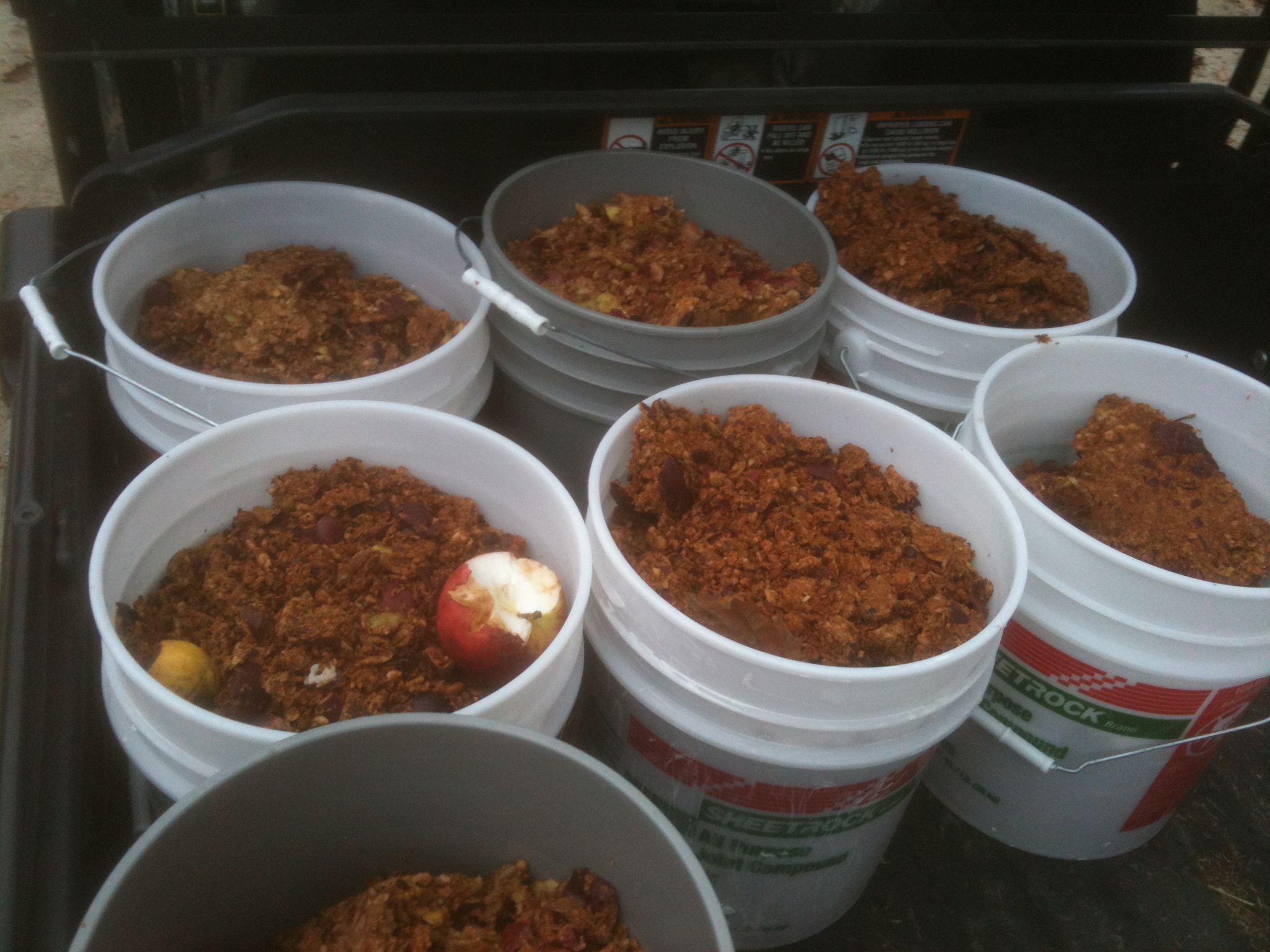
The pomace – the mass left over after the juice has been extracted – was cleaned out and scattered in the woods for the deer. Nothing was wasted. We pressed 8 bushels and got 18+ gallons of juice. It is absolutely delicious!
Barn Beams…round 2
Posted: October 21, 2012 Filed under: Permaculture & Home Renovation 2 Comments
What remains of the barn now are planks stacked in the shed, or beams piled out front of the house, under a blue tarp. Quite a bit, actually.
My scavenging was compelled not by a plan to use the wood, but its untold poetry. Not that I ever will know its text. I just want to preserve the chance.
Our friend John, a farmer poet, shared thoughts recently, about an old barn from his family:
“…[in] the summer of 88, when my pop decided that the barn behind our house on the Gaspe coast (both built by my great great Irish grandpap) was ready to given up its ghosts and come down.
“He paid a man (who was infamous for having killed another in a fist fight) to dismantle it in exchange for the wood. Decades later, he’d finally admit that he’d come to regret the decision, wishing he’d kept at least enough to frame a small chalet behind the place.
“Economic necessity pressing (we had 5 kids supported by a teacher’s wage), he still contends that he had no choice. That said, I can feel the sadness in his voice when he talks about it.
“Our people were in those beams, their sweat soaked into the grain, the low moaning song of their lovely cows worked into the patina. It’s good to hear you’re keeping some of the bones of the space, honoring the makers, the maker and the dark forest from which those timbers were likely culled.”
gathering stones
Posted: October 18, 2012 Filed under: Permaculture & Home Renovation 1 Comment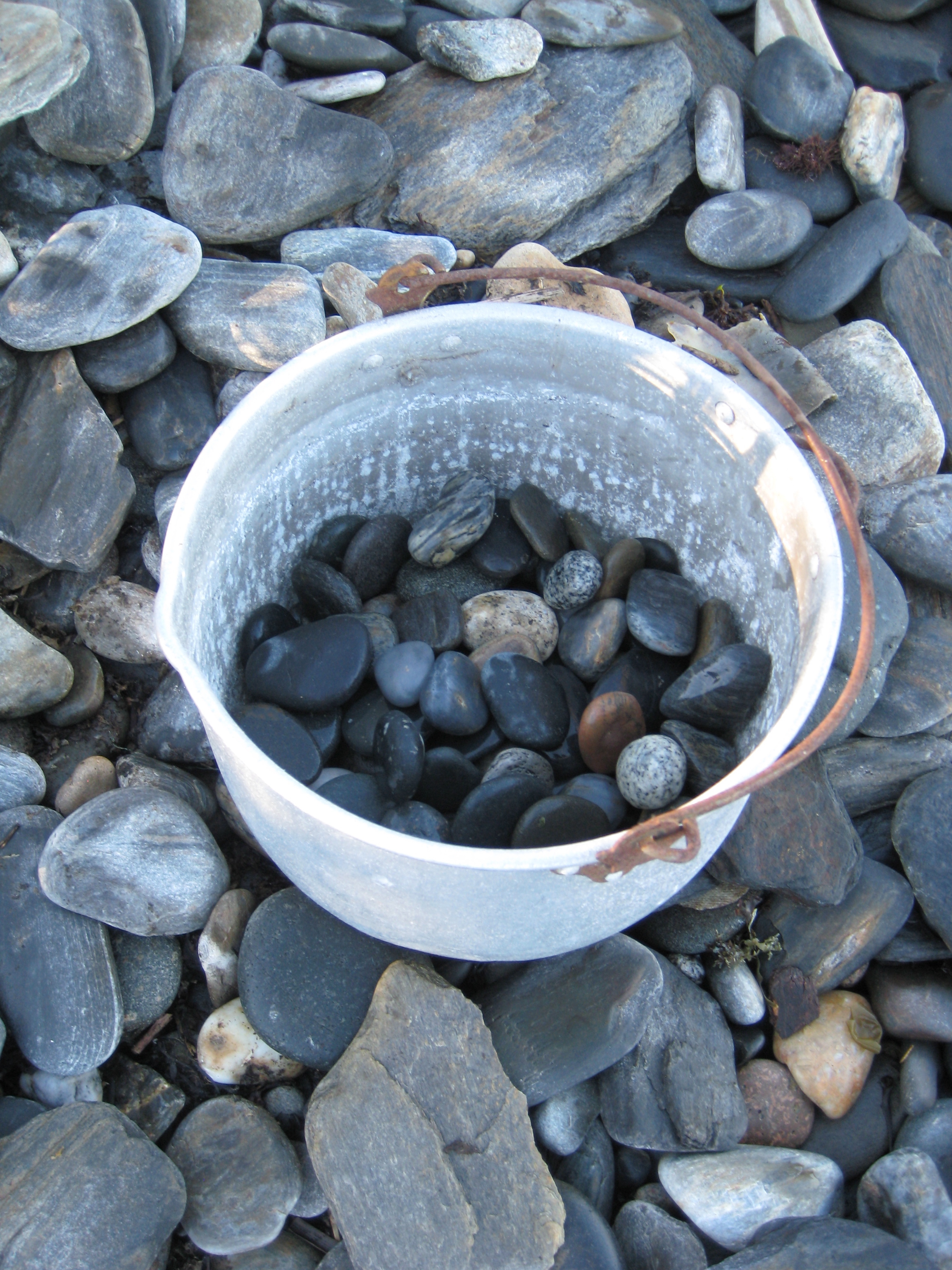
For our kitchen cabinets, we are going to make pull knobs using beach stones. Today was a perfect mid-autumn day, and we went gathering along the cliff walk.




These photos capture the story, but not the majestic sound of the surf. We can only imagine how the awesome coast sounded to our little one inside Becca’s belly.



dense pack cellulose
Posted: October 16, 2012 Filed under: Permaculture & Home Renovation 2 CommentsThe primary objectives of our rehab have been heat and weatherization. The latter has been accomplished by creating an eight inch wall cavity, filled with dense pack cellulose insulation.
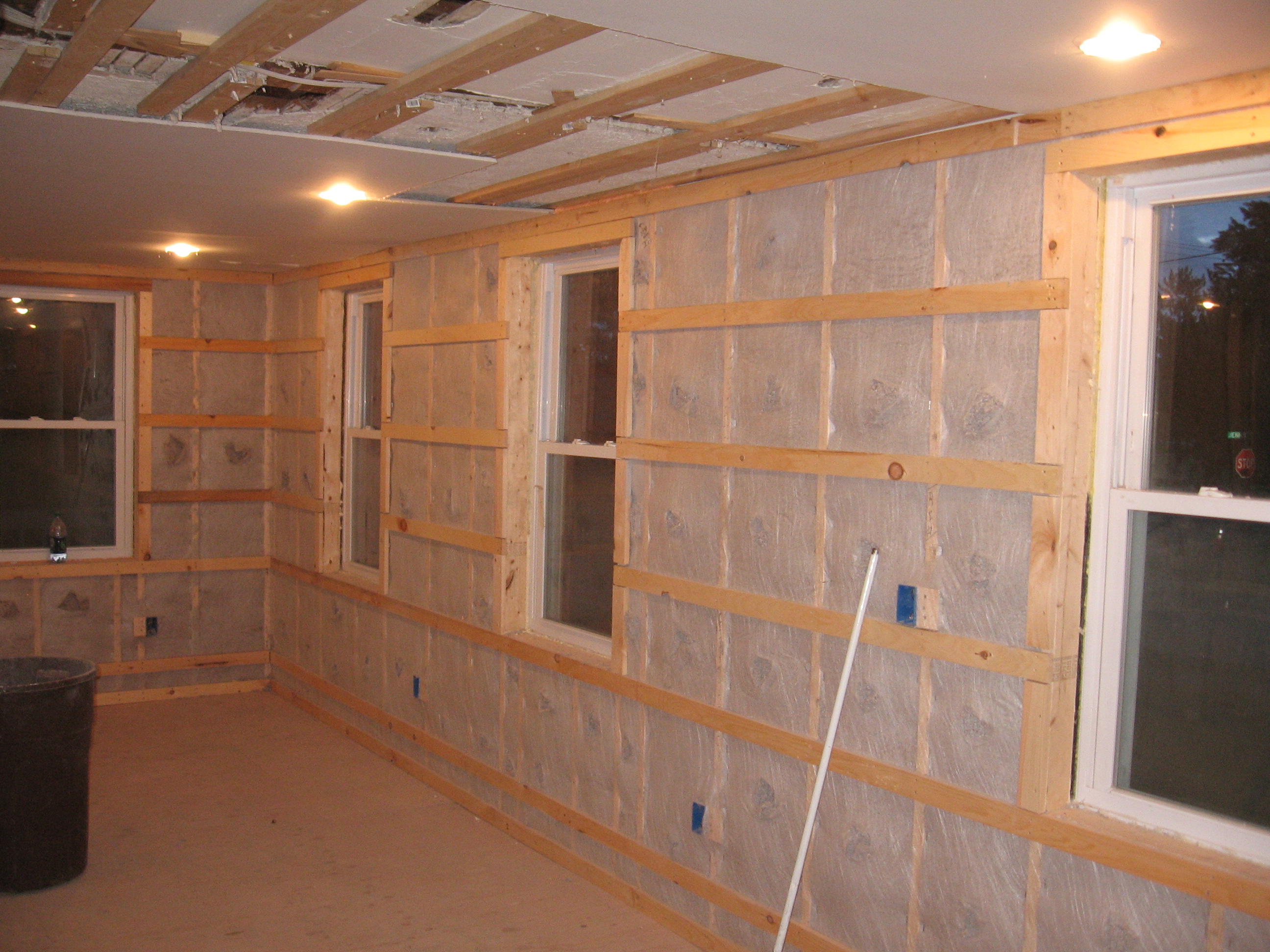
After the demo of the lathe and horse-hair plaster, we built a new inner wall using 2×4 studs. We then attached a fine mesh cloth to the studs, and applied 1 x 3 pine strapping. The strapping would hold the mesh firmly after the cellulose was blown in place.

This photo (to the left) shows the mesh before the strapping. The photo to the right shows the strapping applied, and the cellulose being blown in place.

Cellulose is made of 80% post consumer recycled newsprint (we have gained a new respect for our print journalism family members!) treated with borates to resist fire, insects, and mold.
The Building and Construction Technology group at UMass Amherst has done studies on cellulose and reports “insulating a 1500 sq ft house with cellulose will recycle as much newspaper as an individual will consume in 40 years.” (Our house measures 1300 sf).
When I asked how stable cellulose was, the crew chief said the cellulose “will last as long as the house.” Dense pack cellulose – blown into place by high-powered fans – is effective at blocking air leakage through cracks, holes, and gaps. Our 190 year-old house had plenty of those.
The r-factor of cellulose (the rate at which heat is transferred through the cavity) is rated somewhere between 3.7 to 4 per inch of wall cavity. Because our inner wall studs do not line up with the old exterior studs, (the new studs are 16″ on center, but the old studs are at odd intervals) the thermal bridging is reduced. If the inner studs matched the outer studs, we would have a series of 16″ cavities. In our house, however, the new and old studs do not match up, creating a thermal cavity with more area, thereby creating a greater insulated mass.
At 4-r per inch we should surpass 30-r, putting us into the super-insulated category. I am told.
We blew the cellulose into the walls, the attic, and the crawlspace. Our attic insulation achieved an R-factor of 60.
Prepping the crawl space was a dismal task. A dirt floor, 16 feet long by 5.5 feet wide, with varmint holes below and spider webs above, I had to crawl into that space to apply the mesh netting. (I kept wondering if a gopher would poke up its head!) The space varies from 18″ to 9″ high – a wicked tight space to work overhead, lying on your back. For three hours.
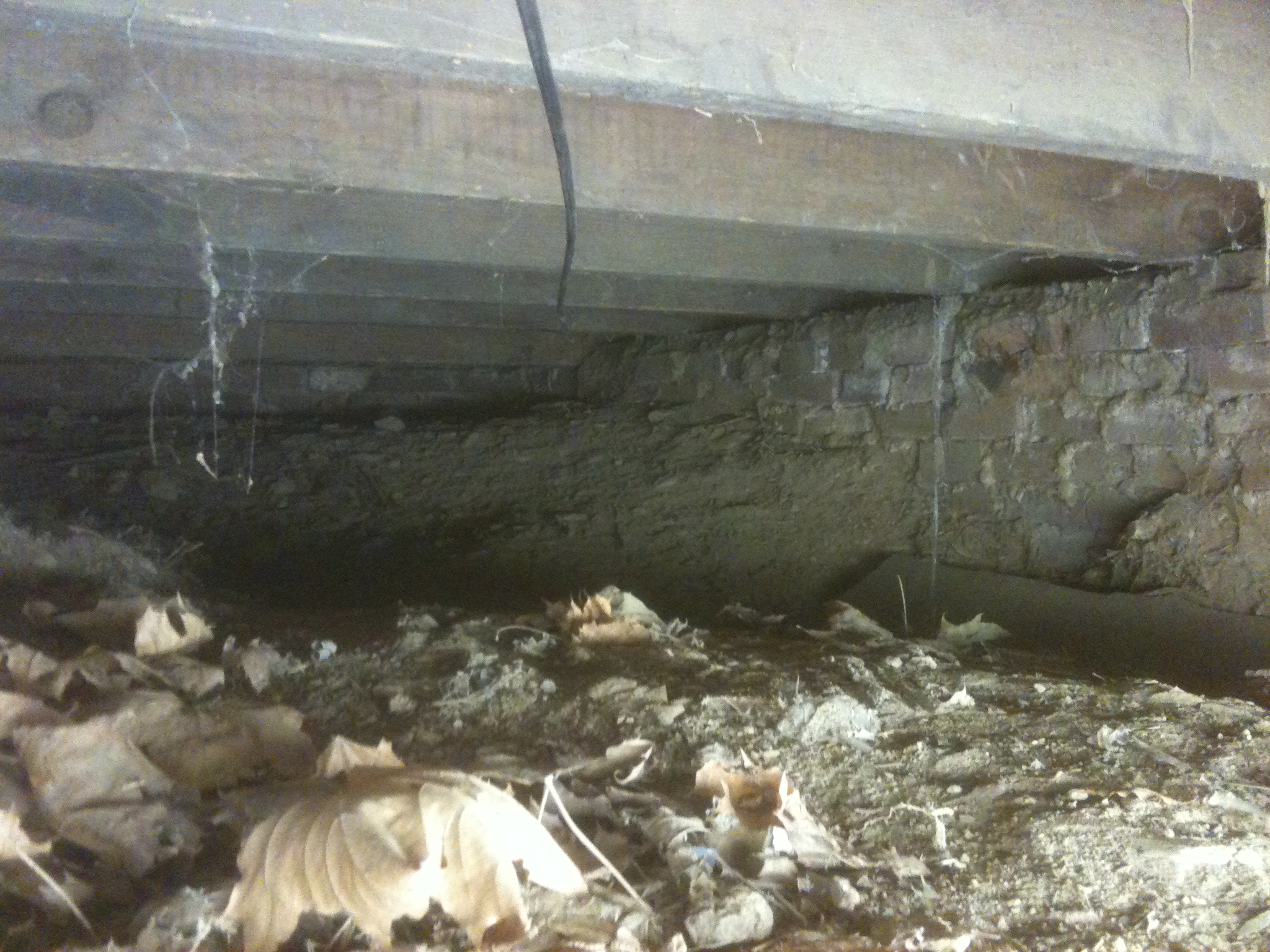
It wasn’t much of a choice. Applying no insulation would leave a cold zone along our bedroom floor. That work achieved an R-factor of approximately 20.
On a cold January morning that will have been well worth the effort!
Next I plan to lay 10-millimeter plastic over the dirt floor to create a vapor barrier. Eventually, we will apply spray foam insulation to the brick walls of the crawlspace to create as tight an insulation as possible.

tumbling down the barn
Posted: October 9, 2012 Filed under: Permaculture & Home Renovation 1 CommentThe question had been, should we cut the ell from the barn or the barn from the ell. I chose the latter, which meant that the common wall between the barn and the ell would remain; it would not be pretty but we would not have to build a new exterior wall to the ell. This would save us hundreds of dollars.


I began by drilling holes through the barn wall, above the roof line of the ell. (upper left photo). I wanted to mark a line along which to cut, while being sure not to cut into the Ell roof.
Then I took the trusty sawz-all and cut with abandon. The wood crumbled rather than cut, and my certainty increased that tearing down the barn was the right course. Restoration of the barn was not only cost prohibitive, it was not possible. The wood was rotted through.
My cuts were not pretty. I chunked out pieces, cutting a wide swath, to ensure the barn would fall freely away from the ell. We could not risk losing the ell along with the barn.
It didn’t take long – maybe two hours – to separate the two structures. It took half that time to bring the barn down.
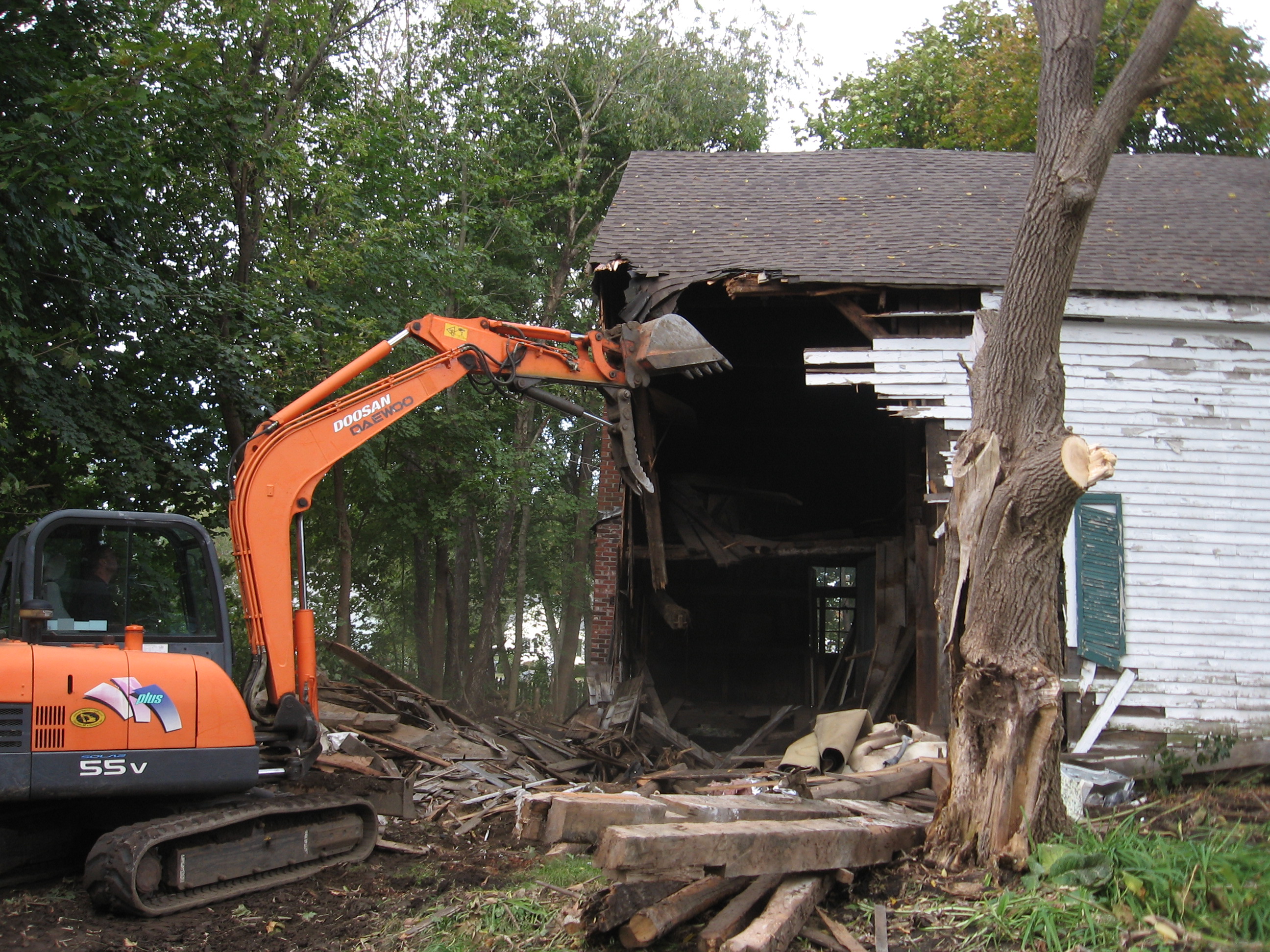
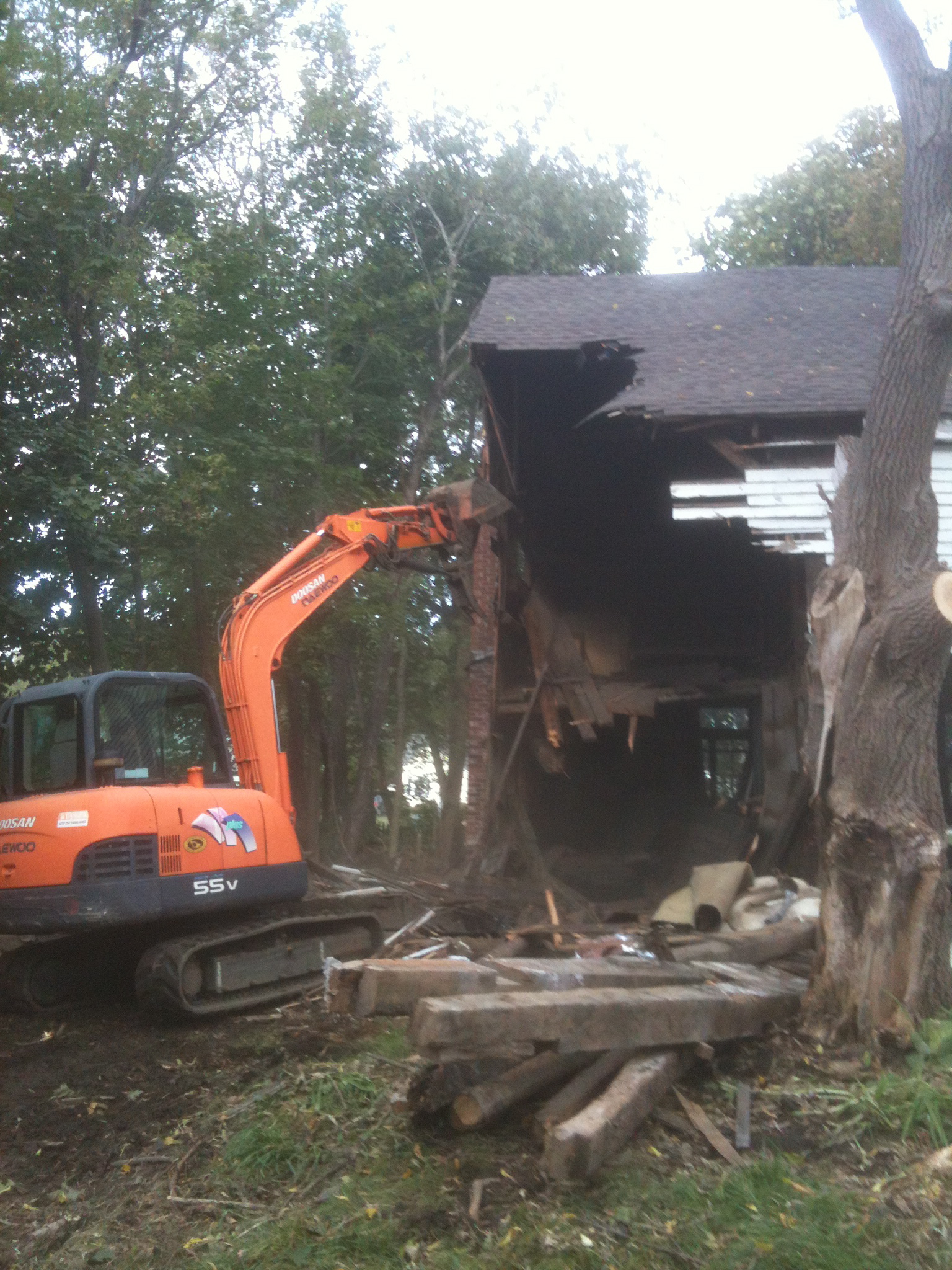 Our friend Russ brought over his excavator and chowed through the barn, the jaws of his machine chomping and ripping boards free.
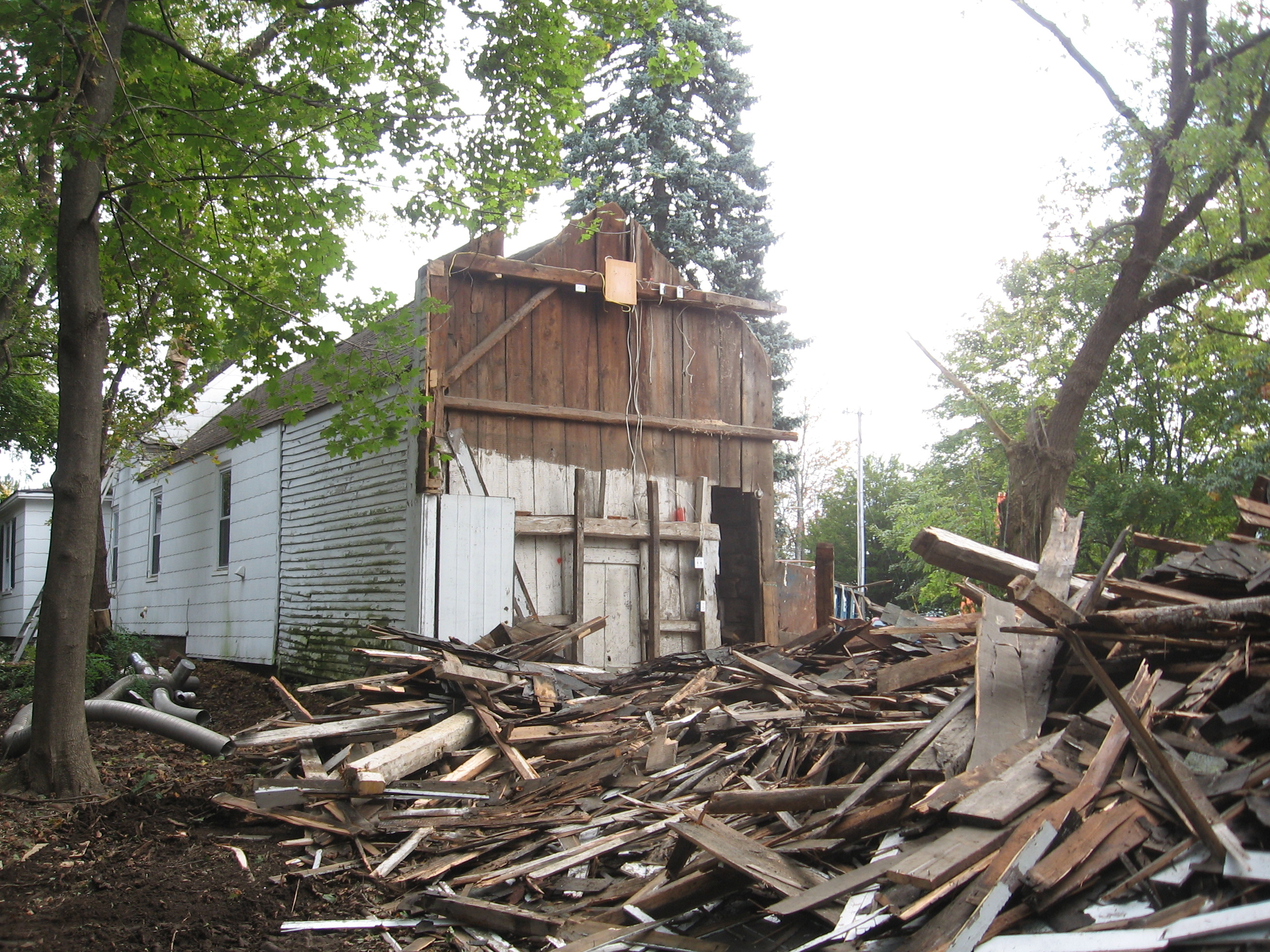
Regretably, I had to leave to run an errand, and within an hour I returned to a void, where the barn had been. I missed the grand whoosh when the barn collapsed into itself, crumbling down into a heap.
Before the demo I had been able to pull lots of decking and many beams. I will be able to make a killer tree fort for our children, and we have gained a great addition to our lawn and garden.
Haz Mat
Posted: October 6, 2012 Filed under: Permaculture & Home Renovation 1 Comment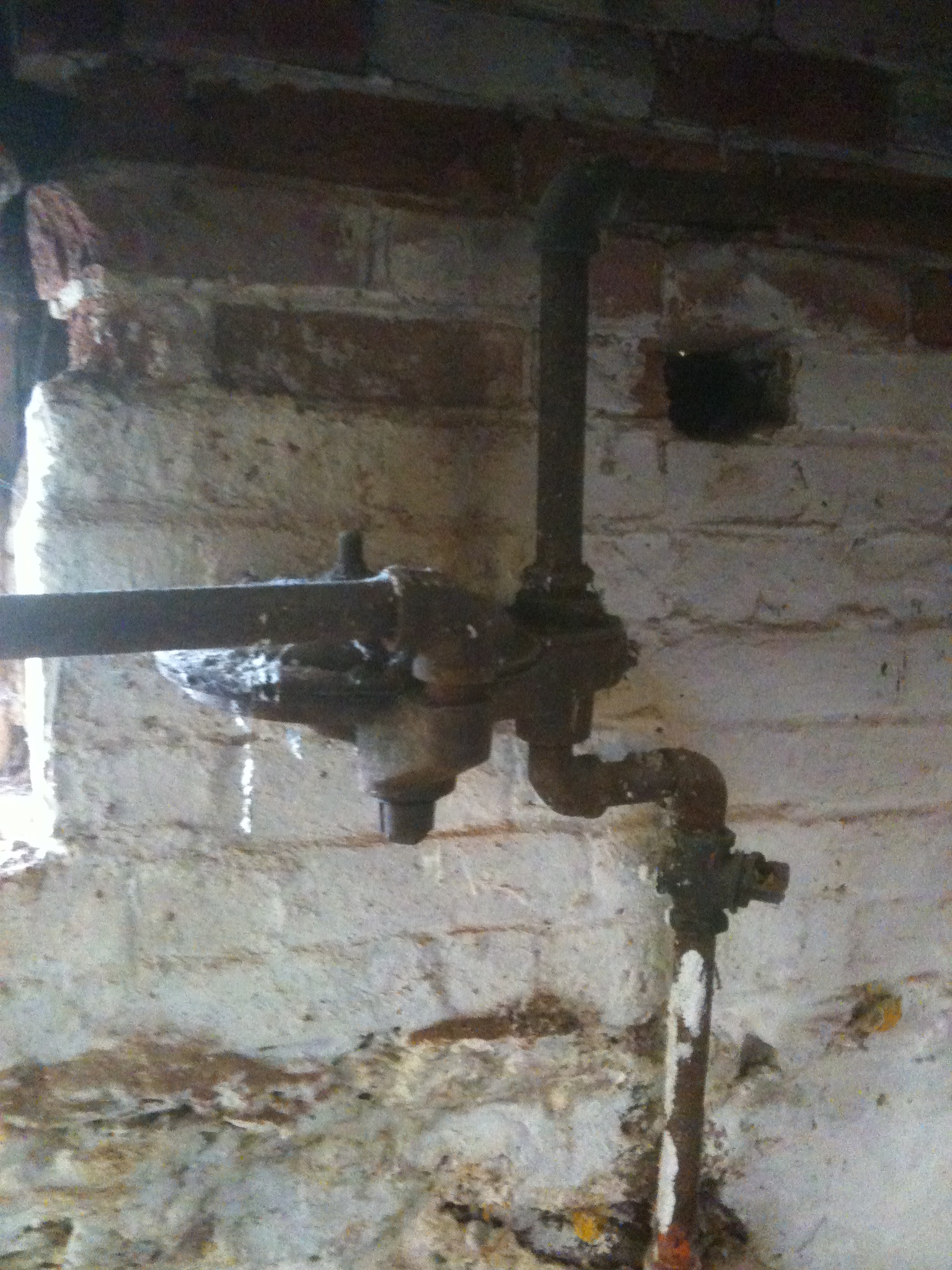
After removing three oil tanks, two chimneys, one pellet stove, one oil furnace – having run the table, heating wise, you could say – we wondered about this odd-shaped device, rusted and ominously anchored to the basement wall.
Something told me to call the utility. “There are rusted old pipes and before I remove them I would like you to take a look. And, by the way, there is a natural gas converter from the oil furnace. You may as well take that back too.” A perfunctory call. Prudent nonetheless.
Roger, a natural gas man, arrived in his white fleet car. The gas converter was a five-minute detail. He was glad to get that back. That odd-shaped device in the basement – like a UFO from Roswell New Mexico – unleashed a whole new dimension.
“Do NOT touch that!” he exclaimed. “That is a mercury regulator! I thought we had retrieved all those!” He gazed at it, excitement mounting, as though our basement held an elixir to the doldrums of a mid-career utility man. “That is maybe from the 1950s. Those were popular when my father worked in the natural gas business. But mercury became taboo in the 1990s so we started taking them out. I thought we had gotten them all by now.” My heart sank to my stomach. Was this the dreaded “other shoe,” discovered at last in our basement?
He continued, “You cannot remove that. If the mercury falls onto your floor this basement will be covered with men in white suits. That needs to be removed by a hazardous waste specialist.”
My stomach began churning with dollar signs. Roger said, “This needs to be removed by the utility. The utility foots the bill.” My interest piqued, excitedly. “Could you repeat that?” I asked?
Roger called his boss, and then called his boss’s boss (and made a point of telling me so). I asked again. Are you saying this will be removed by the utility, at no cost to me? “Yes,” he said. Proudly. “But it may take some time.”
So here we are. Waiting in line, not sure our number. Not able to get info from the utility. And the rusted relic waits, quietly by the wall, until come the men in white suits.
Hopefully before we move in.
But never will I touch that singular non-DIY object in the house.
just before dawn
Posted: October 6, 2012 Filed under: Permaculture & Home Renovation 2 Comments
The inspections went well. The building inspector spent all of five minutes at the house. The electrical inspector didn’t bother to visit, just gave it a thumbs up. Marcus, our electrician, explained, “We work closely together. It was a rainy afternoon, and who feels like going out in the rain? He knows my work.”
Maybe that is the way things are done here, or maybe our subcontractors are that good. Anyway, that is his story and I am sticking to it. Now it is on to the dense-pack cellulose insulation.

200 years of lumber
Posted: October 3, 2012 Filed under: Permaculture & Home Renovation 1 Comment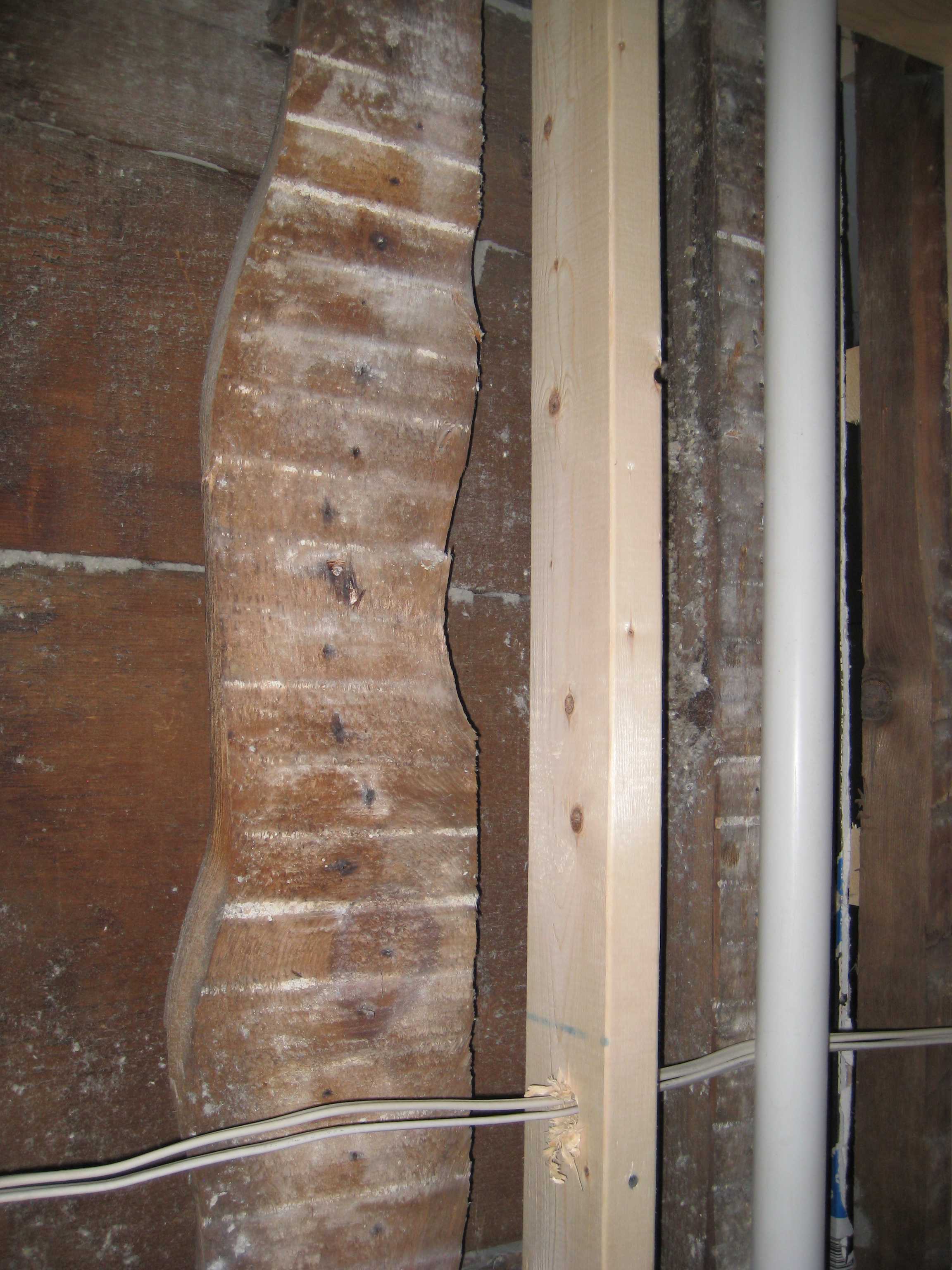
Whether you buy local or big box, lumber these days comes dimensioned: square edged, more or less straight, sized at 2×4, x6, x8, x10 or x12.
Not so 200 years ago. Then, you tied up your boots, heaved an axe upon your shoulder and went to the woods. What came out worked fine, and bespoke the mood of the maker and tree, a moment captured in time.
Our house, gutted and opened to the gills, tells stories of days of yore. While my smart phone buzzes with emails and missives, it is worth pausing to reflect, perhaps to burn sage, and give thanks for an old house stout and sturdy.
Post and Beam
Posted: September 30, 2012 Filed under: Permaculture & Home Renovation 1 CommentThe end of week 6 (pregnancy week 28) was robust. The house passed the plumbing inspection and we are almost finished with the framing. Electrical and framing inspections are on deck this week and then we start on the dense pack insulation.
I have cut a few beams out of the barn using a Sawz-All (an A #1 demo tool), but this week we attacked with a chain saw. Here is Caleb cutting out a beam, and the quick result.
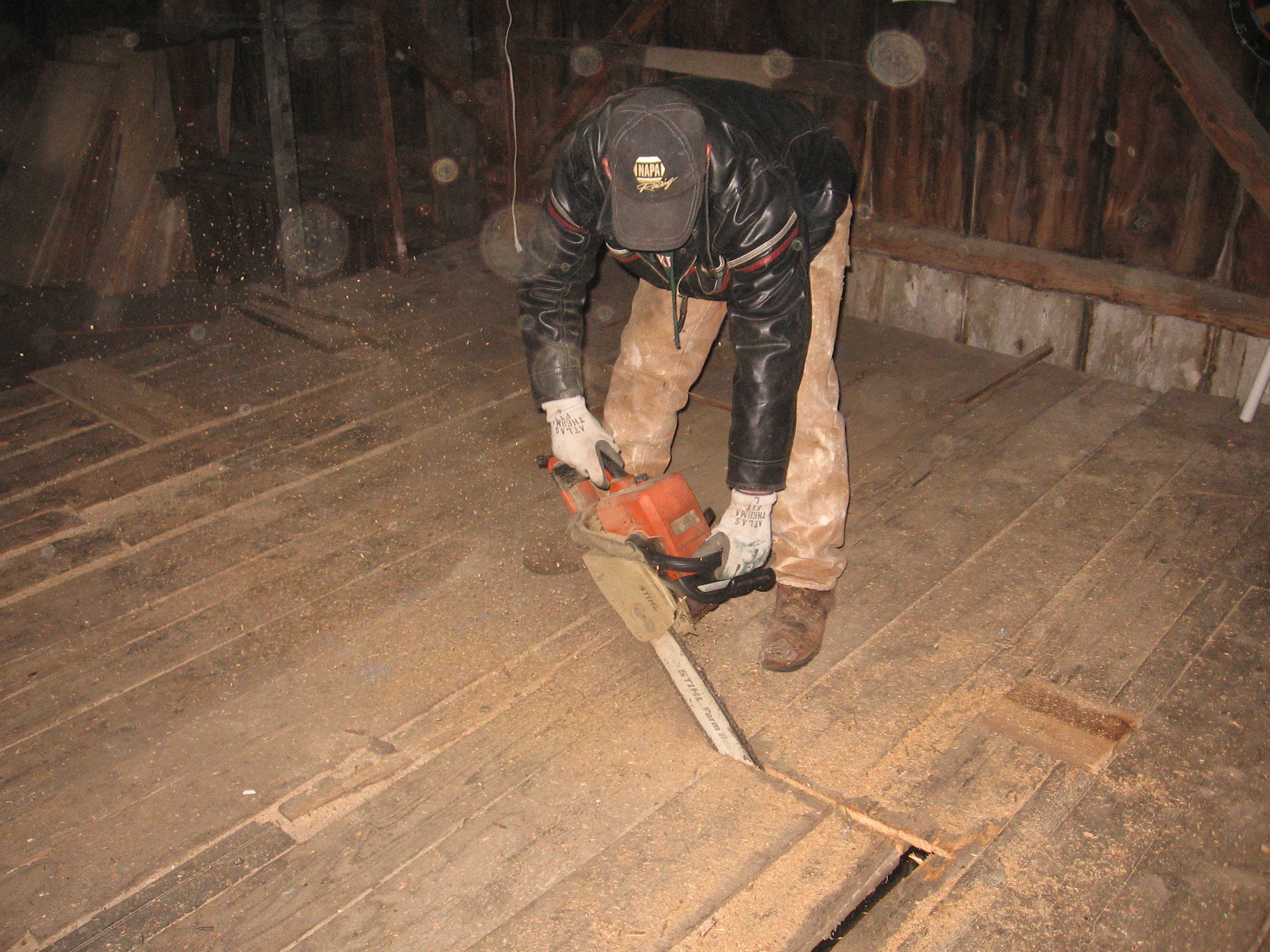

We used this beam as a supporting post in what will be the study.
Once we had removed the chimney and gutted the house, we noticed a sag in the ceiling. Closer inspection showed that the ceiling joists do not span the width of the house but run the length, anchored to a carrying beam placed in the center of the house. It is an odd construction.
If the joists ran the width, each would individually rest upon the outer walls, transferring the weight of each downward to the foundation. But running lengthwise puts all of the second floor weight upon a single carrying beam (which does run across the width of the first floor). Short of rebuilding the house, there is no way to change it. Our desire to create an open floorplan had run into serious issues.
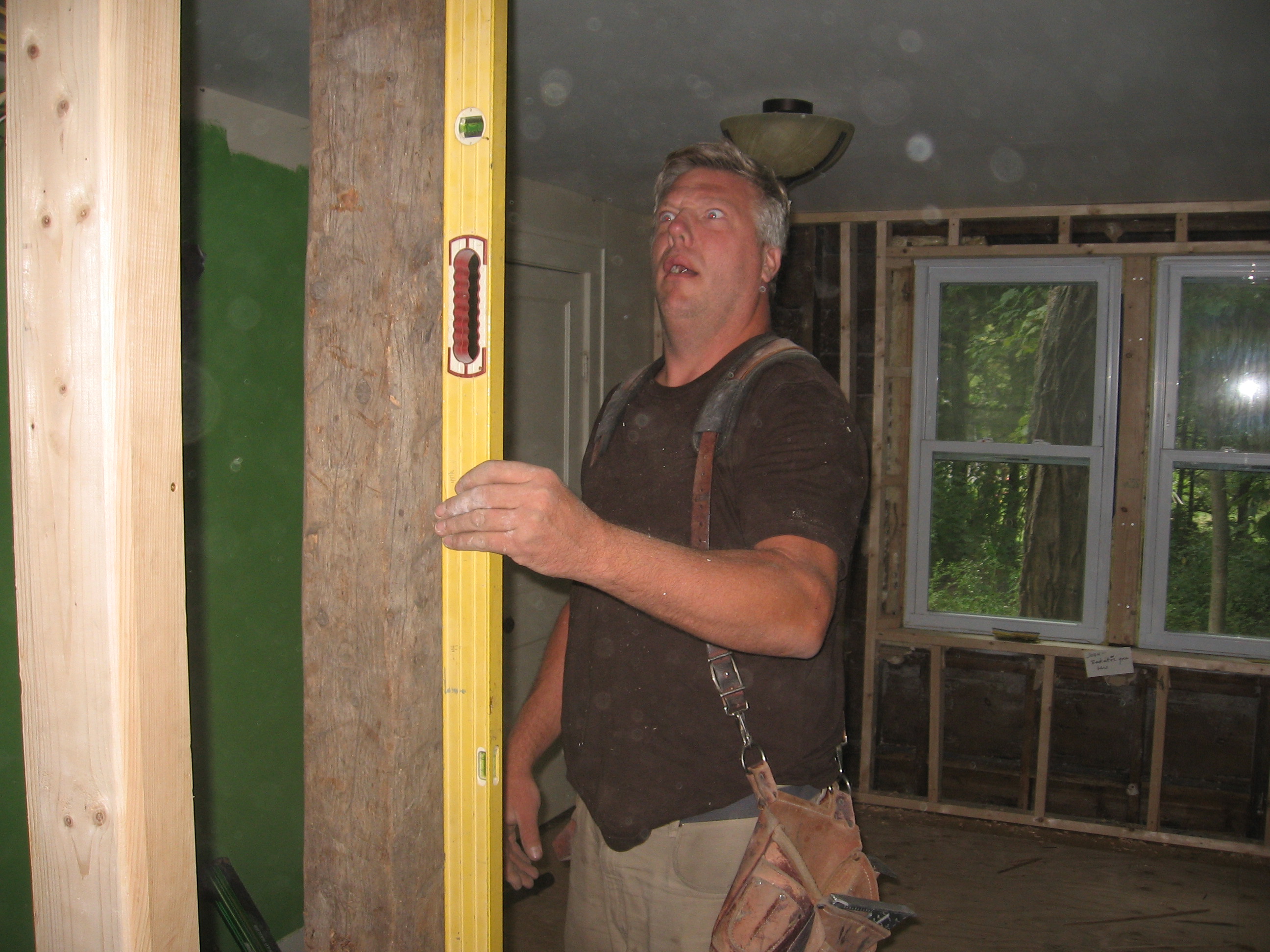
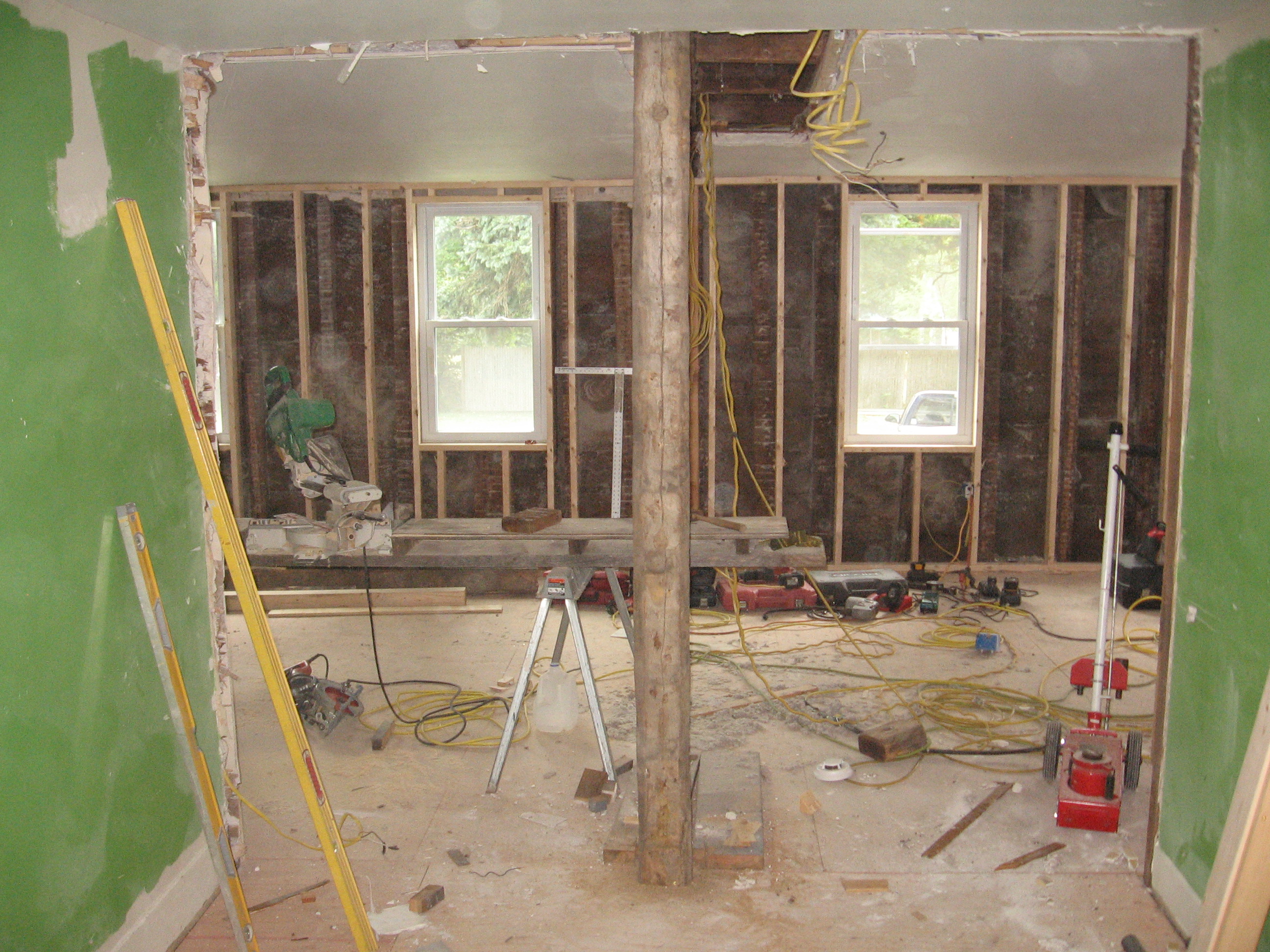
We needed a post somewhere on the ground floor, and we chose off center, where we had removed an interior wall to open up the study. This placement keeps the post out of the main room.
We brought a piece of the barn into the house, to support the carrying beam from below. The 190 year-old wood looks great!
But still, the sag remained in the main room. To be precise, the ceiling sagged 1 3/8″ over a six foot span. And since we absolutely wanted to keep the open flow of the main room, our only option was to lift up the ceiling from above.
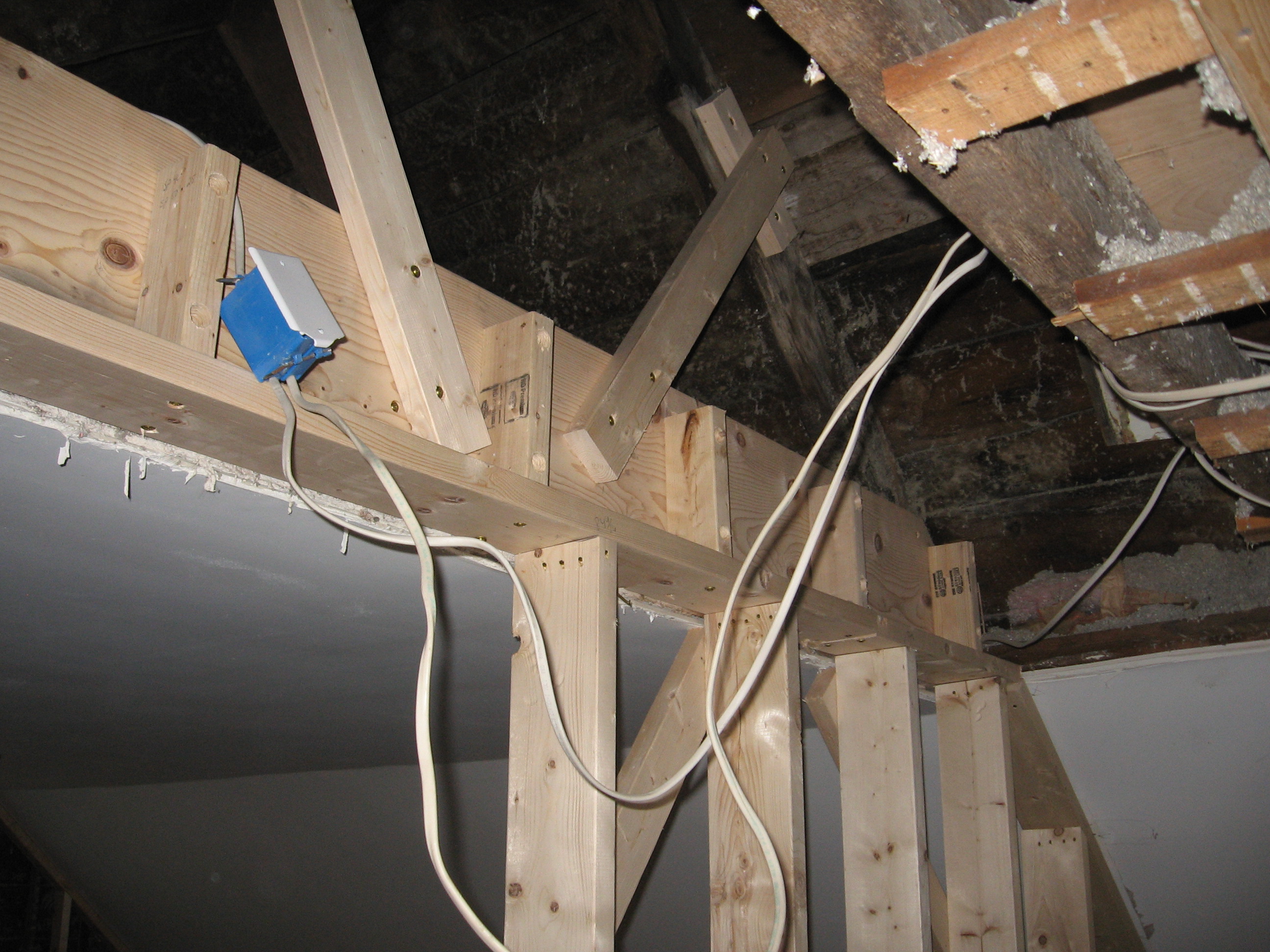
Our solution was to build a truss, attached to the roof rafters, that anchors a wall sheathed with plywood glued to the studs. We then jacked the ceiling up from the first floor, and the base plate of the upstairs wall was lag screwed to the carrying beam. The ceiling was sucked up, and the glued on plywood creates a super strong and rigid supporting truss.
Some photos might help to make it clearer. The first photo shows the upstairs before the wall or truss were built; the ceiling has been cut open. The second photo shows the 2 x 12 beam anchored to the rafters.

 The photo on the left below shows the beam with additional anchors up to the rafters. The downward weight will not cause the rafters to sag inward because the 2 x 12 has locked them in place. On the right you can see the wall’s top plate lagged to the 2 x 12 and the 2 x 6 studs running downward.

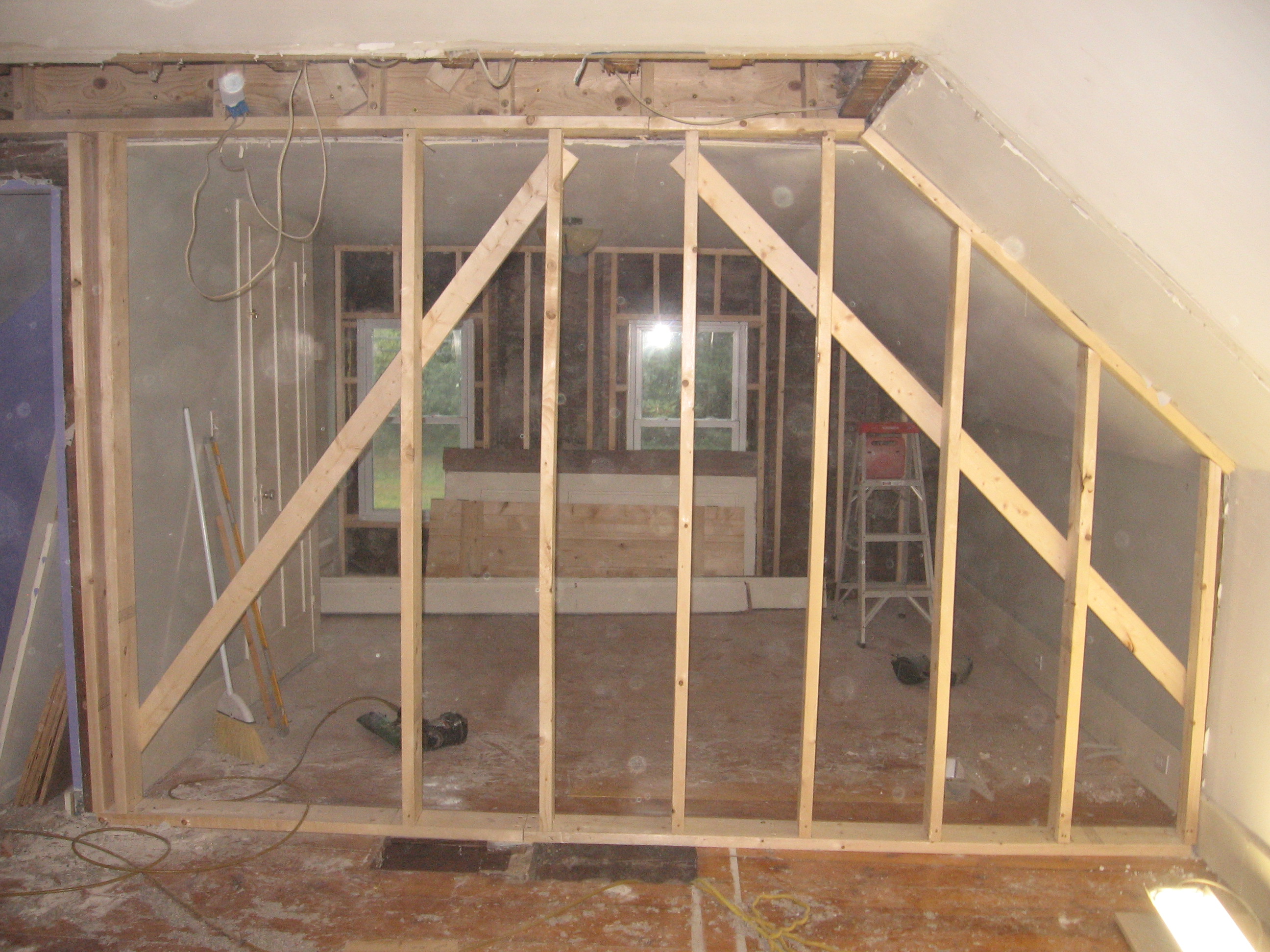
This photo shows the framed wall, with 2 x 6 studs rather than 2 x 4s, before the sheathing has been applied. The base plate is anchored down to the carrying beam of the downstairs ceiling.
Lifting the ceiling (and floor) up, to remove a 1 3/8″ sag is a pretty major accomplishment. All credit goes to our mastermind contractor Noah Wentworth, and his superb Evergreen Building Collaborative.
our rose will remain
Posted: September 27, 2012 Filed under: Art & Healing, Permaculture & Home Renovation 3 Commentshaving gutted the house, filled a dumpster, carried out fossil fuels and old oil tanks, heaved bags of insulation down from the attic, yanked out plants overgrown along the foundation, I came across this white rose; a sentry to our new house, sending out three fragrant blossoms, in late september. things go well. this is the start of our garden.